

ISO/IEC 20000-6:2017
(Main)Information technology — Service management — Part 6: Requirements for bodies providing audit and certification of service management systems
General Information
- Abstract
ISO/IEC 20000-6:2017 specifies requirements and provides guidance for certification bodies providing audit and certification of an SMS in accordance with ISO/IEC 20000‑1. It does not change the requirements specified in ISO/IEC 20000‑1. ISO/IEC 20000-6:2017 can also be used by accreditation bodies for accreditation of certification bodies. A certification body providing SMS certification is expected to be able to demonstrate fulfilment of the requirements specified in ISO/IEC 20000-6:2017, in addition to the requirements in ISO/IEC 17021‑1.
- Status
- Published
- Publication Date
- 05-Jun-2017
- Technical Committee
- ISO/IEC JTC 1/SC 40 - IT service management and IT governance
- Drafting Committee
- ISO/IEC JTC 1/SC 40/WG 2 - Service management – Information technology
- Current Stage
- 9093 - International Standard confirmed
- Start Date
- 07-Sep-2022
- Completion Date
- 29-Aug-2026
Buy Documents

ISO/IEC 20000-6:2017 - Information technology -- Service management
ISO/IEC 20000-6:2017 - Information technology — Service management — Part 6: Requirements for bodies providing audit and certification of service management systems/6/2017
Overview
ISO/IEC 20000-6:2017 specifies requirements and guidance for certification bodies that audit and certify a Service Management System (SMS) against ISO/IEC 20000‑1. It complements - and is used alongside - ISO/IEC 17021‑1, providing SMS‑specific criteria to harmonize certification practices. It does not alter ISO/IEC 20000‑1 requirements. Accreditation bodies can also use ISO/IEC 20000‑6:2017 when assessing certification bodies.
Key topics and requirements
The standard focuses on practical controls and processes a certification body must have to reliably assess IT service management systems:
Principles and general requirements
- Legal and contractual matters, impartiality, liability and financing.
Management of impartiality
- Conflict‑of‑interest rules (e.g., limits on consultancy, training content, pre‑audit readiness activities) and rules for maintaining objective certification decisions.
Structural and resource requirements
- Organizational structure, competence of personnel, use of external auditors and technical experts, personnel records, and outsourcing rules.
Information requirements
- Public information, certification documents, use of marks, confidentiality and information exchange with clients.
Process requirements for audits and certification
- Pre‑certification activities (application, application review), audit programme, determining audit time, multi‑site sampling, handling multiple management system standards, planning audits, team selection, audit plans, and conduction of audits (opening/closing meetings, evidence gathering, reporting).
Nonconformities and corrective actions
- Recording findings, cause analysis, verification of effectiveness of corrections and corrective actions.
Decision and post‑decision activities
- Certification decision, maintaining certification (surveillance, recertification), appeals, complaints and client record management.
Practical applications and users
ISO/IEC 20000‑6:2017 is primarily used by:
- Certification bodies seeking to develop, demonstrate or benchmark their SMS audit and certification processes for IT service management.
- Accreditation bodies assessing certification bodies for compliance with SMS‑specific criteria.
- Large organizations and auditors preparing for or participating in SMS certification audits who want clarity on how certification bodies operate.
- Consultants and trainers who need to understand the boundary between acceptable pre‑audit activities and prohibited consultancy.
Benefits include more consistent audits, improved impartiality, clearer auditor competence requirements, and predictable processes for multi‑site and complex SMS audits.
Related standards
- ISO/IEC 20000‑1 - Service management system requirements (audit target)
- ISO/IEC 17021‑1 - Requirements for bodies providing audit and certification of management systems (generic certification requirements)
- ISO/IEC TR 20000‑10 - Concepts and terminology for IT service management
Keywords: ISO/IEC 20000-6:2017, SMS certification, service management, certification bodies, audit and certification, ISO/IEC 20000-1, ISO/IEC 17021-1, impartiality, auditor competence, multi-site sampling.
Buy Documents
ISO/IEC 20000-6:2017 - Information technology -- Service management
ISO/IEC 20000-6:2017 - Information technology — Service management — Part 6: Requirements for bodies providing audit and certification of service management systems/6/2017
Get Certified
Connect with accredited certification bodies for this standard

BSI Group
BSI (British Standards Institution) is the business standards company that helps organizations make excellence a habit.

Bureau Veritas
Bureau Veritas is a world leader in laboratory testing, inspection and certification services.

DNV
DNV is an independent assurance and risk management provider.
Sponsored listings
Frequently Asked Questions
ISO/IEC 20000-6:2017 is a standard published by the International Organization for Standardization (ISO). Its full title is "Information technology — Service management — Part 6: Requirements for bodies providing audit and certification of service management systems". This standard covers: ISO/IEC 20000-6:2017 specifies requirements and provides guidance for certification bodies providing audit and certification of an SMS in accordance with ISO/IEC 20000‑1. It does not change the requirements specified in ISO/IEC 20000‑1. ISO/IEC 20000-6:2017 can also be used by accreditation bodies for accreditation of certification bodies. A certification body providing SMS certification is expected to be able to demonstrate fulfilment of the requirements specified in ISO/IEC 20000-6:2017, in addition to the requirements in ISO/IEC 17021‑1.
ISO/IEC 20000-6:2017 specifies requirements and provides guidance for certification bodies providing audit and certification of an SMS in accordance with ISO/IEC 20000‑1. It does not change the requirements specified in ISO/IEC 20000‑1. ISO/IEC 20000-6:2017 can also be used by accreditation bodies for accreditation of certification bodies. A certification body providing SMS certification is expected to be able to demonstrate fulfilment of the requirements specified in ISO/IEC 20000-6:2017, in addition to the requirements in ISO/IEC 17021‑1.
ISO/IEC 20000-6:2017 is classified under the following ICS (International Classification for Standards) categories: 03.080.99 - Other services; 03.120.20 - Product and company certification. Conformity assessment; 35.020 - Information technology (IT) in general. The ICS classification helps identify the subject area and facilitates finding related standards.
ISO/IEC 20000-6:2017 is available in PDF format for immediate download after purchase. The document can be added to your cart and obtained through the secure checkout process. Digital delivery ensures instant access to the complete standard document.
Standards Content (Sample)
INTERNATIONAL ISO/IEC
STANDARD 20000-6
First edition
2017-06
Information technology — Service
management —
Part 6:
Requirements for bodies providing
audit and certification of service
management systems
Technologies de l’information — Gestion des services —
Partie 6: Exigences pour les organismes procédant à l’audit et à la
certification des systèmes de management de la gestion des services
Reference number
©
ISO/IEC 2017
© ISO/IEC 2017, Published in Switzerland
All rights reserved. Unless otherwise specified, no part of this publication may be reproduced or utilized otherwise in any form
or by any means, electronic or mechanical, including photocopying, or posting on the internet or an intranet, without prior
written permission. Permission can be requested from either ISO at the address below or ISO’s member body in the country of
the requester.
ISO copyright office
Ch. de Blandonnet 8 • CP 401
CH-1214 Vernier, Geneva, Switzerland
Tel. +41 22 749 01 11
Fax +41 22 749 09 47
copyright@iso.org
www.iso.org
ii © ISO/IEC 2017 – All rights reserved
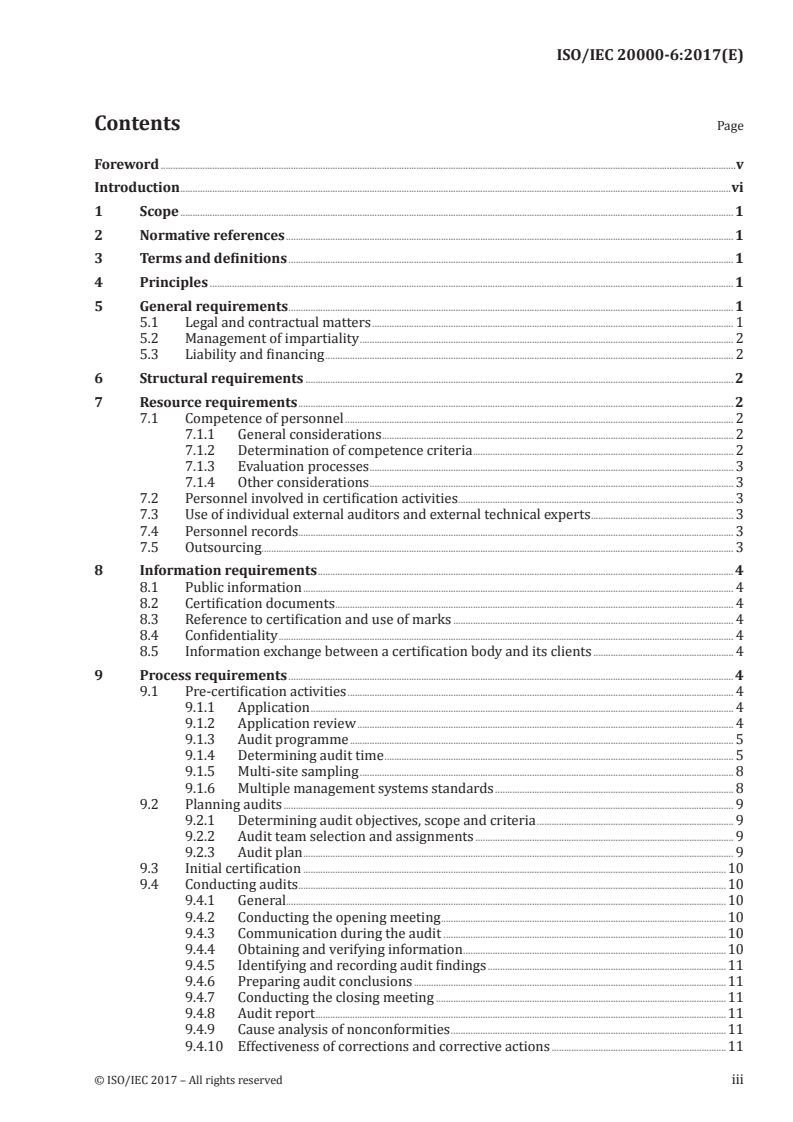
Contents Page
Foreword .v
Introduction .vi
1 Scope . 1
2 Normative references . 1
3 Terms and definitions . 1
4 Principles . 1
5 General requirements . 1
5.1 Legal and contractual matters . 1
5.2 Management of impartiality . 2
5.3 Liability and financing . 2
6 Structural requirements . 2
7 Resource requirements . 2
7.1 Competence of personnel . 2
7.1.1 General considerations . 2
7.1.2 Determination of competence criteria . 2
7.1.3 Evaluation processes . 3
7.1.4 Other considerations . 3
7.2 Personnel involved in certification activities . 3
7.3 Use of individual external auditors and external technical experts . 3
7.4 Personnel records. 3
7.5 Outsourcing. 3
8 Information requirements . 4
8.1 Public information . 4
8.2 Certification documents . 4
8.3 Reference to certification and use of marks . 4
8.4 Confidentiality . 4
8.5 Information exchange between a certification body and its clients . 4
9 Process requirements . 4
9.1 Pre-certification activities . 4
9.1.1 Application . 4
9.1.2 Application review . 4
9.1.3 Audit programme . 5
9.1.4 Determining audit time . 5
9.1.5 Multi-site sampling . 8
9.1.6 Multiple management systems standards . 8
9.2 Planning audits . 9
9.2.1 Determining audit objectives, scope and criteria . 9
9.2.2 Audit team selection and assignments . 9
9.2.3 Audit plan . 9
9.3 Initial certification .10
9.4 Conducting audits .10
9.4.1 General.10
9.4.2 Conducting the opening meeting .10
9.4.3 Communication during the audit .10
9.4.4 Obtaining and verifying information .10
9.4.5 Identifying and recording audit findings .11
9.4.6 Preparing audit conclusions .11
9.4.7 Conducting the closing meeting .11
9.4.8 Audit report .11
9.4.9 Cause analysis of nonconformities .11
9.4.10 Effectiveness of corrections and corrective actions .11
© ISO/IEC 2017 – All rights reserved iii
9.5 Certification decision .11
9.6 Maintaining certification .11
9.7 Appeals .11
9.8 Complaints .11
9.9 Client records .11
9.10 Management system requirements for certification bodies .12
Bibliography .13
iv © ISO/IEC 2017 – All rights reserved
Foreword
ISO (the International Organization for Standardization) and IEC (the International Electrotechnical
Commission) form the specialized system for worldwide standardization. National bodies that are
members of ISO or IEC participate in the development of International Standards through technical
committees established by the respective organization to deal with particular fields of technical
activity. ISO and IEC technical committees collaborate in fields of mutual interest. Other international
organizations, governmental and non-governmental, in liaison with ISO and IEC, also take part in the
work. In the field of information technology, ISO and IEC have established a joint technical committee,
ISO/IEC JTC 1.
The procedures used to develop this document and those intended for its further maintenance are
described in the ISO/IEC Directives, Part 1. In particular the different approval criteria needed for the
different types of ISO documents should be noted. This document was drafted in accordance with the
editorial rules of the ISO/IEC Directives, Part 2 (see www .iso .org/ directives).
Attention is drawn to the possibility that some of the elements of this document may be the subject of
patent rights. ISO shall not be held responsible for identifying any or all such patent rights. Details of
any patent rights identified during the development of the document will be in the Introduction and/or
on the ISO list of patent declarations received (see www .iso .org/ patents).
Any trade name used in this document is information given for the convenience of users and does not
constitute an endorsement.
For an explanation on the meaning of ISO specific terms and expressions related to conformity assessment,
as well as information about ISO’s adherence to the World Trade Organization (WTO) principles in the
Technical Barriers to Trade (TBT) see the following URL: www . i so .org/ iso/ foreword .html.
For an explanation on the voluntary nature of standards, the meaning of ISO specific terms and
expressions related to conformity assessment, as well as information about ISO’s adherence to the
World Trade Organization (WTO) principles in the Technical Barriers to Trade (TBT) see the following
URL: w w w . i s o .org/ iso/ foreword .html.
This document was prepared by Technical Committee ISO/IEC JTC 1, Information technology,
subcommittee, SC 40, IT Service Management and IT Governance.
A list of all parts in the ISO/IEC 20000 series can be found on the ISO website.
© ISO/IEC 2017 – All rights reserved v
Introduction
This document is for use by certification bodies for auditing and certifying a service management
system (SMS) in accordance with ISO/IEC 20000-1. It can also be used by accreditation bodies when
assessing certification bodies. It is intended to be used in conjunction with ISO/IEC 17021-1, which
sets out criteria for certification bodies providing audit and certification of management systems. This
document provides requirements additional to those in ISO/IEC 17021-1.
Correct application of this document will enable certification bodies to harmonize their application of
ISO/IEC 17021-1 for assessments against ISO/IEC 20000-1. It will also enable accreditation bodies to
harmonize their application of the standards they use to assess certification bodies.
This document follows the structure of ISO/IEC 17021-1, as far as possible. The requirements additional
to those in ISO/IEC 17021-1 are shown as subclauses numbered “SMxxx”.
ISO/IEC 17021-1 and this document use the term “client” for the organization seeking certification.
vi © ISO/IEC 2017 – All rights reserved
INTERNATIONAL STANDARD ISO/IEC 20000-6:2017(E)
Information technology — Service management —
Part 6:
Requirements for bodies providing audit and certification
of service management systems
1 Scope
This document specifies requirements and provides guidance for certification bodies providing audit
and certification of an SMS in accordance with ISO/IEC 20000-1. It does not change the requirements
specified in ISO/IEC 20000-1. This document can also be used by accreditation bodies for accreditation
of certification bodies.
A certification body providing SMS certification is expected to be able to demonstrate fulfilment of the
requirements specified in this document, in addition to the requirements in ISO/IEC 17021-1.
2 Normative references
The following documents are referred to in the text in such a way that some or all of their content
constitutes requirements of this document. For dated references, only the edition cited applies. For
undated references, the latest edition of the referenced document (including any amendments) applies.
ISO/IEC 17021-1:2015, Conformity assessment — Requirements for bodies providing audit and certification
of management systems — Part 1: Requirements
ISO/IEC 20000-1, Information technology — Service management — Part 1: Service management system
requirements
ISO/IEC TR 20000-10, Information technology — Service management — Part 10: Concepts and
terminology
3 Terms and definitions
For the purposes of this document, the terms and definitions given in ISO/IEC 17021-1 and
ISO/IEC TR 20000-10 apply.
ISO and IEC maintain terminological databases for use in standardization at the following addresses:
— IEC Electropedia: available at http:// www .electropedia .org/
— ISO Online browsing platform: available at http:// www .iso .org/ obp
4 Principles
For the purposes of this document, the principles in ISO/IEC 17021-1:2015, Clause 4 apply.
5 General requirements
5.1 Legal and contractual matters
The requirements in ISO/IEC 17021-1:2015, 5.1 apply.
© ISO/IEC 2017 – All rights reserved 1
5.2 Management of impartiality
The requirements in ISO/IEC 17021-1:2015, 5.2 apply. In addition, the following requirements and
guidance apply.
5.2.1 SM5.2.1 Conflicts of interest
Certification bodies may carry out the following duties without them being considered as consultancy
or having a potential conflict of interest:
a) arranging and participating as a lecturer in training courses. Where these courses relate to
service management, related management systems or auditing, certification bodies shall confine
themselves to the provision of generic information and advice which is publicly available, i.e. they
shall not provide company-specific advice;
b) making available or publishing on request information describing the certification body’s
interpretation of the requirements of the certification audit standards;
c) activities prior to audit, solely aimed at determining readiness for certification audit. These
activities shall not result in the provision of recommendations or advice that would contravene
this subclause. The certification body shall be able to confirm that such activities do not contravene
these requirements and that they are not used to justify a reduction in the eventual certification
audit duration;
d) performing second and third-party audits according to standards or regulations other than those
being part of the scope of accreditation;
e) adding value during certification audits and surveillance visits, e.g. by identifying opportunities for
improvement, as they become evident during the audit, without recommending specific solutions.
The certification body shall not provide internal service management reviews of the client’s SMS
subject to certification. The certification body shall be independent of the body or bodies (including any
individuals) which provide the internal SMS audit.
5.3 Liability and financing
The requirements in ISO/IEC 17021-1:2015, 5.3 apply.
6 Structural requirements
The requirements in ISO/IEC 17021-1:2015, Clause 6 apply.
7 Resource requirements
7.1 Competence of personnel
7.1.1 General considerations
The requirements in ISO/IEC 17021-1:2015, 7.1.1 apply.
7.1.2 Determination of competence criteria
The requirements in ISO/IEC 17021-1:2015, 7.1.2 apply. In addition, the following requirements and
guidance apply.
2 © ISO/IEC 2017 – All rights reserved
7.1.2.1 SM7.1.2.1 The term “technical area”
ISO/IEC 20000-1 states that all requirements are generic and are intended to be applicable to all clients,
regardless of type, size and the nature of the services delivered. For ISO/IEC 20000-1 audits, the term
“technical area” relates to the SMS, including service management processes and the services within
the scope of the SMS. “Technical area” does not relate to any underlying technology used to enable
service delivery.
7.1.3 Evaluation processes
The requirements in ISO/IEC 17021-1:2015, 7.1.3 apply.
7.1.4 Other considerations
The requirements in ISO/IEC 17021-1:2015, 7.1.4 apply.
7.2 Personnel involved in certification activities
The requirements in ISO/IEC 17021-1:2015, 7.2 apply. In addition, the following requirements and
guidance apply.
7.2.1 SM7.2.1 Competence of personnel involved in certification activities
The certification body shall define criteria for the training and competence development of auditors
and personnel involved in managing and supporting certification activities. The certification body shall
ensure knowledge, as appropriate for each role, of:
a) the requirements specified in ISO/IEC 20000-1;
b) the relevant parts of ISO/IEC 20000, especially ISO/IEC 20000-2, ISO/IEC 20000-3 and
ISO/IEC TR 20000-10.
The certification body shall ensure that auditors and personnel involved in managing and supporting
certification activities have appropriate awareness of the impact of legal and regulatory requirements
relevant to auditing an SMS, according to the jurisdictions in scope. Awareness of legal and regulatory
requirements does not imply profound legal knowledge: a management system certification audit is not
a legal compliance audit.
The certification body shall ensure auditors keep knowledge and skills in service management and
auditing up to date through continual professional development.
7.3 Use of individual external auditors and
...
INTERNATIONAL ISO/IEC
STANDARD 20000-6
First edition
2017-06
Information technology — Service
management —
Part 6:
Requirements for bodies providing
audit and certification of service
management systems
Technologies de l’information — Gestion des services —
Partie 6: Exigences pour les organismes procédant à l’audit et à la
certification des systèmes de management de la gestion des services
Reference number
©
ISO/IEC 2017
© ISO/IEC 2017, Published in Switzerland
All rights reserved. Unless otherwise specified, no part of this publication may be reproduced or utilized otherwise in any form
or by any means, electronic or mechanical, including photocopying, or posting on the internet or an intranet, without prior
written permission. Permission can be requested from either ISO at the address below or ISO’s member body in the country of
the requester.
ISO copyright office
Ch. de Blandonnet 8 • CP 401
CH-1214 Vernier, Geneva, Switzerland
Tel. +41 22 749 01 11
Fax +41 22 749 09 47
copyright@iso.org
www.iso.org
ii © ISO/IEC 2017 – All rights reserved
Contents Page
Foreword .v
Introduction .vi
1 Scope . 1
2 Normative references . 1
3 Terms and definitions . 1
4 Principles . 1
5 General requirements . 1
5.1 Legal and contractual matters . 1
5.2 Management of impartiality . 2
5.3 Liability and financing . 2
6 Structural requirements . 2
7 Resource requirements . 2
7.1 Competence of personnel . 2
7.1.1 General considerations . 2
7.1.2 Determination of competence criteria . 2
7.1.3 Evaluation processes . 3
7.1.4 Other considerations . 3
7.2 Personnel involved in certification activities . 3
7.3 Use of individual external auditors and external technical experts . 3
7.4 Personnel records. 3
7.5 Outsourcing. 3
8 Information requirements . 4
8.1 Public information . 4
8.2 Certification documents . 4
8.3 Reference to certification and use of marks . 4
8.4 Confidentiality . 4
8.5 Information exchange between a certification body and its clients . 4
9 Process requirements . 4
9.1 Pre-certification activities . 4
9.1.1 Application . 4
9.1.2 Application review . 4
9.1.3 Audit programme . 5
9.1.4 Determining audit time . 5
9.1.5 Multi-site sampling . 8
9.1.6 Multiple management systems standards . 8
9.2 Planning audits . 9
9.2.1 Determining audit objectives, scope and criteria . 9
9.2.2 Audit team selection and assignments . 9
9.2.3 Audit plan . 9
9.3 Initial certification .10
9.4 Conducting audits .10
9.4.1 General.10
9.4.2 Conducting the opening meeting .10
9.4.3 Communication during the audit .10
9.4.4 Obtaining and verifying information .10
9.4.5 Identifying and recording audit findings .11
9.4.6 Preparing audit conclusions .11
9.4.7 Conducting the closing meeting .11
9.4.8 Audit report .11
9.4.9 Cause analysis of nonconformities .11
9.4.10 Effectiveness of corrections and corrective actions .11
© ISO/IEC 2017 – All rights reserved iii
9.5 Certification decision .11
9.6 Maintaining certification .11
9.7 Appeals .11
9.8 Complaints .11
9.9 Client records .11
9.10 Management system requirements for certification bodies .12
Bibliography .13
iv © ISO/IEC 2017 – All rights reserved
Foreword
ISO (the International Organization for Standardization) and IEC (the International Electrotechnical
Commission) form the specialized system for worldwide standardization. National bodies that are
members of ISO or IEC participate in the development of International Standards through technical
committees established by the respective organization to deal with particular fields of technical
activity. ISO and IEC technical committees collaborate in fields of mutual interest. Other international
organizations, governmental and non-governmental, in liaison with ISO and IEC, also take part in the
work. In the field of information technology, ISO and IEC have established a joint technical committee,
ISO/IEC JTC 1.
The procedures used to develop this document and those intended for its further maintenance are
described in the ISO/IEC Directives, Part 1. In particular the different approval criteria needed for the
different types of ISO documents should be noted. This document was drafted in accordance with the
editorial rules of the ISO/IEC Directives, Part 2 (see www .iso .org/ directives).
Attention is drawn to the possibility that some of the elements of this document may be the subject of
patent rights. ISO shall not be held responsible for identifying any or all such patent rights. Details of
any patent rights identified during the development of the document will be in the Introduction and/or
on the ISO list of patent declarations received (see www .iso .org/ patents).
Any trade name used in this document is information given for the convenience of users and does not
constitute an endorsement.
For an explanation on the meaning of ISO specific terms and expressions related to conformity assessment,
as well as information about ISO’s adherence to the World Trade Organization (WTO) principles in the
Technical Barriers to Trade (TBT) see the following URL: www . i so .org/ iso/ foreword .html.
For an explanation on the voluntary nature of standards, the meaning of ISO specific terms and
expressions related to conformity assessment, as well as information about ISO’s adherence to the
World Trade Organization (WTO) principles in the Technical Barriers to Trade (TBT) see the following
URL: w w w . i s o .org/ iso/ foreword .html.
This document was prepared by Technical Committee ISO/IEC JTC 1, Information technology,
subcommittee, SC 40, IT Service Management and IT Governance.
A list of all parts in the ISO/IEC 20000 series can be found on the ISO website.
© ISO/IEC 2017 – All rights reserved v
Introduction
This document is for use by certification bodies for auditing and certifying a service management
system (SMS) in accordance with ISO/IEC 20000-1. It can also be used by accreditation bodies when
assessing certification bodies. It is intended to be used in conjunction with ISO/IEC 17021-1, which
sets out criteria for certification bodies providing audit and certification of management systems. This
document provides requirements additional to those in ISO/IEC 17021-1.
Correct application of this document will enable certification bodies to harmonize their application of
ISO/IEC 17021-1 for assessments against ISO/IEC 20000-1. It will also enable accreditation bodies to
harmonize their application of the standards they use to assess certification bodies.
This document follows the structure of ISO/IEC 17021-1, as far as possible. The requirements additional
to those in ISO/IEC 17021-1 are shown as subclauses numbered “SMxxx”.
ISO/IEC 17021-1 and this document use the term “client” for the organization seeking certification.
vi © ISO/IEC 2017 – All rights reserved
INTERNATIONAL STANDARD ISO/IEC 20000-6:2017(E)
Information technology — Service management —
Part 6:
Requirements for bodies providing audit and certification
of service management systems
1 Scope
This document specifies requirements and provides guidance for certification bodies providing audit
and certification of an SMS in accordance with ISO/IEC 20000-1. It does not change the requirements
specified in ISO/IEC 20000-1. This document can also be used by accreditation bodies for accreditation
of certification bodies.
A certification body providing SMS certification is expected to be able to demonstrate fulfilment of the
requirements specified in this document, in addition to the requirements in ISO/IEC 17021-1.
2 Normative references
The following documents are referred to in the text in such a way that some or all of their content
constitutes requirements of this document. For dated references, only the edition cited applies. For
undated references, the latest edition of the referenced document (including any amendments) applies.
ISO/IEC 17021-1:2015, Conformity assessment — Requirements for bodies providing audit and certification
of management systems — Part 1: Requirements
ISO/IEC 20000-1, Information technology — Service management — Part 1: Service management system
requirements
ISO/IEC TR 20000-10, Information technology — Service management — Part 10: Concepts and
terminology
3 Terms and definitions
For the purposes of this document, the terms and definitions given in ISO/IEC 17021-1 and
ISO/IEC TR 20000-10 apply.
ISO and IEC maintain terminological databases for use in standardization at the following addresses:
— IEC Electropedia: available at http:// www .electropedia .org/
— ISO Online browsing platform: available at http:// www .iso .org/ obp
4 Principles
For the purposes of this document, the principles in ISO/IEC 17021-1:2015, Clause 4 apply.
5 General requirements
5.1 Legal and contractual matters
The requirements in ISO/IEC 17021-1:2015, 5.1 apply.
© ISO/IEC 2017 – All rights reserved 1
5.2 Management of impartiality
The requirements in ISO/IEC 17021-1:2015, 5.2 apply. In addition, the following requirements and
guidance apply.
5.2.1 SM5.2.1 Conflicts of interest
Certification bodies may carry out the following duties without them being considered as consultancy
or having a potential conflict of interest:
a) arranging and participating as a lecturer in training courses. Where these courses relate to
service management, related management systems or auditing, certification bodies shall confine
themselves to the provision of generic information and advice which is publicly available, i.e. they
shall not provide company-specific advice;
b) making available or publishing on request information describing the certification body’s
interpretation of the requirements of the certification audit standards;
c) activities prior to audit, solely aimed at determining readiness for certification audit. These
activities shall not result in the provision of recommendations or advice that would contravene
this subclause. The certification body shall be able to confirm that such activities do not contravene
these requirements and that they are not used to justify a reduction in the eventual certification
audit duration;
d) performing second and third-party audits according to standards or regulations other than those
being part of the scope of accreditation;
e) adding value during certification audits and surveillance visits, e.g. by identifying opportunities for
improvement, as they become evident during the audit, without recommending specific solutions.
The certification body shall not provide internal service management reviews of the client’s SMS
subject to certification. The certification body shall be independent of the body or bodies (including any
individuals) which provide the internal SMS audit.
5.3 Liability and financing
The requirements in ISO/IEC 17021-1:2015, 5.3 apply.
6 Structural requirements
The requirements in ISO/IEC 17021-1:2015, Clause 6 apply.
7 Resource requirements
7.1 Competence of personnel
7.1.1 General considerations
The requirements in ISO/IEC 17021-1:2015, 7.1.1 apply.
7.1.2 Determination of competence criteria
The requirements in ISO/IEC 17021-1:2015, 7.1.2 apply. In addition, the following requirements and
guidance apply.
2 © ISO/IEC 2017 – All rights reserved
7.1.2.1 SM7.1.2.1 The term “technical area”
ISO/IEC 20000-1 states that all requirements are generic and are intended to be applicable to all clients,
regardless of type, size and the nature of the services delivered. For ISO/IEC 20000-1 audits, the term
“technical area” relates to the SMS, including service management processes and the services within
the scope of the SMS. “Technical area” does not relate to any underlying technology used to enable
service delivery.
7.1.3 Evaluation processes
The requirements in ISO/IEC 17021-1:2015, 7.1.3 apply.
7.1.4 Other considerations
The requirements in ISO/IEC 17021-1:2015, 7.1.4 apply.
7.2 Personnel involved in certification activities
The requirements in ISO/IEC 17021-1:2015, 7.2 apply. In addition, the following requirements and
guidance apply.
7.2.1 SM7.2.1 Competence of personnel involved in certification activities
The certification body shall define criteria for the training and competence development of auditors
and personnel involved in managing and supporting certification activities. The certification body shall
ensure knowledge, as appropriate for each role, of:
a) the requirements specified in ISO/IEC 20000-1;
b) the relevant parts of ISO/IEC 20000, especially ISO/IEC 20000-2, ISO/IEC 20000-3 and
ISO/IEC TR 20000-10.
The certification body shall ensure that auditors and personnel involved in managing and supporting
certification activities have appropriate awareness of the impact of legal and regulatory requirements
relevant to auditing an SMS, according to the jurisdictions in scope. Awareness of legal and regulatory
requirements does not imply profound legal knowledge: a management system certification audit is not
a legal compliance audit.
The certification body shall ensure auditors keep knowledge and skills in service management and
auditing up to date through continual professional development.
7.3 Use of individual external auditors and
...