


ISO/TR 10017:1999
(Main)Guidance on statistical techniques for ISO 9001:1994
Guidance on statistical techniques for ISO 9001:1994
Lignes directrices pour les techniques statistiques relatives à l'ISO 9001:1994
General Information
- Status
- Withdrawn
- Publication Date
- 01-Sep-1999
- Withdrawal Date
- 01-Sep-1999
- Technical Committee
- ISO/TC 176/SC 3 - Supporting technologies
- Drafting Committee
- ISO/TC 176/SC 3 - Supporting technologies
- Current Stage
- 9599 - Withdrawal of International Standard
- Start Date
- 08-May-2003
- Completion Date
- 14-Feb-2026
Relations
- Effective Date
- 12-May-2008
- Effective Date
- 15-Apr-2008
Get Certified
Connect with accredited certification bodies for this standard

BSI Group
BSI (British Standards Institution) is the business standards company that helps organizations make excellence a habit.

Bureau Veritas
Bureau Veritas is a world leader in laboratory testing, inspection and certification services.

DNV
DNV is an independent assurance and risk management provider.
Sponsored listings
Frequently Asked Questions
ISO/TR 10017:1999 is a technical report published by the International Organization for Standardization (ISO). Its full title is "Guidance on statistical techniques for ISO 9001:1994". This standard covers: Guidance on statistical techniques for ISO 9001:1994
Guidance on statistical techniques for ISO 9001:1994
ISO/TR 10017:1999 is classified under the following ICS (International Classification for Standards) categories: 03.100.70 - Management systems; 03.120.10 - Quality management and quality assurance; 03.120.30 - Application of statistical methods. The ICS classification helps identify the subject area and facilitates finding related standards.
ISO/TR 10017:1999 has the following relationships with other standards: It is inter standard links to SIST ISO/TR 10017:2003, ISO/TR 10017:2003. Understanding these relationships helps ensure you are using the most current and applicable version of the standard.
ISO/TR 10017:1999 is available in PDF format for immediate download after purchase. The document can be added to your cart and obtained through the secure checkout process. Digital delivery ensures instant access to the complete standard document.
Standards Content (Sample)
TECHNICAL ISO/TR
REPORT 10017
First edition
1999-09-01
Guidance on statistical techniques for
ISO 9001:1994
Lignes directrices pour les techniques statistiques relatives à
l'ISO 9001:1994
A
Reference number
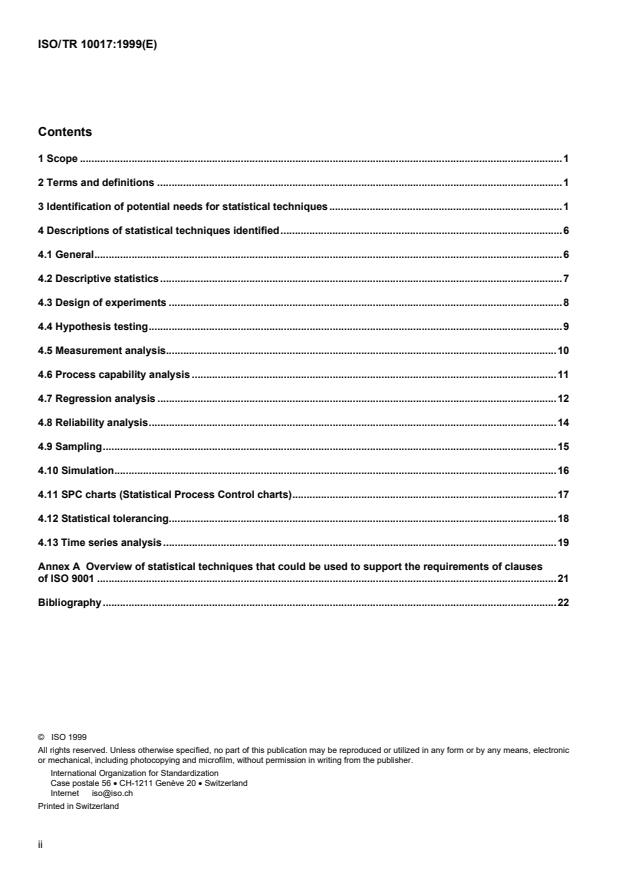
Contents
1 Scope .1
2 Terms and definitions .1
3 Identification of potential needs for statistical techniques.1
4 Descriptions of statistical techniques identified.6
4.1 General.6
4.2 Descriptive statistics.7
4.3 Design of experiments .8
4.4 Hypothesis testing.9
4.5 Measurement analysis.10
4.6 Process capability analysis .11
4.7 Regression analysis .12
4.8 Reliability analysis.14
4.9 Sampling.15
4.10 Simulation.16
4.11 SPC charts (Statistical Process Control charts).17
4.12 Statistical tolerancing.18
4.13 Time series analysis.19
Annex A Overview of statistical techniques that could be used to support the requirements of clauses
of ISO 9001 .21
Bibliography.22
© ISO 1999
All rights reserved. Unless otherwise specified, no part of this publication may be reproduced or utilized in any form or by any means, electronic
or mechanical, including photocopying and microfilm, without permission in writing from the publisher.
International Organization for Standardization
Case postale 56 • CH-1211 Genève 20 • Switzerland
Internet iso@iso.ch
Printed in Switzerland
ii
© ISO
Foreword
ISO (the International Organization for Standardization) is a worldwide federation of national standards bodies (ISO
member bodies). The work of preparing International Standards is normally carried out through ISO technical
committees. Each member body interested in a subject for which a technical committee has been established has
the right to be represented on that committee. International organizations, governmental and non-governmental, in
liaison with ISO, also take part in the work. ISO collaborates closely with the International Electrotechnical
Commission (IEC) on all matters of electrotechnical standardization.
International Standards are drafted in accordance with the rules given in the ISO/IEC Directives, Part 3.
The main task of technical committees is to prepare International Standards. Draft International Standards adopted
by the technical committees are circulated to the member bodies for voting. Publication as an International Standard
requires approval by at least 75 % of the member bodies casting a vote.
In exceptional circumstances, when a technical committee has collected data of a different kind from that which is
normally published as an International Standard (“state of the art”, for example), it may decide by a simple majority
vote of its participating members to publish a Technical Report. A Technical Report is entirely informative in nature
and does not have to be reviewed until the data it provides are considered to be no longer valid or useful.
ISO/TR 10017 was prepared by Technical Committee ISO/TC 176, Quality management and quality assurance,
Subcommittee SC 3, Supporting technologies.
This Technical Report may be updated to reflect future revisions of ISO 9001. Comments on the contents of this
Technical Report may be sent to ISO Central Secretariat for consideration in a future revision.
iii
© ISO
Introduction
The purpose of this Technical Report is to assist an organization in identifying statistical techniques that can be
useful in developing, implementing or maintaining a quality system in compliance with ISO 9001:1994.
In this context, the usefulness of statistical techniques follows from the variability that may be observed in the
behaviour and outcome of practically all processes, even under conditions of apparent stability. Such variability can
be observed in the quantifiable characteristics of products and processes, and may be seen to exist at various
stages over the total life cycle of products from market research to customer service and final disposal.
Statistical techniques can help measure, describe, analyse, interpret and model such variability, even with a
relatively limited amount of data. Statistical analysis of such data can help provide a better understanding of the
nature, extent and causes of variability. This could help to solve and even prevent problems that may result from
such variability.
Statistical techniques can thus permit better use of available data to assist in decision making, and thereby help to
improve to the quality of products and processes in the stages of design, development, production, installation and
servicing.
This Technical Report is intended to guide and assist an organization in considering and selecting statistical
techniques appropriate to the needs of the organization. The criteria for determining the need for statistical
techniques, and the appropriateness of the technique(s) selected, remain the prerogative of the organization.
The statistical techniques described in this Technical Report are also relevant for use with other standards in the
ISO 9000 family. In particular, annex D of ISO 9000-1:1994 is a cross-reference list of clause numbers for
corresponding topics in ISO 9001, ISO 9002, ISO 9003 and ISO 9004-1 (1994 editions).
iv
©
TECHNICAL REPORT ISO ISO/TR 10017:1999(E)
Guidance on statistical techniques for ISO 9001:1994
1 Scope
This Technical Report provides guidance on the selection of appropriate statistical techniques that may be useful to
an organization in developing, implementing or maintaining a quality system in compliance with ISO 9001. This is
done by examining the requirements of ISO 9001 that involve the use of quantitative data, and then identifying and
describing those statistical techniques that may be useful when applied to such data.
The list of statistical techniques cited in this Technical Report is neither complete nor exhaustive, and should not
preclude the use of any other techniques (statistical or otherwise) that are deemed to be beneficial to the
organization. Further, this Technical Report does not attempt to prescribe which statistical technique(s) must be
used; nor does it attempt to advise on how the technique(s) should be implemented.
This Technical Report is not intended for contractual, regulatory or certification purposes. It is not intended
to be used as a mandatory checklist for compliance with ISO 9001:1994 requirements. The justification for using
statistical techniques is that their application would help to improve the effectiveness of the quality system.
2 Terms and definitions
For the purposes of this Technical Report, the terms and definitions given in ISO 8402, ISO 3534 (all parts) and
IEC 60050 apply.
References in this Technical Report to "product" are applicable to the generic product categories of service,
hardware, processed materials, software or a combination thereof, in accordance with Notes 1 and 2 accompanying
the definition of "product" in ISO 8402.
3 Identification of potential needs for statistical techniques
The need for quantitative data that may reasonably be associated with the implementation of the clauses and sub-
clauses of ISO 9001 is identified in Table 1. Listed against the need for quantitative data thus identified are one or
more appropriate statistical techniques that potentially may be applied to such data, and whose application would
benefit the organization.
Where no need for quantitative data could be readily associated with a clause or sub-clause of ISO 9001, no
statistical technique is identified.
Discretion has been exercized in citing only those techniques that are well known and have been used in a wide
range of applications, with recognized benefits to users.
Each of the statistical techniques noted below is described briefly in clause 4, to assist the organization to assess
the relevance and value of the statistical techniques cited, and to help determine whether or not to use them in a
specific context.
© ISO
Table 1 — Needs involving quantitative data, and supporting statistical technique(s)
Clause/sub-clause of Needs involving the use of quantitative Statistical technique(s)
ISO 9001:1994 data
4.1 Management responsibility
4.1.1 Quality policy Need to assess the extent to which the Sampling
quality policy is implemented in the
organization
4.1.2 Organization
4.1.2.1 Responsibility and None identified
authority
4.1.2.2 Resources None identified
4.1.2.3 Management None identified
representative
4.1.3 Management review Need for quantitative assessment of the Descriptive statistics;
organization’s performance against its Sampling; SPC charts; Time
quality objectives series analysis
4.2 Quality system
4.2.1 General None identified
4.2.2 Quality system None identified
procedures
4.2.3 Quality planning None identified
4.3 Contract review
4.3.1 General None identified
4.3.2 Review
4.3.2.a Review None identified
4.3.2.b Review None identified
4.3.2.c Review Need to analyse tender, contract or order Measurement analysis;
and to ensure that the supplier has the Process capability analysis;
capability to meet requirements Reliability analysis; Sampling
4.3.3 Amendment to a contract None identified
4.3.4 Records None identified
4.4 Design control
4.4.1 General None identified
4.4.2 Design and development None identified
planning
4.4.3 Organizational and None identified
technical interfaces
4.4.4 Design input Need to identify and review input Measurement analysis;
requirements for adequacy, and resolve Process capability analysis;
differences Reliability analysis; Statistical
tolerancing
4.4.5.a Design output Need to assess that design outputs satisfy Descriptive statistics;
input requirements Hypothesis testing;
Measurement analysis;
Process capability analysis;
Reliability analysis; Sampling;
Statistical tolerancing
4.4.5.b Design output None identified
4.4.5.c Design output Need to identify critical design Regression analysis;
characteristics Reliability analysis; Simulation
4.4.6 Design review None identified
© ISO
Table 1 (continued)
Clause/sub-clause of Needs involving the use of quantitative Statistical technique(s)
ISO 9001:1994 data
4.4.7 Design verification Need to ensure that design meets stated Design of experiments;
requirements Hypothesis testing;
Measurement analysis;
Regression analysis;
Reliability analysis; Sampling;
Simulation
4.4.8 Design validation Need to ensure that product conforms to Hypothesis testing;
defined user needs and/or requirements Regression analysis;
Reliability analysis; Sampling;
Simulation
4.4.9 Design changes None identified
4.5 Document and data control
4.5.1 General None identified
4.5.2 Document and data None identified
approval and issue
4.5.3 Document and data None identified
changes
4.6 Purchasing
4.6.1 General None identified
4.6.2.a Evaluation of Need to evaluate subcontractors on the Descriptive statistics;
subcontractors basis of their ability to meet requirements Hypothesis testing; Process
capability analysis; Sampling
4.6.2.b Evaluation of None identified
subcontractors
4.6.2.c Evaluation of Need to describe and summarise Descriptive statistics
subcontractors performance of sub-contractors
4.6.3 Purchasing data None identified
4.6.4 Verification of purchased
product
4.6.4.1 Supplier verification at None identified
subcontractor's premises
4.6.4.2 Customer verification of None identified
subcontracted product
4.7 Control of customer- None identified
supplied product
4.8 Product identification and None identified
traceability
4.9 Process control
4.9.a Process control None identified
4.9.b Process control Need to ensure the suitability of Descriptive statistics;
equipment Measurement analysis;
Process capability analysis
4.9.c Process control None identified
4.9.d Process control Need to monitor and control suitable Descriptive statistics; Design
process parameters and product of experiments; Regression
characteristics analysis; Sampling; SPC
charts; Time series analysis
4.9.e Process control Need to approve processes and Descriptive statistics;
equipment Measurement analysis;
Process capability analysis
4.9.f Process control None identified
4.9.g Process control Need for suitable maintenance of Descriptive statistics; Process
equipment to ensure continuing process capability analysis; Reliability
capability analysis; Simulation
© ISO
Table 1 (continued)
Clause/sub-clause of Needs involving the use of quantitative Statistical technique(s)
ISO 9001:1994 data
4.10 Inspection and testing
4.10.1 General Need to specify inspection and test Hypothesis testing; Reliability
activities to verify that product analysis; Sampling
requirements are met
4.10.2 Receiving inspection
and testing
4.10.2.1 Receiving inspection Need to verify that incoming product Descriptive statistics;
and testing conforms to specified requirements Hypothesis testing; Reliability
analysis; Sampling
4.10.2.2 Receiving inspection None identified
and testing
4.10.2.3 Receiving inspection None identified
and testing
4.10.3.a In-process inspection Need to inspect and test product as Descriptive statistics;
and testing required Hypothesis testing; Reliability
analysis; Sampling
4.10.3.b In-process inspection
and testing
4.10.4 Final inspection and Need to verify that finished product Descriptive statistics;
testing conforms to specified requirements Hypothesis testing; Reliability
analysis; Sampling
4.10.5 Inspection and test None identified
records
4.11 Control of inspection,
measuring and test equipment
4.11.1 General None identified
4.11.2.a Control procedure Need to assess the capability of Descriptive statistics;
inspection, measurement and test Measurement analysis;
equipment Process capability analysis;
SPC charts
4.11.2.b Control procedure None identified
4.11.2.c Control procedure Need to define process for calibration of Descriptive statistics;
inspection, measurement and test Measurement analysis;
equipment Process capability analysis;
SPC charts
4.11.2.d Control procedure None identified
4.11.2.e Control procedure None identified
4.11.2.f Control procedure Need to assess validity of previous Descriptive statistics;
inspection and test results. Hypothesis testing; Reliability
analysis; Sampling; SPC
charts
4.11.2.g Control procedure None identified
4.11.2.h Control procedure None identified
4.11.2.i Control procedure None identified
4.12 Inspection and test status None identified
4.13 Control of nonconforming
product
4.13.1General None identified
4.13.2.a Review and None identified
disposition of nonconforming
product
4.13.2.b Review and None identified
disposition of nonconforming
product
© ISO
Table 1 (continued)
Clause/sub-clause of Needs involving the use of quantitative Statistical technique(s)
ISO 9001:1994 data
4.13.2.c Review and None identified
disposition of nonconforming
product
4.13.2.d Review and None identified
disposition of nonconforming
product
4.14 Corrective and preventive
action
4.14.1 General None identified
4.14.2.a Corrective action Need to assess effectiveness of process Descriptive statistics;
for handling customer complaints and Sampling
reports of product nonconformities.
4.14.2.b Corrective action Need to analyse the cause of non- Descriptive statistics; Design
conformities relating to product, process of experiments; Measurement
or quality system analysis; Process capability
analysis; Regression
analysis; Reliability analysis;
Sampling; Simulation; SPC
charts; Statistical tolerancing;
Time series analysis
4.14.2.c Corrective action None identified
4.14.2.d Corrective action Need to evaluate the effectiveness of Descriptive statistics;
corrective action Hypothesis testing;
Regression analysis;
Sampling; SPC charts; Time
series analysis
4.14.3.a Preventive action Need to summarise and analyse product Descriptive statistics;
or process data related to actual or Regression analysis; Time
potential non-conformities series analysis
4.14.3.b Preventive action None identified
4.14.3.c Preventive action Need to ensure the effectiveness of Descriptive statistics;
preventive action Hypothesis testing;
Regression analysis;
Sampling; SPC charts; Time
series analysis
4.14.3.d Preventive action None identified
4.15 Handling, storage,
packaging, preservation and
delivery None identified
4.15.1 General
4.15.2 Handling None identified
4.15.3 Storage Need to assess deterioration of product in Descriptive statistics;
stock, and to determine appropriate Hypothesis testing; Reliability
interval between assessments analysis; Sampling; Time
series analysis
4.15.4 Packaging Need to assess conformance of packing, Descriptive statistics; Process
packaging and marking processes to capability analysis; Sampling;
specified requirements SPC charts;
4.15.5 Preservation Need to assess the adequacy of Descriptive statistics;
preservation and segregation of product Hypothesis testing; Sampling;
under supplier's control Tme series analysis
4.15.6 Delivery Need to assess adequacy of protection of Descriptive statistics;
product quality after final inspection and Sampling
test
4.16 Control of quality records None identified
© ISO
Table 1 (continued)
Clause/sub-clause of Needs involving the use of quantitative Statistical technique(s)
ISO 9001:1994 data
4.17 Internal quality audits Potential need for sampling in planning Descriptive statistics;
and conducting internal audits; and need Sampling
for summarising data from audits and
verifying effectiveness
4.18 Training None identified
4.19 Servicing Need to verify that servicing meets Descriptive statistics;
specified requirements Sampling
4.20 Statistical techniques
4.20.1 Identification of need This clause calls for the identification of Suitable statistical techniques
the need for statistical techniques. identified for consideration.
4.20.2 Procedures None identified
The findings of Table 1 are summarized in annex A, which presents an overview of the range of statistical
techniques and the extent to which they could be used to support the implementation of ISO 9001.
4 Descriptions of statistical techniques identified
4.1 General
The following statistical techniques, or families of techniques, that might help an organization to meets its needs, are
identified in clause 3:
descriptive statistics
design of experiments
hypothesis testing
measurement analysis
process capability analysis
regression
reliability analysis
sampling
simulation
Statistical Process Control charts
statistical tolerancing
time series analysis
As stated earlier, the criteria used in selecting the techniques gathered above are that the techniques are well
known and widely used, and their application has resulted in benefit to users.
The choice of technique and the manner of its application will depend on the circumstances and purpose of the
exercise, which will differ from case to case.
A brief description of each statistical technique, or family of techniques, listed above is provided in 4.2 to 4.13. The
descriptions are intended to assist a lay reader to assess the potential applicability and benefit of using the
statistical techniques in implementing the requirements of a quality system. However, the actual application of
statistical techniques cited here will require more guidance and expertise than is provided by this Technical Report.
© ISO
There is a great body of information on statistical techniques available in the public domain, such as textbooks,
journals, reports, industry handbooks and other sources of information, which may assist the organization in the
1)
effective use of statistical techniques . However it is beyond the scope of this Technical Report to cite these
sources, and the search for such information is left to individual initiative.
4.2 Descriptive statistics
4.2.1 What it is
The term descriptive statistics refers to procedures for summarizing and presenting quantitative data in a manner
that reveals the characteristics of the distribution of data.
The characteristics of data that are typically of interest are its central tendency (most often described by the mean,
and also by the mode or median), and its spread or dispersion (usually measured by the range, standard deviation
or variance). Another characteristic of interest is the distribution of data, for which there are quantitative measures
that describe the shape of the distribution (such as the degree of “skewness”, which describes symmetry).
The information provided by descriptive statistics can often be conveyed readily and effectively by a variety of
graphical methods. These range from simple displays of data in the form of pie-charts, bar-charts, histograms,
simple scatter plots and trend charts, to displays of a more complex nature involving specialised scaling such as
probability plots, and graphics involving multiple dimensions and variables.
Graphical methods are useful in that they can often reveal unusual features of the data that may not be readily
detected in quantitative analysis. They have extensive use in data analysis when exploring or verifying relationships
between variables, and in estimating the parameters that describe such relationships. Also, they have an important
application in summarising and presenting complex data or data relationships in an effective manner, especially for
non-specialist audiences.
Graphical methods are implicitly invoked in many of the statistical techniques referred to in this Technical Report,
and should be regarded as a vital component of statistical analysis.
4.2.2 What it is used for
Descriptive statistics is used for summarizing and characterising data. It is usually the initial step in the analysis of
quantitative data, and often constitutes the first step towards the use of other statistical procedures.
The characteristics of sample data may serve as a basis for making inferences regarding the characteristics of
populations, with a prescribed margin of error and level of confidence, provided the underlying statistical
assumptions are satisfied.
4.2.3 Benefits
Descriptive statistics offers an efficient and relatively simple way of summarizing and characterising data, and also
offers a convenient way of presenting such information. It is easily understood and can be useful for analysis and
decision making at all levels.
4.2.4 Limitations and cautions
Descriptive statistics provides quantitative measures of the characteristics (such as the mean and standard
deviation) of sample data. However these measures are subject to the limitations of sample size and the sampling
method employed. Also, these quantitative measures cannot be assumed to be valid estimates of characteristics of
the population from which the sample was drawn, unless the statistical assumptions associated with sampling are
satisfied.
4.2.5 Examples of applications
Descriptive statistics has useful application in almost all areas where quantitative data are collected. Some
examples of such applications are:
1) Listed in the bibliography are ISO and IEC standards and technical reports related to statistical techniques. They are cited
here for information; this report does not specify compliance to them.
© ISO
summarizing key measures of product characteristics (such as the mean and spread);
describing the performance of some process parameter, such as oven temperature;
characterizing delivery time or response time in the service industry;
summarizing data from customer surveys.
4.3 Design of experiments
4.3.1 What it is
Design of experiments (abbreviated as "DOE", or sometimes abridged as "Designed Experiments") refers to
investigations carried out in a planned manner, and which rely on a statistical assessment of results to reach
conclusions at a stated level of confidence.
The specific arrangement and manner in which the experiments are to be carried out is called the "experiment
design", and such design is governed by the objective of the exercise and the conditions under which the
experiments are to be conducted.
DOE typically involves inducing change(s) to the system under investigation, and statistically assessing the effect of
such change on the system. Its objective may be to validate some characteristic(s) of a system, or it may be to
investigate the influence of one or more factors on some characteristic(s) of a system.
4.3.2 What it is used for
DOE can be used for evaluating some characteristic of a product, process or system, with a stated level of
confidence. This may be done for the purpose of validation against a specified standard, or for comparative
assessment of several systems.
DOE is particularly useful for investigating complex systems whose outcome may be influenced by a potentially
large number of factors. The objective of the experiment may be to maximize or optimize a characteristic of interest,
or to reduce its variability. DOE can be used to identify the more influential factors in a system, the magnitude of
their influence, and the relationships (i.e., "interactions") if any, between the factors. The findings may be used to
facilitate the design and development of a product or process, or to control or improve an existing system.
The information from a designed experiment may be used to formulate a mathematical model that describes the
system characteristic(s) of interest as a function of the influential factors; and with certain limitations (cited briefly
below), such a model can be used for purposes of prediction.
4.3.3 Benefits
When estimating or validating a characteristic of interest, there is a need to assure that the results obtained are not
simply due to chance variation. This applies to assessments made against some prescribed standard, and to an
even greater degree in comparing two or more systems. DOE allows one to make such assessments, with a
prescribed level of confidence.
A major advantage of DOE is its relative efficiency and economy in investigating the effects of multiple factors in a
process, as compared to investigating each factor individually. Also, its ability to identify the interactions between
certain factors can lead to a deeper understanding of the process. Such benefits are especially pronounced when
dealing with complex processes, i.e. processes that involve a large number of potentially influential factors.
Finally, when investigating a system there is the risk of incorrectly assuming causality where there may be only
chance correlation between two or more variables. The risk of such error can be reduced through the use of sound
principles of experiment design.
4.3.4 Limitations and cautions
Some level of inherent variation (often aptly described as “noise”) is present in all systems, and this can sometimes
cloud the results of investigations and lead to incorrect conclusions. Other potential sources of error include the
confounding effect of unknown (or simply unrecognized) factors that may be present, or the confounding effect of
dependencies between the various factors in a system. The risk posed by such errors can be mitigated by well
© ISO
designed experiments through, for example, the choice of sample size or by other considerations in experiment
design; but these risks can never be eliminated, and therefore must be borne in mind when forming conclusions.
Also, strictly speaking the experiment findings are valid for the factors and the range of values considered in the
experiment. Therefore, one must exercise caution in extrapolating (or interpolating) much beyond the range of
values considered in the experiment.
Finally, the theory of DOE makes certain fundamental assumptions, such as the existence of a canonical
relationship between a mathematical model and the physical reality being studied, whose validity or adequacy are
subject to debate.
4.3.5 Examples of applications
A familiar application of DOE is in assessing products or processes as, for example, in validating the effect of
medical treatment, or in assessing the relative effectiveness of several types of treatment. Industrial examples of
such application include validation tests of products against some specified performance standards.
DOE is widely used to identify the influential factors in complex processes and thereby control or improve the mean
value, or reduce the variability, of some characteristic of interest such as process yield, product strength, durability,
noise level etc. Such experiments are frequently encountered in the production, for example, of electronic
components, automobiles and chemicals. They are also widely used in areas as diverse as agriculture and
medicine. The scope of applications remains potentially vast.
4.4 Hypothesis testing
4.4.1 What it is
Hypothesis testing is a statistical procedure to determine, with a prescribed level of risk, if a set of data (typically
from a sample) is compatible with a given hypothesis. The hypothesis may pertain to an assumption of a particular
statistical distribution or model, or it may pertain to the value of some parameter of a distribution (such as its mean
value).
The procedure for hypothesis testing involves assessing the evidence (in the form of data) to decide whether a
given hypothesis regarding a statistical model or parameter, should or should not be rejected.
4.4.2 What it is used for
Hypothesis testing is widely used to enable one to conclude, at a stated level of confidence, whether or not a
hypothesis regarding a parameter of a population (as estimated from a sample) is valid. The procedure can
therefore be applied to test whether or not a population parameter meets a particular standard; or it may be used to
test for differences in two or more populations.
Hypothesis testing is also used for testing model assumptions, such as whether or not the distribution of a
population is normal, whether sample data is random, etc.
The hypothesis test is explicitly or implicitly invoked in many of the statistical techniques cited in this Technical
Report such as sampling, SPC charts, design of experiments, regression analysis, measurement analysis, etc.
In addition to a hypothesis test, a range of values in which the parameter in question may plausibly lie (described as
a “confidence interval”) may be constructed to provide useful supplementary information.
4.4.3 Benefits
Hypothesis testing allows an assertion to be made about some parameter of a population, with a stated level of
confidence. As such, it may be of assistance in making decisions that may depend on the parameter.
Hypothesis testing can similarly allow assertions to be made regarding the nature of the distribution of a population,
as well as properties of the sample data itself.
© ISO
4.4.4 Limitations and cautions
To ensure the validity of conclusions reached from hypothesis testing, it is essential that the underlying statistical
assumptions are adequately satisfied, notably that the samples are independently and randomly drawn. At a
theoretical level, there is some debate regarding how a hypothesis test can be used to make valid inferences.
4.4.5 Examples of applications
Hypothesis testing has general application when an assertion must be made about a parameter or the distribution of
one or more populations (as estimated by a sample) or in assessing the sample data itself. For example, the
procedure may be used:
to test whether the mean (or standard deviation) of a population meets a given value, such as a target or a
standard;
to test whether the means of two populations are different, as when comparing different batches of
components;
to test that the proportion of a population with defects does not exceed a given value;
to test for differences in the proportion of defective units in the outputs of two processes;
to test whether the sample data has been randomly drawn from a single population;
to test if the distribution of a population is normal;
to test whether an observation in a sample is an "outlier"; i.e. an extreme value of questionable validity.
4.5 Measurement analysis
4.5.1 What it is
Measurement analysis (also referred to as "measurement system analysis") is a set of procedures to evaluate the
uncertainty of measurement systems under the range of conditions in which the system operates. Measurement
errors can be analysed using the same methods as those used to analyse product characteristics.
4.5.2 What it is used for
Measurement uncertainty should be taken into account whenever data are collected. Measurement analysis is used
for assessing, at a prescribed level of confidence, whether the measurement system is suitable for its intended
purpose. It is used for quantifying variation from various sources such as variation due to the appraiser (i.e. the
person taking the measurement), or variation from the measurement instrument itself. It is also used to describe the
variation due to the measurement system as a proportion of the total process variation, or the total allowable
variation.
4.5.3 Benefits
Measurement analysis provides a quantitative and cost-effective way of selecting a measurement instrument, or for
deciding whether the instrument is capable of assessing the product or process parameter being examined.
Measurement analysis provides a basis for comparing and reconciling differences in measurement, by quantifying
variation from various sources in measurement systems themselves.
4.5.4 Limitations and cautions
In all but the simplest cases, measurement analysis needs to be conducted by trained specialists. Unless care and
expertise is used in its application, the results of measurement analysis may encourage false and potentially costly
over-optimism, both in the measurement results and in the acceptability of the product. Conversely, over-pessimism
can result in the unnecessary replacement of adequate measurement systems.
© ISO
4.5.5 Examples of applications
a) Measurement uncertainty determination: The quantification of measurement uncertainties can serve to support
an organization’s assurance to its customers (internal or external) that its measurement processes are capable
of adequately measuring the quality level to be achieved. Measurement uncertainty analysis can often highlight
variability in areas that are critical to product quality, and hence guide an organization in allocating resources in
such areas to improve or maintain quality.
b) Selection of new instruments: Measurement analysis can help guide the choice of a new instrument by
examining the proportion of variation that is associated with the instrument.
c) Determination of the characteristics of a particular method (trueness, precision, repeatability, reproducibility,
etc.): This allows the selection of the most appropriate measurement method(s) to be used in support of
assuring product quality. It may also allow an organization to balance the cost and effectiveness of various
measurement methods against their effect on product quality.
d) Proficiency testing: An organization’s measurement system can be assessed and quantified by comparing its
measurement results with those obtained from other measurement systems. Also, in addition to providing
assurance to customers, this may help an organization to improve its methods or the training of its staff with
regard to measurement analysis.
4.6 Process capability analysis
4.6.1 What it is
Process capability analysis is the examination of the inherent variability and distribution of a process, in order to
estimate its ability to produce output that conforms to the range of variation permitted by specifications.
When the data are measurable variables (of the product or process), the inherent variability of the process is stated
in terms of the “spread” of the process when it is in a state of statistical control (see 4.11), and is usually measured
as six standard deviations (6s) of the process distribution. If the process data is a normally distributed (“bell
shaped”) variable, this spread will (in theory) encompass 99,73 % of the population.
Process capability may be conveniently expressed as an index, which relates the actual process variability to the
tolerance permitted by specifications. A widely used capability index for variable data is "C ", a ratio of the total
p
tolerance divided by 6s, which is a measure of the theoretical capability of a process that is perfectly centred
between the specification limits. Another widely used index is "C ", which describes the actual capability of a
pk
process which may or not be centred. Other capability indices have been devised to better account for long- and
short-term variability and for variation around the intended process target value.
When the process data involves "attributes" (e.g. percent nonconforming, or the number of nonconformities),
process capability is stated as the average proportion of nonconforming units, or the average rate of non-
conformities.
4.6.2 What it is used for
Process capability analysis is used to assess the ability of a process to produce outputs that consistently conform to
specifications, and to estimate the amount of nonconforming product that can be expected.
This concept can be applied to assessing the capability of any sub-set of a process, such as a specific machine.
The analysis of “machine capability” can be used, for example, to evaluate specific equipment or to assess its
contribution to overall process capability.
4.6.3 Benefits
Process capability analysis provides an assessment of the inherent variability of a process and an estimate of the
percentage of nonconforming items that can be expected. This enables the organization to estimate the costs of
nonconformance, and can help guide decisions regarding process improvement.
Setting minimum standards for process capability can guide the organization in selecting processes and equipment
that can produce acceptable product.
© ISO
4.6.4 Limitations and cautions
The concept of capability strictly applies to a process in a state of statistical control. Therefore, process capability
analysis should be performed in conjunction with control methods to provide ongoing verification of control.
Estimates of the percentage of nonconforming product are subject to assumptions of normality. When strict
normality is not realized in practice, such estimates should be treated with caution, especially in the case of
processes with high capability ratios.
Capability indices can be misleading when the process distribution is substantially non-normal.
Estimates of the percentage of nonconforming units should be based on methods of analysis developed for such
distributions. Likewise, in the case of processes that are subject to systematic assignable causes of variation, such
as tool wear, specialised approaches must be used to calculate and interpret capability.
4.6.5 Examples of applications:
Process capability is used to establish rational engineering specifications for manufactured products by ensuring
that component variations are consistent with allowable tolerance build-ups in the assembled product. Conversely,
when tight tolerances are necessary, component manufacturers are required to achieve specified levels of process
capability to ensure high yields and minimum waste.
High process capability goals (e.g. C > 2) are sometimes used at the component and subsystem level to achieve
p
desired cumulative quality and reliability of complex systems.
Machine capability analysis is used to assess the ability of a machine to produce or perform to stated requirements.
This is helpful in making purchase or repair decisions.
Automotive, aerospace, electronics, food, pharmaceutical and medical device manufacturers routinely use process
capability as a major criterion to assess sub-contractors and products. This allows the manufacturer to minimise
direct inspection of purchased products and materials.
Some companies in manufacturing and service industries track process capability indices to identify the need for
process improvements, or to verify the effectiveness of such improvements.
4.7 Regression analysis
4.7.1 What it is
Regression analysis relates the behaviour of a characteristic of interest (usually called the “response variable”) with
potentially causal factors (usually called “explanatory variables”). Such a relationship is specified by a model that
may come from science, economics, engineering, etc. The objective is to help understand the potential cause of
variation in the response, and to explain how much each factor contributes to that variation. This is achieved by
statistically relating variation in the response variable with variation in the explanatory variables, and obtaining the
best fit by minimizing the deviations between the predicted and the actual response.
4.7.2 What it is used for
Regression analysis allows the user to do the following:
to test hypotheses about the influence of potential explanatory variables on the response, and use this
information to describe the estimated change in the response for a given change in an explanatory variable;
to predict the value of the response variable, for specific values of the explanatory variables;
to predict (at a stated level of confidence) the range of values within which the response is expected to lie,
given specific values for the explanatory variables;
to estimate the direction and degree of association between the response variable and an explanator
...
Questions, Comments and Discussion
Ask us and Technical Secretary will try to provide an answer. You can facilitate discussion about the standard in here.
Loading comments...