


ISO 23597:2023
(Main)Rare earth — Determination of rare earth content in individual rare earth metals and their oxides — Titration method
Rare earth — Determination of rare earth content in individual rare earth metals and their oxides — Titration method
This document specifies a titration method for the determination of rare earth content in 15 kinds of individual rare earth metals (lanthanum, cerium, praseodymium, neodymium, samarium, europium, gadolinium, terbium, dysprosium, holmium, erbium, thulium, ytterbium, lutetium and yttrium) and their oxides. The determination ranges for the rare earth content in mass fraction are as follows: — rare earth metal: 98,0 % (mass fraction) to 99,5 % (mass fraction); — rare earth oxide: 95,0 % (mass fraction) to 99,5 % (mass fraction). It does not apply to individual rare earth metals and their oxides when: a) the relative rare earth purity is less than 99,5 % in mass fraction; b) the total content of various (non-rare earth) metallic elements is greater than 0,5 % in mass fraction; c) the content of thorium, scandium or zinc is greater than 0,1 % in mass fraction.
Terres rares — Détermination de la teneur en terres rares dans les métaux des terres rares individuels et leurs oxydes — Méthode de titrage
General Information
- Status
- Published
- Publication Date
- 29-Aug-2023
- Technical Committee
- ISO/TC 298 - Rare earth
- Drafting Committee
- ISO/TC 298/WG 4 - Testing and Analysis
- Current Stage
- 6060 - International Standard published
- Start Date
- 30-Aug-2023
- Due Date
- 28-May-2023
- Completion Date
- 30-Aug-2023
Overview
ISO 23597:2023 - Rare earth - Determination of rare earth content in individual rare earth metals and their oxides - Titration method describes a standardized analytical procedure to measure the total rare earth content in individual rare earth metals and their oxides. The method covers 15 elements (lanthanum, cerium, praseodymium, neodymium, samarium, europium, gadolinium, terbium, dysprosium, holmium, erbium, thulium, ytterbium, lutetium and yttrium) and is intended for materials with high purity used across the rare earth supply chain.
Key Topics and Requirements
- Scope and applicability
- Applicable to individual rare earth metals (98.0 % to 99.5 % mass fraction) and oxides (95.0 % to 99.5 % mass fraction).
- Not applicable when relative rare earth purity < 99.5 %, total non-rare-earth metals > 0.5 %, or thorium/scandium/zinc > 0.1 % (mass fraction).
- Analytical principle
- Quantitative complexometric titration using EDTA at pH 5.5, with xylenol orange as the indicator.
- Interfering non-rare-earth ions (e.g., iron) are masked using sulfosalicylic acid prior to titration.
- Reagents & standards
- EDTA titrant (standardized), xylenol orange indicator, hexamethylene tetramine buffer (pH 5.5), sulfosalicylic acid, and zinc standard solution for EDTA standardization.
- Apparatus
- pH meter, automatic titrator, analytical balance, furnace and drying oven for sample conditioning.
- Sample preparation
- Metals: remove oxidized surface, prepare drillings/fragments and weigh promptly to minimize oxidation.
- Oxides: may be tested on an original, dried or ignited basis depending on reporting needs.
- Procedure, calculation and reporting
- Dissolution, masking, titration and calculation steps are specified; precision and test-report requirements are included.
Applications and Who Uses It
- Quality control laboratories in rare earth production and refining.
- Producers and traders for product specification, grading and pricing negotiation.
- Analytical laboratories providing compositional certification for rare earth metals/oxides.
- Downstream manufacturers (magnets, phosphors, catalysts) requiring verified feedstock purity.
- Supports fair trade, consistency, comparability and regulatory or contractual compliance across the rare earth supply chain.
Related Standards
- ISO 23597 references terminology and concepts from ISO 22444 series and cites statistical guidance such as ISO/TR 21074 for precision/permissible tolerances.
- Users should consult related ISO/TC 298 documentation for complementary test methods and terminology.
Keywords: ISO 23597:2023, rare earth titration method, rare earth content determination, EDTA titration, xylenol orange, rare earth metals, rare earth oxides, analytical method, quality control.
Get Certified
Connect with accredited certification bodies for this standard

Element Materials Technology
Materials testing and product certification.

Inštitut za kovinske materiale in tehnologije
Institute of Metals and Technology. Materials testing, metallurgical analysis, NDT.
Sponsored listings
Frequently Asked Questions
ISO 23597:2023 is a standard published by the International Organization for Standardization (ISO). Its full title is "Rare earth — Determination of rare earth content in individual rare earth metals and their oxides — Titration method". This standard covers: This document specifies a titration method for the determination of rare earth content in 15 kinds of individual rare earth metals (lanthanum, cerium, praseodymium, neodymium, samarium, europium, gadolinium, terbium, dysprosium, holmium, erbium, thulium, ytterbium, lutetium and yttrium) and their oxides. The determination ranges for the rare earth content in mass fraction are as follows: — rare earth metal: 98,0 % (mass fraction) to 99,5 % (mass fraction); — rare earth oxide: 95,0 % (mass fraction) to 99,5 % (mass fraction). It does not apply to individual rare earth metals and their oxides when: a) the relative rare earth purity is less than 99,5 % in mass fraction; b) the total content of various (non-rare earth) metallic elements is greater than 0,5 % in mass fraction; c) the content of thorium, scandium or zinc is greater than 0,1 % in mass fraction.
This document specifies a titration method for the determination of rare earth content in 15 kinds of individual rare earth metals (lanthanum, cerium, praseodymium, neodymium, samarium, europium, gadolinium, terbium, dysprosium, holmium, erbium, thulium, ytterbium, lutetium and yttrium) and their oxides. The determination ranges for the rare earth content in mass fraction are as follows: — rare earth metal: 98,0 % (mass fraction) to 99,5 % (mass fraction); — rare earth oxide: 95,0 % (mass fraction) to 99,5 % (mass fraction). It does not apply to individual rare earth metals and their oxides when: a) the relative rare earth purity is less than 99,5 % in mass fraction; b) the total content of various (non-rare earth) metallic elements is greater than 0,5 % in mass fraction; c) the content of thorium, scandium or zinc is greater than 0,1 % in mass fraction.
ISO 23597:2023 is classified under the following ICS (International Classification for Standards) categories: 77.040.30 - Chemical analysis of metals. The ICS classification helps identify the subject area and facilitates finding related standards.
ISO 23597:2023 is available in PDF format for immediate download after purchase. The document can be added to your cart and obtained through the secure checkout process. Digital delivery ensures instant access to the complete standard document.
Standards Content (Sample)
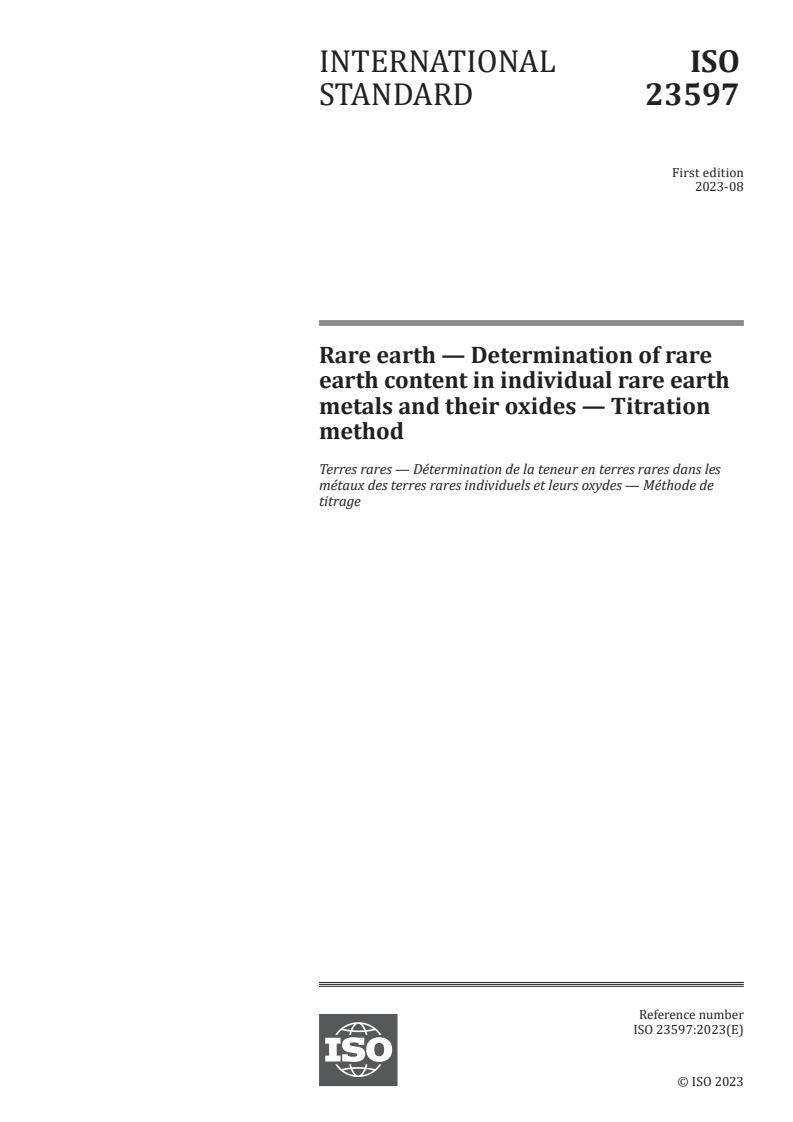
INTERNATIONAL ISO
STANDARD 23597
First edition
2023-08
Rare earth — Determination of rare
earth content in individual rare earth
metals and their oxides — Titration
method
Terres rares — Détermination de la teneur en terres rares dans les
métaux des terres rares individuels et leurs oxydes — Méthode de
titrage
Reference number
© ISO 2023
All rights reserved. Unless otherwise specified, or required in the context of its implementation, no part of this publication may
be reproduced or utilized otherwise in any form or by any means, electronic or mechanical, including photocopying, or posting on
the internet or an intranet, without prior written permission. Permission can be requested from either ISO at the address below
or ISO’s member body in the country of the requester.
ISO copyright office
CP 401 • Ch. de Blandonnet 8
CH-1214 Vernier, Geneva
Phone: +41 22 749 01 11
Email: copyright@iso.org
Website: www.iso.org
Published in Switzerland
ii
Contents Page
Foreword .iv
Introduction .v
1 Scope . 1
2 Normative references . 1
3 Terms and definitions . 1
4 Principle . 3
5 Reagents . 3
6 Apparatus . 5
7 Sample preparation .5
8 Procedure .5
8.1 Test portion . 5
8.2 Dissolution . . 5
8.3 Titration. 6
9 Calculation and expression of results . 6
9.1 Calculation of results . 6
9.2 Precision . . . 7
10 Test report . 8
Annex A (informative) Information on the precision test . 9
Bibliography .10
iii
Foreword
ISO (the International Organization for Standardization) is a worldwide federation of national standards
bodies (ISO member bodies). The work of preparing International Standards is normally carried out
through ISO technical committees. Each member body interested in a subject for which a technical
committee has been established has the right to be represented on that committee. International
organizations, governmental and non-governmental, in liaison with ISO, also take part in the work.
ISO collaborates closely with the International Electrotechnical Commission (IEC) on all matters of
electrotechnical standardization.
The procedures used to develop this document and those intended for its further maintenance are
described in the ISO/IEC Directives, Part 1. In particular, the different approval criteria needed for the
different types of ISO document should be noted. This document was drafted in accordance with the
editorial rules of the ISO/IEC Directives, Part 2 (see www.iso.org/directives).
ISO draws attention to the possibility that the implementation of this document may involve the use
of (a) patent(s). ISO takes no position concerning the evidence, validity or applicability of any claimed
patent rights in respect thereof. As of the date of publication of this document, ISO had not received
notice of (a) patent(s) which may be required to implement this document. However, implementers are
cautioned that this may not represent the latest information, which may be obtained from the patent
database available at www.iso.org/patents. ISO shall not be held responsible for identifying any or all
such patent rights.
Any trade name used in this document is information given for the convenience of users and does not
constitute an endorsement.
For an explanation of the voluntary nature of standards, the meaning of ISO specific terms and
expressions related to conformity assessment, as well as information about ISO's adherence to
the World Trade Organization (WTO) principles in the Technical Barriers to Trade (TBT), see
www.iso.org/iso/foreword.html.
This document was prepared by Technical Committee ISO/TC 298, Rare earth.
Any feedback or questions on this document should be directed to the user’s national standards body. A
complete listing of these bodies can be found at www.iso.org/members.html.
iv
Introduction
Individual rare earth metals and their oxides are both materials containing only one kind of rare earth
element. They are refined and separated rare earth products, which are widely used as the feedstock
for making downstream products in the rare earth industry. In the products, there exist trace non-rare
earth impurities including some carbonates, oxalates and moisture. Some of them (such as Ca, Si, Fe)
come from raw materials and others (such as Fe) come from industrial processes of rare earth metal
from the electrolytic process.
Rare earth content refers to the mass fraction of all rare earth elements in the material. It is an
important chemical composition index to determine the quality of the individual rare earth metals
and their oxides. A scientific and standardized method to determine the rare earth content, which is
used to price the product in trading, is helpful to reduce variability and to improve the consistency and
comparability of interlaboratory results, consequently facilitating the fair trade of rare earth products.
The document aims to supply a classic titration method for the determination of rare earth content
for individual rare earth metals and their oxides, which can be adopted by rare earth producers,
consumers, traders and other stakeholders.
v
INTERNATIONAL STANDARD ISO 23597:2023(E)
Rare earth — Determination of rare earth content in
individual rare earth metals and their oxides — Titration
method
WARNING — The use of this document can involve hazardous materials, operations and
equipment. This document does not purport to address any safety problems associated with
its use. It is the responsibility of the user of this document to establish appropriate safety and
health practices and determine the applicability of regulatory limitations prior to use.
1 Scope
This document specifies a titration method for the determination of rare earth content in 15 kinds of
individual rare earth metals (lanthanum, cerium, praseodymium, neodymium, samarium, europium,
gadolinium, terbium, dysprosium, holmium, erbium, thulium, ytterbium, lutetium and yttrium) and
their oxides.
The determination ranges for the rare earth content in mass fraction are as follows:
— rare earth metal: 98,0 % (mass fraction) to 99,5 % (mass fraction);
— rare earth oxide: 95,0 % (mass fraction) to 99,5 % (mass fraction).
It does not apply to individual rare earth metals and their oxides when:
a) the relative rare earth purity is less than 99,5 % in mass fraction;
b) the total content of various (non-rare earth) metallic elements is greater than 0,5 % in mass
fraction;
c) the content of thorium, scandium or zinc is greater than 0,1 % in mass fraction.
2 Normative references
There are no normative references in this document.
3 Terms and definitions
For the purposes of this document, the following terms and definitions apply.
ISO and IEC maintain terminology databases for use in standardization at the following addresses:
— ISO Online browsing platform: available at https:// www .iso .org/ obp
— IEC Electropedia: available at https:// www .electropedia .org/
3.1
rare earth content
total rare earth content
mass fraction of rare earths in the material
Note 1 to entry: For rare earth oxides and other compounds, the fraction is generally provided as a percentage of
rare earth oxide, i.e. % REO or % TREO. For metals and alloys, the content is generally provided as a percentage
of rare earth metal, i.e. % REM or % TREM.
Note 2 to entry: For rare earth oxides and other compounds, the formula of the rare earth content is RE O except
2 3
for CeO , Pr O and Tb O .
2 6 11 4 7
[SOURCE: ISO 22444-1:2020, 3.7, modified — Note 2 to entry added.]
3.2
rare earth content (original basis)
rare earth content (3.1) of a material as contained in the original as-received sample that has not
undergone any treatment
3.3
rare earth content (dry basis)
rare earth content (3.1) of a material as contained in the sample subjected to drying in air at 105 °C for
1 h
3.4
rare earth content (ignition basis)
rare earth content (3.1) of a material as contained in the sample subjected to ignition in air at 950 °C for
1 h
3.5
individual rare earth metal
metallic substance containing only one rare earth element, including La, Ce, Pr, Nd, Pm, Sm, Eu, Gd, Tb,
Dy, Ho, Er, Tm, Yb, Lu, Sc and Y
Note 1 to entry: It is assumed that the relative purity of an individual rare earth metal is at least 99,5 %.
Note 2 to entry: Pm and Sc are not within the scope of this document.
[SOURCE: ISO 22444-2:2020, 4.2, modified — Note 1 to entry deleted. New Notes 1 and 2 to entry
added.]
3.6
individual rare earth oxide
chemical compound containing one rare earth element and the oxygen element
Note 1 to entry: It is assumed that the relative rare earth purity (3.7) of an individual rare earth oxide is at least
99,5 %.
3.7
relative rare earth purity
mass fraction of the specified rare earth element or rare earth oxide out of the rare earth content (3.1)
Note 1 to entry: It is expressed as a percentage with the basis (REM or REO) stated.
[SOURCE: ISO 22444-1:2020, 3.13]
3.8
permissible tolerance
α
alternative expressions for precision parameters, including r (repeatability limit), R (intralaboratory
w
reproducibility limit) and R (interlaboratory reproducibility limit)
Note 1 to entry: Permissible tolerances replace precision parameters only when the precision parameters are
independent of the level.
Note 2 to entry: Permissible tolerances can be expressed as α(s ), α(s ) and α(s ) and calculated by using the
r Rw R
following formula from ISO/TR 21074:2016, 6.6.5:
n
αβ=×28,
i
∑
n
i=1
where
β is the statistical values of s , s and s for each level;
r Rw R
i is the identifier for each level;
n is the number of levels.
4 Principle
The samples are dissolved in acid solutions. Rare earth ions are titrated and complexed quantitatively
at pH 5,5 with a standard EDTA solution and xylenol orange as an indicator after masking coexisting
non-rare earth ions such as iron, etc. with sulfosalicylic acid.
5 Reagents
WARNING — Concentrated acids and alkalis are corrosive and their vapours irritate the mucous
membranes. Users should consult the safety data sheet and safety labelling for each reagent
before using. Care shall be taken to avoid any type of contact during use. Appropriate protective
equipment shall be worn when working with concentrated acids and alkalis. All the procedures
involving acids and alkalis shall be carried out in a fume hood.
...
Questions, Comments and Discussion
Ask us and Technical Secretary will try to provide an answer. You can facilitate discussion about the standard in here.
Loading comments...