

ISO/TS 11672:2016
(Main)Connectors for fluid power and general use — Designation and nomenclature
General Information
- Abstract
ISO/TS 11672:2016 collects the various designation and nomenclature schemes specified in International Standards for connectors and similar products standardized by ISO/TC 131/SC 4. It establishes a uniform nomenclature structure to facilitate standardization of product names used for threaded connectors, push-in connectors, flanges, hose fittings, port plugs and quick-action couplings. The designation and nomenclature established in this document are applicable for procurement purposes when agreed to by user and supplier.
- Status
- Published
- Publication Date
- 01-Sep-2016
- Technical Committee
- ISO/TC 131/SC 4 - Connectors and similar products and components
- Current Stage
- 9093 - International Standard confirmed
- Start Date
- 04-Jun-2024
- Completion Date
- 29-Aug-2026
Buy Documents
ISO/TS 11672:2016 - Connectors for fluid power and general use — Designation and nomenclature Released:9/2/2016
ISO/TS 11672:2016 - Connectors for fluid power and general use — Designation and nomenclature/2/2016
Overview
ISO/TS 11672:2016 - Connectors for fluid power and general use - Designation and nomenclature - collects and harmonizes the designation and nomenclature schemes used in ISO connector standards developed by ISO/TC 131/SC 4. The Technical Specification defines a uniform, alphanumeric system for naming and ordering threaded connectors, push‑in connectors, flanges, hose fittings, port plugs and quick‑action couplings. Its naming rules are intended for procurement, part identification and international standardization when agreed between user and supplier.
Key topics and technical requirements
- Uniform designation format: a structured sequence - connector name, reference to the relevant ISO standard (ISO XXXX), type/shape letter symbols, size code, and material/seal symbols.
- Type and shape symbols: predefined letter symbols (e.g., SD for stud, SW for swivel, E for 90° elbow, T for tee) listed in normative tables and Annex A (index of symbols).
- Size coding rules:
- Tube and hose end sizes in millimetres (use multiplication symbol × to separate multiple end sizes).
- Threaded stud notation: metric (M + size), BSP (G + size + A tolerance class), UN/UNF (size + UN/UNF).
- Ordering precedence rules for unions, tees and crosses (larger-run sizes first; stud before hose ends, etc.).
- Duty (working pressure) symbols: extra light‑duty (LL), light‑duty (L), heavy‑duty (S).
- Material and seal symbols: connector materials (S = steel, B = copper/alloys, SS = stainless steel) and seal materials (N = NBR, H = HNBR, E = EPDM, F = FKM).
- Ordering conventions: exact punctuation rules (hyphens, multiplication symbol, no spaces around those separators) to facilitate unambiguous procurement.
- Annexes:
- Annex A (normative): alphabetical index of letter symbols.
- Annex B (informative): application examples.
- Annex C (informative): correlation of SAE dash sizes to ISO connector, tube and hose sizes.
Applications and who uses it
ISO/TS 11672:2016 is used by:
- Design and engineering teams specifying hydraulic and pneumatic connectors.
- Procurement and purchasing to create unambiguous part codes for international supply chains.
- Manufacturers and suppliers for consistent product naming and catalogs.
- Maintenance and spare‑parts management to ensure correct replacements.
- Standards committees and technical authors aligning multiple ISO connector standards.
Practical uses include creating purchase orders, parts lists, CAD/BOM entries, and technical documentation where consistent connector designation and nomenclature prevents miscommunication across suppliers and regions.
Related standards
ISO/TS 11672:2016 references and harmonizes with connector standards from ISO/TC 131/SC 4 such as ISO 8434 series (tube connectors), ISO 12151 series (hose fittings), ISO 6162 (flanges), and others - see the document tables and annexes for cross‑references and examples.
Relations
- Effective Date
- 06-Jun-2022
Buy Documents
ISO/TS 11672:2016 - Connectors for fluid power and general use — Designation and nomenclature Released:9/2/2016
ISO/TS 11672:2016 - Connectors for fluid power and general use — Designation and nomenclature/2/2016
Get Certified
Connect with accredited certification bodies for this standard

Institut za varilstvo d.o.o. (Welding Institute)
Slovenia's leading welding institute since 1952. ISO 3834, EN 1090, pressure equipment certification, NDT personnel, welder qualification. Only IIW Au
Sponsored listings
Frequently Asked Questions
ISO/TS 11672:2016 is a technical specification published by the International Organization for Standardization (ISO). Its full title is "Connectors for fluid power and general use — Designation and nomenclature". This standard covers: ISO/TS 11672:2016 collects the various designation and nomenclature schemes specified in International Standards for connectors and similar products standardized by ISO/TC 131/SC 4. It establishes a uniform nomenclature structure to facilitate standardization of product names used for threaded connectors, push-in connectors, flanges, hose fittings, port plugs and quick-action couplings. The designation and nomenclature established in this document are applicable for procurement purposes when agreed to by user and supplier.
ISO/TS 11672:2016 collects the various designation and nomenclature schemes specified in International Standards for connectors and similar products standardized by ISO/TC 131/SC 4. It establishes a uniform nomenclature structure to facilitate standardization of product names used for threaded connectors, push-in connectors, flanges, hose fittings, port plugs and quick-action couplings. The designation and nomenclature established in this document are applicable for procurement purposes when agreed to by user and supplier.
ISO/TS 11672:2016 is classified under the following ICS (International Classification for Standards) categories: 01.040.23 - Fluid systems and components for general use (Vocabularies); 23.100.40 - Piping and couplings. The ICS classification helps identify the subject area and facilitates finding related standards.
ISO/TS 11672:2016 has the following relationships with other standards: It is inter standard links to ISO 14819-1:2021. Understanding these relationships helps ensure you are using the most current and applicable version of the standard.
ISO/TS 11672:2016 is available in PDF format for immediate download after purchase. The document can be added to your cart and obtained through the secure checkout process. Digital delivery ensures instant access to the complete standard document.
Standards Content (Sample)
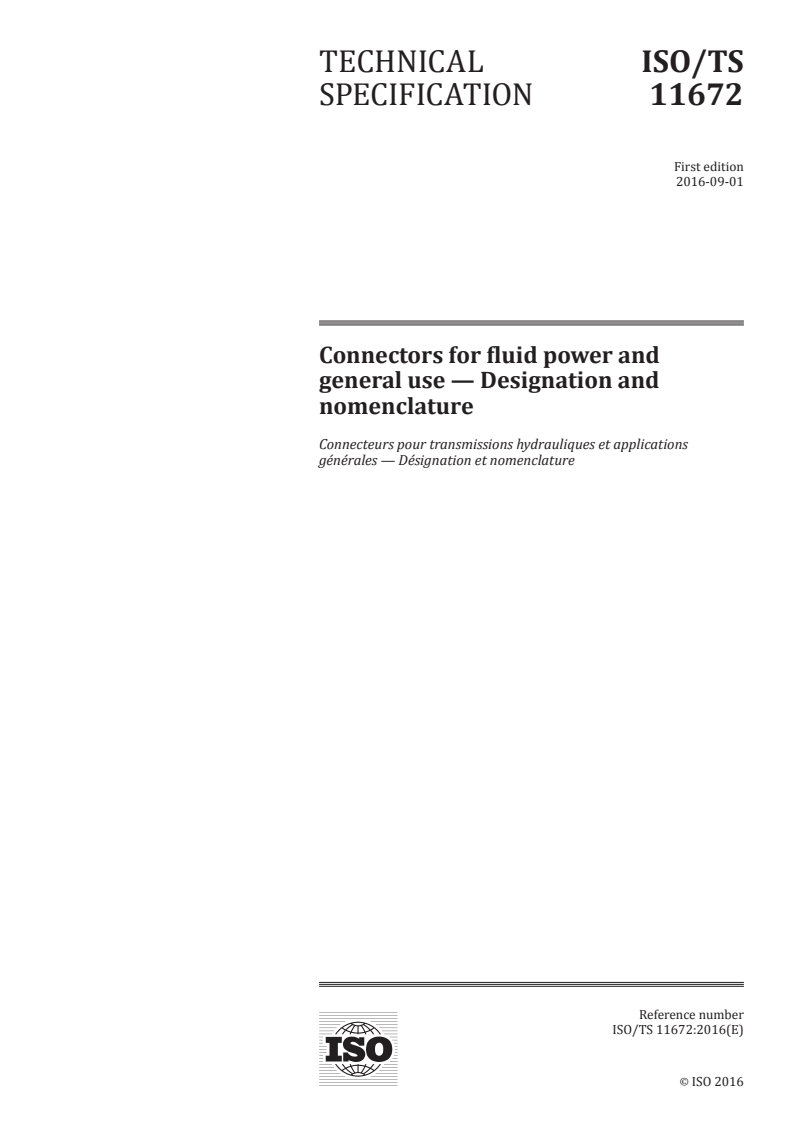
TECHNICAL ISO/TS
SPECIFICATION 11672
First edition
2016-09-01
Connectors for fluid power and
general use — Designation and
nomenclature
Connecteurs pour transmissions hydrauliques et applications
générales — Désignation et nomenclature
Reference number
©
ISO 2016
© ISO 2016, Published in Switzerland
All rights reserved. Unless otherwise specified, no part of this publication may be reproduced or utilized otherwise in any form
or by any means, electronic or mechanical, including photocopying, or posting on the internet or an intranet, without prior
written permission. Permission can be requested from either ISO at the address below or ISO’s member body in the country of
the requester.
ISO copyright office
Ch. de Blandonnet 8 • CP 401
CH-1214 Vernier, Geneva, Switzerland
Tel. +41 22 749 01 11
Fax +41 22 749 09 47
copyright@iso.org
www.iso.org
ii © ISO 2016 – All rights reserved
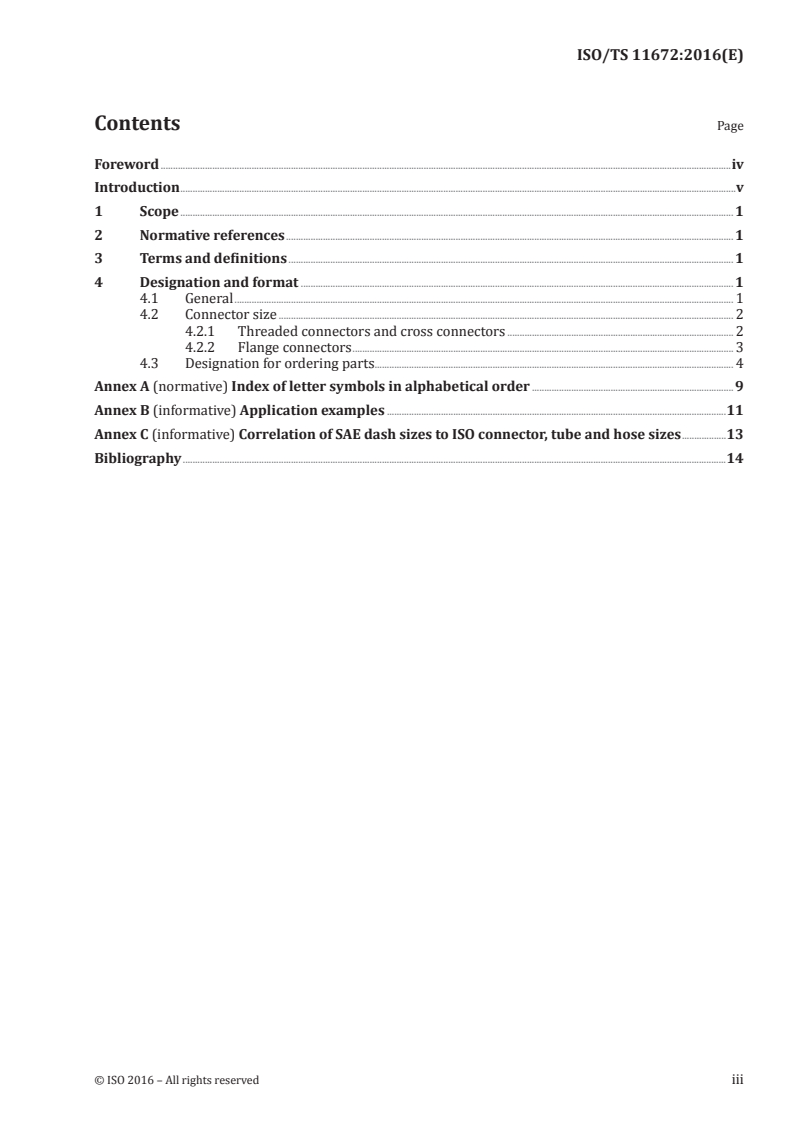
Contents Page
Foreword .iv
Introduction .v
1 Scope . 1
2 Normative references . 1
3 Terms and definitions . 1
4 Designation and format . 1
4.1 General . 1
4.2 Connector size . 2
4.2.1 Threaded connectors and cross connectors . 2
4.2.2 Flange connectors . 3
4.3 Designation for ordering parts . 4
Annex A (normative) Index of letter symbols in alphabetical order . 9
Annex B (informative) Application examples .11
Annex C (informative) Correlation of SAE dash sizes to ISO connector, tube and hose sizes .13
Bibliography .14
Foreword
ISO (the International Organization for Standardization) is a worldwide federation of national standards
bodies (ISO member bodies). The work of preparing International Standards is normally carried out
through ISO technical committees. Each member body interested in a subject for which a technical
committee has been established has the right to be represented on that committee. International
organizations, governmental and non-governmental, in liaison with ISO, also take part in the work.
ISO collaborates closely with the International Electrotechnical Commission (IEC) on all matters of
electrotechnical standardization.
The procedures used to develop this document and those intended for its further maintenance are
described in the ISO/IEC Directives, Part 1. In particular the different approval criteria needed for the
different types of ISO documents should be noted. This document was drafted in accordance with the
editorial rules of the ISO/IEC Directives, Part 2 (see www.iso.org/directives).
Attention is drawn to the possibility that some of the elements of this document may be the subject of
patent rights. ISO shall not be held responsible for identifying any or all such patent rights. Details of
any patent rights identified during the development of the document will be in the Introduction and/or
on the ISO list of patent declarations received (see www.iso.org/patents).
Any trade name used in this document is information given for the convenience of users and does not
constitute an endorsement.
For an explanation on the meaning of ISO specific terms and expressions related to conformity assessment,
as well as information about ISO’s adherence to the World Trade Organization (WTO) principles in the
Technical Barriers to Trade (TBT) see the following URL: www.iso.org/iso/foreword.html.
The committee responsible for this document is ISO/TC 131, Fluid power systems, Subcommittee SC 4,
Connectors and similar products and components.
iv © ISO 2016 – All rights reserved
Introduction
In fluid power systems, power is transmitted and controlled through a fluid (liquid or gas) under
pressure within an enclosed circuit. In general applications, a fluid can be conveyed under pressure.
Components can be connected through their ports by connections (connectors) and conductors (tubes
and hoses). Tubes are rigid conductors; hoses are flexible conductors.
Annexes A and B are normative; Annex C is informative.
TECHNICAL SPECIFICATION ISO/TS 11672:2016(E)
Connectors for fluid power and general use — Designation
and nomenclature
1 Scope
This document collects the various designation and nomenclature schemes specified in International
Standards for connectors and similar products standardized by ISO/TC 131/SC 4. It establishes a
uniform nomenclature structure to facilitate standardization of product names used for threaded
connectors, push-in connectors, flanges, hose fittings, port plugs and quick-action couplings.
The designation and nomenclature established in this document are applicable for procurement
purposes when agreed to by user and supplier.
2 Normative references
The following documents are referred to in the text in such a way that some or all of their content
constitutes requirements of this document. For dated references, only the edition cited applies. For
undated references, the latest edition of the referenced document (including any amendments) applies.
There are no normative references in this document.
3 Terms and definitions
ISO and IEC maintain terminological databases for use in standardization at the following addresses:
— IEC Electropedia: available at http://www.electropedia.org/
— ISO Online browsing platform: available at http://www.iso.org/obp
4 Designation and format
4.1 General
Designations use the format shown in Figure 1 when specifying a part for procurement to International
Standards for connectors developed by ISO/TC 131/SC 4. Tube ends are assumed, so there is no type
symbol for unions. When multiple end types are required to describe a threaded connector type, use
the stud end first, when applicable (e.g. SDSWS). If there is no stud end, the description of the part shall
dictate the designation order (e.g. WDRDNP for a weld-on reducing nipple).
Key
1 connector name – the name for the part (for example, connector, hose fitting, coupling, etc.) from the standard.
2 connector standard number – the term “ISO” and the number of the relevant International Standard.
3 connector type designation – the abbreviated designation consists of symbol for connector end type (Table 1)
followed by, when needed, symbol for connector shape (Table 2) followed by symbol for complete connector
(Table 3), if so ordered.
4 connector size – see 5.2.
5 connector material symbol (Table 7) followed by seal material symbol (Table 8), where applicable.
Figure 1 — System for designating and specifying a part
4.2 Connector size
The appropriate size designator for the connector end(s) from the relevant International Standard.
4.2.1 Threaded connectors and cross connectors
The following general rules shall apply:
— larger tube end size shall precede the smaller one for straight unions and union elbows;
— tube end size shall precede that of stud, hose, or other ends of the connector;
— male tube end shall precede female (swivel) tube end;
— for tee connectors, designation shall start with the size of the larger end on the run followed by the
size of the branch;
— if the tee connector has a swivel, it shall be designated first, and on run tees the branch size
shall follow;
— for cross connectors, leg with the largest tube end size shall be considered the run and the other
the branch;
— the sequence shall be run sizes (large followed by small) followed by branch sizes (large followed
by small);
2 © ISO 2016 – All rights reserved
— for tube or hose ends, the size of tube or hose in millimetres is used (for 8434-1 connectors the size
is followed by the duty symbol (Table 4));
— for stud ends with metric threads, symbol “M” followed by thread size (without pitch) followed by
the duty symbol (Table 4), followed by type of sealing (Table 5), e.g. M14LB for M14×1,5 light duty
stud with metal-to metal sealing.
— for stud ends with BSP threads, symbol “G” followed by thread size in inches followed by “A”
(tolerance class), followed by duty symbol, followed by type of sealing, e.g. G1/4ASE for heavy duty
stud end with G1/4 BSP threads and elastomeric sealing;
— for stud ends with UN/UNF threads, thread size in inches (without pitch) followed by UN or UNF, as
appropriate, followed by duty symbol (no sealing type is needed as only O-ring sealing is used with
these threads).
4.2.2 Flange connectors
For split flange clamps, FCS, the letter M if the split flange clamps are used with metric screws only,
followed by a dash and the nominal size.
4.2.2.1 FCS-25 and FCSM-32
Most split flange clamps accept both inch and metric screws and shall use FCS. Those that only accept
inch screws shall use FCS and those that accept metric screws only shall use FCSM.
For one-piece flange clamps, FC, the letter M if the one-piece flange clamps are used with metric screws
only, followed by a dash and the nominal size e.g. FC-25 or FCM-32.
Most one-piece flange clamps accept both inch and metric screws and shall use FC. Those that only
accept inch screws shall use FC and those that accept metric screws only shall use FCM
— For flange ports, P, followed by a dash and the nominal size and the letter M if the flange ports use
metric screws e.g. P-76 or P-76M
— For flange heads, FH, followed by a dash and the nominal size e.g. FH-76
4.2.2.2 Push-in connectors
For tube ends, the outside diameter of the tubes with which they are to be connected, if all tubes are the
same size, otherwise the largest and then the smallest each separated by a multiplication symbol (×).
For stud ends, the outside diameter of the tubes with which they are to be connected, followed by the
stud end thread designation separated by a multiplication symbol (×).
4.2.2.3 Hose fittings
For ISO 12151-1, ISO 12151-5 and ISO 12151-6 hose fittings, the connection size, followed by a
multiplication symbol (×) and the hose size e.g. 12×12,5.
For ISO 12151-2, ISO 12151-3 and ISO 12151-4 hose fittings, the duty symbol, the connection size,
followed by a multiplication symbol (×) and the hose size e.g. L22×19.
4.2.2.4 Port plugs
Same as the stud ends for threaded connectors (see 5.2.1).
4.2.2.5 Quick-action couplings
Since are no connector styles, only the coupling series (A, B, or C) and the nominal coupling diameter
are required there.
4.3 Designation for ordering parts
Connectors, hose fittings, port plugs, flanges, push-in fittings and quick-action couplings are designated
by an alphanumeric code to facilitate ordering. They are designated by the connector name and a space,
followed by reference to the relevant standard (ISO XXXX), followed by a hyphen, then the type letter
symbols (connector type and shape, where applicable), followed by a hyphen and followed by the size
code (tube/hose/flange end and/or thread size designators) for the ends, followed by hyphen and
followed by connector and seal (if applicable) material symbols.
Size designators for connector ends shall be separated by a multiplication symbol (×). There shall be no
spaces on either side of the hyphens or the multiplication symbol.
See Tables 1 through 9 for the alpha-numeric symbols to be used.
Annex A provides an index of the letter symbols used in alphabetical order.
Annex B provides examples of how the designation system is applied.
Annex C provides correlation of SAE dash sizes to ISO connector, tube and hose sizes.
Table 1 — Letter symbols to be used in designating connector types for fluid power and
general use
Tube connectors
Letter
Connector type Hose fittings
symbol
Threaded Flange Push-in
Banjo BJ 14743
Bulkhead BH 8434-1 14743
8434-2
8434-3
8434-6
Braze-on BR 8434-1
8434-3
Cap CP 8434-1
8434-2
8434-3
Plug PL 8434-1 14743
8434-2
8434-3
Port P 6162-1 14743
6162-2
Reducer RD 8434-1
8434-2
Reducer with nut RDA
8434-6
Reducer without nut RDB
8434-3
8434-3
Stud SD 8434-1 14743 12151-4
8434-2
8434-3
8434-6
Swivel SW 8434-1 14743 12151-2
8434-2 12151-5
With sealing surface SWA
8434-6 12151-6
not exposed
SWB
With sealing surface 8434-3 12151-1
exposed
8434-3 12151-1
Swivel with O-ring SWO 8434-1
Swivel bulkhead SWBH 14743
4 © ISO 2016 – All rights reserved
ISO/TS 11672:20
...
TECHNICAL ISO/TS
SPECIFICATION 11672
First edition
2016-09-01
Connectors for fluid power and
general use — Designation and
nomenclature
Connecteurs pour transmissions hydrauliques et applications
générales — Désignation et nomenclature
Reference number
©
ISO 2016
© ISO 2016, Published in Switzerland
All rights reserved. Unless otherwise specified, no part of this publication may be reproduced or utilized otherwise in any form
or by any means, electronic or mechanical, including photocopying, or posting on the internet or an intranet, without prior
written permission. Permission can be requested from either ISO at the address below or ISO’s member body in the country of
the requester.
ISO copyright office
Ch. de Blandonnet 8 • CP 401
CH-1214 Vernier, Geneva, Switzerland
Tel. +41 22 749 01 11
Fax +41 22 749 09 47
copyright@iso.org
www.iso.org
ii © ISO 2016 – All rights reserved
Contents Page
Foreword .iv
Introduction .v
1 Scope . 1
2 Normative references . 1
3 Terms and definitions . 1
4 Designation and format . 1
4.1 General . 1
4.2 Connector size . 2
4.2.1 Threaded connectors and cross connectors . 2
4.2.2 Flange connectors . 3
4.3 Designation for ordering parts . 4
Annex A (normative) Index of letter symbols in alphabetical order . 9
Annex B (informative) Application examples .11
Annex C (informative) Correlation of SAE dash sizes to ISO connector, tube and hose sizes .13
Bibliography .14
Foreword
ISO (the International Organization for Standardization) is a worldwide federation of national standards
bodies (ISO member bodies). The work of preparing International Standards is normally carried out
through ISO technical committees. Each member body interested in a subject for which a technical
committee has been established has the right to be represented on that committee. International
organizations, governmental and non-governmental, in liaison with ISO, also take part in the work.
ISO collaborates closely with the International Electrotechnical Commission (IEC) on all matters of
electrotechnical standardization.
The procedures used to develop this document and those intended for its further maintenance are
described in the ISO/IEC Directives, Part 1. In particular the different approval criteria needed for the
different types of ISO documents should be noted. This document was drafted in accordance with the
editorial rules of the ISO/IEC Directives, Part 2 (see www.iso.org/directives).
Attention is drawn to the possibility that some of the elements of this document may be the subject of
patent rights. ISO shall not be held responsible for identifying any or all such patent rights. Details of
any patent rights identified during the development of the document will be in the Introduction and/or
on the ISO list of patent declarations received (see www.iso.org/patents).
Any trade name used in this document is information given for the convenience of users and does not
constitute an endorsement.
For an explanation on the meaning of ISO specific terms and expressions related to conformity assessment,
as well as information about ISO’s adherence to the World Trade Organization (WTO) principles in the
Technical Barriers to Trade (TBT) see the following URL: www.iso.org/iso/foreword.html.
The committee responsible for this document is ISO/TC 131, Fluid power systems, Subcommittee SC 4,
Connectors and similar products and components.
iv © ISO 2016 – All rights reserved
Introduction
In fluid power systems, power is transmitted and controlled through a fluid (liquid or gas) under
pressure within an enclosed circuit. In general applications, a fluid can be conveyed under pressure.
Components can be connected through their ports by connections (connectors) and conductors (tubes
and hoses). Tubes are rigid conductors; hoses are flexible conductors.
Annexes A and B are normative; Annex C is informative.
TECHNICAL SPECIFICATION ISO/TS 11672:2016(E)
Connectors for fluid power and general use — Designation
and nomenclature
1 Scope
This document collects the various designation and nomenclature schemes specified in International
Standards for connectors and similar products standardized by ISO/TC 131/SC 4. It establishes a
uniform nomenclature structure to facilitate standardization of product names used for threaded
connectors, push-in connectors, flanges, hose fittings, port plugs and quick-action couplings.
The designation and nomenclature established in this document are applicable for procurement
purposes when agreed to by user and supplier.
2 Normative references
The following documents are referred to in the text in such a way that some or all of their content
constitutes requirements of this document. For dated references, only the edition cited applies. For
undated references, the latest edition of the referenced document (including any amendments) applies.
There are no normative references in this document.
3 Terms and definitions
ISO and IEC maintain terminological databases for use in standardization at the following addresses:
— IEC Electropedia: available at http://www.electropedia.org/
— ISO Online browsing platform: available at http://www.iso.org/obp
4 Designation and format
4.1 General
Designations use the format shown in Figure 1 when specifying a part for procurement to International
Standards for connectors developed by ISO/TC 131/SC 4. Tube ends are assumed, so there is no type
symbol for unions. When multiple end types are required to describe a threaded connector type, use
the stud end first, when applicable (e.g. SDSWS). If there is no stud end, the description of the part shall
dictate the designation order (e.g. WDRDNP for a weld-on reducing nipple).
Key
1 connector name – the name for the part (for example, connector, hose fitting, coupling, etc.) from the standard.
2 connector standard number – the term “ISO” and the number of the relevant International Standard.
3 connector type designation – the abbreviated designation consists of symbol for connector end type (Table 1)
followed by, when needed, symbol for connector shape (Table 2) followed by symbol for complete connector
(Table 3), if so ordered.
4 connector size – see 5.2.
5 connector material symbol (Table 7) followed by seal material symbol (Table 8), where applicable.
Figure 1 — System for designating and specifying a part
4.2 Connector size
The appropriate size designator for the connector end(s) from the relevant International Standard.
4.2.1 Threaded connectors and cross connectors
The following general rules shall apply:
— larger tube end size shall precede the smaller one for straight unions and union elbows;
— tube end size shall precede that of stud, hose, or other ends of the connector;
— male tube end shall precede female (swivel) tube end;
— for tee connectors, designation shall start with the size of the larger end on the run followed by the
size of the branch;
— if the tee connector has a swivel, it shall be designated first, and on run tees the branch size
shall follow;
— for cross connectors, leg with the largest tube end size shall be considered the run and the other
the branch;
— the sequence shall be run sizes (large followed by small) followed by branch sizes (large followed
by small);
2 © ISO 2016 – All rights reserved
— for tube or hose ends, the size of tube or hose in millimetres is used (for 8434-1 connectors the size
is followed by the duty symbol (Table 4));
— for stud ends with metric threads, symbol “M” followed by thread size (without pitch) followed by
the duty symbol (Table 4), followed by type of sealing (Table 5), e.g. M14LB for M14×1,5 light duty
stud with metal-to metal sealing.
— for stud ends with BSP threads, symbol “G” followed by thread size in inches followed by “A”
(tolerance class), followed by duty symbol, followed by type of sealing, e.g. G1/4ASE for heavy duty
stud end with G1/4 BSP threads and elastomeric sealing;
— for stud ends with UN/UNF threads, thread size in inches (without pitch) followed by UN or UNF, as
appropriate, followed by duty symbol (no sealing type is needed as only O-ring sealing is used with
these threads).
4.2.2 Flange connectors
For split flange clamps, FCS, the letter M if the split flange clamps are used with metric screws only,
followed by a dash and the nominal size.
4.2.2.1 FCS-25 and FCSM-32
Most split flange clamps accept both inch and metric screws and shall use FCS. Those that only accept
inch screws shall use FCS and those that accept metric screws only shall use FCSM.
For one-piece flange clamps, FC, the letter M if the one-piece flange clamps are used with metric screws
only, followed by a dash and the nominal size e.g. FC-25 or FCM-32.
Most one-piece flange clamps accept both inch and metric screws and shall use FC. Those that only
accept inch screws shall use FC and those that accept metric screws only shall use FCM
— For flange ports, P, followed by a dash and the nominal size and the letter M if the flange ports use
metric screws e.g. P-76 or P-76M
— For flange heads, FH, followed by a dash and the nominal size e.g. FH-76
4.2.2.2 Push-in connectors
For tube ends, the outside diameter of the tubes with which they are to be connected, if all tubes are the
same size, otherwise the largest and then the smallest each separated by a multiplication symbol (×).
For stud ends, the outside diameter of the tubes with which they are to be connected, followed by the
stud end thread designation separated by a multiplication symbol (×).
4.2.2.3 Hose fittings
For ISO 12151-1, ISO 12151-5 and ISO 12151-6 hose fittings, the connection size, followed by a
multiplication symbol (×) and the hose size e.g. 12×12,5.
For ISO 12151-2, ISO 12151-3 and ISO 12151-4 hose fittings, the duty symbol, the connection size,
followed by a multiplication symbol (×) and the hose size e.g. L22×19.
4.2.2.4 Port plugs
Same as the stud ends for threaded connectors (see 5.2.1).
4.2.2.5 Quick-action couplings
Since are no connector styles, only the coupling series (A, B, or C) and the nominal coupling diameter
are required there.
4.3 Designation for ordering parts
Connectors, hose fittings, port plugs, flanges, push-in fittings and quick-action couplings are designated
by an alphanumeric code to facilitate ordering. They are designated by the connector name and a space,
followed by reference to the relevant standard (ISO XXXX), followed by a hyphen, then the type letter
symbols (connector type and shape, where applicable), followed by a hyphen and followed by the size
code (tube/hose/flange end and/or thread size designators) for the ends, followed by hyphen and
followed by connector and seal (if applicable) material symbols.
Size designators for connector ends shall be separated by a multiplication symbol (×). There shall be no
spaces on either side of the hyphens or the multiplication symbol.
See Tables 1 through 9 for the alpha-numeric symbols to be used.
Annex A provides an index of the letter symbols used in alphabetical order.
Annex B provides examples of how the designation system is applied.
Annex C provides correlation of SAE dash sizes to ISO connector, tube and hose sizes.
Table 1 — Letter symbols to be used in designating connector types for fluid power and
general use
Tube connectors
Letter
Connector type Hose fittings
symbol
Threaded Flange Push-in
Banjo BJ 14743
Bulkhead BH 8434-1 14743
8434-2
8434-3
8434-6
Braze-on BR 8434-1
8434-3
Cap CP 8434-1
8434-2
8434-3
Plug PL 8434-1 14743
8434-2
8434-3
Port P 6162-1 14743
6162-2
Reducer RD 8434-1
8434-2
Reducer with nut RDA
8434-6
Reducer without nut RDB
8434-3
8434-3
Stud SD 8434-1 14743 12151-4
8434-2
8434-3
8434-6
Swivel SW 8434-1 14743 12151-2
8434-2 12151-5
With sealing surface SWA
8434-6 12151-6
not exposed
SWB
With sealing surface 8434-3 12151-1
exposed
8434-3 12151-1
Swivel with O-ring SWO 8434-1
Swivel bulkhead SWBH 14743
4 © ISO 2016 – All rights reserved
ISO/TS 11672:20
...