


ISO 6707-3:2022
(Main)Buildings and civil engineering works — Vocabulary — Part 3: Sustainability terms
Buildings and civil engineering works — Vocabulary — Part 3: Sustainability terms
This document establishes preferred terms and definitions for concepts applicable to sustainability and sustainable development related to buildings and civil engineering works.
Titre manque — Partie 3: Titre manque
General Information
- Status
- Published
- Publication Date
- 29-Nov-2022
- Technical Committee
- ISO/TC 59/SC 2 - Terminology and harmonization of languages
- Current Stage
- 6060 - International Standard published
- Start Date
- 30-Nov-2022
- Due Date
- 09-Jan-2023
- Completion Date
- 30-Nov-2022
Relations
- Revises
ISO 6707-3:2017 - Buildings and civil engineering works — Vocabulary — Part 3: Sustainability terms - Effective Date
- 23-Apr-2020

Get Certified
Connect with accredited certification bodies for this standard

ICC Evaluation Service
Building products evaluation and certification.

QAI Laboratories
Building and construction product testing and certification.

Aboma Certification B.V.
Specialized in construction, metal, and transport sectors.
Sponsored listings
Frequently Asked Questions
ISO 6707-3:2022 is a standard published by the International Organization for Standardization (ISO). Its full title is "Buildings and civil engineering works — Vocabulary — Part 3: Sustainability terms". This standard covers: This document establishes preferred terms and definitions for concepts applicable to sustainability and sustainable development related to buildings and civil engineering works.
This document establishes preferred terms and definitions for concepts applicable to sustainability and sustainable development related to buildings and civil engineering works.
ISO 6707-3:2022 is classified under the following ICS (International Classification for Standards) categories: 01.040.91 - Construction materials and building (Vocabularies); 91.010.20 - Contractual aspects. The ICS classification helps identify the subject area and facilitates finding related standards.
ISO 6707-3:2022 has the following relationships with other standards: It is inter standard links to ISO 6707-3:2017. Understanding these relationships helps ensure you are using the most current and applicable version of the standard.
ISO 6707-3:2022 is available in PDF format for immediate download after purchase. The document can be added to your cart and obtained through the secure checkout process. Digital delivery ensures instant access to the complete standard document.
Standards Content (Sample)
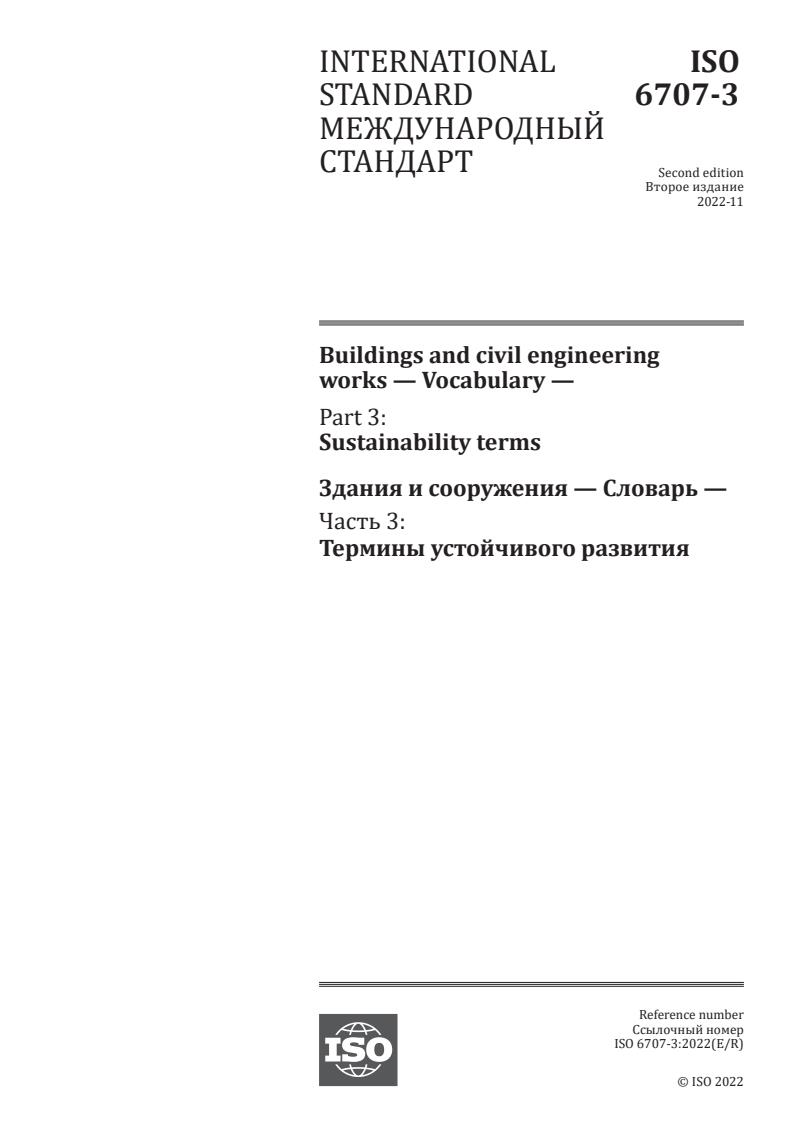
INTERNATIONAL ISO
STANDARD 6707-3
МЕЖДУНАРОДНЫЙ
СТАНДАРТ
Second edition
Второе издание
2022-11
Buildings and civil engineering
works — Vocabulary —
Part 3:
Sustainability terms
Здания и сооружения — Словарь —
Часть 3:
Термины устойчивого развития
Reference number
Ссылочный номер
ДОКУМЕНТ ЗАЩИЩЕН АВТОРСКИМ ПРАВОМ
© ISO 2022
All rights reserved. Unless otherwise specified, or required in the context of its implementation, no part of this publication may
be reproduced or utilized otherwise in any form or by any means, electronic or mechanical, including photocopying, or posting on
the internet or an intranet, without prior written permission. Permission can be requested from either ISO at the address below
or ISO’s member body in the country of the requester.
Все права защищены. Если не указано иное или в ходе реализации, никакую часть настоящей публикации нельзя
копировать или использовать в какой -либо форме или каким-либо электронным или механическим способом, включая
фотокопирование, или размещение в сети интернет или интранет, без предварительного письменного согласия
ISO. Запрос о разрешении может быть направлен по адресу, приведенному ниже, или в комитет – член ISO в стране
запрашивающей стороны.
ISO copyright office
CP 401 • Ch. de Blandonnet 8
CH-1214 Vernier, Geneva
Tel. + 41 22 749 01 11
E-mail copyright@iso.org
Web www.iso.org
Published in Switzerland
Опубликовано в Швейцарии
ii
© ISO 2022 – All rights reserved/Все права сохраняются
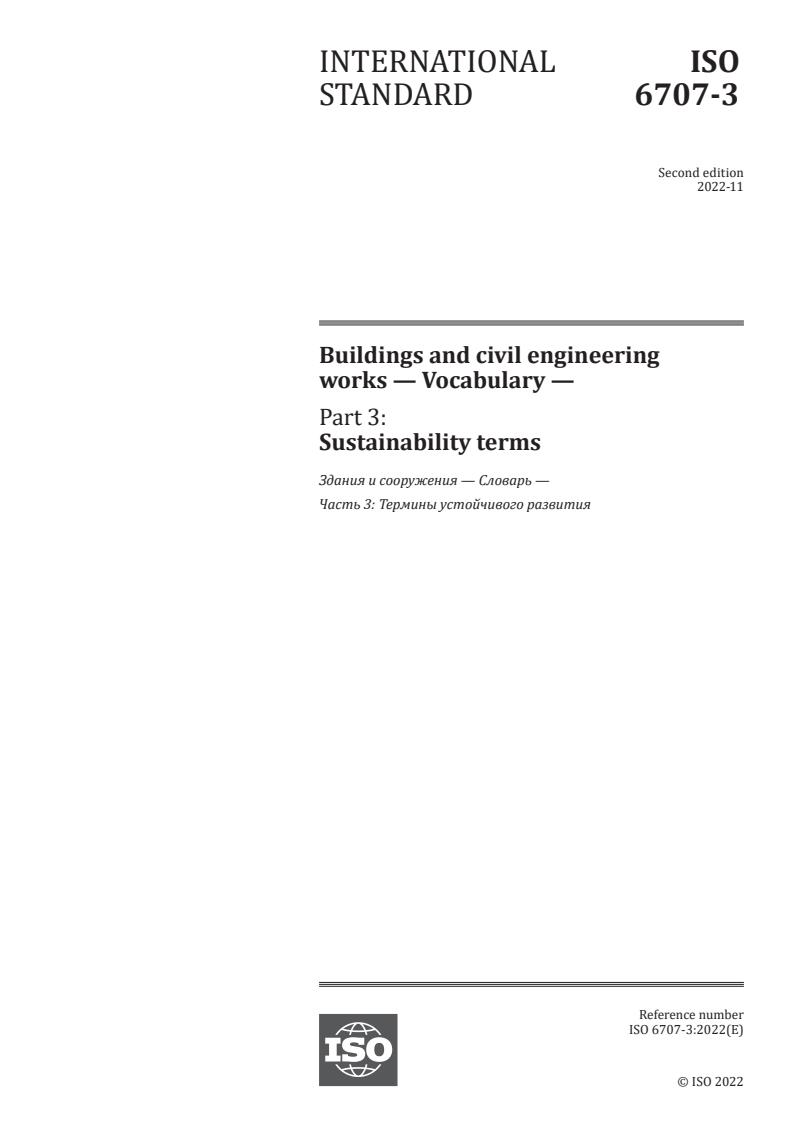
INTERNATIONAL ISO
STANDARD 6707-3
Second edition
2022-11
Buildings and civil engineering
works — Vocabulary —
Part 3:
Sustainability terms
Здания и сооружения — Словарь —
Часть 3: Термины устойчивого развития
Reference number
© ISO 2022
All rights reserved. Unless otherwise specified, or required in the context of its implementation, no part of this publication may
be reproduced or utilized otherwise in any form or by any means, electronic or mechanical, including photocopying, or posting on
the internet or an intranet, without prior written permission. Permission can be requested from either ISO at the address below
or ISO’s member body in the country of the requester.
ISO copyright office
CP 401 • Ch. de Blandonnet 8
CH-1214 Vernier, Geneva
Phone: +41 22 749 01 11
Email: copyright@iso.org
Website: www.iso.org
Published in Switzerland
ii
Contents Page
Foreword .iv
Introduction .v
1 Scope . 1
2 Normative references . 1
3 Terms and definitions . 1
3.1 Base terms . 1
3.2 Objects . 4
3.3 Equipment, products, systems . 5
3.4 Activities, processes, methods, persons . 7
3.5 Resources for construction works . 11
3.6 Energy and renewable energy resources .12
3.7 Data, information, documents . 15
3.8 Life cycle planning . . 19
3.9 Greenhouse gases, emissions, global warming, conditions and phenomena.22
3.10 Ability, performance, indicators, requirements and measures . 26
Bibliography .31
Index .33
iii
Foreword
ISO (the International Organization for Standardization) is a worldwide federation of national standards
bodies (ISO member bodies). The work of preparing International Standards is normally carried out
through ISO technical committees. Each member body interested in a subject for which a technical
committee has been established has the right to be represented on that committee. International
organizations, governmental and non-governmental, in liaison with ISO, also take part in the work.
ISO collaborates closely with the International Electrotechnical Commission (IEC) on all matters of
electrotechnical standardization.
The procedures used to develop this document and those intended for its further maintenance are
described in the ISO/IEC Directives, Part 1. In particular, the different approval criteria needed for the
different types of ISO documents should be noted. This document was drafted in accordance with the
editorial rules of the ISO/IEC Directives, Part 2 (see www.iso.org/directives).
Attention is drawn to the possibility that some of the elements of this document may be the subject of
patent rights. ISO shall not be held responsible for identifying any or all such patent rights. Details of
any patent rights identified during the development of the document will be in the Introduction and/or
on the ISO list of patent declarations received (see www.iso.org/patents).
Any trade name used in this document is information given for the convenience of users and does not
constitute an endorsement.
For an explanation of the voluntary nature of standards, the meaning of ISO specific terms and
expressions related to conformity assessment, as well as information about ISO's adherence to
the World Trade Organization (WTO) principles in the Technical Barriers to Trade (TBT), see
www.iso.org/iso/foreword.html.
This document was prepared by Technical Committee ISO/TC 59, Buildings and civil engineering works,
Subcommitee SC 2, Terminology and harmonization of languages, in collaboration with Technical
Committee ISO/TC 59, Buildings and civil engineering works, Subcommitee SC 17, Sustainability in
buildings and civil engineering works.
This second edition cancels and replaces the first edition (ISO 6707-3:2017), which has been technically
revised.
The main changes are as follows:
— some ambiguous concepts have been clarified;
— terms defined in ISO/TC 59/SC17 standards but not included in the previous edition have been
added;
— alignment with definitions in ISO/TC 59/SC 17 standards has been improved;
— reference has been made to definitions in the recently published ISO 14050;
— the method of connecting definitions with ISO 6707-1 has been changed;
— the edition is published in English and Russian.
This document is intended to be used in conjunction with ISO 6707-1.
A list of all parts in the ISO 6707 series can be found on the ISO website.
Any feedback or questions on this document should be directed to the user’s national standards body. A
complete listing of these bodies can be found at www.iso.org/members.html.
iv
Introduction
With the growth in the number of international construction projects and the development of the
international market in construction products, there is an increasing need for agreement on a common
language.
This document establishes preferred terms and concepts related to sustainability for buildings and
other types of construction works. Communication is important to the implementation and operation
of the concept of sustainable development related to building and civil engineering. In the interest of
common understanding and standardization, consistent word usage is encouraged to help eliminate
the major barrier to effective technical communication.
This document presents a mix of terms and definitions, some of which are repeated from other ISO
publications, while others are those that have been derived from ISO standards on environmental
management and environmental life cycle assessment. Derivations have been performed carefully in
order to maintain the original intention, but to enable interpretation in the context of sustainability
and sustainable development related to buildings and civil engineering works.
This document does not contain a complete list of terms relevant to the thematic field, but focuses
on concepts that have been standardized and/or applied through publication of individual standards
within ISO/TC 59/SC 17 and on terms and definitions of concepts frequently encountered in the
literature related to sustainability in buildings and other types of construction works.
Attention has been paid to how the terms selected have been used in ISO standards and European
standards so as to maintain the original intention.
A related vocabulary on terms under ISO/TC 268, ISO 37100, focuses on concepts that have been
standardized and/or applied through publications within ISO/TC 268.
Where terms are used in definitions to designate concepts that are defined elsewhere in this document,
the relevant terms are presented in italics and the term number is given after the relevant term.
To facilitate the locating of any term given in the document, irrespective of preference or country of
origin, the alphabetical index lists all preferred and admitted terms.
v
INTERNATIONAL STANDARD ISO 6707-3:2022(E)
Buildings and civil engineering works — Vocabulary —
Part 3:
Sustainability terms
1 Scope
This document establishes preferred terms and definitions for concepts applicable to sustainability and
sustainable development related to buildings and civil engineering works.
2 Normative references
There are no normative references in this document.
3 Terms and definitions
ISO and IEC maintain terminology databases for use in standardization at the following addresses:
— ISO Online browsing platform: available at https:// www .iso .org/ obp
— IEC Electropedia: available at https:// www .electropedia .org/
3.1 Base terms
3.1.1
sustainable development
development that meets the environmental, social and economic needs of the present without
compromising the ability of future generations to meet their own needs
[SOURCE: ISO Guide 82:2019, 3.2, modified — Note 1 to entry has been deleted.]
3.1.2
sustainability
state of the global system, including environmental (3.10.3), social (3.10.4) and economic aspects (3.10.5),
in which the needs of the present are met without compromising the ability of future generations to
meet their own needs
Note 1 to entry: The environmental, social and economic aspects interact, and are interdependent and are often
referred to as the three dimensions of sustainability.
[SOURCE: ISO Guide 82:2019, 3.1, modified — Note 2 to entry has been deleted.]
3.1.3
built environment
collection of man-made or induced physical objects
Note 1 to entry: When treated as a whole, the built environment typically is taken to include buildings, external
works (landscaped areas) and other construction works within the area under consideration.
3.1.4
technosphere
sphere or realm of human technological activity
Note 1 to entry: Technosphere includes the technologically modified environment.
Note 2 to entry: Primary resources are acquired or extracted from the natural part of the geosphere (unaffected
by humans). These primary resources are used in the technosphere and result in emissions to the environment.
Note 3 to entry: For definition of geosphere and biosphere, please refer to ISO 27914.
3.1.5
impact
result of a change or existing condition that may be adverse, neutral or beneficial
[SOURCE: ISO 15392:2019, 3.17]
3.1.6
combustion
confined and controlled burning process
Note 1 to entry: Combustion can not only decrease the volume of solid waste (3.1.22) destined for landfill (3.4.7),
but can also recover energy from waste.
Note 2 to entry: The key difference between combustion and incineration is that combustion includes the reaction
between substances and oxygen, which produces energy, whereas incineration is the destruction of something
via burning.
3.1.7
freshwater
water having a low concentration of dissolved solids
Note 1 to entry: Freshwater typically contains less than 1 000 mg/l of dissolved solids and is generally accepted
as suitable for withdrawal and conventional treatment to produce potable water.
Note 2 to entry: The concentration of total dissolved solids can vary considerably over space and/or time.
[SOURCE: ISO 21930:2017, 3.6.9]
3.1.8
consumption of freshwater
net freshwater (3.1.7) entering the product system (3.8.17) being studied that is not returned to the
same drainage basin (3.2.8) from which it originated
[SOURCE: ISO 21930:2017, 3.6.10]
3.1.9
grey water
waste water from household baths and showers, hand basins and kitchen sinks but excluding waste
water and excreta from water closets
[SOURCE: ISO 6107:2021, 3.259, modified — The alternative preferred term "sullage" has been deleted.]
3.1.10
black water
waste water and excreta from water closets, excluding water from baths, showers, hand basins and
sinks
[SOURCE: ISO 6107:2021, 3.78]
3.1.11
environmental quality standard
value, generally described by regulation, which specifies the maximum permissible concentration of a
potentially hazardous chemical in an environmental sample, generally of air or water
3.1.12
indoor air quality
quality of air inside a building, described in terms of odour, physical parameters, chemical and biological
pollutants
Note 1 to entry: Indoor air quality is directly related to the ventilation rate, air distribution patterns and pollution
sources.
Note 2 to entry: Indoor air quality is important in ensuring human health, olfactory comfort and perceived
comfort.
Note 3 to entry: Adapted from ISO 16813:2006, 3.21. The definition has been simplified to refer to a building
in general, versus only non-industrial buildings, and the non-essential but relevant characteristics are now
referenced in notes.
[SOURCE: ISO 16000-40:2019, 3.24]
3.1.13
indoor environmental quality
measure of a building’s internal environment in relation to the health, comfort and well-being of those
who use space within it
3.1.14
indoor acoustic comfort
occupant satisfaction with the indoor acoustic environment, described in terms of sound pressure level,
reverberation and noise level
[SOURCE: ISO 21929-1:2011, 3.3, modified — The word "indoor" has been added to the term; "reaction
of occupants to" has been replaced by "occupant satisfaction with"; "audibility" has been replaced by
"reverberation and noise level".]
3.1.15
indoor thermal comfort
occupant satisfaction with the indoor thermal environment, described in terms of air temperature,
vapour pressure and air velocity
3.1.16
indoor visual comfort
occupant satisfaction with the indoor visual environment, described in terms of illumination level,
glare, visibility, reflection and psychological and physiological content with natural and artificial
illumination
[SOURCE: ISO 16813:2006, 3.29, modified — The word "indoor" has been added to the term.]
3.1.17
circular economy
economy that is restorative and regenerative by design, and which aims to keep products, components
and materials at their highest utility and value at all times, distinguishing between technical and
biological cycles
[SOURCE: ISO 14009:2020, 3.1.8]
3.1.18
scenario
collection of assumptions and information relevant to possible future events
[SOURCE: ISO 21930:2017, 3.1.8]
3.1.19
sick building syndrome
non-specific symptoms of some building occupants associated with time spent in a building that
diminish or disappear when they leave the building
3.1.20
solar heat gain
heat provided by solar radiation entering, directly or indirectly (after absorption or building elements),
into the building through windows, opaque walls and roofs, or passive solar devices as sunspaces,
transparent (3.7.21) insulation and solar walls
[SOURCE: ISO 52000-1:2017, 3.6.10, modified — Note 1 to entry has been deleted.]
3.1.21
volatile organic compound
VOC
any organic liquid and/or solid that evaporates spontaneously at the prevailing temperature and
pressure of the atmosphere with which it is in contact
Note 1 to entry: The shortened term, VOC, is used as the primary preferred term in this document.
[SOURCE: ISO 21930:2017, 3.8.5]
3.1.22
waste
any material or object which the holder discards, or intends to discard, or is required to discard
[SOURCE: ISO 15270:2008, 3.34]
3.2 Objects
3.2.1
infrastructure
structure, such as a dam, bridge, road, railway, runway, utilities, pipeline, or
sewerage system, or the result of operations such as dredging, earthwork, but excluding a building and
its associated site works
[SOURCE: ISO 15392:2019, 3.6, modified — The alternative terms "civil engineering works" and
"civil engineering project, US" have been deleted; the words "construction works, comprising a" and
"geotechnical processes" have been deleted; note 1 to entry has been deleted.]
3.2.2
land take
total area of land required for construction works
[SOURCE: ISO/TS 21929-2:2015, 3.23, modified — "the civil engineering works" has been replaced by
"construction works".]
3.2.3
solar farm
large-scale photovoltaic installation that uses solar energy (3.6.21) to generate electricity and that
is connected to the electricity grid
3.2.4
tidal barrage
structure that captures and releases tidal water moving in and out of a bay or river
3.2.5
wind turbine
device that converts kinetic energy from the wind into electricity
3.2.6
wind farm
group of wind turbines (3.2.5) in the same location used to produce energy
Note 1 to entry: Wind farms can vary in size from a small number to several hundred wind turbines.
3.2.7
water body
entity of water with definite hydrological, hydrogeomorphological, physical, chemical and biological
characteristics in a given geographical area
EXAMPLE Lakes, rivers, groundwaters, seas, icebergs, glaciers and reservoirs.
3.2.8
drainage basin
area from which direct surface runoff from precipitation drains by gravity into a stream or other water
body (3.2.7)
[SOURCE: ISO 14050:2020, 3.10.23]
3.3 Equipment, products, systems
3.3.1
product
construction product
item manufactured or processed for incorporation into construction works
Note 1 to entry: Construction product is used as the primary preferred term in this document. Where the term
"product" refers to a product used in the construction works, the term "construction product" is used. Where the
term "product" has a wider connotation in a standard referred to, the term "product" is retained.
3.3.2
co-product
product (3.3.1) coming from the same unit process (3.4.22) or product system (3.8.17) as one or more
other products
Note 1 to entry: Where one of the co-products is an input to a process, this is normally considered as a product
input. Waste (3.1.22) from a unit process or product system is not a co-product.
[SOURCE: ISO 14050:2020, 3.5.13, modified — Note 1 to entry has been added.]
3.3.3
by-product
co-product (3.3.2) from a process that is incidental or not intentionally produced and which cannot be
avoided
Note 1 to entry: Waste (3.1.22) is distinguished as a non-product, so is not a by-product.
[SOURCE: ISO 21930:2017, 3.4.7, modified — Note 1 to entry has been changed from “Wastes are not by-
products”.]
3.3.4
heat pump
device that transfers heat energy from a source of heat to another space or for water heating
Note 1 to entry: A heat pump uses external power to accomplish the work of transferring energy from the heat
source.
Note 2 to entry: In common understanding heat pump involves four main components: a condenser, an expansion
valve, an evaporator and a compressor.
3.3.5
air-source heat pump
heat pump (3.3.4) that extracts heat from the outside air in order to provide space and water heating for
a building
3.3.6
ground source heat pump
heat pump (3.3.4) that extracts heat from the ground in order to provide space and water heating for a
building
3.3.7
photovoltaic array
two or more photovoltaic modules at one location that together provide a photovoltaic solar energy
(3.6.21) system
3.3.8
solar collector
device in which solar radiation is absorbed and converted to heat
3.3.9
heat exchanger
device built for efficient heat transfer from one medium to another
Note 1 to entry: Heat exchanger can be used in both heating and cooling processes.
3.3.10
biogas digester
air-tight tank in which biomass (3.6.7) is transformed into methane
3.3.11
condensing boiler
oil or gas boiler designed to make use of the latent heat released by condensation of water vapour in the
flue combustion
3.3.12
biomass boiler
boiler that burns logs, pellets or chips or other types of biomass (3.6.7) and is connected to a heating
and hot water system
3.3.13
wood-burning stove
heating appliance capable of burning wood fuel and wood-based biomass (3.6.7) fuel that consists of a
metallic closed fire container connected by ventilating pipes to a chimney or flue
3.3.14
compact fluorescent lamp
CFL
energy saving fluorescent lamp with a tube that is curved or folded to fit into the space of an
incandescent bulb, together with a compact electronic ballast in its base
3.3.15
light-emitting diode lamp
LED lamp
semiconductor-based light emitting device that produces light using one or more light-emitting diodes
3.3.16
light pipe
light tube
tube lined with reflective material to channel natural or artificial light into buildings or from one space
to another
Note 1 to entry: A light pipe or tube that channels only natural light is referred to as a daylight pipe or daylight
tube.
3.3.17
fuel cell
electrochemical device that generates electricity by the conversion of fuel and an oxidant without any
physical or chemical consumption of the electrodes or electrolyte without excessive heat generation
3.3.18
smart meter
energy meter that can both send and receive information using an external electronic communications
network
3.3.19
smart grid
electric grid system, which is characterized by the use of communication networks and the control of
grid components and loads
3.4 Activities, processes, methods, persons
3.4.1
demolition
removal by destructive means
EXAMPLE Demolition by pushing or pulling, fragmenting by crushing or shearing, implosion or rapid
progressive failure of construction works or their component parts.
[SOURCE: ISO 20887:2020, 3.11]
3.4.2
disassembly
non-destructive taking apart of a construction works into constituent materials or components
[SOURCE: ISO 20887:2020, 3.12, modified — “or construction asset” has been deleted; note 1 to entry
has been deleted.]
3.4.3
disposal
transformation of the state of construction works that is no longer of use or surplus to requirements
Note 1 to entry: Transformation can include, either individually or in some combination, the disassembly (3.4.2)
or demolition (3.4.1) of the object under consideration.
Note 2 to entry: Transformation can be performed for subsequent reuse (3.5.6) or recycling (3.4.21) or sending to
landfill (3.4.7) and incineration.
[SOURCE: ISO 21929-1:2011, 3.9, modified — “building or facility” has been replaced with “construction
works”; “or surplus to requirement” has been added; in note 1 to entry, "recycling" has been deleted;
“decommissioning, deconstruction and” has been replaced with “disassembly or”; note 2 to entry has
been added.]
3.4.4
energy retrofit
installation and/or implementation of energy conservation measure in an existing construction works
3.4.5
land use change
change in human use or management of land
[SOURCE: ISO 14055-1:2017, 3.2.7]
3.4.6
waste management
administrative and operational activities involved in the handling, pretreatment, treatment,
conditioning, transport, storage and disposal (3.4.3) of waste (3.1.22)
3.4.7
landfill
waste (3.1.22) disposal (3.4.3) site for the deposit of waste onto or into land under controlled or
regulated conditions
[SOURCE: ISO 21930:2017, 3.8.2]
3.4.8
waste recovery
retrieval or treatment of waste (3.1.22) for reuse (3.5.6) or recycling (3.4.21) as another product
3.4.9
rainwater harvesting
accumulation and deposition of rainwater for reuse (3.5.6) before it reaches the aquifer
Note 1 to entry: Uses include water for livestock or for irrigation.
3.4.10
reclamation
return of damaged, degraded or derelict land to beneficial use
[SOURCE: ISO 11074:2015, 2.2.11, modified — The alternative preferred term "rehabilitation" and note
1 to entry have been deleted.]
3.4.11
water resource management
activity of planning, developing, distributing and managing the optimum use of water resources
3.4.12
water withdrawal
anthropogenic removal of water from any water body (3.2.7) or drainage basin (3.2.8), either
permanently or temporarily
[SOURCE: ISO 14050:2020, 3.10.14]
3.4.13
environmental assessment
process to identify objectively the environmental aspects (3.10.3) and to determine the consequences of
past, current and expected future activities on the environment
3.4.14
environmental management
part of the management system used to manage environmental aspects (3.10.3), fulfil compliance with
environmental obligations and address environmental risks and opportunities
[SOURCE: ISO 14050:2020, 3.3.1, modified — The term has been changed from "environmental
management system"; the abbreviated term "EMS" has been removed; ”compliance obligations, and
address risks and opportunities” has been changed to “compliance with environmental obligations and
address environmental risk and opportunities”.]
3.4.15
carbonation
carbon dioxide reaction with cementitious products to form calcium carbonate
[SOURCE: ISO 21930:2017, 3.8.1]
3.4.16
downstream process
process that is carried out after the designated process in the stream of relevant processes
Note 1 to entry: Downstream in supply chain includes produced materials, wastes (3.1.22), emissions and sewage.
3.4.17
upstream process
process that is carried out before the designated process in the stream of relevant processes
Note 1 to entry: Upstream in supply chain includes sources that are used for production like energy, raw
materials, services and transport.
3.4.18
joint co-production process
process of producing a product and one or more co-products (3.3.2) or by-products (3.3.3) where the
proportion of outputs is not commonly changed or cannot be varied
[SOURCE: ISO 21930:2017, 3.4.8]
3.4.19
life cycle assessment
compilation and assessment of the inputs, outputs and the potential environmental impacts (3.9.14) of a
product system (3.8.17) throughout its life cycle
[SOURCE: ISO 14050:2020, 3.6.2, modified — The abbreviated term "LCA" has been deleted.]
3.4.20
PCR review
process whereby a third-party (3.4.32) panel verifies the product category rules (3.7.14)
[SOURCE: ISO14050: 2020, 3.7.13, modified — The alternative term "product category rules review" has
been removed.]
3.4.21
recycling
recovery operation by which waste (3.1.22) materials are reprocessed into products (3.3.1), materials
or substances whether for the original or other purposes
Note 1 to entry: It includes the reprocessing of organic material but does not include energy recovery and the
reprocessing into materials that are used as fuels or for backfilling operations.
3.4.22
unit process
smallest element considered in the life cycle inventory analysis (3.4.26) for which input and output data
are quantified
[SOURCE: ISO 14050:2020, 3.6.9]
3.4.23
environmental protection plan
plan providing an assessment of the environmental risks, the measures to be taken to minimize risks,
the point when corrective action will be taken, the type of action to be taken, and identifying those
responsible for monitoring and for taking action
[SOURCE: ISO 11074:2015, 6.1.7, modified — “associated with remediation” has been deleted.]
3.4.24
life-cycle costing
methodology for systematic economic evaluation of life-cycle costs over a period of analysis
Note 1 to entry: Life-cycle costing can address a period of analysis that covers the entire life cycle or (a) selected
stage(s) or periods of interest thereof.
[SOURCE: ISO 15686-5:2017, 3.1.8, modified — “as defined in the agreed scope” has been deleted.]
3.4.25
life cycle impact assessment
phase of life cycle assessment (3.4.19) aimed at understanding and evaluating the magnitude and
significance of the potential environmental impacts (3.9.14) for a product system (3.8.17) throughout the
life cycle of the product
[SOURCE: ISO 14040:2006, 3.4, modified — The abbreviated term "LCIA" has been deleted.]
3.4.26
life cycle inventory analysis
phase of life cycle assessment (3.4.19) involving the compilation and quantification of inputs and outputs
for a product (3.3.1) throughout its life cycle
[SOURCE: ISO 14050:2020, 3.6.3]
3.4.27
responsible sourcing
responsible sourcing of materials
sustainable approach to managing a product from the point at which its raw materials and energy are
extracted or harvested in their raw state through manufacturing and processing
Note 1 to entry: Responsible sourcing manages social (3.10.4), environmental (3.10.3) and/or economic aspects
(3.10.5).
Note 2 to entry: Responsible sourcing manages the supply chain.
3.4.28
zero waste
philosophy that encourages the design of resource life cycles so that waste (3.1.22) is eliminated and all
products are reused or recycled
3.4.29
lean construction
designing and constructing with the aim of using materials efficiently and decreasing time, effort, costs
and wastage in the construction works
3.4.30
verifier
competent person(s) or organization independent of sponsor or practitioner carrying out a sustainability
assessment, with responsibility for performing and reporting on a verification process
[SOURCE: ISO 14050:2020, 3.4.5, modified – “competent and independent persons or persons” has been
replaced with "competent person(s) or organization independent of sponsor or practitioner carrying
out a sustainability assessment.]
3.4.31
programme operator
body or bodies that conduct a sustainability (3.1.2) assessment programme
Note 1 to entry: Responsibilities, obligations and liability of operators differ depending on the programmes being
operated.
Note 2 to entry: The responsibilities of EPD (3.7.23) programme operators are summarized in ISO 14025:2006,
6.3.
3.4.32
third party
person or body not involved in scoping or conducting a sustainability study
3.4.33
footprint
metric(s) used to report life cycle assessment (3.4.19) results addressing an area of protection (3.9.6)
[SOURCE: ISO 14050:2020, 3.7.17, modified — “area of concern” has been changed to “area of protection”.]
3.5 Resources for construction works
3.5.1
materials recovery
recovery from previous use or from waste (3.1.22) derived from one product system (3.8.17) and used
as input to another product system
3.5.2
recovered material
material that has already been processed or used, then separated, diverted from previous use or
removed from a waste (3.1.22) stream in order to be recycled for usage as a product performing another
function, reused for the same purpose or used to substitute primary materials (3.5.5)
3.5.3
renewable resource
resource that is grown, naturally replenished or cleansed on a human time scale
EXAMPLE Trees in forests, grasses in grasslands and fertile soil, wind.
Note 1 to entry: A renewable resource is capable of being exhausted but can last indefinitely with proper
stewardship.
Note 2 to entry: Activities that occur in the technosphere (3.1.4) such as recycling (3.4.21) are not considered
natural replenishment or cleansing.
Note 3 to entry: In this context, human time scale refers to a measurement based on the typical life time of a
human rather than the time humans have been in existence.
[SOURCE: ISO 21930:2017, 3.6.2, modified — In note 3 to entry, “a measurement based on” has been
added.]
3.5.4
non-renewable resource
resource that exists in a fixed amount that cannot be naturally replenished or cleansed on a human
time scale
Note 1 to entry: Activities that occur in the technosphere (3.1.4) such as recycling (3.4.21) are not considered
natural replenishment or cleansing.
Note 2 to entry: In this context, human time scale refers to measurement based on the typical life time of a human
rather than the time humans have been in existence.
[SOURCE: ISO 21930:2017, 3.6.3, modified — In note 2 to entry, “measurement based on” has been
added; note 3 to entry has been deleted.]
3.5.5
primary material
virgin raw material
material which has never been processed into any form of end-use product
[SOURCE: ISO 21067-2:2015, 2.4.4, modified — The term has been changed from "primary raw
material".]
3.5.6
reuse
operation by which products or components are used again
Note 1 to entry: The definition is a modification of that in Directive 2008/98/EC.
3.6 Energy and renewable energy resources
3.6.1
energy source
source from which useful energy can be extracted or recovered either directly or by means of a
conversion or transformation process
EXAMPLE Oil or gas fields, coal mines, sun, wind, the ground [geothermal energy (3.6.14)], the ocean [tidal
energy (3.6.17), ocean thermal energy], forests etc.
[SOURCE: ISO 52000-1:2017, 3.4.15]
3.6.2
exported energy
energy supplied by the technical building systems through the system boundary (3.8.11)
Note 1 to entry: Exported energy can also come from manufacturing processes or from waste (3.1.22) treatment
processes, such as electricity from municipal waste treatment plants or landfill (3.4.7) gases.
[SOURCE: ISO 52000-1:2017, 3.4.20, modified — In the definition, “assessment boundary” has been
replaced by “system boundary”; “expressed per energy carrier” has been deleted; note 1 to entry and
note 2 to entry have been deleted; a new note 1 to entry has been added.]
3.6.3
secondary fuel
fuel recovered from previous use or from waste (3.1.22), derived from a previous product system
(3.8.17) and used as an input in another product system
Note 1 to entry: Processes providing a secondary fuel are considered from the point where the secondary fuel
enters the product system from a previous product system.
Note 2 to entry: Secondary fuels can be recovered from previous use or from wastes such as solvents, wood,
tyres, oil, animal fats.
Note 3 to entry: Secondary fuels can be renewable or non-renewable, depending on the status of the material
before it became waste.
[SOURCE: ISO 21930:2017, 3.6.5, modified — In note 1 to entry, “(i.e., system boundary)” has been
deleted.]
3.6.4
low-carbon energy source
source of power which produces fewer greenhouse gases than other means of power generation
3.6.5
fossil fuel
carbonaceous material derived from geological deposits, including coal, peat, natural gas and liquid fuel
3.6.6
carbon-based fuel
fuel whose energy derives principally from the oxidation or burning of carbon
Note 1 to entry: Carbon-based fuels include fossil fuels (3.6.5) that are extracted and biofuels (3.6.10) that are
harvested or waste plastics, waste textiles, meat and bone meal etc.
3.6.7
biomass
material of biological origin excluding material embedded in geological formations, peat and material
transformed to fossilized material
[SOURCE: ISO 14050:2020, 3.8.25]
3.6.8
biobased
derived from biomass (3.6.7)
[SOURCE: ISO 21930:2017, 3.7.4]
3.6.9
biodiesel
fuel comprised of mono-alkyl esters of fatty acids, derived from vegetable oils or animal fats
3.6.10
biofuel
fuel derived from biomass (3.6.7)
3.6.11
biogenic
produced in natural processes by living organisms but not fossilized or derived from fossil resources
[SOURCE: ISO 21930:2017, 3.7.1]
3.6.12
embodied energy
total of all the energy used in the processes associated with the extraction, production, transportation,
installation, use, refurbishment, replacement and disposal at the end of life of products (3.3.1) and
services, but excluding the energy used for operation
3.6.13
energy-from-waste
thermal waste (3.1.22) treatment process in which energy is produced in the form of steam, electricity
and hot water
3.6.13.1
waste to energy
conversion of waste (3.1.22) materials for which no recycling (3.4.21) demand exists diverted from a
landfill (3.4.7) into usable heat, electricity, or fuel through a variety of processes, including combustion
(3.1.6), gasification, pyrolization, anaerobic digestion, and landfill gas (3.9.34) recovery
Note 1 to entry: If the product initially sent to waste is recycled, then energy-from-waste (3.6.13) can be a
secondary product.
3.6.14
geothermal energy
energy emitted from within the Earth’s crust, usually obtained from hot water or steam
3.6.15
hydro energy
electrical energy derived from turbines being spun by flowing water
3.6.16
ocean energy
energy, usually electrical energy, obtained by harnessing the energy in tides, waves and thermal
gradients in the oceans
[SOURCE: US Energy Information Administration. Glossary]
3.6.17
tidal energy
useable energy from the kinetic energy of water flowing into and out of tidal areas
3.6.18
wave energy
useable energy from the kinetic energy of waves
3.6.19
wind power
use of wind to provide mechanical power through wind turbines (3.2.5) to turn electric generators
Note 1 to entry: Traditionally wind power does other work, like milling or pumping.
3.6.20
nuclear energy
electricity generated by the use of thermal energy released from the fission of nuclear fuel in a reactor
[SOURCE: US Energy Information Administration. Glossary]
3.6.21
solar energy
radiant energy of the sun converted into other forms of energy, such as heat or electricity
3.6.22
primary energy
energy that has not been subjected to any conversion or transformation process
[SOURCE: ISO 16818:2008, 3.177, modified —– Notes 1 and 2 to entry have been deleted.]
3.6.23
delivered energy
amount of energy arriving at a location or an installation
Note 1 to entry: Delivered energy can be calculated for defined energy uses.
3.6.24
recovered energy
energy recovered from a process, including waste (3.1.22) treatment processes
Note 1 to entry: Recovered energy can be renewable or non-renewable, depending on the status of the resource
originally used to generate the energy.
3.6.25
renewable energy
energy from a renewable resource (3.5.3)
3.6.26
energy carrier
substance or phenomenon that can be used to produce mechanical work or heat or to operate chemical
or physical processes
[SOURCE: ISO 16745-1:2017, 3.7, modified — Notes to entry have been deleted.]
3.6.27
coefficient of performance
ratio of the rate of heat delivered or removed to the rate of energy input, in consistent units, for a
technical building system, under designated operating conditions
[SOURCE: ISO 16818:2008, 3.36, modified — The abbreviated term "COP" has been deleted; “or
removed” has been added; “complete heat pump” has been replaced with “technical building”; note 1 to
entry has been deleted.]
3.6.28
thermal mass
capacity of a material to store heat
3.6.29
combined heat and power
CHP
simultaneous generation of one process of thermal energy and electrical and/or mechanical energy
[SOURCE: ISO 52000-1:2017, 3.3.5, modified — The alternative preferred term "cogeneration" has been
deleted.]
3.6.30
cogeneration
energy conversion from the same source into two or more utilized forms of energy within one common
controlled process
Note 1 to entry: combined heat and power (3.6.29) is a specific implementation of cogeneration used for the
simultaneous production of heat and electricity.
[SOURCE: ISO/IEC 13273-1:2015, 3.1.8]
3.6.31
post-consumer recycled content
material generated by households or by commercial, industrial and institutional facilities in their role
as end-users of the product which can no longer be used for its intended purpose, including returns of
material from the distribution chain
[SOURCE: ISO 1382:2020, 3.373, modified — The alternative preferred term "post-consumer material"
and the abbreviated term "PCR" have been deleted.]
3.6.32
pre-consumer recycled content
material diverted from the waste (3.1.22) stream during a manufacturing process, excluding
reutilization of materials such as rework, regrind or scrap generated in a process and capable of being
reclaimed within the same process that generated it
[SOURCE: ISO 1382:2020, 3.375, modified — The term has been changed from "post-industrial recycled
content"; the alternative preferred term "pre-consumer material" and the abbreviated term "PIR" have
been deleted.]
3.6.33
feed-in tariff
tariff for surplus energy exported to the grid, applied by an energy supplier to someone who installs an
electricity generating technology from a renewable or low-carbon energy source (3.6.4)
Note 1 to entry: Typically, the customer is paid at cost-based price, for the energy supplied, although the
arrangements differ from one country to another.
3.6.34
green energy tariff
charge for
...
Questions, Comments and Discussion
Ask us and Technical Secretary will try to provide an answer. You can facilitate discussion about the standard in here.
Loading comments...