

ISO 26142:2010
(Main)Hydrogen detection apparatus — Stationary applications
General Information
- Abstract
ISO 26142:2010 defines the performance requirements and test methods of hydrogen detection apparatus that is designed to measure and monitor hydrogen concentrations in stationary applications. The provisions in ISO 26142:2010 cover the hydrogen detection apparatus used to achieve the single and/or multilevel safety operations, such as nitrogen purging or ventilation and/or system shut-off corresponding to the hydrogen concentration. The requirements applicable to the overall safety system, as well as the installation requirements of such apparatus, are excluded. ISO 26142:2010 sets out only the requirements applicable to a product standard for hydrogen detection apparatus, such as precision, response time, stability, measuring range, selectivity and poisoning. ISO 26142:2010 is intended to be used for certification purposes.
- Status
- Published
- Publication Date
- 13-May-2010
- Technical Committee
- ISO/TC 197 - Hydrogen technologies
- Drafting Committee
- ISO/TC 197 - Hydrogen technologies
- Current Stage
- 9060 - Close of review
- Completion Date
- 02-Sep-2031
Buy Documents
ISO 26142:2010 - Hydrogen detection apparatus -- Stationary applications
ISO 26142:2010 - Hydrogen detection apparatus — Stationary applications/14/2010
Overview
ISO 26142:2010 - Hydrogen detection apparatus - Stationary applications - is an international product standard that defines performance requirements and test methods for hydrogen detection apparatus intended to measure and monitor hydrogen concentrations in stationary installations. The standard is technology‑neutral and focused on the detector product itself (precision, response time, stability, measuring range, selectivity, poisoning), not on installation rules or the overall safety system. ISO 26142:2010 is intended for certification of hydrogen detection apparatus used to support single‑ or multilevel safety actions (e.g., ventilation, nitrogen purging, system shut‑off).
Key Topics and Technical Requirements
ISO 26142:2010 covers technical topics and test procedures relevant to reliable hydrogen sensing and detection:
- Measuring range and calibration - declared range for safe monitoring, plus calibration practices.
- Response time and recovery - standard response tests to verify fast detection and recovery behavior.
- Precision and stability - repeatability and long‑term drift under normal conditions.
- Selectivity and poisoning - immunity to interfering gases and degradation from contaminants.
- Alarm set point(s) - fixed or adjustable thresholds that trigger alarms or outputs.
- Aspirated vs diffusion sensors - requirements for sampling/aspiration methods and flow‑through testing.
- Environmental and robustness tests - temperature, pressure, humidity, vibration, orientation, and electromagnetic compatibility (EMC).
- Power supply resilience - behavior under voltage variations, interruptions and transients.
- Field calibration and maintenance - provisions for calibration kits and practical upkeep.
- Test methods include chamber and flow‑through methods (Annex A and B) and a defined sequence and sample preparation for testing.
Practical Applications and Who Uses ISO 26142
ISO 26142 is applied where controlled, reliable hydrogen monitoring is required:
- Hydrogen vehicle refuelling stations (primary focus)
- Hydrogen production, storage and handling facilities
- Industrial fixed installations and laboratory environments
- System integrators, sensor manufacturers, test laboratories and certification bodies use the standard to certify products for safety applications.
- Safety engineers and regulators rely on ISO 26142 to specify detector performance for multilevel safety operations (purging, ventilation, automatic shutdown).
Note: ISO 26142 defines detector performance and test methods only; installation, system design and operational safety requirements are outside its scope.
Related Standards (if applicable)
- ISO 14687-1 (hydrogen fuel quality)
- IEC 60079 series (explosive atmospheres)
- IEC 61000-4 series (EMC testing and immunity)
ISO 26142:2010 helps accelerate safe hydrogen infrastructure deployment by providing consistent, certifiable performance criteria for stationary hydrogen detection apparatus.
Relations
- Effective Date
- 09-Feb-2026
Buy Documents
ISO 26142:2010 - Hydrogen detection apparatus -- Stationary applications
ISO 26142:2010 - Hydrogen detection apparatus — Stationary applications/14/2010
Get Certified
Connect with accredited certification bodies for this standard

ECOCERT
Organic and sustainability certification.

Eurofins Food Testing Global
Global leader in food, environment, and pharmaceutical product testing.

Intertek Bangladesh
Intertek certification and testing services in Bangladesh.
Sponsored listings
Frequently Asked Questions
ISO 26142:2010 is a standard published by the International Organization for Standardization (ISO). Its full title is "Hydrogen detection apparatus — Stationary applications". This standard covers: ISO 26142:2010 defines the performance requirements and test methods of hydrogen detection apparatus that is designed to measure and monitor hydrogen concentrations in stationary applications. The provisions in ISO 26142:2010 cover the hydrogen detection apparatus used to achieve the single and/or multilevel safety operations, such as nitrogen purging or ventilation and/or system shut-off corresponding to the hydrogen concentration. The requirements applicable to the overall safety system, as well as the installation requirements of such apparatus, are excluded. ISO 26142:2010 sets out only the requirements applicable to a product standard for hydrogen detection apparatus, such as precision, response time, stability, measuring range, selectivity and poisoning. ISO 26142:2010 is intended to be used for certification purposes.
ISO 26142:2010 defines the performance requirements and test methods of hydrogen detection apparatus that is designed to measure and monitor hydrogen concentrations in stationary applications. The provisions in ISO 26142:2010 cover the hydrogen detection apparatus used to achieve the single and/or multilevel safety operations, such as nitrogen purging or ventilation and/or system shut-off corresponding to the hydrogen concentration. The requirements applicable to the overall safety system, as well as the installation requirements of such apparatus, are excluded. ISO 26142:2010 sets out only the requirements applicable to a product standard for hydrogen detection apparatus, such as precision, response time, stability, measuring range, selectivity and poisoning. ISO 26142:2010 is intended to be used for certification purposes.
ISO 26142:2010 is classified under the following ICS (International Classification for Standards) categories: 71.020 - Production in the chemical industry; 71.100.20 - Gases for industrial application. The ICS classification helps identify the subject area and facilitates finding related standards.
ISO 26142:2010 has the following relationships with other standards: It is inter standard links to EN ISO 22734-1:2025. Understanding these relationships helps ensure you are using the most current and applicable version of the standard.
ISO 26142:2010 is available in PDF format for immediate download after purchase. The document can be added to your cart and obtained through the secure checkout process. Digital delivery ensures instant access to the complete standard document.
Standards Content (Sample)
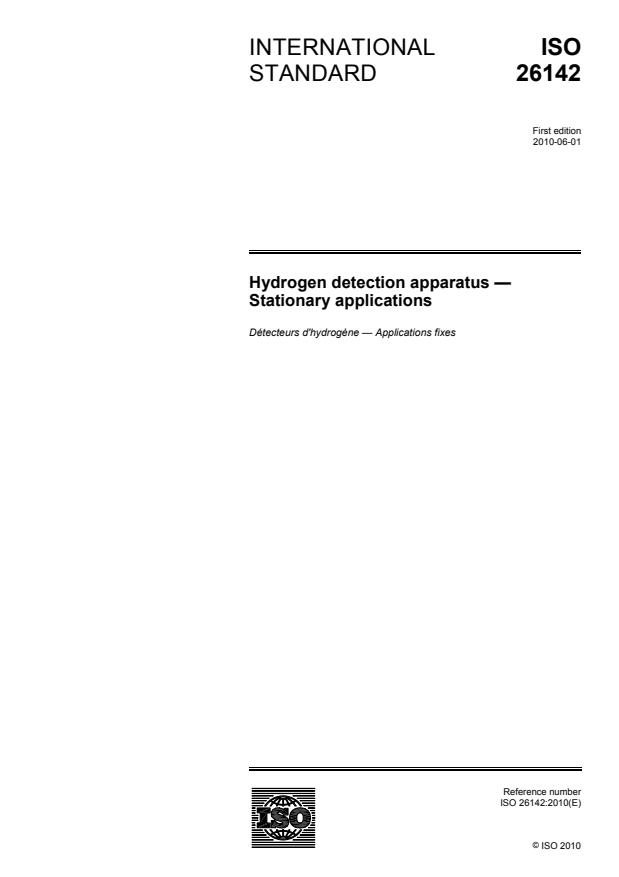
INTERNATIONAL ISO
STANDARD 26142
First edition
2010-06-01
Hydrogen detection apparatus —
Stationary applications
Détecteurs d'hydrogène — Applications fixes
Reference number
©
ISO 2010
PDF disclaimer
This PDF file may contain embedded typefaces. In accordance with Adobe's licensing policy, this file may be printed or viewed but
shall not be edited unless the typefaces which are embedded are licensed to and installed on the computer performing the editing. In
downloading this file, parties accept therein the responsibility of not infringing Adobe's licensing policy. The ISO Central Secretariat
accepts no liability in this area.
Adobe is a trademark of Adobe Systems Incorporated.
Details of the software products used to create this PDF file can be found in the General Info relative to the file; the PDF-creation
parameters were optimized for printing. Every care has been taken to ensure that the file is suitable for use by ISO member bodies. In
the unlikely event that a problem relating to it is found, please inform the Central Secretariat at the address given below.
© ISO 2010
All rights reserved. Unless otherwise specified, no part of this publication may be reproduced or utilized in any form or by any means,
electronic or mechanical, including photocopying and microfilm, without permission in writing from either ISO at the address below or
ISO's member body in the country of the requester.
ISO copyright office
Case postale 56 • CH-1211 Geneva 20
Tel. + 41 22 749 01 11
Fax + 41 22 749 09 47
E-mail copyright@iso.org
Web www.iso.org
Published in Switzerland
ii © ISO 2010 – All rights reserved
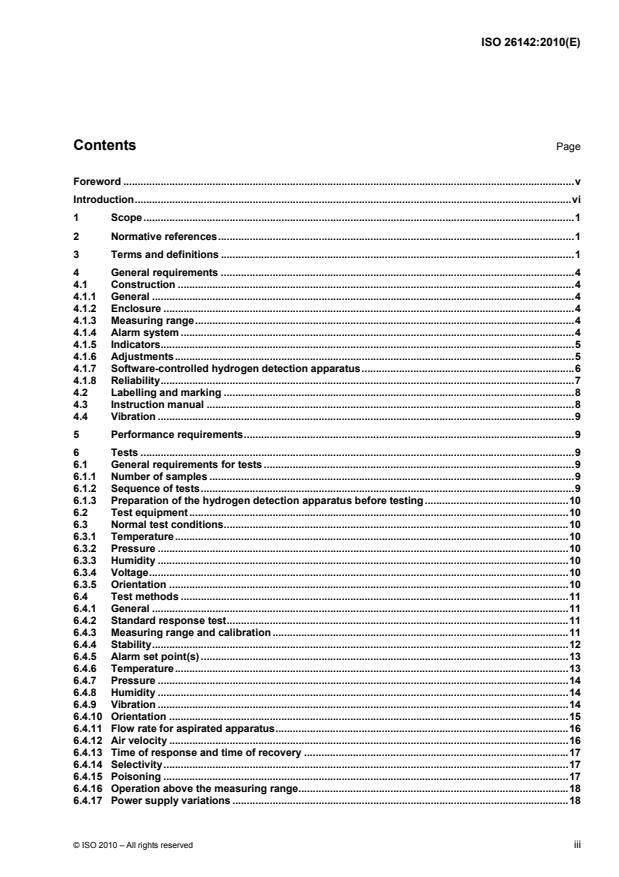
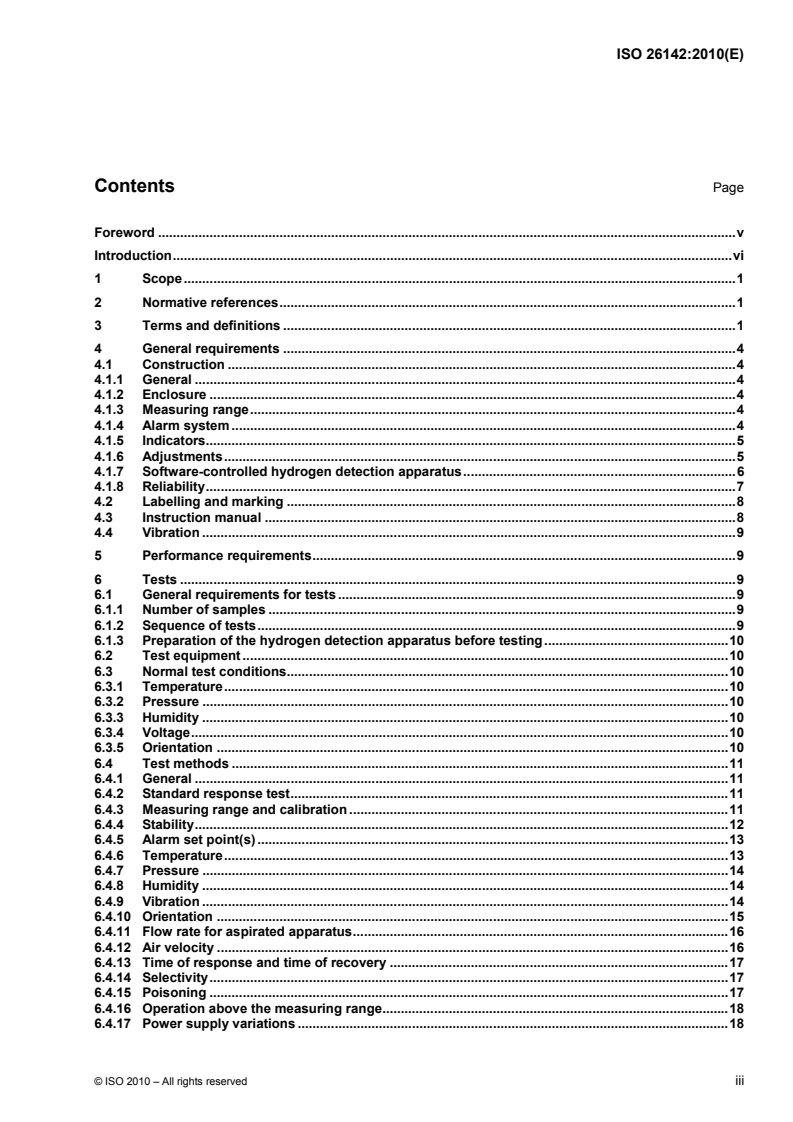
Contents Page
Foreword .v
Introduction.vi
1 Scope.1
2 Normative references.1
3 Terms and definitions .1
4 General requirements .4
4.1 Construction .4
4.1.1 General .4
4.1.2 Enclosure .4
4.1.3 Measuring range.4
4.1.4 Alarm system .4
4.1.5 Indicators.5
4.1.6 Adjustments.5
4.1.7 Software-controlled hydrogen detection apparatus.6
4.1.8 Reliability.7
4.2 Labelling and marking .8
4.3 Instruction manual .8
4.4 Vibration .9
5 Performance requirements.9
6 Tests .9
6.1 General requirements for tests .9
6.1.1 Number of samples .9
6.1.2 Sequence of tests.9
6.1.3 Preparation of the hydrogen detection apparatus before testing.10
6.2 Test equipment .10
6.3 Normal test conditions.10
6.3.1 Temperature.10
6.3.2 Pressure .10
6.3.3 Humidity .10
6.3.4 Voltage.10
6.3.5 Orientation .10
6.4 Test methods .11
6.4.1 General .11
6.4.2 Standard response test.11
6.4.3 Measuring range and calibration .11
6.4.4 Stability.12
6.4.5 Alarm set point(s) .13
6.4.6 Temperature.13
6.4.7 Pressure .14
6.4.8 Humidity .14
6.4.9 Vibration .14
6.4.10 Orientation .15
6.4.11 Flow rate for aspirated apparatus.16
6.4.12 Air velocity .16
6.4.13 Time of response and time of recovery .17
6.4.14 Selectivity.17
6.4.15 Poisoning .17
6.4.16 Operation above the measuring range.18
6.4.17 Power supply variations .18
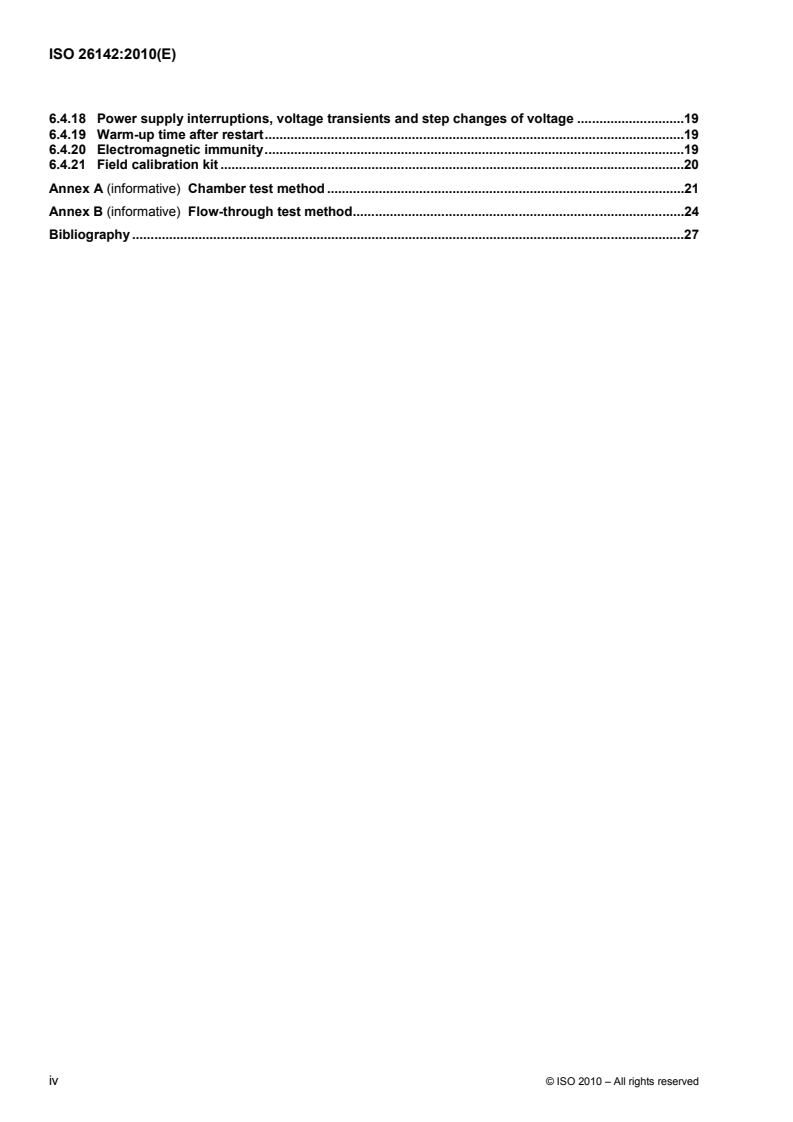
6.4.18 Power supply interruptions, voltage transients and step changes of voltage .19
6.4.19 Warm-up time after restart.19
6.4.20 Electromagnetic immunity.19
6.4.21 Field calibration kit .20
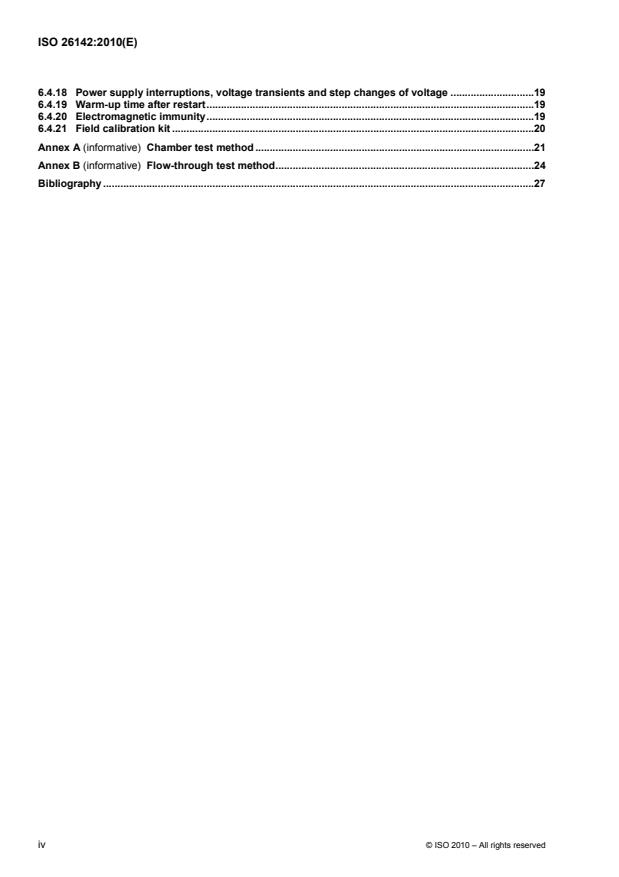
Annex A (informative) Chamber test method .21
Annex B (informative) Flow-through test method.24
Bibliography .27
iv © ISO 2010 – All rights reserved
Foreword
ISO (the International Organization for Standardization) is a worldwide federation of national standards bodies
(ISO member bodies). The work of preparing International Standards is normally carried out through ISO
technical committees. Each member body interested in a subject for which a technical committee has been
established has the right to be represented on that committee. International organizations, governmental and
non-governmental, in liaison with ISO, also take part in the work. ISO collaborates closely with the
International Electrotechnical Commission (IEC) on all matters of electrotechnical standardization.
International Standards are drafted in accordance with the rules given in the ISO/IEC Directives, Part 2.
The main task of technical committees is to prepare International Standards. Draft International Standards
adopted by the technical committees are circulated to the member bodies for voting. Publication as an
International Standard requires approval by at least 75 % of the member bodies casting a vote.
Attention is drawn to the possibility that some of the elements of this document may be the subject of patent
rights. ISO shall not be held responsible for identifying any or all such patent rights.
ISO 26142 was prepared by Technical Committee ISO/TC 197, Hydrogen technologies.
Introduction
Over the course of several years, international efforts have been initiated for the development of necessary
regulations, codes and standards required for the introduction of hydrogen energy systems in consumer
environments. Such codes and standards usually require a safety system to detect hydrogen concentrations
before a fraction of the flammable or explosive limit is reached, in order to allow for purging, shut-off, and
similar safety operations.
This International Standard provides requirements for stationary hydrogen detection apparatus, covering both
performance requirements and test methods. This International Standard is intended to cover situations where
the user desires the ability to detect hydrogen leaks and monitor hydrogen concentrations relevant to safety.
This International Standard is primarily intended for hydrogen detection apparatus at vehicle refuelling stations,
where a high level of safety management is required. This sector has an immediate need for this standard and
is expected to be the main application for such apparatus, but this standard can also be applied to other
stationary installations where the detection of hydrogen is required.
This International Standard is not intended to exclude any specific technologies that meet the performance
requirements herein.
This International Standard contains the important quantitative and technical specifications against the danger
of hydrogen leakage. This standard will promote international cooperation under easy-to-understand
requirements, by leading to widespread use of hydrogen energy.
Benefits to be gained by the implementation of this International Standard include using the performance
requirements in the standard to overcome safety concerns and aiding in development of the hydrogen fuel
infrastructure.
In this International Standard, attention is concentrated on specific requirements related to performance and
testing of hydrogen detection apparatus, such as a specific detection range for single and multiple safety
systems, selectivity, poisoning, fast response time, and hydrogen-specific test methods needed by the
hydrogen energy industry. This International Standard focuses primarily on stationary hydrogen technologies
whose main purpose is to produce, store and handle hydrogen, and not on systems that might generate
hydrogen as an undesirable by-product. The purpose of a hydrogen detection apparatus according to this
standard is to mitigate risk from unintended hydrogen releases within a wide range of hydrogen
concentrations including those exceeding the lower flammability limit.
Hydrogen-related facilities might be required to have the ability to detect hydrogen concentrations before a
specified concentration of hydrogen or fraction of flammable limit is reached, in order to allow for single and/or
multilevel safety operations, such as nitrogen purging or ventilation and/or system shut-off; or there might be a
desire to detect hydrogen concentrations above the lower flammability limit, in order to monitor concentrations
following a release. The hydrogen detection apparatus described in this International Standard can detect the
hydrogen leak concentration at multiple points determined by users to realize such multilevel safety operations.
vi © ISO 2010 – All rights reserved
INTERNATIONAL STANDARD ISO 26142:2010(E)
Hydrogen detection apparatus — Stationary applications
1 Scope
This International Standard defines the performance requirements and test methods of hydrogen detection
apparatus that is designed to measure and monitor hydrogen concentrations in stationary applications. The
provisions in this International Standard cover the hydrogen detection apparatus used to achieve the single
and/or multilevel safety operations, such as nitrogen purging or ventilation and/or system shut-off
corresponding to the hydrogen concentration. The requirements applicable to the overall safety system, as
well as the installation requirements of such apparatus, are excluded. This International Standard sets out
only the requirements applicable to a product standard for hydrogen detection apparatus, such as precision,
response time, stability, measuring range, selectivity and poisoning.
This International Standard is intended to be used for certification purposes.
2 Normative references
The following referenced documents are indispensable for the application of this document. For dated
references, only the edition cited applies. For undated references, the latest edition of the referenced
document (including any amendments) applies.
ISO 14687-1:1999, Hydrogen fuel — Product specification — Part 1: All applications except proton exchange
membrane (PEM) fuel cell for road vehicles
ISO 14687-1:1999/Cor.2:2008, Hydrogen fuel — Product specification — Part 1: All applications except proton
exchange membrane (PEM) fuel cell for road vehicles — Technical Corrigendum 2
IEC 61000-4-1, Electromagnetic compatibility (EMC) — Part 4-1: Testing and measurement techniques —
Overview of IEC 61000-4 series
IEC 61000-4-3, Electromagnetic compatibility (EMC) — Part 4-3: Testing and measurement techniques —
Radiated, radio-frequency, electromagnetic field immunity test
IEC 61000-4-4, Electromagnetic compatibility (EMC) — Part 4-4: Testing and measurement techniques —
Electrical fast transient/burst immunity test
IEC 60079-0:2008, Explosive atmospheres — Part 0: Equipment — General requirements
IEC 60079 (all parts), Explosive atmospheres
3 Terms and definitions
For the purposes of this document, the following terms and definitions apply.
3.1
alarm set point
fixed or adjustable setting of the hydrogen detection apparatus that is intended to select the hydrogen volume
fraction at which an indication, an alarm or another output function will automatically be activated
3.2
ambient air
normal atmosphere surrounding the hydrogen detection apparatus
3.3
aspirated hydrogen detection apparatus
hydrogen detection apparatus that samples the gas to be detected by introducing it to the hydrogen sensor(s)
in a forced manner (e.g. use of a gas sampling pump or induction of a flow through a pressure differential)
3.4
clean air
air that is free of flammable gases, interfering or contaminating substances, and dust
3.5
control unit
part of hydrogen detection apparatus that is commonly referred to as the apparatus body and which excludes
its remote sensor(s) and connections, if any
3.6
data collecting interval
time interval between the time when an indication data is collected and the time when the next indication data
is corrected
3.7
diffusion chamber
chamber that can be sealed with controlled conditions of temperature, humidity and test-gas volume fraction,
used for performing the test on the hydrogen detection apparatus
3.8
fault signal
audible, visible or other type of signal different from the alarm signal, providing, directly or indirectly, a warning
or an indication that the hydrogen detection apparatus is not working satisfactorily
3.9
final indication
indication given by the hydrogen detection apparatus after stabilization
3.10
hydrogen detection apparatus
assembly with an integrated or a remote hydrogen sensor that is intended to detect and measure the
hydrogen volume fraction over a declared measuring range
NOTE 1 The hydrogen detection apparatus may be provided with a single or multiple alarm set points.
NOTE 2 The hydrogen detection apparatus may include one or more built-in alarm indications, output contacts for
alarm and/or electrical signals for alarm.
3.11
hydrogen sensing element
component that provides a measurable, continuously changing physical quantity in correlation to the
surrounding hydrogen volume fraction
3.12
hydrogen sensor
assembly, which contains one or more hydrogen sensing elements and may also contain circuit components
associated with the hydrogen sensing elements, that provides a continuously changing physical quantity or
signal in correlation to the physical quantity provided by the hydrogen sensing element(s)
2 © ISO 2010 – All rights reserved
3.13
hydrogen volume fraction
hydrogen content expressed as the ratio of the volume of hydrogen to the total volume of all components in
the gas mixture under standard conditions of temperature and pressure of 20 °C and 101,325 kPa
3.14
interferant
any substance that affects the sensitivity of a hydrogen sensing element by contacting or adhering to it
3.15
latching alarm
alarm that, once activated, requires deliberate manual action to be deactivated
3.16
measuring range
range, defined by the lowest and highest hydrogen volume fractions, within which a hydrogen detection
apparatus can measure hydrogen volume fractions within the specified accuracy
3.17
multi-level detection
continuous detection and monitoring of hydrogen volume fraction with multiple alarm set points
3.18
nominal supply voltage
voltage corresponding to the manufacturer-recommended operating voltage for the hydrogen detection
apparatus
3.19
poisoning
phenomenon caused by any interferant that permanently affects the sensitivity of a hydrogen sensing element
3.20
remote hydrogen sensor
hydrogen sensor that is remotely connected to a hydrogen detection apparatus
3.21
selectivity
response of the hydrogen detection apparatus to hydrogen compared with the response to other gases
NOTE If there is high selectivity to hydrogen, the results will be less ambiguous and the cross-sensitivity to other
gases will be low.
3.22
sensitivity
ratio of change produced in the apparatus by a known volume fraction of hydrogen
NOTE 1 Depending on the context, this can refer to the minimum change in the volume fraction of hydrogen that the
apparatus will detect.
NOTE 2 High sensitivity implies that low volume fractions can be measured.
3.23
special state
state of the hydrogen detection apparatus other than those in which monitoring of hydrogen volume fractions
takes place, for example, warm-up, calibration mode or fault condition
3.24
stabilization
state in which three successive readings of a hydrogen detection apparatus, taken at 30 s intervals, indicate
no changes greater than 5 % of the volume fraction of the test gas
3.25
test gas
mixture of hydrogen and clean air with a known volume fraction, which is used for performance tests of
hydrogen detection apparatus
3.26
time of response
t
time interval, with the hydrogen detection apparatus in a warmed-up condition, between the time when an
instantaneous variation from clean air to the standard test gas is produced at the inlet of the remote hydrogen
sensor or the integrated hydrogen sensor(s) and the time when the response reaches a stated percentage (x)
of the final indication
3.27
time of recovery
t
time interval, with the hydrogen detection apparatus in a warmed-up condition, between the time when an
instantaneous variation from the standard test gas to clean air is produced at the inlet of the remote hydrogen
sensor or the integrated hydrogen sensor(s) and the time when the response decreases to a stated
percentage (x) of the final indication
3.28
warm-up time
time interval between the time when the hydrogen detection apparatus is switched on and the time when the
special state indicator is turned off, showing that the hydrogen detection apparatus is in a warmed-up
condition
4 General requirements
4.1 Construction
4.1.1 General
The hydrogen detection apparatus designed to be used in a hazardous area shall comply with IEC 60079-0
and the relevant parts of IEC 60079.
4.1.2 Enclosure
If the application demands it, all parts of the enclosure shall be constructed of corrosion-resistant materials or
be protected against corrosion.
4.1.3 Measuring range
The measuring range of the hydrogen detection apparatus shall be declared by the manufacturer. The
measuring range shall cover a minimum of one order of magnitude. If the hydrogen detection apparatus uses
two or more hydrogen sensor technologies or principles to cover a wide measuring range, the manufacturer
shall declare the number of hydrogen sensors and/or specify the measuring range pertaining to each
hydrogen sensor technology or principle.
4.1.4 Alarm system
4.1.4.1 Alarm
The hydrogen detection apparatus shall have at least one latching alarm with a fixed or adjustable alarm set
point. If two or more alarm set points are provided, the lower may be non-latching, based on user preference.
While the alarm condition is still present, the hydrogen detection apparatus shall be designed in such a way
4 © ISO 2010 – All rights reserved
that any alarms, except for optional audible alarms, shall remain in operation. Alarm devices shall be tamper-
proof.
−2
At least one alarm set point shall be available at or below a hydrogen volume fraction in air of 1 × 10 .
4.1.4.2 Fault signals
The hydrogen detection apparatus shall provide a fault signal in the event of loss of power. A short circuit or
open circuit in the connection to any remote hydrogen sensor shall also be indicated by a fault signal. An
aspirated hydrogen detection apparatus shall indicate the adequacy of flow conditions and produce a fault
signal in the event of a flow failure.
4.1.5 Indicators
4.1.5.1 Power indication
The detection apparatus shall provide a visual power indicator that clearly indicates if the power to the
hydrogen detection apparatus is on or off.
4.1.5.2 Signals for recording
For a hydrogen detection apparatus where the resolution of the read-out device is inadequate to demonstrate
compliance with this International Standard, the manufacturer shall identify suitable points for connecting,
indicating or recording devices for the purpose of testing the compliance of the hydrogen detection apparatus
with this International Standard.
4.1.5.3 Measuring range
Any under-range or over-range measurements shall be clearly indicated.
If the hydrogen detection apparatus covers more than one measuring range, the measuring range selected
shall be clearly identified.
All indications may be shown on the separate control unit.
4.1.5.4 Indicating colours
If only one indicating light is provided for alarm, fault or other indications, it shall be red in colour.
If separate indicating lights are used, the colour shall be used in the following order of priority:
a) red for alarm indication;
b) yellow for fault indication;
c) green for operation.
In addition to the colour requirements, the indicator lights shall be labelled to show their functions.
4.1.6 Adjustments
All adjustment devices shall be designed so as to discourage unauthorized or inadvertent interference with the
hydrogen detection apparatus. Examples would include procedural devices such as a keyboard instrument, or
mechanical devices such as a cover requiring the use of a tool.
A fixed explosion-protected hydrogen detection apparatus or hydrogen sensor housed in explosion-protected
enclosures shall be designed so that, if any facilities for adjustment are necessary for routine recalibration and
for resetting or similar functions, these facilities shall be externally accessible. The means for making
adjustments shall not degrade the explosion protection of the hydrogen detection apparatus or hydrogen
sensor.
The adjustments of the zero and signal amplification shall be so designed that adjustment of one will not affect
the other.
4.1.7 Software-controlled hydrogen detection apparatus
4.1.7.1 General
In the design of software-controlled hydrogen detection apparatus, the risks arising from faults in the program
shall be taken into account. In case of malfunction, a manual override switch shall be provided. The manual
override switch shall be protected from use by unauthorized personnel.
4.1.7.2 Conversion errors
The relationship between corresponding analogue and digital values shall be unambiguous. The output range
shall be capable of coping with the full range of input values within the instrument specification. A clear
indication shall be provided if the conversion range is exceeded.
The design shall take into account the maximum possible analogue-to-digital, computational and
digital-to-analogue converter errors. The combined effect of digitization errors shall not be greater than the
smallest deviation of indication required by this International Standard.
4.1.7.3 Special state indication
All special states entered by the hydrogen detection apparatus shall be indicated by a contact or other
transmittable output signal.
4.1.7.4 Software
The installed software version shall be identified, for example, by a marking on the installed memory
component, a marking in (if accessible) or on the hydrogen detection apparatus, or a display during power-up
or on user command.
It shall not be possible for the user to modify the program code.
Parameter settings shall be checked for validity. Invalid inputs shall be rejected. An access barrier shall be
provided against parameter changing by unauthorized persons, e.g. it may be integrated by an authorization
code in the software or may be realised by a mechanical lock. Parameter settings shall be preserved after
removal of power, and while passing a special state. All user-changeable parameters and their valid ranges
shall be listed in the software documentation.
Software shall have a structured design to facilitate testing and maintenance. If used, program modules shall
have a clearly defined interface to other modules.
Software documentation shall be included in the technical file of the product. It shall include the following:
a) the hydrogen detection apparatus to which the software belongs;
b) identification of the software version;
c) functional description;
d) software structure (e.g. flow chart, Nassi-Schneidermann diagram);
e) any software modification provided with the date of change and new identification data.
6 © ISO 2010 – All rights reserved
4.1.7.5 Data transmission
Digital data transmission between spatially separated components of hydrogen detection apparatus shall be
reliable. Delays resulting from transmission errors shall not extend the response time t by more than a third
of the requirements specified in 6.4.13. If they do, the hydrogen detection apparatus shall pass over to a
defined special state. The defined special state shall be documented in the instruction manual.
4.1.7.6 Self-test routines
Digital components and digital functions shall incorporate self-test routines. On failure detection, the hydrogen
detection apparatus shall pass over to a defined special state. The defined special state shall be documented
in the instruction manual.
The following minimum self-test routines shall be performed by the hydrogen detection apparatus:
a) the power supply of digital components shall be monitored within time intervals of a maximum of ten times
the response time t ;
b) monitoring equipment with its own time base (e.g. watchdog) shall work independently and separately
from the parts of the digital components which perform the data processing;
c) program and parameter memory shall be monitored by procedures which allow the detection of a single
bit error;
d) volatile memory shall be monitored by procedures that test the readability and writeability of the memory
cells.
The tests shall be carried out automatically after the hydrogen detection apparatus is switched on and be
repeated at regular intervals of 24 h or less.
All available visible and audible output functions shall be tested. The test shall be carried out automatically
after starting the operation or on user request. The result may need to be verified by the user.
4.1.7.7 Functional concept
The manufacturer shall provide the following documentation for functional concept analysis and evaluation:
⎯ measuring sequence (including all possible variations);
⎯ possible special states;
⎯ parameters and their acceptable adjustment range;
⎯ representation of measuring values and indications;
⎯ generation of alarms and signals;
⎯ extent and performance of self-test routines;
⎯ extent and performance of remote data transmission.
4.1.8 Reliability
A reliability analysis shall be conducted on the hydrogen detection apparatus in accordance with a recognized
International Standard. The results of this reliability analysis, as well as the standard used, shall be recorded
by the manufacturer.
4.2 Labelling and marking
The hydrogen detection apparatus and the remote hydrogen sensor, if used, shall be marked legibly and
indelibly with the following minimum requirements:
a) name and address, including the country of the manufacturer;
b) a reference to this International Standard;
c) designation of series or type;
d) serial number;
e) if applicable, specific marking describing the type of explosion protection in accordance with the relevant
part of IEC 60079.
4.3 Instruction manual
Each hydrogen detection apparatus shall be provided with an instruction manual that includes the following
information:
a) complete instructions, drawings and diagrams for safe and proper operation, installation and servicing of
the hydrogen detection apparatus;
b) operating instructions and adjustment procedures;
c) recommendations for initial checking and calibration of the hydrogen detection apparatus on a routine
basis, including instructions for the use of the field calibration kit, if provided;
d) measuring range of the hydrogen detection apparatus (see 4.1.3);
e) details of operational limitations including, where applicable, the following:
1) information that describes the sensitivities to other gases to which the hydrogen detection apparatus
is responsive;
2) temperature limits;
3) humidity ranges;
4) supply voltage limits;
5) relevant characteristics and construction details of required interconnecting cables;
6) battery data;
7) pressure limits;
f) recommended storage conditions (temperature, humidity, pressure) and storage-life limitations for the
hydrogen detection apparatus, replacement parts and accessories;
g) expected operation life-time;
h) information on the adverse effects on the hydrogen sensor of poisons and interferants;
i) for aspirated hydrogen detection apparatus, indication of the minimum and maximum flow rates and
pressure, as well as the tubing type, maximum length and size for proper operation;
j) for aspirated hydrogen detection apparatus, instructions for ensuring that the sample lines are intact and
that proper flow is established;
8 © ISO 2010 – All rights reserved
k) statements of the nature and significance of all alarms and fault signals, the duration of such alarms and
signals (if time-limited or non-latching) and any provisions that may be made for silencing or resetting
such alarms and signals, as applicable;
l) details of any method for the determination of the possible sources of a malfunction and any corrective
procedures (i.e. trouble-shooting procedures);
m) identification of the alarm devices, outputs or contacts that are of the non-latching type, where applicable;
n) recommended replacement-parts list;
o) list of optional accessories (e.g. collecting cones, weather-protecting devices), if provided, and their
identification (e.g. part numbers) as well as the description of their effects on the hydrogen detection
apparatus characteristics (including response time and sensitivity);
p) marking and any special conditions of service;
q) any special instructions or information that are required due to the special nature of the hydrogen
detection apparatus (such as non-linear responses);
r) If applicable, instructions on the use of voice signal alarms, including the language of the recorded
message;
s) dos and don'ts clearly shown or illustrated.
4.4 Vibration
The manufacturer shall pack the hydrogen detection apparatus in such a manner as to prevent damage due to
possible vibration during transportation. The hydrogen detection apparatus shall also be constructed to
withstand the vibrations expected in its use.
5 Performance requirements
The hydrogen detection apparatus shall meet the performance requirements specified in the tests defined in
Clause 6.
6 Tests
6.1 General requirements for tests
6.1.1 Number of samples
The tests shall be carried out on one hydrogen detection apparatus for type testing, except as permitted by
6.1.2.
6.1.2 Sequence of tests
The hydrogen detection apparatus shall be subjected to all of the applicable tests specified in 6.4. The test
sequence detailed below shall be followed:
a) long-term stability, as in 6.4.4.2;
b) operation above the measuring range, as in 6.4.16;
c) poisoning, as in 6.4.15.
The other tests specified in 6.4 shall be carried out in a sequence to be defined by the manufacturer before
and/or after the above sequence. For these tests, a sample which is different from the one used in the above
sequence may be used.
6.1.3 Preparation of the hydrogen detection apparatus before testing
The hydrogen detection apparatus shall be prepared and mounted in a manner representative of the typical
application, in accordance with the instruction manual, including all necessary interconnections, initial
adjustments and initial calibrations. Adjustments may be made, where appropriate, at the beginning of each
test.
Attachments, such as cone or weather protection, that are intended for optional use as indicated in the
instruction manual shall not be attached to the hydrogen detection apparatus.
6.2 Test equipment
A diffusion chamber that can be sealed (see Annex A), or alternative facilities such as flow-type (see Annex B)
or mask-type shall be used for the tests. If a flow-type or mask-type is used, the test procedure specific to that
particular test method shall be followed.
When a mask is used for calibration or for the injection of test gas into the sensor, the design and operation of
the mask (in particular the pressure and velocity inside the mask) shall not inadmissibly influence the
response of the hydrogen detection apparatus or the results obtained.
The manufacturer of the hydrogen detection apparatus should be consulted when determining the design of
the calibration mask. The manufacturer may provide a suitable calibration mask, together with details of
suggested pressure or flow for application calibration gases, with the hydrogen detection apparatus.
If a test gas with a hydrogen volume fraction of 4 % or more is to be used, each component of the test
equipment shall comply with the Zone I requirements of IEC 60079-0:2008.
6.3 Normal test conditions
6.3.1 Temperature
Unless otherwise specified, the tests shall be carried out at a temperature between 15 °C and 25 °C and the
temperature shall be kept constant within ±2 °C throughout the duration of the test.
6.3.2 Pressure
Unless otherwise specified, the tests shall be performed at pressures between 80 kPa and 108 kPa and the
pressure shall be kept constant within ±1 kPa throughout the duration of the test. For long-term tests, the
influence of pressure changes shall be taken into account using the results of the pressure test of 6.4.7.
6.3.3 Humidity
Unless otherwise specified, the tests shall be carried out at a relative humidity (RH) between 20 % and 80 %
and the RH shall be maintained constant within ±10 % throughout the duration of the test.
6.3.4 Voltage
Unless otherwise specified, mains-powered and fixed direct-current (DC)-powered hydrogen detection
apparatus shall be operated within 2 % of the manufacturer's recommended supply voltage and frequency.
6.3.5 Orientation
The hydrogen detection apparatus shall be tested in the orientation recommended by the manufacturer.
10 © ISO 2010 – All rights reserved
6.4 Test methods
6.4.1 General
This International Standard is not intended to exclude any specific technologies that meet the performance
requirements herein. In the event that a test method defined in this International Standard is not suitable for a
specific technology, an alternative test method may be used. In this case, the alternative test method and
results shall be reported.
6.4.2 Standard response test
6.4.2.1 Standard test gas
The tests shall be conducted using a single test gas per one order of magnitude in the measuring range with a
hydrogen volume fraction at the midpoint of that order. If the measuring range is less than two orders of
magnitude, then the test shall be conducted with a single test gas having a hydrogen volume fraction at the
midpoint of the measuring range. If the measuring range is more than two but less than three orders of
magnitude, then two test gases shall be used. When the hydrogen detection apparatus uses two or more
types of sensors covering different measuring ranges, the tests shall be conducted using two or more test
gases with a hydrogen volume fraction at the midpoint of each measuring range. For any range of two or more
orders of magnitude, one test gas per order of magnitude shall be used.
All gases used in testing described in this International Standard should be of certified reagent grade
traceable to a national or International Standard such as Grade A of ISO 14687-1:1999.
−3
For test gases with a hydrogen volume fraction of 10 or higher, the relative tolerance shall be ±5 % and
−3
known to be within ±2 %, and for those gases with a hydrogen volume fraction of less than 10 , the relative
tolerance shall be ±10 % and known to be within ±2 %.
If the hydrogen volume fraction of the test gas is within the explosion range, hydrogen may be mixed with
nitrogen, provided that the measuring function of the hydrogen detection apparatus is not affected by oxygen
deficiency. Otherwise, the hydrogen volume fraction of the standard test gas may be taken outside the
explosive range as near as possible to the values stated above.
6.4.2.2 Procedure
The remote hydrogen sensor or the integrated hydrogen sensor shall be exposed to clean air until the
atmosphere stabilizes at the normal test conditions. The indication shall be recorded as the offset value. The
atmosphere shall be changed to the test gas, and the final indication shall be recorded (see Annexes A and B
for details).
6.4.3 Measuring range and calibration
6.4.3.1 Initial preparation of the hydrogen detection apparatus
If necessary, the hydrogen detection apparatus shall be calibrated and adjustments shall be carried out to
obtain correct indications in accordance with the manufacturer's instruction manual.
6.4.3.2 Validation of accuracy (calibration curve)
Calibration and adjustment shall be performed according to the manufacturer's recommended specifications.
Validation shall be performed with five points or more per order of magnitude of the measuring range.
Additional orders of magnitudes shall be validated with at least four additional points per each order of
magnitude. For a measuring range of less than two orders of magnitude, a minimum of five test hydrogen
volume fractions shall be used, but additional testing points can be added, as needed. The hydrogen volume
fractions may be equally distributed or as otherwise needed. The hydrogen detection apparatus shall be
exposed in ascending order to each hydrogen volume fraction of the test gas for 3 min without exposure to
clean air between the hydrogen volume fractions. Following the highest hydrogen volume fraction, the
hydrogen detection apparatu
...
INTERNATIONAL ISO
STANDARD 26142
First edition
2010-06-01
Hydrogen detection apparatus —
Stationary applications
Détecteurs d'hydrogène — Applications fixes
Reference number
©
ISO 2010
PDF disclaimer
This PDF file may contain embedded typefaces. In accordance with Adobe's licensing policy, this file may be printed or viewed but
shall not be edited unless the typefaces which are embedded are licensed to and installed on the computer performing the editing. In
downloading this file, parties accept therein the responsibility of not infringing Adobe's licensing policy. The ISO Central Secretariat
accepts no liability in this area.
Adobe is a trademark of Adobe Systems Incorporated.
Details of the software products used to create this PDF file can be found in the General Info relative to the file; the PDF-creation
parameters were optimized for printing. Every care has been taken to ensure that the file is suitable for use by ISO member bodies. In
the unlikely event that a problem relating to it is found, please inform the Central Secretariat at the address given below.
© ISO 2010
All rights reserved. Unless otherwise specified, no part of this publication may be reproduced or utilized in any form or by any means,
electronic or mechanical, including photocopying and microfilm, without permission in writing from either ISO at the address below or
ISO's member body in the country of the requester.
ISO copyright office
Case postale 56 • CH-1211 Geneva 20
Tel. + 41 22 749 01 11
Fax + 41 22 749 09 47
E-mail copyright@iso.org
Web www.iso.org
Published in Switzerland
ii © ISO 2010 – All rights reserved
Contents Page
Foreword .v
Introduction.vi
1 Scope.1
2 Normative references.1
3 Terms and definitions .1
4 General requirements .4
4.1 Construction .4
4.1.1 General .4
4.1.2 Enclosure .4
4.1.3 Measuring range.4
4.1.4 Alarm system .4
4.1.5 Indicators.5
4.1.6 Adjustments.5
4.1.7 Software-controlled hydrogen detection apparatus.6
4.1.8 Reliability.7
4.2 Labelling and marking .8
4.3 Instruction manual .8
4.4 Vibration .9
5 Performance requirements.9
6 Tests .9
6.1 General requirements for tests .9
6.1.1 Number of samples .9
6.1.2 Sequence of tests.9
6.1.3 Preparation of the hydrogen detection apparatus before testing.10
6.2 Test equipment .10
6.3 Normal test conditions.10
6.3.1 Temperature.10
6.3.2 Pressure .10
6.3.3 Humidity .10
6.3.4 Voltage.10
6.3.5 Orientation .10
6.4 Test methods .11
6.4.1 General .11
6.4.2 Standard response test.11
6.4.3 Measuring range and calibration .11
6.4.4 Stability.12
6.4.5 Alarm set point(s) .13
6.4.6 Temperature.13
6.4.7 Pressure .14
6.4.8 Humidity .14
6.4.9 Vibration .14
6.4.10 Orientation .15
6.4.11 Flow rate for aspirated apparatus.16
6.4.12 Air velocity .16
6.4.13 Time of response and time of recovery .17
6.4.14 Selectivity.17
6.4.15 Poisoning .17
6.4.16 Operation above the measuring range.18
6.4.17 Power supply variations .18
6.4.18 Power supply interruptions, voltage transients and step changes of voltage .19
6.4.19 Warm-up time after restart.19
6.4.20 Electromagnetic immunity.19
6.4.21 Field calibration kit .20
Annex A (informative) Chamber test method .21
Annex B (informative) Flow-through test method.24
Bibliography .27
iv © ISO 2010 – All rights reserved
Foreword
ISO (the International Organization for Standardization) is a worldwide federation of national standards bodies
(ISO member bodies). The work of preparing International Standards is normally carried out through ISO
technical committees. Each member body interested in a subject for which a technical committee has been
established has the right to be represented on that committee. International organizations, governmental and
non-governmental, in liaison with ISO, also take part in the work. ISO collaborates closely with the
International Electrotechnical Commission (IEC) on all matters of electrotechnical standardization.
International Standards are drafted in accordance with the rules given in the ISO/IEC Directives, Part 2.
The main task of technical committees is to prepare International Standards. Draft International Standards
adopted by the technical committees are circulated to the member bodies for voting. Publication as an
International Standard requires approval by at least 75 % of the member bodies casting a vote.
Attention is drawn to the possibility that some of the elements of this document may be the subject of patent
rights. ISO shall not be held responsible for identifying any or all such patent rights.
ISO 26142 was prepared by Technical Committee ISO/TC 197, Hydrogen technologies.
Introduction
Over the course of several years, international efforts have been initiated for the development of necessary
regulations, codes and standards required for the introduction of hydrogen energy systems in consumer
environments. Such codes and standards usually require a safety system to detect hydrogen concentrations
before a fraction of the flammable or explosive limit is reached, in order to allow for purging, shut-off, and
similar safety operations.
This International Standard provides requirements for stationary hydrogen detection apparatus, covering both
performance requirements and test methods. This International Standard is intended to cover situations where
the user desires the ability to detect hydrogen leaks and monitor hydrogen concentrations relevant to safety.
This International Standard is primarily intended for hydrogen detection apparatus at vehicle refuelling stations,
where a high level of safety management is required. This sector has an immediate need for this standard and
is expected to be the main application for such apparatus, but this standard can also be applied to other
stationary installations where the detection of hydrogen is required.
This International Standard is not intended to exclude any specific technologies that meet the performance
requirements herein.
This International Standard contains the important quantitative and technical specifications against the danger
of hydrogen leakage. This standard will promote international cooperation under easy-to-understand
requirements, by leading to widespread use of hydrogen energy.
Benefits to be gained by the implementation of this International Standard include using the performance
requirements in the standard to overcome safety concerns and aiding in development of the hydrogen fuel
infrastructure.
In this International Standard, attention is concentrated on specific requirements related to performance and
testing of hydrogen detection apparatus, such as a specific detection range for single and multiple safety
systems, selectivity, poisoning, fast response time, and hydrogen-specific test methods needed by the
hydrogen energy industry. This International Standard focuses primarily on stationary hydrogen technologies
whose main purpose is to produce, store and handle hydrogen, and not on systems that might generate
hydrogen as an undesirable by-product. The purpose of a hydrogen detection apparatus according to this
standard is to mitigate risk from unintended hydrogen releases within a wide range of hydrogen
concentrations including those exceeding the lower flammability limit.
Hydrogen-related facilities might be required to have the ability to detect hydrogen concentrations before a
specified concentration of hydrogen or fraction of flammable limit is reached, in order to allow for single and/or
multilevel safety operations, such as nitrogen purging or ventilation and/or system shut-off; or there might be a
desire to detect hydrogen concentrations above the lower flammability limit, in order to monitor concentrations
following a release. The hydrogen detection apparatus described in this International Standard can detect the
hydrogen leak concentration at multiple points determined by users to realize such multilevel safety operations.
vi © ISO 2010 – All rights reserved
INTERNATIONAL STANDARD ISO 26142:2010(E)
Hydrogen detection apparatus — Stationary applications
1 Scope
This International Standard defines the performance requirements and test methods of hydrogen detection
apparatus that is designed to measure and monitor hydrogen concentrations in stationary applications. The
provisions in this International Standard cover the hydrogen detection apparatus used to achieve the single
and/or multilevel safety operations, such as nitrogen purging or ventilation and/or system shut-off
corresponding to the hydrogen concentration. The requirements applicable to the overall safety system, as
well as the installation requirements of such apparatus, are excluded. This International Standard sets out
only the requirements applicable to a product standard for hydrogen detection apparatus, such as precision,
response time, stability, measuring range, selectivity and poisoning.
This International Standard is intended to be used for certification purposes.
2 Normative references
The following referenced documents are indispensable for the application of this document. For dated
references, only the edition cited applies. For undated references, the latest edition of the referenced
document (including any amendments) applies.
ISO 14687-1:1999, Hydrogen fuel — Product specification — Part 1: All applications except proton exchange
membrane (PEM) fuel cell for road vehicles
ISO 14687-1:1999/Cor.2:2008, Hydrogen fuel — Product specification — Part 1: All applications except proton
exchange membrane (PEM) fuel cell for road vehicles — Technical Corrigendum 2
IEC 61000-4-1, Electromagnetic compatibility (EMC) — Part 4-1: Testing and measurement techniques —
Overview of IEC 61000-4 series
IEC 61000-4-3, Electromagnetic compatibility (EMC) — Part 4-3: Testing and measurement techniques —
Radiated, radio-frequency, electromagnetic field immunity test
IEC 61000-4-4, Electromagnetic compatibility (EMC) — Part 4-4: Testing and measurement techniques —
Electrical fast transient/burst immunity test
IEC 60079-0:2008, Explosive atmospheres — Part 0: Equipment — General requirements
IEC 60079 (all parts), Explosive atmospheres
3 Terms and definitions
For the purposes of this document, the following terms and definitions apply.
3.1
alarm set point
fixed or adjustable setting of the hydrogen detection apparatus that is intended to select the hydrogen volume
fraction at which an indication, an alarm or another output function will automatically be activated
3.2
ambient air
normal atmosphere surrounding the hydrogen detection apparatus
3.3
aspirated hydrogen detection apparatus
hydrogen detection apparatus that samples the gas to be detected by introducing it to the hydrogen sensor(s)
in a forced manner (e.g. use of a gas sampling pump or induction of a flow through a pressure differential)
3.4
clean air
air that is free of flammable gases, interfering or contaminating substances, and dust
3.5
control unit
part of hydrogen detection apparatus that is commonly referred to as the apparatus body and which excludes
its remote sensor(s) and connections, if any
3.6
data collecting interval
time interval between the time when an indication data is collected and the time when the next indication data
is corrected
3.7
diffusion chamber
chamber that can be sealed with controlled conditions of temperature, humidity and test-gas volume fraction,
used for performing the test on the hydrogen detection apparatus
3.8
fault signal
audible, visible or other type of signal different from the alarm signal, providing, directly or indirectly, a warning
or an indication that the hydrogen detection apparatus is not working satisfactorily
3.9
final indication
indication given by the hydrogen detection apparatus after stabilization
3.10
hydrogen detection apparatus
assembly with an integrated or a remote hydrogen sensor that is intended to detect and measure the
hydrogen volume fraction over a declared measuring range
NOTE 1 The hydrogen detection apparatus may be provided with a single or multiple alarm set points.
NOTE 2 The hydrogen detection apparatus may include one or more built-in alarm indications, output contacts for
alarm and/or electrical signals for alarm.
3.11
hydrogen sensing element
component that provides a measurable, continuously changing physical quantity in correlation to the
surrounding hydrogen volume fraction
3.12
hydrogen sensor
assembly, which contains one or more hydrogen sensing elements and may also contain circuit components
associated with the hydrogen sensing elements, that provides a continuously changing physical quantity or
signal in correlation to the physical quantity provided by the hydrogen sensing element(s)
2 © ISO 2010 – All rights reserved
3.13
hydrogen volume fraction
hydrogen content expressed as the ratio of the volume of hydrogen to the total volume of all components in
the gas mixture under standard conditions of temperature and pressure of 20 °C and 101,325 kPa
3.14
interferant
any substance that affects the sensitivity of a hydrogen sensing element by contacting or adhering to it
3.15
latching alarm
alarm that, once activated, requires deliberate manual action to be deactivated
3.16
measuring range
range, defined by the lowest and highest hydrogen volume fractions, within which a hydrogen detection
apparatus can measure hydrogen volume fractions within the specified accuracy
3.17
multi-level detection
continuous detection and monitoring of hydrogen volume fraction with multiple alarm set points
3.18
nominal supply voltage
voltage corresponding to the manufacturer-recommended operating voltage for the hydrogen detection
apparatus
3.19
poisoning
phenomenon caused by any interferant that permanently affects the sensitivity of a hydrogen sensing element
3.20
remote hydrogen sensor
hydrogen sensor that is remotely connected to a hydrogen detection apparatus
3.21
selectivity
response of the hydrogen detection apparatus to hydrogen compared with the response to other gases
NOTE If there is high selectivity to hydrogen, the results will be less ambiguous and the cross-sensitivity to other
gases will be low.
3.22
sensitivity
ratio of change produced in the apparatus by a known volume fraction of hydrogen
NOTE 1 Depending on the context, this can refer to the minimum change in the volume fraction of hydrogen that the
apparatus will detect.
NOTE 2 High sensitivity implies that low volume fractions can be measured.
3.23
special state
state of the hydrogen detection apparatus other than those in which monitoring of hydrogen volume fractions
takes place, for example, warm-up, calibration mode or fault condition
3.24
stabilization
state in which three successive readings of a hydrogen detection apparatus, taken at 30 s intervals, indicate
no changes greater than 5 % of the volume fraction of the test gas
3.25
test gas
mixture of hydrogen and clean air with a known volume fraction, which is used for performance tests of
hydrogen detection apparatus
3.26
time of response
t
time interval, with the hydrogen detection apparatus in a warmed-up condition, between the time when an
instantaneous variation from clean air to the standard test gas is produced at the inlet of the remote hydrogen
sensor or the integrated hydrogen sensor(s) and the time when the response reaches a stated percentage (x)
of the final indication
3.27
time of recovery
t
time interval, with the hydrogen detection apparatus in a warmed-up condition, between the time when an
instantaneous variation from the standard test gas to clean air is produced at the inlet of the remote hydrogen
sensor or the integrated hydrogen sensor(s) and the time when the response decreases to a stated
percentage (x) of the final indication
3.28
warm-up time
time interval between the time when the hydrogen detection apparatus is switched on and the time when the
special state indicator is turned off, showing that the hydrogen detection apparatus is in a warmed-up
condition
4 General requirements
4.1 Construction
4.1.1 General
The hydrogen detection apparatus designed to be used in a hazardous area shall comply with IEC 60079-0
and the relevant parts of IEC 60079.
4.1.2 Enclosure
If the application demands it, all parts of the enclosure shall be constructed of corrosion-resistant materials or
be protected against corrosion.
4.1.3 Measuring range
The measuring range of the hydrogen detection apparatus shall be declared by the manufacturer. The
measuring range shall cover a minimum of one order of magnitude. If the hydrogen detection apparatus uses
two or more hydrogen sensor technologies or principles to cover a wide measuring range, the manufacturer
shall declare the number of hydrogen sensors and/or specify the measuring range pertaining to each
hydrogen sensor technology or principle.
4.1.4 Alarm system
4.1.4.1 Alarm
The hydrogen detection apparatus shall have at least one latching alarm with a fixed or adjustable alarm set
point. If two or more alarm set points are provided, the lower may be non-latching, based on user preference.
While the alarm condition is still present, the hydrogen detection apparatus shall be designed in such a way
4 © ISO 2010 – All rights reserved
that any alarms, except for optional audible alarms, shall remain in operation. Alarm devices shall be tamper-
proof.
−2
At least one alarm set point shall be available at or below a hydrogen volume fraction in air of 1 × 10 .
4.1.4.2 Fault signals
The hydrogen detection apparatus shall provide a fault signal in the event of loss of power. A short circuit or
open circuit in the connection to any remote hydrogen sensor shall also be indicated by a fault signal. An
aspirated hydrogen detection apparatus shall indicate the adequacy of flow conditions and produce a fault
signal in the event of a flow failure.
4.1.5 Indicators
4.1.5.1 Power indication
The detection apparatus shall provide a visual power indicator that clearly indicates if the power to the
hydrogen detection apparatus is on or off.
4.1.5.2 Signals for recording
For a hydrogen detection apparatus where the resolution of the read-out device is inadequate to demonstrate
compliance with this International Standard, the manufacturer shall identify suitable points for connecting,
indicating or recording devices for the purpose of testing the compliance of the hydrogen detection apparatus
with this International Standard.
4.1.5.3 Measuring range
Any under-range or over-range measurements shall be clearly indicated.
If the hydrogen detection apparatus covers more than one measuring range, the measuring range selected
shall be clearly identified.
All indications may be shown on the separate control unit.
4.1.5.4 Indicating colours
If only one indicating light is provided for alarm, fault or other indications, it shall be red in colour.
If separate indicating lights are used, the colour shall be used in the following order of priority:
a) red for alarm indication;
b) yellow for fault indication;
c) green for operation.
In addition to the colour requirements, the indicator lights shall be labelled to show their functions.
4.1.6 Adjustments
All adjustment devices shall be designed so as to discourage unauthorized or inadvertent interference with the
hydrogen detection apparatus. Examples would include procedural devices such as a keyboard instrument, or
mechanical devices such as a cover requiring the use of a tool.
A fixed explosion-protected hydrogen detection apparatus or hydrogen sensor housed in explosion-protected
enclosures shall be designed so that, if any facilities for adjustment are necessary for routine recalibration and
for resetting or similar functions, these facilities shall be externally accessible. The means for making
adjustments shall not degrade the explosion protection of the hydrogen detection apparatus or hydrogen
sensor.
The adjustments of the zero and signal amplification shall be so designed that adjustment of one will not affect
the other.
4.1.7 Software-controlled hydrogen detection apparatus
4.1.7.1 General
In the design of software-controlled hydrogen detection apparatus, the risks arising from faults in the program
shall be taken into account. In case of malfunction, a manual override switch shall be provided. The manual
override switch shall be protected from use by unauthorized personnel.
4.1.7.2 Conversion errors
The relationship between corresponding analogue and digital values shall be unambiguous. The output range
shall be capable of coping with the full range of input values within the instrument specification. A clear
indication shall be provided if the conversion range is exceeded.
The design shall take into account the maximum possible analogue-to-digital, computational and
digital-to-analogue converter errors. The combined effect of digitization errors shall not be greater than the
smallest deviation of indication required by this International Standard.
4.1.7.3 Special state indication
All special states entered by the hydrogen detection apparatus shall be indicated by a contact or other
transmittable output signal.
4.1.7.4 Software
The installed software version shall be identified, for example, by a marking on the installed memory
component, a marking in (if accessible) or on the hydrogen detection apparatus, or a display during power-up
or on user command.
It shall not be possible for the user to modify the program code.
Parameter settings shall be checked for validity. Invalid inputs shall be rejected. An access barrier shall be
provided against parameter changing by unauthorized persons, e.g. it may be integrated by an authorization
code in the software or may be realised by a mechanical lock. Parameter settings shall be preserved after
removal of power, and while passing a special state. All user-changeable parameters and their valid ranges
shall be listed in the software documentation.
Software shall have a structured design to facilitate testing and maintenance. If used, program modules shall
have a clearly defined interface to other modules.
Software documentation shall be included in the technical file of the product. It shall include the following:
a) the hydrogen detection apparatus to which the software belongs;
b) identification of the software version;
c) functional description;
d) software structure (e.g. flow chart, Nassi-Schneidermann diagram);
e) any software modification provided with the date of change and new identification data.
6 © ISO 2010 – All rights reserved
4.1.7.5 Data transmission
Digital data transmission between spatially separated components of hydrogen detection apparatus shall be
reliable. Delays resulting from transmission errors shall not extend the response time t by more than a third
of the requirements specified in 6.4.13. If they do, the hydrogen detection apparatus shall pass over to a
defined special state. The defined special state shall be documented in the instruction manual.
4.1.7.6 Self-test routines
Digital components and digital functions shall incorporate self-test routines. On failure detection, the hydrogen
detection apparatus shall pass over to a defined special state. The defined special state shall be documented
in the instruction manual.
The following minimum self-test routines shall be performed by the hydrogen detection apparatus:
a) the power supply of digital components shall be monitored within time intervals of a maximum of ten times
the response time t ;
b) monitoring equipment with its own time base (e.g. watchdog) shall work independently and separately
from the parts of the digital components which perform the data processing;
c) program and parameter memory shall be monitored by procedures which allow the detection of a single
bit error;
d) volatile memory shall be monitored by procedures that test the readability and writeability of the memory
cells.
The tests shall be carried out automatically after the hydrogen detection apparatus is switched on and be
repeated at regular intervals of 24 h or less.
All available visible and audible output functions shall be tested. The test shall be carried out automatically
after starting the operation or on user request. The result may need to be verified by the user.
4.1.7.7 Functional concept
The manufacturer shall provide the following documentation for functional concept analysis and evaluation:
⎯ measuring sequence (including all possible variations);
⎯ possible special states;
⎯ parameters and their acceptable adjustment range;
⎯ representation of measuring values and indications;
⎯ generation of alarms and signals;
⎯ extent and performance of self-test routines;
⎯ extent and performance of remote data transmission.
4.1.8 Reliability
A reliability analysis shall be conducted on the hydrogen detection apparatus in accordance with a recognized
International Standard. The results of this reliability analysis, as well as the standard used, shall be recorded
by the manufacturer.
4.2 Labelling and marking
The hydrogen detection apparatus and the remote hydrogen sensor, if used, shall be marked legibly and
indelibly with the following minimum requirements:
a) name and address, including the country of the manufacturer;
b) a reference to this International Standard;
c) designation of series or type;
d) serial number;
e) if applicable, specific marking describing the type of explosion protection in accordance with the relevant
part of IEC 60079.
4.3 Instruction manual
Each hydrogen detection apparatus shall be provided with an instruction manual that includes the following
information:
a) complete instructions, drawings and diagrams for safe and proper operation, installation and servicing of
the hydrogen detection apparatus;
b) operating instructions and adjustment procedures;
c) recommendations for initial checking and calibration of the hydrogen detection apparatus on a routine
basis, including instructions for the use of the field calibration kit, if provided;
d) measuring range of the hydrogen detection apparatus (see 4.1.3);
e) details of operational limitations including, where applicable, the following:
1) information that describes the sensitivities to other gases to which the hydrogen detection apparatus
is responsive;
2) temperature limits;
3) humidity ranges;
4) supply voltage limits;
5) relevant characteristics and construction details of required interconnecting cables;
6) battery data;
7) pressure limits;
f) recommended storage conditions (temperature, humidity, pressure) and storage-life limitations for the
hydrogen detection apparatus, replacement parts and accessories;
g) expected operation life-time;
h) information on the adverse effects on the hydrogen sensor of poisons and interferants;
i) for aspirated hydrogen detection apparatus, indication of the minimum and maximum flow rates and
pressure, as well as the tubing type, maximum length and size for proper operation;
j) for aspirated hydrogen detection apparatus, instructions for ensuring that the sample lines are intact and
that proper flow is established;
8 © ISO 2010 – All rights reserved
k) statements of the nature and significance of all alarms and fault signals, the duration of such alarms and
signals (if time-limited or non-latching) and any provisions that may be made for silencing or resetting
such alarms and signals, as applicable;
l) details of any method for the determination of the possible sources of a malfunction and any corrective
procedures (i.e. trouble-shooting procedures);
m) identification of the alarm devices, outputs or contacts that are of the non-latching type, where applicable;
n) recommended replacement-parts list;
o) list of optional accessories (e.g. collecting cones, weather-protecting devices), if provided, and their
identification (e.g. part numbers) as well as the description of their effects on the hydrogen detection
apparatus characteristics (including response time and sensitivity);
p) marking and any special conditions of service;
q) any special instructions or information that are required due to the special nature of the hydrogen
detection apparatus (such as non-linear responses);
r) If applicable, instructions on the use of voice signal alarms, including the language of the recorded
message;
s) dos and don'ts clearly shown or illustrated.
4.4 Vibration
The manufacturer shall pack the hydrogen detection apparatus in such a manner as to prevent damage due to
possible vibration during transportation. The hydrogen detection apparatus shall also be constructed to
withstand the vibrations expected in its use.
5 Performance requirements
The hydrogen detection apparatus shall meet the performance requirements specified in the tests defined in
Clause 6.
6 Tests
6.1 General requirements for tests
6.1.1 Number of samples
The tests shall be carried out on one hydrogen detection apparatus for type testing, except as permitted by
6.1.2.
6.1.2 Sequence of tests
The hydrogen detection apparatus shall be subjected to all of the applicable tests specified in 6.4. The test
sequence detailed below shall be followed:
a) long-term stability, as in 6.4.4.2;
b) operation above the measuring range, as in 6.4.16;
c) poisoning, as in 6.4.15.
The other tests specified in 6.4 shall be carried out in a sequence to be defined by the manufacturer before
and/or after the above sequence. For these tests, a sample which is different from the one used in the above
sequence may be used.
6.1.3 Preparation of the hydrogen detection apparatus before testing
The hydrogen detection apparatus shall be prepared and mounted in a manner representative of the typical
application, in accordance with the instruction manual, including all necessary interconnections, initial
adjustments and initial calibrations. Adjustments may be made, where appropriate, at the beginning of each
test.
Attachments, such as cone or weather protection, that are intended for optional use as indicated in the
instruction manual shall not be attached to the hydrogen detection apparatus.
6.2 Test equipment
A diffusion chamber that can be sealed (see Annex A), or alternative facilities such as flow-type (see Annex B)
or mask-type shall be used for the tests. If a flow-type or mask-type is used, the test procedure specific to that
particular test method shall be followed.
When a mask is used for calibration or for the injection of test gas into the sensor, the design and operation of
the mask (in particular the pressure and velocity inside the mask) shall not inadmissibly influence the
response of the hydrogen detection apparatus or the results obtained.
The manufacturer of the hydrogen detection apparatus should be consulted when determining the design of
the calibration mask. The manufacturer may provide a suitable calibration mask, together with details of
suggested pressure or flow for application calibration gases, with the hydrogen detection apparatus.
If a test gas with a hydrogen volume fraction of 4 % or more is to be used, each component of the test
equipment shall comply with the Zone I requirements of IEC 60079-0:2008.
6.3 Normal test conditions
6.3.1 Temperature
Unless otherwise specified, the tests shall be carried out at a temperature between 15 °C and 25 °C and the
temperature shall be kept constant within ±2 °C throughout the duration of the test.
6.3.2 Pressure
Unless otherwise specified, the tests shall be performed at pressures between 80 kPa and 108 kPa and the
pressure shall be kept constant within ±1 kPa throughout the duration of the test. For long-term tests, the
influence of pressure changes shall be taken into account using the results of the pressure test of 6.4.7.
6.3.3 Humidity
Unless otherwise specified, the tests shall be carried out at a relative humidity (RH) between 20 % and 80 %
and the RH shall be maintained constant within ±10 % throughout the duration of the test.
6.3.4 Voltage
Unless otherwise specified, mains-powered and fixed direct-current (DC)-powered hydrogen detection
apparatus shall be operated within 2 % of the manufacturer's recommended supply voltage and frequency.
6.3.5 Orientation
The hydrogen detection apparatus shall be tested in the orientation recommended by the manufacturer.
10 © ISO 2010 – All rights reserved
6.4 Test methods
6.4.1 General
This International Standard is not intended to exclude any specific technologies that meet the performance
requirements herein. In the event that a test method defined in this International Standard is not suitable for a
specific technology, an alternative test method may be used. In this case, the alternative test method and
results shall be reported.
6.4.2 Standard response test
6.4.2.1 Standard test gas
The tests shall be conducted using a single test gas per one order of magnitude in the measuring range with a
hydrogen volume fraction at the midpoint of that order. If the measuring range is less than two orders of
magnitude, then the test shall be conducted with a single test gas having a hydrogen volume fraction at the
midpoint of the measuring range. If the measuring range is more than two but less than three orders of
magnitude, then two test gases shall be used. When the hydrogen detection apparatus uses two or more
types of sensors covering different measuring ranges, the tests shall be conducted using two or more test
gases with a hydrogen volume fraction at the midpoint of each measuring range. For any range of two or more
orders of magnitude, one test gas per order of magnitude shall be used.
All gases used in testing described in this International Standard should be of certified reagent grade
traceable to a national or International Standard such as Grade A of ISO 14687-1:1999.
−3
For test gases with a hydrogen volume fraction of 10 or higher, the relative tolerance shall be ±5 % and
−3
known to be within ±2 %, and for those gases with a hydrogen volume fraction of less than 10 , the relative
tolerance shall be ±10 % and known to be within ±2 %.
If the hydrogen volume fraction of the test gas is within the explosion range, hydrogen may be mixed with
nitrogen, provided that the measuring function of the hydrogen detection apparatus is not affected by oxygen
deficiency. Otherwise, the hydrogen volume fraction of the standard test gas may be taken outside the
explosive range as near as possible to the values stated above.
6.4.2.2 Procedure
The remote hydrogen sensor or the integrated hydrogen sensor shall be exposed to clean air until the
atmosphere stabilizes at the normal test conditions. The indication shall be recorded as the offset value. The
atmosphere shall be changed to the test gas, and the final indication shall be recorded (see Annexes A and B
for details).
6.4.3 Measuring range and calibration
6.4.3.1 Initial preparation of the hydrogen detection apparatus
If necessary, the hydrogen detection apparatus shall be calibrated and adjustments shall be carried out to
obtain correct indications in accordance with the manufacturer's instruction manual.
6.4.3.2 Validation of accuracy (calibration curve)
Calibration and adjustment shall be performed according to the manufacturer's recommended specifications.
Validation shall be performed with five points or more per order of magnitude of the measuring range.
Additional orders of magnitudes shall be validated with at least four additional points per each order of
magnitude. For a measuring range of less than two orders of magnitude, a minimum of five test hydrogen
volume fractions shall be used, but additional testing points can be added, as needed. The hydrogen volume
fractions may be equally distributed or as otherwise needed. The hydrogen detection apparatus shall be
exposed in ascending order to each hydrogen volume fraction of the test gas for 3 min without exposure to
clean air between the hydrogen volume fractions. Following the highest hydrogen volume fraction, the
hydrogen detection apparatu
...