

ISO 18768-2:2022
(Main)Organic coatings on aluminium and its alloys — Methods for specifying decorative and protective organic coatings on aluminium — Part 2: Liquid coatings
General Information
- Abstract
This document specifies methods for specifying decorative and protective organic coatings on aluminium and its alloys. It defines the characteristic properties of organic liquid coatings and provides testing methods with minimum performance requirements, with reference to the application and the aggressiveness of the environment in which the painted aluminium exists. This document is applicable to aluminium products with liquid coatings for general applications, and liquid coatings mainly processed by electrostatic liquid spraying, air spraying or airless spraying. This document does not apply to coil coatings on aluminium.
- Status
- Published
- Publication Date
- 31-May-2022
- Technical Committee
- ISO/TC 79/SC 2 - Organic and anodic oxidation coatings on aluminium
- Current Stage
- 6060 - International Standard published
- Start Date
- 01-Jun-2022
- Due Date
- 07-May-2022
- Completion Date
- 01-Jun-2022



Overview
ISO 18768-2:2022: Organic coatings on aluminium and its alloys - Part 2: Liquid coatings defines methods for specifying decorative and protective organic liquid coatings applied to aluminium and its alloys. The standard describes characteristic properties of liquid coating systems, required testing methods, and minimum performance requirements referenced to the intended application and the aggressiveness of the service environment. It applies to aluminium products finished by liquid coating processes such as electrostatic liquid spraying, air spraying, and airless spraying, and explicitly excludes coil coatings.
Key Topics
ISO 18768-2 covers technical topics and test methods used to specify and verify liquid organic coatings on aluminium:
- Information exchange: data the customer must supply to the surface processor (substrate, environment, appearance requirements).
- Metal preparation and pretreatment: substrate types, degreasing, anodic oxidation, chemical conversion coatings and alternative pretreatments.
- Coating categories: classification by use and performance expectations.
- Measurement and performance tests, including:
- Appearance, colour, gloss and distinctness of image
- Coating thickness and hardness (pencil)
- Adhesion (dry, wet, pull-off, scratch/circular roll)
- Impact, multi-impact (stone chipping) and abrasion resistance (falling sand, rubber-wheel)
- Flexibility (T-bend, mandrel), cupping and processing resistance
- Chemical and solvent resistance (acids, alkalis, detergents, oils)
- Corrosion resistance and cyclic corrosion tests (neutral and acid salt spray variants, filiform corrosion, humidity and wet heat tests)
- Water resistance and thermocycling
- Minimum performance requirements tied to service environment aggressiveness.
Applications
ISO 18768-2 is practical for specifying and verifying liquid-coated aluminium used in a wide range of general applications where decorative appearance and/or corrosion protection are required. Typical application areas include:
- Architectural aluminium (cladding, windows, curtain walls)
- Exterior equipment enclosures and building components
- Transport and fabricated aluminium parts requiring painted finishes The standard helps purchasers, specifiers and surface processors select coating systems and acceptance criteria that match environmental exposure and functional needs.
Who should use this standard
- Coating manufacturers and formulators
- Aluminium fabricators and finishing shops (surface processors)
- Specifiers, architects and OEMs issuing coating requirements
- Test laboratories and quality inspectors validating coating performance
Related standards
For a complete specification suite, consult other ISO standards on organic coatings, surface preparation and corrosion testing and other parts of the ISO 18768 series (check the ISO catalogue for related parts and cross-references).
Relations
- Consolidated By
ISO 23308-1:2025 - Energy efficiency of industrial trucks — Test methods — Part 1: General - Effective Date
- 04-Feb-2023
Get Certified
Connect with accredited certification bodies for this standard

DVS-ZERT GmbH
German welding certification society.
CARES (UK Certification Authority for Reinforcing Steels)
UK certification for reinforcing steels and construction.
EWF/IIW (European/International Welding Federation)
International welding personnel certification.
Sponsored listings
Frequently Asked Questions
ISO 18768-2:2022 is a standard published by the International Organization for Standardization (ISO). Its full title is "Organic coatings on aluminium and its alloys — Methods for specifying decorative and protective organic coatings on aluminium — Part 2: Liquid coatings". This standard covers: This document specifies methods for specifying decorative and protective organic coatings on aluminium and its alloys. It defines the characteristic properties of organic liquid coatings and provides testing methods with minimum performance requirements, with reference to the application and the aggressiveness of the environment in which the painted aluminium exists. This document is applicable to aluminium products with liquid coatings for general applications, and liquid coatings mainly processed by electrostatic liquid spraying, air spraying or airless spraying. This document does not apply to coil coatings on aluminium.
This document specifies methods for specifying decorative and protective organic coatings on aluminium and its alloys. It defines the characteristic properties of organic liquid coatings and provides testing methods with minimum performance requirements, with reference to the application and the aggressiveness of the environment in which the painted aluminium exists. This document is applicable to aluminium products with liquid coatings for general applications, and liquid coatings mainly processed by electrostatic liquid spraying, air spraying or airless spraying. This document does not apply to coil coatings on aluminium.
ISO 18768-2:2022 is classified under the following ICS (International Classification for Standards) categories: 25.220.60 - Organic coatings. The ICS classification helps identify the subject area and facilitates finding related standards.
ISO 18768-2:2022 has the following relationships with other standards: It is inter standard links to ISO 23308-1:2025. Understanding these relationships helps ensure you are using the most current and applicable version of the standard.
ISO 18768-2:2022 is available in PDF format for immediate download after purchase. The document can be added to your cart and obtained through the secure checkout process. Digital delivery ensures instant access to the complete standard document.
Standards Content (Sample)
INTERNATIONAL ISO
STANDARD 18768-2
First edition
2022-06
Organic coatings on aluminium and
its alloys — Methods for specifying
decorative and protective organic
coatings on aluminium —
Part 2:
Liquid coatings
Couches organiques sur l’aluminium et ses alliages — Méthodes
de spécification des revêtements décoratifs et protecteurs sur
aluminium —
Partie 2: Revêtements liquides
Reference number
© ISO 2022
All rights reserved. Unless otherwise specified, or required in the context of its implementation, no part of this publication may
be reproduced or utilized otherwise in any form or by any means, electronic or mechanical, including photocopying, or posting on
the internet or an intranet, without prior written permission. Permission can be requested from either ISO at the address below
or ISO’s member body in the country of the requester.
ISO copyright office
CP 401 • Ch. de Blandonnet 8
CH-1214 Vernier, Geneva
Phone: +41 22 749 01 11
Email: copyright@iso.org
Website: www.iso.org
Published in Switzerland
ii
Contents Page
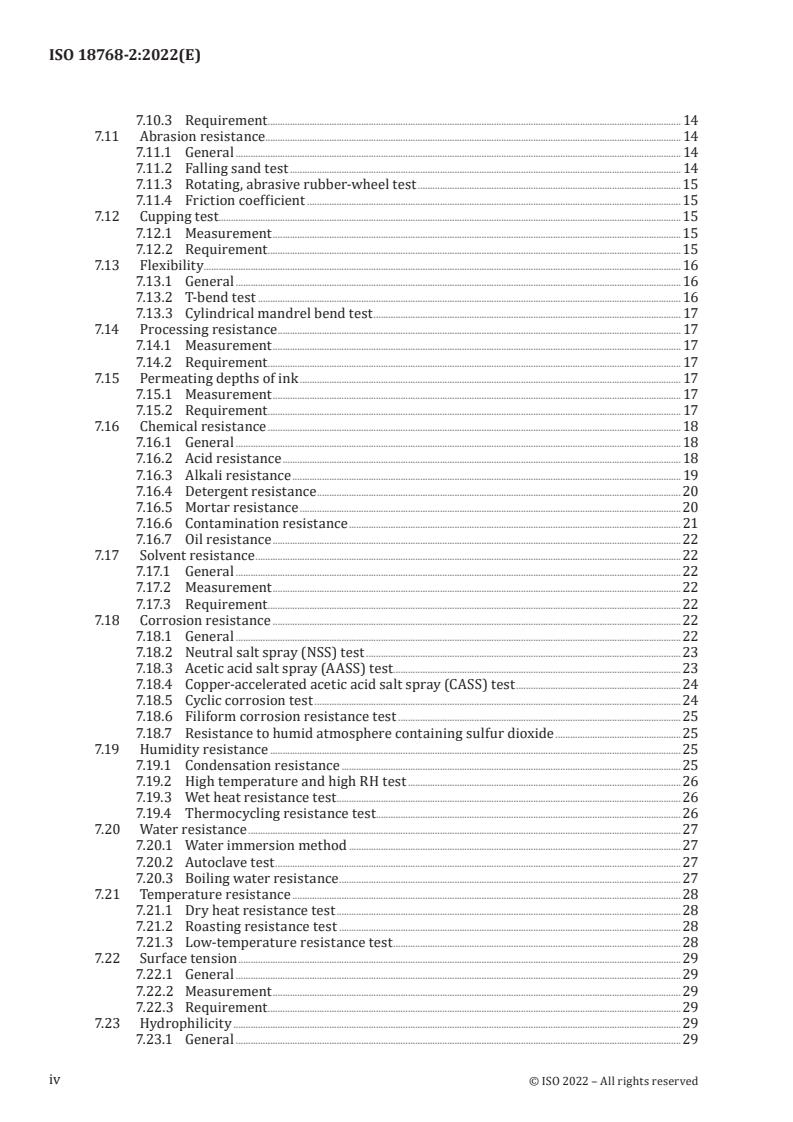
Foreword . vi
Introduction .vii
1 Scope . 1
2 Normative references . 1
3 Terms and definitions . 2
4 Information to be supplied by the customer to the surface processor .3
5 Metal preparation and pretreatment . 5
5.1 Material (substrate) . 5
5.2 Pretreatment of the substrate . 5
5.2.1 General . 5
5.2.2 Degreasing etching and rinsing . 5
5.2.3 Anodic oxidation coating . 5
5.2.4 Chemical conversion coatings . 5
5.2.5 Alternative pretreatment . 6
6 Categories . 6
7 Tests . 8
7.1 General . 8
7.2 Appearance . 8
7.2.1 General . 8
7.2.2 Measurement . 8
7.2.3 Requirement . 8
7.3 Colour . 9
7.3.1 General . 9
7.3.2 Visual method . 9
7.3.3 Instrumental method . 9
7.4 Gloss . 9
7.4.1 Measurement . 9
7.4.2 Requirement . 10
7.5 Brightness (distinctness of image) . 10
7.5.1 General . 10
7.5.2 Measurement . 10
7.5.3 Requirement . 10
7.6 Thickness . 10
7.6.1 General . 10
7.6.2 Measurement . 11
7.6.3 Requirement . 11
7.7 Hardness (pencil) . . 11
7.7.1 Measurement . 11
7.7.2 Requirement . 11
7.8 Adhesion . 11
7.8.1 General . 11
7.8.2 Scratch circular roll method .12
7.8.3 Dry adhesion test .12
7.8.4 Wet adhesion test.13
7.8.5 Pull-off test .13
7.9 Impact resistance . 13
7.9.1 General .13
7.9.2 Measurement . 14
7.9.3 Requirement . 14
7.10 Multi-impact stone chipping resistance . 14
7.10.1 General . 14
7.10.2 Measurement . 14
iii
7.10.3 Requirement . 14
7.11 Abrasion resistance . . . 14
7.11.1 General . 14
7.11.2 Falling sand test . 14
7.11.3 Rotating, abrasive rubber-wheel test . 15
7.11.4 Friction coefficient . 15
7.12 Cupping test.15
7.12.1 Measurement .15
7.12.2 Requirement .15
7.13 Flexibility. 16
7.13.1 General . 16
7.13.2 T-bend test . 16
7.13.3 Cylindrical mandrel bend test . 17
7.14 Processing resistance . 17
7.14.1 Measurement . 17
7.14.2 Requirement . 17
7.15 Permeating depths of ink . 17
7.15.1 Measurement . 17
7.15.2 Requirement . 17
7.16 Chemical resistance . 18
7.16.1 General . 18
7.16.2 Acid resistance . 18
7.16.3 Alkali resistance . 19
7.16.4 Detergent resistance . 20
7.16.5 Mortar resistance .20
7.16.6 Contamination resistance . 21
7.16.7 Oil resistance .22
7.17 Solvent resistance .22
7.17.1 General .22
7.17.2 Measurement .22
7.17.3 Requirement .22
7.18 Corrosion resistance .22
7.18.1 General .22
7.18.2 Neutral salt spray (NSS) test . 23
7.18.3 Acetic acid salt spray (AASS) test . 23
7.18.4 Copper-accelerated acetic acid salt spray (CASS) test . 24
7.18.5 Cyclic corrosion test . 24
7.18.6 Filiform corrosion resistance test . 25
7.18.7 Resistance to humid atmosphere containing sulfur dioxide .25
7.19 Humidity resistance . 25
7.19.1 Condensation resistance . 25
7.19.2 High temperature and high RH test . 26
7.19.3 Wet heat resistance test . .26
7.19.4 Thermocycling resistance test . 26
7.20 Water resistance . 27
7.20.1 Water immersion method . 27
7.20.2 Autoclave test . 27
7.20.3 Boiling water resistance . 27
7.21 Temperature resistance .28
7.21.1 Dry heat resistance test .28
7.21.2 Roasting resistance test .28
7.21.3 Low-temperature resistance test .28
7.22 Surface tension .29
7.22.1 General .29
7.22.2 Measurement .29
7.22.3 Requirement .29
7.23 Hydrophilicity .29
7.23.1 General .29
iv
7.23.2 Measurement .29
7.23.3 Requirement .30
7.24 Thermal viscosity .30
7.24.1 General .30
7.24.2 Measurement .30
7.24.3 Requirement . 31
7.25 Resistivity . 31
7.25.1 General . 31
7.25.2 Measurement . 31
7.25.3 Requirement . 31
7.26 Weathering resistance . 31
7.26.1 General . 31
7.26.2 Outdoor exposure . . 31
7.26.3 Accelerated weathering resistance . 32
7.27 Sealing compounds adhesion . 32
7.27.1 Measurement . 32
7.27.2 Requirement . 33
Annex A (informative) Summary of information to be supplied by the customer to the
surface processor .34
Annex B (informative) Coating materials .37
Annex C (informative) Categories for architectural application .38
Bibliography .39
v
Foreword
ISO (the International Organization for Standardization) is a worldwide federation of national standards
bodies (ISO member bodies). The work of preparing International Standards is normally carried out
through ISO technical committees. Each member body interested in a subject for which a technical
committee has been established has the right to be represented on that committee. International
organizations, governmental and non-governmental, in liaison with ISO, also take part in the work.
ISO collaborates closely with the International Electrotechnical Commission (IEC) on all matters of
electrotechnical standardization.
The procedures used to develop this document and those intended for its further maintenance are
described in the ISO/IEC Directives, Part 1. In particular, the different approval criteria needed for the
different types of ISO documents should be noted. This document was drafted in accordance with the
editorial rules of the ISO/IEC Directives, Part 2 (see www.iso.org/directives).
Attention is drawn to the possibility that some of the elements of this document may be the subject of
patent rights. ISO shall not be held responsible for identifying any or all such patent rights. Details of
any patent rights identified during the development of the document will be in the Introduction and/or
on the ISO list of patent declarations received (see www.iso.org/patents).
Any trade name used in this document is information given for the convenience of users and does not
constitute an endorsement.
For an explanation of the voluntary nature of standards, the meaning of ISO specific terms and
expressions related to conformity assessment, as well as information about ISO’s adherence to
the World Trade Organization (WTO) principles in the Technical Barriers to Trade (TBT), see
www.iso.org/iso/foreword.html.
This document was prepared by Technical Committee ISO/TC 79, Light metals and their alloys,
Subcommittee SC 2, Organic and anodic oxidation coatings on aluminium.
A list of all parts in the ISO 18768 series can be found on the ISO website.
Any feedback or questions on this document should be directed to the user’s national standards body. A
complete listing of these bodies can be found at www.iso.org/members.html.
vi
Introduction
There are three major surface treatments on aluminium and its alloys:
a) anodic oxidation coatings;
b) organic coatings;
c) combined coatings of anodic oxidation coatings and organic coatings.
ISO 18768-1 and this document provide the performance requirements and test methods for b) organic
coatings.
Performance requirements and test methods for a) anodic oxidation coatings are given in ISO 7599 and
for c) combined coatings of anodic oxidation coatings and organic coatings in ISO 28340.
It is assumed that users are familiar with other relevant international and regional standards. Those
standards should be respected, and this document adopts optional systems in such cases.
vii
INTERNATIONAL STANDARD ISO 18768-2:2022(E)
Organic coatings on aluminium and its alloys — Methods
for specifying decorative and protective organic coatings
on aluminium —
Part 2:
Liquid coatings
1 Scope
This document specifies methods for specifying decorative and protective organic coatings on
aluminium and its alloys. It defines the characteristic properties of organic liquid coatings and provides
testing methods with minimum performance requirements, with reference to the application and the
aggressiveness of the environment in which the painted aluminium exists.
This document is applicable to aluminium products with liquid coatings for general applications, and
liquid coatings mainly processed by electrostatic liquid spraying, air spraying or airless spraying.
This document does not apply to coil coatings on aluminium.
2 Normative references
The following documents are referred to in the text in such a way that some or all of their content
constitutes requirements of this document. For dated references, only the edition cited applies. For
undated references, the latest edition of the referenced document (including any amendments) applies.
ISO 1463, Metallic and oxide coatings — Measurement of coating thickness — Microscopical method
ISO 1519, Paints and varnishes — Bend test (cylindrical mandrel)
ISO 1520, Paints and varnishes — Cupping test
ISO 2106, Anodizing of aluminium and its alloys — Determination of mass per unit area (surface density) of
anodic oxidation coatings — Gravimetric method
ISO 2360, Non-conductive coatings on non-magnetic electrically conductive base metals — Measurement
of coating thickness — Amplitude-sensitive eddy-current method
ISO 2409, Paints and varnishes — Cross-cut test
ISO 2812-2, Paints and varnishes — Determination of resistance to liquids — Part 2: Water immersion
method
ISO 2813, Paints and varnishes — Determination of gloss value at 20°, 60° and 85°
ISO 3892, Conversion coatings on metallic materials — Determination of coating mass per unit area —
Gravimetric methods
ISO 4211-2, Furniture — Tests for surface finishes — Part 2: Assessment of resistance to wet heat
ISO 4211-3, Furniture — Tests for surface finishes — Part 3: Assessment of resistance to dry heat
ISO 4623-2, Paints and varnishes — Determination of resistance to filiform corrosion — Part 2: Aluminium
substrates
ISO 4624, Paints and varnishes — Pull-off test for adhesion
ISO 4628-2, Paints and varnishes — Evaluation of degradation of coatings — Designation of quantity
and size of defects, and of intensity of uniform changes in appearance — Part 2: Assessment of degree of
blistering
ISO 4628-10, Paints and varnishes — Evaluation of degradation of coatings — Designation of quantity
and size of defects, and of intensity of uniform changes in appearance — Part 10: Assessment of degree of
filiform corrosion
ISO 6270-1, Paints and varnishes — Determination of resistance to humidity — Part 1: Condensation
(single-sided exposure)
ISO 6270-2, Paints and varnishes — Determination of resistance to humidity — Part 2: Condensation (in-
cabinet exposure with heated water reservoir)
ISO 6270-3, Paints and varnishes — Determination of resistance to humidity — Part 3: Condensation (in-
cabinet exposure with heated, bubbling water reservoir)
ISO 6272-2, Paints and varnishes — Rapid-deformation (impact resistance) tests — Part 2: Falling-weight
test, small-area indenter
ISO 7784-1, Paints and varnishes — Determination of resistance to abrasion — Part 1: Method with
abrasive-paper covered wheels and rotating test specimen
ISO 7784-2, Paints and varnishes — Determination of resistance to abrasion — Part 2: Method with
abrasive rubber wheels and rotating test specimen
ISO 8295, Plastics — Film and sheeting — Determination of the coefficients of friction
ISO 8296, Plastics — Film and sheeting — Determination of wetting tension
ISO 9227, Corrosion tests in artificial atmospheres — Salt spray tests
ISO 15184, Paints and varnishes — Determination of film hardness by pencil test
ISO 17132:2007, Paints and varnishes — T-bend test
ISO 16474-2, Paints and varnishes — Methods of exposure to laboratory light sources — Part 2: Xenon-arc
lamps
ISO 21227-2, Paints and varnishes — Evaluation of defects on coated surfaces using optical imaging —
Part 2: Evaluation procedure for multi-impact stone-chipping test
ISO 28340:2013, Combined coatings on aluminium — General specifications for combined coatings of
electrophoretic organic coatings and anodic oxidation coatings on aluminium
ASTM C207, Standard Specification for Hydrated Lime for Masonry Purposes
ASTM D968, Standard Test Methods for Abrasion Resistance of Organic Coatings by Falling Abrasive
ASTM D7869, Standard Practice for Xenon Arc Exposure Test with Enhanced Light and Water Exposure for
Transportation Coatings
QUALICOAT Specifications 2022, Specifications for a quality label for liquid and powder organic coatings
on aluminium for architectural applications
GSB QR AL 631-7 ST 663-7, Measuring and Testing Methods
3 Terms and definitions
For the purposes of this document, the following terms and definitions apply.
ISO and IEC maintain terminology databases for use in standardization at the following addresses:
— ISO Online browsing platform: available at https:// www .iso .org/ obp
— IEC Electropedia: available at https:// www .electropedia .org/
3.1
liquid coating
dry coating with a certain thickness that has effects of decorative and protective for a product, coating
is formed by liquid lacquer excluding the coating whose based layer is formed by anodizing, combined
coating or powder coating
3.2
reference sample
reference specimen
sample which defines the criteria for acceptable properties
Note 1 to entry: This may be agreed between the customer and the surface processor
3.3
significant surface
part of the article covered or to be covered by the coatings, and for which the coatings are essential for
service and/or appearance
3.4
test specimen
single sample of the final product to be used for testing
4 Information to be supplied by the customer to the surface processor
In order to coat the product correctly and depending on the application, the following information
should be supplied by the customer to the surface processor, if necessary, in consultation with the
aluminium supplier and/or the surface processor.
A summary of the references to this information is given in Annex A.
a) a reference to this document, i.e. ISO 18768-2;
b) the intended service use of the article to be coated;
c) the environmental categories of the intended service (see Clause 6);
d) the specification of the aluminium (chemical composition and temper designations) to be coated;
e) an indication of the significant surface(s) of the product to be coated;
f) the preferred position and maximum size of contact marks;
g) details of any formal sampling plans required;
h) the type of pretreatment;
i) mass loss by etching;
j) thickness of the anodic oxidation coating or mass of the chemical conversion coating used for
pretreatment;
k) the type of coating process to be used;
l) the quality of appearance required;
m) the acceptable limits of colour variation by agreed reference samples;
n) the thickness of the coating;
o) the hardness of the coating;
p) the dry adhesion of the coating;
q) the wet adhesion of the coating;
r) the value range of gloss measured by equipment;
s) the distinctness of the image;
t) the impact resistance (excluding anodic oxidation coating for pretreatment);
u) the multi-impact stone chipping resistance;
v) the abrasion resistance of the coating;
w) the cupping resistance (excluding anodic oxidation coating for pretreatment);
x) the flexibility of the coating (excluding anodic oxidation coating for pretreatment);
y) the processing resistance, such as cutting, milling or drilling;
z) the permeating depths of ink into the coating;
aa) the solvent resistance;
bb) the humidity resistance;
cc) the water resistance;
dd) the temperature resistance;
ee) the surface tension of the coating;
ff) the hydrophilicity of the coating;
gg) the thermal viscosity of the coating;
hh) the resistivity;
ii) the acid resistance;
jj) the alkali resistance;
kk) the detergent resistance;
ll) the mortar resistance;
mm) the contamination resistance;
nn) the oil resistance;
oo) the corrosion resistance;
pp) the resistance to a humid atmosphere containing sulfur dioxide;
qq) the filiform corrosion resistance;
rr) the weathering resistance of the coating;
ss) the accelerated weathering resistance;
tt) the colour difference between test specimens and reference samples using a colour difference
meter;
uu) the value range of the gloss measured by equipment;
vv) the sealing compounds adhesion.
5 Metal preparation and pretreatment
5.1 Material (substrate)
Aluminium and aluminium alloys are classified in accordance with ISO 209.
5.2 Pretreatment of the substrate
5.2.1 General
Before application of the coating, a pretreatment coating should be applied. This pretreatment may be
one of the following:
a) anodic oxidation coating;
b) chemical conversion coating with aqueous solutions containing either chromate ions or chromate
and phosphate ions, without applying an electric current;
c) an alternative pretreatment (e.g. chromium-free systems).
After the chemical conversion coating process, the substrate is normally rinsed with deionized water
(preferably below 30 μS/cm at 20 °C) and dried.
There are also some coatings used mainly for decorative purposes, which do not need to be pretreated
before coating.
If a non-rinsing pretreatment is applied, the last rinsing is carried out before the conversion coating
process.
5.2.2 Degreasing etching and rinsing
All surface contaminants such as greases, lubricants and residues shall be removed using alkaline or
acidic solutions and/or solvents in appropriate combinations. Before the conversion stage, the substrate
shall be thoroughly cleaned.
Mass loss before and after etching should be measured by the mass of a test specimen. It should be no
2 2
less than 1 g/m , and preferably more than 2 g/m .
5.2.3 Anodic oxidation coating
The anodic oxidation pretreatment should be chosen so as to produce an anodic oxidation coating with
a thickness of 3 μm to 10 μm without chalking and surface flaws. It shall be measured in accordance
with ISO 2360. After the pretreatment, rinse the specimen with deionized water to remove the acid
from the surface. The anodic oxidation coating should not be sealed.
The time between anodic oxidation pretreatment and liquid coating should be less than 72 h. If the time
between the anodic oxidation pretreatment and liquid coating is more than 24 h, the anodic oxidation
pretreatment should be tested by a dye spot test in accordance with ISO 2143. The intensity of the stain
should be level 5.
5.2.4 Chemical conversion coatings
A chemical conversion coating shall be produced by application of the appropriate solution. Generally,
chromate and phosphate are used.
The surface density of conversion coatings shall be agreed between the customer and the surface
processor. In the absence of such an agreement, the mass of the chromate coating should be between
2 2 2 2
0,4 g/m and 1,0 g/m for chromate conversion coating and between 0,4 g/m and 1,2 g/m for
chromate-phosphate conversion coating. It shall be measured in accordance with surface density (see
7.6.2.3).
The drying temperature should not exceed 65 °C for chromate conversion coating and 85 °C for
chromate-phosphate conversion coating.
5.2.5 Alternative pretreatment
Alternative pretreatments, e.g. chromium-free system, or other processes may be specified but shall be
agreed between the customer and the surface processor, taking into consideration the recommendations
from the chemical supplier.
6 Categories
Symbols, typical properties and applications of the more common coating materials are shown in
Table B.1. Symbols of the more common coating materials are for information only.
There are two typical environmental categories: corrosivity and UV radiation.
The corrosion protection and the adhesion of the coating on the aluminium is mainly determined by
the surface pretreatment before coating. For this reason, the surface pretreatment should be selected
according to the corrosivity category. It is recommended that the corrosivity category is defined in the
specification.
The permanent colour stability of a coating and the decorative appearance of the coated surface depends
on the UV resistance of the coating material. For this reason, the coating material should be selected
based on the UV category. It is recommended that the UV category is defined in the specification.
Examples of typical applications of liquid coatings for architectural application are shown in Tables C.1
and C.2.
The corrosivity category defined by the corrosion effects given in ISO 9223 are shown in Table 1. The
UV categories are shown in Table 2.
Table 1 — Description of typical atmospheric environments
related to the estimation of corrosivity categories
b
Typical environments — Examples
Corrosivity Corrosiv-
a
category ity
Indoor Outdoor
C1 Very low Heated spaces with low relative Dry or cold zone, atmospheric environ-
humidity and insignificant pollution, ment with very low pollution and time
e.g. offices, schools, museums. of wetness, e.g. certain deserts, Central
Arctic/Antarctica.
C2 Low Unheated spaces with varying Temperate zone, atmospheric environ-
temperature and relative humidity. ment with low pollution (SO < 5 µg/m ),
Low frequency of condensation and e.g. rural areas, small towns.
low pollution, e.g. storage, sport halls.
Dry or cold zone, atmospheric environ-
ment with short time of wetness, e.g.
deserts, subarctic areas.
Table 1 (continued)
b
Typical environments — Examples
Corrosivity Corrosiv-
a
category ity
Indoor Outdoor
C3 Medium Spaces with moderate frequency of Temperate zone, atmospheric
condensation and moderate pollution environment with medium pollution
3 3
from production process, e.g. food- (SO : 5 µg/m to 30 µg/m ) or some
processing plants, laundries, effect of chlorides, e.g. urban areas,
breweries, dairies. coastal areas with low deposition of
chlorides.
Subtropical and tropical zone,
atmosphere with low pollution.
C4 High Spaces with high frequency of Temperate zone, atmospheric environ-
condensation and high pollution from ment with high
...