

ISO/PRF 11177
(Main)Vitreous and porcelain enamels — Inside and outside enamelled valves and pressure pipe fittings for untreated and potable water supply — Quality requirements and testing
- Abstract
This document specifies the requirements for product quality and product testing of enamelled valves and pressure pipe fittings for untreated and potable water supply. It does not apply to chemical service glass-enamel and apparatus enamel.
- Status
- Not Published
- Technical Committee
- ISO/TC 107 - Metallic and other inorganic coatings
- Drafting Committee
- ISO/TC 107/WG 2 - Vitreous and porcelain enamel coatings
- Current Stage
- 5020 - Proof sent to secretariat or FDIS ballot initiated: 8 weeks - 50 Approval
- Start Date
- 04-Nov-2026
Buy Documents
ISO/PRF 11177 - Vitreous and porcelain enamels — Inside and outside enamelled valves and pressure pipe fittings for untreated and potable water supply — Quality requirements and testing

REDLINE ISO/PRF 11177 - Vitreous and porcelain enamels — Inside and outside enamelled valves and pressure pipe fittings for untreated and potable water supply — Quality requirements and testing
ISO/PRF 11177 is an ISO document for inside and outside enamelled valves and pressure pipe fittings used in untreated and potable water supply. It specifies product quality requirements and the test methods used to check them, so manufacturers, laboratories, and buyers can judge whether an enamelled component meets the expected surface, durability, and resistance properties.
What does ISO/PRF 11177 specify?
ISO/PRF 11177 specifies quality requirements and testing for enamelled valves and pressure pipe fittings for untreated and potable water supply. It applies to the enamelled product, not to chemical service glass-enamel or apparatus enamel.
The document is organized into six clauses:
- Scope
- Normative references
- Terms and definitions
- Sampling
- Quality requirements and testing procedures
- Test report
That structure matters in practice because it separates what the document covers, which test methods to use, how samples are chosen, what acceptance features are checked, and what must be recorded in the final report.
What are the key requirements of ISO/PRF 11177?
ISO/PRF 11177 focuses on visible enamel quality, coating performance, and resistance to service conditions that valves and pressure pipe fittings can meet during storage, transport, installation, and operation. The tests are designed around real stresses such as impact, abrasion, corrosion, climate, and ultraviolet exposure.
Surface quality and thickness
Clause 5.1 requires the enamelling to be uniform and smooth, with sealing surfaces made so the seal effect is not impaired. Small edge colour variations are acceptable, and isolated pores are allowed within stated size and count limits. In practice, this is the first visual acceptance check for defects that could affect sealing or appearance.
Clause 5.2 requires coat thickness measurement with a calibrated system in accordance with ISO 2178. The coating thickness is set within a defined range, except for flange holes, and random samples are taken from each production batch. This gives a repeatable way to confirm that the enamel layer is neither too thin nor excessively thick.
Mechanical and thermal resistance
Clause 5.3 sets surface scratch hardness by the Mohs scale in accordance with ISO 6769. The minimum value matters because the enamel must resist handling and service wear.
Clause 5.4 covers thermal shock resistance in accordance with ISO 13807, using cast-iron samples and a defined temperature difference with water cooling at room temperature. After testing, the enamel must show no visible defects. This checks whether the coating can survive sudden temperature changes.
Corrosion and chemical resistance
Clause 5.5 requires resistance to water and steam using ISO 28706-2, followed by visual inspection. Clause 5.6 requires resistance to citric acid in accordance with ISO 28706-1:2008, Clause 9, Class AA. Together, these clauses check how the enamel behaves against common water-related and acidic exposure.
Clause 5.7 deals with exterior coating resistance in very aggressive soils, using both a watery solution and a moist soil exposure over six months. The visual check after exposure must not show defects. This is important for buried or externally exposed fittings.
Damage, climate, and use conditions
Clauses 5.8 to 5.10 cover corrosion and chemical resistance after impact damage, scratch damage, and abrasion damage. In each case, the damaged area is exposed to deionized water at 80 °C for three days, then checked visually. These tests show whether the enamel still protects the base material after the coating has been damaged.
Clause 5.11 covers climatic exposure and ultraviolet radiation using ISO 16474-1 and ISO 16474-2. Above-ground structural components must remain resistant to weathering and UV effects, without fading or loss of corrosion resistance. Clause 5.12 points to national regulation for physiological harmlessness where no European or international rule exists.
Clause 4 states that sampling is agreed between the contractual partners, so the purchaser and supplier need to define how test pieces are selected.
What terms does ISO/PRF 11177 define?
ISO/PRF 11177 uses defined terms from ISO 19496-1 and adds its own key terms.
- Corrosion - a material reaction with its environment that changes the material and can reduce function.
- Sub-surface migration - corrosion that progresses under the protective layer and can separate it from the base material.
- UV radiation - the ultraviolet light exposure used in the climatic exposure test.
- HRC - the hardness scale used for the falling weight in the impact damage test.
- pH - the acidity measure used to set the soil test conditions.
- w/v - a weight/volume expression used to describe the composition of the soil mixtures.
Who uses ISO/PRF 11177?
ISO/PRF 11177 is used by manufacturers of enamelled valves and pressure pipe fittings, enamel coaters, and test laboratories. It is also useful for quality managers, procurement teams, and buyers who need to specify or verify enamel performance for untreated and potable water supply. In practice, it supports product acceptance, batch testing, and reporting.
What changed in ISO/PRF 11177 from the previous edition?
ISO/PRF 11177 is the third edition and it cancels and replaces ISO 11177:2019. The changes stated in the document are:
- updated normative references
- updated terms and definitions
- redefined coating thickness specification
- specified testing frequency for the quality requirements
- a new clause on durability and sustainability
Which standards are used with ISO/PRF 11177?
ISO/PRF 11177 relies on several referenced standards for the test methods and terminology it uses:
- ISO 2178 - magnetic measurement of coating thickness
- ISO 6370-1 - abrasion testing apparatus
- ISO 6370-2 - loss in mass after sub-surface abrasion
- ISO 6769 - surface scratch hardness according to the Mohs scale
- ISO 13807 - thermal shock crack formation test method
- ISO 15695 - scratch resistance of enamel finishes
- ISO 16474-1 and ISO 16474-2 - laboratory light exposure guidance and xenon-arc exposure
- ISO 19496-1 - terms and definitions for vitreous and porcelain enamels
- ISO 28706-1:2008 and ISO 28706-2 - chemical corrosion resistance tests
- DIN 50929-3 - soil corrosion assessment used in the external soil resistance clause
What does the ISO/PRF 11177 document contain?
ISO/PRF 11177 contains a sequence of quality checks and test procedures for enamelled water-supply valves and pressure pipe fittings. It includes visual surface criteria, thickness measurement, hardness testing, thermal shock testing, several corrosion resistance tests, and exposure tests for climate and ultraviolet radiation. The document also gives the conditions for impact, scratch, and abrasion damage tests, then checks the damaged area for defects after water exposure.
It also specifies what the test report must record, including the sample, laboratory, document reference, batch size, non-conforming parts, test results, unusual features, deviations, and the testing date. That makes the document suitable for production control, type testing, and formal reporting.
Relations
- Effective Date
- 12-Feb-2026
- Effective Date
- 01-Feb-2025
Buy Documents
ISO/PRF 11177 - Vitreous and porcelain enamels — Inside and outside enamelled valves and pressure pipe fittings for untreated and potable water supply — Quality requirements and testing
REDLINE ISO/PRF 11177 - Vitreous and porcelain enamels — Inside and outside enamelled valves and pressure pipe fittings for untreated and potable water supply — Quality requirements and testing
Get Certified
Connect with accredited certification bodies for this standard

DIBt (Deutsches Institut für Bautechnik)
German Institute for Building Technology.

DIN CERTCO
DIN Group product certification.

DVS-ZERT GmbH
German welding certification society.
Sponsored listings
Frequently Asked Questions
ISO/PRF 11177 is a draft published by the International Organization for Standardization (ISO). Its full title is "Vitreous and porcelain enamels — Inside and outside enamelled valves and pressure pipe fittings for untreated and potable water supply — Quality requirements and testing". This standard covers: This document specifies the requirements for product quality and product testing of enamelled valves and pressure pipe fittings for untreated and potable water supply. It does not apply to chemical service glass-enamel and apparatus enamel.
This document specifies the requirements for product quality and product testing of enamelled valves and pressure pipe fittings for untreated and potable water supply. It does not apply to chemical service glass-enamel and apparatus enamel.
ISO/PRF 11177 is classified under the following ICS (International Classification for Standards) categories: 25.220.50 - Enamels; 91.140.60 - Water supply systems. The ICS classification helps identify the subject area and facilitates finding related standards.
ISO/PRF 11177 has the following relationships with other standards: It is inter standard links to prEN ISO 11177, ISO 11177:2019. Understanding these relationships helps ensure you are using the most current and applicable version of the standard.
ISO/PRF 11177 is available in PDF format for immediate download after purchase. The document can be added to your cart and obtained through the secure checkout process. Digital delivery ensures instant access to the complete standard document.
Standards Content (Sample)
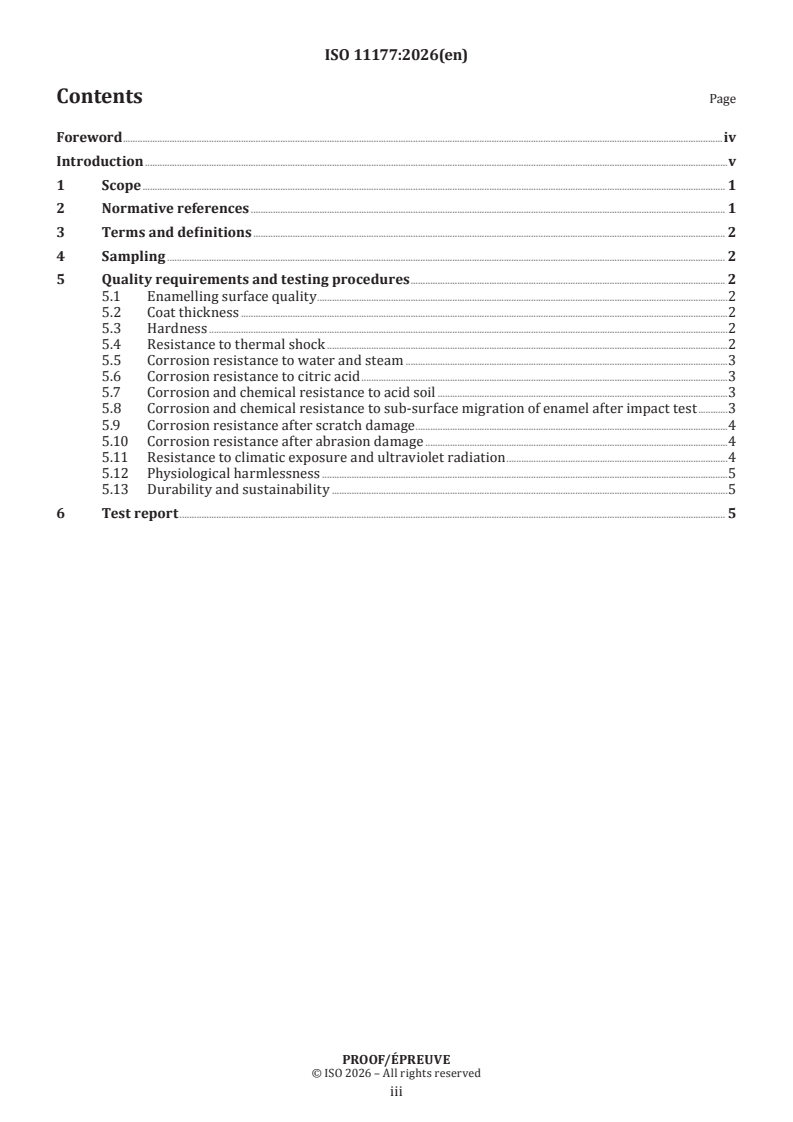
Contents
- Introduction
- 1 Scope
- 2 Normative references
- 3 Terms and definitions
- 3.1 corrosion
- 3.2 sub-surface migration
- 4 Sampling
- 5 Quality requirements and testing procedures
- 5.1 Enamelling surface quality
- 5.2 Coat thickness
- 5.3 Hardness
- 5.4 Resistance to thermal shock
- 5.5 Corrosion resistance to water and steam
- 5.6 Corrosion resistance to citric acid
- 5.7 Corrosion and chemical resistance to acid soil
- 5.8 Corrosion and chemical resistance to sub-surface migration of enamel after impact test
- 5.9 Corrosion resistance after scratch damage
- 5.10 Corrosion resistance after abrasion damage
- 5.11 Resistance to climatic exposure and ultraviolet radiation
- 5.12 Physiological harmlessness
- 5.13 Durability and sustainability
- 6 Test report
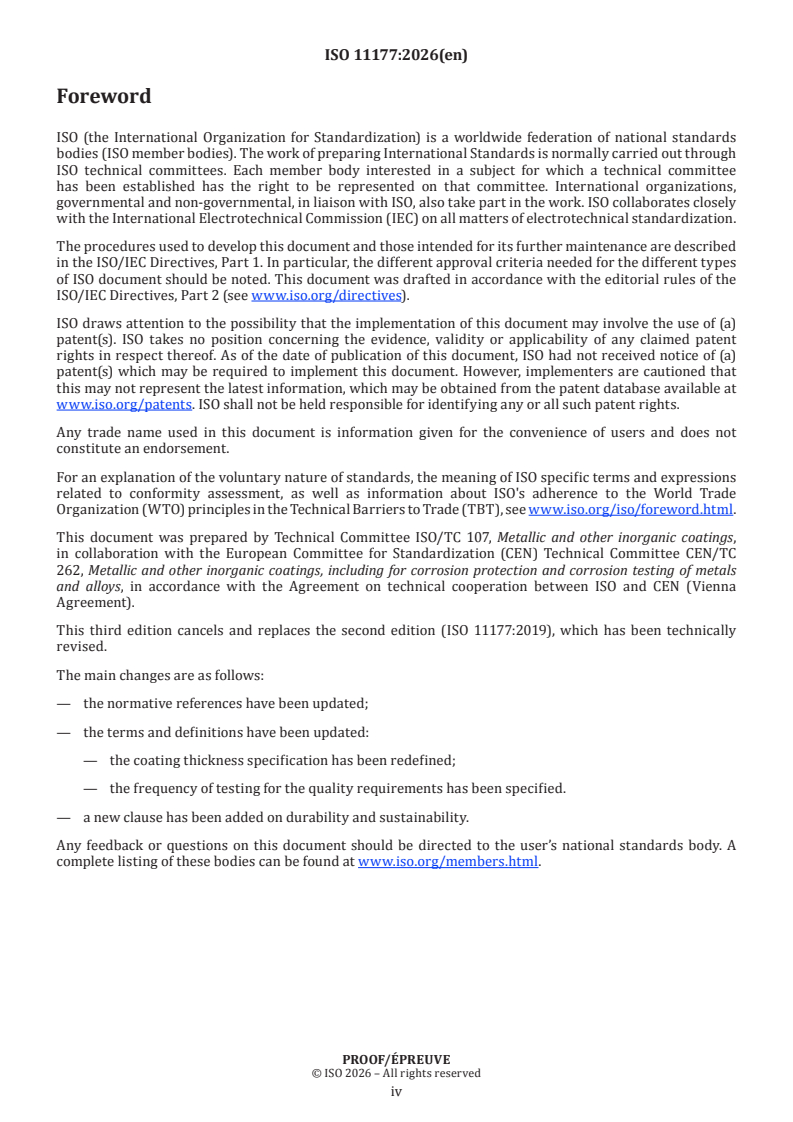
Introduction
The requirements specified in this document regarding the product quality of enamelled valves and pressure pipe fittings for untreated and potable water supply take into account the real stress conditions to which a component can be subjected in the course of its operating life. Typical types of stress are:
- during storage: climate, UV radiation, mechanical stress;
- during transportation: mechanical stress, e.g. at certain points (impact), laterally (friction);
- during preparation for installation: cleaning agents, mechanical stress, e.g. at certain points (impact), laterally (friction);
- during installation: mechanical stress;
- during operation: abrasion caused by the carried medium, corrosion from surrounding medium, mechanical stress from shifting ground loads, UV radiation with valves built in above ground. PROOF/ÉPREUVE
International Standard ISO 11177:2026(en) Vitreous and porcelain enamels — Inside and outside enamelled valves and pressure pipe fittings for untreated and potable water supply — Quality requirements and testing
1 Scope
This document specifies the requirements for product quality and product testing of enamelled valves and pressure pipe fittings for untreated and potable water supply. This document does not apply to chemical service glass-enamel and apparatus enamel.
2 Normative references
The following documents are referred to in the text in such a way that some or all of their content constitutes requirements of this document. For dated references, only the edition cited applies. For undated references, the latest edition of the referenced document (including any amendments) applies. ISO 2178, Non-magnetic coatings on magnetic substrates — Measurement of coating thickness — Magnetic method ISO 6370-1, Vitreous and porcelain enamels — Determination of the resistance to abrasion — Part 1: Abrasion testing apparatus ISO 6370-2, Vitreous and porcelain enamels — Determination of the resistance to abrasion — Part 2: Loss in mass after sub-surface abrasion ISO 6769, Vitreous and porcelain enamels — Determination of surface scratch hardness according to the Mohs scale ISO 13807, Vitreous and porcelain enamels — Determination of crack formation temperature in the thermal shock testing of enamels for the chemical industry ISO 15695, Vitreous and porcelain enamels — Determination of scratch resistance of enamel finishes ISO 16474-1, Paints and varnishes — Methods of exposure to laboratory light sources — Part 1: General guidance ISO 16474-2, Paints and varnishes — Methods of exposure to laboratory light sources — Part 2: Xenon-arc lamps ISO 19496-1, Vitreous and porcelain enamels — Terminology — Part 1: Terms and definitions ISO 28706-1:2008, Vitreous and porcelain enamels — Determination of resistance to chemical corrosion — Part 1: Determination of resistance to chemical corrosion by acids at room temperature ISO 28706-2, Vitreous and porcelain enamels — Determination of resistance to chemical corrosion — Part 2:
Determination of resistance to chemical corrosion by boiling acids, boiling neutral liquids, alkaline liquids and/ or their vapours DIN 50929-3, Corrosion of metals — Probability of corrosion of metallic materials when subject to corrosion from the outside — Buried and underwater pipelines and structural components PROOF/ÉPREUVE
ISO 11177:2026(en)
3 Terms and definitions
For the purposes of this document, the terms and definitions given in ISO 19496-1 and the following apply. ISO and IEC maintain terminology databases for use in standardization at the following addresses:
- ISO Online browsing platform: available at https:// www .iso .org/ obp
- IEC Electropedia: available at https:// www .electropedia .org/
3.1 corrosion
reaction of a material with its environment causing a measurable change in the material which can lead to impaired function of a component or a complete system
...
Contents
- Introduction
- 1 Scope
- 2 Normative references
- 3 Terms and definitions
- 3.1 Formatted: TermNum2, Adjust space between Latin and
- 3.2 sub-surface migration
- 4 Sampling
- 5 Quality requirements and testing procedures
- 5.3 Hardness
- 5.4 Resistance to thermal shock
- 5.5 Corrosion resistance to water and steam
- 5.6 Corrosion resistance to citric acid
- 5.7 Corrosion and chemical resistance to acid soil
- 5.9 Corrosion resistance after scratch damage
- 5.10 Corrosion resistance after abrasion damage
- 5.13 Durability and sustainability
- 6 Test report
Introduction
The requirements specified in this document regarding the product quality of enamelled valves and pressure pipe fittings for untreated and potable water supply take into account the real stress conditions to which a component can be subjected in the course of its operating life. Typical types of stress are:
Typical types of stress are:— Formatted: Adjust space between Latin and Asian text, - during storage: climate, UV radiation, mechanical stress; Adjust space between Asian text and numbers, Tab stops: Not at 0.7 cm + 1.4 cm + 2.1 cm + 2.8 cm + 3.5 cm + 4.2 - — during transportation: mechanical stress, e.g. at certain points (impact), laterally (friction); cm + 4.9 cm + 5.6 cm + 6.3 cm + 7 cm - — during preparation for installation: cleaning agents, mechanical stress, e.g. at certain points (impact), laterally (friction); - — during installation: mechanical stress; - — during operation: abrasion caused by the carried medium, corrosion from surrounding medium, mechanical stress from shifting ground loads, UV radiation with valves built in above ground. Formatted: Font: 10 pt Formatted: Font: 10 pt Formatted: Font: 10 pt Formatted: FooterCentered, Left, Space Before: 0 pt, Tab stops: Not at 17.2 cm Formatted: Font: 11 pt
International Standard ISO 11177:2026(en) Formatted
Formatted
Formatted Vitreous and porcelain enamels — Inside and outside enamelled ... Formatted
valves and pressure pipe fittings for untreated and potable water Formatted
supply — Quality requirements and testing Formatted
Formatted
1 Scope
Formatted
Formatted This document specifies the requirements for product quality and product testing of enamelled valves and
pressure pipe fittings for untreated and potable water supply. Formatted
Formatted
ItThis document does not apply to chemical service glass-enamel and apparatus enamel. Formatted
Formatted
2 Normative references
Formatted
Formatted The following documents are referred to in the text in such a way that some or all of their content constitutes ... requirements of this document. For dated references, only the edition cited applies. For undated references, Formatted
the latest edition of the referenced document (including any amendments) applies. Formatted
Formatted
ISO 2178, Non-magnetic coatings on magnetic substrates — Measurement of coating thickness — Magnetic Formatted
method Formatted
ISO 6370--1, Vitreous and porcelain enamels — Determination of the resistance to abrasion — Part 1:
Formatted
Abrasion testing apparatus Formatted
Formatted
ISO 6370--2, Vitreous and porcelain enamels — Determination of the resistance to abrasion — Part 2: Loss in Formatted
mass after sub-surface abrasion Formatted
ISO 6769, Vitreous and porcelain enamels — Determination of surface scratch hardness according to the Mohs Formatted
scale Formatted
Formatted
ISO 13807, Vitreous and porcelain enamels — Determination of crack formation temperature in the thermal Formatted
shock testing of enamels for the chemical industry Formatted
ISO 15695, Vitreous and porcelain enamels — Determination of scratch resistance of enamel finishes Formatted
Formatted
ISO 16474--1, Paints and varnishes — Methods of exposure to laboratory light sources — Part 1: General Formatted
guidance Formatted
Formatted ISO 16474--2, Paints and varnishes — Methods of exposure to laboratory light sources — Part 2: Xenon-arc
lamps Formatted
Formatted
ISO 19496--1, Vitreous and porcelain enamels — Terminology — Part 1: Terms and definitions Formatted
Formatted
ISO 28706--1:2008, Vitreous and porcelain enamels — Determination of resistance to chemical corrosion — Formatted Part 1: Determination of resistance to chemical corrosion by acids at room temperature
Formatted
ISO 28706--2, Vitreous and porcelain enamels — Determination of resistance to chemical corrosion — Part 2:
Formatted
Determination of resistance to chemical corrosion by boiling acids, boiling neutral liquids, alkaline liquids Formatted
and/or their vapours Formatted
Formatted
ISO/DIS PRF 11177(E:2026(en) Formatted: Font: Bold Formatted: Font: Bold Formatted: Font: Bold DIN 50929--3, Corrosion of metals — Probability of corrosion of metallic materials when subject to corrosion Formatted: HeaderCentered, Space After: 0 pt from the outside — Buried and underwater pipelines and structural components Formatted: Default Paragraph Font Formatted: Default Paragraph Font
Formatted: Default Paragraph Font Formatted: Default Paragraph Font
3 Terms and definitions
Formatted: Adjust space between Latin and Asian text, Adjust space between Asian text and numbers For the purposes of this document, the terms and definitions given in ISO 19496-1 and the following apply. Formatted: Default Paragraph Font ISO and IEC maintain terminologicalterminology databases for use in standardization at the following Formatted: Default Paragraph Font addresses:
Formatted: Default Paragraph Font - ISO Online browsing platform: available at https://www.iso.org/obp - IEC Electropedia: available at https://www.electropedia.org/
3.1 Formatted: TermNum2, Adjust space between Latin and
Asian text, Adjust space between Asian text and numbers corrosion reaction of a material with its environment causing a measurable change in the material which can lead to impaired function of a component or a complete system
3.2 sub-surface migration
type of corrosion (3.1) whereby the attack progresses underneath the protective layer parallel to the surface which can lead to separation of the protective layer from the base material
4 Sampling
Sampling shall be agreed between contractual partners.
5 Quality requirements and testing procedures
5.1 Enamelling surface quality Formatted: Adjust space between Latin and Asian text, Adjust space between Asian text and numbers, Tab stops: Not at 0.71 cm The enamelling of all parts shall be uniform and smooth and carried out in such a way on the sealing surfaces Formatted: Adjust space between Latin and Asian text, that the seal effect is not impaired.
Adjust space between Asian text and numbers Slight variations in colour on edges and ridge areas do not impair product quality and are acceptable. Isolated pores are acceptable provided the dimension of an individual pore does not exceed 1 mm and that no more than seven pores are visible on a surface segment with a diameter of approximately 35 mm. 5.2 Coat thickness Formatted: Adjust space between Latin and Asian text, Adjust space between Asian text and numbers, Tab stops: Not at 0.71 cm The measurement of coat thickness shall be carried out using a calibrated test system in accordance with Formatted: Adjust space between Latin and Asian text, ISO 2178.
...