

ISO/DTS 19480
(Main)Polyethylene pipes and fittings for the supply of gaseous fuels or water — Training and assessment of fusion operators
- Abstract
This Technical Specification specifies the training, assessment and approval of fusion operators, with the aim of establishing and maintaining their competency in the construction of polyethylene (PE) piping systems for the supply of gaseous fuels in accordance with ISO/TS 10839, for the supply of water, or in the construction of such systems used in other pressure applications. It covers the butt fusion and electrofusion fusion jointing techniques and considers both the theoretical and practical knowledge necessary for making high-quality fusion joints.
- Status
- Not Published
- Drafting Committee
- ISO/TC 138/SC 4/WG 2 - Fusion of PE Pipe Systems
- Current Stage
- 5000 - Final text received or FDIS registered for formal approval - 50 Approval
- Start Date
- 13-Aug-2026
- Due Date
- 23-Apr-2026
- Completion Date
- 23-Apr-2026
Buy Documents
ISO/DTS 19480 - Polyethylene pipes and fittings for the supply of gaseous fuels or water — Training and assessment of fusion operators

REDLINE ISO/DTS 19480 - Polyethylene pipes and fittings for the supply of gaseous fuels or water — Training and assessment of fusion operators
ISO/DTS 19480 is an ISO Technical Specification on training, assessment and approval of fusion operators for polyethylene (PE) piping systems. It sets out how operators are trained and checked for work on gas, water and other pressure applications, with a focus on butt fusion and electrofusion. The document is for training centres, pipeline operators, assessors and installers who need a common basis for proving operator competence.
What does ISO/DTS 19480 specify?
ISO/DTS 19480 specifies requirements and guidance for the training, assessment and approval of fusion operators. It is organized into scope, normative references, terms and definitions, training organization, training, assessment, and a normative annex on examination.
The scope covers PE piping systems for gaseous fuels in line with ISO/TS 10839, for water supply, and for other pressure applications. It also notes that other thermoplastic materials such as polypropylene, polybutylene and PVDF can fall within its scope.
| Annex | What it covers |
|---|---|
| Annex A | Examination: theoretical test, practical test, laboratory testing of fused assemblies, qualification and re-assessment |
What are the key requirements of ISO/DTS 19480?
ISO/DTS 19480 focuses on proving that a fusion operator can make and judge sound joints in real working conditions. The main requirements are about who trains the operator, what the training must include, how the examination is run, and how continued competence is renewed.
Training organization and equipment
Clause 4 requires trainees to follow a training course at a training centre to obtain qualification. The trainer must have the required experience and mastery of the fusion technique, and the centre must have the machines, control units, scrapers and other equipment normally used on site. In practice, this means the operator learns on equipment and methods that match the job.
Clause 4 also requires the fusion equipment to conform to ISO 12176-1 for butt fusion and ISO 12176-2 for electrofusion. That matters because the training has to reflect compatible, recognized equipment rather than local improvisation.
Training content
Clause 5 allows the course to be arranged in modules or packages based on the pipeline operator’s needs. It also requires safety topics related specifically to the fusion process, so training is not limited to technical steps alone.
Clause 5.2 requires the trainee to use suitable pipes and fittings and to complete at least one three-dimensional configuration. This is practical proof that the operator can work around obstacles and not only on straight, easy layouts.
Theoretical knowledge
Clause 5.2.2 requires theory on raw materials, pipes, fittings, valves, preparation tools and devices, and both electrofusion and butt fusion techniques. It also covers PE material types, SDR, manufacturing, marking, inspection of components, available test methods, and environmental aspects such as responsible use and disposal of materials. For a buyer or quality manager, this shows the course is intended to cover both product knowledge and jobsite discipline.
Electrofusion practice
Clause 5.2.3.1 requires experience with electrofusion socket and saddle techniques and with the manufacturer’s instructions, plus any relevant national specification. The trainee must check for damage, verify calibration, prepare the joint correctly, learn the coded parameters on fittings, and recognize typical imperfections. This is important because electrofusion quality depends on both correct setup and correct reading of the fitting data.
Butt fusion practice
Clause 5.2.3.2 requires experience with one or more butt fusion procedures in ISO 21307, or an equivalent national or industry specification. The training must reflect the type of machine used, manual or fully automatic, and the final assessment must state the machine type. The trainee must also practice machine setup, alignment, planing, cleaning and joint evaluation.
Assessment and renewal
Clause 6 requires both a theoretical and practical examination, with the examination content given in Annex A. The assessor must be accepted by the contracting parties and may supervise the theory and observe the practical work, including selected destructive tests such as tensile, peel decohesion, crushing decohesion or tear tests as applicable. If the operator fails, clause 6.3 requires retesting after at least one week, and repeated failure means the training course is repeated.
What terms does ISO/DTS 19480 define?
- Fusion operator - a person trained to carry out fusion jointing between PE pipes and/or fittings based on a fusion procedure.
- Pipeline operator - a private or public organization authorized to design, construct, operate and maintain the supply system; this is often the party that sets training needs.
- Training centre - the establishment that provides the training for fusion operators.
- Standard dimension ratio (SDR) - the numerical designation of a pipe series based on the ratio of nominal outside diameter to nominal wall thickness; it is used when selecting and comparing pipe dimensions.
Who uses ISO/DTS 19480?
ISO/DTS 19480 is used by training centres that teach fusion operators, by pipeline operators that specify the required skill level, and by assessors who examine operator competence. It is also relevant to contractors and installers working on PE piping systems for gaseous fuels, water supply, and other pressure applications.
In practice, it supports workforce qualification for butt fusion and electrofusion work. It is also useful for quality managers who need a documented basis for training records, operator approval and periodic re-assessment.
What changed in ISO/DTS 19480 from the previous edition?
ISO/DTS 19480 is the first edition that cancels and replaces ISO/TR 19480:2005. The main change stated in the foreword is the deletion of the socket fusion process.
Which standards are used with ISO/DTS 19480?
- ISO/TS 10839 - gives the code of practice for design, handling and installation of PE systems for gaseous fuels, and is used here as a guide for quality control and general jointing practice.
- ISO 4427-2 and ISO 4427-3 - specify PE pipes and fittings for water supply, which are the product references for water-related training.
- ISO 4437-2 and ISO 4437-3 - specify PE pipes and fittings for gaseous fuels, which are the product references for gas-related training.
- ISO 12176-1 and ISO 12176-2 - set equipment requirements for butt fusion and electrofusion, so the training uses suitable machines and control units.
- ISO 21307 - gives butt fusion jointing procedures for PE piping systems, and forms the basis for butt fusion training.
- ISO 13953, ISO 13954, ISO 13955, ISO 13956 and ISO 21751 - provide the destructive test methods used to assess fused test assemblies.
- ISO/TS 16486-8 - is a related training and assessment specification for polyamide fusion operators.
- EN 14728 - is cited for classifying fusion imperfections by image.
What does the ISO/DTS 19480 document contain?
ISO/DTS 19480 contains a structured training and examination framework rather than a design code. Clause 4 covers training organization, Clause 5 covers the curriculum and the technical content of the course, and Clause 6 covers the theoretical and practical examination and re-assessment.
The document includes two main tables: Table 1 on theoretical course topics and Table 2 on fusion jointing techniques. Annex A sets out the examination format, including multiple-choice theory questions, practical fused test assemblies, laboratory testing and qualification renewal.
Relations
- Effective Date
- 17-Sep-2022
Buy Documents
ISO/DTS 19480 - Polyethylene pipes and fittings for the supply of gaseous fuels or water — Training and assessment of fusion operators
REDLINE ISO/DTS 19480 - Polyethylene pipes and fittings for the supply of gaseous fuels or water — Training and assessment of fusion operators
Get Certified
Connect with accredited certification bodies for this standard

BSI Group
BSI (British Standards Institution) is the business standards company that helps organizations make excellence a habit.

Bureau Veritas
Bureau Veritas is a world leader in laboratory testing, inspection and certification services.

DNV
DNV is an independent assurance and risk management provider.
Sponsored listings
Frequently Asked Questions
ISO/DTS 19480 is a draft published by the International Organization for Standardization (ISO). Its full title is "Polyethylene pipes and fittings for the supply of gaseous fuels or water — Training and assessment of fusion operators". This standard covers: This Technical Specification specifies the training, assessment and approval of fusion operators, with the aim of establishing and maintaining their competency in the construction of polyethylene (PE) piping systems for the supply of gaseous fuels in accordance with ISO/TS 10839, for the supply of water, or in the construction of such systems used in other pressure applications. It covers the butt fusion and electrofusion fusion jointing techniques and considers both the theoretical and practical knowledge necessary for making high-quality fusion joints.
This Technical Specification specifies the training, assessment and approval of fusion operators, with the aim of establishing and maintaining their competency in the construction of polyethylene (PE) piping systems for the supply of gaseous fuels in accordance with ISO/TS 10839, for the supply of water, or in the construction of such systems used in other pressure applications. It covers the butt fusion and electrofusion fusion jointing techniques and considers both the theoretical and practical knowledge necessary for making high-quality fusion joints.
ISO/DTS 19480 is classified under the following ICS (International Classification for Standards) categories: 03.100.30 - Management of human resources; 23.040.20 - Plastics pipes; 23.040.45 - Plastics fittings; 25.160.10 - Welding processes. The ICS classification helps identify the subject area and facilitates finding related standards.
ISO/DTS 19480 has the following relationships with other standards: It is inter standard links to ISO/TR 19480:2005. Understanding these relationships helps ensure you are using the most current and applicable version of the standard.
ISO/DTS 19480 is available in PDF format for immediate download after purchase. The document can be added to your cart and obtained through the secure checkout process. Digital delivery ensures instant access to the complete standard document.
Standards Content (Sample)
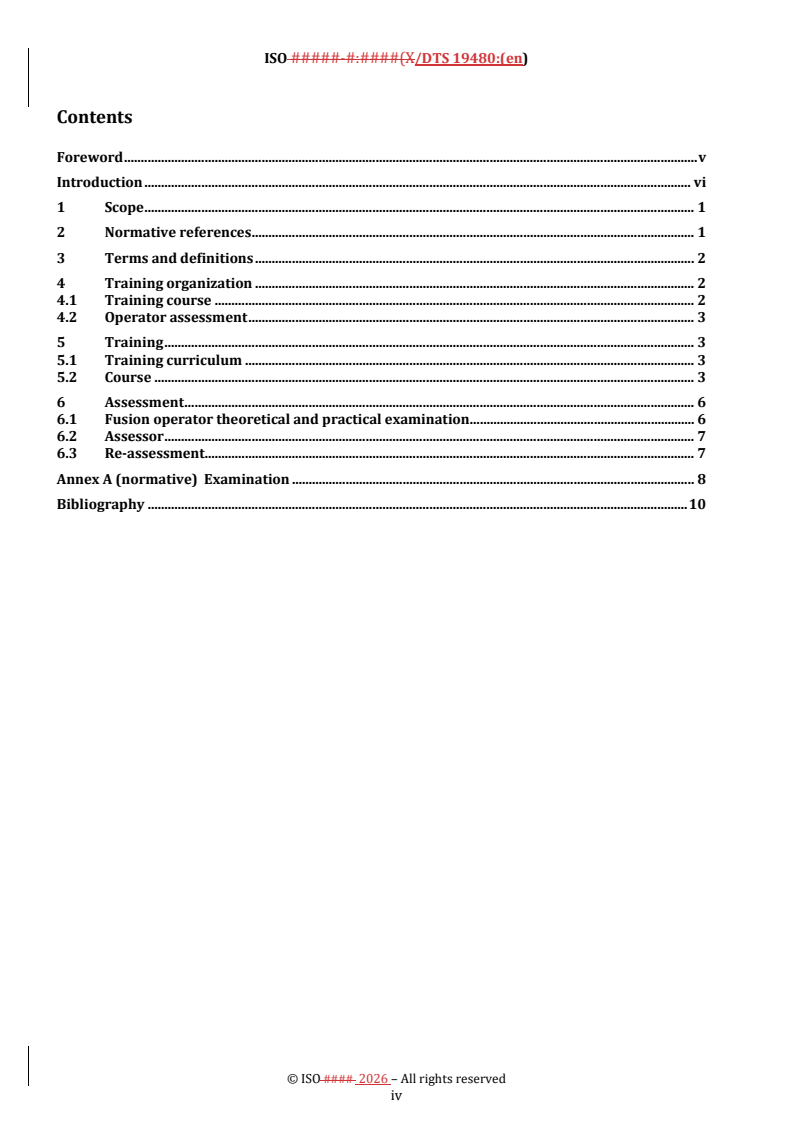
Contents
- Introduction
- 1 Scope
- 2 Normative references
- 3 Terms and definitions
- 3.1 fusion operator
- 3.2 pipeline operator
- 3.3 training centre
- 3.4 standard dimension ratio
- 4 Training organization
- 4.1 Training course
- 4.2 Operator assessment
- 5 Training
- 5.1 Training curriculum
- 5.2 Course
- 6 Assessment
- 6.1 Fusion operator theoretical and practical examination
- 6.2 Assessor
- 6.3 Re-assessment
- Annex A
- Bibliography
Introduction
The quality of a piping system for the supply of gaseous fuels or water is to a large extent determined by the skills of the operators involved in installing the network. When installing polyethylene (PE) pipes, the quality of the fusion joints is essential for the piping system. Since fusion joints in PE piping systems can be made using various technologies, it is important that the fusion operators are trained and competent in the fusion technology employed in constructing PE networks. Continued competence of the fusion operator is covered by periodic re-training and re-assessment.
FINAL DRAFT Technical Specification ISO/DTS 19480:2026(en) Polyethylene pipes and fittings for the supply of gaseous fuels or water — Training and assessment of fusion operators
1 Scope
This document provides requirements and guidance for the training, assessment and approval of fusion operators, with the aim of establishing and maintaining their competency in the construction of polyethylene [1] (PE) piping systems for the supply of gaseous fuels in accordance with ISO/TS 10839, for the supply of water, or in the construction of such systems used in other pressure applications. It covers the butt fusion, and electrofusion jointing techniques and considers both the theoretical and practical knowledge necessary for making high-quality fusion joints.
Other thermoplastic materials, e.g. polypropylene, polybutylene, PVDF, can apply to this document. [2] NOTE Training and assessment of fusion operators for polyamide piping systems is given in ISO/TS 16486-8.
2 Normative references
The following documents are referred to in the text in such a way that some or all of their content constitutes requirements of this document. For dated references, only the edition cited applies. For undated references, the latest edition of the referenced document (including any amendments) applies. ISO 4427-2, Plastics piping systems for water supply, and for drainage and sewerage under pressure — Polyethylene (PE) — Part 2: Pipes ISO 4427-3, Plastics piping systems for water supply, and for drainage and sewerage under pressure — Polyethylene (PE) — Part 3: Fittings ISO 4437-2, Plastics piping systems for the supply of gaseous fuels — Polyethylene (PE) — Part 2: Pipes ISO 4437-3, Plastics piping systems for the supply of gaseous fuels — Polyethylene (PE) — Part 3: Fittings ISO 12176-1, Plastics pipes and fittings — Equipment for fusion jointing polyethylene systems — Part 1: Butt fusion ISO 12176-2, Plastics pipes and fittings — Equipment for fusion jointing polyethylene systems — Part 2:
Electrofusion ISO 13953, Polyethylene (PE) pipes and fittings — Determination of the tensile strength and failure mode of test pieces from a butt-fused joint ISO 13954, Plastics pipes and fittings — Peel decohesion test for polyethylene (PE) electrofusion assemblies of nominal outside diameter greater than or equal to 90 mm ISO 13955, Plastics pipes and fittings — Crushing decohesion test for polyethylene (PE) electrofusion assemblies ISO 13956, Plastics pipes and fittings — Decohesion test of polyethylene (PE) saddle fusion joints — Evaluation of ductility of fusion joint interface by tear test ISO 21307, Plastics pipes and fittings — Butt fusion jointing procedures for polyethylene (PE) piping systems
3 Terms and definitions
For the purposes of this document, the following terms and definitions apply.
ISO/DTS 19480:2026(en) ISO and IEC maintain terminology databases for use in standardization at the following addresses:
- ISO Online browsing platform: available at https:// www .iso .org/ obp
- IEC Electropedia: available at https:// www .electropedia .org/
3.1 fusion operator
person trained to carry out fusion jointing between either polyethylene (PE) pipes or fittings, or both, based on a fusion procedure Note 1 to entry: The fusion operator is trained for one or more fusion procedures, involving the operation of either manual or automatic fusion-jointing machines, or both.
3.2 pipeline operator
private or public organization authorized to design, construct and/or operate and maintain the supply system
3.3 training centre
establishment for training of fusion operators (3.1)
3.4 standard dimension ratio
SDR numerical designation of a pipe series which is a convenient round number, approximately equal to the dimension ratio of the nominal outside diameter and the nominal wall thickness
4 Training organization
4.1 Training course
A trainee fusion operator for PE systems shall follow a training course at a training centre, to obtain a fusion operator qualification. The training centre shall provide the training courses under the conditions described in Clause 5.
The courses shall be delivered by a competent trainer with the required experience of fusion processes and mastery of the fusion technique involved.
The training centre shall have fusion machines, control units, scrapers and specific equipment commonly used in worksite.
The trainee fusion operator may be trained:
- on the training centre equipment, or
- on the organization's own equipment and premises if accepted by the training centre. The fusion equipment shall conform to ISO 12176-1 for butt fusion equipment and ISO 12176-2 for electrofusion equipment.
4.2 Operator assessment
A trainee fusion operator who has followed a training course as described in 4.1 shall then pass a theoretical and practical assessment to be qualified as a fusion operator for PE systems (see 6.1).
ISO/DTS 19480:2026(en)
5 Training
5.1 Training curriculum
The training course shall consist of any combination of fusion packages based on the requirements of the pipeline operators. These packages may be given as individual modules or combined to suit requirements. During the training, attention should also be drawn to safety issues as required by the organization. The course related to safety should deal with safety aspects related specifically to the fusion process.
5.2 Course
5.2.1 General
The training shall be provided by a trainer in accordance with 4.1. All consumables and tools necessary for the training package shall be available during the training session. The pipes and fittings to be used shall be in accordance with ISO 4437-2 and ISO 4437-3 for the supply of gaseous fuels, and ISO 4427-2 and ISO 4427-3 for the supply of water. Similar PE products conforming to other standards may also be used.
The training shall be designed so that the trainee fusion operator learns to master the fusion technique and the materials and practical problems involved in laying a pipe, around obstacles. During the practical training, the trainee fusion operator shall construct at least one three-dimensional configuration (connection between two pipes laid in different axes). The trainee fusion operator shall receive information (hard copy or digital) covering all the elements dealt with in the training. The course should be drawn up in the languages used in the country where the training is implemented.
...
Contents
- Introduction
- 1 Scope
- 2 Normative references
- 3 Terms and definitions
- 3.4 standard dimension ratio
- 4 Training organization
- 4.1 Training course
- 4.2 Operator assessment
- 5 Training
- 5.1 Training curriculum
- 5.2 Course
- 6 Assessment
- 6.1 Fusion operator theoretical and practical examination
- 6.2 Assessor
- 6.3 Re-assessment
- Annex A
- Bibliography
Introduction
The quality of a piping system for the supply of gaseous fuels or water is to a large extent determined by the skills of the operators involved in installing the network. When installing polyethylene (PE) pipes, the quality of the fusion joints is essential for the piping system.
Since fusion joints in PE piping systems can be made using various technologies, it is important that the fusion operators are trained and competent in the fusion technology employed in constructing PE networks. Continued competence of the fusion operator is covered by periodic re-training and re-assessment.
ISO/DTS 19480:2026(E:(en) Polyethylene pipes and fittings for the supply of gaseous fuels or water — Training and assessment of fusion operators
1 Scope
This document gives provides requirements and guidance and other provisions for the training, assessment and approval of fusion operators, with the aim of establishing and maintaining their competency in the construction of polyethylene (PE) piping systems for the supply of gaseous fuels in accordance with [1] ISO/TS 10839 [1],, for the supply of water, or in the construction of such systems used in other pressure applications. It covers the butt fusion, and electrofusion jointing techniques and considers both the theoretical and practical knowledge necessary for making high-quality fusion joints. Other thermoplastic materials, e.g.:. polypropylene, , polybutylene, PVDF, can be in the scope ofapply to this document.
[2] NOTE Training and assessment of fusion operators for polyamide piping systems is given in ISO/TS 16486-8 [2] .
2 Normative references
The following documents are referred to in the text in such a way that some or all of their content constitutes requirements of this document. For dated references, only the edition cited applies. For undated references, the latest edition of the referenced document (including any amendments) applies. ISO 4427-2:2019, Plastics piping systems for water supply, and for drainage and sewerage under pressure — Polyethylene (PE) — Part 2: Pipes ISO 4427-3:2019, Plastics piping systems for water supply, and for drainage and sewerage under pressure — Polyethylene (PE) — Part 3: Fittings ISO 4437-2:2024, Plastics piping systems for the supply of gaseous fuels — Polyethylene (PE) — Part 2: Pipes ISO 4437-3:2024, Plastics piping systems for the supply of gaseous fuels — Polyethylene (PE) — Part 3: Fittings ISO 12176-1, Plastics pipes and fittings — Equipment for fusion -jointing polyethylene systems — Part 1: Butt fusion ISO 12176-2, Plastics pipes and fittings — Equipment for fusion jointing polyethylene systems — Part 2:
Electrofusion ISO 13953, Polyethylene (PE) pipes and fittings — Determination of the tensile strength and failure mode of test pieces from a butt-fused joint ISO 13954, Plastics pipes and fittings — Peel decohesion test for polyethylene (PE) electrofusion assemblies of nominal outside diameter greater than or equal to 90 mm ISO 13955, Plastics pipes and fittings — Crushing decohesion test for polyethylene (PE) electrofusion assemblies ISO 13956, Plastics pipes and fittings — Decohesion test of polyethylene (PE) saddle fusion joints — Evaluation of ductility of fusion joint interface by tear test ISO 21307, Plastics pipes and fittings — Butt fusion jointing procedures for polyethylene (PE) piping systems ISO 21751, Plastics pipes and fittings — Decohesion test of electrofusion assemblies — Strip-bend test
ISO #####-#:####(X/DTS 19480:(en)
3 Terms and definitions
For the purposes of this document, the following terms and definitions apply. ISO and IEC maintain terminology databases for use in standardization at the following addresses:
- ISO Online browsing platform: available at https://www.iso.org/obp - IEC Electropedia: available at https://www.electropedia.org/ 3.1 3.1 fusion operator person trained to carry out fusion jointing between either polyethylene (PE) pipes and/or fittings, or both, based on a fusion procedure NOTE Note 1 to entry: The fusion operator is trained for one or more fusion procedures, involving the operation of either manual and/or automatic fusion-jointing machines, or both. 3.2 3.2 pipeline operator private or public organization authorized to design, construct and/or operate and maintain the supply system 3.3 3.3 training centre establishment for training of fusion operators (3.1)
3.4 standard dimension ratio
SDR numerical designation of a pipe series which is a convenient round number, approximately equal to the dimension ratio of the nominal outside diameter and the nominal wall thickness
4 Training organization
4.1 Training course
A trainee fusion operator for PE systems shall follow a training course at a training centre, to obtain a fusion operator qualification. The training centre shall provide the training courses under the conditions described in Clause 5this document..
The courses shall be delivered by a competent trainer havingwith the required experience of fusion processes and mastery of the fusion technique involved.
The training centre shall have fusion machines, control units, scrapers and specific equipment commonly used in worksite.
The trainee fusion operator may be trained:
- on the training centre equipment, or
- on company’sthe organization's own equipment and premises if accepted by the training centre.
ISO/DTS 19480:2026(E:(en) The fusion equipment shall comply withconform to ISO 12176-1 for butt fusion equipment and ISO 12176-2 for electrofusion equipment.
4.2 Operator assessment
A trainee fusion operator who has followed a training course as described abovein 4.1 shall then pass a theoretical and practical assessment to be qualified as a fusion operator for PE systems (see 6.16.1)).
5 Training
5.1 Training curriculum
The training course shall consist of any combination of fusion packages based on the requirements of the pipeline operators. These packages may be given as individual modules or combined to suit requirements. During the training, attention should also be drawn to safety issues as required by the companyorganization. The course related to safety should deal with safety aspects related specifically to the fusion process.
5.2 Course
5.2.1 General
The training shall be provided by a trainer in accordance with 4.1according to 4.1.. All consumables and tools necessary for the training package shall be available during the training session. The pipes and fittings to be used shall be those in accordance with ISO 4437-2 and ISO 4437-3 for the supply of gaseous fuels, and ISO 4427-2 and ISO 4427-3 for the supply of water, similar. Similar PE products conforming to other standards may also be used for the scope of this document. . The lessonstraining shall be designed so that the trainee fusion operator learns to master the fusion technique and to master the materials and practical problems involved in laying a pipe, around obstacles. In connection with the latter aspect, duringDuring the practical training, the trainee fusion operator shall construct at least one three-dimensional configuration (connection between two pipes laid in different axes). The trainee fusion operator shall receive information (hard copy, or digital or whatsoever) covering all the elements dealt with in the training. The course should be drawn up in one of the national languages used in the country where the training is implemented.
...