

ISO 6563:2025
(Main)Rear load carrier for wheeled vehicles — Requirements and test methods
General Information
- Abstract
This document specifies the minimum functional safety requirements for rear load carriers intended for attachment on the rear of passenger cars and light commercial vehicles with a maximum gross weight up to 3,5 t as defined in ISO 1176. This document does not apply to incomplete and supplemental rear load carriers. This document establishes technical specifications and test methods that offer both road users and users of the rear load carriers a minimum level of functional safety when the rear load carriers are being used in accordance with the manufacturer’s instructions. Moreover, the requirements of this document complement the directives from UNECE‑R 26 and its successive amendments concerning these products.
- Status
- Published
- Publication Date
- 26-Nov-2025
- Current Stage
- 6060 - International Standard published
- Start Date
- 27-Nov-2025
- Due Date
- 23-Nov-2024
- Completion Date
- 27-Nov-2025
Overview
ISO 6563:2025 - "Rear load carrier for wheeled vehicles - Requirements and test methods" defines minimum functional safety requirements and standardized test methods for rear load carriers intended for attachment to the rear of passenger cars and light commercial vehicles (maximum gross weight up to 3.5 t as per ISO 1176). The standard aims to ensure safe transport of bicycles, cargo and luggage when carriers are used according to the manufacturer's instructions, and it complements regulatory directives such as UNECE‑R 26.
Key topics and technical requirements
ISO 6563 covers the full product lifecycle from design verification to user information. Major technical topics include:
- Scope & classification
- Types of rear load carriers (trunk/hatch-mounted, coupling ball/plate, spare‑wheel, chassis‑mounted).
- Materials and environmental durability
- Corrosion resistance (salt spray considerations), weather resistance, cold/heat resistance of plastics and attachment elements.
- Structural performance and test methods
- Static load-bearing capacity in three axes: vertical (Fz), longitudinal (Fx) and lateral (Fy).
- Dynamic tests including Belgian pavé simulation, lane-change manoeuvre, crash simulation, brake test and speed‑bump resistance.
- Measurement of residual displacements, internal component movement and load displacement.
- Fixings and restraining systems
- Resistance of straps, belts, metallic fixings, clamps and other attachments - including tensile/elongation behaviour.
- Vehicle interfaces and lighting
- Interfaces to vehicle, external projections, rear license plate visibility and lighting/signalling requirements.
- Quality assurance and conformity
- Test sample preparation and sequence, measurement uncertainties (e.g., forces ±5 %, masses ±2 %), product marking and required user information (assembly and use instructions).
- Annexes
- Normative annexes provide a test bicycle, Belgian pavé rack specifications, and recommended test setups.
Practical applications and who uses ISO 6563
ISO 6563 is practical for:
- Rear load carrier manufacturers - product design, durability validation, and compliance testing.
- Automotive OEMs and accessory suppliers - ensuring safe vehicle integration and user compatibility.
- Test laboratories and certification bodies - standardized test methods and acceptance criteria.
- Regulators and compliance teams - harmonizing national rules with international best practice.
- Retailers and installers - verifying product marking, instructions and safe installation procedures.
By adopting ISO 6563, stakeholders reduce risk of load loss or vehicle damage, improve product reliability, and facilitate market access through harmonized safety requirements.
Related standards
- ISO 1176 (vehicle classes / gross weight reference)
- UNECE‑R 26 (regulatory directives on rear carriers)
- ISO 1103 (coupling balls), ISO 9227 (corrosion tests), IEC/IEEE 82079-1 (instructions for use) - referenced for detailed test or documentation methods.
Get Certified
Connect with accredited certification bodies for this standard

TÜV Rheinland
TÜV Rheinland is a leading international provider of technical services.

TÜV SÜD
TÜV SÜD is a trusted partner of choice for safety, security and sustainability solutions.

DEKRA Certification Inc.
DEKRA US certification services.
Sponsored listings
Frequently Asked Questions
ISO 6563:2025 is a standard published by the International Organization for Standardization (ISO). Its full title is "Rear load carrier for wheeled vehicles — Requirements and test methods". This standard covers: This document specifies the minimum functional safety requirements for rear load carriers intended for attachment on the rear of passenger cars and light commercial vehicles with a maximum gross weight up to 3,5 t as defined in ISO 1176. This document does not apply to incomplete and supplemental rear load carriers. This document establishes technical specifications and test methods that offer both road users and users of the rear load carriers a minimum level of functional safety when the rear load carriers are being used in accordance with the manufacturer’s instructions. Moreover, the requirements of this document complement the directives from UNECE‑R 26 and its successive amendments concerning these products.
This document specifies the minimum functional safety requirements for rear load carriers intended for attachment on the rear of passenger cars and light commercial vehicles with a maximum gross weight up to 3,5 t as defined in ISO 1176. This document does not apply to incomplete and supplemental rear load carriers. This document establishes technical specifications and test methods that offer both road users and users of the rear load carriers a minimum level of functional safety when the rear load carriers are being used in accordance with the manufacturer’s instructions. Moreover, the requirements of this document complement the directives from UNECE‑R 26 and its successive amendments concerning these products.
ISO 6563:2025 is classified under the following ICS (International Classification for Standards) categories: 43.040.60 - Bodies and body components; 43.100 - Passenger cars. Caravans and light trailers. The ICS classification helps identify the subject area and facilitates finding related standards.
ISO 6563:2025 is available in PDF format for immediate download after purchase. The document can be added to your cart and obtained through the secure checkout process. Digital delivery ensures instant access to the complete standard document.
Standards Content (Sample)
International
Standard
ISO 6563
First edition
Rear load carrier for wheeled
2025-11
vehicles — Requirements and
test methods
Porte-charges arrière pour véhicules à roues — Exigences et
méthodes d'essai
Reference number
© ISO 2025
All rights reserved. Unless otherwise specified, or required in the context of its implementation, no part of this publication may
be reproduced or utilized otherwise in any form or by any means, electronic or mechanical, including photocopying, or posting on
the internet or an intranet, without prior written permission. Permission can be requested from either ISO at the address below
or ISO’s member body in the country of the requester.
ISO copyright office
CP 401 • Ch. de Blandonnet 8
CH-1214 Vernier, Geneva
Phone: +41 22 749 01 11
Email: copyright@iso.org
Website: www.iso.org
Published in Switzerland
ii
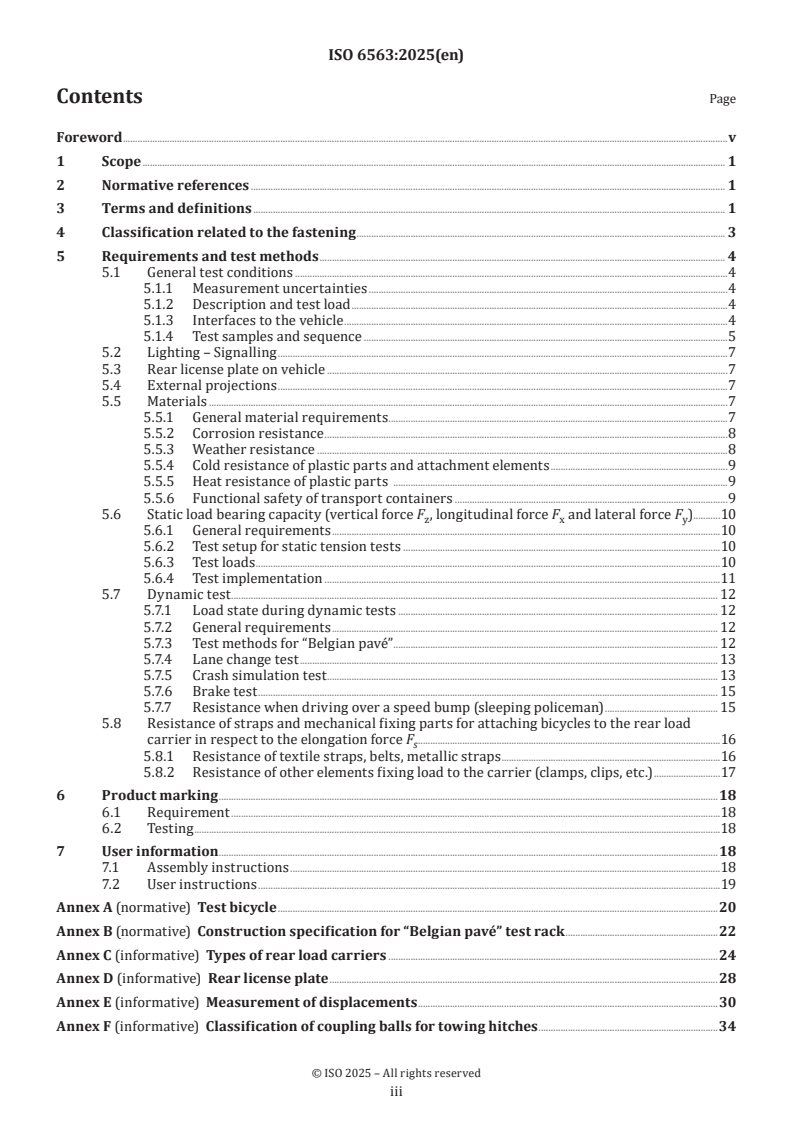
Contents Page
Foreword .v
1 Scope . 1
2 Normative references . 1
3 Terms and definitions . 1
4 Classification related to the fastening . 3
5 Requirements and test methods . 4
5.1 General test conditions .4
5.1.1 Measurement uncertainties .4
5.1.2 Description and test load .4
5.1.3 Interfaces to the vehicle .4
5.1.4 Test samples and sequence .5
5.2 Lighting – Signalling .7
5.3 Rear license plate on vehicle .7
5.4 External projections .7
5.5 Materials .7
5.5.1 General material requirements .7
5.5.2 Corrosion resistance .8
5.5.3 Weather resistance .8
5.5.4 Cold resistance of plastic parts and attachment elements .9
5.5.5 Heat resistance of plastic parts .9
5.5.6 Functional safety of transport containers .9
5.6 Static load bearing capacity (vertical force F , longitudinal force F and lateral force F ) .10
z x y
5.6.1 General requirements .10
5.6.2 Test setup for static tension tests .10
5.6.3 Test loads .10
5.6.4 Test implementation .11
5.7 Dynamic test . 12
5.7.1 Load state during dynamic tests . 12
5.7.2 General requirements . 12
5.7.3 Test methods for “Belgian pavé” . . 12
5.7.4 Lane change test . 13
5.7.5 Crash simulation test . 13
5.7.6 Brake test . 15
5.7.7 Resistance when driving over a speed bump (sleeping policeman) . 15
5.8 Resistance of straps and mechanical fixing parts for attaching bicycles to the rear load
carrier in respect to the elongation force F .16
s
5.8.1 Resistance of textile straps, belts, metallic straps .16
5.8.2 Resistance of other elements fixing load to the carrier (clamps, clips, etc.) .17
6 Product marking .18
6.1 Requirement .18
6.2 Testing .18
7 User information .18
7.1 Assembly instructions .18
7.2 User instructions .19
Annex A (normative) Test bicycle .20
Annex B (normative) Construction specification for “Belgian pavé” test rack .22
Annex C (informative) Types of rear load carriers .24
Annex D (informative) Rear license plate .28
Annex E (informative) Measurement of displacements .30
Annex F (informative) Classification of coupling balls for towing hitches .34
iii
Annex G (informative) Typical test setup for the static and crash test .35
Bibliography .39
iv
Foreword
ISO (the International Organization for Standardization) is a worldwide federation of national standards
bodies (ISO member bodies). The work of preparing International Standards is normally carried out through
ISO technical committees. Each member body interested in a subject for which a technical committee
has been established has the right to be represented on that committee. International organizations,
governmental and non-governmental, in liaison with ISO, also take part in the work. ISO collaborates closely
with the International Electrotechnical Commission (IEC) on all matters of electrotechnical standardization.
The procedures used to develop this document and those intended for its further maintenance are described
in the ISO/IEC Directives, Part 1. In particular, the different approval criteria needed for the different types
of ISO document should be noted. This document was drafted in accordance with the editorial rules of the
ISO/IEC Directives, Part 2 (see www.iso.org/directives).
ISO draws attention to the possibility that the implementation of this document may involve the use of (a)
patent(s). ISO takes no position concerning the evidence, validity or applicability of any claimed patent
rights in respect thereof. As of the date of publication of this document, ISO had not received notice of (a)
patent(s) which may be required to implement this document. However, implementers are cautioned that
this may not represent the latest information, which may be obtained from the patent database available at
www.iso.org/patents. ISO shall not be held responsible for identifying any or all such patent rights.
Any trade name used in this document is information given for the convenience of users and does not
constitute an endorsement.
For an explanation of the voluntary nature of standards, the meaning of ISO specific terms and expressions
related to conformity assessment, as well as information about ISO's adherence to the World Trade
Organization (WTO) principles in the Technical Barriers to Trade (TBT), see www.iso.org/iso/foreword.html.
This document was prepared by Technical Committee ISO/TC 22, Road vehicles, Subcommittee SC 40, Specific
aspects for passenger cars, light and heavy commercial vehicles, special vehicles, buses and trailers/caravans.
Any feedback or questions on this document should be directed to the user’s national standards body. A
complete listing of these bodies can be found at www.iso.org/members.html.
v
International Standard ISO 6563:2025(en)
Rear load carrier for wheeled vehicles — Requirements and
test methods
1 Scope
This document specifies the minimum functional safety requirements for rear load carriers intended for
attachment on the rear of passenger cars and light commercial vehicles with a maximum gross weight up
to 3,5 t as defined in ISO 1176. This document does not apply to incomplete and supplemental rear load
carriers.
This document establishes technical specifications and test methods that offer both road users and users
of the rear load carriers a minimum level of functional safety when the rear load carriers are being used in
accordance with the manufacturer’s instructions.
Moreover, the requirements of this document complement the directives from UNECE-R 26 and its successive
amendments concerning these products.
2 Normative references
The following documents are referred to in the text in such a way that some or all of their content constitutes
requirements of this document. For dated references, only the edition cited applies. For undated references,
the latest edition of the referenced document (including any amendments) applies.
ISO 1103, Road vehicles — Coupling balls for caravans and light trailers — Dimensions
ISO 1431-1, Rubber, vulcanized or thermoplastic — Resistance to ozone cracking — Part 1: Static and dynamic
strain testing
ISO 3888-2, Passenger cars — Test track for a severe lane-change manoeuvre — Part 2: Obstacle avoidance
ISO 179-1, Plastics — Determination of Charpy impact properties — Part 1: Non-instrumented impact test
ISO 4892-2, Plastics — Methods of exposure to laboratory light sources — Part 2: Xenon-arc lamps
ISO 9227, Corrosion tests in artificial atmospheres — Salt spray tests
IEC/IEEE 82079-1, Preparation of information for use (instructions for use) of products — Part 1: Principles and
general requirements
EN 12195-2:2000, Load restraint assemblies on road vehicles - Safety - Part 2: Web lashing made from man-
made fibres
3 Terms and definitions
For the purposes of this document, the following terms and definitions apply.
ISO and IEC maintain terminology databases for use in standardization at the following addresses:
— ISO Online browsing platform: available at https:// www .iso .org/ obp
— IEC Electropedia: available at https:// www .electropedia .org/
3.1
rear load carrier
device intended for carrying bicycles, cargo, luggage and goods on the rear of a wheeled vehicle
3.2
mass of the rear load carrier
m
s
mass which includes the means of attachment and all mounted parts, in kg
Note 1 to entry: Mounted parts are lighting, adapters, straps, etc.
3.3
mass of the test load
m
tb
mass of representative test load, in kg
3.4
total mass
mm=+m
totals tb
mass of the system comprising rear load carrier (3.1) and payload on vehicle, in kg
Note 1 to entry: Mounted parts are lighting, adapters, straps, etc.
Note 2 to entry: The total mass works on the total centre of gravity.
3.5
vertical force
F
z
force applied during testing to simulate the vertical components of the force caused by the vertical effect of
the load upward, +F , and downward, −F , as defined in Figure 1, in N
z z
Key
1 carrying surface
2 zero-Z-plane (horizontal reference plane)
3 zero-Y-plane (vertical longitudinal reference plane)
4 zero-X-plane (vertical lateral reference plane)
Figure 1 — Application directions of the forces F , F and F
x y z
3.6
longitudinal force
F
x
force applied during testing to simulate the horizontal components of the forces directed forwards, −F , and
x
backwards, +F , in the direction of travel, which are caused by the load as defined in Figure 1, in N
x
3.7
lateral force
F
y
force applied during testing to simulate the horizontal components of the lateral forces directed to the right,
+F , and left, −F , in the direction of travel, which are caused by the load as defined in Figure 1, in N
y y
3.8
tensile force of the strap
F
s
force applied during testing to simulate the elongation behaviour caused by the load acting on the straps, in N
3.9
residual displacement at a given point
D
difference between the position before and after each step of the test, for the contact points of the rear load
carrier (3.1) to vehicle, in mm
Note 1 to entry: A contact point can be a supporting point, a fixation point or all other connecting points.
3.10
displacement of the load
d
difference between the position of each load on the rear load carrier (3.1) at each attachment point before
and after the relevant test, in mm
3.11
residual displacement of the internal components of rear load carriers
e
difference in the distance between the position of the interface to any component of the rear load carrier
(3.1) that ensures the interface to the vehicle, and the component of the rear load carrier on which it is
mounted, before and after the relevant test, in mm
3.12
functional safety
transport of the rear load carrier (3.1) so as to ensure road safety and prevent loss
4 Classification related to the fastening
Depending on the attachment to the vehicle, the following distinctions are made:
a) fitted to the trunk lid or rear wall (see Figures C.1 and C.2);
b) fitted to the hatch (see Figures C.3 and C.4);
c) fitted to the coupling ball or plate (see Figures C.5, C.6 and C.7);
d) fitted to the spare wheel (see Figure C.8);
e) fitted on and in the chassis (see Figure C.9).
5 Requirements and test methods
5.1 General test conditions
5.1.1 Measurement uncertainties
Unless otherwise stated, the measurement uncertainties based on the N values shall correspond to the
following:
— forces and torques ±5 %;
— masses and weights ±2 %;
— dimensions ±2 %;
— angles ±2°;
— time (e.g. test duration) ±5 s;
— temperatures ±5 °C;
— pressure ±5 %;
— speed ±5 %.
5.1.2 Description and test load
Static: The test shall be carried out with the permissible maximum payload indicated by the manufacturer,
but with 30 kg payload as a minimum, unless otherwise specified for individual tests (i.e. boxes,
baskets). For rear load carriers for bicycles, the test shall be carried out with one test bicycle per
rail according to the data in Annex A.
The force shall be applied according to Table 1.
Table 1 — Force application points
Rear load carrier Force application occurs Position of the centre of gravity
Bike rear load carrier At the centre of gravity of each bike See Annex A
Ski or snowboard rear load carrier At the centre of gravity of each pair of Equivalent substitute device can be
skis or snowboard used
Other rear load carrier At the centre of gravity of the equip- Equivalent substitute device can be
ment carried used
Dynamic: The test shall be carried out with the permissible maximum payload indicated by the manufactur-
er, including the relevant safety factors, but with 30 kg payload as a minimum, unless otherwise
specified for individual tests. For rear load carriers for bicycles, the test shall be carried out with
one test bicycle per rail according to the data in Annex A.
5.1.3 Interfaces to the vehicle
5.1.3.1 Coupling balls
For the test outlined in 5.7, the coupling balls shall be:
a) in accordance with ISO 1103;
NOTE Coupling balls with a diameter of minimum 49,00 mm can also occur in road traffic owing to wear (see
UNECE-R 55).
b) metallically bare surface without paint-based surface treatment;
c) degreased;
d) steel.
5.1.3.2 Other interfaces on the vehicle to other attachments
The data of the interface manufacturer shall be observed, e.g. for spare wheel holders.
5.1.4 Test samples and sequence
Five test samples shall be used for the tests. The sequence of the tests shall follow Figure 2.
Figure 2 — Test sequence
The following test sequence shall be followed:
a) study of the instruction for fitting and use of leaflet (in accordance with IEC/IEEE 82079-1);
b) preconditioning, mountability and assembling tests;
c) dynamic tests:
1) Belgian pavé test;
2) speed bump test (sleeping policeman);
3) evasion test;
4) braking test;
5) city crash test.
Deviations from the test sequence shall be documented.
d) preconditioning of the specimen used for static tests;
e) static tests:
1) vertical force +F and −F ;
z z
2) longitudinal force +F and −F ;
x x
3) lateral force +F and −F ;
y y
4) if necessary, testing of straps and attachment elements;
f) other tests (resistance to corrosion, material, etc.).
5.2 Lighting – Signalling
UNECE-R 48 provides regulation for lighting and light signal devices. See Annex D.
5.3 Rear license plate on vehicle
If the license plate on the vehicle is partly hidden by the rear load carrier or by the load itself, it is necessary
to mount it visibly or duplicate it on the rear load carrier. Examples are given in Annex D (Figures D.1 -
D.4). The manufacturer shall advise the user by including a warning in the instructions for use (see 7.2) to
duplicate the license plate and its lighting devices on the rear load carrier.
5.4 External projections
The area that can be touched by a ball with a diameter of 165 mm after mounting the rear load carrier shall
not exhibit any parts with a rounding radius of less than 2,5 mm.
NOTE See ECE-R 26.
5.5 Materials
5.5.1 General material requirements
The following requirements and associated tests apply for components whose failure would also entail a
failure of the overall system or detachment or loss of the load, or which would render safe driving of the
vehicle impossible.
The rear load carrier shall fulfil the requirements outlined in 5.7 and 5.8 with the materials used, in the
temperature range between −20 °C and +60 °C.
This shall be shown by one of the following methods:
a) material certification and report showing that the design is suitable for functional safety;
EXAMPLE The report of the technical specification of the material or sample provided by the manufacturer
or certification from the manufacturer.
b) by direct testing under the extreme conditions outlined in 5.5.1;
c) reference to applicable material standards.
5.5.2 Corrosion resistance
5.5.2.1 Requirements
When tested in accordance with 5.5.2.2, no base metal corrosion of functional parts is permissible during
the test.
5.5.2.2 Test methods
All parts of the rear load carriers need to be exposed to a neutral salt spray test with 5 % sodium chloride
for 168 h. The functional parts, whose failure would lead to loss of the load, shall not exhibit any base metal
corrosion. The test shall be performed in accordance with ISO 9227. The functional parts shall be assembled
when tested.
5.5.3 Weather resistance
5.5.3.1 Requirements and test methods for the weather resistance of elastomers subject to
tensile loads
After the test, no weather damage shall occur that impairs the function of the attachment elements.
1)
Elastomers subject to tensile load are exposed to an ozone concentration of (50 ± 5) pphm for 48 h. After
the test, the sample shall be loaded in accordance with ISO 1431-1, with an elongation of (20 ± 2) %. Cracks
are not permissible.
5.5.3.2 Requirements for the weather resistance of plastic strap parts and attachment elements
exposed to UV
The determined impact strength shall not drop by more than 20 % in comparison to the non-aged samples,
whereby a corresponding service life of 5 years is assumed.
5.5.3.3 Testing the weather resistance of plastic straps parts and attachment elements exposed to UV
Plastic parts exposed to UV shall be tested in accordance with ISO 4892-2. The test duration in the
synchronisation is 250 h. The black standard temperature is (65 ± 3) °C. The test cycle is performed with a
rain time of (18 ± 0,5) min and a subsequent drying time of (102 ± 0,5) min. The relative air humidity in the
dry phase is (50 ± 10) %. The irradiance is (0,51 ± 0,02) W/(m ⋅ nm) at 340 nm. Following the test according
to ISO 4892-2, method A, cycle 1, Charpy impact strength test (according to ISO 179-1) and shall be carried
out as in ISO 179-1:2023, Table 1 fU or n on aged and non-aged samples for material composites, composite
materials or other hybrid structures.
The Charpy impact test is carried out with an impact on the non-weathered side. The decrease in impact
strength due to weathering shall be determined on samples that have the same orientation in respect to the
manufacturing process like extruding direction.
5.5.3.4 Evaluation of the weather resistance of plastic strap parts and attachment elements
exposed to UV
To determine the impact strength value on non-aged and aged samples, seven of the 10 tested samples shall
exhibit a fracture in order to attain a true (or actual) impact strength value or the resultant mean value (in
1) pphm: parts ozone per hundred millions.
accordance with ISO 179-1:2023). If 0 % fracture is present in the non-aged samples when determining the
impact strength (meaning there is no fracture and the test specimen is only bent and/or drawn through,
possibly in conjunction with a white fracture), then the impact strength value displayed on the test device
shall be included as an initial value for drawn-through, non-fractured samples (with fracture type).
5.5.4 Cold resistance of plastic parts and attachment elements
5.5.4.1 General requirements
No obvious damage (fracture) or deformation shall occur on the component after the cold resistance test.
The test shall be carried out after storage at −20 °C. The storage duration is 2 h per 1 mm wall thickness.
5.5.4.2 General test
Ball drop test with steel ball:
Energy: 2,0 J;
Ball weight: 250 g;
Fall height: 0,815 m;
Component temperature: −20 °C.
The storage duration is 2 h per 1 mm wall thickness.
The component shall be impacted at the point with the highest probability of failure.
No obvious damage or deformation shall occur on the component after the impact test.
5.5.5 Heat resistance of plastic parts
5.5.5.1 Requirements for the heat resistance of plastic parts
The component shall not exhibit any visible permanent deformation after the test. The function shall be
assured.
5.5.5.2 Testing the heat resistance of plastic parts
Rear load carriers whose carrying elements comprise plastic parts are loaded with 1,5 times the permissible
load bearing capacity in the intended assembly position.
The test duration is 6 h at a temperature of 80 °C.
5.5.6 Functional safety of transport containers
5.5.6.1 Requirements for the functional safety of transport containers
The maximum form deviation at −20 °C and +60 °C shall not impair the functional safety. The transport
container shall open and close safely in line with the instructions for use at −20 °C and +60 °C. Visible
permanent deformations are not permitted.
5.5.6.2 Testing the functional safety of transport containers
The transport container is mounted in the usage position according to the manufacturer’s data.
The test is carried out with continuous component temperatures of −20 °C and +60 °C. The cold and hot
storage time of the test parts is 2 h per 1 mm wall thickness.
At least one conditioning of the part at room temperature (23 ± 5) °C) shall be applied between both storage
temperatures for 2 h respectively per 1 mm wall thickness.
The functional safety test is carried out with 1,5 times the permissible load bearing capacity in the intended
assembly position.
5.6 Static load bearing capacity (vertical force F, longitudinal force F and lateral force F )
z x y
5.6.1 General requirements
The following requirements shall be fulfilled for the static load:
a) the load shall remain fixed on the rear load carrier;
b) the load and the rear load carrier shall remain fixed on the test device;
c) no cracking of parts shall occur;
d) the residual deflection at a given point, D, shall not exceed 20 mm and for a rear load carrier fitted on a
towing ball ±8° (including the twist on the ball);
e) the displacement of the load, d, after unloading shall not exceed 20 mm;
f) residual deflection, e, of the components shall not exceed 20 mm;
g) no part of the rear load carrier shall deform in such a way that a safe handling and use is no longer
assured;
h) each strap in its blocking devices shall not slide more than 10 mm. The load shall be safely attached to
the rear load carrier.
EXAMPLE Straps can be used for fixing bicycles on the rear load carrier. Straps can also be used for fixing the rear
load carrier on the vehicle.
NOTE Examples of how to depict the measurement of displacement and free space around a coupling ball are
given in Annex E.
5.6.2 Test setup for static tension tests
Static tension tests shall be carried out as follows:
— vehicle-specific rear load carriers with the vehicle of the usage range;
— rear load carriers that are not vehicle specific can be mounted on a typical vehicle or on a device similar
to the substitute test setups proposed in Annex G or using a coupling ball according to ISO 1103.
Only the attachment parts supplied by the manufacturer with the product may be used.
Rear load carriers (not bicycle carriers) shall be loaded for the static test with the payload indicated by the
manufacturer.
Rear load carriers intended to carry bicycles shall be loaded according to the maximum load stated by the
manufacturer, but never lower than 15 kg/bicycle.
5.6.3 Test loads
The nominal range of the force ±F is given by formula (1), in N:
z
Fm =⋅20, g (
...