

ISO 6887-6:2013
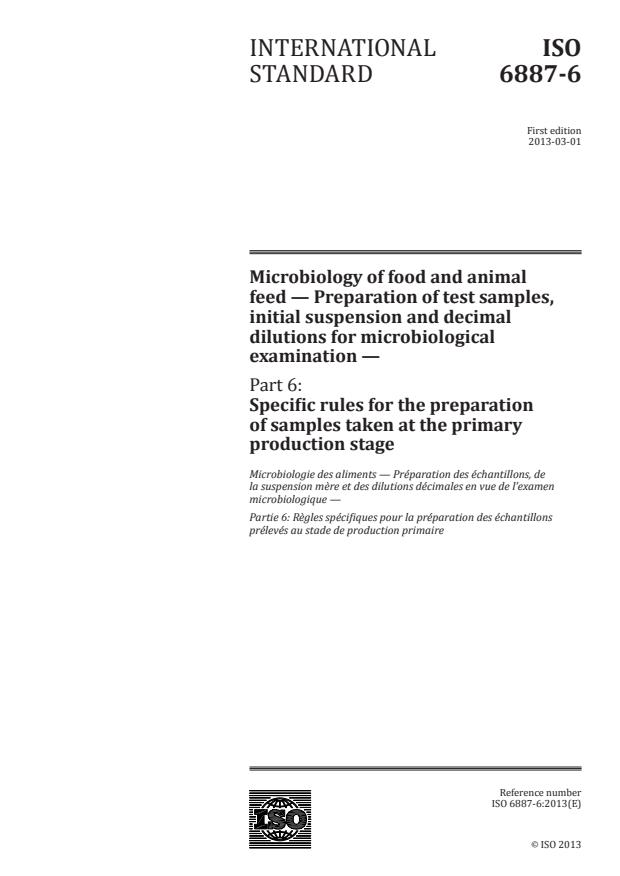
(Main)Microbiology of food and animal feed — Preparation of test samples, initial suspension and decimal dilutions for microbiological examination — Part 6: Specific rules for the preparation of samples taken at the primary production stage
General Information
- Abstract
ISO 6887-6:2013 specifies rules for the preparation of samples taken at all stages from the farm to the slaughterhouse and their suspension for microbiological examination when the samples require different preparation from the methods described in ISO 6887-1. ISO 6887-6:2013 excludes the preparation of samples for both enumeration and detection test methods where preparation details are specified in the relevant International Standards. ISO 6887-6:2013 is applicable to various samples taken from the hatchery, the farm, from the vehicle or the animals during transportation, or from animals or their carcasses in the slaughterhouse, to indicate the microbiological status of the animals in relation to zoonotic agents. ISO 6887-6:2013 does not apply to samples taken to assess the hygiene of meat.
- Status
- Published
- Publication Date
- 28-Feb-2013
- Technical Committee
- ISO/TC 34/SC 9 - Microbiology
- Drafting Committee
- ISO/TC 34/SC 9 - Microbiology
- Current Stage
- 9093 - International Standard confirmed
- Start Date
- 12-Feb-2024
- Completion Date
- 29-Aug-2026
Buy Documents
ISO 6887-6:2013 - Microbiology of food and animal feed — Preparation of test samples, initial suspension and decimal dilutions for microbiological examination — Part 6: Specific rules for the preparation of samples taken at the primary production stage Released:3/1/2013
ISO 6887-6:2013 - Microbiologie des aliments — Préparation des échantillons, de la suspension mere et des dilutions décimales en vue de l'examen microbiologique — Partie 6: Regles spécifiques pour la préparation des échantillons prélevés au stade de production primaire Released:3/1/2013
Overview
ISO 6887-6:2013 - Microbiology of food and animal feed: Preparation of test samples, initial suspension and decimal dilutions - Part 6 provides specific rules for preparing samples taken at the primary production stage (farm, hatchery, transport, slaughterhouse) for microbiological examination. It complements ISO 6887-1 (general rules) by detailing how to handle samples that require different treatment than the general method. The standard focuses on obtaining representative initial suspensions and further decimal dilutions to support both detection and enumeration of microorganisms relevant to animal health and zoonotic agents. It does not apply to meat hygiene assessments or aquatic primary production samples.
Key Topics
- Scope and exclusions: Applies to samples from hatchery, farm, vehicles in transport, animals and carcasses at slaughter for determining microbiological status with respect to zoonotic agents; excludes meat hygiene and aquatic production sampling.
- Principle: Prepare an initial suspension to evenly distribute microorganisms without reducing viability; prepare further decimal dilutions as needed for culture or enumeration.
- Sample types: Fabric and stick swabs, bootsock/drag/rope swabs, Moore’s drain swabs, litter, pooled or individual faecal samples, dust, water, lymph nodes and gut contents.
- Preparation rules: Aseptic techniques, full transfer of laboratory samples, considerations for pooling (e.g., prefer pool sizes ≤ 20 faecal samples), and impact of added diluent volume on detection limits.
- Diluents & neutralizers: Use appropriate diluents (ISO 6887-1), neutralizing agents when required (ISO 13307), and follow disinfectant guidance (ISO 7218).
- Apparatus: Homogenizers (stomacher, blender, pulsifier), sterile tools, flasks, pipettes and other standard microbiology glassware.
- Storage: Hold samples under conditions suitable for target organism survival (see ISO 7218).
Applications
- Laboratory SOPs for veterinary and food microbiology testing at the primary production stage
- On-farm surveillance for zoonotic agents (Salmonella, Campylobacter, etc.)
- Sampling protocols for hatcheries, transport vehicles and slaughterhouse monitoring
- Reference for regulatory and diagnostic laboratories preparing test portions, initial suspensions, and dilution series
- Supports biosecurity programs, outbreak investigations and compliance testing
Related Standards
- ISO 6887-1: General rules for preparation of initial suspension and decimal dilutions
- ISO 7218: General requirements and guidance for microbiological examinations
- ISO 13307: Primary production stage - Sampling techniques
- ISO 6887-2 to -5: Specific rules for meat, fish, milk and other products
- ISO 6579 (referenced example for Salmonella procedures)
Keywords: ISO 6887-6:2013, sample preparation, initial suspension, decimal dilutions, primary production, microbiology of food, farm sampling, hatchery testing, bootsock swabs, faecal pooling.
Relations
- Effective Date
- 08-Jul-2026
- Effective Date
- 09-Feb-2026
- Effective Date
- 09-Feb-2026
- Effective Date
- 09-Feb-2026
- Effective Date
- 09-Feb-2026
- Effective Date
- 09-Feb-2026
- Effective Date
- 09-Feb-2026
- Effective Date
- 09-Feb-2026
- Effective Date
- 09-Feb-2026
- Effective Date
- 09-Feb-2026
- Effective Date
- 09-Feb-2026
- Effective Date
- 09-Feb-2026
- Effective Date
- 09-Feb-2026
- Effective Date
- 09-Feb-2026
- Effective Date
- 09-Feb-2026
Buy Documents
ISO 6887-6:2013 - Microbiology of food and animal feed — Preparation of test samples, initial suspension and decimal dilutions for microbiological examination — Part 6: Specific rules for the preparation of samples taken at the primary production stage Released:3/1/2013
ISO 6887-6:2013 - Microbiologie des aliments — Préparation des échantillons, de la suspension mere et des dilutions décimales en vue de l'examen microbiologique — Partie 6: Regles spécifiques pour la préparation des échantillons prélevés au stade de production primaire Released:3/1/2013
Frequently Asked Questions
ISO 6887-6:2013 is a standard published by the International Organization for Standardization (ISO). Its full title is "Microbiology of food and animal feed — Preparation of test samples, initial suspension and decimal dilutions for microbiological examination — Part 6: Specific rules for the preparation of samples taken at the primary production stage". This standard covers: ISO 6887-6:2013 specifies rules for the preparation of samples taken at all stages from the farm to the slaughterhouse and their suspension for microbiological examination when the samples require different preparation from the methods described in ISO 6887-1. ISO 6887-6:2013 excludes the preparation of samples for both enumeration and detection test methods where preparation details are specified in the relevant International Standards. ISO 6887-6:2013 is applicable to various samples taken from the hatchery, the farm, from the vehicle or the animals during transportation, or from animals or their carcasses in the slaughterhouse, to indicate the microbiological status of the animals in relation to zoonotic agents. ISO 6887-6:2013 does not apply to samples taken to assess the hygiene of meat.
ISO 6887-6:2013 specifies rules for the preparation of samples taken at all stages from the farm to the slaughterhouse and their suspension for microbiological examination when the samples require different preparation from the methods described in ISO 6887-1. ISO 6887-6:2013 excludes the preparation of samples for both enumeration and detection test methods where preparation details are specified in the relevant International Standards. ISO 6887-6:2013 is applicable to various samples taken from the hatchery, the farm, from the vehicle or the animals during transportation, or from animals or their carcasses in the slaughterhouse, to indicate the microbiological status of the animals in relation to zoonotic agents. ISO 6887-6:2013 does not apply to samples taken to assess the hygiene of meat.
ISO 6887-6:2013 is classified under the following ICS (International Classification for Standards) categories: 07.100.30 - Food microbiology. The ICS classification helps identify the subject area and facilitates finding related standards.
ISO 6887-6:2013 has the following relationships with other standards: It is inter standard links to EN ISO 24914:2026, CEN ISO/TS 6579-2:2012, EN ISO 22964:2017, EN ISO 11290-2:2017, EN ISO 10273:2017, EN ISO 6888-2:2021, EN ISO 16140-3:2021, EN ISO 6888-1:2021, EN ISO 11133:2014, EN ISO 22174:2024, EN ISO 21528-1:2017, EN ISO 16140-4:2020, EN ISO 16649-3:2015, EN ISO 21528-2:2017, EN ISO 6579-1:2017. Understanding these relationships helps ensure you are using the most current and applicable version of the standard.
ISO 6887-6:2013 is available in PDF format for immediate download after purchase. The document can be added to your cart and obtained through the secure checkout process. Digital delivery ensures instant access to the complete standard document.
Standards Content (Sample)
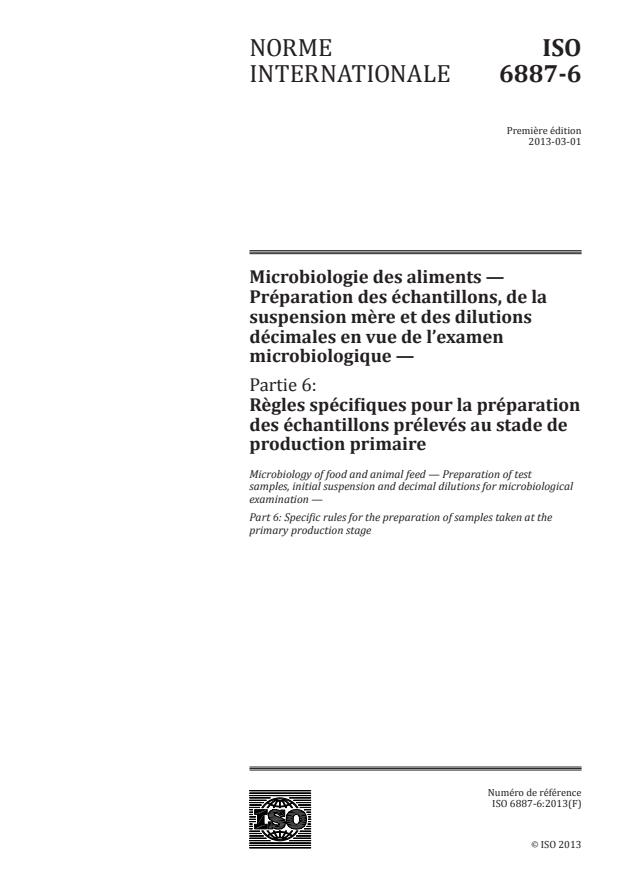
INTERNATIONAL ISO
STANDARD 6887-6
First edition
2013-03-01
Microbiology of food and animal
feed — Preparation of test samples,
initial suspension and decimal
dilutions for microbiological
examination —
Part 6:
Specific rules for the preparation
of samples taken at the primary
production stage
Microbiologie des aliments — Préparation des échantillons, de
la suspension mère et des dilutions décimales en vue de l’examen
microbiologique —
Partie 6: Règles spécifiques pour la préparation des échantillons
prélevés au stade de production primaire
Reference number
©
ISO 2013
© ISO 2013
All rights reserved. Unless otherwise specified, no part of this publication may be reproduced or utilized otherwise in any form
or by any means, electronic or mechanical, including photocopying, or posting on the internet or an intranet, without prior
written permission. Permission can be requested from either ISO at the address below or ISO’s member body in the country of
the requester.
ISO copyright office
Case postale 56 • CH-1211 Geneva 20
Tel. + 41 22 749 01 11
Fax + 41 22 749 09 47
E-mail copyright@iso.org
Web www.iso.org
Published in Switzerland
ii © ISO 2013 – All rights reserved
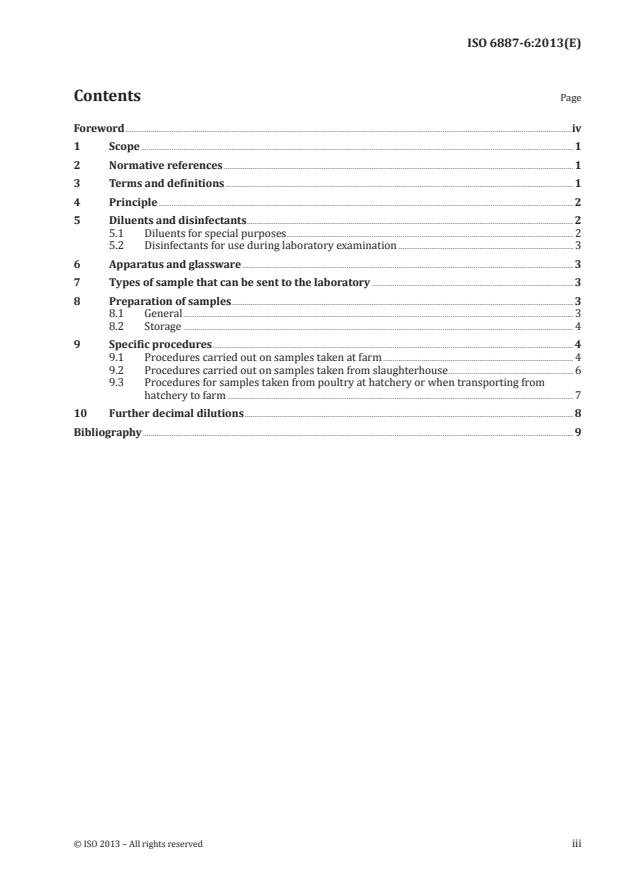
Contents Page
Foreword .iv
1 Scope . 1
2 Normative references . 1
3 Terms and definitions . 1
4 Principle . 2
5 Diluents and disinfectants . 2
5.1 Diluents for special purposes . 2
5.2 Disinfectants for use during laboratory examination . 3
6 Apparatus and glassware . 3
7 Types of sample that can be sent to the laboratory . 3
8 Preparation of samples. 3
8.1 General . 3
8.2 Storage . 4
9 Specific procedures. 4
9.1 Procedures carried out on samples taken at farm . 4
9.2 Procedures carried out on samples taken from slaughterhouse . 6
9.3 Procedures for samples taken from poultry at hatchery or when transporting from
hatchery to farm . 7
10 Further decimal dilutions . 8
Bibliography . 9
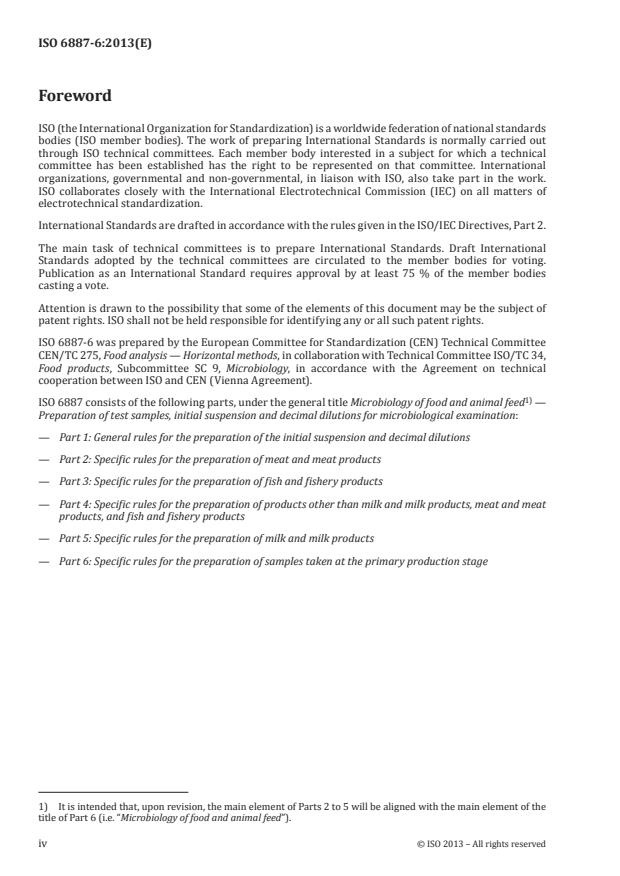
Foreword
ISO (the International Organization for Standardization) is a worldwide federation of national standards
bodies (ISO member bodies). The work of preparing International Standards is normally carried out
through ISO technical committees. Each member body interested in a subject for which a technical
committee has been established has the right to be represented on that committee. International
organizations, governmental and non-governmental, in liaison with ISO, also take part in the work.
ISO collaborates closely with the International Electrotechnical Commission (IEC) on all matters of
electrotechnical standardization.
International Standards are drafted in accordance with the rules given in the ISO/IEC Directives, Part 2.
The main task of technical committees is to prepare International Standards. Draft International
Standards adopted by the technical committees are circulated to the member bodies for voting.
Publication as an International Standard requires approval by at least 75 % of the member bodies
casting a vote.
Attention is drawn to the possibility that some of the elements of this document may be the subject of
patent rights. ISO shall not be held responsible for identifying any or all such patent rights.
ISO 6887-6 was prepared by the European Committee for Standardization (CEN) Technical Committee
CEN/TC 275, Food analysis — Horizontal methods, in collaboration with Technical Committee ISO/TC 34,
Food products, Subcommittee SC 9, Microbiology, in accordance with the Agreement on technical
cooperation between ISO and CEN (Vienna Agreement).
1)
ISO 6887 consists of the following parts, under the general title Microbiology of food and animal feed —
Preparation of test samples, initial suspension and decimal dilutions for microbiological examination:
— Part 1: General rules for the preparation of the initial suspension and decimal dilutions
— Part 2: Specific rules for the preparation of meat and meat products
— Part 3: Specific rules for the preparation of fish and fishery products
— Part 4: Specific rules for the preparation of products other than milk and milk products, meat and meat
products, and fish and fishery products
— Part 5: Specific rules for the preparation of milk and milk products
— Part 6: Specific rules for the preparation of samples taken at the primary production stage
1) It is intended that, upon revision, the main element of Parts 2 to 5 will be aligned with the main element of the
title of Part 6 (i.e. “Microbiology of food and animal feed”).
iv © ISO 2013 – All rights reserved
INTERNATIONAL STANDARD ISO 6887-6:2013(E)
Microbiology of food and animal feed — Preparation of
test samples, initial suspension and decimal dilutions for
microbiological examination —
Part 6:
Specific rules for the preparation of samples taken at the
primary production stage
1 Scope
This part of ISO 6887 specifies rules for the preparation of samples taken at all stages from the farm
to the slaughterhouse and their suspension for microbiological examination when the samples require
different preparation from the methods described in ISO 6887-1. ISO 6887-1 defines the general rules for
the preparation of the initial suspension and decimal dilutions for microbiological examination.
This part of ISO 6887 excludes the preparation of samples for both enumeration and detection test
methods where preparation details are specified in the relevant International Standards.
This part of ISO 6887 is applicable to various samples taken from the hatchery, the farm, from the
vehicle or the animals during transportation, or from animals or their carcasses in the slaughterhouse,
to indicate the microbiological status of the animals in relation to zoonotic agents. This part of ISO 6887
does not apply to samples taken to assess the hygiene of meat. These are covered by ISO 6887-2.
This part of ISO 6887 does not consider samples taken from the aquatic environment (marine or
freshwater) at the primary production stage. These are covered by ISO 6887-3.
2 Normative references
The following documents, in whole or in part, are normatively referenced in this document and are
indispensable for its application. For dated references, only the edition cited applies. For undated
references, the latest edition of the referenced document (including any amendments) applies.
ISO 6887-1, Microbiology of food and animal feeding stuffs — Preparation of test samples, initial suspension
and decimal dilutions for microbiological examination — Part 1: General rules for the preparation of the
1)
initial suspension and decimal dilutions
ISO 7218:2007, Microbiology of food and animal feeding stuffs — General requirements and guidance for
microbiological examinations
ISO 13307, Microbiology of food and animal feed — Primary production stage — Sampling techniques
3 Terms and definitions
For the purposes of this document, the following terms and definitions apply.
3.1
laboratory sample
sample prepared for sending to the laboratory and intended for inspection or testing
3.2
test portion
measured (volume or mass) representative sample taken from the laboratory sample (3.1) for use in the
preparation of the initial suspension (3.4)
3.3
pooled sample
composite sample taken from a number of different animals or composites of separate environmental
samples
3.4
initial suspension
primary dilution
suspension, solution or emulsion obtained after a weighed or measured quantity of the product under
examination (or of a test sample prepared from the product) has been mixed with, normally, a nine-fold
quantity of diluent, allowing large particles, if present, to settle
Note 1 to entry: Sometimes higher or lower initial dilutions are prepared, for example 1 in 5 or 1 in 100 (V → V ).
1 2
3.5
further decimal dilutions
suspension or solution obtained by mixing a measured volume of the initial suspension (3.4) with a nine-
fold volume of diluent and by repeating this operation with each dilution prepared in this way, until a
decimal dilution series, suitable for the inoculation of culture media, is obtained
4 Principle
An initial suspension (3.4) is prepared to obtain as uniform a distribution as possible of the
microorganisms contained in the test sample, without reducing their viability.
A suspension for pre-enrichment or enrichment is prepared in the same way, using the medium
recommended by the method of analysis concerned, except in the special cases mentioned in each
product subclause (section) of this part of ISO 6887.
If necessary, further dilutions (3.5) are prepared in order to reduce the number of microorganisms
per unit volume to allow, after incubation, observation of any growth (in the case of liquid media) or
enumeration of colonies (in or on agar plates), as stated in each specific standard.
In order to restrict, if required, the range of enumeration to a given interval, or if high numbers of
microorganisms are foreseen, it is possible to inoculate only the appropriate dilutions (at least two
successive dilutions) according to the calculation described in ISO 7218.
5 Diluents and disinfectants
Diluents for general use are described in ISO 6887-1.
5.1 Diluents for special purposes
5.1.1 Neutralizing agents
Neutralizing liquid, prepared in accordance with ISO 13307, is used if needed at 10 % volume fraction in
diluent. Neutralizer is normally added when the sample is taken, before transportation to the laboratory.
NOTE If a high level of formalin is expected in the samples, L-histidine (0.9 %) can be also added to the pre-
enrichment broth.
2 © ISO 2013 – All rights reserved
5.2 Disinfectants for use during laboratory examination
Disinfectants are given in ISO 7218:2007, 6.2.4.
6 Apparatus and glassware
Usual microbiological laboratory equipment for general use (see ISO 6887-1 and ISO 7218) and, in
particular, the following:
6.1 Homogenizers
6.1.1 Peristaltic homogenizer (stomacher)
6.1.2 Rotary homogenizer (blender)
6.1.3 Vibrational mixer (pulsifier)
6.2 Sterile hammer or plastic mallet
6.3 Sterile sand, pestle and mortar
6.4 Sterile forceps, scissors, scalpels, spatulas, spoons
6.5 Sterile flasks or screw-cap bottles of appropriate capacities
6.6 Sterile total delivery graduated pipettes, pipette tips
7 Types of sample that can be sent to the laboratory
The samples shall be taken and transported in accordance with ISO 7218 and ISO 13307.
The following list includes examples only. More detailed information on samples needed in different
situations is given in Clause 9:
— samples taken at the farm:
— from the environment (e.g. swabs, litter, faeces, dust, water);
— from animals (e.g. swabs);
— samples taken at slaughter (e.g. rectal or caecal content, mesenteric lymph nodes);
— samples taken a
...
NORME ISO
INTERNATIONALE 6887-6
Première édition
2013-03-01
Microbiologie des aliments —
Préparation des échantillons, de la
suspension mère et des dilutions
décimales en vue de l’examen
microbiologique —
Partie 6:
Règles spécifiques pour la préparation
des échantillons prélevés au stade de
production primaire
Microbiology of food and animal feed — Preparation of test
samples, initial suspension and decimal dilutions for microbiological
examination —
Part 6: Specific rules for the preparation of samples taken at the
primary production stage
Numéro de référence
©
ISO 2013
DOCUMENT PROTÉGÉ PAR COPYRIGHT
© ISO 2013
Droits de reproduction réservés. Sauf indication contraire, aucune partie de cette publication ne peut être reproduite ni utilisée
sous quelque forme que ce soit et par aucun procédé, électronique ou mécanique, y compris la photocopie, l’affichage sur
l’internet ou sur un Intranet, sans autorisation écrite préalable. Les demandes d’autorisation peuvent être adressées à l’ISO à
l’adresse ci-après ou au comité membre de l’ISO dans le pays du demandeur.
ISO copyright office
Case postale 56 • CH-1211 Geneva 20
Tel. + 41 22 749 01 11
Fax + 41 22 749 09 47
E-mail copyright@iso.org
Web www.iso.org
Publié en Suisse
ii © ISO 2013 – Tous droits réservés
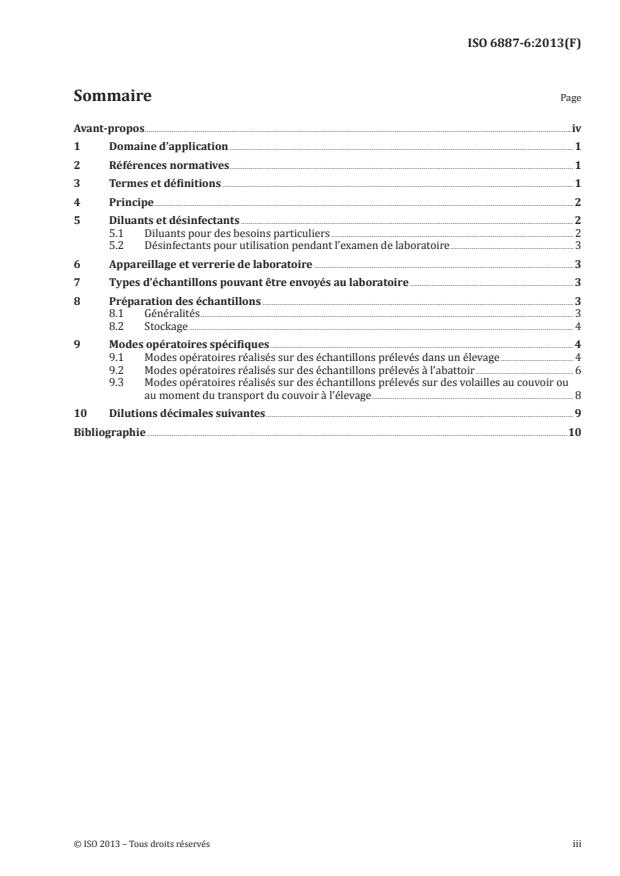
Sommaire Page
Avant-propos .iv
1 Domaine d’application . 1
2 Références normatives . 1
3 Termes et définitions . 1
4 Principe . 2
5 Diluants et désinfectants . 2
5.1 Diluants pour des besoins particuliers . 2
5.2 Désinfectants pour utilisation pendant l’examen de laboratoire . 3
6 Appareillage et verrerie de laboratoire . 3
7 Types d’échantillons pouvant être envoyés au laboratoire . 3
8 Préparation des échantillons . 3
8.1 Généralités . 3
8.2 Stockage . 4
9 Modes opératoires spécifiques . 4
9.1 Modes opératoires réalisés sur des échantillons prélevés dans un élevage . 4
9.2 Modes opératoires réalisés sur des échantillons prélevés à l’abattoir . 6
9.3 Modes opératoires réalisés sur des échantillons prélevés sur des volailles au couvoir ou
au moment du transport du couvoir à l’élevage . 8
10 Dilutions décimales suivantes . 9
Bibliographie .10
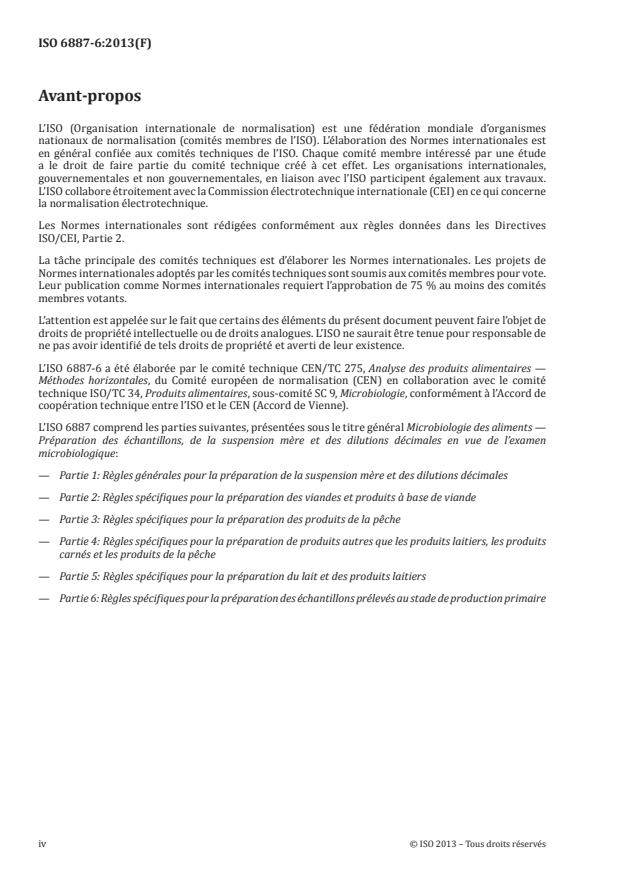
Avant-propos
L’ISO (Organisation internationale de normalisation) est une fédération mondiale d’organismes
nationaux de normalisation (comités membres de l’ISO). L’élaboration des Normes internationales est
en général confiée aux comités techniques de l’ISO. Chaque comité membre intéressé par une étude
a le droit de faire partie du comité technique créé à cet effet. Les organisations internationales,
gouvernementales et non gouvernementales, en liaison avec l’ISO participent également aux travaux.
L’ISO collabore étroitement avec la Commission électrotechnique internationale (CEI) en ce qui concerne
la normalisation électrotechnique.
Les Normes internationales sont rédigées conformément aux règles données dans les Directives
ISO/CEI, Partie 2.
La tâche principale des comités techniques est d’élaborer les Normes internationales. Les projets de
Normes internationales adoptés par les comités techniques sont soumis aux comités membres pour vote.
Leur publication comme Normes internationales requiert l’approbation de 75 % au moins des comités
membres votants.
L’attention est appelée sur le fait que certains des éléments du présent document peuvent faire l’objet de
droits de propriété intellectuelle ou de droits analogues. L’ISO ne saurait être tenue pour responsable de
ne pas avoir identifié de tels droits de propriété et averti de leur existence.
L’ISO 6887-6 a été élaborée par le comité technique CEN/TC 275, Analyse des produits alimentaires —
Méthodes horizontales, du Comité européen de normalisation (CEN) en collaboration avec le comité
technique ISO/TC 34, Produits alimentaires, sous-comité SC 9, Microbiologie, conformément à l’Accord de
coopération technique entre l’ISO et le CEN (Accord de Vienne).
L’ISO 6887 comprend les parties suivantes, présentées sous le titre général Microbiologie des aliments —
Préparation des échantillons, de la suspension mère et des dilutions décimales en vue de l’examen
microbiologique:
— Partie 1: Règles générales pour la préparation de la suspension mère et des dilutions décimales
— Partie 2: Règles spécifiques pour la préparation des viandes et produits à base de viande
— Partie 3: Règles spécifiques pour la préparation des produits de la pêche
— Partie 4: Règles spécifiques pour la préparation de produits autres que les produits laitiers, les produits
carnés et les produits de la pêche
— Partie 5: Règles spécifiques pour la préparation du lait et des produits laitiers
— Partie 6: Règles spécifiques pour la préparation des échantillons prélevés au stade de production primaire
iv © ISO 2013 – Tous droits réservés
NORME INTERNATIONALE ISO 6887-6:2013(F)
Microbiologie des aliments — Préparation des
échantillons, de la suspension mère et des dilutions
décimales en vue de l’examen microbiologique —
Partie 6:
Règles spécifiques pour la préparation des échantillons
prélevés au stade de production primaire
1 Domaine d’application
La présente partie de l’ISO 6887 spécifie des règles pour la préparation d’échantillons prélevés à toutes
les étapes depuis l’élevage jusqu’à l’abattoir et leur suspension pour examen biologique lorsque les
échantillons nécessitent une méthode de préparation différente de celles décrites dans l’ISO 6887-1.
L’ISO 6887-1 définit les règles générales pour la préparation de la suspension mère et des dilutions
décimales en vue d’examens microbiologiques.
La présente partie de l’ISO 6687 n’inclut pas la préparation d’échantillons destinés à des méthodes de
recherche et de dénombrement dont les détails concernant la préparation sont spécifiés dans les Normes
internationales appropriées.
La présente partie de l’ISO 6887 est applicable aux divers échantillons prélevés dans un couvoir, un élevage,
un véhicule ou sur les animaux pendant le transport, ou sur les animaux ou leur carcasse à l’abattoir, afin
d’indiquer le statut microbiologique des animaux par rapport à des agents zoonotiques. La présente partie
de l’ISO 6687 ne s’applique pas aux échantillons prélevés pour évaluer l’hygiène de la viande.
La présente partie de l’ISO 6887 ne prend pas en compte les échantillons prélevés dans l’environnement
aquatique (marin ou d’eau douce) au stade de la production primaire. Ceux-ci sont traités dans
l’ISO 6887-3.
2 Références normatives
Les documents de référence suivants sont indispensables pour l’application du présent document. Pour
les références datées, seule l’édition citée s’applique. Pour les références non datées, la dernière édition
du document de référence s’applique (y compris les éventuels amendements).
ISO 6887-1, Microbiologie des aliments — Préparation des échantillons, de la suspension mère et des
dilutions décimales en vue de l’examen microbiologique — Partie 1: Règles générales pour la préparation de
la suspension mère et des dilutions décimales
ISO 7218:2007, Microbiologie des aliments — Exigences générales et recommandations
ISO 13307, Microbiologie des aliments — Stade de production primaire — Techniques de prélèvement
3 Termes et définitions
Pour les besoins du présent document, les termes et définitions suivants s’appliquent.
3.1
échantillon pour laboratoire
échantillon préparé pour être envoyé au laboratoire et destiné aux essais ou inspections
3.2
prise d’essai
échantillon représentatif mesuré (volume ou masse) prélevé sur l’échantillon pour laboratoire (3.1) pour
servir à la préparation de la suspension mère (3.4)
3.3
échantillon groupé
échantillon composite prélevé sur un nombre déterminé d’animaux différents ou composé de plusieurs
échantillons environnementaux
3.4
suspension mère
première dilution
suspension, solution ou émulsion obtenue après qu’une quantité pesée ou mesurée du produit à analyser
(ou d’un échantillon pour essai préparé à partir de ce produit) a été mélangée avec une quantité de diluant
égale le plus souvent à neuf fois la quantité de produit, en laissant se déposer les grosses particules, s’il y en a
Note 1 à l’article: Parfois, des dilutions mères plus ou moins élevées sont préparées, par exemple, 1 pour 5 ou 1
pour 100 (V → V ).
1 2
3.5
dilutions décimales suivantes
suspension ou solution obtenue en mélangeant un volume mesuré de la suspension mère (3.4) avec neuf fois
le volume de diluant et en répétant cette opération avec chaque dilution préparée de cette façon, jusqu’à
l’obtention d’une série de dilution décimale, appropriée pour l’ensemencement des milieux de culture
4 Principe
La suspension mère (3.4) est préparée de façon à obtenir une répartition aussi uniforme que possible
des micro-organismes contenus dans l’échantillon pour essai, sans réduire leur viabilité.
Une suspension de pré-enrichissement ou d’enrichissement est préparée de la même façon, avec
utilisation du milieu préconisé par la méthode d’analyse concernée, sauf cas particuliers mentionnés
dans chaque paragraphe (chapitre) relatif à un produit de la présente partie de l’ISO 6887.
Si nécessaire, des dilutions suivantes (3.5) sont préparées en vue de réduire le nombre de micro-
organismes par unité de volume pour permettre, après incubation, d’observer leur éventuel
développement (cas des milieux liquides) ou de dénombrer les colonies (en inclusion ou en surface d’une
gélose coulée en boîte), comme précisé dans chaque norme spécifique.
Pour restreindre, si nécessaire, le domaine de dénombrement à un intervalle donné, ou si un nombre élevé
de micro-organismes est attendu, il est possible d’ensemencer uniquement les dilutions appropriées (au
moins deux dilutions successives) selon le mode de calcul décrit dans l’ISO 7218.
5 Diluants et désinfectants
Des diluants d’emploi général sont décrits dans l’ISO 6887-1.
5.1 Diluants pour des besoins particuliers
5.1.1 Agents neutralisants
Le liquide neutralisant, préparé conformément à l’ISO 13307, est utilisé si besoin à une concentration de
10 % dans le volume final de diluant. Le neutralisant est normalement ajouté lorsque l’échantillon est
prélevé, avant transport au laboratoire.
NOTE Si un taux élevé de formol dans les échantillons est suspecté, du L-histidine (0,9 %) peut aussi être
ajouté au bouillon de pré-enrichissement.
2 © ISO 2013 – Tous droits réservés
5.2 Désinfectants pour utilisation pendant l’examen de laboratoire
Des exemples de désinfectants sont donnés dans l’ISO 7218:2007, 6.2.4.
6 Appareillage et verrerie de laboratoire
Matériel courant de laboratoire de microbiologie pour usage général (voir l’ISO 6887-1 et l’ISO 7218) et,
en particulier, ce qui suit:
6.1 Homogénéisateurs
6.1.1 Homogénéisateur péristaltique (stomacher).
6.1.2 Homogénéisateur de type rotatif (blender).
6.1.3 Homogénéisateur par vibrations (pulsifier).
6.2 Marteau ou maillet en plastique, stériles.
6.3 Sable, pilon et mortier stériles.
6.4 Pinces, ciseaux, scalpels, spatules et cuillères, stériles.
6.5 Fioles ou flacons à bouchon à vis stériles de capacité appropriée.
6.6 Pipettes stériles graduées à écoulement total et système de pipetage.
7 Types d’échantillons pouvant être envoyés au laboratoire
Les échantillons doivent être prélevés et transportés conformément à l’ISO 7218 et l’ISO 13307.
La liste suivante est donnée à titre d’exemple seulement. Des informations plus détaillées sur les
échantillons nécessaires dans des situations différentes sont données dans l’Article 9:
— des échantillons prélevés à l’élevage;
— dans l’environnement (par exemple chiffonnettes, déchets, matières fécales, poussières, eau);
— sur les animaux (par exemple écouvillons);
— des échantillons prélevés à l’abattoir (par exemple contenu rectal ou cæcal, ganglions lymphatiques
mésentériques);
— des échantillons prélevés au couvoir (par exemple fonds de casiers d’éclosoir, coquilles d’œuf cassées);
— des échantillons prélevés sur des véhicules, des modules ou des caisses pour le transport d’animaux
(par exemple chiffonnettes).
8 Préparation des échantillons
8.1 Généralités
Il est recommandé de réaliser toutes les préparations et les manipulations à l’aide de bonnes techniques
d’asepsie et avec du matériel stérile afin de prévenir la contamination microbiologique des échantillons
par des sources extérieures (voir l’ISO 7218).
Si l’échantillon est transféré dans un autre récipient et que la totalité de l’échantillon pour laboratoire
doit être utilisée, s’assurer que tout l’échantillon est transféré (par exemple lors du transfert de
chaussettes d’un récipient d’origine dans un nouveau récipient, veiller à ce qu’aucun matériau provenant
des chaussettes ne demeure dans l’ancien récipient).
Indiquer dans le rapport le mode opératoire utilisé pour l’analyse s’il est différent du mode opératoire
décrit dans la présente partie de l’ISO 6887.
8.2 Stockage
Les échantillons d
...