


ISO 24551:2019
(Main)Ergonomics — Accessible design — Spoken instructions of consumer products
Ergonomics — Accessible design — Spoken instructions of consumer products
This document specifies ergonomic requirements and recommendations for consumer product spoken instructions that are provided to guide users in the operation of a product and/or as a means of providing feedback to users about the status/state of a product. Such instructions can be used by persons with or without visual impairments, and are useful for users who have difficulty reading and/or cognitive impairments. The applicability of the requirements and recommendations described in this document does not depend on the language of the instructions or whether the instructions are provided via recorded human speech or synthesized speech from text. The requirements and recommendations in this document are applicable to conventional, stand-alone consumer products in general, whose function is limited by characteristics that prevent a user from attaching, installing or using assistive technology in order to use the product. They are not applicable to machines and equipment used for professional work. This document does not apply to products for which the instructional content and/or the means of presentation are specified in other standards (e.g. medical devices, fire alarms). It also does not provide recommendations or requirements for spoken instructions of Interactive Voice Response (IVR) systems or digital assistants on personal computers or similar devices. NOTE ISO 9241‑154 provides recommendations or requirements for IVR systems. This document does not specify voice sounds of text-to-speech systems or narrative speech used in place of printed instruction manuals and independently from the product.
Ergonomie — Conception accessible — Instructions orales pour les produits de consommation courante
Le présent document spécifie des exigences et des recommandations ergonomiques pour les instructions orales des produits de consommation courante qui sont fournies pour guider les utilisateurs lors de l'utilisation d'un produit et/ou qui permettent de renseigner les utilisateurs sur le statut/l'état d'un produit. Ces instructions peuvent être utilisées par des personnes présentant ou non des déficiences visuelles, et sont utiles pour les utilisateurs qui ont des difficultés à lire et/ou des déficiences cognitives. L'applicabilité des exigences et recommandations décrites dans le présent document ne dépend pas de la langue des instructions ou du fait que les instructions soient fournies sous forme de parole humaine enregistrée ou de discours synthétisé à partir de texte. Les exigences et recommandations décrites dans le présent document sont applicables aux produits de consommation courante conventionnels et autonomes, dont la fonction est en général limitée par des caractéristiques qui empêchent l'utilisateur d'attacher, d'installer ou d'utiliser une technologie d'aide pour utiliser le produit. Elles ne sont pas applicables aux machines et équipements utilisés à des fins professionnelles. Le présent document ne s'applique pas aux produits dont le contenu didactique et/ou les moyens de présentation sont spécifiés dans d'autres normes (par exemple dispositifs médicaux, alarmes incendie). Il ne fournit pas non plus de recommandations ou d'exigences concernant les instructions orales des systèmes de réponse vocale interactive (RVI) ou des assistants numériques sur les ordinateurs personnels ou autres dispositifs similaires. NOTE L'ISO 9241‑154 fournit des recommandations ou des exigences sur les systèmes RVI. Le présent document ne spécifie pas les sons de voix des systèmes de synthèse vocale ou de discours narratif utilisés à la place des manuels d'instructions imprimés et indépendamment du produit.
General Information
- Status
- Published
- Publication Date
- 22-Oct-2019
- Technical Committee
- ISO/TC 159/SC 4 - Ergonomics of human-system interaction
- Drafting Committee
- ISO/TC 159/SC 4 - Ergonomics of human-system interaction
- Current Stage
- 9093 - International Standard confirmed
- Start Date
- 18-Nov-2025
- Completion Date
- 12-Feb-2026
Relations
- Effective Date
- 12-Feb-2026
- Effective Date
- 17-Sep-2016
Overview
ISO 24551:2019 - Ergonomics - Accessible design - Spoken instructions of consumer products - defines ergonomic requirements and recommendations for spoken instructions provided by consumer products. It covers spoken guidance and feedback used during product operation to help people with or without visual impairments and users with reading or cognitive difficulties. The standard applies to conventional, stand‑alone consumer products (not professional machinery, medical devices, fire alarms, IVR systems or digital assistants) and emphasizes intelligibility, usability and accessibility of spoken instructions.
Key topics and technical requirements
- Scope and applicability: Targets consumer products where assistive technology cannot be attached; excludes professional equipment and systems specified in other standards (e.g., medical devices, IVR).
- General requirements:
- Users must be able to turn spoken instructions on/off without visual cues; caution messages should not be easily disabled.
- Spoken instructions must be repeatable on request and may be preceded by an attention signal that can be muted.
- Visual indication of spoken‑instruction state is required (helps users with hearing loss).
- Spoken instructions should terminate when the related user action occurs; error messages must include corrective guidance.
- Audio quality and intelligibility:
- Prefer digitized human speech over synthesized speech where possible.
- Transmitted frequency range must be sufficient for high intelligibility - intelligibility drops if the upper frequency limit is below about 5 kHz.
- Volume must be user‑adjustable (independently if other audio channels exist); speech rate should be controllable without altering frequency.
- Content and wording:
- Keep instructions short and simple (one or two sentences; limited key words).
- Avoid ambiguous words and use consistent vocabulary that matches product labels/manuals.
- Offer simple and detailed instruction modes for complex products.
- Evaluation:
- Spoken instructions should be validated with user testing; Annex B defines a normative validation test and Annex A addresses volume settings.
Applications and users
- Useful for product designers, UX/ergonomics engineers, accessibility specialists, manufacturers of consumer electronics, household appliances, and device UX teams.
- Helps teams design accessible audio interfaces for users with visual impairment, reading difficulties, cognitive limitations, or situational needs (e.g., hands‑free operation).
Related standards
- ISO 9241‑154 (IVR systems recommendations)
- ISO/IEC Guide 71 and ISO/TR 22411 (accessible design principles)
- ISO 20282‑1 (consumer product definition)
Keywords: ISO 24551:2019, spoken instructions, accessible design, ergonomics, consumer products, speech intelligibility, digitized speech, text-to-speech, accessibility testing.
ISO 24551:2019 - Ergonomics -- Accessible design -- Spoken instructions of consumer products
ISO 24551:2019 - Ergonomie -- Conception accessible -- Instructions orales pour les produits de consommation courante
Get Certified
Connect with accredited certification bodies for this standard

BSI Group
BSI (British Standards Institution) is the business standards company that helps organizations make excellence a habit.

TÜV Rheinland
TÜV Rheinland is a leading international provider of technical services.

TÜV SÜD
TÜV SÜD is a trusted partner of choice for safety, security and sustainability solutions.
Sponsored listings
Frequently Asked Questions
ISO 24551:2019 is a standard published by the International Organization for Standardization (ISO). Its full title is "Ergonomics — Accessible design — Spoken instructions of consumer products". This standard covers: This document specifies ergonomic requirements and recommendations for consumer product spoken instructions that are provided to guide users in the operation of a product and/or as a means of providing feedback to users about the status/state of a product. Such instructions can be used by persons with or without visual impairments, and are useful for users who have difficulty reading and/or cognitive impairments. The applicability of the requirements and recommendations described in this document does not depend on the language of the instructions or whether the instructions are provided via recorded human speech or synthesized speech from text. The requirements and recommendations in this document are applicable to conventional, stand-alone consumer products in general, whose function is limited by characteristics that prevent a user from attaching, installing or using assistive technology in order to use the product. They are not applicable to machines and equipment used for professional work. This document does not apply to products for which the instructional content and/or the means of presentation are specified in other standards (e.g. medical devices, fire alarms). It also does not provide recommendations or requirements for spoken instructions of Interactive Voice Response (IVR) systems or digital assistants on personal computers or similar devices. NOTE ISO 9241‑154 provides recommendations or requirements for IVR systems. This document does not specify voice sounds of text-to-speech systems or narrative speech used in place of printed instruction manuals and independently from the product.
This document specifies ergonomic requirements and recommendations for consumer product spoken instructions that are provided to guide users in the operation of a product and/or as a means of providing feedback to users about the status/state of a product. Such instructions can be used by persons with or without visual impairments, and are useful for users who have difficulty reading and/or cognitive impairments. The applicability of the requirements and recommendations described in this document does not depend on the language of the instructions or whether the instructions are provided via recorded human speech or synthesized speech from text. The requirements and recommendations in this document are applicable to conventional, stand-alone consumer products in general, whose function is limited by characteristics that prevent a user from attaching, installing or using assistive technology in order to use the product. They are not applicable to machines and equipment used for professional work. This document does not apply to products for which the instructional content and/or the means of presentation are specified in other standards (e.g. medical devices, fire alarms). It also does not provide recommendations or requirements for spoken instructions of Interactive Voice Response (IVR) systems or digital assistants on personal computers or similar devices. NOTE ISO 9241‑154 provides recommendations or requirements for IVR systems. This document does not specify voice sounds of text-to-speech systems or narrative speech used in place of printed instruction manuals and independently from the product.
ISO 24551:2019 is classified under the following ICS (International Classification for Standards) categories: 11.180.15 - Aids for deaf and hearing impaired people; 11.180.30 - Aids for blind or partially sighted people; 13.180 - Ergonomics. The ICS classification helps identify the subject area and facilitates finding related standards.
ISO 24551:2019 has the following relationships with other standards: It is inter standard links to EN ISO 24551:2019, ISO 24500:2010. Understanding these relationships helps ensure you are using the most current and applicable version of the standard.
ISO 24551:2019 is available in PDF format for immediate download after purchase. The document can be added to your cart and obtained through the secure checkout process. Digital delivery ensures instant access to the complete standard document.
Standards Content (Sample)
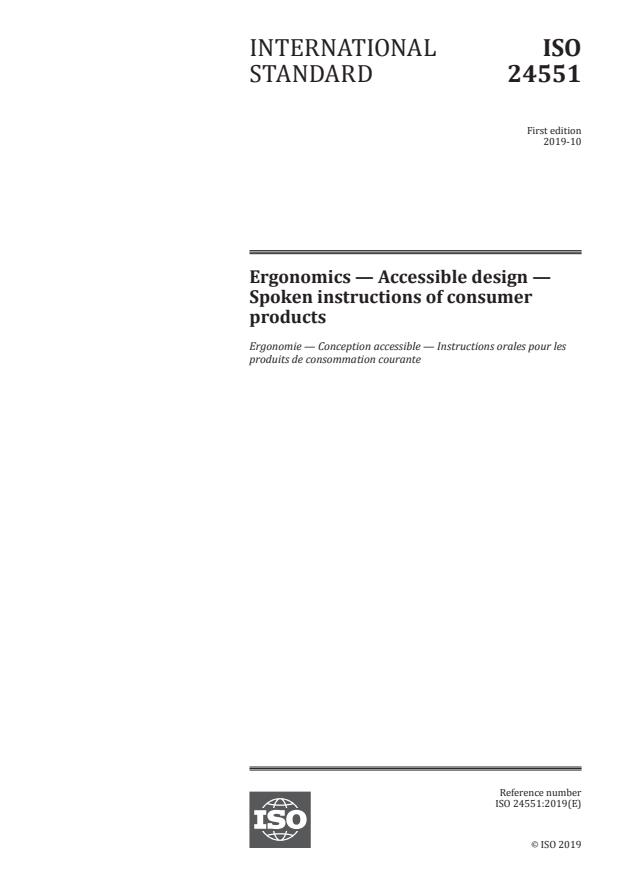
INTERNATIONAL ISO
STANDARD 24551
First edition
2019-10
Ergonomics — Accessible design —
Spoken instructions of consumer
products
Ergonomie — Conception accessible — Instructions orales pour les
produits de consommation courante
Reference number
©
ISO 2019
© ISO 2019
All rights reserved. Unless otherwise specified, or required in the context of its implementation, no part of this publication may
be reproduced or utilized otherwise in any form or by any means, electronic or mechanical, including photocopying, or posting
on the internet or an intranet, without prior written permission. Permission can be requested from either ISO at the address
below or ISO’s member body in the country of the requester.
ISO copyright office
CP 401 • Ch. de Blandonnet 8
CH-1214 Vernier, Geneva
Phone: +41 22 749 01 11
Fax: +41 22 749 09 47
Email: copyright@iso.org
Website: www.iso.org
Published in Switzerland
ii © ISO 2019 – All rights reserved
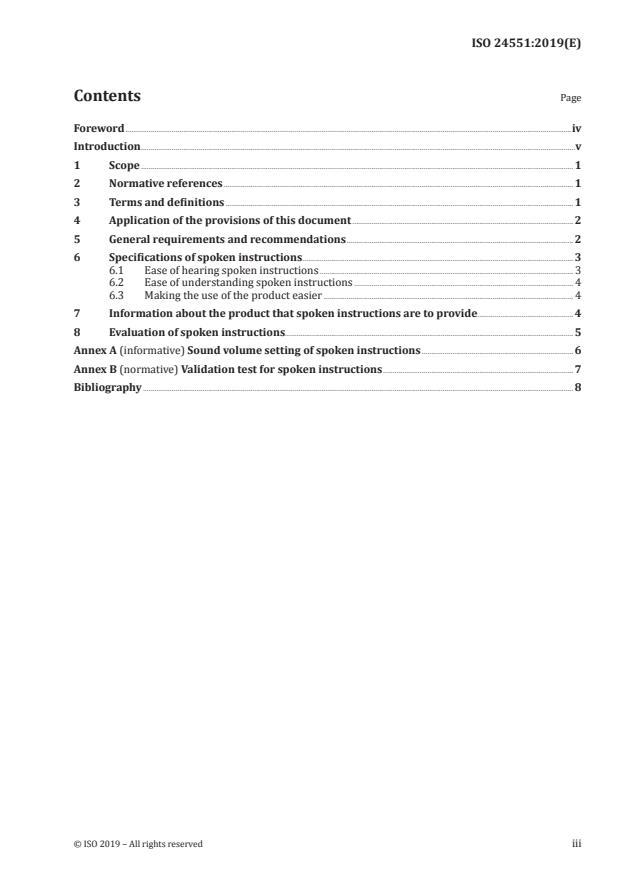
Contents Page
Foreword .iv
Introduction .v
1 Scope . 1
2 Normative references . 1
3 Terms and definitions . 1
4 Application of the provisions of this document . 2
5 General requirements and recommendations . 2
6 Specifications of spoken instructions . 3
6.1 Ease of hearing spoken instructions . 3
6.2 Ease of understanding spoken instructions . 4
6.3 Making the use of the product easier . 4
7 Information about the product that spoken instructions are to provide .4
8 Evaluation of spoken instructions. 5
Annex A (informative) Sound volume setting of spoken instructions . 6
Annex B (normative) Validation test for spoken instructions . 7
Bibliography . 8
Foreword
ISO (the International Organization for Standardization) is a worldwide federation of national standards
bodies (ISO member bodies). The work of preparing International Standards is normally carried out
through ISO technical committees. Each member body interested in a subject for which a technical
committee has been established has the right to be represented on that committee. International
organizations, governmental and non-governmental, in liaison with ISO, also take part in the work.
ISO collaborates closely with the International Electrotechnical Commission (IEC) on all matters of
electrotechnical standardization.
The procedures used to develop this document and those intended for its further maintenance are
described in the ISO/IEC Directives, Part 1. In particular, the different approval criteria needed for the
different types of ISO documents should be noted. This document was drafted in accordance with the
editorial rules of the ISO/IEC Directives, Part 2 (see www .iso .org/ directives).
Attention is drawn to the possibility that some of the elements of this document may be the subject of
patent rights. ISO shall not be held responsible for identifying any or all such patent rights. Details of
any patent rights identified during the development of the document will be in the Introduction and/or
on the ISO list of patent declarations received (see www .iso .org/ patents).
Any trade name used in this document is information given for the convenience of users and does not
constitute an endorsement.
For an explanation of the voluntary nature of standards, the meaning of ISO specific terms and
expressions related to conformity assessment, as well as information about ISO's adherence to the
World Trade Organization (WTO) principles in the Technical Barriers to Trade (TBT) see www .iso .org/
iso/ foreword .html.
This document was prepared by Technical Committee ISO/TC 159, Ergonomics, Subcommittee SC 4,
Ergonomics of human-system interaction.
This first edition cancels and replaces ISO 24500:2010.
Any feedback or questions on this document should be directed to the user’s national standards body. A
complete listing of these bodies can be found at www .iso .org/ members .html.
iv © ISO 2019 – All rights reserved
Introduction
Consumer products, as defined in ISO 20282-1, include home electrical appliances, information and
telecommunication products, gas-heating equipment, toys, sanitary equipment, health-care products,
and cameras, some of which use spoken instructions.
These spoken instructions can assist product users regardless of age, including those with visual
impairments or moderate cognitive disorders that can cause reading difficulties, in using the product
correctly and safely. The spoken instructions are also helpful for some users who are not accustomed
to using the product. Therefore, the instructions should be designed so that they are easy to hear and
comprehend.
This document adopts the principles of accessible design given in ISO/IEC Guide 71 and amplified in
ISO/TR 22411.
INTERNATIONAL STANDARD ISO 24551:2019(E)
Ergonomics — Accessible design — Spoken instructions of
consumer products
1 Scope
This document specifies ergonomic requirements and recommendations for consumer product
spoken instructions that are provided to guide users in the operation of a product and/or as a means
of providing feedback to users about the status/state of a product. Such instructions can be used by
persons with or without visual impairments, and are useful for users who have difficulty reading and/
or cognitive impairments.
The applicability of the requirements and recommendations described in this document does not
depend on the language of the instructions or whether the instructions are provided via recorded
human speech or synthesized speech from text.
The requirements and recommendations in this document are applicable to conventional, stand-alone
consumer products in general, whose function is limited by characteristics that prevent a user from
attaching, installing or using assistive technology in order to use the product. They are not applicable
to machines and equipment used for professional work.
This document does not apply to products for which the instructional content and/or the means of
presentation are specified in other standards (e.g. medical devices, fire alarms). It also does not provide
recommendations or requirements for spoken instructions of Interactive Voice Response (IVR) systems
or digital assistants on personal computers or similar devices.
NOTE ISO 9241-154 provides recommendations or requirements for IVR systems.
This document does not specify voice sounds of text-to-speech systems or narrative speech used in
place of printed instruction manuals and independently from the product.
2 Normative references
There are no normative references in this document.
3 Terms and definitions
For the purposes of this document, the following terms and definitions apply.
ISO and IEC maintain terminological databases for use in standardization at the following addresses:
— ISO Online browsing platform: available at https:// www .iso .org/ obp
— IEC Electropedia: available at http:// www .electropedia .org/
3.1
consumer product
product that is intended to be acquired and used by an individual for personal rather than
professional use
[SOURCE: ISO 20282-1:2006, 3.2]
3.2
spoken instruction
instruction emitted by a product for the purpose of conveying information to help the user to use the
product correctly or to know the state of the product
3.3
caution message
message that informs the user of what they should or should not do at a particular point in the
operation of a product, or which provides information (which can include instructions) with respect to
an operational problem with the product that can require user action
Note 1 to entry: Caution messages have a function similar to that of caution signals specified in ISO 24500.
4 Application of the provisions of this document
This document provides requirements and recommendations for consumer product spoken
instructions. Although all the requirements apply to any consumer product, designers shall consider
the nature of their product, the environment in which it will be used, and the characteristics of the
intended user population when identifying applicable recommendations in this document.
For example, for complex consumer products that require a significant amount of spoken instructions
and/or a high degree of user interaction with the spoken instructions, most or all the recommendations
are likely to be appropriate. Alternatively, in the case of very simple consumer products, which have
few spoken instructions and require only limited interaction with the instructions, following every
recommendation would not be practical, feasible, or cost-effective. Designers are advised to consider
the features their users will need to have for the spoken instru
...
NORME ISO
INTERNATIONALE 24551
Première édition
2019-10
Ergonomie — Conception accessible —
Instructions orales pour les produits
de consommation courante
Ergonomics — Accessible design — Spoken instructions of consumer
products
Numéro de référence
©
ISO 2019
DOCUMENT PROTÉGÉ PAR COPYRIGHT
© ISO 2019
Tous droits réservés. Sauf prescription différente ou nécessité dans le contexte de sa mise en œuvre, aucune partie de cette
publication ne peut être reproduite ni utilisée sous quelque forme que ce soit et par aucun procédé, électronique ou mécanique,
y compris la photocopie, ou la diffusion sur l’internet ou sur un intranet, sans autorisation écrite préalable. Une autorisation peut
être demandée à l’ISO à l’adresse ci-après ou au comité membre de l’ISO dans le pays du demandeur.
ISO copyright office
Case postale 401 • Ch. de Blandonnet 8
CH-1214 Vernier, Genève
Tél.: +41 22 749 01 11
Fax: +41 22 749 09 47
E-mail: copyright@iso.org
Web: www.iso.org
Publié en Suisse
ii © ISO 2019 – Tous droits réservés
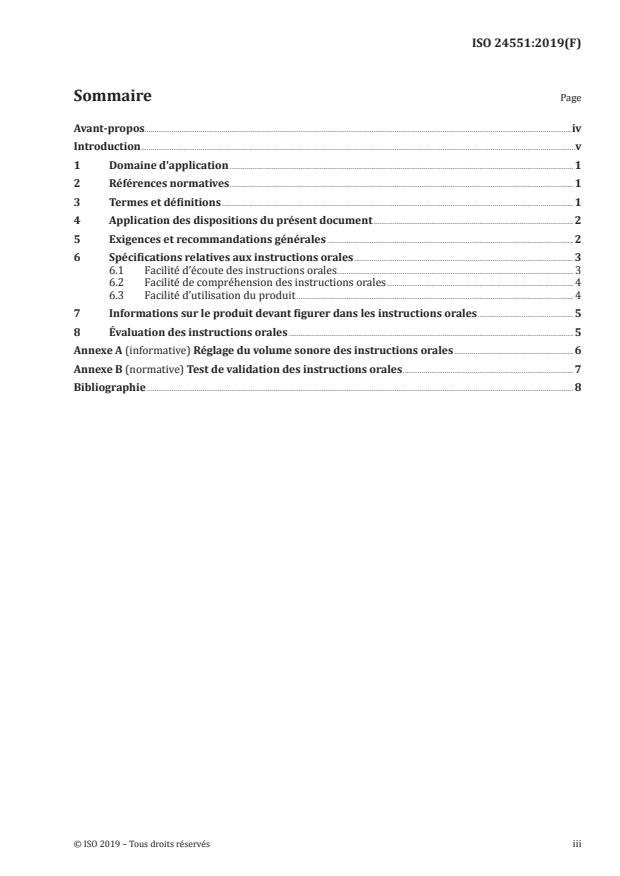
Sommaire Page
Avant-propos .iv
Introduction .v
1 Domaine d'application . 1
2 Références normatives . 1
3 Termes et définitions . 1
4 Application des dispositions du présent document . 2
5 Exigences et recommandations générales . 2
6 Spécifications relatives aux instructions orales . 3
6.1 Facilité d’écoute des instructions orales . 3
6.2 Facilité de compréhension des instructions orales . 4
6.3 Facilité d’utilisation du produit . 4
7 Informations sur le produit devant figurer dans les instructions orales .5
8 Évaluation des instructions orales . 5
Annexe A (informative) Réglage du volume sonore des instructions orales .6
Annexe B (normative) Test de validation des instructions orales . 7
Bibliographie . 8
Avant-propos
L’ISO (Organisation internationale de normalisation) est une fédération mondiale d’organismes
nationaux de normalisation (comités membres de l’ISO). L’élaboration des Normes internationales est
en général confiée aux comités techniques de l’ISO. Chaque comité membre intéressé par une étude
a le droit de faire partie du comité technique créé à cet effet. Les organisations internationales,
gouvernementales et non gouvernementales, en liaison avec l’ISO participent également aux travaux.
L’ISO collabore étroitement avec la Commission électrotechnique internationale (IEC) en ce qui
concerne la normalisation électrotechnique.
Les procédures utilisées pour élaborer le présent document et celles destinées à sa mise à jour sont
décrites dans les Directives ISO/IEC, Partie 1. Il convient, en particulier, de prendre note des différents
critères d’approbation requis pour les différents types de documents ISO. Le présent document a été
rédigé conformément aux règles de rédaction données dans les Directives ISO/IEC, Partie 2 (voir www
.iso .org/ directives).
L’attention est attirée sur le fait que certains des éléments du présent document peuvent faire l’objet de
droits de propriété intellectuelle ou de droits analogues. L’ISO ne saurait être tenue pour responsable
de ne pas avoir identifié de tels droits de propriété et averti de leur existence. Les détails concernant
les références aux droits de propriété intellectuelle ou autres droits analogues identifiés lors de
l’élaboration du document sont indiqués dans l’Introduction et/ou dans la liste des déclarations de
brevets reçues par l’ISO (voir www .iso .org/ brevets).
Les appellations commerciales éventuellement mentionnées dans le présent document sont données
pour information, par souci de commodité, à l’intention des utilisateurs et ne sauraient constituer un
engagement.
Pour une explication de la nature volontaire des normes, la signification des termes et expressions
spécifiques de l’ISO liés à l’évaluation de la conformité, ou pour toute information au sujet de l’adhésion
de l’ISO aux principes de l’Organisation mondiale du commerce (OMC) concernant les obstacles
techniques au commerce (OTC), voir le lien suivant: www .iso .org/ iso/ fr/ avant -propos .html.
Le présent document a été élaboré par le comité technique ISO/TC 159, Ergonomie, sous-comité SC 4,
Ergonomie de l’interaction homme-système.
Cette première édition annule et remplace l'ISO 24500:2010.
Il convient que l’utilisateur adresse tout retour d’information ou toute question concernant le présent
document à l’organisme national de normalisation de son pays. Une liste exhaustive desdits organismes
se trouve à l’adresse www .iso .org/ fr/ members .html.
iv © ISO 2019 – Tous droits réservés
Introduction
Les produits de consommation courante, tels que définis dans l’ISO 20282-1, incluent les appareils
domestiques électriques, les produits d’information et de communication, les appareils de chauffage
à gaz, les jouets, les équipements sanitaires, les produits de soins, les appareils photo, dont certains
utilisent des instructions orales.
Ces instructions orales peuvent aider les utilisateurs des produits, quel que soit leur âge, y compris les
personnes présentant des déficiences visuelles ou des troubles cognitifs moyens pouvant causer des
difficultés de lecture, à utiliser le produit correctement et en toute sécurité. Les instructions orales sont
également utiles à certains utilisateurs qui ne sont pas habitués à utiliser le produit. Par conséquent, il
convient que ces instructions soient conçues pour être faciles à entendre et à comprendre.
Le présent document adopte les principes de conception accessible énoncés dans le Guide ISO/IEC 71 et
développés dans l’ISO/TR 22411.
NORME INTERNATIONALE ISO 24551:2019(F)
Ergonomie — Conception accessible — Instructions orales
pour les produits de consommation courante
1 Domaine d'application
Le présent document spécifie des exigences et des recommandations ergonomiques pour les instructions
orales des produits de consommation courante qui sont fournies pour guider les utilisateurs lors de
l’utilisation d’un produit et/ou qui permettent de renseigner les utilisateurs sur le statut/l’état d’un
produit. Ces instructions peuvent être utilisées par des personnes présentant ou non des déficiences
visuelles, et sont utiles pour les utilisateurs qui ont des difficultés à lire et/ou des déficiences cognitives.
L’applicabilité des exigences et recommandations décrites dans le présent document ne dépend pas de
la langue des instructions ou du fait que les instructions soient fournies sous forme de parole humaine
enregistrée ou de discours synthétisé à partir de texte.
Les exigences et recommandations décrites dans le présent document sont applicables aux produits de
consommation courante conventionnels et autonomes, dont la fonction est en général limitée par des
caractéristiques qui empêchent l’utilisateur d’attacher, d’installer ou d’utiliser une technologie d’aide
pour utiliser le produit. Elles ne sont pas applicables aux machines et équipements utilisés à des fins
professionnelles.
Le présent document ne s’applique pas aux produits dont le contenu didactique et/ou les moyens de
présentation sont spécifiés dans d’autres normes (par exemple dispositifs médicaux, alarmes incendie).
Il ne fournit pas non plus de recommandations ou d’exigences concernant les instructions orales
des systèmes de réponse vocale interactive (RVI) ou des assistants numériques sur les ordinateurs
personnels ou autres dispositifs similaires.
NOTE L’ISO 9241-154 fournit des recommandations ou des exigences sur les systèmes RVI.
Le présent document ne spécifie pas les sons de voix des systèmes de synthèse vocale ou de discours
narratif utilisés à la place des manuels d’instructions imprimés et indépendamment du produit.
2 Références normatives
Le présent document ne contient aucune référence normative.
3 Termes et définitions
Pour les besoins du présent document, les termes et définitions suivants s’appliquent.
L’ISO et l’IEC tiennent à jour des bases de données terminologiques destinées à être utilisées en
normalisation, consultables aux adresses suivantes:
— ISO Online browsing platform: disponible à l’adresse https:// www .iso .org/ obp
— IEC Electropedia: disponible à l’adresse http:// www .electropedia .org/
3.1
produit de consommation courante
produit destiné à être acquis et utilisé par une personne physique pour un usage personnel plutôt que
professionnel
[SOURCE: ISO 20282-1:2006, 3.2]
3.2
instruction orale
instruction émise par un produit dans le but de fournir une information destinée à aider l’utilisateur à
faire usage du produit correctement ou à connaître l’état du produit
3.3
message d’avertissement
message qui informe l’utilisateur de ce qu’il devrait ou ne devrait pas faire à une étape particulière
de l’utilisation d’un produit, ou qui fournit des informations (qui peuvent inclure des instructions)
par rapport à un problème de fonctionnement du produit pouvant nécessiter une action de la part de
l’utilisateur
Note 1 à l'article: Les mises en garde ont une fonction similaire à celle des signaux d’alerte spécifiés dans
l’ISO 24500.
4 Application des dispositions du présent document
Le présent document fournit des exigences et des recommandations sur les instructions orales
des produits de consommation courante. Bien que toutes les exigences s’appliquent à tout produit
de consommation courante, les concepteurs doivent tenir compte de la nature de leur produit, de
l’environnement dans lequel il sera utilisé et des caractéristiques de la population d’utilisateurs
potentiels lorsqu’ils identifient les recommandations applicables dans le présent document.
Par exemple, pour les produits de consommation courante complexes qui nécessitent une grande
quantité d’instructions orales et/ou un haut degré d’interaction de l’utilisateur avec les instructions
orales, la plupart ou la totalité des recommandations sont susceptibles de s’appliquer. Sinon, dans le
cas de produits de consommation courante très simples, qui ont peu d’instructions orales et qui ne
nécessitent qu’une interaction limitée de l’utilisateur avec les instructions, il ne serait pas pratique,
faisable ou rentable de suivre toutes les recommandations. Il est conseillé aux concepteurs de tenir
compte des fonctionnalités dont leurs utilisateurs auront besoin pour que les instructions orales soient
accessibles et utilisables, et de suivre les recommandations applicables correspondantes.
5 Exigences et recommandations générales
a) Il convient que les utilisateurs puissent activer et désactiver les instructions orales, sans avoir
recours à des indices visuels. Les mises en garde liées à l’utilisation en toute sécur
...
Questions, Comments and Discussion
Ask us and Technical Secretary will try to provide an answer. You can facilitate discussion about the standard in here.
Loading comments...