

ISO 20740:2019
(Main)Martial arts — Wushu Taiji sword — Requirements and test method
General Information
- Abstract
This document specifies terms and definitions, product structure, requirements, test method and marking of Wushu Taiji (Tai Chi) sword. This document is applicable to the sword used for the Wushu (Chinese martial arts also known as Kung Fu) Taiji (Tai Chi) sport.
- Status
- Published
- Publication Date
- 23-Jan-2019
- Technical Committee
- ISO/TC 83/SC 6 - Martial arts
- Drafting Committee
- ISO/TC 83/SC 6 - Martial arts
- Current Stage
- 9060 - Close of review
- Completion Date
- 02-Sep-2029
Buy Documents
ISO 20740:2019 - Martial arts -- Wushu Taiji sword -- Requirements and test method
ISO 20740:2019 - Martial arts — Wushu Taiji sword — Requirements and test method/24/2019
ISO 20740:2019 - Arts martiaux -- Épée de tai-chi-chuan -- Exigences et méthode d'essai
ISO 20740:2019 - Arts martiaux — Épée de tai-chi-chuan — Exigences et méthode d'essai/24/2019
Overview
ISO 20740:2019 - "Martial arts - Wushu Taiji sword - Requirements and test method" defines international requirements, test methods and marking rules for Wushu Taiji (Tai Chi) swords used in sport. The standard covers terms and product structure (pommel, hilt, guard, blade), permitted materials, dimensional and mass tolerances, mechanical and surface performance (elasticity, coating adhesion, corrosion resistance), safety limits and marking (Taiji symbol placement). ISO 20740:2019 helps ensure consistent quality, safety and interchangeability of Taiji (Tai Chi) swords for manufacturers, testing labs and sporting bodies.
Key topics and technical requirements
- Materials: Blade materials limited to manganese steel or stainless steel; hilt and scabbard may be wood.
- Dimensions & tolerances: Blade and hilt length models specified (blade lengths from ~700 mm to 900 mm with permitted deviations; hilt lengths 105–120 mm). Pommel, guard and blade width/thickness ranges are defined (e.g., pommel 45–50 mm long, guard 80–120 mm wide).
- Mass tolerances: Model-specific masses are listed (range examples: 0.400 kg to 0.590 kg) with tight deviations (±0.005 kg).
- Elasticity / straightness: After a standardized bend test, blade straightness deviation must be < 2 mm. Test procedure uses a steel plate, 40 mm cylinder and bending to 45° for 1 minute.
- Coating adhesion: Surface-treated components are tested by heating to (300 ± 10) °C then quenching; no flaking or cracking is permitted.
- Corrosion resistance: Surface-treated metal parts must retain above grade 6 after neutral salt spray testing (per ISO 9227).
- Safety & geometry: Tip radius R ≥ 3 mm; minimum blade thickness limits (end ≥ 1.2 mm, middle ≥ 0.7 mm, tip ≥ 0.2 mm); smooth surfaces without burrs.
- Hazardous substances: Maximum limits for elements in coatings (examples: Cd ≤ 75 mg/kg, Pb ≤ 90 mg/kg, Cr ≤ 60 mg/kg, Hg ≤ 0 mg/kg, As ≤ 25 mg/kg, Ba ≤ 1000 mg/kg, Se ≤ 500 mg/kg).
- Marking: Taiji symbol location specified 100–150 mm from blade end with specified orientation.
Applications and who uses it
- Manufacturers & suppliers - design, production tolerances and quality control of Taiji swords.
- Testing and certification labs - perform prescribed tests (dimensions, mass, elasticity, coating adhesion, corrosion, hazardous substances).
- Sports federations & event organizers - verify equipment compliance for competition and demonstration.
- Import/export and regulatory bodies - harmonize product criteria to facilitate trade and consumer safety.
- Martial arts schools / practitioners - ensure training weapons meet safety and performance expectations.
Related standards
- ISO 4287 (surface texture), ISO 8124-3 (migration of elements), ISO 9227 (salt spray corrosion tests), ISO 10289 (corrosion test rating).
Keywords: ISO 20740:2019, Wushu Taiji sword, Taiji sword, Tai Chi sword, requirements and test method, martial arts equipment, corrosion resistance, elasticity, dimensions, safety standards.
Buy Documents
ISO 20740:2019 - Martial arts -- Wushu Taiji sword -- Requirements and test method
ISO 20740:2019 - Martial arts — Wushu Taiji sword — Requirements and test method/24/2019
ISO 20740:2019 - Arts martiaux -- Épée de tai-chi-chuan -- Exigences et méthode d'essai
ISO 20740:2019 - Arts martiaux — Épée de tai-chi-chuan — Exigences et méthode d'essai/24/2019
Frequently Asked Questions
ISO 20740:2019 is a standard published by the International Organization for Standardization (ISO). Its full title is "Martial arts — Wushu Taiji sword — Requirements and test method". This standard covers: This document specifies terms and definitions, product structure, requirements, test method and marking of Wushu Taiji (Tai Chi) sword. This document is applicable to the sword used for the Wushu (Chinese martial arts also known as Kung Fu) Taiji (Tai Chi) sport.
This document specifies terms and definitions, product structure, requirements, test method and marking of Wushu Taiji (Tai Chi) sword. This document is applicable to the sword used for the Wushu (Chinese martial arts also known as Kung Fu) Taiji (Tai Chi) sport.
ISO 20740:2019 is classified under the following ICS (International Classification for Standards) categories: 97.220.99 - Other sports equipment and facilities. The ICS classification helps identify the subject area and facilitates finding related standards.
ISO 20740:2019 is available in PDF format for immediate download after purchase. The document can be added to your cart and obtained through the secure checkout process. Digital delivery ensures instant access to the complete standard document.
Standards Content (Sample)
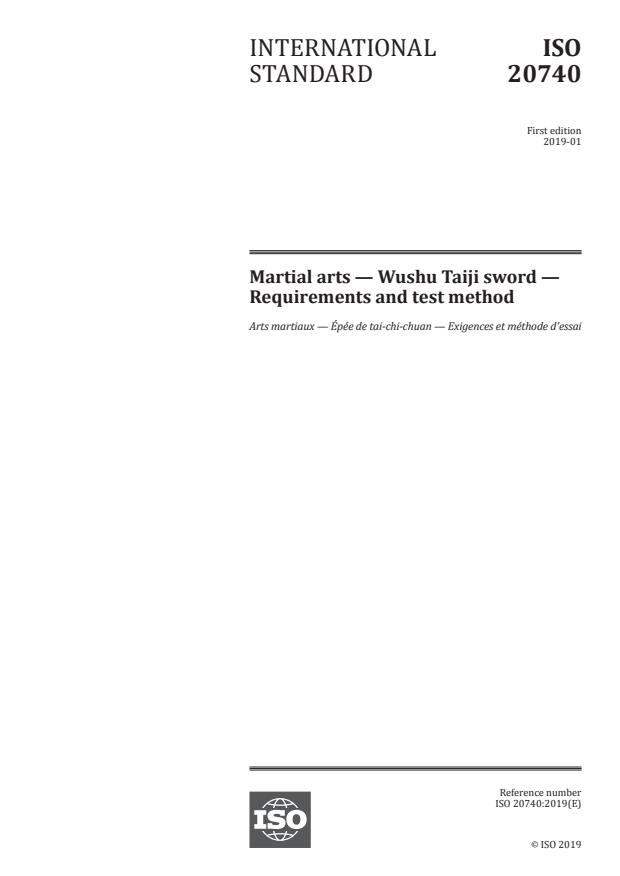
INTERNATIONAL ISO
STANDARD 20740
First edition
2019-01
Martial arts — Wushu Taiji sword —
Requirements and test method
Arts martiaux — Épée de tai-chi-chuan — Exigences et méthode d'essai
Reference number
©
ISO 2019
© ISO 2019
All rights reserved. Unless otherwise specified, or required in the context of its implementation, no part of this publication may
be reproduced or utilized otherwise in any form or by any means, electronic or mechanical, including photocopying, or posting
on the internet or an intranet, without prior written permission. Permission can be requested from either ISO at the address
below or ISO’s member body in the country of the requester.
ISO copyright office
CP 401 • Ch. de Blandonnet 8
CH-1214 Vernier, Geneva
Phone: +41 22 749 01 11
Fax: +41 22 749 09 47
Email: copyright@iso.org
Website: www.iso.org
Published in Switzerland
ii © ISO 2019 – All rights reserved
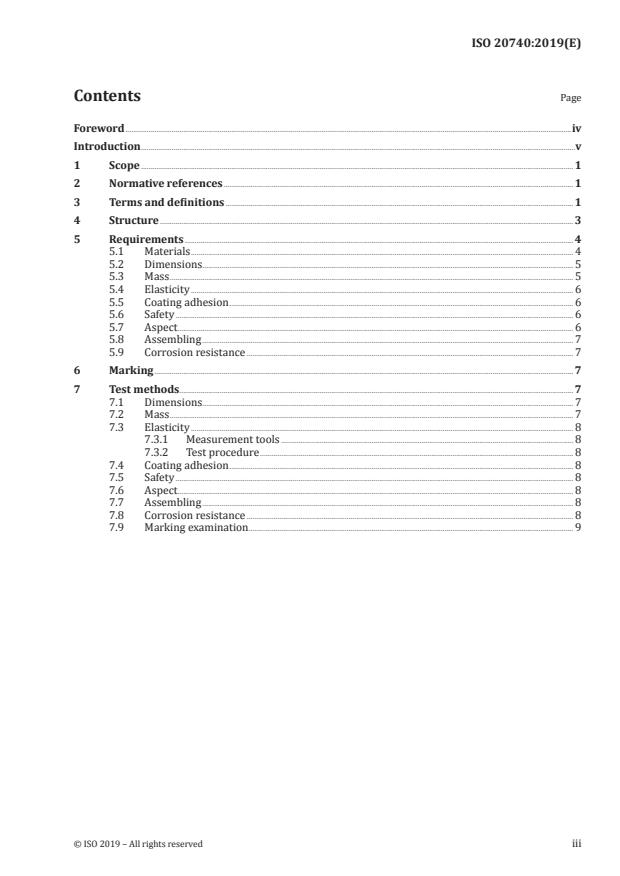
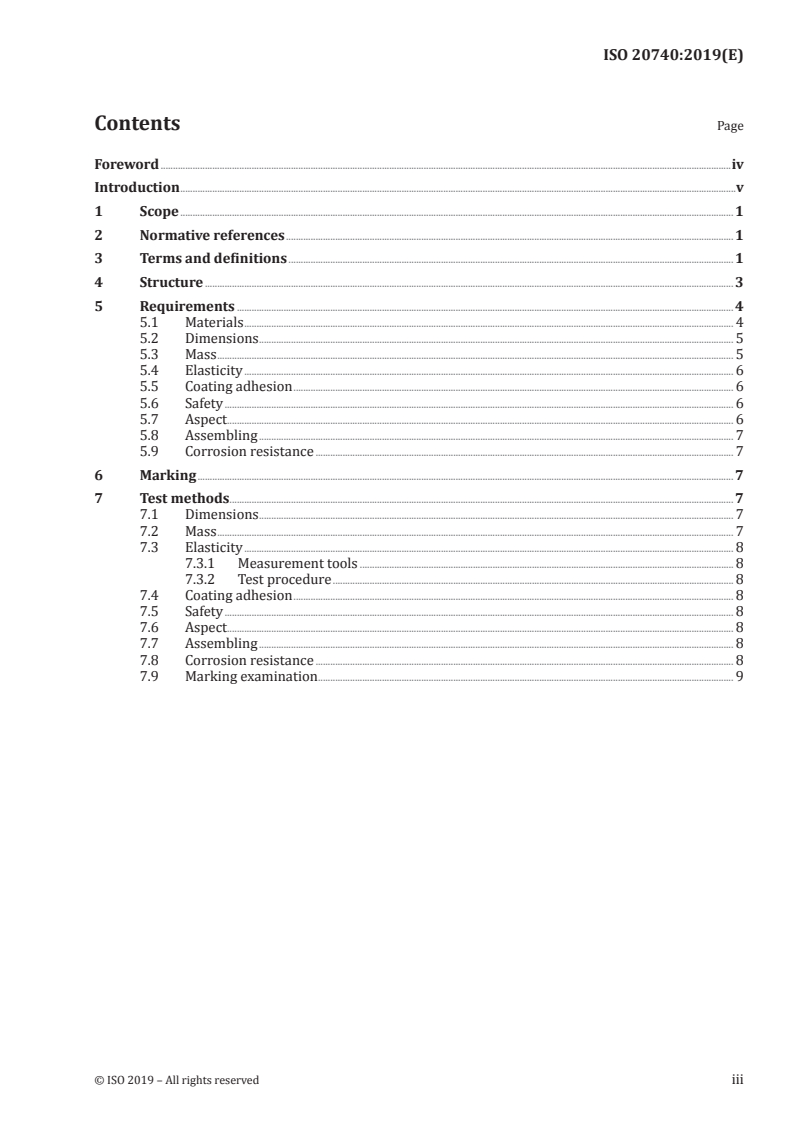
Contents Page
Foreword .iv
Introduction .v
1 Scope . 1
2 Normative references . 1
3 Terms and definitions . 1
4 Structure . 3
5 Requirements . 4
5.1 Materials . 4
5.2 Dimensions . 5
5.3 Mass . 5
5.4 Elasticity . 6
5.5 Coating adhesion . 6
5.6 Safety . 6
5.7 Aspect . . 6
5.8 Assembling . 7
5.9 Corrosion resistance . 7
6 Marking . 7
7 Test methods . 7
7.1 Dimensions . 7
7.2 Mass . 7
7.3 Elasticity . 8
7.3.1 Measurement tools . 8
7.3.2 Test procedure . 8
7.4 Coating adhesion . 8
7.5 Safety . 8
7.6 Aspect . . 8
7.7 Assembling . 8
7.8 Corrosion resistance . 8
7.9 Marking examination . 9
Foreword
ISO (the International Organization for Standardization) is a worldwide federation of national standards
bodies (ISO member bodies). The work of preparing International Standards is normally carried out
through ISO technical committees. Each member body interested in a subject for which a technical
committee has been established has the right to be represented on that committee. International
organizations, governmental and non-governmental, in liaison with ISO, also take part in the work.
ISO collaborates closely with the International Electrotechnical Commission (IEC) on all matters of
electrotechnical standardization.
The procedures used to develop this document and those intended for its further maintenance are
described in the ISO/IEC Directives, Part 1. In particular, the different approval criteria needed for the
different types of ISO documents should be noted. This document was drafted in accordance with the
editorial rules of the ISO/IEC Directives, Part 2 (see www .iso .org/directives).
Attention is drawn to the possibility that some of the elements of this document may be the subject of
patent rights. ISO shall not be held responsible for identifying any or all such patent rights. Details of
any patent rights identified during the development of the document will be in the Introduction and/or
on the ISO list of patent declarations received (see www .iso .org/patents).
Any trade name used in this document is information given for the convenience of users and does not
constitute an endorsement.
For an explanation of the voluntary nature of standards, the meaning of ISO specific terms and
expressions related to conformity assessment, as well as information about ISO's adherence to the
World Trade Organization (WTO) principles in the Technical Barriers to Trade (TBT) see www .iso
.org/iso/foreword .html.
This document was prepared by Technical Committee ISO/TC 83, Sports and other recreational facilities
and equipment, Subcommittee SC 6, Martial arts.
Any feedback or questions on this document should be directed to the user’s national standards body. A
complete listing of these bodies can be found at www .iso .org/members .html.
iv © ISO 2019 – All rights reserved
Introduction
Taiji sword (Taijijian) is an important component of Taiji sport and is one of the short weapons in Taiji.
The art of Taiji is a moderate form of exercise with slow and gentle movements, which are easy to learn,
helpful for people to maintain peaceful mind and good physical health.
With the increasing popularity of Taiji swords, which are used worldwide, a variety of products have
emerged, resulting in inco
...
INTERNATIONAL ISO
STANDARD 20740
First edition
2019-01
Martial arts — Wushu Taiji sword —
Requirements and test method
Arts martiaux — Épée de tai-chi-chuan — Exigences et méthode d'essai
Reference number
©
ISO 2019
© ISO 2019
All rights reserved. Unless otherwise specified, or required in the context of its implementation, no part of this publication may
be reproduced or utilized otherwise in any form or by any means, electronic or mechanical, including photocopying, or posting
on the internet or an intranet, without prior written permission. Permission can be requested from either ISO at the address
below or ISO’s member body in the country of the requester.
ISO copyright office
CP 401 • Ch. de Blandonnet 8
CH-1214 Vernier, Geneva
Phone: +41 22 749 01 11
Fax: +41 22 749 09 47
Email: copyright@iso.org
Website: www.iso.org
Published in Switzerland
ii © ISO 2019 – All rights reserved
Contents Page
Foreword .iv
Introduction .v
1 Scope . 1
2 Normative references . 1
3 Terms and definitions . 1
4 Structure . 3
5 Requirements . 4
5.1 Materials . 4
5.2 Dimensions . 5
5.3 Mass . 5
5.4 Elasticity . 6
5.5 Coating adhesion . 6
5.6 Safety . 6
5.7 Aspect . . 6
5.8 Assembling . 7
5.9 Corrosion resistance . 7
6 Marking . 7
7 Test methods . 7
7.1 Dimensions . 7
7.2 Mass . 7
7.3 Elasticity . 8
7.3.1 Measurement tools . 8
7.3.2 Test procedure . 8
7.4 Coating adhesion . 8
7.5 Safety . 8
7.6 Aspect . . 8
7.7 Assembling . 8
7.8 Corrosion resistance . 8
7.9 Marking examination . 9
Foreword
ISO (the International Organization for Standardization) is a worldwide federation of national standards
bodies (ISO member bodies). The work of preparing International Standards is normally carried out
through ISO technical committees. Each member body interested in a subject for which a technical
committee has been established has the right to be represented on that committee. International
organizations, governmental and non-governmental, in liaison with ISO, also take part in the work.
ISO collaborates closely with the International Electrotechnical Commission (IEC) on all matters of
electrotechnical standardization.
The procedures used to develop this document and those intended for its further maintenance are
described in the ISO/IEC Directives, Part 1. In particular, the different approval criteria needed for the
different types of ISO documents should be noted. This document was drafted in accordance with the
editorial rules of the ISO/IEC Directives, Part 2 (see www .iso .org/directives).
Attention is drawn to the possibility that some of the elements of this document may be the subject of
patent rights. ISO shall not be held responsible for identifying any or all such patent rights. Details of
any patent rights identified during the development of the document will be in the Introduction and/or
on the ISO list of patent declarations received (see www .iso .org/patents).
Any trade name used in this document is information given for the convenience of users and does not
constitute an endorsement.
For an explanation of the voluntary nature of standards, the meaning of ISO specific terms and
expressions related to conformity assessment, as well as information about ISO's adherence to the
World Trade Organization (WTO) principles in the Technical Barriers to Trade (TBT) see www .iso
.org/iso/foreword .html.
This document was prepared by Technical Committee ISO/TC 83, Sports and other recreational facilities
and equipment, Subcommittee SC 6, Martial arts.
Any feedback or questions on this document should be directed to the user’s national standards body. A
complete listing of these bodies can be found at www .iso .org/members .html.
iv © ISO 2019 – All rights reserved
Introduction
Taiji sword (Taijijian) is an important component of Taiji sport and is one of the short weapons in Taiji.
The art of Taiji is a moderate form of exercise with slow and gentle movements, which are easy to learn,
helpful for people to maintain peaceful mind and good physical health.
With the increasing popularity of Taiji swords, which are used worldwide, a variety of products have
emerged, resulting in inco
...
NORME ISO
INTERNATIONALE 20740
Première édition
2019-01
Arts martiaux — Épée de tai-chi-chuan
— Exigences et méthode d'essai
Martial arts — Wushu Taiji sword — Requirements and test method
Numéro de référence
©
ISO 2019
DOCUMENT PROTÉGÉ PAR COPYRIGHT
© ISO 2019
Tous droits réservés. Sauf prescription différente ou nécessité dans le contexte de sa mise en œuvre, aucune partie de cette
publication ne peut être reproduite ni utilisée sous quelque forme que ce soit et par aucun procédé, électronique ou mécanique,
y compris la photocopie, ou la diffusion sur l’internet ou sur un intranet, sans autorisation écrite préalable. Une autorisation peut
être demandée à l’ISO à l’adresse ci-après ou au comité membre de l’ISO dans le pays du demandeur.
ISO copyright office
Case postale 401 • Ch. de Blandonnet 8
CH-1214 Vernier, Genève
Tél.: +41 22 749 01 11
Fax: +41 22 749 09 47
E-mail: copyright@iso.org
Web: www.iso.org
Publié en Suisse
ii © ISO 2019 – Tous droits réservés
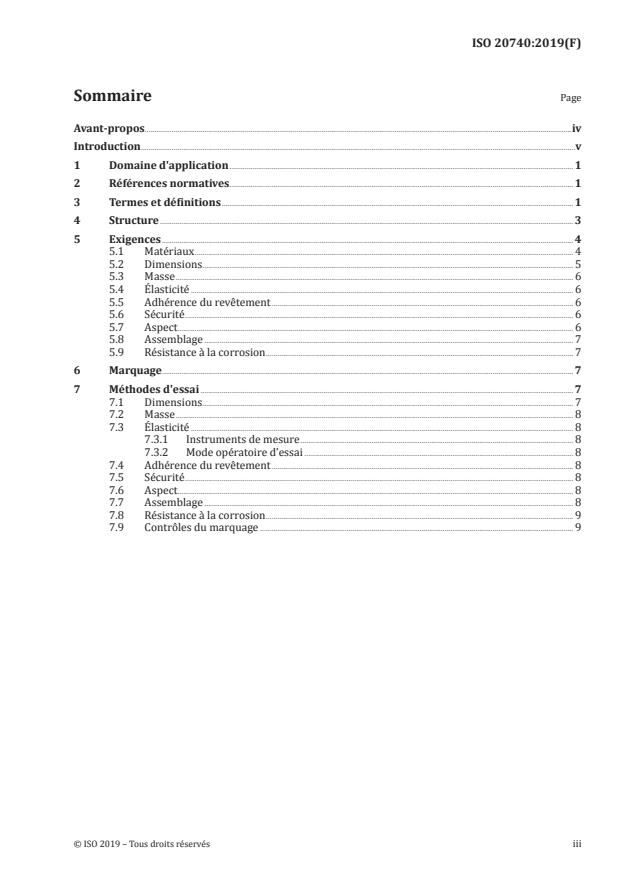
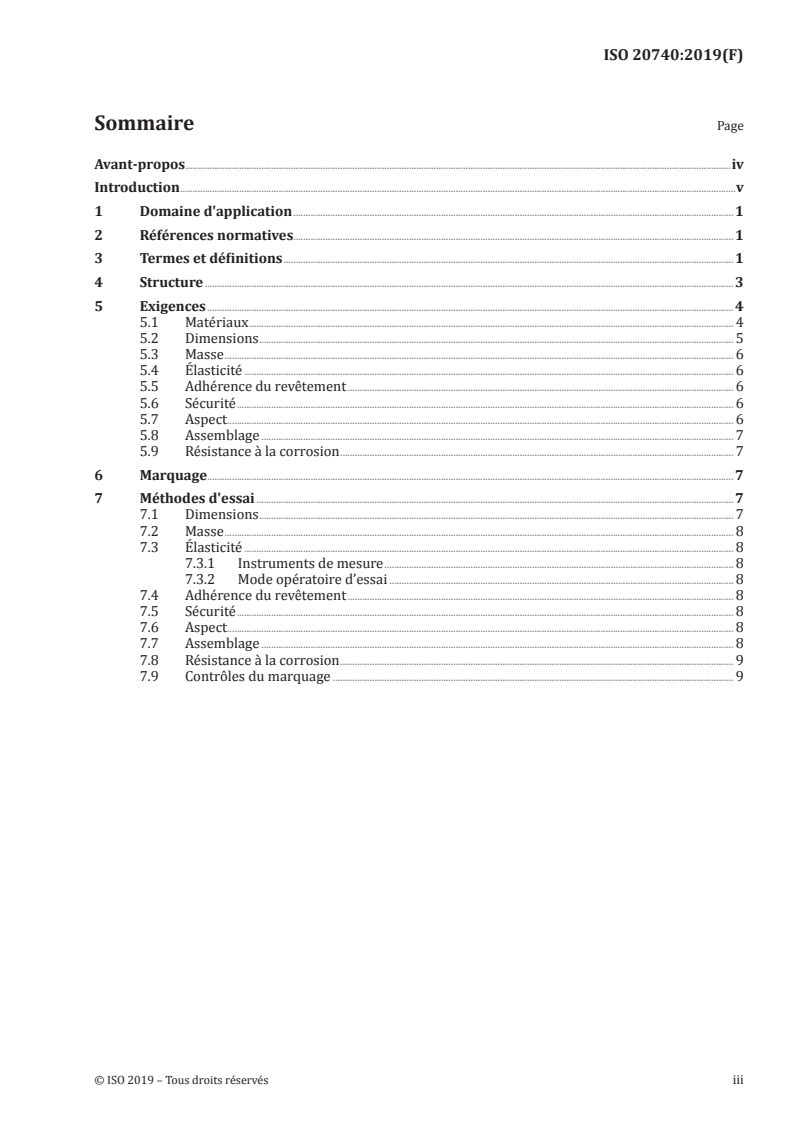
Sommaire Page
Avant-propos .iv
Introduction .v
1 Domaine d'application . 1
2 Références normatives . 1
3 Termes et définitions . 1
4 Structure . 3
5 Exigences . 4
5.1 Matériaux . 4
5.2 Dimensions . 5
5.3 Masse . 6
5.4 Élasticité . 6
5.5 Adhérence du revêtement . 6
5.6 Sécurité . 6
5.7 Aspect . . 6
5.8 Assemblage . 7
5.9 Résistance à la corrosion . 7
6 Marquage . 7
7 Méthodes d'essai . 7
7.1 Dimensions . 7
7.2 Masse . 8
7.3 Élasticité . 8
7.3.1 Instruments de mesure . 8
7.3.2 Mode opératoire d’essai . 8
7.4 Adhérence du revêtement . 8
7.5 Sécurité . 8
7.6 Aspect . . 8
7.7 Assemblage . 8
7.8 Résistance à la corrosion . 9
7.9 Contrôles du marquage . 9
Avant-propos
L'ISO (Organisation internationale de normalisation) est une fédération mondiale d'organismes
nationaux de normalisation (comités membres de l'ISO). L'élaboration des Normes internationales est
en général confiée aux comités techniques de l'ISO. Chaque comité membre intéressé par une étude
a le droit de faire partie du comité technique créé à cet effet. Les organisations internationales,
gouvernementales et non gouvernementales, en liaison avec l'ISO participent également aux travaux.
L'ISO collabore étroitement avec la Commission électrotechnique internationale (IEC) en ce qui
concerne la normalisation électrotechnique.
Les procédures utilisées pour élaborer le présent document et celles destinées à sa mise à jour sont
décrites dans les Directives ISO/IEC, Partie 1. Il convient, en particulier de prendre note des différents
critères d'approbation requis pour les différents types de documents ISO. Le présent document a été
rédigé conformément aux règles de rédaction données dans les Directives ISO/IEC, Partie 2 (voir www
.iso .org/directives).
L'attention est appelée sur le fait que certains des éléments du présent document peuvent faire l'objet de
droits de propriété intellectuelle ou de droits analogues. L'ISO ne saurait être tenue pour responsable
de ne pas avoir identifié de tels droits de propriété et averti de leur existence. Les détails concernant
les références aux droits de propriété intellectuelle ou autres droits analogues identifiés lors de
l'élaboration du document sont indiqués dans l'Introduction et/ou dans la liste des déclarations de
brevets reçues par l’ISO (voir www .iso .org/brevets).
Les appellations commerciales éventuellement mentionnées dans le présent document sont données
pour information, par souci de commodité à l'intention des utilisateurs et ne sauraient constituer un
engagement.
Pour une explication de la nature volontaire des normes, la signification des termes et expressions
spécifiques de l'ISO liés à l'évaluation de la conformité, ou pour toute information au sujet de l'adhésion
de l'ISO aux principes de l’Organisation mondiale du commerce (OMC) concernant les obstacles
techniques au commerce (OTC), voir le lien suivant: www .iso .org/iso/fr/avant -propos .html.
Le présent document a été élaboré par le comité technique ISO/TC 83, Matériel et équipements de sports
et autres activités de loisirs, sous–comité SC 6, Arts martiaux.
Il convient que l’utilisateur adresse tout retour d’information ou toute question concernant le présent
document à l’organisme national de normalisation de son pays. Une liste exhaustive desdits organismes
se trouve à l’adresse www .iso .org/fr/members .html.
iv © ISO 2019 – Tous droits réservés
Introduction
L'épée de tai-chi-chuan est une arme courte qui constitue un élément important de la pratique du tai-
chi-chuan.
Le tai-chi-chuan est une forme modérée d'exercice, avec des mouvements lents et doux, faciles à
apprendre, qui aide à maintenir un esprit paisible et une bonne santé physique.
Avec la popularité grandissante des épées de tai-chi-chuan, qui sont utilisées dans le monde entier,
tout un éventail de produits est apparu, avec pour conséquence le développement de spécifications de
produits incohérentes et une qualité inégale.
Il n'existe à l'heure actuelle aucune norme unifiée sur le tai-chi-chuan à l'échelle mondiale. Le présent
document vise donc à soutenir la promotion de cette discipline et le développement des activités
commerciales entre divers pays et régions, en vue de préserver la sécurité et les intérêts des
consommateurs et de fournir une plateforme internationale pour les entreprises dans les secteurs de la
production et de la commercialisation.
...
NORME ISO
INTERNATIONALE 20740
Première édition
2019-01
Arts martiaux — Épée de tai-chi-chuan
— Exigences et méthode d'essai
Martial arts — Wushu Taiji sword — Requirements and test method
Numéro de référence
©
ISO 2019
DOCUMENT PROTÉGÉ PAR COPYRIGHT
© ISO 2019
Tous droits réservés. Sauf prescription différente ou nécessité dans le contexte de sa mise en œuvre, aucune partie de cette
publication ne peut être reproduite ni utilisée sous quelque forme que ce soit et par aucun procédé, électronique ou mécanique,
y compris la photocopie, ou la diffusion sur l’internet ou sur un intranet, sans autorisation écrite préalable. Une autorisation peut
être demandée à l’ISO à l’adresse ci-après ou au comité membre de l’ISO dans le pays du demandeur.
ISO copyright office
Case postale 401 • Ch. de Blandonnet 8
CH-1214 Vernier, Genève
Tél.: +41 22 749 01 11
Fax: +41 22 749 09 47
E-mail: copyright@iso.org
Web: www.iso.org
Publié en Suisse
ii © ISO 2019 – Tous droits réservés
Sommaire Page
Avant-propos .iv
Introduction .v
1 Domaine d'application . 1
2 Références normatives . 1
3 Termes et définitions . 1
4 Structure . 3
5 Exigences . 4
5.1 Matériaux . 4
5.2 Dimensions . 5
5.3 Masse . 6
5.4 Élasticité . 6
5.5 Adhérence du revêtement . 6
5.6 Sécurité . 6
5.7 Aspect . . 6
5.8 Assemblage . 7
5.9 Résistance à la corrosion . 7
6 Marquage . 7
7 Méthodes d'essai . 7
7.1 Dimensions . 7
7.2 Masse . 8
7.3 Élasticité . 8
7.3.1 Instruments de mesure . 8
7.3.2 Mode opératoire d’essai . 8
7.4 Adhérence du revêtement . 8
7.5 Sécurité . 8
7.6 Aspect . . 8
7.7 Assemblage . 8
7.8 Résistance à la corrosion . 9
7.9 Contrôles du marquage . 9
Avant-propos
L'ISO (Organisation internationale de normalisation) est une fédération mondiale d'organismes
nationaux de normalisation (comités membres de l'ISO). L'élaboration des Normes internationales est
en général confiée aux comités techniques de l'ISO. Chaque comité membre intéressé par une étude
a le droit de faire partie du comité technique créé à cet effet. Les organisations internationales,
gouvernementales et non gouvernementales, en liaison avec l'ISO participent également aux travaux.
L'ISO collabore étroitement avec la Commission électrotechnique internationale (IEC) en ce qui
concerne la normalisation électrotechnique.
Les procédures utilisées pour élaborer le présent document et celles destinées à sa mise à jour sont
décrites dans les Directives ISO/IEC, Partie 1. Il convient, en particulier de prendre note des différents
critères d'approbation requis pour les différents types de documents ISO. Le présent document a été
rédigé conformément aux règles de rédaction données dans les Directives ISO/IEC, Partie 2 (voir www
.iso .org/directives).
L'attention est appelée sur le fait que certains des éléments du présent document peuvent faire l'objet de
droits de propriété intellectuelle ou de droits analogues. L'ISO ne saurait être tenue pour responsable
de ne pas avoir identifié de tels droits de propriété et averti de leur existence. Les détails concernant
les références aux droits de propriété intellectuelle ou autres droits analogues identifiés lors de
l'élaboration du document sont indiqués dans l'Introduction et/ou dans la liste des déclarations de
brevets reçues par l’ISO (voir www .iso .org/brevets).
Les appellations commerciales éventuellement mentionnées dans le présent document sont données
pour information, par souci de commodité à l'intention des utilisateurs et ne sauraient constituer un
engagement.
Pour une explication de la nature volontaire des normes, la signification des termes et expressions
spécifiques de l'ISO liés à l'évaluation de la conformité, ou pour toute information au sujet de l'adhésion
de l'ISO aux principes de l’Organisation mondiale du commerce (OMC) concernant les obstacles
techniques au commerce (OTC), voir le lien suivant: www .iso .org/iso/fr/avant -propos .html.
Le présent document a été élaboré par le comité technique ISO/TC 83, Matériel et équipements de sports
et autres activités de loisirs, sous–comité SC 6, Arts martiaux.
Il convient que l’utilisateur adresse tout retour d’information ou toute question concernant le présent
document à l’organisme national de normalisation de son pays. Une liste exhaustive desdits organismes
se trouve à l’adresse www .iso .org/fr/members .html.
iv © ISO 2019 – Tous droits réservés
Introduction
L'épée de tai-chi-chuan est une arme courte qui constitue un élément important de la pratique du tai-
chi-chuan.
Le tai-chi-chuan est une forme modérée d'exercice, avec des mouvements lents et doux, faciles à
apprendre, qui aide à maintenir un esprit paisible et une bonne santé physique.
Avec la popularité grandissante des épées de tai-chi-chuan, qui sont utilisées dans le monde entier,
tout un éventail de produits est apparu, avec pour conséquence le développement de spécifications de
produits incohérentes et une qualité inégale.
Il n'existe à l'heure actuelle aucune norme unifiée sur le tai-chi-chuan à l'échelle mondiale. Le présent
document vise donc à soutenir la promotion de cette discipline et le développement des activités
commerciales entre divers pays et régions, en vue de préserver la sécurité et les intérêts des
consommateurs et de fournir une plateforme internationale pour les entreprises dans les secteurs de la
production et de la commercialisation.
...