

ISO 2227:1972
(Main)Formaldehyde solutions for industrial use — Determination of formaldehyde content
General Information
- Abstract
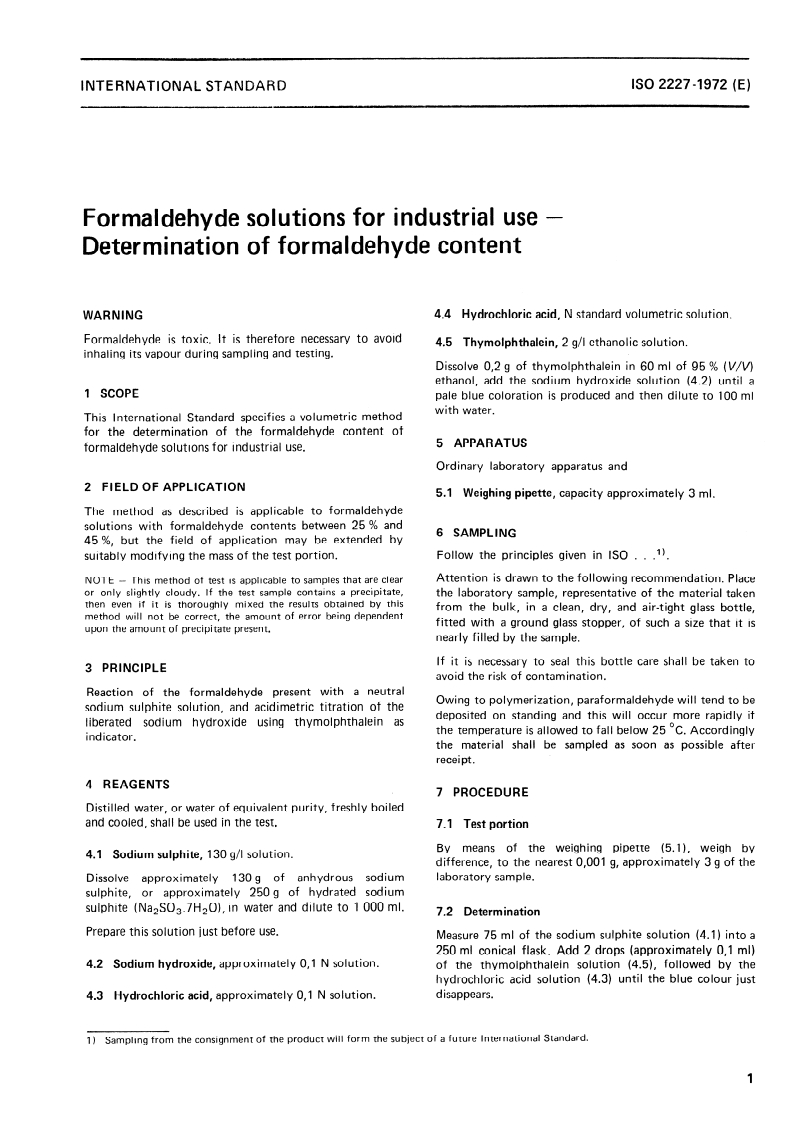
The specified method is applicable to HCHO contents between 25 5 and 45 %. The field of application may be extended by siutably modifying the mass of the test portion. The principle consists in the reaction of the test solution with a neutral sodium sulphite solution, and acidimetric titration of the liberated sodium hydroxide in presence of thymolphthalein as indicator.
- Status
- Published
- Publication Date
- 30-Nov-1972
- Technical Committee
- ISO/TC 47 - Chemistry
- Drafting Committee
- ISO/TC 47 - Chemistry
- Current Stage
- 9093 - International Standard confirmed
- Start Date
- 20-Oct-2023
- Completion Date
- 29-Aug-2026
Buy Documents
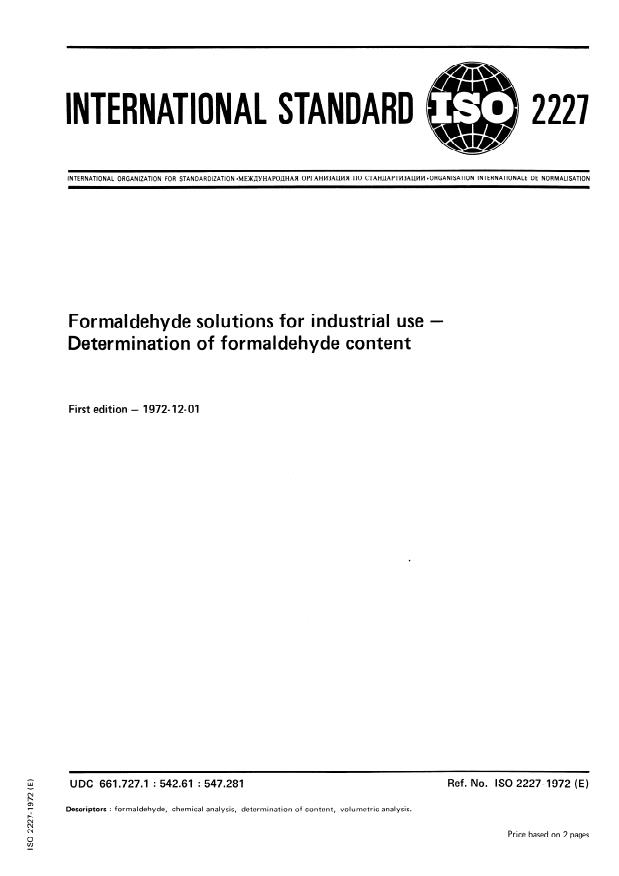
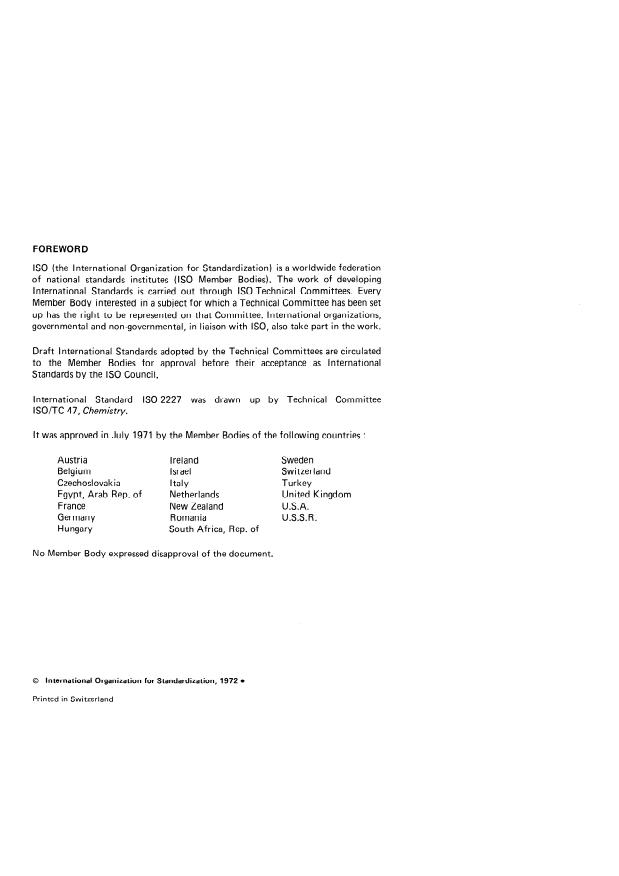
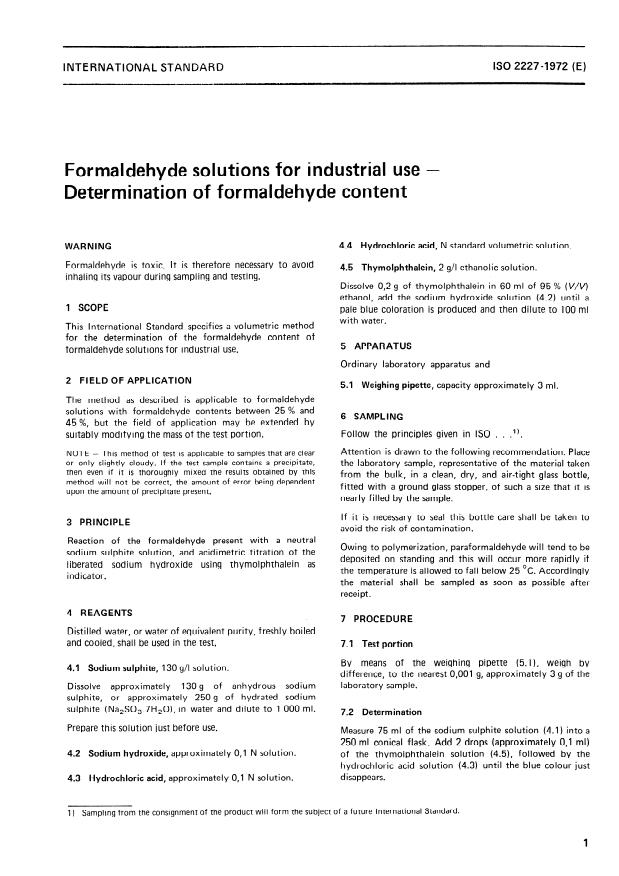

ISO 2227:1972 - Formaldehyde solutions for industrial use -- Determination of formaldehyde content
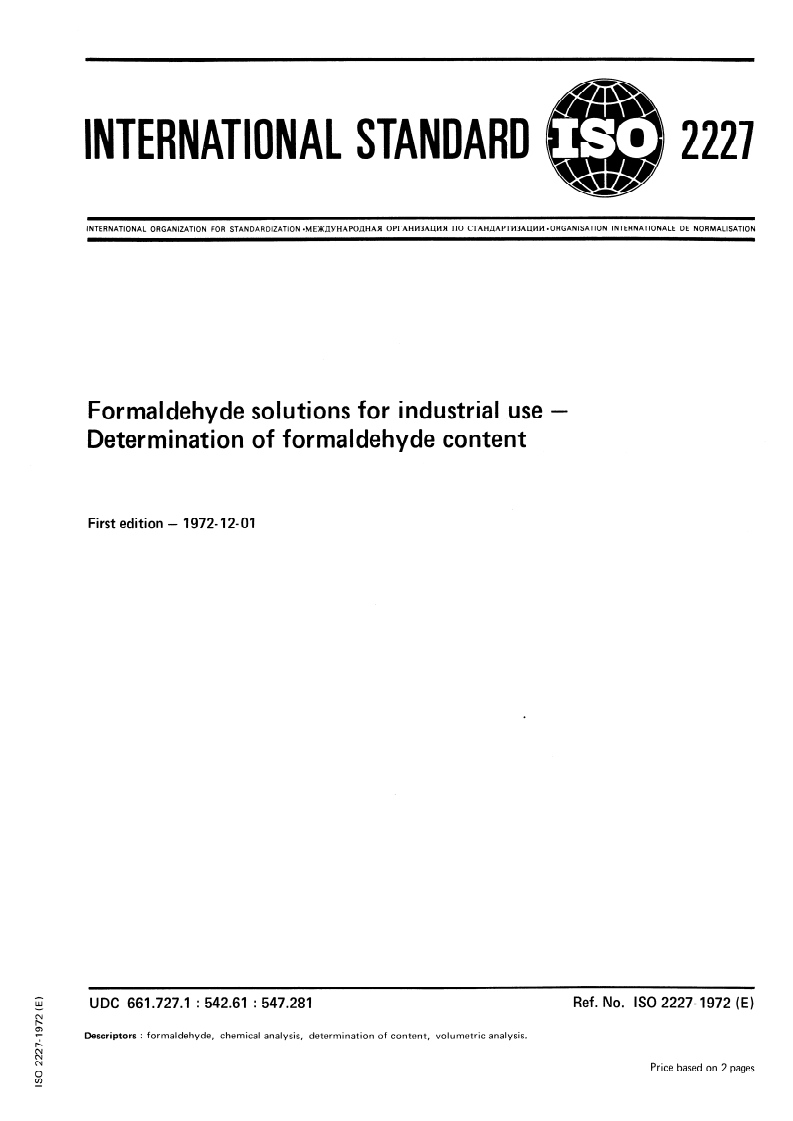
ISO 2227:1972 - Formaldehyde solutions for industrial use — Determination of formaldehyde content/1/1972

ISO 2227:1972 - Solutions de formaldéhyde a usage industriel -- Dosage du formaldéhyde
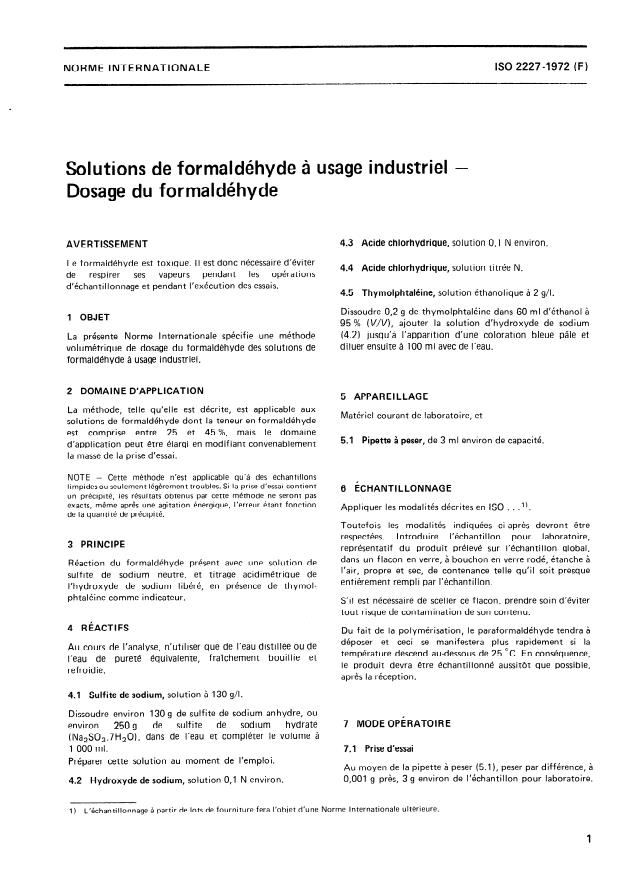

ISO 2227:1972 - Solutions de formaldéhyde a usage industriel -- Dosage du formaldéhyde
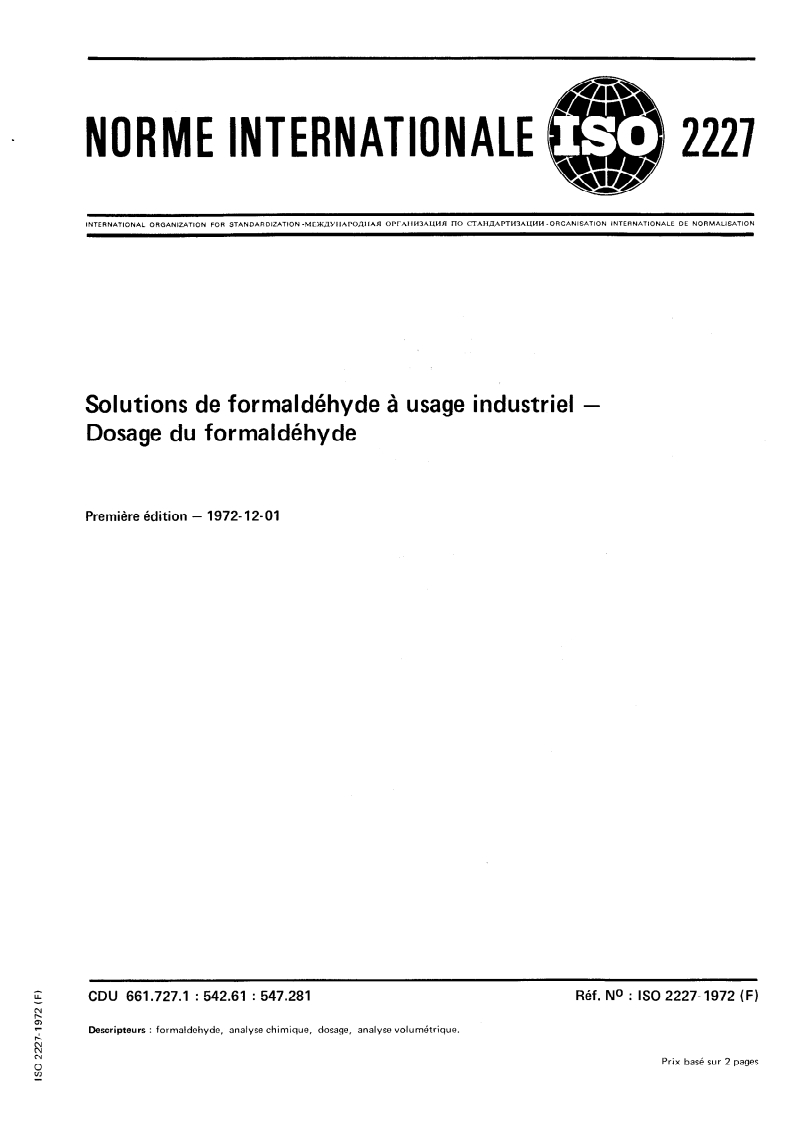
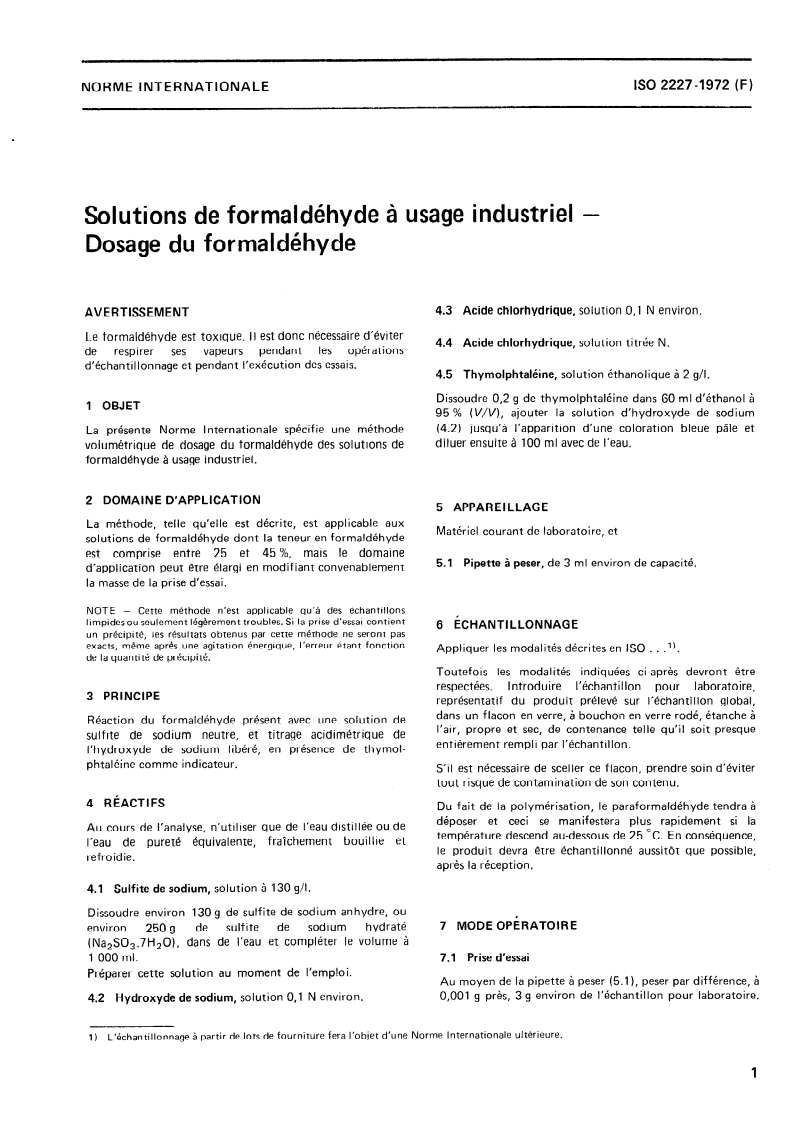
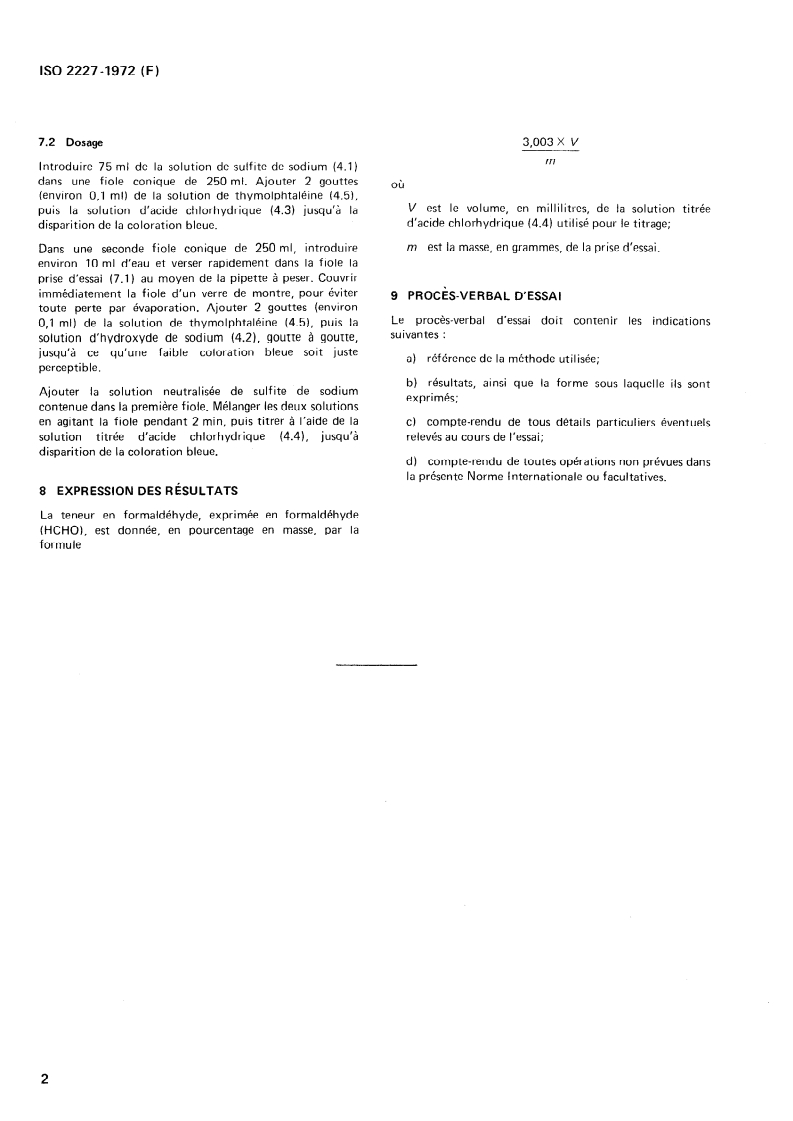
ISO 2227:1972 - Solutions de formaldéhyde à usage industriel — Dosage du formaldéhyde/1/1972
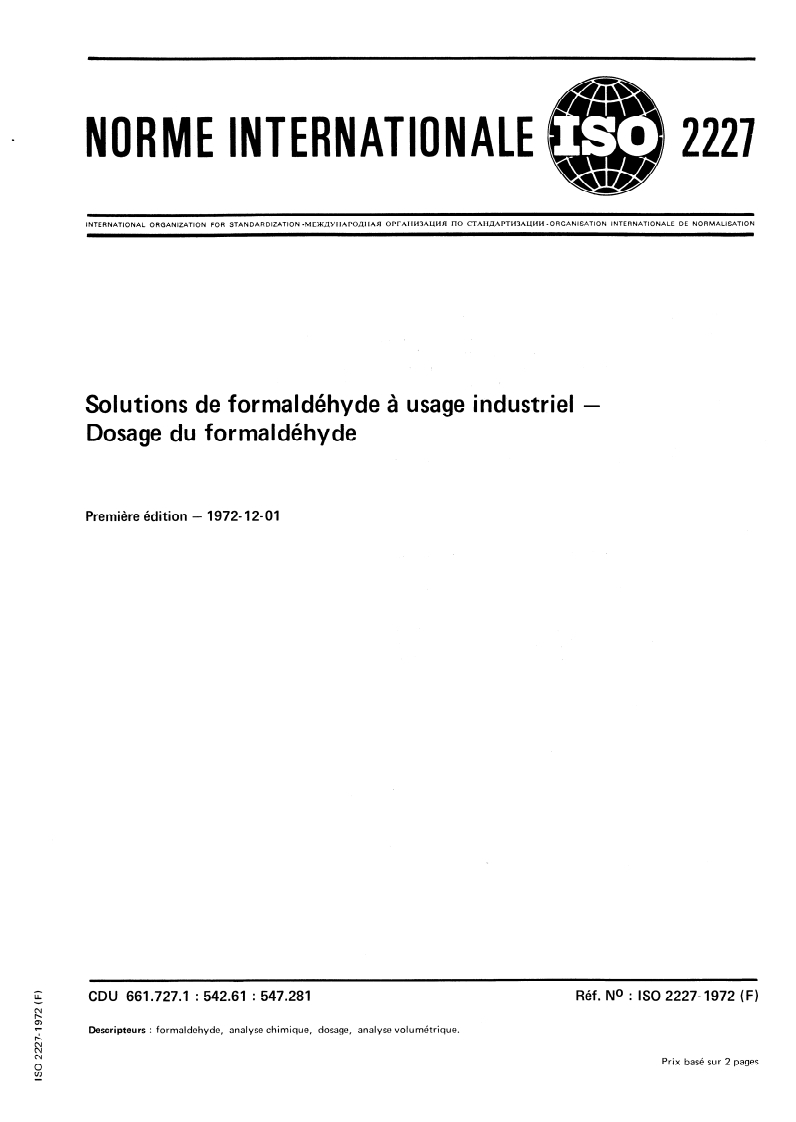
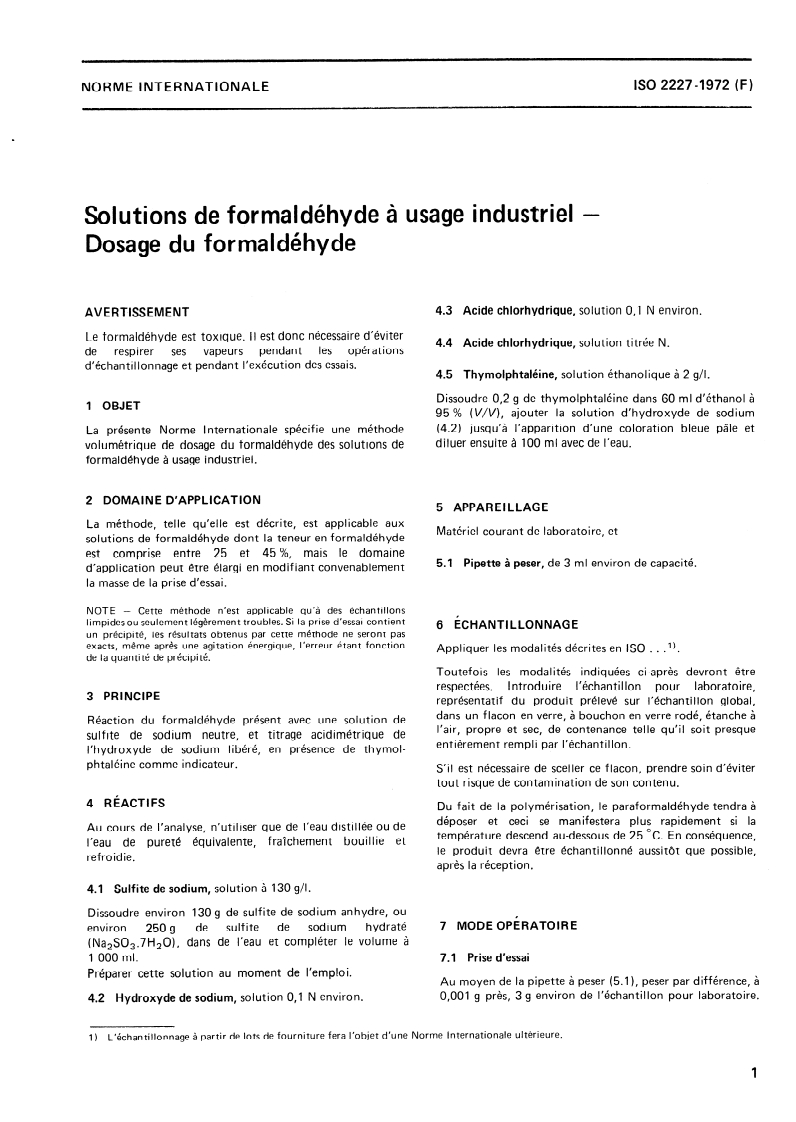
ISO 2227:1972 - Solutions de formaldéhyde à usage industriel — Dosage du formaldéhyde/1/1972
Overview
ISO 2227:1972 specifies a volumetric method for determining the formaldehyde (HCHO) content of industrial formaldehyde solutions. The procedure is applicable to solutions with 25–45% HCHO (field of application extendable by adjusting the test portion). The method is based on reaction of formaldehyde with a neutral sodium sulphite (sulfite) solution and an acidimetric titration of the liberated sodium hydroxide using thymolphthalein as the indicator. The standard also includes sampling, reagent and apparatus recommendations and safety warnings (formaldehyde is toxic; avoid inhalation).
Key topics and requirements
- Scope & applicability: Designed for industrial formaldehyde solutions between approximately 25% and 45% HCHO; extendable by modifying test portion mass.
- Principle: Formaldehyde reacts with neutral sodium sulphite; the liberated NaOH is titrated acidimetrically to an endpoint indicated by thymolphthalein.
- Reagents:
- Sodium sulphite solution (≈130 g/L) - prepared immediately before use.
- Sodium hydroxide, approximately 0.1 N.
- Hydrochloric acid standard volumetric solution, approximately 0.1 N.
- Thymolphthalein ethanolic indicator (2 g/L preparation).
- Apparatus: Ordinary laboratory glassware; a weighing pipette (~3 mL) for precise test portions.
- Procedure highlights:
- Weigh a small test portion (approx. 3 g) into water, neutralize and mix with reagents as specified.
- Combine test portion with neutralized sodium sulphite and titrate with standard HCl to the thymolphthalein endpoint.
- Mix and allow reactions to proceed for the prescribed time before titration.
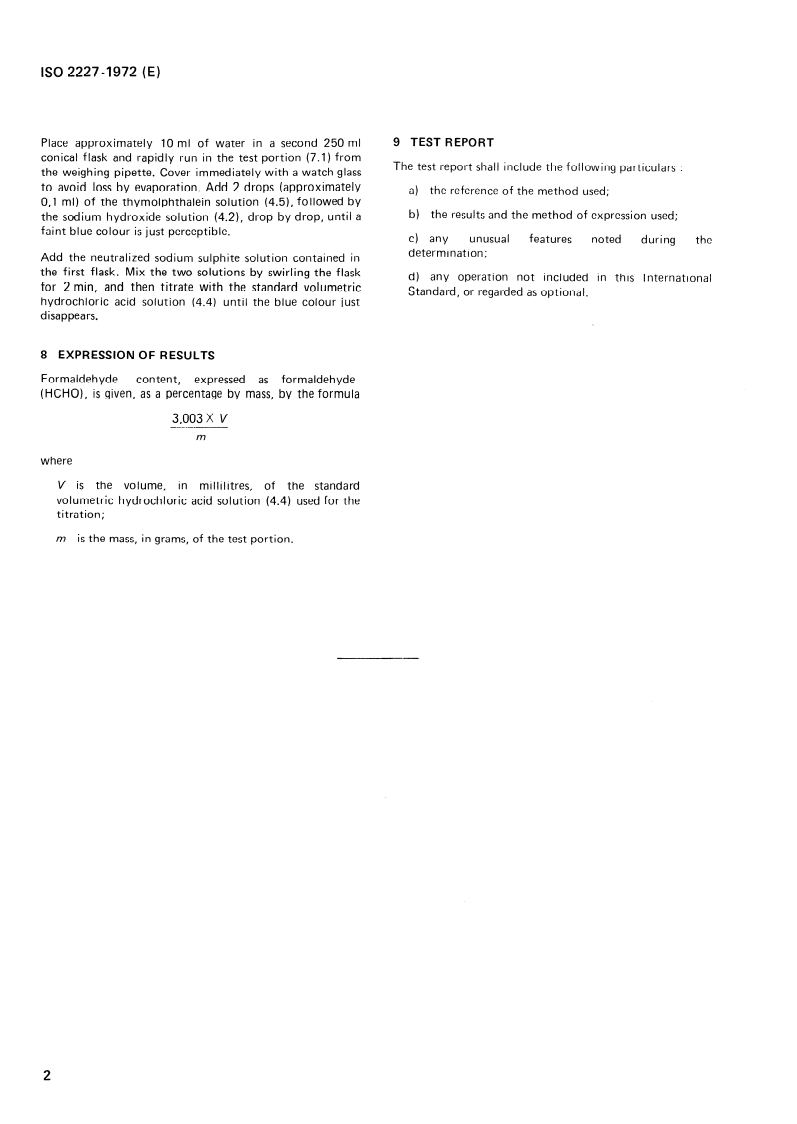
- Expression of results: Formaldehyde content is calculated from the volume of HCl used and the mass of the test portion (expressed as percentage by mass).
- Sampling and sample condition: Method is valid for clear or slightly cloudy samples only; presence of precipitate (e.g., paraformaldehyde) invalidates results. Samples should be taken and tested promptly to avoid polymerization.
Applications and users
- Quality control laboratories in chemical manufacturing (formalin and formaldehyde producers).
- Industrial users relying on accurate HCHO concentration: resins, adhesives, textiles, disinfectants, and intermediate chemical producers.
- Regulatory and testing laboratories performing compliance checks and product certification.
- Suppliers and purchasers verifying batch concentration for process control and safety data.
Related standards
- ISO 2227 should be used alongside ISO guidance on sampling procedures and other ISO/ national standards covering formaldehyde testing, workplace exposure, and emissions. For precise sampling protocols, consult the appropriate ISO sampling standards and local regulatory guidance.
Keywords: ISO 2227:1972, formaldehyde determination, formaldehyde solutions, volumetric method, sodium sulphite titration, thymolphthalein indicator, industrial formaldehyde, quality control.
Buy Documents
ISO 2227:1972 - Formaldehyde solutions for industrial use -- Determination of formaldehyde content
ISO 2227:1972 - Formaldehyde solutions for industrial use — Determination of formaldehyde content/1/1972
ISO 2227:1972 - Solutions de formaldéhyde a usage industriel -- Dosage du formaldéhyde
ISO 2227:1972 - Solutions de formaldéhyde a usage industriel -- Dosage du formaldéhyde
ISO 2227:1972 - Solutions de formaldéhyde à usage industriel — Dosage du formaldéhyde/1/1972
ISO 2227:1972 - Solutions de formaldéhyde à usage industriel — Dosage du formaldéhyde/1/1972
Get Certified
Connect with accredited certification bodies for this standard

ECOCERT
Organic and sustainability certification.

Eurofins Food Testing Global
Global leader in food, environment, and pharmaceutical product testing.

Intertek Bangladesh
Intertek certification and testing services in Bangladesh.
Sponsored listings
Frequently Asked Questions
ISO 2227:1972 is a standard published by the International Organization for Standardization (ISO). Its full title is "Formaldehyde solutions for industrial use — Determination of formaldehyde content". This standard covers: The specified method is applicable to HCHO contents between 25 5 and 45 %. The field of application may be extended by siutably modifying the mass of the test portion. The principle consists in the reaction of the test solution with a neutral sodium sulphite solution, and acidimetric titration of the liberated sodium hydroxide in presence of thymolphthalein as indicator.
The specified method is applicable to HCHO contents between 25 5 and 45 %. The field of application may be extended by siutably modifying the mass of the test portion. The principle consists in the reaction of the test solution with a neutral sodium sulphite solution, and acidimetric titration of the liberated sodium hydroxide in presence of thymolphthalein as indicator.
ISO 2227:1972 is classified under the following ICS (International Classification for Standards) categories: 71.080.80 - Aldehydes and ketones. The ICS classification helps identify the subject area and facilitates finding related standards.
ISO 2227:1972 is available in PDF format for immediate download after purchase. The document can be added to your cart and obtained through the secure checkout process. Digital delivery ensures instant access to the complete standard document.
Standards Content (Sample)
INTERNATIONAL STANDARD
INTERNATIONAL ORGANIZATION FOR STANDARDIZATION l MEXAYHAPOAHAJl OPI-AHM3ALWI I-IO CTAHAAPTM3ALWiM .ORGANISATION INTERNATIONALE DE NORMALISATION
Formaldehyde solutions for industrial use -
Determination of formaldehyde content
First edition - 1972- 12-01
UDC 661.727.1 : 542.61 : 547.281 Ref. No. IS0 2227-1972 (E)
formaldehyde, chemical analysis, determination of content, volumetric analysis.
Descriptors :
Price based on 2 pages
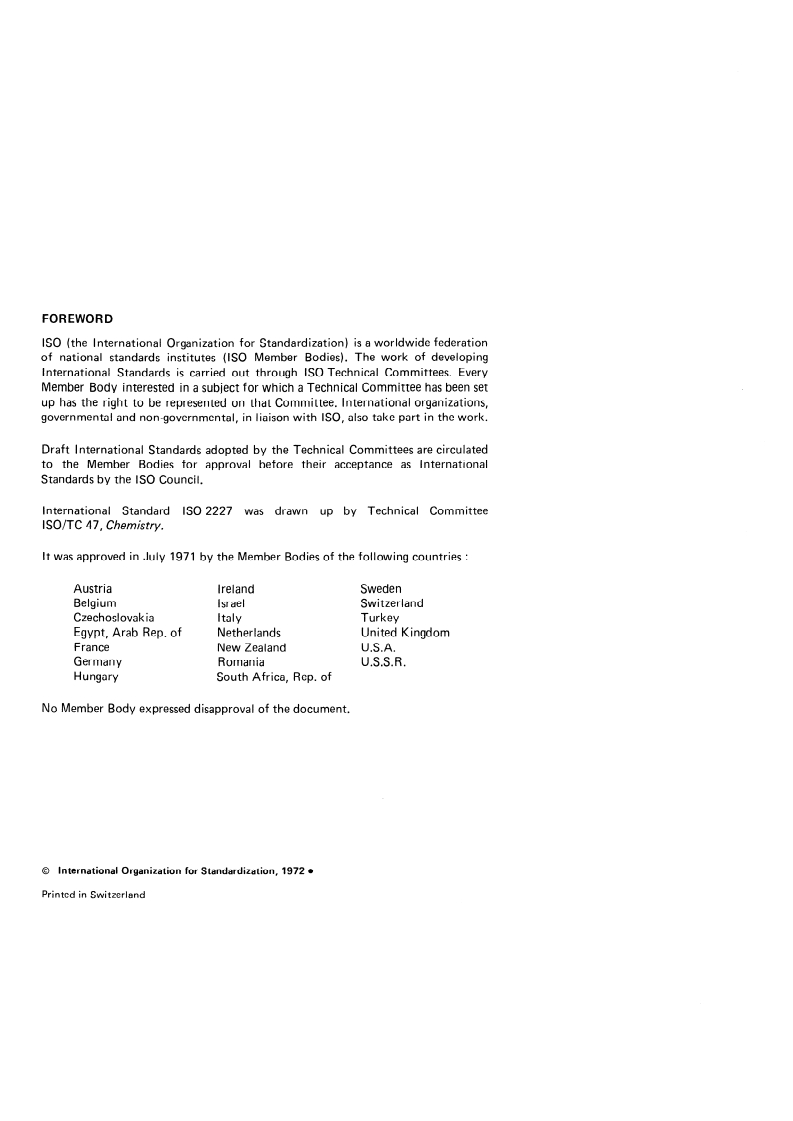
FOREWORD
IS0 (the International Organization for Standardization) is a worldwide federation
of national standards institutes (IS0 Member Bodies). The work of developing
International Standards is carried out through IS0 Technical Committees. Every
Member Body interested in a subject for which a Technical Committee has been set
up has the right to be represented on that Committee. International organizations,
governmental and non-governmental, in liaison with ISO, also take part in the work.
Draft International Standards adopted by the Technical Committees are circulated
to the Member Bodies for approval before their acceptance as International
Standards by the IS0 Council.
International Standard IS0 2227 was drawn up by Technical Committee
ISO/TC 47, Chemistry.
It was approved in July 1971 by the Member Bodies of the following countries :
Austria Ireland Sweden
Belgium Switzerland
Israel
Czechoslovakia Italy Turkey
Egypt, Arab Rep. of Netherlands United Kingdom
France
New Zealand U.S.A.
Germany
Romania U.S.S.R.
Hungary
South Africa, Rep. of
No Member Body expressed disapproval of the document.
0 International Organization for Standardization, 1972 l
Printed in Switzerland
IS0 2227-1972 (E)
INTERNATIONAL STANDARD
Formaldehyde solutions for industrial use -
Determination of formaldehyde content
4.4 Hydrochloric acid, N standard volumetric solution.
WARNING
Formaldehyde is toxic. It is therefore necessary to avoid
4.5 Thymolphthalein, 2 g/l ethanolic solution.
inhaling its vapour during sampling and testing.
Dissolve 0,2 g of thymolphthalein in 60 ml of 95 % (V/V)
ethanol, add the sodium hydroxide solution (4.2) until a
1 SCOPE
pale blue coloration is produced and then dilute to 100 ml
with water.
This International Standard specifies a volumetric method
for the determination of the formaldehyde content of
5 APPARATUS
formaldehyde solutions for industrial use.
Ordinary laboratory apparatus and
2 FIELD OF APPLICATION
5.1 Weighing pipette, capacity approximately 3 ml.
The method as described is applicable to formaldehyde
solutions with formaldehyde contents between 25 % and
6 SAMPLING
45 %, but the field of application may be extended by
Follow the principles given in IS0 . . .I).
suitably modifying the mass of the test portion.
Attention is drawn to the following recommendation. Place
NOTE - This method of test is applicable to samples that are clear
or only slightly cloudy. If the test sample contains a precipitate,
the laboratory sample, representative of the material taken
then even if it is thoroughly mixed the results obtained by this
fr
...
INTERNATIONAL STANDARD
INTERNATIONAL ORGANIZATION FOR STANDARDIZATION l MEXAYHAPOAHAJl OPI-AHM3ALWI I-IO CTAHAAPTM3ALWiM .ORGANISATION INTERNATIONALE DE NORMALISATION
Formaldehyde solutions for industrial use -
Determination of formaldehyde content
First edition - 1972- 12-01
UDC 661.727.1 : 542.61 : 547.281 Ref. No. IS0 2227-1972 (E)
formaldehyde, chemical analysis, determination of content, volumetric analysis.
Descriptors :
Price based on 2 pages
FOREWORD
IS0 (the International Organization for Standardization) is a worldwide federation
of national standards institutes (IS0 Member Bodies). The work of developing
International Standards is carried out through IS0 Technical Committees. Every
Member Body interested in a subject for which a Technical Committee has been set
up has the right to be represented on that Committee. International organizations,
governmental and non-governmental, in liaison with ISO, also take part in the work.
Draft International Standards adopted by the Technical Committees are circulated
to the Member Bodies for approval before their acceptance as International
Standards by the IS0 Council.
International Standard IS0 2227 was drawn up by Technical Committee
ISO/TC 47, Chemistry.
It was approved in July 1971 by the Member Bodies of the following countries :
Austria Ireland Sweden
Belgium Switzerland
Israel
Czechoslovakia Italy Turkey
Egypt, Arab Rep. of Netherlands United Kingdom
France
New Zealand U.S.A.
Germany
Romania U.S.S.R.
Hungary
South Africa, Rep. of
No Member Body expressed disapproval of the document.
0 International Organization for Standardization, 1972 l
Printed in Switzerland
IS0 2227-1972 (E)
INTERNATIONAL STANDARD
Formaldehyde solutions for industrial use -
Determination of formaldehyde content
4.4 Hydrochloric acid, N standard volumetric solution.
WARNING
Formaldehyde is toxic. It is therefore necessary to avoid
4.5 Thymolphthalein, 2 g/l ethanolic solution.
inhaling its vapour during sampling and testing.
Dissolve 0,2 g of thymolphthalein in 60 ml of 95 % (V/V)
ethanol, add the sodium hydroxide solution (4.2) until a
1 SCOPE
pale blue coloration is produced and then dilute to 100 ml
with water.
This International Standard specifies a volumetric method
for the determination of the formaldehyde content of
5 APPARATUS
formaldehyde solutions for industrial use.
Ordinary laboratory apparatus and
2 FIELD OF APPLICATION
5.1 Weighing pipette, capacity approximately 3 ml.
The method as described is applicable to formaldehyde
solutions with formaldehyde contents between 25 % and
6 SAMPLING
45 %, but the field of application may be extended by
Follow the principles given in IS0 . . .I).
suitably modifying the mass of the test portion.
Attention is drawn to the following recommendation. Place
NOTE - This method of test is applicable to samples that are clear
or only slightly cloudy. If the test sample contains a precipitate,
the laboratory sample, representative of the material taken
then even if it is thoroughly mixed the results obtained by this
fr
...
NORME INTERNATIONALE
INTERNATIONAL ORGANIZATION FOR STANDARDIZATION l MEXflYHAPOAHAR OPI-AHM3ALtM(I I-TO CTAHAAPTM3ALWiM -ORGANISATION INTERNATIONALE DE NORMALISATION
Solutions de formaldéhyde à usage industriel -
Dosage du formaldéhyde
Première édition - 1972- 12- 01
Réf. No : ISO 2227-1972 (F)
CDU 661.727.1 : 542.61 : 547.281
formaldehyde, analyse chimique, dosage, analyse volumétrique,
Descripteurs :
Prix basé sur 2 pages
AVANT-PROPOS
ISO (Organisation Internationale de Normalisation) est une fédération mondiale
d’organismes nationaux de normalisation (Comités Membres KO). L’élaboration de
Normes Internationales est confiée aux Comités Techniques ISO. Chaque Comité
Membre intéressé par une étude a le droit de faire partie du Comité Technique
correspondant. Les organisations internationales, gouvernementales et non
gouvernementales, en liaison avec I’ISO, participent également aux travaux.
Les Projets de Normes Internationales adoptés par les Comités Techniques sont
soumis aux Comités Membres pour approbation, avant leur acceptation comme
Normes Internationales par le Conseil de I’ISO.
La Norme Internationale ISO 2227 a été établie par le Comité Tectmique
ISO/TC 47, Chimie.
Elle fut approuvée en juillet 1971 par les Comités Membres des pays suivants :
Afrique du Sud, Rép. d’ Irlande Suède
Allemagne Israël Suisse
Autriche Italie
Tchécoslovaquie
Belgique
Nouvel le-Zélande Turquie
Egypte, Rép. arabe d’ PaysBas U.R.S.S.
France Roumanie U.S.A.
Hongrie Royaume-Uni
Aucun Comité Membre n’a désapprouvé le document.
0 Organisation Internationale de Normalisation, 1972 l
Imprimé en Suisse
ISO 2227-1972 (F)
NORME INTERNATIONALE
Solutions de formaldéhyde à usage industriel -
Dosage du formaldéhyde
4.3 Acide chlorhydrique, solution 0,l N environ.
AVERTISSEMENT
Le formaldéhyde est toxique. II est donc nécessaire d’éviter
4.4 Acide chlorhydrique, solution titrée N.
de respirer ses vapeurs pendant les opérations
d’échantillonnage et pendant l’exécution des essais.
4.5 Thymolphtaléine, solution éthanolique à 2 g/l.
Dissoudre 0,2 g de thymolphtaléine dans 60 ml d’éthanol à
1 OBJET
95 % (WV), ajouter la solution d’hydroxyde de sodium
(4.2) jusqu’à l’apparition d’une coloration bleue pâle et
La présente Norme Internationale spécifie une méthode
diluer ensuite à 100 ml avec de l’eau.
volumétrique de dosage du formaldéhyde des solutions de
formaldéhyde à usage industriel.
2 DOMAINE D’APPLICATION
5 APPAREILLAGE
La méthode, telle qu’elle est décrite, est applicable aux
Matériel courant de laboratoire, et
solutions de formaldéhyde dont la teneur en formaldéhyde
est comprise entre 25 et 45 %, mais le domaine
5.1 Pipette à peser, de 3 ml environ de capacité.
d’application peut être élargi en modifiant convenablement
la masse de la prise d’essai.
NOTE - Cette méthode n’est applicable qu’à des échantillons
limpides ou seulement légèrement troubles. Si la prise d’essai contient
6 ÉCHANTILLONNAGE
un précipité, les résultats obtenus par cette méthode ne seront pas
exacts, même après une agitation énergique, l’erreur étant fonction
Appliquer les modalités décrites en ISO . . .l).
de la quantité de précipité.
Toutefois les modalités indiquées ci-après devront être
respectées. Introduire I’éch
...
NORME INTERNATIONALE
INTERNATIONAL ORGANIZATION FOR STANDARDIZATION l MEXflYHAPOAHAR OPI-AHM3ALtM(I I-TO CTAHAAPTM3ALWiM -ORGANISATION INTERNATIONALE DE NORMALISATION
Solutions de formaldéhyde à usage industriel -
Dosage du formaldéhyde
Première édition - 1972- 12- 01
Réf. No : ISO 2227-1972 (F)
CDU 661.727.1 : 542.61 : 547.281
formaldehyde, analyse chimique, dosage, analyse volumétrique,
Descripteurs :
Prix basé sur 2 pages
AVANT-PROPOS
ISO (Organisation Internationale de Normalisation) est une fédération mondiale
d’organismes nationaux de normalisation (Comités Membres KO). L’élaboration de
Normes Internationales est confiée aux Comités Techniques ISO. Chaque Comité
Membre intéressé par une étude a le droit de faire partie du Comité Technique
correspondant. Les organisations internationales, gouvernementales et non
gouvernementales, en liaison avec I’ISO, participent également aux travaux.
Les Projets de Normes Internationales adoptés par les Comités Techniques sont
soumis aux Comités Membres pour approbation, avant leur acceptation comme
Normes Internationales par le Conseil de I’ISO.
La Norme Internationale ISO 2227 a été établie par le Comité Tectmique
ISO/TC 47, Chimie.
Elle fut approuvée en juillet 1971 par les Comités Membres des pays suivants :
Afrique du Sud, Rép. d’ Irlande Suède
Allemagne Israël Suisse
Autriche Italie
Tchécoslovaquie
Belgique
Nouvel le-Zélande Turquie
Egypte, Rép. arabe d’ PaysBas U.R.S.S.
France Roumanie U.S.A.
Hongrie Royaume-Uni
Aucun Comité Membre n’a désapprouvé le document.
0 Organisation Internationale de Normalisation, 1972 l
Imprimé en Suisse
ISO 2227-1972 (F)
NORME INTERNATIONALE
Solutions de formaldéhyde à usage industriel -
Dosage du formaldéhyde
4.3 Acide chlorhydrique, solution 0,l N environ.
AVERTISSEMENT
Le formaldéhyde est toxique. II est donc nécessaire d’éviter
4.4 Acide chlorhydrique, solution titrée N.
de respirer ses vapeurs pendant les opérations
d’échantillonnage et pendant l’exécution des essais.
4.5 Thymolphtaléine, solution éthanolique à 2 g/l.
Dissoudre 0,2 g de thymolphtaléine dans 60 ml d’éthanol à
1 OBJET
95 % (WV), ajouter la solution d’hydroxyde de sodium
(4.2) jusqu’à l’apparition d’une coloration bleue pâle et
La présente Norme Internationale spécifie une méthode
diluer ensuite à 100 ml avec de l’eau.
volumétrique de dosage du formaldéhyde des solutions de
formaldéhyde à usage industriel.
2 DOMAINE D’APPLICATION
5 APPAREILLAGE
La méthode, telle qu’elle est décrite, est applicable aux
Matériel courant de laboratoire, et
solutions de formaldéhyde dont la teneur en formaldéhyde
est comprise entre 25 et 45 %, mais le domaine
5.1 Pipette à peser, de 3 ml environ de capacité.
d’application peut être élargi en modifiant convenablement
la masse de la prise d’essai.
NOTE - Cette méthode n’est applicable qu’à des échantillons
limpides ou seulement légèrement troubles. Si la prise d’essai contient
6 ÉCHANTILLONNAGE
un précipité, les résultats obtenus par cette méthode ne seront pas
exacts, même après une agitation énergique, l’erreur étant fonction
Appliquer les modalités décrites en ISO . . .l).
de la quantité de précipité.
Toutefois les modalités indiquées ci-après devront être
respectées. Introduire I’éch
...
NORME INTERNATIONALE
INTERNATIONAL ORGANIZATION FOR STANDARDIZATION l MEXflYHAPOAHAR OPI-AHM3ALtM(I I-TO CTAHAAPTM3ALWiM -ORGANISATION INTERNATIONALE DE NORMALISATION
Solutions de formaldéhyde à usage industriel -
Dosage du formaldéhyde
Première édition - 1972- 12- 01
Réf. No : ISO 2227-1972 (F)
CDU 661.727.1 : 542.61 : 547.281
formaldehyde, analyse chimique, dosage, analyse volumétrique,
Descripteurs :
Prix basé sur 2 pages
AVANT-PROPOS
ISO (Organisation Internationale de Normalisation) est une fédération mondiale
d’organismes nationaux de normalisation (Comités Membres KO). L’élaboration de
Normes Internationales est confiée aux Comités Techniques ISO. Chaque Comité
Membre intéressé par une étude a le droit de faire partie du Comité Technique
correspondant. Les organisations internationales, gouvernementales et non
gouvernementales, en liaison avec I’ISO, participent également aux travaux.
Les Projets de Normes Internationales adoptés par les Comités Techniques sont
soumis aux Comités Membres pour approbation, avant leur acceptation comme
Normes Internationales par le Conseil de I’ISO.
La Norme Internationale ISO 2227 a été établie par le Comité Tectmique
ISO/TC 47, Chimie.
Elle fut approuvée en juillet 1971 par les Comités Membres des pays suivants :
Afrique du Sud, Rép. d’ Irlande Suède
Allemagne Israël Suisse
Autriche Italie
Tchécoslovaquie
Belgique
Nouvel le-Zélande Turquie
Egypte, Rép. arabe d’ PaysBas U.R.S.S.
France Roumanie U.S.A.
Hongrie Royaume-Uni
Aucun Comité Membre n’a désapprouvé le document.
0 Organisation Internationale de Normalisation, 1972 l
Imprimé en Suisse
ISO 2227-1972 (F)
NORME INTERNATIONALE
Solutions de formaldéhyde à usage industriel -
Dosage du formaldéhyde
4.3 Acide chlorhydrique, solution 0,l N environ.
AVERTISSEMENT
Le formaldéhyde est toxique. II est donc nécessaire d’éviter
4.4 Acide chlorhydrique, solution titrée N.
de respirer ses vapeurs pendant les opérations
d’échantillonnage et pendant l’exécution des essais.
4.5 Thymolphtaléine, solution éthanolique à 2 g/l.
Dissoudre 0,2 g de thymolphtaléine dans 60 ml d’éthanol à
1 OBJET
95 % (WV), ajouter la solution d’hydroxyde de sodium
(4.2) jusqu’à l’apparition d’une coloration bleue pâle et
La présente Norme Internationale spécifie une méthode
diluer ensuite à 100 ml avec de l’eau.
volumétrique de dosage du formaldéhyde des solutions de
formaldéhyde à usage industriel.
2 DOMAINE D’APPLICATION
5 APPAREILLAGE
La méthode, telle qu’elle est décrite, est applicable aux
Matériel courant de laboratoire, et
solutions de formaldéhyde dont la teneur en formaldéhyde
est comprise entre 25 et 45 %, mais le domaine
5.1 Pipette à peser, de 3 ml environ de capacité.
d’application peut être élargi en modifiant convenablement
la masse de la prise d’essai.
NOTE - Cette méthode n’est applicable qu’à des échantillons
limpides ou seulement légèrement troubles. Si la prise d’essai contient
6 ÉCHANTILLONNAGE
un précipité, les résultats obtenus par cette méthode ne seront pas
exacts, même après une agitation énergique, l’erreur étant fonction
Appliquer les modalités décrites en ISO . . .l).
de la quantité de précipité.
Toutefois les modalités indiquées ci-après devront être
respectées. Introduire I’éch
...
NORME INTERNATIONALE
INTERNATIONAL ORGANIZATION FOR STANDARDIZATION l MEXflYHAPOAHAR OPI-AHM3ALtM(I I-TO CTAHAAPTM3ALWiM -ORGANISATION INTERNATIONALE DE NORMALISATION
Solutions de formaldéhyde à usage industriel -
Dosage du formaldéhyde
Première édition - 1972- 12- 01
Réf. No : ISO 2227-1972 (F)
CDU 661.727.1 : 542.61 : 547.281
formaldehyde, analyse chimique, dosage, analyse volumétrique,
Descripteurs :
Prix basé sur 2 pages
AVANT-PROPOS
ISO (Organisation Internationale de Normalisation) est une fédération mondiale
d’organismes nationaux de normalisation (Comités Membres KO). L’élaboration de
Normes Internationales est confiée aux Comités Techniques ISO. Chaque Comité
Membre intéressé par une étude a le droit de faire partie du Comité Technique
correspondant. Les organisations internationales, gouvernementales et non
gouvernementales, en liaison avec I’ISO, participent également aux travaux.
Les Projets de Normes Internationales adoptés par les Comités Techniques sont
soumis aux Comités Membres pour approbation, avant leur acceptation comme
Normes Internationales par le Conseil de I’ISO.
La Norme Internationale ISO 2227 a été établie par le Comité Tectmique
ISO/TC 47, Chimie.
Elle fut approuvée en juillet 1971 par les Comités Membres des pays suivants :
Afrique du Sud, Rép. d’ Irlande Suède
Allemagne Israël Suisse
Autriche Italie
Tchécoslovaquie
Belgique
Nouvel le-Zélande Turquie
Egypte, Rép. arabe d’ PaysBas U.R.S.S.
France Roumanie U.S.A.
Hongrie Royaume-Uni
Aucun Comité Membre n’a désapprouvé le document.
0 Organisation Internationale de Normalisation, 1972 l
Imprimé en Suisse
ISO 2227-1972 (F)
NORME INTERNATIONALE
Solutions de formaldéhyde à usage industriel -
Dosage du formaldéhyde
4.3 Acide chlorhydrique, solution 0,l N environ.
AVERTISSEMENT
Le formaldéhyde est toxique. II est donc nécessaire d’éviter
4.4 Acide chlorhydrique, solution titrée N.
de respirer ses vapeurs pendant les opérations
d’échantillonnage et pendant l’exécution des essais.
4.5 Thymolphtaléine, solution éthanolique à 2 g/l.
Dissoudre 0,2 g de thymolphtaléine dans 60 ml d’éthanol à
1 OBJET
95 % (WV), ajouter la solution d’hydroxyde de sodium
(4.2) jusqu’à l’apparition d’une coloration bleue pâle et
La présente Norme Internationale spécifie une méthode
diluer ensuite à 100 ml avec de l’eau.
volumétrique de dosage du formaldéhyde des solutions de
formaldéhyde à usage industriel.
2 DOMAINE D’APPLICATION
5 APPAREILLAGE
La méthode, telle qu’elle est décrite, est applicable aux
Matériel courant de laboratoire, et
solutions de formaldéhyde dont la teneur en formaldéhyde
est comprise entre 25 et 45 %, mais le domaine
5.1 Pipette à peser, de 3 ml environ de capacité.
d’application peut être élargi en modifiant convenablement
la masse de la prise d’essai.
NOTE - Cette méthode n’est applicable qu’à des échantillons
limpides ou seulement légèrement troubles. Si la prise d’essai contient
6 ÉCHANTILLONNAGE
un précipité, les résultats obtenus par cette méthode ne seront pas
exacts, même après une agitation énergique, l’erreur étant fonction
Appliquer les modalités décrites en ISO . . .l).
de la quantité de précipité.
Toutefois les modalités indiquées ci-après devront être
respectées. Introduire I’éch
...