

ISO 17966:2026
(Main)Assistive products for toileting, bathing and showering — Requirements and test methods
- Abstract
This document specifies requirements and associated test methods for assistive products for toileting, bathing and showering (from herein referred to as ‘assistive product’ within this document). NOTE 1 Some of the assistive products can be classified as medical devices. This document specifies safety, functional and ergonomic requirements for both persons with disability and assistants that apply during normal use and foreseeable misuse and failure. This document specifies requirements and test methods for assistive products within the following divisions of ISO 9999:2022. 09 12 03 Commode chairs; chairs, with or without castors, with a collection receptacle used for toileting away from the bathroom. 09 12 06 Toilets;1) included are, e.g. raised or height adjustable toilets, toilets with built-in douche and air dryers. 09 12 09 Toilet seats;1) devices attached to the toilet bowl or toilet chair for a person to sit on, which can provide stability and comfort. 09 12 10 Toilet splash guards;1) devices to keep bodily substances from splashing outside the toilet bowl. 09 12 12 Raised toilet seats, free-standing; raised toilet seats (separate) standing on floor, where the seat can easily be removed from the toilet bowl;included are, e.g. over toilet frames. 09 12 15 Raised toilet seats, detachable; raised toilet seats (loose attachments) placed directly on the toilet bowl/toilet seat where the seat insert can easily be removed from the toilet bowl/toilet seat. 09 12 18 Raised toilet seats fixed to toilet; devices permanently fixed on to a toilet bowl to increase the height of the seat and to facilitate sitting down upon, and standing up from, the toilet; included are, e.g. plinths. 09 12 21 Toilet seats with built-in raising mechanism to help standing up and sitting down; toilet seats that have a built-in lifting mechanism to assist a person to sit down on and get up from the toilet. 09 12 24 Toilet arm supports and toilet back supports mounted on toilet; devices mounted on the toilet that provide support getting on or off the toilet. 09 12 25 Toilet arm supports and toilet back supports, free standing. 09 12 36 Douches and air dryers for attachment to a toilet;1) devices attached to a toilet to provide a water spray with or without air blowing afterwards to wash, and possibly dry, a person’s bottom while sitting on the toilet; included are, e.g. toilet seats with that function. 09 33 04 Bath boards; seats without back support placed on the rim across the bathtub. 09 33 05 Bath seats; seats hung from the rim of or placed in the bathtub; included are e.g. bath seats with or without backrest. 09 33 07 Shower chairs with and without wheels; devices for supporting sitting during showering; included are, e.g. shower stools. 09 33 08 Back supports for bath or shower; excluded are, e.g. back support cushions. 09 33 12 Bathing stretchers, shower tables and diaper-changing tables; stationary or portable tables, with or without castors, on which a person lies during bathing, showering or changing. NOTE 2 Mainstream diaper-changing tables for babies/toddlers are excluded. They are covered by EN 12221-1. 09 33 15 Wash basins;1) stationary or portable basins for water used when washing parts of the body. 09 33 18 Bidets;1) stationary or portable basins primarily intended for washing genitals and bottom. 09 33 36 Assistive products for drying oneself;1) devices and materials for enabling a person to dry their own body. 18 15 06 Height adjustable plinths and brackets; height-adjustable surfaces or brackets on which furniture (e.g. wash basins) can be mounted. 18 18 03 Handrails and support rails; bars, usually cylindrical, attached to a wall, floor or other stable structure that provide the means for a person to support or stabilize themselves using hands or arms while walking, e.g. up and down stairs or ramps or moving along corridors. 18 18 06 Fixed grab bars and handgrips; devices, usually straigh
- Status
- Published
- Publication Date
- 21-Oct-2026
- Technical Committee
- ISO/TC 173 - Assistive products
- Drafting Committee
- ISO/TC 173 - Assistive products
- Current Stage
- 6060 - International Standard published
- Start Date
- 22-Oct-2026
- Completion Date
- 22-Oct-2026
Buy Documents
ISO 17966:2026 - Assistive products for toileting, bathing and showering — Requirements and test methods
ISO 17966:2026 - Produits d’assistance pour les toilettes, le bain et la douche — Exigences et méthodes d’essai
ISO 17966:2026 is an ISO standard for assistive products for toileting, bathing and showering. It specifies safety, functional and ergonomic requirements, together with test methods, for products used by persons with disability and assistants during normal use, foreseeable misuse and failure.
What does ISO 17966:2026 specify?
ISO 17966:2026 covers assistive products for toileting, bathing and showering and ties those products to safety, function and ergonomic testing. It organizes the document into general clauses 4 to 21 and 25 to 27, with product-specific clauses 22 to 24 for mobile, fixed and portable products.
The scope includes products such as commode chairs, toilets, toilet seats and splash guards; raised toilet seats; toilet arm supports and back supports; douches and air dryers; bath boards, bath seats and shower chairs; back supports; bathing stretchers, shower tables and diaper-changing tables; wash basins, bidets and drying products; height adjustable plinths and brackets; and handrails, support rails, fixed grab bars, removable grab rails and hinged rails.
For handrails, fixed grab bars, removable grab rails, hinged rails and arm supports, the document states that there are no specific requirements and test methods - only the relevant general requirements apply when they are treated as assistive products.
It also states what is outside scope:
- safe mounting in building structures
- fixed building installations such as water, electricity, drainage and sewerage, and excretion-disposal and wrapping systems
- bathtub hoists covered by ISO 10535:2021
- bathtubs
- stability and friction issues caused by slippery soap surfaces
- products customized or custom-made for one individual user
| Annex | What it covers |
|---|---|
| Annex A | Cognitive impairment |
| Annex B | General recommendations |
| Annex C | Environmental and consumer-related recommendations |
| Annex D | Periodic inspection |
| Annex E | Lithium batteries |
| Annex ZA | Relationship between this European standard and Regulation (EU) 2017/745 |
What are the key requirements of ISO 17966:2026?
General safety, risk and performance
ISO 17966:2026 requires a risk-based approach. Clause 4 says the product safety assessment shall use ISO 14971 and, where relevant, ISO 12100, and it extends the risk review to people around the product, including third persons and lay users.
Clause 4 also requires clinical evaluation for all assistive products. If clinical investigation is needed for conformity assessment, it shall follow ISO 14155. In practice, manufacturers need clinical and risk documentation before they can claim that the product is fit for its intended use.
The same clause also requires intended performance to be defined and described by the manufacturer, including strength, durability and, where relevant, tipping stability. Clause 4.7 adds declared mass limits: the maximum user mass shall be stated, the maximum load shall also be stated if it differs, and the minimum user mass shall be stated when needed for function.
A key practical point is the minimum support level for seated or lying products: products with the purpose of supporting a user in a seated or lying position shall support at least 100 kg body mass. If the product is intended for a lower body mass, the design shall limit misuse by heavier users.
Materials, hygiene and environmental hazards
Clause 5 addresses flammability, biocompatibility, cleaning, disinfection, infection control and corrosion. Materials that contact the human body shall be assessed using ISO 10993-1, and the result shall feed back into the risk analysis. The clause also asks manufacturers to minimize risks from substances leaking from the product, with special attention to carcinogenic, mutagenic, toxic to reproduction substances and other substances of very high concern (SVHCs).
Cleaning and disinfection matter because these products are used in hygiene-related settings. Clause 5.4 covers repeated cleaning and disinfection, including machine-washable products and their marking, so the chosen materials and labels must survive the intended cleaning method.
Clause 5.5 requires corrosion risk to be assessed, and where corrosion could affect user or assistant safety, the product shall be protected accordingly. The document points to a salt spray test according to ISO 9227 with a 72 h duration when that is appropriate. In practice, suppliers need to match material and coating choices to the real bathroom or home-care environment.
Electrical, sound and liquid hazards
Clauses 6 to 10 deal with powered equipment, warnings and contact temperatures. Clause 6 requires noise from power-operated products to be measured using ISO 3746, and audible warning devices must use frequencies between 500 Hz and 3 000 Hz with an A-weighted sound pressure level of at least 65 dB.
Clause 7 requires electrical or electronic parts to conform to IEC 60601-1. Clause 8 adds electrical safety detail for battery-powered products, heated blankets or pads, ingress protection and pendant controls. For products used in a home care environment, IEC 60601-1-11 applies; for electrically heated flexible appliances, IEC 60601-2-35 applies.
Clause 8.2 requires a charge level indicator when user safety depends on the internal power supply, and the indication shall be usable by people with visual or hearing disability. Clause 8.5 requires pendant controls that can fall to survive repeated free-fall testing from 1 m, followed by inspection, functional testing and relevant electrical safety checks.
Clause 9 covers overflow, leakage and ingress of liquids, and Clause 10 covers skin-contact temperatures. The temperature limits depend on the contact duration and material, so manufacturers need to verify surface temperatures on parts that a user may touch during intended use or foreseeable misuse.
Moving parts, traps, falls and ergonomics
Clauses 11 to 13 and 18 to 21 focus on the physical safety of moving, folding and accessible parts. Clause 11 sets rules for moving and folding parts, including safe distances, guards, locking mechanisms, velocity of powered lifting and lowering movements, mechanical wear and feet and toe trapping zones. The safe-distance tables distinguish adults and children, and the document also includes adults with lower height or mass and adults with a low Body Mass Index (BMI).
Clause 12 requires means to prevent falling out when that risk exists, such as side rails, belts or harnesses. Side rails for lying support surfaces have minimum height requirements, and the instructions for use must say when a patient should not be left unattended.
Clause 13 requires safe holes, clearances and V-shaped openings. The V-shaped opening angle shall be at least 75 degrees, which reduces the chance of head entrapment. Clause 18 requires accessible surfaces, corners and edges to be smooth unless the function requires otherwise.
Clause 19 adds a choking-hazard check for products intended for children, using the small parts cylinder. Clause 21 applies ergonomic principles to grips, handles, pedals and controls, including handle diameter, reach, operating height and maximum operating force. For products operated from a standing position, hand-operated controls are placed at 870 mm to 1 100 mm above the floor, and operating forces are limited by operation type.
Product-specific tests for mobile, fixed and portable products
Clauses 22 to 24 add test and design requirements according to product type. Mobile assistive products have requirements for immobilizing means, brakes, rough handling, threshold and door-frame shocks, push-handle position, turning diameter and moving forces. Fixed products are tested as fixed products, but the fixation itself and the building structure are not what the test is intended to assess.
Portable products are checked for stability and strength under the most adverse adjustment position. The product-specific clauses cover shower seats, bathing stretchers, shower tables, diaper-changing tables, bath boards, raised toilet seats, bath/shower chairs, seats, back supports, handrails, grab bars and free-standing arm supports. In practice, a supplier must decide which product family applies and then run the relevant test set.
Manufacturer information and reporting
Clauses 25 to 27 deal with the information supplied by the manufacturer, packaging and the test report. The instructions for use, labels and service information shall follow ISO 20417, and symbols for medical products shall follow ISO 15223-1. Labels must remain legible for the expected lifetime, and the product or main parts must carry traceability, electrical details where relevant, IP rating, energy source details and load data.
Clause 27 sets the minimum content of the test report, including product identification, ambient temperature, controller settings if programmable, photographs, results, deviations and a statement of conformity to the standard.
What terms does ISO 17966:2026 define?
ISO 17966:2026 defines the terms used to describe the users, product types and safety concepts in the document.
- Assistive product - a product that optimizes a person’s functioning and reduces disability.
- Assistant - a person who helps or supports a person with disability in using the assistive product.
- User - the person who is lying, sitting or leaning on the product.
- Intended purpose - the function the manufacturer assigns to the product.
- Intended use - the act of using the product as the manufacturer intends.
- Intended performance - the functional characteristics the manufacturer expects the product to deliver.
- Normal use - use in accordance with the manufacturer’s specifications and information, including maintenance, service and transport.
- Single fault condition - a condition where one risk-reducing means fails or one abnormal condition exists.
- Mobile assistive product - equipment intended to be moved from one location to another while supported by its own wheels or equivalent means.
- Portable assistive product - equipment used with a user in place only when stationary and moved without the user in place.
- Fixed assistive product - a product designed to be fastened to a support or secured in a specific location.
- Pendant control - a hand-held control linked to the product to operate its functions.
Who uses ISO 17966:2026?
ISO 17966:2026 is used by manufacturers, design engineers, test laboratories, quality managers and regulatory teams working on toileting, bathing and showering assistive products. It is also relevant to buyers, procurement teams and care providers who need to compare products by load limits, cleaning method, safety features and intended user group.
The document is particularly relevant for products used in home care and public-area settings, and for teams that must document risk, clinical evaluation, testing, labeling and instructions for use. It also helps suppliers of mobile, fixed and portable equipment choose the right test path for their product type.
What changed in ISO 17966:2026 from the previous edition?
ISO 17966:2026 cancels and replaces ISO 17966:2016, and the foreword says the document has been technically revised. The stated changes include:
- new and updated terms and definitions
- new and updated apparatus
- updated flammability requirements, including other soft parts, polymeric parts and wiring
- updated infection and microbiological contamination requirements, including machine-washable products
- removal of EMC requirements from this document and reference to IEC 60601-1 instead
- revised electrical references and removal of several electrical-system requirements from this document
- clearer battery charge indication requirements
- a specified particulate-ingress requirement
- a new pendant control test
- an updated velocity test for powered lifting and lowering movement
- added means to prevent falling out, such as side rails
- updated force-calculation formulae and drawings
- changed durability life basis and updated cycle tables
- modified static strength, durability and stability test methods
- modified requirements for assistive products for children
- ergonomic changes for hand-operated controls and handles
- modified rough-handling test methods
- modified test methods for fixed and portable products
- added Annex E on lithium batteries
Which standards are used with ISO 17966:2026?
ISO 17966:2026 relies on several standards for risk management, testing, labeling and electrical safety.
- ISO 14971:2019 - risk management for medical devices, used for hazard identification and risk estimation.
- ISO 12100:2010 - general principles for risk assessment and risk reduction.
- ISO 10993-1:2025 - biological safety evaluation for materials that contact the human body.
- ISO 14155 - clinical investigation requirements when a clinical investigation is needed.
- ISO 15223-1:2021 and ISO 20417:2021 - symbols and information supplied by the manufacturer.
- ISO 22442-1:2020 - risk management for products using animal tissues and derivatives.
- ISO 3746:2010 - noise measurement method used for powered products.
- ISO 845:2006 and ISO 2439:2008 - density and hardness data used for specific test materials.
- ISO 9227:2022 - salt spray corrosion testing.
- IEC 60068-2-31:2008 - rough-handling shock and free-fall testing for pendant controls.
- IEC 60332-1-2:2025, IEC 60529:1989+AMD2:2013+COR1:2019, IEC 60601-1:2005+AMD1:2012+AMD2:2020, IEC 60601-1-11:2015+AMD1:2020 and IEC 60601-2-35:2020 - fire, ingress protection and electrical safety requirements.
- IEC 60695-11-10:2013+COR1:2014 - flame test methods.
- EN 614-1:2006+A1:2009 and EN 12527:1998 - ergonomics and castor tests.
Other standards named in the document support use and interpretation:
- ISO 9999:2022 classifies the product types in scope.
- ISO 21801-1:2020 and ISO 21801-2:2022 support cognitive accessibility.
- ISO 21856:2022 supports accessibility and belt or harness guidance.
- ISO/TS 16840-15:2024 supports selection and placement of belts and harnesses.
- IEC/IEEE 82079-1:2019 supports instruction-for-use preparation.
- ISO 21542 is noted for built-environment considerations.
- IEC 61508 and ISO 13849 are mentioned for functional safety of robotic assistive products.
What does the ISO 17966:2026 document contain?
ISO 17966:2026 contains a full test-and-requirements framework for toileting, bathing and showering assistive products. It includes the general clauses on risk analysis, materials, sound, EMC, electrical safety, liquids, surface temperatures, moving parts, fall prevention, entrapment, lifting, drops, strength, durability, stability, ergonomics, product-specific testing, manufacturer information, packaging and test reports.
The document also contains the apparatus descriptions in Clause 4.8, including loading pads, pendulum devices, small parts cylinder, obstruction and hardwood vertical obstacle. Its tables and figures provide the numerical basis for temperature limits, clearances, drop heights, force calculations and durability cycle counts, as well as test set-ups for seats, back supports, lying surfaces, handles, rails and transfer benches.
Annexes A to E give guidance on cognitive impairment, general recommendations, environmental and consumer-related issues, periodic inspection and lithium batteries. Annex ZA maps the standard to Regulation (EU) 2017/745.
Relations
- Effective Date
- 12-Feb-2026
- Effective Date
- 15-Oct-2022
- Effective Date
- 06-Jun-2022
Buy Documents
ISO 17966:2026 - Assistive products for toileting, bathing and showering — Requirements and test methods
ISO 17966:2026 - Produits d’assistance pour les toilettes, le bain et la douche — Exigences et méthodes d’essai
Get Certified
Connect with accredited certification bodies for this standard

BSI Group
BSI (British Standards Institution) is the business standards company that helps organizations make excellence a habit.

TÜV Rheinland
TÜV Rheinland is a leading international provider of technical services.

TÜV SÜD
TÜV SÜD is a trusted partner of choice for safety, security and sustainability solutions.
Sponsored listings
Frequently Asked Questions
ISO 17966:2026 is a standard published by the International Organization for Standardization (ISO). Its full title is "Assistive products for toileting, bathing and showering — Requirements and test methods". This standard covers: This document specifies requirements and associated test methods for assistive products for toileting, bathing and showering (from herein referred to as ‘assistive product’ within this document). NOTE 1 Some of the assistive products can be classified as medical devices. This document specifies safety, functional and ergonomic requirements for both persons with disability and assistants that apply during normal use and foreseeable misuse and failure. This document specifies requirements and test methods for assistive products within the following divisions of ISO 9999:2022. 09 12 03 Commode chairs; chairs, with or without castors, with a collection receptacle used for toileting away from the bathroom. 09 12 06 Toilets;1) included are, e.g. raised or height adjustable toilets, toilets with built-in douche and air dryers. 09 12 09 Toilet seats;1) devices attached to the toilet bowl or toilet chair for a person to sit on, which can provide stability and comfort. 09 12 10 Toilet splash guards;1) devices to keep bodily substances from splashing outside the toilet bowl. 09 12 12 Raised toilet seats, free-standing; raised toilet seats (separate) standing on floor, where the seat can easily be removed from the toilet bowl;included are, e.g. over toilet frames. 09 12 15 Raised toilet seats, detachable; raised toilet seats (loose attachments) placed directly on the toilet bowl/toilet seat where the seat insert can easily be removed from the toilet bowl/toilet seat. 09 12 18 Raised toilet seats fixed to toilet; devices permanently fixed on to a toilet bowl to increase the height of the seat and to facilitate sitting down upon, and standing up from, the toilet; included are, e.g. plinths. 09 12 21 Toilet seats with built-in raising mechanism to help standing up and sitting down; toilet seats that have a built-in lifting mechanism to assist a person to sit down on and get up from the toilet. 09 12 24 Toilet arm supports and toilet back supports mounted on toilet; devices mounted on the toilet that provide support getting on or off the toilet. 09 12 25 Toilet arm supports and toilet back supports, free standing. 09 12 36 Douches and air dryers for attachment to a toilet;1) devices attached to a toilet to provide a water spray with or without air blowing afterwards to wash, and possibly dry, a person’s bottom while sitting on the toilet; included are, e.g. toilet seats with that function. 09 33 04 Bath boards; seats without back support placed on the rim across the bathtub. 09 33 05 Bath seats; seats hung from the rim of or placed in the bathtub; included are e.g. bath seats with or without backrest. 09 33 07 Shower chairs with and without wheels; devices for supporting sitting during showering; included are, e.g. shower stools. 09 33 08 Back supports for bath or shower; excluded are, e.g. back support cushions. 09 33 12 Bathing stretchers, shower tables and diaper-changing tables; stationary or portable tables, with or without castors, on which a person lies during bathing, showering or changing. NOTE 2 Mainstream diaper-changing tables for babies/toddlers are excluded. They are covered by EN 12221-1. 09 33 15 Wash basins;1) stationary or portable basins for water used when washing parts of the body. 09 33 18 Bidets;1) stationary or portable basins primarily intended for washing genitals and bottom. 09 33 36 Assistive products for drying oneself;1) devices and materials for enabling a person to dry their own body. 18 15 06 Height adjustable plinths and brackets; height-adjustable surfaces or brackets on which furniture (e.g. wash basins) can be mounted. 18 18 03 Handrails and support rails; bars, usually cylindrical, attached to a wall, floor or other stable structure that provide the means for a person to support or stabilize themselves using hands or arms while walking, e.g. up and down stairs or ramps or moving along corridors. 18 18 06 Fixed grab bars and handgrips; devices, usually straigh
This document specifies requirements and associated test methods for assistive products for toileting, bathing and showering (from herein referred to as ‘assistive product’ within this document). NOTE 1 Some of the assistive products can be classified as medical devices. This document specifies safety, functional and ergonomic requirements for both persons with disability and assistants that apply during normal use and foreseeable misuse and failure. This document specifies requirements and test methods for assistive products within the following divisions of ISO 9999:2022. 09 12 03 Commode chairs; chairs, with or without castors, with a collection receptacle used for toileting away from the bathroom. 09 12 06 Toilets;1) included are, e.g. raised or height adjustable toilets, toilets with built-in douche and air dryers. 09 12 09 Toilet seats;1) devices attached to the toilet bowl or toilet chair for a person to sit on, which can provide stability and comfort. 09 12 10 Toilet splash guards;1) devices to keep bodily substances from splashing outside the toilet bowl. 09 12 12 Raised toilet seats, free-standing; raised toilet seats (separate) standing on floor, where the seat can easily be removed from the toilet bowl;included are, e.g. over toilet frames. 09 12 15 Raised toilet seats, detachable; raised toilet seats (loose attachments) placed directly on the toilet bowl/toilet seat where the seat insert can easily be removed from the toilet bowl/toilet seat. 09 12 18 Raised toilet seats fixed to toilet; devices permanently fixed on to a toilet bowl to increase the height of the seat and to facilitate sitting down upon, and standing up from, the toilet; included are, e.g. plinths. 09 12 21 Toilet seats with built-in raising mechanism to help standing up and sitting down; toilet seats that have a built-in lifting mechanism to assist a person to sit down on and get up from the toilet. 09 12 24 Toilet arm supports and toilet back supports mounted on toilet; devices mounted on the toilet that provide support getting on or off the toilet. 09 12 25 Toilet arm supports and toilet back supports, free standing. 09 12 36 Douches and air dryers for attachment to a toilet;1) devices attached to a toilet to provide a water spray with or without air blowing afterwards to wash, and possibly dry, a person’s bottom while sitting on the toilet; included are, e.g. toilet seats with that function. 09 33 04 Bath boards; seats without back support placed on the rim across the bathtub. 09 33 05 Bath seats; seats hung from the rim of or placed in the bathtub; included are e.g. bath seats with or without backrest. 09 33 07 Shower chairs with and without wheels; devices for supporting sitting during showering; included are, e.g. shower stools. 09 33 08 Back supports for bath or shower; excluded are, e.g. back support cushions. 09 33 12 Bathing stretchers, shower tables and diaper-changing tables; stationary or portable tables, with or without castors, on which a person lies during bathing, showering or changing. NOTE 2 Mainstream diaper-changing tables for babies/toddlers are excluded. They are covered by EN 12221-1. 09 33 15 Wash basins;1) stationary or portable basins for water used when washing parts of the body. 09 33 18 Bidets;1) stationary or portable basins primarily intended for washing genitals and bottom. 09 33 36 Assistive products for drying oneself;1) devices and materials for enabling a person to dry their own body. 18 15 06 Height adjustable plinths and brackets; height-adjustable surfaces or brackets on which furniture (e.g. wash basins) can be mounted. 18 18 03 Handrails and support rails; bars, usually cylindrical, attached to a wall, floor or other stable structure that provide the means for a person to support or stabilize themselves using hands or arms while walking, e.g. up and down stairs or ramps or moving along corridors. 18 18 06 Fixed grab bars and handgrips; devices, usually straigh
ISO 17966:2026 is classified under the following ICS (International Classification for Standards) categories: 11.180.01 - Aids for disabled and handicapped persons in general; 11.180.99 - Other standards related to aids for disabled and handicapped people. The ICS classification helps identify the subject area and facilitates finding related standards.
ISO 17966:2026 has the following relationships with other standards: It is inter standard links to FprEN ISO 17966, ISO 8502-15:2020, ISO 17966:2016. Understanding these relationships helps ensure you are using the most current and applicable version of the standard.
ISO 17966:2026 is available in PDF format for immediate download after purchase. The document can be added to your cart and obtained through the secure checkout process. Digital delivery ensures instant access to the complete standard document.
Standards Content (Sample)
International
Standard
ISO 17966
Second edition
Assistive products for toileting,
2026-10
bathing and showering —
Requirements and test methods
Produits d’assistance pour les toilettes, le bain et la douche —
Exigences et méthodes d’essai
Reference number
© ISO 2026
All rights reserved.
This ISO publication is protected by copyright and is owned by ISO and/or its licensors.
The content of this ISO publication is provided under licence, not sold. Use is subject to the applicable licence terms issued by ISO,
an ISO member body, or an authorized third-party distributor.
Except as required for implementation or expressly permitted by a separate licence, no part of this ISO publication may be
reproduced, distributed, modified, used, or made available in any form or by any means – electronic or mechanical, including
photocopying, scanning, recording, or posting on internal or external digital platforms.
Any use beyond the scope of the granted rights is prohibited and may result in legal action.
ISO copyright office
CP 401 • CH-1214 Vernier, Geneva
Phone: +41 22 749 01 11
Email: copyright@iso.org
Website: www.iso.org
Published in Switzerland
ii
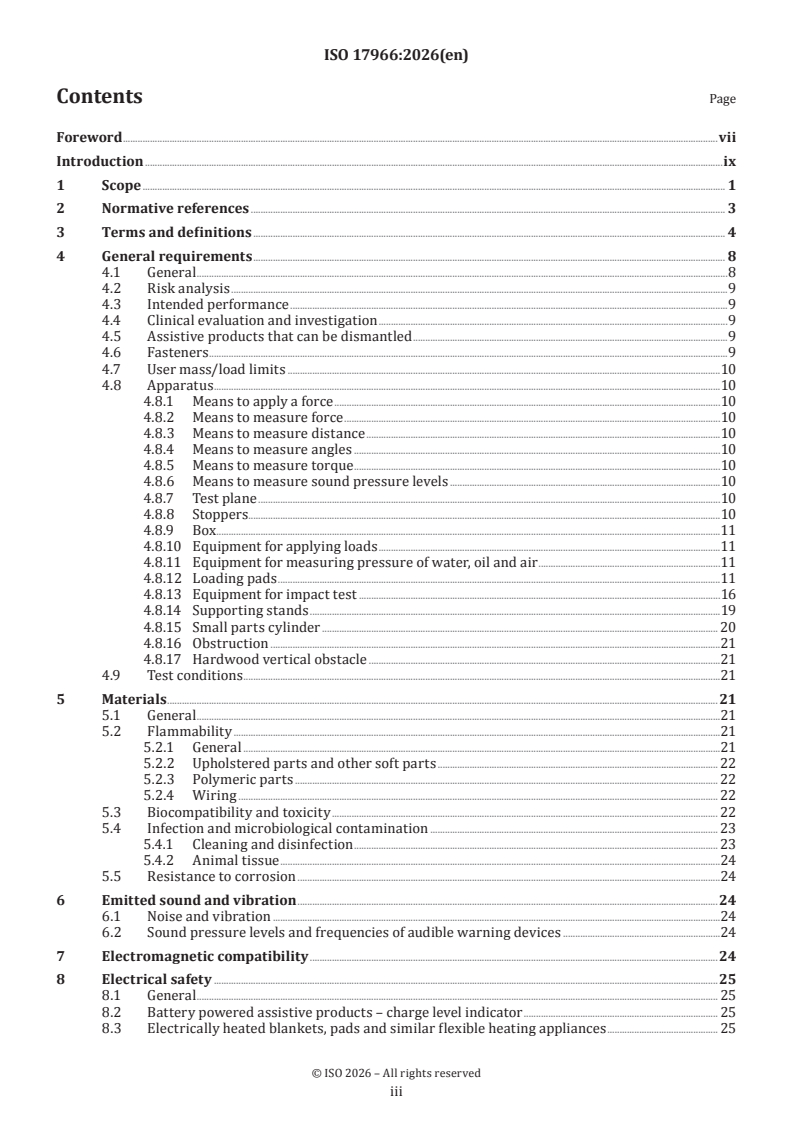
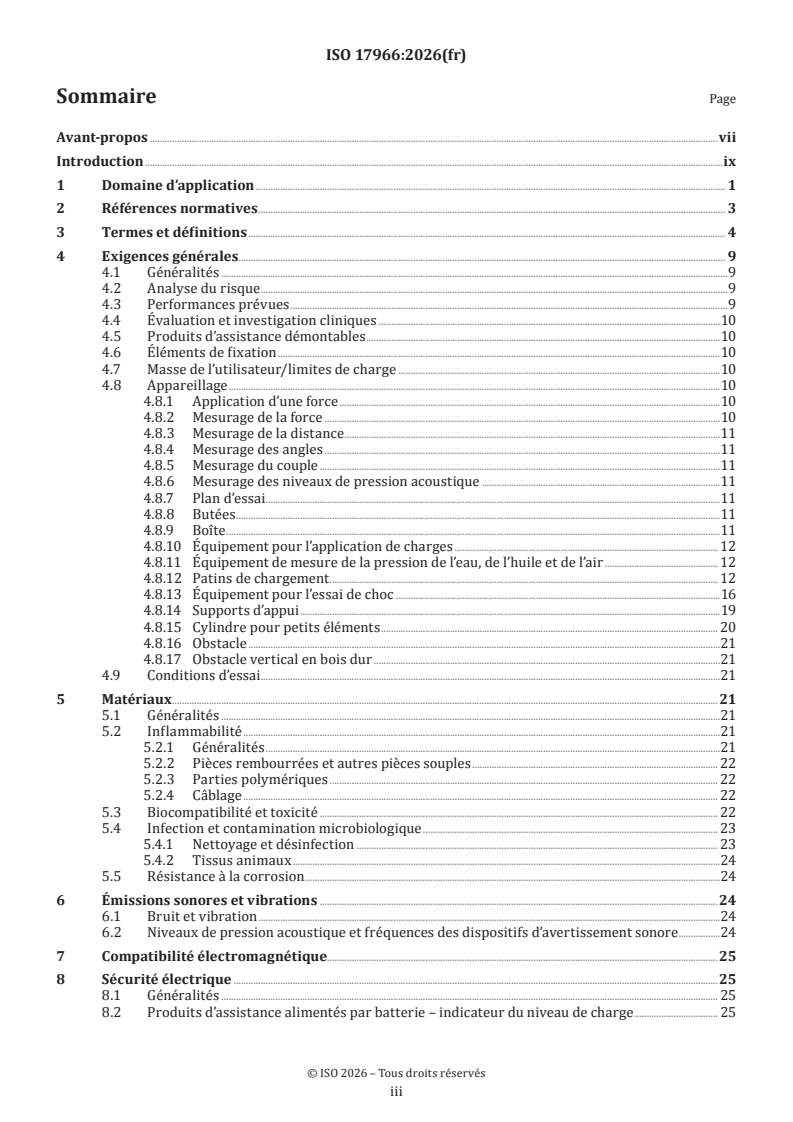
Contents Page
Foreword .vii
Introduction .ix
1 Scope . 1
2 Normative references . 3
3 Terms and definitions . 4
4 General requirements . 8
4.1 General .8
4.2 Risk analysis .9
4.3 Intended performance .9
4.4 Clinical evaluation and investigation .9
4.5 Assistive products that can be dismantled .9
4.6 Fasteners .9
4.7 User mass/load limits .10
4.8 Apparatus .10
4.8.1 Means to apply a force .10
4.8.2 Means to measure force .10
4.8.3 Means to measure distance .10
4.8.4 Means to measure angles .10
4.8.5 Means to measure torque .10
4.8.6 Means to measure sound pressure levels .10
4.8.7 Test plane .10
4.8.8 Stoppers.10
4.8.9 Box . .11
4.8.10 Equipment for applying loads .11
4.8.11 Equipment for measuring pressure of water, oil and air .11
4.8.12 Loading pads .11
4.8.13 Equipment for impact test .16
4.8.14 Supporting stands .19
4.8.15 Small parts cylinder . 20
4.8.16 Obstruction .21
4.8.17 Hardwood vertical obstacle .21
4.9 Test conditions .21
5 Materials .21
5.1 General .21
5.2 Flammability .21
5.2.1 General .21
5.2.2 Upholstered parts and other soft parts . 22
5.2.3 Polymeric parts . 22
5.2.4 Wiring . 22
5.3 Biocompatibility and toxicity . 22
5.4 Infection and microbiological contamination . 23
5.4.1 Cleaning and disinfection . 23
5.4.2 Animal tissue .24
5.5 Resistance to corrosion .24
6 Emitted sound and vibration .24
6.1 Noise and vibration .24
6.2 Sound pressure levels and frequencies of audible warning devices .24
7 Electromagnetic compatibility .24
8 Electrical safety .25
8.1 General . 25
8.2 Battery powered assistive products – charge level indicator . 25
8.3 Electrically heated blankets, pads and similar flexible heating appliances . 25
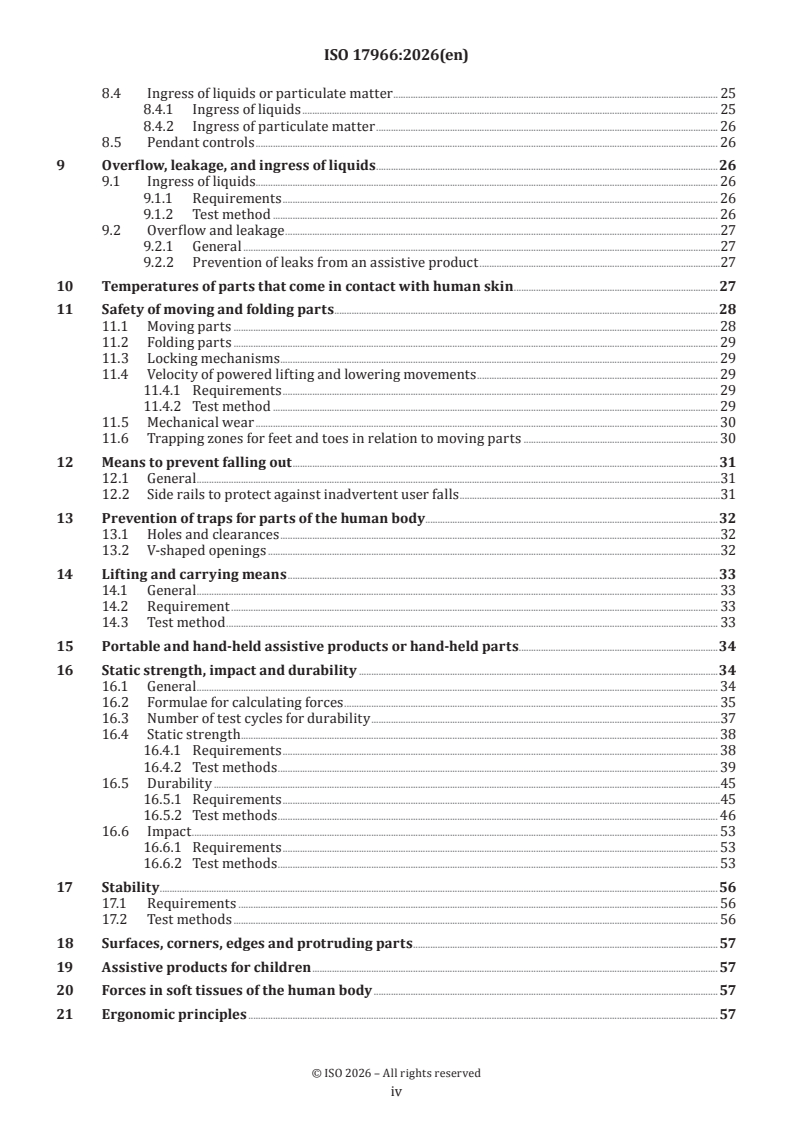
iii
8.4 Ingress of liquids or particulate matter . 25
8.4.1 Ingress of liquids . 25
8.4.2 Ingress of particulate matter . 26
8.5 Pendant controls . 26
9 Overflow, leakage, and ingress of liquids .26
9.1 Ingress of liquids . . . 26
9.1.1 Requirements . 26
9.1.2 Test method . 26
9.2 Overflow and leakage .27
9.2.1 General .27
9.2.2 Prevention of leaks from an assistive product .27
10 Temperatures of parts that come in contact with human skin .27
11 Safety of moving and folding parts .28
11.1 Moving parts . 28
11.2 Folding parts . 29
11.3 Locking mechanisms . 29
11.4 Velocity of powered lifting and lowering movements . 29
11.4.1 Requirements . 29
11.4.2 Test method . 29
11.5 Mechanical wear . 30
11.6 Trapping zones for feet and toes in relation to moving parts . 30
12 Means to prevent falling out .31
12.1 General .31
12.2 Side rails to protect against inadvertent user falls .31
13 Prevention of traps for parts of the human body .32
13.1 Holes and clearances .32
13.2 V-shaped openings .32
14 Lifting and carrying means .33
14.1 General . 33
14.2 Requirement . 33
14.3 Test method . 33
15 Portable and hand-held assistive products or hand-held parts .34
16 Static strength, impact and durability .34
16.1 General . 34
16.2 Formulae for calculating forces . 35
16.3 Number of test cycles for durability .37
16.4 Static strength . . 38
16.4.1 Requirements . 38
16.4.2 Test methods . 39
16.5 Durability .45
16.5.1 Requirements .45
16.5.2 Test methods . 46
16.6 Impact . 53
16.6.1 Requirements . 53
16.6.2 Test methods . 53
17 Stability .56
17.1 Requirements . 56
17.2 Test methods . 56
18 Surfaces, corners, edges and protruding parts .57
19 Assistive products for children .57
20 Forces in soft tissues of the human body .57
21 Ergonomic principles .57
iv
22 Mobile assistive products .58
22.1 General . 58
22.2 Immobilizing means . 58
22.2.1 General . 58
22.2.2 Requirements for locking devices . 58
22.2.3 Test methods for locking devices . 58
22.2.4 Test methods for durability of brakes .59
22.2.5 Brake-operated by a lever .59
22.3 Power-driven mobile assistive products .59
22.4 Rough handling and movement .59
22.4.1 General .59
22.4.2 Requirements .59
22.4.3 Test method for movement over a threshold .59
22.4.4 Test method for door frame shock . 60
22.5 Functional requirements for mobile assistive products . 60
22.5.1 Foot supports . 60
22.5.2 Position of push handles or points . 60
22.5.3 Turning diameter of mobile assistive products . 60
22.6 Moving forces . .61
22.6.1 Requirements for moving forces .61
22.6.2 Test methods for moving forces.61
23 Fixed assistive products . 61
23.1 General .61
23.2 Requirements .62
23.3 Shower seats .62
23.3.1 Description .62
23.3.2 Test methods .62
23.4 Bathing stretchers, shower tables and diaper changing tables . 64
23.4.1 Description . 64
23.4.2 Test methods . 64
23.5 Bath boards, back supports and seats . 65
23.5.1 Description . 65
23.5.2 Test method for durability . 65
23.6 Raised toilet seats . 66
23.6.1 Description . 66
23.6.2 Requirements . 66
23.6.3 Test methods . 66
23.7 Handrails, grab bars and handgrips .67
23.7.1 Description .67
23.7.2 Ergonomic principles . 68
23.7.3 Requirements . 68
23.7.4 Test methods . 68
23.8 Removable grab rails and handgrips . 69
23.8.1 Description . 69
23.8.2 Ergonomic principles . 69
23.8.3 Safety .70
23.8.4 Test methods .70
23.9 Hinged rails and arm supports .71
23.9.1 Description .71
23.9.2 General .71
23.9.3 Test methods .71
24 Portable assistive products . .72
24.1 General . 72
24.2 Stability and strength tests . . 72
24.3 Raised toilet seats, detachable . 72
24.3.1 Description . 72
24.3.2 Requirements . 72
v
24.4 Toilet seats with built-in raising mechanism to help standing up and sitting down (non-
fixed) . 72
24.4.1 Description . 72
24.4.2 Durability . 73
24.5 Bath boards, stools, back supports and seats . 73
24.5.1 Description . 73
24.5.2 Materials . 73
24.5.3 Stability . 73
24.5.4 Stability tests for assistive products designed to be supported by the sides of a
bathtub . 73
24.5.5 Strength test of brackets . 78
24.5.6 Friction test of bath board or seat . 81
24.5.7 Static horizontal force test on handle . 82
24.5.8 Static vertical force test of handle . 82
24.6 Arm support, free-standing . 83
24.6.1 Requirements . 83
24.6.2 Test methods . 83
25 Requirements for information supplied by the manufacturer .83
25.1 General . 83
25.2 Instructions for use . 84
25.2.1 General . 84
25.2.2 Pre-sale information . 84
25.2.3 User information . 85
25.2.4 Service information . 86
25.3 Labelling . 86
26 Packaging.87
27 Test report .87
Annex A (informative) Cognitive impairment .89
Annex B (informative) General recommendations .90
Annex C (informative) Environmental and consumer-related recommendations .98
Annex D (informative) Periodic inspection .103
Annex E (informative) Lithium batteries .104
Bibliography .106
vi
Foreword
ISO (the International Organization for Standardization) is a worldwide federation of national standards
bodies (ISO member bodies). The work of preparing International Standards is normally carried out through
ISO technical committees. Each member body interested in a subject for which a technical committee
has been established has the right to be represented on that committee. International organizations,
governmental and non-governmental, in liaison with ISO, also take part in the work. ISO collaborates closely
with the International Electrotechnical Commission (IEC) on all matters of electrotechnical standardization.
The procedures used to develop this document and those intended for its further maintenance are described
in the ISO/IEC Directives, Part 1. In particular, the different approval criteria needed for the different types
of ISO documents should be noted. This document was drafted in accordance with the editorial rules of the
ISO/IEC Directives, Part 2 (see www.iso.org/directives).
ISO draws attention to the possibility that the implementation of this document may involve the use of (a)
patent(s). ISO takes no position concerning the evidence, validity or applicability of any claimed patent
rights in respect thereof. As of the date of publication of this document, ISO had not received notice of (a)
patent(s) which may be required to implement this document. However, implementers are cautioned that
this may not represent the latest information, which may be obtained from the patent database available at
www.iso.org/patents. ISO shall not be held responsible for identifying any or all such patent rights.
Any trade name used in this document is information given for the convenience of users and does not
constitute an endorsement.
For an explanation of the voluntary nature of standards, the meaning of ISO specific terms and expressions
related to conformity assessment, as well as information about ISO’s adherence to the World Trade
Organization (WTO) principles in the Technical Barriers to Trade (TBT), see www.iso.org/iso/foreword.html.
This document was prepared by Technical Committee ISO/TC 173, Assistive products, in collaboration with
the European Committee for Standardization (CEN) Technical Committee CEN/TC 293, Assistive products
and accessibility, in accordance with the Agreement on technical cooperation between ISO and CEN (Vienna
Agreement).
This second edition cancels and replaces the first edition (ISO 17966:2016), which has been technically
revised.
The main changes are as follows:
— new terms and definitions were added, and a few definitions updated (Clause 3);
— new apparatus was added and a few updated (4.8);
— requirements for flammability were updated, and requirements for other soft parts, polymeric parts and
wiring were added (5.2);
— requirements for infection and microbiological contamination were updated, and requirements, test
methods, performance criteria and marking requirements for machine washable assistive products
were added (5.4);
— requirements for electromagnetic compatibility were removed from this document, reference to
requirements in IEC 60601-1:2005 was added instead (Clause 7);
— reference to electrical standards was adjusted, and requirements for electrical systems, safe positioning,
single fault safety, hold to run activation, emergency stopping functions and continuity of power supply
were therefore removed from this document (8.1);
— charge level indication for battery powered assistive products was modified for better understanding
(8.2);
— requirement for ingress of particulate matter was specified (8.4.2);
— requirement and test of pendant controls was added (8.5);
vii
— update of test method for velocity of powered lifting and lowering movement (11.4.2);
— means to prevent falling out (e.g. side rails) were added (Clause 12);
— Table 6 for calculating forces was updated, formula to find F1 was modified for several products and
drawing examples were given for explanation (16.2);
— designed lifetime t was changed to expected lifetime t in the formula for calculating number of test
DL EL
cycles, expected lifetime was changed from a minimum of 3 years to 5 years, Table 7 and Table 8 were
updated (16.3);
— modification of test methods and new test methods added for static strength (16.4) and durability (16.5);
— modification of test methods for stability (Clause 17);
— Clause 19 for assistive products for children has been modified;
— ergonomic requirement for surface of buttons from previous version were removed (Clause 21);
— ergonomic
...
Norme
internationale
ISO 17966
Deuxième édition
Produits d’assistance pour les
2026-10
toilettes, le bain et la douche —
Exigences et méthodes d’essai
Assistive products for toileting, bathing and showering —
Requirements and test methods
Numéro de référence
DOCUMENT PROTÉGÉ PAR COPYRIGHT
© ISO 2026
Tous droits réservés.
La présente publication de l’ISO est protégée par le droit d’auteur et demeure la propriété de l’ISO et/ou de ses concédants de
licence.
Le contenu de la présente publication de l’ISO est fourni sous licence, et n’est pas vendu. Son utilisation est soumise aux conditions
de licence applicables définies par l’ISO, un organisme membre de l’ISO, ou un distributeur tiers agréé.
Sous réserve des besoins liés à sa mise en œuvre ou d’une autorisation expresse prévue aux termes d’une licence distincte, aucune
partie de la présente publication de l’ISO ne peut être reproduite, distribuée, modifiée, utilisée ou mise à disposition sous quelque
forme ou par quelque moyen que ce soit – électronique ou mécanique, y compris la photocopie, la numérisation, l’enregistrement
ou la publication sur des plateformes numériques internes ou externes.
Toute utilisation hors du champ d’application des droits accordés est interdite et peut donner lieu à des poursuites judiciaires.
ISO copyright office
Case postale 401 • CH-1214 Vernier, Genève
Tél.: +41 22 749 01 11
E-mail: copyright@iso.org
Web: www.iso.org
Publié en Suisse
ii
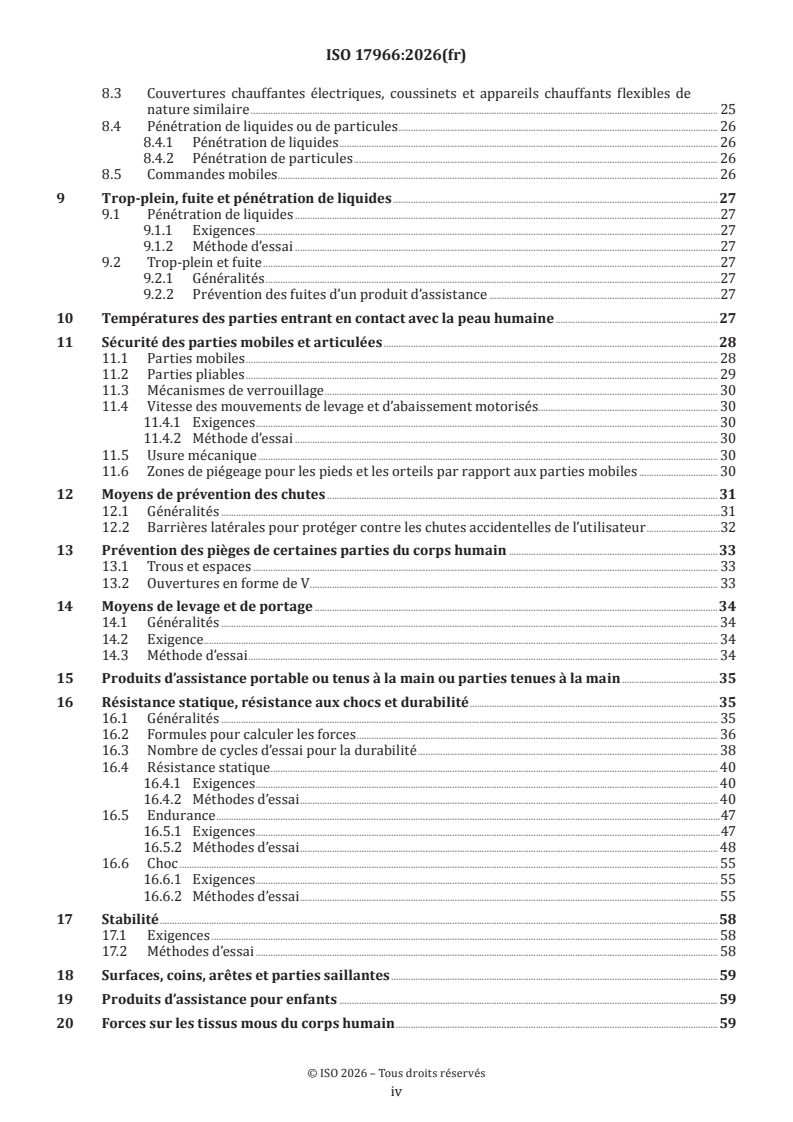
Sommaire Page
Avant-propos .vii
Introduction .ix
1 Domaine d’application . 1
2 Références normatives . 3
3 Termes et définitions . 4
4 Exigences générales . . 9
4.1 Généralités .9
4.2 Analyse du risque .9
4.3 Performances prévues .9
4.4 Évaluation et investigation cliniques .10
4.5 Produits d’assistance démontables .10
4.6 Éléments de fixation .10
4.7 Masse de l’utilisateur/limites de charge .10
4.8 Appareillage .10
4.8.1 Application d’une force .10
4.8.2 Mesurage de la force .10
4.8.3 Mesurage de la distance . .11
4.8.4 Mesurage des angles .11
4.8.5 Mesurage du couple .11
4.8.6 Mesurage des niveaux de pression acoustique .11
4.8.7 Plan d’essai.11
4.8.8 Butées .11
4.8.9 Boîte .11
4.8.10 Équipement pour l’application de charges . 12
4.8.11 Équipement de mesure de la pression de l’eau, de l’huile et de l’air . 12
4.8.12 Patins de chargement . 12
4.8.13 Équipement pour l’essai de choc .16
4.8.14 Supports d’appui .19
4.8.15 Cylindre pour petits éléments . 20
4.8.16 Obstacle .21
4.8.17 Obstacle vertical en bois dur .21
4.9 Conditions d’essai . . .21
5 Matériaux .21
5.1 Généralités .21
5.2 Inflammabilité .21
5.2.1 Généralités .21
5.2.2 Pièces rembourrées et autres pièces souples . 22
5.2.3 Parties polymériques . 22
5.2.4 Câblage . 22
5.3 Biocompatibilité et toxicité . 22
5.4 Infection et contamination microbiologique . 23
5.4.1 Nettoyage et désinfection . 23
5.4.2 Tissus animaux .24
5.5 Résistance à la corrosion .24
6 Émissions sonores et vibrations .24
6.1 Bruit et vibration .24
6.2 Niveaux de pression acoustique et fréquences des dispositifs d’avertissement sonore .24
7 Compatibilité électromagnétique.25
8 Sécurité électrique .25
8.1 Généralités . 25
8.2 Produits d’assistance alimentés par batterie – indicateur du niveau de charge . 25
iii
8.3 Couvertures chauffantes électriques, coussinets et appareils chauffants flexibles de
nature similaire . 25
8.4 Pénétration de liquides ou de particules . 26
8.4.1 Pénétration de liquides . 26
8.4.2 Pénétration de particules . 26
8.5 Commandes mobiles . 26
9 Trop-plein, fuite et pénétration de liquides .27
9.1 Pénétration de liquides .27
9.1.1 Exigences .27
9.1.2 Méthode d’essai .27
9.2 Trop-plein et fuite .27
9.2.1 Généralités .27
9.2.2 Prévention des fuites d’un produit d’assistance .27
10 Températures des parties entrant en contact avec la peau humaine .27
11 Sécurité des parties mobiles et articulées .28
11.1 Parties mobiles . 28
11.2 Parties pliables . 29
11.3 Mécanismes de verrouillage . 30
11.4 Vitesse des mouvements de levage et d’abaissement motorisés . 30
11.4.1 Exigences . 30
11.4.2 Méthode d’essai . 30
11.5 Usure mécanique . 30
11.6 Zones de piégeage pour les pieds et les orteils par rapport aux parties mobiles . 30
12 Moyens de prévention des chutes .31
12.1 Généralités .31
12.2 Barrières latérales pour protéger contre les chutes accidentelles de l’utilisateur .32
13 Prévention des pièges de certaines parties du corps humain .33
13.1 Trous et espaces . 33
13.2 Ouvertures en forme de V . 33
14 Moyens de levage et de portage .34
14.1 Généralités . 34
14.2 Exigence . 34
14.3 Méthode d’essai . 34
15 Produits d’assistance portable ou tenus à la main ou parties tenues à la main .35
16 Résistance statique, résistance aux chocs et durabilité .35
16.1 Généralités . 35
16.2 Formules pour calculer les forces . 36
16.3 Nombre de cycles d’essai pour la durabilité . 38
16.4 Résistance statique . 40
16.4.1 Exigences . 40
16.4.2 Méthodes d’essai . 40
16.5 Endurance .47
16.5.1 Exigences .47
16.5.2 Méthodes d’essai . 48
16.6 Choc . 55
16.6.1 Exigences . 55
16.6.2 Méthodes d’essai . 55
17 Stabilité .58
17.1 Exigences . 58
17.2 Méthodes d’essai . 58
18 Surfaces, coins, arêtes et parties saillantes .59
19 Produits d’assistance pour enfants .59
20 Forces sur les tissus mous du corps humain .59
iv
21 Principes ergonomiques .59
22 Produits d’assistance mobiles .60
22.1 Généralités . 60
22.2 Moyens d’immobilisation . 60
22.2.1 Généralités . 60
22.2.2 Exigences relatives aux dispositifs de verrouillage . 60
22.2.3 Méthodes d’essai des dispositifs de verrouillage . 60
22.2.4 Méthodes d’essai de la durabilité des freins .61
22.2.5 Frein actionné par un levier .61
22.3 Produits d’assistance mobiles motorisés .61
22.4 Manipulation et mouvements brusques . .61
22.4.1 Généralités .61
22.4.2 Exigences .61
22.4.3 Méthode d’essai pour le franchissement d’un seuil .62
22.4.4 Méthode d’essai pour l’impact de cadre de porte .62
22.5 Exigences fonctionnelles pour les produits d’assistance mobiles .62
22.5.1 Repose-pieds .62
22.5.2 Position des poignées/boutons de poussée .62
22.5.3 Diamètre de giration des produits d’assistance mobiles.62
22.6 Forces de déplacement . 63
22.6.1 Exigences relatives aux forces de déplacement . 63
22.6.2 Méthodes d’essai des forces de déplacement . 63
23 Produits d’assistance fixes . .64
23.1 Généralités . 64
23.2 Exigences . 64
23.3 Sièges de douche . . . 65
23.3.1 Description . 65
23.3.2 Méthodes d’essai . 65
23.4 Brancards pour le bain, tables de douche et tables à langer . 66
23.4.1 Description . 66
23.4.2 Méthodes d’essai . 66
23.5 Planches pour le bain, supports dorsaux et sièges .67
23.5.1 Description .67
23.5.2 Méthode d’essai concernant la durabilité .67
23.6 Surélévateurs de WC . 68
23.6.1 Description . 68
23.6.2 Exigences . 68
23.6.3 Méthodes d’essai . 68
23.7 Mains courantes, barres et poignées d’appui . 69
23.7.1 Description . 69
23.7.2 Principes ergonomiques .70
23.7.3 Exigences .70
23.7.4 Méthodes d’essai .70
23.8 Barres et poignées d’appui amovibles .71
23.8.1 Description .71
23.8.2 Principes ergonomiques .71
23.8.3 Sécurité . 72
23.8.4 Méthodes d’essai . 72
23.9 Barres et supports de bras articulés . 73
23.9.1 Description . 73
23.9.2 Généralités . 73
23.9.3 Méthodes d’essai . 73
24 Produits d’assistance portables . 74
24.1 Généralités .74
24.2 Essais de stabilité et de résistance .74
24.3 Surélévateurs de WC, amovibles . 75
24.3.1 Description . 75
v
24.3.2 Exigences . 75
24.4 Cuvettes de WC avec un mécanisme de levage incorporé pour aider à s’asseoir et à se
lever (non fixé) . 75
24.4.1 Description . 75
24.4.2 Endurance . 75
24.5 Planches pour le bain, tabourets, supports dorsaux et sièges . 75
24.5.1 Description . 75
24.5.2 Matériaux . 75
24.5.3 Stabilité . 75
24.5.4 Essais de stabilité des produits d’assistance conçus pour être soutenus par les
rebords d’une baignoire .76
24.5.5 Essai de résistance des supports . 80
24.5.6 Essai de frottement de la planche pour le bain ou le siège de bain . 83
24.5.7 Essai de force horizontale statique sur la poignée . 84
24.5.8 Essai de force verticale statique de la poignée . 84
24.6 Supports de bras, autoportant . 85
24.6.1 Exigences . 85
24.6.2 Méthodes d’essai . 85
25 Exigences relatives aux informations fournies par le fabricant .85
25.1 Généralités . 85
25.2 Instructions d’utilisation . . 86
25.2.1 Généralités . 86
25.2.2 Informations de prévente . 86
25.2.3 Information des utilisateurs . 87
25.2.4 Informations relatives à l’entretien . 88
25.3 Étiquetage . 88
26 Emballage .89
27 Rapports d’essai .90
Annexe A (informative) Déficience cognitive.91
Annexe B (informative) Recommandations générales .92
Annexe C (informative) Recommandations environnementales et relatives aux consommateurs .101
Annexe D (informative) Inspection périodique . .106
Annexe E (informative) Batteries au lithium .107
Bibliographie .109
vi
Avant-propos
L’ISO (Organisation internationale de normalisation) est une fédération mondiale d’organismes nationaux
de normalisation (comités membres de l’ISO). L’élaboration des Normes internationales est en général
confiée aux comités techniques de l’ISO. Chaque comité membre intéressé par une étude a le droit de faire
partie du comité technique créé à cet effet. Les organisations internationales, gouvernementales et non
gouvernementales, en liaison avec l’ISO participent également aux travaux. L’ISO collabore étroitement avec
la Commission électrotechnique internationale (IEC) en ce qui concerne la normalisation électrotechnique.
Les procédures utilisées pour élaborer le présent document et celles destinées à sa mise à jour sont
décrites dans les Directives ISO/IEC, Partie 1. Il convient, en particulier de prendre note des différents
critères d’approbation requis pour les différents types de documents ISO. Le présent document
a été rédigé conformément aux règles de rédaction données dans les Directives ISO/IEC, Partie 2
(voir www.iso.org/directives).
L’ISO attire l’attention sur le fait que la mise en application du présent document peut entraîner l’utilisation
d’un ou de plusieurs brevets. L’ISO ne prend pas position quant à la preuve, à la validité et à l’applicabilité de
tout droit de brevet revendiqué à cet égard. À la date de publication du présent document, l’ISO n’avait pas
reçu notification qu’un ou plusieurs brevets pouvaient être nécessaires à sa mise en application. Toutefois,
il y a lieu d’avertir les responsables de la mise en application du présent document que des informations
plus récentes sont susceptibles de figurer dans la base de données de brevets, disponible à l’adresse
www.iso.org/brevets. L’ISO ne saurait être tenue pour responsable de ne pas avoir identifié tout ou partie de
tels droits de brevet.
Les appellations commerciales éventuellement mentionnées dans le présent document sont données pour
information, par souci de commodité, à l’intention des utilisateurs et ne sauraient constituer un engagement.
Pour une explication de la nature volontaire des normes, la signification des termes et expressions
spécifiques de l’ISO liés à l’évaluation de la conformité, ou pour toute information au sujet de l’adhésion de
l’ISO aux principes de l’Organisation mondiale du commerce (OMC) concernant les obstacles techniques au
commerce (OTC), voir www.iso.org/iso/fr/avant-propos.html.
Le présent document a été élaboré par le comité technique ISO/TC 173, Produits d'assistance, en collaboration
avec le comité technique CEN/TC 293, Produits d'assistance et accessibilité, conformément à l'Accord de
coopération technique entre l'ISO et le CEN (accord de Vienne).
Cette deuxième édition annule et remplace la première édition (ISO 17966:2016) qui a fait l’objet d’une
révision technique.
Les principales modifications sont les suivantes:
— ajout de nouveaux termes et définitions et mise à jour de quelques définitions (Article 3);
— ajout d'un nouvel appareillage et quelques mises à jour (4.8);
— mise à jour des exigences relatives à l'inflammabilité et ajout des exigences relatives aux autres parties
souples, aux parties polymères et au câblage (5.2);
— mise à jour des exigences relatives à l'infection et à la contamination microbiologique, ajout des exigences,
méthodes d'essai, critères de performance et exigences de marquage pour les produits d'assistance
lavables en machine (5.4);
— suppression des exigences relatives à la compatibilité électromagnétique du présent document, ajout
d'une référence aux exigences de l'IEC 60601-1:2005 (Article 7);
— la référence aux normes électriques a été ajustée et les exigences relatives aux systèmes électriques,
au positionnement sûr, à la sécurité en cas de premier défaut, à l'activation par maintien de l'arrêt
d'urgence, aux fonctions d'arrêt d'urgence et à la continuité de l'alimentation ont donc été retirées du
présent document (8.1);
vii
— l'indication du niveau de charge des produits d'assistance alimentés par batterie a été modifiée pour une
meilleure compréhension (8.2);
— l'exigence relative à la pénétration de particules a été spécifiée (8.4.2);
— ajout de l'exigence et de l'essai des commandes mobiles (8.5);
— mise à jour de la méthode d'essai pour la vitesse des mouvements de levage et d'abaissement motorisés
(11.4.2);
— ajout de moyens de prévention des chutes (par exemple rails latéraux) (Article 12);
— mise à jour du Tableau 6 pour le calcul des forces, modification de la formule permettant de trouver F1
pour plusieurs produits et explication des exemples de dessins (16.2);
— la durée de vie conçue t a été modifiée en durée de vie prévue t dans la formule de calcul du nombre
DL EL
de cycles d'essai, la durée de vie prévue est passée d'au moins 3 ans à 5 ans, Tableau 7 et Tableau 8 ont été
mis à jour (16.3);
— modification des méthodes d'essai et ajout de nouvelles méthodes d'essai pour la résistance statique
(16.4) et la durabilité (16.5);
— modification des méthodes d'essai de stabilité (Article 17);
— l’Article 19 pour les produits d'assistance pour enfants a été modifié;
— suppression de l'exigence ergonomique de surface des touches de la version précédente (Article 21);
— les exigences ergonomiques pour les commandes manuelles ont été
...