

ISO/IEC 19763-7:2026
(Main)Information technology — Metamodel framework for interoperability (MFI) — Part 7: Metamodel for service model registration
- Abstract
The primary purpose of the ISO/IEC 19763 series is to specify a metamodel framework for interoperability. This document specifies a metamodel for registering administrative and evolution information of models of services, facilitating interoperability through the reuse of services. This document is only applicable to web services whose capabilities are described by some web service description language (see Annex A for examples of such languages). Figure 1 shows the scope of this document.
- Status
- Published
- Publication Date
- 20-Oct-2026
- Technical Committee
- ISO/IEC JTC 1/SC 32 - Data management and interchange
- Drafting Committee
- ISO/IEC JTC 1/SC 32/WG 2 - MetaData
- Current Stage
- 6060 - International Standard published
- Start Date
- 21-Oct-2026
- Completion Date
- 21-Oct-2026


ISO/IEC 19763-7:2026 is an ISO/IEC standard in the Metamodel framework for interoperability (MFI) series. It specifies a metamodel for registering administrative and evolution information about service models, so that web services can be described, discovered and reused in a more structured way. It is aimed at web services whose capabilities are described by a service description language.
What does ISO/IEC 19763-7:2026 specify?
ISO/IEC 19763-7:2026 specifies how to register service models, the services they describe, and the change history of those services. It applies only to web services described by a service description language, and Annex A gives examples of the kinds of languages that fit that scope.
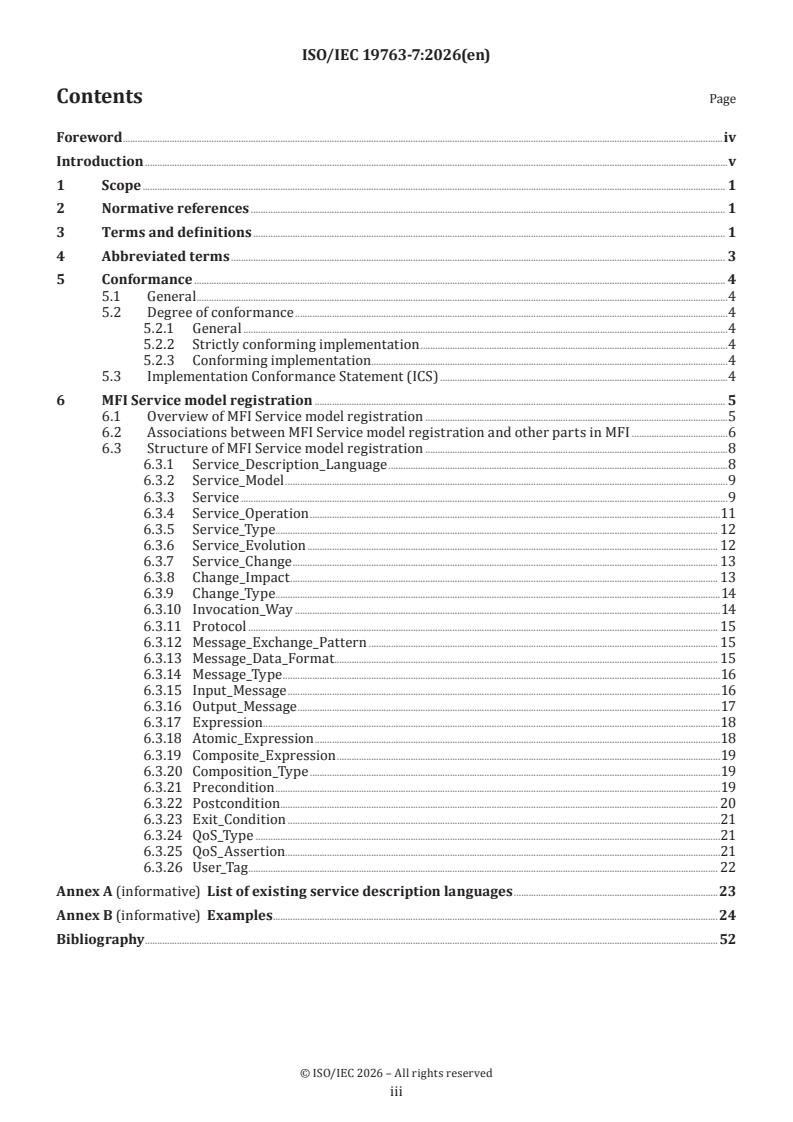
The document is organized into clauses for scope, normative references, terms and definitions, abbreviated terms, conformance, and the MFI service model registration metamodel. Annex A lists existing service description languages, and Annex B gives examples of service model registration in several languages and notations.
| Annex | What it covers |
|---|---|
| Annex A | List of existing service description languages that can be registered with this metamodel |
| Annex B | Worked examples of service model registration, including versioned examples |
What are the key requirements of ISO/IEC 19763-7:2026?
Conformance rules in Clause 5
ISO/IEC 19763-7:2026 requires any claiming implementation to support the metamodel in Clause 6. Clause 5 separates strictly conforming implementations from conforming implementations.
In practice, this matters for interoperability and procurement. A strictly conforming implementation follows only the metamodel in this document, while a conforming implementation may also use extension features. The Implementation Conformance Statement (ICS) must state which conformance class applies and what extensions are used, if any.
What the service registration must capture
ISO/IEC 19763-7:2026 models service registration at two levels: the service model and the service itself. A service model has a name, a unique described IRI, a describing language, and one or more contained services. A service has a name, a unique requested IRI, a domain, a service type, and one or more containing service models.
This is practical because a registry must identify each service and tie it back to the language that describes it. The document also allows a service to be tagged, composed from other services, and linked to goals and service involvements, so the registry can support search, classification and reuse.
How service operations are described
ISO/IEC 19763-7:2026 treats a service as a set of service operations. A service operation can have input messages, output messages, a precondition, a postcondition and an exit condition. Each operation also has an invocation way.
This matters because the standard does not record only a service name. It records what the operation consumes, what it produces, when it may be invoked, and how it is called. That gives registry users enough information to compare interfaces and understand compatibility.
How invocation is characterized
ISO/IEC 19763-7:2026 defines Invocation_Way with three parts: protocol, message exchange pattern, and message data format. Clause 6.3.11 lists protocols such as SOAP, REST, GRAPHQL, gRPC and WebSocket. Clause 6.3.12 lists request-response, one-way and publish-subscribe. Clause 6.3.13 lists JSON, XML and Protobuf.
This is important for heterogeneous services because two services may expose similar functions but require different communication styles. The registration can capture those differences explicitly, which helps with discovery, routing and client adaptation.
How conditions and QoS are expressed
ISO/IEC 19763-7:2026 uses Expression as the logical form for preconditions, postconditions, exit conditions and QoS assertions. Clause 6.3.17 allows an expression to be atomic or composite, and Clause 6.3.20 defines conjunction, disjunction and negation for composite expressions.
In practice, this lets a registry store service rules in a structured form instead of free text. QoS Assertion links one or more QoS types to the service, so the registry can capture non-functional properties such as availability or response time alongside functional behavior.
How service evolution is tracked
ISO/IEC 19763-7:2026 includes explicit service evolution modeling. A service evolution has a version number, a description, an evolving service, one or more service changes, and optional links to the previous and next evolution. Clause 6.3.7 and Clause 6.3.9 identify change types such as initialization, service name change, input-output change, operation change, protocol change, endpoint change, message exchange pattern change, message data format change and QoS change.
This is useful when service consumers need to judge whether a new version is compatible with an existing integration. Clause 6.3.8 also classifies impact as initial, major, minor or patch, which helps teams record the practical significance of each change.
How ISO/IEC 19763-7:2026 connects to other MFI parts
ISO/IEC 19763-7:2026 links service registration to other MFI parts through goals, processes and roles. Clause 6.2 states that services and service operations can achieve goals, service operations can fully realize processes, and services can involve roles through service involvements.
This matters because the document is not only about storing service metadata. It also connects service descriptions to process and role models, which supports broader interoperability across the MFI framework.
What terms does ISO/IEC 19763-7:2026 define?
- service - A kind of application that encapsulates one or more computing modules and is accessed through a specified interface.
- web service - A service designed to support interoperable machine-to-machine interaction over a network.
- service operation - The execution action of a service.
- QoS assertion - A specification of one or more QoS types for a service.
- service evolution - A set of changes in the functional or non-functional properties of a service over its lifecycle.
- invocation way - The combination of protocol, message exchange pattern and message data format used by a service operation.
- user tag - A tag added by an individual or organization to describe a service from the creator’s point of view.
- Implementation Conformance Statement (ICS) - The statement an implementation provides to declare whether it is strictly conforming or conforming and, if relevant, which extensions it uses.
Who uses ISO/IEC 19763-7:2026?
ISO/IEC 19763-7:2026 is used by people who design and operate service registries, metamodel-based repositories and interoperability platforms. It is also relevant to service architects, integration teams and vendors that need to register web services in a structured way.
Service providers use it to describe service models, operations, invocation details, QoS and version changes. Service consumers and governance teams use it to compare services, track evolution, and support discovery and reuse across service networks and service ecosystems.
The examples in Annex B show use with WSDL, WSML, WADL, OWL-S, OpenAPI and Protobuf, so the standard is relevant wherever those service description languages are used to publish and manage services.
What changed in ISO/IEC 19763-7:2026 from the previous edition?
ISO/IEC 19763-7:2026 is the second edition and cancels and replaces ISO/IEC 19763-7:2015. It is technically revised.
The main changes stated in the document are:
- Additional metaclasses for heterogeneous services using multiple protocols, including Invocation_Way, Message_Exchange_Pattern, Protocol and Message_Data_Format.
- Additional metaclasses for service evolution, including Service_Evolution, Service_Change, Change_Type and Change_Impact.
- An updated Annex B with registration examples, including an OpenAPI service registration example and a PROTO3 service registration example.
Which standards are used with ISO/IEC 19763-7:2026?
ISO/IEC 19763-7:2026 uses these companion parts of the ISO/IEC 19763 series as normative references:
- ISO/IEC 19763-3 - provides the metamodel for ontology registration and supplies terms and definitions used by this document.
- ISO/IEC 19763-5 - provides the metamodel for process model registration, which is used for links between services and processes.
- ISO/IEC 19763-8 - provides the metamodel for role and goal model registration, which is used for links between services, goals and roles.
- ISO/IEC 19763-10 - provides the core model and basic mapping, which underpins the subclass relationships used in Clause 6.
What does the ISO/IEC 19763-7:2026 document contain?
Clause 6 contains the main metamodel description, starting with an overview and then the associations with other MFI parts and the detailed structure of each metaclass. The clause defines the registration objects for service description languages, service models, services, operations, messages, expressions, QoS and evolution.
Figures 2 to 4 show the metamodel and its relationships to the other MFI parts. Clause 6.3 is the most detailed part of the document and lists the attributes and associations for each metaclass, which is what implementers use when building a registry or mapping service metadata.
Annex A is a compact list of service description languages that can be registered, and Annex B gives worked examples for registration tasks. Those examples are useful for design and implementation work because they show how the metamodel is applied to real service descriptions and how changes are recorded from one version to the next.
Relations
- Effective Date
- 10-May-2025
Get Certified
Connect with accredited certification bodies for this standard

BSI Group
BSI (British Standards Institution) is the business standards company that helps organizations make excellence a habit.

NYCE
Mexican standards and certification body.
Sponsored listings
Frequently Asked Questions
ISO/IEC 19763-7:2026 is a standard published by the International Organization for Standardization (ISO). Its full title is "Information technology — Metamodel framework for interoperability (MFI) — Part 7: Metamodel for service model registration". This standard covers: The primary purpose of the ISO/IEC 19763 series is to specify a metamodel framework for interoperability. This document specifies a metamodel for registering administrative and evolution information of models of services, facilitating interoperability through the reuse of services. This document is only applicable to web services whose capabilities are described by some web service description language (see Annex A for examples of such languages). Figure 1 shows the scope of this document.
The primary purpose of the ISO/IEC 19763 series is to specify a metamodel framework for interoperability. This document specifies a metamodel for registering administrative and evolution information of models of services, facilitating interoperability through the reuse of services. This document is only applicable to web services whose capabilities are described by some web service description language (see Annex A for examples of such languages). Figure 1 shows the scope of this document.
ISO/IEC 19763-7:2026 is classified under the following ICS (International Classification for Standards) categories: 35.040.50 - Automatic identification and data capture techniques. The ICS classification helps identify the subject area and facilitates finding related standards.
ISO/IEC 19763-7:2026 has the following relationships with other standards: It is inter standard links to ISO/IEC 19763-7:2015. Understanding these relationships helps ensure you are using the most current and applicable version of the standard.
ISO/IEC 19763-7:2026 is available in PDF format for immediate download after purchase. The document can be added to your cart and obtained through the secure checkout process. Digital delivery ensures instant access to the complete standard document.
Standards Content (Sample)
International
Standard
ISO/IEC 19763-7
Second edition
Information technology —
2026-10
Metamodel framework for
interoperability (MFI) —
Part 7:
Metamodel for service model
registration
Technologies de l'information — Cadre du métamodèle pour
l'interopérabilité (MFI) —
Partie 7: Métamodèle pour l'enregistrement du modèle de service
Reference number
© ISO/IEC 2026
All rights reserved.
This ISO publication is protected by copyright and is owned by ISO and/or its licensors.
The content of this ISO publication is provided under licence, not sold. Use is subject to the applicable licence terms issued by ISO,
an ISO member body, or an authorized third-party distributor.
Except as required for implementation or expressly permitted by a separate licence, no part of this ISO publication may be
reproduced, distributed, modified, used, or made available in any form or by any means – electronic or mechanical, including
photocopying, scanning, recording, or posting on internal or external digital platforms.
Any use beyond the scope of the granted rights is prohibited and may result in legal action.
ISO copyright office
CP 401 • CH-1214 Vernier, Geneva
Phone: +41 22 749 01 11
Email: copyright@iso.org
Website: www.iso.org
Published in Switzerland
© ISO/IEC 2026 – All rights reserved
ii
Contents Page
Foreword .iv
Introduction .v
1 Scope . 1
2 Normative references . 1
3 Terms and definitions . 1
4 Abbreviated terms . 3
5 Conformance . 4
5.1 General .4
5.2 Degree of conformance .4
5.2.1 General .4
5.2.2 Strictly conforming implementation .4
5.2.3 Conforming implementation . .4
5.3 Implementation Conformance Statement (ICS) .4
6 MFI Service model registration . 5
6.1 Overview of MFI Service model registration .5
6.2 Associations between MFI Service model registration and other parts in MFI .6
6.3 Structure of MFI Service model registration .8
6.3.1 Service_Description_Language .8
6.3.2 Service_Model .9
6.3.3 Service .9
6.3.4 Service_Operation .11
6.3.5 Service_Type. 12
6.3.6 Service_Evolution . 12
6.3.7 Service_Change . 13
6.3.8 Change_Impact . 13
6.3.9 Change_Type.14
6.3.10 Invocation_Way .14
6.3.11 Protocol . 15
6.3.12 Message_Exchange_Pattern . 15
6.3.13 Message_Data_Format . . 15
6.3.14 Message_Type .16
6.3.15 Input_Message .16
6.3.16 Output_Message .17
6.3.17 Expression .18
6.3.18 Atomic_Expression .18
6.3.19 Composite_Expression .19
6.3.20 Composition_Type .19
6.3.21 Precondition .19
6.3.22 Postcondition . 20
6.3.23 Exit_Condition .21
6.3.24 QoS_Type .21
6.3.25 QoS_Assertion . .21
6.3.26 User_Tag . 22
Annex A (informative) List of existing service description languages .23
Annex B (informative) Examples .24
Bibliography .52
© ISO/IEC 2026 – All rights reserved
iii
Foreword
ISO (the International Organization for Standardization) and IEC (the International Electrotechnical
Commission) form the specialized system for worldwide standardization. National bodies that are
members of ISO or IEC participate in the development of International Standards through technical
committees established by the respective organization to deal with particular fields of technical activity.
ISO and IEC technical committees collaborate in fields of mutual interest. Other international organizations,
governmental and non-governmental, in liaison with ISO and IEC, also take part in the work.
The procedures used to develop this document and those intended for its further maintenance are described
in the ISO/IEC Directives, Part 1. In particular, the different approval criteria needed for the different types
of document should be noted. This document was drafted in accordance with the editorial rules of the ISO/
IEC Directives, Part 2 (see www.iso.org/directives or www.iec.ch/members_experts/refdocs).
ISO and IEC draw attention to the possibility that the implementation of this document may involve the
use of (a) patent(s). ISO and IEC take no position concerning the evidence, validity or applicability of any
claimed patent rights in respect thereof. As of the date of publication of this document, ISO and IEC have not
received notice of (a) patent(s) which may be required to implement this document. However, implementers
are cautioned that this may not represent the latest information, which may be obtained from the patent
database available at www.iso.org/patents and https://patents.iec.ch. ISO and IEC shall not be held
responsible for identifying any or all such patent rights.
Any trade name used in this document is information given for the convenience of users and does not
constitute an endorsement.
For an explanation of the voluntary nature of standards, the meaning of ISO specific terms and expressions
related to conformity assessment, as well as information about ISO's adherence to the World Trade
Organization (WTO) principles in the Technical Barriers to Trade (TBT) see www.iso.org/iso/foreword.html.
In the IEC, see www.iec.ch/understanding-standards.
This document was prepared by Joint Technical Committee ISO/IEC JTC 1, Information technology,
Subcommittee SC 32, Data management and interchange.
This second edition cancels and replaces the first edition (ISO/IEC 19763-7:2015), which has been technically
revised.
The main changes are as follows:
— Additional metaclasses and enumerated datatypes have been introduced in the metamodel of MFI service
model registration to support registration of heterogeneous services using multiple protocols, including
Invocation_Way, Message_Exchange_Pattern, Protocol, and Message_Data_Format.
— Additional metaclasses and enumerated datatypes have been introduced in the metamodel of MFI
service model registration to support registration of service evolution, including Service_Evolution,
Service_Change, Change_Type, and Change_Impact.
— Annex B has been updated, providing registration examples, including an OpenAPI service registration
example and a PROTO service registration example.
A list of all parts in the ISO/IEC 19763 series can be found on the ISO and IEC websites.
Any feedback or questions on this document should be directed to the user’s national standards
body. A complete listing of these bodies can be found at www.iso.org/members.html and
www.iec.ch/national-committees.
© ISO/IEC 2026 – All rights reserved
iv
Introduction
With the rapid development of Service Oriented Computing (SOC), more and more computing resources are
presented in the form of web services. Meanwhile, business integration based on web services is becoming a
popular application development method. A web service is a kind of Web based application that encapsulates
one or more computing modules and is designed to support interoperable machine-to-machine interaction
over a network.
In Web Service registration and management, ebXML RegRep is a standard defining the Service interface,
protocols and information model for an integrated registry and repository, which provides basic support for
publishing and discovering Web Services within and across enterprises. Nevertheless, keyword matching
is the basic service discovery method in ebXML RegRep, thus the discovery results will be inevitably
inaccurate, and the discovery process will be time-consuming. When business information interchange and
integration becomes increasingly frequent, major work in web service discovery should be processed by
machine. This shift necessitates the semantic description of administrative and evolution-related metadata
of services, along with the provision of corresponding registration and management mechanisms. Moreover,
with the rapid growth of service networks and service ecosystems, where large numbers of heterogeneous
services coexist and dynamically evolve, the demand for interoperability becomes increasingly critical.
Services characterized by more diverse communication protocols, description languages, message exchange
patterns, and data formats must be capable of sharing and interaction. To support this, service registration
frameworks must be enhanced to ensure that services can be discovered, composed, and evolved within
highly dynamic and diverse digital ecosystems.
This document intends to provide a generic framework for registering administrative and evolution
information about web services in an explicit way. The relationship between MFI service model registration,
the service registry, and service models expressed in different service description languages is illustrated in
Figure 1.
Key
service model
metadata about service
NOTE Not every model needs to exist in a repository before registration
Figure 1 — Scope of MFI Service model registration
© ISO/IEC 2026 – All rights reserved
v
International Standard ISO/IEC 19763-7:2026(en)
Information technology — Metamodel framework for
interoperability (MFI) —
Part 7:
Metamodel for service model registration
1 Scope
The primary purpose of the ISO/IEC 19763 series is to specify a metamodel framework for interoperability.
This document specifies a metamodel for registering administrative and evolution information of models of
services, facilitating interoperability through the reuse of services.
This document is only applicable to web services whose capabilities are described by some web service
description language (see Annex A for examples of such languages). Figure 1 shows the scope of this
document.
2 Normative references
The following documents are referred to in the text in such a way that some or all of their content constitutes
requirements of this document. For dated references, only the edition cited applies. For undated references,
the latest edition of the referenced document (including any amendments) applies.
ISO/IEC 19763-3, Information technology — Metamodel framework for interoperability (MFI) — Part 3:
Metamodel for ontology registration
ISO/IEC 19763-5, Information technology — Metamodel framework for interoperability (MFI) — Part 5:
Metamodel for process model registration
ISO/IEC 19763-8, Information technology — Metamodel framework for interoperability (MFI) — Part 8:
Metamodel for role and goal model registration
ISO/IEC 19763-10, Information technology — Metamodel framework for interoperability (MFI) — Part 10: Core
model and basic mapping
3 Terms and definitions
For the purposes of this document, the terms and definitions given in ISO/IEC 19763-3, ISO/IEC 19763-5,
ISO/IEC 19763-8, ISO/IEC 19763-10 and the following apply.
ISO and IEC maintain terminology databases for use in standardization at the following addresses:
— ISO Online browsing platform: available at https:// www .iso .org/ obp
— IEC Electropedia: available at https:// www .electropedia .org/
3.1
service
kind of application which encapsulates one or more computing modules and can be accessed through a
specified interface
© ISO/IEC 2026 – All rights reserved
3.2
service operation
execution action of a service (3.1)
3.3
expression
sentence which is expressed using a logical notation to specify either a condition that applies to a service
operation (3.2) or a QoS assertion (3.13) that applies to a service (3.1)
3.4
atomic expression
logical expression (3.3) that has the unit granularity
3.5
composite expression
logical expression (3.3) that comprises multiple atomic expressions (3.4) and (or) other composite expressions
(3.5) by using connectives such as conjunction, disjunction and negation
3.6
precondition
constraint that must be true when an operation is invoked
Note 1 to entry: The operation can be a process or service operation (3.2).
3.7
postcondition
constraint that must be true at the completion of an operation
Note 1 to entry: The operation can be a process or service operation (3.2).
3.8
exit condition
constraint that, if true, causes an operation to finish unsuccessfully
Note 1 to entry: The operation can be a process or service operation (3.2).
3.9
message type
type of the message or a set of messages that is (are) consumed or generated during the execution of a service
operation (3.2)
3.10
input message
information contained in the message that the service operation (3.2) consumes for its execution
3.11
output message
information contained in the message that the service operation (3.2) generates after its execution
3.12
QoS type
specified non-functional property for a service (3.1), such as availability, response time, etc
3.13
QoS assertion
specification of one or more QoS types (3.12) for the service (3.1)
3.14
web service
kind of service (3.1) that is designed to support interoperable machine-to-machine interaction over a network
© ISO/IEC 2026 – All rights reserved
3.15
entity service
web service (3.14) that bases its functional boundary on one or more related organization entities, such as
customer, employee, invoice and claim
3.16
task service
web service (3.14) with a functional boundary directly associated with a process model
3.17
utility service
web service (3.14) that is dedicated to providing reusable, cross-cutting utility functionality, such as event
logging, notification, and exception handling
3.18
service evolution
changes in the functional or non-functional properties of a service (3.1) that occur throughout the lifecycle of
the service (3.1)
Note 1 to entry: Such changes include, but are not limited to, modifications to its computing modules, interfaces,
communication protocols, message exchange patterns, or data formats.
3.19
user tag
tag annotated by an individual or organization in order to describe the service (3.1) according to the
understanding of the creator of the tag
4 Abbreviated terms
ebXML RegRep ebXML Registry and Repository
GraphQL Graph Query Language
gRPC Google Remote Procedure Call
IRI Internationalized Resource Identifier
MFI Core and Core model and basic mapping (see ISO/IEC 19763-10)
mapping
MFI Process Metamodel for process model registration (see ISO/IEC 19763-5)
model registration
MFI Role and Metamodel for role and goal model registration (see ISO/IEC 19763-8)
Goal model registration
MFI Service Metamodel for service model registration (see ISO/IEC 19763-7)
model registration
OWL-S Web Ontology Language for Services
QoS Quality of Service
REST Representational State Transfer
SOAP Simple Object Access Protocol
SWRL Semantic Web Rule Language
SWSL Semantic Web Service Language
© ISO/IEC 2026 – All rights reserved
WADL Web Application Description Language
WSDL Web Service Description Language
WSML Web Service Modelling Language
5 Conformance
5.1 General
An implementation claiming conformance with this document shall support the metamodel specified in
Clause 6, depending on a degree of conformance as described in 5.2.
5.2 Degree of conformance
5.2.1 General
The distinction between ‘strictly conforming’ and ‘conforming’ implementations is necessary to address
the simultaneous needs for interoperability and extensions. This document describes specifications that
promote interoperability. Extensions are motivated by needs of users, vendors, institutions and industries,
but are not specified by this document.
A strictly conforming implementation may be limited in usefulness but is maximally interoperable with
respect to this document. A conforming implementation may be more useful, but may be less interoperable
with respect to this document.
5.2.2 Strictly conforming implementation
A strictly conforming implementation:
a) shall support the metamodel specified in Clause 6;
b) shall not use, test, access, or probe for any extension features nor extensions to the metamodel specified
in Clause 6.
5.2.3 Conforming implementation
A conforming implementation:
a) shall support the metamodel specified in Clause 6;
b) as permitted by the implementation, may use, test, access, or probe for any extension features or
extensions to the metamodel specified in Clause 6.
NOTE 1 All strictly conforming implementations are also conforming implementations.
NOTE 2 The use of extensions to the metamodel can cause undefined behaviour.
5.3 Implementation Conformance Statement (ICS)
An implementation claiming conformance with this document shall include an Implementation Conformance
Statement stating:
a) whether it is a strictly conforming implementation in 5.2.2 or a conforming implementation in 5.2.3;
b) what extensions, if any, are supported or used if it is a conforming implementation.
© ISO/IEC 2026 – All rights reserved
6 MFI Service model registration
6.1 Overview of MFI Service model registration
This part of MFI specifies the metamodel that can be used to register functional and non-functional
information about web services (hereafter referred to simply as “services”). Examples of some service
description languages that can be registered using this metamodel are listed in Annex A.
Figure 2 shows the metamodel for the registration of services. This metamodel allows the registration of the
common functional and non-functional features of services described using a number of service description
languages. Each service model, expressed using a specific service description language, may describe one or
more services. Each service is described by zero or one QoS assertion. This QoS assertion is used to represent
the quantitative or qualitative non-functional features of the service, such as response time, cost, reliability,
etc. Each QoS assertion is defined using one and only one expression, which may be a composite expression
or an atomic expression. Each QoS assertion is of one or more QoS types. A service may undergo multiple
service evolutions throughout its lifecycle. Each service evolution comprises one or more service changes,
with each change describing a specific modification and its corresponding impact on service consumers.
A service is an independent and modular component and it can be accessed only by interfaces. For this reason,
the functional capability of a service is expressed using service operations, where each service operation
denotes an execution action of the service. Each service is comprised of zero, one or more service operations.
Each service operation is described with zero or one precondition, with zero or one postcondition and with
zero or one exit condition. A precondition specifies a constraint that must be true when a service operation
is invoked. A postcondition specifies a constraint that must be true at the completion of a service operation,
and an exit condition specifies a constraint that, if true, causes an operation to finish unsuccessfully. Each
precondition, each postcondition and each exit condition is defined using one and only one expression,
which may be a composite expression or an atomic expression. Each service operation is also described with
zero, one or more input messages and with zero, one or more output messages. Each input message specifies
information that the operation needs for its execution. Each output message specifies information that the
operation generates after its successful execution. Each message type provides a description of a message or
a set of messages, where each of these messages is consumed or generated during the execution of a service
operation. Each input message is constrained by zero, one or more preconditions and each output message is
constrained by zero, one or more postconditions. Each service operation may have an invocation way, which
involves the communication protocol, message exchange pattern, and message data format. Each service can
be annotated by zero, one or more user tags, each of which may be created by any person using the service.
© ISO/IEC 2026 – All rights reserved
NOTE Metaclasses whose names are italicized are abstract metaclasses.
Figure 2 — Metamodel of MFI service model registration
6.2 Associations between MFI Service model registration and other parts in MFI
Figure 3 shows the associations between MFI Service model registration (this document) and MFI Role and
Goal model registration and MFI Process model registration.
© ISO/IEC 2026 – All rights reserved
Key
metaclasses from other parts of MFI
Figure 3 — Associations between MFI Service model registration and MFI Process model
registration and MFI Role and Goal model registration
Each service achieves zero, one or more goals. Each goal is achieved by zero, one or more services. Each service
operation achieves zero, one or more goals. Each goal is achieved by zero, one or more service operations.
Each service operation can fully realize zero, one or more processes. Each process is fully realized by zero,
one or more service operations. Each service involves zero, one or more service involvements, where each
service involvement is the involvement of a role with a service, such as actor or beneficiary. Each service
involvement indicates that a role is involved in the execution of one and only one service.
The association between the metaclasses in MFI Service model registration and the metaclasses in MFI Core
and mapping is shown in Figure 4.
Service_Description_Language in MFI Service model registration is a subclass of Modelling_Language in
MFI Core and mapping. Service_Model in MFI Service model registration is a subclass of Model in MFI Core
and mapping. All the remaining metaclasses are subclasses of Model_Element in MFI Core and mapping.
All subclasses have the associations which are inherited from their superclass. Some inherited associations
are specifications of associations specialized in MFI Core and mapping. The details of specialization are
defined in 6.3.
© ISO/IEC 2026 – All rights reserved
NOTE Metaclasses whose names are italicized are abstract metaclasses
Figure 4 — The associations between MFI Service model registration and MFI Core and mapping
6.3 Structure of MFI Service model registration
6.3.1 Service_Description_Language
Service_Description_Language is a metaclass each instance of which represents a language or a notation
that is used to model a service.
Superclass
Modelling_Language (from MFI Core and mapping)
Attribute DataType Multiplicity Description
name string 1.1 The name of this service description language
Reference Class Multiplicity Description Inverse Precedence
expressed_model Service_Model 0.* The set of service describing_ No
models that are language
described by this
service description
language. This
reference special-
izes the ‘describes’
reference which is
inherited from the
superclass
© ISO/IEC 2026 – All rights reserved
Constraints
[None]
6.3.2 Service_Model
Service_Model is a metaclass each instance of which represents a model that is used to model services that
can be modelled.
Superclass
Model (from MFI Core and mapping)
Attribute DataType Multiplicity Description
name string 1.1 The name of this service model
described_IRI string 0.1 The IRI that identifies the corresponding service
model
Reference Class Multiplicity Description Inverse Precedence
describing_language Service_ 1.1 The language or expressed_ Yes
Description_ notation that is model
Language used to model this
service. This ref-
erence specializes
the ‘described_by’
reference which is
inherited from the
superclass
contained_service Service 1.* The set of services, containing_ Yes
each of which is model
modelled by this
service model. This
reference special-
izes the ‘contains’
reference which is
inherited from the
superclass
Constraints
The value of attribute ‘described_IRI’ has to be unique in this metaclass.
6.3.3 Service
Service is a metaclass each instance of which represents a kind of web based application which encapsulates
one or more computing modules and can be accessed through a specified interface.
Superclass
Model_Element (from MFI Core and mapping)
Attribute DataType Multiplicity Description
name string 1.1 The name of this service
requested_IRI string 1.1 The IRI for invoking this service
© ISO/IEC 2026 – All rights reserved
domain string 1.1 The domain that this service belongs to
service_type Service_Type 1.1 The type of this service
Reference Class Multiplicity Description Inverse Precedence
owned_qos_ QoS_Assertion 0.1 The QoS assertion asserted_service Yes
assertion that applies to this
service
contained_service_ Service_Operation 0.* The set of service containing_ Yes
operation operations, each of service
which denotes an
execution action of
this service
service_tag User_Tag 0.* The set of tags, tagged_service Yes
each of which is
annotated by an
individual or an or-
ganization in order
to describe this
service
composing_ service Service 0.* The set of services, composed_ Yes
each of which is a service
component of this
service
composed_ service Service 0.1 The composite ser- composing_ No
vice which contains service
this service
containing_model Service_Model 1.* The set of service contained_ No
models, each of service
which is used to
model this service.
This reference spe-
cializes the ‘con-
tained_by’ reference
which is inherited
from the superclass
evolved_evolution Service_Evolution 0.* The set of service evolving_ Yes
evolutions, each of service
which is used to de-
scribe an evolution
achieved_goal Goal 0.* The set of goals, achieving_ Yes
(from MFI Role each of which is service
and Goal model achieved by this
registration) service
© ISO/IEC 2026 – All rights reserved
involved_service_ Service_ 0.* The set of service involving_ Yes
involvement Involvement involvement, service
(from MFI Role each of which
and Goal model represents a state-
registration) ment that specifies
how a particular
role is involved in
this service
Constraints
The value of attribute “requested_IRI” has to be unique in this metaclass.
6.3.4 Service_Operation
Service_Operation is a metaclass each instance of which denotes one of the execution actions of a service.
Superclass
Model_Element (from MFI Core and mapping)
Attribute DataType Multiplicity Description
name string 1.1 The name of this service operation
Reference Class Multiplicity Description Inverse Precedence
consumed_ Input_Message 0.* The set of messag- containing_ Yes
message es, each of which is service_
consumed by this operation
service operation for
its execution
generated_ Output_Message 0.* The set of messages, containing_ Yes
message each of which is gen- service_
erated by this service operation
operation after its
execution
contained_ Precondition 0.1 The constraint that containing_ Yes
precondition must be true when service_
this operation is operation
invoked
contained_ Postcondition 0.1 The constraint that containing_ Yes
postcondition must be true at the service_
completion of this operation
operation
contained_ Exit_Condition 0.1 The constraint that containing_ Yes
exit_condition must be true when service_
a service operation operation
exits abnormally
containing_ Service 1.1 The service that contained_ No
service contains this service service_
operation operation
© ISO/IEC 2026 – All rights reserved
used_invocation_ Invocation_Way 0.1 The invocation way containing_ Yes
way used by the service service_
operation operation
achieved_ goal Goal(from MFI 0.* The set of goals, achieving_ Yes
Role and Goal each of which is service_
model registra- achieved by this ser- operation
tion) vice operation
fully_realized_ Process(from 0.* The set of processes, fully_realizing_ Yes
process MFI Process each of which is fully service_operation
model registra- realized by this ser-
tion) vice operation
Constraints
[None]
6.3.5 Service_Type
Service_Type is an enumerated datatype with the following values.
Value Description
entity_service Indicates that this service bases its functional boundary on one or more related organiza-
tion entities, such as customer, employee, invoice, and claim.
task_service Indicates that this service has a functional boundary directly associated with a process
model.
utility_service Indicates that this service provides reusable and cross-cutting utility functionality, such
as event logging, notification, and exception handling.
6.3.6 Service_Evolution
Service_Evolution is a metaclass that has information on the evolution of a service.
Superclass
Model_Element (from MFI Core and mapping)
Attribute DataType Multiplicity Description
version_number string 1.1 The new version number of this evolution
description string 1.1 The description of this evolution
Reference Class Multiplicity Description Inverse Precedence
evolving_service Service 1.1 The service that evolved_evolution No
undergoes this
evolution
contained_ Service_Change 1.* The service containing_ Yes
service_change changes belonging service_
to this evolution evolution
© ISO/IEC 2026 – All rights reserved
previous_evolution Service_Evolution 0.1 The immediately next_evolution Yes
preceding version
of this evolution
next_evolution Service_Evolution 0.1 The next previous_evolution No
evolution that suc-
ceeds this version
Constraints
[None]
6.3.7 Service_Change
Service_Change is a metaclass that specifies the details of modifications occurring during a service evolution.
Superclass
Model_Element (from MFI Core and mapping)
Attribute DataType Multiplicity Description
name string 1.1 The name of this service change
change_type Change_Type 1.1 The change type of this service change
change_impact Change_Impact 1.1 The change impact of this service change
change_detail string 0.1 The description of what specifically changed
Reference Class Multiplicity Description Inverse Precedence
containing_ Service_Evolution 1.1 The service evolution contained_ No
service_ to which this change service_
evolution belongs change
Constraints
[None]
6.3.8 Change_Impact
Change_Impact is an enumerated datatype with the following values.
Value Description
initial Indicates the initial introduction of a service or operation. It is not a modification of an
existing element but serves as the baseline version from which future changes will be
tracked.
major Indicates breaking changes that are not backward-compatible. Such changes often re-
quire substantial adjustments by service consumers, such as introducing a new version of
an API with different endpoints or data structures
minor Indicates additive changes that are backward-compatible. Such changes may add new
functionality or enhancements without breaking existing compatibility, such as adding a
new optional parameter to an existing API endpoint
© ISO/IEC 2026 – All rights reserved
patch Indicates bug fixes or small improvements that are backward-compatible. The change ad-
dresses minor fixes, such as fixing a bug in the service that caused crashes or optimizing
performance for a specific service operation
6.3.9 Change_Type
Change_Type is an enumerated datatype with the following values.
Value Description
initialization Indicates the initial registration of a service, capturing its baseline definition
when it is first registered into the registry.
service_name_change Indicates that the change involves modifying the name of a service, which may
affect how the service is identified and referenced by its consumers
input_output_change Indicates that the change involves adding, removing, or altering the input and
(or) output message of a service operation, which may affect the compatibility of
consumers relying on the existing input and (or) output format
operation_change Indicates that the change involves adding, removing, or altering operations
within a service, which may affect the service's functional boundary and its
interaction with consumers
protocol_change Indicates a change in the communication protocol (e.g., from REST to gRPC),
which may require significant client adaptation
endpoint_change Indicates that the service’s network address (e.g., URL or port) has changed,
affecting service accessibility and requiring updates to service registries or
clients
message_exchange_ Indicates that the change involves modifying the message exchange pattern
pattern_change used by the service, which may affect communication flows and interaction
semantics with consumers
message_data_format_ Indicates changes in the serialization format (e.g., from XML to JSON), impacting
change how clients parse or generate messages
QoS_change Indicates changes in QoS properties, which may affect service selection or con-
tractual guarantees
6.3.10 Invocation_Way
Invocation_Way is a metaclass that denotes the invocation way of a service operation.
Superclass
Model_Element (from MFI Core and mapping)
Attribute DataType Multiplicity Description
protocol Protocol 1.1 The protocol used in this invocation
message_exchange_ Message_ 1.1 The message exchange pattern used in this invocation
pattern Exchange_
Pattern
© ISO/IEC 2026 – All rights reserved
message_data_ Message_ 1.1 The message data format used in this invocation
format Data_For-
mat
Reference Class Multiplicity Description Inverse Precedence
containing_ Service_ 0.* The service operation used_ No
service_ Operation that uses this invocation_way
operation invocation way
Constraints
[None]
6.3.11 Protocol
Protocol is an enumerated datatype with the following values.
Value Description
SOAP Indicates that the communication uses the Simple Object Access Protocol, a standardized
protocol for exchanging structured information in web services
REST Indicates that the communication follows the Representational State Transfer architec-
tural style
GRAPHQL Indicates that the communication uses GraphQL, a query language and runtime for APIs
that enables clients to request only the data they need
gRPC Indicates that the communication uses gRPC, a high-performance RPC (Remote Proce-
dure Call) framework based on HTTP/2
WebSocket Indicates that the communication uses WebSocket, a full-duplex communication protocol
over a single, long-lived TCP connection
6.3.12 Message_Exchange_Pattern
Message_Exchange_Pattern is an enumerated datatype with the following values.
Value Description
request-response Indicates a two-way interaction where the sender (service consumer) sends a re-
quest message to the service, and the service responds with a corresponding reply
message. This pattern is synchronous and typically used for operations requiring
immediate feedback or results
one-way Indicates a one-way interaction where the sender sends a message to the service
without expecting a response. This pattern is asynchronous and is often used for op-
erations where the sender does not require confirmation or further communication
publish-subscribe Indicates a pattern where the service (publisher) broadcasts messages to multiple
subscribers, which receive updates based on their subscriptions
6.3.13 Message_Data_Format
Message_Data_Format is an enumerated datatype with the following values.
© ISO/IEC 2026 – All rights reserved
Value Description
JSON Indicates that the message data is formatted using JavaScript Object Notation (JSON), a
lightweight, human-readable, and widely used data interchange format
XML Indicates that the message data is formatted using Extensible Markup Language (XML), a
markup language for encoding structured data.
Protobuf Indicates that the message data is formatted using Protocol Buffers (Protobuf), a compact
binary serialization format
6.3.14 Message_Type
Message_Type is a metaclass each instance of which represents a data type of the message that is consumed
or generated for
...