

ISO 7892:1988
(Main)Vertical building elements — Impact resistance tests — Impact bodies and general test procedures
General Information
- Abstract
Defines the conventional impact bodies used in order to reproduce the effect of actual impacts on vertical building elements as well as the general test procedures and the test procedures specific to each type of building element tested being given in the standards specific to these building elements. Applies to all vertical building elements excluding doorsets.
- Status
- Published
- Publication Date
- 27-Jul-1988
- Technical Committee
- ISO/TC 59 - Buildings and civil engineering works
- Drafting Committee
- ISO/TC 59 - Buildings and civil engineering works
- Current Stage
- 9093 - International Standard confirmed
- Start Date
- 26-Feb-2024
- Completion Date
- 29-Aug-2026
Buy Documents
ISO 7892:1988 - Vertical building elements — Impact resistance tests — Impact bodies and general test procedures Released:7/28/1988
ISO 7892:1988 - Ouvrages verticaux des constructions — Essais de résistance aux chocs — Corps de chocs et modalités des essais de choc Released:7/28/1988
ISO 7892:1988 - Ouvrages verticaux des constructions — Essais de résistance aux chocs — Corps de chocs et modalités des essais de choc Released:7/28/1988
Overview
ISO 7892:1988 - "Vertical building elements - Impact resistance tests - Impact bodies and general test procedures" defines the conventional impact bodies and the general laboratory procedures used to reproduce and assess the effect of real-world impacts on vertical (or nearly vertical) building elements. The standard applies to all vertical building elements except doorsets and is intended to be used together with product-specific test and performance standards that set impact energies, impact locations, and acceptance criteria.
Key topics and technical requirements
- Scope and intent: Provides a harmonized method for creating repeatable impact conditions representative of actual impacts on facades, partitions, cross-walls and other vertical building elements.
- Three classes of impact bodies:
- Hard bodies: steel ball-bearings (examples in the standard: 500 g with 50 mm diameter; 1 kg with 62.5 mm diameter) used to simulate impacts from stones or sharp furniture corners.
- Small soft bodies: a 3 kg rubber/ canvas ball (100 mm diameter) filled with a sand/lead-shot mixture to simulate localized deformable impacts (e.g., fists, small objects, footballs).
- Large soft bodies: a 50 kg spheroconical tarpaulin bag filled with 3 mm glass marbles to simulate large-area impacts (e.g., human body shoulder impacts or falls).
- General test procedures:
- Impacts are produced by a pendular drop mechanism; the impact body is suspended and released to fall pendularly onto the specimen.
- Test apparatus must reproduce actual support and anchorage conditions so that energy absorption is not altered; allowable displacements of fixings are limited (example: < 0.1 mm under impact).
- Orientation rules: the tangent plane at the impact point should be at right angles to the pendular fall plane unless specific element standards indicate otherwise.
- Drop heights and impact angles are not set in ISO 7892 itself but are determined in the standards specific to each building element.
Practical applications and users
- Who uses ISO 7892: test laboratories, façade and partition manufacturers, building envelope consultants, structural engineers, product certification bodies, and standards authors specifying impact resistance performance.
- Why it matters: Provides repeatable, comparable methods for evaluating the ability of vertical building elements to resist accidental or exceptional impacts-important for safety, durability, compliance, and specification of materials in buildings.
Related standards
- ISO 8270 (doorsets - soft heavy body impact test) - doorsets are excluded from ISO 7892 and handled separately.
- ISO/TC 59 (Building construction) - technical committee responsible for preparation.
Keywords: ISO 7892, impact resistance tests, vertical building elements, impact bodies, test procedures, pendular fall, steel ball-bearing, spheroconical bag, facade impact testing.
Relations
- Effective Date
- 09-Feb-2026
- Referred By
EN 14190:2014 - Gypsum board products from reprocessing - Definitions, requirements and test methods - Effective Date
- 09-Feb-2026
- Effective Date
- 09-Feb-2026
- Effective Date
- 09-Feb-2026
- Effective Date
- 09-Feb-2026
- Effective Date
- 09-Feb-2026
- Effective Date
- 09-Feb-2026
- Referred By
EN 13815:2006 - Fibrous gypsum plaster casts - Definitions, requirements and test methods - Effective Date
- 09-Feb-2026
- Effective Date
- 09-Feb-2026
- Effective Date
- 09-Feb-2026
- Effective Date
- 09-Feb-2026
- Effective Date
- 09-Feb-2026
- Effective Date
- 09-Feb-2026
- Effective Date
- 09-Feb-2026
- Effective Date
- 09-Feb-2026
Buy Documents
ISO 7892:1988 - Vertical building elements — Impact resistance tests — Impact bodies and general test procedures Released:7/28/1988
ISO 7892:1988 - Ouvrages verticaux des constructions — Essais de résistance aux chocs — Corps de chocs et modalités des essais de choc Released:7/28/1988
ISO 7892:1988 - Ouvrages verticaux des constructions — Essais de résistance aux chocs — Corps de chocs et modalités des essais de choc Released:7/28/1988
Get Certified
Connect with accredited certification bodies for this standard

DIBt (Deutsches Institut für Bautechnik)
German Institute for Building Technology.
DIN CERTCO
DIN Group product certification.

Aboma Certification B.V.
Specialized in construction, metal, and transport sectors.
Sponsored listings
Frequently Asked Questions
ISO 7892:1988 is a standard published by the International Organization for Standardization (ISO). Its full title is "Vertical building elements — Impact resistance tests — Impact bodies and general test procedures". This standard covers: Defines the conventional impact bodies used in order to reproduce the effect of actual impacts on vertical building elements as well as the general test procedures and the test procedures specific to each type of building element tested being given in the standards specific to these building elements. Applies to all vertical building elements excluding doorsets.
Defines the conventional impact bodies used in order to reproduce the effect of actual impacts on vertical building elements as well as the general test procedures and the test procedures specific to each type of building element tested being given in the standards specific to these building elements. Applies to all vertical building elements excluding doorsets.
ISO 7892:1988 is classified under the following ICS (International Classification for Standards) categories: 91.060.10 - Walls. Partitions. Facades. The ICS classification helps identify the subject area and facilitates finding related standards.
ISO 7892:1988 has the following relationships with other standards: It is inter standard links to EN 13497:2002, EN 14190:2014, EN 13915:2017, EN 15057:2006, EN 520:2004+A1:2009, EN 534:2006+A1:2010, EN 13950:2014, EN 13815:2006, EN 15200:2007, EN 17530:2022, EN 14428:2015, EN 17530:2022+A1:2024, EN 13950:2005, EN 14428:2004+A1:2008, EN 15283-2:2008+A1:2009. Understanding these relationships helps ensure you are using the most current and applicable version of the standard.
ISO 7892:1988 is available in PDF format for immediate download after purchase. The document can be added to your cart and obtained through the secure checkout process. Digital delivery ensures instant access to the complete standard document.
Standards Content (Sample)
INTERNATIONAL STANDARD
First edition
1988-08-01
INTERNATIONAL ORGANIZATION FOR STANDARDIZATION
ORGANISATION INTERNATIONALE DE NORMALISATION
MEXAYHAPOAHAFI OPTAHM3A~MR n0 CTAHAAPTM3A4MM
Vertical building elements - Impact resistance
tests - Impact bodies and general test procedures
Ouvrages verticaux des cons truc tions - Essais de rksistance aux chocs - Corps de chocs et
modalittk des essais de choc
Reference number
ISO 7892: 1988 (E)
ISO 7892 : 1988 (EI
Foreword
ISO (the International Organization for Standardization) is a worldwide federation of
national Standards bodies (ISO member bodies). The work of preparing International
Standards is normally carried out through ISO technical committees. Esch member
body interested in a subject for which a technical committee has been established has
the right to be represented on that committee. International organizations, govern-
mental and non-governmental, in liaison with ISO, also take part in the work. ISO
collaborates closely with the International Electrotechnical Commission (IEC) on all
matters of electrotechnical standardization.
Draft International Standards adopted by the technical committees are circulated to
the member bodies for approval before their acceptance as International Standards by
the ISO Council. They are approved in accordance with ISO procedures requiring at
least 75 % approval by the member bodies voting.
International Standard ISO 7892 was prepared by Technical Committee ISO/TC 59,
Building construc tion.
Users should note that all International Standards undergo revision from time to time
and that any reference made herein to any other International Standard implies its
latest edition, unless otherwise stated.
0 International Organkation for Standardization, 1988
Printed in Switzerland
INTERNATIONAL STANDARD ISO 7892 : 1988 (E)
Vertical building elements - Impact resistance
tests - Impact bodies and general test procedures
1 Scope and field of application
0 Introduction
This International Standard defines
0.1 This International Standard is one of a series of Standards
relating Po the Performance of building elements.
-
the conventional impact bodies used in Order to
reproduce the effect of actual impacts on vertical building
This series comprises firstly
elements,
-
-
Performance Standards which indicate the type of per- the general test procedures, the test procedures
specific to each type of building element tested being given
formante characterizing each family of elements -
in the Standards specific to these building elements.
facades, partitions, roofs, Cross-Walls, tridimensional units
,
-
making up a building with their scales of values, if re-
lt applies to all vertical (or nearly vertical) building elements,
quired, and which also refer to suitable methods for deter-
mining Performance, excluding doorsets for which a method is specified in ISO
8270.‘)
-
and, secondly, International Standards applicable to
The impacts used for verifying a property of the material, often
each family of elements, describing the means (measure-
specific to the Character of this material, are defined in the stan-
ment, calculation, test method or method of examination)
dards dealing with these materials.
by which a certain Performance achieved by the element is
to be evaluated or verified, and/or the means of forecasting
The impacts used in Order to create shock effects in particular
the life expectancy.
types of Walls are not dealt with in this International Standard.
In conjunction with this series of Standards, another series will
The specifications particular to each type of building element
also be established defining the rules pertaining to dimensional
(impact energy, location and number of impacts, etc.) as well
Coordination and modular Coordination for the different families
as the criteria for the assessment of the results are given in the
of elements, given that they and Performance are so related
test and Performance Standards dealing with these building
that some correlation is desirable.
elements.
0.2 The vertical Walls of buildings may be subject to different
2 Types of impacts
types of impact as described below :
The three types of conventional impacts to be applied are as
-
impacts from small hard bodies, for example, cor-
follows.
responding to impact from a stone thrown from the outside
or to impact from the corner of a piece of furniture on the
NOTE - The impacts arising from an Object moving at high Speed
inside,
(such as firearm projectiles, hail) are not considered in this International
Standard.
-
exceptional impacts from the inside, for example, cor-
responding to impacts from men, animals or deformable ob-
2.1 Impacts from hard bodies
jects against Walls, acting on a small area,
These represent in particular impacts resulting from the
-
displacement or the projection of non-deformable objects (for
exceptional impacts from the outside, for example, cor-
responding to projections of men or animals against the example, displacement of a piece of furniture or throwing of a
stone).
facades, their whole mass acting on a large impact area.
,
1) ISO 8270, Doorsets - Soft heavy body impact test.
ISO 7892 : 1988 (El
32.5 The two nuts (lifting and expandable wing-nut) are suf-
2.2 Impacts from small soft bodies
ficiently loosened to give access to the 15 mm diameter hole,
through which a mixture with a particle size of 0/2 mm, com-
These represent in particular the impact of a human body on a
posed of fine sand and lead shot is poured.
small impact area (for example, blow from fist or knee) as well
as the impacts resulting from the displacement or projection of
small deformable objects (for example, a football).
3.2.6 The bag shall be filled until it weighs 3 kg, taking into
account the mass of the ball and the bolt. The proportions of
sand/lead shot shall be such that this mass + 0,03 kg means
2.3 Impacts from large soft bodies
that the bag is nearly full.
a human body on a
These represent i n particular the impact of
filling the bag, the nuts are correctly tig htened
3.2. 7 After and
large impact area (for example, blow from shoulder, fall).
the Iifting nu t is fixed in Position by means of a lack-nut.
3 Definition of impact bodies 3.3 Large soft impact bodies
3.3.1 The large soft impact body is a spheroconical bag
3.1 Hard bodies
having a mass of 50 kg (see figure 2).
bearings (available from
3.1.1 Hard bodies are plain steel ball-
3.3.2 This spheroconical bag is made of eight sections of tar-
manufacturers of ball-bearings).
paulin sewn together.
3.1.2 The one termed a “500 g steel ball-bearing” has a
3.3.3 The dimensions of the bag when filled are those of a
diameter of 50 mm; to it may be fixed a link-bolt; its mass shall
volume composed of a sphere of 400 mm diameter inscribed in
be500 + 5g.
a cone, the top of which is located at a distance of 400 mm
from the centre of the sphere.
3.1.3 The other termed a “1 kg steel ball-bearing” has a
diameter of 62,5 mm; to it may be fixed a link-bolt; its mass
3.3.4 The bottom of the bag is strengthened by a circular
shall be 1 000 + 10 g,
ther of 1 it.
piece of lea 20 mm diameter sewn onto
3.2 Small soft bodies
3.3.5 The top of the bag is slightly truncated in Order to make
an opening of 80 mm diameter. This opening is strengthened
by a leather Strip sewn onto the bag, to which are fixed four
3.2.1 The small soft body is a ball weighing 3 kg (sec
equidistant rings held together by a Suspension ring.
figure 1).
3.3.6 The bag is filled with hardened glass marbles of 3 mm
3.2.2 This is a spherical ball with a diameter of 100 mm, com-
diameter (usually used for grinding paint); its mass is
prising a 1,5 mm thick envelope made of flexible rubber wit
...
ISO
NORME INTERNATIONALE
Première édition
1988-08-01
INTERNATIONAL ORGANIZATION FOR STANDARDIZATION
ORGANISATION INTERNATIONALE DE NORMALISATION
MEXflYHAPO~HAfl OPI-AHM3AqMR Il0 CTAH~APTM3A~MM
Ouvrages verticaux des constructions - Essais de
résistance aux chocs - Corps de chocs et modalités
des essais de choc
Vertical building elements - Impact resistance tests - Impact bodies and general test
procedures
Numéro de référence
ISO 7892: 1988 (F)
ISO 7892 : 1988 (F)
Avant-propos
L’ISO (Organisation internationale de normalisation) est une fédération mondiale
d’organismes nationaux de normalisation (comités membres de I’ISO). L’élaboration
des Normes internationales est en général confiée aux comités techniques de I’ISO.
Chaque comité membre intéressé par une étude a le droit de faire partie du comité
technique créé à cet effet. Les organisations internationales, gouvernementales et non
gouvernementales, en liaison avec I’ISO participent également aux travaux. L’ISO col-
labore étroitement avec la Commission électrotechnique internationale KEI) en ce qui
concerne la normalisation électrotechnique.
Les projets de Normes internationales adoptés par les comités techniques sont soumis
aux comités membres pour approbation, avant leur acceptation comme Normes inter-
nationales par le Conseil de I’ISO. Les Normes internationales sont approuvées confor-
mément aux procédures de I’ISO qui requièrent l’approbation de 75 % au moins des
comités membres votants.
La Norme internationale ISO 7892 a été élaborée par le comité technique ISO/TC 59,
Cons truc tion immobilière.
L’attention des utilisateurs est attirée sur le fait que toutes les Normes internationales
sont de temps en temps soumises à révision et que toute référence faite à une autre
Norme internationale dans le présent document implique qu’il s’agit, sauf indication
contraire, de la dernière édition.
0 Organisation internationale de normalisation, 1988
Imprimé en Suisse
NORME INTERNATIONALE
ISO 7892 : 1988 (F)
Ouvrages verticaux des constructions - Essais de
- Corps de chocs et modalités
résistance aux chocs
des essais de choc
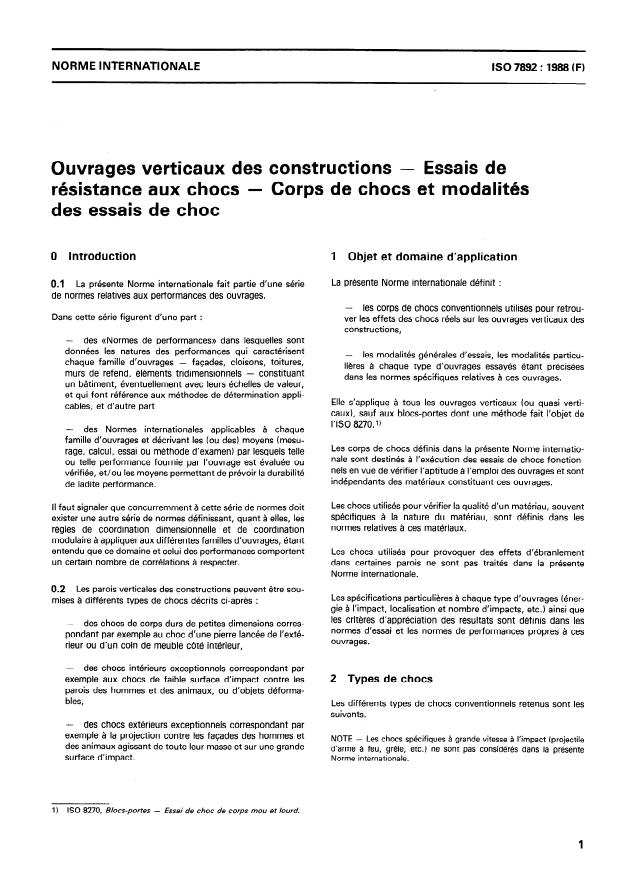
0 Introduction 1 Objet et domaine d’application
La présente Norme internationale définit :
0.1 La présente Norme internationale fait partie d’une série
de normes relatives aux performances des ouvrages.
- les corps de chocs conventionnels utilisés pour retrou-
Dans cette série figurent d’une part :
ver les effets des chocs réels sur les ouvrages verticaux des
constructions,
- des «Normes de performances» dans lesquelles sont
données les natures des performances qui caractérisent
- les modalités générales d’essais, les modalités particu-
chaque famille d’ouvrages - facades, cloisons, toitures,
lières à chaque type d’ouvrages essayés étant précisées
murs de refend, éléments tridimensionnels - constituant
dans les normes spécifiques relatives à ces ouvrages.
un bâtiment, éventuellement avec leurs échelles de valeur,
et qui font référence aux méthodes de détermination appli-
Elle s’applique à tous les ouvrages verticaux (ou quasi verti-
cables, et d’autre part
caux), sauf aux blocs-portes dont une méthode fait l’objet de
I’ISO 8270. ‘1
- des Normes internationales applicables à chaque
famille d’ouvrages et décrivant les (ou des) moyens (mesu-
Les corps de chocs définis dans la présente Norme internatio-
rage, calcul, essai ou méthode d’examen) par lesquels telle
nale sont destinés à l’exécution des essais de chocs fonction-
ou telle performance fournie par l’ouvrage est évaluée ou
nels en vue de vérifier l’aptitude à l’emploi des ouvrages et sont
vérifiée, et/ou les moyens permettant de prévoir la durabilité
indépendants des matériaux constituant ces ouvrages.
de ladite performance.
Les chocs utilisés pour vérifier la qualité d’un matériau, souvent
Il faut signaler que concurremment à cette série de normes doit
spécifiques à la nature du matériau, sont définis dans les
exister une autre série de normes définissant, quant à elles, les
normes relatives à ces matériaux.
règles de coordination dimensionnelle et de ’ coordination
modulaire à appliquer aux différentes familles d’ouvrages, étant
entendu que ce domaine et celui des performances comportent Les chocs utilisés pour provoquer des effets d’ébranlement
un certain nombre de corrélations à respecter. dans certaines parois ne sont pas traités dans la présente
Norme internationale.
0.2 Les parois verticales des constructions peuvent être sou-
Les spécifications particulières à chaque type d’ouvrages (éner-
mises à différents types de chocs décrits ci-après :
gie à l’impact, localisation et nombre d’impacts, etc.) ainsi que
les critères d’appréciation des résultats sont définis dans les
- des chocs de corps durs de petites dimensions corres-
normes d’essai et les normes de performances propres à ces
pondant par exemple au choc d’une pierre lancée de I’exté-
ouvrages.
rieur ou d’un coin de meuble côté intérieur,
- des chocs intérieurs exceptionnels correspondant par
exemple aux chocs de faible surface d’impact contre les 2 Types de chocs
parois des hommes et des animaux, ou d’objets déforma-
bles,
Les différents types de chocs conventionnels retenus sont les
suivants.
- des chocs extérieurs exceptionnels correspondant par
exemple à la projection contre les facades des hommes et
NOTE - Les chocs spécifiques à grande vitesse à l’impact (projectile
des animaux agissant de toute leur masse et sur une grande
d’arme à feu, grêle, etc.) ne sont pas considérés dans la présente
surface d’impact.
Norme internationale.
1) ISO 8270, Blocs-portes - Essai de choc de corps mou et lourd.
ISO 7892 : 1988 (FI
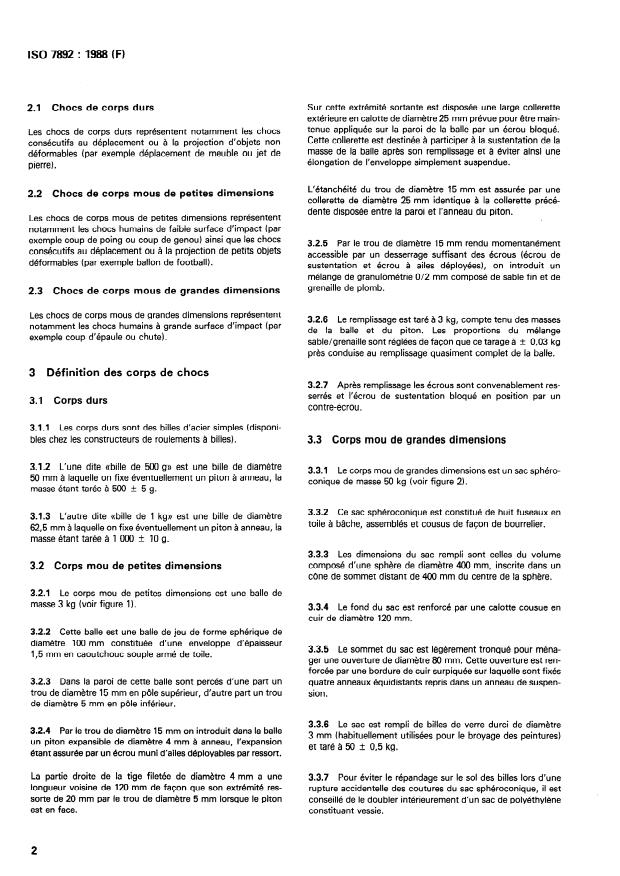
Sur cette extrémité sortante est disposée une large collerette
Chocs de corps durs
21 .
extérieure en calotte de diamètre 25 mm prévue pour être main-
tenue appliquée sur la paroi de la balle par un écrou bloqué.
Les chocs de corps durs représentent notamment les chocs
Cette collerette est destinée à participer à la sustentation de la
consécutifs au déplacement ou à la projection d’objets non
masse de la balle après son remplissage et à éviter ainsi une
déformables (par exemple déplacement de meuble ou jet de
élongation de l’enveloppe simplement suspendue.
pierre).
L’étanchéité du trou de diamètre 15 mm est assurée par une
2.2 Chocs de corps mous de petites dimensions
collerette de diamètre 25 mm identique à la collerette précé-
dente disposée entre la paroi et l’anneau du piton.
Les chocs de corps mous de petites dimensions représentent
notamment les chocs humains de faible surface d’impact (par
exemple coup de poing ou coup de genou) ainsi que les chocs
3.2.5 Par le trou de diamètre 15 mm rendu momentanément
consécutifs au déplacement ou à la projection de petits objets
accessible par un desserrage suffisant des écrous (écrou de
déformables (par exemple ballon de football).
sustentation et écrou à ailes déployées), on introduit un
mélange de granulométrie 0/2 mm composé de sable fin et de
grenaille de plomb.
. Chocs de corps mous de grandes dimensions
Les chocs de corps mous de grandes dimensions représentent
3.2.6 Le remplissage est taré à 3 kg, compte tenu des masses
notamment les chocs humains à grande surface d’impact (par
de la balle et du piton. Les proportions du mélange
exemple coup d’épaule ou chute).
sable/grenaille sont réglées de facon que ce tarage à * 0,03 kg
près conduise au remplissage quasiment complet de la balle.
3 Définition des corps de chocs
3.2.7 Après remplissage les écrous sont convenablement res-
serrés et l’écrou de sustentation bloqué en position par un
3.1 Corps durs
contre-écrou.
des billes d’acier simples (disponi-
3.1.1 Les corps durs sont
bles chez les constructeurs de roulements à billes). . Corps mou de grandes dimensions
3.1.2 L’une dite «bille de 500 g» est une bille de diamètre
Ihéro-
3.3.1 Le corps mou de grandes dimensions est un sac sp
50 mm à laquelle on fixe éventuellement un piton à anneau, la
conique de masse 50 kg (voir figure 2).
masse étant tarée à 500 + 5 g.
3.3.2 Ce sac sphéroconique est constitué de huit fuseaux en
3.1.3 L’autre dite «bille de 1 kg» est une bille de diamètre
toile à
bâche, assemblés et cousus de facon de bourrelier.
62,5 mm à laquelle on fixe éventuellement un piton à anneau, la
masse étant tarée à 1 000 + 10 g.
3.3.3 Les dimensions du sac rempli
...
ISO
NORME INTERNATIONALE
Première édition
1988-08-01
INTERNATIONAL ORGANIZATION FOR STANDARDIZATION
ORGANISATION INTERNATIONALE DE NORMALISATION
MEXflYHAPO~HAfl OPI-AHM3AqMR Il0 CTAH~APTM3A~MM
Ouvrages verticaux des constructions - Essais de
résistance aux chocs - Corps de chocs et modalités
des essais de choc
Vertical building elements - Impact resistance tests - Impact bodies and general test
procedures
Numéro de référence
ISO 7892: 1988 (F)
ISO 7892 : 1988 (F)
Avant-propos
L’ISO (Organisation internationale de normalisation) est une fédération mondiale
d’organismes nationaux de normalisation (comités membres de I’ISO). L’élaboration
des Normes internationales est en général confiée aux comités techniques de I’ISO.
Chaque comité membre intéressé par une étude a le droit de faire partie du comité
technique créé à cet effet. Les organisations internationales, gouvernementales et non
gouvernementales, en liaison avec I’ISO participent également aux travaux. L’ISO col-
labore étroitement avec la Commission électrotechnique internationale KEI) en ce qui
concerne la normalisation électrotechnique.
Les projets de Normes internationales adoptés par les comités techniques sont soumis
aux comités membres pour approbation, avant leur acceptation comme Normes inter-
nationales par le Conseil de I’ISO. Les Normes internationales sont approuvées confor-
mément aux procédures de I’ISO qui requièrent l’approbation de 75 % au moins des
comités membres votants.
La Norme internationale ISO 7892 a été élaborée par le comité technique ISO/TC 59,
Cons truc tion immobilière.
L’attention des utilisateurs est attirée sur le fait que toutes les Normes internationales
sont de temps en temps soumises à révision et que toute référence faite à une autre
Norme internationale dans le présent document implique qu’il s’agit, sauf indication
contraire, de la dernière édition.
0 Organisation internationale de normalisation, 1988
Imprimé en Suisse
NORME INTERNATIONALE
ISO 7892 : 1988 (F)
Ouvrages verticaux des constructions - Essais de
- Corps de chocs et modalités
résistance aux chocs
des essais de choc
0 Introduction 1 Objet et domaine d’application
La présente Norme internationale définit :
0.1 La présente Norme internationale fait partie d’une série
de normes relatives aux performances des ouvrages.
- les corps de chocs conventionnels utilisés pour retrou-
Dans cette série figurent d’une part :
ver les effets des chocs réels sur les ouvrages verticaux des
constructions,
- des «Normes de performances» dans lesquelles sont
données les natures des performances qui caractérisent
- les modalités générales d’essais, les modalités particu-
chaque famille d’ouvrages - facades, cloisons, toitures,
lières à chaque type d’ouvrages essayés étant précisées
murs de refend, éléments tridimensionnels - constituant
dans les normes spécifiques relatives à ces ouvrages.
un bâtiment, éventuellement avec leurs échelles de valeur,
et qui font référence aux méthodes de détermination appli-
Elle s’applique à tous les ouvrages verticaux (ou quasi verti-
cables, et d’autre part
caux), sauf aux blocs-portes dont une méthode fait l’objet de
I’ISO 8270. ‘1
- des Normes internationales applicables à chaque
famille d’ouvrages et décrivant les (ou des) moyens (mesu-
Les corps de chocs définis dans la présente Norme internatio-
rage, calcul, essai ou méthode d’examen) par lesquels telle
nale sont destinés à l’exécution des essais de chocs fonction-
ou telle performance fournie par l’ouvrage est évaluée ou
nels en vue de vérifier l’aptitude à l’emploi des ouvrages et sont
vérifiée, et/ou les moyens permettant de prévoir la durabilité
indépendants des matériaux constituant ces ouvrages.
de ladite performance.
Les chocs utilisés pour vérifier la qualité d’un matériau, souvent
Il faut signaler que concurremment à cette série de normes doit
spécifiques à la nature du matériau, sont définis dans les
exister une autre série de normes définissant, quant à elles, les
normes relatives à ces matériaux.
règles de coordination dimensionnelle et de ’ coordination
modulaire à appliquer aux différentes familles d’ouvrages, étant
entendu que ce domaine et celui des performances comportent Les chocs utilisés pour provoquer des effets d’ébranlement
un certain nombre de corrélations à respecter. dans certaines parois ne sont pas traités dans la présente
Norme internationale.
0.2 Les parois verticales des constructions peuvent être sou-
Les spécifications particulières à chaque type d’ouvrages (éner-
mises à différents types de chocs décrits ci-après :
gie à l’impact, localisation et nombre d’impacts, etc.) ainsi que
les critères d’appréciation des résultats sont définis dans les
- des chocs de corps durs de petites dimensions corres-
normes d’essai et les normes de performances propres à ces
pondant par exemple au choc d’une pierre lancée de I’exté-
ouvrages.
rieur ou d’un coin de meuble côté intérieur,
- des chocs intérieurs exceptionnels correspondant par
exemple aux chocs de faible surface d’impact contre les 2 Types de chocs
parois des hommes et des animaux, ou d’objets déforma-
bles,
Les différents types de chocs conventionnels retenus sont les
suivants.
- des chocs extérieurs exceptionnels correspondant par
exemple à la projection contre les facades des hommes et
NOTE - Les chocs spécifiques à grande vitesse à l’impact (projectile
des animaux agissant de toute leur masse et sur une grande
d’arme à feu, grêle, etc.) ne sont pas considérés dans la présente
surface d’impact.
Norme internationale.
1) ISO 8270, Blocs-portes - Essai de choc de corps mou et lourd.
ISO 7892 : 1988 (FI
Sur cette extrémité sortante est disposée une large collerette
Chocs de corps durs
21 .
extérieure en calotte de diamètre 25 mm prévue pour être main-
tenue appliquée sur la paroi de la balle par un écrou bloqué.
Les chocs de corps durs représentent notamment les chocs
Cette collerette est destinée à participer à la sustentation de la
consécutifs au déplacement ou à la projection d’objets non
masse de la balle après son remplissage et à éviter ainsi une
déformables (par exemple déplacement de meuble ou jet de
élongation de l’enveloppe simplement suspendue.
pierre).
L’étanchéité du trou de diamètre 15 mm est assurée par une
2.2 Chocs de corps mous de petites dimensions
collerette de diamètre 25 mm identique à la collerette précé-
dente disposée entre la paroi et l’anneau du piton.
Les chocs de corps mous de petites dimensions représentent
notamment les chocs humains de faible surface d’impact (par
exemple coup de poing ou coup de genou) ainsi que les chocs
3.2.5 Par le trou de diamètre 15 mm rendu momentanément
consécutifs au déplacement ou à la projection de petits objets
accessible par un desserrage suffisant des écrous (écrou de
déformables (par exemple ballon de football).
sustentation et écrou à ailes déployées), on introduit un
mélange de granulométrie 0/2 mm composé de sable fin et de
grenaille de plomb.
. Chocs de corps mous de grandes dimensions
Les chocs de corps mous de grandes dimensions représentent
3.2.6 Le remplissage est taré à 3 kg, compte tenu des masses
notamment les chocs humains à grande surface d’impact (par
de la balle et du piton. Les proportions du mélange
exemple coup d’épaule ou chute).
sable/grenaille sont réglées de facon que ce tarage à * 0,03 kg
près conduise au remplissage quasiment complet de la balle.
3 Définition des corps de chocs
3.2.7 Après remplissage les écrous sont convenablement res-
serrés et l’écrou de sustentation bloqué en position par un
3.1 Corps durs
contre-écrou.
des billes d’acier simples (disponi-
3.1.1 Les corps durs sont
bles chez les constructeurs de roulements à billes). . Corps mou de grandes dimensions
3.1.2 L’une dite «bille de 500 g» est une bille de diamètre
Ihéro-
3.3.1 Le corps mou de grandes dimensions est un sac sp
50 mm à laquelle on fixe éventuellement un piton à anneau, la
conique de masse 50 kg (voir figure 2).
masse étant tarée à 500 + 5 g.
3.3.2 Ce sac sphéroconique est constitué de huit fuseaux en
3.1.3 L’autre dite «bille de 1 kg» est une bille de diamètre
toile à
bâche, assemblés et cousus de facon de bourrelier.
62,5 mm à laquelle on fixe éventuellement un piton à anneau, la
masse étant tarée à 1 000 + 10 g.
3.3.3 Les dimensions du sac rempli
...