

IEC 61496-1:2012
(Main)Safety of machinery - Electro-sensitive protective equipment - Part 1: General requirements and tests
General Information
- Abstract
IEC 61496-1:2012 specifies general requirements for the design, construction and testing of non-contact electro-sensitive protective equipment (ESPE) designed specifically to detect persons as part of a safety related system. Special attention is directed to functional and design requirements that ensure an appropriate safety-related performance is achieved. An ESPE may include optional safety-related functions, the requirements for which are given in Annex A. This third edition cancels and replaces the second edition published in 2004 and its amendment 1 (2007). The main changes with respect to the previous edition are as follows: The design, test and verification requirements have been updated to make them consistent with the latest standards for functional safety and EMC. The contents of the corrigendum of April 2015 have been included in this copy.
- Status
- Published
- Publication Date
- 04-Apr-2012
- Technical Committee
- TC 44 - Safety of machinery - Electrotechnical aspects
- Current Stage
- DELPUB - Deleted Publication
- Start Date
- 14-Jul-2020
- Completion Date
- 31-May-2018
Overview
IEC 61496-1:2012 is an international standard developed by the International Electrotechnical Commission (IEC) that specifies the general requirements and testing methods for electro-sensitive protective equipment (ESPE). This standard addresses the safety of machinery through the use of non-contact ESPE designed specifically to detect the presence of persons as a part of safety-related control systems. The third edition of IEC 61496-1 updates design, testing, and verification requirements to align with the latest standards in functional safety and electromagnetic compatibility (EMC).
The standard ensures that ESPE devices meet rigorous functional and design criteria to achieve appropriate safety performance levels, enhancing the protection of personnel around hazardous machinery. Optional safety-related functions are described in Annex A, providing guidelines for extended features.
Key Topics
Functional Requirements
IEC 61496-1 details how ESPE systems must perform under normal operation, including the sensing functions that enable detection of personnel. It categorizes ESPE types and associates each with required safety performance levels, such as Performance Level (PL) and Safety Integrity Level (SIL).Design Requirements
The standard outlines specifications concerning electrical supply, fault detection mechanisms, electrical and non-electrical components, output signal switching devices (OSSD), indicators, and adjustment means. It also addresses the design to minimize common cause failures and the integration of programmable or complex integrated circuits with emphasis on software and functional design.Environmental Requirements
To ensure reliable operation in diverse environments, IEC 61496-1 covers ambient temperature and humidity ranges, electrical disturbances (including EMC), mechanical influences, and enclosure protections.Testing Procedures
Comprehensive testing protocols are defined, including type tests, functional tests (response time, sensing function), performance under fault conditions, environmental tests, and verification of programmable components. These tests validate conformity to safety and performance criteria.Marking and Documentation
Requirements for clear marking for identification and safe use are prescribed, including power supply indications, adjustment controls, enclosure information, and durability of markings. Accompanying documentation must facilitate safe installation, operation, and maintenance.
Applications
IEC 61496-1:2012 applies to a broad range of industrial settings where machinery safety is critical, including:
Manufacturing Automation
Integration of ESPE such as light curtains and safety scanners to prevent access to hazardous zones while machinery is in operation.Robotics and Assembly Lines
Providing safety barriers that detect human entry without physical contact, allowing machines to halt processes immediately to prevent accidents.Material Handling Equipment
Ensuring worker safety around automated conveyors, lifting devices, and packaging machines by detecting human presence.Electromechanical Systems
Deployment of ESPE in machine guarding applications to comply with safety regulations and reduce workplace injuries.
The standard helps manufacturers, safety engineers, and compliance officers design, evaluate, and certify ESPE systems that enhance workplace safety in line with international best practices.
Related Standards
IEC 61496-1 forms part of the IEC 61496 series on electro-sensitive protective equipment and is designed to complement other key safety and functional standards, including:
IEC 61508 – Functional safety of electrical/electronic/programmable electronic safety-related systems, providing foundational principles applicable to ESPE.
IEC 62061 – Safety of machinery – Functional safety of safety-related electrical, electronic, and programmable electronic control systems.
ISO 13849-1 – Safety-related parts of control systems, focusing on performance levels related to machinery safety.
EMC Standards (e.g., IEC 61000 series) – Addressing electromagnetic compatibility considerations critical for ESPE function and testing.
Adherence to IEC 61496-1 and its related standards helps ensure comprehensive safety integration in machinery systems worldwide.
Keywords: IEC 61496-1, electro-sensitive protective equipment, ESPE, safety of machinery, non-contact safety devices, functional safety, EMC, performance level, safety integrity level, machinery safety standards, industrial safety, machine guarding, safety testing, programmable safety systems.
Relations
- Referred By
EN ISO 19085-1:2021 - Woodworking machines - Safety - Part 1: Common requirements (ISO 19085-1:2021) - Effective Date
- 09-Feb-2026
- Effective Date
- 09-Feb-2026
- Effective Date
- 09-Feb-2026
- Effective Date
- 09-Feb-2026
- Effective Date
- 09-Feb-2026
- Effective Date
- 09-Feb-2026
- Referred By
EN ISO 19085-1:2017 - Woodworking machines - Safety - Part 1: Common requirements (ISO 19085-1:2017) - Effective Date
- 09-Feb-2026
- Effective Date
- 05-Sep-2023
- Effective Date
- 05-Sep-2023
- Effective Date
- 05-Sep-2023
- Effective Date
- 05-Sep-2023
- Effective Date
- 05-Sep-2023
- Effective Date
- 05-Sep-2023
Get Certified
Connect with accredited certification bodies for this standard

IMQ S.p.A. (Certification)
Italian electrical product certification.

SLG Prüf- und Zertifizierungs GmbH
German testing and certification body.

UL Solutions
Global safety science company with testing, inspection and certification.
Sponsored listings
Frequently Asked Questions
IEC 61496-1:2012 is a standard published by the International Electrotechnical Commission (IEC). Its full title is "Safety of machinery - Electro-sensitive protective equipment - Part 1: General requirements and tests". This standard covers: IEC 61496-1:2012 specifies general requirements for the design, construction and testing of non-contact electro-sensitive protective equipment (ESPE) designed specifically to detect persons as part of a safety related system. Special attention is directed to functional and design requirements that ensure an appropriate safety-related performance is achieved. An ESPE may include optional safety-related functions, the requirements for which are given in Annex A. This third edition cancels and replaces the second edition published in 2004 and its amendment 1 (2007). The main changes with respect to the previous edition are as follows: The design, test and verification requirements have been updated to make them consistent with the latest standards for functional safety and EMC. The contents of the corrigendum of April 2015 have been included in this copy.
IEC 61496-1:2012 specifies general requirements for the design, construction and testing of non-contact electro-sensitive protective equipment (ESPE) designed specifically to detect persons as part of a safety related system. Special attention is directed to functional and design requirements that ensure an appropriate safety-related performance is achieved. An ESPE may include optional safety-related functions, the requirements for which are given in Annex A. This third edition cancels and replaces the second edition published in 2004 and its amendment 1 (2007). The main changes with respect to the previous edition are as follows: The design, test and verification requirements have been updated to make them consistent with the latest standards for functional safety and EMC. The contents of the corrigendum of April 2015 have been included in this copy.
IEC 61496-1:2012 is classified under the following ICS (International Classification for Standards) categories: 13.110 - Safety of machinery; 29.260.99 - Other electrical equipment for working in special conditions. The ICS classification helps identify the subject area and facilitates finding related standards.
IEC 61496-1:2012 has the following relationships with other standards: It is inter standard links to EN ISO 19085-1:2021, EN ISO 20430:2020, EN ISO 13482:2014, EN ISO 10218-2:2011, EN ISO 16092-1:2018, EN ISO 11111-1:2016, EN ISO 19085-1:2017, IEC 61496-1:2012/COR1:2015, IEC 61496-1:2004/AMD1:2007, IEC 61496-1:2004/COR1:2008, IEC 61496-1:2020, IEC 61496-1:2004, IEC 61496-1:2004/COR2:2008. Understanding these relationships helps ensure you are using the most current and applicable version of the standard.
IEC 61496-1:2012 is available in PDF format for immediate download after purchase. The document can be added to your cart and obtained through the secure checkout process. Digital delivery ensures instant access to the complete standard document.
Standards Content (Sample)
IEC 61496-1 ®
Edition 3.0 2012-04
INTERNATIONAL
STANDARD
NORME
INTERNATIONALE
Safety of machinery – Electro-sensitive protective equipment –
Part 1: General requirements and tests
Sécurité des machines – Equipements de protection électro-sensibles –
Partie 1: Prescriptions générales et essais
All rights reserved. Unless otherwise specified, no part of this publication may be reproduced or utilized in any form
or by any means, electronic or mechanical, including photocopying and microfilm, without permission in writing from
either IEC or IEC's member National Committee in the country of the requester.
If you have any questions about IEC copyright or have an enquiry about obtaining additional rights to this publication,
please contact the address below or your local IEC member National Committee for further information.
Droits de reproduction réservés. Sauf indication contraire, aucune partie de cette publication ne peut être reproduite ni
utilisée sous quelque forme que ce soit et par aucun procédé, électronique ou mécanique, y compris la photocopie et les
microfilms, sans l'accord écrit de la CEI ou du Comité national de la CEI du pays du demandeur.
Si vous avez des questions sur le copyright de la CEI ou si vous désirez obtenir des droits supplémentaires sur cette
publication, utilisez les coordonnées ci-après ou contactez le Comité national de la CEI de votre pays de résidence.
IEC Central Office Tel.: +41 22 919 02 11
3, rue de Varembé Fax: +41 22 919 03 00
CH-1211 Geneva 20 info@iec.ch
Switzerland www.iec.ch
About the IEC
The International Electrotechnical Commission (IEC) is the leading global organization that prepares and publishes
International Standards for all electrical, electronic and related technologies.
About IEC publications
The technical content of IEC publications is kept under constant review by the IEC. Please make sure that you have the
latest edition, a corrigenda or an amendment might have been published.
Useful links:
IEC publications search - www.iec.ch/searchpub Electropedia - www.electropedia.org
The advanced search enables you to find IEC publications The world's leading online dictionary of electronic and
by a variety of criteria (reference number, text, technical electrical terms containing more than 30 000 terms and
committee,…). definitions in English and French, with equivalent terms in
It also gives information on projects, replaced and additional languages. Also known as the International
withdrawn publications. Electrotechnical Vocabulary (IEV) on-line.
IEC Just Published - webstore.iec.ch/justpublished Customer Service Centre - webstore.iec.ch/csc
Stay up to date on all new IEC publications. Just Published If you wish to give us your feedback on this publication
details all new publications released. Available on-line and or need further assistance, please contact the
also once a month by email. Customer Service Centre: csc@iec.ch.
A propos de la CEI
La Commission Electrotechnique Internationale (CEI) est la première organisation mondiale qui élabore et publie des
Normes internationales pour tout ce qui a trait à l'électricité, à l'électronique et aux technologies apparentées.
A propos des publications CEI
Le contenu technique des publications de la CEI est constamment revu. Veuillez vous assurer que vous possédez
l’édition la plus récente, un corrigendum ou amendement peut avoir été publié.
Liens utiles:
Recherche de publications CEI - www.iec.ch/searchpub Electropedia - www.electropedia.org
La recherche avancée vous permet de trouver des Le premier dictionnaire en ligne au monde de termes
publications CEI en utilisant différents critères (numéro de électroniques et électriques. Il contient plus de 30 000
référence, texte, comité d’études,…). termes et définitions en anglais et en français, ainsi que
Elle donne aussi des informations sur les projets et les les termes équivalents dans les langues additionnelles.
publications remplacées ou retirées. Egalement appelé Vocabulaire Electrotechnique
International (VEI) en ligne.
Just Published CEI - webstore.iec.ch/justpublished
Service Clients - webstore.iec.ch/csc
Restez informé sur les nouvelles publications de la CEI.
Just Published détaille les nouvelles publications parues. Si vous désirez nous donner des commentaires sur
Disponible en ligne et aussi une fois par mois par email. cette publication ou si vous avez des questions
contactez-nous: csc@iec.ch.
IEC 61496-1 ®
Edition 3.0 2012-04
INTERNATIONAL
STANDARD
NORME
INTERNATIONALE
Safety of machinery – Electro-sensitive protective equipment –
Part 1: General requirements and tests
Sécurité des machines – Equipements de protection électro-sensibles –
Partie 1: Prescriptions générales et essais
INTERNATIONAL
ELECTROTECHNICAL
COMMISSION
COMMISSION
ELECTROTECHNIQUE
PRICE CODE
INTERNATIONALE
XA
CODE PRIX
ICS 13.110; 29.260.99 ISBN 978-2-8322-0061-2
– 2 – 61496-1 © IEC:2012
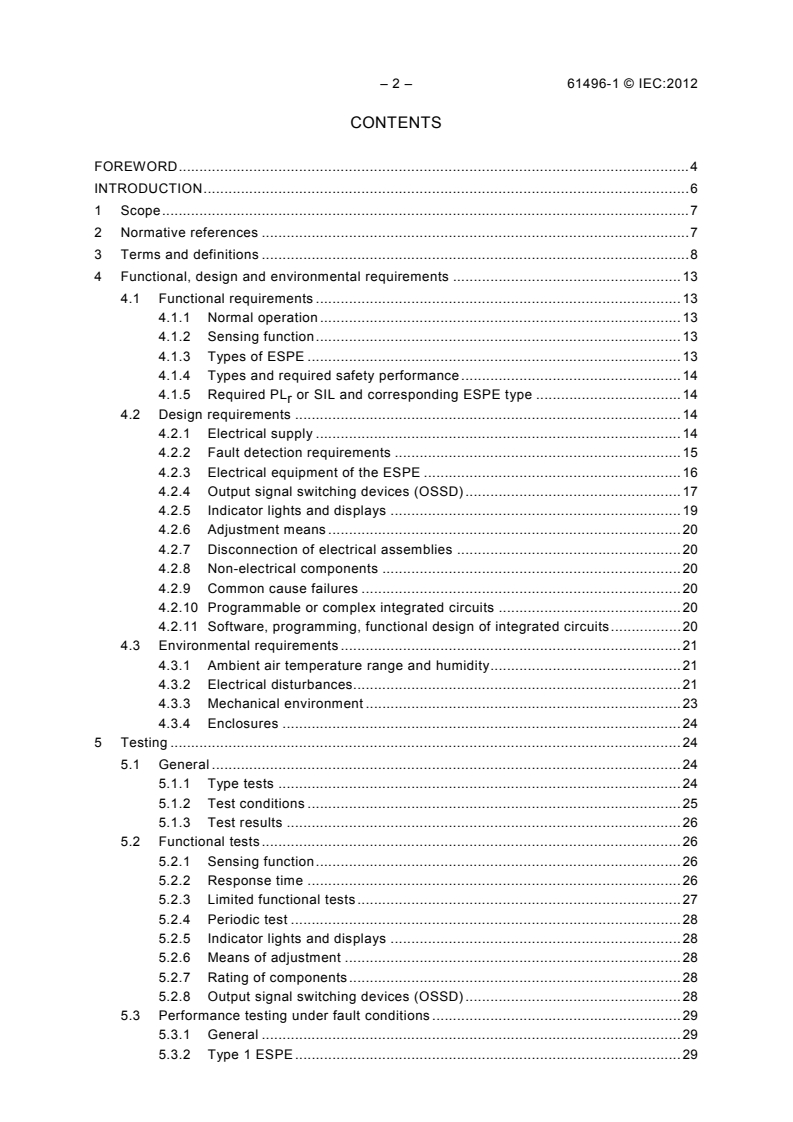
CONTENTS
FOREWORD . 4
INTRODUCTION . 6
1 Scope . 7
2 Normative references . 7
3 Terms and definitions . 8
4 Functional, design and environmental requirements . 13
4.1 Functional requirements . 13
4.1.1 Normal operation . 13
4.1.2 Sensing function . 13
4.1.3 Types of ESPE . 13
4.1.4 Types and required safety performance . 14
4.1.5 Required PL or SIL and corresponding ESPE type . 14
r
4.2 Design requirements . 14
4.2.1 Electrical supply . 14
4.2.2 Fault detection requirements . 15
4.2.3 Electrical equipment of the ESPE . 16
4.2.4 Output signal switching devices (OSSD) . 17
4.2.5 Indicator lights and displays . 19
4.2.6 Adjustment means . 20
4.2.7 Disconnection of electrical assemblies . 20
4.2.8 Non-electrical components . 20
4.2.9 Common cause failures . 20
4.2.10 Programmable or complex integrated circuits . 20
4.2.11 Software, programming, functional design of integrated circuits . 20
4.3 Environmental requirements . 21
4.3.1 Ambient air temperature range and humidity . 21
4.3.2 Electrical disturbances. 21
4.3.3 Mechanical environment . 23
4.3.4 Enclosures . 24
5 Testing . 24
5.1 General . 24
5.1.1 Type tests . 24
5.1.2 Test conditions . 25
5.1.3 Test results . 26
5.2 Functional tests . 26
5.2.1 Sensing function . 26
5.2.2 Response time . 26
5.2.3 Limited functional tests . 27
5.2.4 Periodic test . 28
5.2.5 Indicator lights and displays . 28
5.2.6 Means of adjustment . 28
5.2.7 Rating of components . 28
5.2.8 Output signal switching devices (OSSD) . 28
5.3 Performance testing under fault conditions . 29
5.3.1 General . 29
5.3.2 Type 1 ESPE . 29
61496-1 © IEC:2012 – 3 –
5.3.3 Type 2 ESPE . 29
5.3.4 Type 3 ESPE . 29
5.3.5 Type 4 ESPE . 30
5.4 Environmental tests . 30
5.4.1 Rated supply voltage . 30
5.4.2 Ambient temperature variation and humidity . 30
5.4.3 Effects of electrical disturbances . 31
5.4.4 Mechanical influences . 33
5.4.5 Enclosures . 33
5.5 Validation of programmable or complex integrated circuits . 33
5.5.1 General . 33
5.5.2 Complex or programmable integrated circuits . 34
5.5.3 Software, programming, functional design of integrated circuits . 34
5.5.4 Test results analysis statement . 34
6 Marking for identification and for safe use . 34
6.1 General . 34
6.2 ESPE supplied from a dedicated power supply . 35
6.3 ESPE supplied from an internal electrical power source . 35
6.4 Adjustment . 35
6.5 Enclosures . 35
6.6 Control devices . 35
6.7 Terminal markings . 35
6.8 Marking durability . 36
7 Accompanying documents . 36
Annex A (normative) Optional functions of the ESPE . 39
Annex B (normative) Catalogue of single faults affecting the electrical equipment of
the ESPE, to be applied as specified in 5.3 . 46
Annex C (informative) Conformity assessment . 47
Bibliography . 48
Index . 49
Figure 1 – Examples of ESPEs using safety-related communication interfaces . 19
Figure 2 – Test setup for the EMC test of ESPEs with safety-related communication
interfaces . 26
Table 1 – Types and required safety performance . 14
Table 2 – Required PL or SIL and corresponding ESPE type . 14
r
Table 4 – Supply voltage interruptions . 21
– 4 – 61496-1 © IEC:2012
INTERNATIONAL ELECTROTECHNICAL COMMISSION
___________
SAFETY OF MACHINERY –
ELECTRO-SENSITIVE PROTECTIVE EQUIPMENT –
Part 1: General requirements and tests
FOREWORD
1) The International Electrotechnical Commission (IEC) is a worldwide organization for standardization comprising
all national electrotechnical committees (IEC National Committees). The object of IEC is to promote
international co-operation on all questions concerning standardization in the electrical and electronic fields. To
this end and in addition to other activities, IEC publishes International Standards, Technical Specifications,
Technical Reports, Publicly Available Specifications (PAS) and Guides (hereafter referred to as “IEC
Publication(s)”). Their preparation is entrusted to technical committees; any IEC National Committee interested
in the subject dealt with may participate in this preparatory work. International, governmental and non-
governmental organizations liaising with the IEC also participate in this preparation. IEC collaborates closely
with the International Organization for Standardization (ISO) in accordance with conditions determined by
agreement between the two organizations.
2) The formal decisions or agreements of IEC on technical matters express, as nearly as possible, an international
consensus of opinion on the relevant subjects since each technical committee has representation from all
interested IEC National Committees.
3) IEC Publications have the form of recommendations for international use and are accepted by IEC National
Committees in that sense. While all reasonable efforts are made to ensure that the technical content of IEC
Publications is accurate, IEC cannot be held responsible for the way in which they are used or for any
misinterpretation by any end user.
4) In order to promote international uniformity, IEC National Committees undertake to apply IEC Publications
transparently to the maximum extent possible in their national and regional publications. Any divergence
between any IEC Publication and the corresponding national or regional publication shall be clearly indicated in
the latter.
5) IEC itself does not provide any attestation of conformity. Independent certification bodies provide conformity
assessment services and, in some areas, access to IEC marks of conformity. IEC is not responsible for any
services carried out by independent certification bodies.
6) All users should ensure that they have the latest edition of this publication.
7) No liability shall attach to IEC or its directors, employees, servants or agents including individual experts and
members of its technical committees and IEC National Committees for any personal injury, property damage or
other damage of any nature whatsoever, whether direct or indirect, or for costs (including legal fees) and
expenses arising out of the publication, use of, or reliance upon, this IEC Publication or any other IEC
Publications.
8) Attention is drawn to the Normative references cited in this publication. Use of the referenced publications is
indispensable for the correct application of this publication.
9) Attention is drawn to the possibility that some of the elements of this IEC Publication may be the subject of
patent rights. IEC shall not be held responsible for identifying any or all such patent rights.
International Standard IEC 61496-1 has been prepared by IEC technical committee 44:
Safety of machinery – Electrotechnical aspects.
This third edition cancels and replaces the second edition published in 2004 and its
amendment 1 (2007). The document 44/615/CDV, circulated to the National Committees as
amendment 2, led to the publication of this new edition.
The main changes with respect to the previous edition are as follows: The design, test and
verification requirements have been updated to make them consistent with the latest
standards for functional safety and EMC.
61496-1 © IEC:2012 – 5 –
The text of this standard is based on the following documents:
CDV Report on voting
44/615/CDV 44/641/RVC
Full information on the voting for the approval of this standard can be found in the report on
voting indicated in the above table.
This publication has been drafted in accordance with the ISO/IEC Directives, Part 2.
A list of all the parts in the IEC 61496 series, published under the general title Safety of
machinery – Electro-sensitive protective equipment, can be found on the IEC website.
A vertical line in the margin shows where the base publication has been modified by
amendment 2.
The committee has decided that the contents of this publication will remain unchanged until
the stability date indicated on the IEC web site under "http://webstore.iec.ch" in the data
related to the specific publication. At this date, the publication will be
• reconfirmed,
• withdrawn,
• replaced by a revised edition, or
• amended.
The contents of the corrigendum of April 2015 have been included in this copy.
– 6 – 61496-1 © IEC:2012
INTRODUCTION
An electro-sensitive protective equipment (ESPE) is applied to machinery presenting a risk of
personal injury. It provides protection by causing the machine to revert to a safe condition
before a person can be placed in a hazardous situation.
This part of IEC 61496 provides general design and performance requirements of ESPEs for
use over a broad range of applications. Essential features of equipment meeting the
requirements of this standard are the appropriate level of safety-related performance provided
and the built-in periodic functional checks/self-checks that are specified to ensure that this
level of performance is maintained.
Each type of machine presents its own particular hazards and it is not the purpose of this
standard to recommend the manner of application of the ESPE to any particular machine. The
application of the ESPE should be a matter for agreement between the equipment supplier,
the machine user and the enforcing authority, and in this context attention is drawn to the
relevant guidance established internationally, for example ISO 12100.
This part of IEC 61496 specifies technical requirements of electro-sensitive protective
equipment. The application of this standard may require the use of substances and/or test
procedures that could be injurious to health unless adequate precautions are taken.
Conformance with this standard in no way absolves either the supplier or the user from
statutory obligations relating to the safety and health of persons during the use of the
equipment covered by this standard.
Due to the complexity of the technology used to implement ESPEs, there are many issues
that are highly dependent on analysis and expertise in specific test and measurement
techniques. In order to provide a high level of confidence, independent review by relevant
experts is recommended.
61496-1 © IEC:2012 – 7 –
SAFETY OF MACHINERY –
ELECTRO-SENSITIVE PROTECTIVE EQUIPMENT –
Part 1: General requirements and tests
1 Scope
This part of IEC 61496 specifies general requirements for the design, construction and testing
of non-contact electro-sensitive protective equipment (ESPE) designed specifically to detect
persons as part of a safety related system. Special attention is directed to functional and
design requirements that ensure an appropriate safety-related performance is achieved. An
ESPE may include optional safety-related functions, the requirements for which are given in
Annex A.
The particular requirements for specific types of sensing function are given in other parts of
this standard.
This standard does not specify the dimensions or configuration of the detection zone and its
disposition in relation to hazards in any particular application, nor what constitutes a
hazardous state of any machine. It is restricted to the functioning of the ESPE and how it
interfaces with the machine.
While a data interface can be used to control optional safety-related ESPE functions
(Annex A), this standard does not provide specific requirements. Requirements for these
safety-related functions can be determined by consulting other standards (for example,
IEC 61508, IEC/TS 62046, IEC 62061, and ISO13849-1).
This standard may be relevant to applications other than those for the protection of persons,
for example for the protection of machinery or products from mechanical damage. In those
applications, different requirements can be necessary, for example when the materials that
have to be recognized by the sensing function have different properties from those of
persons.
This standard does not deal with electromagnetic compatibility (EMC) emission requirements.
2 Normative references
The following documents, in whole or in part, are normatively referenced in this document and
are indispensable for its application. For dated references, only the edition cited applies. For
undated references, the latest edition of the referenced document (including any
amendments) applies.
IEC 60068-2-6, Environmental testing – Part 2-6: Tests – Test Fc: Vibration (sinusoidal)
IEC 60068-2-27, Environmental testing – Part 2-27: Tests – Test Ea and guidance: Shock
IEC 60204-1:2009, Safety of machinery – Electrical equipment of machines – Part 1: General
requirements
IEC 60445, Basic and safety principles for man-machine interface, marking and identification
– Identification of equipment terminals, conductor terminations and conductors
IEC 60447, Basic and safety principles for man-machine interface, marking and identification
– Actuating principles
– 8 – 61496-1 © IEC:2012
IEC 60529, Degrees of protection provided by enclosures (IP code)
IEC 60947-1:2011, Low-voltage switchgear and controlgear – Part 1: General rules
IEC 61000-4-2, Electromagnetic compatibility (EMC) – Part 4-2: Testing and measurement
techniques – Electrostatic discharge immunity test
IEC 61000-4-3, Electromagnetic compatibility (EMC) – Part 4-3: Testing and measurement
techniques – Radiated, radio-frequency, electromagnetic field immunity test
IEC 61000-4-4:2004, Electromagnetic compatibility (EMC) – Part 4: Testing and measurement
techniques – Section 4: Electrical fast transient/burst immunity test
IEC 61000-4-5:2005, Electromagnetic compatibility (EMC) – Part 4-5: Testing and
measurement techniques – Surge immunity test
IEC 61000-4-6, Electromagnetic compatibility (EMC) – Part 4-6: Testing and measurement
techniques – Immunity to conducted disturbances, induced by radio-frequency fields
IEC 61000-6-2, Electromagnetic compatibility (EMC) – Part 6-2: Generic standards –
Immunity for industrial environments
IEC 61131-2:2007, Programmable controllers – Part 2: Equipment requirements and tests
IEC 61508 (all parts), Functional safety of electrical/electronic/programmable electronic
safety-related systems
IEC 62061, Safety of machinery – Functional safety of safety-related electrical, electronic and
programmable electronic control systems
IEC/TS 62046, Safety of machinery – Application of protective equipment to detect the
presence of persons
ISO 9001, Quality management systems – Requirements
ISO 12100:2010, Safety of machinery – General principles for design – Risk assessment and
risk reduction
ISO 13849-1, Safety of machinery – Safety-related parts of control systems – Part 1: General
principles for design
ISO 13849-2:2003, Safety of machinery – Safety-related parts of control systems – Part 2:
Validation
3 Terms and definitions
For the purposes of this document, the following terms and definitions apply.
NOTE The index lists, in alphabetical order, the terms and acronyms defined in Clause 3 and indicates where
they are used in the text of this part.
3.1
blanking
optional function that permits an object of a size greater than the detection capability of the
ESPE to be located within the detection zone without causing an OFF-state of the OSSD(s)
Note 1 to entry: Fixed blanking is a technique wherein the locations of the blanked areas of the detection zone do
not change during operation. The detection capability of the other parts of the detection zone remains unchanged.
Note 2 to entry: Floating blanking is a technique wherein the blanked area of the detection zone follows the
location of a moving object(s) during operation. The detection capability of the other areas remains unchanged.
61496-1 © IEC:2012 – 9 –
3.2
controlling/monitoring device
part of the electro-sensitive protective equipment (ESPE) that:
– receives and processes information from the sensing device and provides signals to the
output signal switching devices (OSSD),
– monitors the sensing device and the OSSD
3.3
detection capability
sensing function parameter limit specified by the supplier that will cause actuation of the
electro-sensitive protective equipment (ESPE)
3.4
detection zone
zone within which a specified test piece will be detected by the electro-sensitive protective
equipment (ESPE)
3.5
electro-sensitive protective equipment
ESPE
assembly of devices and/or components working together for protective tripping or presence-
sensing purposes and comprising as a minimum
– a sensing device;
– controlling/monitoring devices;
– output signal switching devices and/or a safety-related data interface
Note 1 to the entry: The safety-related control system associated with the ESPE, or the ESPE itself, may further
include a secondary switching device, muting functions, stopping performance monitor, etc. (see Annex A).
Note 2 to entry: A safety-related communication interface can be integrated in the same enclosure as the ESPE.
3.6
external device monitoring
EDM
means by which the electro-sensitive protective equipment (ESPE) monitors the state of
control devices which are external to the ESPE
3.7
failure
termination of the ability of an item to perform a required function
[SOURCE: IEC 60050-191:1990, 191-04-01, modified]
Note 1 to entry: After failure the item has a fault.
Note 2 to entry: 'Failure' is an event, as distinguished from 'fault', which is a state.
Note 3 to entry: This concept, as defined, does not apply to items consisting of software only.
Note 4 to entry: In practice, the terms fault and failure are often used synonymously.
3.8
failure to danger
failure which prevents or delays all output signal switching devices going to, and/or remaining
in the OFF-state in response to a condition which, in normal operation, would result in their so
doing
– 10 – 61496-1 © IEC:2012
3.9
fault
state of an item characterized by inability to perform a required function, excluding the
inability during preventive maintenance or other planned actions, or due to lack of external
resources
[SOURCE: IEC 60050-191:1990, 191-05-01]
Note 1 to entry: A fault is often the result of a failure of the item itself, but may exist without prior failure.
Note 2 to entry: In English the term “fault” and its definition are identical with those given in IEV 191-05-01. In the
field of machinery, the French term “défaut” and the German term “Fehler” are used rather than the terms “panne”
and “Fehlzustand” that appear with this definition.
3.10
final switching device
FSD
component of the machine's safety-related control system that interrupts the circuit to the
machine primary control element (MPCE) when the output signal switching device (OSSD)
goes to the OFF-state
3.11
integrated circuit – complex or programmable
monolithic, hybrid or module circuit which satisfies one or more of the criteria below:
a) more than 1 000 gates are used in the digital mode,
b) more than 24 functionally different external electrical connections are available for use;
c) the functions can be programmed
Note 1 to entry: Examples include ASICs, ROMs, PROMs, EPROMs, PALs, CPUs, PLAs, and PLDs.
Note 2 to entry: The circuits may function in the analogue mode, the digital mode, or a combination of the two
modes.
3.12
integrated circuit – simple
monolithic, hybrid or module circuit which satisfies none of the criteria in 3.11
Note 1 to entry: Examples are SSI or MSI logic ICs, comparators.
Note 2 to entry: The circuits may function in the analogue mode, in the digital mode, or in a combination of the
two modes.
3.13
lock-out condition
condition, initiated by a fault, preventing normal operation of the electro-sensitive protective
equipment (ESPE). All output signal switching devices (OSSDs) and, where applicable, all
secondary switching devices (SSDs) are signalled to go to the OFF-state
3.14
machine primary control element
MPCE
electrically powered element that directly controls the normal operation of a machine in such a
way that it is the last element (in time) to function when machine operation is to be initiated or
arrested
Note 1 to entry: This element can be, for example, a mains contactor, a magnetic clutch or an electrically
operated hydraulic valve.
61496-1 © IEC:2012 – 11 –
3.15
machine secondary control element
MSCE
machine control element, independent of the machine primary control element(s), that is
capable of removing the source of power from the prime mover of the relevant hazardous
parts
Note 1 to entry: When fitted, the MSCE is normally controlled by the secondary switching device (SSD).
Note 2 to entry: This element can be, for example, a mains contactor, a magnetic clutch or an electrically
operated hydraulic valve.
3.16
muting
a temporary automatic suspension of a safety function(s) by safety-related parts of the control
system
Note 1 to entry: For ESPE-muting see Clause A.7
3.17
OFF-state
state of the output(s) of the ESPE in which the machine under control is caused to stop
running and is prevented from starting (for example, the output circuit is interrupted and
disables the flow of current)
3.18
ON-state
state of the output(s) of the ESPE in which the machine under control is allowed to run
(for example, the output circuit is complete and enables the flow of current)
3.19
output signal switching device
OSSD
component of the electro-sensitive protective equipment (ESPE) connected to the machine
control system which, when the sensing device is actuated during normal operation, responds
by going to the OFF-state
3.20
overall system stopping performance
time interval resulting from the sum of the electro-sensitive protective equipment (ESPE)
response time and the time to the cessation of hazardous machine operation
3.21
response time
maximum time between the occurrence of the event leading to the actuation of the sensing
device and the output signal switching devices (OSSD) achieving the OFF-state
Note 1 to entry: When an ESPE includes a safety-related data interface, the response time is defined at the
output of the safety-related data interface.
Note 2 to entry: When a safety-related communication interface is included in the ESPE enclosure, then the
response time is defined at the output of the safety-related communication interface. In this case, the response
time is also dependent on the protocol and architecture of the communication network.
Note 3 to entry: If an ESPE has both a safety-related data interface and OSSDs, the ESPE can have a different
response time for the safety-related data interface and for the OSSDs.
– 12 – 61496-1 © IEC:2012
3.22
restart interlock
means of preventing automatic restarting of a machine after actuation of the sensing device
during a hazardous part of the machine operating cycle, after a change in mode of operation
of the machine, and after a change in the means of start control of the machine
Note 1 to entry: Modes of operation include inch, single stroke, automatic. Means of start control include foot
switch, two-hand control, and single or double actuation of the electro-sensitive protection equipment (ESPE)
sensing device.
3.23
safety-related part of a control system
part or subpart(s) of a control system which respond(s) to input signals and generate(s)
safety-related output signals
Note 1 to entry: This also includes monitoring systems.
Note 2 to entry: The combined safety-related parts of a control system start at the points where the safety-related
signals are initiated and end at the output of the power control elements (see also ISO 12100, Annex A)
3.24
secondary switching device
SSD
device which, in a lock-out condition goes to the OFF-state. It may be used to initiate an
appropriate machine control action, for example de-energizing the machine secondary control
element (MSCE)
3.25
sensing device
part of the electro-sensitive protective equipment (ESPE) which uses electro-sensitive means
to determine the event or state that the ESPE is intended to detect
EXAMPLE An opto-electronic sensing device would detect an opaque object entering the
detection zone.
3.26
start interlock
means which prevents an automatic machine start when the electrical supply to the electro-
sensitive protection equipment (ESPE) is switched on, or is interrupted and restored
3.27
stopping performance monitor
SPM
monitoring means to determine whether or not the overall system stopping performance is
within the pre-set limit(s)
3.28
supplier
entity (for example manufacturer, contractor, installer, integrator) that provides equipment or
services associated with the machine
Note 1 to entry: The user may act in the capacity of a supplier to himself.
3.29
safety-related data interface
direct connection (peer-to-peer) interface between the output of the ESPE and the safety-
related communication interface that is used to represent the status of the OSSD(s)
NOTE 1 to entry: A data interface will not have addressing capability.
NOTE 2 to entry: The safety-related data interface can be bi-directional.
61496-1 © IEC:2012 – 13 –
3.30
safety-related communication interface
safety-related connection to a standardized communication network intended for safety-
related control functions
4 Functional, design and environmental requirements
4.1 Functional requirements
4.1.1 Normal operation
Normal operation is the state of an ESPE where no faults are detected and where the
OSSD(s) are allowed to be in the ON-state or the OFF-state depending on the state of the
sensing function and operating mode.
In normal operation, the ESPE shall respond by giving (an) appropriate output signal(s) when
part of a person greater than or equal to the detection capability (as specified in the relevant
part of IEC 61496) enters or is in the detection zone.
The ESPE response time shall not exceed that stated by the supplier. No means of
adjustment of the response time shall be possible without the use of a key, key-word or tool.
4.1.2 Sensing function
The detection capability shall be effective over the detection zone specified by the supplier.
No adjustment of the detection zone, detection capability or blanking function (monitored,
unmonitored, fixed or floating) shall be possible without the use of a key, key-word or tool.
4.1.3 Types of ESPE
In this standard, three types of ESPEs are considered. The types differ in their performance in
the presence of faults and under influences from environmental conditions. In this part, the
effects of electrical and electromechanical faults are considered (such faults are listed in
Annex B). Additional requirements are provided in the other parts where faults generated by
the particular sensing technology employed are considered. It is the responsibility of the
machine manufacturer and/or the user to prescribe which type is required for a particular
application.
NOTE Requirements for a type 1 ESPE are not being considered at this time.
A type 2 ESPE shall fulfil the fault detection requirements of 4.2.2.3.
For a type 2 ESPE, in normal operation the output circuit of at least one output signal
switching device shall go to the OFF-state when the sensing function is actuated, or when
power is removed from the ESPE.
A type 2 ESPE shall have a means of periodic test.
A type 3 ESPE shall fulfil the fault detection requirements of 4.2.2.4.
A type 4 ESPE shall fulfil the fault detection requirements of 4.2.2.5.
For a type 3 ESPE and for a type 4 ESPE, in normal operation the output circuit of at least
two output signal switching devices shall go to the OFF-state when the sensing function is
actuated, or when power is removed from the ESPE.
When a single safety-related data interface is used to perform the functions of the OSSD(s),
then the data interface and associated safety-related communication interface shall meet the
– 14 – 61496-1 © IEC:2012
requirements of 4.2.4.4. In this case, a single safety-related data interface can substitute for
two OSSDs in a type 3 or type 4 ESPE.
4.1.4 Types and required safety performance
An ESPE shall meet a level of safety performance in accordance with IEC 62061 and/or ISO
13849-1, as stated in Table 1.
Table 1 – Types and required safety performance
Type
1 2 3 4
Safety performance according to IEC 62061 and/or SIL 1 and SIL 2 and SIL 3 and
ISO 13849-1 N/A SILCL 1 SILCL 2 SILCL 3
and/or and/or and/or
PL c PL d PL e
NOTE The device dependent PFH values claimed for the control electronics is not restricted (for example, a
d
-6
manufacturer can claim a Type 2 has a PFH lower than 10 ).
d
4.1.5 Required PL or SIL and corresponding ESPE type
r
In addition to the different levels of safety performance of the electrical parts of an ESPE
control system, the potential risk reduction that can be provided by an ESPE is limited also by
the systematic capabilities (for example, environmental influences, EMC, optical performance
and detection principle). The limits are shown in Table 2.
Table 2 – Required PL or SIL and corresponding ESPE type
r
Type
1 2 3 4
For a safety function that includes an ESPE, the SIL 1 SIL 2 and/or
SIL 3 and/or
maximum PL or SIL that can be achieved by the N/A and/or PL d PL e
r r
ESPE PL c
r
NOTE 1 The intention of Table 2 is to limit the minimum type that should be employed for the risk reduction of a
required safety function. For example: If a safety function requires SIL 2, then from Table 2, it can be seen that a
Type 2 would not be sufficient.
NOTE 2 Table 2 and related text will be included in the next edition of IEC 62046.
4.2 Design requirements
4.2.1 Electrical supply
The ESPE shall be designed to operate correctly with the conditions of the nominal supply as
specified below, unless otherwise specified by the user:
AC supplies
Voltage: 0,85 to 1,1 of nominal voltage
Frequency: 0,99 to 1,01 of nominal frequency (continuously)
0,98 to 1,02 of nominal frequency (short-time)
Harmonics: Harmonic distortion not to exceed 10 % of the total r.m.s. voltage
nd th
between live conductors for the sum of the 2 through to the 5
harmonic. An additional 2 % of the total r.m.s. voltage between live
th th
conductors for the sum of the 6 through to the 30 harmonic is
permissible.
61496-1 © IEC:2012 – 15 –
DC supplies
From batteries
Voltage: 0,85 to 1,15 of nominal voltage
0,7 to 1,2 of nominal voltage in the case of battery-operated vehicles
From converting equipment
Voltage: 0,9 to 1,1 of nominal voltage
Ripple (peak-to-peak): Shall not exceed 0,05 of nominal voltage.
For protection against electric shock, see 4.2.3.2.
NOTE For protection against electrical interference, the power source should meet the requirements of
IEC 61000-6-2.
4.2.2 Fault detection requirements
4.2.2.1 General
The ESPE shall respond to the faults listed in Annex B, in accordance with 4.2.2.3 to 4.2.2.5
as appropriate. The faults listed in Annex B are not exclusive and, if necessary, additional
faults shall be considered. For new components not mentioned in Annex B, a failure mode
and effects analysis (FMEA, see IEC 60812) shall be carried out to establish the faults that
are to be considered for those components.
From a lock-out condition, it shall not be possible for the ESPE to resume normal operation
(for example, by interruption and restoration of the mains power supply or by reset) while the
fault which initiated the lock-out condition is still present.
At power on and prior to OSSD(s) going to the ON-state, a test shall be performed to verify
the absence of faults within the ESPE.
4.2.2.2 Particular requirements for a type 1 ESPE
NOTE Particular requirements for a type 1 ESPE are not under consideration at this time.
4.2.2.3 Particular requirements for a type 2 ESPE
A type 2 ESPE shall have a means of periodic test to reveal a failure to danger (for example
loss of detection capability, response time exceeding that specified).
The test shall be performed at power-on of the ESPE before going to the ON-state and at
each reset as a minimum.
NOTE 1 Dependin
...