

IEC 61496-1:2004
(Main)Safety of machinery - Electro-sensitive protective equipment - Part 1: General requirements and tests
General Information
- Abstract
specifies general requirements for the design, construction and testing of non-contact electro-sensitive protective equipment (ESPE) designed specifically to detect persons as part of a safety related system. Special attention is directed to functional and design requirements that ensure an appropriate safety-related performance is achieved. An ESPE may include optional safety-related functions, the requirements for which are given in Annex A.
- Status
- Published
- Publication Date
- 21-Jan-2008
- Technical Committee
- TC 44 - Safety of machinery - Electrotechnical aspects
- Current Stage
- DELPUB - Deleted Publication
- Start Date
- 05-Apr-2012
- Completion Date
- 28-Aug-2026
Buy Documents
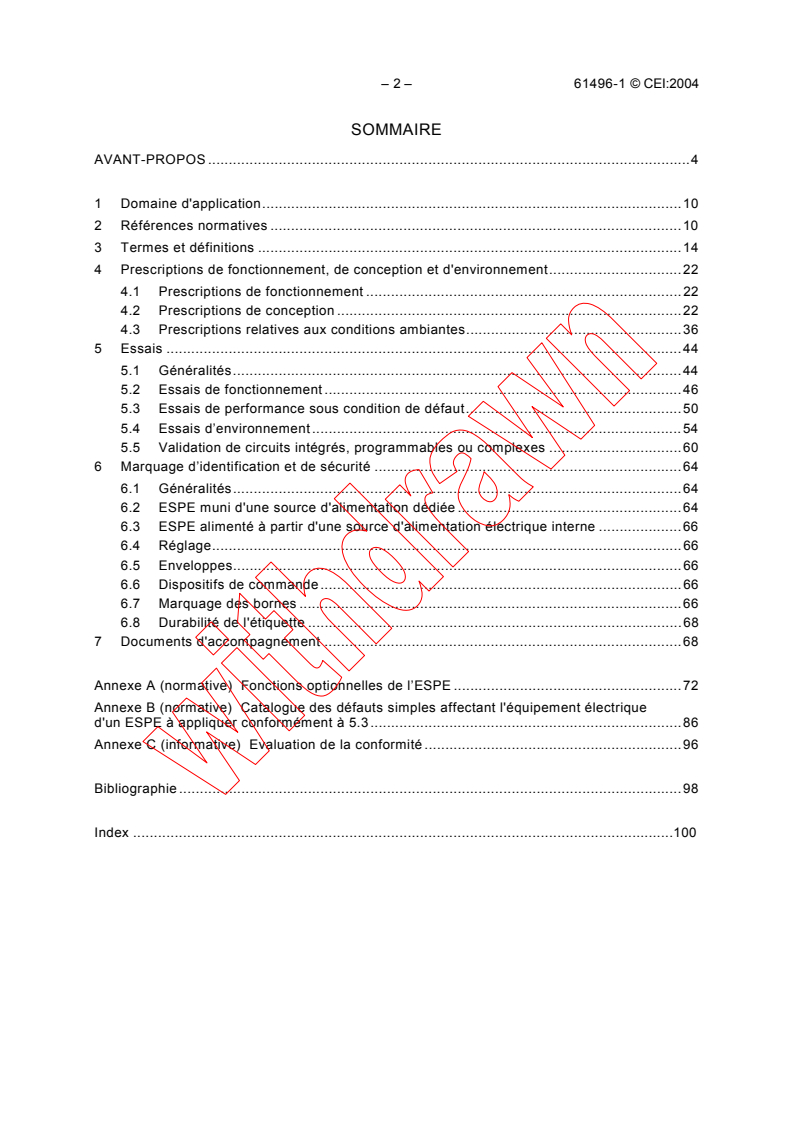
IEC 61496-1:2004 - Safety of machinery - Electro-sensitive protective equipment - Part 1: General requirements and tests Released:2/4/2004
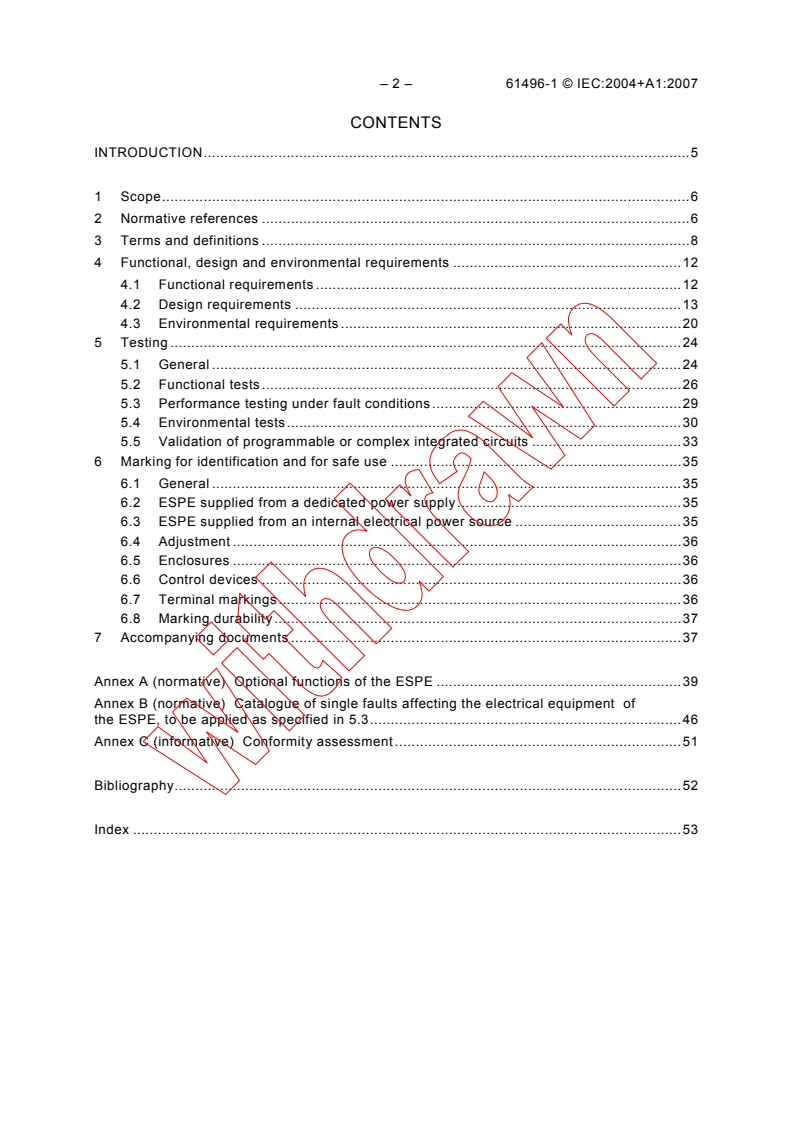
IEC 61496-1:2004+AMD1:2007 CSV - Safety of machinery - Electro-sensitive protective equipment - Part 1: General requirements and tests Released:1/22/2008
Overview
IEC 61496-1:2004 is an international standard developed by the International Electrotechnical Commission (IEC) that specifies the general requirements and testing methods for electro-sensitive protective equipment (ESPE) used in machinery safety. This standard addresses non-contact ESPE designed specifically to detect the presence of persons as part of a safety-related system to prevent accidents and injuries in industrial environments. It ensures that ESPE devices meet appropriate safety-related performance levels through stringent design, functional, environmental, and testing criteria.
This standard serves as a foundational document for manufacturers, industrial users, and safety enforcement authorities involved in the implementation of electro-sensitive protection devices. It also supports consistent application of safety measures by defining requirements for construction, functional safety checks, system interfaces, and durable markings essential for safe machine operation.
Key Topics
Scope and Application
IEC 61496-1 covers the design, construction, and testing of ESPE used in machinery safety systems. It focuses on performance requirements to reliably detect persons without physical contact, helping machinery revert to a safe state to avoid hazardous situations.Functional Requirements
The standard mandates rigorous functional criteria, including the ESPE's ability to maintain safety-related performance during normal operation, periodic self-checks, and fault conditions. These requirements ensure that ESPE reliably detects human presence and mitigates risk before injury can occur.Design and Environmental Criteria
Requirements include robust design considerations to cope with environmental factors such as vibration, shock, temperature, and humidity. The ESPE must maintain safety performance under these conditions to ensure reliability in industrial settings.Testing Procedures
IEC 61496-1 prescribes comprehensive testing protocols covering general functionality, performance under fault conditions, environmental resistance, and validation of embedded programmable electronics. These tests verify compliance and help manufacturers certify products for safe use.Marking and Documentation
Equipment must feature clear and durable markings for identification, safe use instructions, and terminal identification. Proper documentation accompanying the ESPE facilitates correct installation, adjustment, and maintenance.Optional Safety Functions
Annex A outlines optional safety-related functions that an ESPE may include. While these are not mandatory, they provide enhanced safety features adaptable to specific machinery requirements.Conformity Assessment
Annex C provides guidance on conformity assessment processes to verify that ESPE devices meet the standard’s safety and performance requirements.
Applications
IEC 61496-1 ESPE devices are critical components in safeguarding personnel working with or around hazardous machinery in industries such as manufacturing, automotive, packaging, robotics, and material handling. Typical applications include:
Presence Detection Systems
Light curtains, safety scanners, and proximity sensors that detect operators approaching dangerous zones, triggering machine shutdown or safe states to prevent injury.Access Control in Safety Zones
Non-contact sensors controlling entry to hazardous areas, ensuring only authorized or safe modes of access.Interlocking Safety Systems
ESPE integrated with control systems to allow safe operations by monitoring and responding to human presence dynamically.Machine Safety Upgrades
Retrofit existing machinery with electro-sensitive protective equipment to comply with updated safety regulations and reduce workplace accidents.
By adhering to the IEC 61496-1 standard, organizations enhance workplace safety, comply with international regulations, and reduce risks associated with machinery operation.
Related Standards
For comprehensive machinery safety and integrated system design, IEC 61496-1 works in conjunction with other standards, including:
IEC 61508 – Functional safety of electrical/electronic systems: Guidelines for safety-related system life cycles including ESPE reliability.
IEC/TS 62046 – Application of ESPE for safeguarding: Guidance on the correct implementation and use of electro-sensitive protective systems.
IEC 62061 – Safety of machinery: Functional safety of safety-related electrical control systems specific to machine safety requirements.
ISO 13849-1 – Safety-related parts of control systems: Design and validation principles for performance level requirements in machinery safety.
IEC 60204-1 – Electrical equipment of industrial machines: General electrical requirements supporting ESPE integration.
IEC 61000 series – Electromagnetic compatibility testing standards relevant for ensuring ESPE immunity against interference.
These standards complement IEC 61496-1 by providing detailed requirements for the safety lifecycle, control system integration, and environmental compatibility that are essential in comprehensive machinery safety management.
Keywords: IEC 61496-1, electro-sensitive protective equipment, ESPE, machinery safety, safety standards, non-contact safety devices, functional safety, industrial safety sensors, machine guarding, safety-related systems, safety equipment testing, machinery risk reduction.
Relations
- Effective Date
- 25-Aug-2026
- Effective Date
- 25-Aug-2026
- Effective Date
- 25-Aug-2026
- Effective Date
- 25-Aug-2026
- Effective Date
- 05-Sep-2023
- Effective Date
- 05-Sep-2023
- Effective Date
- 05-Sep-2023
- Effective Date
- 05-Sep-2023
- Effective Date
- 05-Sep-2023
- Effective Date
- 05-Sep-2023
Buy Documents
IEC 61496-1:2004 - Safety of machinery - Electro-sensitive protective equipment - Part 1: General requirements and tests Released:2/4/2004
IEC 61496-1:2004+AMD1:2007 CSV - Safety of machinery - Electro-sensitive protective equipment - Part 1: General requirements and tests Released:1/22/2008
Get Certified
Connect with accredited certification bodies for this standard

IMQ S.p.A. (Certification)
Italian electrical product certification.

SLG Prüf- und Zertifizierungs GmbH
German testing and certification body.

UL Solutions
Global safety science company with testing, inspection and certification.
Sponsored listings
Frequently Asked Questions
IEC 61496-1:2004 is a standard published by the International Electrotechnical Commission (IEC). Its full title is "Safety of machinery - Electro-sensitive protective equipment - Part 1: General requirements and tests". This standard covers: specifies general requirements for the design, construction and testing of non-contact electro-sensitive protective equipment (ESPE) designed specifically to detect persons as part of a safety related system. Special attention is directed to functional and design requirements that ensure an appropriate safety-related performance is achieved. An ESPE may include optional safety-related functions, the requirements for which are given in Annex A.
specifies general requirements for the design, construction and testing of non-contact electro-sensitive protective equipment (ESPE) designed specifically to detect persons as part of a safety related system. Special attention is directed to functional and design requirements that ensure an appropriate safety-related performance is achieved. An ESPE may include optional safety-related functions, the requirements for which are given in Annex A.
IEC 61496-1:2004 is classified under the following ICS (International Classification for Standards) categories: 13.110 - Safety of machinery; 29.260.99 - Other electrical equipment for working in special conditions. The ICS classification helps identify the subject area and facilitates finding related standards.
IEC 61496-1:2004 has the following relationships with other standards: It is inter standard links to EN ISO 8230-1:2008, EN ISO 13855:2010, EN ISO 11111-1:2009, EN ISO 11111-6:2005, IEC 61496-1:2004/AMD1:2007, IEC 61496-1:2004/COR2:2008, IEC 61496-1:2004/COR1:2008, IEC 61496-1:2012, IEC 61496-1:1997/COR1:1998, IEC 61496-1:1997. Understanding these relationships helps ensure you are using the most current and applicable version of the standard.
IEC 61496-1:2004 is available in PDF format for immediate download after purchase. The document can be added to your cart and obtained through the secure checkout process. Digital delivery ensures instant access to the complete standard document.
Standards Content (Sample)
NORME CEI
INTERNATIONALE IEC
61496-1
INTERNATIONAL
Deuxième édition
STANDARD
Second edition
2004-02
Sécurité des machines –
Equipements de protection électro-sensibles –
Partie 1:
Prescriptions générales et essais
Safety of machinery –
Electro-sensitive protective equipment –
Part 1:
General requirements and tests
Numéro de référence
Reference number
CEI/IEC 61496-1:2004
Numérotation des publications Publication numbering
Depuis le 1er janvier 1997, les publications de la CEI As from 1 January 1997 all IEC publications are
sont numérotées à partir de 60000. Ainsi, la CEI 34-1 issued with a designation in the 60000 series. For
devient la CEI 60034-1. example, IEC 34-1 is now referred to as IEC 60034-1.
Editions consolidées Consolidated editions
Les versions consolidées de certaines publications de la The IEC is now publishing consolidated versions of its
CEI incorporant les amendements sont disponibles. Par publications. For example, edition numbers 1.0, 1.1
exemple, les numéros d’édition 1.0, 1.1 et 1.2 indiquent and 1.2 refer, respectively, to the base publication,
respectivement la publication de base, la publication de the base publication incorporating amendment 1 and
base incorporant l’amendement 1, et la publication de the base publication incorporating amendments 1
base incorporant les amendements 1 et 2. and 2.
Informations supplémentaires Further information on IEC publications
sur les publications de la CEI
Le contenu technique des publications de la CEI est The technical content of IEC publications is kept
constamment revu par la CEI afin qu'il reflète l'état under constant review by the IEC, thus ensuring that
actuel de la technique. Des renseignements relatifs à the content reflects current technology. Information
cette publication, y compris sa validité, sont dispo- relating to this publication, including its validity, is
nibles dans le Catalogue des publications de la CEI available in the IEC Catalogue of publications
(voir ci-dessous) en plus des nouvelles éditions, (see below) in addition to new editions, amendments
amendements et corrigenda. Des informations sur les and corrigenda. Information on the subjects under
sujets à l’étude et l’avancement des travaux entrepris consideration and work in progress undertaken by the
par le comité d’études qui a élaboré cette publication, technical committee which has prepared this
ainsi que la liste des publications parues, sont publication, as well as the list of publications issued,
également disponibles par l’intermédiaire de: is also available from the following:
• Site web de la CEI (www.iec.ch) • IEC Web Site (www.iec.ch)
• Catalogue des publications de la CEI • Catalogue of IEC publications
Le catalogue en ligne sur le site web de la CEI The on-line catalogue on the IEC web site
(http://www.iec.ch/searchpub/cur_fut.htm) vous permet (http://www.iec.ch/searchpub/cur_fut.htm) enables
de faire des recherches en utilisant de nombreux you to search by a variety of criteria including text
critères, comprenant des recherches textuelles, par searches, technical committees and date of
comité d’études ou date de publication. Des publication. On-line information is also available
informations en ligne sont également disponibles sur on recently issued publications, withdrawn and
les nouvelles publications, les publications rempla- replaced publications, as well as corrigenda.
cées ou retirées, ainsi que sur les corrigenda.
• IEC Just Published • IEC Just Published
Ce résumé des dernières publications parues This summary of recently issued publications
(http://www.iec.ch/online_news/justpub/jp_entry.htm) (http://www.iec.ch/online_news/justpub/jp_entry.htm)
est aussi disponible par courrier électronique. is also available by email. Please contact the
Veuillez prendre contact avec le Service client Customer Service Centre (see below) for further
(voir ci-dessous) pour plus d’informations. information.
• Service clients • Customer Service Centre
Si vous avez des questions au sujet de cette If you have any questions regarding this
publication ou avez besoin de renseignements publication or need further assistance, please
supplémentaires, prenez contact avec le Service contact the Customer Service Centre:
clients:
Email: custserv@iec.ch Email: custserv@iec.ch
Tél: +41 22 919 02 11 Tel: +41 22 919 02 11
Fax: +41 22 919 03 00 Fax: +41 22 919 03 00
.
NORME CEI
INTERNATIONALE IEC
61496-1
INTERNATIONAL
Deuxième édition
STANDARD
Second edition
2004-02
Sécurité des machines –
Equipements de protection électro-sensibles –
Partie 1:
Prescriptions générales et essais
Safety of machinery –
Electro-sensitive protective equipment –
Part 1:
General requirements and tests
IEC 2004 Droits de reproduction réservés Copyright - all rights reserved
Aucune partie de cette publication ne peut être reproduite ni No part of this publication may be reproduced or utilized in any
utilisée sous quelque forme que ce soit et par aucun procédé, form or by any means, electronic or mechanical, including
électronique ou mécanique, y compris la photocopie et les photocopying and microfilm, without permission in writing from
microfilms, sans l'accord écrit de l'éditeur. the publisher.
International Electrotechnical Commission, 3, rue de Varembé, PO Box 131, CH-1211 Geneva 20, Switzerland
Telephone: +41 22 919 02 11 Telefax: +41 22 919 03 00 E-mail: inmail@iec.ch Web: www.iec.ch
CODE PRIX
XA
PRICE CODE
Commission Electrotechnique Internationale
International Electrotechnical Commission
МеждународнаяЭлектротехническаяКомиссия
Pour prix, voir catalogue en vigueur
For price, see current catalogue
– 2 – 61496-1 © CEI:2004
SOMMAIRE
AVANT-PROPOS .4
1 Domaine d'application.10
2 Références normatives .10
3 Termes et définitions .14
4 Prescriptions de fonctionnement, de conception et d'environnement.22
4.1 Prescriptions de fonctionnement .22
4.2 Prescriptions de conception .22
4.3 Prescriptions relatives aux conditions ambiantes.36
5 Essais .44
5.1 Généralités.44
5.2 Essais de fonctionnement .46
5.3 Essais de performance sous condition de défaut.50
5.4 Essais d’environnement.54
5.5 Validation de circuits intégrés, programmables ou complexes .60
6 Marquage d’identification et de sécurité .64
6.1 Généralités.64
6.2 ESPE muni d'une source d'alimentation dédiée .64
6.3 ESPE alimenté à partir d'une source d'alimentation électrique interne .66
6.4 Réglage.66
6.5 Enveloppes.66
6.6 Dispositifs de commande.66
6.7 Marquage des bornes .66
6.8 Durabilité de l'étiquette .68
7 Documents d'accompagnement .68
Annexe A (normative) Fonctions optionnelles de l’ESPE .72
Annexe B (normative) Catalogue des défauts simples affectant l'équipement électrique
d'un ESPE à appliquer conformément à 5.3.86
Annexe C (informative) Evaluation de la conformité .96
Bibliographie .98
Index .100
61496-1 © IEC:2004 – 3 –
CONTENTS
INTRODUCTION.9
1 Scope.11
2 Normative references .11
3 Terms and definitions .15
4 Functional, design and environmental requirements .23
4.1 Functional requirements .23
4.2 Design requirements .23
4.3 Environmental requirements .37
5 Testing .45
5.1 General .45
5.2 Functional tests.47
5.3 Performance testing under fault conditions .51
5.4 Environmental tests.55
5.5 Validation of programmable or complex integrated circuits .61
6 Marking for identification and for safe use .65
6.1 General .65
6.2 ESPE supplied from a dedicated power supply.65
6.3 ESPE supplied from an internal electrical power source .67
6.4 Adjustment .67
6.5 Enclosures .67
6.6 Control devices .67
6.7 Terminal markings.67
6.8 Marking durability.69
7 Accompanying documents .69
Annex A (normative) Optional functions of the ESPE .73
Annex B (normative) Catalogue of single faults affecting the electrical equipment of
the ESPE, to be applied as specified in 5.3.87
Annex C (informative) Conformity assessment .97
Bibliography.99
Index .101
– 4 – 61496-1 © CEI:2004
COMMISSION ÉLECTROTECHNIQUE INTERNATIONALE
___________
SÉCURITÉ DES MACHINES –
ÉQUIPEMENTS DE PROTECTION ÉLECTRO-SENSIBLES –
Partie 1: Prescriptions générales et essais
AVANT-PROPOS
1) La Commission Electrotechnique Internationale (CEI) est une organisation mondiale de normalisation composée
de l'ensemble des comités électrotechniques nationaux (Comités nationaux de la CEI). La CEI a pour objet de
favoriser la coopération internationale pour toutes les questions de normalisation dans les domaines de
l'électricité et de l'électronique. A cet effet, la CEI – entre autres activités – publie des Normes internationales,
des Spécifications techniques, des Rapports techniques, des Spécifications accessibles au public (PAS) et des
Guides (ci-après dénommés "Publication(s) de la CEI"). Leur élaboration est confiée à des comités d'études,
aux travaux desquels tout Comité national intéressé par le sujet traité peut participer. Les organisations
internationales, gouvernementales et non gouvernementales, en liaison avec la CEI, participent également aux
travaux. La CEI collabore étroitement avec l'Organisation Internationale de Normalisation (ISO), selon des
conditions fixées par accord entre les deux organisations.
2) Les décisions ou accords officiels de la CEI concernant les questions techniques représentent, dans la mesure
du possible, un accord international sur les sujets étudiés, étant donné que les Comités nationaux de la CEI
intéressés sont représentés dans chaque comité d’études.
3) Les Publications de la CEI se présentent sous la forme de recommandations internationales et sont agréées
comme telles par les Comités nationaux de la CEI. Tous les efforts raisonnables sont entrepris afin que la CEI
s'assure de l'exactitude du contenu technique de ses publications; la CEI ne peut pas être tenue responsable de
l'éventuelle mauvaise utilisation ou interprétation qui en est faite par un quelconque utilisateur final.
4) Dans le but d'encourager l'uniformité internationale, les Comités nationaux de la CEI s'engagent, dans toute la
mesure possible, à appliquer de façon transparente les Publications de la CEI dans leurs publications
nationales et régionales. Toutes divergences entre toutes Publications de la CEI et toutes publications
nationales ou régionales correspondantes doivent être indiquées en termes clairs dans ces dernières.
5) La CEI n’a prévu aucune procédure de marquage valant indication d’approbation et n'engage pas sa
responsabilité pour les équipements déclarés conformes à une de ses Publications.
6) Tous les utilisateurs doivent s'assurer qu'ils sont en possession de la dernière édition de cette publication.
7) Aucune responsabilité ne doit être imputée à la CEI, à ses administrateurs, employés, auxiliaires ou
mandataires, y compris ses experts particuliers et les membres de ses comités d'études et des Comités
nationaux de la CEI, pour tout préjudice causé en cas de dommages corporels et matériels, ou de tout autre
dommage de quelque nature que ce soit, directe ou indirecte, ou pour supporter les coûts (y compris les frais
de justice) et les dépenses découlant de la publication ou de l'utilisation de cette Publication de la CEI ou de
toute autre Publication de la CEI, ou au crédit qui lui est accordé.
8) L'attention est attirée sur les références normatives citées dans cette publication. L'utilisation de publications
référencées est obligatoire pour une application correcte de la présente publication.
9) L’attention est attirée sur le fait que certains des éléments de la présente Publication de la CEI peuvent faire
l’objet de droits de propriété intellectuelle ou de droits analogues. La CEI ne saurait être tenue pour
responsable de ne pas avoir identifié de tels droits de propriété et de ne pas avoir signalé leur existence.
La Norme internationale CEI 61496-1 a été établie par le comité d’études 44 de la CEI:
Sécurité des machines – Aspects électrotechniques, en collaboration avec le comité d’études
CENELEC 44X: Sécurité des machines – Aspects électrotechniques.
Cette deuxième édition annule et remplace la première édition parue en 1997. Cette édition
constitue une révision technique. Dans la présente édition de cette partie de la CEI 61496, les
prescriptions générales pour les ESPE de type 3 ont été ajoutées. De plus, plusieurs
modifications et corrections mineures ont été effectuées afin de clarifier les prescriptions et
d'aligner la présente norme avec les pratiques en usage.
Cette norme a le statut de norme de famille de produits et doit être utilisée comme référence
normative pour une norme de produit concernant la sécurité des machines.
61496-1 © IEC:2004 – 5 –
INTERNATIONAL ELECTROTECHNICAL COMMISSION
___________
SAFETY OF MACHINERY –
ELECTRO-SENSITIVE PROTECTIVE EQUIPMENT –
Part 1: General requirements and tests
FOREWORD
1) The International Electrotechnical Commission (IEC) is a worldwide organization for standardization comprising
all national electrotechnical committees (IEC National Committees). The object of IEC is to promote
international co-operation on all questions concerning standardization in the electrical and electronic fields. To
this end and in addition to other activities, IEC publishes International Standards, Technical Specifications,
Technical Reports, Publicly Available Specifications (PAS) and Guides (hereafter referred to as “IEC
Publication(s)”). Their preparation is entrusted to technical committees; any IEC National Committee interested
in the subject dealt with may participate in this preparatory work. International, governmental and non-
governmental organizations liaising with the IEC also participate in this preparation. IEC collaborates closely
with the International Organization for Standardization (ISO) in accordance with conditions determined by
agreement between the two organizations.
2) The formal decisions or agreements of IEC on technical matters express, as nearly as possible, an international
consensus of opinion on the relevant subjects since each technical committee has representation from all
interested IEC National Committees.
3) IEC Publications have the form of recommendations for international use and are accepted by IEC National
Committees in that sense. While all reasonable efforts are made to ensure that the technical content of IEC
Publications is accurate, IEC cannot be held responsible for the way in which they are used or for any
misinterpretation by any end user.
4) In order to promote international uniformity, IEC National Committees undertake to apply IEC Publications
transparently to the maximum extent possible in their national and regional publications. Any divergence
between any IEC Publication and the corresponding national or regional publication shall be clearly indicated in
the latter.
5) IEC provides no marking procedure to indicate its approval and cannot be rendered responsible for any
equipment declared to be in conformity with an IEC Publication.
6) All users should ensure that they have the latest edition of this publication.
7) No liability shall attach to IEC or its directors, employees, servants or agents including individual experts and
members of its technical committees and IEC National Committees for any personal injury, property damage or
other damage of any nature whatsoever, whether direct or indirect, or for costs (including legal fees) and
expenses arising out of the publication, use of, or reliance upon, this IEC Publication or any other IEC
Publications.
8) Attention is drawn to the Normative references cited in this publication. Use of the referenced publications is
indispensable for the correct application of this publication.
9) Attention is drawn to the possibility that some of the elements of this IEC Publication may be the subject of
patent rights. IEC shall not be held responsible for identifying any or all such patent rights.
International Standard IEC 61496-1 has been prepared by IEC technical committee 44:
Safety of machinery – Electrotechnical aspects, in collaboration with CENELEC technical
committee 44X: Safety of machinery – Electrotechnical aspects.
This second edition cancels and replaces the first edition, published in 1997. This edition
constitutes a technical revision. In this edition of this part of IEC 61496, general requirements
for a Type 3 ESPE have been added. In addition, several small changes and corrections have
been made to clarify the requirements and to align this standard with current practice.
This standard has the status of a product family standard and may be used as a normative
reference in a dedicated product standard for the safety of machinery.
– 6 – 61496-1 © CEI:2004
Cette norme a été rédigée afin de définir les exigences générales applicables aux équipements
de protection électro-sensibles (ESPE) tout particulièrement destinés à la sécurité des
machines et a été élaborée pour répondre aux besoins des constructeurs, des industriels et
des organismes de sécurité.
Le texte de cette norme est issu des documents suivants:
FDIS Rapport de vote
44/444/FDIS 44/445/RVD
Le rapport de vote indiqué dans le tableau ci-dessus donne toute information sur le vote ayant
abouti à l'approbation de cette norme.
Cette publication a été rédigée selon les Directives ISO/CEI, Partie 2.
Le comité a décidé que le contenu de cette publication ne sera pas modifié avant 2008. A cette
date, la publication sera
• reconduite;
• supprimée;
• remplacée par une édition révisée, ou
• amendée.
Le contenu du corrigendum de juillet 2008 été pris en considération dans cet exemplaire.
61496-1 © IEC:2004 – 7 –
This standard has been prepared as a specification of general requirements for electro-
sensitive protective equipment (ESPE) specifically related to machinery safety and has been
developed to meet the needs of manufacturers, industrial users and safety enforcement
authorities.
The text of this standard is based on the following documents:
FDIS Report on voting
44/444/FDIS 44/445/RVD
Full information on the voting for the approval of this standard can be found in the report of
voting indicated in the above table.
This publication has been drafted in accordance with the ISO/IEC Directives, Part 2.
The committee has decided that the contents of this publication will remain unchanged until
2008. At this date, the publication will be
• reconfirmed;
• withdrawn;
• replaced by a revised edition, or
• amended.
The contents of the corrigendum of July 2008 have been included in this copy.
– 8 – 61496-1 © CEI:2004
INTRODUCTION
Un système de protection électro-sensible (ESPE) est utilisé sur les machines présentant des
risques d'accident pour les personnes. Il fournit une protection en mettant la machine en un
état sûr avant qu'une personne ne puisse se trouver dans une situation dangereuse.
La présente partie de la CEI 61496 fournit les prescriptions générales de conception et de
performance des ESPE utilisés pour une large gamme d'applications. Les caractéristiques
essentielles des équipements satisfaisant aux prescriptions de la présente norme sont le
niveau approprié de sécurité intrinsèque et les vérifications/auto-contrôles de fonctionnement,
périodiques et intégrés qui sont prescrits afin de s'assurer que ce niveau de sécurité est
maintenu.
Chaque type de machine présente ses propres risques (phénomènes dangereux) et l'objectif
de la présente norme n'est pas de recommander la méthode d'application de l’ESPE à une
machine particulière. Il convient que l'application de l'ESPE fasse l'objet d'un accord entre le
fournisseur de l'équipement, l'utilisateur de la machine et l'organisme de sécurité; dans ce
contexte, l'attention est attirée sur les textes de recommandation internationaux concernés, par
exemple l’ISO TR 12100.
La présente partie de la CEI 61496 spécifie les prescriptions techniques des équipements de
systèmes de protection électro-sensibles. L'application de la présente norme peut nécessiter
l'utilisation de substances et/ou de procédures d'essai qui peuvent nuire à la santé si des
précautions appropriées ne sont pas prises. La conformité à la présente norme ne dispense en
aucune manière le fournisseur ou l'utilisateur de leurs obligations légales en matière de
sécurité et d'hygiène des personnes dans le cadre de l'utilisation des équipements couverts
par la présente norme.
61496-1 © IEC:2004 – 9 –
INTRODUCTION
An electro-sensitive protective equipment (ESPE) is applied to machinery presenting a risk of
personal injury. It provides protection by causing the machine to revert to a safe condition
before a person can be placed in a hazardous situation.
This part of IEC 61496 provides general design and performance requirements of ESPEs for
use over a broad range of applications. Essential features of equipment meeting the
requirements of this standard are the appropriate level of safety-related performance provided
and the built-in periodic functional checks/self-checks that are specified to ensure that this
level of performance is maintained.
Each type of machine presents its own particular hazards and it is not the purpose of this
standard to recommend the manner of application of the ESPE to any particular machine. The
application of the ESPE should be a matter for agreement between the equipment supplier,
the machine user and the enforcing authority, and in this context attention is drawn to the
relevant guidance established internationally, for example ISO TR 12100.
This part of IEC 61496 specifies technical requirements of electro-sensitive protective
equipment. The application of this standard may require the use of substances and/or test
procedures that could be injurious to health unless adequate precautions are taken.
Conformance with this standard in no way absolves either the supplier or the user from
statutory obligations relating to the safety and health of persons during the use of the
equipment covered by this standard.
– 10 – 61496-1 © CEI:2004
SÉCURITÉ DES MACHINES –
ÉQUIPEMENTS DE PROTECTION ÉLECTRO-SENSIBLES –
Partie 1: Prescriptions générales et essais
1 Domaine d'application
La présente partie de la CEI 61496 définit les prescriptions générales de conception, de
construction et d'essai des équipements de protection électro-sensibles (ESPE) sans contact
spécifiquement conçus pour détecter des personnes au sein d’un système relatif à la sécurité.
Une attention particulière est portée sur les prescriptions de fonctionnement et de conception
assurant que le niveau de sécurité approprié est atteint. Un ESPE peut proposer des fonctions
optionnelles, liées à la sécurité: les prescriptions pour celles-ci sont énumérées en Annexe A.
Les prescriptions particulières pour des types spécifiques de fonctions de détection sont
fournies dans d'autres parties de cette norme.
La présente norme ne prescrit ni les dimensions ou la configuration de la zone de détection, ni
sa disposition par rapport aux risques (phénomènes dangereux) dans une application
particulière, ni ce qui constitue un état dangereux pour une machine donnée. Elle se limite au
fonctionnement de l’ESPE et à son interface avec la machine.
Il est possible que la présente norme soit utilisable pour des applications autres que la
protection des personnes, par exemple la protection des machines ou des produits contre des
dommages mécaniques. Dans ces applications, des prescriptions différentes peuvent être
nécessaires, par exemple lorsque les matériaux qui doivent être reconnus par le dispositif de
détection ont des caractéristiques différentes de celles des personnes.
Cette norme n’englobe pas les prescriptions relatives à l’émission concernant la compatibilité
électromagnétique (CEM).
2 Références normatives
Les documents de référence suivants sont indispensables pour l'application du présent
document. Pour les références datées, seule l'édition citée s'applique. Pour les références non
datées, la dernière édition du document de référence s'applique (y compris les éventuels
amendements).
CEI 60050-191:1990, Vocabulaire Electrotechnique International (VEI) – Chapitre 191: Sûreté
de fonctionnement et qualité de service
CEI 60068-2-6:1995, Essais d'environnement – Partie 2: Essais – Essai Fc: Vibrations
(sinusoïdales)
CEI 60068-2-29:1987, Essais fondamentaux climatiques et de robustesse mécanique –
Partie 2: Essais – Essai Eb et guide: Secousses
CEI 60204-1:1997, Sécurité des machines – Equipement électrique des machines – Partie 1:
Règles générales
CEI 60249-2, Matériaux de base pour circuits imprimés – Deuxième partie: Spécifications
CEI 60439-1:1999, Ensembles d’appareillage à basse tension – Partie 1: Ensembles de série
et ensembles dérivés de série
61496-1 © IEC:2004 – 11 –
SAFETY OF MACHINERY –
ELECTRO-SENSITIVE PROTECTIVE EQUIPMENT –
Part 1: General requirements and tests
1 Scope
This part of IEC 61496 specifies general requirements for the design, construction and testing
of non-contact electro-sensitive protective equipment (ESPE) designed specifically to detect
persons as part of a safety related system. Special attention is directed to functional and
design requirements that ensure an appropriate safety-related performance is achieved. An
ESPE may include optional safety-related functions, the requirements for which are given in
Annex A.
The particular requirements for specific types of sensing function are given in other parts of
this standard.
This standard does not specify the dimensions or configuration of the detection zone and its
disposition in relation to hazards in any particular application, nor what constitutes a
hazardous state of any machine. It is restricted to the functioning of the ESPE and how it
interfaces with the machine.
This standard may be relevant to applications other than those for the protection of persons,
for example for the protection of machinery or products from mechanical damage. In those
applications, different requirements can be necessary, for example when the materials that
have to be recognized by the sensing function have different properties from those of
persons.
This standard does not deal with electromagnetic compatibility (EMC) emission requirements.
2 Normative references
The following referenced documents are indispensable for the application of this document.
For dated references, only the edition cited applies. For undated references, the latest edition
of the referenced document (including any amendments) applies.
IEC 60050-191:1990, International Electrotechnical Vocabulary (IEV) – Chapter 191: Depend-
ability and quality of service
IEC 60068-2-6:1995, Environmental testing – Part 2: Tests – Test Fc: Vibration (sinusoidal)
IEC 60068-2-29:1987, Basic environmental testing procedures – Part 2: Tests – Test Eb and
guidance: Bump
IEC 60204-1:1997, Safety of machinery – Electrical equipment of industrial machines – Part
1: General requirements
IEC 60249-2, Base materials for printed circuits – Part 2: Specifications
IEC 60439-1:1999, Low-voltage switchgear and controlgear assemblies – Part 1: Type-tested
and partially type-tested assemblies
– 12 – 61496-1 © CEI:2004
CEI 60445:1999, Principes fondamentaux et de sécurité pour les interfaces homme-machines,
le marquage et l’identification – Identification des bornes de matériels et des extrémités de
certains conducteurs désignés et règles générales pour un système alphanumérique
CEI 60447:1993, Interface homme-machine (IHM) – Principes de manœuvre
CEI 60529:2001, Degrés de protection procurés par les enveloppes (code IP)
CEI 60664-1:1992, Coordination de l’isolement des matériels dans les systèmes (réseaux) à
basse tension – Partie 1: Principes, prescriptions et essais
CEI 60947-5-1:1997, Appareillage à basse tension – Partie 5-1: Appareils et éléments de
commutation pour circuits de commande – Appareils électromécaniques pour circuits de
commande
CEI 60950 (toutes les parties), Matériels de traitement de l'information – Sécurité
CEI 61000-4-2:1995, Compatibilité électromagnétique (CEM) – Partie 4-2: Techniques d'essai
et de mesure – Essai d'immunité aux décharges électrostatiques – Publication fondamentale
en CEM
CEI 61000-4-3:2002, Compatibilité électromagnétique (CEM) – Partie 4-3: Techniques d'essai
et de mesure – Essai d'immunité aux champs électromagnétiques rayonnés aux fréquences
radioélectriques – Publication fondamentale en CEM
CEI 61000-4-4:1995, Compatibilité électromagnétique (CEM) – Partie 4: Techniques d'essai et
de mesure – Section 4: Essais d'immunité aux transitoires électriques rapides en salves –
Publication fondamentale en CEM
CEI 61000-4-5:2001, Compatibilité électromagnétique (CEM) – Partie 4-5: Techniques d'essai
et de mesure – Essai d'immunité aux ondes de choc – Publication fondamentale en CEM
CEI 61000-4-6:2001, Compatibilité électromagnétique (CEM) – Partie 4-6: Techniques d'essai
et de mesure – Immunité aux perturbations conduites, induites par les champs radioélectriques
– Publication fondamentale en CEM
CEI 61000-6-2:1999, Compatibilité électromagnétique (CEM) – Partie 6-2: Normes génériques
– Immunité pour les environnements industriels
CEI 61131-2:1992, Automates programmables – Partie 2: Spécifications et essais des
équipements
CEI 61508 (toutes les parties): Sécurité fonctionnelle des systèmes électriques/électroniques/
électroniques programmables relatifs à la sécurité
ISO 9001:2000, Systèmes de management de la qualité – Exigences
ISO/TR 12100-1:1992, Sécurité des machines – Notions fondamentales, principes généraux de
conception – Partie 1: Terminologie de base, méthodologie
ISO/TR 12100-2:1992, Sécurité des machines – Notions fondamentales, principes généraux de
conception – Partie 2: Principes and spécifications techniques
ISO 13849-1:1999, Sécurité des machines – Parties des systèmes de commande relative à la
sécurité – Partie 1: Principes généraux de conception
61496-1 © IEC:2004 – 13 –
IEC 60445:1999, Basic and safety principles for man-machine interface, marking and
identification – Identification of equipment terminals and of terminations of certain designated
conductors, including general rules for an alphanumeric system
IEC 60447:1993, Man-machine interface (MMI) – Actuating principles
IEC 60529:2001, Degrees of protection provided by enclosures (IP code)
IEC 60664-1:1992, Insulation coordination for equipment within low-voltage systems – Part 1:
Principles, requirements and tests
IEC 60947-5-1:1997, Low-voltage switchgear and controlgear – Part 5-1: Control circuit
devices and switching elements – Electromechanical control circuit devices
IEC 60950 (all parts), Information technology equipment – Safety
IEC 61000-4-2:1995, Electromagnetic compatibility (EMC) – Part 4-2: Testing and
measurement techniques – Electrostatic discharge immunity test – Basic EMC publication
IEC 61000-4-3:2002, Electromagnetic compatibility (EMC) – Part 4-3: Testing and
measurement techniques – Radiated, radio-frequency, electromagnetic field immunity test –
Basic EMC publication
IEC 61000-4-4:1995, Electromagnetic compatibility (EMC) – Part 4: Testing and measurement
techniques – Section 4: Electrical fast transient/burst immunity test – Basic EMC publication
IEC 61000-4-5:2001, Electromagnetic compatibility (EMC) – Part 4-5: Testing and
measurement techniques – Surge immunity tests – Basic EMC publication
IEC 61000-4-6:2001, Electromagnetic compatibility (EMC) – Part 4-6: Testing and
measurement techniques – Immunity to conducted disturbances, induced by radio-frequency
fields – Basic EMC publication
IEC 61000-6-2:1999, Electromagnetic compatibility (EMC) – Part 6-2: Generic standards –
Immunity for industrial environments
IEC 61131-2:1992, Programmable controllers – Part 2: Equipment requirements and tests
IEC 61508 (all parts), Functional safety of electrical/electronic/programmable electronic
safety-related systems
ISO 9001:2000, Quality management systems – Requirements
ISO/TR 12100-1:1992, Safety of machinery – Basic concepts, general principles for design –
Part 1: Basic terminology, methodology
ISO/TR 12100-2:1992, Safety of machinery – Basic concepts, general principles for design –
Part 2: Technical principles and specifications
ISO 13849-1:1999, Safety of machinery – Safety-related parts of control systems – Part 1:
General principles for design
– 14 – 61496-1 © CEI:2004
3 Termes et définitions
Pour les besoins du présent document, les termes et définitions suivants s'appliquent.
NOTE L'index énumère, par ordre alphabétique, les termes et les sigles définis dans le présent Article et indique
où ils sont utilisés dans le texte de cette partie.
3.1
blanking
fonction optionnelle qui permet à un objet dont la taille est supérieure à la capacité de
détection de l’ESPE d’être présent dans la zone de détection sans provoquer le passage à
l’état INACTIF du ou des OSSD.
NOTE 1 Le blanking fixe est une technique pour laquelle les localisations des parties faisant l’objet d’un blanking
ne changent pas pendant le fonctionnement. La capacité de détection des autres parties de la zone de détection
demeure inchangée.
NOTE 2 Le blanking flottant est une technique pour laquelle la partie de la zone de détection faisant l’objet d’un
blanking suit la localisation d’un objet se déplaçant pendant le fonctionnement. La capacité de détection des autres
parties demeure inchangée.
3.2
dispositif de commande/surveillance
partie de l’équipement de protection électro-sensible (ESPE) qui:
– reçoit et traite les informations en provenance du dispositif de détection et fournit les
signaux aux dispositifs de commutation du signal de sortie (OSSD),
– surveille le dispositif de détection et les OSSD
3.3
capacité de détection
limite du paramètre de la fonction de détection spécifiée par le constructeur qui entraîne une
manœuvre de l’équipement de protection électro-sensible (ESPE)
3.4
zone de détection
zone dans laquelle l'éprouvette d'essai spécifiée sera détectée par l’équipement de protection
électro-sensible (ESPE)
3.5
équipement de protection électro-sensible
ESPE
ensemble de dispositifs et/ou de composants travaillant conjointement pour obtenir un
déclenchement de protection ou une détection de présence et comprenant au minimum:
– un dispositif de détection;
– des dispositifs de commande/surveillance;
– des dispositifs de commutation du signal de sortie
NOTE Le système de commande relatif à la sécurité associé à l’ESPE, ou l’ESPE proprement dit, peuvent
également comprendre un dispositif de commutation secondaire (SSD), des fonctions d'inhibition, des fonctions de
surveillance des performances de mise à l'arrêt, etc. (voir Annexe A).
3.6
dispositif de surveillance des commutateurs externes
EDM
moyen par lequel le système de protection électro-sensible (ESPE) surveille l’état des
commutateurs qui lui sont externes
61496-1 © IEC:2004 – 15 –
3 Terms and definitions
For the purposes of this document, the following terms and definitions apply.
NOTE The index lists, in alphabetical order, the terms and acronyms defined in this Clause and indicates where
they are used in the text of this part.
3.1
blanking
optional function that permits an object of a size greater than the detection capability of the
ESPE to be located within the detection zone without causing an OFF-state of the OSSD(s)
NOTE 1 Fixed blanking is a technique wherein the locations of the blanked areas of the detection zone do not
change during operation. The detection capability of the other parts of the detection zone remain unchanged.
NOTE 2 Floating blanking is a technique wherein the blanked area of the detection zone follows the location of a
moving object(s) during operation. The detection capability of the other areas remains unchanged.
3.2
controlling/monitoring device
part of the electro-sensitive protective equipment (ESPE) that:
– receives and processes information from the sensing device and provides signals to the
output signal switching devices (OSSD),
– monitors the sensing device and the OSSD
3.3
detection capability
sensing function parameter limit specified by the supplier that will cause actuation of the
electro-sensitive protective equipment (ESPE)
3.4
detection zone
zone within which a specified test piece will be detected by the electro-sensitive protective
equipment (ESPE)
3.5
electro-sensitive protective equipment (ESPE)
assembly of devices and/or components working together for protective tripping or presence-
sensing purposes and comprising as a minimum
– a sensing device;
– controlling/monitoring devices;
– output signal switching devices
NOTE The safety-related control system associated with the ESPE, or the ESPE itself, may further include a
secondary switching device, muting functions, stopping performance monitor, etc. (see Annex A).
3.6
external device monitoring (EDM)
means by which the electro-sensitive protective equipment (ESPE) monitors the state of
control devices which are external to the ESPE
– 16 – 61496-1 © CEI:2004
3.7
défaillance
cessation de l'aptitude d'une entité à accomplir une fonction requise
[VEI 191-04-01, modifiée]
NOTE 1 Après une défaillance, cette entité a un défaut.
NOTE 2 Une défaillance est un passage d'un état à un autre, par opposition à un défaut, qui est un état.
NOTE 3 La notion de défaillance, telle qu’elle est définie, ne s'applique pas à une entité constituée seulement de
logiciel.
NOTE 4 En pratique, les termes «défaut» et «défaillance» sont souvent utilisés comme synonymes.
3.8
défaillance dangereuse
défaillance qui empêche ou retarde la mise hors circuit et/ou le maintien à l'état INACTIF de
tous les dispositifs de commutation du signal de sortie (OSSD), en réponse à une situation qui,
en fonctionnement normal, les aurait mis dans cet état
3.9
défaut
état d’une entité inapte à accomplir une fonction requise, non comprise l’inaptitude due à la
maintenance préventive ou à d’autres actions programmées, ou due à un manque de moyens
extérieurs
[VEI 191-05-01, modifiée]
NOTE 1 Un défaut est souvent la conséquence d’une défaillance de l’entité elle-même, mais il peut exister sans
défaillance préalable.
NOTE 2 En anglais, le terme «fault» et sa définition sont identiques à ceux donnés dans le VEI 191-05-01. Dans
le domaine des machines, en français et en allemand on utilise les termes «défaut» et «Fehler» de préférence aux
termes «pannes» et «Fehlzustand» qui sont donnés avec la même définition.
3.10
dispositif de commutation terminal
FSD
composant du système de commande relatif à la sécurité de la machine qui interrompt le
circuit vers l'élément de commande primaire de la machine (MPCE), lorsque le dispositif de
commutation du signal de sortie (OSSD) passe à l’état INACTIF
3.11
circuit intégré – complexe ou programmable
circuit monolithique, hybride ou modulaire qui satisfait au moins à un des critères ci-dessous:
a) utilise plus de 1 000 portes logiques,
b) propose plus de 24 entrées/sorties de connections externes,
c) propose des fonctions programmables
NOTE 1 Exemples: ASIC, ROM, PROM, EPROM, PAL, CPU, PLA, PLD.
NOTE 2 Ces circuits peuvent être numériques, analogiques ou fonctionner dans les deux modes.
3.12
circuit intégré – simple
circuit monolithique, hybride ou
...
IEC 61496-1
Edition 2.1 2008-01
INTERNATIONAL
STANDARD
NORME
INTERNATIONALE
Safety of machinery – Electro-sensitive protective equipment –
Part 1: General requirements and tests
Sécurité des machines – Equipements de protection électro-sensibles –
Partie 1: Prescriptions générales et essais
All rights reserved. Unless otherwise specified, no part of this publication may be reproduced or utilized in any form or by
any means, electronic or mechanical, including photocopying and microfilm, without permission in writing from either IEC or
IEC's member National Committee in the country of the requester.
If you have any questions about IEC copyright or have an enquiry about obtaining additional rights to this publication,
please contact the address below or your local IEC member National Committee for further information.
Droits de reproduction réservés. Sauf indication contraire, aucune partie de cette publication ne peut être reproduite
ni utilisée sous quelque forme que ce soit et par aucun procédé, électronique ou mécanique, y compris la photocopie
et les microfilms, sans l'accord écrit de la CEI ou du Comité national de la CEI du pays du demandeur.
Si vous avez des questions sur le copyright de la CEI ou si vous désirez obtenir des droits supplémentaires sur cette
publication, utilisez les coordonnées ci-après ou contactez le Comité national de la CEI de votre pays de résidence.
IEC Central Office
3, rue de Varembé
CH-1211 Geneva 20
Switzerland
Email: inmail@iec.ch
Web: www.iec.ch
About the IEC
The International Electrotechnical Commission (IEC) is the leading global organization that prepares and publishes
International Standards for all electrical, electronic and related technologies.
About IEC publications
The technical content of IEC publications is kept under constant review by the IEC. Please make sure that you have the
latest edition, a corrigenda or an amendment might have been published.
ƒ Catalogue of IEC publications: www.iec.ch/searchpub
The IEC on-line Catalogue enables you to search by a variety of criteria (reference number, text, technical committee,…).
It also gives information on projects, withdrawn and replaced publications.
ƒ IEC Just Published: www.iec.ch/online_news/justpub
Stay up to date on all new IEC publications. Just Published details twice a month all new publications released. Available
on-line and also by email.
ƒ Electropedia: www.electropedia.org
The world's leading online dictionary of electronic and electrical terms containing more than 20 000 terms and definitions
in English and French, with equivalent terms in additional languages. Also known as the International Electrotechnical
Vocabulary online.
ƒ Customer Service Centre: www.iec.ch/webstore/custserv
If you wish to give us your feedback on this publication or need further assistance, please visit the Customer Service
Centre FAQ or contact us:
Email: csc@iec.ch
Tel.: +41 22 919 02 11
Fax: +41 22 919 03 00
A propos de la CEI
La Commission Electrotechnique Internationale (CEI) est la première organisation mondiale qui élabore et publie des
normes internationales pour tout ce qui a trait à l'électricité, à l'électronique et aux technologies apparentées.
A propos des publications CEI
Le contenu technique des publications de la CEI est constamment revu. Veuillez vous assurer que vous possédez
l’édition la plus récente, un corrigendum ou amendement peut avoir été publié.
ƒ Catalogue des publications de la CEI: www.iec.ch/searchpub/cur_fut-f.htm
Le Catalogue en-ligne de la CEI vous permet d’effectuer des recherches en utilisant différents critères (numéro de référence,
texte, comité d’études,…). Il donne aussi des informations sur les projets et les publications retirées ou remplacées.
ƒ Just Published CEI: www.iec.ch/online_news/justpub
Restez informé sur les nouvelles publications de la CEI. Just Published détaille deux fois par mois les nouvelles
publications parues. Disponible en-ligne et aussi par email.
ƒ Electropedia: www.electropedia.org
Le premier dictionnaire en ligne au monde de termes électroniques et électriques. Il contient plus de 20 000 termes et
définitions en anglais et en français, ainsi que les termes équivalents dans les langues additionnelles. Egalement appelé
Vocabulaire Electrotechnique International en ligne.
ƒ Service Clients: www.iec.ch/webstore/custserv/custserv_entry-f.htm
Si vous désirez nous donner des commentaires sur cette publication ou si vous avez des questions, visitez le FAQ du
Service clients ou contactez-nous:
Email: csc@iec.ch
Tél.: +41 22 919 02 11
Fax: +41 22 919 03 00
IEC 61496-1
Edition 2.1 2008-01
INTERNATIONAL
STANDARD
NORME
INTERNATIONALE
Safety of machinery – Electro-sensitive protective equipment –
Part 1: General requirements and tests
Sécurité des machines – Equipements de protection électro-sensibles –
Partie 1: Prescriptions générales et essais
INTERNATIONAL
ELECTROTECHNICAL
COMMISSION
COMMISSION
ELECTROTECHNIQUE
PRICE CODE
INTERNATIONALE
CQ
CODE PRIX
ICS 13.110; 29.260.99 ISBN 2-8318-9374-7
– 2 – 61496-1 © IEC:2004+A1:2007
CONTENTS
INTRODUCTION.5
1 Scope.6
2 Normative references.6
3 Terms and definitions .8
4 Functional, design and environmental requirements .12
4.1 Functional requirements.12
4.2 Design requirements.13
4.3 Environmental requirements .20
5 Testing.24
5.1 General.24
5.2 Functional tests.26
5.3 Performance testing under fault conditions .29
5.4 Environmental tests.30
5.5 Validation of programmable or complex integrated circuits .33
6 Marking for identification and for safe use .35
6.1 General.35
6.2 ESPE supplied from a dedicated power supply.35
6.3 ESPE supplied from an internal electrical power source .35
6.4 Adjustment.36
6.5 Enclosures.36
6.6 Control devices .36
6.7 Terminal markings.36
6.8 Marking durability.37
7 Accompanying documents.37
Annex A (normative) Optional functions of the ESPE .39
Annex B (normative) Catalogue of single faults affecting the electrical equipment of
the ESPE, to be applied as specified in 5.3.46
Annex C (informative) Conformity assessment .51
Bibliography.52
Index .53
61496-1 © IEC:2004+A1:2007 – 3 –
INTERNATIONAL ELECTROTECHNICAL COMMISSION
___________
SAFETY OF MACHINERY –
ELECTRO-SENSITIVE PROTECTIVE EQUIPMENT –
Part 1: General requirements and tests
FOREWORD
1) The International Electrotechnical Commission (IEC) is a worldwide organization for standardization comprising
all national electrotechnical committees (IEC National Committees). The object of IEC is to promote
international co-operation on all questions concerning standardization in the electrical and electronic fields. To
this end and in addition to other activities, IEC publishes International Standards, Technical Specifications,
Technical Reports, Publicly Available Specifications (PAS) and Guides (hereafter referred to as “IEC
Publication(s)”). Their preparation is entrusted to technical committees; any IEC National Committee interested
in the subject dealt with may participate in this preparatory work. International, governmental and non-
governmental organizations liaising with the IEC also participate in this preparation. IEC collaborates closely
with the International Organization for Standardization (ISO) in accordance with conditions determined by
agreement between the two organizations.
2) The formal decisions or agreements of IEC on technical matters express, as nearly as possible, an international
consensus of opinion on the relevant subjects since each technical committee has representation from all
interested IEC National Committees.
3) IEC Publications have the form of recommendations for international use and are accepted by IEC National
Committees in that sense. While all reasonable efforts are made to ensure that the technical content of IEC
Publications is accurate, IEC cannot be held responsible for the way in which they are used or for any
misinterpretation by any end user.
4) In order to promote international uniformity, IEC National Committees undertake to apply IEC Publications
transparently to the maximum extent possible in their national and regional publications. Any divergence
between any IEC Publication and the corresponding national or regional publication shall be clearly indicated in
the latter.
5) IEC provides no marking procedure to indicate its approval and cannot be rendered responsible for any
equipment declared to be in conformity with an IEC Publication.
6) All users should ensure that they have the latest edition of this publication.
7) No liability shall attach to IEC or its directors, employees, servants or agents including individual experts and
members of its technical committees and IEC National Committees for any personal injury, property damage or
other damage of any nature whatsoever, whether direct or indirect, or for costs (including legal fees) and
expenses arising out of the publication, use of, or reliance upon, this IEC Publication or any other IEC
Publications.
8) Attention is drawn to the Normative references cited in this publication. Use of the referenced publications is
indispensable for the correct application of this publication.
9) Attention is drawn to the possibility that some of the elements of this IEC Publication may be the subject of
patent rights. IEC shall not be held responsible for identifying any or all such patent rights.
International Standard IEC 61496-1 has been prepared by IEC technical committee 44:
Safety of machinery – Electrotechnical aspects, in collaboration with CENELEC technical
committee 44X: Safety of machinery – Electrotechnical aspects.
This edition constitutes a technical revision. In this edition of this part of IEC 61496, general
requirements for a Type 3 ESPE have been added. In addition, several small changes and
corrections have been made to clarify the requirements and to align this standard with current
practice.
This standard has the status of a product family standard and may be used as a normative
reference in a dedicated product standard for the safety of machinery.
– 4 – 61496-1 © IEC:2004+A1:2007
This standard has been prepared as a specification of general requirements for electro-
sensitive protective equipment (ESPE) specifically related to machinery safety and has been
developed to meet the needs of manufacturers, industrial users and safety enforcement
authorities.
This consolidated version of IEC 61496-1 consists of the second edition (2004) [documents
44/444/FDIS and 44/445/RVD], its amendment 1 (2007) [documents 44/560/FDIS and
44/568/RVD] and its corrigendum of July 2008.
The technical content is therefore identical to the base edition and its amendment and has
been prepared for user convenience.
It bears the edition number 2.1.
A vertical line in the margin shows where the base publication has been modified by
amendment 1.
This publication has been drafted in accordance with the ISO/IEC Directives, Part 2.
The committee has decided that the contents of the base publication and its amendments will
remain unchanged until the maintenance result date indicated on the IEC web site under
"http://webstore.iec.ch" in the data related to the specific publication. At this date,
the publication will be
• reconfirmed,
• withdrawn,
• replaced by a revised edition, or
• amended.
61496-1 © IEC:2004+A1:2007 – 5 –
INTRODUCTION
An electro-sensitive protective equipment (ESPE) is applied to machinery presenting a risk of
personal injury. It provides protection by causing the machine to revert to a safe condition
before a person can be placed in a hazardous situation.
This part of IEC 61496 provides general design and performance requirements of ESPEs for
use over a broad range of applications. Essential features of equipment meeting the
requirements of this standard are the appropriate level of safety-related performance provided
and the built-in periodic functional checks/self-checks that are specified to ensure that this
level of performance is maintained.
Each type of machine presents its own particular hazards and it is not the purpose of this
standard to recommend the manner of application of the ESPE to any particular machine. The
application of the ESPE should be a matter for agreement between the equipment supplier,
the machine user and the enforcing authority, and in this context attention is drawn to the
relevant guidance established internationally, for example ISO TR 12100.
This part of IEC 61496 specifies technical requirements of electro-sensitive protective
equipment. The application of this standard may require the use of substances and/or test
procedures that could be injurious to health unless adequate precautions are taken.
Conformance with this standard in no way absolves either the supplier or the user from
statutory obligations relating to the safety and health of persons during the use of the
equipment covered by this standard.
– 6 – 61496-1 © IEC:2004+A1:2007
SAFETY OF MACHINERY –
ELECTRO-SENSITIVE PROTECTIVE EQUIPMENT –
Part 1: General requirements and tests
1 Scope
This part of IEC 61496 specifies general requirements for the design, construction and testing
of non-contact electro-sensitive protective equipment (ESPE) designed specifically to detect
persons as part of a safety related system. Special attention is directed to functional and
design requirements that ensure an appropriate safety-related performance is achieved. An
ESPE may include optional safety-related functions, the requirements for which are given in
Annex A.
The particular requirements for specific types of sensing function are given in other parts of
this standard.
This standard does not specify the dimensions or configuration of the detection zone and its
disposition in relation to hazards in any particular application, nor what constitutes a
hazardous state of any machine. It is restricted to the functioning of the ESPE and how it
interfaces with the machine.
While a data interface can be used to control optional safety-related ESPE functions
(Annex A), this standard does not provide specific requirements. Requirements for these
safety-related functions can be determined by consulting other standards (for example, IEC
61508, IEC/TS 62046, IEC 62061, and ISO13849-1).
This standard may be relevant to applications other than those for the protection of persons,
for example for the protection of machinery or products from mechanical damage. In those
applications, different requirements can be necessary, for example when the materials that
have to be recognized by the sensing function have different properties from those of
persons.
This standard does not deal with electromagnetic compatibility (EMC) emission requirements.
2 Normative references
The following referenced documents are indispensable for the application of this document.
For dated references, only the edition cited applies. For undated references, the latest edition
of the referenced document (including any amendments) applies.
IEC 60050-191:1990, International Electrotechnical Vocabulary (IEV) – Chapter 191: Depend-
ability and quality of service
IEC 60068-2-6:1995, Environmental testing – Part 2: Tests – Test Fc: Vibration (sinusoidal)
IEC 60068-2-29:1987, Basic environmental testing procedures – Part 2: Tests – Test Eb and
guidance: Bump
IEC 60204-1:1997, Safety of machinery – Electrical equipment of industrial machines – Part 1:
General requirements
61496-1 © IEC:2004+A1:2007 – 7 –
IEC 60249-2, Base materials for printed circuits – Part 2: Specifications
IEC 60439-1:1999, Low-voltage switchgear and controlgear assemblies – Part 1: Type-tested
and partially type-tested assemblies
IEC 60445:1999, Basic and safety principles for man-machine interface, marking and
identification – Identification of equipment terminals and of terminations of certain designated
conductors, including general rules for an alphanumeric system
IEC 60447:1993, Man-machine interface (MMI) – Actuating principles
IEC 60529:2001, Degrees of protection provided by enclosures (IP code)
IEC 60664-1:1992, Insulation coordination for equipment within low-voltage systems – Part 1:
Principles, requirements and tests
IEC 60947-5-1:1997, Low-voltage switchgear and controlgear – Part 5-1: Control circuit
devices and switching elements – Electromechanical control circuit devices
IEC 60950 (all parts), Information technology equipment – Safety
IEC 61000-4-2:1995, Electromagnetic compatibility (EMC) – Part 4-2: Testing and
measurement techniques – Electrostatic discharge immunity test – Basic EMC publication
IEC 61000-4-3:2002, Electromagnetic compatibility (EMC) – Part 4-3: Testing and
measurement techniques – Radiated, radio-frequency, electromagnetic field immunity test –
Basic EMC publication
IEC 61000-4-4:1995, Electromagnetic compatibility (EMC) – Part 4: Testing and measurement
techniques – Section 4: Electrical fast transient/burst immunity test – Basic EMC publication
IEC 61000-4-5:2001, Electromagnetic compatibility (EMC) – Part 4-5: Testing and
measurement techniques – Surge immunity tests – Basic EMC publication
IEC 61000-4-6:2001, Electromagnetic compatibility (EMC) – Part 4-6: Testing and
measurement techniques – Immunity to conducted disturbances, induced by radio-frequency
fields – Basic EMC publication
IEC 61000-6-2:1999, Electromagnetic compatibility (EMC) – Part 6-2: Generic standards –
Immunity for industrial environments
IEC 61131-2:1992, Programmable controllers – Part 2: Equipment requirements and tests
IEC 61508 (all parts), Functional safety of electrical/electronic/programmable electronic
safety-related systems
IEC 62061, Safety of machinery – Functional safety of safety-related electrical, electronic and
programmable electronic control systems
ISO 9001:2000, Quality management systems – Requirements
ISO/TR 12100-1:1992, Safety of machinery – Basic concepts, general principles for design –
Part 1: Basic terminology, methodology
ISO/TR 12100-2:1992, Safety of machinery – Basic concepts, general principles for design –
Part 2: Technical principles and specifications
ISO 13849-1:1999, Safety of machinery – Safety-related parts of control systems – Part 1:
General principles for design
– 8 – 61496-1 © IEC:2004+A1:2007
3 Terms and definitions
For the purposes of this document, the following terms and definitions apply.
NOTE The index lists, in alphabetical order, the terms and acronyms defined in this Clause and indicates where
they are used in the text of this part.
3.1
blanking
optional function that permits an object of a size greater than the detection capability of the
ESPE to be located within the detection zone without causing an OFF-state of the OSSD(s)
NOTE 1 Fixed blanking is a technique wherein the locations of the blanked areas of the detection zone do not
change during operation. The detection capability of the other parts of the detection zone remain unchanged.
NOTE 2 Floating blanking is a technique wherein the blanked area of the detection zone follows the location of a
moving object(s) during operation. The detection capability of the other areas remains unchanged.
3.2
controlling/monitoring device
part of the electro-sensitive protective equipment (ESPE) that:
– receives and processes information from the sensing device and provides signals to the
output signal switching devices (OSSD),
– monitors the sensing device and the OSSD
3.3
detection capability
sensing function parameter limit specified by the supplier that will cause actuation of the
electro-sensitive protective equipment (ESPE)
3.4
detection zone
zone within which a specified test piece will be detected by the electro-sensitive protective
equipment (ESPE)
3.5
electro-sensitive protective equipment
ESPE
assembly of devices and/or components working together for protective tripping or presence-
sensing purposes and comprising as a minimum
– a sensing device;
– controlling/monitoring devices;
– output signal switching devices and/or a safety-related data interface
NOTE 1 The safety-related control system associated with the ESPE, or the ESPE itself, may further include a
secondary switching device, muting functions, stopping performance monitor, etc. (see Annex A).
NOTE 2 A safety-related communication interface can be integrated in the same enclosure as the ESPE.
3.6
external device monitoring (EDM)
means by which the electro-sensitive protective equipment (ESPE) monitors the state of
control devices which are external to the ESPE
61496-1 © IEC:2004+A1:2007 – 9 –
3.7
failure
termination of the ability of an item to perform a required function
[IEV 191-04-01, modified]
NOTE 1 After failure the item has a fault.
NOTE 2 'Failure' is an event, as distinguished from 'fault', which is a state.
NOTE 3 This concept, as defined, does not apply to items consisting of software only.
NOTE 4 In practice, the terms fault and failure are often used synonymously.
3.8
failure to danger
failure which prevents or delays all output signal switching devices going to, and/or remaining
in the OFF-state in response to a condition which, in normal operation, would result in their so
doing
3.9
fault
state of an item characterized by inability to perform a required function, excluding the
inability during preventive maintenance or other planned actions, or due to lack of external
resources
[IEV 191-05-01]
NOTE 1 A fault is often the result of a failure of the item itself, but may exist without prior failure.
NOTE 2 In English the term “fault” and its definition are identical with those given in IEV 191-05-01. In the field of
machinery, the French term “défaut” and the German term “Fehler” are used rather than the terms “panne” and
“Fehlzustand” that appear with this definition.
3.10
final switching device
FSD
component of the machine's safety-related control system that interrupts the circuit to the
machine primary control element (MPCE) when the output signal switching device (OSSD)
goes to the OFF-state
3.11
integrated circuit – complex or programmable
monolithic, hybrid or module circuit which satisfies one or more of the criteria below:
a) more than 1 000 gates are used in the digital mode,
b) more than 24 functionally different external electrical connections are available for use;
c) the functions can be programmed
NOTE 1 Examples include ASICs, ROMs, PROMs, EPROMs, PALs, CPUs, PLAs, and PLDs.
NOTE 2 The circuits may function in the analogue mode, the digital mode, or a combination of the two modes.
3.12
integrated circuit – simple
monolithic, hybrid or module circuit which satisfies none of the criteria in 3.11
NOTE 1 Examples are SSI or MSI logic ICs, comparators.
NOTE 2 The circuits may function in the analogue mode, in the digital mode, or in a combination of the two
modes.
3.13
lock-out condition
condition, initiated by a fault, preventing normal operation of the electro-sensitive protective
equipment (ESPE). All output signal switching devices (OSSDs) and, where applicable, all
secondary switching devices (SSDs) are signalled to go to the OFF-state
– 10 – 61496-1 © IEC:2004+A1:2007
3.14
machine primary control element
MPCE
electrically powered element that directly controls the normal operation of a machine in such a way
that it is the last element (in time) to function when machine operation is to be initiated or arrested
NOTE This element can be, for example, a mains contactor, a magnetic clutch or an electrically operated
hydraulic valve.
3.15
machine secondary control element
MSCE
machine control element, independent of the machine primary control element(s), that is
capable of removing the source of power from the prime mover of the relevant hazardous parts
NOTE 1 When fitted, the MSCE is normally controlled by the secondary switching device (SSD).
NOTE 2 This element can be, for example, a mains contactor, a magnetic clutch or an electrically operated
hydraulic valve.
3.16
muting
temporary automatic suspension of a safety function(s) by safety-related parts of the control
system
NOTE For ESPE-muting, see Clause A.7.
3.17
OFF-state
state of the output(s) of the ESPE in which the machine under control is caused to stop
running and is prevented from starting (for example, the output circuit is interrupted and
disables the flow of current)
3.18
ON-state
state of the output(s) of the ESPE in which the machine under control is allowed to run
(for example, the output circuit is complete and enables the flow of current)
3.19
output signal switching device
OSSD
component of the electro-sensitive protective equipment (ESPE) connected to the machine
control system which, when the sensing device is actuated during normal operation, responds
by going to the OFF-state
3.20
overall system stopping performance
time interval resulting from the sum of the electro-sensitive protective equipment (ESPE)
response time and the time to the cessation of hazardous machine operation
3.21
response time
maximum time between the occurrence of the event leading to the actuation of the sensing
device and the output signal switching devices (OSSD) achieving the OFF-state
NOTE 1 When an ESPE includes a safety-related data interface, the response time is defined at the output of the
safety-related data interface.
NOTE 2 When a safety-related communication interface is included in the ESPE enclosure, then the response
time is defined at the output of the safety-related communication interface. In this case, the response time is also
dependent on the protocol and architecture of the communication network.
NOTE 3 If an ESPE has both a safety-related data interface and OSSDs, the ESPE can have a different response
time for the safety-related data interface and for the OSSDs.
61496-1 © IEC:2004+A1:2007 – 11 –
3.22
restart interlock
means of preventing automatic restarting of a machine after actuation of the sensing device
during a hazardous part of the machine operating cycle, after a change in mode of operation
of the machine, and after a change in the means of start control of the machine
NOTE Modes of operation include inch, single stroke, automatic. Means of start control include foot switch, two-
hand control, and single or double actuation of the electro-sensitive protection equipment (ESPE) sensing device.
3.23
safety-related part of a control system
part or subpart(s) of a control system which respond(s) to input signals and generate(s)
safety-related output signals
NOTE 1 This also includes monitoring systems.
NOTE 2 The combined safety-related parts of a control system start at the points where the safety-related signals
are initiated and end at the output of the power control elements (see also ISO/TR 12100-1, Annex A)
3.24
secondary switching device
SSD
device which, in a lock-out condition goes to the OFF-state. It may be used to initiate an
appropriate machine control action, for example de-energizing the machine secondary control
element (MSCE)
3.25
sensing device
part of the electro-sensitive protective equipment (ESPE) which uses electro-sensitive means
to determine the event or state that the ESPE is intended to detect
EXAMPLE An opto-electronic sensing device would detect an opaque object entering the
detection zone.
3.26
start interlock
means which prevents an automatic machine start when the electrical supply to the electro-
sensitive protection equipment (ESPE) is switched on, or is interrupted and restored
3.27
stopping performance monitor
SPM
monitoring means to determine whether or not the overall system stopping performance is
within the preset limit(s)
3.28
supplier
entity (for example manufacturer, contractor, installer, integrator) that provides equipment or
services associated with the machine
NOTE The user may act in the capacity of a supplier to himself.
3.29
safety-related data interface
direct connection (peer-to-peer) interface between the output of the ESPE and the safety-
related communication interface that is used to represent the status of the OSSD(s)
NOTE 1 A data interface will not have addressing capability.
NOTE 2 The safety-related data interface can be bi-directional.
– 12 – 61496-1 © IEC:2004+A1:2007
3.30
safety-related communication interface
safety-related connection to a standardized communication network intended for safety-
related control functions
4 Functional, design and environmental requirements
4.1 Functional requirements
4.1.1 Normal operation
In normal operation, the ESPE shall respond by giving (an) appropriate output signal(s) when
part of a person greater than or equal to the detection capability (as specified in the relevant
part of IEC 61496) enters or is in the detection zone.
The ESPE response time shall not exceed that stated by the supplier. No means of
adjustment of the response time shall be possible without the use of a key, key-word or tool.
4.1.2 Sensing function
The detection capability shall be effective over the detection zone specified by the supplier.
No adjustment of the detection zone, detection capability or blanking function (monitored,
unmonitored, fixed or floating) shall be possible without the use of a key, key-word or tool.
4.1.3 Types of ESPE
In this standard, three types of ESPEs are considered. The types differ in their performance in
the presence of faults and under influences from environmental conditions. In this part, the
effects of electrical and electromechanical faults are considered (such faults are listed in
Annex B). Additional requirements are provided in the other parts where faults generated by
the particular sensing technology employed are considered. It is the responsibility of the
machine manufacturer and/or the user to prescribe which type is required for a particular
application.
NOTE Requirements for a type 1 ESPE are not being considered at this time.
A type 2 ESPE shall fulfil the fault detection requirements of 4.2.2.3.
For a type 2 ESPE, in normal operation the output circuit of at least one output signal
switching device shall go to the OFF-state when the sensing function is actuated, or when
power is removed from the ESPE.
A type 2 ESPE shall have a means of periodic test.
A type 3 ESPE shall fulfil the fault detection requirements of 4.2.2.4.
A type 4 ESPE shall fulfil the fault detection requirements of 4.2.2.5.
For a type 3 ESPE and for a type 4 ESPE, in normal operation the output circuit of at least
two output signal switching devices shall go to the OFF-state when the sensing function is
actuated, or when power is removed from the ESPE.
When a single safety-related data interface is used to perform the functions of the OSSD(s),
then the data interface and associated safety-related communication interface shall meet the
requirements of 4.2.4.4. In this case, a single safety-related data interface can substitute for
two OSSDs in a type 3 or type 4 ESPE.
61496-1 © IEC:2004+A1:2007 – 13 –
4.2 Design requirements
4.2.1 Electrical supply
The ESPE shall be designed to operate correctly with the conditions of the nominal supply as
specified below, unless otherwise specified by the user:
AC supplies
Voltage: 0,85 to 1,1 of nominal voltage
Frequency: 0,99 to 1,01 of nominal frequency (continuously)
0,98 to 1,02 of nominal frequency (short-time)
Harmonics: Harmonic distortion not to exceed 10 % of the total r.m.s. voltage
nd th
between live conductors for the sum of the 2 through to the 5
harmonic. An additional 2 % of the total r.m.s. voltage between live
th th
conductors for the sum of the 6 through to the 30 harmonic is
permissible.
DC supplies
From batteries
Voltage: 0,85 to 1,15 of nominal voltage
0,7 to 1,2 of nominal voltage in the case of battery-operated vehicles
From converting equipment
Voltage: 0,9 to 1,1 of nominal voltage
Ripple (peak-to-peak): Shall not exceed 0,05 of nominal voltage.
For protection against electric shock, see 4.2.3.2.
NOTE For protection against electrical interference, the power source should meet the requirements of
IEC 61000-6-2.
4.2.2 Fault detection requirements
4.2.2.1 General
The ESPE shall respond to the faults listed in Annex B, in accordance with 4.2.2.3 to 4.2.2.5
as appropriate. It shall not be possible for the ESPE to achieve a reset from a lock-out
condition by interruption and restoration of the mains power supply when the fault which
initiated the lock-out condition is still present. At power on and prior to OSSD(s) going to the
ON-state, a test shall be performed to verify the absence of internal faults within the ESPE.
When an ESPE uses a safety-related communication interface to perform the OSSD
functions, the fault-detection requirements in 4.2.2.3 to 4.2.2.5 can be modified to include
requirements given in IEC 62061/IEC 61508 in accordance with the appropriate SIL
(for example, SIL 3 for Type 4, SIL 2 for Type 3 and SIL 1 for Type 2).
4.2.2.2 Particular requirements for a type 1 ESPE
NOTE Particular requirements for a type 1 ESPE are not under consideration at this time.
– 14 – 61496-1 © IEC:2004+A1:2007
4.2.2.3 Particular requirements for a type 2 ESPE
A type 2 ESPE shall have an means of periodic test to reveal a failure to danger (for example
loss of detection capability, response time exceeding that specified).
A single fault resulting in the loss of detection capability or the increase in response time
beyond the specified time or preventing one or more of the OSSDs going to the OFF-state,
shall result in a lock-out condition as a result of the next periodic test.
Where the periodic test is intended to be initiated by an external (for example machine)
safety-related control system, the ESPE shall be provided with suitable input facilities (for
example terminals).
The duration of the periodic test shall be such that the intended safety function is not
impaired.
NOTE If the type 2 ESPE is intended for use as a trip device (for example when used as a perimeter guard), and
the duration of the periodic test is greater than 150 ms, it is possible for a person to pass through the detection
zone without being detected. In this case a restart interlock should be included.
If the periodic test is automatically initiated, the correct functioning of the periodic test shall
be monitored and a single fault in the parts implementing the monitoring function shall be
detected. In the event of a fault, the OSSD(s) shall be signalled to go to the OFF-state.
If one or more OSSDs does not go to the OFF-state, a lock-out condition shall be initiated.
An ESPE with only one OSSD shall have a minimum of one SSD (see Clause A.4).
4.2.2.4 Particular requirements for a type 3 ESPE
A single fault resulting in a loss of detection capability or an increase in response time beyond
the specified value or a single fault preventing one or more OSSD going to the OFF-state
shall cause the ESPE to go to a lock-out condition within a time specified in the relevant part
of this standard, or immediately upon any of the following demand events where fault
detection requires a change in state:
– on actuation of the sensing function;
– on reset of the start or restart interlock, if available (see Clauses A.5 and A.6).
In cases where a single fault which in itself does not cause a failure to danger is not detected,
the occurrence of one additional fault shall not cause a failure to danger. For verification of
this requirement, see 5.3.4.
4.2.2.5 Particular requirements for a type 4 ESPE
A single fault resulting in a loss of detection capability shall cause the ESPE to go to a lock-
out condition within the response time.
A single fault resulting in an increase in response time beyond the specified value or a single
fault preventing one or more than one OSSD going to the OFF-state, shall cause the ESPE to
go to a lock-out condition immediately, i.e. within the response time, or immediately upon any
of the following demand events where fault detection requires a change of state:
– on actuation of the sensing function;
– on reset of the start or restart interlock, if available (see Clauses A.5 and A.6).
61496-1 © IEC:2004+A1:2007 – 15 –
In cases where a single fault which in itself does not cause a failure to danger is not detected,
the occurrence of further faults shall not cause a failure to danger. For verification of this
requirement, see 5.3.5.
NOTE 1 Design measures for a type 4 ESPE may include:
– single-channel technique with dynamic fault detection measures; or
– single-channel technique with an internally generated automatic check, performed frequently so that the
automatic check interval for fault detection is included in the safety device response time; and
– multiple channel techniques such that any disparity between channels results in a lock-out condition.
NOTE 2 For additional requirements for integrated circuits, complex or programmable, see 4.2.10.
4.2.3 Electrical equipment of the ESPE
4.2.3.1 General
The electrical equipment (components) of the ESPE shall:
– conform to appropriate IEC standards where they exist;
– be suitable for the intended use; and
– be operated within their specified ratings.
4.2.3.2 Protection against electric shock
Protection against electric shock shall be provided in accordance with 6.1 of IEC 60204-1.
4.2.3.3 Protection of electrical equipment
Overcurrent protection shall be provided in accordance with 7.2.1, 7.2.3, 7.2.7, 7.2.8, and
7.2.9 of IEC 60204-1.
NOTE Information may need to be given to the user of the ESPE as to the maximum rating of fuses, or setting of
an overcurrent protective device for the circuit(s) connected to the OSSD(s) output connection points.
4.2.3.4 Pollution degree
The electrical equipment shall be suitable for pollution degree 2 (see 6.1.2.3 of IEC 60439-1).
4.2.3.5 Clearance, creepage distances and isolating distances
The electrical equipment shall be designed and constructed in accordance with 7.1.2 of
IEC 60439-1.
4.2.3.6 Wiring
The electrical equipment shall be wired in accordance with 7.8.3 of IEC 60439-1.
4.2.4 Output signal switching devices (OSSD)
4.2.4.1 General
Separate output connection points (terminals) shall be provided for each OSSD.
The OSSD should be so rated that their loads can be switched without the use of arc
suppression devices.
NOTE In the interest of improved reliability, it is strongly recommended that switching voltage-suppression
devices are fitted, which should be connected across the loads and not across the contacts.
– 16 – 61496-1 © IEC:2004+A1:2007
The output circuit of the OSSDs should be adequately protected to prevent failure to danger,
for example welded contacts under overcurrent conditions (see 7.2.9 of IEC 60204-1).
Measures should be provided to minimize the possibility of failure to danger from common
cause failures.
Some functions of the machine safety-related control system may be performed by the ESPE,
for example the OSSD may perform the function of a FSD.
Both a type 3 ESPE and a type 4 ESPE shall incorporate a minimum of two independently
operated OSSDs.
A reference to an OSSD action (for example, go to the OFF-state) will also mean a
corresponding action of a safety-related data interface. A single safety-related data interface
can meet the requirements of having two OSSDs.
4.2.4.2 Relay OSSDs
If relay OSSDs are provided, the state (i.e. position) of the contacts shall be monitored. This
can be achieved by monitoring the state of an auxiliary contact(s) on relays with mechanically
linked (positively guided) contacts. The mechanical link ensures that the monitored contact
follows the change of state of the OSSD contact(s).
Special design and constructional measures shall be used to ensure that the make (normally-
open) contact(s) and the break (normally-closed) contact(s) cannot be in the closed position
simultaneously.
NOTE 1 The mechanical link ensures that the monitored contact follows the change of state of the OSSD
contact(s).
NOTE 2 It is important that relay drop out voltage and the separation distance between the contacts are
maintained at a proper level over the entire stated life of the relay.
4.2.4.3 Solid state OSSDs
Solid state OSSD outputs may be either current sourcing or current sinking types. When
current sourcing outputs are provided, they shall meet the requirements of this Subclause.
NOTE 1 Requirements for current sinking outputs which may be required for certain applications are not defined
in this standard. Special care should be exercised in their use (when current sinking outputs are used, a short-
circuit to the reference potential or an open circuit will be interpreted by the inputs and loads as the ON-state). The
requirements of IEC 60204-1, 9.1.4 should also be considered.
NOTE 2 For a nominal rated supply voltage of 24 V d.c., the output voltage and current
...