

IEC 62258-2:2005
(Main)Semiconductor die products - Part 2: Exchange data formats
General Information
- Abstract
IEC 62258-2:2005 has been developed to facilitate the production, supply and use of semiconductor die products, including but not limited to wafers, singulated bare die, die and wafers with attached connection structures, minimally or partially encapsulated die and wafers. This standard specifies the data formats that may be used for the exchange of data covered by other parts in the IEC 62258 series as well as definitions of all parameters used according to the principles and methods of IEC 61360-1, IEC 61360-2 and IEC 61360-4. It introduces a Device Data Exchange (DDX) format, with the prime goal of facilitating the transfer of adequate geometric data between the die manufacturer and the CAD/CAE user and formal information models that allow data exchange in other formats such as STEP physical file format, fin accordance with ISO 10303-21 and XML. The data format has been kept intentionally flexible to permit usage beyond this initial scope. This standard reflects the DDX data format: version 1.2.1.
- Status
- Published
- Publication Date
- 12-Jun-2005
- Technical Committee
- TC 47 - Semiconductor devices
- Drafting Committee
- PT 62258 - TC 47/PT 62258
- Current Stage
- DELPUB - Deleted Publication
- Start Date
- 25-May-2011
- Completion Date
- 28-Aug-2026
Buy Documents
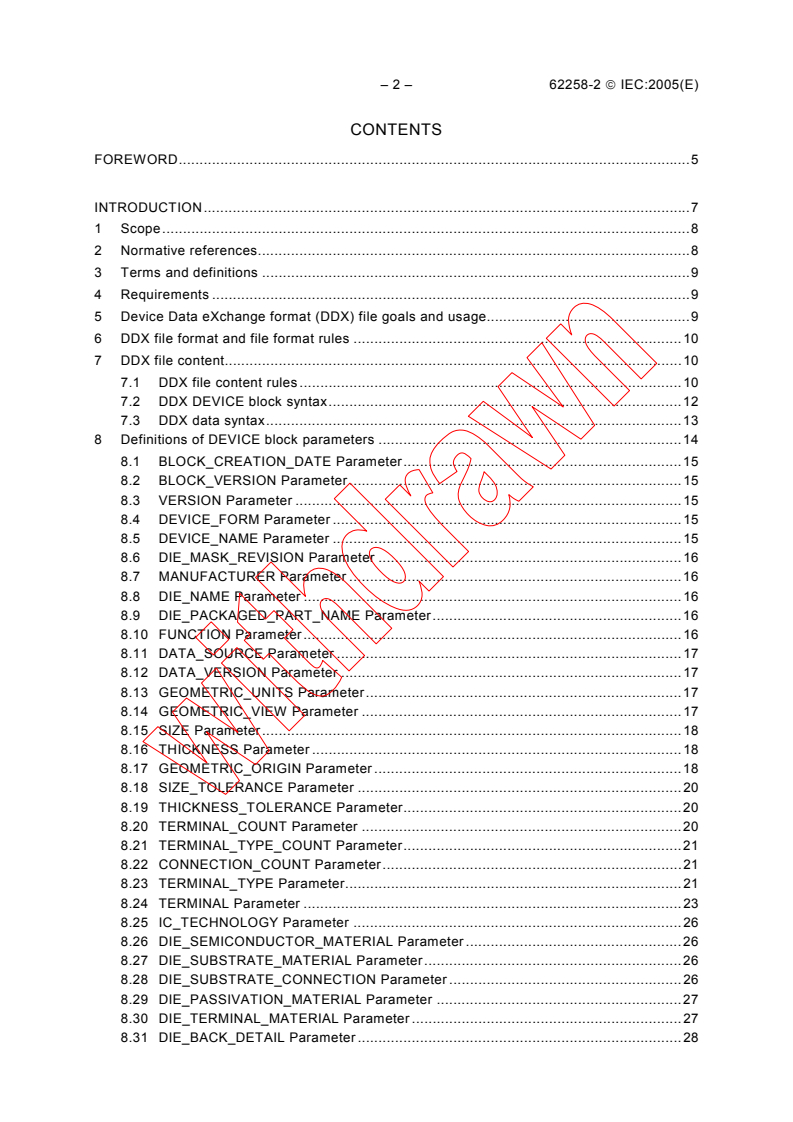
IEC 62258-2:2005 - Semiconductor die products - Part 2: Exchange data formats Released:6/13/2005
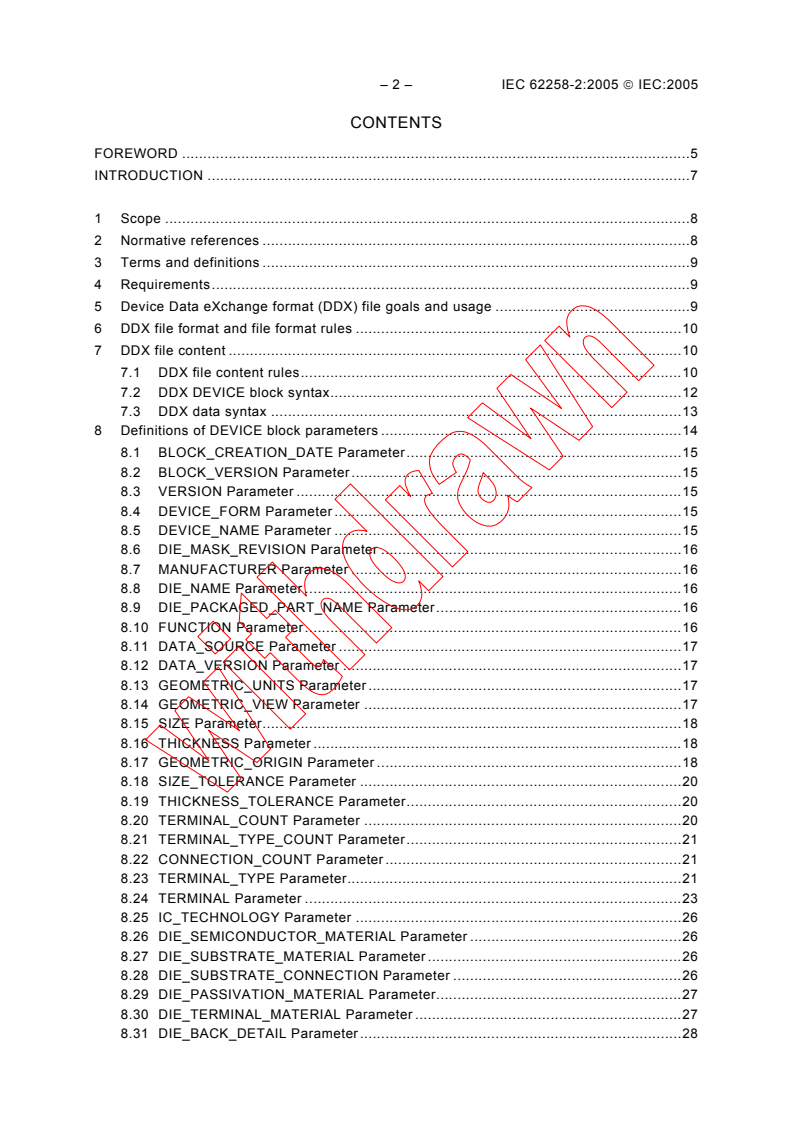
IEC 62258-2:2005 - Semiconductor die products - Part 2: Exchange data formats Released:6/13/2005
Overview
IEC 62258-2:2005 - "Semiconductor die products - Part 2: Exchange data formats" defines standardized data formats to support the production, supply and use of semiconductor die products (wafers, singulated bare die, bumped die, partially encapsulated die, etc.). The standard introduces the Device Data eXchange (DDX) format (reflected as DDX version 1.2.1) and describes how DDX and related file formats (for example STEP physical file format / ISO 10303-21 and XML) can be used to transfer geometric data and device metadata between die manufacturers and CAD/CAE users. The format is intentionally flexible to permit broader usage beyond the initial scope.
Key Topics and Requirements
- DDX file goals and usage - primary objective is reliable transfer of adequate geometric and device data between suppliers and CAD/CAE systems.
- File format rules and syntax - defines DDX file structure, the required DEVICE block, and rules for content and parameter naming.
- Parameter definitions - exhaustive definitions for device parameters (size, thickness, terminals, terminal types, materials, wafer parameters, simulation model references, delivery and packing codes, fiducials, tolerances, etc.), using IEC 61360 principles for data semantics.
- Geometric and orientation data - guidance on geometric units, geometric origin, views, die orientation and positional parameters to support CAD/CAM interoperability.
- Formal information models - DDX EXPRESS schema and guidance for representing DDX data in other exchange formats such as STEP SPF and XML.
- Annexes and examples - informative annexes include DDX DEVICE block examples, SPF examples, CAD view illustrations, simulation properties and cross-references to IEC 61360-4.
Practical Applications
- Enables consistent exchange of die geometry and metadata across the semiconductor supply chain.
- Supports CAD/CAE integration for:
- Package design and floorplanning
- Assembly and test equipment programming
- Packaging houses and subcontractors receiving die data
- CAD/CAM tool vendors implementing import/export of die data
- Useful for process engineers, packaging engineers, EDA and CAD tool developers, wafer foundries, OSATs and procurement teams who require machine-readable, standardized die descriptors for automation and verification.
Who Uses This Standard
- Die manufacturers and foundries
- EDA/CAD/CAE developers and integrators
- Packaging and assembly houses (OSATs)
- Test and inspection equipment vendors
- Supply-chain and procurement specialists needing standardized device descriptions
Related Standards
- IEC 61360 series (data element semantics and definitions)
- ISO 10303-21 (STEP Physical File / SPF) - for representation of DDX in STEP files
Keywords: IEC 62258-2, DDX, semiconductor die, exchange data formats, STEP SPF, ISO 10303-21, XML, CAD/CAE, geometric data, die manufacturer.
Relations
- Effective Date
- 05-Sep-2023
Buy Documents
IEC 62258-2:2005 - Semiconductor die products - Part 2: Exchange data formats Released:6/13/2005
IEC 62258-2:2005 - Semiconductor die products - Part 2: Exchange data formats Released:6/13/2005
Frequently Asked Questions
IEC 62258-2:2005 is a standard published by the International Electrotechnical Commission (IEC). Its full title is "Semiconductor die products - Part 2: Exchange data formats". This standard covers: IEC 62258-2:2005 has been developed to facilitate the production, supply and use of semiconductor die products, including but not limited to wafers, singulated bare die, die and wafers with attached connection structures, minimally or partially encapsulated die and wafers. This standard specifies the data formats that may be used for the exchange of data covered by other parts in the IEC 62258 series as well as definitions of all parameters used according to the principles and methods of IEC 61360-1, IEC 61360-2 and IEC 61360-4. It introduces a Device Data Exchange (DDX) format, with the prime goal of facilitating the transfer of adequate geometric data between the die manufacturer and the CAD/CAE user and formal information models that allow data exchange in other formats such as STEP physical file format, fin accordance with ISO 10303-21 and XML. The data format has been kept intentionally flexible to permit usage beyond this initial scope. This standard reflects the DDX data format: version 1.2.1.
IEC 62258-2:2005 has been developed to facilitate the production, supply and use of semiconductor die products, including but not limited to wafers, singulated bare die, die and wafers with attached connection structures, minimally or partially encapsulated die and wafers. This standard specifies the data formats that may be used for the exchange of data covered by other parts in the IEC 62258 series as well as definitions of all parameters used according to the principles and methods of IEC 61360-1, IEC 61360-2 and IEC 61360-4. It introduces a Device Data Exchange (DDX) format, with the prime goal of facilitating the transfer of adequate geometric data between the die manufacturer and the CAD/CAE user and formal information models that allow data exchange in other formats such as STEP physical file format, fin accordance with ISO 10303-21 and XML. The data format has been kept intentionally flexible to permit usage beyond this initial scope. This standard reflects the DDX data format: version 1.2.1.
IEC 62258-2:2005 is classified under the following ICS (International Classification for Standards) categories: 31.080.99 - Other semiconductor devices. The ICS classification helps identify the subject area and facilitates finding related standards.
IEC 62258-2:2005 has the following relationships with other standards: It is inter standard links to IEC 62258-2:2011. Understanding these relationships helps ensure you are using the most current and applicable version of the standard.
IEC 62258-2:2005 is available in PDF format for immediate download after purchase. The document can be added to your cart and obtained through the secure checkout process. Digital delivery ensures instant access to the complete standard document.
Standards Content (Sample)
INTERNATIONAL IEC
STANDARD 62258-2
First edition
2005-06
Semiconductor die products –
Part 2:
Exchange data formats
Reference number
Publication numbering
As from 1 January 1997 all IEC publications are issued with a designation in the
60000 series. For example, IEC 34-1 is now referred to as IEC 60034-1.
Consolidated editions
The IEC is now publishing consolidated versions of its publications. For example,
edition numbers 1.0, 1.1 and 1.2 refer, respectively, to the base publication, the
base publication incorporating amendment 1 and the base publication incorporating
amendments 1 and 2.
Further information on IEC publications
The technical content of IEC publications is kept under constant review by the IEC,
thus ensuring that the content reflects current technology. Information relating to
this publication, including its validity, is available in the IEC Catalogue of
publications (see below) in addition to new editions, amendments and corrigenda.
Information on the subjects under consideration and work in progress undertaken
by the technical committee which has prepared this publication, as well as the list
of publications issued, is also available from the following:
• IEC Web Site (www.iec.ch)
• Catalogue of IEC publications
The on-line catalogue on the IEC web site (www.iec.ch/searchpub) enables you to
search by a variety of criteria including text searches, technical committees
and date of publication. On-line information is also available on recently issued
publications, withdrawn and replaced publications, as well as corrigenda.
• IEC Just Published
This summary of recently issued publications (www.iec.ch/online_news/ justpub)
is also available by email. Please contact the Customer Service Centre (see
below) for further information.
• Customer Service Centre
If you have any questions regarding this publication or need further assistance,
please contact the Customer Service Centre:
Email: custserv@iec.ch
Tel: +41 22 919 02 11
Fax: +41 22 919 03 00
INTERNATIONAL IEC
STANDARD 62258-2
First edition
2005-06
Semiconductor die products –
Part 2:
Exchange data formats
IEC 2005 Copyright - all rights reserved
No part of this publication may be reproduced or utilized in any form or by any means, electronic or
mechanical, including photocopying and microfilm, without permission in writing from the publisher.
International Electrotechnical Commission, 3, rue de Varembé, PO Box 131, CH-1211 Geneva 20, Switzerland
Telephone: +41 22 919 02 11 Telefax: +41 22 919 03 00 E-mail: inmail@iec.ch Web: www.iec.ch
PRICE CODE
Commission Electrotechnique Internationale XB
International Electrotechnical Commission
МеждународнаяЭлектротехническаяКомиссия
For price, see current catalogue
– 2 – 62258-2 IEC:2005(E)
CONTENTS
FOREWORD.5
INTRODUCTION.7
1 Scope.8
2 Normative references.8
3 Terms and definitions .9
4 Requirements .9
5 Device Data eXchange format (DDX) file goals and usage.9
6 DDX file format and file format rules .10
7 DDX file content.10
7.1 DDX file content rules .10
7.2 DDX DEVICE block syntax.12
7.3 DDX data syntax.13
8 Definitions of DEVICE block parameters .14
8.1 BLOCK_CREATION_DATE Parameter.15
8.2 BLOCK_VERSION Parameter .15
8.3 VERSION Parameter .15
8.4 DEVICE_FORM Parameter .15
8.5 DEVICE_NAME Parameter .15
8.6 DIE_MASK_REVISION Parameter .16
8.7 MANUFACTURER Parameter .16
8.8 DIE_NAME Parameter .16
8.9 DIE_PACKAGED_PART_NAME Parameter.16
8.10 FUNCTION Parameter.16
8.11 DATA_SOURCE Parameter .17
8.12 DATA_VERSION Parameter .17
8.13 GEOMETRIC_UNITS Parameter.17
8.14 GEOMETRIC_VIEW Parameter .17
8.15 SIZE Parameter.18
8.16 THICKNESS Parameter .18
8.17 GEOMETRIC_ORIGIN Parameter .18
8.18 SIZE_TOLERANCE Parameter .20
8.19 THICKNESS_TOLERANCE Parameter.20
8.20 TERMINAL_COUNT Parameter .20
8.21 TERMINAL_TYPE_COUNT Parameter.21
8.22 CONNECTION_COUNT Parameter.21
8.23 TERMINAL_TYPE Parameter.21
8.24 TERMINAL Parameter .23
8.25 IC_TECHNOLOGY Parameter .26
8.26 DIE_SEMICONDUCTOR_MATERIAL Parameter .26
8.27 DIE_SUBSTRATE_MATERIAL Parameter.26
8.28 DIE_SUBSTRATE_CONNECTION Parameter .26
8.29 DIE_PASSIVATION_MATERIAL Parameter .27
8.30 DIE_TERMINAL_MATERIAL Parameter .27
8.31 DIE_BACK_DETAIL Parameter .28
62258-2 IEC:2005(E) – 3 –
8.32 WAFER_SIZE Parameter.28
8.33 MAX_TEMP Parameter.28
8.34 POWER_RANGE Parameter.28
8.35 TEMPERATURE_RANGE Parameter .28
8.36 Simulator MODEL FILE Parameter.29
8.37 Simulator MODEL FILE DATE Parameter.29
8.38 Simulator NAME Parameter .29
8.39 Simulator VERSION Parameter.29
8.40 Simulator COMPLIANCE Parameter.30
8.41 DIE_DELIVERY_FORM Parameter .30
8.42 PACKING_CODE Parameter.30
8.43 BUMP_MATERIAL Parameter .30
8.44 BUMP_HEIGHT Parameter .30
8.45 BUMP_HEIGHT_TOLERANCE Parameter.31
8.46 MPD_PACKAGE_MATERIAL Parameter .31
8.47 MPD_PACKAGE_STYLE Parameter .31
8.48 MPD_DELIVERY_FORM Parameter.31
8.49 MPD_CONNECTION_TYPE Parameter.32
8.50 MPD_CONNECTION_MATERIAL Parameter.32
8.51 FIDUCIAL_TYPE Parameter .32
8.52 FIDUCIAL Parameter.33
8.53 WAFER_DIE_STEP_SIZE Parameter .35
8.54 WAFER_GROSS_DIE_COUNT Parameter.35
8.55 WAFER_INDEX Parameter.35
8.56 WAFER_RETICULE_STEP_SIZE Parameter .35
8.57 WAFER_RETICULE_GROSS_DIE_COUNT Parameter .36
9 DDX EXPRESS model schema .36
9.1 Type definitions .36
9.2 File structure .40
9.3 Device names.40
9.4 Device block.40
9.5 Die size .41
9.6 Bare or bumped die type.42
9.7 Bare die type .42
9.8 Bumped bare die type.42
9.9 Lead-frame die type.43
9.10 Minimally packaged device .43
9.11 Die delivery forms.43
9.12 Terminal types.44
9.13 Rectangular terminal.44
9.14 Circular terminal .44
9.15 Elliptic terminal .44
9.16 Polygonal terminal .45
9.17 Terminals .45
9.18 Simulation data.46
9.19 Fiducial type .46
9.20 Fiducial .46
9.21 Die and feature size.47
9.22 Position .47
– 4 – 62258-2 IEC:2005(E)
9.23 Orientation .47
9.24 Date .48
9.25 Substrate connection .48
9.26 Wafer index.48
Annex A (informative) Example of a DDX DEVICE block.49
Annex B (informative) Example of DDX data in STEP Physical FILE (SPF) format.51
Annex C (informative) Typical CAD view from the DDX file block example given in
Annex A .53
Annex D (informative) Properties for simulation .54
Annex E (informative) TERMINAL and TERMINAL_TYPE graphical usage for CAD/CAM
systems .55
Annex F (informative) Cross-reference with IEC 61360-4.58
Annex G (informative) Notes on VERSION and NAME parameters.60
Annex H (informative) Notes on WAFER parameters .61
Annex I (informative) additional notes.63
Annex J (informative) DDX version history.64
Bibliography .66
Figure 1 – Relationship between geometric centre and geometric origin.19
Figure C.1 – CAD representation of DDX example from Annex A .53
Figure E.1 – Highlighting the MX and MY orientation properties .56
Figure E.2 – Highlighting the angular rotational orientation properties .57
Figure H.1 – Illustrating the WAFER parameters.62
Table 1 – Terminal shape types.22
Table 2 – Terminal shape coordinates .22
Table 3 – Terminal IO types .24
Table 4 – Substrate connection parameters.27
Table F.1 – Parameter list .58
Table J.1 – Parameter change history list .64
62258-2 IEC:2005(E) – 5 –
INTERNATIONAL ELECTROTECHNICAL COMMISSION
____________
SEMICONDUCTOR DIE PRODUCTS –
Part 2: Exchange data formats
FOREWORD
1) The International Electrotechnical Commission (IEC) is a worldwide organization for standardization comprising
all national electrotechnical committees (IEC National Committees). The object of IEC is to promote
international co-operation on all questions concerning standardization in the electrical and electronic fields. To
this end and in addition to other activities, IEC publishes International Standards, Technical Specifications,
Technical Reports, Publicly Available Specifications (PAS) and Guides (hereafter referred to as “IEC
Publication(s)”). Their preparation is entrusted to technical committees; any IEC National Committee interested
in the subject dealt with may participate in this preparatory work. International, governmental and non-
governmental organizations liaising with the IEC also participate in this preparation. IEC collaborates closely
with the International Organization for Standardization (ISO) in accordance with conditions determined by
agreement between the two organizations.
2) The formal decisions or agreements of IEC on technical matters express, as nearly as possible, an international
consensus of opinion on the relevant subjects since each technical committee has representation from all
interested IEC National Committees.
3) IEC Publications have the form of recommendations for international use and are accepted by IEC National
Committees in that sense. While all reasonable efforts are made to ensure that the technical content of IEC
Publications is accurate, IEC cannot be held responsible for the way in which they are used or for any
misinterpretation by any end user.
4) In order to promote international uniformity, IEC National Committees undertake to apply IEC Publications
transparently to the maximum extent possible in their national and regional publications. Any divergence
between any IEC Publication and the corresponding national or regional publication shall be clearly indicated in
the latter.
5) IEC provides no marking procedure to indicate its approval and cannot be rendered responsible for any
equipment declared to be in conformity with an IEC Publication.
6) All users should ensure that they have the latest edition of this publication.
7) No liability shall attach to IEC or its directors, employees, servants or agents including individual experts and
members of its technical committees and IEC National Committees for any personal injury, property damage or
other damage of any nature whatsoever, whether direct or indirect, or for costs (including legal fees) and
expenses arising out of the publication, use of, or reliance upon, this IEC Publication or any other IEC
Publications.
8) Attention is drawn to the Normative references cited in this publication. Use of the referenced publications is
indispensable for the correct application of this publication.
9) Attention is drawn to the possibility that some of the elements of this IEC Publication may be the subject of
patent rights. IEC shall not be held responsible for identifying any or all such patent rights.
International Standard IEC 62258-2 has been prepared by IEC technical committee 47:
Semiconductor devices.
The text of this standard is based on the following documents:
FDIS Report on voting
47/1809/FDIS 47/1822/RVD
Full information on the voting for the approval of this standard can be found in the report on
voting indicated in the above table.
This Part of IEC 62258 should be read in conjunction with IEC 62258-1.
This publication has been drafted in accordance with the ISO/IEC Directives, Part 2.
– 6 – 62258-2 IEC:2005(E)
IEC 62258, as currently conceived, consists of the following parts, under the general title
Semiconductor die products
Part 1: Requirements for procurement and use
Part 2: Exchange data formats
Part 3: Recommendations for good practice in handling, packing and storage
Part 4: Questionnaire for die users and suppliers
Part 5: Requirements for information concerning electrical simulation
Part 6: Requirements for information concerning thermal simulation
Further parts may be added as required.
The committee has decided that the contents of this publication will remain unchanged until the
maintenance result date indicated on the IEC web site under "http://webstore.iec.ch" in the data
related to the specific publication. At this date, the publication will be
• reconfirmed;
• withdrawn;
• replaced by a revised edition, or
• amended.
62258-2 IEC:2005(E) – 7 –
INTRODUCTION
th
This International Standard is based on the work carried out in the ESPRIT 4 Framework
project GOOD-DIE which resulted in the publication of the ES 59008 series of European
specifications. Organisations that helped prepare this standard included the ESPRIT GOOD-
DIE and ENCAST projects, the Die Products Consortium, and JEITA.
– 8 – 62258-2 IEC:2005(E)
SEMICONDUCTOR DIE PRODUCTS –
Part 2: Exchange data formats
1 Scope
This part of IEC 62258 has been developed to facilitate the production, supply and use of
semiconductor die products, including but not limited to
– wafers,
– singulated bare die,
– die and wafers with attached connection structures,
– minimally or partially encapsulated die and wafers.
This standard specifies the data formats that may be used for the exchange of data covered by
other parts in the IEC 62258 series as well as definitions of all parameters used according to
the principles and methods of IEC 61360-1, IEC 61360-2 and IEC 61360-4. It introduces a
Device Data Exchange (DDX) format, with the prime goal of facilitating the transfer of adequate
geometric data between the die manufacturer and the CAD/CAE user and formal information
models that allow data exchange in other formats such as STEP physical file format, fin
accordance with ISO 10303-21 and XML. The data format has been kept intentionally flexible
to permit usage beyond this initial scope.
This standard reflects the DDX data format: version 1.2.1.
2 Normative references
The following referenced documents are indispensable for the application of this document. For
dated references, only the edition cited applies. For undated references, the latest edition of
the referenced document (including any amendments) applies.
IEC 62258-1, Semiconductor die products – Part 1: Requirements for procurement and use
IEC 61360-1:2002, Standard data element types with associated classification scheme for
electric components – Part 1: Definitions – Principles and methods
IEC 61360-2:2002, Standard data element types with associated classification scheme for
electric components – Part 2: EXPRESS dictionary schema
IEC 61360-4:1997, Standard data element types with associated classification scheme for
electric components – Part 4: IEC reference collection of standard data element types,
component classes and terms
ISO 6093:1985, Information processing – Representation of numerical values in character
strings for information interchange
ISO 8601:2004, Data elements and interchange formats – Information interchange –
Representation of dates and times
ISO 10303-21:2002, Industrial automation systems and integration – Product data
representation and exchange – Part 21: Implementation methods: Clear text encoding of the
exchange structure
___________
To be published.
62258-2 IEC:2005(E) – 9 –
3 Terms and definitions
For the purposes of this document, the definitions as given in IEC 62258-1 shall apply.
4 Requirements
Specific reference for Parameter Variables is made to the IEC 61360 Data Element Type (DET)
codes, which are defined in Part 4 of IEC 61360-4.
5 Device Data eXchange format (DDX) file goals and usage
To facilitate the transferral of data by electronic media from the device vendor to the end-user
for use within a CAD or CAE system, a data file format, Device Data eXchange, (DDX), shall be
used. This data file format has been deliberately kept flexible, to permit further enhancements
and additions for future use.
It is strongly recommended that Device Data eXchange files have the three letter DDX file
extension, and a Device Data eXchange file shall hereon be referred to as a DDX file.
5.1 Data that are to be transferred from a device vendor to a user shall be contained in a
single computer-readable DDX file, and the minimum contents of this file shall suffice a
geometric CAD/CAE software design system. The file shall be textually readable, to
permit simple manual verification.
5.2 The DDX file and its data contents shall be independent of both computer machine and
operating system.
5.3 The DDX file contents shall include mechanical and interconnectivity information, but
may additionally include electrical and functional data.
5.4 The DDX file may contain data for one or more devices and shall be capable of being
used as a library file by a CAD/CAE software design system. The file may contain one
or more sets of data for the same device type, each having different delivery forms,
such as bumped die, bare die, and Chip-Scale packaging.
5.5 The DDX file shall be capable of being simply or automatically generated, such as by
an ASCII text editor or a spreadsheet.
5.6 The DDX file shall be capable of referencing additional external files, such as
simulation and thermal model files.
5.7 All data shall be defined in such a way that conversion to or from other exchange
formats is possible, such as GDSII and CIF for geometric data of die. As close a
compatibility to the existing DIE (Die Information Exchange) data as possible is desired,
to facilitate simple translation of partial DIE data files.
5.8 Definitions of parameters shall be in conformity with IEC 61360-1 (refer to Clause 5 of
IEC 62258-1).
– 10 – 62258-2 IEC:2005(E)
6 DDX file format and file format rules
NOTE Version 1.2.1 of DDX supersedes version 1.0.0 contained in ES 59008-6-1 [1] .
The DDX file shall be an ASCII compatible text file with suitable line termination. Line
termination will depend upon the operating system. DOS/Windows generally uses a
carriage/line-feed terminator (ASCII 0Dh/0Ah), whereas UNIX invariably relies solely
upon a line-feed (ASCII 0Ah) terminator, the carriage return (ASCII 0Dh) being
present by implication.
6.1 All data not complying to the data syntax (refer to 7.3) shall be treated as a remark and,
as such, ignored.
6.2 All mandatory data shall be present. Missing data shall be flagged as an error, rendering
that data unusable.
6.3 ASCII characters 00h to 7Fh are permitted, ASCII characters 80h to FFh shall be
ignored.
6.4 All text data shall be case independent.
6.5 Underscores “_” shall be ignored in a variable or property name, and may be used as
intermediate name separators. Underscores are valid within textual string and name
data.
6.6 A comma “,” shall be used as a data separator.
6.7 All data lines shall be terminated with a semicolon, “;”.
6.8 Braces are used to open and close structures or BLOCKs. An open brace “{“ shall be
used to begin a structure or block, and a close brace “}” shall be used to terminate a
structure or block.
6.9 Brackets “()” shall be permitted, then ignored, in numeric data for clarity (e.g. in
coordinate pairs).
6.10 To accommodate typical spreadsheet CSV (Comma Separated Variable) format outputs,
textual data may be inside double quotes “”, and matching pairs of double quotes shall be
ignored.
6.11 Mathematical operations, calculations or formulae shall not be permitted within numeric
data.
6.12 Space characters (ASCII 20h) and tab characters (ASCII 09h) shall both be treated as
space separators, multiple space and tab characters will syntactically be treated as a
single space separator.
6.13 Lines beginning with a hash “#” shall be treated as an intentional comment. All data on
that line shall be ignored.
7 DDX file content
7.1 DDX file content rules
7.1.1 Block structure
Data shall only exist within a block structure, referred to as a DEVICE block, and one or more
DEVICE blocks, each containing data, may exist within a single file. Each DEVICE block is
unique, and shall only contain data relevant to a single device, having a specific device form.
All data within each DEVICE block shall be treated as being local and unique only to that block.
(Refer to 6.8)
___________
Figures in brackets refer to the bibliography.
62258-2 IEC:2005(E) – 11 –
7.1.2 Parameter types
There are two types of parameters use for data, structures and variables, and these
parameters shall only exist with a DEVICE block:
– A structure determines a set or multiple sets of data having different data types.
– A variable is equated to a single or multiple data of a single data type.
7.1.3 Data types
Data types comprise:
7.1.3.1 Textual string data
All ASCII characters from ASCII 20h to ASCII 7Fh are permitted within textual data, characters
including and above ASCII 80h shall be ignored. Consideration may be given to special print
and display control characters to permit the printing of underscore or overscore characters. It is
advised that textual string data are placed within pairs of double quotes, refer 6.10.
7.1.3.2 Textual name data
All names shall be unique, and shall only consist of the following characters from the ASCII
character set:-
A-Z a-z 0-9 $ – % & ! @ _ .
When textual name data are used to form a file name, it is advisable for the name to be limited
to eight characters for the file name and to three characters for the file extension, with a point
“.” used as the name/extension delimiter, in line with many common operating systems. It is
advisable for textual name data to be placed within pairs of double quotes (refer to Clause 6).
Note that all textual data are case independent, and spaces are not permitted within a textual
name.
7.1.3.3 Real numeric data
Real numeric data shall comply to ISO 6093:1985, and shall consist of the following characters:
0-9 + – . E e
The data values may be signed, and use engineering or scientific notation, but shall not include
dimensional units, e.g.
90008, 9000.80, 9.0008E5, -5207, -5.207E3, 0.102, 102E-3
Note that a comma “,” is used as a data separator, and therefore shall not be used as a
replacement for a decimal point “.”.
7.1.3.4 Integer numeric data
Integer numeric data values shall comply with ISO 6093:1985, and only the characters 0 to 9
are permitted. Integers shall be unsigned, and shall not include dimensional units.
For practical purposes, an integer shall be limited to 16-bit resolution, i.e. integer values
between and including 0 to 65536 only are acceptable.
– 12 – 62258-2 IEC:2005(E)
7.1.3.5 Date data
Date data values shall comply with ISO 8601:2000 format, Yr2000 compliant, and may include
time information as well e.g.
“YYYY-MM-DD”, “YYYYMMDD”, “YYYY-MM-DDTHH:MM:SS”.
7.1.4 Forward references
To permit single-pass parsing, no variable identifier or variable name shall be referenced prior
to being defined.
7.1.5 Units
-6
All units shall belong to the SI system, apart from the geometric unit of the micron (10 m), the
-3
inch and the mil (10 inch). Only one unit of dimension shall be permitted within a single
DEVICE block. Note that the inch and the mil are non-preferred units, and are only present due
to continued common usage.
7.1.6 Coordinate data
In all coordinate data, the X coordinate shall precede the Y coordinate and the Y coordinate
shall precede the Z coordinate (i.e. X,Y or X,Y,Z).
The X coordinate shall be the horizontal axis (numerically left to right), the Y coordinate shall
be the vertical axis (numerically bottom to top), and the Z coordinate shall be depth axis
(numerically near to far).
7.2 DDX DEVICE block syntax
DEVICE device_name device_form {
relevant die data ……
}
The DDX file may contain one or more DEVICE blocks, all data pertaining to a particular device
shall be embedded within the relevant block. (refer to 6.1 and 7.1.1).
A DEVICE block is opened by the DEVICE keyword and opening brace “{“, (as shown), and the
DEVICE block is closed by the matching closing brace “}”.
Data not within a DEVICE block structure shall be treated as a remark, permitting the future
addition of checksum information, file creation date and historical data etc., within the DDX file,
without affecting the actual device data.
The device_name is the given name by which the device shall be referred, and the
device_form is the mechanical form of the device to which the block data pertains.
Valid data for the device_form variable are
– bare_die,
– bumped_die,
– lead_frame_die
– minimally_packaged_device (or MPD).
62258-2 IEC:2005(E) – 13 –
Further device_form types may be added at a later stage, refer to IEC 61360-4, AAD004-001,
“die type code”, for further details.
Only one DEVICE block having device_name of type device_form shall be present within the
DDX file, but duplication of either device_name or device_form is permissible.
An example of a typical DDX file arrangement of DEVICE blocks is as follows:
DEVICE name1 bare_die {
relevant data for device “name1” as a bare die.
}
DEVICE name1 bumped_die {
relevant data for device “name1”as a bumped die.
}
DEVICE name2 mpd {
relevant data for device “name2” as a minimally packaged device.
}
DEVICE name2 bare_die {
relevant data for device “name2” as a bare die.
}
DEVICE name1 mpd {
relevant data for device “name1” as a minimally packaged device.
}
DEVICE name3 bare_die {
relevant data for device “name3” as a bare die.
}
In the above example, there are three occurrences of a DEVICE block for device “name1”, and
two occurrences of a DEVICE block for device “name2”, but each of these DEVICE blocks
specify a different device_form. The order or sequencing of the DEVICE blocks has no
relevance.
7.3 DDX data syntax
Property = value [, value];
[equate separator] }>[data terminator][line terminator]
::= Parameter name
[space] ::= {space character (20h) or tab character (09h)}0+
[equate separator] ::= [space]{equal =}[space]
[separator] ::= [space]{comma ,}[space]
[data terminator] ::= [space]{semicolon;}
[line terminator] ::= {CR or CR/LF}
For example:
thickness = 100.0 ;
Thickness=470;
geometric_units=micron;
geometricunits = micron;
GeometricUnits= “millimetres”;
terminal_type = T1, Circle, 220;
Terminal_Type = T2, Rectangle, 200 , 250;
TerminalType = T2, O, (200, 250);
TERMINALTYPE = T2, O, 200 , 250;
Thus, terminal_type, Terminal_Type, TerminalType and TERMINALTYPE will all reference
the same parameter name.
– 14 – 62258-2 IEC:2005(E)
8 Definitions of DEVICE block parameters
Where a parameter is unique to the device_form, as defined in the DEVICE block, the
parameter will be preceded with the following:
DIE_ data parameter is unique to bare die or bumped die form
BUMP_ data parameter is unique to only bumped die
MPD_ data parameter is unique to a minimally packaged device, such as a
CSP
WAFER_ data parameter is unique to a die device delivered at wafer level
LEAD_ data parameter is unique to a die device with attached lead frame.
Within the following list of data parameters (8.1 onwards), the following are shown:
– the parameter name, as used syntactically within the DDX file,
– the parameter type, indicating either a variable or structure data type,
– the parameter function, determining its usage and meaning,
– the parameter value, indicating the type of data expected,
– any parameter limitation, indicating any limitation within the DEVICE block,
– parameter dependencies, highlighting parameters that need to be declared prior to
invocation,
– one or more practical examples, and
– any relevant notes.
A brief table of parameters is given in Annex F, and a working example of a full DDX DEVICE
block is given in Annex A, with its expected graphical output in Annex C.
All parameters shall conform to the relevant IEC 61360 Data Element Type (DET) codes, as
defined in IEC 61360-4.
Terms and conventions
A point of electrical connection is called a terminal. This may be a bond-pad for a bare die, and
may equally refer to the landing or connection footprint area required by an interconnection
medium. It is a common convention for die to have the initial terminal, numbered 1, in the
upper left hand corner of the die, and for terminal or pin numbering to continue counter-
clockwise in sequence.
The X coordinate dimensions are for the length in the horizontal plane with increasing positive
values to the right. The Y coordinate dimensions are for the width in the horizontal plane with
increasing positive values away from the user’s view. The Z coordinate dimensions are for
height in the vertical direction with increasing positive values upwards.
As a point of reference, all die components, including bumped die, are generally viewed from
above with the active side upwards.
Summary of general rules
• All valid data shall be contained within a DEVICE block (refer to 7.1.1).
• Any local or unique parameter, such as a name, shall be defined prior to its usage.
• All parameters shall conform to the relevant IEC 61360 DET codes, as defined in
IEC 61360-4 (refer to 5.8).
• The units of measurement, GEOMETRIC_UNITS, shall be defined before any geometric
variable is defined.
• The geometric origin, GEOMETRIC_ORIGIN, and the geometric view, GEOMETRIC_VIEW,
shall be defined before any geometric coordinates are defined.
62258-2 IEC:2005(E) – 15 –
• The TERMINAL_COUNT parameter shall be defined before any TERMINAL parameters
are referred to and the number of TERMINAL parameters shall not exceed the
TERMINAL_COUNT value.
• The TERMINAL_TYPE_COUNT parameter shall be defined before any TERMINAL_TYPE
parameters are referred to and the number of TERMINAL_TYPE parameters shall not
exceed the TERMINAL_TYPE_COUNT value.
8.1 BLOCK_CREATION_DATE Parameter
Parameter Name BLOCK_CREATION_DATE
Parameter Type Variable
Parameter Function Specifies the date that the DEVICE block was created and last edited.
Parameter Values Date, as described in 7.1.3.5
Limitations Shall be declared only once within a single DEVICE block.
Example BLOCK_CREATION_DATE = “1997-12-25”;
Notes Refer to Annex G
8.2 BLOCK_VERSION Parameter
Parameter Name BLOCK_VERSION
Parameter Type Variable
Parameter Function Specifies the version number and/or issue number of the DEVICE
block.
Parameter Values Textual string data, as described in 7.1.3.1
Limitations Shall be declared only once within a single DEVICE block.
Example BLOCK_VERSION = “1.0A”;
Notes Refer to Annex G
8.3 VERSION Parameter
Parameter Name VERSION
Parameter Type Variable
Parameter Function Specifies the revision/version number of the DDX standard, (currently
at version 1.2.1), to which this DEVICE block conforms.
Parameter Values Textual string data, as described in 7.1.3.1
Limitations Shall be declared only once within a single DEVICE block.
Example VERSION = “1.2.1”;
Notes Refer to Annex G
8.4 DEVICE_FORM Parameter
This is defined within the DEVICE block heading by the device_form parameter.
Parameter Name device_form
Parameter Type Variable, refer to 7.2 on DEVICE blocks
Parameter Function Defines the physical form of the device.
Parameter Values Textual string data, as described in 7.1.3.1
Example bare_die, bumped_die, MPD
Notes Refer to 7.2 and Annex G.
8.5 DEVICE_NAME Parameter
This is defined within the DEVICE block heading as the device_name parameter
Parameter Name device_name
Parameter Type Variable, refer to 7.2 on DEVICE blocks
Parameter Function Defines the device’s reference name.
Parameter Values Textual name data, as described in 7.1.3.2
Example SN74LS04
Notes Refer to 7.1.6, 7.2 and Annex G.
– 16 – 62258-2 IEC:2005(E)
8.6 DIE_MASK_REVISION Parameter
Parameter Name DIE_MASK_REVISION
Parameter Type Variable
Parameter Function Specifies the mask revision details associated with that particular
version on the die.
Parameter Values Textual string data, as described in 7.1.3.1
Limitations Shall be declared only once within a single DEVICE block.
Example DIE_MASK_REVISION = “RTDAC1”
DIE_MASK_REVISION = “9033-2-101-M5/2”
Notes Intended to ensure that the die data matches the geometric version of
the actual die. Refer to Annex G.
8.7 MANUFACTURER Parameter
Parameter Name MANUFACTURER
Parameter Type Variable
Parameter Function Specifies the manufacturer or fabrication house of the device.
Parameter Values Textual string data, as described in 7.1.3.1
Limitations Shall be declared only once within a single DEVICE block.
Example MANUFACTURER = “Fuzziwuz Logic Inc.”;
8.8 DIE_NAME Parameter
Parameter Name DIE_NAME
Parameter Type Variable
Parameter Function Specifies the name of the die or mask set from which the die was
produced.
Parameter Values Textual string data, as described in 7.1.3.1
Limitations Shall be declared only once within a single DEVICE block.
Example DIE_NAME = “XXC345”;
Notes Refer to Annex G
8.9 DIE_PACKAGED_PART_NAME Parameter
Parameter Name DIE_PACKAGED_PART_NAME
Parameter Type Variable
Parameter Function Specifies the manufacturers part name for the equivalent packaged
part, where available or applicable.
Parameter Values Textual string data, as described in 7.1.3.1
Example DIE_PACKAGED_PART_NAME = “SN5405JN”;
Notes Used to reference the identical packaged die part, not merely similar
function, when supplied by the same manufacturer in packaged form.
8.10 FUNCTION Parameter
Parameter Name FUNCTION
Parameter Type Variable
Parameter Function A brief description of the devices’ function.
Parameter Values Textual string data, as described in 7.1.3.1
Limitations Shall be declared only once within a single DEVICE block.
Example FUNCTION = “16 Bit Microprocessor”;
Notes IEC 61360-4 specifies certain functional and application classes that
may be used.
62258-2 IEC:2005(E) – 17 –
8.11 DATA_SOURCE Parameter
Parameter Name DATA_SOURCE
Parameter Type Variable
Parameter Function Specifies the source of the device data, essentially where this is
different from the manufacturer or fabrication house.
Parameter Values Textual string data, as described in 7.1.3.1
Limitations Shall be declared only once within a single DEVICE block.
Example DATA_SOURCE = “AnyChip Technology Ltd.”;
DATA_SOURCE = “Good-Die database”;
8.12 DATA_VERSION Parameter
Parameter Na
...
IEC 62258-2 ®
Edition 1.0 2005-06
INTERNATIONAL
STANDARD
NORME
INTERNATIONALE
Semiconductor die products –
Part 2: Exchange data formats
Produits de puces de semiconducteurs –
Partie 2: Formats d'échange de données
All rights reserved. Unless otherwise specified, no part of this publication may be reproduced or utilized in any form
or by any means, electronic or mechanical, including photocopying and microfilm, without permission in writing from
either IEC or IEC's member National Committee in the country of the requester.
If you have any questions about IEC copyright or have an enquiry about obtaining additional rights to this publication,
please contact the address below or your local IEC member National Committee for further information.
Droits de reproduction réservés. Sauf indication contraire, aucune partie de cette publication ne peut être reproduite ni
utilisée sous quelque forme que ce soit et par aucun procédé, électronique ou mécanique, y compris la photocopie et les
microfilms, sans l'accord écrit de la CEI ou du Comité national de la CEI du pays du demandeur.
Si vous avez des questions sur le copyright de la CEI ou si vous désirez obtenir des droits supplémentaires sur cette
publication, utilisez les coordonnées ci-après ou contactez le Comité national de la CEI de votre pays de résidence.
IEC Central Office Tel.: +41 22 919 02 11
3, rue de Varembé Fax: +41 22 919 03 00
CH-1211 Geneva 20 info@iec.ch
Switzerland www.iec.ch
About the IEC
The International Electrotechnical Commission (IEC) is the leading global organization that prepares and publishes
International Standards for all electrical, electronic and related technologies.
About IEC publications
The technical content of IEC publications is kept under constant review by the IEC. Please make sure that you have the
latest edition, a corrigenda or an amendment might have been published.
Useful links:
IEC publications search - www.iec.ch/searchpub Electropedia - www.electropedia.org
The advanced search enables you to find IEC publications The world's leading online dictionary of electronic and
by a variety of criteria (reference number, text, technical electrical terms containing more than 30 000 terms and
committee,…). definitions in English and French, with equivalent terms in
It also gives information on projects, replaced and additional languages. Also known as the International
withdrawn publications. Electrotechnical Vocabulary (IEV) on-line.
IEC Just Published - webstore.iec.ch/justpublished Customer Service Centre - webstore.iec.ch/csc
Stay up to date on all new IEC publications. Just Published If you wish to give us your feedback on this publication
details all new publications released. Available on-line and or need further assistance, please contact the
also once a month by email. Customer Service Centre: csc@iec.ch.
A propos de la CEI
La Commission Electrotechnique Internationale (CEI) est la première organisation mondiale qui élabore et publie des
Normes internationales pour tout ce qui a trait à l'électricité, à l'électronique et aux technologies apparentées.
A propos des publications CEI
Le contenu technique des publications de la CEI est constamment revu. Veuillez vous assurer que vous possédez
l’édition la plus récente, un corrigendum ou amendement peut avoir été publié.
Liens utiles:
Recherche de publications CEI - www.iec.ch/searchpub Electropedia - www.electropedia.org
La recherche avancée vous permet de trouver des Le premier dictionnaire en ligne au monde de termes
publications CEI en utilisant différents critères (numéro de électroniques et électriques. Il contient plus de 30 000
référence, texte, comité d’études,…). termes et définitions en anglais et en français, ainsi que
Elle donne aussi des informations sur les projets et les les termes équivalents dans les langues additionnelles.
publications remplacées ou retirées. Egalement appelé Vocabulaire Electrotechnique
International (VEI) en ligne.
Just Published CEI - webstore.iec.ch/justpublished
Service Clients - webstore.iec.ch/csc
Restez informé sur les nouvelles publications de la CEI.
Just Published détaille les nouvelles publications parues. Si vous désirez nous donner des commentaires sur
Disponible en ligne et aussi une fois par mois par email. cette publication ou si vous avez des questions
contactez-nous: csc@iec.ch.
IEC 62258-2 ®
Edition 1.0 2005-06
INTERNATIONAL
STANDARD
NORME
INTERNATIONALE
Semiconductor die products –
Part 2: Exchange data formats
Produits de puces de semiconducteurs –
Partie 2: Formats d'échange de données
INTERNATIONAL
ELECTROTECHNICAL
COMMISSION
COMMISSION
ELECTROTECHNIQUE
INTERNATIONALE
ICS 31.080.99 ISBN 978-2-83220-878-6
– 2 – IEC 62258-2:2005 IEC:2005
CONTENTS
FOREWORD . 5
INTRODUCTION . 7
1 Scope . 8
2 Normative references . 8
3 Terms and definitions . 9
4 Requirements . 9
5 Device Data eXchange format (DDX) file goals and usage . 9
6 DDX file format and file format rules . 10
7 DDX file content . 10
7.1 DDX file content rules . 10
7.2 DDX DEVICE block syntax . 12
7.3 DDX data syntax . 13
8 Definitions of DEVICE block parameters . 14
8.1 BLOCK_CREATION_DATE Parameter . 15
8.2 BLOCK_VERSION Parameter . 15
8.3 VERSION Parameter . 15
8.4 DEVICE_FORM Parameter . 15
8.5 DEVICE_NAME Parameter . 15
8.6 DIE_MASK_REVISION Parameter . 16
8.7 MANUFACTURER Parameter . 16
8.8 DIE_NAME Parameter . 16
8.9 DIE_PACKAGED_PART_NAME Parameter . 16
8.10 FUNCTION Parameter . 16
8.11 DATA_SOURCE Parameter . 17
8.12 DATA_VERSION Parameter . 17
8.13 GEOMETRIC_UNITS Parameter . 17
8.14 GEOMETRIC_VIEW Parameter . 17
8.15 SIZE Parameter . 18
8.16 THICKNESS Parameter . 18
8.17 GEOMETRIC_ORIGIN Parameter . 18
8.18 SIZE_TOLERANCE Parameter . 20
8.19 THICKNESS_TOLERANCE Parameter . 20
8.20 TERMINAL_COUNT Parameter . 20
8.21 TERMINAL_TYPE_COUNT Parameter . 21
8.22 CONNECTION_COUNT Parameter . 21
8.23 TERMINAL_TYPE Parameter . 21
8.24 TERMINAL Parameter . 23
8.25 IC_TECHNOLOGY Parameter . 26
8.26 DIE_SEMICONDUCTOR_MATERIAL Parameter . 26
8.27 DIE_SUBSTRATE_MATERIAL Parameter . 26
8.28 DIE_SUBSTRATE_CONNECTION Parameter . 26
8.29 DIE_PASSIVATION_MATERIAL Parameter . 27
8.30 DIE_TERMINAL_MATERIAL Parameter . 27
8.31 DIE_BACK_DETAIL Parameter . 28
8.32 WAFER_SIZE Parameter . 28
8.33 MAX_TEMP Parameter . 28
8.34 POWER_RANGE Parameter . 28
8.35 TEMPERATURE_RANGE Parameter . 28
8.36 Simulator MODEL FILE Parameter . 29
8.37 Simulator MODEL FILE DATE Parameter . 29
8.38 Simulator NAME Parameter . 29
8.39 Simulator VERSION Parameter . 29
8.40 Simulator COMPLIANCE Parameter. 30
8.41 DIE_DELIVERY_FORM Parameter . 30
8.42 PACKING_CODE Parameter . 30
8.43 BUMP_MATERIAL Parameter . 30
8.44 BUMP_HEIGHT Parameter . 30
8.45 BUMP_HEIGHT_TOLERANCE Parameter . 31
8.46 MPD_PACKAGE_MATERIAL Parameter . 31
8.47 MPD_PACKAGE_STYLE Parameter . 31
8.48 MPD_DELIVERY_FORM Parameter . 31
8.49 MPD_CONNECTION_TYPE Parameter . 32
8.50 MPD_CONNECTION_MATERIAL Parameter . 32
8.51 FIDUCIAL_TYPE Parameter . 32
8.52 FIDUCIAL Parameter . 33
8.53 WAFER_DIE_STEP_SIZE Parameter . 35
8.54 WAFER_GROSS_DIE_COUNT Parameter . 35
8.55 WAFER_INDEX Parameter . 35
8.56 WAFER_RETICULE_STEP_SIZE Parameter . 35
8.57 WAFER_RETICULE_GROSS_DIE_COUNT Parameter . 36
9 DDX EXPRESS model schema . 36
9.1 Type definitions . 36
9.2 File structure . 40
9.3 Device names . 40
9.4 Device block . 40
9.5 Die size . 41
9.6 Bare or bumped die type . 42
9.7 Bare die type . 42
9.8 Bumped bare die type . 42
9.9 Lead-frame die type . 43
9.10 Minimally packaged device . 43
9.11 Die delivery forms . 43
9.12 Terminal types . 44
9.13 Rectangular terminal . 44
9.14 Circular terminal . 44
9.15 Elliptic terminal . 44
9.16 Polygonal terminal . 45
9.17 Terminals . 45
9.18 Simulation data . 46
9.19 Fiducial type . 46
9.20 Fiducial . 46
9.21 Die and feature size . 47
9.22 Position . 47
– 4 – IEC 62258-2:2005 IEC:2005
9.23 Orientation . 47
9.24 Date . 48
9.25 Substrate connection . 48
9.26 Wafer index . 48
Annex A (informative) Example of a DDX DEVICE block . 49
Annex B (informative) Example of DDX data in STEP Physical FILE (SPF) format . 51
Annex C (informative) Typical CAD view from the DDX file block example given in
Annex A . 53
Annex D (informative) Properties for simulation . 54
Annex E (informative) TERMINAL and TERMINAL_TYPE graphical usage for
CAD/CAM systems . 55
Annex F (informative) Cross-reference with IEC 61360-4 . 58
Annex G (informative) Notes on VERSION and NAME parameters . 60
Annex H (informative) Notes on WAFER parameters . 61
Annex I (informative) additional notes . 63
Annex J (informative) DDX version history . 64
Bibliography . 66
Figure 1 – Relationship between geometric centre and geometric origin . 19
Figure C.1 – CAD representation of DDX example from Annex A . 53
Figure E.1 – Highlighting the MX and MY orientation properties . 56
Figure E.2 – Highlighting the angular rotational orientation properties . 57
Figure H.1 – Illustrating the WAFER parameters . 62
Table 1 – Terminal shape types . 22
Table 2 – Terminal shape coordinates . 22
Table 3 – Terminal IO types . 24
Table 4 – Substrate connection parameters . 27
Table F.1 – Parameter list . 58
Table J.1 – Parameter change history list . 64
INTERNATIONAL ELECTROTECHNICAL COMMISSION
____________
SEMICONDUCTOR DIE PRODUCTS –
Part 2: Exchange data formats
FOREWORD
1) The International Electrotechnical Commission (IEC) is a worldwide organization for standardization comprising
all national electrotechnical committees (IEC National Committees). The object of IEC is to promote
international co-operation on all questions concerning standardization in the electrical and electronic fields. To
this end and in addition to other activities, IEC publishes International Standards, Technical Specifications,
Technical Reports, Publicly Available Specifications (PAS) and Guides (hereafter referred to as “IEC
Publication(s)”). Their preparation is entrusted to technical committees; any IEC National Committee interested
in the subject dealt with may participate in this preparatory work. International, governmental and non-
governmental organizations liaising with the IEC also participate in this preparation. IEC collaborates closely
with the International Organization for Standardization (ISO) in accordance with conditions determined by
agreement between the two organizations.
2) The formal decisions or agreements of IEC on technical matters express, as nearly as possible, an
international consensus of opinion on the relevant subjects since each technical committee has representation
from all interested IEC National Committees.
3) IEC Publications have the form of recommendations for international use and are accepted by IEC National
Committees in that sense. While all reasonable efforts are made to ensure that the technical content of IEC
Publications is accurate, IEC cannot be held responsible for the way in which they are used or for any
misinterpretation by any end user.
4) In order to promote international uniformity, IEC National Committees undertake to apply IEC Publications
transparently to the maximum extent possible in their national and regional publications. Any divergence
between any IEC Publication and the corresponding national or regional publication shall be clearly indicated
in the latter.
5) IEC provides no marking procedure to indicate its approval and cannot be rendered responsible for any
equipment declared to be in conformity with an IEC Publication.
6) All users should ensure that they have the latest edition of this publication.
7) No liability shall attach to IEC or its directors, employees, servants or agents including individual experts and
members of its technical committees and IEC National Committees for any personal injury, property damage or
other damage of any nature whatsoever, whether direct or indirect, or for costs (including legal fees) and
expenses arising out of the publication, use of, or reliance upon, this IEC Publication or any other IEC
Publications.
8) Attention is drawn to the Normative references cited in this publication. Use of the referenced publications is
indispensable for the correct application of this publication.
9) Attention is drawn to the possibility that some of the elements of this IEC Publication may be the subject of
patent rights. IEC shall not be held responsible for identifying any or all such patent rights.
International Standard IEC 62258-2 has been prepared by IEC technical committee 47:
Semiconductor devices.
This bilingual version (2013-07) corresponds to the monolingual English version, published in
2005-06.
The text of this standard is based on the following documents:
FDIS Report on voting
47/1809/FDIS 47/1822/RVD
Full information on the voting for the approval of this standard can be found in the report on
voting indicated in the above table.
The French version of this standard has not been voted upon.
This Part of IEC 62258 should be read in conjunction with IEC 62258-1.
– 6 – IEC 62258-2:2005 IEC:2005
This publication has been drafted in accordance with the ISO/IEC Directives, Part 2.
IEC 62258, as currently conceived, consists of the following parts, under the general title
Semiconductor die products
Part 1: Requirements for procurement and use
Part 2: Exchange data formats
Part 3: Recommendations for good practice in handling, packing and storage
Part 4: Questionnaire for die users and suppliers
Part 5: Requirements for information concerning electrical simulation
Part 6: Requirements for information concerning thermal simulation
Further parts may be added as required.
The committee has decided that the contents of this publication will remain unchanged until
the maintenance result date indicated on the IEC web site under "http://webstore.iec.ch" in
the data related to the specific publication. At this date, the publication will be
• reconfirmed;
• withdrawn;
• replaced by a revised edition, or
• amended.
INTRODUCTION
th
This International Standard is based on the work carried out in the ESPRIT 4 Framework
project GOOD-DIE which resulted in the publication of the ES 59008 series of European
specifications. Organisations that helped prepare this standard included the ESPRIT GOOD-
DIE and ENCAST projects, the Die Products Consortium, and JEITA.
– 8 – IEC 62258-2:2005 IEC:2005
SEMICONDUCTOR DIE PRODUCTS –
Part 2: Exchange data formats
1 Scope
This part of IEC 62258 has been developed to facilitate the production, supply and use of
semiconductor die products, including but not limited to
– wafers,
– singulated bare die,
– die and wafers with attached connection structures,
– minimally or partially encapsulated die and wafers.
This standard specifies the data formats that may be used for the exchange of data covered
by other parts in the IEC 62258 series as well as definitions of all parameters used according
to the principles and methods of IEC 61360-1, IEC 61360-2 and IEC 61360-4. It introduces a
Device Data Exchange (DDX) format, with the prime goal of facilitating the transfer of
adequate geometric data between the die manufacturer and the CAD/CAE user and formal
information models that allow data exchange in other formats such as STEP physical file
format, fin accordance with ISO 10303-21 and XML. The data format has been kept
intentionally flexible to permit usage beyond this initial scope.
This standard reflects the DDX data format: version 1.2.1.
2 Normative references
The following referenced documents are indispensable for the application of this document.
For dated references, only the edition cited applies. For undated references, the latest edition
of the referenced document (including any amendments) applies.
IEC 62258-1, Semiconductor die products – Part 1: Requirements for procurement and use
IEC 61360-1:2002, Standard data element types with associated classification scheme for
electric components – Part 1: Definitions – Principles and methods
IEC 61360-2:2002, Standard data element types with associated classification scheme for
electric components – Part 2: EXPRESS dictionary schema
IEC 61360-4:1997, Standard data element types with associated classification scheme for
electric components – Part 4: IEC reference collection of standard data element types,
component classes and terms
ISO 6093:1985, Information processing – Representation of numerical values in character
strings for information interchange
ISO 8601:2004, Data elements and interchange formats – Information interchange –
Representation of dates and times
ISO 10303-21:2002, Industrial automation systems and integration – Product data
representation and exchange – Part 21: Implementation methods: Clear text encoding of the
exchange structure
___________
To be published.
3 Terms and definitions
For the purposes of this document, the definitions as given in IEC 62258-1 shall apply.
4 Requirements
Specific reference for Parameter Variables is made to the IEC 61360 Data Element Type
(DET) codes, which are defined in Part 4 of IEC 61360-4.
5 Device Data eXchange format (DDX) file goals and usage
To facilitate the transferral of data by electronic media from the device vendor to the end-user
for use within a CAD or CAE system, a data file format, Device Data eXchange, (DDX), shall
be used. This data file format has been deliberately kept flexible, to permit further
enhancements and additions for future use.
It is strongly recommended that Device Data eXchange files have the three letter DDX file
extension, and a Device Data eXchange file shall hereon be referred to as a DDX file.
5.1 Data that are to be transferred from a device vendor to a user shall be contained in a
single computer-readable DDX file, and the minimum contents of this file shall suffice
a geometric CAD/CAE software design system. The file shall be textually readable, to
permit simple manual verification.
5.2 The DDX file and its data contents shall be independent of both computer machine
and operating system.
5.3 The DDX file contents shall include mechanical and interconnectivity information, but
may additionally include electrical and functional data.
5.4 The DDX file may contain data for one or more devices and shall be capable of being
used as a library file by a CAD/CAE software design system. The file may contain one
or more sets of data for the same device type, each having different delivery forms,
such as bumped die, bare die, and Chip-Scale packaging.
5.5 The DDX file shall be capable of being simply or automatically generated, such as by
an ASCII text editor or a spreadsheet.
5.6 The DDX file shall be capable of referencing additional external files, such as
simulation and thermal model files.
5.7 All data shall be defined in such a way that conversion to or from other exchange
formats is possible, such as GDSII and CIF for geometric data of die. As close a
compatibility to the existing DIE (Die Information Exchange) data as possible is
desired, to facilitate simple translation of partial DIE data files.
5.8 Definitions of parameters shall be in conformity with IEC 61360-1 (refer to Clause 5 of
IEC 62258-1).
– 10 – IEC 62258-2:2005 IEC:2005
6 DDX file format and file format rules
NOTE Version 1.2.1 of DDX supersedes version 1.0.0 contained in ES 59008-6-1 [1] .
The DDX file shall be an ASCII compatible text file with suitable line termination. Line
termination will depend upon the operating system. DOS/Windows generally uses a
carriage/line-feed terminator (ASCII 0Dh/0Ah), whereas UNIX invariably relies
solely upon a line-feed (ASCII 0Ah) terminator, the carriage return (ASCII 0Dh)
being present by implication.
6.1 All data not complying to the data syntax (refer to 7.3) shall be treated as a remark and,
as such, ignored.
6.2 All mandatory data shall be present. Missing data shall be flagged as an error,
rendering that data unusable.
6.3 ASCII characters 00h to 7Fh are permitted, ASCII characters 80h to FFh shall be
ignored.
6.4 All text data shall be case independent.
6.5 Underscores “_” shall be ignored in a variable or property name, and may be used as
intermediate name separators. Underscores are valid within textual string and name
data.
6.6 A comma “,” shall be used as a data separator.
6.7 All data lines shall be terminated with a semicolon, “;”.
6.8 Braces are used to open and close structures or BLOCKs. An open brace “{“ shall be
used to begin a structure or block, and a close brace “}” shall be used to terminate a
structure or block.
6.9 Brackets “()” shall be permitted, then ignored, in numeric data for clarity (e.g. in
coordinate pairs).
6.10 To accommodate typical spreadsheet CSV (Comma Separated Variable) format
outputs, textual data may be inside double quotes “”, and matching pairs of double
quotes shall be ignored.
6.11 Mathematical operations, calculations or formulae shall not be permitted within numeric
data.
6.12 Space characters (ASCII 20h) and tab characters (ASCII 09h) shall both be treated as
space separators, multiple space and tab characters will syntactically be treated as a
single space separator.
6.13 Lines beginning with a hash “#” shall be treated as an intentional comment. All data on
that line shall be ignored.
7 DDX file content
7.1 DDX file content rules
7.1.1 Block structure
Data shall only exist within a block structure, referred to as a DEVICE block, and one or more
DEVICE blocks, each containing data, may exist within a single file. Each DEVICE block is
unique, and shall only contain data relevant to a single device, having a specific device form.
All data within each DEVICE block shall be treated as being local and unique only to that
block. (Refer to 6.8)
___________
Figures in brackets refer to the bibliography.
7.1.2 Parameter types
There are two types of parameters use for data, structures and variables, and these
parameters shall only exist with a DEVICE block:
– A structure determines a set or multiple sets of data having different data types.
– A variable is equated to a single or multiple data of a single data type.
7.1.3 Data types
Data types comprise:
7.1.3.1 Textual string data
All ASCII characters from ASCII 20h to ASCII 7Fh are permitted within textual data,
characters including and above ASCII 80h shall be ignored. Consideration may be given to
special print and display control characters to permit the printing of underscore or overscore
characters. It is advised that textual string data are placed within pairs of double quotes, refer
6.10.
7.1.3.2 Textual name data
All names shall be unique, and shall only consist of the following characters from the ASCII
character set:-
A-Z a-z 0-9 $ – % & ! @ _ .
When textual name data are used to form a file name, it is advisable for the name to be
limited to eight characters for the file name and to three characters for the file extension, with
a point “.” used as the name/extension delimiter, in line with many common operating
systems. It is advisable for textual name data to be placed within pairs of double quotes
(refer to Clause 6).
Note that all textual data are case independent, and spaces are not permitted within a textual
name.
7.1.3.3 Real numeric data
Real numeric data shall comply to ISO 6093:1985, and shall consist of the following
characters:
0-9 + – . E e
The data values may be signed, and use engineering or scientific notation, but shall not
include dimensional units, e.g.
90008, 9000.80, 9.0008E5, -5207, -5.207E3, 0.102, 102E-3
Note that a comma “,” is used as a data separator, and therefore shall not be used as a
replacement for a decimal point “.”.
7.1.3.4 Integer numeric data
Integer numeric data values shall comply with ISO 6093:1985, and only the characters 0 to 9
are permitted. Integers shall be unsigned, and shall not include dimensional units.
For practical purposes, an integer shall be limited to 16-bit resolution, i.e. integer values
between and including 0 to 65536 only are acceptable.
– 12 – IEC 62258-2:2005 IEC:2005
7.1.3.5 Date data
Date data values shall comply with ISO 8601:2000 format, Yr2000 compliant, and may
include time information as well e.g.
“YYYY-MM-DD”, “YYYYMMDD”, “YYYY-MM-DDTHH:MM:SS”.
7.1.4 Forward references
To permit single-pass parsing, no variable identifier or variable name shall be referenced
prior to being defined.
7.1.5 Units
-6
All units shall belong to the SI system, apart from the geometric unit of the micron (10 m),
-3
the inch and the mil (10 inch). Only one unit of dimension shall be permitted within a single
DEVICE block. Note that the inch and the mil are non-preferred units, and are only present
due to continued common usage.
7.1.6 Coordinate data
In all coordinate data, the X coordinate shall precede the Y coordinate and the Y coordinate
shall precede the Z coordinate (i.e. X,Y or X,Y,Z).
The X coordinate shall be the horizontal axis (numerically left to right), the Y coordinate shall
be the vertical axis (numerically bottom to top), and the Z coordinate shall be depth axis
(numerically near to far).
7.2 DDX DEVICE block syntax
DEVICE device_name device_form {
relevant die data ……
}
The DDX file may contain one or more DEVICE blocks, all data pertaining to a particular
device shall be embedded within the relevant block. (refer to 6.1 and 7.1.1).
A DEVICE block is opened by the DEVICE keyword and opening brace “{“, (as shown), and
the DEVICE block is closed by the matching closing brace “}”.
Data not within a DEVICE block structure shall be treated as a remark, permitting the future
addition of checksum information, file creation date and historical data etc., within the DDX
file, without affecting the actual device data.
The device_name is the given name by which the device shall be referred, and the
device_form is the mechanical form of the device to which the block data pertains.
Valid data for the device_form variable are
– bare_die,
– bumped_die,
– lead_frame_die
– minimally_packaged_device (or MPD).
Further device_form types may be added at a later stage, refer to IEC 61360-4, AAD004-
001, “die type code”, for further details.
Only one DEVICE block having device_name of type device_form shall be present within
the DDX file, but duplication of either device_name or device_form is permissible.
An example of a typical DDX file arrangement of DEVICE blocks is as follows:
DEVICE name1 bare_die {
relevant data for device “name1” as a bare die.
}
DEVICE name1 bumped_die {
relevant data for device “name1”as a bumped die.
}
DEVICE name2 mpd {
relevant data for device “name2” as a minimally packaged device.
}
DEVICE name2 bare_die {
relevant data for device “name2” as a bare die.
}
DEVICE name1 mpd {
relevant data for device “name1” as a minimally packaged device.
}
DEVICE name3 bare_die {
relevant data for device “name3” as a bare die.
}
In the above example, there are three occurrences of a DEVICE block for device “name1”,
and two occurrences of a DEVICE block for device “name2”, but each of these DEVICE
blocks specify a different device_form. The order or sequencing of the DEVICE blocks has
no relevance.
7.3 DDX data syntax
Property = value [, value];
[equate separator] }>[data terminator][line terminator]
::= Parameter name
[space] ::= {space character (20h) or tab character (09h)}0+
[equate separator] ::= [space]{equal =}[space]
[separator] ::= [space]{comma ,}[space]
[data terminator] ::= [space]{semicolon;}
[line terminator] ::= {CR or CR/LF}
For example:
thickness = 100.0 ;
Thickness=470;
geometric_units=micron;
geometricunits = micron;
GeometricUnits= “millimetres”;
terminal_type = T1, Circle, 220;
Terminal_Type = T2, Rectangle, 200 , 250;
TerminalType = T2, O, (200, 250);
TERMINALTYPE = T2, O, 200 , 250;
Thus, terminal_type, Terminal_Type, TerminalType and TERMINALTYPE will all reference
the same parameter name.
– 14 – IEC 62258-2:2005 IEC:2005
8 Definitions of DEVICE block parameters
Where a parameter is unique to the device_form, as defined in the DEVICE block, the
parameter will be preceded with the following:
DIE_ data parameter is unique to bare die or bumped die form
BUMP_ data parameter is unique to only bumped die
MPD_ data parameter is unique to a minimally packaged device, such as a
CSP
WAFER_ data parameter is unique to a die device delivered at wafer level
LEAD_ data parameter is unique to a die device with attached lead frame.
Within the following list of data parameters (8.1 onwards), the following are shown:
– the parameter name, as used syntactically within the DDX file,
– the parameter type, indicating either a variable or structure data type,
– the parameter function, determining its usage and meaning,
– the parameter value, indicating the type of data expected,
– any parameter limitation, indicating any limitation within the DEVICE block,
– parameter dependencies, highlighting parameters that need to be declared prior to
invocation,
– one or more practical examples, and
– any relevant notes.
A brief table of parameters is given in Annex F, and a working example of a full DDX DEVICE
block is given in Annex A, with its expected graphical output in Annex C.
All parameters shall conform to the relevant IEC 61360 Data Element Type (DET) codes, as
defined in IEC 61360-4.
Terms and conventions
A point of electrical connection is called a terminal. This may be a bond-pad for a bare die,
and may equally refer to the landing or connection footprint area required by an
interconnection medium. It is a common convention for die to have the initial terminal,
numbered 1, in the upper left hand corner of the die, and for terminal or pin numbering to
continue counter-clockwise in sequence.
The X coordinate dimensions are for the length in the horizontal plane with increasing
positive values to the right. The Y coordinate dimensions are for the width in the horizontal
plane with increasing positive values away from the user’s view. The Z coordinate
dimensions are for height in the vertical direction with increasing positive values upwards.
As a point of reference, all die components, including bumped die, are generally viewed from
above with the active side upwards.
Summary of general rules
• All valid data shall be contained within a DEVICE block (refer to 7.1.1).
• Any local or unique parameter, such as a name, shall be defined prior to its usage.
• All parameters shall conform to the relevant IEC 61360 DET codes, as defined in
IEC 61360-4 (refer to 5.8).
• The units of measurement, GEOMETRIC_UNITS, shall be defined before any geometric
variable is defined.
• The geometric origin, GEOMETRIC_ORIGIN, and the geometric view, GEOMETRIC_VIEW,
shall be defined before any geometric coordinates are defined.
• The TERMINAL_COUNT parameter shall be defined before any TERMINAL parameters
are referred to and the number of TERMINAL parameters shall not exceed the
TERMINAL_COUNT value.
• The TERMINAL_TYPE_COUNT parameter shall be defined before any TERMINAL_TYPE
parameters are referred to and the number of TERMINAL_TYPE parameters shall not
exceed the TERMINAL_TYPE_COUNT value.
8.1 BLOCK_CREATION_DATE Parameter
Parameter Name BLOCK_CREATION_DATE
Parameter Type Variable
Parameter Function Specifies the date that the DEVICE block was created and last edited.
Parameter Values Date, as described in 7.1.3.5
Limitations Shall be declared only once within a single DEVICE block.
Example BLOCK_CREATION_DATE = “1997-12-25”;
Notes Refer to Annex G
8.2 BLOCK_VERSION Parameter
Parameter Name BLOCK_VERSION
Parameter Type Variable
Parameter Function Specifies the version number and/or issue number of the DEVICE
block.
Parameter Values Textual string data, as described in 7.1.3.1
Limitations Shall be declared only once within a single DEVICE block.
Example BLOCK_VERSION = “1.0A”;
Notes Refer to Annex G
8.3 VERSION Parameter
Parameter Name VERSION
Parameter Type Variable
Parameter Function Specifies the revision/version number of the DDX standard, (currently
at version 1.2.1), to which this DEVICE block conforms.
Parameter Values Textual string data, as described in 7.1.3.1
Limitations Shall be declared only once within a single DEVICE block.
Example VERSION = “1.2.1”;
Notes Refer to Annex G
8.4 DEVICE_FORM Parameter
This is defined within the DEVICE block heading by the device_form parameter.
Parameter Name device_form
Parameter Type Variable, refer to 7.2 on DEVICE blocks
Parameter Function Defines the physical form of the device.
Parameter Values Textual string data, as described in 7.1.3.1
Example bare_die, bumped_die, MPD
Notes Refer to 7.2 and Annex G.
8.5 DEVICE_NAME Parameter
This is defined within the DEVICE block heading as the device_name parameter
Parameter Name device_name
Parameter Type Variable, refer to 7.2 on DEVICE blocks
Parameter Function Defines the device’s reference name.
Parameter Values Textual name data, as described in 7.1.3.2
Example SN74LS04
Notes Refer to 7.1.6, 7.2 and Annex G.
– 16 – IEC 62258-2:2005 IEC:2005
8.6 DIE_MASK_REVIS
...