


IEC 61057:2017
(Main)Live working - Insulating aerial devices for mounting on a chassis
Live working - Insulating aerial devices for mounting on a chassis
IEC 61057:2017 is applicable to insulating aerial devices for mounting on a chassis, to be used for live working on electrical installations at nominal voltages above 1 000V r.m.s. AC in the range 45 Hz to 65 Hz and 1 500V DC. This second edition cancels and replaces the first edition published in 1991 and IEC TS 61813:2000. This edition constitutes a technical revision.
This edition includes the following significant technical changes with respect to the previous edition:
a) general review of the requirements and test provisions;
b) preparation of the elements of evaluation of defects, and general application of IEC 61318:2007;
c) distinguishes between tests for hollow booms and those for foam filled booms;
d) references ISO 16368 for particular mechanical tests;
e) further information on vacuum protection and leakage current monitoring and a mandatory requirement that aerial devices for bare hand work be fitted with a permanently installed lower test electrode system;
f) controls of high electrical resistance;
g) reference to SAE for insulating hydraulic hoses;
h) inclusion of IEC TS 61813 for care, maintenance and in-service testing of aerial devices with insulating booms.
Travaux sous tension - Dispositifs élévateurs isolants pour montage sur un châssis
L'IEC 61057:2017 s'applique aux dispositifs élévateurs isolants destinés à être montés sur un châssis, utilisés pour les travaux sous tension sur les installations électriques à des tensions nominales supérieures à 1 000 V en courant alternatif en valeur efficace dans la plage comprise entre 45 Hz et 65 Hz et à 1 500 V en courant continu. Cette deuxième édition annule et remplace la première édition, parue en 1991, ainsi que l’IEC TS 61813:2000. Cette édition constitue une révision technique.
Cette édition inclut les modifications techniques majeures suivantes par rapport à l'édition précédente:
a) examen général des exigences et dispositions d'essai;
b) préparation des éléments d'évaluation des défauts et application générale de l'IEC TS 61318:2007;
c) distinction entre les essais pour bras creux et ceux pour bras remplis de mousse;
d) référence à l'ISO 16368 pour les essais mécaniques particuliers;
e) de plus amples informations sur la protection contre le vide et le contrôle du courant de fuite ainsi qu’une exigence obligatoire selon laquelle les dispositifs élévateurs destinés à des travaux au potentiel doivent être équipés de manière permanente d’un système d’électrode d’essai inférieure;
f) contrôles de la résistance électrique élevée;
g) référence à SAE pour les flexibles hydrauliques isolants;
h) inclusion de l’IEC TS 61813 concernant les précautions à prendre, l’entretien et les essais en service des élévateurs à bras isolants.
General Information
- Status
- Published
- Publication Date
- 18-Jun-2017
- Technical Committee
- TC 78 - Live working
- Drafting Committee
- WG 12 - TC 78/WG 12
- Current Stage
- PPUB - Publication issued
- Start Date
- 19-Jun-2017
- Completion Date
- 30-Jun-2017
Relations
- Effective Date
- 05-Sep-2023
- Revises
IEC 61057:1991/COR1:1999 - Corrigendum 1 - Aerial devices with insulating boom used for live working - Effective Date
- 05-Sep-2023
Overview
IEC 61057:2017 is an international standard published by the International Electrotechnical Commission (IEC) that specifies requirements for insulating aerial devices mounted on a chassis. These devices are designed for live working on electrical installations operating at nominal voltages above 1,000 V AC (r.m.s.) within a frequency range of 45 Hz to 65 Hz, and up to 1,500 V DC. This second edition replaces the original 1991 edition and incorporates a technical revision to enhance safety, functionality, and maintenance guidelines.
The standard is essential for ensuring the safe use, design, testing, and maintenance of aerial devices used by utility and maintenance workers when working live on high-voltage electrical systems. It supports ongoing efforts to reduce electrical hazards and enhance operational safety in electrical live working environments.
Key Topics
Safety and Electrical Requirements
- Insulating Systems: Specifications for insulating booms, fixed handling tools, insulating hydraulic hoses, and optical fiber cables to minimize electric shock risk.
- Lower Test Electrode System: Mandatory installation for devices used in bare hand live working, enabling reliable electrical testing.
- High Electrical Resistance Controls: Guidelines for electrical resistance monitoring in upper control systems to ensure operational safety.
- Corona and Gradient Control Devices: Measures to mitigate corona discharge and voltage gradients around aerial devices.
- Chassis Insulation and Earthing: Requirements related to the insulating system of the chassis and earthing to avoid leakage currents.
Mechanical and Functional Features
- Structural Design and Stability: Criteria to ensure integrity and wind resistance of insulating aerial devices.
- Boom Travel and Load Sensing: Protection against unauthorized boom motion and overload detection.
- Hydraulic System Safety: Including vacuum protection, pressure rise control, system depressurization, and bursting strength for hydraulic hoses.
- Platform Safety: Specifications for platform security, leveling, guardrails, baskets, and attachments for fall protection.
- Control Systems: Requirements for activation, duplicate controls, emergency stops, and remote monitoring through radio or optical fibre.
Testing and Compliance
- Electrical Tests: Dielectric and leakage current tests for insulating components and complete devices.
- Mechanical Tests: Functional and durability assessments including tests for hollow and foam-filled booms.
- Conformance Testing: Procedures for verifying compliance post-production to maintain safety standards.
- Care and Maintenance: Guidelines for handling, storing, cleaning, inspecting, and repairing insulating components to ensure long-term reliability.
Applications
IEC 61057:2017 applies primarily to manufacturers, users, and maintenance personnel involved with:
- Utility Companies: For safe live working on power distribution and transmission systems.
- Electrical Maintenance Services: Ensuring safe access during electrical system troubleshooting and repairs.
- Safety Inspectors and Regulators: Verifying compliance with international safety standards for aerial devices used in energized environments.
- Equipment Designers and Manufacturers: Developing insulated aerial platforms that meet rigorous safety and performance requirements for live electrical work.
By following IEC 61057, organizations mitigate risks associated with electrical contact, reduce downtime caused by equipment failures, and comply with international safety legislation.
Related Standards
- IEC 61318:2007 – Evaluation of defects in electrical insulating materials, referenced for defect assessment in aerial devices.
- IEC TS 61813:2000 – Guidelines for care, maintenance, and in-service testing of aerial devices with insulating booms.
- ISO 16368 – Mechanical testing of aerial devices, referenced for specific mechanical test criteria.
- SAE Standards – Specifications for insulating hydraulic hoses utilized in aerial devices.
- IEC 60417-5216 – Symbol for live working suitability, used for marking compliant devices.
Together, these standards provide comprehensive frameworks for the design, manufacturing, testing, use, and upkeep of insulating aerial devices used in live working applications.
By adhering to IEC 61057:2017, professionals ensure compliant, safe, and efficient live working practices on high-voltage electrical installations through standardized criteria covering electrical insulation, mechanical stability, and operation controls. This fosters safer work environments and improved reliability in aerial lifting devices for energized electrical systems.
Frequently Asked Questions
IEC 61057:2017 is a standard published by the International Electrotechnical Commission (IEC). Its full title is "Live working - Insulating aerial devices for mounting on a chassis". This standard covers: IEC 61057:2017 is applicable to insulating aerial devices for mounting on a chassis, to be used for live working on electrical installations at nominal voltages above 1 000V r.m.s. AC in the range 45 Hz to 65 Hz and 1 500V DC. This second edition cancels and replaces the first edition published in 1991 and IEC TS 61813:2000. This edition constitutes a technical revision. This edition includes the following significant technical changes with respect to the previous edition: a) general review of the requirements and test provisions; b) preparation of the elements of evaluation of defects, and general application of IEC 61318:2007; c) distinguishes between tests for hollow booms and those for foam filled booms; d) references ISO 16368 for particular mechanical tests; e) further information on vacuum protection and leakage current monitoring and a mandatory requirement that aerial devices for bare hand work be fitted with a permanently installed lower test electrode system; f) controls of high electrical resistance; g) reference to SAE for insulating hydraulic hoses; h) inclusion of IEC TS 61813 for care, maintenance and in-service testing of aerial devices with insulating booms.
IEC 61057:2017 is applicable to insulating aerial devices for mounting on a chassis, to be used for live working on electrical installations at nominal voltages above 1 000V r.m.s. AC in the range 45 Hz to 65 Hz and 1 500V DC. This second edition cancels and replaces the first edition published in 1991 and IEC TS 61813:2000. This edition constitutes a technical revision. This edition includes the following significant technical changes with respect to the previous edition: a) general review of the requirements and test provisions; b) preparation of the elements of evaluation of defects, and general application of IEC 61318:2007; c) distinguishes between tests for hollow booms and those for foam filled booms; d) references ISO 16368 for particular mechanical tests; e) further information on vacuum protection and leakage current monitoring and a mandatory requirement that aerial devices for bare hand work be fitted with a permanently installed lower test electrode system; f) controls of high electrical resistance; g) reference to SAE for insulating hydraulic hoses; h) inclusion of IEC TS 61813 for care, maintenance and in-service testing of aerial devices with insulating booms.
IEC 61057:2017 is classified under the following ICS (International Classification for Standards) categories: 01 - GENERALITIES. TERMINOLOGY. STANDARDIZATION. DOCUMENTATION; 13.260 - Protection against electric shock. Live working; 13.280 - Radiation protection; 29.260.99 - Other electrical equipment for working in special conditions. The ICS classification helps identify the subject area and facilitates finding related standards.
IEC 61057:2017 has the following relationships with other standards: It is inter standard links to IEC TS 61813:2000, IEC 61057:1991/COR1:1999. Understanding these relationships helps ensure you are using the most current and applicable version of the standard.
IEC 61057:2017 is available in PDF format for immediate download after purchase. The document can be added to your cart and obtained through the secure checkout process. Digital delivery ensures instant access to the complete standard document.
Standards Content (Sample)
IEC 61057 ®
Edition 2.0 2017-06
INTERNATIONAL
STANDARD
NORME
INTERNATIONALE
Live working – Insulating aerial devices for mounting on a chassis
Travaux sous tension – Dispositifs élévateurs isolants pour montage sur un
châssis
All rights reserved. Unless otherwise specified, no part of this publication may be reproduced or utilized in any form
or by any means, electronic or mechanical, including photocopying and microfilm, without permission in writing from
either IEC or IEC's member National Committee in the country of the requester. If you have any questions about IEC
copyright or have an enquiry about obtaining additional rights to this publication, please contact the address below or
your local IEC member National Committee for further information.
Droits de reproduction réservés. Sauf indication contraire, aucune partie de cette publication ne peut être reproduite
ni utilisée sous quelque forme que ce soit et par aucun procédé, électronique ou mécanique, y compris la photocopie
et les microfilms, sans l'accord écrit de l'IEC ou du Comité national de l'IEC du pays du demandeur. Si vous avez des
questions sur le copyright de l'IEC ou si vous désirez obtenir des droits supplémentaires sur cette publication, utilisez
les coordonnées ci-après ou contactez le Comité national de l'IEC de votre pays de résidence.
IEC Central Office Tel.: +41 22 919 02 11
3, rue de Varembé Fax: +41 22 919 03 00
CH-1211 Geneva 20 info@iec.ch
Switzerland www.iec.ch
About the IEC
The International Electrotechnical Commission (IEC) is the leading global organization that prepares and publishes
International Standards for all electrical, electronic and related technologies.
About IEC publications
The technical content of IEC publications is kept under constant review by the IEC. Please make sure that you have the
latest edition, a corrigenda or an amendment might have been published.
IEC Catalogue - webstore.iec.ch/catalogue Electropedia - www.electropedia.org
The stand-alone application for consulting the entire The world's leading online dictionary of electronic and
bibliographical information on IEC International Standards, electrical terms containing 20 000 terms and definitions in
Technical Specifications, Technical Reports and other English and French, with equivalent terms in 16 additional
documents. Available for PC, Mac OS, Android Tablets and languages. Also known as the International Electrotechnical
iPad. Vocabulary (IEV) online.
IEC publications search - www.iec.ch/searchpub IEC Glossary - std.iec.ch/glossary
The advanced search enables to find IEC publications by a 65 000 electrotechnical terminology entries in English and
variety of criteria (reference number, text, technical French extracted from the Terms and Definitions clause of
committee,…). It also gives information on projects, replaced IEC publications issued since 2002. Some entries have been
and withdrawn publications. collected from earlier publications of IEC TC 37, 77, 86 and
CISPR.
IEC Just Published - webstore.iec.ch/justpublished
Stay up to date on all new IEC publications. Just Published IEC Customer Service Centre - webstore.iec.ch/csc
details all new publications released. Available online and If you wish to give us your feedback on this publication or
also once a month by email. need further assistance, please contact the Customer Service
Centre: csc@iec.ch.
A propos de l'IEC
La Commission Electrotechnique Internationale (IEC) est la première organisation mondiale qui élabore et publie des
Normes internationales pour tout ce qui a trait à l'électricité, à l'électronique et aux technologies apparentées.
A propos des publications IEC
Le contenu technique des publications IEC est constamment revu. Veuillez vous assurer que vous possédez l’édition la
plus récente, un corrigendum ou amendement peut avoir été publié.
Catalogue IEC - webstore.iec.ch/catalogue Electropedia - www.electropedia.org
Application autonome pour consulter tous les renseignements
Le premier dictionnaire en ligne de termes électroniques et
bibliographiques sur les Normes internationales,
électriques. Il contient 20 000 termes et définitions en anglais
Spécifications techniques, Rapports techniques et autres
et en français, ainsi que les termes équivalents dans 16
documents de l'IEC. Disponible pour PC, Mac OS, tablettes
langues additionnelles. Egalement appelé Vocabulaire
Android et iPad.
Electrotechnique International (IEV) en ligne.
Recherche de publications IEC - www.iec.ch/searchpub
Glossaire IEC - std.iec.ch/glossary
65 000 entrées terminologiques électrotechniques, en anglais
La recherche avancée permet de trouver des publications IEC
en utilisant différents critères (numéro de référence, texte, et en français, extraites des articles Termes et Définitions des
comité d’études,…). Elle donne aussi des informations sur les publications IEC parues depuis 2002. Plus certaines entrées
projets et les publications remplacées ou retirées. antérieures extraites des publications des CE 37, 77, 86 et
CISPR de l'IEC.
IEC Just Published - webstore.iec.ch/justpublished
Service Clients - webstore.iec.ch/csc
Restez informé sur les nouvelles publications IEC. Just
Published détaille les nouvelles publications parues. Si vous désirez nous donner des commentaires sur cette
Disponible en ligne et aussi une fois par mois par email. publication ou si vous avez des questions contactez-nous:
csc@iec.ch.
IEC 61057 ®
Edition 2.0 2017-06
INTERNATIONAL
STANDARD
NORME
INTERNATIONALE
Live working – Insulating aerial devices for mounting on a chassis
Travaux sous tension – Dispositifs élévateurs isolants pour montage sur un
châssis
INTERNATIONAL
ELECTROTECHNICAL
COMMISSION
COMMISSION
ELECTROTECHNIQUE
INTERNATIONALE
ICS 13.260; 29.260.99 ISBN 978-2-8322-4427-2
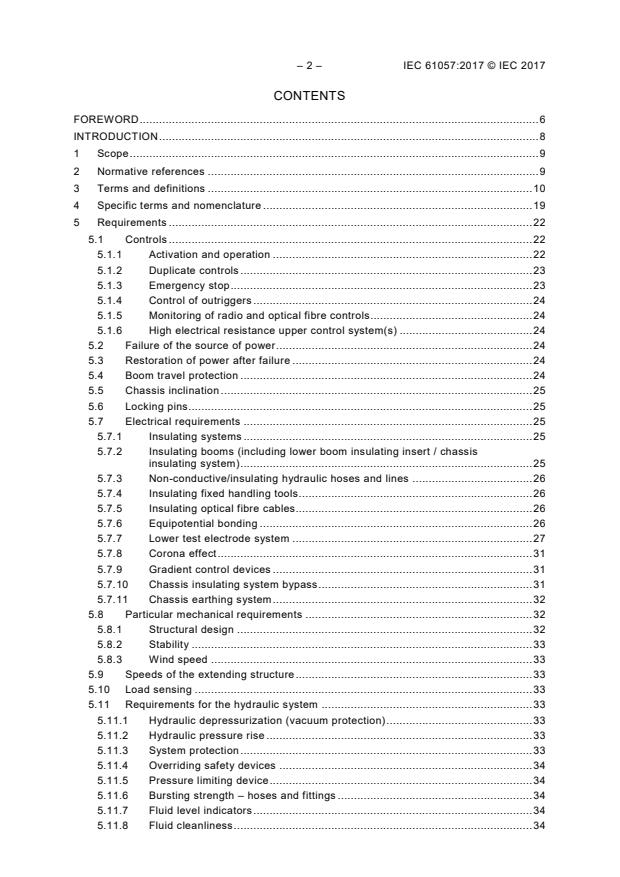
– 2 – IEC 61057:2017 © IEC 2017
CONTENTS
FOREWORD . 6
INTRODUCTION . 8
1 Scope . 9
2 Normative references . 9
3 Terms and definitions . 10
4 Specific terms and nomenclature . 19
5 Requirements . 22
5.1 Controls . 22
5.1.1 Activation and operation . 22
5.1.2 Duplicate controls . 23
5.1.3 Emergency stop . 23
5.1.4 Control of outriggers . 24
5.1.5 Monitoring of radio and optical fibre controls . 24
5.1.6 High electrical resistance upper control system(s) . 24
5.2 Failure of the source of power . 24
5.3 Restoration of power after failure . 24
5.4 Boom travel protection . 24
5.5 Chassis inclination . 25
5.6 Locking pins . 25
5.7 Electrical requirements . 25
5.7.1 Insulating systems . 25
5.7.2 Insulating booms (including lower boom insulating insert / chassis
insulating system) . 25
5.7.3 Non-conductive/insulating hydraulic hoses and lines . 26
5.7.4 Insulating fixed handling tools . 26
5.7.5 Insulating optical fibre cables. 26
5.7.6 Equipotential bonding . 26
5.7.7 Lower test electrode system . 27
5.7.8 Corona effect . 31
5.7.9 Gradient control devices . 31
5.7.10 Chassis insulating system bypass . 31
5.7.11 Chassis earthing system . 32
5.8 Particular mechanical requirements . 32
5.8.1 Structural design . 32
5.8.2 Stability . 33
5.8.3 Wind speed . 33
5.9 Speeds of the extending structure . 33
5.10 Load sensing . 33
5.11 Requirements for the hydraulic system . 33
5.11.1 Hydraulic depressurization (vacuum protection) . 33
5.11.2 Hydraulic pressure rise . 33
5.11.3 System protection . 33
5.11.4 Overriding safety devices . 34
5.11.5 Pressure limiting device . 34
5.11.6 Bursting strength – hoses and fittings . 34
5.11.7 Fluid level indicators . 34
5.11.8 Fluid cleanliness . 34
5.12 Requirements for the platforms . 34
5.12.1 Platform security . 34
5.12.2 Platform levelling . 34
5.12.3 Guardrail system . 35
5.12.4 Baskets . 35
5.12.5 Personnel safety attachments (and attachment for fall protection) . 35
5.13 Marking . 35
5.14 Instructions for use . 36
5.15 Dimensions and mass . 36
6 Tests . 36
6.1 General . 36
6.2 Visual and dimensional check . 37
6.3 Design check and functional testing . 37
6.4 Durability of markings . 37
6.5 Dye penetration test of insulating foam-filled booms . 37
6.6 Electrical tests . 38
6.6.1 General . 38
6.6.2 Electrical tests for insulating booms, insulating fixed handling tools and
optical fibre cables. 38
6.6.3 Test of insulating baskets or liners . 50
6.6.4 Dielectric test of the insulating fixed handling tools . 51
6.7 Dielectric tests of the insulating systems of the complete aerial devices . 52
6.7.1 General . 52
6.7.2 Aerial devices with lower test electrode system . 52
6.7.3 Aerial devices without lower test electrode system. 55
6.8 Lower test electrode system . 61
6.9 Equipotential bonding . 61
6.10 Mechanical tests . 61
6.10.1 Mechanical tests on insulating boom with its fittings . 61
6.10.2 Platform creep . 62
6.10.3 Hydraulic depressurization (vacuum protection) . 62
6.11 Design and functional tests . 63
7 Conformance testing of aerial devices after completion of the production phase . 63
8 Modifications . 63
Annex A (informative) Guidelines for selecting the characteristics of insulating aerial
devices as a function of the live working methods . 64
A.1 General . 64
A.2 Bare hand live working . 64
A.3 Live line tool, distance or hot stick working . 64
A.4 Insulating (rubber) glove working . 65
A.5 Use under DC . 65
A.6 Advice for buyers of insulating aerial devices meeting the requirements of
this document not intending to make use of them for live working . 65
Annex B (normative) Suitable for live working; double triangle IEC-60417-5216:2002-10 . 66
Annex C (normative) General type test procedure . 67
Annex D (normative) Classification of defects and tests to be allocated . 69
Annex E (informative) Care and maintenance . 71
E.1 General . 71
– 4 – IEC 61057:2017 © IEC 2017
E.2 Care of insulating components . 71
E.2.1 Care whilst in transit . 71
E.2.2 Care during work activities . 71
E.2.3 Storage. 72
E.3 Maintenance of insulating components . 72
E.3.1 General . 72
E.3.2 Cleaning . 72
E.3.3 Siliconing or waxing . 73
E.4 Inspection of insulating components . 73
E.4.1 General . 73
E.4.2 Pre-start inspection . 73
E.4.3 Frequent and annual inspections of aerial devices . 74
E.5 Tests . 74
E.5.1 Periodic electrical tests . 74
E.5.2 Mechanical test – Acoustic emission testing . 80
E.6 Records . 81
E.7 Repairing/refurbishing . 81
E.8 Overriding safety devices . 82
E.9 Care, maintenance and periodic inspection when insulating aerial devices
are for other uses than live working . 82
Annex F (informative) Hydraulic depressurization (vacuum protection) (see 5.11.1 and
6.10.3) . 83
F.1 General . 83
F.2 In-line check valves . 83
F.2.1 General . 83
F.2.2 Testing the in-line check valves (typical test procedure – reference
Figure F.1) . 83
F.3 Atmospheric check valve assembly . 84
F.3.1 General . 84
F.3.2 Testing the atmospheric check valves (typical test procedure –
reference Figure F.2) . 85
Bibliography . 87
Figure 1 – Specific terms . 21
Figure 2 – Nomenclature . 22
Figure 3 – Typical equipotential bonding arrangement . 27
Figure 4 – Leakage current monitoring . 30
Figure 5 – Example of temporary bypassing arrangement for chassis insulating system . 32
Figure 6 – AC dielectric test before and after exposure to humidity (method A) –
Typical test arrangement . 40
Figure 7 – AC dielectric tests before and after exposure to humidity (method A) –
Assembly diagram of the test piece to the guard electrodes . 42
Figure 8 – AC dielectric tests before and after exposure to humidity (method A) –
Constructional drawings for guard electrodes and parts . 43
Figure 9 – AC dielectric tests before and after exposure to humidity (method A) –
Constructional drawings for brass electrode and for insulating support parts according
to test piece . 44
Figure 10 – Details of electrode arrangement . 46
Figure 11 – Test arrangement . 46
Figure 12 – DC dielectric test before and after water soaking (method B) – Typical test
arrangement . 48
Figure 13 – Preparation of optical fibre cable test piece for test after the infliction of a
gash . 50
Figure 14 – Test of insulating basket or liner . 51
Figure 15 – Test of the upper insulating system of devices with lower test electrode
system . 53
Figure 16 – Test of the upper insulating system of devices without permanently
installed lower test electrode system . 57
Figure 17 – Dielectric test for insulating insert/chassis insulating system . 60
Figure 18 – Test of high electrical resistance component(s) . 60
Figure E.1 – DC only test of the upper insulating system of devices without
permanently installed lower test electrode system. 78
Figure E.2 – DC only test of insulating lower boom insert or chassis insulating system . 80
Figure F.1 – In-line check valve test for the insulating boom vacuum protection system . 84
Figure F.2 – Atmospheric check valve assembly test for the insulating boom vacuum
protection system. 85
Table 1 – Values for AC dielectric tests of the upper insulating system of devices with
lower test electrode system . 54
Table 2 – Values for DC dielectric tests of the upper insulating system of devices with
lower test electrode system . 55
Table 3 – Dielectric test for aerial devices without lower test electrode system . 58
Table C.1 – List and chronological order (where required) of type tests . 67
Table D.1 – Classification of defects and associated requirements and tests . 69
Table E.1 – Electrical test values for periodic electrical testing of insulating aerial
devices with lower test electrode system for AC applications . 75
Table E.2 – Electrical test values for periodic testing of insulating aerial devices
without lower test electrode system for AC applications . 75
Table E.3 – Electrical test values for periodic electrical testing of insulating
components of aerial devices for AC applications . 76
Table E.4 – Electrical test values for periodic electrical testing of insulating aerial
devices with lower test electrode system for DC applications . 76
Table F.1 – Allowable vacuum formation within hydraulic lines (adjusted for altitude) . 86
– 6 – IEC 61057:2017 © IEC 2017
INTERNATIONAL ELECTROTECHNICAL COMMISSION
____________
LIVE WORKING –
INSULATING AERIAL DEVICES
FOR MOUNTING ON A CHASSIS
FOREWORD
1) The International Electrotechnical Commission (IEC) is a worldwide organization for standardization comprising
all national electrotechnical committees (IEC National Committees). The object of IEC is to promote
international co-operation on all questions concerning standardization in the electrical and electronic fields. To
this end and in addition to other activities, IEC publishes International Standards, Technical Specifications,
Technical Reports, Publicly Available Specifications (PAS) and Guides (hereafter referred to as “IEC
Publication(s)”). Their preparation is entrusted to technical committees; any IEC National Committee interested
in the subject dealt with may participate in this preparatory work. International, governmental and non-
governmental organizations liaising with the IEC also participate in this preparation. IEC collaborates closely
with the International Organization for Standardization (ISO) in accordance with conditions determined by
agreement between the two organizations.
2) The formal decisions or agreements of IEC on technical matters express, as nearly as possible, an international
consensus of opinion on the relevant subjects since each technical committee has representation from all
interested IEC National Committees.
3) IEC Publications have the form of recommendations for international use and are accepted by IEC National
Committees in that sense. While all reasonable efforts are made to ensure that the technical content of IEC
Publications is accurate, IEC cannot be held responsible for the way in which they are used or for any
misinterpretation by any end user.
4) In order to promote international uniformity, IEC National Committees undertake to apply IEC Publications
transparently to the maximum extent possible in their national and regional publications. Any divergence
between any IEC Publication and the corresponding national or regional publication shall be clearly indicated in
the latter.
5) IEC itself does not provide any attestation of conformity. Independent certification bodies provide conformity
assessment services and, in some areas, access to IEC marks of conformity. IEC is not responsible for any
services carried out by independent certification bodies.
6) All users should ensure that they have the latest edition of this publication.
7) No liability shall attach to IEC or its directors, employees, servants or agents including individual experts and
members of its technical committees and IEC National Committees for any personal injury, property damage or
other damage of any nature whatsoever, whether direct or indirect, or for costs (including legal fees) and
expenses arising out of the publication, use of, or reliance upon, this IEC Publication or any other IEC
Publications.
8) Attention is drawn to the Normative references cited in this publication. Use of the referenced publications is
indispensable for the correct application of this publication.
9) Attention is drawn to the possibility that some of the elements of this IEC Publication may be the subject of
patent rights. IEC shall not be held responsible for identifying any or all such patent rights.
International Standard IEC 61057 has been prepared by IEC technical committee 78: Live
working.
This second edition cancels and replaces the first edition published in 1991 and
IEC TS 61813:2000. This edition constitutes a technical revision.
This edition includes the following significant technical changes with respect to the previous
edition:
a) general review of the requirements and test provisions;
b) preparation of the elements of evaluation of defects, and general application of
IEC 61318:2007;
c) distinguishes between tests for hollow booms and those for foam filled booms;
d) references ISO 16368 for particular mechanical tests;
e) further information on vacuum protection and leakage current monitoring and a mandatory
requirement that aerial devices for bare hand work be fitted with a permanently installed
lower test electrode system;
f) controls of high electrical resistance;
g) reference to SAE for insulating hydraulic hoses;
h) inclusion of IEC TS 61813 for care, maintenance and in-service testing of aerial devices
with insulating booms.
The text of this standard is based on the following documents:
FDIS Report on voting
78/1182/FDIS 78/1183/RVD
Full information on the voting for the approval of this standard can be found in the report on
voting indicated in the above table.
This publication has been drafted in accordance with the ISO/IEC Directives, Part 2.
Terms defined in Clause 3 are given in italic print throughout this standard.
The committee has decided that the contents of this publication will remain unchanged until
the stability date indicated on the IEC website under "http://webstore.iec.ch" in the data
related to the specific publication. At this date, the publication will be
• reconfirmed,
• withdrawn,
• replaced by a revised edition, or
• amended.
– 8 – IEC 61057:2017 © IEC 2017
INTRODUCTION
This document covers insulating aerial devices for use at temperatures between −25 °C and
+55 °C. Where aerial devices are for use in unusual atmospheric conditions (for example,
higher or lower temperatures), other considerations may be appropriate and will be identified
by the manufacturer both in the markings and instructions for use.
The products covered by this document are primarily intended to be used for live working or
for work within the live working zone. It recognizes that a user may specify a product, or
products complying with this document where there is a risk of accidental contact with live
(energized) part(s). In such circumstances users are reminded that national or local
regulations regarding maintaining of Minimum Approach Distances to live parts, or those
obtained from IEC 61472 are to be applied. Annex A of this document gives advice and
information.
The product covered by this document may have an impact on the environment during some
or all stages of its life cycle. These impacts can range from slight to significant, be short-term
or long-term, and occur at the global, regional or local level.
Except for a disposal statement in the Instructions for use, this document does not include
requirements and test provisions for the manufacturers of the product, or recommendations to
the users of the product for environmental improvement. However, all parties intervening in its
design, manufacture, packaging, distribution, use, maintenance, repair, reuse, recovery and
disposal are invited to take account of environmental considerations.
LIVE WORKING –
INSULATING AERIAL DEVICES
FOR MOUNTING ON A CHASSIS
1 Scope
This document is applicable to insulating aerial devices for mounting on a chassis, to be used
for live working on electrical installations at nominal voltages above 1 000V r.m.s. AC in the
range 45 Hz to 65 Hz and 1 500V DC.
The primary purpose of an aerial device is for work positioning of personnel. Other devices,
such as jibs, may be fitted in order to assist the operator in performing the work.
This document also includes requirements and tests for the parts of the chassis influencing
the performance of the insulating aerial devices to be used for live working.
When mounted on a chassis, the insulating aerial device becomes a component of a mobile
elevating work platform (MEWP). Complementary requirements for the resulting MEWP are
included in ISO 16368.
NOTE 1 In Europe, EN 280 instead of ISO 16368 is often used as reference for complementary requirements.
The products designed and manufactured according to this document contribute to the safety
of users, provided they are used by skilled persons, in accordance with safe methods of work
and the instructions for use.
NOTE 2 Any requirements that are in conflict with or are meant to be complementary to ISO 16368 are delineated
herein.
Radial boom (digger) derricks are not covered by this document.
2 Normative references
The following documents are referred to in the text in such a way that some or all of their
content constitutes requirements of this document. For dated references, only the edition
cited applies. For undated references, the latest edition of the referenced document (including
any amendments) applies.
IEC 60060-1, High-voltage test techniques – Part 1: General definitions and test requirements
IEC 60060-2, High-voltage test techniques – Part 2: Measuring systems
IEC 60212:2010, Standard conditions for use prior to and during the testing of solid electrical
insulating materials
IEC 60417, Graphical symbols for use on equipment (available at http://www.graphical-
symbols.info/equipment)
IEC 61318, Live working – Conformity assessment applicable to tools, devices and equipment
IEC 62237:2003, Live working – Insulating hoses with fittings for use with hydraulic tools and
equipment
– 10 – IEC 61057:2017 © IEC 2017
ISO 16368:2010, Mobile elevating work platforms – Design, calculations, safety requirements
and test methods
ISO 13850, Safety of machinery – Emergency stop function – Principles for design
SAE J343, Test and Test Procedures for SAE 100R Series Hydraulic Hose and Hose
Assemblies
SAE J517, Hydraulic hose
3 Terms and definitions
For the purposes of this document, the terms and definitions given in IEC 61318, ISO 16368
and the following apply.
ISO and IEC maintain terminological databases for use in standardization at the following
addresses:
• IEC Electropedia: available at http://www.electropedia.org/
• ISO Online browsing platform: available at http://www.iso.org/obp
3.1
aerial device
insulating aerial device
any device, extensible, articulating or both, incorporating insulating components and which is
primarily designed and used to position personnel at or near an electric potential different
from that of earth
Note 1 to entry: An insulating aerial device may also be used to handle material if designed and equipped for that
purpose.
Note 2 to entry: An insulating aerial device does not include a chassis. When an aerial device is mounted on a
mobile chassis it becomes a component of a mobile elevating work platform (MEWP).
3.2
aerial device centre of gravity – horizontal
horizontal component of the distance from the axis of rotation to the centre of gravity of the
aerial device in the stowed position
SEE: Figure 1
3.3
aerial device centre of gravity – vertical
vertical component of the distance above the mounting surface of the aerial device to the
centre of gravity of the aerial device in the stowed position
SEE: Figure 1
3.4
aerial device mass
mass of the standard aerial device, less optional counterweights, accessories and auxiliary
equipment
3.5
bare hand working
live working carried out in accordance with a method where the worker is electrically bonded
to the energized parts on which live working is to be performed whilst being suitably isolated
from surrounding parts which are at different potentials
[SOURCE: IEC 60050-651:2014, 651-21-07, modified – The definition has been modified for
clarity.]
3.6
basket
bucket
totally enclosed type of platform which does not need guardrails or toe-guard
3.7
boom tip
furthest extremity of the upper boom from the turntable and the end of the upper boom to
which the platform is attached
SEE: Figure 2
3.8
brittle material
fibreglass-reinforced plastic material or material that does not meet the requirements for
ductile material
3.9
cab-axle dimension
distance between the back of the cab and the rear axle centreline of the chassis
recommended for mounting the aerial device
SEE: Figure 1
3.10
centre of rotation location
distance from the centreline of the rear axle to the axis of rotation of the turntable
SEE: Figure 1
3.11
chassis
base on which the aerial device is mounted
3.12
chassis frame height
height from ground level to the top of the chassis frame rail
SEE: Figure 1
3.13
chassis insulating system
all dielectric components installed between the chassis and the upper insulating boom and
designed to insulate the chassis should the portion of the aerial device between the upper
insulating boom and this system contact a live part
SEE: Figure 2
Note 1 to entry: A lower boom insulating insert is a type of chassis insulating system.
3.14
conductive shield
guard ring
device used to shield the lower test electrode system from capacitive coupling
– 12 – IEC 61057:2017 © IEC 2017
3.15
control
means by which operation of a function is effected
3.16
disruptive discharge
sparkover
flashover
passage of an arc following dielectric breakdown
Note 1 to entry: The term “sparkover” (in French “amorçage”) is used when a disruptive discharge occurs in a
gaseous or liquid dielectric.
Note 2 to entry: The term “flashover” (in French “contournement”) is used when a disruptive discharge occurs
over the surface of a solid dielectric surrounded by a gaseous or liquid medium.
Note 3 to entry: The term “puncture” (in French “perforation”) is used when a disruptive discharge occurs through
a solid dielectric.
[SOURCE: IEC 60050-604:1987, 604-03-38]
3.17
ductile material
material that has a minimum elongation at failure of 10 % in a gauge length of 51 mm of a
standardized test specimen
3.18
elbow
structure connecting the upper boom to the lower boom, about which one articulates relative
to the other
SEE: Figure 2
3.19
elbow pin
horizontal pin about which the upper boom rotates relative to the lower boom
SEE: Figure 2
3.20
extensible boom aerial device
aerial device on which the length of the upper boom can be varied within pre-determined
limits
EXAMPLE telescoping boom
3.21
fixed handling tool
tool that is mechanically mounted at the boom tip or platform
EXAMPLE jib, phase lifter
3.22
formally trained and qualified person
competent person possessing the appropriate practical and theoretical knowledge and having
adequate skill and experience to enable them to perform the required duty, interpret the
resultant information and from that information determine that the equipment is safe to use,
and report the importance of any defect found or suspected in relation to the safety and
continued use of the equipment
3.23
front overhang
maximum distance of any part of the aerial device forward of the front bumper
SEE: Figure 1
3.24
front projection
maximum distance of any part of the aerial device forward of the front axle centreline when
stowed for travel
SEE: Figure 1
3.25
gradient control device
corona ring
device at the upper end of an insulating boom that reduces electrical stress level(s) below
that considered to be disruptive
3.26
guardrail system
guard rail system
system of barriers intended to protect personnel from falling to lower levels
3.27
hot stick working
live working carried out in accordance with a method where the worker remains at a specified
distance from the energized parts and carries out the work by means of insulating sticks
[SOURCE: IEC 60050-651:2014, 651-21-05]
3.28
horizontal reach
maximum distance reached from the centreline of the rotating turntable to the outer edge of
the platform
SEE: Figure 1
3.29
instability
condition of a MEWP in which the sum of the moments tending to overturn the MEWP is equal
to or exceeds the sum of the moments tending to resist overturning
3.30
insulating boom
insulating component of the extending structure denominated the upper boom and, where
provided, the lower boom insert.
Note 1 to entry: ISO 16368 defines extending structure.
3.31
insulating glove working
live working carried out in accordance with a method where the worker is in direct contact with
an energized part and is electrically protected by electrical insulating gloves
[SOURCE: IEC 60050-651:2014, 651-21-06]
– 14 – IEC 61057:2017 © IEC 2017
3.32
insulation gap
minimum length of the upper insulating system being the shortest distance in
any boom position between conductive components at each end
SEE: Figure 1
3.33
insulation gap
minimum length of the chassis insulating system
SEE: Figure 1
3.34
jib
auxiliary arm at the upper boom tip to handle supplemental loads
SEE: Figure 2
3.35
liner
insert which fits inside the platform
SEE: Figure 2
Note 1 to entry: The liner may be insulating or conductive.
3.36
lower boom
structural member attached to a turntable or base, which supports the upper boom
SEE: Figure 2
3.37
lower boom cylinder
hydraulic cylinder which articulates the lower boom
SEE: Figure 2
3.38
lower boom insert
lower boom insulating insert
part of the lower boom made of high dielectric strength material
Note 1 to entry: The material is usually made of fibreglass reinforced plastic or equivalent.
3.39
lower boom pin
horizontal pin about which the lower boom is raised and lowe
...
Questions, Comments and Discussion
Ask us and Technical Secretary will try to provide an answer. You can facilitate discussion about the standard in here.
Loading comments...