

IEC 62047-4:2026
(Main)Semiconductor devices - Micro-electromechanical devices - Part 4: Generic specification for MEMS
General Information
- Abstract
IEC 62047-4:2026 describes generic specifications for micro-electromechanical systems (MEMS) made by semiconductors, which are the basis for specifications given in other parts of this series for various types of MEMS applications such as sensors, RF MEMS, optical MEMS, bio-MEMS, micro TAS, and power MEMS. This document specifies general procedures for quality assessment and establishes general principles for describing and testing of electrical, optical, mechanical and environmental characteristics. This part of IEC 62047 aids in the preparation of standards that define devices and systems made by micromachining technology, including but not limited to, material characterization and handling, assembly and testing, process control and measuring methods. MEMS described in this document are basically made of semiconductor material. However, the statements made in this document are also applicable to MEMS using materials other than semiconductor, for example, polymers, glass, metals and ceramic materials.
This edition includes the following significant technical changes with respect to the previous edition:
a) in the Scope, optical MEMS, bio-MEMS, micro TAS, and power MEMS for various types of MEMS applications were included;
b) MEMS categories and terms in Table 1 were slightly modified such consumer electronics and automotive were added that in application technology.
- Status
- Published
- Publication Date
- 06-Jan-2026
- Technical Committee
- SC 47F - Micro-electromechanical systems
- Drafting Committee
- WG 1 - TC 47/SC 47F/WG 1
- Current Stage
- PPUB - Publication issued
- Start Date
- 07-Jan-2026
- Completion Date
- 23-Jan-2026
Buy Documents
IEC 62047-4:2026 - Semiconductor devices - Micro-electromechanical devices - Part 4: Generic specification for MEMS/7/2026
IEC 62047-4:2026 RLV - Semiconductor devices - Micro-electromechanical devices - Part 4: Generic specification for MEMS Released:1/7/2026
Overview
IEC 62047-4:2026 is an international standard developed by the International Electrotechnical Commission (IEC) that provides generic specifications for micro-electromechanical systems (MEMS) fabricated using semiconductor technologies. This updated edition expands the scope to cover a broad variety of MEMS applications including sensors, RF MEMS, optical MEMS, bio-MEMS, micro total analysis systems (micro TAS), and power MEMS. The standard defines general quality assessment procedures and sets forth principles for describing and testing electrical, optical, mechanical, and environmental characteristics of MEMS devices.
This standard serves as a foundational reference for developing more specific MEMS standards addressing different device types and application fields. While its focus is on semiconductor-based MEMS, it also applies to devices made from alternative materials like polymers, glass, metals, and ceramics.
Key Topics
- Generic Specifications for MEMS: Defines baseline requirements and terminology for MEMS devices and systems made by micromachining technologies.
- Quality Assessment Procedures: Establishes test schedules, sample selection methods, and approval processes aimed at ensuring device reliability and performance consistency.
- Environmental and Reliability Testing: Addresses standard environmental conditions, climatic and mechanical tests, endurance testing, and failure rate evaluations to assess MEMS durability.
- Measurement and Testing Methods: Provides guidelines for electrical, optical, and mechanical measurements under controlled conditions, ensuring precise and repeatable testing results.
- Device Identification and Traceability: Specifies marking, packaging, and traceability requirements for MEMS products to support quality control and supply chain management.
- Classification of MEMS Technologies: Includes annexes describing manufacturing processes (bulk and surface micromachining, LIGA, laser micromachining, micro molding) and application areas such as consumer electronics and automotive sectors.
Applications
IEC 62047-4:2026 supports the standardization and quality assurance of MEMS across a wide range of applications, including but not limited to:
- Consumer Electronics: Accelerometers, gyroscopes, microphones, and pressure sensors used in smartphones, wearables, and other consumer devices.
- Automotive Systems: MEMS for vehicle stability control, airbag deployment sensors, tire pressure monitoring, and advanced driver assistance systems (ADAS).
- Biomedical Devices: Bio-MEMS for diagnostics, drug delivery, lab-on-chip systems, and implantable sensors.
- Telecommunication and RF Devices: RF MEMS components for switches, filters, and resonators in communication infrastructure.
- Optical and Imaging Devices: Optical MEMS for display technologies, adaptive optics, and scanning mirrors.
- Environmental and Industrial Sensors: Devices for gas detection, humidity sensing, and industrial process monitoring.
- Power MEMS: Micro-scale energy harvesters, micro power generation, and actuation systems.
The standards facilitate interoperability and reliability, enabling manufacturers to design MEMS that meet international quality criteria and performance benchmarks.
Related Standards
Users of IEC 62047-4:2026 may also reference these related IEC standards for complementary information and procedures:
- IEC 60027 (Letter symbols in electrical technology) – for consistent notation and units.
- IEC 60050-523 (International Electrotechnical Vocabulary) – for MEMS-specific terminology.
- IEC 60068-2 (Environmental testing) – for standardized environmental test conditions and procedures.
- IEC 60747-1 (Semiconductor devices – General) – foundational semiconductor device requirements.
- IEC 60749 (Mechanical and climatic test methods for semiconductor devices) – for device stress testing.
- IEC 61193-2 (Quality assessment systems – Sampling) – statistical sampling and quality control methods.
These standards complement IEC 62047-4 by providing detailed procedures and vocabularies essential for the robust specification, manufacture, and quality assurance of MEMS devices.
By adhering to IEC 62047-4:2026, manufacturers and developers of MEMS technology can ensure consistent quality assessment, enhance device reliability, and facilitate international market acceptance. This standard stands as a key resource for innovation and quality in the growing micro-electromechanical systems industry.
Relations
- Effective Date
- 05-Sep-2023
Buy Documents
IEC 62047-4:2026 - Semiconductor devices - Micro-electromechanical devices - Part 4: Generic specification for MEMS/7/2026
IEC 62047-4:2026 RLV - Semiconductor devices - Micro-electromechanical devices - Part 4: Generic specification for MEMS Released:1/7/2026
Frequently Asked Questions
IEC 62047-4:2026 is a standard published by the International Electrotechnical Commission (IEC). Its full title is "Semiconductor devices - Micro-electromechanical devices - Part 4: Generic specification for MEMS". This standard covers: IEC 62047-4:2026 describes generic specifications for micro-electromechanical systems (MEMS) made by semiconductors, which are the basis for specifications given in other parts of this series for various types of MEMS applications such as sensors, RF MEMS, optical MEMS, bio-MEMS, micro TAS, and power MEMS. This document specifies general procedures for quality assessment and establishes general principles for describing and testing of electrical, optical, mechanical and environmental characteristics. This part of IEC 62047 aids in the preparation of standards that define devices and systems made by micromachining technology, including but not limited to, material characterization and handling, assembly and testing, process control and measuring methods. MEMS described in this document are basically made of semiconductor material. However, the statements made in this document are also applicable to MEMS using materials other than semiconductor, for example, polymers, glass, metals and ceramic materials. This edition includes the following significant technical changes with respect to the previous edition: a) in the Scope, optical MEMS, bio-MEMS, micro TAS, and power MEMS for various types of MEMS applications were included; b) MEMS categories and terms in Table 1 were slightly modified such consumer electronics and automotive were added that in application technology.
IEC 62047-4:2026 describes generic specifications for micro-electromechanical systems (MEMS) made by semiconductors, which are the basis for specifications given in other parts of this series for various types of MEMS applications such as sensors, RF MEMS, optical MEMS, bio-MEMS, micro TAS, and power MEMS. This document specifies general procedures for quality assessment and establishes general principles for describing and testing of electrical, optical, mechanical and environmental characteristics. This part of IEC 62047 aids in the preparation of standards that define devices and systems made by micromachining technology, including but not limited to, material characterization and handling, assembly and testing, process control and measuring methods. MEMS described in this document are basically made of semiconductor material. However, the statements made in this document are also applicable to MEMS using materials other than semiconductor, for example, polymers, glass, metals and ceramic materials. This edition includes the following significant technical changes with respect to the previous edition: a) in the Scope, optical MEMS, bio-MEMS, micro TAS, and power MEMS for various types of MEMS applications were included; b) MEMS categories and terms in Table 1 were slightly modified such consumer electronics and automotive were added that in application technology.
IEC 62047-4:2026 is classified under the following ICS (International Classification for Standards) categories: 31.080.99 - Other semiconductor devices. The ICS classification helps identify the subject area and facilitates finding related standards.
IEC 62047-4:2026 has the following relationships with other standards: It is inter standard links to IEC 62047-4:2008. Understanding these relationships helps ensure you are using the most current and applicable version of the standard.
IEC 62047-4:2026 is available in PDF format for immediate download after purchase. The document can be added to your cart and obtained through the secure checkout process. Digital delivery ensures instant access to the complete standard document.
Standards Content (Sample)
IEC 62047-4 ®
Edition 2.0 2026-01
INTERNATIONAL
STANDARD
Semiconductor devices - Micro-electromechanical devices -
Part 4: Generic specification for MEMS
ICS 31.080.99 ISBN 978-2-8327-0965-8
All rights reserved. Unless otherwise specified, no part of this publication may be reproduced or utilized in any form or
by any means, electronic or mechanical, including photocopying and microfilm, without permission in writing from either
IEC or IEC's member National Committee in the country of the requester. If you have any questions about IEC copyright
or have an enquiry about obtaining additional rights to this publication, please contact the address below or your local
IEC member National Committee for further information.
IEC Secretariat Tel.: +41 22 919 02 11
3, rue de Varembé info@iec.ch
CH-1211 Geneva 20 www.iec.ch
Switzerland
About the IEC
The International Electrotechnical Commission (IEC) is the leading global organization that prepares and publishes
International Standards for all electrical, electronic and related technologies.
About IEC publications
The technical content of IEC publications is kept under constant review by the IEC. Please make sure that you have the
latest edition, a corrigendum or an amendment might have been published.
IEC publications search - IEC Products & Services Portal - products.iec.ch
webstore.iec.ch/advsearchform Discover our powerful search engine and read freely all the
The advanced search enables to find IEC publications by a publications previews, graphical symbols and the glossary.
variety of criteria (reference number, text, technical With a subscription you will always have access to up to date
committee, …). It also gives information on projects, content tailored to your needs.
replaced and withdrawn publications.
Electropedia - www.electropedia.org
The world's leading online dictionary on electrotechnology,
IEC Just Published - webstore.iec.ch/justpublished
Stay up to date on all new IEC publications. Just Published containing more than 22 500 terminological entries in English
details all new publications released. Available online and and French, with equivalent terms in 25 additional languages.
once a month by email. Also known as the International Electrotechnical Vocabulary
(IEV) online.
IEC Customer Service Centre - webstore.iec.ch/csc
If you wish to give us your feedback on this publication or
need further assistance, please contact the Customer
Service Centre: sales@iec.ch.
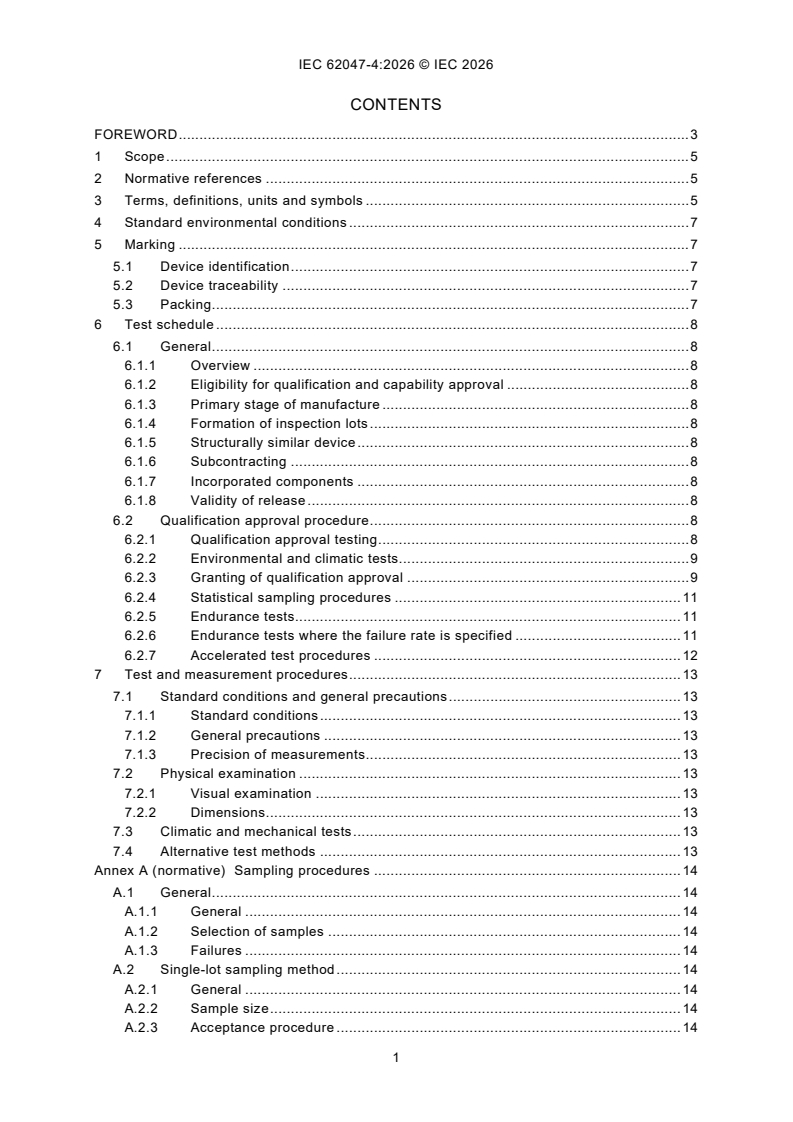
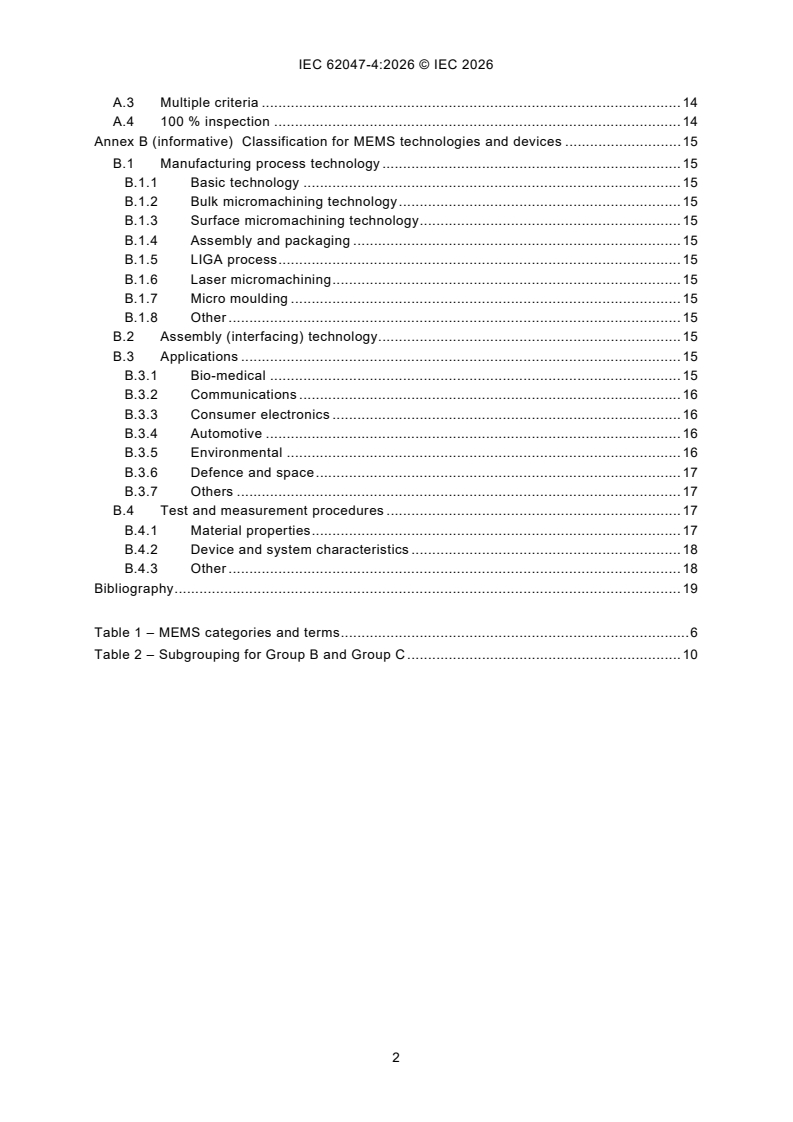
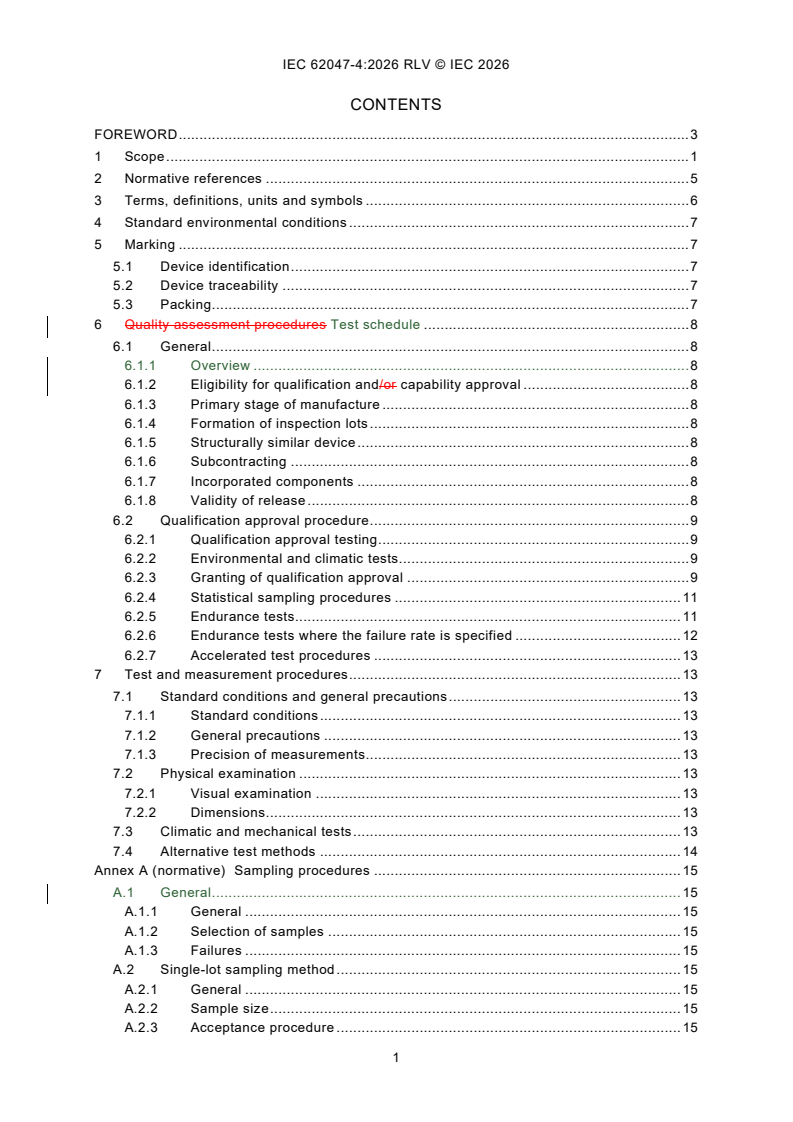
CONTENTS
FOREWORD . 3
1 Scope . 5
2 Normative references . 5
3 Terms, definitions, units and symbols . 5
4 Standard environmental conditions . 7
5 Marking . 7
5.1 Device identification . 7
5.2 Device traceability . 7
5.3 Packing . 7
6 Test schedule . 8
6.1 General . 8
6.1.1 Overview . 8
6.1.2 Eligibility for qualification and capability approval . 8
6.1.3 Primary stage of manufacture . 8
6.1.4 Formation of inspection lots . 8
6.1.5 Structurally similar device . 8
6.1.6 Subcontracting . 8
6.1.7 Incorporated components . 8
6.1.8 Validity of release . 8
6.2 Qualification approval procedure . 8
6.2.1 Qualification approval testing . 8
6.2.2 Environmental and climatic tests. 9
6.2.3 Granting of qualification approval . 9
6.2.4 Statistical sampling procedures . 11
6.2.5 Endurance tests. 11
6.2.6 Endurance tests where the failure rate is specified . 11
6.2.7 Accelerated test procedures . 12
7 Test and measurement procedures . 13
7.1 Standard conditions and general precautions . 13
7.1.1 Standard conditions . 13
7.1.2 General precautions . 13
7.1.3 Precision of measurements . 13
7.2 Physical examination . 13
7.2.1 Visual examination . 13
7.2.2 Dimensions . 13
7.3 Climatic and mechanical tests . 13
7.4 Alternative test methods . 13
Annex A (normative) Sampling procedures . 14
A.1 General . 14
A.1.1 General . 14
A.1.2 Selection of samples . 14
A.1.3 Failures . 14
A.2 Single-lot sampling method . 14
A.2.1 General . 14
A.2.2 Sample size . 14
A.2.3 Acceptance procedure . 14
A.3 Multiple criteria . 14
A.4 100 % inspection . 14
Annex B (informative) Classification for MEMS technologies and devices . 15
B.1 Manufacturing process technology . 15
B.1.1 Basic technology . 15
B.1.2 Bulk micromachining technology . 15
B.1.3 Surface micromachining technology . 15
B.1.4 Assembly and packaging . 15
B.1.5 LIGA process . 15
B.1.6 Laser micromachining . 15
B.1.7 Micro moulding . 15
B.1.8 Other . 15
B.2 Assembly (interfacing) technology . 15
B.3 Applications . 15
B.3.1 Bio-medical . 15
B.3.2 Communications . 16
B.3.3 Consumer electronics . 16
B.3.4 Automotive . 16
B.3.5 Environmental . 16
B.3.6 Defence and space . 17
B.3.7 Others . 17
B.4 Test and measurement procedures . 17
B.4.1 Material properties . 17
B.4.2 Device and system characteristics . 18
B.4.3 Other . 18
Bibliography . 19
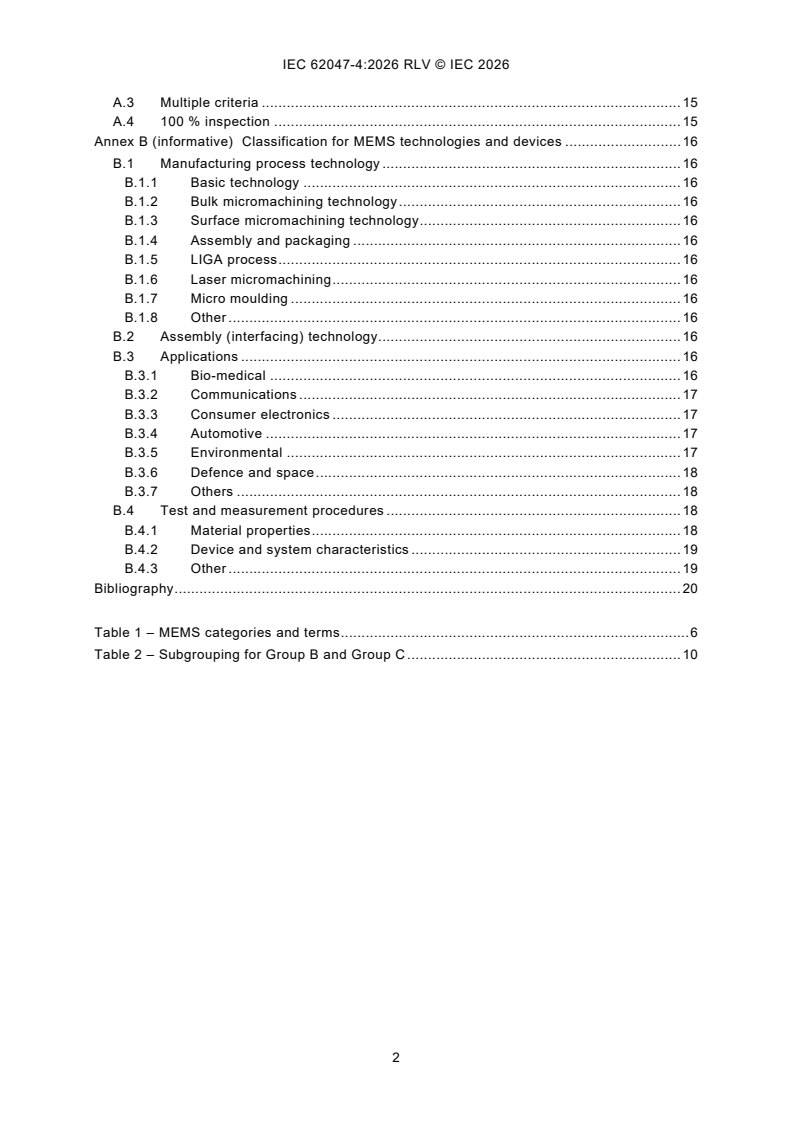
Table 1 – MEMS categories and terms . 6
Table 2 – Subgrouping for Group B and Group C . 10
INTERNATIONAL ELECTROTECHNICAL COMMISSION
____________
Semiconductor devices - Micro-electromechanical devices -
Part 4: Generic specification for MEMS
FOREWORD
1) The International Electrotechnical Commission (IEC) is a worldwide organization for standardization comprising
all national electrotechnical committees (IEC National Committees). The object of IEC is to promote international
co-operation on all questions concerning standardization in the electrical and electronic fields. To this end and
in addition to other activities, IEC publishes International Standards, Technical Specifications, Technical Reports,
Publicly Available Specifications (PAS) and Guides (hereafter referred to as “IEC Publication(s)”). Their
preparation is entrusted to technical committees; any IEC National Committee interested in the subject dealt with
may participate in this preparatory work. International, governmental and non-governmental organizations liaising
with the IEC also participate in this preparation. IEC collaborates closely with the International Organization for
Standardization (ISO) in accordance with conditions determined by agreement between the two organizations.
2) The formal decisions or agreements of IEC on technical matters express, as nearly as possible, an international
consensus of opinion on the relevant subjects since each technical committee has representation from all
interested IEC National Committees.
3) IEC Publications have the form of recommendations for international use and are accepted by IEC National
Committees in that sense. While all reasonable efforts are made to ensure that the technical content of IEC
Publications is accurate, IEC cannot be held responsible for the way in which they are used or for any
misinterpretation by any end user.
4) In order to promote international uniformity, IEC National Committees undertake to apply IEC Publications
transparently to the maximum extent possible in their national and regional publications. Any divergence between
any IEC Publication and the corresponding national or regional publication shall be clearly indicated in the latter.
5) IEC itself does not provide any attestation of conformity. Independent certification bodies provide conformity
assessment services and, in some areas, access to IEC marks of conformity. IEC is not responsible for any
services carried out by independent certification bodies.
6) All users should ensure that they have the latest edition of this publication.
7) No liability shall attach to IEC or its directors, employees, servants or agents including individual experts and
members of its technical committees and IEC National Committees for any personal injury, property damage or
other damage of any nature whatsoever, whether direct or indirect, or for costs (including legal fees) and
expenses arising out of the publication, use of, or reliance upon, this IEC Publication or any other IEC
Publications.
8) Attention is drawn to the Normative references cited in this publication. Use of the referenced publications is
indispensable for the correct application of this publication.
9) IEC draws attention to the possibility that the implementation of this document may involve the use of (a)
patent(s). IEC takes no position concerning the evidence, validity or applicability of any claimed patent rights in
respect thereof. As of the date of publication of this document, IEC had not received notice of (a) patent(s), which
may be required to implement this document. However, implementers are cautioned that this may not represent
the latest information, which may be obtained from the patent database available at https://patents.iec.ch. IEC
shall not be held responsible for identifying any or all such patent rights.
IEC 62047-4 has been prepared by subcommittee 47F: Micro-electromechanical systems, of
IEC technical committee 47: Semiconductor devices. It is an International Standard.
This second edition cancels and replaces the first edition published in 2008. This edition
constitutes a technical revision.
This edition includes the following significant technical changes with respect to the previous
edition:
a) in the Scope, optical MEMS, bio-MEMS, micro TAS, and power MEMS for various types of
MEMS applications were included;
b) MEMS categories and terms in Table 1 were slightly modified such consumer electronics
and automotive were added that in application technology.
The text of this International Standard is based on the following documents:
Draft Report on voting
47F/532/FDIS 47F/540/RVD
Full information on the voting for its approval can be found in the report on voting indicated in
the above table.
The language used for the development of this International Standard is English.
A list of all parts in the IEC 62047 series, published under the general title Semiconductor
devices - Micro-electromechanical devices, can be found on the IEC website.
This document was drafted in accordance with ISO/IEC Directives, Part 2, and developed in
accordance with ISO/IEC Directives, Part 1 and ISO/IEC Directives, IEC Supplement, available
at www.iec.ch/members_experts/refdocs. The main document types developed by IEC are
described in greater detail at www.iec.ch/publications.
The committee has decided that the contents of this document will remain unchanged until the
stability date indicated on the IEC website under webstore.iec.ch in the data related to the
specific document. At this date, the document will be
– reconfirmed,
– withdrawn, or
– revised.
1 Scope
This part of IEC 62047 describes generic specifications for micro-electromechanical systems
(MEMS) made by semiconductors, which are the basis for specifications given in other parts of
this series for various types of MEMS applications such as sensors, RF MEMS, optical MEMS,
bio-MEMS, micro TAS, and power MEMS. This document specifies general procedures for
quality assessment and establishes general principles for describing and testing of electrical,
optical, mechanical and environmental characteristics.
This part of IEC 62047 aids in the preparation of standards that define devices and systems
made by micromachining technology, including but not limited to, material characterization and
handling, assembly and testing, process control and measuring methods. MEMS described in
this document are basically made of semiconductor material. However, the statements made in
this document are also applicable to MEMS using materials other than semiconductor, for
example, polymers, glass, metals and ceramic materials.
2 Normative references
The following documents are referred to in the text in such a way that some or all of their content
constitutes requirements of this document. For dated references, only the edition cited applies.
For undated references, the latest edition of the referenced document (including any
amendments) applies.
IEC 60027 (all parts), Letter symbols to be used in electrical technology
IEC 60050-523, International Electrotechnical Vocabulary (IEV) - Part 523: Micro-
electromechanical devices (available at www.electropedia.org)
IEC 60068-2 (all parts), Environmental testing - Part 2: Tests
IEC 60617, Graphical symbols for diagrams
IEC 61193-2, Quality assessment systems - Part 2: Selection and use of sampling plans for
inspection of electronic components and packages
IEC 62047-1, Semiconductor devices - Micro-electromechanical devices - Part 1: Terms and
definitions
ISO 2859-1:1999, Sampling procedures for inspection by attributes - Part 1: Sampling schemes
indexed by acceptance quality limit (AQL) for lot-by-lot inspection
ISO 2859-1:1999/AMD1:2011
ISO 80000-1, Quantities and units - Part 1:General
3 Terms, definitions, units and symbols
For the purposes of this document, the following terms,definitions, units and symbols apply.
ISO and IEC maintain terminology databases for use in standardization at the following
addresses:
– IEC Electropedia: available at https://www.electropedia.org/
– ISO Online browsing platform: available at https://www.iso.org/obp
For the purposes of this document, terms shall, wherever possible, be taken from IEC 62047-1;
units, and graphical and letter symbols shall, wherever possible, be taken from IEC 60027 (all
parts), IEC 60617 and ISO 80000-1.
Any other units, symbols or terminology peculiar to one of the devices covered by this generic
specification shall be taken from the IEC or ISO standards (see Clause 2) or derived in
accordance with the principles of the standards listed above.
Table 1 shows the categories and terms on MEMS area. The terms of MEMS shall also be taken
from IEC 60050-523 Micro-electromechanical devices. More detailed classification for MEMS
technologies and devices are referenced in Annex B.
Table 1 – MEMS categories and terms
Category Sub-category Terms
General MEMS, MST, micromachine, micromachine technology
Microscience and engineering, scale effect, mesotribology, microtribology,
Science and engineering
biomimetics, ciliary motion, self-organization
Material science Shape memory polymer, modification
Actuator, micro-actuator, electrostatic actuator, light driven actuator,
Actuator piezoelectric actuator, shape memory alloy actuator, sol-gel conversion
actuator, comb drive actuator, wobble motor
Microsensor, biosensor, integrated microprobe, ion sensitive field effect
Functional
Sensor transistor (ISFET), accelerometer, micro-gyroscope, pressure sensor,
element
microphone, flow sensor
Diaphragm structure, microcantilever, microchannel, micromirror, scanning
Other mirror, microswitch, optical switch, microgripper, micropump, microvalve,
integrated mass flow controller, micro fuel cell, photoelectric transducer
General Micromachining
Silicon process, thick film technology, thin film technology, bulk micro-
Silicon process machining, surface micromachining, photolithography, electron beam
lithography, photomask, photoresist, silicon-on-insulator (SOI)
LIGA process LIGA process, UV-LIGA, X-ray lithography
Energy beam processing, sputtering, focused ion beam machining, electron
Beam process
beam process, laser direct writing
Machining Etching process, wet etching, dry etching, isotropic etching, anisotropic
Etching
technology etching, etch stop, lost wafer process, sacrificial etching, reactive ion
process
etching (RIE), DRIE, ICP
Deposition Vapour deposition, physical vapour deposition process (PVD),
process electroforming
Other removal Micro-electro-discharge machining
process
Plastic working Hot embossing process
Other Micro-moulding, STM machining
Bonding, adhesive bonding, anodic bonding, diffusion bonding, silicon
Bonding/
Bonding
fusion bonding
assembling
technology
Other Micro-manipulator, non-contact handling, packaging, wafer level packaging
...
IEC 62047-4 ®
Edition 2.0 2026-01
INTERNATIONAL
STANDARD
REDLINE VERSION
Semiconductor devices - Micro-electromechanical devices -
Part 4: Generic specification for MEMS
ICS 31.080.99 ISBN 978-2-8327-0987-0
All rights reserved. Unless otherwise specified, no part of this publication may be reproduced or utilized in any form or
by any means, electronic or mechanical, including photocopying and microfilm, without permission in writing from either
IEC or IEC's member National Committee in the country of the requester. If you have any questions about IEC copyright
or have an enquiry about obtaining additional rights to this publication, please contact the address below or your local
IEC member National Committee for further information.
IEC Secretariat Tel.: +41 22 919 02 11
3, rue de Varembé info@iec.ch
CH-1211 Geneva 20 www.iec.ch
Switzerland
About the IEC
The International Electrotechnical Commission (IEC) is the leading global organization that prepares and publishes
International Standards for all electrical, electronic and related technologies.
About IEC publications
The technical content of IEC publications is kept under constant review by the IEC. Please make sure that you have the
latest edition, a corrigendum or an amendment might have been published.
IEC publications search - IEC Products & Services Portal - products.iec.ch
webstore.iec.ch/advsearchform Discover our powerful search engine and read freely all the
The advanced search enables to find IEC publications by a publications previews, graphical symbols and the glossary.
variety of criteria (reference number, text, technical With a subscription you will always have access to up to date
committee, …). It also gives information on projects, content tailored to your needs.
replaced and withdrawn publications.
Electropedia - www.electropedia.org
The world's leading online dictionary on electrotechnology,
IEC Just Published - webstore.iec.ch/justpublished
Stay up to date on all new IEC publications. Just Published containing more than 22 500 terminological entries in English
details all new publications released. Available online and and French, with equivalent terms in 25 additional languages.
once a month by email. Also known as the International Electrotechnical Vocabulary
(IEV) online.
IEC Customer Service Centre - webstore.iec.ch/csc
If you wish to give us your feedback on this publication or
need further assistance, please contact the Customer
Service Centre: sales@iec.ch.
CONTENTS
FOREWORD . 3
1 Scope . 1
2 Normative references . 5
3 Terms, definitions, units and symbols . 6
4 Standard environmental conditions . 7
5 Marking . 7
5.1 Device identification . 7
5.2 Device traceability . 7
5.3 Packing . 7
6 Quality assessment procedures Test schedule . 8
6.1 General . 8
6.1.1 Overview . 8
6.1.2 Eligibility for qualification and/or capability approval . 8
6.1.3 Primary stage of manufacture . 8
6.1.4 Formation of inspection lots . 8
6.1.5 Structurally similar device . 8
6.1.6 Subcontracting . 8
6.1.7 Incorporated components . 8
6.1.8 Validity of release . 8
6.2 Qualification approval procedure . 9
6.2.1 Qualification approval testing . 9
6.2.2 Environmental and climatic tests. 9
6.2.3 Granting of qualification approval . 9
6.2.4 Statistical sampling procedures . 11
6.2.5 Endurance tests. 11
6.2.6 Endurance tests where the failure rate is specified . 12
6.2.7 Accelerated test procedures . 13
7 Test and measurement procedures . 13
7.1 Standard conditions and general precautions . 13
7.1.1 Standard conditions . 13
7.1.2 General precautions . 13
7.1.3 Precision of measurements . 13
7.2 Physical examination . 13
7.2.1 Visual examination . 13
7.2.2 Dimensions . 13
7.3 Climatic and mechanical tests . 13
7.4 Alternative test methods . 14
Annex A (normative) Sampling procedures . 15
A.1 General . 15
A.1.1 General . 15
A.1.2 Selection of samples . 15
A.1.3 Failures . 15
A.2 Single-lot sampling method . 15
A.2.1 General . 15
A.2.2 Sample size . 15
A.2.3 Acceptance procedure . 15
A.3 Multiple criteria . 15
A.4 100 % inspection . 15
Annex B (informative) Classification for MEMS technologies and devices . 16
B.1 Manufacturing process technology . 16
B.1.1 Basic technology . 16
B.1.2 Bulk micromachining technology . 16
B.1.3 Surface micromachining technology . 16
B.1.4 Assembly and packaging . 16
B.1.5 LIGA process . 16
B.1.6 Laser micromachining . 16
B.1.7 Micro moulding . 16
B.1.8 Other . 16
B.2 Assembly (interfacing) technology . 16
B.3 Applications . 16
B.3.1 Bio-medical . 16
B.3.2 Communications . 17
B.3.3 Consumer electronics . 17
B.3.4 Automotive . 17
B.3.5 Environmental . 17
B.3.6 Defence and space . 18
B.3.7 Others . 18
B.4 Test and measurement procedures . 18
B.4.1 Material properties . 18
B.4.2 Device and system characteristics . 19
B.4.3 Other . 19
Bibliography . 20
Table 1 – MEMS categories and terms . 6
Table 2 – Subgrouping for Group B and Group C . 10
INTERNATIONAL ELECTROTECHNICAL COMMISSION
____________
Semiconductor devices - Micro-electromechanical devices -
Part 4: Generic specification for MEMS
FOREWORD
1) The International Electrotechnical Commission (IEC) is a worldwide organization for standardization comprising
all national electrotechnical committees (IEC National Committees). The object of IEC is to promote international
co-operation on all questions concerning standardization in the electrical and electronic fields. To this end and
in addition to other activities, IEC publishes International Standards, Technical Specifications, Technical Reports,
Publicly Available Specifications (PAS) and Guides (hereafter referred to as “IEC Publication(s)”). Their
preparation is entrusted to technical committees; any IEC National Committee interested in the subject dealt with
may participate in this preparatory work. International, governmental and non-governmental organizations liaising
with the IEC also participate in this preparation. IEC collaborates closely with the International Organization for
Standardization (ISO) in accordance with conditions determined by agreement between the two organizations.
2) The formal decisions or agreements of IEC on technical matters express, as nearly as possible, an international
consensus of opinion on the relevant subjects since each technical committee has representation from all
interested IEC National Committees.
3) IEC Publications have the form of recommendations for international use and are accepted by IEC National
Committees in that sense. While all reasonable efforts are made to ensure that the technical content of IEC
Publications is accurate, IEC cannot be held responsible for the way in which they are used or for any
misinterpretation by any end user.
4) In order to promote international uniformity, IEC National Committees undertake to apply IEC Publications
transparently to the maximum extent possible in their national and regional publications. Any divergence between
any IEC Publication and the corresponding national or regional publication shall be clearly indicated in the latter.
5) IEC itself does not provide any attestation of conformity. Independent certification bodies provide conformity
assessment services and, in some areas, access to IEC marks of conformity. IEC is not responsible for any
services carried out by independent certification bodies.
6) All users should ensure that they have the latest edition of this publication.
7) No liability shall attach to IEC or its directors, employees, servants or agents including individual experts and
members of its technical committees and IEC National Committees for any personal injury, property damage or
other damage of any nature whatsoever, whether direct or indirect, or for costs (including legal fees) and
expenses arising out of the publication, use of, or reliance upon, this IEC Publication or any other IEC
Publications.
8) Attention is drawn to the Normative references cited in this publication. Use of the referenced publications is
indispensable for the correct application of this publication.
9) IEC draws attention to the possibility that the implementation of this document may involve the use of (a)
patent(s). IEC takes no position concerning the evidence, validity or applicability of any claimed patent rights in
respect thereof. As of the date of publication of this document, IEC had not received notice of (a) patent(s), which
may be required to implement this document. However, implementers are cautioned that this may not represent
the latest information, which may be obtained from the patent database available at https://patents.iec.ch. IEC
shall not be held responsible for identifying any or all such patent rights.
This redline version of the official IEC Standard allows the user to identify the changes made
to the previous edition IEC 62047-4:2008. A vertical bar appears in the margin wherever a
change has been made. Additions are in green text, deletions are in strikethrough red text.
IEC 62047-4 has been prepared by subcommittee 47F: Micro-electromechanical systems, of
IEC technical committee 47: Semiconductor devices. It is an International Standard.
This second edition cancels and replaces the first edition published in 2008. This edition
constitutes a technical revision.
This edition includes the following significant technical changes with respect to the previous
edition:
a) in the Scope, optical MEMS, bio-MEMS, micro TAS, and power MEMS for various types of
MEMS applications were included;
b) MEMS categories and terms in Table 1 were slightly modified such consumer electronics
and automotive were added that in application technology.
The text of this International Standard is based on the following documents:
Draft Report on voting
47F/532/FDIS 47F/540/RVD
Full information on the voting for its approval can be found in the report on voting indicated in
the above table.
The language used for the development of this International Standard is English.
A list of all parts in the IEC 62047 series, published under the general title Semiconductor
devices - Micro-electromechanical devices, can be found on the IEC website.
This document was drafted in accordance with ISO/IEC Directives, Part 2, and developed in
accordance with ISO/IEC Directives, Part 1 and ISO/IEC Directives, IEC Supplement, available
at www.iec.ch/members_experts/refdocs. The main document types developed by IEC are
described in greater detail at www.iec.ch/publications.
The committee has decided that the contents of this document will remain unchanged until the
stability date indicated on the IEC website under webstore.iec.ch in the data related to the
specific document. At this date, the document will be
– reconfirmed,
– withdrawn, or
– revised.
1 Scope
This part of IEC 62047 describes generic specifications for micro-electromechanical systems
(MEMS) made by semiconductors, which are the basis for specifications given in other parts of
this series for various types of MEMS applications such as sensors, RF MEMS, excluding optical
MEMS, bio-MEMS, micro TAS, and power MEMS. This document specifies general procedures
for quality assessment to be used in IECQ-CECC systems and establishes general principles
for describing and testing of electrical, optical, mechanical and environmental characteristics.
This part of IEC 62047 aids in the preparation of standards that define devices and systems
made by micromachining technology, including but not limited to, material characterization and
handling, assembly and testing, process control and measuring methods. MEMS described in
this document are basically made of semiconductor material. However, the statements made in
this document are also applicable to MEMS using materials other than semiconductor, for
example, polymers, glass, metals and ceramic materials.
2 Normative references
The following documents are referred to in the text in such a way that some or all of their content
constitutes requirements of this document. For dated references, only the edition cited applies.
For undated references, the latest edition of the referenced document (including any
amendments) applies.
IEC 60027 (all parts), Letter symbols to be used in electrical technology
IEC 60050-523, International Electrotechnical Vocabulary (IEV) - Part 523: Micro-
electromechanical devices (available at www.electropedia.org)
IEC 60068-2 (all parts), Environmental testing - Part 2: Tests
IEC 60617, Graphical symbols for diagrams
IEC 60747-1:2006, Semiconductor devices – Part 1: General
IEC 60749 (all parts), Semiconductor devices – Mechanical and climatic test methods
IEC 61193-2, Quality assessment systems - Part 2: Selection and use of sampling plans for
inspection of electronic components and packages
IEC 62047-1, Semiconductor devices - Micro-electromechanical devices - Part 1: Terms and
definitions
IEC QC 001002-3:2005, IEC Quality Assessment System for Electronic Components (IECQ) –
Rules of Procedure – Part 3: Approval procedures
ISO 1000, SI units and recommendations for the use of their multiples and of certain other units
ISO 2859-1:1999, Sampling procedures for inspection by attributes - Part 1: Sampling schemes
indexed by acceptance quality limit (AQL) for lot-by-lot inspection
ISO 2859-1:1999/AMD1:2011
ISO 80000-1, Quantities and units - Part 1:General
3 Terms, definitions, units and symbols
For the purposes of this document, the following terms,definitions, units and symbols apply.
ISO and IEC maintain terminology databases for use in standardization at the following
addresses:
– IEC Electropedia: available at https://www.electropedia.org/
– ISO Online browsing platform: available at https://www.iso.org/obp
For the purposes of this document, terms shall, wherever possible, be taken from IEC 62047-1;
units, and graphical and letter symbols shall, wherever possible, be taken from IEC 60027 (all
parts), IEC 60617 and ISO 1000 ISO 80000-1.
Any other units, symbols or terminology peculiar to one of the devices covered by this generic
specification shall be taken from the IEC or ISO standards (see Clause 2) or derived in
accordance with the principles of the standards listed above.
Table 1 shows the categories and terms on MEMS area. The terms of MEMS shall also be taken
from IEC 60050-523 Micro-electromechanical devices. More detailed classification for MEMS
technologies and devices are referenced in Annex B.
Table 1 – MEMS categories and terms
Category Sub-category Terms
General MEMS, MST, micromachine, micromachine technology
Microscience and engineering, scale effect, mesotribology, microtribology,
Science and engineering
biomimetics, ciliary motion, self-organization
Material science Shape memory polymer, modification
Actuator, micro-actuator, electrostatic actuator, light driven actuator,
Actuator piezoelectric actuator, shape memory alloy actuator, sol-gel conversion
actuator, comb drive actuator, wobble motor
Microsensor, biosensor, integrated microprobe, ion sensitive field effect
Functional
Sensor transistor (ISFET), accelerometer, micro-gyroscope, pressure sensor,
element
microphone, flow sensor
Diaphragm structure, microcantilever, microchannel, micromirror, scanning
Other mirror, microswitch, optical switch, microgripper, micropump, microvalve,
integrated mass flow controller, micro fuel cell, photoelectric transducer
General Micromachining
Silicon process, thick film technology, thin film technology, bulk micro-
Silicon process machining, surface micromachining, photolithography, electron beam
lithography, photomask, photoresist, silicon-on-insulator (SOI)
LIGA process LIGA process, UV-LIGA, X-ray lithography
Energy beam processing, sputtering, focused ion beam machining, electron
Beam process
beam process, laser direct writing
Machining Etching process, wet etching, dry etching, isotropic etching, anisotropic
Etching
etching, etch stop, lost wafer process, sacrificial etching, reactive ion
technology
process
etching (RIE), DRIE, ICP
Deposition Vapour deposition, physical vapour deposition process (PVD),
process electroforming
Other removal Micro-electro-discharge machining
process
Plastic working Hot embossing process
Other Micro-moulding, STM machining
Bonding, adhesive bonding, anodic bonding, diffusion bonding, silicon
Bonding
fusion bonding
Category Sub-category Terms
Bonding/ Micro-manipulator, non-contact handling, packaging, wafer level packaging
assembling Other
technology
Scanning probe microscope (SPM), atomic force microscope (AFM),
Microscope
Evaluation
scanning tunneling microscope (STM), near-field microscope
technology
Other Aspect ratio, power-to-weight ratio
Bio-MEMS, RF-MEMS, MOEMS (micro-opto-electro-mechanical system),
General
lab-on-a-chip, micro TAS, micro-reactor
Consumer Inkjet printer, projector, mobile phone, notebook computer, wearable
electronics devices, drone, etc.
Application
Automotive Air bag, fuel injection, brake, tire, air conditioning, navigation, etc.
technology
Microscopic surgery (micro-surgery), active catheter, fibre endoscope,
Biomedical use smart pill, bio-chip, DNA-chip, protein chip, cell handling, cell fusion,
polymerase chain reaction (PCR)
Industrial use Microfactory
4 Standard environmental conditions
Standard environmental conditions for the measurement of characteristics, tests and operating
conditions shall be at a temperature of 25 °C ± 3 °C, a relative humidity of 25 % to 85 %, and a
pressure of 86 kPa to 106 kPa. [1][2][3]
5 Marking
5.1 Device identification
The marking on the device shall have clear identification of the device and its quality level.
5.2 Device traceability
The device shall be provided with a traceability code which enables back-tracking of the device
to a certain production or inspection lot.
5.3 Packing
Marking on the packing shall state:
a) the device identification code;
b) the traceability code(s) of the enclosed devices;
c) the number of enclosed devices;
d) the required precautions, if any.
This marking shall can be according to customs regulations.
NOTE Additional requirements can be specified in the relevant detail specification.
___________
Numbers in square brackets refer to the Bibliography.
6 Quality assessment procedures Test schedule
6.1 General
6.1.1 Overview
When this document, and related standards, are used for the purpose of a full quality
assessment system such as IEC quality assessment system for Electronic Components (IECQ) ,
this Clause 6 applies.
NOTE IECQ is the IEC quality assessment system, one of IEC’s Conformity Assessment Systems. The referencing
below of IECQ 03-3 does not imply that IECQ certification is a requirement. However information regarding IECQ
certification can be obtained from www.iecq.org.
6.1.2 Eligibility for qualification and/or capability approval
A type of device becomes eligible for qualification and/or capability approval when the rules of
the following procedures as set out below, are satisfied.
Clause 3 of IEC QC 001002-3Annex C of IECQ 03-3:2023 [6] describes the procedure for
qualification approval (QA), the release for delivery and validity of release.
6.1.3 Primary stage of manufacture
The primary stage of manufacture is defined in the sectional specification.
6.1.4 Formation of inspection lots
See 3.3.1 of IEC QC 001002-3.
See 8.14.1 Formation of inspection lots of IECQ 03-3:2023 [6].
6.1.5 Structurally similar device
See 3.3.2 of IEC QC 001002-3.
See 8.14.2 Structurally similar components of IECQ 03-3:2023 [6].
6.1.6 Subcontracting
The use of subcontracting is permitted, unreservedly.
See 3.1.2.3 to 3.1.2.7 of IEC QC001002-3.
See 8.12 of IECQ 03-3:2023 [6], Subcontracting and use of IECQ Approved Process.
6.1.7 Incorporated components
See 5.2.3 of IEC QC 001002-3.
See D.8.15 Incorporated Components of IECQ 03-3:2023 [6].
6.1.8 Validity of release
See 3.2.2 of IEC QC 001002-3.
See 8.13.2 Validity of release of IECQ 03-3:2023 [6].
6.2 Qualification approval procedure
6.2.1 Qualification approval testing
Method a), b) or c) of 3.1.4 of IEC QC 001002-3 8.4 of IECQ 03-3:2023 [6] may be used at the
manufacturer's discretion in accordance with the inspection requirements given in the sectional
or blank detail specifications.
Samples may can be composed of appropriate structurally similar devices.
All measurements called for in the detail specification shall be recorded.
The qualification report shall include a summary of all the test results for each group and
subgroup, including number of devices tested and number of devices failed. This summary shall
be derived from the recorded data. The manufacturer shall retain all data for submission to the
NSI tester on demand.
6.2.2 Environmental and climatic tests
For environmental and climatic tests, refer to the IEC 60749 series.
6.2.3 Granting of qualification approval
See the rules of procedure given in 3.1.5 of IEC QC 001002-3.
6.2.3.1 Quality conformance tests
Quality conformance tests are those tests which are performed on a lot-by-lot basis and
periodically on specimens taken from production to establish that the quality of the product is
being maintained. The sectional or detail specification shall prescribe those tests which have
to shall be performed.
Lot-by-lot tests are carried out on each inspection lot. The results are used to determine whether
the lot complies with the specified requirements.
Lot-by-lot tests may can be divided into two groups:
– Group A, covering visual and dimensional inspection of the devices and the principal
characteristics of the devices (initial measurement);
– Group B, covering additional important characteristics.
Each group may can be divided into two or more subgroups. The following subgroups are
recommended.
Subgroup A1
This subgroup comprises a visual examination as specified in 6.2.1.
Subgroup A2
This subgroup comprises measurements of primary electrical characteristics of the device.
Subgroup A3
This subgroup comprises measurements of primary optical characteristics of the device.
NOTE Not all MEMS devices have optical characteristics. Therefore, this subgroup is optional.
Subgroup A4 and A5
These subgroups may are not be required. if they comprise measurements of secondary
characteristics of the device. The correct requirements for each device quality category are
given in the relevant sectional or blank detail specification. The choice between
subgroups A4 or A5 for given measurements is essentially governed by the desirability of
performing them at a given quality level.
6.2.3.2 Periodic inspection
Periodic inspection is carried out on a sample drawn either from an individual lot or from a
number of lots. The lot(s) from which the sample is drawn shall have been shown to comply
with the requirements for lot-by-lot inspection. The results from tests in this category are used
to verify that the level of technical performance is being maintained.
Periodic tests are combined into Group C, which may can be divided into two or more subgroups
as described in 6.2.3.
Group D may can be added containing additional tests required for the maintenance of QA.
6.2.3.3 Division of Group B and Group C into subgroups
To enable comparison and to facilitate change from Group B to Group C and vice versa when
necessary, tests in these groups are divided among subgroups bearing the same number for
corresponding tests as shown in Table 2.
Table 2 – Subgrouping for Group B and Group C
Subgroup Characteristics
B1/C1 Comprises measurements that control dimensional interchangeability of the devices
B2/C2 Comprises measurements that assess the electrical properties of the device design
B3/C3 Comprises measurements that assess the optical properties of the device design
B4/C4 Comprises measurements that further assess some of the electrical and optical
characteristics of the device already measured in Group A by measurement under different
voltage, current, temperature or optical conditions
B5/C5 Comprises verification of ratings of the device, where appropriate
B6/C6 Comprises tests intended to assess mechanical robustness of the device
B7/C7 Comprises tests intended to assess interconnection ability of the device
B8/C8 Comprises tests intended to assess the ability of the device to withstand climatic stress, for
example change of temperature, sealing
B9/C9 Comprises tests intended to assess the ability of the device to withstand mechanical
stresses, for example vibration, shock
B10/C10 Comprises tests intended to assess the ability of the device to withstand long-term humidity
B11/C11 Comprises tests intended to assess electrical and optical properties of the device under
storage conditions at extremes of temperature
B12/C12 Comprises tests intended to assess performance of the device under different conditions of
air pressure
B13/C13 Comprise tests intended to assess failure characteristics of the device under endurance
testing
B14/C14 Comprises tests on the permanence of marking
These subgroups may not all be required. The required subgroups are specified in the relevant
sectional or blank detail specification.
6.2.3.4 Inspection requirements
6.2.3.4.1 General
The statistical sampling procedures described in 6.2.4 shall be used.
6.2.3.4.2 Procedure in case of failure in periodic tests
When a group B failure occurs, the corresponding group C tests (see 6.2.3.2) are invalid. In the
event of failing periodic inspection tests, see the rules of procedure given in 3.1.8 of IEC
QC001002-3. Non-conformances in periodic tests of IECQ 03-3:2023 [6].
6.2.3.5 Switching rules for reduced inspection in Group C
The procedure is applicable to subgroups of Group C tests having a periodicity of 12 months or
less when specifically permitted by the sectional specification. It shall not be applied to
endurance tests unless otherwise prescribed in the relevant specification.
The relevant specification shall describe any limitations with respect to values, styles, etc., of
a device in the use of this procedure.
See the switching rules of procedure given in 3.2.8 of IEC QC 001002-3 8.13.8 Switching rules
for reduced inspection in Group C of IECQ 03-3:2023 [6].
6.2.3.6 Delivery of device subjected to destructive or non-destructive tests
Tests considered as destructive are marked (D) in the sectional or blank detail specification.
Devices subjected to destructive tests shall not be included in the lot for delivery. Devices
subjected to non-destructive environmental tests may can be delivered provided they are re-
tested according to Group A requirements and satisfy them.
6.2.3.7 Delayed deliveries
Before delivery of lots which have been stored longer than the storage time, and in conditions
specified in the relevant sectional or blank detail specification, the lots or the quantities to be
delivered shall undergo the specified Group A inspection and Group B interconnection ability
tests.
6.2.4 Statistical sampling procedures
6.2.4.1 General
For Group A, B and C inspections, either the AQL sampling procedure or the zero-defects
sampling procedure shall be used. The detail specification shall specify which of the procedures
is to shall be used.
6.2.4.2 AQL sampling plans
See ISO 2859-1:1999, ISO 2859-1:1999/AMD1:2011 and Annex A. There are three types of
sampling plans: single, double and multiple. When several types of plans are available for a
given AQL and code letter, any one may can be used.
6.2.4.3 Zero-defects sampling plans
See IEC 61193-2 and Annex A.
6.2.5 Endurance tests
Endurance tests shall be specified in the detail specification.
6.2.6 Endurance tests where the failure rate is specified
6.2.6.1 General
Failure rate used in this document is defined as a percentage per thousand hours. Endurance
tests with the specified failure rate shall be specified in the detail specification. Endurance tests
performed on devices at, or within, their maximum ratings shall be considered non-destructive.
6.2.6.2 Selection of samples
Samples for endurance tests shall be selected at random from the inspection lot (see Annex A).
The sample size for a 1 000 h test shall be given in the detail specification (see 6.2.4).
The acceptance number shall be the one associated with the particular sample size chosen.
6.2.6.3 Failure
A device which fails at one or more of the end-point limits specified for endurance tests shall
be considered a failure. If the sample fails, the test may can be terminated at the discretion of
the manufacturer.
6.2.6.4 Endurance test time and sample size
When the failure rate is specified, the endurance test time shall be 1 000 h initially. Once a lot
has passed the 1 000 h test, endurance tests can be reduced to a certain period, as specified
in the detail specification.
6.2.6.5 Procedure to be used when the number of observed failures exceeds the
acceptance number
6.2.6.5.1 General
In the event that the number of failures observed on endurance tests exceeds the acceptance
number, the manufacturer shall choose one of the following options:
a) withdraw the entire lot;
b) add additional samples in accordance with 6.2;
c) extend the test time to 1 000 h in accordance with 6.2, if a time less than 1 000 h was
chosen;
d) rescreen the lot and submit or resubmit.
6.2.6.5.2 Additional samples
This option shall be used only once for each submission. When this option is chosen, a new
total sample size (initial plus added) shall be chosen by the manufacturer. A quantity of
additional devices sufficient to increase the sample to the newly chosen total sample size shall
be selected from the lot. The new acceptance number shall be the one associated with the new
total sample size chosen. The added sample shall be subjected to the same endurance test
conditions and time period as the initial sample. If the total observed number of defectives
(initial plus added) does not exceed the acceptance number for the total sample, the lot shall
be accepted; if the observed number of defectives exceeds the new acceptance number, the
lot shall be rejected.
6.2.6.5.3 Extension of endurance test period
If an endurance test time periods less than 1 000 h is used and the number of failures observed
in the initial sample exceeds the acceptance number, the manufacturer may can, instead of
adding additional samples, choose to extend the test time of the entire initial sample to 1 000 h
and determine a new acceptance number. The new acceptance number shall be one associated
with the largest sample size in the specified column which is less than, or equal to, the sample
size being tested. A device which is a failure at the initial reading interval shall be considered
as such at the 1 000 h reading interval. If the observed number of defectives exceeds this
acceptance number, the lot shall not be accepted.
6.2.7 Accelerated test procedures
Accelerated test may can be applied when the acceleration factor is defined in advance
according to the proper theoretical analysis or experimental data.
7 Test and measurement procedures
7.1 Standard conditions and general precautions
7.1.1 Standard conditions
Unless otherwise specified, all measurements are carried out under the following atmospheric
conditions:
– ambient temperature 25 °C ± 3 °C;
– relative humidity between 25 % and 85 %;
– atmospheric pressure between 86 kPa and 106 kPa.
Measurements may can be carried out at other temperatures, provided the National Supervising
Inspectorate tester is satisfied that the device will conform to the detail specification when
tested at an ambient temperature of 25 °C ± 1 °C and relative humidity between 48 % and 52 %
when this is important.
7.1.2 General precautions
Usual precautions should be taken to avoid damage to the device.
General precautions for electrostatic-sensitive devices are given in Clause 8 of
IEC 60747-1:2006.
7.1.3 Precision of measurements
The limits quoted in the detail specification are absolute. Measurement inaccuracies uncertainty
shall be taken into account when determining the actual measurement limits.
7.2 Physical examination
7.2.1 Visual examination
Unless otherwise specified, visual examination shall be performed under normal lighting
conditions. Examination shall be made for correctness of the following elements:
a) marking and its legibility;
b) appearance of the device.
7.2.2 Dimensions
Dimensions shall be checked in accordance with the specified drawing.
7.3 Climatic and mechanical tests
Methods for climatic and mechanical tests shall be specified in the sectional specification or in
the blank detail specification in accordance with the IEC 60068-2 series. They shall be used
when required and as prescribed by the detail specification. They are indicated as "destructive"
.
or "non-destructive" according to 6.2.3.6
When a mandatory sequence of testing is required, it shall be specified in the sectional
specification or in the blank detail specification.
7.4 Alternative test methods
All specified measurements should be performed by using the methods given in the detail
specification. In case alternative methods giving equivalent results have been used, it shall be
clearly noted on the reports that it has not been measured in accordance with IEC specified
methods.
Annex A
(normative)
Sampling procedures
A.1 General
A.1.1 General
The following specified procedures are suitable for all quality conformance requirements.
A.1.2 Selection of samples
Sample shall be randomly selected from the inspection lot. For continuous production, the
manufacturer, at his option, may can select samples in a regular periodic manner during
manufacture, provided that the lot meets the requirements for the formation of lots.
A.1.3 Failures
Failure of a device for one or more tests of a subgroup shall be termed as a single failure.
A.2 Single-lot sampling method
A.2.1 General
Quality conformance inspection information (sample sizes and number of observed defectives)
shall be accumulated from a single inspection lot to demonstrate conformance to the individual
subgroup criteria.
A.2.2 Sample size
The sample size for each subgroup shall be determined in accordance with ISO 2859-1 or and
IEC 61193-2. The manufacturer may, at his option, can select a sample size greater than that
required; however, the number of failures permitted shall not exceed the acceptance number.
A.2.3 Acceptance procedure
An acceptance number shall be chosen and the associated number of sample devices selected
and tested. If the observed number of defectives from the sample is less than or equal to the
pre-selected acceptance number, the lot shall be accepted.
A.3 Multiple criteria
When one sample is used for more than one acceptance criterion, the entire sample for a
subgroup shall be used for all criteria within the subgroup.
A.4 100 % inspection
Inspection of 100 % of the lot shall be allowed, at the option of the manufacturer, for subgroups
other than those which are called destructive.
Annex B
(informative)
Classification for MEMS technologies and devices
B.1 Manufacturing process technology
B.1.1 Basic technology
– Oxidation
– Photolithography
– Etching technology: wet etching, dry etching, etc.
– Deposition technology: evaporation, CVD, sputtering, etc.
B.1.2 Bulk micromachining technology
B.1.3 Surface micromachining technology
B.1.4 Assembly and packaging
Bonding technology: direct bonding, electrostatic bonding (anodic bonding), eutectic bonding
B.1.5 LIGA process
B.1.6 Laser micromachining
B.1.7 Micro moulding
B.1.8 Other
B.2 Assembly (interfacing) technology
B.3 Applications
B.3.1 Bio-medical
– DNA chip
– Protein chip
– AS
– Blood pressure sensor
– Muscle stimulators and drug delivery systems
– Implanted pressure sensors
– Prosthetics
– Miniature analytical instruments
– Pacemakers
B.3.2 Communications
B.3.2.1 RF
– Relay and switch
– Inductor
– Capacitor
– Duplexer and filter
– VCO (voltage controlled oscillator)
– Splitter and coupler
B.3.2.2 Optical
– Micro-mirror
– Variable optical attenuator (VOA)
– Switch
– Lens
– Filter
B.3.3 Consumer electronics
– Displays
– Storage
– Micro-cooler
– Microphones
– Gyroscopes
– Chemical sensors
B.3.4 Automotive
– Internal navigation sensors
– Air conditioning compressor sensor
– Brake force sensors
– Suspension control
...