

IEC 61514-2:2004
(Main)Industrial process control systems - Part 2: Methods of evaluating the performance of intelligent valve positioners with pneumatic outputs
General Information
- Abstract
specifies design reviews and tests intended to measure and determine the static and dynamic performance, the degree of intelligence and the communication capabilities of single-acting or double-acting intelligent valve positioners. The tests may be applied to positioners which receive standard analogue electrical input signals (as specified in IEC 60381) and/or digital signals via a data communication link and have a pneumatic output.
- Status
- Published
- Publication Date
- 28-Jan-2004
- Technical Committee
- SC 65B - Measurement and control devices
- Drafting Committee
- WG 6 - TC 65/SC 65B/WG 6
- Current Stage
- DELPUB - Deleted Publication
- Start Date
- 27-Jun-2013
- Completion Date
- 28-Aug-2026
Buy Documents
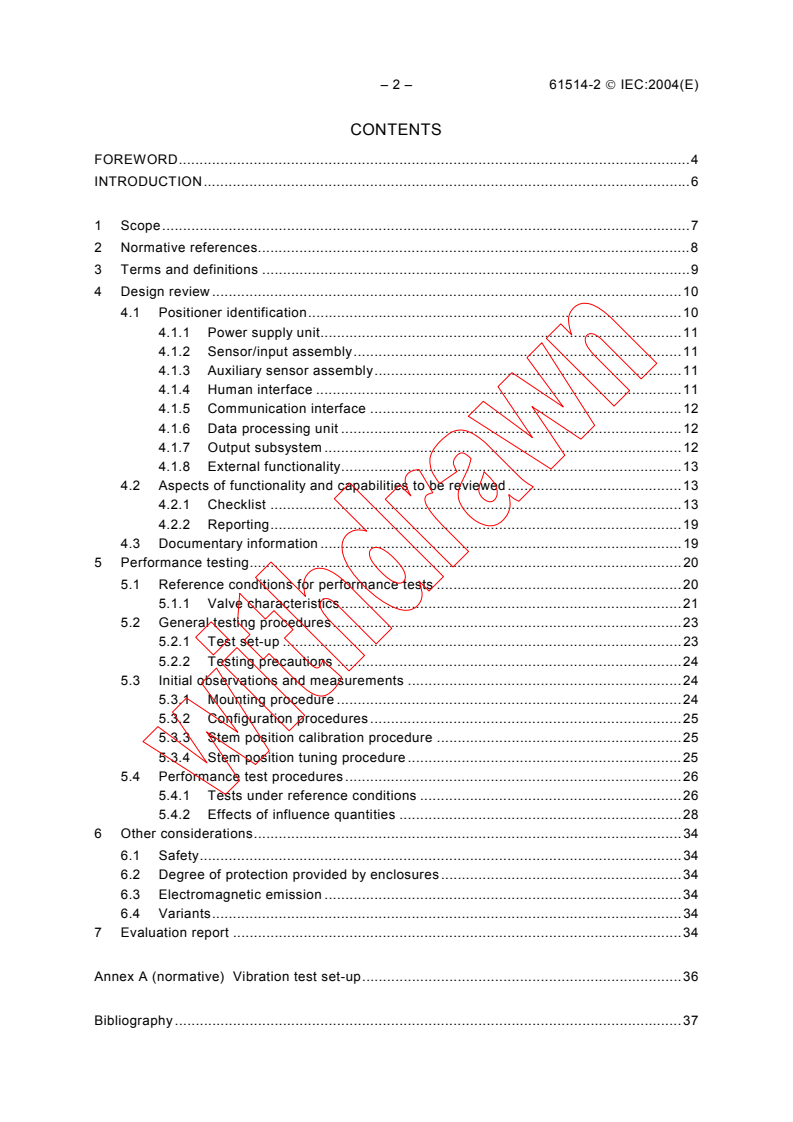
IEC 61514-2:2004 - Industrial process control systems - Part 2: Methods of evaluating the performance of intelligent valve positioners with pneumatic outputs Released:1/29/2004

IEC 61514-2:2004 - Industrial process control systems - Part 2: Methods of evaluating the performance of intelligent valve positioners with pneumatic outputs Released:1/29/2004
Overview
IEC 61514-2:2004 - Industrial process control systems, Part 2 - defines methods for evaluating the performance of intelligent valve positioners with pneumatic outputs. This first-edition IEC standard specifies structured design reviews and performance tests to measure static and dynamic behaviour, the degree of intelligence, and communication capabilities of single‑acting or double‑acting positioners. It applies to devices that accept standard analogue electrical inputs (see IEC 60381) and/or digital signals via data communication links and provide pneumatic outputs.
Key topics and requirements
- Scope of evaluation
- Static and dynamic performance testing when mounted on representative actuator/valve assemblies.
- Assessment of the degree of intelligence: data processing, decision-making, self‑testing and diagnostic features.
- Verification of communication capabilities including bi‑directional links and digital interfaces.
- Design review checklist
- Identification of power supply, sensors/inputs, auxiliary sensors, human interface, communication interface, data processing unit and output subsystem.
- Review of hardware and software design, functional capabilities and reporting/documentation.
- Performance testing procedures
- Test setups for step responses, stability, tuning and calibration procedures.
- Tests under reference conditions and influence‑quantity variations (e.g., supply pressure, friction, actuator sizes).
- Requirement to report actuator-specific parameters (size, stroke, friction, spring package) because positioner performance is actuator dependent.
- Environmental, safety and EMC considerations
- Test guidance references environmental and EMC standards (vibration, temperature, damp heat, IP protection, immunity tests).
- Reporting
- Structured evaluation reports and guidance for partial test programmes when a full evaluation is not feasible.
- Applicability to non‑intelligent devices
- Can be used, in reduced form, to evaluate microprocessor‑based positioners without bi‑directional communication.
Applications and users
Who uses IEC 61514-2:
- Manufacturers - product development, validation and pre‑production qualification.
- Test laboratories - independent verification of supplier performance claims.
- Plant engineers / OEMs / end users - acceptance testing, procurement specifications, and installation validation.
- Maintenance and reliability teams - diagnostic verification, retrofit assessments, and operational troubleshooting.
Practical applications:
- Defining test programs for valve positioner type‑testing and acceptance.
- Comparing positioner models on dynamic response, stability and communications.
- Specifying requirements for digital communication and diagnostics in control systems.
Related standards
Relevant cross‑references include IEC 61514 (Part 1) framework, IEC 60381 (analogue inputs), and environmental/EMC standards such as IEC 60068 series (environmental testing), IEC 60529 (IP code) and IEC 61000‑4‑11 (EMC immunity). These referenced documents support correct application of the evaluation methods.
Relations
- Effective Date
- 05-Sep-2023
Buy Documents
IEC 61514-2:2004 - Industrial process control systems - Part 2: Methods of evaluating the performance of intelligent valve positioners with pneumatic outputs Released:1/29/2004
IEC 61514-2:2004 - Industrial process control systems - Part 2: Methods of evaluating the performance of intelligent valve positioners with pneumatic outputs Released:1/29/2004
Get Certified
Connect with accredited certification bodies for this standard

DVS-ZERT GmbH
German welding certification society.
Institut za varilstvo d.o.o. (Welding Institute)
Slovenia's leading welding institute since 1952. ISO 3834, EN 1090, pressure equipment certification, NDT personnel, welder qualification. Only IIW Au
CARES (UK Certification Authority for Reinforcing Steels)
UK certification for reinforcing steels and construction.
Sponsored listings
Frequently Asked Questions
IEC 61514-2:2004 is a standard published by the International Electrotechnical Commission (IEC). Its full title is "Industrial process control systems - Part 2: Methods of evaluating the performance of intelligent valve positioners with pneumatic outputs". This standard covers: specifies design reviews and tests intended to measure and determine the static and dynamic performance, the degree of intelligence and the communication capabilities of single-acting or double-acting intelligent valve positioners. The tests may be applied to positioners which receive standard analogue electrical input signals (as specified in IEC 60381) and/or digital signals via a data communication link and have a pneumatic output.
specifies design reviews and tests intended to measure and determine the static and dynamic performance, the degree of intelligence and the communication capabilities of single-acting or double-acting intelligent valve positioners. The tests may be applied to positioners which receive standard analogue electrical input signals (as specified in IEC 60381) and/or digital signals via a data communication link and have a pneumatic output.
IEC 61514-2:2004 is classified under the following ICS (International Classification for Standards) categories: 23.060.99 - Other valves; 25.040.40 - Industrial process measurement and control. The ICS classification helps identify the subject area and facilitates finding related standards.
IEC 61514-2:2004 has the following relationships with other standards: It is inter standard links to IEC 61514-2:2013. Understanding these relationships helps ensure you are using the most current and applicable version of the standard.
IEC 61514-2:2004 is available in PDF format for immediate download after purchase. The document can be added to your cart and obtained through the secure checkout process. Digital delivery ensures instant access to the complete standard document.
Standards Content (Sample)
INTERNATIONAL IEC
STANDARD 61514-2
First edition
2004-01
Industrial process control systems –
Part 2:
Methods of evaluating the performance
of intelligent valve positioners
with pneumatic outputs
Reference number
Publication numbering
As from 1 January 1997 all IEC publications are issued with a designation in the
60000 series. For example, IEC 34-1 is now referred to as IEC 60034-1.
Consolidated editions
The IEC is now publishing consolidated versions of its publications. For example,
edition numbers 1.0, 1.1 and 1.2 refer, respectively, to the base publication, the
base publication incorporating amendment 1 and the base publication incorporating
amendments 1 and 2.
Further information on IEC publications
The technical content of IEC publications is kept under constant review by the IEC,
thus ensuring that the content reflects current technology. Information relating to
this publication, including its validity, is available in the IEC Catalogue of
publications (see below) in addition to new editions, amendments and corrigenda.
Information on the subjects under consideration and work in progress undertaken
by the technical committee which has prepared this publication, as well as the list
of publications issued, is also available from the following:
• IEC Web Site (www.iec.ch)
• Catalogue of IEC publications
The on-line catalogue on the IEC web site (www.iec.ch/searchpub) enables you to
search by a variety of criteria including text searches, technical committees
and date of publication. On-line information is also available on recently issued
publications, withdrawn and replaced publications, as well as corrigenda.
• IEC Just Published
This summary of recently issued publications (www.iec.ch/online_news/ justpub)
is also available by email. Please contact the Customer Service Centre (see
below) for further information.
• Customer Service Centre
If you have any questions regarding this publication or need further assistance,
please contact the Customer Service Centre:
Email: custserv@iec.ch
Tel: +41 22 919 02 11
Fax: +41 22 919 03 00
INTERNATIONAL IEC
STANDARD 61514-2
First edition
2004-01
Industrial process control systems –
Part 2:
Methods of evaluating the performance
of intelligent valve positioners
with pneumatic outputs
IEC 2004 Copyright - all rights reserved
No part of this publication may be reproduced or utilized in any form or by any means, electronic or
mechanical, including photocopying and microfilm, without permission in writing from the publisher.
International Electrotechnical Commission, 3, rue de Varembé, PO Box 131, CH-1211 Geneva 20, Switzerland
Telephone: +41 22 919 02 11 Telefax: +41 22 919 03 00 E-mail: inmail@iec.ch Web: www.iec.ch
PRICE CODE
Commission Electrotechnique Internationale W
International Electrotechnical Commission
МеждународнаяЭлектротехническаяКомиссия
For price, see current catalogue
– 2 – 61514-2 IEC:2004(E)
CONTENTS
FOREWORD.4
INTRODUCTION.6
1 Scope.7
2 Normative references.8
3 Terms and definitions .9
4 Design review.10
4.1 Positioner identification.10
4.1.1 Power supply unit.11
4.1.2 Sensor/input assembly.11
4.1.3 Auxiliary sensor assembly.11
4.1.4 Human interface.11
4.1.5 Communication interface.12
4.1.6 Data processing unit .12
4.1.7 Output subsystem.12
4.1.8 External functionality.13
4.2 Aspects of functionality and capabilities to be reviewed .13
4.2.1 Checklist.13
4.2.2 Reporting.19
4.3 Documentary information.19
5 Performance testing.20
5.1 Reference conditions for performance tests .20
5.1.1 Valve characteristics.21
5.2 General testing procedures.23
5.2.1 Test set-up.23
5.2.2 Testing precautions.24
5.3 Initial observations and measurements .24
5.3.1 Mounting procedure.24
5.3.2 Configuration procedures.25
5.3.3 Stem position calibration procedure .25
5.3.4 Stem position tuning procedure.25
5.4 Performance test procedures .26
5.4.1 Tests under reference conditions .26
5.4.2 Effects of influence quantities .28
6 Other considerations.34
6.1 Safety.34
6.2 Degree of protection provided by enclosures.34
6.3 Electromagnetic emission.34
6.4 Variants.34
7 Evaluation report.34
Annex A (normative) Vibration test set-up.36
Bibliography .37
61514-2 IEC:2004(E) – 3 –
Figure 1 – Positioner model in extensive configuration.11
Figure 2 – Basic design for positioners with analogue outputs.13
Figure 3 – Basic design for positioners with pulsed output .13
Figure 4 – Basic test set-up.24
Figure 5 – Examples of step responses of positioners .28
Table 1 – Single or double acting linear .21
Table 2 – Single or double acting rotary for an angle between 60° – 90° .22
Table 3 – Matrix of instrument properties and tests.29
– 4 – 61514-2 IEC:2004(E)
INTERNATIONAL ELECTROTECHNICAL COMMISSION
___________
INDUSTRIAL PROCESS CONTROL SYSTEMS –
Part 2: Methods of evaluating the performance of
intelligent valve positioners with pneumatic outputs
FOREWORD
1) The International Electrotechnical Commission (IEC) is a worldwide organization for standardization comprising
all national electrotechnical committees (IEC National Committees). The object of IEC is to promote
international co-operation on all questions concerning standardization in the electrical and electronic fields. To
this end and in addition to other activities, IEC publishes International Standards, Technical Specifications,
Technical Reports, Publicly Available Specifications (PAS) and Guides (hereafter referred to as “IEC
Publication(s)”). Their preparation is entrusted to technical committees; any IEC National Committee interested
in the subject dealt with may participate in this preparatory work. International, governmental and non-
governmental organizations liaising with the IEC also participate in this preparation. IEC collaborates closely
with the International Organization for Standardization (ISO) in accordance with conditions determined by
agreement between the two organizations.
2) The formal decisions or agreements of IEC on technical matters express, as nearly as possible, an international
consensus of opinion on the relevant subjects since each technical committee has representation from all
interested IEC National Committees.
3) IEC Publications have the form of recommendations for international use and are accepted by IEC National
Committees in that sense. While all reasonable efforts are made to ensure that the technical content of IEC
Publications is accurate, IEC cannot be held responsible for the way in which they are used or for any
misinterpretation by any end user.
4) In order to promote international uniformity, IEC National Committees undertake to apply IEC Publications
transparently to the maximum extent possible in their national and regional publications. Any divergence
between any IEC Publication and the corresponding national or regional publication shall be clearly indicated in
the latter.
5) IEC provides no marking procedure to indicate its approval and cannot be rendered responsible for any
equipment declared to be in conformity with an IEC Publication.
6) All users should ensure that they have the latest edition of this publication.
7) No liability shall attach to IEC or its directors, employees, servants or agents including individual experts and
members of its technical committees and IEC National Committees for any personal injury, property damage or
other damage of any nature whatsoever, whether direct or indirect, or for costs (including legal fees) and
expenses arising out of the publication, use of, or reliance upon, this IEC Publication or any other IEC
Publications.
8) Attention is drawn to the Normative references cited in this publication. Use of the referenced publications is
indispensable for the correct application of this publication.
9) Attention is drawn to the possibility that some of the elements of this IEC Publication may be the subject of
patent rights. IEC shall not be held responsible for identifying any or all such patent rights.
International Standard IEC 61514-2 has been prepared by subcommittee 65B: Devices, of
IEC technical committee 65: Industrial-process measurement and control.
This standard is to be read in conjunction with IEC 61514.
The text of this standard is based on the following documents:
FDIS Report on voting
65B/515/FDIS 65B/522/RVD
Full information on the voting for the approval of this standard can be found in the report on
voting indicated in the above table.
This publication has been drafted in accordance with the ISO/IEC Directives, Part 2.
61514-2 IEC:2004(E) – 5 –
The committee has decided that the contents of this publication will remain unchanged until
2009. At this date, the publication will be
• reconfirmed;
• withdrawn;
• replaced by a revised edition, or
• amended.
A bilingual version of this publication may be issued at a later date.
– 6 – 61514-2 IEC:2004(E)
INTRODUCTION
New instruments for process control and measurement including valve positioners are mainly
equipped with microprocessors thereby utilising digital data processing and communication
methods and/or artificial intelligence, making them more complex and giving them a consider-
able added value.
Modern intelligent valve positioners are no longer only controlling the valve position, but they
are in many cases also equipped with various facilities for self-testing, actuator/valve condition
monitoring and alarming. The variety of added functionalities is large. They can no longer be
compared with the single function "cam-type" positioners. Therefore, accuracy related
performance testing although still very important is no longer sufficient to demonstrate their
flexibility, capabilities and other features with respect to engineering, installation, maintain-
ability, reliability and operability.
In this standard the evaluation considers performance testing and a design review of both
hardware and software. The layout of this document follows to some extent the framework of
IEC 62098. A number of performance tests described in IEC 61514 are still valid for intelligent
valve positioners. Further reading of IEC 61069 is recommended.
61514-2 IEC:2004(E) – 7 –
INDUSTRIAL PROCESS CONTROL SYSTEMS –
Part 2: Methods of evaluating the performance of
intelligent valve positioners with pneumatic outputs
1 Scope
This part of IEC 61514 specifies design reviews and tests intended to measure and determine
the static and dynamic performance, the degree of intelligence and the communication
capabilities of single-acting or double-acting intelligent valve positioners. The tests may be
applied to positioners which receive standard analogue electrical input signals (as specified in
IEC 60381) and/or digital signals via a data communication link and have a pneumatic output.
An intelligent valve positioner as defined in Clause 3 is an instrument that uses for performing
its functions digital techniques for data processing, decision-making and bi-directional
communication. It may be equipped with additional sensors and additional functionality
supporting the main function.
The performance testing of an intelligent valve positioner needs to be conducted with the
positioner mounted on and connected to one or preferably more actuator/valve assemblies in
turn. The specific characteristic parameters of these combinations such as size, stroke, friction
(hysteresis), type of packing, spring package and supply pressure for the pneumatic part, are
to be carefully chosen and reported. It should be noted that the performance of a positioner in
such combinations is actuator dependent. Tests on different sizes of actuators are required in
particular for the determination of the operational range (dynamic response and stability) of a
positioner.
The methods of evaluation given in this standard are intended for use by manufacturers to
determine the performance of their products and by users or testing laboratories to verify
equipment performance specifications. The manufacturers of intelligent positioners are urged
to apply this standard at an early stage of development.
This standard is intended to provide guidance for designing evaluations of intelligent valve
positioners by providing:
– a checklist for reviewing their hardware and software design in a structured way;
– test methods for measuring and qualifying their performance under various environmental
and operational conditions;
– methods for reporting the data obtained.
When a full evaluation, in accordance with this standard, is not required or possible, the tests
which are required should be performed and the results reported in accordance with the
relevant parts of this standard. In such cases, the test report should state that it does not cover
the full number of tests specified herein. Furthermore, the items omitted should be mentioned,
to give the reader of the report a clear overview.
The standard is also applicable for non-intelligent microprocessor-based valve positioners
without means for bi-directional communication. In that case an evaluation should be reduced
to a limited programme of performance testing and a short review of the construction.
– 8 – 61514-2 IEC:2004(E)
2 Normative references
The following referenced documents are indispensable for the application of this document. For
dated references, only the edition cited applies. For undated references, the latest edition of
the referenced document (including any amendments) applies.
IEC 60050-351:1998, International Electrotechnical Vocabulary (IEV) – Part 351: Automatic
control
IEC 60068-2-1: 1990, Environmental testing – Part 2: Tests. Tests A: Cold
IEC 60068-2-2: 1974, Environmental testing – Part 2: Tests. Tests B: Dry heat
IEC 60068-2-6: 1995, Environmental testing – Part 2: Tests. Test Fc: Vibration (sinusoidal)
IEC 60068-2-31: 1969, Environmental testing – Part 2: Tests. Test Ec: Drop and topple,
primarily for equipment-type specimens
IEC 60068-2-78: 2001, Environmental testing – Part 2-78: Tests. Test Cab: Damp heat, steady
state
IEC 60079 (all parts), Electrical apparatus for explosive gas atmospheres
IEC 60529:1989, Degrees of protection provided by enclosures (IP Code)
IEC 60534-1, Industrial-process control valves – Part 1: Control valve terminology and general
considerations
IEC 60654 (all parts), Operating conditions for industrial-process measurement and control
equipment
IEC 60721-3, Classification of environmental conditions – Part 3 Classification of groups of
environmental parameters and their severities
IEC 61000-4-11, Electromagnetic compatibility (EMC) – Part 4-11: Testing and measurement
techniques – Voltage dips, short interruptions and voltage variations immunity tests
IEC 61010-1:2001, Safety requirements for electrical equipment for measurement, control, and
laboratory use – Part 1: General requirements
IEC 61032:1997, Protection of persons and equipment by enclosures – Probes for verification
IEC 61069 (all parts), Industrial-process measurement and control – Evaluation of system
properties for the purpose of system assessment
IEC 61158 (all parts), Digital data communications for measurement and control – Fieldbus for
use in industrial control systems
IEC 61298 (all parts), Process measurement and control devices – General methods and
procedures for evaluating performance
IEC 61326:2002, Electrical equipment for measurement, control and laboratory use – EMC
requirements
61514-2 IEC:2004(E) – 9 –
IEC/PAS 61499 (all parts), Function blocks for industrial-process measurement and control
systems
IEC 61514:2000, Industrial-process control systems – Methods of evaluating the performance
of valve positioners with pneumatic outputs
IEC 62098:2000, Evaluation methods for microprocessor-based instruments
CISPR 22, Information technology equipment – Radio disturbance characteristics – Limits and
methods of measurement
3 Terms and definitions
For the purposes of this document, the terms and definitions given in IEC 61514 and
IEC 60050(351), in addition to the following apply.
3.1
intelligent valve positioner
position controller as defined in 3.1 of IEC 61514 based on microprocessor technology, and
utilising digital techniques for data processing, decision-making and bi-directional communi-
cation; it may be equipped with additional sensors and additional functionality supporting the
main function.
NOTE 1 In this standard, only positioners with pneumatic output signals are considered. The input signal may be
an electric current or voltage, or a digital signal via a fieldbus.
NOTE 2 For non-intelligent microprocessor-based position controllers without bi-directional communication an
evaluation is reduced to a limited amount of performance testing and an abridged design review of the construction.
3.2
configuring
process of implementing the functionality required for a certain application
3.3
configurability
extent to which an intelligent positioner can be provided with functions to control various
applications
3.4
calibration
process of adjusting the range of travel to the required value for acquiring a defined input-to-
travel characteristic. The adjusted travel can either be from stop to stop or to a value in
between as defined by the valve manufacturer
NOTE Instruments may exist that are provided with an automatic procedure for travel range adjustment, which
may then be addressed with the term auto-calibration.
3.5
tuning
process of adjusting the various control parameters for a certain application
NOTE The stem tuning procedure can range from "trial and error" to an automatic proprietary procedure provided
by the manufacturer and often addressed as auto-tuning.
3.6
set-up
process of configuring, calibrating and tuning a positioner for optimal controlling of a specific
actuator/valve assembly
– 10 – 61514-2 IEC:2004(E)
3.7
travel cut-off
point close to the extreme end (low or high) of the characteristic curve at which the positioner
forces the valve to the corresponding mechanical stop (fully closed or fully open)
3.8
stroke time
time required to travel between two different positions under a defined set of conditions
3.9
dead band
finite range of values within which reversal of the input variable does not produce any
noticeable change in the output variable
3.10
operating mode
selected method of operation of the positioner
3.11
setpoint
input variable, which sets the desired value of the controlled variable (travel)
NOTE The input variable may originate from an analogue source (mA or voltage) or from a digital source (fieldbus)
or local keyboard).
3.12
balance pressure
average of the pressures on the opposite chambers of a double acting actuator in steady state
condition
NOTE The balance pressure must be expressed as a percentage of the positioner supply pressure to evaluate the
stiffness of the double acting system.
4 Design review
The observations of this clause shall be based on open literature (manuals, instruction leaflets,
etc.) provided to a user on delivery of the instruments and whatever the manufacturer is willing
to disclose. They shall not contain confidential information.
The design review is meant to identify and make explicit the functionality and capabilities of the
intelligent valve positioner under consideration in a structured way. As intelligent positioners
appear in a great variety of designs a review has to show in a structured way the details of
– their physical structure;
– their functional structure.
Subclause 4.1 guides the evaluator in the process of describing the physical structure of
intelligent positioners through identifying the hardware modules and the I/O's to the operational
and environmental domains.
Thereafter the functional structure is described using the checklist of 4.2. The checklist gives a
structured framework of the relevant issues, which have to be addressed by the evaluator
through adequate qualitative and quantitative experiments.
4.1 Positioner identification
The structured identification process, based on the following considerations, leads to a
blockscheme and a concise description of the positioner under test, which shall be included in
the evaluation report. It may be enhanced with photographs or drawings of important details.
61514-2 IEC:2004(E) – 11 –
The instrument, schematically shown in Figure 1, can have the following main physical
modules and provisions for connection to the external world:
To external system
Supply voltage
Power supply Communication
Supply pressure
interface
unit
Current input
Data
Sensor/input Output
E
processing
Feedback from actuator
assembly subsystem
Output pressure
P
unit
to actuator
Pos. output pressure
Aux. sensor
pos. internal temp.
assembly
Human
Upstream line pressure mA position output
interface
Diff. pressure
Stuffing box
over valve
leakage
detector
To human operator
IEC 002/04
Figure 1 – Positioner model in extensive configuration
4.1.1 Power supply unit
Instruments that require a separate connection to an a.c. or d.c. supply voltage may exist.
However, the majority of instruments are "loop powered" which means that they receive power
either through the current input for instruments that need an analogue (mA) setpoint, or
through the fieldbus when the setpoint is a digital signal.
4.1.2 Sensor/input assembly
The main sensor/input assembly is that part of the positioner to which the analogue setpoint is
connected and which also receives the feedback signal from the actuator/valve assembly (stem
movement). It supports the primary function of the positioner. Parts of the assembly may be
distributed at physically different locations in the positioner. In instruments that receive a digital
setpoint the current input as shown in Figure 4 does not exist. The feedback signal is
generated by a mechanical interface (linkage) between the positioner and the valve stem.
4.1.3 Auxiliary sensor assembly
The auxiliary sensor assembly is for the electronics part integrated with the main sensor input
assembly. Many positioners are equipped with a pressure sensor in the pneumatic output
circuit and a temperature sensor inside the electronics housing. Their signals may be used in
the stem position control algorithm. For safeguarding and condition monitoring of the valve a
positioner may be equipped with additional sensors. It may also be equipped with circuits for
digital inputs from switches.
4.1.4 Human interface
A positioner can be classified as intelligent only when data produced by the positioner can be
communicated to the external world. The human interface is an important tool for
communication. It consists of integral means at the instrument for reading out data (local
display) and provisions for entering and requesting data (local pushbuttons). It may appear that
some instruments are not equipped with a human interface. In these cases access is provided
via the data communication interface and an external device (handheld terminal or PC).
– 12 – 61514-2 IEC:2004(E)
4.1.5 Communication interface
Positioner intelligence is further supported by the communication interface, which connects the
positioner to external systems. Through the interface and a fieldbus, data transfer (setpoint,
configuration and process data) takes place between the positioner and the external system.
There are also hybrid instruments, which require an analogue input for control data where the
data communication interface is integrated in the input circuit and has no separate point of
connection for the fieldbus. The digital information is superimposed on the analogue input
current. There may be instruments which do not have a communication interface. Then
configuration and read-out of data take place via the human interface.
4.1.6 Data processing unit
The data processing unit provides the instrument with a number of functions that may vary
considerably from make to make. The functions that can be implemented include:
– control function;
– configuration;
– calibration;
– tuning;
– valve condition monitoring (valve diagnostics);
– external process control function;
– self-testing;
– trending and data storage;
– part of the functionality may be located in external devices that are temporarily or
continuously connected to the data communication interface (e.g. configuration, trending).
4.1.7 Output subsystem
In the single acting version the output subsystem converts the digital information via an electro-
pneumatic converter (E/P) into the pneumatic signal for controlling the actuator.
In the double acting version the output subsystem is equipped with two oppositely operating
E/P-converters. In balanced (steady) position the converters provide pressures that, apart from
the friction force to the valve stem, are equal. The relation between the balance pressure and
the supply pressure determines the stiffness of a double acting system.
With respect to the pneumatic unit, the following two designs can be identified:
– using analogue techniques of conventional E/P-converters as shown in Figure 2;
– using pulsed digital techniques basically as shown in Figure 3, with electronically controlled
two-position pilot valves.
Moreover, the output subsystem can also be provided with isolated analogue signal outputs
proportional to one (or more) of the measured or calculated data and/or one or more
configurable output relays for alarm purposes. Such outputs usually require a separate power
supply.
61514-2 IEC:2004(E) – 13 –
Control signal Stem position
Data processing
unit
feedback
Supply pressure
E/P
converter
Pneumatic
amplifier
Valve and actuator
IEC 003/04
Figure 2 – Basic design for positioners with analogue outputs
Control signal Control signal
open close
Pilot Pilot
valve 1 valve 2
Supply
Venting
pressure
output
Actuator
Stem travel
IEC 004/04
Figure 3 – Basic design for positioners with pulsed output
4.1.8 External functionality
Through the data communication interface and the fieldbus the instrument communicates with
PCs, handheld devices and DCS systems. In many cases a part of the functionality of the
positioner may reside in these devices. This may include the following functions:
– (Remote) configuration tool.
– Data storage (configuration, position trend, valve condition).
– Parts of the calibration and stem tuning procedure.
– Automated valve condition monitoring and alarming.
In an evaluation the external functionality (if present) shall be considered as well.
4.2 Aspects of functionality and capabilities to be reviewed
4.2.1 Checklist
The following tables shall serve as a checklist for the determination of the functions and
capabilities implemented in the positioner under consideration. An example of the reporting
format can be found in 4.3.
– 14 – 61514-2 IEC:2004(E)
4.2.1.1 Functionality
Function/capability Aspects to be considered during evaluation
Suitable for rotary valve If so, also indicate the stroke range and describe the accessories required for
mechanical linkage
Suitable for linear stroke valve If so, also indicate the stroke range and describe the accessories required for
mechanical linkage
Direct/reverse action Check whether choice of direct/reverse action is possible and describe how the
mechanism operates
Double acting version Mention availability
Stem position control algorithm For each control parameter give:
parameters
• Name
• Adjustment range if user-adjustable
• Default values if applicable
• Check whether invalid values are recognised and rejected
• Check whether negative values are accepted, if so observe behaviour on
instability after step change
• Check if outputs of internal sensors are used in the stem position control
algorithm and check whether and how backup is provided in case of
sensor failure
• Some designs have a double set of control parameters for upscale or
downscale movement, verify
• What value defines indefinite (‘99999’ or ‘0’)?
Other parameters affecting For a number of parameters (supply pressure, valve and actuator data, etc.)
control values may be requested to be entered during configuration. They might be
used in the stem position control algorithm. Check whether they are indeed
used in the stem position control algorithm or are informative only.
Operating modes Describe the available operating modes, their hierarchy, span of control,
switching order (also check availability of bumpless transfer), degree of
authorised access to positioner database (configuration, control parameters,
secondary parameters).
Operating modes could be:
• Out of service or standby
• Automatic control
• Manual control (local or remote)
Split range application Is split range operation possible?
If so, check whether it is a fixed setting or a user-adjustable range
Stroke time Check whether the stroke time is user-adjustable. When set to zero,
parameters such as actuator volume, valve friction, spring package, supply
pressure and restrictions determine stroke time. When set to values exceeding
the actuator characteristic, speed is constant.
Travel cut-off Cut-off is usually possible at the lower end of the characteristic (also known as
tight shut-off), but also cut-off at the upper end can be present. Indicate which
option is available and whether cut-off values are user-configurable.
Check whether a dead band is implemented and operational between activation
and release. Indicate whether it is related to the input signal or to the feedback
position signal.
Filters If filters are provided, are they analogue or digital?
External (process) control Can function blocks (according to IEC 61499) for an external control loop be
implemented?
Special functions Indicate if special functions are available (e.g. pressure sensor in actuator,
leak detection, flow measurement)
61514-2 IEC:2004(E) – 15 –
4.2.1.2 Configurability
Function/capability Aspects to be considered during evaluation
Fieldbus compatibility Check whether the instrument under test is suited for either:
• connection to one of the fieldbusses in accordance with IEC 61158
• or stand-alone application in combination with a temporary connection to a
proprietary fieldbus
• or stand-alone application
A concise listing may be added of instrument versions versus link compatibility
Configuration tools Check if the instrument can be configured:
• From local controls (human interface) on instrument
• Remotely from PC or a host computer
• Via handheld communication unit to be connected temporarily
On-line (re)configuration Check whether parameters can be changed in control mode, if so whether the
position of the valve stem is unacceptably affected.
Check whether there is a security mechanism that prohibits on-line access to
all or some parameters.
Off-line configuration Check whether it is possible to set up and store configurations for a number of
positioners on a separate (off-line) PC, which is not connected to a positioner.
Up/download to/from PC Check if configuration upload is possible. Check if download of off-line
prepared configurations is possible.
Configurable travel Mention user-selectable characteristics that reside in the instrument, such as:
characteristics
• Linear
• Equal percentage (IEC 60534-1) 1:50; 1:30; 1:25, etc.
• Equal percentage proprietary
• Quick opening
• Segmental (user defined travel characteristic), mention number of
segments
NOTE The equal percentage characteristic is sometimes realised by
segmental approach. It is important to state the number of segments and their
size and to evaluate the maximum errors with respect to the theoretical equal
percentage characteristic.
Configurable “fail-safe” position Check the availability of a configurable fail-safe position:
• What is reaction on failures (closed or open)?
• On what failures is fail-safe activated?
Balance pressure Check whether the balance pressure for the double acting version is user-
adjustable
Conditions on start-up after loss After a power down the user may want the positioner to return to a defined
of power or an instrument reset position. Positioners may be provided with:
• Return to last value
• Go to fail-safe
• Go to a user-defined value
• Return to control in manual mode
– 16 – 61514-2 IEC:2004(E)
4.2.1.3 Hardware configuration
Function/capability Aspects to be considered during evaluation
Hinged covers
Comment for these items on:
Valve position feedback
• Complexity and soundness of construction and protection against damage
mechanism
• Separate termination compartment
Internal modules
• Availability of material of construction for severe service application (e.g.
Support to valve offshore, food)
• Availability of integrated pneumatic connections
Protruding parts
• Availability of quick connect provisions for electrical and pneumatic
Local controls
connections
Electrical connections
• Isolation of pneumatic and electronic compartments
Pneumatic connections
Remote position sensor Check the availability of a remote position sensor that provides mechanical
separation of the electronics and comment on soundness and ease of
installation and calibration
4.2.1.4 Operability
Function/capability Aspects to be considered during evaluation
Local controls (tools) for access Give a concise description of:
• Available controls (pushbuttons, etc.)
• Accessibility
• Ergonomic layout and use of the controls
• Can controls be used in hazardous locations?
Local displays Give concise description of data that can be shown on the local displays:
• Number of lines and characters per line
• Control parameters given
• Error messages, etc.
Is display readable without removing covers?
Human interface at external Give a concise description of the organisation and hierarchy of the various user
system access groups and related displays in the PC based software.
Give for a handheld communicator a picture with layout of display and
keyboard.
Other points for human List other hardware tools (switches, potmeters, etc.) and the related
interaction parameters they control
Valve diagnostics Check whether implemented Valve Diagnostics cover the following aspects:
• Change in performance of control valve (dead band, resolution, etc.)
• Change of friction
• Wear of plug
• Wear of stem
• Packing leakage
• Seat leakage
• Break of stem
• Cavitation
• Broken actuator spring
• Air leakage at actuator
• Valve stuck
• Torn diaphragm at actuator
• Detection of reduction of performance by plugging of pneumatic
• Other aspects
Robustness
61514-2 IEC:2004(E) – 17 –
Function/capability Aspects to be considered during evaluation
Checks on extent of and tools for Check how the aspects mentioned above are diagnosed, tested, stored,
Valve Diagnostics reported and presented by the positioner or the host system.
Does the diagnostic tool provide direct automatic interpretation by the
instrument or does it require a specific level of human expertise. For each
aspect check which of the tools (tests) mentioned below are used, check per
tool the following points:
• Whether the diagnostic tests can be performed in-service
• Whether it is an on-line automatic test or an operator-initiated
• Check intervals between automatic tests
• Check user-adaptability of test parameters
• Check whether test affects the stem position.
• Indicate whether data can be stored and where (local or in PC)
• Check whether there is a related direct alert/alarm message or whether it
has to be deduced by the user from other information given by the
positioner. (Example: Many positioners are equipped with a user-
adjustable alarm indicating that the valve is not reaching its position in a
certain time. Break of stem, and broken spring will most probably trigger
this alarm.)
• Check the action of the positioner on appearance of diagnostic alarms
Tools (tests) that can be present are amongst other things:
• High/low position alarms
• Rate of change alarm
• Cycle counter/accumulator
• Travel accumulator
• Valve signature test
• Step response test
• Time to settle exceeds the set limit
• Accumulator for time close to zero
4.2.1.5 Dependability
Function/capability Aspects to be considered during evaluation
Positioner diagnostics Describe in short the extent of the system for diagnosing internal positioner
failures and securing safe operation in case of failures. Mechanisms may be
implemented for detecting:
• Flash ROM Failure
• No Free Time
• Reference Voltage Failure
• Drive Current Failure
• Critical NVM Failure
• Temperature Sensor Failure
• Pressure Sensor Failure
• Travel Feedback Sensor Failure
Fieldbus devices may provide specific messages such as:
• I/O Processor Fault
• Output not Running
• Static Parameters Lost
• Calibration Data Read Error
Check which diagnostics are performed:
• On-line (in service) automatically, continuously or intermittently
On-line (in service) user-initiated
Offline (out of service)
Does the manufacturer provide a coverage factor with respect to detection of
internal failures?
– 18 – 61514-2 IEC:2004(E)
Function/capability Aspects to be considered during evaluation
Detection of incorrect use Does the instrument detect errors and failures due to incorrect and unintended
operation and maintenance actions such as:
• Incorrect address settings via jumpers or dip switches;
• Reverse connection of power wiring, connectors, printed circuit boards (if
possible)
• Putting connectors at incorrect positions (if length of wiring permits this)
• Leaving an open circuit by not connecting a connector
• Performing incomplete or incorrect start-up procedure
• Leaving the instrument at an incorrect security level
• Multiple use of same address in a multi-drop digital communication system
• Causing short circuit by touching adjacent parts when performing
mechanical adjustments
Alarms Basically two groups of alarm types can be distinguished:
• Process alarms (related to the above mentioned valve diagnostic aspects
and the valve/actuator condition). Alarm settings may be user-adjustable.
• Selftest alarms (related to above mentioned positioner diagnostics on
internal electrical failures). These alarms are in general not user-
accessible.
• Which alarms in both groups are provided?
• How do they communicate?
Hard wired via relay outputs
On local display
Via fieldbus
• Do alarms appear automatically or only on user request?
Security against unauthorised Describe method of implementation of security:
access
• Hardware (write protect switch)
• Software (passwords, number of access levels and the degrees of access
and configurability at these levels)
• Access to local controls
Maintainability What level of repair does the manufacturer specify? (exchange of parts,
exchange of complete instrument)
Determine time to repair comprising of replacement in workshop
...
IEC 61514-2
Edition 1.0 2004-01
INTERNATIONAL
STANDARD
NORME
INTERNATIONALE
Industrial process control systems –
Part 2: Methods of evaluating the performance of intelligent valve positioners
with pneumatic outputs
Systèmes de commande des processus industriels –
Partie 2: Méthodes d’évaluation des performances des positionneurs de vanne
intelligents à sorties pneumatiques
All rights reserved. Unless otherwise specified, no part of this publication may be reproduced or utilized in any form or by
any means, electronic or mechanical, including photocopying and microfilm, without permission in writing from either IEC or
IEC's member National Committee in the country of the requester.
If you have any questions about IEC copyright or have an enquiry about obtaining additional rights to this publication,
please contact the address below or your local IEC member National Committee for further information.
Droits de reproduction réservés. Sauf indication contraire, aucune partie de cette publication ne peut être reproduite
ni utilisée sous quelque forme que ce soit et par aucun procédé, électronique ou mécanique, y compris la photocopie
et les microfilms, sans l'accord écrit de la CEI ou du Comité national de la CEI du pays du demandeur.
Si vous avez des questions sur le copyright de la CEI ou si vous désirez obtenir des droits supplémentaires sur cette
publication, utilisez les coordonnées ci-après ou contactez le Comité national de la CEI de votre pays de résidence.
IEC Central Office
3, rue de Varembé
CH-1211 Geneva 20
Switzerland
Email: inmail@iec.ch
Web: www.iec.ch
About the IEC
The International Electrotechnical Commission (IEC) is the leading global organization that prepares and publishes
International Standards for all electrical, electronic and related technologies.
About IEC publications
The technical content of IEC publications is kept under constant review by the IEC. Please make sure that you have the
latest edition, a corrigenda or an amendment might have been published.
ƒ Catalogue of IEC publications: www.iec.ch/searchpub
The IEC on-line Catalogue enables you to search by a variety of criteria (reference number, text, technical committee,…).
It also gives information on projects, withdrawn and replaced publications.
ƒ IEC Just Published: www.iec.ch/online_news/justpub
Stay up to date on all new IEC publications. Just Published details twice a month all new publications released. Available
on-line and also by email.
ƒ Electropedia: www.electropedia.org
The world's leading online dictionary of electronic and electrical terms containing more than 20 000 terms and definitions
in English and French, with equivalent terms in additional languages. Also known as the International Electrotechnical
Vocabulary online.
ƒ Customer Service Centre: www.iec.ch/webstore/custserv
If you wish to give us your feedback on this publication or need further assistance, please visit the Customer Service
Centre FAQ or contact us:
Email: csc@iec.ch
Tel.: +41 22 919 02 11
Fax: +41 22 919 03 00
A propos de la CEI
La Commission Electrotechnique Internationale (CEI) est la première organisation mondiale qui élabore et publie des
normes internationales pour tout ce qui a trait à l'électricité, à l'électronique et aux technologies apparentées.
A propos des publications CEI
Le contenu technique des publications de la CEI est constamment revu. Veuillez vous assurer que vous possédez
l’édition la plus récente, un corrigendum ou amendement peut avoir été publié.
ƒ Catalogue des publications de la CEI: www.iec.ch/searchpub/cur_fut-f.htm
Le Catalogue en-ligne de la CEI vous permet d’effectuer des recherches en utilisant différents critères (numéro de référence,
texte, comité d’études,…). Il donne aussi des informations sur les projets et les publications retirées ou remplacées.
ƒ Just Published CEI: www.iec.ch/online_news/justpub
Restez informé sur les nouvelles publications de la CEI. Just Published détaille deux fois par mois les nouvelles
publications parues. Disponible en-ligne et aussi par email.
ƒ Electropedia: www.electropedia.org
Le premier dictionnaire en ligne au monde de termes électroniques et électriques. Il contient plus de 20 000 termes et
définitions en anglais et en français, ainsi que les termes équivalents dans les langues additionnelles. Egalement appelé
Vocabulaire Electrotechnique International en ligne.
ƒ Service Clients: www.iec.ch/webstore/custserv/custserv_entry-f.htm
Si vous désirez nous donner des commentaires sur cette publication ou si vous avez des questions, visitez le FAQ du
Service clients ou contactez-nous:
Email: csc@iec.ch
Tél.: +41 22 919 02 11
Fax: +41 22 919 03 00
IEC 61514-2
Edition 1.0 2004-01
INTERNATIONAL
STANDARD
NORME
INTERNATIONALE
Industrial process control systems –
Part 2: Methods of evaluating the performance of intelligent valve positioners
with pneumatic outputs
Systèmes de commande des processus industriels –
Partie 2: Méthodes d’évaluation des performances des positionneurs de vanne
intelligents à sorties pneumatiques
INTERNATIONAL
ELECTROTECHNICAL
COMMISSION
COMMISSION
ELECTROTECHNIQUE
PRICE CODE
INTERNATIONALE
X
CODE PRIX
ICS 23.060; 25.040.40 ISBN 2-8318-7557-9
– 2 – 61514-2 © CEI:2004
SOMMAIRE
AVANT-PROPOS.6
INTRODUCTION.10
1 Domaine d’application.12
2 Références normatives.14
3 Termes et définitions .16
4 Revue de conception.18
4.1 Identification du positionneur.20
4.1.1 Unité d'alimentation.20
4.1.2 Ensemble capteur/entrée.20
4.1.3 Ensemble capteur auxiliaire.22
4.1.4 Interface humaine.22
4.1.5 Interface de communication.22
4.1.6 Unité de traitement de données .22
4.1.7 Sous-système de sortie .22
4.1.8 Fonctionnalité externe.26
4.2 Revue des fonctionnalités .26
4.2.1 Liste de contrôle.26
4.2.2 Rapport.40
4.3 Information documentaire.42
5 Essais de performance.44
5.1 Conditions de référence pour les essais de performance.44
5.1.1 Caractéristiques des vannes.46
5.2 Présentation générale des méthodes d'essai.50
5.2.1 Montage d'essai.50
5.2.2 Précautions à prendre lors des essais .52
5.3 Observations et mesures initiales .52
5.3.1 Procédure de montage.52
5.3.2 Procédures de configuration.52
5.3.3 Procédure d'étalonnage de la position de la tige.54
5.3.4 Procédure d'adaptation de la position de la tige.54
5.4 Méthodes d'essai de performance .56
5.4.1 Essais dans des conditions de référence .56
5.4.2 Effets des grandeurs d'influence.64
6 Autres considérations.76
6.1 Sécurité.76
6.2 Degré de protection procuré par les enveloppes.76
6.3 Emission électromagnétique.76
6.4 Variantes.76
7 Rapport d'évaluation.76
Annexe A (normative) Montage d'essai de vibration .80
Bibliographie.82
61514-2 © IEC:2004 – 3 –
CONTENTS
FOREWORD.7
INTRODUCTION.11
1 Scope.13
2 Normative references.15
3 Terms and definitions .17
4 Design review.19
4.1 Positioner identification.21
4.1.1 Power supply unit.21
4.1.2 Sensor/input assembly.21
4.1.3 Auxiliary sensor assembly.23
4.1.4 Human interface.23
4.1.5 Communication interface.23
4.1.6 Data processing unit .23
4.1.7 Output subsystem.23
4.1.8 External functionality.27
4.2 Aspects of functionality and capabilities to be reviewed .27
4.2.1 Checklist.27
4.2.2 Reporting.41
4.3 Documentary information.43
5 Performance testing.45
5.1 Reference conditions for performance tests .45
5.1.1 Valve characteristics.47
5.2 General testing procedures.51
5.2.1 Test set-up.51
5.2.2 Testing precautions.53
5.3 Initial observations and measurements .53
5.3.1 Mounting procedure.53
5.3.2 Configuration procedures.53
5.3.3 Stem position calibration procedure .55
5.3.4 Stem position tuning procedure.55
5.4 Performance test procedures .57
5.4.1 Tests under reference conditions .57
5.4.2 Effects of influence quantities .65
6 Other considerations.77
6.1 Safety.77
6.2 Degree of protection provided by enclosures.77
6.3 Electromagnetic emission.77
6.4 Variants.77
7 Evaluation report.77
Annex A (normative) Vibration test set-up.81
Bibliography .83
– 4 – 61514-2 © CEI:2004
Figure 1 – Modèle de positionneur en configuration étendue.20
Figure 2 – Conception de base pour des positionneurs à sorties analogiques .24
Figure 3 – Conception de base pour des positionneurs à sortie pulsée .26
Figure 4 – Montage d'essai de base.52
Figure 5 – Exemples de réponses échelonnées de positionneurs.62
Figure A.1 – Montage pour l'essai de vibration.80
Tableau 1 – Actionneur linéaire à simple ou double effet .46
Tableau 2 – Actionneur rotatif à simple ou double effet pour un angle compris entre
60° et 90° .46
Tableau 3 – Matrice des propriétés de l'instrument et essais correspondants .66
61514-2 © IEC:2004 – 5 –
Figure 1 – Positioner model in extensive configuration.21
Figure 2 – Basic design for positioners with analogue outputs.25
Figure 3 – Basic design for positioners with pulsed output .27
Figure 4 – Basic test set-up.53
Figure 5 – Examples of step responses of positioners .63
Figure A.1– Test set-up for vibration test……………………………………………………….81
Table 1 – Single or double acting linear .47
Table 2 – Single or double acting rotary for an angle between 60° – 90° .47
Table 3 – Matrix of instrument properties and tests.67
– 6 – 61514-2 © CEI:2004
COMMISSION ÉLECTROTECHNIQUE INTERNATIONALE
___________
SYSTÈMES DE COMMANDE DES PROCESSUS INDUSTRIELS –
Partie 2: Méthodes d’évaluation des performances des positionneurs
de vanne intelligents à sorties pneumatiques
AVANT-PROPOS
1) La Commission Electrotechnique Internationale (CEI) est une organisation mondiale de normalisation
composée de l'ensemble des comités électrotechniques nationaux (Comités nationaux de la CEI). La CEI a
pour objet de favoriser la coopération internationale pour toutes les questions de normalisation dans les
domaines de l'électricité et de l'électronique. A cet effet, la CEI – entre autres activités – publie des Normes
internationales, des Spécifications techniques, des Rapports techniques, des Spécifications accessibles au
public (PAS) et des Guides (ci-après dénommés "Publication(s) de la CEI"). Leur élaboration est confiée à des
comités d'études, aux travaux desquels tout Comité national intéressé par le sujet traité peut participer. Les
organisations internationales, gouvernementales et non gouvernementales, en liaison avec la CEI, participent
également aux travaux. La CEI collabore étroitement avec l'Organisation Internationale de Normalisation (ISO),
selon des conditions fixées par accord entre les deux organisations.
2) Les décisions ou accords officiels de la CEI concernant les questions techniques représentent, dans la mesure
du possible, un accord international sur les sujets étudiés, étant donné que les Comités nationaux de la CEI
intéressés sont représentés dans chaque comité d’études.
3) Les Publications de la CEI se présentent sous la forme de recommandations internationales et sont agréées
comme telles par les Comités nationaux de la CEI. Tous les efforts raisonnables sont entrepris afin que la CEI
s'assure de l'exactitude du contenu technique de ses publications; la CEI ne peut pas être tenue responsable
de l'éventuelle mauvaise utilisation ou interprétation qui en est faite par un quelconque utilisateur final.
4) Dans le but d'encourager l'uniformité internationale, les Comités nationaux de la CEI s'engagent, dans toute la
mesure possible, à appliquer de façon transparente les Publications de la CEI dans leurs publications
nationales et régionales. Toutes divergences entre toutes Publications de la CEI et toutes publications
nationales ou régionales correspondantes doivent être indiquées en termes clairs dans ces dernières.
5) La CEI n’a prévu aucune procédure de marquage valant indication d’approbation et n'engage pas sa
responsabilité pour les équipements déclarés conformes à une de ses Publications.
6) Tous les utilisateurs doivent s'assurer qu'ils sont en possession de la dernière édition de cette publication.
7) Aucune responsabilité ne doit être imputée à la CEI, à ses administrateurs, employés, auxiliaires ou
mandataires, y compris ses experts particuliers et les membres de ses comités d'études et des Comités
nationaux de la CEI, pour tout préjudice causé en cas de dommages corporels et matériels, ou de tout autre
dommage de quelque nature que ce soit, directe ou indirecte, ou pour supporter les coûts (y compris les frais
de justice) et les dépenses découlant de la publication ou de l'utilisation de cette Publication de la CEI ou de
toute autre Publication de la CEI, ou au crédit qui lui est accordé.
8) L'attention est attirée sur les références normatives citées dans cette publication. L'utilisation de publications
référencées est obligatoire pour une application correcte de la présente publication.
9) L’attention est attirée sur le fait que certains des éléments de la présente Publication de la CEI peuvent faire
l’objet de droits de propriété intellectuelle ou de droits analogues. La CEI ne saurait être tenue pour
responsable de ne pas avoir identifié de tels droits de propriété et de ne pas avoir signalé leur existence.
La Norme internationale CEI 61514-2 a été établie par le sous-comité 65B: Dispositifs, du
comité d’études 65 de la CEI: Mesure et commande dans les processus industriels.
La présente norme doit être lue conjointement avec la CEI 61514.
La présente version bilingue, publiée en 2004-07, correspond à la version anglaise.
Le texte anglais de cette norme est issu des documents 65B/515/FDIS et 65B/522/RVD.
Le rapport de vote 65B/522/RVD donne toute information sur le vote ayant abouti à
l'approbation de cette norme.
61514-2 © IEC:2004 – 7 –
INTERNATIONAL ELECTROTECHNICAL COMMISSION
___________
INDUSTRIAL PROCESS CONTROL SYSTEMS –
Part 2: Methods of evaluating the performance of
intelligent valve positioners with pneumatic outputs
FOREWORD
1) The International Electrotechnical Commission (IEC) is a worldwide organization for standardization comprising
all national electrotechnical committees (IEC National Committees). The object of IEC is to promote
international co-operation on all questions concerning standardization in the electrical and electronic fields. To
this end and in addition to other activities, IEC publishes International Standards, Technical Specifications,
Technical Reports, Publicly Available Specifications (PAS) and Guides (hereafter referred to as “IEC
Publication(s)”). Their preparation is entrusted to technical committees; any IEC National Committee interested
in the subject dealt with may participate in this preparatory work. International, governmental and non-
governmental organizations liaising with the IEC also participate in this preparation. IEC collaborates closely
with the International Organization for Standardization (ISO) in accordance with conditions determined by
agreement between the two organizations.
2) The formal decisions or agreements of IEC on technical matters express, as nearly as possible, an international
consensus of opinion on the relevant subjects since each technical committee has representation from all
interested IEC National Committees.
3) IEC Publications have the form of recommendations for international use and are accepted by IEC National
Committees in that sense. While all reasonable efforts are made to ensure that the technical content of IEC
Publications is accurate, IEC cannot be held responsible for the way in which they are used or for any
misinterpretation by any end user.
4) In order to promote international uniformity, IEC National Committees undertake to apply IEC Publications
transparently to the maximum extent possible in their national and regional publications. Any divergence
between any IEC Publication and the corresponding national or regional publication shall be clearly indicated in
the latter.
5) IEC provides no marking procedure to indicate its approval and cannot be rendered responsible for any
equipment declared to be in conformity with an IEC Publication.
6) All users should ensure that they have the latest edition of this publication.
7) No liability shall attach to IEC or its directors, employees, servants or agents including individual experts and
members of its technical committees and IEC National Committees for any personal injury, property damage or
other damage of any nature whatsoever, whether direct or indirect, or for costs (including legal fees) and
expenses arising out of the publication, use of, or reliance upon, this IEC Publication or any other IEC
Publications.
8) Attention is drawn to the Normative references cited in this publication. Use of the referenced publications is
indispensable for the correct application of this publication.
9) Attention is drawn to the possibility that some of the elements of this IEC Publication may be the subject of
patent rights. IEC shall not be held responsible for identifying any or all such patent rights.
International Standard IEC 61514-2 has been prepared by subcommittee 65B: Devices, of
IEC technical committee 65: Industrial-process measurement and control.
This standard is to be read in conjunction with IEC 61514.
This bilingual version, published in 2004-07, corresponds to the English version.
The text of this standard is based on the following documents:
FDIS Report on voting
65B/515/FDIS 65B/522/RVD
Full information on the voting for the approval of this standard can be found in the report on
voting indicated in the above table.
– 8 – 61514-2 © CEI:2004
La version française de cette norme n’a pas été soumise au vote.
Cette publication a été rédigée selon les directives de l'ISO/CEI, Partie 2.
Le comité a décidé que le contenu de cette publication ne sera pas modifié avant la date de
maintenance indiquée sur le site web de la CEI sous «http://webstore.iec.ch» dans les
données relatives à la publication recherchée. A cette date, la publication sera
• reconduite;
• supprimée;
• remplacée par une édition révisée, ou
• amendée.
61514-2 © IEC:2004 – 9 –
The French version of this standard has not been voted upon.
This publication has been drafted in accordance with the ISO/IEC Directives, Part 2.
The committee has decided that the contents of this publication will remain unchanged until the
maintenance result date indicated on the IEC web site under "http://webstore.iec.ch" in the data
related to the specific publication. At this date, the publication will be
• reconfirmed;
• withdrawn;
• replaced by a revised edition, or
• amended.
– 10 – 61514-2 © CEI:2004
INTRODUCTION
Nombre de nouveaux équipements de commande et de mesure des processus intégrant des
positionneurs de vanne sont équipés de microprocesseurs et par conséquent utilisent des
méthodes de traitement et de transmission des données et/ou l'intelligence artificielle, ce qui
en fait des systèmes plus complexes et leur confère une valeur ajoutée considérable.
Les positionneurs de vanne intelligents modernes ne sont plus uniquement destinés à
commander la position de la vanne; mais, dans de nombreux cas, ils disposent également de
fonctions diverses d'essais automatiques, de surveillance de l'état de l'actionneur/vanne et de
déclenchement d'alarmes. La gamme des fonctionnalités ajoutées est large. Il n'est plus
possible de les comparer aux positionneurs de type à came à fonction unique. Aussi, les
essais de performance liés à la précision, même s'ils demeurent très importants, ne suffisent
plus à démontrer leur flexibilité, leurs capacités et autres caractéristiques en termes
d'ingénierie, d'installation, de maintenabilité, de fiabilité et d'opérabilité.
Dans la présente norme, l'évaluation couvre les essais de performance ainsi qu'une revue de
conception à la fois du matériel et du logiciel. La présentation du présent document suit dans
une certaine mesure la structure de la CEI 62098. Nombre d'essais de performance décrits
dans la CEI 61514 demeurent valables pour les positionneurs de vanne intelligents. Il est
également recommandé de se reporter à la CEI 61069.
61514-2 © IEC:2004 – 11 –
INTRODUCTION
New instruments for process control and measurement including valve positioners are mainly
equipped with microprocessors thereby utilising digital data processing and communication
methods and/or artificial intelligence, making them more complex and giving them a consider-
able added value.
Modern intelligent valve positioners are no longer only controlling the valve position, but they
are in many cases also equipped with various facilities for self-testing, actuator/valve condition
monitoring and alarming. The variety of added functionalities is large. They can no longer be
compared with the single function "cam-type" positioners. Therefore, accuracy related
performance testing although still very important is no longer sufficient to demonstrate their
flexibility, capabilities and other features with respect to engineering, installation, maintain-
ability, reliability and operability.
In this standard the evaluation considers performance testing and a design review of both
hardware and software. The layout of this document follows to some extent the framework of
IEC 62098. A number of performance tests described in IEC 61514 are still valid for intelligent
valve positioners. Further reading of IEC 61069 is recommended.
– 12 – 61514-2 © CEI:2004
SYSTÈMES DE COMMANDE DES PROCESSUS INDUSTRIELS –
Partie 2: Méthodes d’évaluation des performances des positionneurs
de vanne intelligents à sorties pneumatiques
1 Domaine d’application
La présente partie de la CEI 61514 prescrit des revues de conception et des essais destinés
à mesurer et à déterminer les performances statiques et dynamiques, le degré d'intelligence
et les capacités de transmission de données des positionneurs de vanne intelligents à simple
et double effet. Les essais peuvent être appliqués à des positionneurs qui reçoivent des
signaux analogiques d'entrée électriques normalisés (comme spécifié dans la norme
CEI 60381) et/ou des signaux numériques par l'intermédiaire d'une liaison de transmission de
données et qui disposent d'une sortie pneumatique. Un positionneur de vanne intelligent tel
que défini dans l'Article 3 est un instrument qui, pour remplir ses fonctions, utilise des
techniques numériques de traitement de données, de prise de décision et de transmission
bidirectionnelle. Il peut être muni de capteurs ainsi que de fonctionnalités supplémentaires
pour soutenir sa fonction principale.
Les essais de performance d'un positionneur de vanne intelligent doivent être conduits en le
montant ou en le reliant tour à tour à un ou plusieurs ensembles actionneur/vanne. Les
paramètres de caractéristiques spécifiques de ces combinaisons, tels que la dimension, la
course, le frottement (hystérésis), le type de garniture d'étanchéité, le bloc ressort et la
pression d'alimentation de la partie pneumatique doivent être choisis avec soin et faire l'objet
d'un rapport. Il convient de noter que, dans de telles combinaisons, les performances d'un
positionneur dépendent de l’assemblage vanne plus actionneur. Il est nécessaire d'effectuer
des essais sur différentes tailles d'actionneurs, notamment pour déterminer la plage
opérationnelle (la réponse dynamique et la stabilité) d'un positionneur.
Les méthodes d'évaluation données dans la présente norme sont destinées aux fabricants qui
doivent les utiliser pour déterminer les performances de leurs produits et aux utilisateurs ou
aux laboratoires d'essai qui doivent les utiliser pour vérifier les spécifications des
performances des équipements. Les fabricants de positionneurs intelligents sont encouragés
à appliquer la présente norme très tôt au cours du développement de leurs produits.
La présente norme donne des instructions permettant de concevoir les évaluations de
positionneurs de vanne intelligents et fournit à cet effet:
– une liste de contrôle permettant de revoir la conception de leurs matériels et de leurs
logiciels de manière structurée;
– des méthodes d'essai pour mesurer et qualifier leurs performances dans diverses
conditions environnementales et opérationnelles;
– des méthodes de compte-rendu des données obtenues.
Quand une évaluation complète, conforme à la présente norme, n’est ni exigée ni possible, il
convient d’effectuer les essais exigés et de rendre compte de leurs résultats conformément
aux parties pertinentes de la présente norme. Dans ce cas, il convient que le rapport d’essai
déclare qu’il ne couvre pas la totalité des essais spécifiés ici. En outre, il convient d'indiquer
les éléments omis afin de donner au lecteur du rapport une vue claire de la situation.
La présente norme s'applique également aux positionneurs de vanne à microprocesseurs non
intelligents ne disposant pas de moyens de transmission bidirectionnelle. Dans ce cas, il est
recommandé de réduire l'évaluation à un programme limité d'essais de performance et à une
courte revue de la conception.
61514-2 © IEC:2004 – 13 –
INDUSTRIAL PROCESS CONTROL SYSTEMS –
Part 2: Methods of evaluating the performance of
intelligent valve positioners with pneumatic outputs
1 Scope
This part of IEC 61514 specifies design reviews and tests intended to measure and determine
the static and dynamic performance, the degree of intelligence and the communication
capabilities of single-acting or double-acting intelligent valve positioners. The tests may be
applied to positioners which receive standard analogue electrical input signals (as specified in
IEC 60381) and/or digital signals via a data communication link and have a pneumatic output.
An intelligent valve positioner as defined in Clause 3 is an instrument that uses for performing
its functions digital techniques for data processing, decision-making and bi-directional
communication. It may be equipped with additional sensors and additional functionality
supporting the main function.
The performance testing of an intelligent valve positioner needs to be conducted with the
positioner mounted on and connected to one or preferably more actuator/valve assemblies in
turn. The specific characteristic parameters of these combinations such as size, stroke, friction
(hysteresis), type of packing, spring package and supply pressure for the pneumatic part, are
to be carefully chosen and reported. It should be noted that the performance of a positioner in
such combinations is actuator dependent. Tests on different sizes of actuators are required in
particular for the determination of the operational range (dynamic response and stability) of a
positioner.
The methods of evaluation given in this standard are intended for use by manufacturers to
determine the performance of their products and by users or testing laboratories to verify
equipment performance specifications. The manufacturers of intelligent positioners are urged
to apply this standard at an early stage of development.
This standard is intended to provide guidance for designing evaluations of intelligent valve
positioners by providing:
– a checklist for reviewing their hardware and software design in a structured way;
– test methods for measuring and qualifying their performance under various environmental
and operational conditions;
– methods for reporting the data obtained.
When a full evaluation, in accordance with this standard, is not required or possible, the tests
which are required should be performed and the results reported in accordance with the
relevant parts of this standard. In such cases, the test report should state that it does not cover
the full number of tests specified herein. Furthermore, the items omitted should be mentioned,
to give the reader of the report a clear overview.
The standard is also applicable for non-intelligent microprocessor-based valve positioners
without means for bi-directional communication. In that case an evaluation should be reduced
to a limited programme of performance testing and a short review of the construction.
– 14 – 61514-2 © CEI:2004
2 Références normatives
Les documents référencés ci-dessous sont indispensables pour l'application du présent
document. Pour les références datées, seule l'édition citée s'applique. Pour les références
non datées, la dernière édition du document auquel il est fait référence (y compris les
amendements) s'applique.
CEI 60050-351:1998, Vocabulaire Electrotechnique International (VEI) – Partie 351:
Commande et régulation automatiques
CEI 60068-2-1:1990, Essais d’environnement – Deuxième partie: Essais. Essais A: Froid
CEI 60068-2-2:1974, Essais d’environnement – Deuxième partie: Essais. Essais B: Chaleur
sèche
CEI 60068-2-6:1995, Essais d’environnement – Deuxième partie: Essais. Essai Fc: Vibrations
(sinusoïdales)
CEI 60068-2-31:1969, Essais d’environnement – Deuxième partie: Essais. Essai Ec: Chute et
culbute, essai destiné en premier lieu aux matériels
CEI 60068-2-78:2001, Essais d’environnement – Partie 2-78: Essais. Essai Cab: Chaleur
humide, essai continu
CEI 60079 (toutes les parties), Matériel électrique pour atmosphères explosives gazeuses
CEI 60529: 1989, Degrés de protection procurés par les enveloppes (Code IP)
CEI 60534-1, Vannes de régulation des processus industriels – Première partie: Terminologie
des vannes de régulation et considérations générales
CEI 60654 (toutes les parties), Conditions de fonctionnement pour les matériels de mesure et
commande dans les processus industriels
CEI 60721-3, Classification des conditions d'environnement – Partie 3: Classification des
groupements des agents d'environnement et de leurs sévérités
CEI 61000-4-11, Compatibilité électromagnétique (CEM) – Partie 4-11: Techniques d'essai et
de mesure – Essais d'immunité aux creux de tension, coupures brèves et variations de
tension
CEI 61010-1:2001, Règles de sécurité pour appareils électriques de mesurage, de régulation
et de laboratoire – Première partie: Prescriptions générales
CEI 61032:1997, Protection des personnes et des matériels par les enveloppes – Calibres
d'essai pour la vérification
CEI 61069 (toutes les parties), Mesure et commande dans les processus industriels –
Appréciation des propriétés d'un système en vue de son évaluation
CEI 61158 (toutes les parties), Communications numériques de données pour la mesure et la
commande – Bus de terrain utilisé dans les systèmes de contrôle industriel
CEI 61298 (toutes les parties), Dispositifs de mesure et de commande de processus –
Méthodes et procédures générales d'évaluation des performances
61514-2 © IEC:2004 – 15 –
2 Normative references
The following referenced documents are indispensable for the application of this document. For
dated references, only the edition cited applies. For undated references, the latest edition of
the referenced document (including any amendments) applies.
IEC 60050-351:1998, International Electrotechnical Vocabulary (IEV) – Part 351: Automatic
control
IEC 60068-2-1: 1990, Environmental testing – Part 2: Tests. Tests A: Cold
IEC 60068-2-2: 1974, Environmental testing – Part 2: Tests. Tests B: Dry heat
IEC 60068-2-6: 1995, Environmental testing – Part 2: Tests. Test Fc: Vibration (sinusoidal)
IEC 60068-2-31: 1969, Environmental testing – Part 2: Tests. Test Ec: Drop and topple,
primarily for equipment-type specimens
IEC 60068-2-78: 2001, Environmental testing – Part 2-78: Tests. Test Cab: Damp heat, steady
state
IEC 60079 (all parts), Electrical apparatus for explosive gas atmospheres
IEC 60529:1989, Degrees of protection provided by enclosures (IP Code)
IEC 60534-1, Industrial-process control valves – Part 1: Control valve terminology and general
considerations
IEC 60654 (all parts), Operating conditions for industrial-process measurement and control
equipment
IEC 60721-3, Classification of environmental conditions – Part 3 Classification of groups of
environmental parameters and their severities
IEC 61000-4-11, Electromagnetic compatibility (EMC) – Part 4-11: Testing and measurement
techniques – Voltage dips, short interruptions and voltage variations immunity tests
IEC 61010-1:2001, Safety requirements for electrical equipment for measurement, control, and
laboratory use – Part 1: General requirements
IEC 61032:1997, Protection of persons and equipment by enclosures – Probes for verification
IEC 61069 (all parts), Industrial-process measurement and control – Evaluation of system
properties for the purpose of system assessment
IEC 61158 (all parts), Digital data communications for measurement and control – Fieldbus for
use in industrial control systems
IEC 61298 (all parts), Process measurement and control devices – General methods and
procedures for evaluating performance
– 16 – 61514-2 © CEI:2004
CEI 61326:2002, Matériels électriques de mesure, de commande et de laboratoire –
Prescriptions relatives à la CEM
CEI/PAS 61499 (toutes les parties), Blocs fonctionnels pour les systèmes de mesure et de
commande des processus industriels
CEI 61514:2000, Systèmes de commande des processus industriels – Méthodes d'évaluation
des performances des positionneurs de vannes à sorties pneumatiques
CEI 62098:2000, Méthodes d'évaluation des instruments à microprocesseur
CISPR 22, Appareils de traitement de l'information – Caractéristiques des perturbations
radioélectriques – Limites et méthodes de mesure
3 Termes et définitions
Pour les besoins du présent document, les termes et définitions de la CEI 61514, de la
CEI 60050(351), ainsi que les suivants s'appliquent.
3.1
positionneur de vanne intelligent
contrôleur de position, tel que défini en 3.1 de la CEI 61514, à microprocesseur et utilisant
des techniques numériques de traitement de données, de prise de décision et de transmission
bidirectionnelle; il peut être muni de capteurs ainsi que de fonctionnalités supplémentaires
pour soutenir sa fonction principale
NOTE 1 Dans la présente norme, seuls les positionneurs à signaux de sortie pneumatique sont pris en compte.
Le signal d'entrée peut être un courant ou une tension électrique ou un signal numérique transitant par un bus de
terrain.
NOTE 2 Pour les positionneurs de vanne à microprocesseur non intelligents ne disposant pas de moyens de
transmission bidirectionnelle, une évaluation se réduit à un nombre limité d'essais de performance et à une revue
limitée de conception de la construction.
3.2
configuration
processus de mise en œuvre de la fonctionnalité requise pour une certaine application
3.3
configurabilité
aptitude d'un positionneur intelligent à prendre en charge des fonctions permettant de
commander diverses applications
3.4
étalonnage
processus d'ajustement de la course à l’échelle requise afin d'acquérir une caractéristique
définie de la position par rapport à l’entrée. La course peut être réglée de butée à butée ou à
une échelle intermédiaire définie par le fabricant de la vanne
NOTE Il peut y avoir des instruments disposant d'une procédure automatique de réglage de la course et dans ce
cas ils sont qualifiés d'instruments à auto-étalonnage.
3.5
adaptation
processus de réglage des différents paramètres de commande pour une application donnée
NOTE En ce qui concerne la tige, la procédure d'adaptation peut aller d'une méthode par approximations
successives à une procédure propriétaire automatique prévue par le fabricant et souvent désignée par le terme
auto-adaptation.
61514-2 © IEC:2004 – 17 –
IEC 61326:2002, Electrical equipment for measurement, control and laboratory use – EMC
requirements
IEC/PAS 61499 (all parts), Function blocks for industrial-process measurement and control
systems
IEC 61514:2000, Industrial-p
...