

IEC 62127-2:2007
(Main)Ultrasonics - Hydrophones - Part 2: Calibration for ultrasonic fields up to 40 MHz
General Information
- Abstract
IEC 62127-2:2007 specifies absolute hydrophone calibration methods and relative (comparative) hydrophone calibration methods. This standard is applicable to:
- hydrophones used for measurements made in water and in the ultrasonic frequency range up to 40 MHz;
- hydrophones employing circular piezoelectric sensor elements, designed to measure the pulsed wave and continuous wave ultrasonic fields generated by ultrasonic equipment;
- and hydrophones with or without a hydrophone pre-amplifier. IEC 62127-1, IEC 62127-2 and IEC 62127-3 are being published simultaneously. Together these cancel and replace IEC 60866:1987, IEC 61101:1991, IEC 61102:1991, IEC 61220:1993 and IEC 62092:2001. The contents of the corrigendum of August 2008 have been included in this copy. The French version of this standard has not been voted upon.
- Status
- Published
- Publication Date
- 21-Mar-2017
- Technical Committee
- TC 87 - Ultrasonics
- Drafting Committee
- WG 8 - TC 87/WG 8
- Current Stage
- DELPUB - Deleted Publication
- Start Date
- 07-Jan-2025
- Completion Date
- 15-Dec-2021
Buy Documents
IEC 62127-2:2007 - Ultrasonics - Hydrophones - Part 2: Calibration for ultrasonic fields up to 40 MHz Released:8/23/2007
IEC 62127-2:2007 - Ultrasonics - Hydrophones - Part 2: Calibration for ultrasonic fields up to 40 MHz Released:8/23/2007
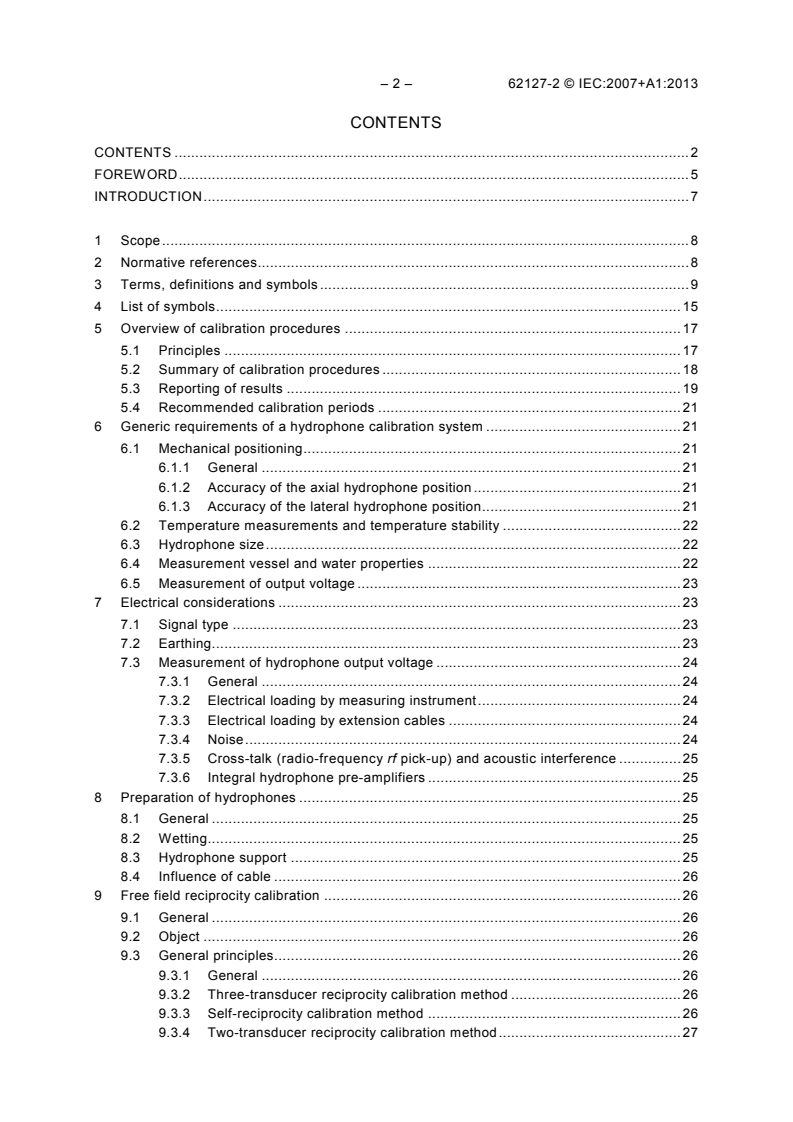
IEC 62127-2:2007+AMD1:2013 CSV - Ultrasonics - Hydrophones - Part 2: Calibration for ultrasonicfields up to 40 MHz Released:2/8/2013

IEC 62127-2:2007+AMD1:2013+AMD2:2017 CSV - Ultrasonics - Hydrophones - Part 2: Calibration for ultrasonic fields up to 40 MHz Released:3/22/2017
Overview
IEC 62127-2:2007 - "Ultrasonics - Hydrophones - Part 2: Calibration for ultrasonic fields up to 40 MHz" specifies methods for absolute and relative (comparative) calibration of hydrophones used for ultrasonic measurements in water. The standard applies to hydrophones with circular piezoelectric sensor elements (pulsed and continuous wave) and covers devices with or without integral pre-amplifiers. IEC 62127-2 was published together with Parts 1 and 3 and replaces several earlier IEC standards (see Related Standards).
Key topics and technical requirements
- Calibration methods: Defines free-field reciprocity techniques (two‑, three‑transducer and self‑reciprocity), planar scanning (absolute) methods and optical interferometry for calibrations up to 40 MHz, plus comparison calibrations using a standard hydrophone.
- Measurement system requirements: Mechanical positioning accuracy (axial and lateral), temperature measurement and stability, vessel and water properties, hydrophone size limits and recommended calibration intervals.
- Electrical considerations: Signal types, earthing, measurement of hydrophone output voltage, electrical loading by instruments and cables, noise, RF cross‑talk, and handling of integral pre‑amplifiers.
- Procedures & reporting: Stepwise procedural requirements for each calibration technique, recommended data to report, and guidance on measurement corrections.
- Uncertainty and corrections: Informative annexes address uncertainty assessment for free‑field calibration, electrical loading corrections, phase response determination, waveform concepts and the behavior of PVDF polymer sensors in high‑intensity fields.
Practical applications
IEC 62127-2 is used to ensure traceable, repeatable hydrophone sensitivity and phase measurements for ultrasonic fields up to 40 MHz. Typical applications include:
- Calibration laboratories performing hydrophone calibration and measurement traceability.
- Manufacturers of ultrasonic transducers and systems (medical, industrial, NDT) verifying acoustic output.
- Medical device test houses measuring diagnostic and therapeutic ultrasound fields.
- Research institutions characterizing ultrasonic fields, phases and waveforms.
- Quality assurance and regulatory compliance where standardized acoustic metrology is required.
Using this standard helps reduce measurement uncertainty, ensure consistent reporting, and support conformity assessment for ultrasonic equipment.
Related standards
- IEC 62127-1, IEC 62127-3 (published simultaneously) - companion parts of the hydrophone series.
- Replaces: IEC 60866:1987, IEC 61101:1991, IEC 61102:1991, IEC 61220:1993 and IEC 62092:2001.
- Note: Corrigendum of August 2008 is included in this edition.
Keywords: IEC 62127-2, hydrophone calibration, ultrasonic fields up to 40 MHz, reciprocity calibration, planar scanning, optical interferometry, calibration uncertainty.
Relations
- Effective Date
- 05-Sep-2023
- Effective Date
- 05-Sep-2023
- Effective Date
- 05-Sep-2023
- Effective Date
- 05-Sep-2023
- Effective Date
- 05-Sep-2023
Buy Documents
IEC 62127-2:2007 - Ultrasonics - Hydrophones - Part 2: Calibration for ultrasonic fields up to 40 MHz Released:8/23/2007
IEC 62127-2:2007 - Ultrasonics - Hydrophones - Part 2: Calibration for ultrasonic fields up to 40 MHz Released:8/23/2007
IEC 62127-2:2007+AMD1:2013 CSV - Ultrasonics - Hydrophones - Part 2: Calibration for ultrasonicfields up to 40 MHz Released:2/8/2013
IEC 62127-2:2007+AMD1:2013+AMD2:2017 CSV - Ultrasonics - Hydrophones - Part 2: Calibration for ultrasonic fields up to 40 MHz Released:3/22/2017
Get Certified
Connect with accredited certification bodies for this standard

BSMI (Bureau of Standards, Metrology and Inspection)
Taiwan's standards and inspection authority.
Sponsored listings
Frequently Asked Questions
IEC 62127-2:2007 is a standard published by the International Electrotechnical Commission (IEC). Its full title is "Ultrasonics - Hydrophones - Part 2: Calibration for ultrasonic fields up to 40 MHz". This standard covers: IEC 62127-2:2007 specifies absolute hydrophone calibration methods and relative (comparative) hydrophone calibration methods. This standard is applicable to: - hydrophones used for measurements made in water and in the ultrasonic frequency range up to 40 MHz; - hydrophones employing circular piezoelectric sensor elements, designed to measure the pulsed wave and continuous wave ultrasonic fields generated by ultrasonic equipment; - and hydrophones with or without a hydrophone pre-amplifier. IEC 62127-1, IEC 62127-2 and IEC 62127-3 are being published simultaneously. Together these cancel and replace IEC 60866:1987, IEC 61101:1991, IEC 61102:1991, IEC 61220:1993 and IEC 62092:2001. The contents of the corrigendum of August 2008 have been included in this copy. The French version of this standard has not been voted upon.
IEC 62127-2:2007 specifies absolute hydrophone calibration methods and relative (comparative) hydrophone calibration methods. This standard is applicable to: - hydrophones used for measurements made in water and in the ultrasonic frequency range up to 40 MHz; - hydrophones employing circular piezoelectric sensor elements, designed to measure the pulsed wave and continuous wave ultrasonic fields generated by ultrasonic equipment; - and hydrophones with or without a hydrophone pre-amplifier. IEC 62127-1, IEC 62127-2 and IEC 62127-3 are being published simultaneously. Together these cancel and replace IEC 60866:1987, IEC 61101:1991, IEC 61102:1991, IEC 61220:1993 and IEC 62092:2001. The contents of the corrigendum of August 2008 have been included in this copy. The French version of this standard has not been voted upon.
IEC 62127-2:2007 is classified under the following ICS (International Classification for Standards) categories: 01 - GENERALITIES. TERMINOLOGY. STANDARDIZATION. DOCUMENTATION; 17.140.50 - Electroacoustics. The ICS classification helps identify the subject area and facilitates finding related standards.
IEC 62127-2:2007 has the following relationships with other standards: It is inter standard links to IEC 62092:2001, IEC 62127-2:2007/AMD1:2013, IEC 62127-2:2007/AMD2:2017, IEC 62127-2:2007/COR1:2008, IEC 62127-2:2025. Understanding these relationships helps ensure you are using the most current and applicable version of the standard.
IEC 62127-2:2007 is available in PDF format for immediate download after purchase. The document can be added to your cart and obtained through the secure checkout process. Digital delivery ensures instant access to the complete standard document.
Standards Content (Sample)
IEC 62127-2
Edition 1.0 2007-08
INTERNATIONAL
STANDARD
Ultrasonics – Hydrophones –
Part 2: Calibration for ultrasonic fields up to 40 MHz
All rights reserved. Unless otherwise specified, no part of this publication may be reproduced or utilized in any form
or by any means, electronic or mechanical, including photocopying and microfilm, without permission in writing from
either IEC or IEC's member National Committee in the country of the requester.
If you have any questions about IEC copyright or have an enquiry about obtaining additional rights to this publication,
please contact the address below or your local IEC member National Committee for further information.
IEC Central Office
3, rue de Varembé
CH-1211 Geneva 20
Switzerland
Email: inmail@iec.ch
Web: www.iec.ch
About the IEC
The International Electrotechnical Commission (IEC) is the leading global organization that prepares and publishes
International Standards for all electrical, electronic and related technologies.
About IEC publications
The technical content of IEC publications is kept under constant review by the IEC. Please make sure that you have the
latest edition, a corrigenda or an amendment might have been published.
ƒ Catalogue of IEC publications: www.iec.ch/searchpub
The IEC on-line Catalogue enables you to search by a variety of criteria (reference number, text, technical committee,…).
It also gives information on projects, withdrawn and replaced publications.
ƒ IEC Just Published: www.iec.ch/online_news/justpub
Stay up to date on all new IEC publications. Just Published details twice a month all new publications released. Available
on-line and also by email.
ƒ Electropedia: www.electropedia.org
The world's leading online dictionary of electronic and electrical terms containing more than 20 000 terms and definitions
in English and French, with equivalent terms in additional languages. Also known as the International Electrotechnical
Vocabulary online.
ƒ Customer Service Centre: www.iec.ch/webstore/custserv
If you wish to give us your feedback on this publication or need further assistance, please visit the Customer Service
Centre FAQ or contact us:
Email: csc@iec.ch
Tel.: +41 22 919 02 11
Fax: +41 22 919 03 00
IEC 62127-2
Edition 1.0 2007-08
INTERNATIONAL
STANDARD
Ultrasonics – Hydrophones –
Part 2: Calibration for ultrasonic fields up to 40 MHz
INTERNATIONAL
ELECTROTECHNICAL
COMMISSION
PRICE CODE
XC
ICS 17.140.50 ISBN 2-8318-9277-5
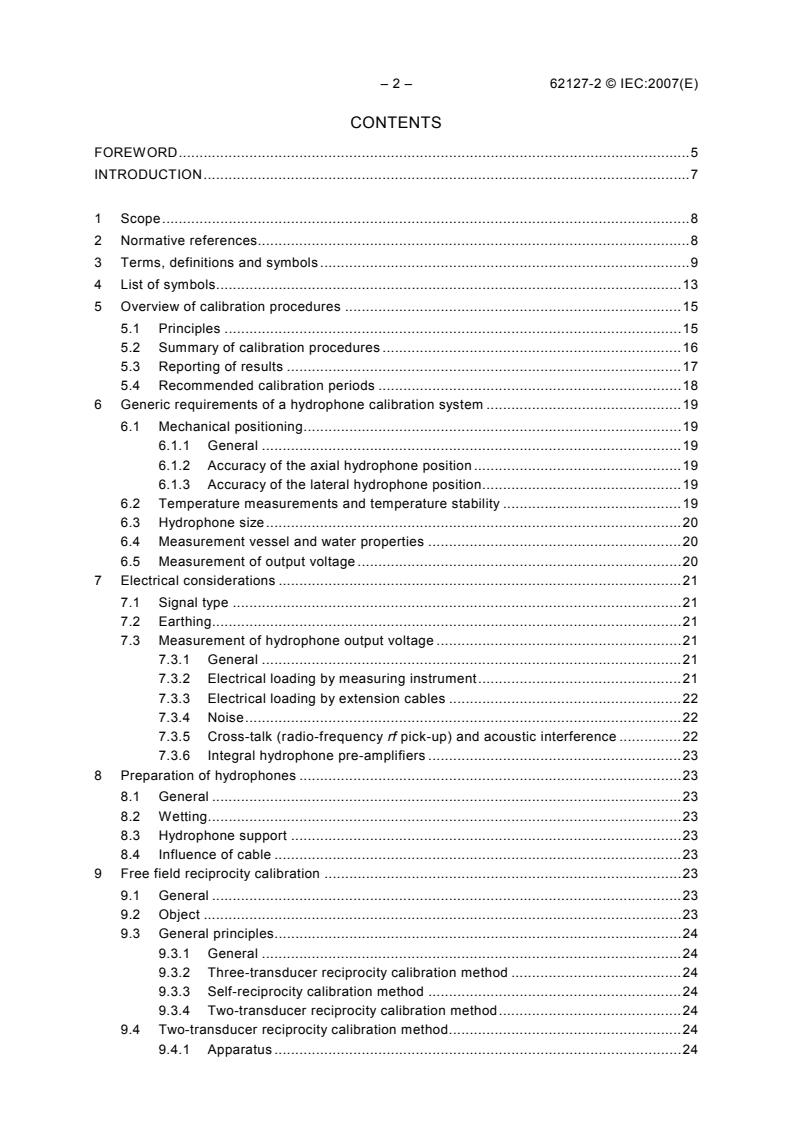
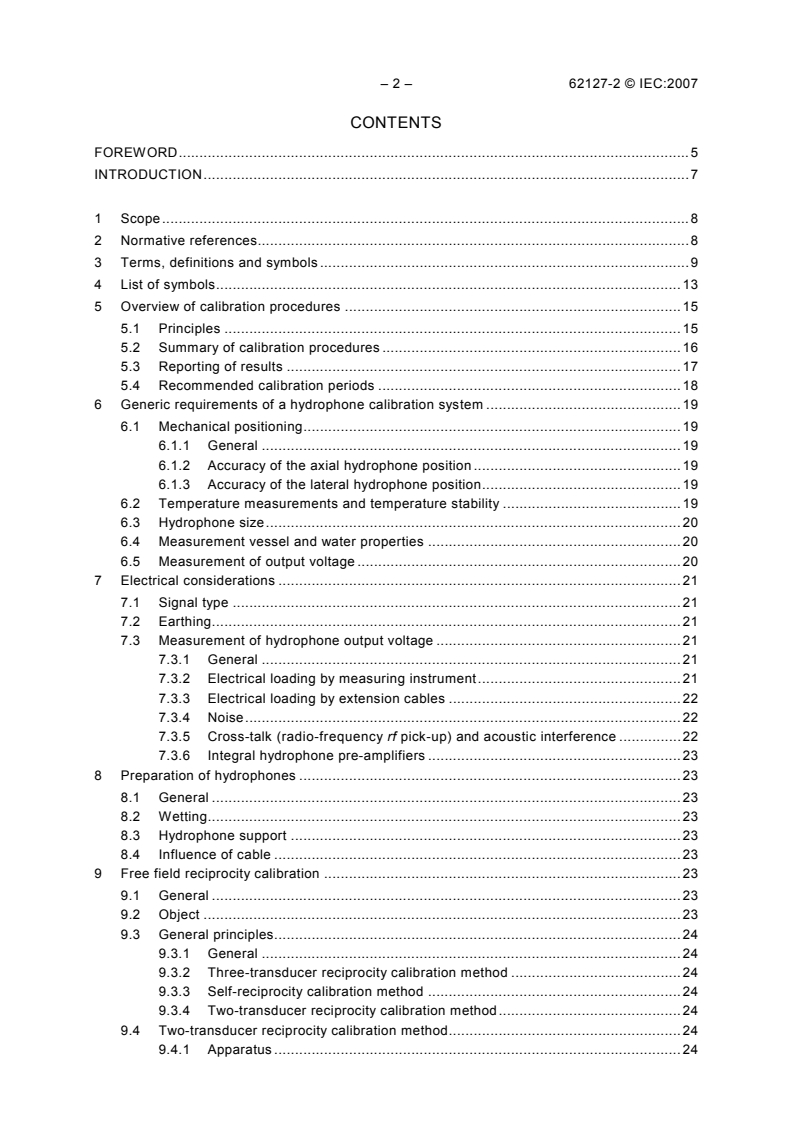
– 2 – 62127-2 © IEC:2007(E)
CONTENTS
FOREWORD.5
INTRODUCTION.7
1 Scope.8
2 Normative references.8
3 Terms, definitions and symbols .9
4 List of symbols.13
5 Overview of calibration procedures .15
5.1 Principles .15
5.2 Summary of calibration procedures .16
5.3 Reporting of results .17
5.4 Recommended calibration periods .18
6 Generic requirements of a hydrophone calibration system .19
6.1 Mechanical positioning.19
6.1.1 General .19
6.1.2 Accuracy of the axial hydrophone position .19
6.1.3 Accuracy of the lateral hydrophone position.19
6.2 Temperature measurements and temperature stability .19
6.3 Hydrophone size.20
6.4 Measurement vessel and water properties .20
6.5 Measurement of output voltage .20
7 Electrical considerations .21
7.1 Signal type .21
7.2 Earthing.21
7.3 Measurement of hydrophone output voltage .21
7.3.1 General .21
7.3.2 Electrical loading by measuring instrument.21
7.3.3 Electrical loading by extension cables .22
7.3.4 Noise.22
7.3.5 Cross-talk (radio-frequency rf pick-up) and acoustic interference .22
7.3.6 Integral hydrophone pre-amplifiers .23
8 Preparation of hydrophones .23
8.1 General .23
8.2 Wetting.23
8.3 Hydrophone support .23
8.4 Influence of cable .23
9 Free field reciprocity calibration .23
9.1 General .23
9.2 Object .23
9.3 General principles.24
9.3.1 General .24
9.3.2 Three-transducer reciprocity calibration method .24
9.3.3 Self-reciprocity calibration method .24
9.3.4 Two-transducer reciprocity calibration method.24
9.4 Two-transducer reciprocity calibration method.24
9.4.1 Apparatus .24
62127-2 © IEC:2007(E) – 3 –
9.4.2 Procedure.25
10 Free field calibration by planar scanning .25
10.1 General .25
10.2 Object .25
10.3 General principle .25
10.4 Procedural requirements.27
10.4.1 Hydrophone scanning .27
10.5 Procedure.27
10.5.1 Power measurement .27
10.5.2 Transducer mounting .27
10.5.3 Measurement conditions .27
10.5.4 Measurements .28
10.6 Corrections and sources of uncertainty .28
11 Free field calibration by optical interferometry .28
11.1 General .28
11.2 Principle .28
12 Calibration by comparison using a standard hydrophone .28
12.1 General .28
12.2 Object .28
12.3 Principle .29
12.4 Procedural requirements.29
12.4.1 Source transducer .29
12.4.2 Source transducer drive signal .29
12.4.3 Measurement system .29
12.5 Procedure.30
12.5.1 Measurements (Type I): determination of the directional response of a
hydrophone.30
12.5.2 Measurements (Type II): calibration by comparison using a standard
hydrophone.30
12.6 Maximum hydrophone size.31
Annex A (informative) Assessment of uncertainty in free field calibration of
hydrophones .32
Annex B (informative) Behaviour of PVDF polymer sensors in high intensity ultrasonic
fields.34
Annex C (informative) Electrical loading corrections .37
Annex D (informative) Absolute calibration of hydrophones using the planar scanning
technique .38
Annex E (informative) Properties of water.46
Annex F (informative) The absolute calibration of hydrophones by optical
interferometry up to 40 MHz .48
Annex G (informative) Waveform concepts.58
Annex H (informative) Time delay spectrometry – requirements and a brief review of
the technique .68
Annex I (informative) Determination of the phase response of hydrophones .71
Annex J (informative) Maximum size considerations for the active element of a
hydrophone.77
– 4 – 62127-2 © IEC:2007(E)
Bibliography .79
Figure F.1 – Experimental set-up of the interferometric foil technique .51
Figure F.2 – End-of-cable open-circuit sensitivity, M , of a coplanar membrane
c
hydrophone.53
Figure F.3 – Hydrophone waveform generated by a 9 μm coplanar membrane
hydrophone positioned at the focus of a 5 MHz transducer (focal length 51 mm) .54
Figure F.4 – Interferometer (displacement) waveform generated with the pellicle
positioned at the focus of the 5 MHz transducer (focal position 51 mm) .55
Figure F.5 – Frequency spectrum of the displacement waveform (lower curve) and the
differentiated displacement waveform (upper curve) .55
Figure F.6 – Sensitivity of a 0,2 mm active element diameter of a 9 μm bilaminar
membrane hydrophone determined at 5 MHz intervals over the frequency range 5 MHz
to 60 MHz .56
Figure G.1 – Coordinates of a field point, P, in the near field of a plane- circular source
transducer of radius, a .65
t
Figure I.1 – Phase of end-of-cable open-circuit sensitivity for two membrane
hydrophones .73
Figure I.2 – Phase of end-of-cable open-circuit sensitivity for a ∅0,2 mm needle
hydrophone.75
Table 1 – List of typical uncertainty values obtained by the calibration methods
specified in this standard and for the frequency range listed here .17
Table E.1 – Speed of sound c and specific acoustic impedance, ρc, as a function of
temperature, for propagation in water .46
Table G.1 – Temporal waveform and hydrophone position concepts described in this
Annex .
Table I.1. – Example of uncertainties (where a coverage factor, k = 2, is used) for a
HTDS phase calibration of a needle hydrophone with a diameter of 0,2 mm, expressed
at a confidence level of 95 %.73
62127-2 © IEC:2007(E) – 5 –
INTERNATIONAL ELECTROTECHNICAL COMMISSION
____________
ULTRASONICS – HYDROPHONES –
Part 2: Calibration for ultrasonic fields up to 40 MHz
FOREWORD
1) The International Electrotechnical Commission (IEC) is a worldwide organization for standardization comprising
all national electrotechnical committees (IEC National Committees). The object of IEC is to promote
international co-operation on all questions concerning standardization in the electrical and electronic fields. To
this end and in addition to other activities, IEC publishes International Standards, Technical Specifications,
Technical Reports, Publicly Available Specifications (PAS) and Guides (hereafter referred to as “IEC
Publication(s)”). Their preparation is entrusted to technical committees; any IEC National Committee interested
in the subject dealt with may participate in this preparatory work. International, governmental and non-
governmental organizations liaising with the IEC also participate in this preparation. IEC collaborates closely
with the International Organization for Standardization (ISO) in accordance with conditions determined by
agreement between the two organizations.
2) The formal decisions or agreements of IEC on technical matters express, as nearly as possible, an international
consensus of opinion on the relevant subjects since each technical committee has representation from all
interested IEC National Committees.
3) IEC Publications have the form of recommendations for international use and are accepted by IEC National
Committees in that sense. While all reasonable efforts are made to ensure that the technical content of IEC
Publications is accurate, IEC cannot be held responsible for the way in which they are used or for any
misinterpretation by any end user.
4) In order to promote international uniformity, IEC National Committees undertake to apply IEC Publications
transparently to the maximum extent possible in their national and regional publications. Any divergence
between any IEC Publication and the corresponding national or regional publication shall be clearly indicated in
the latter.
5) IEC provides no marking procedure to indicate its approval and cannot be rendered responsible for any
equipment declared to be in conformity with an IEC Publication.
6) All users should ensure that they have the latest edition of this publication.
7) No liability shall attach to IEC or its directors, employees, servants or agents including individual experts and
members of its technical committees and IEC National Committees for any personal injury, property damage or
other damage of any nature whatsoever, whether direct or indirect, or for costs (including legal fees) and
expenses arising out of the publication, use of, or reliance upon, this IEC Publication or any other IEC
Publications.
8) Attention is drawn to the Normative references cited in this publication. Use of the referenced publications is
indispensable for the correct application of this publication.
9) Attention is drawn to the possibility that some of the elements of this IEC Publication may be the subject of
patent rights. IEC shall not be held responsible for identifying any or all such patent rights.
International Standard IEC 62127-2 has been prepared by IEC technical committee 87:
Ultrasonics.
IEC 62127-1, IEC 62127-2 and IEC 62127-3 are being published simultaneously. Together
these cancel and replace IEC 60866:1987, IEC 61101:1991, IEC 61102:1991, IEC 61220:1993
and IEC 62092:2001.
The text of this standard is based on the following documents:
Enquiry draft Report on voting
87/353/CDV 87/372/RVC
Full information on the voting for the approval of this standard can be found in the report on
voting indicated in the above table.
This publication has been drafted in accordance with the ISO/IEC Directives, Part 2.
– 6 – 62127-2 © IEC:2007(E)
A list of all parts of IEC 62127 series, published under the general title Ultrasonics –
Hydrophones, can be found on the IEC website.
NOTE Words in bold in the text are defined in Clause 3.
The committee has decided that the contents of this publication will remain unchanged until the
maintenance result date indicated on the IEC website under "http://webstore.iec.ch" in the data
related to the specific publication. At this date, the publication will be
• reconfirmed;
• withdrawn;
• replaced by a revised edition; or
• amended.
A bilingual version of this publication may be issued at a later date.
The contents of the corrigendum of August 2008 have been included in this copy.
62127-2 © IEC:2007(E) – 7 –
INTRODUCTION
The spatial and temporal distribution of acoustic pressure in an ultrasonic field in a liquid
medium is commonly determined using miniature ultrasonic hydrophones. These devices are
not absolute measurement instruments and require calibration. The purpose of this part of
IEC 62127 is to specify those calibration methods to be used in determining the response of a
hydrophone in the ultrasonic range, i.e. above 20 kHz up to a frequency of 40 MHz. The main
hydrophone application in this context lies in the measurement of ultrasonic fields emitted by
medical diagnostic equipment in water. Hydrophone behaviour over this wide frequency band
is required in order to reliably characterize the acoustic parameters of the applied acoustic
field. In particular, the frequency range above 15 MHz is important to fully characterize this
equipment, primarily due to the increased appearance of high-frequency components in the
ultrasonic signals, caused by non-linear propagation. In addition, the number of medical
ultrasonic systems that use frequencies above 15 MHz, particularly intra-operative probes, is
growing. It has turned out in recent years that the hydrophone response below 0,5 MHz is also
required to reliably determine the peak-negative (rarefactional) acoustic pressure.
While the term "hydrophone" can be used in a wider sense, it is understood here as referring
to miniature piezoelectric hydrophones. It is this instrument type that is used today in various
areas of medical ultrasonics and, in particular, to characterize quantitatively the field structure
of medical diagnostic instruments. With regard to other pressure sensor types, such as those
based on fibre optics, some of the requirements of this standard are applicable to these as well
but others are not. If in the future these other "hydrophone" types gain more importance in
field measurement practice, their characteristics and calibration will have to be dealt with in a
revised version of this standard or in a separate one.
NOTE This standard covers the ultrasonic frequency range, from 20 kHz to an upper frequency of 40 MHz.
Standards dealing with hydrophone properties (IEC 62127-3) and hydrophone use (IEC 62127-1) are being
developed in parallel as part of a programme of maintenance activities aimed at restructuring and merging, where
possible, all existing ultrasonic hydrophone standards. This will eventually lead to unified standards covering the
whole field of practical hydrophone application.
– 8 – 62127-2 © IEC:2007(E)
ULTRASONICS — HYDROPHONES —
Part 2: Calibration for ultrasonic fields up to 40 MHz
1 Scope
This part of IEC 62127 specifies:
• absolute hydrophone calibration methods;
• relative (comparative) hydrophone calibration methods.
Recommendations and references to accepted literature are made for the various relative and
absolute calibration methods in the frequency range covered by this standard.
This standard is applicable to
• hydrophones used for measurements made in water and in the ultrasonic frequency range
up to 40 MHz;
NOTE 1 Although some physiotherapy medical applications of medical ultrasound are developing which
operate in the frequency range 40 kHz to 100 kHz, the primary frequency range of diagnostic imaging remains
above 2 MHz. It has recently been established that, even in the latter case, the hydrophone response at
substantially lower frequencies can influence measurements made of key acoustic parameters [1].
• hydrophones employing circular piezoelectric sensor elements, designed to measure the
pulsed wave and continuous wave ultrasonic fields generated by ultrasonic equipment;
NOTE 2 Some hydrophones can have non-circular active elements, arising from slight deviations from a
circular structure caused, for example by electrode structure, or conversely, the active elements can actually
be squares. The clauses within this standard remain valid, although, in these cases, special attention should
be paid to the directional response and to the effective radii of the active element through various axes of
rotation.
• hydrophones with or without a hydrophone pre-amplifier.
2 Normative references
The following referenced documents are indispensable for the application of this document. For
dated references, only the edition cited applies. For undated references, the latest edition of
the referenced document (including any amendments) applies.
IEC 60050-801:1994, International Electrotechnical Vocabulary – Chapter 801: Acoustics
and electro-acoustics
IEC 60565, Underwater acoustics – Hydrophones – Calibration in the frequency range 0,01 Hz
to 1 MHz
IEC 61161:2006, Ultrasonics – Power measurement – Radiation force balances and performance
requirements
IEC 61828:2006, Ultrasonics – Focusing transducers – Definitions and measurement methods
for the transmitted fields
IEC 62127-1, Ultrasonics – Hydrophones – Part 1: Measurement and characterization of
medical ultrasonic fields up to 40 MHz
IEC 62127-3, Ultrasonics – Hydrophones – Part 3: Properties of hydrophones for ultrasonic
fields up to 40 MHz
62127-2 © IEC:2007(E) – 9 –
3 Terms, definitions and symbols
For the purposes of this document, the terms and definitions given in IEC 62127-1 and the
following apply.
3.1
acoustic centre
point on or near a transducer from which the spherically divergent sound waves emitted by the
transducer, and observable at remote points, appear to diverge
3.2
beam axis
straight line that passes through the beam centrepoints of two planes perpendicular to the line
which connects the point of maximal pulse-pressure-squared integral with the centre of the
external transducer aperture
NOTE 1 The location of the first plane is the location of the plane containing the maximum pulse-pressure-
squared integral or, alternatively, is one containing a single main lobe which is in the focal Fraunhofer zone. The
location of the second plane is as far as is practicable from the first plane and parallel to the first with the same two
orthogonal scan lines (x and y axes) used for the first plane.
NOTE 2 In a number of cases, the term pulse-pressure-squared integral is replaced in the above definition by
any linearly related quantity, for example
a) in the case of a continuous wave signal the term pulse-pressure-squared integral is replaced by mean square
acoustic pressure as defined in IEC 61689,
b) in cases where signal synchronisation with the scanframe is not available the term pulse-pressure-squared
integral may be replaced by temporal average intensity.
NOTE 3 See Figure 1 of IEC 62127-1.
NOTE 4 Definition adopted from IEC 62127-1.
3.3
beam centrepoint
position determined by the intersection of two lines passing through the beamwidth midpoints
of two orthogonal planes, xz and yz
NOTE Definition adopted from IEC 61828:2001.
3.4
beamwidth
w , w , w
6 12 20
greatest distance between two points on a specified axis perpendicular to the beam axis where
the pulse-pressure-squared integral falls below its maximum on the specified axis by a
specified amount
NOTE 1 In a number of cases, the term pulse-pressure-squared integral is replaced in the above definition by
any linearly related quantity, for example
a) in the case of a continuous wave signal the term pulse-pressure-squared integral is replaced by mean square
acoustic pressure as defined in IEC 61689,
b) in cases where signal synchronisation with the scanframe is not available the term pulse-pressure-squared
integral may be replaced by temporal average intensity.
NOTE 2 Commonly used beamwidths are specified at – 6 dB, –12 dB and –20 dB levels below the maximum. The
decibel calculation implies taking 10 times the logarithm of the ratios of the integrals.
NOTE 3 Beamwidth is expressed in metres (m).
NOTE 4 Definition adopted from IEC 62127-1.
– 10 – 62127-2 © IEC:2007(E)
3.5
beamwidth midpoint
linear average of the location of the centres of beamwidths in a plane
NOTE 1 The average is taken over 20 beamwidth levels corresponding to intervals in the −0,1 dB to −26 dB range
(see IEC 61828, Clause B.2).
NOTE 2 Definition adopted from IEC 61828:2001.
3.6
beam centre
point in a plane in the far field, usually perpendicular to the beam axis, at which the spatial-
peak temporal-peak acoustic pressure occurs
3.7
diametrical beam scan
set of measurements of the hydrophone output voltage made while moving the hydrophone in a
straight line passing through a point on the beam axis and in a direction normal to the beam
axis
NOTE 1 The diametrical beam scan may extend to different distances on either side of the beam axis.
NOTE 2 Definition adopted from IEC 62127-1.
3.8
directional response
description, generally presented graphically, of the response of a hydrophone, as a function of
direction of propagation of the incident plane sound wave, in a specified plane through the
reference centre and at a specified frequency
NOTE Definition adopted from IEC 60565.
3.9
effective radius of a non-focused ultrasonic transducer
a
t
radius of a perfect disc piston-like ultrasonic source transducer that has a predicted axial
acoustic pressure distribution approximately equivalent to the observed axial acoustic pressure
distribution over an axial distance until at least the last axial maximum has passed
NOTE 1 The effective radius of an non-focused ultrasonic transducer is expressed in metres (m).
NOTE 2 Definition adopted from IEC 62127-1.
3.10
effective hydrophone radius
a , a , a
h h3 h6
radius of a stiff disc receiver hydrophone that has a predicted directional response function
with an angular width equal to the observed angular width
NOTE 1 The angular width is determined at a specified level below the peak of the directional response function.
For the specified levels of 3 dB and 6 dB, the radii are denoted by a and a respectively.
h3 h6
NOTE 2 The effective hydrophone radius is expressed in metres (m).
NOTE 3 The radius is usually a function of frequency. For representative experimental data, see [2].
NOTE 4 Definition adopted from IEC 62127-3.
62127-2 © IEC:2007(E) – 11 –
3.11
electric load impedance
Z
L
complex electric input impedance (consisting of a real and an imaginary part) to which the
hydrophone assembly output cable is connected or is to be connected
NOTE 1 The electric load impedance is expressed in ohms (Ω).
NOTE 2 Definition adopted from IEC 62127-3.
3.12
end-of-cable loaded sensitivity
end-of-cable loaded sensitivity of a hydrophone (or hydrophone-assembly)
M (f)
L
ratio of the instantaneous voltage at the end of any integral cable or output connector of a
hydrophone or hydrophone-assembly, when connected to a specified electric load
impedance, to the instantaneous acoustic pressure in the undisturbed free field of a plane
wave in the position of the reference centre of the hydrophone if the hydrophone were
removed
NOTE 1 End-of-cable loaded sensitivity is expressed in volts per pascal (V/Pa).
NOTE 2 Definition adopted from IEC 62127-3.
3.13
end-of-cable open-circuit sensitivity
end-of-cable open-circuit sensitivity of a hydrophone
M (f)
c
ratio of the instantaneous open-circuit voltage at the end of any integral cable or output
connector of a hydrophone to the instantaneous acoustic pressure in the undisturbed free
field of a plane wave in the position of the reference centre of the hydrophone if the
hydrophone were removed
NOTE 1 End-of-cable open-circuit sensitivity is expressed in volts per pascal (V/Pa).
NOTE 2 Definition adopted from IEC 62127-3.
3.14
external transducer aperture
part of the surface of the ultrasonic transducer or ultrasonic transducer element group
assembly that emits ultrasonic radiation into the propagation medium.
NOTE 1 This surface is either directly in contact with the patient or is in contact with a water or liquid path to the
patient (see Figure 2 of IEC 62127-1).
NOTE 2 Definition adopted from IEC 61828:2001.
3.15
far field
acoustic (sound) field at distances from an ultrasonic transducer where the values of the
instantaneous acoustic pressure and particle velocity are substantially in phase (see also
IEC 60050-801, 801-23-30)
NOTE 1 In the far field, the sound pressure appears to be spherically divergent from a point on or near the
radiating surface. Hence, the pressure produced by the sound source is approximately inversely proportional to the
distance from the source.
NOTE 2 The term "far field" is used in this standard only in connection with non-focusing source transducers. For
focusing transducers a different terminology for the various parts of the transmitted field applies (see IEC 61828).
– 12 – 62127-2 © IEC:2007(E)
3.16
free field
sound field in a homogeneous and isotropic medium in which the effects of boundaries are
negligible
NOTE Definition adopted from IEC 60565: 2006, 3.13.
3.17
hydrophone
transducer that produces electric signals in response to waterborne acoustic signals.
NOTE Definition adopted from IEC 60050-801, 801-32-26.
3.18
hydrophone assembly
combination of hydrophone and hydrophone pre-amplifier
NOTE 2 Definition adopted from IEC 62127-3.
3.19
hydrophone axis
nominal symmetry axis of the hydrophone active element
NOTE 1 Unless stated otherwise (explicitly and quantitatively) by the manufacturer, it is understood for the
purposes of this standard that this is given by the apparent geometrical symmetry axis of the hydrophone.
NOTE 2 Definition adopted from IEC 62127-3.
3.20
hydrophone geometrical radius
geometrical radius of a hydrophone active element
a
g
radius defined by the dimensions of the active element of a hydrophone
NOTE 1 The hydrophone geometrical radius is expressed in metres (m)
NOTE 2 Definition adopted from IEC 62127-3.
3.21
hydrophone pre-amplifier
active electronic device connected to, or to be connected to, a particular hydrophone and
reducing its output impedance
NOTE 1 A hydrophone pre-amplifier requires a supply voltage (or supply voltages).
NOTE 2 The hydrophone pre-amplifier may have a forward voltage transmission factor of less than one, i.e. it
need not necessarily be a voltage amplifier in the strict sense.
NOTE 3 Definition adopted from IEC 62127-3.
3.22
instantaneous acoustic pressure
p(t)
pressure minus the ambient pressure at a particular instant in time and at a particular point in
an acoustic field (see also IEC 60050-801, 801-21-19)
NOTE 1 Instantaneous acoustic pressure is expressed in pascal (Pa).
NOTE 2 Definition adopted from IEC 62127-1.
62127-2 © IEC:2007(E) – 13 –
3.23
instantaneous intensity
I(t)
acoustic energy transmitted per unit time in the direction of acoustic wave propagation per unit
area normal to this direction at a particular instant in time and at a particular point in an
acoustic field
NOTE 1 Instantaneous intensity is the product of instantaneous acoustic pressure and particle velocity. It is
difficult to measure intensity in the ultrasound frequency range. For the measurement purposes referred to in this
standard, and if it is reasonable to assume far field conditions, the instantaneous intensity, I is approximated as
p(t)
(1)
I(t) =
ρ c
where
p(t) is the instantaneous acoustic pressure;
ρ is the density of the medium;
c is the velocity of sound in the medium.
NOTE 2 Instantaneous intensity is expressed in watts per metre squared (W/m ).
3.24
reference centre
point on or near a hydrophone about which its acoustic receiving sensitivity is defined
NOTE Unless stated otherwise (explicitly and quantitatively) by the manufacturer, it is understood for the purposes
of this standard that this is given by the geometrical centre of the front surface of the hydrophone active element.
(See IEC 60565: 2006, 3.25)
3.25
uncertainty
parameter, associated with the result of a measurement, that characterizes the dispersion of
the values that could reasonably be attributed to the measurand
NOTE See the ISO Guide to the Expression of Uncertainty in Measurement [3], 2.2.3.
4 List of symbols
a effective hydrophone radius (a , a : with special reference to a 3 dB or
h h3 h6
6 dB definition, respectively)
a hydrophone geometrical radius
g
a maximum effective radius for a specific hydrophone application
max
a lateral distance from the beam axis (a , a : maximum values with
P PmaxE PmaxH
respect to avoiding edge wave and head wave interference, respectively)
a effective radius of an non-focused ultrasonic transducer
t
A geometrical area of an ultrasonic transducer
g
B/A Fox-Wallace non-linearity parameter
c speed of sound in a medium (usually water)
C end-of-cable capacitance of the hydrophone including any integral cable and
H
connector
normalized directional response function
D(θ)
e base of natural logarithms
f frequency
f fundamental drive frequency of a signal used to generate non-linear
f
distortion
– 14 – 62127-2 © IEC:2007(E)
f upper frequency limit of the stated frequency band of a hydrophone
u
I magnitude of the instantaneous intensity assuming proportionality with
p
acoustic pressure squared
r
instantaneous intensity vector at the point (x,y,z) at time t
I (x,y,z,t)
I(x,y,z,t) component of the instantaneous intensity vector in the propagation
direction at the point (x,y,z) at time t
F geometric focal length of a focusing transducer
jmax the number of the farthest scan point in a radial scan
k
circular wave number (= 2π/λ)
M
general symbol for the complex hydrophone sensitivity, M = M being its
modulus and arg(M) being its argument (= phase angle)
M (f) end-of-cable open-circuit sensitivity
c
M (f) end-of-cable loaded sensitivity
L
N number of waveform averages taken to generate a time-averaged voltage
av
waveform
N number of diametrical samples
N harmonic number
harm
p pressure amplitude
p acoustic pressure amplitude at the face of a transducer
p(x,y,z,t) instantaneous acoustic pressure at the point (x,y,z) at time t
P(l) total ultrasonic power passing through a plane of infinite extent in an
acoustic field at a distance l from an ultrasonic transducer
P total ultrasonic power emitted by a transducer
o
rf radio-frequency signals
r distance from the ultrasonic beam centre to a scan point
R
(lλ/πa ) - normalized distance between a transducer and a hydrophone in
terms of the Rayleigh distance (πa /λ)
R ,R distances from the beam centre to the extremes of the ith diametrical
1i 2i
beam scan
s distance from the ultrasonic beam centre to the nearest scan point
t arrival time of the nearest head wave
H
t time available for a free field measurement in time delay spectrometry
TDS
TF acoustic transmission factor
U (x,y,z,t) end-of-cable voltage for a hydrophone with the hydrophone at the
L
reference point (x,y,z) and at time t
’
end-of-cable voltage for a hydrophone including noise with the
U (x,y,z,t)
L
hydrophone at the reference point (x,y,z) and at time t
U (x,y,z) root-mean-square (rms) noise level measured with a hydrophone at the
n
reference point (x,y,z)
U voltage at the terminals of an ultrasonic transducer
T
r
Instantaneous particle velocity vector at the point (x,y,z) at time t
v(x,y,z,t)
v speed of a radial wave in a transducer plate
t
w beamwidth of the fundamental-frequency field component
f
z axial distance between a hydrophone and an ultrasonic transducer
surface. (z , z , z and z are special distance values according to certain
1 2 3 4
criteria involving edge waves and head waves)
z minimum distance for a finite size hydrophone from a transducer
min
z distance of the pressure focus from a focusing transducer
pf
distance difference
Δz
Z complex electric output impedance of a hydrophone
h
62127-2 © IEC:2007(E) – 15 –
Z complex electric load impedance
L
amplitude attenuation coefficient of plane waves in a medium (usually
α
water)
β non-linearity parameter in the sense of β = 1+ B()2A
amplitude of the second harmonic expressed as a percentage of the
δ
acoustic pressure at the fundamental frequency
pressure amplitude correction for finite hydrophone size
δ
av
angle between the ultrasonic propagation direction and the z-axis,
Θ
equivalent to the angle between the line joining the centre of the
ultrasonic tranducer and the centre of the hydrophone and the propagation
direction
angle between the line joining the centre of the ultrasonic transducer to
Θ
the centre of the hydrophone and the direction of maximum sensitivity of
the hydrophone
ratio of beam radius to the effective hydrophone radius
γ
acoustic displacement as measured by an optical interferometer
ζ
angle of incidence of an ultrasonic wave with respect to the hydrophone axis
θ
(θ , θ : with special reference to 3 dB and 6 dB defined levels)
3 6
λ ultrasonic wavelength
optical wavelength
λ
ξ
π 2 times the Rayleigh length ( a λ, see IEC 61828) of a focusing
t
transducer
(mass) density of the measurement liquid (water)
ρ
ρc
specific acoustic impedance
σ non-linear distortion parameter
non-linear propagation parameter
σ
m
τ pulse duration or burst duration (τ , τ : maximum values with respect
maxE maxH
to avoiding edge wave and head wave interference, respectively)
circular frequency
ω
5 Overview of calibration procedures
5.1 Principles
Hydrophones are required for absolute measurements of the properties of an acoustic field.
The time-dependent voltage output from a hydrophone, u(t), may be presented in the form:
)u(t) = p(t) * m(t (2)
where
p(t) is the pressure waveform;
* is a convolution;
m(t) is the impulse response of the hydrophone.
Viewed in the Fourier domain, if U(f), P(f) and M(f) are the respective Fourier transforms, then
the resultant voltage spectrum, U(f), is equal to P(f) × M(f). The quantity M(f) is the
hydrophone transfer function (sensitivity) and its complex value comprises both real and
imaginary components.
In agreement with present measurement practice, hydrophones are dealt with in this standard
as amplitude (magnitude) sensors and not as phase sensors. However, there is some evidence
– 16 – 62127-2 © IEC:2007(E)
that phase measurement will become more important in the future, particularly due to the
application of deconvolution methods (see IEC 62127-1), which require the complex
hydrophone transfer function. If indeed phase measurements become important, this standard
will need revision, with more rigorous requirements being necessary for that kind of
measurement. A summary of current capability for (relative) phase measurement is provided in
Annex I.
NOTE 1 Accordingly, the hydrophone sensitivity is understood as a real quantity (expressing the ratio of
amplitudes) throughout this standard.
Procedures for the calibration of hydrophones are specified usi
...
IEC 62127-2 ®
Edition 1.0 2007-08
INTERNATIONAL
STANDARD
NORME
INTERNATIONALE
Ultrasonics – Hydrophones –
Part 2: Calibration for ultrasonic fields up to 40 MHz
Ultrasons – Hydrophones –
Partie 2: Etalonnage des champs ultrasoniques jusqu’à 40 MHz
All rights reserved. Unless otherwise specified, no part of this publication may be reproduced or utilized in any form
or by any means, electronic or mechanical, including photocopying and microfilm, without permission in writing from
either IEC or IEC's member National Committee in the country of the requester.
If you have any questions about IEC copyright or have an enquiry about obtaining additional rights to this publication,
please contact the address below or your local IEC member National Committee for further information.
Droits de reproduction réservés. Sauf indication contraire, aucune partie de cette publication ne peut être reproduite ni
utilisée sous quelque forme que ce soit et par aucun procédé, électronique ou mécanique, y compris la photocopie et les
microfilms, sans l'accord écrit de la CEI ou du Comité national de la CEI du pays du demandeur.
Si vous avez des questions sur le copyright de la CEI ou si vous désirez obtenir des droits supplémentaires sur cette
publication, utilisez les coordonnées ci-après ou contactez le Comité national de la CEI de votre pays de résidence.
IEC Central Office Tel.: +41 22 919 02 11
3, rue de Varembé Fax: +41 22 919 03 00
CH-1211 Geneva 20 info@iec.ch
Switzerland www.iec.ch
About the IEC
The International Electrotechnical Commission (IEC) is the leading global organization that prepares and publishes
International Standards for all electrical, electronic and related technologies.
About IEC publications
The technical content of IEC publications is kept under constant review by the IEC. Please make sure that you have the
latest edition, a corrigenda or an amendment might have been published.
Useful links:
IEC publications search - www.iec.ch/searchpub Electropedia - www.electropedia.org
The advanced search enables you to find IEC publications The world's leading online dictionary of electronic and
by a variety of criteria (reference number, text, technical electrical terms containing more than 30 000 terms and
committee,…). definitions in English and French, with equivalent terms in
It also gives information on projects, replaced and additional languages. Also known as the International
withdrawn publications. Electrotechnical Vocabulary (IEV) on-line.
IEC Just Published - webstore.iec.ch/justpublished Customer Service Centre - webstore.iec.ch/csc
Stay up to date on all new IEC publications. Just Published If you wish to give us your feedback on this publication
details all new publications released. Available on-line and or need further assistance, please contact the
also once a month by email. Customer Service Centre: csc@iec.ch.
A propos de la CEI
La Commission Electrotechnique Internationale (CEI) est la première organisation mondiale qui élabore et publie des
Normes internationales pour tout ce qui a trait à l'électricité, à l'électronique et aux technologies apparentées.
A propos des publications CEI
Le contenu technique des publications de la CEI est constamment revu. Veuillez vous assurer que vous possédez
l’édition la plus récente, un corrigendum ou amendement peut avoir été publié.
Liens utiles:
Recherche de publications CEI - www.iec.ch/searchpub Electropedia - www.electropedia.org
La recherche avancée vous permet de trouver des Le premier dictionnaire en ligne au monde de termes
publications CEI en utilisant différents critères (numéro de électroniques et électriques. Il contient plus de 30 000
référence, texte, comité d’études,…). termes et définitions en anglais et en français, ainsi que
Elle donne aussi des informations sur les projets et les les termes équivalents dans les langues additionnelles.
publications remplacées ou retirées. Egalement appelé Vocabulaire Electrotechnique
International (VEI) en ligne.
Just Published CEI - webstore.iec.ch/justpublished
Service Clients - webstore.iec.ch/csc
Restez informé sur les nouvelles publications de la CEI.
Just Published détaille les nouvelles publications parues. Si vous désirez nous donner des commentaires sur
Disponible en ligne et aussi une fois par mois par email. cette publication ou si vous avez des questions
contactez-nous: csc@iec.ch.
IEC 62127-2 ®
Edition 1.0 2007-08
INTERNATIONAL
STANDARD
NORME
INTERNATIONALE
Ultrasonics – Hydrophones –
Part 2: Calibration for ultrasonic fields up to 40 MHz
Ultrasons – Hydrophones –
Partie 2: Etalonnage des champs ultrasoniques jusqu’à 40 MHz
INTERNATIONAL
ELECTROTECHNICAL
COMMISSION
COMMISSION
ELECTROTECHNIQUE
PRICE CODE
INTERNATIONALE
CODE PRIX XC
ICS 17.140.50 ISBN 978-2-83220-136-7
– 2 – 62127-2 © IEC:2007
CONTENTS
FOREWORD . 5
INTRODUCTION . 7
1 Scope . 8
2 Normative references. 8
3 Terms, definitions and symbols . 9
4 List of symbols . 13
5 Overview of calibration procedures . 15
5.1 Principles . 15
5.2 Summary of calibration procedures . 16
5.3 Reporting of results . 17
5.4 Recommended calibration periods . 18
6 Generic requirements of a hydrophone calibration system . 19
6.1 Mechanical positioning . 19
6.1.1 General . 19
6.1.2 Accuracy of the axial hydrophone position . 19
6.1.3 Accuracy of the lateral hydrophone position . 19
6.2 Temperature measurements and temperature stability . 19
6.3 Hydrophone size . 20
6.4 Measurement vessel and water properties . 20
6.5 Measurement of output voltage . 20
7 Electrical considerations . 21
7.1 Signal type . 21
7.2 Earthing . 21
7.3 Measurement of hydrophone output voltage . 21
7.3.1 General . 21
7.3.2 Electrical loading by measuring instrument . 21
7.3.3 Electrical loading by extension cables . 22
7.3.4 Noise . 22
7.3.5 Cross-talk (radio-frequency rf pick-up) and acoustic interference . 22
7.3.6 Integral hydrophone pre-amplifiers . 23
8 Preparation of hydrophones . 23
8.1 General . 23
8.2 Wetting . 23
8.3 Hydrophone support . 23
8.4 Influence of cable . 23
9 Free field reciprocity calibration . 23
9.1 General . 23
9.2 Object . 23
9.3 General principles . 24
9.3.1 General . 24
9.3.2 Three-transducer reciprocity calibration method . 24
9.3.3 Self-reciprocity calibration method . 24
9.3.4 Two-transducer reciprocity calibration method . 24
9.4 Two-transducer reciprocity calibration method . 24
9.4.1 Apparatus . 24
62127-2 © IEC:2007 – 3 –
9.4.2 Procedure . 25
10 Free field calibration by planar scanning . 25
10.1 General . 25
10.2 Object . 25
10.3 General principle . 25
10.4 Procedural requirements . 27
10.4.1 Hydrophone scanning . 27
10.5 Procedure . 27
10.5.1 Power measurement . 27
10.5.2 Transducer mounting . 27
10.5.3 Measurement conditions . 27
10.5.4 Measurements . 28
10.6 Corrections and sources of uncertainty . 28
11 Free field calibration by optical interferometry . 28
11.1 General . 28
11.2 Principle . 28
12 Calibration by comparison using a standard hydrophone . 28
12.1 General . 28
12.2 Object . 28
12.3 Principle . 29
12.4 Procedural requirements . 29
12.4.1 Source transducer . 29
12.4.2 Source transducer drive signal . 29
12.4.3 Measurement system . 29
12.5 Procedure . 30
12.5.1 Measurements (Type I): determination of the directional response of a
hydrophone . 30
12.5.2 Measurements (Type II): calibration by comparison using a standard
hydrophone . 30
12.6 Maximum hydrophone size . 31
Annex A (informative) Assessment of uncertainty in free field calibration of
hydrophones . 32
Annex B (informative) Behaviour of PVDF polymer sensors in high intensity ultrasonic
fields . 34
Annex C (informative) Electrical loading corrections . 37
Annex D (informative) Absolute calibration of hydrophones using the planar scanning
technique . 38
Annex E (informative) Properties of water . 46
Annex F (informative) The absolute calibration of hydrophones by optical
interferometry up to 40 MHz . 48
Annex G (informative) Waveform concepts . 58
Annex H (informative) Time delay spectrometry – requirements and a brief review of
the technique . 68
Annex I (informative) Determination of the phase response of hydrophones . 71
Annex J (informative) Maximum size considerations for the active element of a
hydrophone . 77
– 4 – 62127-2 © IEC:2007
Bibliography . 79
Figure F.1 – Experimental set-up of the interferometric foil technique . 51
Figure F.2 – End-of-cable open-circuit sensitivity, M , of a coplanar membrane
c
hydrophone . 53
Figure F.3 – Hydrophone waveform generated by a 9 µm coplanar membrane
hydrophone positioned at the focus of a 5 MHz transducer (focal length 51 mm) . 54
Figure F.4 – Interferometer (displacement) waveform generated with the pellicle
positioned at the focus of the 5 MHz transducer (focal position 51 mm) . 55
Figure F.5 – Frequency spectrum of the displacement waveform (lower curve) and the
differentiated displacement waveform (upper curve) . 55
Figure F.6 – Sensitivity of a 0,2 mm active element diameter of a 9 µm bilaminar
membrane hydrophone determined at 5 MHz intervals over the frequency range 5 MHz
to 60 MHz . 56
Figure G.1 – Coordinates of a field point, P, in the near field of a plane- circular source
........................................................................................................ 65
transducer of radius, a
t
Figure I.1 – Phase of end-of-cable open-circuit sensitivity for two membrane
hydrophones . 73
Figure I.2 – Phase of end-of-cable open-circuit sensitivity for a ∅0,2 mm needle
hydrophone . 75
Table 1 – List of typical uncertainty values obtained by the calibration methods specified
in this standard and for the frequency range listed here . 17
Table E.1 – Speed of sound c [, ] and specific acoustic impedance, ρc, as a function of
temperature, for propagation in water . 46
Table G.1 – Temporal waveform and hydrophone position concepts described in this
Annex . 58
Table I.1 – Example of uncertainties (where a coverage factor, k = 2, is used) for a
HTDS phase calibration of a needle hydrophone with a diameter of 0,2 mm, expressed
at a confidence level of 95 % . 73
62127-2 © IEC:2007 – 5 –
INTERNATIONAL ELECTROTECHNICAL COMMISSION
____________
ULTRASONICS – HYDROPHONES –
Part 2: Calibration for ultrasonic fields up to 40 MHz
FOREWORD
1) The International Electrotechnical Commission (IEC) is a worldwide organization for standardization comprising
all national electrotechnical committees (IEC National Committees). The object of IEC is to promote
international co-operation on all questions concerning standardization in the electrical and electronic fields. To
this end and in addition to other activities, IEC publishes International Standards, Technical Specifications,
Technical Reports, Publicly Available Specifications (PAS) and Guides (hereafter referred to as “IEC
Publication(s)”). Their preparation is entrusted to technical committees; any IEC National Committee interested
in the subject dealt with may participate in this preparatory work. International, governmental and non-
governmental organizations liaising with the IEC also participate in this preparation. IEC collaborates closely
with the International Organization for Standardization (ISO) in accordance with conditions determined by
agreement between the two organizations.
2) The formal decisions or agreements of IEC on technical matters express, as nearly as possible, an international
consensus of opinion on the relevant subjects since each technical committee has representation from all
interested IEC National Committees.
3) IEC Publications have the form of recommendations for international use and are accepted by IEC National
Committees in that sense. While all reasonable efforts are made to ensure that the technical content of IEC
Publications is accurate, IEC cannot be held responsible for the way in which they are used or for any
misinterpretation by any end user.
4) In order to promote international uniformity, IEC National Committees undertake to apply IEC Publications
transparently to the maximum extent possible in their national and regional publications. Any divergence
between any IEC Publication and the corresponding national or regional publication shall be clearly indicated in
the latter.
5) IEC provides no marking procedure to indicate its approval and cannot be rendered responsible for any
equipment declared to be in conformity with an IEC Publication.
6) All users should ensure that they have the latest edition of this publication.
7) No liability shall attach to IEC or its directors, employees, servants or agents including individual experts and
members of its technical committees and IEC National Committees for any personal injury, property damage or
other damage of any nature whatsoever, whether direct or indirect, or for costs (including legal fees) and
expenses arising out of the publication, use of, or reliance upon, this IEC Publication or any other IEC
Publications.
8) Attention is drawn to the Normative references cited in this publication. Use of the referenced publications is
indispensable for the correct application of this publication.
9) Attention is drawn to the possibility that some of the elements of this IEC Publication may be the subject of
patent rights. IEC shall not be held responsible for identifying any or all such patent rights.
International Standard IEC 62127-2 has been prepared by IEC technical committee 87:
Ultrasonics.
IEC 62127-1, IEC 62127-2 and IEC 62127-3 are being published simultaneously. Together
these cancel and replace IEC 60866:1987, IEC 61101:1991, IEC 61102:1991, IEC 61220:1993
and IEC 62092:2001.
This bilingual version (2012-06) corresponds to the monolingual English version, published in
2007-08.
– 6 – 62127-2 © IEC:2007
The text of this standard is based on the following documents:
Enquiry draft Report on voting
87/353/CDV 87/372/RVC
Full information on the voting for the approval of this standard can be found in the report on
voting indicated in the above table.
The French version of this standard has not been voted upon.
This publication has been drafted in accordance with the ISO/IEC Directives, Part 2.
A list of all parts of IEC 62127 series, published under the general title Ultrasonics –
Hydrophones, can be found on the IEC website.
NOTE Words in bold in the text are defined in Clause 3.
The committee has decided that the contents of this publication will remain unchanged until the
maintenance result date indicated on the IEC website under "http://webstore.iec.ch" in the data
related to the specific publication. At this date, the publication will be
• reconfirmed;
• withdrawn;
• replaced by a revised edition; or
• amended.
The contents of the corrigendum of August 2008 have been included in this copy.
62127-2 © IEC:2007 – 7 –
INTRODUCTION
The spatial and temporal distribution of acoustic pressure in an ultrasonic field in a liquid
medium is commonly determined using miniature ultrasonic hydrophones. These devices are
not absolute measurement instruments and require calibration. The purpose of this part of
IEC 62127 is to specify those calibration methods to be used in determining the response of a
hydrophone in the ultrasonic range, i.e. above 20 kHz up to a frequency of 40 MHz. The main
hydrophone application in this context lies in the measurement of ultrasonic fields emitted by
medical diagnostic equipment in water. Hydrophone behaviour over this wide frequency band
is required in order to reliably characterize the acoustic parameters of the applied acoustic
field. In particular, the frequency range above 15 MHz is important to fully characterize this
equipment, primarily due to the increased appearance of high-frequency components in the
ultrasonic signals, caused by non-linear propagation. In addition, the number of medical
ultrasonic systems that use frequencies above 15 MHz, particularly intra-operative probes, is
growing. It has turned out in recent years that the hydrophone response below 0,5 MHz is also
required to reliably determine the peak-negative (rarefactional) acoustic pressure.
While the term "hydrophone" can be used in a wider sense, it is understood here as referring
to miniature piezoelectric hydrophones. It is this instrument type that is used today in various
areas of medical ultrasonics and, in particular, to characterize quantitatively the field structure
of medical diagnostic instruments. With regard to other pressure sensor types, such as those
based on fibre optics, some of the requirements of this standard are applicable to these as well
but others are not. If in the future these other "hydrophone" types gain more importance in
field measurement practice, their characteristics and calibration will have to be dealt with in a
revised version of this standard or in a separate one.
NOTE This standard covers the ultrasonic frequency range, from 20 kHz to an upper frequency of 40 MHz.
Standards dealing with hydrophone properties (IEC 62127-3) and hydrophone use (IEC 62127-1) are being
developed in parallel as part of a programme of maintenance activities aimed at restructuring and merging, where
possible, all existing ultrasonic hydrophone standards. This will eventually lead to unified standards covering the
whole field of practical hydrophone application.
– 8 – 62127-2 © IEC:2007
ULTRASONICS – HYDROPHONES –
Part 2: Calibration for ultrasonic fields up to 40 MHz
1 Scope
This part of IEC 62127 specifies:
• absolute hydrophone calibration methods;
• relative (comparative) hydrophone calibration methods.
Recommendations and references to accepted literature are made for the various relative and
absolute calibration methods in the frequency range covered by this standard.
This standard is applicable to
• hydrophones used for measurements made in water and in the ultrasonic frequency range
up to 40 MHz;
NOTE 1 Although some physiotherapy medical applications of medical ultrasound are developing which
operate in the frequency range 40 kHz to 100 kHz, the primary frequency range of diagnostic imaging remains
above 2 MHz. It has recently been established that, even in the latter case, the hydrophone response at
substantially lower frequencies can influence measurements made of key acoustic parameters [1].
• hydrophones employing circular piezoelectric sensor elements, designed to measure the
pulsed wave and continuous wave ultrasonic fields generated by ultrasonic equipment;
NOTE 2 Some hydrophones can have non-circular active elements, arising from slight deviations from a
circular structure caused, for example by electrode structure, or conversely, the active elements can actually
be squares. The clauses within this standard remain valid, although, in these cases, special attention should
be paid to the directional response and to the effective radii of the active element through various axes of
rotation.
• hydrophones with or without a hydrophone pre-amplifier.
2 Normative references
The following referenced documents are indispensable for the application of this document. For
dated references, only the edition cited applies. For undated references, the latest edition of
the referenced document (including any amendments) applies.
IEC 60050-801:1994, International Electrotechnical Vocabulary – Chapter 801: Acoustics
and electro-acoustics
IEC 60565, Underwater acoustics – Hydrophones – Calibration in the frequency range 0,01 Hz
to 1 MHz
IEC 61161:2006, Ultrasonics – Power measurement – Radiation force balances and performance
requirements
IEC 61828:2006, Ultrasonics – Focusing transducers – Definitions and measurement methods
for the transmitted fields
IEC 62127-1, Ultrasonics – Hydrophones – Part 1: Measurement and characterization of
medical ultrasonic fields up to 40 MHz
IEC 62127-3, Ultrasonics – Hydrophones – Part 3: Properties of hydrophones for ultrasonic
fields up to 40 MHz
62127-2 © IEC:2007 – 9 –
3 Terms, definitions and symbols
For the purposes of this document, the terms and definitions given in IEC 62127-1 and the
following apply.
3.1
acoustic centre
point on or near a transducer from which the spherically divergent sound waves emitted by the
transducer, and observable at remote points, appear to diverge
3.2
beam axis
straight line that passes through the beam centrepoints of two planes perpendicular to the line
which connects the point of maximal pulse-pressure-squared integral with the centre of the
external transducer aperture
NOTE 1 The location of the first plane is the location of the plane containing the maximum pulse-pressure-
squared integral or, alternatively, is one containing a single main lobe which is in the focal Fraunhofer zone. The
location of the second plane is as far as is practicable from the first plane and parallel to the first with the same two
orthogonal scan lines (x and y axes) used for the first plane.
NOTE 2 In a number of cases, the term pulse-pressure-squared integral is replaced in the above definition by
any linearly related quantity, for example
a) in the case of a continuous wave signal the term pulse-pressure-squared integral is replaced by mean square
acoustic pressure as defined in IEC 61689,
b) in cases where signal synchronisation with the scanframe is not available the term pulse-pressure-squared
integral may be replaced by temporal average intensity.
NOTE 3 See Figure 1 of IEC 62127-1.
NOTE 4 Definition adopted from IEC 62127-1.
3.3
beam centrepoint
position determined by the intersection of two lines passing through the beamwidth midpoints
of two orthogonal planes, xz and yz
NOTE Definition adopted from IEC 61828:2001.
3.4
beamwidth
w , w , w
6 12 20
greatest distance between two points on a specified axis perpendicular to the beam axis where
the pulse-pressure-squared integral falls below its maximum on the specified axis by a
specified amount
NOTE 1 In a number of cases, the term pulse-pressure-squared integral is replaced in the above definition by
any linearly related quantity, for example
a) in the case of a continuous wave signal the term pulse-pressure-squared integral is replaced by mean square
acoustic pressure as defined in IEC 61689,
b) in cases where signal synchronisation with the scanframe is not available the term pulse-pressure-squared
integral may be replaced by temporal average intensity.
NOTE 2 Commonly used beamwidths are specified at – 6 dB, –12 dB and –20 dB levels below the maximum. The
decibel calculation implies taking 10 times the logarithm of the ratios of the integrals.
NOTE 3 Beamwidth is expressed in metres (m).
NOTE 4 Definition adopted from IEC 62127-1.
– 10 – 62127-2 © IEC:2007
3.5
beamwidth midpoint
linear average of the location of the centres of beamwidths in a plane
NOTE 1 The average is taken over 20 beamwidth levels corresponding to intervals in the −0,1 dB to −26 dB range
(see IEC 61828, Clause B.2).
NOTE 2 Definition adopted from IEC 61828:2001.
3.6
beam centre
point in a plane in the far field, usually perpendicular to the beam axis, at which the spatial-
peak temporal-peak acoustic pressure occurs
3.7
diametrical beam scan
set of measurements of the hydrophone output voltage made while moving the hydrophone in a
straight line passing through a point on the beam axis and in a direction normal to the beam
axis
NOTE 1 The diametrical beam scan may extend to different distances on either side of the beam axis.
NOTE 2 Definition adopted from IEC 62127-1.
3.8
directional response
description, generally presented graphically, of the response of a hydrophone, as a function of
direction of propagation of the incident plane sound wave, in a specified plane through the
reference centre and at a specified frequency
NOTE Definition adopted from IEC 60565.
3.9
effective radius of a non-focused ultrasonic transducer
a
t
radius of a perfect disc piston-like ultrasonic source transducer that has a predicted axial
acoustic pressure distribution approximately equivalent to the observed axial acoustic pressure
distribution over an axial distance until at least the last axial maximum has passed
NOTE 1 The effective radius of an non-focused ultrasonic transducer is expressed in metres (m).
NOTE 2 Definition adopted from IEC 62127-1.
3.10
effective hydrophone radius
, a , a
a
h h3 h6
radius of a stiff disc receiver hydrophone that has a predicted directional response function
with an angular width equal to the observed angular width
NOTE 1 The angular width is determined at a specified level below the peak of the directional response function.
For the specified levels of 3 dB and 6 dB, the radii are denoted by a and a respectively.
h3 h6
NOTE 2 The effective hydrophone radius is expressed in metres (m).
NOTE 3 The radius is usually a function of frequency. For representative experimental data, see [2].
NOTE 4 Definition adopted from IEC 62127-3.
62127-2 © IEC:2007 – 11 –
3.11
electric load impedance
Z
L
complex electric input impedance (consisting of a real and an imaginary part) to which the
hydrophone assembly output cable is connected or is to be connected
NOTE 1 The electric load impedance is expressed in ohms (Ω).
NOTE 2 Definition adopted from IEC 62127-3.
3.12
end-of-cable loaded sensitivity
end-of-cable loaded sensitivity of a hydrophone (or hydrophone-assembly)
M (f)
L
ratio of the instantaneous voltage at the end of any integral cable or output connector of a
hydrophone or hydrophone-assembly, when connected to a specified electric load
impedance, to the instantaneous acoustic pressure in the undisturbed free field of a plane
wave in the position of the reference centre of the hydrophone if the hydrophone were
removed
NOTE 1 End-of-cable loaded sensitivity is expressed in volts per pascal (V/Pa).
NOTE 2 Definition adopted from IEC 62127-3.
3.13
end-of-cable open-circuit sensitivity
end-of-cable open-circuit sensitivity of a hydrophone
M (f)
c
ratio of the instantaneous open-circuit voltage at the end of any integral cable or output
connector of a hydrophone to the instantaneous acoustic pressure in the undisturbed free
field of a plane wave in the position of the reference centre of the hydrophone if the
hydrophone were removed
NOTE 1 End-of-cable open-circuit sensitivity is expressed in volts per pascal (V/Pa).
NOTE 2 Definition adopted from IEC 62127-3.
3.14
external transducer aperture
part of the surface of the ultrasonic transducer or ultrasonic transducer element group
assembly that emits ultrasonic radiation into the propagation medium.
NOTE 1 This surface is either directly in contact with the patient or is in contact with a water or liquid path to the
patient (see Figure 2 of IEC 62127-1).
NOTE 2 Definition adopted from IEC 61828:2001.
3.15
far field
acoustic (sound) field at distances from an ultrasonic transducer where the values of the
instantaneous acoustic pressure and particle velocity are substantially in phase (see also
IEC 60050-801, 801-23-30)
NOTE 1 In the far field, the sound pressure appears to be spherically divergent from a point on or near the
radiating surface. Hence, the pressure produced by the sound source is approximately inversely proportional to the
distance from the source.
NOTE 2 The term "far field" is used in this standard only in connection with non-focusing source transducers. For
focusing transducers a different terminology for the various parts of the transmitted field applies (see IEC 61828).
– 12 – 62127-2 © IEC:2007
3.16
free field
sound field in a homogeneous and isotropic medium in which the effects of boundaries are
negligible
NOTE Definition adopted from IEC 60565: 2006, 3.13.
3.17
hydrophone
transducer that produces electric signals in response to waterborne acoustic signals.
NOTE Definition adopted from IEC 60050-801, 801-32-26.
3.18
hydrophone assembly
combination of hydrophone and hydrophone pre-amplifier
NOTE 2 Definition adopted from IEC 62127-3.
3.19
hydrophone axis
nominal symmetry axis of the hydrophone active element
NOTE 1 Unless stated otherwise (explicitly and quantitatively) by the manufacturer, it is understood for the
purposes of this standard that this is given by the apparent geometrical symmetry axis of the hydrophone.
NOTE 2 Definition adopted from IEC 62127-3.
3.20
hydrophone geometrical radius
geometrical radius of a hydrophone active element
a
g
radius defined by the dimensions of the active element of a hydrophone
NOTE 1 The hydrophone geometrical radius is expressed in metres (m)
NOTE 2 Definition adopted from IEC 62127-3.
3.21
hydrophone pre-amplifier
active electronic device connected to, or to be connected to, a particular hydrophone and
reducing its output impedance
NOTE 1 A hydrophone pre-amplifier requires a supply voltage (or supply voltages).
NOTE 2 The hydrophone pre-amplifier may have a forward voltage transmission factor of less than one, i.e. it
need not necessarily be a voltage amplifier in the strict sense.
NOTE 3 Definition adopted from IEC 62127-3.
3.22
instantaneous acoustic pressure
p(t)
pressure minus the ambient pressure at a particular instant in time and at a particular point in
an acoustic field (see also IEC 60050-801, 801-21-19)
NOTE 1 Instantaneous acoustic pressure is expressed in pascal (Pa).
NOTE 2 Definition adopted from IEC 62127-1.
62127-2 © IEC:2007 – 13 –
3.23
instantaneous intensity
I(t)
acoustic energy transmitted per unit time in the direction of acoustic wave propagation per unit
area normal to this direction at a particular instant in time and at a particular point in an
acoustic field
NOTE 1 Instantaneous intensity is the product of instantaneous acoustic pressure and particle velocity. It is
difficult to measure intensity in the ultrasound frequency range. For the measurement purposes referred to in this
standard, and if it is reasonable to assume far field conditions, the instantaneous intensity, I is approximated as
p(t)
(1)
I(t) =
ρ c
where
p(t) is the instantaneous acoustic pressure;
ρ is the density of the medium;
c is the velocity of sound in the medium.
NOTE 2 Instantaneous intensity is expressed in watts per metre squared (W/m ).
3.24
reference centre
point on or near a hydrophone about which its acoustic receiving sensitivity is defined
NOTE Unless stated otherwise (explicitly and quantitatively) by the manufacturer, it is understood for the purposes
of this standard that this is given by the geometrical centre of the front surface of the hydrophone active element.
(See IEC 60565: 2006, 3.25)
3.25
uncertainty
parameter, associated with the result of a measurement, that characterizes the dispersion of
the values that could reasonably be attributed to the measurand
NOTE See the ISO Guide to the Expression of Uncertainty in Measurement [3], 2.2.3.
4 List of symbols
a effective hydrophone radius (a , a : with special reference to a 3 dB or
h h3 h6
6 dB definition, respectively)
a hydrophone geometrical radius
g
a maximum effective radius for a specific hydrophone application
max
a lateral distance from the beam axis (a , a : maximum values with
P PmaxE PmaxH
respect to avoiding edge wave and head wave interference, respectively)
a effective radius of an non-focused ultrasonic transducer
t
A geometrical area of an ultrasonic transducer
g
B/A Fox-Wallace non-linearity parameter
c speed of sound in a medium (usually water)
C end-of-cable capacitance of the hydrophone including any integral cable and
H
connector
normalized directional response function
D(θ)
e base of natural logarithms
f frequency
f fundamental drive frequency of a signal used to generate non-linear
f
distortion
– 14 – 62127-2 © IEC:2007
f upper frequency limit of the stated frequency band of a hydrophone
u
I magnitude of the instantaneous intensity assuming proportionality with
p
acoustic pressure squared
instantaneous intensity vector at the point (x,y,z) at time t
I (x,y,z,t)
I(x,y,z,t) component of the instantaneous intensity vector in the propagation
direction at the point (x,y,z) at time t
F geometric focal length of a focusing transducer
jmax the number of the farthest scan point in a radial scan
k
circular wave number (= 2π/λ)
M
general symbol for the complex hydrophone sensitivity, M = M being its
modulus and arg(M) being its argument (= phase angle)
M (f) end-of-cable open-circuit sensitivity
c
M (f) end-of-cable loaded sensitivity
L
N number of waveform averages taken to generate a time-averaged voltage
av
waveform
N number of diametrical samples
N harmonic number
harm
p pressure amplitude
p acoustic pressure amplitude at the face of a transducer
p(x,y,z,t) instantaneous acoustic pressure at the point (x,y,z) at time t
P(l) total ultrasonic power passing through a plane of infinite extent in an
acoustic field at a distance l from an ultrasonic transducer
P total ultrasonic power emitted by a transducer
o
rf radio-frequency signals
r distance from the ultrasonic beam centre to a scan point
R
(lλ/πa ) - normalized distance between a transducer and a hydrophone in
terms of the Rayleigh distance (πa /λ)
R ,R distances from the beam centre to the extremes of the ith diametrical
1i 2i
beam scan
s distance from the ultrasonic beam centre to the nearest scan point
t arrival time of the nearest head wave
H
t time available for a free field measurement in time delay spectrometry
TDS
TF acoustic transmission factor
U (x,y,z,t) end-of-cable voltage for a hydrophone with the hydrophone at the
L
reference point (x,y,z) and at time t
’
end-of-cable voltage for a hydrophone including noise with the
U (x,y,z,t)
L
hydrophone at the reference point (x,y,z) and at time t
U (x,y,z) root-mean-square (rms) noise level measured with a hydrophone at the
n
reference point (x,y,z)
U voltage at the terminals of an ultrasonic transducer
T
Instantaneous particle velocity vector at the point (x,y,z) at time t
v(x,y,z,t)
v speed of a radial wave in a transducer plate
t
w beamwidth of the fundamental-frequency field component
f
z axial distance between a hydrophone and an ultrasonic transducer
surface. (z , z , z and z are special distance values according to certain
1 2 3 4
criteria involving edge waves and head waves)
z minimum distance for a finite size hydrophone from a transducer
min
z distance of the pressure focus from a focusing transducer
pf
∆z distance difference
Z complex electric output impedance of a hydrophone
h
62127-2 © IEC:2007 – 15 –
Z complex electric load impedance
L
amplitude attenuation coefficient of plane waves in a
...
IEC 62127-2 ®
Edition 1.1 2013-02
INTERNATIONAL
STANDARD
NORME
INTERNATIONALE
colour
inside
Ultrasonics – Hydrophones –
Part 2: Calibration for ultrasonic fields up to 40 MHz
Ultrasons – Hydrophones –
Partie 2: Etalonnage des champs ultrasoniques jusqu’à 40 MHz
All rights reserved. Unless otherwise specified, no part of this publication may be reproduced or utilized in any form
or by any means, electronic or mechanical, including photocopying and microfilm, without permission in writing from
either IEC or IEC's member National Committee in the country of the requester.
If you have any questions about IEC copyright or have an enquiry about obtaining additional rights to this publication,
please contact the address below or your local IEC member National Committee for further information.
Droits de reproduction réservés. Sauf indication contraire, aucune partie de cette publication ne peut être reproduite ni
utilisée sous quelque forme que ce soit et par aucun procédé, électronique ou mécanique, y compris la photocopie et les
microfilms, sans l'accord écrit de la CEI ou du Comité national de la CEI du pays du demandeur.
Si vous avez des questions sur le copyright de la CEI ou si vous désirez obtenir des droits supplémentaires sur cette
publication, utilisez les coordonnées ci-après ou contactez le Comité national de la CEI de votre pays de résidence.
IEC Central Office Tel.: +41 22 919 02 11
3, rue de Varembé Fax: +41 22 919 03 00
CH-1211 Geneva 20 info@iec.ch
Switzerland www.iec.ch
About the IEC
The International Electrotechnical Commission (IEC) is the leading global organization that prepares and publishes
International Standards for all electrical, electronic and related technologies.
About IEC publications
The technical content of IEC publications is kept under constant review by the IEC. Please make sure that you have the
latest edition, a corrigenda or an amendment might have been published.
Useful links:
IEC publications search - www.iec.ch/searchpub Electropedia - www.electropedia.org
The advanced search enables you to find IEC publications The world's leading online dictionary of electronic and
by a variety of criteria (reference number, text, technical electrical terms containing more than 30 000 terms and
committee,…). definitions in English and French, with equivalent terms in
It also gives information on projects, replaced and additional languages. Also known as the International
withdrawn publications. Electrotechnical Vocabulary (IEV) on-line.
IEC Just Published - webstore.iec.ch/justpublished Customer Service Centre - webstore.iec.ch/csc
Stay up to date on all new IEC publications. Just Published If you wish to give us your feedback on this publication
details all new publications released. Available on-line and or need further assistance, please contact the
also once a month by email. Customer Service Centre: csc@iec.ch.
A propos de la CEI
La Commission Electrotechnique Internationale (CEI) est la première organisation mondiale qui élabore et publie des
Normes internationales pour tout ce qui a trait à l'électricité, à l'électronique et aux technologies apparentées.
A propos des publications CEI
Le contenu technique des publications de la CEI est constamment revu. Veuillez vous assurer que vous possédez
l’édition la plus récente, un corrigendum ou amendement peut avoir été publié.
Liens utiles:
Recherche de publications CEI - www.iec.ch/searchpub Electropedia - www.electropedia.org
La recherche avancée vous permet de trouver des Le premier dictionnaire en ligne au monde de termes
publications CEI en utilisant différents critères (numéro de électroniques et électriques. Il contient plus de 30 000
référence, texte, comité d’études,…). termes et définitions en anglais et en français, ainsi que
Elle donne aussi des informations sur les projets et les les termes équivalents dans les langues additionnelles.
publications remplacées ou retirées. Egalement appelé Vocabulaire Electrotechnique
International (VEI) en ligne.
Just Published CEI - webstore.iec.ch/justpublished
Service Clients - webstore.iec.ch/csc
Restez informé sur les nouvelles publications de la CEI.
Just Published détaille les nouvelles publications parues. Si vous désirez nous donner des commentaires sur
Disponible en ligne et aussi une fois par mois par email. cette publication ou si vous avez des questions
contactez-nous: csc@iec.ch.
IEC 62127-2 ®
Edition 1.1 2013-02
INTERNATIONAL
STANDARD
NORME
INTERNATIONALE
colour
inside
Ultrasonics – Hydrophones –
Part 2: Calibration for ultrasonic fields up to 40 MHz
Ultrasons – Hydrophones –
Partie 2: Etalonnage des champs ultrasoniques jusqu’à 40 MHz
INTERNATIONAL
ELECTROTECHNICAL
COMMISSION
COMMISSION
ELECTROTECHNIQUE
INTERNATIONALE
ICS 11.040.50 ISBN 978-2-8322-0649-2
– 2 – 62127-2 © IEC:2007+A1:2013
CONTENTS
CONTENTS . 2
FOREWORD . 5
INTRODUCTION . 7
1 Scope . 8
2 Normative references. 8
3 Terms, definitions and symbols . 9
4 List of symbols . 15
5 Overview of calibration procedures . 17
5.1 Principles . 17
5.2 Summary of calibration procedures . 18
5.3 Reporting of results . 19
5.4 Recommended calibration periods . 21
6 Generic requirements of a hydrophone calibration system . 21
6.1 Mechanical positioning . 21
6.1.1 General . 21
6.1.2 Accuracy of the axial hydrophone position . 21
6.1.3 Accuracy of the lateral hydrophone position . 21
6.2 Temperature measurements and temperature stability . 22
6.3 Hydrophone size . 22
6.4 Measurement vessel and water properties . 22
6.5 Measurement of output voltage . 23
7 Electrical considerations . 23
7.1 Signal type . 23
7.2 Earthing . 23
7.3 Measurement of hydrophone output voltage . 24
7.3.1 General . 24
7.3.2 Electrical loading by measuring instrument . 24
7.3.3 Electrical loading by extension cables . 24
7.3.4 Noise . 24
7.3.5 Cross-talk (radio-frequency rf pick-up) and acoustic interference . 25
7.3.6 Integral hydrophone pre-amplifiers . 25
8 Preparation of hydrophones . 25
8.1 General . 25
8.2 Wetting . 25
8.3 Hydrophone support . 25
8.4 Influence of cable . 26
9 Free field reciprocity calibration . 26
9.1 General . 26
9.2 Object . 26
9.3 General principles . 26
9.3.1 General . 26
9.3.2 Three-transducer reciprocity calibration method . 26
9.3.3 Self-reciprocity calibration method . 26
9.3.4 Two-transducer reciprocity calibration method . 27
62127-2 © IEC:2007+A1:2013 – 3 –
9.4 Two-transducer reciprocity calibration method . 27
9.4.1 Apparatus . 27
9.4.2 Procedure . 27
10 Free field calibration by planar scanning . 27
10.1 General . 27
10.2 Object . 27
10.3 General principle . 28
10.4 Procedural requirements . 29
10.4.1 Hydrophone scanning . 29
10.5 Procedure . 29
10.5.1 Power measurement . 29
10.5.2 Transducer mounting . 30
10.5.3 Measurement conditions . 30
10.5.4 Measurements . 30
10.6 Corrections and sources of uncertainty . 30
11 Free field calibration by optical interferometry . 30
11.1 General . 30
11.2 Principle . 31
12 Calibration by comparison using a standard hydrophone . 31
12.1 General . 31
12.2 Object . 31
12.3 Principle . 31
12.4 Procedural requirements . 32
12.4.1 Source transducer . 32
12.4.2 Source transducer drive signal . 32
12.4.3 Measurement system . 32
12.5 Procedure . 32
12.5.1 Measurements (Type I): determination of the directional response of a
hydrophone . 32
12.5.2 Measurements (Type II): calibration by comparison using a standard
hydrophone . 33
12.6 Maximum hydrophone size . 33
Annex A (informative) Assessment of uncertainty in free field calibration of
hydrophones . 35
Annex B (informative) Behaviour of PVDF polymer sensors in high intensity ultrasonic
fields . 37
Annex C (informative) Electrical loading corrections . 40
Annex D (informative) Absolute calibration of hydrophones using the planar scanning
technique . 41
Annex E (informative) Properties of water . 49
Annex F (informative) The absolute calibration of hydrophones by optical
interferometry up to 40 MHz . 51
Annex G (informative) Waveform concepts . 61
Annex H (informative) Time delay spectrometry – requirements and a brief review of
the technique . 71
Annex I (informative) Determination of the phase response of hydrophones . 74
Annex J (informative) Maximum size considerations for the active element of
a hydrophone . 80
– 4 – 62127-2 © IEC:2007+A1:2013
Annex K (informative) Two-transducer reciprocity calibration method . 82
Bibliography . 97
Figure F.1 – Experimental set-up of the interferometric foil technique . 54
Figure F.2 – End-of-cable open-circuit sensitivity, M , of a coplanar membrane
c
hydrophone . 56
Figure F.3 – Hydrophone waveform generated by a 9 µm coplanar membrane
hydrophone positioned at the focus of a 5 MHz transducer (focal length 51 mm) . 57
Figure F.4 – Interferometer (displacement) waveform generated with the pellicle
positioned at the focus of the 5 MHz transducer (focal position 51 mm) . 58
Figure F.5 – Frequency spectrum of the displacement waveform (lower curve) and
the differentiated displacement waveform (upper curve) . 58
Figure F.6 – Sensitivity of a 0,2 mm active element diameter of a 9 µm bilaminar
membrane hydrophone determined at 5 MHz intervals over the frequency range
5 MHz to 60 MHz . 59
Figure G.1 – Coordinates of a field point, P, in the near field of a plane-circular source
transducer of radius, a . 68
t
Figure I.1 – Phase of end-of-cable open-circuit sensitivity for two membrane
hydrophones . 76
Figure I.2 – Phase of end-of-cable open-circuit sensitivity for a ∅0,2 mm needle
hydrophone . 78
Figure K.1 – Experimental arrangement for the two-transducer reciprocity calibration
method . 95
Figure K.2 – Block diagram of the electrical circuit for the two-transducer reciprocity
calibration method. . 95
Figure K.3 – The value of the term G (part of the correction factor k) plotted as
c
a function of the normalized distance. . 96
Figure K.4 – Average pressure plotted against normalized distance for transducers of
different size. Parameter is the ratio receiver/transmitter diameter (according to
reference [7] in Clause K.12) . 96
Table 1 – List of typical uncertainty values obtained by the calibration methods specified
in this standard and for the frequency range listed here . 19
Table E.1 – Speed of sound c [36, 37] and specific acoustic impedance, ρc, as
a function of temperature, for propagation in water . 49
Table G.1 – Temporal waveform and hydrophone position concepts described in
this annex . 61
Table I.1 – Example of uncertainties (where a coverage factor, k = 2, is used) for
a HTDS phase calibration of a needle hydrophone with a diameter of 0,2 mm,
expressed at a confidence level of 95 % . 76
62127-2 © IEC:2007+A1:2013 – 5 –
INTERNATIONAL ELECTROTECHNICAL COMMISSION
____________
ULTRASONICS – HYDROPHONES –
Part 2: Calibration for ultrasonic fields up to 40 MHz
FOREWORD
1) The International Electrotechnical Commission (IEC) is a worldwide organization for standardization comprising
all national electrotechnical committees (IEC National Committees). The object of IEC is to promote
international co-operation on all questions concerning standardization in the electrical and electronic fields. To
this end and in addition to other activities, IEC publishes International Standards, Technical Specifications,
Technical Reports, Publicly Available Specifications (PAS) and Guides (hereafter referred to as “IEC
Publication(s)”). Their preparation is entrusted to technical committees; any IEC National Committee interested
in the subject dealt with may participate in this preparatory work. International, governmental and non-
governmental organizations liaising with the IEC also participate in this preparation. IEC collaborates closely
with the International Organization for Standardization (ISO) in accordance with conditions determined by
agreement between the two organizations.
2) The formal decisions or agreements of IEC on technical matters express, as nearly as possible, an international
consensus of opinion on the relevant subjects since each technical committee has representation from all
interested IEC National Committees.
3) IEC Publications have the form of recommendations for international use and are accepted by IEC National
Committees in that sense. While all reasonable efforts are made to ensure that the technical content of IEC
Publications is accurate, IEC cannot be held responsible for the way in which they are used or for any
misinterpretation by any end user.
4) In order to promote international uniformity, IEC National Committees undertake to apply IEC Publications
transparently to the maximum extent possible in their national and regional publications. Any divergence
between any IEC Publication and the corresponding national or regional publication shall be clearly indicated in
the latter.
5) IEC itself does not provide any attestation of conformity. Independent certification bodies provide conformity
assessment services and, in some areas, access to IEC marks of conformity. IEC is not responsible for any
services carried out by independent certification bodies.
6) All users should ensure that they have the latest edition of this publication.
7) No liability shall attach to IEC or its directors, employees, servants or agents including individual experts and
members of its technical committees and IEC National Committees for any personal injury, property damage or
other damage of any nature whatsoever, whether direct or indirect, or for costs (including legal fees) and
expenses arising out of the publication, use of, or reliance upon, this IEC Publication or any other IEC
Publications.
8) Attention is drawn to the Normative references cited in this publication. Use of the referenced publications is
indispensable for the correct application of this publication.
9) Attention is drawn to the possibility that some of the elements of this IEC Publication may be the subject of
patent rights. IEC shall not be held responsible for identifying any or all such patent rights.
This consolidated version of IEC 62127-2 consists of the first edition (2007) [documents
87/353/CDV and 87/372/RVC], its amendment 1 (2013) [documents 87/519/FDIS and
87/527/RVD] and its corrigendum of August 2008. It bears the edition number 1.1.
The technical content is therefore identical to the base edition and its amendment and
has been prepared for user convenience. A vertical line in the margin shows where the
base publication has been modified by amendment 1. Additions and deletions are
displayed in red, with deletions being struck through.
– 6 – 62127-2 © IEC:2007+A1:2013
International Standard IEC 62127-2 has been prepared by IEC technical committee 87:
Ultrasonics.
IEC 62127-1, IEC 62127-2 and IEC 62127-3 are being published simultaneously. Together
these cancel and replace IEC 60866:1987, IEC 61101:1991, IEC 61102:1991, IEC 61220:1993
and IEC 62092:2001.
This bilingual version (2012-06) corresponds to the monolingual English version, published in
2007-08.
The French version of this standard has not been voted upon.
This publication has been drafted in accordance with the ISO/IEC Directives, Part 2.
A list of all parts of IEC 62127 series, published under the general title Ultrasonics –
Hydrophones, can be found on the IEC website.
NOTE Words in bold in the text are defined in Clause 3.
The committee has decided that the contents of the base publication and its amendments will
remain unchanged until the stability date indicated on the IEC web site under
"http://webstore.iec.ch" in the data related to the specific publication. At this date, the
publication will be
• reconfirmed,
• withdrawn,
• replaced by a revised edition, or
• amended.
IMPORTANT – The “colour inside” logo on the cover page of this publication indicates
that it contains colours which are considered to be useful for the correct understanding
of its contents. Users should therefore print this publication using a colour printer.
62127-2 © IEC:2007+A1:2013 – 7 –
INTRODUCTION
The spatial and temporal distribution of acoustic pressure in an ultrasonic field in a liquid
medium is commonly determined using miniature ultrasonic hydrophones. These devices are
not absolute measurement instruments and require calibration. The purpose of this part of
IEC 62127 is to specify those calibration methods to be used in determining the response of a
hydrophone in the ultrasonic range, i.e. above 20 kHz up to a frequency of 40 MHz. The main
hydrophone application in this context lies in the measurement of ultrasonic fields emitted by
medical diagnostic equipment in water. Hydrophone behaviour over this wide frequency band
is required in order to reliably characterize the acoustic parameters of the applied acoustic
field. In particular, the frequency range above 15 MHz is important to fully characterize this
equipment, primarily due to the increased appearance of high-frequency components in the
ultrasonic signals, caused by non-linear nonlinear propagation. In addition, the number of
medical ultrasonic systems that use frequencies above 15 MHz, particularly intra-operative
probes, is growing. It has turned out in recent years that the hydrophone response below
0,5 MHz is also required to reliably determine the peak-negative (rarefactional) acoustic
pressure.
While the term "hydrophone" can be used in a wider sense, it is understood here as referring
to miniature piezoelectric hydrophones. It is this instrument type that is used today in various
areas of medical ultrasonics and, in particular, to characterize quantitatively the field structure
of medical diagnostic instruments. With regard to other pressure sensor types, such as those
based on fibre optics, some of the requirements of this standard are applicable to these as well
but others are not. If in the future these other "hydrophone" types gain more importance in
field measurement practice, their characteristics and calibration will have to be dealt with in a
revised version of this standard or in a separate one.
NOTE This standard covers the ultrasonic frequency range, from 20 kHz to an upper frequency of 40 MHz.
Standards dealing with hydrophone properties (IEC 62127-3) and hydrophone use (IEC 62127-1) are being
developed in parallel as part of a programme of maintenance activities aimed at restructuring and merging, where
possible, all existing ultrasonic hydrophone standards. This will eventually lead to unified standards covering the
whole field of practical hydrophone application.
– 8 – 62127-2 © IEC:2007+A1:2013
ULTRASONICS – HYDROPHONES –
Part 2: Calibration for ultrasonic fields up to 40 MHz
1 Scope
This part of IEC 62127 specifies:
• absolute hydrophone calibration methods;
• relative (comparative) hydrophone calibration methods.
Recommendations and references to accepted literature are made for the various relative and
absolute calibration methods in the frequency range covered by this standard.
This standard is applicable to
• hydrophones used for measurements made in water and in the ultrasonic frequency range
up to 40 MHz;
NOTE 1 Although some physiotherapy medical applications of medical ultrasound are developing which
operate in the frequency range 40 kHz to 100 kHz, the primary frequency range of diagnostic imaging remains
above 2 MHz. It has recently been established that, even in the latter case, the hydrophone response at
substantially lower frequencies can influence measurements made of key acoustic parameters [1].
• hydrophones employing circular piezoelectric sensor elements, designed to measure the
pulsed wave and continuous wave ultrasonic fields generated by ultrasonic equipment;
NOTE 2 Some hydrophones can have non-circular active elements, arising from slight deviations from a
circular structure caused, for example by electrode structure, or conversely, the active elements can actually
be squares. The clauses within this standard remain valid, although, in these cases, special attention should
be paid to the directional response and to the effective radii of the active element through various axes of
rotation.
• hydrophones with or without a hydrophone pre-amplifier.
2 Normative references
The following referenced documents are indispensable for the application of this document. For
dated references, only the edition cited applies. For undated references, the latest edition of
the referenced document (including any amendments) applies.
IEC 60050-801:1994, International Electrotechnical Vocabulary – Chapter 801: Acoustics and
electroacoustics
IEC 60565, Underwater acoustics – Hydrophones – Calibration in the frequency range 0,01 Hz
to 1 MHz
IEC 61161:2006, Ultrasonics – Power measurement – Radiation force balances and
performance requirements
IEC 61828:2006, Ultrasonics – Focusing transducers – Definitions and measurement methods
for the transmitted fields
IEC 62127-1:2007, Ultrasonics – Hydrophones – Part 1: Measurement and characterization of
medical ultrasonic fields up to 40 MHz
Amendment 1:2013
IEC 62127-3, Ultrasonics – Hydrophones – Part 3: Properties of hydrophones for ultrasonic
fields up to 40 MHz
62127-2 © IEC:2007+A1:2013 – 9 –
3 Terms, definitions and symbols
For the purposes of this document, the terms and definitions given in IEC 62127-1 and the
following apply.
3.1
acoustic centre
point on or near a transducer from which the spherically divergent sound waves emitted by the
transducer, and observable at remote points, appear to diverge
3.2
beam axis
straight line that passes through the beam centrepoints of two planes perpendicular to the line
which connects the point of maximal pulse-pressure-squared integral with the centre of the
external transducer aperture
NOTE 1 The location of the first plane is the location of the plane containing the maximum pulse-pressure-
squared integral or, alternatively, is one containing a single main lobe which is in the focal Fraunhofer zone. The
location of the second plane is as far as is practicable from the first plane and parallel to the first with the same two
orthogonal scan lines (x and y axes) used for the first plane.
NOTE 2 In a number of cases, the term pulse-pressure-squared integral is replaced in the above definition by
any linearly related quantity, for example
a) in the case of a continuous wave signal the term pulse-pressure-squared integral is replaced by mean square
acoustic pressure as defined in IEC 61689,
b) in cases where signal synchronisation with the scanframe is not available the term pulse-pressure-squared
integral may be replaced by temporal average intensity.
NOTE 3 See Figure 1 of IEC 62127-1.
NOTE 4 Definition adopted from IEC 62127-1.
3.3
beam centrepoint
position determined by the intersection of two lines passing through the beamwidth midpoints
of two orthogonal planes, xz and yz
NOTE Definition adopted from IEC 61828:2001.
3.4
beamwidth
w , w , w
6 12 20
greatest distance between two points on a specified axis perpendicular to the beam axis where
the pulse-pressure-squared integral falls below its maximum on the specified axis by a
specified amount
NOTE 1 In a number of cases, the term pulse-pressure-squared integral is replaced in the above definition by
any linearly related quantity, for example
a) in the case of a continuous wave signal the term pulse-pressure-squared integral is replaced by mean square
acoustic pressure as defined in IEC 61689,
b) in cases where signal synchronisation with the scanframe is not available the term pulse-pressure-squared
integral may be replaced by temporal average intensity.
NOTE 2 Commonly used beamwidths are specified at – 6 dB, –12 dB and –20 dB levels below the maximum. The
decibel calculation implies taking 10 times the logarithm of the ratios of the integrals.
NOTE 3 Beamwidth is expressed in metres (m).
NOTE 4 Definition adopted from IEC 62127-1.
– 10 – 62127-2 © IEC:2007+A1:2013
3.5
beamwidth midpoint
linear average of the location of the centres of beamwidths in a plane
NOTE 1 The average is taken over 20 beamwidth levels corresponding to intervals in the −0,1 dB to −26 dB range
(see IEC 61828, Clause B.2).
NOTE 2 Definition adopted from IEC 61828:2001.
3.6
beam centre
point in a plane in the far field, usually perpendicular to the beam axis, at which the spatial-
peak temporal-peak acoustic pressure occurs
3.7
diametrical beam scan
set of measurements of the hydrophone output voltage made while moving the hydrophone in a
straight line passing through a point on the beam axis and in a direction normal to the beam
axis
NOTE 1 The diametrical beam scan may extend to different distances on either side of the beam axis.
NOTE 2 Definition adopted from IEC 62127-1.
3.8
directional response
description, generally presented graphically, of the response of a hydrophone, as a function of
direction of propagation of the incident plane sound wave, in a specified plane through the
reference centre and at a specified frequency
NOTE Definition adopted from IEC 60565.
3.9
effective radius of a non-focused non-focusing ultrasonic transducer
a
t
radius of a perfect disc piston-like ultrasonic source transducer that has a predicted axial
acoustic pressure distribution approximately equivalent to the observed axial acoustic pressure
distribution over an axial distance until at least the last axial maximum has passed
NOTE 1 The effective radius of a non-focused non-focusing ultrasonic transducer is expressed in metres
(m).
NOTE 2 Definition adopted from IEC 62127-1.
3.10
effective hydrophone radius
a , a , a
h h3 h6
radius of a stiff disc receiver hydrophone that has a predicted directional response function
with an angular width equal to the observed angular width
NOTE 1 The angular width is determined at a specified level below the peak of the directional response function.
For the specified levels of 3 dB and 6 dB, the radii are denoted by a and a respectively.
h3 h6
NOTE 2 The effective hydrophone radius is expressed in metres (m).
NOTE 3 The radius is usually a function of frequency. For representative experimental data, see [2].
NOTE 4 Definition adopted from IEC 62127-3.
62127-2 © IEC:2007+A1:2013 – 11 –
3.11
electric load impedance
Z
L
complex electric input impedance (consisting of a real and an imaginary part) to which the
hydrophone assembly output cable is connected or is to be connected
NOTE 1 The electric load impedance is expressed in ohms (Ω).
NOTE 2 Definition adopted from IEC 62127-3.
3.12
end-of-cable loaded sensitivity
end-of-cable loaded sensitivity of a hydrophone (or hydrophone-assembly)
M (f)
L
ratio of the instantaneous voltage at the end of any integral cable or output connector of a
hydrophone or hydrophone-assembly, when connected to a specified electric load
impedance, to the instantaneous acoustic pressure in the undisturbed free field of a plane
wave in the position of the reference centre of the hydrophone if the hydrophone were
removed
NOTE 1 End-of-cable loaded sensitivity is expressed in volts per pascal (V/Pa).
NOTE 2 Definition adopted from IEC 62127-3.
3.13
end-of-cable open-circuit sensitivity
end-of-cable open-circuit sensitivity of a hydrophone
M (f)
c
ratio of the instantaneous open-circuit voltage at the end of any integral cable or output
connector of a hydrophone to the instantaneous acoustic pressure in the undisturbed free
field of a plane wave in the position of the reference centre of the hydrophone if the
hydrophone were removed
NOTE 1 End-of-cable open-circuit sensitivity is expressed in volts per pascal (V/Pa).
NOTE 2 Definition adopted from IEC 62127-3.
3.14
external transducer aperture
part of the surface of the ultrasonic transducer or ultrasonic transducer element group
assembly that emits ultrasonic radiation into the propagation medium.
NOTE 1 This surface is either directly in contact with the patient or is in contact with a water or liquid path to the
patient (see Figure 2 1 of IEC 62127-1).
NOTE 2 Definition adopted from IEC 61828:2001.
3.15
far field
acoustic (sound) field at distances from an ultrasonic transducer where the values of the
instantaneous acoustic pressure and particle velocity are substantially in phase (see also
IEC 60050-801, 801-23-30) region of the field where z>z aligned along the beam axis for planar
T
non-focusing transducers
NOTE 1 In the far field, the sound pressure appears to be spherically divergent from a point on or near the
radiating surface. Hence, the pressure produced by the sound source is approximately inversely proportional to the
distance from the source.
NOTE 2 The term "far field" is used in this standard only in connection with non-focusing source transducers. For
focusing transducers a different terminology for the various parts of the transmitted field applies (see IEC 61828).
– 12 – 62127-2 © IEC:2007+A1:2013
NOTE 3 If the shape of the transducer aperture produces several transition distances, the one furthest from the
transducer shall be used.
[SOURCE: IEC 62127-1:2007/Amendment 1:2013, definition 3.28]
3.16
free field
sound field in a homogeneous and isotropic medium in which the effects of boundaries are
negligible
NOTE Definition adopted from IEC 60565: 2006, 3.13.
3.17
hydrophone
transducer that produces electric signals in response to waterborne acoustic signals.
NOTE Definition adopted from IEC 60050-801, 801-32-26.
3.18
hydrophone assembly
combination of hydrophone and hydrophone pre-amplifier
NOTE 2 Definition adopted from IEC 62127-3.
3.19
hydrophone axis
nominal symmetry axis of the hydrophone active element
NOTE 1 Unless stated otherwise (explicitly and quantitatively) by the manufacturer, it is understood for the
purposes of this standard that this is given by the apparent geometrical symmetry axis of the hydrophone.
NOTE 2 Definition adopted from IEC 62127-3.
3.20
hydrophone geometrical radius
geometrical radius of a hydrophone active element
a
g
radius defined by the dimensions of the active element of a hydrophone
NOTE 1 The hydrophone geometrical radius is expressed in metres (m)
NOTE 2 Definition adopted from IEC 62127-3.
3.21
hydrophone pre-amplifier
active electronic device connected to, or to be connected to, a particular hydrophone and
reducing its output impedance
NOTE 1 A hydrophone pre-amplifier requires a supply voltage (or supply voltages).
NOTE 2 The hydrophone pre-amplifier may have a forward voltage transmission factor of less than one, i.e. it
need not necessarily be a voltage amplifier in the strict sense.
NOTE 3 Definition adopted from IEC 62127-3.
3.22
instantaneous acoustic pressure
p(t)
pressure minus the ambient pressure at a particular instant in time and at a particular point in
an acoustic field (see also IEC 60050-801, 801-21-19)
NOTE 1 Instantaneous acoustic pressure is expressed in pascal (Pa).
NOTE 2 Definition adopted from IEC 62127-1.
62127-2 © IEC:2007+A1:2013 – 13 –
3.23
instantaneous intensity
I(t)
acoustic energy transmitted per unit time in the direction of acoustic wave propagation per unit
area normal to this direction at a particular instant in time and at a particular point in an
acoustic field
NOTE 1 Instantaneous intensity is the product of instantaneous acoustic pressure and particle velocity. It is
difficult to measure intensity in the ultrasound frequency range. For the measurement purposes referred to in this
International Standard, and if it is reasonable to assume far field conditions, and under conditions of sufficient
distance from the external transducer aperture (at least one transducer diameter, or an equivalent transducer
dimension in the case of a non-circular transducer) the instantaneous intensity, I is can be approximated as by
the derived instantaneous intensity.
p(t)
(1)
I(t) =
ρ c
where
p(t) is the instantaneous acoustic pressure;
ρ is the density of the medium;
c is the velocity of sound in the medium.
NOTE 2 Instantaneous intensity is expressed in watts per square metre squared (W/m ).
3.24
reference centre
point on or near a hydrophone about which its acoustic receiving sensitivity is defined
NOTE Unless stated otherwise (explicitly and quantitatively) by the manufacturer, it is understood for the purposes
of this standard that this is given by the geometrical centre of the front surface of the hydrophone active element.
(See IEC 60565: 2006, 3.25)
3.25
uncertainty
parameter, associated with the result of a measurement, that characterizes the dispersion of
the values that could reasonably be attributed to the measurand
NOTE See the ISO Guide to the Expression of Uncertainty in Measurement [3], 2.2.3.
3.26
derived instantaneous intensity
approximation of the instantaneous intensity
For the measurement purposes referred to in this International Standard, and under conditions
of sufficient distance from the transducer (at least one transducer diameter, or an equivalent
transducer dimension in the case of a non-circular transducer) the derived instantaneous
intensity is determined by
p(t)
I(t) = (1)
ρ c
where:
p(t) is the instantaneous acoustic pressure;
ρ is the density of the medium;
c is the speed of sound in the medium.
– 14 – 62127-2 © IEC:2007+A1:2013
NOTE 1 For measurement purposes referred to in this International Standard, the derived instantaneous
intensity is an approximation of the instantaneous intensity.
NOTE 2 Increased uncertainty should be taken into account for measurements very close to the transducer.
NOTE 3 Derived instantaneous intensity is expressed in watts per square metre (W/m ).
[SOURCE: IEC 62127-1:2007/ Amendment 1:2013, definition 3.78]
3.27
effective wavelength
λ
longitudinal speed of sound in the propagation medium divided by the arithmetic-mean
working frequency
NOTE Effective wavelength is expressed in metres (m).
[SOURCE:IEC 61828:2001, definition 4.2.24].
3.28
longitudinal plane
plane defined by the beam axis and a specified orthogonal axis
NOTE See Figure 1 in IEC 62127-1.
[SOURCE: IEC 62127-1:2007, definition 3.35].
...
IEC 62127-2 ®
Edition 1.2 2017-03
CONSOLIDATED VERSION
INTERNATIONAL
STANDARD
NORME
INTERNATIONALE
colour
inside
Ultrasonics – Hydrophones –
Part 2: Calibration for ultrasonic fields up to 40 MHz
Ultrasons – Hydrophones –
Partie 2: Etalonnage des champs ultrasoniques jusqu’à 40 MHz
All rights reserved. Unless otherwise specified, no part of this publication may be reproduced or utilized in any form
or by any means, electronic or mechanical, including photocopying and microfilm, without permission in writing from
either IEC or IEC's member National Committee in the country of the requester. If you have any questions about IEC
copyright or have an enquiry about obtaining additional rights to this publication, please contact the address below or
your local IEC member National Committee for further information.
Droits de reproduction réservés. Sauf indication contraire, aucune partie de cette publication ne peut être reproduite
ni utilisée sous quelque forme que ce soit et par aucun procédé, électronique ou mécanique, y compris la photocopie
et les microfilms, sans l'accord écrit de l'IEC ou du Comité national de l'IEC du pays du demandeur. Si vous avez des
questions sur le copyright de l'IEC ou si vous désirez obtenir des droits supplémentaires sur cette publication, utilisez
les coordonnées ci-après ou contactez le Comité national de l'IEC de votre pays de résidence.
IEC Central Office Tel.: +41 22 919 02 11
3, rue de Varembé Fax: +41 22 919 03 00
CH-1211 Geneva 20 info@iec.ch
Switzerland www.iec.ch
About the IEC
The International Electrotechnical Commission (IEC) is the leading global organization that prepares and publishes
International Standards for all electrical, electronic and related technologies.
About IEC publications
The technical content of IEC publications is kept under constant review by the IEC. Please make sure that you have the
latest edition, a corrigenda or an amendment might have been published.
IEC Catalogue - webstore.iec.ch/catalogue Electropedia - www.electropedia.org
The stand-alone application for consulting the entire The world's leading online dictionary of electronic and
bibliographical information on IEC International Standards, electrical terms containing 20 000 terms and definitions in
Technical Specifications, Technical Reports and other English and French, with equivalent terms in 16 additional
documents. Available for PC, Mac OS, Android Tablets and languages. Also known as the International Electrotechnical
iPad. Vocabulary (IEV) online.
IEC publications search - www.iec.ch/searchpub IEC Glossary - std.iec.ch/glossary
The advanced search enables to find IEC publications by a 65 000 electrotechnical terminology entries in English and
variety of criteria (reference number, text, technical French extracted from the Terms and Definitions clause of
committee,…). It also gives information on projects, replaced IEC publications issued since 2002. Some entries have been
and withdrawn publications. collected from earlier publications of IEC TC 37, 77, 86 and
CISPR.
IEC Just Published - webstore.iec.ch/justpublished
Stay up to date on all new IEC publications. Just Published IEC Customer Service Centre - webstore.iec.ch/csc
details all new publications released. Available online and If you wish to give us your feedback on this publication or
also once a month by email. need further assistance, please contact the Customer Service
Centre: csc@iec.ch.
A propos de l'IEC
La Commission Electrotechnique Internationale (IEC) est la première organisation mondiale qui élabore et publie des
Normes internationales pour tout ce qui a trait à l'électricité, à l'électronique et aux technologies apparentées.
A propos des publications IEC
Le contenu technique des publications IEC est constamment revu. Veuillez vous assurer que vous possédez l’édition la
plus récente, un corrigendum ou amendement peut avoir été publié.
Catalogue IEC - webstore.iec.ch/catalogue Electropedia - www.electropedia.org
Application autonome pour consulter tous les renseignements
Le premier dictionnaire en ligne de termes électroniques et
bibliographiques sur les Normes internationales,
électriques. Il contient 20 000 termes et définitions en anglais
Spécifications techniques, Rapports techniques et autres
et en français, ainsi que les termes équivalents dans 16
documents de l'IEC. Disponible pour PC, Mac OS, tablettes
langues additionnelles. Egalement appelé Vocabulaire
Android et iPad.
Electrotechnique International (IEV) en ligne.
Recherche de publications IEC - www.iec.ch/searchpub
Glossaire IEC - std.iec.ch/glossary
La recherche avancée permet de trouver des publications IEC
65 000 entrées terminologiques électrotechniques, en anglais
en utilisant différents critères (numéro de référence, texte,
et en français, extraites des articles Termes et Définitions des
comité d’études,…). Elle donne aussi des informations sur les
publications IEC parues depuis 2002. Plus certaines entrées
projets et les publications remplacées ou retirées.
antérieures extraites des publications des CE 37, 77, 86 et
CISPR de l'IEC.
IEC Just Published - webstore.iec.ch/justpublished
Restez informé sur les nouvelles publications IEC. Just Service Clients - webstore.iec.ch/csc
Published détaille les nouvelles publications parues. Si vous désirez nous donner des commentaires sur cette
Disponible en ligne et aussi une fois par mois par email. publication ou si vous avez des questions contactez-nous:
csc@iec.ch.
IEC 62127-2 ®
Edition 1.2 2017-03
CONSOLIDATED VERSION
INTERNATIONAL
STANDARD
NORME
INTERNATIONALE
colour
inside
Ultrasonics – Hydrophones –
Part 2: Calibration for ultrasonic fields up to 40 MHz
Ultrasons – Hydrophones –
Partie 2: Etalonnage des champs ultrasoniques jusqu’à 40 MHz
INTERNATIONAL
ELECTROTECHNICAL
COMMISSION
COMMISSION
ELECTROTECHNIQUE
INTERNATIONALE
ICS 17.140.50 ISBN 978-2-8322-4136-3
IEC 62127-2 ®
Edition 1.2 2017-03
CONSOLIDATED VERSION
REDLINE VERSION
VERSION REDLINE
colour
inside
Ultrasonics – Hydrophones –
Part 2: Calibration for ultrasonic fields up to 40 MHz
Ultrasons – Hydrophones –
Partie 2: Etalonnage des champs ultrasoniques jusqu’à 40 MHz
– 2 – IEC 62127-2:2007+AMD1:2013
+AMD2:2017 CSV © IEC 2017
CONTENTS
FOREWORD . 5
INTRODUCTION . 7
1 Scope . 8
2 Normative references. 8
3 Terms, definitions and symbols . 9
4 List of symbols . 15
5 Overview of calibration procedures . 18
5.1 Principles . 18
5.2 Summary of calibration procedures . 19
5.3 Reporting of results . 20
5.4 Recommended calibration periods . 21
6 Generic requirements of a hydrophone calibration system . 22
6.1 Mechanical positioning . 22
6.1.1 General . 22
6.1.2 Accuracy of the axial hydrophone position . 22
6.1.3 Accuracy of the lateral hydrophone position . 22
6.2 Temperature measurements and temperature stability . 22
6.3 Hydrophone size . 23
6.4 Measurement vessel and water properties . 23
6.5 Measurement of output voltage . 24
7 Electrical considerations . 24
7.1 Signal type . 24
7.2 Earthing . 24
7.3 Measurement of hydrophone output voltage . 24
7.3.1 General . 24
7.3.2 Electrical loading by measuring instrument . 25
7.3.3 Electrical loading by extension cables . 25
7.3.4 Noise . 25
7.3.5 Cross-talk (radio-frequency rf pick-up) and acoustic interference . 25
7.3.6 Integral hydrophone pre-amplifiers . 26
8 Preparation of hydrophones . 26
8.1 General . 26
8.2 Wetting . 26
8.3 Hydrophone support . 26
8.4 Influence of cable . 26
9 Free field reciprocity calibration . 27
9.1 General . 27
9.2 Object . 27
9.3 General principles . 27
9.3.1 General . 27
9.3.2 Three-transducer reciprocity calibration method . 27
9.3.3 Self-reciprocity calibration method . 27
9.3.4 Two-transducer reciprocity calibration method . 27
9.4 Two-transducer reciprocity calibration method . 28
9.4.1 Apparatus Auxiliary transducers . 28
+AMD2:2017 CSV © IEC 2017
9.4.2 Procedure Reflector . 28
9.4.3 Measurement field . 29
9.4.4 Reciprocity approach . 29
9.4.5 Measurement procedure . 29
10 Free field calibration by planar scanning . 29
10.1 General . 29
10.2 Object . 29
10.3 General principle . 30
10.4 Procedural requirements . 31
10.4.1 Hydrophone scanning . 31
10.5 Procedure . 31
10.5.1 Power measurement . 31
10.5.2 Transducer mounting . 32
10.5.3 Measurement conditions . 32
10.5.4 Measurements . 32
10.6 Corrections and sources of uncertainty . 32
11 Free field calibration by optical interferometry . 32
11.1 General . 32
11.2 Principle . 33
12 Calibration by comparison using a standard hydrophone . 33
12.1 General . 33
12.2 Object . 33
12.3 Principle . 33
12.4 Procedural requirements . 34
12.4.1 Source transducer . 34
12.4.2 Source transducer drive signal . 34
12.4.3 Measurement system . 34
12.5 Procedure . 34
12.5.1 Measurements (Type I): determination of the directional response of a
hydrophone . 34
12.5.2 Measurements (Type II): calibration by comparison using a standard
hydrophone . 35
12.6 Maximum hydrophone size . 35
Annex A (informative) Assessment of uncertainty in free field calibration of
hydrophones . 37
Annex B (informative) Behaviour of PVDF polymer sensors in high intensity ultrasonic
fields . 39
Annex C (informative) Electrical loading corrections . 42
Annex D (informative) Absolute calibration of hydrophones using the planar scanning
technique . 43
Annex E (informative) Properties of water . 51
Annex F (informative) The absolute calibration of hydrophones by optical
interferometry up to 40 MHz . 53
Annex G (informative) Waveform concepts . 63
Annex H (informative) Time delay spectrometry – requirements and a brief review of
the technique . 73
Annex I (informative) Determination of the phase response of hydrophones . 76
Annex J (informative) Maximum size considerations for the active element of a
hydrophone . 82
– 4 – IEC 62127-2:2007+AMD1:2013
+AMD2:2017 CSV © IEC 2017
Annex K (informative) Two-transducer reciprocity calibration method . 84
Bibliography . 89
Figure F.1 – Experimental set-up of the interferometric foil technique . 56
Figure F.2 – End-of-cable open-circuit sensitivity, M , of a coplanar membrane
c
hydrophone . 58
Figure F.3 – Hydrophone waveform generated by a 9 µm coplanar membrane
hydrophone positioned at the focus of a 5 MHz transducer (focal length 51 mm) . 59
Figure F.4 – Interferometer (displacement) waveform generated with the pellicle
positioned at the focus of the 5 MHz transducer (focal position 51 mm) . 60
Figure F.5 – Frequency spectrum of the displacement waveform (lower curve) and the
differentiated displacement waveform (upper curve) . 60
Figure F.6 – Sensitivity of a 0,2 mm active element diameter of a 9 µm bilaminar
membrane hydrophone determined at 5 MHz intervals over the frequency range 5 MHz
to 60 MHz . 61
Figure G.1 – Coordinates of a field point, P, in the near field of a plane- circular source
transducer of radius, a . 70
t
Figure I.1 – Phase of end-of-cable open-circuit sensitivity for two membrane
hydrophones . 78
Figure I.2 – Phase of end-of-cable open-circuit sensitivity for a ∅0,2 mm needle
hydrophone . 80
Figure K.1 – Experimental setup with a twisting reflector [83] . 87
Figure K.2 – Experimental setup with a translational reflector [84] . 88
Figure K.3 – Experimental setup with a translational auxiliary transducer [85] . 88
Table 1 – List of typical uncertainty values obtained by the calibration methods specified
in this standard and for the frequency range listed here . 20
Table E.1 – Speed of sound c [, ] and specific acoustic impedance, ρc, as a function of
temperature, for propagation in water . 51
Table G.1 – Temporal waveform and hydrophone position concepts described in this
annex. 63
Table I.1 – Example of uncertainties (where a coverage factor, k = 2, is used) for a
HTDS phase calibration of a needle hydrophone with a diameter of 0,2 mm, expressed
at a confidence level of 95 % . 78
+AMD2:2017 CSV © IEC 2017
INTERNATIONAL ELECTROTECHNICAL COMMISSION
____________
ULTRASONICS – HYDROPHONES –
Part 2: Calibration for ultrasonic fields up to 40 MHz
FOREWORD
1) The International Electrotechnical Commission (IEC) is a worldwide organization for standardization comprising
all national electrotechnical committees (IEC National Committees). The object of IEC is to promote
international co-operation on all questions concerning standardization in the electrical and electronic fields. To
this end and in addition to other activities, IEC publishes International Standards, Technical Specifications,
Technical Reports, Publicly Available Specifications (PAS) and Guides (hereafter referred to as “IEC
Publication(s)”). Their preparation is entrusted to technical committees; any IEC National Committee interested
in the subject dealt with may participate in this preparatory work. International, governmental and non-
governmental organizations liaising with the IEC also participate in this preparation. IEC collaborates closely
with the International Organization for Standardization (ISO) in accordance with conditions determined by
agreement between the two organizations.
2) The formal decisions or agreements of IEC on technical matters express, as nearly as possible, an international
consensus of opinion on the relevant subjects since each technical committee has representation from all
interested IEC National Committees.
3) IEC Publications have the form of recommendations for international use and are accepted by IEC National
Committees in that sense. While all reasonable efforts are made to ensure that the technical content of IEC
Publications is accurate, IEC cannot be held responsible for the way in which they are used or for any
misinterpretation by any end user.
4) In order to promote international uniformity, IEC National Committees undertake to apply IEC Publications
transparently to the maximum extent possible in their national and regional publications. Any divergence
between any IEC Publication and the corresponding national or regional publication shall be clearly indicated in
the latter.
5) IEC itself does not provide any attestation of conformity. Independent certification bodies provide conformity
assessment services and, in some areas, access to IEC marks of conformity. IEC is not responsible for any
services carried out by independent certification bodies.
6) All users should ensure that they have the latest edition of this publication.
7) No liability shall attach to IEC or its directors, employees, servants or agents including individual experts and
members of its technical committees and IEC National Committees for any personal injury, property damage or
other damage of any nature whatsoever, whether direct or indirect, or for costs (including legal fees) and
expenses arising out of the publication, use of, or reliance upon, this IEC Publication or any other IEC
Publications.
8) Attention is drawn to the Normative references cited in this publication. Use of the referenced publications is
indispensable for the correct application of this publication.
9) Attention is drawn to the possibility that some of the elements of this IEC Publication may be the subject of
patent rights. IEC shall not be held responsible for identifying any or all such patent rights.
This consolidated version of the official IEC Standard and its amendments has been prepared
for user convenience.
IEC 62127-2 edition 1.2 contains the first edition (2007-08) [documents 87/353/CDV and 87/372/
RVC] and its corrigendum 1 (2008-08), its amendment 1 (2013-02) [documents 87/519/FDIS and
87/527/RVD] and its amendment 2 (2017-03) [documents 87/612/CDV and 87/639/RVC].
In this Redline version, a vertical line in the margin shows where the technical content is
modified by amendments 1 and 2. Additions are in green text, deletions are in
strikethrough red text. A separate Final version with all changes accepted is available in this
publication.
– 6 – IEC 62127-2:2007+AMD1:2013
+AMD2:2017 CSV © IEC 2017
International Standard IEC 62127-2 has been prepared by IEC technical committee 87:
Ultrasonics.
IEC 62127-1, IEC 62127-2 and IEC 62127-3 are being published simultaneously.
This publication has been drafted in accordance with the ISO/IEC Directives, Part 2.
A list of all parts of IEC 62127 series, published under the general title Ultrasonics –
Hydrophones, can be found on the IEC website.
NOTE Words in bold in the text are defined in Clause 3.
The committee has decided that the contents of the base publication and its amendments will
remain unchanged until the stability date indicated on the IEC web site under
"http://webstore.iec.ch" in the data related to the specific publication. At this date, the
publication will be
• reconfirmed,
• withdrawn,
• replaced by a revised edition, or
• amended.
IMPORTANT – The 'colour inside' logo on the cover page of this publication indicates
that it contains colours which are considered to be useful for the correct understanding
of its contents. Users should therefore print this document using a colour printer.
+AMD2:2017 CSV © IEC 2017
INTRODUCTION
The spatial and temporal distribution of acoustic pressure in an ultrasonic field in a liquid
medium is commonly determined using miniature ultrasonic hydrophones. These devices are
not absolute measurement instruments and require calibration. The purpose of this part of
IEC 62127 is to specify those calibration methods to be used in determining the response of a
hydrophone in the ultrasonic range, i.e. above 20 kHz up to a frequency of 40 MHz. The main
hydrophone application in this context lies in the measurement of ultrasonic fields emitted by
medical diagnostic equipment in water. Hydrophone behaviour over this wide frequency band
is required in order to reliably characterize the acoustic parameters of the applied acoustic
field. In particular, the frequency range above 15 MHz is important to fully characterize this
equipment, primarily due to the increased appearance of high-frequency components in the
ultrasonic signals, caused by non-linear nonlinear propagation. In addition, the number of
medical ultrasonic systems that use frequencies above 15 MHz, particularly intra-operative
probes, is growing. It has turned out in recent years that the hydrophone response below
0,5 MHz is also required to reliably determine the peak-negative (rarefactional) acoustic
pressure.
While the term "hydrophone" can be used in a wider sense, it is understood here as referring
to miniature piezoelectric hydrophones. It is this instrument type that is used today in various
areas of medical ultrasonics and, in particular, to characterize quantitatively the field structure
of medical diagnostic instruments. With regard to other pressure sensor types, such as those
based on fibre optics, some of the requirements of this standard are applicable to these as well
but others are not. If in the future these other "hydrophone" types gain more importance in
field measurement practice, their characteristics and calibration will have to be dealt with in a
revised version of this standard or in a separate one.
NOTE This standard covers the ultrasonic frequency range, from 20 kHz to an upper frequency of 40 MHz.
Standards dealing with hydrophone properties (IEC 62127-3) and hydrophone use (IEC 62127-1) are being
developed in parallel as part of a programme of maintenance activities aimed at restructuring and merging, where
possible, all existing ultrasonic hydrophone standards. This will eventually lead to unified standards covering the
whole field of practical hydrophone application.
– 8 – IEC 62127-2:2007+AMD1:2013
+AMD2:2017 CSV © IEC 2017
ULTRASONICS – HYDROPHONES –
Part 2: Calibration for ultrasonic fields up to 40 MHz
1 Scope
This part of IEC 62127 specifies:
• absolute hydrophone calibration methods;
• relative (comparative) hydrophone calibration methods.
Recommendations and references to accepted literature are made for the various relative and
absolute calibration methods in the frequency range covered by this standard.
This standard is applicable to
• hydrophones used for measurements made in water and in the ultrasonic frequency range
up to 40 MHz;
NOTE 1 Although some physiotherapy medical applications of medical ultrasound are developing which
operate in the frequency range 40 kHz to 100 kHz, the primary frequency range of diagnostic imaging remains
above 2 MHz. It has recently been established that, even in the latter case, the hydrophone response at
substantially lower frequencies can influence measurements made of key acoustic parameters [1].
• hydrophones employing circular piezoelectric sensor elements, designed to measure the
pulsed wave and continuous wave ultrasonic fields generated by ultrasonic equipment;
NOTE 2 Some hydrophones can have non-circular active elements, arising from slight deviations from a
circular structure caused, for example by electrode structure, or conversely, the active elements can actually
be squares. The clauses within this standard remain valid, although, in these cases, special attention should
be paid to the directional response and to the effective radii of the active element through various axes of
rotation.
• hydrophones with or without a hydrophone pre-amplifier.
2 Normative references
The following referenced documents are indispensable for the application of this document. For
dated references, only the edition cited applies. For undated references, the latest edition of
the referenced document (including any amendments) applies.
IEC 60050-801:1994, International Electrotechnical Vocabulary – Chapter 801: Acoustics and
electroacoustics
IEC 60565, Underwater acoustics – Hydrophones – Calibration in the frequency range 0,01 Hz
to 1 MHz
IEC 61161:2006, Ultrasonics – Power measurement – Radiation force balances and
performance requirements
IEC 61689, Ultrasonics – Physiotherapy systems – Field specifications and methods of
measurement in the frequency range 0,5 MHz to 5 MHz
IEC 61828:2006, Ultrasonics – Focusing transducers – Definitions and measurement methods
for the transmitted fields
+AMD2:2017 CSV © IEC 2017
IEC 62127-1:2007, Ultrasonics – Hydrophones – Part 1: Measurement and characterization of
medical ultrasonic fields up to 40 MHz
Amendment 1:2013
IEC 62127-3, Ultrasonics – Hydrophones – Part 3: Properties of hydrophones for ultrasonic
fields up to 40 MHz
3 Terms, definitions and symbols
For the purposes of this document, the terms and definitions given in IEC 62127-1 and the
following apply.
3.1
acoustic centre
point on or near a transducer from which the spherically divergent sound waves emitted by the
transducer, and observable at remote points, appear to diverge
3.2
beam axis
straight line that passes through the beam centrepoints of two planes perpendicular to the line
which connects the point of maximal pulse-pressure-squared integral with the centre of the
external transducer aperture
NOTE 1 The location of the first plane is the location of the plane containing the maximum pulse-pressure-
squared integral or, alternatively, is one containing a single main lobe which is in the focal Fraunhofer zone. The
location of the second plane is as far as is practicable from the first plane and parallel to the first with the same two
orthogonal scan lines (x and y axes) used for the first plane.
NOTE 2 In a number of cases, the term pulse-pressure-squared integral is replaced in the above definition by
any linearly related quantity, for example
a) in the case of a continuous wave signal the term pulse-pressure-squared integral is replaced by mean square
acoustic pressure as defined in IEC 61689,
b) in cases where signal synchronisation with the scanframe is not available the term pulse-pressure-squared
integral may be replaced by temporal average intensity.
NOTE 3 See Figure 1 of IEC 62127-1.
NOTE 4 Definition adopted from IEC 62127-1.
3.3
beam centrepoint
position determined by the intersection of two lines passing through the beamwidth midpoints
of two orthogonal planes, xz and yz
NOTE Definition adopted from IEC 61828:2001.
3.4
beamwidth
w , w , w
6 12 20
greatest distance between two points on a specified axis perpendicular to the beam axis where
the pulse-pressure-squared integral falls below its maximum on the specified axis by a
specified amount
NOTE 1 In a number of cases, the term pulse-pressure-squared integral is replaced in the above definition by
any linearly related quantity, for example
a) in the case of a continuous wave signal the term pulse-pressure-squared integral is replaced by mean square
acoustic pressure as defined in IEC 61689,
– 10 – IEC 62127-2:2007+AMD1:2013
+AMD2:2017 CSV © IEC 2017
b) in cases where signal synchronisation with the scanframe is not available the term pulse-pressure-squared
integral may be replaced by temporal average intensity.
NOTE 2 Commonly used beamwidths are specified at – 6 dB, –12 dB and –20 dB levels below the maximum. The
decibel calculation implies taking 10 times the logarithm of the ratios of the integrals.
NOTE 3 Beamwidth is expressed in metres (m).
NOTE 4 Definition adopted from IEC 62127-1.
3.5
beamwidth midpoint
linear average of the location of the centres of beamwidths in a plane
NOTE 1 The average is taken over 20 beamwidth levels corresponding to intervals in the −0,1 dB to −26 dB range
(see IEC 61828, Clause B.2).
NOTE 2 Definition adopted from IEC 61828:2001.
3.6
beam centre
point in a plane in the far field, usually perpendicular to the beam axis, at which the spatial-
peak temporal-peak acoustic pressure occurs
3.7
diametrical beam scan
set of measurements of the hydrophone output voltage made while moving the hydrophone in a
straight line passing through a point on the beam axis and in a direction normal to the beam
axis
NOTE 1 The diametrical beam scan may extend to different distances on either side of the beam axis.
NOTE 2 Definition adopted from IEC 62127-1.
3.8
directional response
description, generally presented graphically, of the response of a hydrophone, as a function of
direction of propagation of the incident plane sound wave, in a specified plane through the
reference centre and at a specified frequency
NOTE Definition adopted from IEC 60565.
3.9
effective radius of a non-focused non-focusing ultrasonic transducer
a
t
radius of a perfect disc piston-like ultrasonic source transducer that has a predicted axial
acoustic pressure distribution approximately equivalent to the observed axial acoustic pressure
distribution over an axial distance until at least the last axial maximum has passed
NOTE 1 The effective radius of a non-focused non-focusing ultrasonic transducer is expressed in metres
(m).
NOTE 2 Definition adopted from IEC 62127-1.
3.10
effective hydrophone radius
a , a , a
h h3 h6
radius of a stiff disc receiver hydrophone that has a predicted directional response function
with an angular width equal to the observed angular width
NOTE 1 The angular width is determined at a specified level below the peak of the directional response function.
For the specified levels of 3 dB and 6 dB, the radii are denoted by a and a respectively.
h3 h6
NOTE 2 The effective hydrophone radius is expressed in metres (m).
+AMD2:2017 CSV © IEC 2017
NOTE 3 The radius is usually a function of frequency. For representative experimental data, see [2].
NOTE 4 Definition adopted from IEC 62127-3.
3.11
electric load impedance
Z
L
complex electric input impedance (consisting of a real and an imaginary part) to which the
hydrophone assembly output cable is connected or is to be connected
NOTE 1 The electric load impedance is expressed in ohms (Ω).
NOTE 2 Definition adopted from IEC 62127-3.
3.12
end-of-cable loaded sensitivity
end-of-cable loaded sensitivity of a hydrophone (or hydrophone-assembly)
M (f)
L
ratio of the instantaneous voltage at the end of any integral cable or output connector of a
hydrophone or hydrophone-assembly, when connected to a specified electric load
impedance, to the instantaneous acoustic pressure in the undisturbed free field of a plane
wave in the position of the reference centre of the hydrophone if the hydrophone were
removed
NOTE 1 End-of-cable loaded sensitivity is expressed in volts per pascal (V/Pa).
NOTE 2 Definition adopted from IEC 62127-3.
3.13
end-of-cable open-circuit sensitivity
end-of-cable open-circuit sensitivity of a hydrophone
M (f)
c
ratio of the instantaneous open-circuit voltage at the end of any integral cable or output
connector of a hydrophone to the instantaneous acoustic pressure in the undisturbed free
field of a plane wave in the position of the reference centre of the hydrophone if the
hydrophone were removed
NOTE 1 End-of-cable open-circuit sensitivity is expressed in volts per pascal (V/Pa).
NOTE 2 Definition adopted from IEC 62127-3.
3.14
external transducer aperture
part of the surface of the ultrasonic transducer or ultrasonic transducer element group
assembly that emits ultrasonic radiation into the propagation medium.
NOTE 1 This surface is either directly in contact with the patient or is in contact with a water or liquid path to the
patient (see Figure 2 1 of IEC 62127-1).
NOTE 2 Definition adopted from IEC 61828:2001.
3.15
far field
acoustic (sound) field at distances from an ultrasonic transducer where the values of the
instantaneous acoustic pressure and particle velocity are substantially in phase (see also
IEC 60050-801, 801-23-30)
region of the field where z>z aligned along the beam axis for planar non-focusing
T
transducers
– 12 – IEC 62127-2:2007+AMD1:2013
+AMD2:2017 CSV © IEC 2017
NOTE 1 In the far field, the sound pressure appears to be spherically divergent from a point on or near the
radiating surface. Hence, the pressure produced by the sound source is approximately inversely proportional to the
distance from the source.
NOTE 2 The term "far field" is used in this standard only in connection with non-focusing source transducers. For
focusing transducers a different terminology for the various parts of the transmitted field applies (see IEC 61828).
NOTE 3 If the shape of the transducer aperture produces several transition distances, the one furthest from the
transducer shall be used.
[SOURCE: IEC 62127-1:2007/Amendment 1:2013, definition 3.28]
3.16
free field
sound field in a homogeneous and isotropic medium in which the effects of boundaries are
negligible
NOTE Definition adopted from IEC 60565: 2006, 3.13.
3.17
hydrophone
transducer that produces electric signals in response to waterborne acoustic signals.
NOTE Definition adopted from IEC 60050-801, 801-32-26.
3.18
hydrophone assembly
combination of hydrophone and hydrophone pre-amplifier
NOTE 2 Definition adopted from IEC 62127-3.
3.19
hydrophone axis
nominal symmetry axis of the hydrophone active element
NOTE 1 Unless stated otherwise (explicitly and quantitatively) by the manufacturer, it is understood for the
purposes of this standard that this is given by the apparent geometrical symmetry axis of the hydrophone.
NOTE 2 Definition adopted from IEC 62127-3.
3.20
hydrophone geometrical radius
geometrical radius of a hydrophone active element
a
g
radius defined by the dimensions of the active element of a hydrophone
NOTE 1 The hydrophone geometrical radius is expressed in metres (m)
NOTE 2 Definition adopted from IEC 62127-3.
3.21
hydrophone pre-amplifier
active electronic device connected to, or to be connected to, a particular hydrophone and
reducing its output impedance
NOTE 1 A hydrophone pre-amplifier requires a supply voltage (or supply voltages).
NOTE 2 The hydrophone pre-amplifier may have a forward voltage transmission factor of less than one, i.e. it
need not necessarily be a voltage amplifier in the strict sense.
NOTE 3 Definition adopted from IEC 62127-3.
+AMD2:2017 CSV © IEC 2017
3.22
instantaneous acoustic pressure
p(t)
pressure minus the ambient pressure at a particular instant in time and at a particular point in
an acoustic field (see also IEC 60050-801, 801-21-19)
NOTE 1 Instantaneous acoustic pressure is expressed in pascal (Pa).
NOTE 2 Definition adopted from IEC 62127-1.
3.23
instantaneous intensity
I(t)
acoustic energy transmitted per unit time in the direction of acoustic wave propagation per unit
area normal to this direction at a particular instant in time and at a particular point in an
acoustic field
NOTE 1 Instantaneous intensity is the product of instantaneous acoustic pressure and particle velocity. It is
difficult to measure intensity in the ultrasound frequency range. For the measurement purposes referred to in this
International Standard, and if it is reasonable to assume far field conditions, and under conditions of sufficient
distance from the external transducer aperture (at least one transducer diameter, or an equivalent transducer
dimension in the case of a non-circular transducer) the instantaneous intensity, I is can be approximated as by
the derived instantaneous intensity.
p(t)
(1)
I(t) =
ρ c
where
p(t) is the instantaneous acoustic pressure;
ρ is the density of the medium;
c is the velocity of sound in the medium.
NOTE 2 Instantaneous intensity is expressed in watts per square metre squared (W/m ).
3.24
reference centre
point on or near a hydrophone about which its acoustic receiving sensitivity is defined
NOTE Unless stated otherwise (explicitly and quantitatively) by the manufacturer, it is understood for the purposes
of this standard that this is given by the geometrical centre of the front surface of the hydrophone active element.
(See IEC 60565: 2006, 3.25)
3.25
uncertainty
parameter, associated with the result of a measurement, that characterizes the dispersion of
the values that could reasonably be attributed to the measurand
NOTE See the ISO Guide to the Expression of Uncertainty in Measurement [3], 2.2.3.
3.26
derived instantaneous intensity
...