


IEC 62092:2001
(Main)Ultrasonics - Hydrophones - Characteristics and calibration in the frequency range from 15 MHz to 40 MHz
General Information
- Abstract
Applies to - hydrophones employing piezoelectric sensor elements, designed to measure the pulsed and continuous-wave ultrasonic fields generated by ultrasonic equipment; - hydrophones used for measurements made in water and in the frequency range between 15 MHz and 40 MHz; - hydrophones with or without an integral amplifier; - hydrophones with a circular piezoelectrically active element. Specifies - relevant hydrophone characteristics; - methods of determining directional response and hydrophone sensitivity based on relative or comparative measurements; and describes - absolute hydrophone calibration methods. Recommendations and references to accepted literature are made for the various relative and absolute calibration methods in the frequency range covered by this International Standard.
- Status
- Replaced
- Publication Date
- 08-Aug-2001
- Technical Committee
- TC 87 - Ultrasonics
- Drafting Committee
- WG 8 - TC 87/WG 8
- Current Stage
- DELPUB - Deleted Publication
- Start Date
- 23-Aug-2007
- Completion Date
- 28-Aug-2026
Relations
- Effective Date
- 05-Sep-2023
- Effective Date
- 05-Sep-2023
- Effective Date
- 05-Sep-2023
Get Certified
Connect with accredited certification bodies for this standard

BSMI (Bureau of Standards, Metrology and Inspection)
Taiwan's standards and inspection authority.
Sponsored listings
Frequently Asked Questions
IEC 62092:2001 is a standard published by the International Electrotechnical Commission (IEC). Its full title is "Ultrasonics - Hydrophones - Characteristics and calibration in the frequency range from 15 MHz to 40 MHz". This standard covers: Applies to - hydrophones employing piezoelectric sensor elements, designed to measure the pulsed and continuous-wave ultrasonic fields generated by ultrasonic equipment; - hydrophones used for measurements made in water and in the frequency range between 15 MHz and 40 MHz; - hydrophones with or without an integral amplifier; - hydrophones with a circular piezoelectrically active element. Specifies - relevant hydrophone characteristics; - methods of determining directional response and hydrophone sensitivity based on relative or comparative measurements; and describes - absolute hydrophone calibration methods. Recommendations and references to accepted literature are made for the various relative and absolute calibration methods in the frequency range covered by this International Standard.
Applies to - hydrophones employing piezoelectric sensor elements, designed to measure the pulsed and continuous-wave ultrasonic fields generated by ultrasonic equipment; - hydrophones used for measurements made in water and in the frequency range between 15 MHz and 40 MHz; - hydrophones with or without an integral amplifier; - hydrophones with a circular piezoelectrically active element. Specifies - relevant hydrophone characteristics; - methods of determining directional response and hydrophone sensitivity based on relative or comparative measurements; and describes - absolute hydrophone calibration methods. Recommendations and references to accepted literature are made for the various relative and absolute calibration methods in the frequency range covered by this International Standard.
IEC 62092:2001 is classified under the following ICS (International Classification for Standards) categories: 17.140.50 - Electroacoustics. The ICS classification helps identify the subject area and facilitates finding related standards.
IEC 62092:2001 has the following relationships with other standards: It is inter standard links to IEC 62127-3:2007, IEC 62127-1:2007, IEC 62127-2:2007. Understanding these relationships helps ensure you are using the most current and applicable version of the standard.
IEC 62092:2001 is available in PDF format for immediate download after purchase. The document can be added to your cart and obtained through the secure checkout process. Digital delivery ensures instant access to the complete standard document.
Standards Content (Sample)
INTERNATIONAL IEC
STANDARD
First edition
2001-08
Ultrasonics – Hydrophones –
Characteristics and calibration in the
frequency range from 15 MHz to 40 MHz
Ultrasons – Hydrophones –
Caractéristiques et étalonnage dans la gamme
de fréquences de 15 MHz à 40 MHz
Reference number
Publication numbering
As from 1 January 1997 all IEC publications are issued with a designation in the
60000 series. For example, IEC 34-1 is now referred to as IEC 60034-1.
Consolidated editions
The IEC is now publishing consolidated versions of its publications. For example,
edition numbers 1.0, 1.1 and 1.2 refer, respectively, to the base publication, the
base publication incorporating amendment 1 and the base publication incorporating
amendments 1 and 2.
Further information on IEC publications
The technical content of IEC publications is kept under constant review by the IEC,
thus ensuring that the content reflects current technology. Information relating to
this publication, including its validity, is available in the IEC Catalogue of
publications (see below) in addition to new editions, amendments and corrigenda.
Information on the subjects under consideration and work in progress undertaken
by the technical committee which has prepared this publication, as well as the list
of publications issued, is also available from the following:
• IEC Web Site (www.iec.ch)
• Catalogue of IEC publications
The on-line catalogue on the IEC web site (www.iec.ch/catlg-e.htm) enables
you to search by a variety of criteria including text searches, technical
committees and date of publication. On-line information is also available on
recently issued publications, withdrawn and replaced publications, as well as
corrigenda.
• IEC Just Published
This summary of recently issued publications (www.iec.ch/JP.htm) is also
available by email. Please contact the Customer Service Centre (see below) for
further information.
• Customer Service Centre
If you have any questions regarding this publication or need further assistance,
please contact the Customer Service Centre:
Email: custserv@iec.ch
Tel: +41 22 919 02 11
Fax: +41 22 919 03 00
INTERNATIONAL IEC
STANDARD
First edition
2001-08
Utrasonics – Hydrophones –
Characteristics and calibration in the
frequency range from 15 MHz to 40 MHz
Ultrasons – Hydrophones –
Caractéristiques et étalonnage dans la gamme
de fréquences de 15 MHz à 40 MHz
IEC 2001 Copyright - all rights reserved
No part of this publication may be reproduced or utilized in any form or by any means, electronic or
mechanical, including photocopying and microfilm, without permission in writing from the publisher.
International Electrotechnical Commission 3, rue de Varembé Geneva, Switzerland
Telefax: +41 22 919 0300 e-mail: inmail@iec.ch IEC web site http://www.iec.ch
Commission Electrotechnique Internationale
PRICE CODE
XA
International Electrotechnical Commission
For price, see current catalogue
)
– 2 – 62092 IEC:2001(E
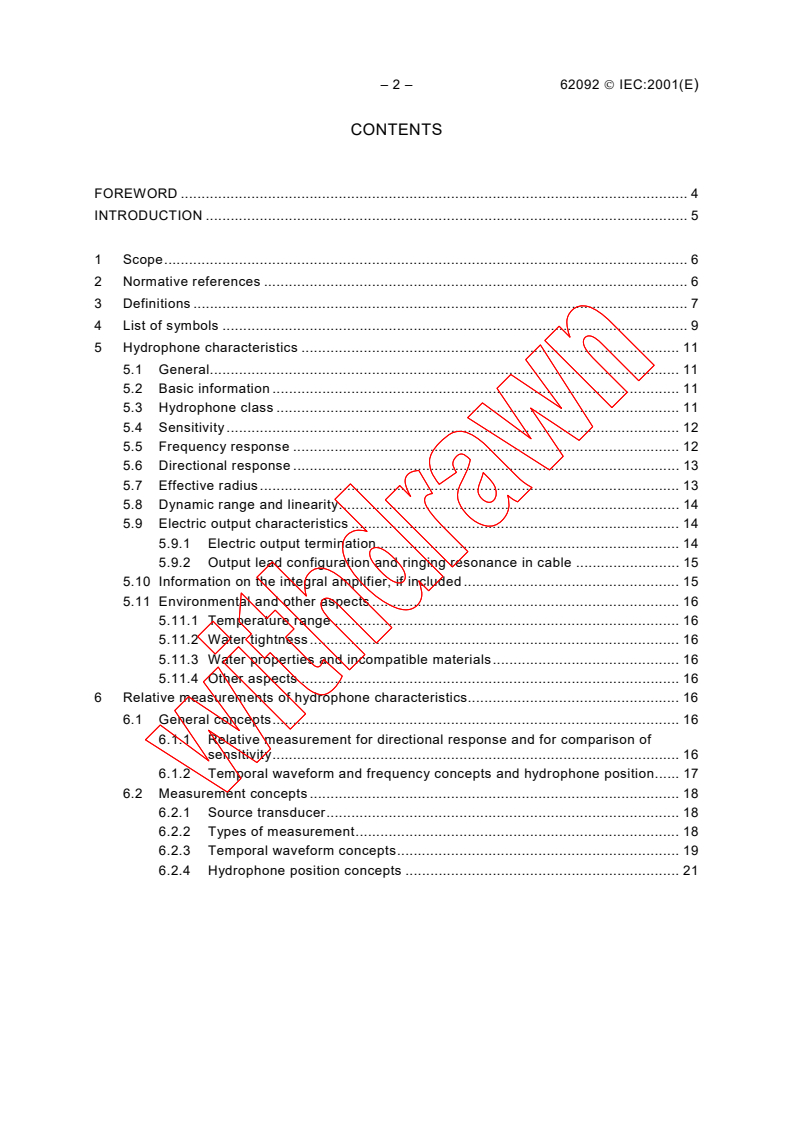
CONTENTS
FOREWORD . 4
INTRODUCTION .5
1 Scope. 6
2 Normative references . 6
3 Definitions . 7
4 List of symbols .9
5 Hydrophone characteristics . 11
5.1 General. 11
5.2 Basic information . 11
5.3 Hydrophone class . 11
5.4 Sensitivity . 12
5.5 Frequency response . 12
5.6 Directional response . 13
5.7 Effective radius. 13
5.8 Dynamic range and linearity. 14
5.9 Electric output characteristics . 14
5.9.1 Electric output termination. 14
5.9.2 Output lead configuration and ringing resonance in cable . 15
5.10 Information on the integral amplifier, if included . 15
5.11 Environmental and other aspects . 16
5.11.1 Temperature range . 16
5.11.2 Water tightness. 16
5.11.3 Water properties and incompatible materials. 16
5.11.4 Other aspects . 16
6 Relative measurements of hydrophone characteristics. 16
6.1 General concepts. 16
6.1.1 Relative measurement for directional response and for comparison of
sensitivity. 16
6.1.2 Temporal waveform and frequency concepts and hydrophone position. 17
6.2 Measurement concepts . 18
6.2.1 Source transducer. 18
6.2.2 Types of measurement. 18
6.2.3 Temporal waveform concepts. 19
6.2.4 Hydrophone position concepts . 21
62092 IEC:2001(E) – 3 –
6.3 Requirements . 24
6.3.1 Measurement vessel and water. 24
6.3.2 Temperature stability . 24
6.3.3 Positional accuracy . 24
6.3.4 Maximum hydrophone size. 25
6.3.5 Requirements for the electronic equipment . 27
6.3.6 Requirements with particular respect to time delay spectrometry . 27
7 Hydrophone calibration. 27
Annex A (informative) Tables . 29
Annex B (informative) Behaviour of PVDF polymer sensors in high intensity
ultrasonic fields . 31
Annex C (informative) Hydrophone positioning in the ultrasonic near field . 34
Annex D (informative) Time delay spectrometry – Requirements and a brief review
of the technique . 36
Annex E (informative) The absolute calibration of hydrophones up to 40 MHz . 39
Bibliography . 50
Figure 1 – Coordinates of a field point P in the near field of a plane- circular source
transducer of radius a . 28
t
Figure E.1 – Experimental set-up of the interferometric foil technique . 42
Figure E.2 – Hydrophone waveform generated by a 9 μm coplanar membrane
hydrophone positioned at the focus of a 5 MHz transducer (focal length 51 mm) . 45
Figure E.3 – Interferometer (displacement) waveform generated with the pellicle
positioned at the focus of the 5 MHz transducer (focal position 51 mm). 45
Figure E.4 – Frequency spectrum of the displacement waveform (lower curve)
and the differentiated displacement waveform (upper curve) . 46
Figure E.5 – Sensitivity of a 0,2 mm active element 9 μm bilaminar membrane
........ 46
hydrophone determined at 5 MHz intervals over the frequency range 5 MHz to 60 MHz
Table A.1 – List of typical uncertainty values obtained by the calibration methods
given in this standard and for the frequency range dealt with here. 29
Table A.2 – Speed of sound c [18, 19] and linear amplitude attenuation coefficient α divided
by the frequency squared ([20], interpolated), as a function of the temperature, in water. 29
Table A.3 – List of the waveform concepts and the hydrophone position concepts. 30
Table A.4 – List of decibel (dB) values and the corresponding amplitude ratios . 30
)
– 4 – 62092 IEC:2001(E
INTERNATIONAL ELECTROTECHNICAL COMMISSION
____________
ULTRASONICS – HYDROPHONES –
CHARACTERISTICS AND CALIBRATION IN THE
FREQUENCY RANGE FROM 15 MHz TO 40 MHz
FOREWORD
1) The IEC (International Electrotechnical Commission) is a worldwide organization for standardization comprising
all national electrotechnical committees (IEC National Committees). The object of the IEC is to promote
international co-operation on all questions concerning standardization in the electrical and electronic fields. To
this end and in addition to other activities, the IEC publishes International Standards. Their preparation is
entrusted to technical committees; any IEC National Committee interested in the subject dealt with may
participate in this preparatory work. International, governmental and non-governmental organizations liaising
with the IEC also participate in this preparation. The IEC collaborates closely with the International
Organization for Standardization (ISO) in accordance with conditions determined by agreement between the
two organizations.
2) The formal decisions or agreements of the IEC on technical matters express, as nearly as possible, an
international consensus of opinion on the relevant subjects since each technical committee has representation
from all interested National Committees.
3) The documents produced have the form of recommendations for international use and are published in the form
of standards, technical specifications, technical reports or guides and they are accepted by the National
Committees in that sense.
4) In order to promote international unification, IEC National Committees undertake to apply IEC International
Standards transparently to the maximum extent possible in their national and regional standards. Any
divergence between the IEC Standard and the corresponding national or regional standard shall be clearly
indicated in the latter.
5) The IEC provides no marking procedure to indicate its approval and cannot be rendered responsible for any
equipment declared to be in conformity with one of its standards.
6) Attention is drawn to the possibility that some of the elements of this International Standard may be the subject
of patent rights. The IEC shall not be held responsible for identifying any or all such patent rights.
International Standard IEC 62092 has been prepared by IEC technical committee 87:
Ultrasonics.
The text of this standard is based on the following documents:
FDIS Report on voting
87/203A/FDIS 87/209/RVD
Full information on the voting for the approval of this standard can be found in the report on
voting indicated in the above table.
This publication has been drafted in accordance with the ISO/IEC Directives, Part 2.
Annexes A, B, C, D and E are for information only.
The committee has decided that the contents of this publication will remain unchanged
until 2006. At this date, the publication will be
reconfirmed;
withdrawn;
replaced by a revised edition, or
amended.
62092 IEC:2001(E) – 5 –
INTRODUCTION
The spatial and temporal distribution of acoustic pressure in an ultrasonic field in a liquid
medium is commonly determined using miniature ultrasonic hydrophones. The characteristics
and calibration of these hydrophones have been dealt with in a number of IEC standards in
the frequency range 0,5 MHz to 15 MHz. The purpose of this International Standard is to
extend this frequency range up to 40 MHz. The main hydrophone application in this context
is the measurement of ultrasonic fields emitted by medical diagnostic equipment in water.
It has turned out in recent years that hydrophone operation in the frequency range above
15 MHz is important to characterize fully this equipment, primarily due to the increased
appearance of high-frequency components in the ultrasonic signals, caused by nonlinear
propagation. In addition, the number of medical ultrasonic systems which use frequencies
above 15 MHz, particularly intra-operative probes, is growing.
While the term "hydrophone" can be used in a wider sense, it is understood here as referring
to miniature piezoelectric hydrophones. It is this instrument type which is used today in
various areas of medical ultrasonics and particularly to characterize quantitatively the field
structure of medical diagnostic instruments. With regard to other pressure sensor types such
as those based on fibre optics, some of the prescriptions of this International Standard are
applicable to these as well but others are not. If in the future these other "hydrophone" types
gain more importance in field measurement practice, their characteristics and calibration will
have to be dealt with in a revised version of this International Standard or in a separate one.
In agreement with present measurement practice, hydrophones are dealt with in this
International Standard as amplitude sensors and not as phase sensors. If phase
measurements were to become important in the future, this standard would need revision,
with more rigorous requirements being necessary for that kind of measurement.
NOTE 1 Accordingly, the hydrophone sensitivity is understood as a real quantity (expressing the ratio of
amplitudes) throughout this International Standard.
NOTE 2 This International Standard covers the frequency range from 15 to 40 MHz. Hydrophone properties and
hydrophone calibration up to 15 MHz are covered by the International Standards IEC 60866 and IEC 61101. In
practice, the useful frequency range of a hydrophone may well extend into both frequency ranges, below and
above 15 MHz. It has therefore been the aim to keep the regulations of this International Standard as far as
possible similar to those of the aforementioned standards. Differences are due either to different technical needs in
the respective frequency ranges or to the technical and scientific progress achieved since the publication of the
aforementioned standards. At present there are maintenance activities aiming at re-structuring and merging, where
possible, all existing hydrophone standards. It can be expected that this will lead to unified standards covering the
whole field of practical hydrophone application.
)
– 6 – 62092 IEC:2001(E
ULTRASONICS – HYDROPHONES –
CHARACTERISTICS AND CALIBRATION IN THE
FREQUENCY RANGE FROM 15 MHz TO 40 MHz
1 Scope
This International Standard is applicable to
• hydrophones employing piezoelectric sensor elements, designed to measure the pulsed
and continuous-wave ultrasonic fields generated by ultrasonic equipment;
• hydrophones used for measurements made in water and in the frequency range between
15 MHz and 40 MHz;
• hydrophones with or without an integral amplifier;
• hydrophones with a circular piezoelectrically active element.
This International Standard specifies
• relevant hydrophone characteristics;
• methods of determining directional response and hydrophone sensitivity based on
relative or comparative measurements;
and describes
• absolute hydrophone calibration methods.
Recommendations and references to accepted literature are made for the various relative and
absolute calibration methods in the frequency range covered by this International Standard.
2 Normative references
The following referenced documents are indispensable for the application of this document.
For dated references, only the edition cited applies. For undated references, the latest edition
of the referenced document (including any amendments) applies.
IEC 60866:1987, Characteristics and calibration of hydrophones for operation in the
frequency range 0,5 MHz to 15 MHz
IEC 61101:1991, The absolute calibration of hydrophones using the planar scanning
technique in the frequency range 0,5 MHz to 15 MHz
IEC 61102:1991, Measurement and characterisation of ultrasonic fields using hydrophones in
the frequency range 0,5 MHz to 15 MHz
IEC 61161:1992, Ultrasonic power measurement in liquids in the frequency range 0,5 MHz
to 25 MHz
Amendment 1 (1998)
IEC 61828:—, Ultrasonics – Focusing transducers – Definitions and measurement methods
for the transmitted fields
___________
There exists a consolidated edition 1.1 (1998) that includes IEC 61161 (1992) and its amendment 1 (1998).
To be published.
62092 IEC:2001(E) – 7 –
3 Definitions
For the purposes of this International Standard, the following definitions apply.
3.1
acoustic centre
the point on or near a transducer from which the spherically divergent sound waves emitted
by the transducer, and observable at remote points, appear to diverge
[definition 3.3 of IEC 60866]
3.2
beam-alignment axis
used for alignment purposes only, beam-alignment axis is a straight line joining two points of
spatial-peak temporal-peak acoustic pressure on two hemispherical surfaces whose centres
are at the approximate geometrical centre of an ultrasonic transducer or ultrasonic transducer
element group. One hemisphere has a radius of curvature of approximately A πλ , where A
g g
is the geometrical area of the ultrasonic transducer or ultrasonic transducer element group
and λ is the wavelength of the ultrasound corresponding to the nominal frequency. The
second hemisphere has a radius of curvature either 2A πλ, or A 3πλ , whichever is the
g g
more appropriate. For the purposes of alignment, this line may be projected to the face of the
ultrasonic transducer or ultrasonic transducer element group.
For most practical applications, two plane surfaces perpendicular to the direction of
propagation of the ultrasound are used. In cases where a unique peak is not located on a
hemispherical surface, another hemispherical surface is chosen with a different radius of
curvature yielding a unique peak
[definition 3.5 of IEC 61102]
3.3
directional response
directional response of a hydrophone
description, generally presented graphically, of the response of a hydrophone, as a function
of direction of propagation of the incident plane sound wave, in a specified plane through the
acoustic centre and at a specified frequency
[definition 3.12 of IEC 60866]
3.4
effective radius
effective radius of a hydrophone active element
radius of a stiff disc receiver hydrophone which has a predicted directional response
function with an angular width equal to the observed angular width. The angular width is
determined at a specified level below the peak of the directional response function. For the
specified levels of 3 dB and 6 dB, the radii are denoted by a and a respectively
3 6
[definitions 3.4 of IEC 61101 and 3.13 of IEC 61102]
Symbols: a , a , a
3 6
Unit: metre, m
3.5
electric load impedance
electric input impedance (consisting of a real and an imaginary part) to which the
hydrophone unit output cable is connected or is to be connected
Symbol: Z
L
Unit: ohm, Ω
)
– 8 – 62092 IEC:2001(E
3.6
end-of-cable loaded sensitivity
end-of-cable loaded sensitivity of a hydrophone
ratio of the instantaneous voltage at the end of any integral cable or connector of a
hydrophone, when connected to a specified electrical input impedance, to the instantaneous
acoustic pressure in the undisturbed free field of a plane wave in the position of the acoustic
centre of the hydrophone if the hydrophone were removed
[definitions 3.5 of IEC 61101 and 3.14 of IEC 61102, modified]
Symbol: M
L
Unit: volt per pascal, V/Pa
3.7
end-of-cable open-circuit sensitivity
end-of-cable open-circuit sensitivity of a hydrophone
ratio of the instantaneous open-circuit voltage at the end of any integral cable or connector of
a hydrophone to the instantaneous acoustic pressure in the undisturbed free field of a plane
wave in the position of the acoustic centre of the hydrophone if the hydrophone were
removed
[definition 3.15 of IEC 61102, modified]
Symbol: M
c
Unit: volt per pascal, V/Pa
3.8
far field
the sound field at a distance from the source where the instantaneous values of the sound
pressure and particle velocity are substantially in phase
[definition 3.2 of IEC 60866]
NOTE 1 In the far field the sound pressure appears to be spherically divergent from a point on or near the
radiating surface. Hence the pressure produced by the sound source is approximately inversely proportional to the
distance from the source.
NOTE 2 The term "far field" is used in this International Standard only in connection with non-focusing source
transducers. For focusing transducers a different terminology for the various parts of the transmitted field applies
(see IEC 61828).
3.9
hydrophone geometrical radius
geometrical radius of a hydrophone active element
radius defined by the dimensions of the active element of a hydrophone
[definition 3.18 of IEC 61102]
Symbol: a
g
Unit: metre, m
3.10
hydrophone
transducer that produces electrical signals in response to waterborne acoustic signals
[See 3.4 of IEC 60866 and 3.19 of IEC 61102]
62092 IEC:2001(E) – 9 –
3.11
hydrophone axis
nominal symmetry axis of the hydrophone active element
NOTE Unless stated otherwise (explicitly and quantitatively) by the manufacturer, it is understood for the
purposes of this standard that this is given by the apparent geometrical symmetry axis of the .
hydrophone
3.12
integral amplifier
active electronic device connected firmly to the hydrophone and reducing its output
impedance
NOTE 1 An integral amplifier requires a supply voltage (or supply voltages).
NOTE 2 The integral amplifier may have a forward voltage transmission factor of less than one, i.e., it need not
necessarily be a voltage amplifier in the strict sense.
3.13
pulse duration
1,25 times the interval between the time when the time integral of the square of the
instantaneous acoustic pressure reaches 10 % and 90 % of its final value
[definition 3.30 of IEC 61102, modified]
3.14
uncertainty
parameter, associated with the result of a measurement, that characterizes the dispersion of
the values that could reasonably be attributed to the measurand
[See 2.2.3 of the ISO/IEC Guide to the Expression of Uncertainty in Measurement [1] ]
4 List of symbols
a = effective radius (a , a : with special reference to a 3 dB or 6 dB definition,
3 6
respectively)
a = hydrophone geometrical radius
g
a = maximum effective radius
max
a = radius of a source transducer
t
A = geometrical area of a source transducer
g
B/A= Fox-Wallace non-linearity parameter
c= speed of sound in the measurement liquid (water)
e= base of natural logarithms
f= frequency
f = fundamental drive frequency of a signal used to generate non-linear distortion
f
f = upper frequency limit of the stated frequency band of a hydrophone
u
F = geometric focal length of a focusing transducer
k= circular wave number
M = end-of-cable open-circuit sensitivity
c
___________
Numbers in square brackets refer to the bibliography in annex F.
)
– 10 – 62092 IEC:2001(E
M = end-of-cable loaded sensitivity
L
n= harmonic number
p = pressure amplitude
r = path length from the transducer rim to a field point
R = lateral distance from the beam-alignment axis (R , R : maximum values
maxE maxH
with respect to avoiding edge-wave and head-wave interference, respectively)
t = arrival time of the nearest head wave
H
t = time available for a free-field measurement in time delay spectrometry
TDS
T = acoustic transmission factor
v = speed of a radial wave in a transducer plate
t
w = beam width of the fundamental-frequency field component
f
x = coordinate along the beam-alignment axis and starting from the transducer
surface (x , x , x and x are special distance values according to certain
1 2 3 4
criteria involving edge waves and head waves)
x = minimum distance for a finite-size hydrophone from a transducer
min
x = distance of the pressure focus from a focusing transducer
pf
Δx = distance difference
Z = electric output impedance of a hydrophone
h
Z = electric load impedance
L
α = small-signal, plane-wave amplitude attenuation coefficient of the measurement
liquid (water)
()
β = non-linearity parameter in the sense of β = 1+ B 2A
γ = ratio of beam diameter to hydrophone diameter
δ = pressure amplitude correction for finite hydrophone size
ζ = acoustic displacement as measured by an optical interferometer
θ = angle of incidence of an ultrasonic wave with respect to the hydrophone axis
(θ , θ : with special reference to a 3 dB or 6 dB definition, respectively)
3 6
λ = ultrasonic wavelength
λ = optical wavelength
ξ = π 2 times the Rayleigh length ( a λ , see IEC 61828) of a focusing transducer
t
ρ = (mass) density of the measurement liquid (water)
σ, σ = non-linear distortion parameter
m
τ = pulse duration or burst duration ( τ , τ : maximum values with respect
maxE maxH
to avoiding edge-wave and head-wave interference, respectively)
ω = circular frequency
62092 IEC:2001(E) – 11 –
5 Hydrophone characteristics
5.1 General
For a full characterization of the hydrophone performance in the frequency range of this
International Standard, the following information is required.
5.2 Basic information
The following shall be briefly stated:
• the basic physical principles of the transduction process, the type of material involved and
the form and geometrical dimensions (diameter, thickness) of the hydrophone active
element;
• the configuration and design of the hydrophone;
NOTE 1 In the case of a membrane hydrophone, for example, it is important to know whether the hydrophone is
of the coplanar or the bilaminar type.
• whether or not an integral amplifier is included in the hydrophone unit;
• the nominal direction of ultrasonic incidence in relation to the hydrophone.
NOTE 2 The last point is important, as it has been found in the literature [2] that even with membrane
hydrophones, the response may change upon reversal of the ultrasonic propagation direction in relation to the
hydrophone.
The frequency of the fundamental thickness resonance of the hydrophone active element
should also be stated.
5.3 Hydrophone class
Since hydrophones are used for many different types of measurement, it is not necessary to
demand the highest performance specifications for every standard device. Two classes of
hydrophones, Class 1 and Class 2, to be used for standardized measurement purposes in
the frequency range dealt with (15 MHz to 40 MHz) are therefore specified as follows.
The end-of-cable sensitivity level of the hydrophone unit (with or without an integral
amplifier) as a function of frequency shall be constant, over a stated bandwidth of at least
one octave in the frequency range from 15 MHz to 40 MHz, with a tolerance of ±2 dB for
Class 1 and ±4 dB for Class 2. In addition, it shall not vary by more than ±0,5 dB (Class 1)
and ±1 dB (Class 2) within any frequency increment of 1 MHz falling inside the frequency
band stated.
NOTE 1 The upper frequency limit of the stated frequency band establishing the class of the hydrophone will
appear frequently and be referred to as f in this International Standard.
u
NOTE 2 The bandwidth criteria for Class 1 and Class 2 relate to their ability to measure accurately
hydrophones
acoustic fields within which a range of frequency components are present. Typically, but not exclusively, the full
quantitative characterization of ultrasonic fields within the frequency range of this standard will require the use of a
Class 1 hydrophone. In contrast, Class 2 hydrophones will be appropriate for use when relative measurements
are required, for example in the determination of the spatial characteristics of a field.
NOTE 3 Rather similar classes having, however, different names, namely Class A and Class B, have
hydrophone
been defined in IEC 60866. Note that the two standards cover different frequency ranges and that the class
definitions in the two standards therefore do not interfere with each other. If a hydrophone whose useful frequency
range is sufficiently broad is to be qualified under both standards, four combinations of hydrophone classes are
possible as follows: Class A + Class 1; Class A + Class 2; Class B + Class 1; Class B + Class 2.
)
– 12 – 62092 IEC:2001(E
5.4 Sensitivity
The end-of-cable sensitivity of the hydrophone unit shall be stated in V/Pa or in decimal
submultiples, or as a logarithmic level in dB with reference to a stated sensitivity value.
If an integral amplifier contributes to the sensitivity value given, this shall be stated.
NOTE 1 "End-of-cable" refers to the end of the output cable of the hydrophone unit, with or without an integral
amplifier.
It shall be stated whether the sensitivity value given is understood as end-of-cable open-
circuit sensitivity or as the end-of-cable loaded sensitivity. In the latter case, the relevant
electric loading conditions shall be stated, i.e. the electric load impedance in order to obtain
the stated sensitivity.
The uncertainty of the stated sensitivity shall be given.
NOTE 2 Table A.1 summarizes overall measurement uncertainties of the most widely used calibration
techniques.
The frequency interval over which the sensitivity is given and over which the uncertainty
applies shall be stated. For the purposes of this standard, sensitivity and uncertainty values
may be given separately for several frequency intervals.
The methods by which the sensitivity and its uncertainty have been obtained shall be
described.
5.5 Frequency response
The hydrophone sensitivity as a function of frequency shall be stated either graphically or as
a list of values and over a frequency range containing at least the frequency band claimed
under 5.3. If it is given as a list of values or as discrete points in a graph, the frequency
distance between adjacent points should not be greater than 1 MHz, as far as the frequency
range of this International Standard is concerned.
The frequency response may be given in terms of absolute sensitivity values or in a relative
representation, relative with reference to the absolute hydrophone sensitivity at a certain
frequency. In the case of the relative representation, the reference sensitivity and the
frequency to which it applies shall be stated.
The statement of the frequency response should refer to the same conditions as the
sensitivity statement according to 5.4. If it is understood as referring to different conditions,
this shall be clearly stated and formulas shall be given for interrelating the various
sensitivities.
If the uncertainty of the sensitivity values in the frequency response representation differs
from the general uncertainty assessment of 5.4, this shall be clearly stated and the new or
additional uncertainty be given. In case the frequency response is presented graphically
only, the additional uncertainty due to reading of the graph shall be less than 10 % of the
total uncertainty listed.
If the frequency response is given as a list of absolute sensitivity values, the sensitivity
statement according to 5.4 may be omitted.
NOTE 1 The frequency response and, hence, the hydrophone class, may depend on the electric load conditions.
NOTE 2 If in a practical application the hydrophone is used with subsequent electronic components such as
amplifier, oscilloscope etc., the frequency response of the whole system is, of course, influenced also by the
frequency response of these additional components.
62092 IEC:2001(E) – 13 –
5.6 Directional response
NOTE 1 The effective radius is obtained from the directional response (see 5.7). While it is desirable to have
the full information, that is, both the and the , this may be relaxed in
directional response effective radius
practice to either the directional response according to this clause being stated or the effective radius according
to 5.7.
NOTE 2 For the purposes of this standard, it is assumed that the hydrophone active element is nominally circular
in geometry. If in the future hydrophones of a different geometry appear on the market, this standard will need
revision or amendment.
The directional response of the hydrophone shall be measured and stated at both the lower
and upper limits of the frequency band claimed under 5.3, as follows.
The directional response shall be measured by rotating the hydrophone about an axis
which is perpendicular to the hydrophone axis, at least from −35° up to +35° (with the
hydrophone axis as reference) or at least from the first left-hand minimum to the first right-
hand minimum, whichever of the angular spans is the lower. This shall be done twice, namely
about two rotational axes perpendicular to each other. If in the plane perpendicular to its axis,
a hydrophone has a certain distinct direction (for example that of the electric leads in the
case of a membrane hydrophone), the rotational axes should be in this direction and
perpendicular to it. The directions of the rotational axes shall be identified on the hydrophone
or in the accompanying literature.
The two resulting directional responses obtained from the two measurements at perpen-
dicular rotational axes shall be given.
If in any of the directional response results obtained, the angle between the direction of
maximum response and the hydrophone axis is greater than 1/10 of the angular difference
between the left-hand −6 dB direction and the right-hand −6 dB direction, this shall be stated
and the deviation-of-axis angle be given.
NOTE 3 Problems in field measurement practice will arise if the direction of maximum hydrophone response
varies significantly with frequency.
5.7 Effective radius
From each of the directional response results obtained according to 5.6, a value for the
effective radius of the hydrophone active element at both the lower and upper limits of the
frequency band claimed under 5.3 shall be derived as follows.
If the angular difference between the left-hand −3 dB direction and the right-hand −3 dB
direction is 2θ and the angular difference between the left-hand −6 dB direction and the
right-hand −6 dB direction is 2θ , the following formulas for the effective radii apply:
1,62 c
a = (1)
2π f sinθ
and
2,22 c
a = (2)
2π f sinθ
where
f is the relevant ultrasonic frequency of the particular measurement;
c is the speed of sound in water at the particular temperature (see table A.2).
)
– 14 – 62092 IEC:2001(E
If, for the directional response in question, a and a are equal to each other within ±10 %
3 6
(of the maximum value), their arithmetic mean shall be used as the effective radius. If not,
that value of the two shall be used whose corresponding angle θ is closer to 10°.
If the two effective radius values thus obtained for the two measurements at perpendicular
rotational axes are equal to each other within ±10 % (of the maximum value), only their
arithmetic mean and a statement of this need be given, otherwise both values shall be given.
If in any of the directional response results obtained, the angle between the direction of
maximum response and the hydrophone axis is greater than 1/10 of the angular difference
between the left-hand −6 dB direction and the right-hand −6 dB direction, this shall be stated
and the deviation-of-axis angle be given, if not done already according to 5.6.
5.8 Dynamic range and linearity
The dynamic range of the hydrophone, i.e. the pressure amplitude range in which the
hydrophone unit (with an integral amplifier if included) can be used, shall be given.
This range is to be understood as meeting at least the following conditions:
1. no mechanical or electrical damage to the hydrophone or the integral amplifier, if
included;
2. no output saturation;
3. the output signal must be above the noise level.
NOTE 1 "Output saturation" means that a non-zero pressure increment at the hydrophone does not lead to a
voltage change.
NOTE 2 The noise level may depend on electromagnetic interference and may thus vary with the electromagnetic
conditions at the place of measurement. Ideally, it may be possible to give a noise level representing all other
sources of noise except electromagnetic interference.
The range of linearity of the hydrophone unit according to 5.1.2 of IEC 60866 should be
given.
NOTE 3 Information on hydrophone linearity is given in annex B.
5.9 Electric output characteristics
All quantitative values in this clause are understood with the hydrophone in water under free-
field conditions.
5.9.1 Electric output termination
It shall be stated which of the following two subclauses applies (i.e. 5.9.1.1 or 5.9.1.2).
5.9.1.1 Matched impedance
If the output impedance is matched to the characteristic impedance of the output cable (which
is typically low in comparison with 1 kΩ):
The electric load impedance to which the output cable is to be connected shall be given. It is
required in this case that all sensitivity statements according to this standard are understood
as end-of-cable loaded sensitivities with reference to this impedance.
Limits for this impedance should be given such that the actual sensitivity agrees with the
stated one within a stated maximum error or within the uncertainties given under 5.4 and 5.5.
NOTE 1 This may be done in practice as follows. A lower and an upper limit for the load resistance (embracing
the characteristic impedance value) are given and an upper limit for the capacitance parallel to the resistance is
given.
62092 IEC:2001(E) – 15 –
NOTE 2 This subclause normally applies if an integral amplifier is included.
NOTE 3 If the input to which the hydrophone output cable is connected is a high-impedance one, the
requirements of this subclause can usually be met by means of an additional shunt resistance.
5.9.1.2 Unmatched impedance
If the output impedance is not matched to the characteristic impedance of the output cable:
The end-of-cable output impedance Z shall be stated as a function of frequency. This can be
h
done by giving the real and the imaginary part or by giving the values of the electrical
components (such as resistance and capacitance) of an equivalent network. In the latter case,
the type of network must be clearly specified (e.g. the resistance being in series or parallel to
the capacitance).
The frequency difference between adjacent frequency points of this statement shall not be
greater than 2 MHz, as far as the frequency range of this International Standard is concerned.
The relation between the end-of-cable loaded sensitivity and the end-of-cable open-circuit
sensitivity depends on Z and Z and is given by
h L
1 2
2 2
Re Z + Im Z
L L
M = M
L c
2 2
[]ReZ + ReZ + [ImZ + ImZ]
h L h L
(3)
where "Re" and "Im" are the real and imaginary parts, respectively, of the relevant quantity.
electric load
This formula can be used for calculating correction factors if the actual
impedance does not agree with the conditions stated in connection with the sensitivity values
given.
This subclause normally applies if no integral amplifier is included.
NOTE Equation (3) applies to a frequency domain consideration. In practical hydrophone applications with
ultrasonic pulses, time domain considerations (temporal convolution and deconvolution) would have to be taken
into account.
5.9.2 Output lead configuration and ringing resonance in cable
The basic configuration of the output leads shall be explained, such as differential output
(floating) or unsymmetric output, i.e., single output and ground.
Any electric transmission line with an unmatched termination may under certain conditions
give rise to resonance ringing. If this is likely to occur with the hydrophone unit in question
(either due to the output cable or to an internal transmission line), particularly at the higher
frequencies associated with finite amplitude distortion, this should be stated and the ringing
frequency to be expected should be given.
5.10 Information on the integral amplifier, if included
The required supply voltage (or supply voltages) and the current consumption shall be stated.
The consequences of supply voltage deviations from the nominal value(s) shall be stated.
All limitations on the amplitude and frequency ranges not given under 5.3, 5.5 and 5.8 shall
be stated, such as those due to slew rate limitations etc.
)
– 16 – 62092 IEC:2001(E
5.11 Environmental and other aspects
5.11.1 Temperature range
The nominal water temperature, its uncertainty, and the temperature range over which the
given sensitivity applies shall be stated. If possible, a correction accounting for temperatures
differing from the stated one should be given, or the sensitivity be given as a function of
temperature. If any of the other relevant quantities according to this standard show substan-
tial changes over the usable temperature range, this shall be stated and a correction given.
5.11.2 Water tightness
It shall be stated which parts of the hydrophone unit are waterproof and which are not.
Limitations, if any, on the duration of water immersion (possibly as a function of temperature)
shall be stated.
5.11.3 Water properties and incompatible materials
Limitations, if any, on the water conductivity shall be stated. The water conditions (for
example conductivity, gas content) to which all the quantitative state
...