

IEC 61847:2025
(Main)Ultrasonics - Surgical systems - Measurement and declaration of the basic output characteristics
General Information
- Abstract
IEC 61847:2025 specifies:
– the essential non-thermal output characteristics of ultrasonic surgical units;
– methods of measurement of these output characteristics;
– those characteristics to be declared by the manufacturers of such equipment.
This document is applicable to equipment which meets the criteria of a), b) and c) below:
a) ultrasonic surgical systems operating in the frequency range 20 kHz to 120 kHz; and
b) ultrasonic surgical systems whose use is the fragmentation, emulsification, debridement, or cutting of human tissue, whether or not those effects are delivered in conjunction with tissue removal or coagulation; and
c) ultrasonic surgical systems in which an acoustic wave is conducted by means of a specifically designed wave guide to deliver energy to the surgical site.
This document is not applicable to:
– lithotripsy equipment which uses extracorporeally induced pressure pulses, focused through liquid conducting media and the soft tissues of the body;
– surgical systems used as part of the therapeutic process (hyperthermia systems);
– surgical systems whose mechanism of action is through frictional heat generated by tissue in contact with the wave guide, e.g. clamp coagulators or clamping vibrational cutters;
– surgical systems whose mechanism of action is through focused ultrasound for either thermal degradation (high intensity focused ultrasound – HIFU or HITU) or cavitation erosion (Histotripsy) of tissue remote from the ultrasound transducer;
– surgical systems whose mechanism of action is through erosion of hard tissues in contact with the applicator tip, e.g. bone cutting or drilling.
This document does not deal with the effectiveness or safety of ultrasonic surgical systems. This document does not deal with airborne noise from the systems, which can affect operators and patients.
IEC 61847:2025 cancels and replaces the first edition published in 1998. This edition constitutes a technical revision.
This edition includes the following significant technical changes with respect to the previous edition:
a) The upper frequency covered by this document has been raised from 60 kHz to 120 kHz.
b) The hydrophone method of measuring ultrasound power is now normative. Because of difficulties in using the calorimetry method of measuring ultrasound power, it is no longer the primary approach.
c) It is recognised that some systems can have more than one mode of vibration under user control, and the measurement techniques and declarations have been updated to address this.
d) The high-frequency component, which relates to cavitation developed at the applicator tip and the vibration amplitude at which cavitation occurs is addressed.
e) Specific requirements for measurement at excursion levels where no cavitation is present, and extrapolation to maximum excursion level(s) are described.
f) Guidance is provided to adapt the methodology described to more complex designs and vibration patterns, excursion directions, and their output characteristics.
g) Guidance is provided with respect to measurement tank arrangements for different types of systems.
h) The list of ultrasound methods and systems not covered by this document was extended to incorporate recent developments.
i) Definitions for cavitation related terms were added.
j) Requirements for the measurement of directivity characteristics of the applicator tip were changed.
k) Annex A was modified and Figure A.1 was added.
l) New literature was added, and the references to other standards were updated.
- Status
- Published
- Publication Date
- 19-May-2025
- Technical Committee
- TC 87 - Ultrasonics
- Drafting Committee
- WG 7 - TC 87/WG 7
- Current Stage
- PPUB - Publication issued
- Start Date
- 20-May-2025
- Completion Date
- 20-Jun-2025
Overview
IEC 61847:2025 is an international standard developed by the International Electrotechnical Commission (IEC) that specifies the measurement and declaration of the basic output characteristics of ultrasonic surgical systems. This second edition updates and replaces the 1998 edition with significant technical revisions, reflecting advances in ultrasonic surgical technology. The standard covers non-thermal output parameters and focuses on systems operating between 20 kHz and 120 kHz, applied in tissue fragmentation, emulsification, debridement, and cutting. It excludes equipment such as lithotripsy, hyperthermia therapeutic devices, and certain high-intensity focused ultrasound systems.
This document is essential for manufacturers, testing laboratories, and regulatory bodies to ensure consistent, reliable, and standardized measurement procedures and transparent output characteristic declarations for ultrasonic surgical units.
Key Topics
Scope and Applicability
- Covers ultrasonic surgical systems using acoustic waves via specialized wave guides to affect human tissue.
- Defines systems operating within the 20 kHz to 120 kHz frequency range.
- Excludes systems relying on frictional heat, focused ultrasound therapies, lithotripsy, and bone-cutting technologies.
Measurement Methods
- Emphasizes the hydrophone technique as the normative method for acoustic power measurement, replacing calorimetry as the primary procedure due to challenges with the latter.
- Details procedures for measuring primary and secondary tip vibration excursion, drive and vibration frequency, output acoustic power, directivity patterns, modulation, duty cycle, and acoustic output areas.
- Provides guidance on adapting measurement techniques for complex system designs, multiple vibration modes, and excursion directions.
Declaration of Output Characteristics
- Specifies essential output parameters that manufacturers must declare to users and regulatory authorities to allow informed evaluation of ultrasonic surgical devices.
- Incorporates parameters related to cavitation thresholds and high-frequency vibration components significant for device performance.
Technical Revisions and Updates
- Frequency range extended to 120 kHz reflecting technological advances.
- Inclusion of guidance on measurement setups, such as tank arrangements tailored to different system configurations.
- Addition of definitions related to cavitation phenomena for improved clarity.
- Updates to directivity measurement requirements and annex modifications to enhance practical applicability.
Applications
IEC 61847:2025 is critical in the medical device field, particularly for:
Manufacturers of Ultrasonic Surgical Equipment
- Ensures compliance with international measurement standards for basic output parameters.
- Facilitates consistent reporting and enhances product transparency and safety data communication.
Testing and Calibration Laboratories
- Provides standardized procedures to validate ultrasonic surgical device output characteristics.
- Supports regulatory and conformity assessment activities.
Regulatory Authorities and Certification Bodies
- Offers a benchmark for performance evaluation during device registration and pre-market approval.
- Enables harmonized global standards adoption to aid international trade and patient safety.
Clinical Engineering and Biomedical Professionals
- Helps in the understanding, selection, and validation of ultrasonic surgical systems based on standardized performance parameters.
- Assists in maintaining quality control and device maintenance.
Related Standards
IEC 61847:2025 complements other IEC and ISO standards covering ultrasonic and medical electrical equipment, including but not limited to:
- IEC 60601 series - Medical electrical equipment safety and essential performance.
- IEC 62304 - Medical device software lifecycle processes, relevant for ultrasonic surgical systems with embedded software controls.
- IEC 62127 - Ultrasonics - Hydrophone measurements, supporting detailed acoustic power assessments.
- ISO 13485 - Quality management systems for medical devices, ensuring manufacturing and documentation practices align with quality requirements.
For comprehensive compliance and effective device evaluation, it’s recommended to consult related IEC standards and harmonize measurement practices within existing health and safety regulations.
Adopting IEC 61847:2025 promotes uniformity in the assessment and declaration of ultrasonic surgical system outputs, facilitating safer and more effective use of innovative surgical technologies worldwide. This standard is instrumental for stakeholders seeking to align with the latest technical requirements and industry best practices in ultrasonic surgical applications.
Relations
- Effective Date
- 05-Sep-2023
Get Certified
Connect with accredited certification bodies for this standard

BSI Group
BSI (British Standards Institution) is the business standards company that helps organizations make excellence a habit.

TÜV Rheinland
TÜV Rheinland is a leading international provider of technical services.

TÜV SÜD
TÜV SÜD is a trusted partner of choice for safety, security and sustainability solutions.
Sponsored listings
Frequently Asked Questions
IEC 61847:2025 is a standard published by the International Electrotechnical Commission (IEC). Its full title is "Ultrasonics - Surgical systems - Measurement and declaration of the basic output characteristics". This standard covers: IEC 61847:2025 specifies: – the essential non-thermal output characteristics of ultrasonic surgical units; – methods of measurement of these output characteristics; – those characteristics to be declared by the manufacturers of such equipment. This document is applicable to equipment which meets the criteria of a), b) and c) below: a) ultrasonic surgical systems operating in the frequency range 20 kHz to 120 kHz; and b) ultrasonic surgical systems whose use is the fragmentation, emulsification, debridement, or cutting of human tissue, whether or not those effects are delivered in conjunction with tissue removal or coagulation; and c) ultrasonic surgical systems in which an acoustic wave is conducted by means of a specifically designed wave guide to deliver energy to the surgical site. This document is not applicable to: – lithotripsy equipment which uses extracorporeally induced pressure pulses, focused through liquid conducting media and the soft tissues of the body; – surgical systems used as part of the therapeutic process (hyperthermia systems); – surgical systems whose mechanism of action is through frictional heat generated by tissue in contact with the wave guide, e.g. clamp coagulators or clamping vibrational cutters; – surgical systems whose mechanism of action is through focused ultrasound for either thermal degradation (high intensity focused ultrasound – HIFU or HITU) or cavitation erosion (Histotripsy) of tissue remote from the ultrasound transducer; – surgical systems whose mechanism of action is through erosion of hard tissues in contact with the applicator tip, e.g. bone cutting or drilling. This document does not deal with the effectiveness or safety of ultrasonic surgical systems. This document does not deal with airborne noise from the systems, which can affect operators and patients. IEC 61847:2025 cancels and replaces the first edition published in 1998. This edition constitutes a technical revision. This edition includes the following significant technical changes with respect to the previous edition: a) The upper frequency covered by this document has been raised from 60 kHz to 120 kHz. b) The hydrophone method of measuring ultrasound power is now normative. Because of difficulties in using the calorimetry method of measuring ultrasound power, it is no longer the primary approach. c) It is recognised that some systems can have more than one mode of vibration under user control, and the measurement techniques and declarations have been updated to address this. d) The high-frequency component, which relates to cavitation developed at the applicator tip and the vibration amplitude at which cavitation occurs is addressed. e) Specific requirements for measurement at excursion levels where no cavitation is present, and extrapolation to maximum excursion level(s) are described. f) Guidance is provided to adapt the methodology described to more complex designs and vibration patterns, excursion directions, and their output characteristics. g) Guidance is provided with respect to measurement tank arrangements for different types of systems. h) The list of ultrasound methods and systems not covered by this document was extended to incorporate recent developments. i) Definitions for cavitation related terms were added. j) Requirements for the measurement of directivity characteristics of the applicator tip were changed. k) Annex A was modified and Figure A.1 was added. l) New literature was added, and the references to other standards were updated.
IEC 61847:2025 specifies: – the essential non-thermal output characteristics of ultrasonic surgical units; – methods of measurement of these output characteristics; – those characteristics to be declared by the manufacturers of such equipment. This document is applicable to equipment which meets the criteria of a), b) and c) below: a) ultrasonic surgical systems operating in the frequency range 20 kHz to 120 kHz; and b) ultrasonic surgical systems whose use is the fragmentation, emulsification, debridement, or cutting of human tissue, whether or not those effects are delivered in conjunction with tissue removal or coagulation; and c) ultrasonic surgical systems in which an acoustic wave is conducted by means of a specifically designed wave guide to deliver energy to the surgical site. This document is not applicable to: – lithotripsy equipment which uses extracorporeally induced pressure pulses, focused through liquid conducting media and the soft tissues of the body; – surgical systems used as part of the therapeutic process (hyperthermia systems); – surgical systems whose mechanism of action is through frictional heat generated by tissue in contact with the wave guide, e.g. clamp coagulators or clamping vibrational cutters; – surgical systems whose mechanism of action is through focused ultrasound for either thermal degradation (high intensity focused ultrasound – HIFU or HITU) or cavitation erosion (Histotripsy) of tissue remote from the ultrasound transducer; – surgical systems whose mechanism of action is through erosion of hard tissues in contact with the applicator tip, e.g. bone cutting or drilling. This document does not deal with the effectiveness or safety of ultrasonic surgical systems. This document does not deal with airborne noise from the systems, which can affect operators and patients. IEC 61847:2025 cancels and replaces the first edition published in 1998. This edition constitutes a technical revision. This edition includes the following significant technical changes with respect to the previous edition: a) The upper frequency covered by this document has been raised from 60 kHz to 120 kHz. b) The hydrophone method of measuring ultrasound power is now normative. Because of difficulties in using the calorimetry method of measuring ultrasound power, it is no longer the primary approach. c) It is recognised that some systems can have more than one mode of vibration under user control, and the measurement techniques and declarations have been updated to address this. d) The high-frequency component, which relates to cavitation developed at the applicator tip and the vibration amplitude at which cavitation occurs is addressed. e) Specific requirements for measurement at excursion levels where no cavitation is present, and extrapolation to maximum excursion level(s) are described. f) Guidance is provided to adapt the methodology described to more complex designs and vibration patterns, excursion directions, and their output characteristics. g) Guidance is provided with respect to measurement tank arrangements for different types of systems. h) The list of ultrasound methods and systems not covered by this document was extended to incorporate recent developments. i) Definitions for cavitation related terms were added. j) Requirements for the measurement of directivity characteristics of the applicator tip were changed. k) Annex A was modified and Figure A.1 was added. l) New literature was added, and the references to other standards were updated.
IEC 61847:2025 is classified under the following ICS (International Classification for Standards) categories: 11.040.01 - Medical equipment in general; 17.140.50 - Electroacoustics. The ICS classification helps identify the subject area and facilitates finding related standards.
IEC 61847:2025 has the following relationships with other standards: It is inter standard links to IEC 61847:1998. Understanding these relationships helps ensure you are using the most current and applicable version of the standard.
IEC 61847:2025 is available in PDF format for immediate download after purchase. The document can be added to your cart and obtained through the secure checkout process. Digital delivery ensures instant access to the complete standard document.
Standards Content (Sample)
IEC 61847 ®
Edition 2.0 2025-05
INTERNATIONAL
STANDARD
NORME
INTERNATIONALE
Ultrasonics – Surgical systems – Measurement and declaration of the basic
output characteristics
Ultrasons – Systèmes chirurgicaux – Mesurage et déclaration des
caractéristiques d'émission de base
ICS 11.040.01, 17.140.50 ISBN 978-2-8327-0442-4
All rights reserved. Unless otherwise specified, no part of this publication may be reproduced or utilized in any form or
by any means, electronic or mechanical, including photocopying and microfilm, without permission in writing from either
IEC or IEC's member National Committee in the country of the requester. If you have any questions about IEC copyright
or have an enquiry about obtaining additional rights to this publication, please contact the address below or your local
IEC member National Committee for further information.
Droits de reproduction réservés. Sauf indication contraire, aucune partie de cette publication ne peut être reproduite ni
utilisée sous quelque forme que ce soit et par aucun procédé, électronique ou mécanique, y compris la photocopie et
les microfilms, sans l'accord écrit de l'IEC ou du Comité national de l'IEC du pays du demandeur. Si vous avez des
questions sur le copyright de l'IEC ou si vous désirez obtenir des droits supplémentaires sur cette publication, utilisez
les coordonnées ci-après ou contactez le Comité national de l'IEC de votre pays de résidence.
IEC Secretariat Tel.: +41 22 919 02 11
3, rue de Varembé info@iec.ch
CH-1211 Geneva 20 www.iec.ch
Switzerland
About the IEC
The International Electrotechnical Commission (IEC) is the leading global organization that prepares and publishes
International Standards for all electrical, electronic and related technologies.
About IEC publications
The technical content of IEC publications is kept under constant review by the IEC. Please make sure that you have the
latest edition, a corrigendum or an amendment might have been published.
IEC publications search - IEC Products & Services Portal - products.iec.ch
webstore.iec.ch/advsearchform Discover our powerful search engine and read freely all the
The advanced search enables to find IEC publications by a publications previews, graphical symbols and the glossary.
variety of criteria (reference number, text, technical With a subscription you will always have access to up to date
committee, …). It also gives information on projects, content tailored to your needs.
replaced and withdrawn publications.
Electropedia - www.electropedia.org
IEC Just Published - webstore.iec.ch/justpublished The world's leading online dictionary on electrotechnology,
Stay up to date on all new IEC publications. Just Published containing more than 22 500 terminological entries in English
details all new publications released. Available online and and French, with equivalent terms in 25 additional languages.
once a month by email. Also known as the International Electrotechnical Vocabulary
(IEV) online.
IEC Customer Service Centre - webstore.iec.ch/csc
If you wish to give us your feedback on this publication or
need further assistance, please contact the Customer
Service Centre: sales@iec.ch.
A propos de l'IEC
La Commission Electrotechnique Internationale (IEC) est la première organisation mondiale qui élabore et publie des
Normes internationales pour tout ce qui a trait à l'électricité, à l'électronique et aux technologies apparentées.
A propos des publications IEC
Le contenu technique des publications IEC est constamment revu. Veuillez vous assurer que vous possédez l’édition la
plus récente, un corrigendum ou amendement peut avoir été publié.
Recherche de publications IEC - IEC Products & Services Portal - products.iec.ch
webstore.iec.ch/advsearchform Découvrez notre puissant moteur de recherche et consultez
La recherche avancée permet de trouver des publications gratuitement tous les aperçus des publications, symboles
IEC en utilisant différents critères (numéro de référence, graphiques et le glossaire. Avec un abonnement, vous aurez
texte, comité d’études, …). Elle donne aussi des toujours accès à un contenu à jour adapté à vos besoins.
informations sur les projets et les publications remplacées
ou retirées. Electropedia - www.electropedia.org
Le premier dictionnaire d'électrotechnologie en ligne au
IEC Just Published - webstore.iec.ch/justpublished monde, avec plus de 22 500 articles terminologiques en
Restez informé sur les nouvelles publications IEC. Just anglais et en français, ainsi que les termes équivalents
Published détaille les nouvelles publications parues. dans 25 langues additionnelles. Egalement appelé
Disponible en ligne et une fois par mois par email. Vocabulaire Electrotechnique International (IEV) en ligne.
Service Clients - webstore.iec.ch/csc
Si vous désirez nous donner des commentaires sur cette
publication ou si vous avez des questions contactez-
nous: sales@iec.ch.
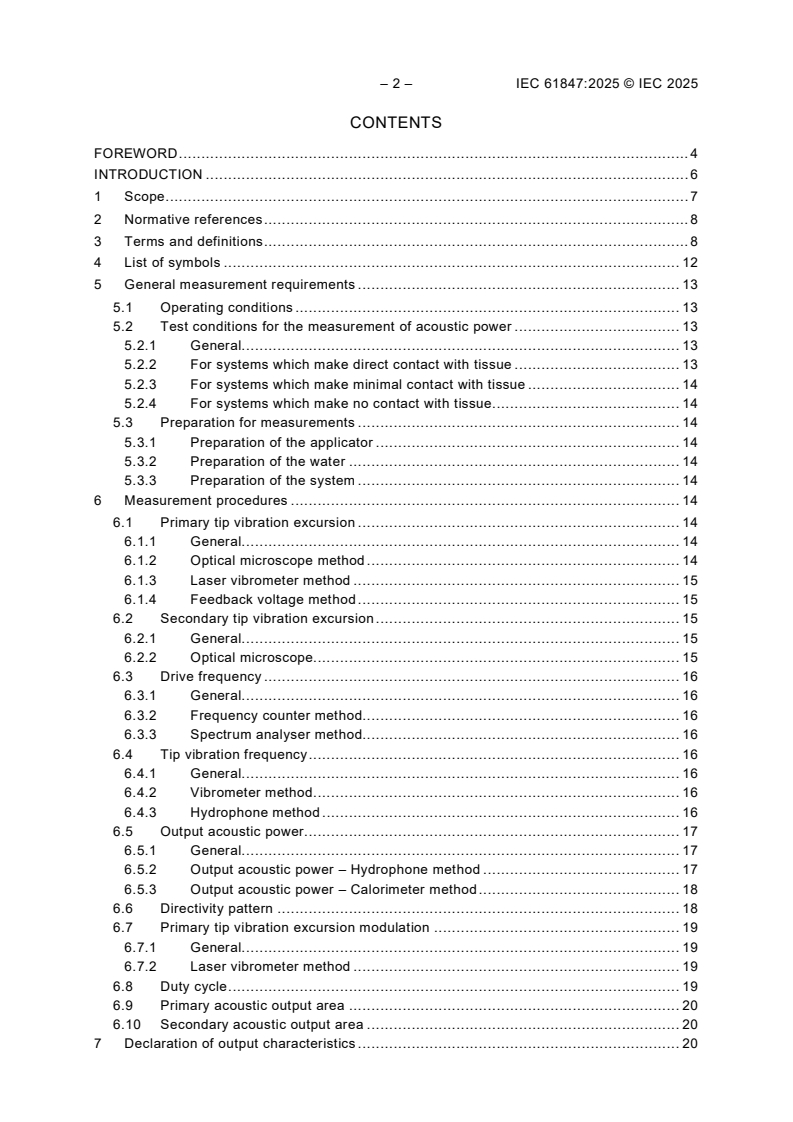
– 2 – IEC 61847:2025 © IEC 2025
CONTENTS
FOREWORD . 4
INTRODUCTION . 6
1 Scope . 7
2 Normative references . 8
3 Terms and definitions . 8
4 List of symbols . 12
5 General measurement requirements . 13
5.1 Operating conditions . 13
5.2 Test conditions for the measurement of acoustic power . 13
5.2.1 General. 13
5.2.2 For systems which make direct contact with tissue . 13
5.2.3 For systems which make minimal contact with tissue . 14
5.2.4 For systems which make no contact with tissue . 14
5.3 Preparation for measurements . 14
5.3.1 Preparation of the applicator . 14
5.3.2 Preparation of the water . 14
5.3.3 Preparation of the system . 14
6 Measurement procedures . 14
6.1 Primary tip vibration excursion . 14
6.1.1 General. 14
6.1.2 Optical microscope method . 14
6.1.3 Laser vibrometer method . 15
6.1.4 Feedback voltage method . 15
6.2 Secondary tip vibration excursion . 15
6.2.1 General. 15
6.2.2 Optical microscope. 15
6.3 Drive frequency . 16
6.3.1 General. 16
6.3.2 Frequency counter method. 16
6.3.3 Spectrum analyser method. 16
6.4 Tip vibration frequency . 16
6.4.1 General. 16
6.4.2 Vibrometer method . 16
6.4.3 Hydrophone method . 16
6.5 Output acoustic power . 17
6.5.1 General. 17
6.5.2 Output acoustic power – Hydrophone method . 17
6.5.3 Output acoustic power – Calorimeter method . 18
6.6 Directivity pattern . 18
6.7 Primary tip vibration excursion modulation . 19
6.7.1 General. 19
6.7.2 Laser vibrometer method . 19
6.8 Duty cycle . 19
6.9 Primary acoustic output area . 20
6.10 Secondary acoustic output area . 20
7 Declaration of output characteristics . 20
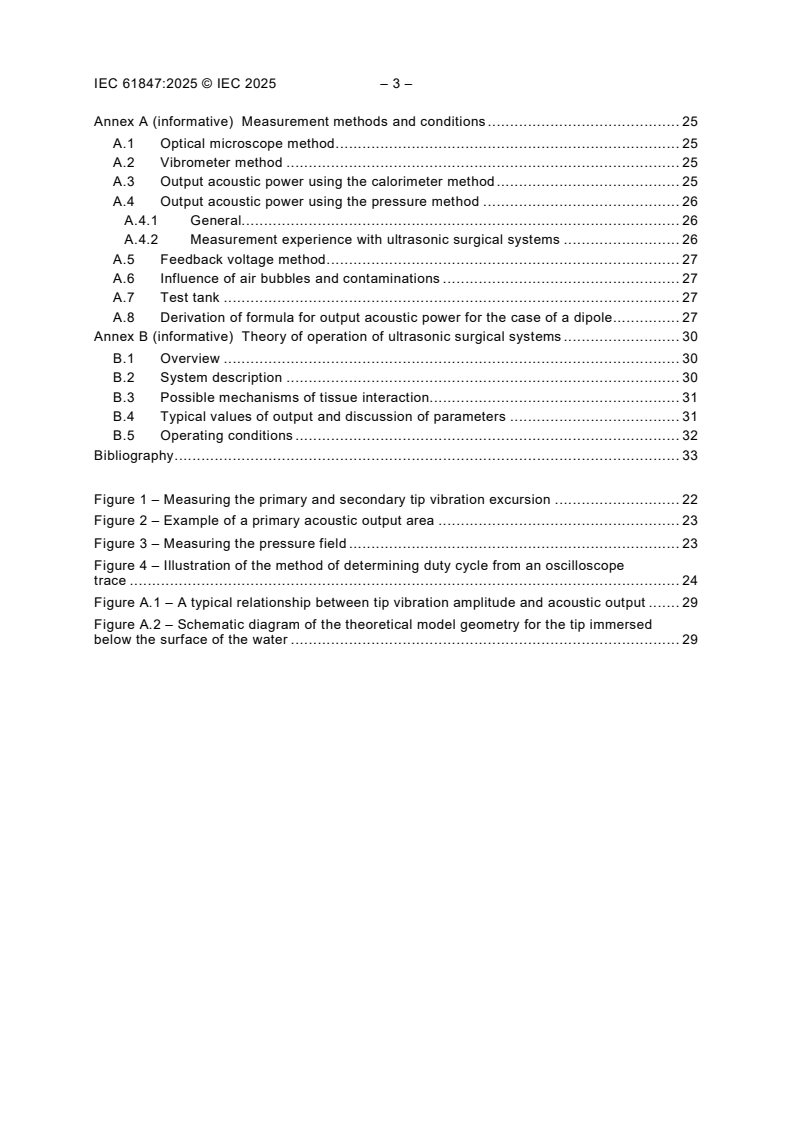
Annex A (informative) Measurement methods and conditions . 25
A.1 Optical microscope method . 25
A.2 Vibrometer method . 25
A.3 Output acoustic power using the calorimeter method . 25
A.4 Output acoustic power using the pressure method . 26
A.4.1 General. 26
A.4.2 Measurement experience with ultrasonic surgical systems . 26
A.5 Feedback voltage method . 27
A.6 Influence of air bubbles and contaminations . 27
A.7 Test tank . 27
A.8 Derivation of formula for output acoustic power for the case of a dipole . 27
Annex B (informative) Theory of operation of ultrasonic surgical systems . 30
B.1 Overview . 30
B.2 System description . 30
B.3 Possible mechanisms of tissue interaction. 31
B.4 Typical values of output and discussion of parameters . 31
B.5 Operating conditions . 32
Bibliography . 33
Figure 1 – Measuring the primary and secondary tip vibration excursion . 22
Figure 2 – Example of a primary acoustic output area . 23
Figure 3 – Measuring the pressure field . 23
Figure 4 – Illustration of the method of determining duty cycle from an oscilloscope
trace . 24
Figure A.1 – A typical relationship between tip vibration amplitude and acoustic output . 29
Figure A.2 – Schematic diagram of the theoretical model geometry for the tip immersed
below the surface of the water . 29
– 4 – IEC 61847:2025 © IEC 2025
INTERNATIONAL ELECTROTECHNICAL COMMISSION
____________
ULTRASONICS – SURGICAL SYSTEMS –
MEASUREMENT AND DECLARATION OF
THE BASIC OUTPUT CHARACTERISTICS
FOREWORD
1) The International Electrotechnical Commission (IEC) is a worldwide organization for standardization comprising
all national electrotechnical committees (IEC National Committees). The object of IEC is to promote international
co-operation on all questions concerning standardization in the electrical and electronic fields. To this end and
in addition to other activities, IEC publishes International Standards, Technical Specifications, Technical Reports,
Publicly Available Specifications (PAS) and Guides (hereafter referred to as "IEC Publication(s)"). Their
preparation is entrusted to technical committees; any IEC National Committee interested in the subject dealt with
may participate in this preparatory work. International, governmental and non-governmental organizations liaising
with the IEC also participate in this preparation. IEC collaborates closely with the International Organization for
Standardization (ISO) in accordance with conditions determined by agreement between the two organizations.
2) The formal decisions or agreements of IEC on technical matters express, as nearly as possible, an international
consensus of opinion on the relevant subjects since each technical committee has representation from all
interested IEC National Committees.
3) IEC Publications have the form of recommendations for international use and are accepted by IEC National
Committees in that sense. While all reasonable efforts are made to ensure that the technical content of IEC
Publications is accurate, IEC cannot be held responsible for the way in which they are used or for any
misinterpretation by any end user.
4) In order to promote international uniformity, IEC National Committees undertake to apply IEC Publications
transparently to the maximum extent possible in their national and regional publications. Any divergence between
any IEC Publication and the corresponding national or regional publication shall be clearly indicated in the latter.
5) IEC itself does not provide any attestation of conformity. Independent certification bodies provide conformity
assessment services and, in some areas, access to IEC marks of conformity. IEC is not responsible for any
services carried out by independent certification bodies.
6) All users should ensure that they have the latest edition of this publication.
7) No liability shall attach to IEC or its directors, employees, servants or agents including individual experts and
members of its technical committees and IEC National Committees for any personal injury, property damage or
other damage of any nature whatsoever, whether direct or indirect, or for costs (including legal fees) and
expenses arising out of the publication, use of, or reliance upon, this IEC Publication or any other IEC
Publications.
8) Attention is drawn to the Normative references cited in this publication. Use of the referenced publications is
indispensable for the correct application of this publication.
9) IEC draws attention to the possibility that the implementation of this document may involve the use of (a)
patent(s). IEC takes no position concerning the evidence, validity or applicability of any claimed patent rights in
respect thereof. As of the date of publication of this document, IEC had not received notice of (a) patent(s), which
may be required to implement this document. However, implementers are cautioned that this may not represent
the latest information, which may be obtained from the patent database available at https://patents.iec.ch. IEC
shall not be held responsible for identifying any or all such patent rights.
IEC 61847 has been prepared by IEC technical committee 87: Ultrasonics. It is an International
Standard.
This second edition cancels and replaces the first edition published in 1998. This edition
constitutes a technical revision.
This edition includes the following significant technical changes with respect to the previous
edition:
a) The upper frequency covered by this document has been raised from 60 kHz to 120 kHz.
b) The hydrophone method of measuring ultrasound power is now normative. Because of
difficulties in using the calorimetry method of measuring ultrasound power, it is no longer
the primary approach.
c) It is recognised that some systems can have more than one mode of vibration under user
control, and the measurement techniques and declarations have been updated to address
this.
d) The high-frequency component, which relates to cavitation developed at the applicator tip
and the vibration amplitude at which cavitation occurs is addressed.
e) Specific requirements for measurement at excursion levels where no cavitation is present,
and extrapolation to maximum excursion level(s) are described.
f) Guidance is provided to adapt the methodology described to more complex designs and
vibration patterns, excursion directions, and their output characteristics.
g) Guidance is provided with respect to measurement tank arrangements for different types of
systems.
h) The list of ultrasound methods and systems not covered by this document was extended to
incorporate recent developments.
i) Definitions for cavitation related terms were added.
j) Requirements for the measurement of directivity characteristics of the applicator tip were
changed.
k) Annex A was modified and Figure A.1 was added.
l) New literature was added, and the references to other standards were updated.
The text of this document is based on the following documents:
Draft Report on voting
87/894/FDIS 87/900/RVD
Full information on the voting for its approval can be found in the report on voting indicated in
the above table.
The language used for the development of this document is English.
This document was drafted in accordance with ISO/IEC Directives, Part 2, and developed in
accordance with ISO/IEC Directives, Part 1 and ISO/IEC Directives, IEC Supplement, available
at www.iec.ch/members_experts/refdocs. The main document types developed by IEC are
described in greater detail at www.iec.ch/publications.
In this document the following print types are used:
– Requirements: in roman type.
– Test specifications: in italic type.
– Notes: in small roman type.
– Words in bold in the text are defined in Clause 3.
The committee has decided that the contents of this document will remain unchanged until the
stability date indicated on the IEC website under webstore.iec.ch in the data related to the
specific document. At this date, the document will be
• reconfirmed,
• withdrawn, or
• revised.
– 6 – IEC 61847:2025 © IEC 2025
INTRODUCTION
Ultrasonic surgical systems, operating in the 20 kHz to 120 kHz range, are used widely in
ophthalmology and neurosurgery to fragment or disintegrate and aspirate unwanted tissue.
Their commercial use in ophthalmology started in 1970. Their application in neurosurgery
followed about 10 years later. Ultrasonic surgical systems are also widely used in oncology
surgery. The use of these systems has expanded to areas such as liposuction and wound
treatments.
This document defines the parameters which characterize the output and performance of open
and closed site ultrasonic surgical systems and indicates which parameters should be declared.
In addition, measurement procedures are described so that technically qualified people will be
able to report on the parameters in a uniform and understandable fashion. An open surgical site
is one in which the area of use is large relative to the size of the applicator tip being inserted
thus precluding any increase in pressure of the organ due to an imbalance of irrigant flow and
suction flow. An example of a closed surgical site is an eye where the incision is closely
controlled.
This document does not provide any guidance on what is the resultant safety or efficacy of
systems described by these parameters. While available data indicate that inertial cavitation
is an important component of efficacy for certain applications, other effects such as acoustic
streaming can be more important in other applications. Overall, it is important that
manufacturers provide users with quantified acoustic and vibrational output metrics, so that
systems can be properly compared, and so that users can improve their surgical technique by
minimizing output while maintaining surgical efficacy.
It is recognized that manufacturers can develop systems with complicated vibrational patterns
and applicator tip geometries. In order to properly compare acoustic output dynamics of such
system, this document describes acoustic pressure measurements to be taken, which, when
combined with excursion and frequency information, allow for the derivation of the effective
acoustic output area. This area is fundamental to the operation of ultrasound surgical systems
and is a key metric for system and applicator tip comparison.
It is recognized that there are difficulties performing acoustic measurements when cavitation,
either inertial or non-inertial, occurs. Therefore, this document describes measurements
performed at low vibration excursion levels when no cavitation is present, with the acoustic
output at higher excursions linearly extrapolated from the low-level measurements. The
excursion level at which cavitation is first detected is also important information for the user.
Cavitation measurement techniques are discussed in other standards currently under
development.
ULTRASONICS – SURGICAL SYSTEMS –
MEASUREMENT AND DECLARATION OF
THE BASIC OUTPUT CHARACTERISTICS
1 Scope
This document specifies:
– the essential non-thermal output characteristics of ultrasonic surgical units;
NOTE 1 One of the parameters of interest is output acoustic power. This document primarily addresses the
low-frequency (under 120 kHz) component of the total delivered energy. The high-frequency component, which
relates to cavitation developed at the tip, is discussed in Clause A.4.
– methods of measurement of these output characteristics;
– those characteristics to be declared by the manufacturers of such equipment.
NOTE 2 In the interest of clarity, a straight tubular shape is used in the basic description of the parameters and
measurements to be made. Guidance is provided to the user of this document to adapt the basic methodology
described to more complex designs as required. It is recognized that complex designs and vibration patterns are
design features of many surgical systems, and therefore it is important that output characteristics be declared
for those conditions.
This document is applicable to equipment which meets the criteria of a), b) and c) below:
a) ultrasonic surgical systems operating in the frequency range 20 kHz to 120 kHz; and
b) ultrasonic surgical systems whose use is the fragmentation, emulsification, debridement, or
cutting of human tissue, whether or not those effects are delivered in conjunction with tissue
removal or coagulation; and
c) ultrasonic surgical systems in which an acoustic wave is conducted by means of a
specifically designed wave guide to deliver energy to the surgical site.
NOTE 3 Examples of these types of systems are surgical aspirators, phacoemulsifiers, intracorporeal
lithotripters, end-cutting systems, ultrasonic liposuction systems, etc.
NOTE 4 The upper frequency limit has been set to accommodate more recently developed systems operating
at higher frequencies than IEC 61847:1998. The techniques of this document are also useful for systems
operating at higher frequencies that use the same mechanisms of action.
This document is not applicable to:
– lithotripsy equipment which uses extracorporeally induced pressure pulses, focused through
liquid conducting media and the soft tissues of the body;
– surgical systems used as part of the therapeutic process (hyperthermia systems);
– surgical systems whose mechanism of action is through frictional heat generated by tissue
in contact with the wave guide, e.g. clamp coagulators or clamping vibrational cutters;
– surgical systems whose mechanism of action is through focused ultrasound for either
thermal degradation (high intensity focused ultrasound – HIFU or HITU) or cavitation
erosion (Histotripsy) of tissue remote from the ultrasound transducer;
– surgical systems whose mechanism of action is through erosion of hard tissues in contact
with the applicator tip, e.g. bone cutting or drilling.
NOTE 5 Limited declaration requirements for surgical systems whose mechanism of action is through erosion
of hard tissues in contact with the applicator tip are listed in Clause 7.
– 8 – IEC 61847:2025 © IEC 2025
This document does not deal with the effectiveness or safety of ultrasonic surgical systems.
This document does not deal with airborne noise from the systems, which can affect operators
and patients.
NOTE 6 Airborne noise levels are addressed in IEC 60601-1 [1] .
NOTE 7 The safety of ultrasonic surgical systems for ophthalmic applications are addressed in IEC 80601-2-58 [2].
NOTE 8 Throughout this document, the term accuracy means the overall uncertainty expressed at the 95 %
confidence level.
2 Normative references
The following documents are referred to in the text in such a way that some or all of their content
constitutes requirements of this document. For dated references, only the edition cited applies.
For undated references, the latest edition of the referenced document (including any
amendments) applies.
IEC 60500, Underwater acoustics – Hydrophones – Properties of hydrophones in the frequency
range 1 Hz to 500 kHz
3 Terms and definitions
For the purposes of this document, the following terms and definitions apply.
ISO and IEC maintain terminology databases for use in standardization at the following
addresses:
• IEC Electropedia: available at https://www.electropedia.org/
• ISO Online browsing platform: available at https://www.iso.org/obp
3.1
applicator tip
applied part
part of the surgical tool which comes into direct contact with body tissues
Note 1 to entry: For systems which do not make direct contact with the surgical or wound site, the applicator tip is
the part of the surgical tool which is directed towards body tissues to effect treatment.
3.2
cavitation
formation, oscillation, vibration, and potential collapse of a bubble or bubbles (gas or vapour)
within a liquid medium
Note 1 to entry: This definition of cavitation is taken from IEC TS 63001:2024 [14], 3.2, 3.4, and 3.5, with
modifications.
3.2.1
acoustic cavitation
cavitation driven by the presence of an acoustic field
3.2.2
inertial cavitation
cavitation in which the collapse of bubbles is driven by the inertia of the medium, including
repetitively, in response to an externally applied acoustic field
___________
Numbers in square brackets refer to the Bibliography.
3.2.3
non-inertial cavitation
oscillation in the size or shape of bubbles in a medium, in response to an externally applied
acoustic field and generally sustained over multiple cycles of the drive frequency, but not
involving the collapses ascribed to inertial cavitation
3.3
directivity pattern
p (Θ)
fd
normalized variation in acoustic pressure as a function of angle at constant range from the
applicator tip
Note 1 to entry: This parameter is used to confirm that the applicator tip produces the directivity pattern that
conforms to the acoustic model used, i.e. monopole or dipole.
Note 2 to entry: The directivity pattern is of dimension number.
3.4
drive frequency
f
d
mean frequency of the driving voltage or current
Note 1 to entry: This parameter, coupled with tip vibration excursion, allows the user to compare the velocities of
applicator tips. For some systems, the tip vibration frequency f can happen at a higher harmonic or sub-harmonic
rp
of this frequency.
Note 2 to entry: For some systems, there can be more than one drive frequency, depending on the intended modes
of operation. In this case, each is described with additional subscripts, e.g., f , f .
d1 d2
Note 3 to entry: The drive frequency is expressed in hertz (Hz).
3.5
duty cycle
D
cy
ratio of the voltage or current pulse
duration (on time) to the duration of one complete modulation cycle while the equipment is
active
Note 1 to entry: The duty cycle is of dimension number and is typically expressed as a percentage.
3.6
output acoustic power
P
a
acoustic power delivered by the applicator tip into water
Note 1 to entry: Measurement of acoustic power delivered by applicator tips having different output areas or
excursion amplitudes will facilitate application of the ALARA principle, the use of exposure levels that are as low as
reasonably achievable.
Note 2 to entry: For some systems, there can be more than one operating condition, with different drive
frequencies, excursions, and effective radiating areas. In this case, each is described with additional subscripts,
e.g. P , P .
a1 a2
Note 3 to entry: The hydrophone method for measuring output acoustic power is specified in 6.5.2. The
calorimetric method had been previously proposed (6.5.3; Clause A.3), but difficulties in the measurement of
ultrasonic surgical systems, especially those systems that involve fluid irrigation and aspiration, result in large
uncertainties. For limited cases, the calorimetric method can be used if the technique is demonstrated to meet the
uncertainty requirements.
Note 4 to entry: The output acoustic power is expressed in watts (W).
– 10 – IEC 61847:2025 © IEC 2025
3.7
primary vibration mode
direction of tip vibration that is considered by the manufacturer to be the default or primary one
that is under user control
3.8
secondary vibration mode
additional vibration mode other than the primary vibration mode
Note 1 to entry: If the vibration mode is not under user control, i.e. it is a vibration mode associated with the primary
vibration mode as a parasitic, then it is measured but it is not required to be reported. If the vibration mode is under
user control, i.e. it represents a specific alternate mode of operation from the primary vibration mode, then it is
measured and reported.
3.9
primary acoustic output area
A
ap
area of the projection of the solid part of the applicator tip in the direction of primary tip
vibration excursion
Note 1 to entry: Primary acoustic output area is used in determining the energy radiated from the end of an
applicator tip for different tips operating at the same vibration excursion and frequency. For hollow or blunt cylinder
applicator tips operated in an excursion direction perpendicular to their face, the primary acoustic output area
can be computed from geometric considerations (see 6.9). For more complex shapes, or for movement that is not
perpendicular to a flat surface, the acoustic output area can be derived from measurements of the tip vibration
frequency, tip excursion, and the pressure measured at a known distance from the tip, using the formulas and
methods within this document.
Note 2 to entry: The primary acoustic output area is expressed in units of metre-squared (m ).
3.10
primary tip vibration excursion
s
p
peak-to-peak displacement of the applicator tip in the direction of maximum amplitude, at a
point on the applicator tip not more than 1 mm from its free end in the direction of maximum
amplitude
Note 1 to entry: The ability to fragment tissue can be correlated to primary tip vibration excursion.
Note 2 to entry: For some systems, the primary tip vibration direction is not colinear with the direction of motion
generated by the vibrational source.
Note 3 to entry: The primary tip vibration excursion is expressed in metres (m).
3.11
primary tip vibration excursion modulation
M
sp
percentage change in the primary tip
vibration excursion from its maximum value to its minimum value
Note 1 to entry: The primary tip vibration excursion modulation is of dimension number and is expressed as a
percentage.
3.12
pulse duration
t
p
time interval beginning at the first time
the drive voltage or current exceeds a reference level and ending at the last time the drive
voltage or current returns to that level
Note 1 to entry: The reference level is equal to the sum of the minimum drive voltage or current and 10 % of the
difference between the maximum and the minimum drive voltage or current.
Note 2 to entry: The pulse duration is expressed in seconds (s).
3.13
reference primary tip vibration excursion
s
pr
maximum primary tip vibration excursion for the combination of applicator tip and handpiece
chosen for measurement
Note 1 to entry: The reference primary tip vibration excursion is expressed in metres (m).
3.14
secondary acoustic output area
A
as
area of the projection of the exposed part of the applicator tip in the direction of the secondary
tip vibration excursion and corresponding to the second largest component of motion
Note 1 to entry: Definitions 3.9 and 3.14 are intended to give the basic areas of interest when considering acoustic
output of simple tubular applicator tips. It is recognized that there can be a wide variety of complex end shapes
available from individual systems.
Note 2 to entry: The secondary acoustic output area can be derived from the secondary tip vibration excursion,
the tip drive frequency and either the acoustic output power or the measured pressure at a known distance using
the formulas and methods within this document.
Note 3 to entry: There can be more than one mode of operation of an individual system, such that there are more
than two (primary and secondary) directions of tip vibration excursion. In this case, each is described with additional
subscripts, e.g., A , A .
as1 as2
Note 4 to entry: The secondary acoustic output area is expressed in units of metre-squared (m ).
3.15
secondary tip vibration excursion
s
s
peak-to-peak displacement of the applicator tip in a direction other than the direction of the
primary tip vibration excursion and corresponding to the direction of the second largest
component of motion of a point on the applicator tip not more than 1 mm from its free (distal)
end
Note 1 to entry: There can be more than one mode of operation of an individual system, such that there are more
than two (primary and secondary) directions of tip vibration excursion. In this case, each shall be described with
additional subscripts, e.g. s , s .
s1 s2
Note 2 to entry: if the secondary tip vibration is not under user control, i.e., it is a parasitic of the primary tip
vibration, then it shall be measured but is not required to be reported. If the secondary tip vibration is under user
control, i.e., it is a specific and distinct mode of system operation, its vibration frequency, reference tip excursion,
acoustic output area, and reference acoustic output power shall be reported.
Note 3 to entry: The secondary tip vibration excursion is expressed in meters (m).
3.16
primary tip vibration frequency
f
rp
fundamental frequency at which the applicator tip oscillates when driving the applicator tip in
the direction of the primary tip vibration excursion
Note 1 to entry: The primary tip vibration frequency is expressed in units of hertz (Hz).
– 12 – IEC 61847:2025 © IEC 2025
3.17
secondary tip vibration frequency
f
rs
fundamental frequency at which the applicator tip oscillates when driving the applicator tip in
the direction of the secondary tip vibration excursion
Note 1 to entry: There can be more than one mode of operation of an individual system, such that there are more
than two (primary and secondary) directions of tip vibration excursion. In this case, each is described with additional
subscripts, e.g. f , f .
rs1 rs2
Note 2 to entry: The secondary tip vibration frequency is expressed in hertz (Hz).
3.18
reference secondary tip vibration excursion
s
sr
maximum secondary tip vibration excursion for the combination of applicator tip and
handpiece chosen for measurement
Note 1 to entry: The reference secondary tip vibration excursion is used to obtain the value of maximum
output acoustic power when the system is operated using the secondary tip vibration. In some cases, it is not
possible to directly measure the maximum output acoustic power at the reference secondary tip vibration
excursion, due to interference from bubble activity. In those circumstances, the output acoustic power is measured
at some lower tip vibration excursion level and then extrapolated to the maximum output acoustic power using the
reference secondary tip vibration excursion.
Note 2 to entry: The reference secondary tip vibration excursion is expressed in metres (m).
3.19
maximum output acoustic power
P
admax
acoustic power delivered by the applicator tip into water, at the reference tip vibration
excursion
Note 1 to entry: If it is not possible to directly measure the maximum output acoustic power at the reference
tip vibration excursion, due to interference from bubble activity, the output acoustic power is measured at some
lower tip vibration excursion level, and then extrapolated to the maximum output acoustic power using the
reference tip vibration excursion.
Note 2 to entry: For some systems, there can be more than one operating condition, with different drive
frequencies, excursions, and effective radiating areas. In this case, each is described with additional subscripts,
e.g. P , P .
admax1 admax2
Note 3 to entry: The maximum output acoustic power is expressed in watts (W).
4 List of symbols
A secondary acoustic output area
as
A primary acoustic output area
ap
c speed of sound in the medium
D duty cycle
cy
f drive frequency
d
f tip vibration frequency
r
M primary tip vibration excursion modulation
sp
p (Θ) directivity pattern
fd
p(r) pressure amplitude at position r
P output acoustic power
a
s primary tip vibration excursion
p
s reference primary tip vibration excursion
pr
s secondary tip vibration excursion
s
t pulse duration
p
ρ density of the measuring medium
5 General measurement requirements
5.1 Operating conditions
Measurements shall be performed with parameters set to the values recommended by the
manufacturer. The parameters to be considered are:
– ambient temperature;
– tip irrigant flow rate (if applicable);
– tip vibration excursion;
– tip aspiration flow rate (if applicable);
– tip configuration;
– system operating mode (if applicable).
The parameters listed above are not set independently during actual surgical use. Therefore,
when a particular surgical environment is to be studied, the parameters listed above shall be
specified so that meaningful comparisons of performance can be made (see Clause B.5).
5.2 Test conditions for the measurement of acoustic power
5.2.1 General
Measurements of output acoustic power shall be made using degassed water (see Clause A.6
for rationale and references to degassing techniques) in a tank, lined with sound absorbing
material and having a suitable size to render it essentially anechoic for the tip vibration
frequency of concern, i.e. free field condition. In addition, for systems which have suction
available, sufficient flow through tip can be used to minimize the accumulation of bubbles on
the front surface of the tip.
5.2.2 For systems which make direct contact with tissue
For those systems in which the nominal operating condition has the applicator tip in contact
with and slightly penetrating into body tissue (e.g., surgical aspirators, phacoemulsifiers), the
applicator tip shall be immersed 1/4 wavelength beneath the surface of the water and the
dipole model shall be used (6.5.2, Clause A.8).
For those systems for which water does not provide a mechanical load comparable to the
surgical condition (e.g., the lens of the eye), the system can produce higher vibration levels at
lower drive voltages than would typically occur. In this case, the manufacturer should account
for this when reporting the output acoustic power.
For those systems in which the nominal operating condition has the applicator completely within
the body (e.g. ultrasonic liposuction systems), the applicator tip shall be immersed several
wavelengths deep into the water and the monopole model shall be used (6.5.2, Clause A.4).
– 14 – IEC 61847:2025 © IEC 2025
5.2.3 For systems which make minimal contact with tissue
For those systems in which the nominal operating condition involves minimal contact with an
open surgical site (e.g., wound debridement), the water tank approach is appropriate to
determine the output acoustic power, and the applicator tip shall be immersed 1/4
wavelength beneath the surface of the water and the dipole model shall be used (6.5.2, Clause
A.8).
5.2.4 For systems which make no contact with tissue
For those systems in which the nominal operating condition involves no contact with tissue
(e.g., non-contact wound irrigation systems), the water tank approach is not appropriate.
Instead, the tip vibration amplitude, frequency, and acoustic output area shall be used to
estimate the output acoustic power assuming a monopole model (6.5.2). The acoustic power
calculation shall be modified to account for the acoustic characteristics of air rather than tissue.
5.3 Preparation for measurements
5.3.1 Preparation of the applicator
Prior to any measurements, all surfaces and parts of the applicator shall be free from
contamination. The applicator tip, the ultrasonic handpiece and the measurement devices
which come into contact with the water and irrigant shall be cleaned with detergent and rinsed
with warm water (see also [3]).
5.3.2 Preparation of the water
Degassed water shall be used (see Clause A.6, see also [4] and [5]).
5.3.3 Preparation of the system
The apparatus shall be allowed a warm-up period as specified by the manufacturer. If a warm-
up period is not specified by the manufacturer, a warm-up period shall be allowed which is long
enough to allow stable operation to be achieved, up to a maximum of 15 min.
6 Measurement procedures
6.1 Primary tip vibration
...