

IEC TS 62903:2023
(Main)Ultrasonics - Measurements of electroacoustical parameters and acoustic output power of spherically curved transducers using the self-reciprocity method
General Information
- Abstract
IEC TS 62903:2023:
a ) establishes the free-field convergent spherical wave self-reciprocity method for ultrasonic transducer calibration,
b) establishes the measurement conditions and experimental procedure required to determine the transducer's electroacoustic parameters and acoustic output power using the self-reciprocity method,
c) establishes the criteria for checking the reciprocity of these transducers and the linear range of the focused field, and
d) provides guiding information for the assessment of the overall measurement uncertainties for radiation conductance.
This document is applicable to:
1) circular spherically curved concave focusing transducers without a centric hole working in the linear amplitude range,
2) measurements in the frequency range 0,5 MHz to 15 MHz, and
3) acoustic pressure amplitudes in the focused field within the linear amplitude range.
Characterization and sensitivity calibration of hydrophones using the reciprocity method are not addressed in this document but covered in IEC 62127-2 and IEC 60565-1.
IEC TS 62903:2023 cancels and replaces the first edition published in 2018. This edition constitutes a technical revision. This edition includes the following significant technical changes with respect to the previous edition:
a) Several quantities are recognized as complex-valued quantities in the definitions and in the main text.
b) Annex I was added to provide typical measurement ranges and to provide example calibration results.
- Status
- Published
- Publication Date
- 12-Jun-2023
- Technical Committee
- TC 87 - Ultrasonics
- Drafting Committee
- WG 8 - TC 87/WG 8
- Current Stage
- PPUB - Publication issued
- Start Date
- 13-Jun-2023
- Completion Date
- 11-Jul-2023
Buy Documents
IEC TS 62903:2023 - Ultrasonics - Measurements of electroacoustical parameters and acoustic output power of spherically curved transducers using the self-reciprocity method Released:6/13/2023
IEC TS 62903:2023 RLV - Ultrasonics - Measurements of electroacoustical parameters and acoustic output power of spherically curved transducers using the self-reciprocity method Released:6/13/2023
Overview
IEC TS 62903:2023 - "Ultrasonics - Measurements of electroacoustical parameters and acoustic output power of spherically curved transducers using the self-reciprocity method" - defines a laboratory method for calibrating and characterizing spherically curved focusing ultrasonic transducers. The technical specification establishes the free-field convergent spherical wave self-reciprocity method, measurement conditions, experimental procedures, reciprocity and linearity checks, and guidance on assessing measurement uncertainty for radiation conductance. This edition (2023) updates the first edition (2018), recognizing several quantities as complex-valued and adding Annex I with typical measurement ranges and example results.
Key Topics and Requirements
- Scope of applicability
- Circular spherically curved concave focusing transducers without a centric hole
- Frequency range 0.5 MHz to 15 MHz
- Measurements within the linear amplitude range of the focused field
- Self-reciprocity calibration
- Free-field convergent spherical wave reciprocity method to obtain electroacoustic parameters and acoustic output power
- Criteria to check reciprocity and to verify the linear range of the focused field
- Measurement system and apparatus
- Water tank, positioning and fixation systems, reflector, current monitor probe, oscilloscope, and measurement hydrophone
- Procedures for determining the effective half-aperture, focus half-angle and effective area
- Calculations and derived parameters
- Transmitting response (to current/voltage), voltage sensitivity, pulse-echo sensitivity, radiation conductance, mechanical quality factor Q, and electroacoustic efficiency
- Diffraction correction coefficient G and treatment of attenuation, speed of sound in water
- Uncertainty assessment
- Guidance and mathematical expressions for evaluating combined standard uncertainty for radiation conductance (Annex H)
- Informative annexes
- Practical ranges, example calibration results, diffraction formulae, and propagation properties of water (Annexes A–I)
Applications and Users
IEC TS 62903:2023 is primarily intended for:
- Calibration and metrology laboratories performing ultrasonic transducer calibration
- Manufacturers of focused ultrasonic transducers (medical imaging, therapeutic ultrasound, nondestructive testing)
- Research groups and test facilities measuring acoustic output power and electroacoustical performance Practical benefits include standardized, reproducible calibration procedures, validated reciprocity and linearity checks, and traceable uncertainty estimation for radiation conductance and power measurements.
Related Standards
- IEC 62127-2 - hydrophone characterization and sensitivity calibration (reciprocity method)
- IEC 60565-1 - hydrophone calibration methods These documents cover hydrophone calibration; IEC TS 62903 explicitly excludes hydrophone reciprocity calibration and focuses on spherically curved transducer characterization.
Relations
- Effective Date
- 05-Sep-2023
Buy Documents
IEC TS 62903:2023 - Ultrasonics - Measurements of electroacoustical parameters and acoustic output power of spherically curved transducers using the self-reciprocity method Released:6/13/2023
IEC TS 62903:2023 RLV - Ultrasonics - Measurements of electroacoustical parameters and acoustic output power of spherically curved transducers using the self-reciprocity method Released:6/13/2023
Get Certified
Connect with accredited certification bodies for this standard

BSMI (Bureau of Standards, Metrology and Inspection)
Taiwan's standards and inspection authority.
Sponsored listings
Frequently Asked Questions
IEC TS 62903:2023 is a technical specification published by the International Electrotechnical Commission (IEC). Its full title is "Ultrasonics - Measurements of electroacoustical parameters and acoustic output power of spherically curved transducers using the self-reciprocity method". This standard covers: IEC TS 62903:2023: a ) establishes the free-field convergent spherical wave self-reciprocity method for ultrasonic transducer calibration, b) establishes the measurement conditions and experimental procedure required to determine the transducer's electroacoustic parameters and acoustic output power using the self-reciprocity method, c) establishes the criteria for checking the reciprocity of these transducers and the linear range of the focused field, and d) provides guiding information for the assessment of the overall measurement uncertainties for radiation conductance. This document is applicable to: 1) circular spherically curved concave focusing transducers without a centric hole working in the linear amplitude range, 2) measurements in the frequency range 0,5 MHz to 15 MHz, and 3) acoustic pressure amplitudes in the focused field within the linear amplitude range. Characterization and sensitivity calibration of hydrophones using the reciprocity method are not addressed in this document but covered in IEC 62127-2 and IEC 60565-1. IEC TS 62903:2023 cancels and replaces the first edition published in 2018. This edition constitutes a technical revision. This edition includes the following significant technical changes with respect to the previous edition: a) Several quantities are recognized as complex-valued quantities in the definitions and in the main text. b) Annex I was added to provide typical measurement ranges and to provide example calibration results.
IEC TS 62903:2023: a ) establishes the free-field convergent spherical wave self-reciprocity method for ultrasonic transducer calibration, b) establishes the measurement conditions and experimental procedure required to determine the transducer's electroacoustic parameters and acoustic output power using the self-reciprocity method, c) establishes the criteria for checking the reciprocity of these transducers and the linear range of the focused field, and d) provides guiding information for the assessment of the overall measurement uncertainties for radiation conductance. This document is applicable to: 1) circular spherically curved concave focusing transducers without a centric hole working in the linear amplitude range, 2) measurements in the frequency range 0,5 MHz to 15 MHz, and 3) acoustic pressure amplitudes in the focused field within the linear amplitude range. Characterization and sensitivity calibration of hydrophones using the reciprocity method are not addressed in this document but covered in IEC 62127-2 and IEC 60565-1. IEC TS 62903:2023 cancels and replaces the first edition published in 2018. This edition constitutes a technical revision. This edition includes the following significant technical changes with respect to the previous edition: a) Several quantities are recognized as complex-valued quantities in the definitions and in the main text. b) Annex I was added to provide typical measurement ranges and to provide example calibration results.
IEC TS 62903:2023 is classified under the following ICS (International Classification for Standards) categories: 17.140.50 - Electroacoustics. The ICS classification helps identify the subject area and facilitates finding related standards.
IEC TS 62903:2023 has the following relationships with other standards: It is inter standard links to IEC TS 62903:2018. Understanding these relationships helps ensure you are using the most current and applicable version of the standard.
IEC TS 62903:2023 is available in PDF format for immediate download after purchase. The document can be added to your cart and obtained through the secure checkout process. Digital delivery ensures instant access to the complete standard document.
Standards Content (Sample)
IEC TS 62903 ®
Edition 2.0 2023-06
TECHNICAL
SPECIFICATION
Ultrasonics – Measurements of electroacoustical parameters and acoustic
output power of spherically curved transducers using the self-reciprocity
method
All rights reserved. Unless otherwise specified, no part of this publication may be reproduced or utilized in any form
or by any means, electronic or mechanical, including photocopying and microfilm, without permission in writing from
either IEC or IEC's member National Committee in the country of the requester. If you have any questions about IEC
copyright or have an enquiry about obtaining additional rights to this publication, please contact the address below or
your local IEC member National Committee for further information.
IEC Secretariat Tel.: +41 22 919 02 11
3, rue de Varembé info@iec.ch
CH-1211 Geneva 20 www.iec.ch
Switzerland
About the IEC
The International Electrotechnical Commission (IEC) is the leading global organization that prepares and publishes
International Standards for all electrical, electronic and related technologies.
About IEC publications
The technical content of IEC publications is kept under constant review by the IEC. Please make sure that you have the
latest edition, a corrigendum or an amendment might have been published.
IEC publications search - webstore.iec.ch/advsearchform IEC Products & Services Portal - products.iec.ch
The advanced search enables to find IEC publications by a Discover our powerful search engine and read freely all the
variety of criteria (reference number, text, technical publications previews. With a subscription you will always have
committee, …). It also gives information on projects, replaced access to up to date content tailored to your needs.
and withdrawn publications.
Electropedia - www.electropedia.org
IEC Just Published - webstore.iec.ch/justpublished
The world's leading online dictionary on electrotechnology,
Stay up to date on all new IEC publications. Just Published
containing more than 22 300 terminological entries in English
details all new publications released. Available online and once
and French, with equivalent terms in 19 additional languages.
a month by email.
Also known as the International Electrotechnical Vocabulary
(IEV) online.
IEC Customer Service Centre - webstore.iec.ch/csc
If you wish to give us your feedback on this publication or need
further assistance, please contact the Customer Service
Centre: sales@iec.ch.
IEC TS 62903 ®
Edition 2.0 2023-06
TECHNICAL
SPECIFICATION
Ultrasonics – Measurements of electroacoustical parameters and acoustic
output power of spherically curved transducers using the self-reciprocity
method
INTERNATIONAL
ELECTROTECHNICAL
COMMISSION
ICS 17.140.50 ISBN 978-2-8322-7107-0
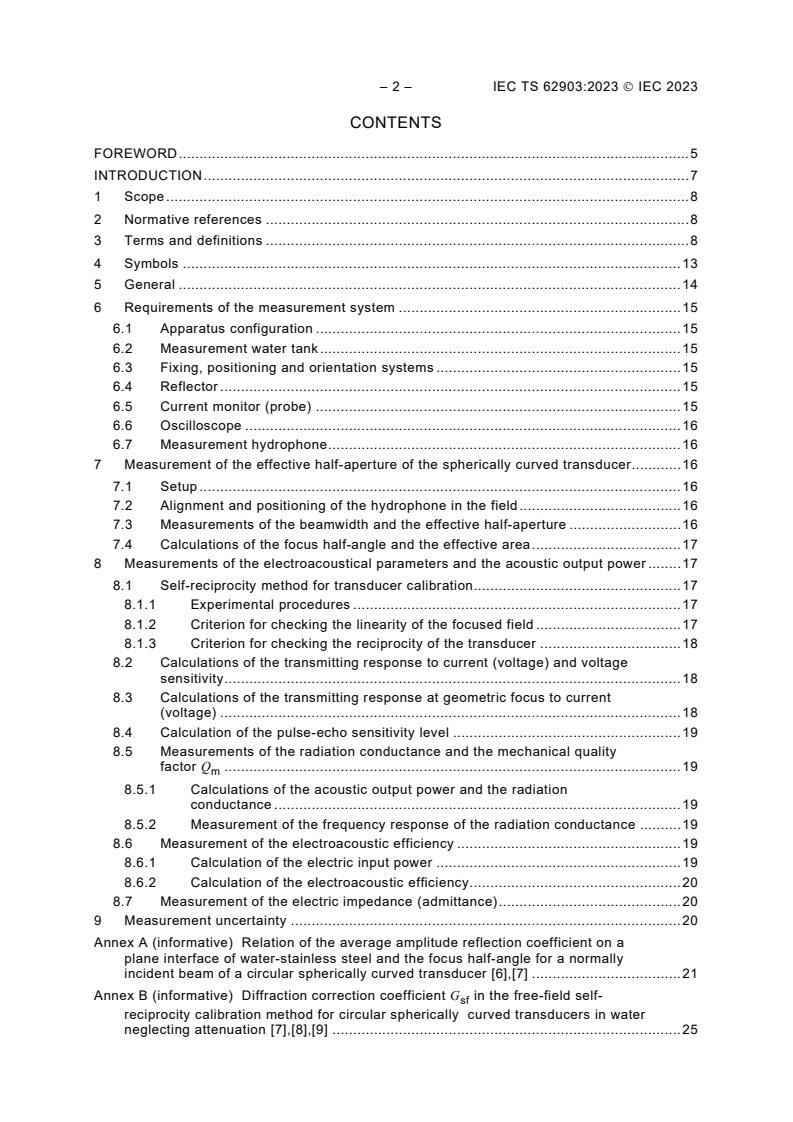
– 2 – IEC TS 62903:2023 IEC 2023
CONTENTS
FOREWORD . 5
INTRODUCTION . 7
1 Scope . 8
2 Normative references . 8
3 Terms and definitions . 8
4 Symbols . 13
5 General . 14
6 Requirements of the measurement system . 15
6.1 Apparatus configuration . 15
6.2 Measurement water tank . 15
6.3 Fixing, positioning and orientation systems . 15
6.4 Reflector . 15
6.5 Current monitor (probe) . 15
6.6 Oscilloscope . 16
6.7 Measurement hydrophone . 16
7 Measurement of the effective half-aperture of the spherically curved transducer . 16
7.1 Setup . 16
7.2 Alignment and positioning of the hydrophone in the field . 16
7.3 Measurements of the beamwidth and the effective half-aperture . 16
7.4 Calculations of the focus half-angle and the effective area . 17
8 Measurements of the electroacoustical parameters and the acoustic output power . 17
8.1 Self-reciprocity method for transducer calibration . 17
8.1.1 Experimental procedures . 17
8.1.2 Criterion for checking the linearity of the focused field . 17
8.1.3 Criterion for checking the reciprocity of the transducer . 18
8.2 Calculations of the transmitting response to current (voltage) and voltage
sensitivity . 18
8.3 Calculations of the transmitting response at geometric focus to current
(voltage) . 18
8.4 Calculation of the pulse-echo sensitivity level . 19
8.5 Measurements of the radiation conductance and the mechanical quality
factor Q . 19
m
8.5.1 Calculations of the acoustic output power and the radiation
conductance . 19
8.5.2 Measurement of the frequency response of the radiation conductance . 19
8.6 Measurement of the electroacoustic efficiency . 19
8.6.1 Calculation of the electric input power . 19
8.6.2 Calculation of the electroacoustic efficiency . 20
8.7 Measurement of the electric impedance (admittance) . 20
9 Measurement uncertainty . 20
Annex A (informative) Relation of the average amplitude reflection coefficient on a
plane interface of water-stainless steel and the focus half-angle for a normally
incident beam of a circular spherically curved transducer [6],[7] . 21
Annex B (informative) Diffraction correction coefficient G in the free-field self-
sf
reciprocity calibration method for circular spherically curved transducers in water
neglecting attenuation [7],[8],[9] . 25
Annex C (informative) Calculation of the diffraction correction coefficient G (R/λ,β) in
sf
the free-field self-reciprocity calibration in a non-attenuating medium for a circular
spherically curved transducer [7],[8],[9],[10] . 27
Annex D (informative) Speed of sound and attenuation in water. 30
D.1 General . 30
D.2 Speed of sound for propagation in water [14] . 30
D.3 Acoustic attenuation coefficient for propagation in water . 30
Annex E (informative) Principle of reciprocity calibration for spherically curved
transducers [7],[8],[9],[16],[17],[18],[19] . 32
E.1 Principle of reciprocity calibration for an ideal spherically focused field of a
transducer . 32
E.2 Principle of reciprocity calibration of a real spherically focused field of a
transducer . 33
E.3 Self-reciprocity calibration of a spherically curved transducer . 33
Annex F (informative) Experimental arrangements . 38
F.1 Experimental arrangement for determining the effective radius of a
transducer [7],[8],[9],[24] . 38
F.2 Experimental arrangement of the self-reciprocity calibration method for a
spherically curved transducer [8],[9],[24],[25] . 38
Annex G (informative) Relationships between the electroacoustical parameters used
in this application [24] . 40
G.1 Relationship between the free-field transmitting response to voltage
(current) and the voltage sensitivity with the radiation conductance . 40
G.2 Relationship between the radiation conductance and the electroacoustic
efficiency . 41
G.3 Relationship between the transmitting response and voltage and acoustic
output power . 41
G.4 Relationship between the pulse echo sensitivity and the radiation
conductance . 41
Annex H (informative) Evaluation and expression of uncertainty in the measurements
of the radiation conductance . 42
H.1 Executive standard . 42
H.2 Evaluation of uncertainty in the measurement of the radiation conductance . 42
H.2.1 Mathematical expression . 42
H.2.2 Type A evaluation of standard uncertainty . 42
H.2.3 Type B evaluation of standard uncertainty . 43
H.2.4 Evaluation of the combined standard uncertainty for the radiation
conductance . 45
Annex I (informative) Measurement range for power and pressure and examples of
electroacoustical parameters obtained . 49
I.1 Measurement range of acoustic pressure and power . 49
I.1.1 Lower limit of acoustic power . 49
I.1.2 Upper limit of pressure [27] . 49
I.2 Calibrated example of electroacoustical parameters . 50
I.2.1 1 MHz focusing transducer with air backing of diameter 80 mm and
focal length 200 mm . 50
I.2.2 5 MHz focusing transducer with air backing of diameter 20 mm and
focal length 20 mm . 51
Bibliography . 52
– 4 – IEC TS 62903:2023 IEC 2023
Figure A.1 – Relation curve of the amplitude reflection coefficient r(θ ) on the interface
i
of water-stainless steel for a plane wave with the incident angle θ . 23
i
Figure A.2 – Average amplitude reflection coefficient r (β) on the plane interface of
av
water-stainless steel in the geometric focal plane of a spherically curved transducer
plotted against the focus half-angle β . 24
Figure C.1 – Geometry of the concave radiating surface A of a spherically curved
transducer and its virtual image surface A′ for their symmetry of mirror-images about
the geometric focal plane (x,y,0) . 27
Figure E.1 – Spherical coordinates . 34
Figure E.2 – Function G (kasinθ), diffraction pattern F (kasinθ) and F (kasinθ) in the
a 0 0
geometric focal plane [10] . 35
Figure F.1 – Scheme of the measurement apparatus for determining the effective half-
aperture of a transducer . 38
Figure F.2 – Scheme of free-field self-reciprocity method applied to a spherically
curved transducer . 39
Figure I.1 – The acoustic power as the function of the excitation voltage squared for a
10 MHz spherically curved transducer with backing of diameter 8 mm and curvature
25 mm . 49
Figure I.2 – Results of a 1 MHz focusing transducer with a diameter of 60 mm and
focal length of 75 mm measured using the self-reciprocity method . 50
Figure I.3 – Frequency responses of G, |S |, |M|, η for a 1 MHz spherical transducer
If a/e
of diameter 80 mm and focal length 200 mm . 50
Figure I.4 – Frequency responses of G, |S |, |M|, η for a 5 MHz spherical transducer
If a/e
of diameter 20 mm and focal length 20 mm . 51
Table A.1 – Parameters used in calculation of the average amplitude reflection
coefficient . 22
Table A.2 – Amplitude reflection coefficient r(θ ) on a plane interface of water-stainless
i
steel for plane wave for various incident angles θ . 22
i
Table A.3 – Average amplitude reflection coefficient r (β) on plane interface of water-
av
stainless steel in the geometric focal plane of a spherically curved transducer for
various focus half-angles β . 23
Table B.1 – Diffraction correction coefficients G of a circular spherically curved
sf
transducer in the self-reciprocity calibration method [7],[8],[9] . 25
Table D.1 – Dependence of speed of sound in water on temperature . 30
Table D.2 – Dependence of α /f in water on temperature . 31
Table E.1 – G values dependent on kasinθ for β ≤ 45° where x = kasinθ (according to
a
O'Neil [10]) . 36
Table E.2 – The (R/λ) values dependent on β when θ ≥ θ and β ≤ 45° for G =
min max G a
a
0,94; 0,95; 0,96; 0,97; 0,98; 0,99 . 37
Table H.1 – Type B evaluation of the standard uncertainties (SU) of input quantities in
measurement . 44
Table H.2 – Components of the standard uncertainty for the measurement of the
radiation conductance using the self-reciprocity method . 47
Table H.3 – The measurement results and evaluated data of uncertainty for five
transducers . 48
INTERNATIONAL ELECTROTECHNICAL COMMISSION
____________
ULTRASONICS – MEASUREMENTS OF ELECTROACOUSTICAL
PARAMETERS AND ACOUSTIC OUTPUT POWER OF SPHERICALLY
CURVED TRANSDUCERS USING THE SELF-RECIPROCITY METHOD
FOREWORD
1) The International Electrotechnical Commission (IEC) is a worldwide organization for standardization comprising
all national electrotechnical committees (IEC National Committees). The object of IEC is to promote international
co-operation on all questions concerning standardization in the electrical and electronic fields. To this end and
in addition to other activities, IEC publishes International Standards, Technical Specifications, Technical Reports,
Publicly Available Specifications (PAS) and Guides (hereafter referred to as “IEC Publication(s)”). Their
preparation is entrusted to technical committees; any IEC National Committee interested in the subject dealt with
may participate in this preparatory work. International, governmental and non-governmental organizations liaising
with the IEC also participate in this preparation. IEC collaborates closely with the International Organization for
Standardization (ISO) in accordance with conditions determined by agreement between the two organizations.
2) The formal decisions or agreements of IEC on technical matters express, as nearly as possible, an international
consensus of opinion on the relevant subjects since each technical committee has representation from all
interested IEC National Committees.
3) IEC Publications have the form of recommendations for international use and are accepted by IEC National
Committees in that sense. While all reasonable efforts are made to ensure that the technical content of IEC
Publications is accurate, IEC cannot be held responsible for the way in which they are used or for any
misinterpretation by any end user.
4) In order to promote international uniformity, IEC National Committees undertake to apply IEC Publications
transparently to the maximum extent possible in their national and regional publications. Any divergence between
any IEC Publication and the corresponding national or regional publication shall be clearly indicated in the latter.
5) IEC itself does not provide any attestation of conformity. Independent certification bodies provide conformity
assessment services and, in some areas, access to IEC marks of conformity. IEC is not responsible for any
services carried out by independent certification bodies.
6) All users should ensure that they have the latest edition of this publication.
7) No liability shall attach to IEC or its directors, employees, servants or agents including individual experts and
members of its technical committees and IEC National Committees for any personal injury, property damage or
other damage of any nature whatsoever, whether direct or indirect, or for costs (including legal fees) and
expenses arising out of the publication, use of, or reliance upon, this IEC Publication or any other IEC
Publications.
8) Attention is drawn to the Normative references cited in this publication. Use of the referenced publications is
indispensable for the correct application of this publication.
9) Attention is drawn to the possibility that some of the elements of this IEC Publication may be the subject of patent
rights. IEC shall not be held responsible for identifying any or all such patent rights.
IEC TS 62903 has been prepared by IEC technical committee 87: Ultrasonics. It is a Technical
Specification.
This second edition cancels and replaces the first edition published in 2018. This edition
constitutes a technical revision.
This edition includes the following significant technical changes with respect to the previous
edition:
a) Several quantities are recognized as complex-valued quantities in the definitions and in the
main text.
b) Annex I was added to provide typical measurement ranges and to provide example
calibration results.
– 6 – IEC TS 62903:2023 IEC 2023
The text of this Technical Specification is based on the following documents:
Draft Report on voting
87/825/DTS 87/829/RVDTS
Full information on the voting for its approval can be found in the report on voting indicated in
the above table.
The language used for the development of this Technical Specification is English.
In this document, the following print types are used:
• terms defined in Clause 3: in bold type.
This document was drafted in accordance with ISO/IEC Directives, Part 2, and developed in
accordance with ISO/IEC Directives, Part 1 and ISO/IEC Directives, IEC Supplement, available
at www.iec.ch/members_experts/refdocs. The main document types developed by IEC are
described in greater detail at www.iec.ch/publications.
The committee has decided that the contents of this document will remain unchanged until the
stability date indicated on the IEC website under webstore.iec.ch in the data related to the
specific document. At this date, the document will be
• reconfirmed,
• withdrawn,
• replaced by a revised edition, or
• amended.
INTRODUCTION
An ultrasonic transducer is an important acoustic device that can act as a transmitter or a
receiver in the applications of medical ultrasound, non-destructive testing, and ultrasonic
materials processing. The performance of a transducer is a decisive factor that governs the
device's range of applicability, efficiency and quality control in the manufacturing. The
mechanisms, transmitting fields, performances, and measurement methods used for these
transducers have been studied over the past few decades. However, the electroacoustical
characterization and measurement methods applied for spherically curved transducers have
not been defined in standard documents for either terms or protocols.
This document defines the relevant electroacoustical parameters for these devices and
establishes the self-reciprocity measurement method for spherically curved concave focusing
transducers.
– 8 – IEC TS 62903:2023 IEC 2023
ULTRASONICS – MEASUREMENTS OF ELECTROACOUSTICAL
PARAMETERS AND ACOUSTIC OUTPUT POWER OF SPHERICALLY
CURVED TRANSDUCERS USING THE SELF-RECIPROCITY METHOD
1 Scope
This document, which is a Technical Specification,
a) establishes the free-field convergent spherical wave self-reciprocity method for ultrasonic
transducer calibration,
b) establishes the measurement conditions and experimental procedure required to determine
the transducer's electroacoustic parameters and acoustic output power using the self-
reciprocity method,
c) establishes the criteria for checking the reciprocity of these transducers and the linear range
of the focused field, and
d) provides guiding information for the assessment of the overall measurement uncertainties
for radiation conductance.
This document is applicable to:
1) circular spherically curved concave focusing transducers without a centric hole working in
the linear amplitude range,
2) measurements in the frequency range 0,5 MHz to 15 MHz, and
3) acoustic pressure amplitudes in the focused field within the linear amplitude range.
Characterization and sensitivity calibration of hydrophones using the reciprocity method are not
addressed in this document but covered in IEC 62127-2 [1] and IEC 60565-1 [2].
2 Normative references
The following documents are referred to in the text in such a way that some or all of their content
constitutes requirements of this document. For dated references, only the edition cited applies.
For undated references, the latest edition of the referenced document (including any
amendments) applies.
IEC 60050-801, International Electrotechnical Vocabulary – Chapter 801: Acoustics and
electroacoustics, available at www.electropedia.org
3 Terms and definitions
For the purposes of this document, the terms and definitions given in IEC 60050-801 and the
following apply.
ISO and IEC maintain terminological databases for use in standardization at the following
addresses:
• IEC Electropedia: available at http://www.electropedia.org/
• ISO Online browsing platform: available at http://www.iso.org/obp
—————————
Numbers in square brackets refer to the Bibliography.
3.1
p
av
average acoustic pressure
acoustic pressure averaged over the effective area of the transducer
Note 1 to entry: Average acoustic pressure is expressed in pascals (Pa).
3.2
r (β)
av
average amplitude reflection coefficient
quotient of the free-field echo average acoustic pressure p (β) reflected by the reflector on
av
the geometric focal plane over the space area coincident with the effective area of the
spherically curved transducer of focus half-angle β, if the transducer were removed, to the
reference acoustic pressure p on the effective area of the transducer in a non-attenuation
medium with negligible diffraction
r (β) = p (β)/p (1)
av av 0
3.3
G
sf
diffraction correction coefficient
quotient of the average acoustic pressure over the spherical segment surface of the
spherically curved transducer's virtual image at a position in the distance of twice geometric
focal length from the transducer, if an ideal reflecting mirror were located on the geometric
focal plane, to the reference acoustic pressure of the transducer in the free-field of a non-
attenuation medium
3.4
A
effective area
area of the radiating surface of a theoretically predicted transducer with specific
field distribution characteristics that are approximately the same as those of a real transducer
of the same type
Note 1 to entry: For a spherically curved transducer, the theoretically predicted acoustic pressure distribution on
the geometric focal plane of a transducer is expected to be approximately the same as that of the real transducer
with the same geometric focal length when operating at the same frequency.
Note 2 to entry: The half-aperture of an effective area is also named the effective half-aperture or the effective
radius.
Note 3 to entry: The effective area of a transducer is expressed in units of metre squared (m ).
3.5
η
a/e
electroacoustic efficiency
quotient of the acoustic output power to the electric input power
3.6
electroacoustical reciprocity principle
electroacoustical reciprocity theorem
principle that the quotient of the free-field voltage (current) sensitivity of a reciprocal
transducer as a receiver, to the transmitting response to current (voltage) of the reciprocal
transducer as a projector is constant
Note 1 to entry: This principle is independent of the construction of the reciprocal transducer.
– 10 – IEC TS 62903:2023 IEC 2023
3.7
free-field
sound field in a homogeneous isotropic medium whose boundaries exert a negligible effect on
the sound wave
[SOURCE: IEC 61161:2013, 3.2]
3.8
M(f)
free-field voltage sensitivity
receiving voltage response
quotient of the Fourier transform of the open-circuit output
voltage signal (U(t)) of a spherically curved transducer within the field of a point source at its
geometric focus to the Fourier transform of the free-field acoustic pressure waveform (p(t))
for a specified frequency f and incidence on the surface of the transducer if the transducer were
removed
Ut
( ( ))
Mf( ) = (2)
pt
( ( ))
Note 1 to entry: The free-field voltage sensitivity of a spherically curved transducer is a complex-value parameter.
The modulus of the free-field voltage sensitivity of a spherically curved transducer is expressed in units of volt per
pascal (V/Pa). The phase angle is the argument of the sensitivity and represents the phase difference between the
electrical transducer output voltage and the incident pressure. The unit of phase is the radian.
3.9
geometric beam boundary
surface containing straight lines passing through the geometric focus and all points around
the periphery of the transducer aperture
Note 1 to entry: Applies to ultrasonic transducers of known construction.
[SOURCE: IEC 61828:2020, 3.64]
3.10
F
geo
geometric focal length
distance from the geometric focus to the position where the beam axis intersects the effective
focusing surface
Note 1 to entry: Applies to transducers with known construction.
Note 2 to entry: Geometric focal length is expressed in metres (m).
Note 3 to entry: This definition applies only to focusing transducers.
[SOURCE: IEC 61828:2020, 3.66]
3.11
geometric focus
point for which all of the effective path lengths in a specified longitudinal plane are equal
Note 1 to entry: Equivalently, the spatial point for which the arrival times of all waves from the transducer have the
same delay relative to the voltage excitation of the transducer, as viewed in the approximation of geometrical
acoustics, neglecting diffraction.
Note 2 to entry: This definition applies only to focusing transducers.
[SOURCE: IEC 61828:2020, 3.67]
3.12
L
Mpe
pulse-echo sensitivity level
twenty times the logarithm to the base 10 of the ratio of the received open-circuit voltage U for
the first echo signal of the spherically curved transducer when acting as a receiver to the
exciting voltage of the transducer U when it is transmitting a tone burst ultrasonic beam in a
T
direction perpendicular to an ideal plane reflector (r = 1) at the geometric focal plane for a
specified frequency
U
L = 20 log dB (3)
Mpe 10
U
T
Note 1 to entry: The logarithmic ratio is expressed in decibels (dB).
3.13
G
radiation conductance
quotient of the acoustic output power and the squared effective transducer input voltage
Note 1 to entry: It is used to characterize the electrical to acoustical transfer of ultrasonic transducers.
Note 2 to entry: The frequency of the input voltage (or current) should be noted.
Note 3 to entry: Radiation conductance is expressed in siemens (S).
[SOURCE: IEC 61161:2013, 3.8, modified – In the definition, "RMS" has been replaced with
"effective" and "ratio" has been replaced with "quotient".]
3.14
reciprocal transducer
linear, passive and reversible electroacoustic transducer such that the coupling coefficients are
equal for transduction regardless of whether transduction is electrical to mechanical or vice
versa
[SOURCE: IEC 60565-1:2020, 3.7]
3.15
J
reciprocity coefficient
quotient of the free-field voltage sensitivity of a reciprocal transducer as a
receiver to the transmitting response to current of the transducer as a projector, or the
quotient of the free-field current sensitivity of a transducer as a receiver to the transmitting
response to voltage of the transducer as a projector
M
J = (4)
S
I
Note 1 to entry: The modulus of the reciprocity coefficient of a spherically curved transducer, |J|= J , is equal to
sf
the quotient of twice the effective area of the transducer to the acoustic characteristic impedance of the medium,
i.e.
M 2A
J (5)
sf
S ρc
I
where
A is the effective area of curved surface of the spherically curved transducer;
ρ is the (mass) density of the medium;
c is the speed of sound in the medium (usually water).
Note 2 to entry: The reciprocity coefficient is expressed in units of watt per pascal squared (W/Pa ).
==
– 12 – IEC TS 62903:2023 IEC 2023
3.16
p
reference acoustic pressure
product of the uniform normal particle velocity on the spherically curved surface of the
transducer and the characteristic impedance of the medium
Note 1 to entry: Reference acoustic pressure is expressed in pascals (Pa).
3.17
reversible transducer
transducer capable of acting as a projector as well as a receiver
[SOURCE: IEC 60565-1:2020, 3.8, modified – In the definition, "hydrophone" has been replaced
with "receiver".]
3.18
self-reciprocity method
transducer calibration method based on the reciprocity principle that uses the received echo
signal from the plane reflector that is set perpendicular to the incident beam axis of the
transducer
3.19
S (f)
I
transmitting response to current
transmitting current response
quotient of the Fourier transform of the reference acoustic pressure (p (t))
on the radiating surface of a transducer in the free field in the absence of interference effects
to the Fourier transform of the exciting electrical current (I(t)) through the electrical terminals
of the transducer for a specified frequency f
pt( )
( )
S ( f ) = (6)
I
It
( ( ))
Note 1 to entry: The transmitting response to current of a transducer is a complex-valued parameter. The
−1
modulus of the transmitting response to current is expressed in units of pascal per ampere, Pa·A . The phase
angle is the argument of the transmitting response and represents the phase difference between the acoustic
pressure at the surface of the transducer and the electric current. The unit of phase angle is the radian.
3.20
S (f)
U
transmitting response to voltage
transmitting voltage response
quotient of the Fourier transform of the reference acoustic pressure (p (t))
on the radiating surface of a transducer in the free field in the absence of interference effects
to the Fourier transform of the electrical exciting voltage across the terminals of the projector
(U (t)), for a specified frequency f
T
pt
( ( ))
S ( f ) = (7)
U
Ut
( ( ))
T
Note 1 to entry: The transmitting response to voltage of a transducer is a complex-valued parameter. The modulus
−1
of the transmitting response to voltage is expressed in units of pascal per volt, Pa·V . The phase angle is the
argument of the transmitting response and represents the phase difference between the reference acoustic pressure
at the surface of the transducer and the exciting electrical voltage. The unit of phase angle is the radian.
4 Symbols
a effective half-aperture, effective radius of transducer
A effective area of transducer
c speed of sound in sound propagating medium usually in water
d distance from the centre of the transmitting surface of the transducer to the
reflecting plane of the reflector in the geometric focal plane
f resonant frequency
f central frequency
c
geometric focal length (F = R)
F
geo geo
G radiation conductance
G diffraction correction coefficient for spherically curved transducer in free-field
sf
self-reciprocity calibration
h height (depth) at the centre of a spherical segment
I acoustic intensity
I , I exciting current amplitude, effective exciting current
T Trms
I short-circuit current amplitude of the generator
k
I first echo current amplitude
echo
J reciprocity coefficient of transducer
J modulus of the reciprocity coefficient of spherically curved transducer
sf
k circular wave number (k = 2π/λ)
k ratio of the acoustic pressure at the geometric focus to the reference acoustic
m
pressure on the radiation surface of the transducer in a non-attenuating medium
l distance from the centre of receiving surface of the hydrophone to the centre of
the transmitting surface of the transducer along their common axis after
alignment
L pulse-echo sensitivity level
Mpe
M free-field voltage sensitivity (receiving voltage response) of a spherically
curved transducer
p reference acoustic pressure of a radiating surface
P acoustic output power
P electrical input power
e
q ratio of the true time-average intensity I to the time-average derived intensity I
p
at the geometric focus (q = (1 + cosβ)/2)
Q mechanical quality factor
m
r amplitude reflection coefficient
r (β) average amplitude reflection coefficient on a plane reflector in the geometric
av
focal plane in water for a spherically curved transducer
R radius of curvature
S transmitting response to current
I
S transmitting response at geometric focus to current
If
S transmitting response to voltage
U
S transmitting response at geometric focus to voltage
Uf
– 14 – IEC TS 62903:2023 IEC 2023
∆t acoustic pulse transit time
F
U open-circuit voltage amplitude of tone burst generator
U , U exciting voltage amplitude, exciting effective voltage of the transducer
T Trms
U maximum of the first echo voltage amplitude received by the transducer to be
calibrated in self-reciprocity calibration process
U output voltage of the current probe when picking up the exciting current of the
IT
transducer
U output voltage of the current probe when picking up the first echo current of the
Iecho
transducer
U output voltage of the current probe when picking up the short-circuit current of
Ik
the tone burst generator
U effective voltage
rms
v particle velocity
w −3 dB beamwidth on geometric focal plane
w −6 dB beamwidth on geometric focal plane
Y electric admittance of transducer in a medium (usually in water)
T
Z electric output impedance of generator
i
Z electric impedance of transducer in a medium (usually in water)
T
α acoustic attenuation coefficient in a medium (usually in water)
β focus half-angle (β = arcsin(a/R))
θ electric impedance angle
e
ρ (mass) density of the sound propagating medium (usually water)
η electroacoustic efficiency
a/e
λ wavelength
τ pulse duration
5 General
The transducer characteristics include the ultrasonic field parameters and the transmission and
reception performance parameters.
The focused field performance parameters include the effective half-aperture (the effective
radius), the beam width, the effective area, the geometric focal length, and the focus
half-angle for spherically curved transducers.
The transmission performance parameters include the radiation conductance, the acoustic
output power, the free-field transmitting response to current (voltage), the electroacoustic
efficiency, and the electric impedance.
The reception performance parameter is the free-field voltage sensitivity.
The transmission-reception parameter is the pulse-echo sensitivity level.
In this document, the beam profile method using a hydrophone is defined for the measurement
of the field performance parameters; the self-reciprocity method is defined for the
measurement of the free-field transmitting response to current (voltage), the free field
voltage sensitivity, pulse-echo sensitivity level, and the acoustic output power (see
Annex E); the radiation conductance is derived from the acoustic power and the effective
exciting voltage; the electroacoustic efficiency is calculated from the acoustic output power
and the detected electrical input power. Relations between these electroacoustical parameters
are given in Annex G. Examples of typical measurement ranges and calibration results are
given in Annex I.
6 Requirements of the measurement system
6.1 Apparatus configuration
The electrical system of the apparatus consists of a tone burst generator, a current monitor
(probe), an oscilloscope and two switches. The acoustical system consists of a water tank for
the measurements, a measurement hydrophone, fixtures, positioning and orientation systems
(for both the transducer and the hydrophone), displacement sensors or indicators, and a
stainless-steel reflector, as shown in Annex F. The apparatus for determining the effective
radius and the self-reciprocity calibration are shown in Figure F.1 and Figure F.2, respectively.
6.2 Measurement water tank
The tank shall have sufficient effective space of water bath to ensure that the maximum distance
between the hydrophone and the transducer can be achieved to meet the requirements for
fixtures, positioning and orienting the devices. The minimum dimensions of the tank for the tone
2 2 1/2 2 2 1/2
burst field measurement only should be (R + cτ) × (2Rcτ + c τ ) × (2Rcτ + c τ ) (length ×
width × height), where R is the radius of curvature, c is the speed of sound in water, τ is the
pulse duration and less than or equal to 30 cycles. Considering other requirements the tank
should be not smaller than 0,55 m × 0,32 m × 0,38 m (length × width × height). The tank is filled
with degassed water, and the water temperature is indicated by a thermometer. The water
temperature should be stable within ±0,5 °C during measurements and should be measured
with a thermometer of ±0,2 °C accuracy. Usage of deionized and degassed water is
recommended. Procedures to prepare degassed water are given in IEC TR 62781 [3].
6.3 Fixing, positioning and orientation systems
The transducer and the hydrophone shall be fixed on fixtures that allow positional adjustment
of the devices in three perpendicular directions as well as allowing their angles of azimuth and
elevation to be independently and continuously being adjusted. The positioning accuracy should
be better than ±0,1 mm in the axial direction z and ±0,01 mm in the lateral directions x and y,
while the orientation accuracy should be better than ±0,05°. The resolution of the displacement
sensor should be 0,01 mm or less.
6.4 Reflector
The reflector is a thick plate or cylinder made of stainless steel. One of the planes or terminal
surfaces of the reflector is used as a reflection plane that should be flat to ±10 μm and should
also show a surface finish good to ±5 μm. The thickness of the reflector shall be large enough
to ensure that the first echo from the rear surface does not interfere with that from the front
surface at the lowest frequency used. A reflector with minimum thickness of 60 mm is suitable.
The reflector diameter shall be sufficient to reflect
...
IEC TS 62903 ®
Edition 2.0 2023-06
REDLINE VERSION
TECHNICAL
SPECIFICATION
colour
inside
Ultrasonics – Measurements of electroacoustical parameters and acoustic
output power of spherically curved transducers using the self-reciprocity
method
All rights reserved. Unless otherwise specified, no part of this publication may be reproduced or utilized in any form
or by any means, electronic or mechanical, including photocopying and microfilm, without permission in writing from
either IEC or IEC's member National Committee in the country of the requester. If you have any questions about IEC
copyright or have an enquiry about obtaining additional rights to this publication, please contact the address below or
your local IEC member National Committee for further information.
IEC Secretariat Tel.: +41 22 919 02 11
3, rue de Varembé info@iec.ch
CH-1211 Geneva 20 www.iec.ch
Switzerland
About the IEC
The International Electrotechnical Commission (IEC) is the leading global organization that prepares and publishes
International Standards for all electrical, electronic and related technologies.
About IEC publications
The technical content of IEC publications is kept under constant review by the IEC. Please make sure that you have the
latest edition, a corrigendum or an amendment might have been published.
IEC publications search - webstore.iec.ch/advsearchform IEC Products & Services Portal - products.iec.ch
The advanced search enables to find IEC publications by a Discover our powerful search engine and read freely all the
variety of criteria (reference number, text, technical publications previews. With a subscription you will always have
committee, …). It also gives information on projects, replaced access to up to date content tailored to your needs.
and withdrawn publications.
Electropedia - www.electropedia.org
IEC Just Published - webstore.iec.ch/justpublished
The world's leading online dictionary on electrotechnology,
Stay up to date on all new IEC publications. Just Published
containing more than 22 300 terminological entries in English
details all new publications released. Available online and once
and French, with equivalent terms in 19 additional languages.
a month by email.
Also known as the International Electrotechnical Vocabulary
(IEV) online.
IEC Customer Service Centre - webstore.iec.ch/csc
If you wish to give us your feedback on this publication or need
further assistance, please contact the Customer Service
Centre: sales@iec.ch.
IEC TS 62903 ®
Edition 2.0 2023-06
REDLINE VERSION
TECHNICAL
SPECIFICATION
colour
inside
Ultrasonics – Measurements of electroacoustical parameters and acoustic
output power of spherically curved transducers using the self-reciprocity
method
INTERNATIONAL
ELECTROTECHNICAL
COMMISSION
ICS 17.140.50 ISBN 978-2-8322-7137-7
– 2 – IEC TS 62903:2023 RLV IEC 2023
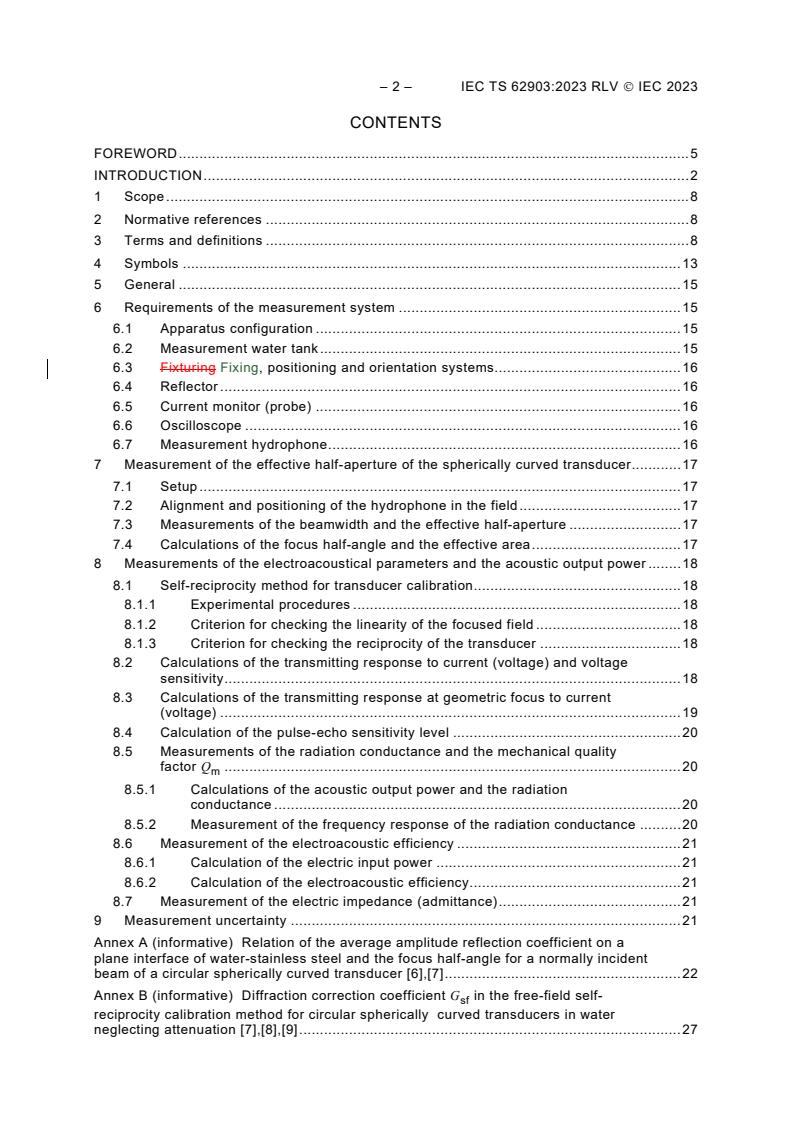
CONTENTS
FOREWORD . 5
INTRODUCTION . 2
1 Scope . 8
2 Normative references . 8
3 Terms and definitions . 8
4 Symbols . 13
5 General . 15
6 Requirements of the measurement system . 15
6.1 Apparatus configuration . 15
6.2 Measurement water tank . 15
6.3 Fixturing Fixing, positioning and orientation systems. 16
6.4 Reflector . 16
6.5 Current monitor (probe) . 16
6.6 Oscilloscope . 16
6.7 Measurement hydrophone . 16
7 Measurement of the effective half-aperture of the spherically curved transducer . 17
7.1 Setup . 17
7.2 Alignment and positioning of the hydrophone in the field . 17
7.3 Measurements of the beamwidth and the effective half-aperture . 17
7.4 Calculations of the focus half-angle and the effective area . 17
8 Measurements of the electroacoustical parameters and the acoustic output power . 18
8.1 Self-reciprocity method for transducer calibration . 18
8.1.1 Experimental procedures . 18
8.1.2 Criterion for checking the linearity of the focused field . 18
8.1.3 Criterion for checking the reciprocity of the transducer . 18
8.2 Calculations of the transmitting response to current (voltage) and voltage
sensitivity . 18
8.3 Calculations of the transmitting response at geometric focus to current
(voltage) . 19
8.4 Calculation of the pulse-echo sensitivity level . 20
8.5 Measurements of the radiation conductance and the mechanical quality
factor Q . 20
m
8.5.1 Calculations of the acoustic output power and the radiation
conductance . 20
8.5.2 Measurement of the frequency response of the radiation conductance . 20
8.6 Measurement of the electroacoustic efficiency . 21
8.6.1 Calculation of the electric input power . 21
8.6.2 Calculation of the electroacoustic efficiency . 21
8.7 Measurement of the electric impedance (admittance) . 21
9 Measurement uncertainty . 21
Annex A (informative) Relation of the average amplitude reflection coefficient on a
plane interface of water-stainless steel and the focus half-angle for a normally incident
beam of a circular spherically curved transducer [6],[7] . 22
Annex B (informative) Diffraction correction coefficient G in the free-field self-
sf
reciprocity calibration method for circular spherically curved transducers in water
neglecting attenuation [7],[8],[9] . 27
Annex C (informative) Calculation of the diffraction correction coefficient G (R/λ,β) in
sf
the free-field self-reciprocity calibration in a non-attenuating medium for a circular
spherically curved transducer [7],[8],[9],[10] . 29
Annex D (informative) Speed of sound and attenuation in water. 32
D.1 General . 32
D.2 Speed of sound for propagation in water [14] . 32
D.3 Acoustic attenuation coefficient for propagation in water . 33
Annex E (informative) Principle of reciprocity calibration for spherically curved
transducers [7],[8],[9],[16],[17],[18],[19] . 34
E.1 Principle of reciprocity calibration for an ideal spherically focused field of a
transducer . 34
E.2 Principle of reciprocity calibration of a real spherically focused field of a
transducer . 35
E.3 Self-reciprocity calibration of a spherically curved transducer . 35
Annex F (informative) Experimental arrangements . 41
F.1 Experimental arrangement for determining the effective radius of a
transducer [7],[8],[9],[24] . 41
F.2 Experimental arrangement of the self-reciprocity calibration method for a
spherically curved transducer [8],[9],[24],[25] . 41
Annex G (informative) Relationships between the electroacoustical parameters used
in this application [24] . 43
G.1 Relationship between the free-field transmitting response to voltage
(current) and the voltage sensitivity with the radiation conductance . 43
G.2 Relationship between the radiation conductance and the electroacoustic
efficiency . 44
G.3 Relationship between the transmitting response and voltage and acoustic
output power . 44
G.4 Relationship between the pulse echo sensitivity and the radiation
conductance . 44
Annex H (informative) Evaluation and expression of uncertainty in the measurements
of the radiation conductance . 45
H.1 Executive standard . 45
H.2 Evaluation of uncertainty in the measurement of the radiation conductance . 45
H.2.1 Mathematical expression . 45
H.2.2 Type A evaluation of standard uncertainty . 45
H.2.3 Type B evaluation of standard uncertainty . 46
H.2.4 Evaluation of the combined standard uncertainty for the radiation
conductance . 49
Annex I (informative) Measurement range for power and pressure and examples of
electroacoustical parameters obtained . 52
I.1 Measurement range of acoustic pressure and power . 52
I.1.1 Lower limit of acoustic power . 52
I.1.2 Upper limit of pressure [27] . 52
I.2 Calibrated example of electroacoustical parameters . 53
I.2.1 1 MHz focusing transducer with air backing of diameter 80 mm and
focal length 200 mm . 53
I.2.2 5 MHz focusing transducer with air backing of diameter 20 mm and
focal length 20 mm . 54
Bibliography . 55
– 4 – IEC TS 62903:2023 RLV IEC 2023
Figure A.1 – Relation curve of the amplitude reflection coefficient r(θ ) on the interface
i
of water-stainless steel for a plane wave with the incident angle θ . 24
i
Figure A.2 – Average amplitude reflection coefficient r (β) on the plane interface of
av
water-stainless steel in the geometric focal plane of a spherically curved transducer
vs. plotted against the focus half-angle β . 26
Figure C.1 – Geometry of the concave radiating surface A of a spherically curved
transducer and its virtual image surface A′ for their symmetry of mirror-images about
the geometric focal plane (x,y,0) . 29
Figure E.1 – Spherical coordinates . 37
Figure E.2 – Function G (kasinθ), diffraction pattern F (kasinθ) and F (kasinθ) in the
a 0 0
geometric focal plane [10] . 38
Figure F.1 – Scheme of the measurement apparatus for determining the effective half-
aperture of a transducer . 41
Figure F.2 – Scheme of free-field self-reciprocity method applied to a spherically
curved transducer . 42
Figure I.1 – The acoustic power as the function of the excitation voltage squared for a
10 MHz spherically curved transducer with backing of diameter 8 mm and curvature
25 mm . 52
Figure I.2 – Results of a 1 MHz focusing transducer with a diameter of 60 mm and
focal length of 75 mm measured using the self-reciprocity method . 53
Figure I.3 – Frequency responses of G, |S |, |M|, η for a 1 MHz spherical transducer
If a/e
of diameter 80 mm and focal length 200 mm . 53
Figure I.4 – Frequency responses of G, |S |, |M|, η for a 5 MHz spherical transducer
If a/e
of diameter 20 mm and focal length 20 mm . 54
Table A.1 – Parameters used in calculation of the average amplitude reflection
coefficient . 23
Table A.2 – Amplitude reflection coefficient r(θ ) on a plane interface of water-stainless
i
steel for plane wave vs. the for various incident θ . 23
i
Table A.3 – Average amplitude reflection coefficient r (β) on plane interface of water-
av
stainless steel in the geometric focal plane of a spherically curved transducer vs. the
for various focus half-angles β . 25
Table B.1 – Diffraction correction coefficients G of a circular spherically curved
sf
transducer in the self-reciprocity calibration method [7],[8],[9] . 27
Table D.1 – Dependence of speed of sound in water on temperature . 32
Table D.2 – Dependence of α /f in water on temperature . 33
Table E.1 – G values dependent on kasinθ for β ≤ 45° where x = kasinθ (according to
a
O'Neil [10]) . 38
Table E.2 – The (R/λ) values dependent on β when θ ≥ θ and β <≤ 45° for G =
min max G a
a
0,94; 0,95; 0,96; 0,97; 0,98; 0,99 . 39
Table H.1 – Type B evaluation of the standard uncertainties (SU) of input quantities in
measurement . 47
Table H.2 – Components of the standard uncertainty for the measurement of the
radiation conductance using the self-reciprocity method . 50
Table H.3 – The measurement results and evaluated data of uncertainty for five
transducers . 51
INTERNATIONAL ELECTROTECHNICAL COMMISSION
____________
ULTRASONICS – MEASUREMENTS OF ELECTROACOUSTICAL
PARAMETERS AND ACOUSTIC OUTPUT POWER OF SPHERICALLY
CURVED TRANSDUCERS USING THE SELF-RECIPROCITY METHOD
FOREWORD
1) The International Electrotechnical Commission (IEC) is a worldwide organization for standardization comprising
all national electrotechnical committees (IEC National Committees). The object of IEC is to promote international
co-operation on all questions concerning standardization in the electrical and electronic fields. To this end and
in addition to other activities, IEC publishes International Standards, Technical Specifications, Technical Reports,
Publicly Available Specifications (PAS) and Guides (hereafter referred to as “IEC Publication(s)”). Their
preparation is entrusted to technical committees; any IEC National Committee interested in the subject dealt with
may participate in this preparatory work. International, governmental and non-governmental organizations liaising
with the IEC also participate in this preparation. IEC collaborates closely with the International Organization for
Standardization (ISO) in accordance with conditions determined by agreement between the two organizations.
2) The formal decisions or agreements of IEC on technical matters express, as nearly as possible, an international
consensus of opinion on the relevant subjects since each technical committee has representation from all
interested IEC National Committees.
3) IEC Publications have the form of recommendations for international use and are accepted by IEC National
Committees in that sense. While all reasonable efforts are made to ensure that the technical content of IEC
Publications is accurate, IEC cannot be held responsible for the way in which they are used or for any
misinterpretation by any end user.
4) In order to promote international uniformity, IEC National Committees undertake to apply IEC Publications
transparently to the maximum extent possible in their national and regional publications. Any divergence between
any IEC Publication and the corresponding national or regional publication shall be clearly indicated in the latter.
5) IEC itself does not provide any attestation of conformity. Independent certification bodies provide conformity
assessment services and, in some areas, access to IEC marks of conformity. IEC is not responsible for any
services carried out by independent certification bodies.
6) All users should ensure that they have the latest edition of this publication.
7) No liability shall attach to IEC or its directors, employees, servants or agents including individual experts and
members of its technical committees and IEC National Committees for any personal injury, property damage or
other damage of any nature whatsoever, whether direct or indirect, or for costs (including legal fees) and
expenses arising out of the publication, use of, or reliance upon, this IEC Publication or any other IEC
Publications.
8) Attention is drawn to the Normative references cited in this publication. Use of the referenced publications is
indispensable for the correct application of this publication.
9) Attention is drawn to the possibility that some of the elements of this IEC Publication may be the subject of patent
rights. IEC shall not be held responsible for identifying any or all such patent rights.
This redline version of the official IEC Standard allows the user to identify the changes
made to the previous edition IEC TS 62903:2018. A vertical bar appears in the margin
wherever a change has been made. Additions are in green text, deletions are in
strikethrough red text.
– 6 – IEC TS 62903:2023 RLV IEC 2023
IEC TS 62903 has been prepared by IEC technical committee 87: Ultrasonics. It is a Technical
Specification.
This second edition cancels and replaces the first edition published in 2018. This edition
constitutes a technical revision.
This edition includes the following significant technical changes with respect to the previous
edition:
a) Several quantities are recognized as complex-valued quantities in the definitions and in the
main text.
b) Annex I was added to provide typical measurement ranges and to provide example
calibration results.
The text of this Technical Specification is based on the following documents:
Draft Report on voting
87/825/DTS 87/829/RVDTS
Full information on the voting for its approval can be found in the report on voting indicated in
the above table.
The language used for the development of this Technical Specification is English.
In this document, the following print types are used:
• terms defined in Clause 3: in bold type.
This document was drafted in accordance with ISO/IEC Directives, Part 2, and developed in
accordance with ISO/IEC Directives, Part 1 and ISO/IEC Directives, IEC Supplement, available
at www.iec.ch/members_experts/refdocs. The main document types developed by IEC are
described in greater detail at www.iec.ch/publications.
The committee has decided that the contents of this document will remain unchanged until the
stability date indicated on the IEC website under webstore.iec.ch in the data related to the
specific document. At this date, the document will be
• reconfirmed,
• withdrawn,
• replaced by a revised edition, or
• amended.
IMPORTANT – The "colour inside" logo on the cover page of this document indicates that it
contains colours which are considered to be useful for the correct understanding of its
contents. Users should therefore print this document using a colour printer.
INTRODUCTION
An ultrasonic transducer is an important acoustic device that can act as a transmitter or a
receiver in the applications of medical ultrasound, non-destructive testing, and ultrasonic
materials processing. The performance of a transducer is a decisive factor that governs the
device's range of applicability, efficiency and quality control in the manufacturing. The
mechanisms, transmitting fields, performances, and measurement methods used for these
transducers have been studied over the past few decades. However, the electroacoustical
characterization and measurement methods applied for spherically curved transducers have
not been defined in standard documents for either terms or protocols.
This document defines the relevant electroacoustical parameters for these devices and
establishes the self-reciprocity measurement method for spherically curved concave focusing
transducers.
– 8 – IEC TS 62903:2023 RLV IEC 2023
ULTRASONICS – MEASUREMENTS OF ELECTROACOUSTICAL
PARAMETERS AND ACOUSTIC OUTPUT POWER OF SPHERICALLY
CURVED TRANSDUCERS USING THE SELF-RECIPROCITY METHOD
1 Scope
This document, which is a Technical Specification,
a) establishes the free-field convergent spherical wave self-reciprocity method for ultrasonic
transducer calibration,
b) establishes the measurement conditions and experimental procedure required to determine
the transducer's electroacoustic parameters and acoustic output power using the self-
reciprocity method,
c) establishes the criteria for checking the reciprocity of these transducers and the linear range
of the focused field, and
d) provides guiding information for the assessment of the overall measurement uncertainties
for radiation conductance.
This document is applicable to:
i) circular spherically curved concave focusing transducers without a centric hole working in
the linear amplitude range,
ii) measurements in the frequency range 0,5 MHz to 15 MHz, and
iii) acoustic pressure amplitudes in the focused field within the linear amplitude range.
Characterization and sensitivity calibration of hydrophones using the reciprocity method are not
addressed in this document but covered in IEC 62127-2 [1] and IEC 60565-1 [2].
2 Normative references
The following documents are referred to in the text in such a way that some or all of their content
constitutes requirements of this document. For dated references, only the edition cited applies.
For undated references, the latest edition of the referenced document (including any
amendments) applies.
IEC 60050-801:1994, International Electrotechnical Vocabulary – Chapter 801: Acoustics and
electroacoustics, available at www.electropedia.org
3 Terms and definitions
For the purposes of this document, the terms and definitions given in IEC 60050-801:1994 and
the following apply.
ISO and IEC maintain terminological databases for use in standardization at the following
addresses:
• IEC Electropedia: available at http://www.electropedia.org/
• ISO Online browsing platform: available at http://www.iso.org/obp
—————————
Numbers in square brackets refer to the Bibliography.
3.1
p
av
average acoustic pressure
acoustic pressure averaged over the effective area of the transducer
Note 1 to entry: Average acoustic pressure is expressed in pascals (Pa).
3.2
r (β)
av
average amplitude reflection coefficient
ratio quotient of the free-field echo average acoustic pressure p (β) reflected by the reflector
av
on the geometric focal plane over the space area coincident with the effective area of the
spherically curved transducer of focus half-angle β, if the transducer were removed, to the
reference acoustic pressure p on the effective area of the transducer in a non-attenuation
medium with negligible diffraction
r (β) = p (β)/p (1)
av av 0
3.3
G
sf
diffraction correction coefficient
ratio quotient of the average acoustic pressure over the spherical segment surface of the
spherically curved transducer's virtual image at a position in the distance of twice geometric
focal length from the transducer, if an ideal reflecting mirror were located on the geometric
focal plane, to the reference acoustic pressure of the transducer in the free-field of a non-
attenuation medium
3.4
A
effective area
area of the radiating surface of a theoretically predicted transducer with specific
field distribution characteristics that are approximately the same as those of a real transducer
of the same type
Note 1 to entry: For a spherically curved transducer, the theoretically predicted acoustic pressure distribution on
the geometric focal plane of a transducer should is expected to be approximately the same as that of the real
transducer with the same geometric focal length when operating at the same frequency.
Note 2 to entry: The half-aperture of an effective area is also named the effective half-aperture or the effective
radius.
Note 3 to entry: The effective area of a transducer is expressed in units of metre squared (m ).
3.5
η
a/e
electroacoustic efficiency
ratio quotient of the acoustic output power to the electric input power
3.6
electroacoustical reciprocity principle
electroacoustical reciprocity theorem
principle that the ratio quotient of the free-field voltage (current) sensitivity of a reciprocal
transducer as a receiver, to the transmitting response to current (voltage) of the reciprocal
transducer as a projector is constant
Note 1 to entry: This principle is independent of the construction of the reciprocal transducer.
– 10 – IEC TS 62903:2023 RLV IEC 2023
3.7
free-field
sound field in a homogeneous isotropic medium whose boundaries exert a negligible effect on
the sound wave
[SOURCE: IEC 61161:2013, 3.2]
3.8
M(f)
free-field voltage sensitivity of a spherically curved transducer
receiving voltage response of a spherically curved transducer
ratio of the open-circuit output voltage of a spherically curved transducer within the field of a
point source at the geometric focus to the free-field acoustic pressure acting on the space
surface where the transducer surface was present, if that transducer were removed
Note 1 to entry: Free-field voltage sensitivity of a spherically curved transducer is expressed in volts per pascal
(V/Pa).
quotient of the Fourier transform of the open-circuit output
voltage signal (U(t)) of a spherically curved transducer within the field of a point source at its
geometric focus to the Fourier transform of the free-field acoustic pressure waveform (p(t))
for a specified frequency f and incidence on the surface of the transducer if the transducer were
removed
Ut
( ( ))
Mf( ) =
(2)
pt
( )
( )
Note 1 to entry: The free-field voltage sensitivity of a spherically curved transducer is a complex-value parameter.
The modulus of the free-field voltage sensitivity of a spherically curved transducer is expressed in units of volt per
pascal (V/Pa). The phase angle is the argument of the sensitivity and represents the phase difference between the
electrical transducer output voltage and the incident pressure. The unit of phase is the radian.
3.9
geometric beam boundary
surface containing straight lines passing through the geometric focus and all points around
the periphery of the transducer aperture
Note 1 to entry: Applies to ultrasonic transducers of known construction.
[SOURCE: IEC 61828:20062020, 3.64]
3.10
F
geo
geometric focal length
distance from the geometric focus to the ultrasonic transducer's position where the beam axis
intersects the effective focusing surface
Note 1 to entry: Applies to transducers with known construction and is equal to the radius of curvature of the
radiating surface.
Note 2 to entry: The focusing surface is the surface of constant phase, whose periphery is coincident with the
transducer's aperture.
Note 2 to entry: Geometric focal length is expressed in metres (m).
Note 3 to entry: This definition applies only to focusing transducers.
[SOURCE: IEC 61828:2020, 3.66]
3.11
geometric focus
point for which all of the effective path lengths in a specified longitudinal plane are equal
Note 1 to entry: The geometric focus is also Equivalently, the spatial point for which the arrival times of all waves
from the transducer have the same delay relative to the voltage excitation of the transducer, as viewed in the
approximation of geometrical acoustics, neglecting diffraction.
Note 2 to entry: This definition applies only to focusing transducers.
[SOURCE: IEC 61828:2006, 4.2.39, modified – In the definition, the added explanation for the
definition "Also, the point for which all.diffraction." has been moved to a Note to entry.
IEC 61828:2020, 3.67]
3.12
L
Mpe
pulse-echo sensitivity level
twenty times the logarithm to the base 10 of the ratio of the received open-circuit voltage U for
the first echo signal of the spherically curved transducer when acting as a receiver to the
exciting voltage of the transducer U when it is transmitting a tone burst ultrasonic beam in a
T
direction perpendicular to an ideal plane reflector (r = 1) at the geometric focal plane for a
specified frequency
U
(3)
L = 20 log dB
Mpe 10
U
T
Note 1 to entry: The logarithmic ratio is expressed in decibels (dB).
3.13
G
radiation conductance
ratio quotient of the acoustic output power and the squared effective transducer input voltage
Note 1 to entry: It is used to characterize the electrical to acoustical transfer of ultrasonic transducers.
Note 2 to entry: The frequency of the input voltage (or current) should be noted.
Note 3 to entry: Radiation conductance is expressed in siemens (S).
[SOURCE: IEC 61161:2013, 3.8, modified – In the definition, "RMS" has been replaced with
"effective" and "ratio" has been replaced with "quotient".]
3.14
reciprocal transducer
linear, passive and reversible electroacoustic transducer such that the coupling coefficients are
equal for transduction regardless of whether transduction is electrical to mechanical or vice
versa
Note 1 to entry: An example of a non-reciprocal transducer is one that mixes a magnetic field device with an
electric field device.
[SOURCE: IEC 60565:2006, 3.24 IEC 60565-1:2020, 3.7]
3.15
J
reciprocity parameter coefficient
ratio quotient of the free-field voltage sensitivity of a reciprocal transducer
as a receiver to the transmitting response to current of the transducer as a projector, or the
ratio quotient of the free-field current sensitivity of a transducer as a receiver to the
transmitting response to voltage of the transducer as a projector
Note 1 to entry: The reciprocity parameter of a spherically curved transducer, J = J , is equal to the quotient of
sf
twice the effective area of the transducer divided by the acoustic characteristic impedance of the medium, i.e.
– 12 – IEC TS 62903:2023 RLV IEC 2023
J = 2A/(ρ c)
sf
where
A is the effective area of curved surface of the spherically curved transducer;
ρ is the (mass) density of the medium;
c is the speed of sound in the medium (usually water).
M
J = (4)
S
I
Note 1 to entry: The modulus of the reciprocity coefficient of a spherically curved transducer, |J|= J , is equal to
sf
the quotient of twice the effective area of the transducer to the acoustic characteristic impedance of the medium,
i.e.
M 2A
J (5)
sf
S ρc
I
where
A is the effective area of curved surface of the spherically curved transducer;
ρ is the (mass) density of the medium;
c is the speed of sound in the medium (usually water).
Note 2 to entry: The reciprocity parameter coefficient is expressed in units of watt per pascal squared (W/Pa ).
3.16
p
reference acoustic pressure
product of the uniform normal particle velocity on the spherically curved surface of the
transducer and the characteristic impedance of the medium
Note 1 to entry: Reference acoustic pressure is expressed in pascals (Pa).
3.17
reversible transducer
transducer capable of acting as a projector as well as a receiver
[SOURCE: IEC 60565:2006, 3.26 IEC 60565-1:2020, 3.8, modified – In the definition,
"hydrophone" has been replaced with "receiver".]
3.18
self-reciprocity method
transducer calibration method based on the reciprocity principle that uses the received echo
signal from the plane reflector that is set perpendicular to the incident beam axis of the
transducer
3.19
S (f)
I
transmitting response to current
transmitting current response
ratio of the reference acoustic pressure on the radiating surface of a transducer in the free-
field in the absence of interference effects to the current flowing through the electrical terminals
of a projector at a given frequency
Note 1 to entry: Transmitting response to current is expressed in pascals per ampere (Pa/A).
quotient of the Fourier transform of the reference acoustic pressure (p (t))
on the radiating surface of a transducer in the free field in the absence of interference effects
to the Fourier transform of the exciting electrical current (I(t)) through the electrical terminals
of the transducer for a specified frequency f
==
pt
( ( ))
S ( f ) = (6)
I
It
( ( ))
Note 1 to entry: The transmitting response to current of a transducer is a complex-valued parameter. The
−1
. The phase
modulus of the transmitting response to current is expressed in units of pascal per ampere, Pa·A
angle is the argument of the transmitting response and represents the phase difference between the acoustic
pressure at the surface of the transducer and the electric current. The unit of phase angle is the radian.
3.20
S (f)
U
transmitting response to voltage
transmitting voltage response
the ratio of the reference acoustic pressure on the radiating surface of a transducer in the
free-field in the absence of interference effects to the exciting voltage of a projector at a given
frequency
Note 1 to entry: Transmitting response to voltage is expressed in pascals per volt (Pa/V).
quotient of the Fourier transform of the reference acoustic pressure (p (t))
on the radiating surface of a transducer in the free field in the absence of interference effects
to the Fourier transform of the electrical exciting voltage across the terminals of the projector
(U (t)), for a specified frequency f
T
pt
( ( ))
S ( f ) = (7)
U
Ut
( ( ))
T
Note 1 to entry: The transmitting response to voltage of a transducer is a complex-valued parameter. The modulus
−1
of the transmitting response to voltage is expressed in units of pascal per volt, Pa·V . The phase angle is the
argument of the transmitting response and represents the phase difference between the reference acoustic pressure
at the surface of the transducer and the exciting electrical voltage. The unit of phase angle is the radian.
4 Symbols
a effective half-aperture, effective radius of transducer
A effective area of transducer
c speed of sound in sound propagating medium usually in water
d distance from the centre of the transmitting surface of the transducer to the
reflecting plane of the reflector in the geometric focal plane
f resonant frequency
f central frequency
c
F geometric focal length (F = R)
geo geo
G radiation conductance
G diffraction correction coefficient for spherically curved transducer in free-field
sf
self-reciprocity calibration
h height (depth) at the centre of a spherical segment
I acoustic intensity
I , I exciting current amplitude, effective exciting current
T Trms
I short-circuit current amplitude of the generator
k
I first echo current amplitude
echo
J reciprocity parameter coefficient of transducer
– 14 – IEC TS 62903:2023 RLV IEC 2023
J modulus of the reciprocity parameter coefficient of spherically curved
sf
transducer
k circular wave number (k = 2π/λ)
k ratio of the acoustic pressure at the geometric focus to the reference acoustic
m
pressure on the radiation surface of the transducer in a non-attenuating medium
l distance from the centre of receiving surface of the hydrophone to the centre of
the transmitting surface of the transducer along their common axis after
alignment
L pulse-echo sensitivity level
Mpe
M free-field voltage sensitivity (receiving voltage response) of a spherically
curved transducer
p reference acoustic pressure of a radiating surface
P acoustic output power
P electrical input power
e
q ratio of the true time-average intensity I to the time-average derived intensity I
p
at the geometric focus (q = (1 + cosβ)/2)
Q mechanical quality factor
m
r amplitude reflection coefficient
r (β) average amplitude reflection coefficient on a plane reflector in the geometric
av
focal plane in water for a spherically curved transducer
R radius of curvature
S transmitting response to current
I
S transmitting response at geometric focus to current
If
S transmitting response to voltage
U
S transmitting response at geometric focus to voltage
Uf
∆t acoustic pulse transit time
F
U open-circuit voltage amplitude of tone burst generator
U , U exciting voltage amplitude, exciting effective voltage of the transducer
T Trms
U maximum of the first echo voltage amplitude received by the transducer to be
calibrated in self-reciprocity calibration process
U output voltage of the current probe picked when picking up the exciting current
IT
of the transducer
U output voltage of the current probe picked when picking up the first echo current
Iecho
of the transducer
U output voltage of the current probe picked when picking up the short-circuit
Ik
current of the tone burst generator
U effective voltage
rms
v particle velocity
w −3 dB beamwidth on geometric focal plane
w −6 dB beamwidth on geometric focal plane
Y electric admittance of transducer in a medium (usually in water)
T
Z electric output impedance of generator
i
Z electric impedance of transducer in a medium (usually in water)
T
α acoustic attenuation coefficient in a medium (usually in water)
β focus half-angle (β = arcsin(a/R))
θ electric impedance angle
e
ρ (mass) density of the sound propagating medium (usually water)
η electroacoustic efficiency
a/e
λ wavelength
τ pulse duration
5 General
The transducer characteristics include the ultrasonic field parameters and the transmission and
reception performance parameters.
The focused field performance parameters include the effective half-aperture (the effective
radius), the beam width, the effective area, the geometric focal length, and the focus
half-angle for spherically curved transducers.
The transmission performance parameters include the radiation conductance, the acoustic
output power, the free-field transmitting response to current (voltage), the electroacoustic
efficiency, and the electric impedance.
The reception performance parameter is the free-field voltage sensitivity.
The transmission-reception parameter is the pulse-echo sensitivity level.
In this document, the beam profile method using a hydrophone is defined for the measurement
of the field performance parameters; the self-reciprocity method is defined for the
measurement of the free-field transmitting response to current (voltage), the free field
voltage sensitivity, pulse-echo sensitivity level, and the acoustic output power (see
Annex E); the radiation conductance is derived from the acoustic power and the effective
exciting voltage; the electroacoustic efficiency is calculated from the acoustic output power
and the detected electrical input power. Relations between these electroacoustical parameters
are given in Annex G. Examples of typical measurement ranges and calibration res
...