

IEC 62127-2:2007/AMD1:2013
(Amendment)Amendment 1 - Ultrasonics - Hydrophones - Part 2: Calibration for ultrasonic fields up to 40 MHz
General Information
- Abstract
- Status
- Published
- Publication Date
- 07-Feb-2013
- Technical Committee
- TC 87 - Ultrasonics
- Drafting Committee
- WG 8 - TC 87/WG 8
- Current Stage
- DELPUB - Deleted Publication
- Start Date
- 07-Jan-2025
- Completion Date
- 28-Aug-2026
Overview
The IEC 62127-2:2007/AMD1:2013 is an important amendment to the international standard for ultrasonics hydrophones, specifically focusing on the calibration of ultrasonic fields up to 40 MHz. Developed by the International Electrotechnical Commission (IEC), this update refines technical definitions and calibration procedures to ensure higher accuracy for measurements in medical, industrial, and research ultrasonic applications.
This amendment emphasizes updated terminologies, enhanced calibration methodologies, and precise measurement practices, significantly supporting the development and verification of ultrasonic hydrophone systems used in high-frequency fields.
Key Topics
Calibration of Ultrasonic Fields
Provides detailed procedures and requirements for calibrating hydrophones operating in ultrasonic fields up to 40 MHz, addressing both free field and absolute calibration techniques.Terminology and Definitions
Updates critical technical terms such as effective radius of non-focusing ultrasonic transducers, instantaneous intensity, and transition distance to maintain consistency and precision in measurements.Measurement Accuracy and Mechanical Positioning
Establishes strict requirements for the accuracy of axial and lateral hydrophone positioning, including guidance on signal maximization and potential influences like spatial averaging.Mounting and Environmental Considerations
Addresses effects of hydrophone mounting, especially at low frequencies, and stresses the importance of eliminating air bubbles for accurate calibration results.Cross-Talk and Interference Mitigation
Discusses procedures to detect and reduce radio-frequency (RF) pick-up and acoustic interference, helping maintain signal integrity during calibration.Updated Normative References
Incorporates the latest relevant IEC standards on ultrasonics and acoustics to ensure coherence across measurement and calibration protocols.
Applications
Medical Ultrasonics
Supports precise ultrasonic field characterization for medical diagnostic and therapeutic devices, such as ultrasound imaging probes and high-intensity focused ultrasound (HIFU) systems.Industrial Ultrasonic Testing
Assists in calibration of hydrophones used in non-destructive testing and ultrasonic cleaning systems ensuring quality and repeatability in measurements.Scientific Research
Enables accurate hydrophone calibration to facilitate experimental studies involving high-frequency ultrasonic waves in physics and acoustics research.Quality Control and Compliance
Provides calibration frameworks aligned with international standards, enabling manufacturers and labs to meet regulatory requirements and deliver reliable products.
Related Standards
- IEC 62127-1:2007 – Measurement and characterization of medical ultrasonic fields up to 40 MHz
- IEC 60050-801 – International Electrotechnical Vocabulary-Acoustics and electroacoustics
- IEC 61161: Ultrasonics – Power measurement using radiation force balances
- IEC 61828:2006 – Ultrasonics focusing transducers-definitions and measurement methods
- IEC/TS 62781 – Procedures for preparation of degassed water for ultrasonic calibration environments
The IEC 62127-2:2007/AMD1:2013 amendment ensures enhanced precision in hydrophone calibration for ultrasonic fields up to 40 MHz, promoting consistency and reliability in high-frequency ultrasonic measurements. This is essential for industries relying on ultrasonic technology for diagnostics, inspection, and scientific innovation, reinforcing quality and regulatory compliance worldwide.
Relations
- Effective Date
- 05-Sep-2023
- Effective Date
- 05-Sep-2023
Get Certified
Connect with accredited certification bodies for this standard

BSMI (Bureau of Standards, Metrology and Inspection)
Taiwan's standards and inspection authority.
Sponsored listings
Frequently Asked Questions
IEC 62127-2:2007/AMD1:2013 is a standard published by the International Electrotechnical Commission (IEC). Its full title is "Amendment 1 - Ultrasonics - Hydrophones - Part 2: Calibration for ultrasonic fields up to 40 MHz". This standard covers: Amendment 1 - Ultrasonics - Hydrophones - Part 2: Calibration for ultrasonic fields up to 40 MHz
Amendment 1 - Ultrasonics - Hydrophones - Part 2: Calibration for ultrasonic fields up to 40 MHz
IEC 62127-2:2007/AMD1:2013 is classified under the following ICS (International Classification for Standards) categories: 17.140.50 - Electroacoustics. The ICS classification helps identify the subject area and facilitates finding related standards.
IEC 62127-2:2007/AMD1:2013 has the following relationships with other standards: It is inter standard links to IEC 62127-2:2007, IEC 62127-2:2025. Understanding these relationships helps ensure you are using the most current and applicable version of the standard.
IEC 62127-2:2007/AMD1:2013 is available in PDF format for immediate download after purchase. The document can be added to your cart and obtained through the secure checkout process. Digital delivery ensures instant access to the complete standard document.
Standards Content (Sample)
IEC 62127-2 ®
Edition 1.0 2013-02
INTERNATIONAL
STANDARD
NORME
INTERNATIONALE
AMENDMENT 1
AMENDEMENT 1
Ultrasonics – Hydrophones –
Part 2: Calibration for ultrasonic fields up to 40 MHz
Ultrasons – Hydrophones –
Partie 2: Etalonnage des champs ultrasoniques jusqu’à 40 MHz
IEC 62127-2:2007/A1:2013
All rights reserved. Unless otherwise specified, no part of this publication may be reproduced or utilized in any form
or by any means, electronic or mechanical, including photocopying and microfilm, without permission in writing from
either IEC or IEC's member National Committee in the country of the requester.
If you have any questions about IEC copyright or have an enquiry about obtaining additional rights to this publication,
please contact the address below or your local IEC member National Committee for further information.
Droits de reproduction réservés. Sauf indication contraire, aucune partie de cette publication ne peut être reproduite ni
utilisée sous quelque forme que ce soit et par aucun procédé, électronique ou mécanique, y compris la photocopie et les
microfilms, sans l'accord écrit de la CEI ou du Comité national de la CEI du pays du demandeur.
Si vous avez des questions sur le copyright de la CEI ou si vous désirez obtenir des droits supplémentaires sur cette
publication, utilisez les coordonnées ci-après ou contactez le Comité national de la CEI de votre pays de résidence.
IEC Central Office Tel.: +41 22 919 02 11
3, rue de Varembé Fax: +41 22 919 03 00
CH-1211 Geneva 20 info@iec.ch
Switzerland www.iec.ch
About the IEC
The International Electrotechnical Commission (IEC) is the leading global organization that prepares and publishes
International Standards for all electrical, electronic and related technologies.
About IEC publications
The technical content of IEC publications is kept under constant review by the IEC. Please make sure that you have the
latest edition, a corrigenda or an amendment might have been published.
Useful links:
IEC publications search - www.iec.ch/searchpub Electropedia - www.electropedia.org
The advanced search enables you to find IEC publications The world's leading online dictionary of electronic and
by a variety of criteria (reference number, text, technical electrical terms containing more than 30 000 terms and
committee,…). definitions in English and French, with equivalent terms in
It also gives information on projects, replaced and additional languages. Also known as the International
withdrawn publications. Electrotechnical Vocabulary (IEV) on-line.
IEC Just Published - webstore.iec.ch/justpublished Customer Service Centre - webstore.iec.ch/csc
Stay up to date on all new IEC publications. Just Published If you wish to give us your feedback on this publication
details all new publications released. Available on-line and or need further assistance, please contact the
also once a month by email. Customer Service Centre: csc@iec.ch.
A propos de la CEI
La Commission Electrotechnique Internationale (CEI) est la première organisation mondiale qui élabore et publie des
Normes internationales pour tout ce qui a trait à l'électricité, à l'électronique et aux technologies apparentées.
A propos des publications CEI
Le contenu technique des publications de la CEI est constamment revu. Veuillez vous assurer que vous possédez
l’édition la plus récente, un corrigendum ou amendement peut avoir été publié.
Liens utiles:
Recherche de publications CEI - www.iec.ch/searchpub Electropedia - www.electropedia.org
La recherche avancée vous permet de trouver des Le premier dictionnaire en ligne au monde de termes
publications CEI en utilisant différents critères (numéro de électroniques et électriques. Il contient plus de 30 000
référence, texte, comité d’études,…). termes et définitions en anglais et en français, ainsi que
Elle donne aussi des informations sur les projets et les les termes équivalents dans les langues additionnelles.
publications remplacées ou retirées. Egalement appelé Vocabulaire Electrotechnique
International (VEI) en ligne.
Just Published CEI - webstore.iec.ch/justpublished
Service Clients - webstore.iec.ch/csc
Restez informé sur les nouvelles publications de la CEI.
Just Published détaille les nouvelles publications parues. Si vous désirez nous donner des commentaires sur
Disponible en ligne et aussi une fois par mois par email. cette publication ou si vous avez des questions
contactez-nous: csc@iec.ch.
IEC 62127-2 ®
Edition 1.0 2013-02
INTERNATIONAL
STANDARD
NORME
INTERNATIONALE
AMENDMENT 1
AMENDEMENT 1
Ultrasonics – Hydrophones –
Part 2: Calibration for ultrasonic fields up to 40 MHz
Ultrasons – Hydrophones –
Partie 2: Etalonnage des champs ultrasoniques jusqu’à 40 MHz
INTERNATIONAL
ELECTROTECHNICAL
COMMISSION
COMMISSION
ELECTROTECHNIQUE
PRICE CODE
INTERNATIONALE
CODE PRIX T
ICS 11.040.50 ISBN 978-2-83220-616-4
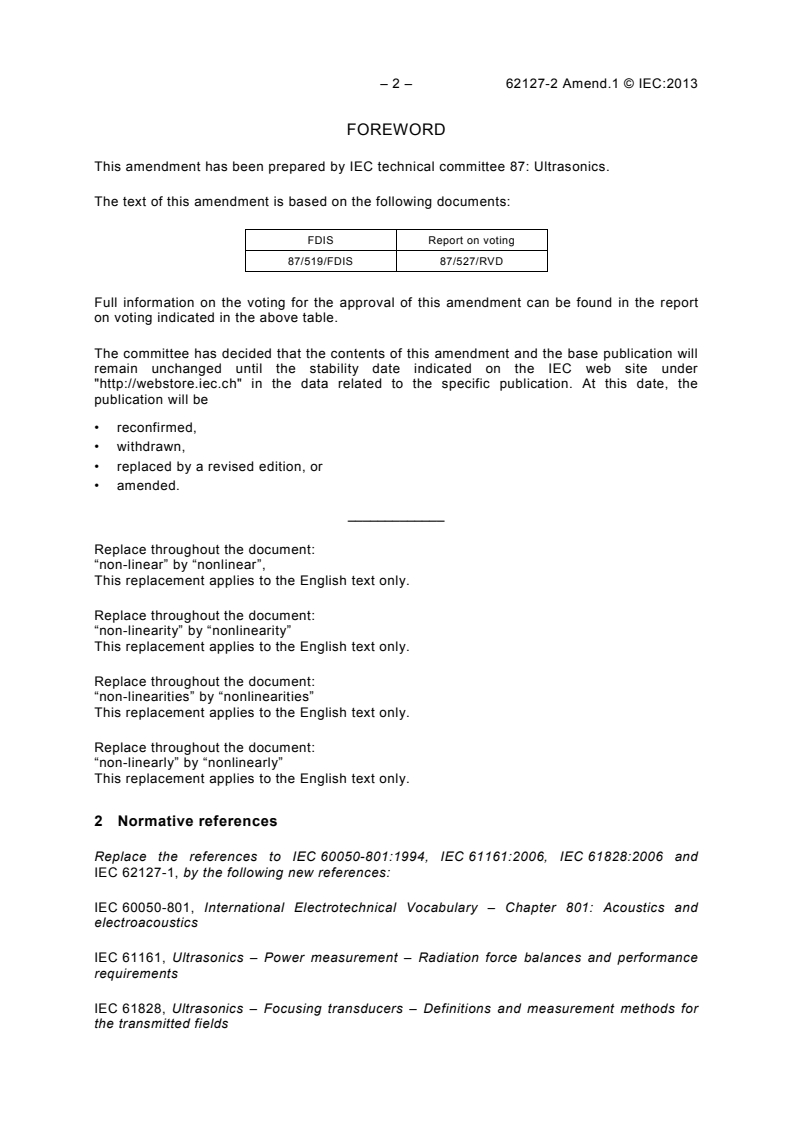
– 2 – 62127-2 Amend.1 © IEC:2013
FOREWORD
This amendment has been prepared by IEC technical committee 87: Ultrasonics.
The text of this amendment is based on the following documents:
FDIS Report on voting
87/519/FDIS 87/527/RVD
Full information on the voting for the approval of this amendment can be found in the report
on voting indicated in the above table.
The committee has decided that the contents of this amendment and the base publication will
remain unchanged until the stability date indicated on the IEC web site under
"http://webstore.iec.ch" in the data related to the specific publication. At this date, the
publication will be
• reconfirmed,
• withdrawn,
• replaced by a revised edition, or
• amended.
_____________
Replace throughout the document:
“non-linear” by “nonlinear”,
This replacement applies to the English text only.
Replace throughout the document:
“non-linearity” by “nonlinearity”
This replacement applies to the English text only.
Replace throughout the document:
“non-linearities” by “nonlinearities”
This replacement applies to the English text only.
Replace throughout the document:
“non-linearly” by “nonlinearly”
This replacement applies to the English text only.
2 Normative references
Replace the references to IEC 60050-801:1994, IEC 61161:2006, IEC 61828:2006 and
IEC 62127-1, by the following new references:
IEC 60050-801, International Electrotechnical Vocabulary – Chapter 801: Acoustics and
electroacoustics
IEC 61161, Ultrasonics – Power measurement – Radiation force balances and performance
requirements
IEC 61828, Ultrasonics – Focusing transducers – Definitions and measurement methods for
the transmitted fields
62127-2 Amend.1 © IEC:2013 – 3 –
IEC 62127-1:2007, Ultrasonics - Hydrophones - Part 1: Measurement and characterization of
medical ultrasonic fields up to 40 MHz
Amendment 1:2013
3 Terms, definitions and symbols
3.9
effective radius of a non-focused ultrasonic transducer
Replace the term by effective radius of a non-focusing ultrasonic transducer
Replace the term in the Note by effective radius of a non-focusing ultrasonic transducer
3.14
external transducer aperture
Replace, in Note 1, "Figure 2" by "Figure 1".
3.15
far field
Replace the existing text of the definition (not including Note 1 and Note 2) by the following:
region of the field where z>z aligned along the beam axis for planar non-focusing transducers.
T
Add the following new Note 3:
NOTE 3 If the shape of the transducer aperture produces several transition distances, the one furthest from the
transducer shall be used.
[SOURCE: IEC 62127-1:2007/Amendment 1:2013, definition 3.28]
3.23
instantaneous intensity
Replace the existing text of Note 1 by the following:
NOTE 1 Instantaneous intensity is the product of instantaneous acoustic pressure and particle velocity. It is
difficult to measure intensity in the ultrasound frequency range. For the measurement purposes referred to in this
International Standard and under conditions of sufficient distance from the external transducer aperture (at least
one transducer diameter, or an equivalent transducer dimension in the case of a non-circular transducer) the
instantaneous intensity can be approximated by the derived instantaneous intensity.
Replace the existing text of Note 2 by the following:
Instantaneous intensity is expressed in watts per square metre (W/m )
Add the following new definitions:
3.26
derived instantaneous intensity
approximation of the instantaneous intensity
For the measurement purposes referred to in this International Standard, and under
conditions of sufficient distance from the transducer (at least one transducer diameter, or an
equivalent transducer dimension in the case of a non-circular transducer) the derived
instantaneous intensity is determined by
– 4 – 62127-2 Amend.1 © IEC:2013
p(t)
(1)
I(t) =
ρ c
where:
p(t) is the instantaneous acoustic pressure;
ρ is the density of the medium;
c is the speed of sound in the medium.
NOTE 1 For measurement purposes referred to in this International Standard, the derived instantaneous
intensity is an approximation of the instantaneous intensity.
NOTE 2 Increased uncertainty should be taken into account for measurements very close to the transducer.
NOTE 3 Derived instantaneous intensity is expressed in watts per square metre (W/m ).
[SOURCE: IEC 62127-1:2007/ Amendment 1:2013, definition 3.78]
3.27
effective wavelength
λ
longitudinal speed of sound in the propagation medium divided by the arithmetic-mean
working frequency
NOTE Effective wavelength is expressed in metres (m).
[SOURCE:IEC 61828:2001, definition 4.2.24].
3.28
longitudinal plane
plane defined by the beam axis and a specified orthogonal axis
NOTE See Figure 1 in IEC 62127-1.
[SOURCE: IEC 62127-1:2007, definition 3.35].
3.29
source aperture plane
closest possible measurement plane to the external transducer aperture, that is
perpendicular to the beam axis
[SOURCE:IEC 61828:2001, definition 4.2.67].
3.30
source aperture width
L
SA
in a specified longitudinal plane, the greatest –20 dB beamwidth along the line of
intersection between the designated longitudinal plane and the source aperture plane
NOTE 1 See Figure 2 in IEC 61828 2001.
NOTE 2 Source aperture width is expressed in metres (m).
[SOURCE:IEC 61828, definition 4.2.68].
62127-2 Amend.1 © IEC:2013 – 5 –
3.31
transducer aperture width
L
TA
full width of the transducer aperture along a specified axis orthogonal to the beam axis of the
unsteered beam at the centre of the transducer
NOTE 1 See Figure 4 in IEC 62127-1 .
NOTE 2 Transducer aperture width is expressed in metres (m).
[SOURCE:IEC 62127-1:2007/ Amendment 1:2013, definition 3.87].
3.32
transition distance
z
T
for a given longitudinal plane, the transition distance is defined based on the transducer
design (when known) or from measurement:
a) from design: the transition distance is the equivalent area of the ultrasonic
transducer aperture width divided by π times the effective wavelength, λ;
b) for measurements, the transition distance is the equivalent area of the source
aperture width divided by π times the effective wavelength.
NOTE 1 Using method a), an unapodized ultrasonic transducer with circular symmetry about the beam axis, the
2 2
equivalent area is πa , where a is the radius. Therefore the transition distance is z = a /λ. For the first example
T
of a square ultrasonic transducer, the equivalent area is (L ) , where L is the transducer aperture width in
TA TA
the longitudinal plane. Therefore, the transition distance for both orthogonal longitudinal planes containing the
sides or transducer aperture widths, is z = (L ) /(πλ). For the second example, for a rectangular ultrasonic
T TA
transducer with transducer aperture widths L and L , the equivalent area for the first linear transducer
TA1 TA2
aperture width for the purpose of calculating the transition distance for the associated longitudinal plane is
(L ) , where L is the transducer aperture width in this longitudinal plane. Therefore, the transition
TA1 TA1
distance for this plane is z = (L ) /(πλ). For the orthogonal longitudinal plane that contains the other
T1 TA1
transducer aperture width, L , the equivalent area for the other for the purpose of calculating the transition
TA2
distance for the associated longitudinal plane is (L ) , where L is the transducer aperture width in this
TA2 TA2
longitudinal plane. Therefore, the transition distance for this plane is z = (L ) /(πλ).
T2 TA2
NOTE 2 Using method b) for measurements in a longitudinal plane, the source aperture width, L , in the same
SA
plane is used in z = (L ) /(πλ).
T SA
NOTE 3 Transition distance is expressed in metre (m).
[SOURCE IEC 61828:2001, definition 4.2.75, modified: There is significant difference in the
layout of the definition]
4 List of symbols
Replace:
a effective radius of a non-focused ultrasonic transducer
t
by
a effective radius of a non-focusing ultrasonic transducer
t
Add the following new symbols:
L transducer aperture width
TA
L source aperture width
SA
z transition distance
T
– 6 – 62127-2 Amend.1 © IEC:2013
5 Overview of calibration procedures
5.3 Reporting of results
Add, after the sixth bullet point ("in situations where the mounting arrangement…") the
following new Note 5 and renumber existing Notes 5 and 6 accordingly:
NOTE 5 Care should be taken in designing the hydrophone mount at low frequencies (below 200 kHz) where the
acoustic wavelengths are sufficiently large that the use of long-bursts may lead to the direct acoustic signal being
contaminated by reflections from the mount. The importance of the effect may be investigated through varying the
burst length and observing the influence of reflections on the hydrophone signal. Acoustic absorbers may be
useful in suppressing these reflections. Hydrophone sensitivity may also be affected by the way the hydrophone
is clamped, and again this may be evaluated by systematically investigating the various configurations.
6 Generic requirements of a hydrophone calibration system
6.1 Mechanical positioning
6.1.2 Accuracy of the axial hydrophone position
Add, after Note 1, the following new Note 2 and renumber existing Notes 3 and 4 accordingly.:
NOTE 2 The distance of the hydrophone from the transducer can be estimated from a knowledge of the time
elapsed between the electrical excitation applied to the transducer and the arrival time of the acoustic wave at the
hydrophone, through a knowledge of the speed of sound in water at that particular temperature.
6.1.3 Accuracy of the lateral hydrophone position
Replace the existing first sentence of the subclause by the following:
The variation of the hydrophone output voltage should be checked when the lateral
hydrophone position is changed to ensure that the signal is maximized.
6.3 Hydrophone size
Number the existing note as Note 1 and add the following new Note 2:
NOTE 2 Guidance in assessing the influence of spatial-averaging on calibrations may be found in IEC 62127-1
and Annex J.
6.4 Measurement vessel and water properties
Replace the existing first paragraph with the following:
The test tank shall be sufficiently large to allow the establishment of free field conditions at
the lowest frequency of interest. It should also be large enough to allow the transducer-
hydrophone separation to be varied to a degree consistent with the requirements of the
applied calibration technique.
7.2 Earthing
Add the following new note:
NOTE This condition may be relaxed when a tone burst is used such that the acoustic signal arrives at the
hydrophone after the electrical excitation is completed.
62127-2 Amend.1 © IEC:2013 – 7 –
7.3.5 Cross-talk (radio-frequency rf pick-up) and acoustic interference
Add, after the second paragraph, the following new Note 1 and renumber the existing note as
Note 2:
NOTE 1 In these situations, cross-talk will contaminate the direct acoustic signal. The effect can be evaluated
through varying the tone-burst length and observing any consequent changes in the hydrophone waveform using
an oscilloscope.
8.2 Wetting
Replace the existing text by the following:
The user shall ensure that the hydrophone is wetted properly and that all air bubbles are
removed from the hydrophone and faces taking active part in the calibration. After
measurements are completed, the active faces shall again be inspected, and the
measurements shall be discarded if any air bubbles are found.
9 Free field reciprocity calibration
9.4 Two-transducer reciprocity calibration method
Add the following new note:
NOTE Within this standard, information on this calibration technique is also presented in Annex K and is provided
for information purposes.
9.4.2 Procedure
Replace the existing text by the following:
In the configuration, the auxiliary transducer is calibrated and then the reflector is removed to
calibrate the hydrophone.
When calibrating the auxiliary transducer, rotate the reflector through an angle of
approximately 10° about an axis parallel to its surface and perpendicular to the line joining the
acoustic centres of the hydrophones and auxiliary transducer.
NOTE This method has been improved through a coaxial configuration of the hydrophone and the auxiliary
transducer with the reflector in the middle of them. This can avoid the error caused by rotation of the reflector and
make the alignment of the hydrophone and the auxiliary transducer easier, and the error can be reduced to about
0,5 dB.
10.5.3 Measurement conditions
Replace, in the Note, the terms "effective radius of a non-focused ultrasonic transducer"
by "effective radius of a non-focusing ultrasonic transducer".
12.5.1 Measurement (Type 1): determination of the directional response of a
hydrophone
Replace the existing Note 4 by the following:
NOTE 4 The effective hydrophone radius is important for the assessment of spatial averaging effects (see
Annex J and IEC 62127-1). The effective hydrophone radius might be frequency dependent for some types of
– 8 – 62127-2 Amend.1 © IEC:2013
hydrophone and for any particular hydrophone might be dependent on the chosen axis. Further information on
the effective hydrophone radius may be found in IEC 62127-3.
Annex D – Absolute calibration of hydrophones using the planar scanning
technique
D.3.6 Noise
Replace, in the first sentence of the first paragraph, the term "beam axis centre" by "beam
axis".
Annex E – Properties of water
Add, at the end of the existing text, the following new sentence:
Procedures to prepare degassed water are given in IEC/TS 62781.
Annex F – The absolute calibration of hydrophones by optical interferometry up
to 40 MHz
F.2.3.1.4 Multipass effects in the foil
Replace, in the last sentence of the subclause "transmission factor, T," by "transmission
factor, TF,".
Annex G – Waveform concepts
G.5.2 Influence of edge-waves
Replace, in the first sentence, "transducer, x," by "transducer, z,".
Annex I – Determination of the phase response of hydrophones
I.1 Overview
Add, at the end of the penultimate sentence in the first paragraph, the following bibliographic
references [76], [77], [78]
Add, after Annex J, the following new annex:
62127-2 Amend.1 © IEC:2013 – 9 –
Annex K
(informative)
Two-transducer reciprocity calibration method
K.1 Overview
A number of techniques are described in technical literature addressing the absolute
determination of acoustic field parameters. The absolute determination of acoustic pressure
amplitude at a single point within an acoustic field may be accomplished through the use of a
calibrated hydrophone. The choice of technique used to calibrate the hydrophone may be
made in terms of the resultant accuracy and convenience of applying the method. For
example, whilst the optical interferometry described in Annex F represents a direct primary-
standard method where the lowest calibration uncertainties can be achieved, it is highly
demanding in terms of the facility requirements and it may be difficult to establish. Of the
other hydrophone calibration methods, the two which have found most favor are reciprocity
and planar scanning (see Annex D), the latter involving the measurement of total power in
combination with the acoustic beam profile measured using a hydrophone.
The reciprocity technique involves measurement of the effect of the field on a second
transducer (for the two-transducer method), or even the transducer generating the acoustic
field (for the self-reciprocity method). The technique requires a relatively simple experimental
facility compared to the two alternative methods: optical interferometry and planar scanning,
and does not involve complex measurement procedures. It can therefore be established in
any laboratory equipped for routine ultrasonic measurements. All of the measurements
involved are electrical and the technique therefore can be made absolute, if indirect, as it
does not involve the realization of the acoustic pascal. Nevertheless, electrical and acoustical
corrections must be applied to the data, and the analysis of the results is rather complicated.
The now obsolete standard, IEC 60866, 1987, described detailed procedures to be followed in
order to perform reciprocity calibration. For the reasons described above, it is considered
valuable to include a virtual copy of the IEC 60866 descriptions within the present standard.
K.2 Additional terms, definitions and symbols
For the purpose of this annex, the following terms and definitions apply.
K.2.1
reversible transducer
transducer capable of acting as a projector as well as a hydrophone
[SOURCE: IEC 60565:2006, definition 3.26]
K.2.2
reciprocal transducer
linear, passive and reversible transducer
[SOURCE: IEC 60565:2006, definition 3.24]
K.2.3
open-circuit voltage at hydrophone
U
voltage appearing at the electrical terminals of a hydrophone when no current passes
through the terminals
– 10 – 62127-2 Amend.1 © IEC:2013
NOTE Open-circuit voltage at hydrophone is expressed in volt (V).
[SOURCE:IEC 60565:2006, definition 3.19]
K.2.4
free-field sensitivity of a hydrophone
M
ratio of the open circuit voltage of the hydrophone to the sound pressure in the undisturbed
free field in the position of the reference centre of the hydrophone if the hydrophone were
removed
NOTE 1 The pressure is sinusoidal.
NOTE 2 The term ‘response’ is sometimes used instead of ‘sensitivity’.
NOTE 3 Free-field sensitivity of a hydrophone is expressed in volt per pascal (V/Pa).
[SOURCE: IEC 60565:2006, definition 3.15 ]
K.2.5
transmitting response to current of a projector
S
at a given frequency, the ratio of the acoustic pressure in the sound wave, at a point to be
specified, in the absence of interference effects, to the current flowing through the electrical
terminals of a projector
NOTE Transmitting response to current of a projector is expressed in pascal per ampere (Pa/A).
K.2.6
reciprocity coefficient
J
for any system in which a reciprocal transducer acts as a projector and receiver, the ratio of
the free-field voltage sensitivity of the transducer, M, to its transmitting response to current, S;
where the transmitted sound waves approximate plane waves, the reciprocity coefficient
approaches 2A/ρc and is called the plane wave reciprocity coefficient
NOTE 1 The plane wave reciprocity coefficient applies to plane wave propagation, as realized in the far field of a
transducer, but pure far field conditions are not used in the procedure described in K.5.6. To cope with this, a
correction factor is described in K.4.4 which includes an allowance for deviations from plane wave conditions.
NOTE 2 Reciprocity coefficient is expressed in watt per squared pascal (W/Pa )
K.2.7
end-of-cable leakage resistance
R
L
the ratio of the voltage across the electrical terminals at the end of the hydrophone cable to
the direct current flowing through these terminals
NOTE 1 The value of the voltage used during the determination of the R should be stated.
L
NOTE 2 End-of-cable leakage resistance is expressed in ohm (Ω)
K.2.8
mechanical Q of hydrophone element
the ratio of the resonance frequency to the bandwidth between the two frequencies at which
the motional impedance of the hydrophone is 1/ 2 times that at resonance
K.3 List of symbols used in this annex
A Effective area of auxiliary transducer
a Effective radius of the hydrophone
62127-2 Amend.1 © IEC:2013 – 11 –
a Effective radius of auxiliary transducer
a Factor by which the reference voltage U must be reduced to make it equal to
u ref
voltage U
a Factor by which the reference voltage U must be reduced to make it equal to
u1 ref
voltage U
a Factor by which the reference voltage U must be reduced in order to drive a
I1 ref
current I through the impedance R
1 0
c Speed of sound in a medium (usually water)
d Distance between hydrophone and reflector
d Distance between auxiliary transducer and reflector
G Correction factor for diffraction loss with auxiliary transducer alone
G Correction factor for diffraction loss with auxiliary transducer and hydrophone
G Correction factor combining G and G , applicable only under certain measurement
c 1 2
conditions
I Current through auxiliary transducer
I Current through short circuit introduced in place of the auxiliary transducer
k
J Reciprocity coefficient
J { = 2 A/ρc } Reciprocity coefficient for plane waves
p
k Correction to open-circuit voltage for the auxiliary transducer
u1
k Correction to open-circuit voltage at a hydrophone
u
M Free-field sensitivity of a hydrophone
*
M Apparent free-field sensitivity of a hydrophone, assuming ideal plane wave
measurement conditions
N Near field distance
p Sound pressure
p Sound pressure in plane wave omitted by auxiliary transducer
R Impedance of standard load equal to the characteristic impedance of the precision
attenuator
R End-of-cable leakage resistance of hydrophone
L
r Amplitude reflection coefficient for the reflector/water interface
s { = (d + d) λ/a } Normalized distance from auxiliary transducer to hydrophone
1 1
S Transmitting response to current of a projector
S Transmitting response to current of auxiliary transducer
*
S Apparent transmitting response to current of auxiliary transducer, assuming ideal
plane wave measurement conditions
U Open-circuit voltage at a hydrophone
U Open-circuit voltage for auxiliary transducer
U Reference voltage
ref
v Velocity of the radiating surface of the transducer
z Distance along the acoustic axis from the transducer
α Amplitude attenuation coefficient of plane waves in a medium (usually water)
λ Ultrasonic wavelength
ρ (mass) Density of the measurement liquid (water)
– 12 – 62127-2 Amend.1 © IEC:2013
K.4 Principle of the two-transducer reciprocity method
K.4.1 General
The recommended calibration procedure is based on the principles presented in K.4.2 to
K.4.4.
K.4.2 Transmitting current response by self-reciprocity
A plane, reciprocal transducer (parameters relating to which will be identified by the suffix 1)
is first calibrated by the self-reciprocity method (see K.9). Its apparent transmitting current
∗
response assuming ideal plane wave measurement conditions, S , is determined by
measuring the current, I , and the received signal voltage, U , by means of the following
1 1
relationship (Equation K.20):
1/2
p U
∗
1 1
S = = (K.1)
I I J
1 1 p
and
2 A
J = (K.2)
p
ρc
where:
is the acoustic pressure in the plane wave emitted by transducer 1;
p
J is the reciprocity coefficient for plane waves;
p
is the effective area of the surface of transducer 1;
A
ρ is the density of the propagation medium (water);
c is the speed of sound in the propagation medium.
The acoustic pressure in the plane wave field transmitted by transducer 1 is then known as a
function of the current.
K.4.3 Free-field voltage sensitivity by substitution
The hydrophone to be calibrated is immersed in the known sound field generated by
transducer 1, and its output open-circuit voltage U determined. The apparent free-field
∗
voltage sensitivity, assuming ideal plane wave measurement conditions, M , is then given by:
1 2
I J
U U
1 p
∗
M = = (K.3)
p I U
1 1 1
K.4.4 Correction for non-plane wave conditions
It is not generally possible to realize either plane (or spherical) wave reciprocity conditions at
the ultrasonic frequencies being considered here, because of the size of available, practical
transducers compared with the wavelengths of the acoustic waves, and because of the
relatively high acoustic absorption in water at these frequencies. In practice, an intermediate
62127-2 Amend.1 © IEC:2013 – 13 –
condition is used and allowance made for the frequency-dependent changes, such as
diffraction and attenuation, which affect the acoustic wave during its propagation between
projector and receiver. This allowance takes the form of a correction factor, k , applied during
∗
the calculation of the calibration results, where M= M k. The correction factor is based
largely on the theoretical model of the pressure distribution in the field emitted by a plane,
circular piston-like source, in which the velocity at any time is identical at all points on the
radiating surface (see Clause K.11).
NOTE The theory of the two-transducer reciprocity method has been described in detail in reference [1] in Clause
K.12.
K.5 Calibration measurement conditions
K.5.1 Overall experimental arrangement
Figure K.1, illustrates the experimental arrangement required for this method of calibration,
and Figure K.2 shows the associated electrical circuits in their simplest form. The auxiliary
transducer 1 radiates repetitive tone bursts of between 10 and 20 cycles into a water tank,
where they are reflected by a thick stainless steel reflector. For the self-reciprocity calibration
of the auxiliary transducer, the transducer is adjusted to a position in which the axis of the
emitted ultrasonic beam is perpendicular to the reflecting surface; and for the second stage,
the calibration of the hydrophone, the reflector is inclined so as to bring the hydrophone into
the centre of the reflected acoustic field. The transducer and hydrophone should be arranged
so that the angle of reflection used in the second stage is less than 10˚ to avoid significant
departure in the value of the reflection coefficient from that at normal incidence.
K.5.2 The auxiliary transducer
The auxiliary transducer should have a plane, circular active face of diameter at least ten
times the wavelength of sound in water at the frequency for which the transducer will be used,
and should satisfy the conditions laid down in K.5.4 as to its suitability for use in reciprocity
calibration procedures. Furthermore, the transducer should be chosen for its ability to radiate
a field which conforms closely to that predicted theoretically for a plane, piston-like source.
NOTE As a guide to the selection of suitable auxiliary transducers, it is recommended that experimentally
determined value of effective radius, a (see K.5.3), should not differ from the true, physical radius of the active
element of any chosen transducer by more than +2 % to –5 %.
Although one auxiliary transducer may be capable of satisfactory operation over a limited
range of frequencies, a set of transducers will in general be required to cover the full
calibration bandwidth.
K.5.3 The effective radius of the auxiliary transducer
The effective radius of the auxiliary transducer, a , is the radius of the equivalent piston-like
source for which the spatial distribution of acoustic pressure amplitude in the far field most
closely resembles that from the transducer itself. The effective radius is determined from a
plot of acoustic pressure amplitude as a function of position along the beam axis, obtained by
means of a hydrophone (details of the experimental method recommended for the
determination of the effective radius are covered in K.10.1).
K.5.4 Checking the suitability of a transducer for use in reciprocity procedures
In practice, it is sufficient to check the applicability of particular transducers to reciprocity
calibration procedures as follows. The transducers are checked in pairs, one being used as a
projector and the other as a receiver. A comparison is made between the ratios of the open-
circuit output voltage of the receiver to the input current of the projector when the functions of
the projector and receiver are interchanged without changing their positions. These two
values should not differ by more than 10 %. If the difference is larger, at least one of the
– 14 – 62127-2 Amend.1 © IEC:2013
transducers is not performing satisfactorily. Comparison of both transducers with a third
reversible transducer will in general reveal which one is at fault.
NOTE If the transducers are identical in construction they can be linear or nonlinear to the same extent and yet
seem reciprocal by the tests outlined above. Therefore these tests should be performed using several different
types for the second transducer before the first can be assumed to be suitable for use in reciprocity calibration
procedures. See reference [2] in Clause K.12.
K.5.5 The reflector
The reflector should comprise a stainless steel disk of sufficient diameter to encompass the
entire ultrasonic beam from any of the auxiliary transducers at a distance from its surface of
at least 1,5 times the near field distance, given by N = a /λ , where a is the effective radius
1 1
of the transducer, and λ the acoustic wavelength in water at its frequency of operation. The
thickness of the reflector should be such that the first reflection from the rear surface will not
interfere with that directly from the front surface for the lowest frequency tone burst to be
used. The reflector should also be flat to ± 10 µm, with a surface finish good to ± 5 µm.
K.5.6 Sound path
During the calibration procedures, it is recommended that the total length of the sound path
from the transducer back to the transducer via the reflector (2d in Figure K.1), and from the
, should lie between 1,5 and 3 times the near-field
transducer to the hydrophone (d+ d)
distance for the particular auxiliary transducer in use.
N
NOTE A total path length of between 1,5 and 3 is found to be most convenient for the determination of the
N N
correction factor (see K.4.3). The use of larger measuring distances, particularly at frequencies above 5 MHz,
would require a significant correction to be applied to the results obtained to take account of attenuation in the
propagation liquid, and measurements carried out within the near-field distance are subject to considerable
uncertainty arising from complicated interference structure in the sound field.
K.5.7 The test tank
The test tank should be sufficiently large to allow the distance between the auxiliary
transducer and the reflector to be set at a value equal to at least 1,5 times the near-field
distance for any of the transducers to be used. The walls of the tank and water surface should
be at a sufficient distance from the transducer and hydrophone to ensure that any signal
resulting from reflections at these surfaces will be delayed with respect to the principal, direct
signal by a time at least equivalent to the duration of the lowest frequency tone burst to be
used. Furthermore, where possible, such surfaces should be lined with acoustically absorbent
materials such as rubber or thick-pile, woollen carpet, and set at an angle of at least 10˚ to
the plane of the reflector itself.
The tank should be filled with freshly distilled or degassed water, which, because of the
continuous absorption of air from the atmosphere, should be replaced at intervals not
exceeding 48 h.
NOTE Water may be degassed by exposure to an atmosphere of air at a pressure reduced to no more than
2 000 Pa, or by heating to approximately 80˚C for 1 h (See also IEC/TR 62781).
K.5.8 Alignment
Precise positioning and orientation of the transducer, hydrophone and reflector are required
and these components, therefore, should be mounted in stable, rigid supports, which allow
the appropriate adjustments to be made. It is recommended that the hydrophone and
transducer be equipped with a means of setting their lateral positions to an accuracy of
± 0,1 mm, and that independent adjustment of their orientations about their acoustic centres
be possible to an accuracy of ± 0,05˚ or better. The reflector is required to rotate through an
angle of approximately 10˚about an axis parallel to its surface and perpendicular to the line
joining the acoustic centres of the hydrophones and auxiliary transducer (see Figure K.1).
62127-2 Amend.1 © IEC:2013 – 15 –
K.6 Experimental method
To avoid the use of calibrated voltage and current meters, which cannot in general be applied
directly to the measurement of tone burst signals, it is recommended that I , U and U are
1 1
measured in terms of a reference voltage, U , and a known resistance, R , by means of a
ref 0
precision attenuator of output impedance equal to R . Then:
U = a U (K.4)
1 u1 ref
U= a U (K.5)
u ref
a U
I1 ref
I = (K.6)
R
where:
a , a and a are proportionality constants
u1 u I1
Substitution of (K.4, K.5 and K.6) in (K.3) yields:
1 2
R a J
a
0 I1 p
* u
M = (K.7)
a a
I1 u1
so that the absolute value of the free-field sensitivity of the hydrophone can be determined
without a knowledge of U , provided U remains constant during the period of the
ref ref
measurement, and provided the absolute value R is known. It is recommended that the value
of R should be known to ± 1 % over the frequency range for which it is to be used.
Details of the experimental procedures recommended for the determination of a , a and
u
u1
a are given in K.10.2.
I1
K.7 Calculation of results
K.7.1 The correction factor, k
In calculating the results of the calibration measurements, allowance must be made for any
differences between the ideal boundary conditions assumed in the derivation of equation (K.7)
and those used in practice. As described in K.4.3, this may be achieved by the introduction of
a correction factor, k , where the true free-field sensitivity of the hydrophone is given by
∗
.
M k
A full evaluation of the correction factor is described in Clause K.11. However, under certain
specific conditions, consistent with the calibration procedures recommended in this standard,
a significant simplification can be achieved. These conditions are:
a) that the ratio of the diameter of the auxiliary transducer to that of the hydrophone is
greater than 5, and
b) that all measurements are performed at total acoustic path lengths between 1,5 and
3 times the near-field distance of the auxiliary transducer.
– 16 – 62127-2 Amend.1 © IEC:2013
By defining a normalized distance, s, as the acoustic path length between the auxiliary
transducer and hydrophone divided by the near-field distance, condition b) may be
summarized as:
2dλ
1,5< <3 (K.8)
a
and
1,5< s<3 (K.9)
where: s =(d + d)λ / a
1 1
Under these conditions, k may be evaluated from the expression:
k
α' d
u1
k= G ⋅ e (K.10)
c
k
u
where:
(a function of s only) allows for the changes in received signal due to diffraction effects
G
c
occurring during propagation of the ultrasound as a beam rather than as an infinite, plane
wave. These effects represent the departure of the real system from the plane wave
conditions assumed in the derivation of , and may be regarded as the reciprocity
J J G
p p c
coefficient for the intermediate conditions used throughout the calibration measurements. The
value of G as a function of s is plotted in Figure K.3.
c
'
α is the amplitude attenuation coefficient for ultrasound in pure, degassed water, and has the
value:
−14 2 −2 -1
α'= 2,2⋅10 f Hz m (K.11)
at a temperature of 23 ˚C.
is the factor by which the signal voltage produced by the auxiliary transducer when acting
k
u1
as a receiver must be multiplied to give the equivalent open-circuit voltage. If the electrical
load conditions (e.g. tone burst generator output impedance) are unchanged between
transmission and reception, the value of may be determined by measuring the current ,
k I
u1 k
through the circuit when the transducer is replaced by a short-circuit link. Then clearly:
I
k
k = (K.12)
u1
I
NOTE If an electric gate is provided to isolate the generator from the transducer immediately after the tone burst
is transmitted, and a high impedance detection circuit is used, the value of k may be taken as unity.
u1
k is the factor by which the voltage produced by the hydrophone must be multiplied to give
u
the equivalent open-circuit value. In general, the hydrophone will be calibrated with the
electrical loading to be used during the hydrophone’s subsequent application, and the
correction to open-circuit voltage sensitivity will be unnecessary.
See references [4] to [10] in Clause K.12.
62127-2 Amend.1 © IEC:2013 – 17 –
K.8 Accuracy
The recommended calibration procedure and simplified correction factor provide a method of
calibrating hydrophones in the 0,5 MHz to 15 MHz frequency band with a overall systematic
uncertainty of less than ±1,5 dB in voltage sensitivity level. The technique is capable of
yielding statistical uncertainties in the measurements, which are significantly less than
± 1,5 dB.
See reference [3] in K.12.
K.9 Plane wave reciprocity
A reciprocal transducer is one, which satisfies the electromechanical reciprocity condition:
ν U
= (K.13)
I F
where: (in transmission) v is the uniform velocity of the radiating surface of the transducer for
an input current I and (in reception) U is the open-circuit voltage produced by a force F acting
on the transducer, assumed in this case to be rigid.
From the definitions of the transmitting response to current of a projector (see K.2.5) and the
free-field sensitivity of a hydrophone (see K.2.4):
p U
tr
S= and (K.14)
M=
I p
rec
where:
p is the acoustic pressure in the sound wave immediately in front of the projector, in the
tr
absence of interference effects, for an input current I
p is the acoustic pressure in the undisturbed free field of a plane wave in the position of
rec
the acoustic centre of the receiver, if it were removed, which gives an open-circuit voltage U .
For a plane wave, the pressure in front of the projector is related to the uniform surface
velocity by the relationship:
p =ρ cν (K.15)
tr
where:
ρ is the density of the propagation medium
c is the speed of sound in the medium
If it is now assumed that the acoustic wave propagates between transmission and reception
without loss or diffraction effects, as for example in an infinite plane wave travelling in a loss-
free medium,
p = p = p (K.16)
tr rec
The force exerted on the surface of the receiver, area A , is therefo
...