

IEC TS 61895:1999
(Main)Ultrasonics - Pulsed Doppler diagnostic systems - Test procedures to determine performance
General Information
- Abstract
This technical specification describes: - test methods for measuring the performance of pulsed Doppler ultrasound systems; - Doppler test objects for carrying out these tests; and applies to - tests made on an overall pulsed Doppler ultrasound system, a system which is not disassembled or disconnected; - tests made on pulsed Doppler ultrasound systems whether they are stand-alone or as part of another ultrasound equipment.
- Status
- Published
- Publication Date
- 07-Oct-1999
- Technical Committee
- TC 87 - Ultrasonics
- Drafting Committee
- WG 10 - TC 87/WG 10
- Current Stage
- PPUB - Publication issued
- Start Date
- 08-Oct-1999
- Completion Date
- 31-Oct-1999

Overview - IEC TS 61895:1999 (Pulsed Doppler ultrasound test procedures)
IEC TS 61895:1999 is a technical specification from the International Electrotechnical Commission (IEC) that defines test procedures and Doppler test objects for measuring the performance of pulsed Doppler diagnostic ultrasound systems. It applies to tests performed on a complete pulsed Doppler system - whether stand‑alone or integrated with other ultrasound equipment - without disassembly. The document focuses on measurement methods for functional performance (not electrical safety, acoustic output, or EMC).
Key topics and technical requirements
The specification organizes test methods and objects to assess functional performance of pulsed Doppler ultrasound systems. Key technical topics include:
- Overall system tests for complete pulsed Doppler devices (single‑ and multi‑channel systems).
- Initial test conditions and worst‑case setup considerations (power supply, probe/target distance, propagation medium, working depth, focusing, PRF, receiver gain).
- Signal and noise metrics: zero signal noise level and Doppler signal power measurement.
- Frequency response: Doppler frequency response range, deviation from flat response and large‑signal performance.
- Spatial response and sample volume: sample volume response, sample volume position registration error, beam position and orientation.
- Artefacts and limits: intrinsic broadening, dead zone close to the transducer, flow direction separation and aliasing (Nyquist limit), baseline frequency shift.
- Measurement accuracy: velocity estimation accuracy, maximum/mean/mode/median frequency estimation, volume flow estimation and velocity waveform indices.
- Doppler test objects: definitions and use of physical and electronic test objects (including an electronic test object) for reproducible test conditions.
The standard provides definitions (e.g., 6 dB/20 dB spectral widths, acoustic working frequency, B‑mode), symbols and normative references to related IEC documents.
Practical applications and intended users
IEC TS 61895 is intended for:
- Manufacturers of pulsed Doppler ultrasound systems for performance verification and production testing.
- Test engineers and service/QA personnel performing acceptance testing, maintenance and troubleshooting.
- Clinical physicists and hospital biomedical engineers implementing routine quality control (QC) checks to ensure diagnostic performance.
- Regulatory and conformity assessment bodies when verifying functional measurement capability of pulsed Doppler devices.
The specification supports three levels of testing: routine QC checks suitable for clinicians/technologists, detailed diagnostic tests for suspected malfunction, and comprehensive manufacturer tests for specification compliance.
Related standards
- IEC 61102 - measurement and characterisation of ultrasonic fields (hydrophones).
- IEC 61206 - continuous‑wave Doppler systems - test procedures.
- IEC 61390 - real‑time pulse‑echo systems - test procedures.
Using IEC TS 61895 helps ensure consistent, reproducible performance testing of pulsed Doppler ultrasound systems and supports reliable clinical Doppler measurements such as blood flow velocity and volume flow estimation.
Get Certified
Connect with accredited certification bodies for this standard

BSMI (Bureau of Standards, Metrology and Inspection)
Taiwan's standards and inspection authority.
Sponsored listings
Frequently Asked Questions
IEC TS 61895:1999 is a technical specification published by the International Electrotechnical Commission (IEC). Its full title is "Ultrasonics - Pulsed Doppler diagnostic systems - Test procedures to determine performance". This standard covers: This technical specification describes: - test methods for measuring the performance of pulsed Doppler ultrasound systems; - Doppler test objects for carrying out these tests; and applies to - tests made on an overall pulsed Doppler ultrasound system, a system which is not disassembled or disconnected; - tests made on pulsed Doppler ultrasound systems whether they are stand-alone or as part of another ultrasound equipment.
This technical specification describes: - test methods for measuring the performance of pulsed Doppler ultrasound systems; - Doppler test objects for carrying out these tests; and applies to - tests made on an overall pulsed Doppler ultrasound system, a system which is not disassembled or disconnected; - tests made on pulsed Doppler ultrasound systems whether they are stand-alone or as part of another ultrasound equipment.
IEC TS 61895:1999 is classified under the following ICS (International Classification for Standards) categories: 01 - GENERALITIES. TERMINOLOGY. STANDARDIZATION. DOCUMENTATION; 17.140.50 - Electroacoustics. The ICS classification helps identify the subject area and facilitates finding related standards.
IEC TS 61895:1999 is available in PDF format for immediate download after purchase. The document can be added to your cart and obtained through the secure checkout process. Digital delivery ensures instant access to the complete standard document.
Standards Content (Sample)
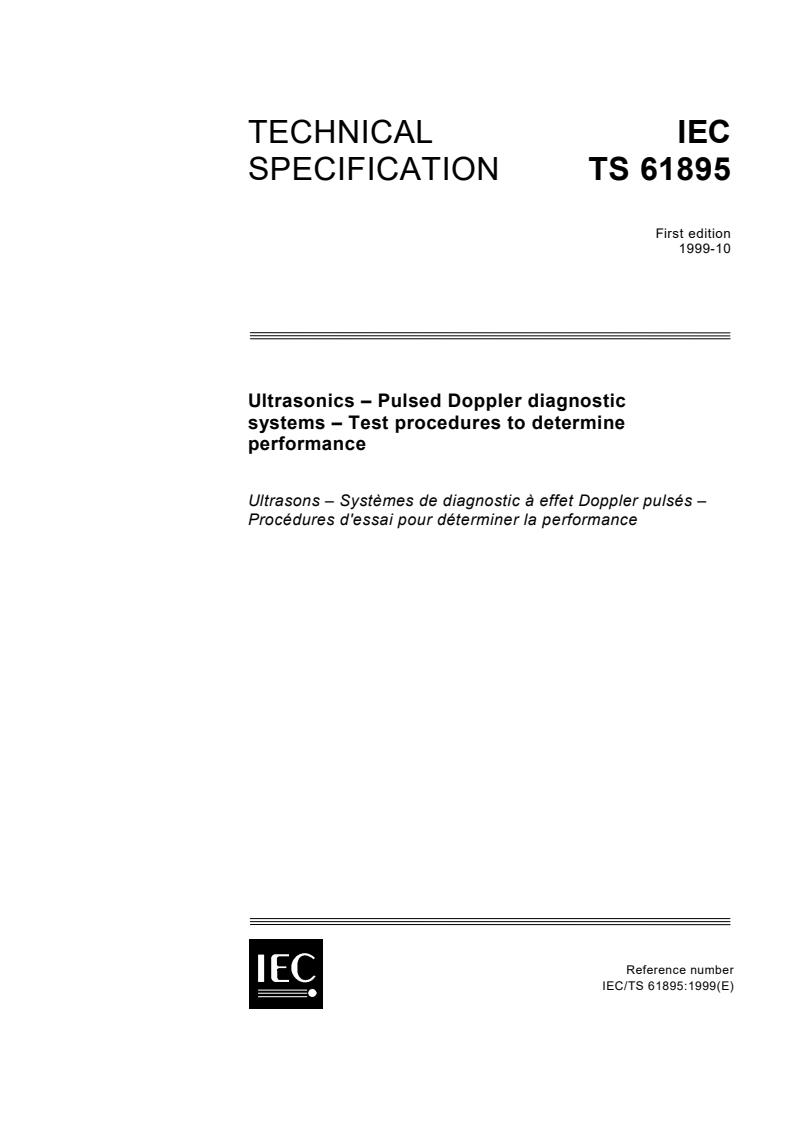
TECHNICAL IEC
SPECIFICATION
TS 61895
First edition
1999-10
Ultrasonics – Pulsed Doppler diagnostic
systems – Test procedures to determine
performance
Ultrasons – Systèmes de diagnostic à effet Doppler pulsés –
Procédures d'essai pour déterminer la performance
Reference number
IEC/TS 61895:1999(E)
Numbering
As from 1 January 1997 all IEC publications are issued with a designation in the
60000 series.
Consolidated publications
Consolidated versions of some IEC publications including amendments are
available. For example, edition numbers 1.0, 1.1 and 1.2 refer, respectively, to the
base publication, the base publication incorporating amendment 1 and the base
publication incorporating amendments 1 and 2.
Validity of this publication
The technical content of IEC publications is kept under constant review by the IEC,
thus ensuring that the content reflects current technology.
Information relating to the date of the reconfirmation of the publication is available
in the IEC catalogue.
Information on the subjects under consideration and work in progress undertaken
by the technical committee which has prepared this publication, as well as the list
of publications issued, is to be found at the following IEC sources:
• IEC web site*
• Catalogue of IEC publications
Published yearly with regular updates
(On-line catalogue)*
• IEC Bulletin
Available both at the IEC web site* and as a printed periodical
Terminology, graphical and letter symbols
For general terminology, readers are referred to IEC 60050: International
Electrotechnical Vocabulary (IEV).
For graphical symbols, and letter symbols and signs approved by the IEC for
general use, readers are referred to publications IEC 60027: Letter symbols to be
used in electrical technology, IEC 60417: Graphical symbols for use on equipment.
Index, survey and compilation of the single sheets and IEC 60617: Graphical symbols
for diagrams.
* See web site address on title page.
TECHNICAL IEC
SPECIFICATION
TS 61895
First edition
1999-10
Ultrasonics – Pulsed Doppler diagnostic
systems – Test procedures to determine
performance
Ultrasons – Systèmes de diagnostic à effet Doppler pulsés –
Procédures d'essai pour déterminer la performance
IEC 1999 Copyright - all rights reserved
No part of this publication may be reproduced or utilized in any form or by any means, electronic or
mechanical, including photocopying and microfilm, without permission in writing from the publisher.
International Electrotechnical Commission 3, rue de Varembé Geneva, Switzerland
Telefax: +41 22 919 0300 e-mail: inmail@iec.ch IEC web site http://www.iec.ch
Commission Electrotechnique Internationale
PRICE CODE
V
International Electrotechnical Commission
For price, see current catalogue
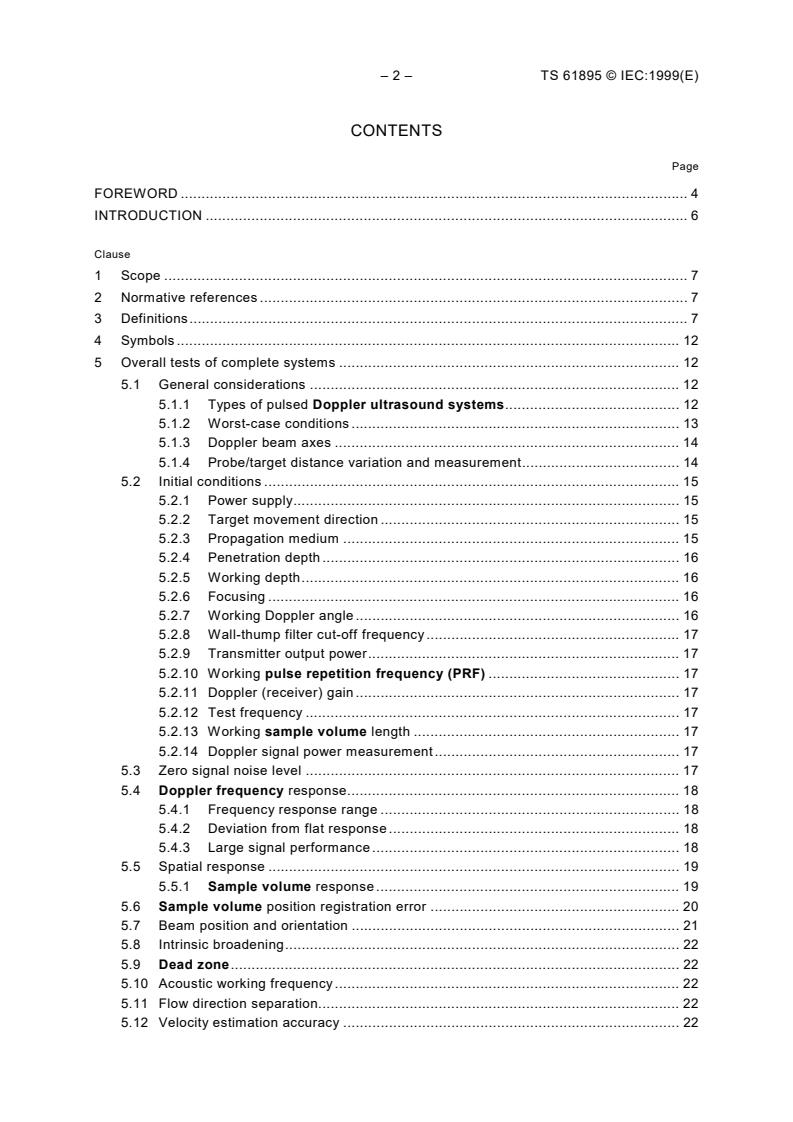
– 2 – TS 61895 © IEC:1999(E)
CONTENTS
Page
FOREWORD . 4
INTRODUCTION .6
Clause
1 Scope . 7
2 Normative references . 7
3 Definitions. 7
4 Symbols . 12
5 Overall tests of complete systems . 12
5.1 General considerations . 12
5.1.1 Types of pulsed Doppler ultrasound systems. 12
5.1.2 Worst-case conditions . 13
5.1.3 Doppler beam axes . 14
5.1.4 Probe/target distance variation and measurement. 14
5.2 Initial conditions . 15
5.2.1 Power supply. 15
5.2.2 Target movement direction . 15
5.2.3 Propagation medium . 15
5.2.4 Penetration depth. 16
5.2.5 Working depth. 16
5.2.6 Focusing . 16
5.2.7 Working Doppler angle . 16
5.2.8 Wall-thump filter cut-off frequency. 17
5.2.9 Transmitter output power. 17
5.2.10 Working pulse repetition frequency (PRF) . 17
5.2.11 Doppler (receiver) gain. 17
5.2.12 Test frequency . 17
5.2.13 Working sample volume length . 17
5.2.14 Doppler signal power measurement. 17
5.3 Zero signal noise level . 17
5.4 Doppler frequency response. 18
5.4.1 Frequency response range . 18
5.4.2 Deviation from flat response . 18
5.4.3 Large signal performance . 18
5.5 Spatial response . 19
5.5.1 Sample volume response . 19
5.6 Sample volume position registration error . 20
5.7 Beam position and orientation . 21
5.8 Intrinsic broadening. 22
5.9 Dead zone. 22
5.10 Acoustic working frequency. 22
5.11 Flow direction separation. 22
5.12 Velocity estimation accuracy . 22
TS 61895 © IEC:1999(E) – 3 –
5.13 Volume flow estimation accuracy. 22
5.14 Maximum, mean, mode and median frequency estimation accuracy. 23
5.15 Velocity waveform indices estimation accuracy. 25
6 Doppler test objects. 26
6.1 Test objects. 26
6.2 Electronic test object . 26
Annex A (normative) Description of pulsed Doppler ultrasound systems. 28
A.1 Single-channel system . 28
A.2 Multi-channel system . 29
A.3 Aliasing . 29
A.4 Duplex and triplex scanners . 29
Bibliography . 32
– 4 – TS 61895 © IEC:1999(E)
INTERNATIONAL ELECTROTECHNICAL COMMISSION
––––––––––––
ULTRASONICS –
PULSED DOPPLER DIAGNOSTIC SYSTEMS –
TEST PROCEDURES TO DETERMINE PERFORMANCE
FOREWORD
1) The IEC (International Electrotechnical Commission) is a worldwide organization for standardization comprising
all national electrotechnical committees (IEC National Committees). The object of the IEC is to promote
international co-operation on all questions concerning standardization in the electrical and electronic fields. To
this end and in addition to other activities, the IEC publishes International Standards. Their preparation is
entrusted to technical committees; any IEC National Committee interested in the subject dealt with may
participate in this preparatory work. International, governmental and non-governmental organizations liaising
with the IEC also participate in this preparation. The IEC collaborates closely with the International Organization
for Standardization (ISO) in accordance with conditions determined by agreement between the two
organizations.
2) The formal decisions or agreements of the IEC on technical matters express, as nearly as possible, an
international consensus of opinion on the relevant subjects since each technical committee has representation
from all interested National Committees.
3) The documents produced have the form of recommendations for international use and are published in the form
of standards, technical specifications, technical reports or guides and they are accepted by the National
Committees in that sense.
4) In order to promote international unification, IEC National Committees undertake to apply IEC International
Standards transparently to the maximum extent possible in their national and regional standards. Any
divergence between the IEC Standard and the corresponding national or regional standard shall be clearly
indicated in the latter.
5) The IEC provides no marking procedure to indicate its approval and cannot be rendered responsible for any
equipment declared to be in conformity with one of its standards.
6) Attention is drawn to the possibility that some of the elements of this technical specification may be the subject
of patent rights. The IEC shall not be held responsible for identifying any or all such patent rights.
The main task of IEC technical committees is to prepare International Standards. In
exceptional circumstances, a technical committee may propose the publication of a technical
specification when
the required support cannot be obtained for the publication of an International Standard,
despite repeated efforts, or
the subject is still under technical development or where, for any other reason, there is the
future but no immediate possibility of an agreement on an International Standard.
Technical specifications are subject to review within three years of publication to decide
whether they can be transformed into International Standards.
IEC 61895, which is a technical specification, has been prepared by IEC technical committee
87: Ultrasonics.
The text of this technical specification is based on the following documents:
Enquiry draft Report on voting
87/151/CDV 87/168/RVC
Full information on the voting for the approval of this technical specification can be found in the
report on voting indicated in the above table.
TS 61895 © IEC:1999(E) – 5 –
This publication has been drafted in accordance with the ISO/IEC Directives, Part 3.
Annex A forms an integral part of this technical specification.
The committee has decided that this publication remains valid until 2005. At this date, in
accordance with the committee’s decision, the publication will be
• reconfirmed;
• withdrawn;
• replaced by a revised edition,or
• amended.
A bilingual version of this publication may be issued at a later date.
– 6 – TS 61895 © IEC:1999(E)
INTRODUCTION
Pulsed ultrasonic Doppler flowmeters and velocimeters are widely used in clinical practice,
usually in combination with real-time B-mode imaging and colour-flow imaging instruments.
The device periodically transmits pulses of ultrasound from an ultrasound transducer and
measures the Doppler shift in the frequency of ultrasound reflected and scattered from moving
tissues. This Doppler shift is proportional to the component of reflector or scatterer velocity
along the ultrasound beam. By looking for Doppler shifts in the received signal at specific times
after transmission (range-gating), the device can be used to determine the variation of tissue
velocity with distance along the ultrasound beam. The device is sensitive to movement only
within a region of the beam called the sample volume. The position of the sample volume along
the beam may be adjusted by altering the delay between transmission and range-gating. Multi-
channel devices have a number of sample volumes operating simultaneously.
The pulsed ultrasonic device is most commonly used to investigate blood flow when the
ultrasound is scattered from red blood cells.
This technical specification describes a range of tests which may be used to measure
performance and the test objects required. In many cases, the test method and test object
have been described in IEC 61206 and in these cases reference is simply made to this
document. Other tests and test objects are described in [1] and [2]. The test methods may be
considered as falling into one of the following three categories. The first is routine quality
control tests that can be carried out by a clinician or technologist to ensure that the system is
working adequately or has adequate sensitivity. The second is more elaborate test methods,
conducted less frequently, when, for example, the system is suspected of malfunctioning. The
third represents tests that would be carried out by a manufacturer on complete systems in
order to guarantee compliance with specification.
TS 61895 © IEC:1999(E) – 7 –
ULTRASONICS –
PULSED DOPPLER DIAGNOSTIC SYSTEMS –
TEST PROCEDURES TO DETERMINE PERFORMANCE
1 Scope
This technical specification describes
– test methods for measuring the performance of pulsed Doppler ultrasound systems;
– Doppler test objects for carrying out these tests;
and applies to
– tests made on an overall pulsed Doppler ultrasound system, a system which is not
disassembled or disconnected;
– tests made on pulsed Doppler ultrasound systems whether they are stand-alone or as
part of another ultrasound instrument.
Electrical safety, acoustic output and electromagnetic compatibility (EMC) are not covered in
this technical specification.
The workload to perform all described tests is, in general, prohibitive. It is intended that a
subset of the described tests is adopted for regular use. However, experience to give guidance
for selection has still to be gathered and will be the subject of ongoing work.
2 Normative references
The following normative documents contain provisions which, through reference in this text,
constitute provisions of this technical specification. For dated references, subsequent
amendments to, or revisions of, any of these publications do not apply. However, parties to
agreements based on this technical specification are encouraged to investigate the possibility
of applying the most recent editions of the normative documents indicated below. For undated
references, the latest edition of the normative document referred to applies. Members of IEC
and ISO maintain registers of currently valid International Standards.
IEC 61102:1991, Measurement and characterisation of ultrasonic fields using hydrophones in
the frequency range 0,5 MHz to 15 MHz
IEC 61206:1993, Ultrasonics – Continuous-wave Doppler systems – Test procedures
IEC 61390:1996, Ultrasonics – Real-time pulse-echo systems – Test procedures to determine
performance specifications
3 Definitions
For the purposes of this technical report, the following definitions apply.
3.1
6 dB spectral width
width of a frequency spectrum between the frequencies at which the spectral power is 6 dB
less than the maximum power
– 8 – TS 61895 © IEC:1999(E)
3.2
20 dB spectral width
width of a frequency spectrum between the frequencies at which the spectral power is 20 dB
less than the maximum power
3.3
acoustic working frequency
centre frequency
zero-crossing acoustic-working frequency of the transmitted pulse spectrum
[3.4 of IEC 61102, modified]
3.4
aliasing
false indication of signal frequency as a result of sampling at too low a frequency
NOTE Aliasing occurs when the Doppler frequency exceeds the Nyquist limit frequency of the Doppler
ultrasound system. In a non-directional system, the indicated frequency of the Doppler signal is the true Doppler
frequency mirrored in the Nyquist limit frequency. In a directional system, the indicated frequency of the
Doppler signal is the true Doppler frequency mirrored in the Nyquist limit frequency and changed in sign. In
using a baseline shift, the term should be replaced by
systems Doppler frequency Doppler frequency plus
baseline frequency shift in the above explanation.
3.5
baseline frequency shift
frequency by which the Doppler signal is shifted before analysis in order to alleviate the effects
of aliasing
3.6
B-mode (brightness-modulated display)
image generated by a pulse-echo ultrasound scanner in which the echoes from reflectors and
scatterers in the tissues swept by a pulsed ultrasound beam are represented by a brightness-
modulated two-dimensional display
3.7
clutter
unwanted components of the Doppler signal as it appears after the Doppler demodulator
NOTE Clutter arises from stationary or slowly moving reflectors and is usually removed by high-pass filters (wall-
thump filters) within the
Doppler ultrasound system.
3.8
dead zone
region close to the transducer in which the system is insensitive to tissue movement
3.9
directional
direction sensing
descriptor of a type of Doppler ultrasound system which indicates whether scatterers or
reflectors are approaching or receding from the ultrasonic transducer
[1.3.1 of IEC 61206]
3.10
direction resolving
direction separating
descriptor of a type of Doppler ultrasound system in which the Doppler output appears at
different output terminals, output channels or output devices depending on the direction of
scatterer or reflector motion relative to the transducer
[1.3.2 of IEC 61206, modified]
TS 61895 © IEC:1999(E) – 9 –
3.11
Doppler angle
acute angle between the axis of the ultrasound beam during Doppler measurements and the
direction of movement of the scatterer or reflector
3.12
Doppler demodulator
that part of the Doppler ultrasound system at which the Doppler signal is derived through
mixing of the received signal and a reference signal
3.13
Doppler frequency
Doppler-shift frequency
change in frequency of an ultrasound scattered or reflected wave caused by relative motion
between the scatterer or reflector and the transducer. It is the difference in frequency between
the transmitted and the received wave
[1.3.3 of IEC 61206, modified]
3.14
Doppler output connector
electrical connector or that part of the Doppler ultrasound system at which the Doppler
output is available for connection to external output devices
[1.3.5 of IEC 61206]
3.15
Doppler output
signal at the Doppler frequency or at Doppler frequencies which activates the output device
[1.3.4 of IEC 61206, modified]
3.16
Doppler spectrum
set of Doppler frequencies produced by a Doppler ultrasound system
[1.3.6 of IEC 61206]
3.17
Doppler test object
artificial structure used in testing Doppler ultrasound systems
3.18
Doppler ultrasound system
equipment designed to transmit and receive ultrasound and to generate a Doppler output from
the difference in frequency between the transmitted and received waves
[1.3.8 of IEC 61206]
3.19
duplex scanner
ultrasound instrument which combines real-time B-mode imaging with a Doppler ultrasound
system
3.20
nominal Doppler beam direction axis
assumed axis of the ultrasonic beam from the transducer used for Doppler measurements.
This axis will often be the axis of rotational symmetry of the Doppler probe for a single-element
transducer
– 10 – TS 61895 © IEC:1999(E)
3.21
nominal first lateral Doppler beam axis
coordinate axis perpendicular to the nominal Doppler beam direction axis and with a position
indicated on the probe body for a single-beam direction probe or contained within the scan
plane for the probe of a duplex or triplex scanner (see figure A.2)
3.22
nominal second lateral Doppler beam axis
coordinate axis perpendicular to both the nominal Doppler beam direction axis and the
nominal first lateral Doppler beam axis. This axis is perpendicular to the scan plane for a the
probe of a duplex or triplex scanner (see figure A.2)
NOTE The nominal first lateral Doppler beam axis, the nominal second Doppler beam axis and the nominal
Doppler beam direction axis form a right-handed Cartesian co-ordinate set as shown in figure A.2.
3.23
nominal sample volume length
length of the sample volume indicated by the system. This normally will be a numerical display
or a distance between markers on a screen indicating the extent of the sample volume along
the nominal Doppler beam direction axis
3.24
non-directional
descriptor of a type of Doppler ultrasound system which is not directional
[1.3.9 of IEC 61206]
3.25
Nyquist limit frequency
half the pulse repetition frequency. In systems not using a baseline shift, it equals the
frequency under which aliasing does not occur
3.26
observed velocity
component of the velocity of a scatterer or reflector along the axis of the ultrasound beam. This
is directed towards or away from the transducers
3.27
output channel
part of the Doppler ultrasound system which functionally represents a particular aspect of the
Doppler output
NOTE A Doppler ultrasound system may have two output channels, each representing a flow in a particular
direction.
[1.3.12 of IEC 61206]
3.28
output device
any device included in a Doppler ultrasound system or capable of being connected to it that
makes the Doppler output accessible to the human senses
[1.3.13 of IEC 61206]
3.29
phase-quadrature demodulation
a method of derivation of Doppler signals incorporating flow direction information, in which two
Doppler demodulators are used with reference signals 90° out of phase – leading to in-
phase and quadrature Doppler signals 90° out of phase. The direction of the phase shift
between the in-phase and quadrature parts of the Doppler signal component at a particular
frequency indicates the direction of movement of the target giving rise to that component
TS 61895 © IEC:1999(E) – 11 –
3.30
pulse repetition frequency (PRF)
the number of pulses or bursts of ultrasound emitted by the transducer per second
3.31
range gate
that part of the Doppler ultrasound system which selects signals received from a range of
depths to generate the Doppler signal. This is achieved by selecting signals arriving during a
time interval following a delay after pulse transmission
3.32
reference signal
the signal mixed with the received signal in the Doppler demodulator in order to generate the
Doppler signal. In non-directional Doppler ultrasound systems or systems using phase-
quadrature demodulation the reference signal is at the transmitted frequency. In off-set
frequency directional Doppler ultrasound systems, the reference signal is at the
transmitted frequency plus or minus the off-set frequency
3.33
sample volume
the region of the ultrasound beam in which moving scatterers or reflectors give rise to
components of the Doppler signal from the Doppler ultrasound system
3.34
scan plane
plane containing ultrasonic scan lines
[3.29 of IEC 61390]
3.35
sonogram
a frequency-time display in which the relative amplitude or power of each frequency component
of the detected signal from successive or overlapping time windows is displayed as adjoining
vertical grey scale lines
3.36
spectral width
range of Doppler frequencies within the Doppler spectrum
3.37
spectrum
a display of amplitude or power against frequency, showing the relative amplitude or power of
each frequency component contained in the detected signal (see Doppler spectrum)
3.38
string test object
line of scatterers moving at a constant velocity in the direction of the line, and having
ultrasound scattering properties similar to that of a moving column of blood
3.39
system
Doppler ultrasound system
See 3.18
– 12 – TS 61895 © IEC:1999(E)
3.40
target
reflector, scatterer or collection of scatterers giving rise to a received signal
3.41
target depth
distance from the probe face to the target along the beam
3.42
triplex scanner
ultrasound instrument which combines real-time B-mode imaging and colour-flow imaging with
a pulsed Doppler ultrasound system
4 Symbols
c = average speed of sound in a medium
L = distance from the transducer face to the centre of the sample volume
L = maximum depth of penetration of the pulsed Doppler ultrasound system
max
f = acoustic working frequency
f = frequency of sinusoidal variation in mean frequency of simulated Doppler signal used
vm
in maximum, mean, mode and median frequency estimation accuracy test
5 Overall tests of complete systems
5.1 General considerations
5.1.1 Types of pulsed Doppler ultrasound systems
A pulsed Doppler ultrasound system may be directional, non-directional or direction-
resolving. Directional (or directional sensing) refers to a type of pulsed Doppler ultrasound
system which indicates whether reflectors or scatterers are approaching or receding from the
ultrasonic transducer. Non-directional Doppler ultrasound systems do not indicate the
direction of movement. Direction-resolving (or direction-separating) Doppler ultrasound
systems provide for Doppler outputs to appear at different output channels depending on
the direction of reflector or scatterer movement. The system may use a phase-quadrature
demodulation or offset reference frequency demodulation in order to derive Doppler signals
retaining flow direction information. Annex A gives descriptions and diagrams of these different
types of pulsed Doppler ultrasound systems.
The system may be a stand-alone instrument or part of a B-mode and/or flow imaging
system. The stand-alone instrument may make use of a single transducer for transmission and
reception or separate transducers for these functions, in which case the instrument may be
switched to operate in the continuous wave mode. When incorporated with a B-mode real-time
imaging instrument, a separate transducer may be used for pulsed Doppler operation or the
same transducer used for pulse echo imaging and pulsed Doppler work.
TS 61895 © IEC:1999(E) – 13 –
The system may be part of a duplex or a triplex scanner. Duplex scanners allow display of
the nominal Doppler beam axis direction used for Doppler measurements to be displayed on
the B-mode image along with indications of the depth and length of the sample volume.
Provision is made for the operator to line up an electronic marker parallel to the axis of the
displayed blood vessel in order that the instrument may calculate the angle between the
ultrasound beam and the direction of the vessel. This allows the conversion of Doppler
frequencies to blood velocities on the assumption of flow in the axial direction. Triplex
scanners, in addition to the functions of the duplex scanners, display images of moving
blood, colour-coded according to blood velocity, superimposed on the B-mode image.
The system may or may not be equipped with automatic adaptation of operating parameters to
the depth of the sample volume and the nature of the tissue between the transducer and
sample volume. Examples of parameters which are adapted in this way are pulse repetition
frequency (PRF), focal depth, transducer aperture and transmission signal spectrum.
The system may incorporate a method of spectral analysis of the Doppler signal, displaying the
time-varying frequency spectrum of the Doppler signal. This frequency analysis may be based
on the Fast Fourier Transform (FFT) or other methods of spectral analysis. The system may
as an alternative display the time-varying maximum, mean, mode or median Doppler
frequency derived from the spectral analyser, or more directly, by time-domain processing.
The system may incorporate interactive or automated measurement and/or calculation
systems to process further the data from the spectrum analysis and/or Doppler frequency
waveform – calculating, for example, indices of waveform shape and spectral width.
The system may incorporate means for the operator to listen to the Doppler signal using a
loudspeaker or headphones.
The system may be a multi-channel instrument having a number of sample volumes and
associated Doppler signal channels.
5.1.2 Worst-case conditions
A test method may be applied to determine a particular performance parameter of a system.
Often a number of quantities can have a bearing on overall performance, each of which
requires the application of a distinct test method. Some of these quantities need to be
maximized and others need to be minimized in order to obtain best overall performance.
Considering overall performance, table 1 gives the worst-case conditions for key quantities
appropriate to pulsed Doppler ultrasound systems and the corresponding subclause numbers
which describe a suitable test method. As an example, if the penetration as mentioned in 5.2.4
is minimized, this will lead to worst-case overall performance; conversely, maximizing
penetration will lead to maximized performance.
– 14 – TS 61895 © IEC:1999(E)
Table 1 – Worst case for various quantities, and corresponding subclause numbers
Worst case is minimum value of Worst case is maximum value of
Quantities Subclauses Quantities Subclauses
Penetration depth 5.2.4 5.9
Dead zone
Clutter rejection index 5.4.3.1 High-frequency 5.4.1
response error
Flow direction 5.11 Low-frequency 5.4.1
separation response error
Harmonic distortion 5.4.3.2
Intermodulation 5.4.3.3
distortion
Sample volume 5.6
registration error
Intrinsic broadening 5.8
Beam position and 5.7
orientation error
Velocity estimation 5.12
error
Volume flow estimation 5.13
error
Maximum, mean, mode 5.14
and median frequency
estimation errors
5.1.3 Doppler beam axes
For the purposes of determining the orientation of the ultrasound probe, three orthogonal axes
should be defined. One of these is the nominal Doppler beam direction axis and the other
two are the first and second lateral Doppler beam axes. The first lateral axis is perpendicular to
the sound beam axis and is in the plane of the scan. The second lateral axis is also
perpendicular to the sound beam axis but is perpendicular to the plane of the scan. In a self-
contained pulsed Doppler ultrasound system, these axes should be defined with respect to a
mark or feature on the probe body. In a duplex or triplex scanner, the first lateral Doppler
beam axis should be within the scan plane (see annex A).
5.1.4 Probe/target distance variation and measurement
The probe of the Doppler ultrasound system should be attached to a calibrated positioning
mechanism capable of movement in three orthogonal directions. The directions of movement
should be parallel to the nominal Doppler beam direction axis and parallel to the nominal
first and second lateral Doppler beam axes. Alternatively, the probe of the Doppler
ultrasound system may be held in a fixed position and the target moved parallel to these
axes.
TS 61895 © IEC:1999(E) – 15 –
5.2 Initial conditions
These subclauses describe conditions common to all of the tests given in 5.2.4 and 5.3 to 5.15,
as well as a procedure to determine the appropriate Doppler frequency and distance ranges
to be used for these measurements.
Where a particular type of system may be comprised of various combinations of components,
it is intended that each combination should be regarded as a separate system for testing
purposes. For example, a system may have various transducer options. In this case, each
transducer and output recording or presentation device connected to the basic system will
define a different system. For the test to be meaningful, all instrument control settings should
be recorded during the test. For those tests where the operator is required to make an
assessment of performance from a grey scale or colour video display, the video monitor
settings and ambient lighting conditions should be such that the lowest displayed intensity level
above background is clearly distinguishable from the background.
5.2.1 Power supply
To ensure that the stated specifications hold over the range of power supply voltage, tests
should be undertaken for the different power line voltages and worst-case test result values
reported. The power line voltages are to be used at their nominal values and at 10 % above
and below the nominal voltage. For power line operated systems, the worst-case values are
those obtained after a specified warm-up time.
Portable, battery-operated systems weighing less than one kilogram should be tested with no
warm-up and only over the time span sufficient to perform each test to simulate typical use.
Heavier battery-powered systems should be tested under the same conditions as the power
line operated systems.
For all battery-operated systems the results should be the worst case found over the span of
battery voltages from the fully charged condition to a nominal end-of-life voltage. Any system
tuning or adjustment should be carried out as specified in the instructions supplied to the user.
It should be stated whether the nominal life-span of the battery occurs under continuous or
intermittent conditions of use. This allows the manufacturer to select the intended normal
battery life for either intermittent or continuous use. Manufacturers may report best-case
results (for example, with fully charged batteries) in addition to worst-case results, provided
that they report the system condition under which the results were obtained.
5.2.2 Target movement direction
If the pulsed Doppler ultrasound system is part of a duplex or triplex scanner then the
target movement should be within the scan plane of the imaging system, unless otherwise
stated. If the pulsed Doppler ultrasound system is stand-alone, then the target's movement
should be within the plane defined by the nominal Doppler beam direction axis and the
nominal first lateral Doppler beam axis, unless otherwise stated.
5.2.3 Propagation medium
Most of the tests listed below can be performed in an appropriate non-attenuative medium
–1
whose acoustic velocity is 1 540 ms , such as a 9,0 % glycerol solution by volume. If an
electronic injection system is used, this may be coupled to the transducer under test using a
–1
solid medium such as perspex which has a higher acoustic velocity of 2 700 to 2 800 ms .
Attenuation using a suitable absorbor is required for the measurement of penetration depth.
–1
This should have an acoustic velocity of 1 540 ms . The attenuation may be tissue equivalent
–1 –1 –1 –1
(0,45 dB cm MHz to 0,55 dB cm MHz ), as commonly used in a flow phantom, or it may
be higher, as it may be necessary to perform sensitivity measurements using an attenuative
polyurethane wedge in conjunction with a string test object.
– 16 – TS 61895 © IEC:1999(E)
5.2.4 Penetration depth
The maximum depth of penetration along the ultrasound beam (L ) is measured using a
max
Doppler test object with an attenuating tissue-mimicking medium between the probe and
target. The target depth is increased until the Doppler signal power is equal to the noise
power – that is, when the power of the Doppler output with a moving target (signal plus noise)
is double that with a stationary target (noise only). In this case the signal-to-noise ratio (SNR)
is zero decibels.
If the maximum depth in the Doppler test object is insufficient to reduce the signal power to
give a SNR of zero decibels, the transmitter power should be reduced to enable the above
condition to be achieved. In this case, the transmitter output setting should be noted.
The attenuation coefficient of the tissue mimicking medium should be within the range 0,45 dB
–1 –1 –1 –1
cm MHz to 0,55 dB cm MHz , as commonly used in a flow phantom, or it may be higher
–1 –1 –1 –1
(for example 0,70 dB cm MHz to 0,80 dB cm MHz ) and should be reported along with
the results of this test.
It should be noted that penetration depends on the target, and comparisons between systems
are valid only if similar targets are used.
5.2.5 Working depth
Except where otherwise stated, measurements should be made at a distance between the
probe face and the target (along the beam) of L /2, where L is the maximum depth of
max max
penetration (see 5.2.4).
5.2.6 Focusing
When testing systems with an operator-set (non-automatic) variable focus in duplex or triplex
scanners, the nominal focus should be adjusted to the depth of the centre of the sample
volume, or as close as the system focus and sample volume depth settings allow.
5.2.7 Working Doppler angle
Except where stated otherwise, the angle between the nominal Doppler beam direction axis
and the direction of target movement in the Doppler test object should be 0°, 30°, 45°, or 60°.
It should be noted that it may not be possible to achieve all these angles in all test objects (for
example 0° in most flow test objects).
In a stand-alone pulsed Doppler ultrasound system with a transducer mounted in such a way
that the beam axis is designed to be coincident with the probe axis, the probe axis should be
taken as the nominal Doppler beam direction axis. In other isolated systems, the nominal
Doppler beam direction axis should be described by the manufacturer.
In duplex and triplex scanners, the working Doppler angle is that measured between the
Doppler beam and the direction of target movement as indicated on the image screen. If the
Doppler beam orientation is variable, this angle should be set to 60°.
TS 61895 © IEC:1999(E) – 17 –
5.2.8 Wall-thump filter cut-off frequency
Except where otherwise stated, in systems with variable wall-thump filter cut-off frequencies
–5
this frequency should be set to 4 × 10 f or the nearest value allowed by the system for
o
peripheral vascular applications, where f is the acoustic-working frequency. This
o
–1
corresponds approximately to 3 cms for a Doppler angle of zero. For other systems other
filter cut-off frequencies may be more appropriate. For example, for fetal applications this
–5
frequency should be set to 2 × 10 f or the nearest value allowed by the system, and for
o
–5
adult cardiology applications, this frequency should be set to 6 × 10 f or the nearest value
o
allowed by the system.
5.2.9 Transmitter output power
Except where otherwise stated, in systems where the transmitted output power is variable, this
power should be set at maximum.
5.2.10 Working pulse repetition frequency (PRF)
Except where otherwise stated, the PRF should be set to 0,4c/L or the nearest lower
max
frequency allowed by the system.
5.2.11 Doppler (receiver) gain
Except where otherwise stated, in systems with a real-time spectrum analyser as an output
device, the Doppler gain should be set in such a way that, with the transmitter power at
minimum and the target stationary, the noise is just not visible on the display. Alternatively, in
systems with no spectral analyser, the Doppler gain should be set to give a small but
measurable noise signal on the Doppler output.
5.2.12 Test frequency
The test frequency is the Doppler frequency to be used in performing the tests. For the
electronic injection test device, this is the frequency of the injected audio signal. For other test
devices, this is the mean Doppler frequency. Except where otherwise stated, a test frequency
–4
of 5 × 10 f or a frequency specified by the manufacturer should be used.
o
5.2.13 Working sample volume length
Except where otherwise stated, in systems where the sample volume length is variable, the
nominal sample volume length should be set to 25 × 10 /f mm, or the nearest greater length
o
allowed by the system, or if a greater length is not available, the nearest length, where f is the
o
acoustic working frequency in hertz.
5.2.14 Doppler signal power measurement
Doppler signal power can be measured at a Doppler output connector. The Doppler signal
power may be measured by any device having an accuracy of better than 5 % at the signal
level under consideration. It should be quoted as mean square signal volts, root-mean-square
(r.m.s.) volts or in decibels relative to 1,0 volts r.m.s. A true reading r.m.s. meter is suitable.
Note that only relative values are required in all the tests.
5.3 Zero signal noise level
With the test object producing a Doppler signal at the test frequency, the receiver level and
transmitted power output are set to display the Doppler signal on the sonogram such that the
full grey scale range of the display is utilized. The motion of the target is stopped, or in the
case of the electronic injection device, the injected signal is switched off. The signal level at
the Doppler output is noted as the zero signal noise level.
– 18 – TS 61895 © IEC:1999(E)
5.4 Doppler frequency response
The Doppler frequency response and accuracy are preferably tested with a test object giving
rise to a narrow Doppler spectrum. An electronic Doppler test object with a single-frequency
Doppler shift or a string Doppler test object may be used.
5.4.1 Frequency response range
The baseline of the frequency display should be set to zero. Frequency response is measured
for the frequency range from 0 Hz to the upper Nyquist limit. The shift frequency of the
electronic Doppler test object or the speed of the moving target in a string or flow Doppler
test object is varied over this range. The time-average Doppler output signal level is
measured as a function of Doppler frequency using an r.m.s. voltmeter or power meter and a
means of mean frequency measurement. If the Doppler output signal level has one peak
value, the low-frequency response frequency and the high-frequency response frequency are
found from those frequencies at which the output voltage is 3 dB less than its peak level,
although other limits may be used if so declared. The same procedure should apply in the case
of multiply peaked response curves, where the lowest value between the peaks is above the
–3 dB level relative to the largest peak described above.
If the response curve is multiply peaked and the lowest value between the peaks is below the
–3 dB level relative to the largest peak described above, then the smallest value found between
the peaks should be taken as the minimal detectable signal level. A horizontal line graph at this
signal will then intercept the frequency response curve at this minimum and two other points.
These two other points are the low- and high-frequency response values and should be quoted
as
...