


IEC 60950-1:2005/AMD1:2009
(Amendment)Amendment 1 - Information technology equipment - Safety - Part 1: General requirements
General Information
- Abstract
The contents of the corrigendum of August 2012 have been included in this copy.
- Status
- Withdrawn
- Publication Date
- 16-Dec-2009
- Withdrawal Date
- 28-Mar-2024
- Technical Committee
- TC 108 - Safety of electronic equipment within the field of audio/video, information technology and communication technology
- Drafting Committee
- MT 2 - TC 108/MT 2
- Current Stage
- WPUB - Publication withdrawn
- Start Date
- 02-Apr-2024
- Completion Date
- 28-Aug-2026
Buy Documents
IEC 60950-1:2005/AMD1:2009 - Amendment 1 - Information technology equipment - Safety - Part 1: General requirements Released:12/17/2009
IEC 60950-1:2005/AMD1:2009 - Amendment 1 - Information technology equipment - Safety - Part 1: General requirements Released:12/17/2009
Relations
- Effective Date
- 05-Sep-2023
- Effective Date
- 05-Sep-2023
Buy Documents
IEC 60950-1:2005/AMD1:2009 - Amendment 1 - Information technology equipment - Safety - Part 1: General requirements Released:12/17/2009
IEC 60950-1:2005/AMD1:2009 - Amendment 1 - Information technology equipment - Safety - Part 1: General requirements Released:12/17/2009
Get Certified
Connect with accredited certification bodies for this standard

BSI Group
BSI (British Standards Institution) is the business standards company that helps organizations make excellence a habit.

NYCE
Mexican standards and certification body.
Sponsored listings
Frequently Asked Questions
IEC 60950-1:2005/AMD1:2009 is a standard published by the International Electrotechnical Commission (IEC). Its full title is "Amendment 1 - Information technology equipment - Safety - Part 1: General requirements". This standard covers: The contents of the corrigendum of August 2012 have been included in this copy.
The contents of the corrigendum of August 2012 have been included in this copy.
IEC 60950-1:2005/AMD1:2009 is classified under the following ICS (International Classification for Standards) categories: 35.020 - Information technology (IT) in general; 35.260 - Office machines. The ICS classification helps identify the subject area and facilitates finding related standards.
IEC 60950-1:2005/AMD1:2009 has the following relationships with other standards: It is inter standard links to IEC 60950-1:2005, IEC 60950-1:2005/AMD1:2009/COR1:2012. Understanding these relationships helps ensure you are using the most current and applicable version of the standard.
IEC 60950-1:2005/AMD1:2009 is available in PDF format for immediate download after purchase. The document can be added to your cart and obtained through the secure checkout process. Digital delivery ensures instant access to the complete standard document.
Standards Content (Sample)
IEC 60950-1 ®
Edition 2.0 2009-12
INTERNATIONAL
STANDARD
AMENDMENT 1
Information technology equipment – Safety –
Part 1: General requirements
IEC 60950-1:2005/A1:2009(E)
All rights reserved. Unless otherwise specified, no part of this publication may be reproduced or utilized in any form
or by any means, electronic or mechanical, including photocopying and microfilm, without permission in writing from
either IEC or IEC's member National Committee in the country of the requester.
If you have any questions about IEC copyright or have an enquiry about obtaining additional rights to this publication,
please contact the address below or your local IEC member National Committee for further information.
IEC Central Office
3, rue de Varembé
CH-1211 Geneva 20
Switzerland
Email: inmail@iec.ch
Web: www.iec.ch
About the IEC
The International Electrotechnical Commission (IEC) is the leading global organization that prepares and publishes
International Standards for all electrical, electronic and related technologies.
About IEC publications
The technical content of IEC publications is kept under constant review by the IEC. Please make sure that you have the
latest edition, a corrigenda or an amendment might have been published.
ƒ Catalogue of IEC publications: www.iec.ch/searchpub
The IEC on-line Catalogue enables you to search by a variety of criteria (reference number, text, technical committee,…).
It also gives information on projects, withdrawn and replaced publications.
ƒ IEC Just Published: www.iec.ch/online_news/justpub
Stay up to date on all new IEC publications. Just Published details twice a month all new publications released. Available
on-line and also by email.
ƒ Electropedia: www.electropedia.org
The world's leading online dictionary of electronic and electrical terms containing more than 20 000 terms and definitions
in English and French, with equivalent terms in additional languages. Also known as the International Electrotechnical
Vocabulary online.
ƒ Customer Service Centre: www.iec.ch/webstore/custserv
If you wish to give us your feedback on this publication or need further assistance, please visit the Customer Service
Centre FAQ or contact us:
Email: csc@iec.ch
Tel.: +41 22 919 02 11
Fax: +41 22 919 03 00
IEC 60950-1 ®
Edition 2.0 2009-12
INTERNATIONAL
STANDARD
AMENDMENT 1
Information technology equipment – Safety –
Part 1: General requirements
INTERNATIONAL
ELECTROTECHNICAL
COMMISSION
PRICE CODE
W
ICS 35.020; 35.260 ISBN 978-2-88910-345-4
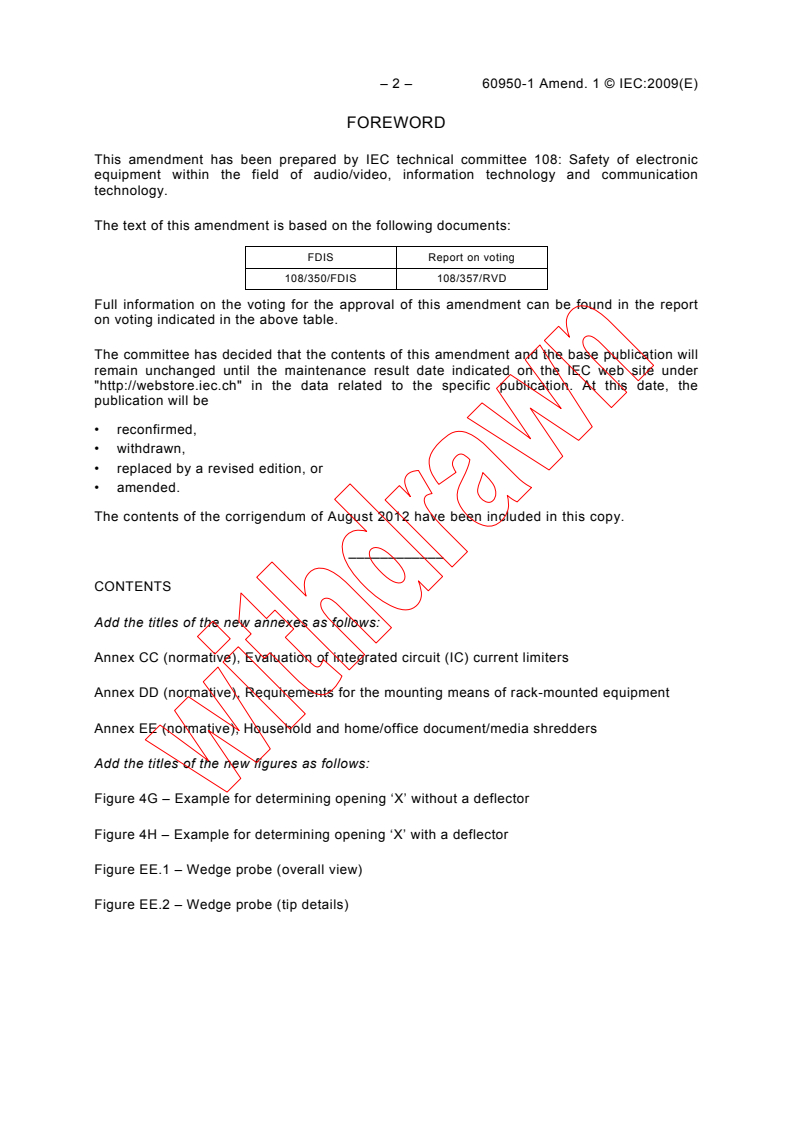
– 2 – 60950-1 Amend. 1 © IEC:2009(E)
FOREWORD
This amendment has been prepared by IEC technical committee 108: Safety of electronic
equipment within the field of audio/video, information technology and communication
technology.
The text of this amendment is based on the following documents:
FDIS Report on voting
108/350/FDIS 108/357/RVD
Full information on the voting for the approval of this amendment can be found in the report
on voting indicated in the above table.
The committee has decided that the contents of this amendment and the base publication will
remain unchanged until the maintenance result date indicated on the IEC web site under
"http://webstore.iec.ch" in the data related to the specific publication. At this date, the
publication will be
• reconfirmed,
• withdrawn,
• replaced by a revised edition, or
• amended.
The contents of the corrigendum of August 2012 have been included in this copy.
____________
CONTENTS
Add the titles of the new annexes as follows:
Annex CC (normative), Evaluation of integrated circuit (IC) current limiters
Annex DD (normative), Requirements for the mounting means of rack-mounted equipment
Annex EE (normative), Household and home/office document/media shredders
Add the titles of the new figures as follows:
Figure 4G – Example for determining opening ‘X’ without a deflector
Figure 4H – Example for determining opening ‘X’ with a deflector
Figure EE.1 – Wedge probe (overall view)
Figure EE.2 – Wedge probe (tip details)
60950-1 Amend. 1 © IEC:2009(E) – 3 –
1.2 Definitions
Add after “RATING, PROTECTIVE CURRENT….1.2.13.17” in the list of “Definitions in alphabetical
order of nouns” the following new entry:
SHREDDER (DOCUMENT/MEDIA, HOUSEHOLD AND HOME/OFFICE) ….1.2.13.18
Add, after the existing definition 1.2.13.17, the following new definition:
1.2.13.18
(HOUSEHOLD AND HOME/OFFICE DOCUMENT/MEDIA) SHREDDER
equipment with a plug configuration associated with PLUGGABLE EQUIPMENT TYPE A, or battery
operated equipment, designed to shred paper or other forms of media as instructed by the
manufacturer
NOTE 1 Examples of other forms of media include but are not limited to digital video disks, compact disks, flash
memory, magnetic strip cards, or magnetic disks, or the like.
NOTE 2 HOUSEHOLD AND HOME/OFFICE DOCUMENT/MEDIA SHREDDERS are typically identified as either strip-cut type
or cross-cut type. A strip-cut HOUSEHOLD AND HOME/OFFICE DOCUMENT/MEDIA SHREDDER shreds the paper into long
strips using a motor-based shredding mechanism. A cross-cut DOCUMENT/MEDIA SHREDDER shreds paper two or
more ways into tiny particles, typically using a more powerful motor and more complex shredding mechanism.
NOTE 3 A document/media shredder is considered to be non-household or non-home/office type if the
document/media shredder is provided with a plug configuration associated with PLUGGABLE EQUIPMENT TYPE B, or is
PERMANENTLY CONNECTED EQUIPMENT.
Table 1C – Capacitor ratings according to IEC 60384-14
Replace the existing rule 3 of this table by the following:
3 For a single capacitor bridging FUNCTIONAL INSULATION, BASIC INSULATION or SUPPLEMENTARY INSULATION, the peak
test voltage of the capacitor shall be at least equal to the peak value of the test voltage (not the r.m.s. voltage) of
Table 5B, or the peak value of the test voltage of Table 5C, as applicable, and the r.m.s. test voltage shall be not
less than the required r.m.s. test voltage of Table 5B, or the equivalent r.m.s. test voltage (not the peak voltage)
of Table 5C, as applicable.
Replace the existing rule 4 of this table by the following:
4 For a single capacitor bridging DOUBLE INSULATION or REINFORCED INSULATION, the peak test voltage of the
capacitor shall be not less than the peak value of the test voltage (not the r.m.s. voltage) of Table 5B, or the peak
value of the test voltage of Table 5C, as applicable; and the r.m.s. test voltage shall be not less than the required
r.m.s. test voltage of Table 5B, or the equivalent r.m.s. test voltage (not the peak voltage) of Table 5C, as
applicable.
Replace the existing rule 7 of this table by the following:
7 If two or more capacitors are used in series, all of the following apply:
– under single fault conditions, the voltage on each of the remaining individual capacitors shall not exceed
the voltage rating of the relevant individual capacitor;
– for BASIC INSULATION or SUPPLEMENTARY INSULATION, the sum of the peak impulse test voltages of all
capacitors shall be not less than the peak value of the test voltage (not the r.m.s. voltage) of Table 5B, or
the peak value of the test voltage of Table 5C, as applicable;
– for BASIC INSULATION or SUPPLEMENTARY INSULATION, the sum of the r.m.s. test voltages of all capacitors
shall be not less than the required r.m.s. test voltage of Table 5B, or the equivalent r.m.s. test voltage (not
the peak voltage) of Table 5C, as applicable;
– for REINFORCED INSULATION, the sum of the peak impulse test voltages of all capacitors shall be not less
than the peak value of the test voltage (not the r.m.s. voltage) of Table 5B, or the peak value of the test
voltage of Table 5C, as applicable;
– for REINFORCED INSULATION, the sum of the r.m.s. test voltages of all capacitors shall be not less than the
required r.m.s. test voltage of Table 5B, or the equivalent r.m.s. test voltage (not the peak voltage) of
Table 5C, as applicable;
– they shall comply with the other rules above.
– 4 – 60950-1 Amend. 1 © IEC:2009(E)
Table 1D – Informative examples of application of capacitors
Replace the existing Table 1D by the following new table:
AC MAINS
SUPPLY
MAINS
Number of capacitors
voltage
TRANSIENT
Overvoltage Bridged Capacitor
VOLTAGE
up to and Category insulation type
Using Table Using Table
including
kV
5B 5C
V r.m.s.
II 1,5 B or S Y2 1 1
II 1,5 D or R Y2 2 2
II 1,5 D or R Y1 1 1
II 1,5 F X2 1 1
III 2,5 F X2 1 1
150 III 2,5 B or S Y2 - 2
III 2,5 D or R Y1 - 1
IV 4,0 F X1 - 1
IV 4,0 B or S Y1 - 1
IV 4,0 B or S Y2 - 2
IV 4,0 D or R Y1 - 2
II 2,5 F X2 1 1
III 4,0 F X1 1 1
II 2,5 B or S Y2 1 2
II 2,5 D or R Y1 1 1
II 2,5 D or R Y2 2 3
III 4,0 B or S Y1 - 1
III 4,0 B or S Y2 - 2
III 4,0 D or R Y1 - 2
III 4,0 D or R Y2 - 4
IV 6,0 F X1 - 2
IV 6,0 B or S Y1 - 2
IV 6,0 D or R Y1 - 3
II 4,0 F X1 1 1
II 4,0 B or S Y1 1 1
II 4,0 D or R Y1 1 2
III 6,0 F X1 - 2
500 III 6,0 B or S Y1 - 2
III 6,0 D or R Y1 - 3
IV 8,0 F X1 - 2
IV 8,0 B or S Y1 - 2
IV 8,0 D or R Y1 - 3
The values in the table apply to FUNCTIONAL INSULATION (F), BASIC INSULATION (B), SUPPLEMENTARY
INSULATION (S), DOUBLE INSULATION (D) and REINFORCED INSULATION (R).
NOTE Table 5B is used for Overvoltage Categories I and II only.
60950-1 Amend. 1 © IEC:2009(E) – 5 –
1.5.7.1 Resistors bridging functional insulation, basic insulation or supplementary
insulation
Replace the existing note of this subclause by the following new note:
NOTE In Finland, Norway and Sweden resistors bridging BASIC INSULATION in CLASS I PLUGGABLE EQUIPMENT TYPE
A must comply with 1.5.7.1. In addition when a single resistor is used, the resistor must withstand the resistor test
in 1.5.7.2.
1.5.7.2 Resistors bridging double insulation or reinforced insulation between the a.c.
mains supply and other circuits
Replace the fifth paragraph of this subclause by the following new paragraph:
If an accessible conductive part or circuit is separated from another part by DOUBLE
INSULATION or REINFORCED INSULATION that is bridged by a resistor or group of resistors, the
accessible part or circuit shall comply with the requirements for a LIMITED CURRENT CIRCUIT in
2.4 between the accessible conductive part or circuit and earth. If a group of resistors is used,
the current measurement in 2.4.2 is made with each resistor short-circuited in turn, unless the
group passes the resistor test below. When measuring the LIMITED CURRENT CIRCUIT, the
ammeter is placed between the load side of the bridging components and any USER
accessible part, including earth.
1.5.9.4 Bridging of basic insulation by a VDR
After the existing note of this subclause, add the following new paragraph:
It is permitted to use a gas discharge tube (GDT) in series with a VDR that bridges BASIC
INSULATION in accordance with the conditions in this subclause if the GDT complies with the
requirements for FUNCTIONAL INSULATION.
– 6 – 60950-1 Amend. 1 © IEC:2009(E)
1.7 Markings and instructions
Replace the existing note of this subclause by the following new note:
NOTE Additional requirements for markings and instructions are contained in the following subclauses:
2.1.1.2 Battery compartments 4.3.3 Adjustable controls
2.1.1.8 Energy hazards 4.3.5 Plugs and sockets
2.3.2.3 Protection by earthing 4.3.13.4 UV radiation
2.6.1 Unearthed parts 4.3.13.5 Lasers
2.6.2 FUNCTIONAL EARTHING 4.4.2 Hazardous moving parts
2.6.3.4 c) Bonding conductors 4.4.5.2 Fan protection for USERS
2.6.5.1 Bonding conductors 4.4.5.3 Fan protection for service persons
2.7.1 External protective devices 4.5.4 Table 4C Marking of hot parts
2.7.6 Neutral fusing 4.5.4 Touch temperatures
2.10.3.2 Overvoltage Categories 4.6.2 Equipment on non-combustible floors
3.2.1.2 DC MAINS SUPPLY 4.6.3 Removable doors and covers
3.3.7 Grouping of wiring terminals 5.1.7.1 TOUCH CURRENT exceeding 3,5 mA
3.4.3 Disconnect devices 5.1.8.2 Summation of TOUCH CURRENTS
3.4.6 Two-pole disconnect devices 6.1.1 and 6.1.2.2 Earthing for a TELECOMMUNICATION NETWORK
3.4.7 Four-pole disconnect devices 7.2 and 7.4.1 Earthing for a CABLE DISTRIBUTION SYSTEM
3.4.9 Plugs as disconnect devices G.2.1 Equipment in Overvoltage Categories III and IV
3.4.10 Interconnected equipment DD.2 Maximum shelf load
3.4.11 Multiple power sources EE.2 Shredder warning
4.1 Equipment stability EE.4 Shredder power disconnection
4.2.5 Impact test
1.7.1 Power rating
Replace the existing title and text of this subclause by the following new title and text
(including the new subclauses 1.7.1.1 and 1.7.1.2):
1.7.1 Power rating and identification markings
1.7.1.1 Power rating markings
Equipment shall be provided with a power rating marking, the purpose of which is to specify a
supply of correct voltage and frequency, and of adequate current-carrying capacity.
If the equipment is not provided with a means for direct connection to a MAINS SUPPLY, it need
not be marked with any electrical rating, such as its RATED VOLTAGE, RATED CURRENT or RATED
FREQUENCY. If the equipment, or a system, has multiple MAINS SUPPLY connections, each
individual MAINS SUPPLY electrical rating must be marked, but the overall equipment or system
electrical rating need not be marked.
60950-1 Amend. 1 © IEC:2009(E) – 7 –
For equipment intended to be installed by an OPERATOR, the power rating marking, if required,
shall be readily visible in any OPERATOR ACCESS AREA. If a manual voltage selector is not
OPERATOR-accessible, the power rating marking shall indicate the RATED VOLTAGE for which
the equipment is set during manufacture; a temporary marker is permitted for this purpose.
The power rating marking is permitted on any outer surface of the equipment, except the
bottom of equipment having a mass exceeding 18 kg.
For STATIONARY EQUIPMENT, the power rating marking shall be visible after the equipment has
been installed as in normal use.
For equipment intended to be installed by a SERVICE PERSON, and if the power rating marking
is in a SERVICE ACCESS AREA, the location of the permanent marking shall be indicated in the
installation instructions or on a readily visible marker on the equipment. It is permitted to use
a temporary marker for this purpose.
The power rating marking shall include the following:
− RATED VOLTAGE(S) or RATED VOLTAGE RANGE(S), in volts;
• the voltage range shall have a hyphen (-) between the minimum and maximum RATED
VOLTAGES and when multiple RATED VOLTAGES or RATED VOLTAGE RANGES are given,
they shall be separated by a solidus (/);
NOTE 1 Some examples of RATED VOLTAGE markings are:
– RATED VOLTAGE RANGE: 220-240 V. This means that the equipment is designed to be connected to an
AC MAINS SUPPLY having any voltage between 220 V and 240 V.
– multiple RATED VOLTAGE: 120/230/240 V. This means that the equipment is designed to be connected to
an AC MAINS SUPPLY having a voltage of 120 V or 230 V or 240 V, usually after internal adjustment.
• if equipment is to be connected to both line conductors and to the neutral conductor
of a single-phase, three-wire power distribution system, the power rating marking
shall give the line-to-neutral voltage and the line-to-line voltage, separated by a
solidus (/), with the added notation "Three wires plus protective earth", "3W + PE" or
equivalent;
NOTE 2 Some examples of the above system rating markings are:
120/240 V; 3 wire + PE;
120/240 V; 3W + (60417-IEC-5019);
100/200 V; 2W + N + PE;
100-120/200-240 V; 2W + N + PE.
− symbol for nature of supply, for d.c. only;
− RATED FREQUENCY or RATED FREQUENCY RANGE, in hertz, unless the equipment is designed
for d.c. only;
− RATED CURRENT, in milliamperes or amperes;
• for equipment with multiple RATED VOLTAGES, the corresponding RATED CURRENTS shall
be marked such that the different current ratings are separated by a solidus (/) and the
relation between RATED VOLTAGE and associated RATED CURRENT appears distinctly;
• equipment with a RATED VOLTAGE RANGE shall be marked with either the maximum
RATED CURRENT or with the current range;
• the power rating marking for RATED CURRENT of a group of units having a single supply
connection shall be placed on the unit which is directly connected to a MAINS
– 8 – 60950-1 Amend. 1 © IEC:2009(E)
SUPPLY. The RATED CURRENT marked on that unit shall be the total maximum current
that can be on circuit at the same time and shall include the combined currents to all
units in the group that can be supplied simultaneously through the unit and that can be
operated simultaneously.
NOTE 3 Some examples of RATED CURRENT markings are:
– for equipment with multiple RATED VOLTAGES:
120/240 V; 2,4/1,2 A;
100-120/200-240 V; 2,4/1,2 A;
– for equipment with a RATED VOLTAGE RANGE:
100-240 V; 2,8 A;
100-240 V; 2,8-1,4 A;
100-120 V; 2,8 A;
200-240 V; 1,4 A.
It is recognized that in some regions it is customary to use a point (·) as a decimal marker instead of a
comma.
Additional markings are permitted, provided that they do not give rise to misunderstanding.
Where symbols are used, they shall conform to ISO 7000 or IEC 60417 where appropriate
symbols exist.
1.7.1.2 Identification markings
Equipment shall be provided by the following identification markings:
− manufacturer's name or trade-mark or identification mark;
− manufacturer's model identification or type reference;
− symbol , IEC 60417-5172 (DB:2003-02), for the identification of CLASS II EQUIPMENT only,
except where this is forbidden by 2.6.2.
Additional identification markings are permitted, provided that they do not give rise to
misunderstanding.
These identification markings shall be readily visible in any OPERATOR ACCESS AREA, except
that they shall not be located on the bottom of equipment having a mass exceeding 18 kg. For
STATIONARY EQUIPMENT, the identification markings shall be visible after the equipment has
been installed as in normal use.
1.7.7.1 Protective earthing and bonding terminals
Replace the first paragraph of this subclause by the following new paragraph:
A wiring terminal intended for connection of a PROTECTIVE EARTHING CONDUCTOR shall be
indicated by the symbol IEC 60417-5019 (DB:2002-10). This symbol shall not be used for
,
other earthing terminals, except that the symbol may also be used to identify the separate
protective earthing terminal specified in 5.1.7.1.
60950-1 Amend. 1 © IEC:2009(E) – 9 –
2.1.1.5 Energy hazards
Replace the existing text of c)2) by the following:
2) the stored energy in a capacitor is at a HAZARDOUS ENERGY LEVEL if the voltage, U, is 2 V or
more, and the stored energy, E, calculated from the following equation, is 20 J or more:
2 –6
E = 0,5 CU × 10
Where:
E is the energy, in joules (J);
C is the capacitance, in microfarads (µF);
U is the measured voltage on the capacitor, in volts (V).
2.1.1.7 Discharge of capacitors in equipment
Replace the last sentence of the last paragraph of this subclause by the following:
When conducting the voltage decay measurement, the measurement is either made with, or
referred to, an instrument having an input impedance consisting of a resistance of
Ω ± 5 MΩ in parallel with an input capacitance of 25 pF or less.
100 M
2.1.1.8 Energy hazards - d.c. mains supplies
Replace the last sentence of item a) by the following:
A HAZARDOUS ENERGY LEVEL exists if the voltage, U, is 2 V or more, and the stored energy, E,
is 20 J or more.
2.4.1 General requirements
Add the following new Note 2 at the end of this subclause, and renumber the existing note as
Note 1:
NOTE 2 A LIMITED CURRENT CIRCUIT may be derived from either a PRIMARY CIRCUIT or a SECONDARY CIRCUIT.
2.5 Limited power sources
Replace the existing item b) by the following:
b) a linear or non-linear impedance limits the output in compliance with Table 2B. If a
positive temperature coefficient device is used, it shall:
– pass the tests specified in IEC 60730-1, Clauses 15, 17, J.15 and J.17; or
– meet the requirements in IEC 60730-1 for a device for Type 2.AL action;
– 10 – 60950-1 Amend. 1 © IEC:2009(E)
Replace the existing item c) by the following:
c) a regulating network, or an integrated circuit (IC) current limiter, limits the output in
compliance with Table 2B, both with and without a simulated single fault (see 1.4.14) in
the regulating network or the IC current limiter (open circuit or short circuit). A single fault
between the input and output is not conducted if the IC current limiter meets a suitable
test program as given in Annex CC;
2.6.2 Functional earthing
Delete the words “or inaccessible” in the first sentence of the existing first paragraph of this
subclause.
2.6.5.6 Corrosion resistance
Replace the words “protective earthing” by “protective earthing and protective bonding” in the
first sentence of the existing first paragraph of this subclause.
2.8.4 Fail-safe operation
Add, after the second item of the list, the following new paragraph and note:
For protection against extreme hazard, either a redundant system of two SAFETY INTERLOCK
systems shall be used or the fixed separation distances in a single SAFETY INTERLOCK system
circuit (for example, those associated with printed boards) shall meet the requirements for
REINFORCED INSULATION.
NOTE A SAFETY INTERLOCK system is considered to consist of the components/elements that are directly capable
of disconnecting the hazardous part (for example, relay contacts or a switch) including components (for example, a
relay coil) and other parts forming part of the initiation circuit (for example, those mounted on printed boards).
Replace the first compliance statement of this subclause by the following:
Compliance is checked by inspection of the SAFETY INTERLOCK system, circuit diagrams and
available data and, if necessary, by simulation of single faults (see 1.4.14) (for example,
failure of a semi-conductor device or an electromechanical component). Moving mechanical
parts in mechanical and electromechanical systems are not subjected to simulated single
faults if they comply with 2.8.5 and 2.8.7. Fixed separation distances in SAFETY INTERLOCK
system circuits (for example, those associated with printed boards) that protect against other
than extreme hazards are not subjected to simulated single faults if the separation distances
comply with 2.8.7.1.
2.8.7 Switches and relays
Replace the existing title of this subclause by the following new title:
2.8.7 Switches, relays and their related circuits
60950-1 Amend. 1 © IEC:2009(E) – 11 –
2.8.7.1 Contact gaps
Replace the existing title and text of this subclause by the following new title and text:
2.8.7.1 Separation distances for contact gaps and their related circuits
If the separation distances for contact gaps and their related circuits are located in the
PRIMARY CIRCUIT, the separation distances shall not be less than that for a disconnect device
(see 3.4.2). If the separation distance is located in a circuit other than a PRIMARY CIRCUIT, the
separation distance shall be not less than the relevant minimum CLEARANCE value for BASIC
INSULATION in a SECONDARY CIRCUIT specified in 2.10.3 (or Annex G).
Compliance is checked by inspection of the available data and, if necessary, by measurement.
2.8.7.2 Overload test
Replace the existing text of this subclause by the following new text:
The contact of a switch or relay in the SAFETY INTERLOCK system is subjected to an overload
test consisting of 50 cycles of operation at the rate of 6 to 10 cycles per minute, making and
breaking 150 % of the current imposed in the application, except that where a switch or relay
contact switches a motor load, the test is conducted with the rotor of the motor in a locked
condition. After the test, the SAFETY INTERLOCK system, including the switch or relay, shall still
be functional.
2.8.7.3 Endurance test
Replace the existing text of this subclause by the following new text:
The contact of a switch or a relay in the SAFETY INTERLOCK system is subjected to an
endurance test, making and breaking 100 % of the current imposed in the application at a rate
of 6 to 10 cycles of operation per minute. A higher rate of cycling is permitted if requested by
the manufacturer. For reed switches used in SAFETY INTERLOCK systems located in ELV
CIRCUITS, SELV CIRCUITS and TNV-1 CIRCUITS, the test is 100 000 operating cycles. For other
switches and relays in SAFETY INTERLOCK systems, the test is 10 000 operating cycles. After
the test, the SAFETY INTERLOCK system, including a switch or relay, shall still be functional.
2.8.7.4 Electric strength test
Replace the existing text of this subclause by the following new text:
Except for reed switches in ELV CIRCUITS, SELV CIRCUITS and TNV-1 CIRCUITS, an electric
strength test as specified in 5.2.2, is applied between the contacts of the relays and switches
after the tests of 2.8.7.2 and 2.8.7.3. If the contact is in a PRIMARY CIRCUIT, the test voltage is
as specified for REINFORCED INSULATION. If the contact is in a circuit other than a PRIMARY
CIRCUIT, the test voltage is as specified for BASIC INSULATION in a PRIMARY CIRCUIT.
– 12 – 60950-1 Amend. 1 © IEC:2009(E)
2.9.2 Humidity conditioning
Replace the first paragraph of this subclause by the following new paragraph:
Where required by 2.9.1, 2.10.8.3, 2.10.10 or 2.10.11, humidity conditioning is conducted for
48 h in a cabinet or room containing air with a relative humidity of (93 ± 3) %. The
temperature of the air, at all places where samples can be located, is maintained within 2 K of
any convenient value t between 20 °C and 30 °C such that condensation does not occur.
During this conditioning the component or subassembly is not energized.
Table 2K – Minimum clearances for insulation in primary circuits and between primary
and secondary circuits
Replace the existing Table 2K by the following new table:
CLEARANCES in mm
MAINS TRANSIENT VOLTAGE
PEAK WORKING
c c c
1 500 V 2 500 V 4 000 V
VOLTAGE
Pollution degree
up to and including
b b b
1 and 2 3 1 and 2 3 1, 2 and 3
V
F B/S R F B/S R F B/S R F B/S R F B/S R
a
71 0,4 1,0 2,0 0,8 1,3 2,6 1,0 2,0 4,0 1,3 2,0 4,0 2,0 3,2 6,4
(0,5) (1,0) (0,8) (1,6) (1,5) (3,0) (1,5) (3,0) (3,0) (6,0)
a
210 0,5 1,0 2,0 0,8 1,3 2,6 1,4 2,0 4,0 1,5 2,0 4,0 2,0 3,2 6,4
(0,5) (1,0) (0,8) (1,6) (1,5) (3,0) (1,5) (3,0) (3,0) (6,0)
a
420 F 1,5 B/S 2,0 (1,5) R 4,0 (3,0) 2,5 3,2 6,4
(3,0) (6,0)
840 F 3,0 B/S 3,2 (3,0) R 6,4 (6,0)
1 400 F/B/S 4,2 R 6,4
2 800 F/B/S/R 8,4
7 000 F/B/S/R 17,5
9 800 F/B/S/R 25
14 000 F/B/S/R 37
28 000 F/B/S/R 80
42 000 F/B/S/R 130
The values in the table are applicable to FUNCTIONAL INSULATION (F) if required by 5.3.4 a) (see 2.10.1.3), BASIC
INSULATION (B), SUPPLEMENTARY INSULATION (S) and REINFORCED INSULATION (R).
The values in parentheses apply to BASIC INSULATION, SUPPLEMENTARY INSULATION or REINFORCED INSULATION only if
manufacturing is subjected to a quality control programme that provides at least the same level of assurance as the
example given in Clause R.2. DOUBLE INSULATION and REINFORCED INSULATION shall be subjected to ROUTINE TESTS for
electric strength.
If the PEAK WORKING VOLTAGE exceeds the peak value of the AC MAINS SUPPLY voltage, linear interpolation is permitted
between the nearest two points, the calculated minimum CLEARANCE being rounded up to the next higher 0,1 mm
increment.
a
If the PEAK WORKING VOLTAGE exceeds the peak value of the AC MAINS SUPPLY voltage, use the peak value of the AC
MAINS SUPPLY voltage in this column and use Table 2L in accordance with 2.10.3.3 b) regarding additional
CLEARANCES
b
It is not required to pass the tests of 2.10.10 for Pollution Degree 1.
c
The relationship between MAINS TRANSIENT VOLTAGE and AC MAINS SUPPLY voltage is given in Table 2J.
60950-1 Amend. 1 © IEC:2009(E) – 13 –
Table 2L – Additional clearances in primary circuits
Add the following new paragraph to the existing conditions of Table 2L (after "For voltage
values…linear extrapolation is permitted."):
For voltage values within the PEAK WORKING VOLTAGE values given in the table, linear interpolation is permitted
between the nearest two points, the calculated minimum additional CLEARANCE being rounded up to the next higher
0,1 mm increment.
Table 2M – Minimum clearances in secondary circuits
In the 7 000 V row of Table 2M, replace the existing value "7,5" by "17,5".
– 14 – 60950-1 Amend. 1 © IEC:2009(E)
Table 2N – Minimum creepage distances
Replace the existing Table 2N by the following new table:
CREEPAGE DISTANCES in mm
Pollution degree
RMS WORKING VOLTAGE a
1 2 3
up to and including
Material Group
I, II, I II IIIa, IIIb I II IIIa, IIIb (see
V
IIIa, IIIb Note)
10 0,08 0,4 0,4 0,4 1,0 1,0 1,0
12,5 0,09 0,42 0,42 0,42 1,05 1,05 1,05
16 0,1 0,45 0,45 0,45 1,1 1,1 1,1
20 0,11 0,48 0,48 0,48 1,2 1,2 1,2
25 0,125 0,5 0,5 0,5 1,25 1,25 1,25
32 0,14 0,53 0,53 0,53 1,3 1,3 1,3
40 0,16 0,56 0,8 1,1 1,4 1,6 1,8
50 0,18 0,6 0,85 1,2 1,5 1,7 1,9
63 0,2 0,63 0,9 1,25 1,6 1,8 2,0
80 0,22 0,67 0,9 1,3 1,7 1,9 2,1
100 0,25 0,71 1,0 1,4 1,8 2,0 2,2
125 0,28 0,75 1,05 1,5 1,9 2,1 2,4
160 0,32 0,8 1,1 1,6 2,0 2,2 2,5
200 0,42 1,0 1,4 2,0 2,5 2,8 3,2
250 0,56 1,25 1,8 2,5 3,2 3,6 4,0
320 0,75 1,6 2,2 3,2 4,0 4,5 5,0
400 1,0 2,0 2,8 4,0 5,0 5,6 6,3
500 1,3 2,5 3,6 5,0 6,3 7,1 8,0
630 1,8 3,2 4,5 6,3 8,0 9,0 10
800 2,4 4,0 5,6 8,0 10 11 12,5
1 000 3,2 5,0 7,1 10 12,5 14 16
1 250 4,2 6,3 9,0 12,5 16 18 20
1 600 5,6 8,0 11 16 20 22 25
2 000 7,5 10 14 20 25 28 32
2 500 10 12,5 18 25 32 36 40
3 200 12,5 16 22 32 40 45 50
4 000 16 20 28 40 50 56 63
5 000 20 25 36 50 63 71 80
6 300 25 32 45 63 80 90 100
8 000 32 40 56 80 100 110 125
10 000 40 50 71 100 125 140 160
12 500 50 63 90 125
16 000 63 80 110 160
20 000 80 100 140 200
25 000 100 125 180 250
32 000 125 160 220 320
40 000 160 200 280 400
50 000 200 250 360 500
63 000 250 320 450 600
The values in the table apply to FUNCTIONAL INSULATION if required by 5.3.4 (a) (see 2.10.1.3),
BASIC INSULATION and SUPPLEMENTARY INSULATION. For REINFORCED INSULATION the values are
twice those in the table.
Linear interpolation may be used between the nearest two points, the calculated minimum
CREEPAGE DISTANCE being rounded up to the next higher specified increment, or the value in the
next row below, whichever is lower. For values:
- not exceeding 0,5 mm, the specified increment is 0,01 mm; and
- for those exceeding 0,5 mm, the specified increment is 0,1 mm.
For REINFORCED INSULATION, the calculated value for BASIC INSULATION shall be doubled first
before applying the rounding off.
NOTE Material Group IIIb is not recommended for applications in Pollution Degree 3 with an
RMS WORKING VOLTAGE above 630 V.
a
It is permitted to use the values for Pollution Degree 1 if one sample passes the tests of
2.10.10.
60950-1 Amend. 1 © IEC:2009(E) – 15 –
2.10.5.5 Cemented joints
Replace the sixth paragraph of this subclause by the following new paragraph:
For b) and c) above, the tests of 2.10.10 and 2.10.11 are not applied to a printed board made
using pre-preg if the temperature of the printed board measured during the test of 4.5.2 does
not exceed 90 °C at any point on the printed board material.
– 16 – 60950-1 Amend. 1 © IEC:2009(E)
Table 2Q – Minimum separation distances for coated printed boards
Replace the existing Table 2Q by the following new table:
PEAK WORKING VOLTAGE
BASIC INSULATION or REINFORCED INSULATION
up to and including
SUPPLEMENTARY INSULATION
mm mm
V peak
a
71 0,025 0,05
a
89 0,04 0,08
a
113 0,063 0,125
a
141 0,1 0,2
a
177 0,16 0,32
a
227 0,25 0,5
a
283 0,4 0,8
a
354 0,56 1,12
a
455 0,75 1,5
570 1,0 2,0
710 1,3 2,6
895 1,8 3,6
1 135 2,4 3,8
1 450 2,8 4,0
1 770 3,4 4,2
2 260 4,1 4,6
2 830 5,0 5,0
3 540 6,3 6,3
4 520 8,2 8,2
5 660 10,0 10,0
7 070 13,0 13,0
8 910 16,0 16,0
11 310 20,0 20,0
14 140 26,0 26,0
17 700 33,0 33,0
22 600 43,0 43,0
28 300 55,0 55,0
35 400 70,0 70,0
45 200 86,0 86,0
Linear interpolation may be used between the nearest two points, the calculated minimum
separation distance being rounded up to the next higher specified increment, or the value in the
next row below, whichever is lower. For values:
- not exceeding 0,5 mm, the specified increment is 0,01 mm; and
- for those exceeding 0,5 mm, the specified increment is 0,1 mm.
a
The test of 2.10.8 is not required.
60950-1 Amend. 1 © IEC:2009(E) – 17 –
4.2.1 General
Add the following new sentence at the end of the first paragraph of this subclause:
For additional requirements for rack-mounted equipment, see Annex DD.
Replace the third paragraph of this subclause by the following new paragraph:
A MECHANICAL ENCLOSURE shall be sufficiently complete to contain or deflect parts, which
because of failure or for other reasons, might become loose, separated or thrown from a
moving part.
Delete the note.
Replace the fourth paragraph of this subclause by the following new paragraph:
Compliance is checked by inspection of the construction and available data and, where
necessary, by the relevant tests of 4.2.2 to 4.2.7 as specified.
4.2.5 Impact test
Replace the fifth paragraph of this subclause by the following new paragraph:
The impact test is not applied to the following:
− the face of a cathode ray tube (see 4.2.8);
− the platen glass of equipment (for example, on a copying machine);
ENCLOSURE of STATIONARY EQUIPMENT, including EQUIPMENT FOR BUILDING-
− the surface of the
IN, that is inaccessible and protected after installation;
− a flat panel display
• having a surface area of glass not exceeding 0,1 m or with a major dimension not
exceeding 450 mm; or
• made of laminated glass; or
NOTE Laminated glass includes constructions such as plastic film affixed to a single side of the glass.
• that has been evaluated and complies with 19.5 of IEC 60065.
4.2.6 Drop test
In the fourth paragraph of this subclause, replace “19 mm to 20 mm” of the existing text by
“18 mm ± 2 mm”.
4.2.7 Stress relief test
Replace the second paragraph of this subclause by the following new paragraph:
– 18 – 60950-1 Amend. 1 © IEC:2009(E)
Compliance is checked by the mould stress relief test of IEC 60695-10-3, or by the test
procedure described below, or by the inspection of the construction and the available data
where appropriate.
Replace the third paragraph of this subclause by the following new paragraph:
One sample consisting of the complete equipment, or of the complete ENCLOSURE together
with any supporting framework, is placed in a circulating air oven at a temperature 10 K
higher than the maximum temperature observed on the ENCLOSURE during the test of 4.5.2,
but not less than 70 °C, for a period of 7 h, then permitted to cool to room temperature.
4.3.13.3 Effect of ultraviolet (UV) radiation on materials
Add the following new text to the existing note of this subclause:
A lamp that has UV in the spectrum from 180 nm to 400 nm as its predominant radiation emission (as specified by
the lamp manufacturer), and emits higher than 0,001 W/m irradiance, is considered to produce "significant"
radiation.
4.3.13.4 Human exposure to ultraviolet (UV) radiation
Add the following new text to the existing Note 1 of this subclause:
A lamp that has UV in the spectrum from 180 nm to 400 nm as its predominant radiation emission (as specified by
the lamp manufacturer), and emits higher than 0,001 W/m irradiance, is considered to produce "significant"
radiation.
Add the following new paragraph and Note 2 after the existing Note 1:
Equipment that produces a combination of visible light and UV light that is only emitted
through a glass focusing lens having a 90 % UV attenuation up to 400 nm is exempt if there
are no other openings through which visible radiation is emitted.
NOTE 2 Glass with a thickness of 2 mm usually complies with this requirement.
Renumber the existing Note 2 and 3 as 3 and 4 respectively.
4.3.13.5 Lasers (including LEDs)
Replace the existing title and text of this subclause by the following new title and text:
4.3.13.5 Lasers (including laser diodes) and LEDs
4.3.13.5.1 Lasers (including laser diodes)
Except as permitted below, equipment shall be classified and labelled according to
IEC 60825-1, IEC 60825-2 and IEC 60825-12, as applicable.
Equipment that is inherently a Class I laser product, which means the equipment contains no
laser or laser diode of a higher class number, is not required to have a laser warning label or
other laser statement.
60950-1 Amend. 1 © IEC:2009(E) – 19 –
The data for a laser or a laser diode shall confirm that these components comply with the
Accessible Emission Limit for Class I when measured according to IEC 60825-1, for the above
exception to apply. The data may be obtained from the component manufacturer (see 1.4.15)
and can relate to the component alone or to the component in its intended application in the
equipment. The lasers or laser diodes shall produce radiation only in the wavelength range of
180 nm to 1 mm.
Compliance is checked by inspection, by evaluation of the data provided by the manufacturer
and, if necessary, by testing according to IEC 60825-1.
4.3.13.5.2 Light emitting diodes (LEDs)
Equipment containing LEDs that produce optical radiation in excess of the limits specified in
IEC 62471 in the wavelength range 200 nm to 3 000 nm, as specified by the lamp
manufacturer, shall be provided with means (such as an interlock, barriers, guards or the
equivalent) to reduce the likelihood of optical radiation exceeding the limits specified in IEC 62471
from appearing in USER accessible areas. Low power applications of LEDs need not comply with
IEC 62471.
NOTE 1 Some examples of low power applications of LEDs that will normally comply are those used as:
− indicating lights;
− infra-red devices such as are used in home entertainment devices;
− infra-red devices for data transmission, such as are used between computers and computer peripherals;
− optocouplers; and
− other similar low power devices.
Compliance is checked by evaluation of available data sheets, by inspection and, if necessary,
by measurement.
NOTE 2 For guidance on measuring techniques, see IEC 62471.
4.4.1 General
Replace the first paragraph of this subclause by the following new paragraph:
Except for moving fan blades, hazardous moving parts of the equipment (which means
moving parts that have the potential to cause injury) shall be so arranged, enclosed or
guarded as to reduce the risk of injury to persons. Moving fan blades are evaluated in
accordance with 4.4.5.
4.4.2 Protection in operator access areas
Add the following new sentence at the end of the first paragraph of this subclause:
HOUSEHOLD AND HOME/OFFICE DOCUMENT/MEDIA SHREDDERS shall also comply with Annex EE.
– 20 – 60950-1 Amend. 1 © IEC:2009(E)
After the existing Subclause 4.4.4, add the following new subclause:
4.4.5 Protection against moving fan blades
4.4.5.1 General
Equipment shall be so constructed that the likelihood of injury from moving fan blades has
been minimized.
The likelihood of injury from moving fan blades is determined by calculating the K factor for
each fan blade, where the K factor is equal to:
–7 2 2
K = 6 × 10 (m r N )
Where:
m is the mass (kg) of the moving part of the fan assembly (blade, shaft and rotor);
r is the radius (mm) of the fan blade from the centre line of the motor (shaft) to the tip of
the outer area likely to be contacted;
N is the rotational speed (r/min) of the fan blade.
The classification of moving fan blades relative to their ability to cause injury is as follows:
a) a moving fan blade is not considered likely to cause pain or injury if
r /min K factor
+ ≤ 1
15000 2 400
b) a moving fan blade is considered likely to cause pain, but is not considered likely to
cause injury if
r /min K factor
+ ≤ 1
22000 3 600
c) a moving fan blade that does not comply with a) or b) above is considered likely to cause
injury.
4.4.5.2 Protection for users
A moving fan blade classified as 4.4.5.1 a) may be located in an OPERATOR ACCESS AREA.
Under a single fault condition, a moving fan blade classified as 4.4.5.1 a) may reach the limits
permitted for a moving fan blade classified as 4.4.5.1 b).
A moving fan blade classified as 4.4.5.1 b) shall not be located in an OPERATOR ACCESS AREA
during normal operation. Under a single fault condition, a moving fan blade classified as
4.4.5.1 b) shall remain within the limits of 4.4.5.1 b). If such a moving fan blade is accessible
only during USER servicing, then a warning in accordance with the following shall be provided.
Either the symbol , or a similar symbol, combined with the triangle shaped warning sign
from ISO 3864-2, or the following statement or equivalent text shall be used:
WARNING
Hazardous moving parts
Keep away from moving fan blades
60950-1 Amend. 1 © IEC:2009(E) – 21 –
A moving fan blade classified as 4.4.5.1 c) that is arranged, located, enclosed or guarded so
that the possibility of contact with the moving parts of the fan is unlikely by a USER during
USER servicing, shall be provided with a warning as specified above.
During USER servicing conditions, where the equipment protection against access to a moving
fan blade classified as 4.4.5.1 b) or 4.4.5.1 c) must be defeated or bypassed to perform the
servicing, an instruction shall be provided to disconnect the power source prior to defeating or
bypassing the equipment protection means, and to restore the equipment protection means
before restoring power.
4.4.5.3 Protection for service persons
No equipment protection from moving fan blades is required for the protection for SERVICE
PERSONS.
During servicing in areas where inadvertent contact with a moving fan blade classified as
4.4.5.1 c) is possible by a SERVICE PERSON, a marking in accordance with 4.4.5.2 shall be
provided to identify the location of the moving fan blade along with any necessary instructions
required for the SERVICE PERSON to avoid contacting the moving fan blade.
6.1.2.1 Requirements
In the existing Note 2, replace “EN 60950-1:200x” by “EN 60950-1:2006”.
6.2.1 Separation requirements
Replace the existing item a) of this subclause by the following new item:
a) Unearthed conductive parts and non-conductive parts of the equipment expected to be
held or otherwise maintained in continuous contact with the body during normal use (for
example, a telephone handset or head
...
IEC 60950-1 ®
Edition 2.0 2009-12
INTERNATIONAL
STANDARD
NORME
INTERNATIONALE
AMENDMENT 1
AMENDEMENT 1
Information technology equipment – Safety –
Part 1: General requirements
Matériels de traitement de l'information – Sécurité –
Partie 1: Exigences générales
IEC 60950-1:2005/A1:2009
All rights reserved. Unless otherwise specified, no part of this publication may be reproduced or utilized in any form
or by any means, electronic or mechanical, including photocopying and microfilm, without permission in writing from
either IEC or IEC's member National Committee in the country of the requester.
If you have any questions about IEC copyright or have an enquiry about obtaining additional rights to this publication,
please contact the address below or your local IEC member National Committee for further information.
Droits de reproduction réservés. Sauf indication contraire, aucune partie de cette publication ne peut être reproduite ni
utilisée sous quelque forme que ce soit et par aucun procédé, électronique ou mécanique, y compris la photocopie et les
microfilms, sans l'accord écrit de la CEI ou du Comité national de la CEI du pays du demandeur.
Si vous avez des questions sur le copyright de la CEI ou si vous désirez obtenir des droits supplémentaires sur cette
publication, utilisez les coordonnées ci-après ou contactez le Comité national de la CEI de votre pays de résidence.
IEC Central Office Tel.: +41 22 919 02 11
3, rue de Varembé Fax: +41 22 919 03 00
CH-1211 Geneva 20 info@iec.ch
Switzerland www.iec.ch
About the IEC
The International Electrotechnical Commission (IEC) is the leading global organization that prepares and publishes
International Standards for all electrical, electronic and related technologies.
About IEC publications
The technical content of IEC publications is kept under constant review by the IEC. Please make sure that you have the
latest edition, a corrigenda or an amendment might have been published.
Useful links:
IEC publications search - www.iec.ch/searchpub Electropedia - www.electropedia.org
The advanced search enables you to find IEC publications The world's leading online dictionary of electronic and
by a variety of criteria (reference number, text, technical electrical terms containing more than 30 000 terms and
committee,…). definitions in English and French, with equivalent terms in
It also gives information on projects, replaced and additional languages. Also known as the International
withdrawn publications. Electrotechnical Vocabulary (IEV) on-line.
IEC Just Published - webstore.iec.ch/justpublished Customer Service Centre - webstore.iec.ch/csc
Stay up to date on all new IEC publications. Just Published If you wish to give us your feedback on this publication
details all new publications released. Available on-line and or need further assistance, please contact the
also once a month by email. Customer Service Centre: csc@iec.ch.
A propos de la CEI
La Commission Electrotechnique Internationale (CEI) est la première organisation mondiale qui élabore et publie des
Normes internationales pour tout ce qui a trait à l'électricité, à l'électronique et aux technologies apparentées.
A propos des publications CEI
Le contenu technique des publications de la CEI est constamment revu. Veuillez vous assurer que vous possédez
l’édition la plus récente, un corrigendum ou amendement peut avoir été publié.
Liens utiles:
Recherche de publications CEI - www.iec.ch/searchpub Electropedia - www.electropedia.org
La recherche avancée vous permet de trouver des Le premier dictionnaire en ligne au monde de termes
publications CEI en utilisant différents critères (numéro de électroniques et électriques. Il contient plus de 30 000
référence, texte, comité d’études,…). termes et définitions en anglais et en français, ainsi que
Elle donne aussi des informations sur les projets et les les termes équivalents dans les langues additionnelles.
publications remplacées ou retirées. Egalement appelé Vocabulaire Electrotechnique
International (VEI) en ligne.
Just Published CEI - webstore.iec.ch/justpublished
Service Clients - webstore.iec.ch/csc
Restez informé sur les nouvelles publications de la CEI.
Just Published détaille les nouvelles publications parues. Si vous désirez nous donner des commentaires sur
Disponible en ligne et aussi une fois par mois par email. cette publication ou si vous avez des questions
contactez-nous: csc@iec.ch.
IEC 60950-1 ®
Edition 2.0 2009-12
INTERNATIONAL
STANDARD
NORME
INTERNATIONALE
AMENDMENT 1
AMENDEMENT 1
Information technology equipment – Safety –
Part 1: General requirements
Matériels de traitement de l'information – Sécurité –
Partie 1: Exigences générales
INTERNATIONAL
ELECTROTECHNICAL
COMMISSION
COMMISSION
ELECTROTECHNIQUE
PRICE CODE
INTERNATIONALE
CODE PRIX W
ICS 35.020; 35.260 ISBN 978-2-88912-075-8
– 2 – 60950-1 Amend. 1 IEC:2009
FOREWORD
This amendment has been prepared by IEC technical committee 108: Safety of electronic
equipment within the field of audio/video, information technology and communication
technology.
This bilingual version (2012-04) corresponds to the monolingual English version, published in
2009-12.
The text of this amendment is based on the following documents:
FDIS Report on voting
108/350/FDIS 108/357/RVD
Full information on the voting for the approval of this amendment can be found in the report
on voting indicated in the above table.
The French version of this amendment has not been voted upon.
The committee has decided that the contents of this amendment and the base publication will
remain unchanged until the maintenance result date indicated on the IEC web site under
"http://webstore.iec.ch" in the data related to the specific publication. At this date, the
publication will be
• reconfirmed,
• withdrawn,
• replaced by a revised edition, or
• amended.
The contents of the corrigendum of August 2012 have been included in this copy.
____________
CONTENTS
Add the titles of the new annexes as follows:
Annex CC (normative), Evaluation of integrated circuit (IC) current limiters
Annex DD (normative), Requirements for the mounting means of rack-mounted equipment
Annex EE (normative), Household and home/office document/media shredders
Add the titles of the new figures as follows:
Figure 4G – Example for determining opening ‘X’ without a deflector
Figure 4H – Example for determining opening ‘X’ with a deflector
Figure EE.1 – Wedge probe (overall view)
Figure EE.2 – Wedge probe (tip details)
60950-1 Amend. 1 IEC:2009 – 3 –
1.2 Definitions
Add after “RATING, PROTECTIVE CURRENT….1.2.13.17” in the list of “Definitions in alphabetical
order of nouns” the following new entry:
SHREDDER (DOCUMENT/MEDIA, HOUSEHOLD AND HOME/OFFICE) ….1.2.13.18
Add, after the existing definition 1.2.13.17, the following new definition:
1.2.13.18
(HOUSEHOLD AND HOME/OFFICE DOCUMENT/MEDIA) SHREDDER
equipment with a plug configuration associated with PLUGGABLE EQUIPMENT TYPE A, or battery
operated equipment, designed to shred paper or other forms of media as instructed by the
manufacturer
NOTE 1 Examples of other forms of media include but are not limited to digital video disks, compact disks, flash
memory, magnetic strip cards, or magnetic disks, or the like.
NOTE 2 HOUSEHOLD AND HOME/OFFICE DOCUMENT/MEDIA SHREDDERS are typically identified as either strip-cut type
or cross-cut type. A strip-cut HOUSEHOLD AND HOME/OFFICE DOCUMENT/MEDIA SHREDDER shreds the paper into long
strips using a motor-based shredding mechanism. A cross-cut DOCUMENT/MEDIA SHREDDER shreds paper two or
more ways into tiny particles, typically using a more powerful motor and more complex shredding mechanism.
NOTE 3 A document/media shredder is considered to be non-household or non-home/office type if the
document/media shredder is provided with a plug configuration associated with PLUGGABLE EQUIPMENT TYPE B, or is
PERMANENTLY CONNECTED EQUIPMENT.
Table 1C – Capacitor ratings according to IEC 60384-14
Replace the existing rule 3 of this table by the following:
3 For a single capacitor bridging FUNCTIONAL INSULATION, BASIC INSULATION or SUPPLEMENTARY INSULATION, the peak
test voltage of the capacitor shall be at least equal to the peak value of the test voltage (not the r.m.s. voltage) of
Table 5B, or the peak value of the test voltage of Table 5C, as applicable, and the r.m.s. test voltage shall be not
less than the required r.m.s. test voltage of Table 5B, or the equivalent r.m.s. test voltage (not the peak voltage)
of Table 5C, as applicable.
Replace the existing rule 4 of this table by the following:
4 For a single capacitor bridging DOUBLE INSULATION or REINFORCED INSULATION, the peak test voltage of the
capacitor shall be not less than the peak value of the test voltage (not the r.m.s. voltage) of Table 5B, or the peak
value of the test voltage of Table 5C, as applicable; and the r.m.s. test voltage shall be not less than the required
r.m.s. test voltage of Table 5B, or the equivalent r.m.s. test voltage (not the peak voltage) of Table 5C, as
applicable.
Replace the existing rule 7 of this table by the following:
7 If two or more capacitors are used in series, all of the following apply:
– under single fault conditions, the voltage on each of the remaining individual capacitors shall not exceed
the voltage rating of the relevant individual capacitor;
– for BASIC INSULATION or SUPPLEMENTARY INSULATION, the sum of the peak impulse test voltages of all
capacitors shall be not less than the peak value of the test voltage (not the r.m.s. voltage) of Table 5B, or
the peak value of the test voltage of Table 5C, as applicable;
– for BASIC INSULATION or SUPPLEMENTARY INSULATION, the sum of the r.m.s. test voltages of all capacitors
shall be not less than the required r.m.s. test voltage of Table 5B, or the equivalent r.m.s. test voltage (not
the peak voltage) of Table 5C, as applicable;
– for REINFORCED INSULATION, the sum of the peak impulse test voltages of all capacitors shall be not less
than the peak value of the test voltage (not the r.m.s. voltage) of Table 5B, or the peak value of the test
voltage of Table 5C, as applicable;
– for REINFORCED INSULATION, the sum of the r.m.s. test voltages of all capacitors shall be not less than the
required r.m.s. test voltage of Table 5B, or the equivalent r.m.s. test voltage (not the peak voltage) of
Table 5C, as applicable;
– they shall comply with the other rules above.
– 4 – 60950-1 Amend. 1 IEC:2009
Table 1D – Informative examples of application of capacitors
Replace the existing Table 1D by the following new table:
AC MAINS
SUPPLY
MAINS
Number of capacitors
voltage
TRANSIENT
Overvoltage Bridged Capacitor
VOLTAGE
up to and Category insulation type
Using Table Using Table
including
kV
5B 5C
V r.m.s.
II 1,5 B or S Y2 1 1
II 1,5 D or R Y2 2 2
II 1,5 D or R Y1 1 1
II 1,5 F X2 1 1
III 2,5 F X2 1 1
150 III 2,5 B or S Y2 - 2
III 2,5 D or R Y1 - 1
IV 4,0 F X1 - 1
IV 4,0 B or S Y1 - 1
IV 4,0 B or S Y2 - 2
IV 4,0 D or R Y1 - 2
II 2,5 F X2 1 1
250 III 4,0 F X1 1 1
II 2,5 B or S Y2 1 2
II 2,5 D or R Y1 1 1
II 2,5 D or R Y2 2 3
III 4,0 B or S Y1 - 1
III 4,0 B or S Y2 - 2
III 4,0 D or R Y1 - 2
III 4,0 D or R Y2 - 4
IV 6,0 F X1 - 2
IV 6,0 B or S Y1 - 2
IV 6,0 D or R Y1 - 3
II 4,0 F X1 1 1
II 4,0 B or S Y1 1 1
II 4,0 D or R Y1 1 2
III 6,0 F X1 - 2
500 III 6,0 B or S Y1 - 2
III 6,0 D or R Y1 - 3
IV 8,0 F X1 - 2
IV 8,0 B or S Y1 - 2
IV 8,0 D or R Y1 - 3
The values in the table apply to FUNCTIONAL INSULATION (F), BASIC INSULATION (B), SUPPLEMENTARY
INSULATION (S), DOUBLE INSULATION (D) and REINFORCED INSULATION (R).
NOTE Table 5B is used for Overvoltage Categories I and II only.
60950-1 Amend. 1 IEC:2009 – 5 –
1.5.7.1 Resistors bridging functional insulation, basic insulation or supplementary
insulation
Replace the existing note of this subclause by the following new note:
NOTE In Finland, Norway and Sweden resistors bridging BASIC INSULATION in CLASS I PLUGGABLE EQUIPMENT TYPE
A must comply with 1.5.7.1. In addition when a single resistor is used, the resistor must withstand the resistor test
in 1.5.7.2.
1.5.7.2 Resistors bridging double insulation or reinforced insulation between the a.c.
mains supply and other circuits
Replace the fifth paragraph of this subclause by the following new paragraph:
If an accessible conductive part or circuit is separated from another part by DOUBLE
INSULATION or REINFORCED INSULATION that is bridged by a resistor or group of resistors, the
accessible part or circuit shall comply with the requirements for a LIMITED CURRENT CIRCUIT in
2.4 between the accessible conductive part or circuit and earth. If a group of resistors is used,
the current measurement in 2.4.2 is made with each resistor short-circuited in turn, unless the
group passes the resistor test below. When measuring the LIMITED CURRENT CIRCUIT, the
ammeter is placed between the load side of the bridging components and any USER
accessible part, including earth.
1.5.9.4 Bridging of basic insulation by a VDR
After the existing note of this subclause, add the following new paragraph:
It is permitted to use a gas discharge tube (GDT) in series with a VDR that bridges BASIC
INSULATION in accordance with the conditions in this subclause if the GDT complies with the
requirements for FUNCTIONAL INSULATION.
– 6 – 60950-1 Amend. 1 IEC:2009
1.7 Markings and instructions
Replace the existing note of this subclause by the following new note:
NOTE Additional requirements for markings and instructions are contained in the following subclauses:
2.1.1.2 Battery compartments 4.3.3 Adjustable controls
2.1.1.8 Energy hazards 4.3.5 Plugs and sockets
2.3.2.3 Protection by earthing 4.3.13.4 UV radiation
2.6.1 Unearthed parts 4.3.13.5 Lasers
2.6.2 FUNCTIONAL EARTHING 4.4.2 Hazardous moving parts
2.6.3.4 c) Bonding conductors 4.4.5.2 Fan protection for USERS
2.6.5.1 Bonding conductors 4.4.5.3 Fan protection for service persons
2.7.1 External protective devices 4.5.4 Table 4C Marking of hot parts
2.7.6 Neutral fusing 4.5.4 Touch temperatures
2.10.3.2 Overvoltage Categories 4.6.2 Equipment on non-combustible floors
3.2.1.2 DC MAINS SUPPLY 4.6.3 Removable doors and covers
3.3.7 Grouping of wiring terminals 5.1.7.1 TOUCH CURRENT exceeding 3,5 mA
3.4.3 Disconnect devices 5.1.8.2 Summation of TOUCH CURRENTS
3.4.6 Two-pole disconnect devices 6.1.1 and 6.1.2.2 Earthing for a TELECOMMUNICATION NETWORK
3.4.7 Four-pole disconnect devices 7.2 and 7.4.1 Earthing for a CABLE DISTRIBUTION SYSTEM
3.4.9 Plugs as disconnect devices G.2.1 Equipment in Overvoltage Categories III and IV
3.4.10 Interconnected equipment DD.2 Maximum shelf load
3.4.11 Multiple power sources EE.2 Shredder warning
4.1 Equipment stability EE.4 Shredder power disconnection
4.2.5 Impact test
1.7.1 Power rating
Replace the existing title and text of this subclause by the following new title and text
(including the new subclauses 1.7.1.1 and 1.7.1.2):
1.7.1 Power rating and identification markings
1.7.1.1 Power rating markings
Equipment shall be provided with a power rating marking, the purpose of which is to specify a
supply of correct voltage and frequency, and of adequate current-carrying capacity.
If the equipment is not provided with a means for direct connection to a MAINS SUPPLY, it need
not be marked with any electrical rating, such as its RATED VOLTAGE, RATED CURRENT or RATED
FREQUENCY. If the equipment, or a system, has multiple MAINS SUPPLY connections, each
individual MAINS SUPPLY electrical rating must be marked, but the overall equipment or system
electrical rating need not be marked.
60950-1 Amend. 1 IEC:2009 – 7 –
For equipment intended to be installed by an OPERATOR, the power rating marking, if required,
shall be readily visible in any OPERATOR ACCESS AREA. If a manual voltage selector is not
OPERATOR-accessible, the power rating marking shall indicate the RATED VOLTAGE for which
the equipment is set during manufacture; a temporary marker is permitted for this purpose.
The power rating marking is permitted on any outer surface of the equipment, except the
bottom of equipment having a mass exceeding 18 kg.
For STATIONARY EQUIPMENT, the power rating marking shall be visible after the equipment has
been installed as in normal use.
For equipment intended to be installed by a SERVICE PERSON, and if the power rating marking
is in a SERVICE ACCESS AREA, the location of the permanent marking shall be indicated in the
installation instructions or on a readily visible marker on the equipment. It is permitted to use
a temporary marker for this purpose.
The power rating marking shall include the following:
− RATED VOLTAGE(S) or RATED VOLTAGE RANGE(S), in volts;
• the voltage range shall have a hyphen (-) between the minimum and maximum RATED
VOLTAGES and when multiple RATED VOLTAGES or RATED VOLTAGE RANGES are given,
they shall be separated by a solidus (/);
NOTE 1 Some examples of RATED VOLTAGE markings are:
– RATED VOLTAGE RANGE: 220-240 V. This means that the equipment is designed to be connected to an
AC MAINS SUPPLY having any voltage between 220 V and 240 V.
– multiple RATED VOLTAGE: 120/230/240 V. This means that the equipment is designed to be connected to
an AC MAINS SUPPLY having a voltage of 120 V or 230 V or 240 V, usually after internal adjustment.
• if equipment is to be connected to both line conductors and to the neutral conductor
of a single-phase, three-wire power distribution system, the power rating marking
shall give the line-to-neutral voltage and the line-to-line voltage, separated by a
solidus (/), with the added notation "Three wires plus protective earth", "3W + PE" or
equivalent;
NOTE 2 Some examples of the above system rating markings are:
120/240 V; 3 wire + PE;
120/240 V; 3W + (60417-IEC-5019);
100/200 V; 2W + N + PE;
100-120/200-240 V; 2W + N + PE.
− symbol for nature of supply, for d.c. only;
− RATED FREQUENCY or RATED FREQUENCY RANGE, in hertz, unless the equipment is designed
for d.c. only;
− RATED CURRENT, in milliamperes or amperes;
• for equipment with multiple RATED VOLTAGES, the corresponding RATED CURRENTS shall
be marked such that the different current ratings are separated by a solidus (/) and the
relation between RATED VOLTAGE and associated RATED CURRENT appears distinctly;
• equipment with a RATED VOLTAGE RANGE shall be marked with either the maximum
RATED CURRENT or with the current range;
• the power rating marking for RATED CURRENT of a group of units having a single supply
connection shall be placed on the unit which is directly connected to a MAINS SUPPLY.
The RATED CURRENT marked on that unit shall be the total maximum current that can
– 8 – 60950-1 Amend. 1 IEC:2009
be on circuit at the same time and shall include the combined currents to all units in
the group that can be supplied simultaneously through the unit and that can be
operated simultaneously.
NOTE 3 Some examples of RATED CURRENT markings are:
– for equipment with multiple RATED VOLTAGES:
120/240 V; 2,4/1,2 A;
100-120/200-240 V; 2,4/1,2 A;
– for equipment with a RATED VOLTAGE RANGE:
100-240 V; 2,8 A;
100-240 V; 2,8-1,4 A;
100-120 V; 2,8 A;
200-240 V; 1,4 A.
It is recognized that in some regions it is customary to use a point (·) as a decimal marker instead of a
comma.
Additional markings are permitted, provided that they do not give rise to misunderstanding.
Where symbols are used, they shall conform to ISO 7000 or IEC 60417 where appropriate
symbols exist.
1.7.1.2 Identification markings
Equipment shall be provided by the following identification markings:
− manufacturer's name or trade-mark or identification mark;
− manufacturer's model identification or type reference;
− symbol , IEC 60417-5172 (DB:2003-02), for the identification of CLASS II EQUIPMENT only,
except where this is forbidden by 2.6.2.
Additional identification markings are permitted, provided that they do not give rise to
misunderstanding.
These identification markings shall be readily visible in any OPERATOR ACCESS AREA, except
that they shall not be located on the bottom of equipment having a mass exceeding 18 kg. For
STATIONARY EQUIPMENT, the identification markings shall be visible after the equipment has
been installed as in normal use.
1.7.7.1 Protective earthing and bonding terminals
Replace the first paragraph of this subclause by the following new paragraph:
A wiring terminal intended for connection of a PROTECTIVE EARTHING CONDUCTOR shall be
indicated by the symbol IEC 60417-5019 (DB:2002-10). This symbol shall not be used for
,
other earthing terminals, except that the symbol may also be used to identify the separate
protective earthing terminal specified in 5.1.7.1.
60950-1 Amend. 1 IEC:2009 – 9 –
2.1.1.5 Energy hazards
Replace the existing text of c)2) by the following:
2) the stored energy in a capacitor is at a HAZARDOUS ENERGY LEVEL if the voltage, U, is 2 V or
more, and the stored energy, E, calculated from the following equation, is 20 J or more:
2 –6
E = 0,5 CU × 10
Where:
E is the energy, in joules (J);
C is the capacitance, in microfarads (µF);
U is the measured voltage on the capacitor, in volts (V).
2.1.1.7 Discharge of capacitors in equipment
Replace the last sentence of the last paragraph of this subclause by the following:
When conducting the voltage decay measurement, the measurement is either made with, or
referred to, an instrument having an input impedance consisting of a resistance of
Ω ± 5 MΩ in parallel with an input capacitance of 25 pF or less.
100 M
2.1.1.8 Energy hazards - d.c. mains supplies
Replace the last sentence of item a) by the following:
A HAZARDOUS ENERGY LEVEL exists if the voltage, U, is 2 V or more, and the stored energy, E,
is 20 J or more.
2.4.1 General requirements
Add the following new Note 2 at the end of this subclause, and renumber the existing note as
Note 1:
NOTE 2 A LIMITED CURRENT CIRCUIT may be derived from either a PRIMARY CIRCUIT or a SECONDARY CIRCUIT.
2.5 Limited power sources
Replace the existing item b) by the following:
b) a linear or non-linear impedance limits the output in compliance with Table 2B. If a
positive temperature coefficient device is used, it shall:
– pass the tests specified in IEC 60730-1, Clauses 15, 17, J.15 and J.17; or
– meet the requirements in IEC 60730-1 for a device for Type 2.AL action;
– 10 – 60950-1 Amend. 1 IEC:2009
Replace the existing item c) by the following:
c) a regulating network, or an integrated circuit (IC) current limiter, limits the output in
compliance with Table 2B, both with and without a simulated single fault (see 1.4.14) in
the regulating network or the IC current limiter (open circuit or short circuit). A single fault
between the input and output is not conducted if the IC current limiter meets a suitable
test program as given in Annex CC;
2.6.2 Functional earthing
Delete the words “or inaccessible” in the first sentence of the existing first paragraph of this
subclause.
2.6.5.6 Corrosion resistance
Replace the words “protective earthing” by “protective earthing and protective bonding” in the
first sentence of the existing first paragraph of this subclause.
2.8.4 Fail-safe operation
Add, after the second item of the list, the following new paragraph and note:
For protection against extreme hazard, either a redundant system of two SAFETY INTERLOCK
systems shall be used or the fixed separation distances in a single SAFETY INTERLOCK system
circuit (for example, those associated with printed boards) shall meet the requirements for
REINFORCED INSULATION.
NOTE A SAFETY INTERLOCK system is considered to consist of the components/elements that are directly capable
of disconnecting the hazardous part (for example, relay contacts or a switch) including components (for example, a
relay coil) and other parts forming part of the initiation circuit (for example, those mounted on printed boards).
Replace the first compliance statement of this subclause by the following:
Compliance is checked by inspection of the SAFETY INTERLOCK system, circuit diagrams and
available data and, if necessary, by simulation of single faults (see 1.4.14) (for example,
failure of a semi-conductor device or an electromechanical component). Moving mechanical
parts in mechanical and electromechanical systems are not subjected to simulated single
faults if they comply with 2.8.5 and 2.8.7. Fixed separation distances in SAFETY INTERLOCK
system circuits (for example, those associated with printed boards) that protect against other
than extreme hazards are not subjected to simulated single faults if the separation distances
comply with 2.8.7.1.
2.8.7 Switches and relays
Replace the existing title of this subclause by the following new title:
2.8.7 Switches, relays and their related circuits
60950-1 Amend. 1 IEC:2009 – 11 –
2.8.7.1 Contact gaps
Replace the existing title and text of this subclause by the following new title and text:
2.8.7.1 Separation distances for contact gaps and their related circuits
If the separation distances for contact gaps and their related circuits are located in the
PRIMARY CIRCUIT, the separation distances shall not be less than that for a disconnect device
(see 3.4.2). If the separation distance is located in a circuit other than a PRIMARY CIRCUIT, the
separation distance shall be not less than the relevant minimum CLEARANCE value for BASIC
INSULATION in a SECONDARY CIRCUIT specified in 2.10.3 (or Annex G).
Compliance is checked by inspection of the available data and, if necessary, by measurement.
2.8.7.2 Overload test
Replace the existing text of this subclause by the following new text:
The contact of a switch or relay in the SAFETY INTERLOCK system is subjected to an overload
test consisting of 50 cycles of operation at the rate of 6 to 10 cycles per minute, making and
breaking 150 % of the current imposed in the application, except that where a switch or relay
contact switches a motor load, the test is conducted with the rotor of the motor in a locked
condition. After the test, the SAFETY INTERLOCK system, including the switch or relay, shall still
be functional.
2.8.7.3 Endurance test
Replace the existing text of this subclause by the following new text:
The contact of a switch or a relay in the SAFETY INTERLOCK system is subjected to an
endurance test, making and breaking 100 % of the current imposed in the application at a rate
of 6 to 10 cycles of operation per minute. A higher rate of cycling is permitted if requested by
the manufacturer. For reed switches used in SAFETY INTERLOCK systems located in ELV
CIRCUITS, SELV CIRCUITS and TNV-1 CIRCUITS, the test is 100 000 operating cycles. For other
switches and relays in SAFETY INTERLOCK systems, the test is 10 000 operating cycles. After
the test, the SAFETY INTERLOCK system, including a switch or relay, shall still be functional.
2.8.7.4 Electric strength test
Replace the existing text of this subclause by the following new text:
Except for reed switches in ELV CIRCUITS, SELV CIRCUITS and TNV-1 CIRCUITS, an electric
strength test as specified in 5.2.2, is applied between the contacts of the relays and switches
after the tests of 2.8.7.2 and 2.8.7.3. If the contact is in a PRIMARY CIRCUIT, the test voltage is
as specified for REINFORCED INSULATION. If the contact is in a circuit other than a PRIMARY
CIRCUIT, the test voltage is as specified for BASIC INSULATION in a PRIMARY CIRCUIT.
– 12 – 60950-1 Amend. 1 IEC:2009
2.9.2 Humidity conditioning
Replace the first paragraph of this subclause by the following new paragraph:
Where required by 2.9.1, 2.10.8.3, 2.10.10 or 2.10.11, humidity conditioning is conducted for
48 h in a cabinet or room containing air with a relative humidity of (93 ± 3) %. The
temperature of the air, at all places where samples can be located, is maintained within 2 K of
any convenient value t between 20 °C and 30 °C such that condensation does not occur.
During this conditioning the component or subassembly is not energized.
Table 2K – Minimum clearances for insulation in primary circuits and between primary
and secondary circuits
Replace the existing Table 2K by the following new table:
CLEARANCES in mm
MAINS TRANSIENT VOLTAGE
PEAK WORKING
c c c
1 500 V 2 500 V 4 000 V
VOLTAGE
Pollution degree
up to and including
b b b
1 and 2 3 1 and 2 3 1, 2 and 3
V
F B/S R F B/S R F B/S R F B/S R F B/S R
a
71 0,4 1,0 2,0 0,8 1,3 2,6 1,0 2,0 4,0 1,3 2,0 4,0 2,0 3,2 6,4
(0,5) (1,0) (0,8) (1,6) (1,5) (3,0) (1,5) (3,0) (3,0) (6,0)
a
210 0,5 1,0 2,0 0,8 1,3 2,6 1,4 2,0 4,0 1,5 2,0 4,0 2,0 3,2 6,4
(0,5) (1,0) (0,8) (1,6) (1,5) (3,0) (1,5) (3,0) (3,0) (6,0)
a
420 F 1,5 B/S 2,0 (1,5) R 4,0 (3,0) 2,5 3,2 6,4
(3,0) (6,0)
840 F 3,0 B/S 3,2 (3,0) R 6,4 (6,0)
1 400 F/B/S 4,2 R 6,4
2 800 F/B/S/R 8,4
7 000 F/B/S/R 17,5
9 800 F/B/S/R 25
14 000 F/B/S/R 37
28 000 F/B/S/R 80
42 000 F/B/S/R 130
The values in the table are applicable to FUNCTIONAL INSULATION (F) if required by 5.3.4 a) (see 2.10.1.3), BASIC
INSULATION (B), SUPPLEMENTARY INSULATION (S) and REINFORCED INSULATION (R).
The values in parentheses apply to BASIC INSULATION, SUPPLEMENTARY INSULATION or REINFORCED INSULATION only if
manufacturing is subjected to a quality control programme that provides at least the same level of assurance as the
example given in Clause R.2. DOUBLE INSULATION and REINFORCED INSULATION shall be subjected to ROUTINE TESTS for
electric strength.
If the PEAK WORKING VOLTAGE exceeds the peak value of the AC MAINS SUPPLY voltage, linear interpolation is permitted
between the nearest two points, the calculated minimum CLEARANCE being rounded up to the next higher 0,1 mm
increment.
a
If the PEAK WORKING VOLTAGE exceeds the peak value of the AC MAINS SUPPLY voltage, use the peak value of the AC
MAINS SUPPLY voltage in this column and use Table 2L in accordance with 2.10.3.3 b) regarding additional
CLEARANCES
b
It is not required to pass the tests of 2.10.10 for Pollution Degree 1.
c
The relationship between MAINS TRANSIENT VOLTAGE and AC MAINS SUPPLY voltage is given in Table 2J.
60950-1 Amend. 1 IEC:2009 – 13 –
Table 2L – Additional clearances in primary circuits
Add the following new paragraph to the existing conditions of Table 2L (after "For voltage
values…linear extrapolation is permitted."):
For voltage values within the PEAK WORKING VOLTAGE values given in the table, linear interpolation is permitted
between the nearest two points, the calculated minimum additional CLEARANCE being rounded up to the next higher
0,1 mm increment.
Table 2M – Minimum clearances in secondary circuits
In the 7 000 V row of Table 2M, replace the existing value "7,5" by "17,5".
– 14 – 60950-1 Amend. 1 IEC:2009
Table 2N – Minimum creepage distances
Replace the existing Table 2N by the following new table:
CREEPAGE DISTANCES in mm
Pollution degree
RMS WORKING VOLTAGE a
1 2 3
up to and including
Material Group
I, II, I II IIIa, IIIb I II IIIa, IIIb (see
V
IIIa, IIIb Note)
10 0,08 0,4 0,4 0,4 1,0 1,0 1,0
12,5 0,09 0,42 0,42 0,42 1,05 1,05 1,05
16 0,1 0,45 0,45 0,45 1,1 1,1 1,1
20 0,11 0,48 0,48 0,48 1,2 1,2 1,2
25 0,125 0,5 0,5 0,5 1,25 1,25 1,25
32 0,14 0,53 0,53 0,53 1,3 1,3 1,3
40 0,16 0,56 0,8 1,1 1,4 1,6 1,8
50 0,18 0,6 0,85 1,2 1,5 1,7 1,9
63 0,2 0,63 0,9 1,25 1,6 1,8 2,0
80 0,22 0,67 0,9 1,3 1,7 1,9 2,1
100 0,25 0,71 1,0 1,4 1,8 2,0 2,2
125 0,28 0,75 1,05 1,5 1,9 2,1 2,4
160 0,32 0,8 1,1 1,6 2,0 2,2 2,5
200 0,42 1,0 1,4 2,0 2,5 2,8 3,2
250 0,56 1,25 1,8 2,5 3,2 3,6 4,0
320 0,75 1,6 2,2 3,2 4,0 4,5 5,0
400 1,0 2,0 2,8 4,0 5,0 5,6 6,3
500 1,3 2,5 3,6 5,0 6,3 7,1 8,0
630 1,8 3,2 4,5 6,3 8,0 9,0 10
800 2,4 4,0 5,6 8,0 10 11 12,5
1 000 3,2 5,0 7,1 10 12,5 14 16
1 250 4,2 6,3 9,0 12,5 16 18 20
1 600 5,6 8,0 11 16 20 22 25
2 000 7,5 10 14 20 25 28 32
2 500 10 12,5 18 25 32 36 40
3 200 12,5 16 22 32 40 45 50
4 000 16 20 28 40 50 56 63
5 000 20 25 36 50 63 71 80
6 300 25 32 45 63 80 90 100
8 000 32 40 56 80 100 110 125
10 000 40 50 71 100 125 140 160
12 500 50 63 90 125
16 000 63 80 110 160
20 000 80 100 140 200
25 000 100 125 180 250
32 000 125 160 220 320
40 000 160 200 280 400
50 000 200 250 360 500
63 000 250 320 450 600
The values in the table apply to FUNCTIONAL INSULATION if required by 5.3.4 (a) (see 2.10.1.3),
BASIC INSULATION and SUPPLEMENTARY INSULATION. For REINFORCED INSULATION the values are
twice those in the table.
Linear interpolation may be used between the nearest two points, the calculated minimum
CREEPAGE DISTANCE being rounded up to the next higher specified increment, or the value in the
next row below, whichever is lower. For values:
- not exceeding 0,5 mm, the specified increment is 0,01 mm; and
- for those exceeding 0,5 mm, the specified increment is 0,1 mm.
For REINFORCED INSULATION, the calculated value for BASIC INSULATION shall be doubled first
before applying the rounding off.
NOTE Material Group IIIb is not recommended for applications in Pollution Degree 3 with an
RMS WORKING VOLTAGE above 630 V.
a
It is permitted to use the values for Pollution Degree 1 if one sample passes the tests of
2.10.10.
60950-1 Amend. 1 IEC:2009 – 15 –
2.10.5.5 Cemented joints
Replace the sixth paragraph of this subclause by the following new paragraph:
For b) and c) above, the tests of 2.10.10 and 2.10.11 are not applied to a printed board made
using pre-preg if the temperature of the printed board measured during the test of 4.5.2 does
not exceed 90 °C at any point on the printed board material.
– 16 – 60950-1 Amend. 1 IEC:2009
Table 2Q – Minimum separation distances for coated printed boards
Replace the existing Table 2Q by the following new table:
PEAK WORKING VOLTAGE
BASIC INSULATION or REINFORCED INSULATION
up to and including
SUPPLEMENTARY INSULATION
mm mm
V peak
a
71 0,025 0,05
a
89 0,04 0,08
a
113 0,063 0,125
a
141 0,1 0,2
a
177 0,16 0,32
a
227 0,25 0,5
a
283 0,4 0,8
a
354 0,56 1,12
a
455 0,75 1,5
570 1,0 2,0
710 1,3 2,6
895 1,8 3,6
1 135 2,4 3,8
1 450 2,8 4,0
1 770 3,4 4,2
2 260 4,1 4,6
2 830 5,0 5,0
3 540 6,3 6,3
4 520 8,2 8,2
5 660 10,0 10,0
7 070 13,0 13,0
8 910 16,0 16,0
11 310 20,0 20,0
14 140 26,0 26,0
17 700 33,0 33,0
22 600 43,0 43,0
28 300 55,0 55,0
35 400 70,0 70,0
45 200 86,0 86,0
Linear interpolation may be used between the nearest two points, the calculated minimum
separation distance being rounded up to the next higher specified increment, or the value in the
next row below, whichever is lower. For values:
- not exceeding 0,5 mm, the specified increment is 0,01 mm; and
- for those exceeding 0,5 mm, the specified increment is 0,1 mm.
a
The test of 2.10.8 is not required.
60950-1 Amend. 1 IEC:2009 – 17 –
4.2.1 General
Add the following new sentence at the end of the first paragraph of this subclause:
For additional requirements for rack-mounted equipment, see Annex DD.
Replace the third paragraph of this subclause by the following new paragraph:
A MECHANICAL ENCLOSURE shall be sufficiently complete to contain or deflect parts, which
because of failure or for other reasons, might become loose, separated or thrown from a
moving part.
Delete the note.
Replace the fourth paragraph of this subclause by the following new paragraph:
Compliance is checked by inspection of the construction and available data and, where
necessary, by the relevant tests of 4.2.2 to 4.2.7 as specified.
4.2.5 Impact test
Replace the fifth paragraph of this subclause by the following new paragraph:
The impact test is not applied to the following:
− the face of a cathode ray tube (see 4.2.8);
− the platen glass of equipment (for example, on a copying machine);
− the surface of the ENCLOSURE of STATIONARY EQUIPMENT, including EQUIPMENT FOR BUILDING-
IN, that is inaccessible and protected after installation;
− a flat panel display
• having a surface area of glass not exceeding 0,1 m or with a major dimension not
exceeding 450 mm; or
• made of laminated glass; or
NOTE Laminated glass includes constructions such as plastic film affixed to a single side of the glass.
• that has been evaluated and complies with 19.5 of IEC 60065.
4.2.6 Drop test
In the fourth paragraph of this subclause, replace “19 mm to 20 mm” of the existing text by
“18 mm ± 2 mm”.
4.2.7 Stress relief test
Replace the second paragraph of this subclause by the following new paragraph:
– 18 – 60950-1 Amend. 1 IEC:2009
Compliance is checked by the mould stress relief test of IEC 60695-10-3, or by the test
procedure described below, or by the inspection of the construction and the available data
where appropriate.
Replace the third paragraph of this subclause by the following new paragraph:
One sample consisting of the complete equipment, or of the complete ENCLOSURE together
with any supporting framework, is placed in a circulating air oven at a temperature 10 K
higher than the maximum temperature observed on the ENCLOSURE during the test of 4.5.2,
but not less than 70 °C, for a period of 7 h, then permitted to cool to room temperature.
4.3.13.3 Effect of ultraviolet (UV) radiation on materials
Add the following new text to the existing note of this subclause:
A lamp that has UV in the spectrum from 180 nm to 400 nm as its predominant radiation emission (as specified by
the lamp manufacturer), and emits higher than 0,001 W/m irradiance, is considered to produce "significant"
radiation.
4.3.13.4 Human exposure to ultraviolet (UV) radiation
Add the following new text to the existing Note 1 of this subclause:
A lamp that has UV in the spectrum from 180 nm to 400 nm as its predominant radiation emission (as specified by
the lamp manufacturer), and emits higher than 0,001 W/m irradiance, is considered to produce "significant"
radiation.
Add the following new paragraph and Note 2 after the existing Note 1:
Equipment that produces a combination of visible light and UV light that is only emitted
through a glass focusing lens having a 90 % UV attenuation up to 400 nm is exempt if there
are no other openings through which visible radiation is emitted.
NOTE 2 Glass with a thickness of 2 mm usually complies with this requirement.
Renumber the existing Note 2 and 3 as 3 and 4 respectively.
4.3.13.5 Lasers (including LEDs)
Replace the existing title and text of this subclause by the following new title and text:
4.3.13.5 Lasers (including laser diodes) and LEDs
4.3.13.5.1 Lasers (including laser diodes)
Except as permitted below, equipment shall be classified and labelled according to
IEC 60825-1, IEC 60825-2 and IEC 60825-12, as applicable.
Equipment that is inherently a Class I laser product, which means the equipment contains no
laser or laser diode of a higher class number, is not required to have a laser warning label or
other laser statement.
60950-1 Amend. 1 IEC:2009 – 19 –
The data for a laser or a laser diode shall confirm that these components comply with the
Accessible Emission Limit for Class I when measured according to IEC 60825-1, for the above
exception to apply. The data may be obtained from the component manufacturer (see 1.4.15)
and can relate to the component alone or to the component in its intended application in the
equipment. The lasers or laser diodes shall produce radiation only in the wavelength range of
180 nm to 1 mm.
Compliance is checked by inspection, by evaluation of the data provided by the manufacturer
and, if necessary, by testing according to IEC 60825-1.
4.3.13.5.2 Light emitting diodes (LEDs)
Equipment containing LEDs that produce optical radiation in excess of the limits specified in
IEC 62471 in the wavelength range 200 nm to 3 000 nm, as specified by the lamp
manufacturer, shall be provided with means (such as an interlock, barriers, guards or the
equivalent) to reduce the likelihood of optical radiation exceeding the limits specified in IEC 62471
from appearing in USER accessible areas. Low power applications of LEDs need not comply with
IEC 62471.
NOTE 1 Some examples of low power applications of LEDs that will normally comply are those used as:
− indicating lights;
− infra-red devices such as are used in home entertainment devices;
− infra-red devices for data transmission, such as are used between computers and computer peripherals;
− optocouplers; and
− other similar low power devices.
Compliance is checked by evaluation of available data sheets, by inspection and, if necessary,
by measurement.
NOTE 2 For guidance on measuring techniques, see IEC 62471.
4.4.1 General
Replace the first paragraph of this subclause by the following new paragraph:
Except for moving fan blades, hazardous moving parts of the equipment (which means
moving parts that have the potential to cause injury) shall be so arranged, enclosed or
guarded as to reduce the risk of injury to persons. Moving fan blades are evaluated in
accordance with 4.4.5.
4.4.2 Protection in operator access areas
Add the following new sentence at the end of the first paragraph of this subclause:
HOUSEHOLD AND HOME/OFFICE DOCUMENT/MEDIA SHREDDERS shall also comply with Annex EE.
– 20 – 60950-1 Amend. 1 IEC:2009
After the existing Subclause 4.4.4, add the following new subclause:
4.4.5 Protection against moving fan blades
4.4.5.1 General
Equipment shall be so constructed that the likelihood of injury from moving fan blades has
been minimized.
The likelihood of injury from moving fan blades is determined by calculating the K factor for
each fan blade, where the K factor is equal to:
–7 2 2
K = 6 × 10 (m r N )
Where:
m is the mass (kg) of the moving part of the fan assembly (blade, shaft and rotor);
r is the radius (mm) of the fan blade from the centre line of the motor (shaft) to the tip of
the outer area likely to be contacted;
N is the rotational speed (r/min) of the fan blade.
The classification of moving fan blades relative to their ability to cause injury is as follows:
a) a moving fan blade is not considered likely to cause pain or injury if
r /min K factor
+ ≤ 1
15000 2 400
b) a moving fan blade is considered likely to cause pain, but is not considered likely to
cause injury if
K
r /min factor
+ ≤ 1
22000 3 600
c) a moving fan blade that does not comply with a) or b) above is considered likely to cause
injury.
4.4.5.2 Protection for users
A moving fan blade classified as 4.4.5.1 a) may be located in an OPERATOR ACCESS AREA.
Under a single fault condition, a moving fan blade classified as 4.4.5.1 a) may reach the limits
permitted for a moving fan blade classified as 4.4.5.1 b).
A moving fan
...