


IEC 60950-1:2005
(Main)Information technology equipment - Safety - Part 1: General requirements
General Information
- Abstract
Applicable to mains-powered or battery-powered information technology equipment, including electrical business equipment and associated equipment, with a RATED VOLTAGE not exceeding 600 V. Also applicable are components and subassemblies intended for incorporation in information technology equipment. It is not expected that such components and subassemblies comply with every aspect of the standard, provided that the complete information technology equipment, incorporating such components and subassemblies, does comply. The contents of the corrigenda of August 2006 and August 2013 have been included in this copy.
- Status
- Withdrawn
- Publication Date
- 27-May-2013
- Withdrawal Date
- 28-Mar-2024
- Technical Committee
- TC 108 - Safety of electronic equipment within the field of audio/video, information technology and communication technology
- Drafting Committee
- MT 2 - TC 108/MT 2
- Current Stage
- WPUB - Publication withdrawn
- Start Date
- 02-Apr-2024
- Completion Date
- 29-Mar-2024
Buy Documents
IEC 60950-1:2005 - Information technology equipment - Safety - Part 1: General requirements Released:12/8/2005
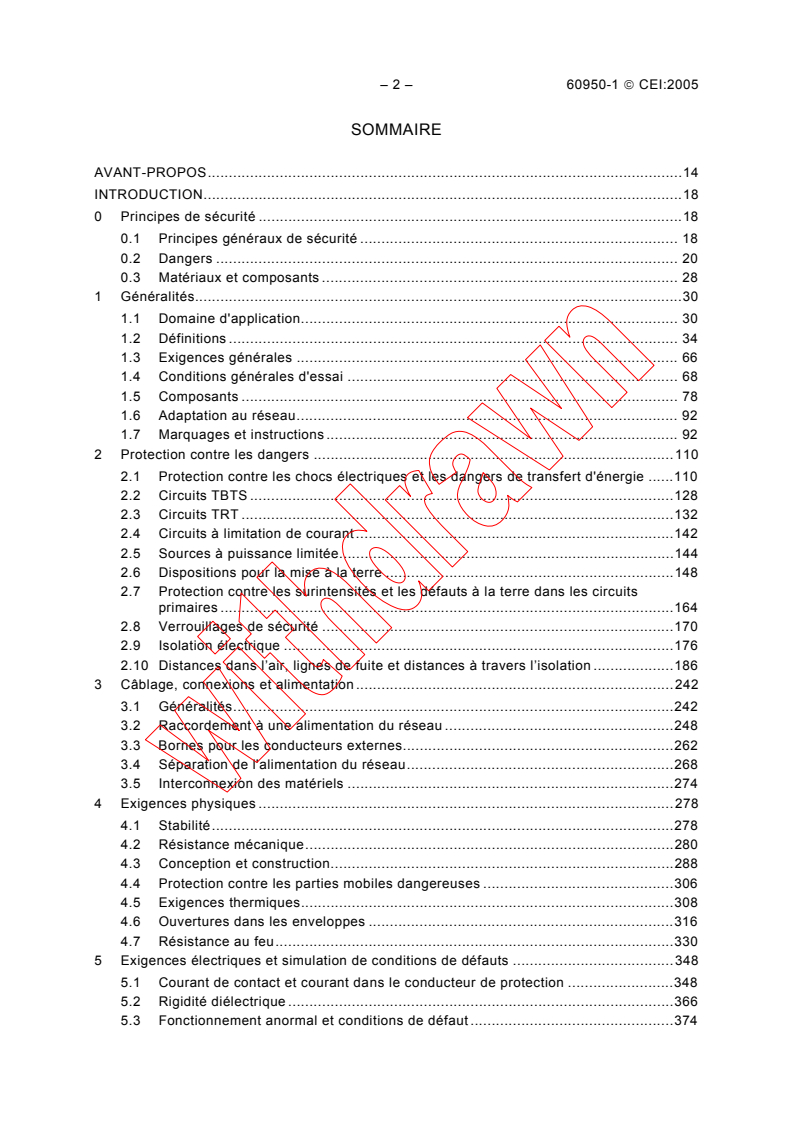
IEC 60950-1:2005 - Matériels de traitement de l'information - Sécurité - Partie 1: Exigences générales Released:12/8/2005
IEC 60950-1:2005 - Information technology equipment - Safety - Part 1: General requirements Released:12/8/2005
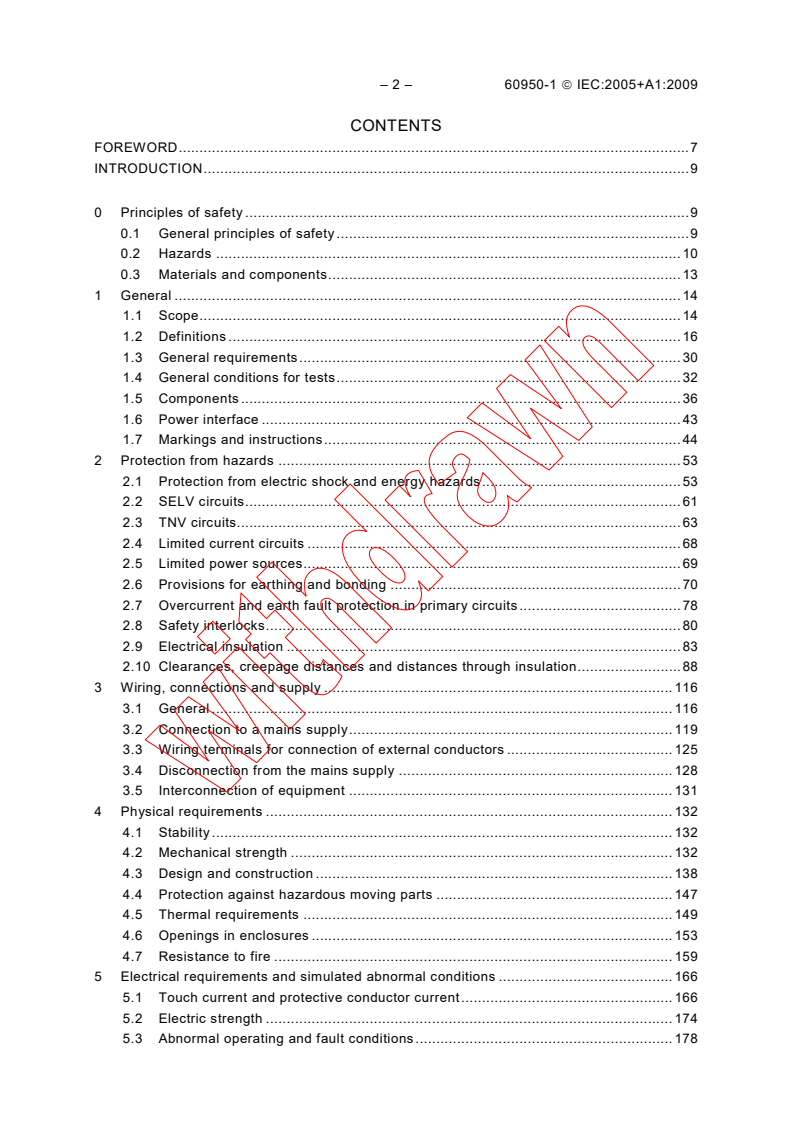
IEC 60950-1:2005+AMD1:2009 CSV - Information technology equipment - Safety - Part 1: General requirements Released:5/10/2012
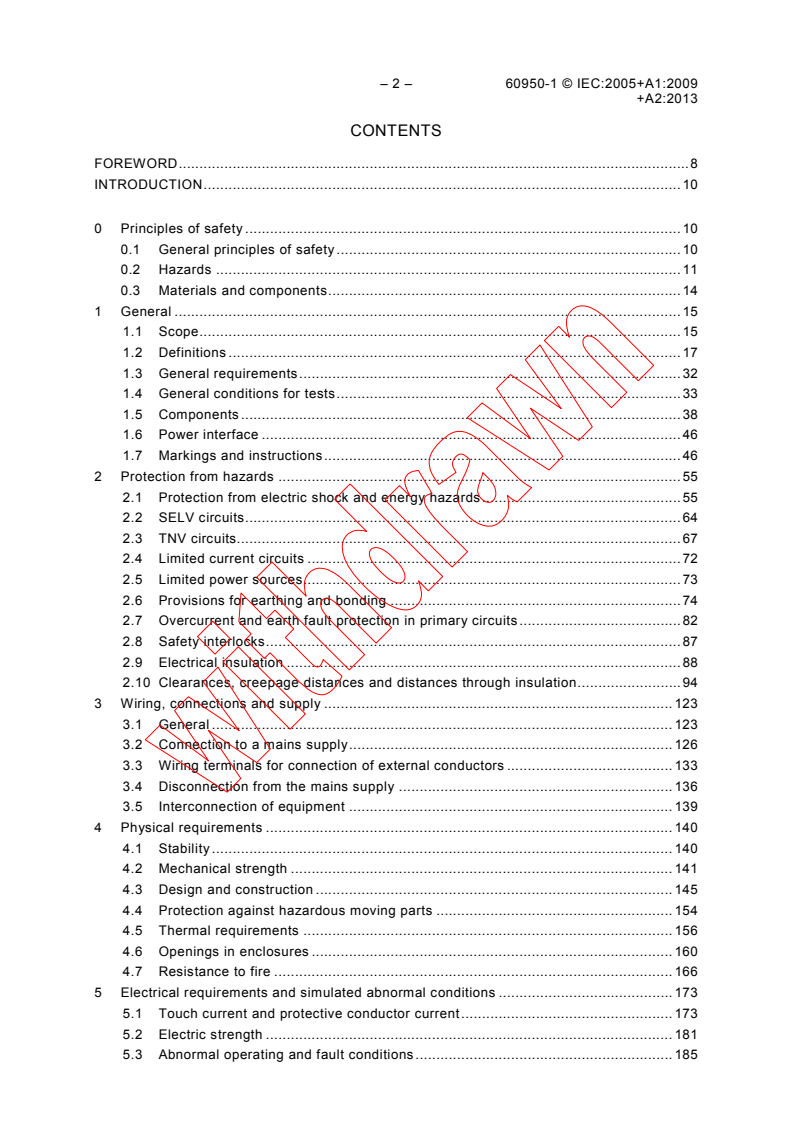
IEC 60950-1:2005+AMD1:2009+AMD2:2013 CSV - Information technology equipment - Safety - Part 1: General requirements Released:5/28/2013
Relations
- Effective Date
- 25-Aug-2026
- Effective Date
- 25-Aug-2026
- Effective Date
- 25-Aug-2026
- Effective Date
- 05-Sep-2023
- Effective Date
- 05-Sep-2023
- Effective Date
- 05-Sep-2023
- Effective Date
- 05-Sep-2023
- Effective Date
- 05-Sep-2023
- Effective Date
- 05-Sep-2023
Buy Documents
IEC 60950-1:2005 - Information technology equipment - Safety - Part 1: General requirements Released:12/8/2005
IEC 60950-1:2005 - Matériels de traitement de l'information - Sécurité - Partie 1: Exigences générales Released:12/8/2005
IEC 60950-1:2005 - Information technology equipment - Safety - Part 1: General requirements Released:12/8/2005
IEC 60950-1:2005+AMD1:2009 CSV - Information technology equipment - Safety - Part 1: General requirements Released:5/10/2012
IEC 60950-1:2005+AMD1:2009+AMD2:2013 CSV - Information technology equipment - Safety - Part 1: General requirements Released:5/28/2013
Get Certified
Connect with accredited certification bodies for this standard

BSI Group
BSI (British Standards Institution) is the business standards company that helps organizations make excellence a habit.

NYCE
Mexican standards and certification body.
Sponsored listings
Frequently Asked Questions
IEC 60950-1:2005 is a standard published by the International Electrotechnical Commission (IEC). Its full title is "Information technology equipment - Safety - Part 1: General requirements". This standard covers: Applicable to mains-powered or battery-powered information technology equipment, including electrical business equipment and associated equipment, with a RATED VOLTAGE not exceeding 600 V. Also applicable are components and subassemblies intended for incorporation in information technology equipment. It is not expected that such components and subassemblies comply with every aspect of the standard, provided that the complete information technology equipment, incorporating such components and subassemblies, does comply. The contents of the corrigenda of August 2006 and August 2013 have been included in this copy.
Applicable to mains-powered or battery-powered information technology equipment, including electrical business equipment and associated equipment, with a RATED VOLTAGE not exceeding 600 V. Also applicable are components and subassemblies intended for incorporation in information technology equipment. It is not expected that such components and subassemblies comply with every aspect of the standard, provided that the complete information technology equipment, incorporating such components and subassemblies, does comply. The contents of the corrigenda of August 2006 and August 2013 have been included in this copy.
IEC 60950-1:2005 is classified under the following ICS (International Classification for Standards) categories: 35.020 - Information technology (IT) in general; 35.260 - Office machines. The ICS classification helps identify the subject area and facilitates finding related standards.
IEC 60950-1:2005 has the following relationships with other standards: It is inter standard links to EN ISO 11608-4:2022, EN ISO 18246:2017, EN ISO 16201:2006, IEC 60950-1:2005/AMD2:2013, IEC 60950-1:2005/AMD1:2009, IEC 60950-1:2005/COR2:2013, IEC 60950-1:2005/COR1:2006, IEC 60950-1:2001, IEC 60950-1:2001/COR1:2002. Understanding these relationships helps ensure you are using the most current and applicable version of the standard.
IEC 60950-1:2005 is available in PDF format for immediate download after purchase. The document can be added to your cart and obtained through the secure checkout process. Digital delivery ensures instant access to the complete standard document.
Standards Content (Sample)
INTERNATIONAL IEC
STANDARD 60950-1
Second edition
2005-12
Information technology equipment –
Safety –
Part 1:
General requirements
This English-language version is derived from the original
bilingual publication by leaving out all French-language
pages. Missing page numbers correspond to the French-
language pages.
Reference number
Publication numbering
As from 1 January 1997 all IEC publications are issued with a designation in the
60000 series. For example, IEC 34-1 is now referred to as IEC 60034-1.
Consolidated editions
The IEC is now publishing consolidated versions of its publications. For example,
edition numbers 1.0, 1.1 and 1.2 refer, respectively, to the base publication, the
base publication incorporating amendment 1 and the base publication incorporating
amendments 1 and 2.
Further information on IEC publications
The technical content of IEC publications is kept under constant review by the IEC,
thus ensuring that the content reflects current technology. Information relating to
this publication, including its validity, is available in the IEC Catalogue of
publications (see below) in addition to new editions, amendments and corrigenda.
Information on the subjects under consideration and work in progress undertaken
by the technical committee which has prepared this publication, as well as the list
of publications issued, is also available from the following:
• IEC Web Site (www.iec.ch)
• Catalogue of IEC publications
The on-line catalogue on the IEC web site (www.iec.ch/searchpub) enables you to
search by a variety of criteria including text searches, technical committees
and date of publication. On-line information is also available on recently issued
publications, withdrawn and replaced publications, as well as corrigenda.
• IEC Just Published
This summary of recently issued publications (www.iec.ch/online_news/ justpub)
is also available by email. Please contact the Customer Service Centre (see
below) for further information.
• Customer Service Centre
If you have any questions regarding this publication or need further assistance,
please contact the Customer Service Centre:
Email: custserv@iec.ch
Tel: +41 22 919 02 11
Fax: +41 22 919 03 00
INTERNATIONAL IEC
STANDARD 60950-1
Second edition
2005-12
Information technology equipment –
Safety –
Part 1:
General requirements
© IEC 2005 Copyright - all rights reserved
No part of this publication may be reproduced or utilized in any form or by any means, electronic or mechanical,
including photocopying and microfilm, without permission in writing from the publisher.
International Electrotechnical Commission, 3, rue de Varembé, PO Box 131, CH-1211 Geneva 20, Switzerland
Telephone: +41 22 919 02 11 Telefax: +41 22 919 03 00 E-mail: inmail@iec.ch Web: www.iec.ch
PRICE CODE
XM
Commission Electrotechnique Internationale
International Electrotechnical Commission
МеждународнаяЭлектротехническаяКомиссия
For price, see current catalogue
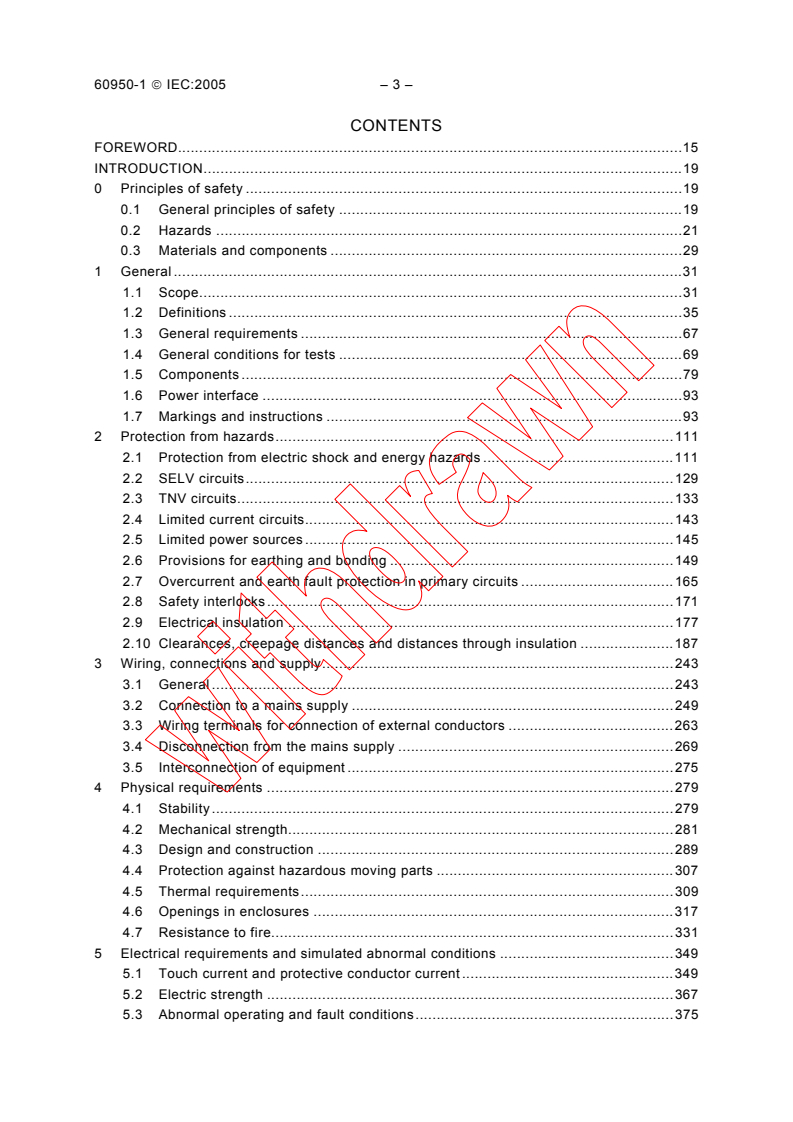
60950-1 IEC:2005 – 3 –
CONTENTS
FOREWORD.15
INTRODUCTION.19
0 Principles of safety .19
0.1 General principles of safety .19
0.2 Hazards .21
0.3 Materials and components .29
1 General .31
1.1 Scope.31
1.2 Definitions.35
1.3 General requirements.67
1.4 General conditions for tests .69
1.5 Components.79
1.6 Power interface .93
1.7 Markings and instructions .93
2 Protection from hazards.111
2.1 Protection from electric shock and energy hazards .111
2.2 SELV circuits.129
2.3 TNV circuits.133
2.4 Limited current circuits.143
2.5 Limited power sources .145
2.6 Provisions for earthing and bonding .149
2.7 Overcurrent and earth fault protection in primary circuits .165
2.8 Safety interlocks.171
2.9 Electrical insulation.177
2.10 Clearances, creepage distances and distances through insulation .187
3 Wiring, connections and supply.243
3.1 General.243
3.2 Connection to a mains supply .249
3.3 Wiring terminals for connection of external conductors .263
3.4 Disconnection from the mains supply .269
3.5 Interconnection of equipment .275
4 Physical requirements .279
4.1 Stability.279
4.2 Mechanical strength.281
4.3 Design and construction .289
4.4 Protection against hazardous moving parts .307
4.5 Thermal requirements.309
4.6 Openings in enclosures .317
4.7 Resistance to fire.331
5 Electrical requirements and simulated abnormal conditions .349
5.1 Touch current and protective conductor current.349
5.2 Electric strength.367
5.3 Abnormal operating and fault conditions.375
60950-1 IEC:2005 – 5 –
6 Connection to telecommunication networks .385
6.1 Protection of telecommunication network service persons, and users of other
equipment connected to the network, from hazards in the equipment.385
6.2 Protection of equipment users from overvoltages on telecommunication
networks .389
6.3 Protection of the telecommunication wiring system from overheating .395
7 Connection to cable distribution systems.397
7.1 General .397
7.2 Protection of cable distribution system service persons, and users of other
equipment connected to the system, from hazardous voltages in the
equipment.397
7.3 Protection of equipment users from overvoltages on the cable distribution
system.397
7.4 Insulation between primary circuits and cable distribution systems.399
Annex A (normative) Tests for resistance to heat and fire .403
Annex B (normative) Motor tests under abnormal conditions .409
Annex C (normative) Transformers.421
Annex D (normative) Measuring instruments for touch current tests .429
Annex E (normative) Temperature rise of a winding .433
Annex F (normative) Measurement of clearances and creepage distances .435
Annex G (normative) Alternative method for determining minimum clearances .451
Annex H (normative) Ionizing radiation .467
Annex J (normative) Table of electrochemical potentials (see 2.6.5.6).469
Annex K (normative) Thermal controls.471
Annex L (normative) Normal load conditions for some types of electrical business
equipment .475
Annex M (normative) Criteria for telephone ringing signals.479
Annex N (normative) Impulse test generators .489
Annex P (normative) Normative references.493
Annex Q (normative) Voltage dependent resistors (VDRs) .501
Annex R (informative) Examples of requirements for quality control programmes .503
Annex S (informative) Procedure for impulse testing.509
Annex T (informative) Guidance on protection against ingress of water .513
Annex U (normative) Insulated winding wires for use without interleaved insulation .517
Annex V (normative) AC power distribution systems .523
Annex W (informative) Summation of touch currents .537
Annex X (informative) Maximum heating effect in transformer tests.543
Annex Y (normative) Ultraviolet light conditioning test.547
Annex Z (informative) Overvoltage categories (see 2.10.3.2 and Clause G.2).549
Annex AA (normative) Mandrel test (see 2.10.5.8) .551
Annex BB (informative) Changes in the second edition .557
60950-1 IEC:2005 – 7 –
Bibliography .563
Index .589
Figure 2A – Test finger .115
Figure 2B – Test pin .117
Figure 2C – Test probe .117
Figure 2D - Accessibility of internal conductive parts .119
Figure 2E – Voltages in SELV circuits under single fault conditions.131
Figure 2F – Maximum voltages permitted after a single fault .135
Figure 2G – Test generator .143
Figure 2H – Examples of application of insulation .185
Figure 2J – Thermal ageing time .237
Figure 2K – Abrasion resistance test for coating layers.239
Figure 4A – Impact test using a steel ball .285
Figure 4B – Examples of cross-sections of designs of openings preventing vertical
access.319
Figure 4C – Examples of louvre design .319
Figure 4D – Enclosure openings.321
Figure 4E – Typical bottom of a fire enclosure for partially enclosed component or
assembly .323
Figure 4F – Baffle plate construction .325
Figure 5A – Test circuit for touch current of single-phase equipment on a star TN or TT
power supply system .353
Figure 5B – Test circuit for touch current of three-phase equipment on a star TN or TT
power supply system .353
Figure 6A – Test for separation between a telecommunication network and earth.389
Figure 6B – Application points of test voltage .391
Figure B.1 – Determination of arithmetic average temperature .411
Figure C.1 – Determination of arithmetic average temperature.423
Figure D.1 – Measuring instrument.429
Figure D.2 – Alternative measuring instrument .431
Figure F.1 – Narrow groove .437
Figure F.2 – Wide groove.437
Figure F.3 – V-shaped groove .437
Figure F.4 – Rib.437
Figure F.5 – Uncemented joint with narrow groove .439
Figure F.6 – Uncemented joint with wide groove.439
Figure F.7 – Uncemented joint with narrow and wide grooves .439
Figure F.8 – Narrow recess.441
Figure F.9 – Wide recess .441
Figure F.10 – Coating around terminals.443
Figure F.11 – Coating over printed wiring .443
60950-1 IEC:2005 – 9 –
Figure F.12 – Measurements through openings in enclosures .445
Figure F.13 – Intervening, unconnected conductive part .445
Figure F.14 – Solid insulating material.447
Figure F.15 – Thin sheet insulating material .447
Figure F.16 – Cemented joints in multi-layer printed board.447
Figure F.17 – Component filled with insulating compound .449
Figure F.18 – Partitioned bobbin .449
Figure M.1 – Definition of ringing period and cadence cycle.481
Figure M.2 – I limit curve for cadenced ringing signal .483
TS1
Figure M.3 – Peak and peak-to-peak currents.483
Figure M.4 – Ringing voltage trip criteria .487
Figure N.1 – ITU-T impulse test generator circuit.489
Figure N.2 – IEC 60065 impulse test generator circuit .491
Figure S.1 – Waveform on insulation without surge suppressors and no breakdown .509
Figure S.2 – Waveforms on insulation during breakdown without surge suppressors .511
Figure S.3 – Waveforms on insulation with surge suppressors in operation .511
Figure S.4 – Waveform on short-circuited surge suppressor and insulation .511
Figure V.1 – Examples of TN-S power distribution systems.527
Figure V.2 – Example of TN-C-S power distribution system.529
Figure V.3 – Example of TN-C power distribution system .529
Figure V.4 – Example of single-phase, three-wire TN-C power distribution system .531
Figure V.5 – Example of three line and neutral TT power distribution system.531
Figure V.6 – Example of three line TT power distribution system.533
Figure V.7 – Example of three line (and neutral) IT power distribution system .533
Figure V.8 – Example of three line IT power distribution system.535
Figure W.1 – Touch current from a floating circuit.537
Figure W.2 – Touch current from an earthed circuit .539
Figure W.3 – Summation of touch currents in a PABX.539
Figure AA.1 – Mandrel .551
Figure AA.2 – Initial position of mandrel .553
Figure AA.3 – Final position of mandrel .553
Table 1A – Voltage ranges of SELV and TNV circuits .51
Table 1B – Equivalence of flammability classes.59
Table 1C – Capacitor ratings according to IEC 60384-14 .83
Table 1D – Informative examples of application of capacitors .85
Table 2A – Distance through insulation of internal wiring .121
Table 2B – Limits for power sources without an overcurrent protective device .147
Table 2C – Limits for power sources with an overcurrent protective device.147
60950-1 IEC:2005 – 11 –
Table 2D – Minimum size of protective bonding conductors .155
Table 2E – Test duration, a.c. mains supplies.157
Table 2F – Informative examples of protective devices in single-phase equipment or
subassemblies.169
Table 2G – Informative examples of protective devices in three-phase equipment .169
Table 2H – Examples of application of insulation .181
Table 2J – AC mains transient voltages.197
Table 2K – Minimum clearances for insulation in primary circuits and between primary
and secondary circuits .199
Table 2L – Additional clearances in primary circuits.201
Table 2M – Minimum clearances in secondary circuits .203
Table 2N – Minimum creepage distances .213
Table 2P – Tests for insulation in non-separable layers .221
Table 2Q – Minimum separation distances for coated printed boards .231
Table 2R – Insulation in printed boards .233
Table 3A – Sizes of cables and conduits for equipment having a rated current not
exceeding 16 A.253
Table 3B – Sizes of conductors .257
Table 3C – Physical tests on power supply cords .261
Table 3D – Range of conductor sizes to be accepted by terminals .265
Table 3E – Sizes of terminals for mains supply conductors and protective earthing
conductors .267
Table 4A – Minimum property retention limits after UV exposure.301
Table 4B – Temperature limits, materials and components.313
Table 4C – Touch temperature limits .315
Table 4D – Size and spacing of openings in metal bottoms of fire enclosures.327
Table 4E – Summary of material flammability requirements .347
Table 5A – Maximum current.357
Table 5B – Test voltages for electric strength tests based on peak working voltages Part 1. 371
Table 5B – Test voltages for electric strength tests based on peak working voltages Part 2. 373
Table 5C – Test voltages for electric strength tests based on required withstand voltages .375
Table 5D – Temperature limits for overload conditions.383
Table B.1 – Temperature limits for motor windings (except for running overload test) .411
Table B.2 – Permitted temperature limits for running overload tests .413
Table C.1 – Temperature limits for transformer windings.423
Table F.1 – Value of X .435
Table G.1 – AC mains transient voltages.453
60950-1 IEC:2005 – 13 –
Table G.2 – Minimum clearances up to 2 000 m above sea level.463
Table J.1 – Electrochemical potentials (V) .469
Table N.1 – Component values for Figures N.1 and N.2.491
Table R.1 – Rules for sampling and inspection – coated printed boards .505
Table R.2 – Rules for sampling and inspection – reduced clearances.507
Table T.1 – Extract from IEC 60529 .515
Table U.1 – Mandrel diameter .519
Table U.2 – Oven temperature .519
Table X.1 – Test steps .545
Table Z.1 – Overvoltage categories.549
60950-1 IEC:2005 – 15 –
INTERNATIONAL ELECTROTECHNICAL COMMISSION
____________
INFORMATION TECHNOLOGY EQUIPMENT –
SAFETY –
Part 1: General requirements
FOREWORD
1) The International Electrotechnical Commission (IEC) is a worldwide organization for standardization comprising
all national electrotechnical committees (IEC National Committees). The object of IEC is to promote
international co-operation on all questions concerning standardization in the electrical and electronic fields. To
this end and in addition to other activities, IEC publishes International Standards, Technical Specifications,
Technical Reports, Publicly Available Specifications (PAS) and Guides (hereafter referred to as “IEC
Publication(s)”). Their preparation is entrusted to technical committees; any IEC National Committee interested
in the subject dealt with may participate in this preparatory work. International, governmental and non-
governmental organizations liaising with the IEC also participate in this preparation. IEC collaborates closely
with the International Organization for Standardization (ISO) in accordance with conditions determined by
agreement between the two organizations.
2) The formal decisions or agreements of IEC on technical matters express, as nearly as possible, an international
consensus of opinion on the relevant subjects since each technical committee has representation from all
interested IEC National Committees.
3) IEC Publications have the form of recommendations for international use and are accepted by IEC National
Committees in that sense. While all reasonable efforts are made to ensure that the technical content of IEC
Publications is accurate, IEC cannot be held responsible for the way in which they are used or for any
misinterpretation by any end user.
4) In order to promote international uniformity, IEC National Committees undertake to apply IEC Publications
transparently to the maximum extent possible in their national and regional publications. Any divergence
between any IEC Publication and the corresponding national or regional publication shall be clearly indicated in
the latter.
5) IEC provides no marking procedure to indicate its approval and cannot be rendered responsible for any
equipment declared to be in conformity with an IEC Publication.
6) All users should ensure that they have the latest edition of this publication.
7) No liability shall attach to IEC or its directors, employees, servants or agents including individual experts and
members of its technical committees and IEC National Committees for any personal injury, property damage or
other damage of any nature whatsoever, whether direct or indirect, or for costs (including legal fees) and
expenses arising out of the publication, use of, or reliance upon, this IEC Publication or any other IEC
Publications.
8) Attention is drawn to the Normative references cited in this publication. Use of the referenced publications is
indispensable for the correct application of this publication.
9) Attention is drawn to the possibility that some of the elements of this IEC Publication may be the subject of
patent rights. IEC shall not be held responsible for identifying any or all such patent rights.
International Standard IEC 60950-1 has been prepared by IEC technical committee 108:
Safety of electronic equipment within the field of audio/video, information technology and
communication technology.
This second edition of IEC 60950-1 cancels and replaces the first edition of IEC 60950-1,
issued in 2001, and constitutes a technical revision. The principal changes in this edition as
compared with the first edition of IEC 60950-1 are given in Annex BB, including a list of
changed subclause, table and figure numbers.
60950-1 IEC:2005 – 17 –
The text of this standard is based on the following documents:
FDIS Report on voting
108/135A/FDIS 108/147/RVD
Full information on the voting for the approval of this standard can be found in the report on
voting indicated in the above table.
IEC 60950-1 includes the basic requirements for the safety of information technology
equipment.
Additional parts of IEC 60950-1 will cover specific safety requirements for information
technology equipment having limited applications or having special features as follows:
Part 21: Remote feeding (published);
Part 22: Equipment installed outdoors (planned);
Part 23: Large data storage equipment (planned);
Except for notes, all text within a normative figure, or in a box under a normative table, is also
normative. Text with a superscript reference is linked to a particular item in the table. Other
text in a box under a table applies to the whole table.
Informative annexes and text beginning with the word "NOTE" are not normative. They are
provided only to give additional information.
"Country" notes are also informative but call attention to requirements that are normative in
those countries.
In this standard, the following print types are used:
− Requirements proper and normative annexes: roman type.
− Compliance statements and test specifications: italic type.
− Notes in the text and in tables: smaller roman type.
− Terms that are defined in 1.2: SMALL CAPITALS.
The committee has decided that the contents of this publication will remain unchanged until
the maintenance result date indicated on the IEC web site under "http://webstore.iec.ch" in
the data related to the specific publication. At this date, the publication will be
• reconfirmed;
• withdrawn;
• replaced by a revised edition, or
• amended.
60950-1 IEC:2005 – 19 –
INTRODUCTION
0 Principles of safety
The following principles have been adopted by technical committee 108 in the development of
this standard.
These principles do not cover performance or functional characteristics of equipment.
Words printed in SMALL CAPITALS are terms that are defined in 1.2 of this standard.
0.1 General principles of safety
It is essential that designers understand the underlying principles of safety requirements in
order that they can engineer safe equipment.
These principles are not an alternative to the detailed requirements of this standard, but are
intended to provide designers with an appreciation of the basis of these requirements. Where
the equipment involves technologies and materials or methods of construction not specifically
covered, the design of the equipment should provide a level of safety not less than those
described in these principles of safety.
Designers shall take into account not only normal operating conditions of the equipment but
also likely fault conditions, consequential faults, foreseeable misuse and external influences
such as temperature, altitude, pollution, moisture, overvoltages on the MAINS SUPPLY and
overvoltages on a TELECOMMUNICATION NETWORK or a CABLE DISTRIBUTION SYSTEM.
Dimensioning of insulation spacings should take account of possible reductions by
manufacturing tolerances, or where deformation could occur due to handling, shock and
vibration likely to be encountered during manufacture, transport and normal use.
The following priorities should be observed in determining what design measures to adopt:
− where possible, specify design criteria that will eliminate, reduce or guard against
hazards;
− where the above is not practicable because the functioning of the equipment would be
impaired, specify the use of protective means independent of the equipment, such as
personal protective equipment (which is not specified in this standard);
− where neither of the above measures is practicable, or in addition to those measures,
specify the provision of markings and instructions regarding the residual risks.
There are two types of persons whose safety needs to be considered, USERS (or OPERATORS)
and SERVICE PERSONS.
USER is the term applied to all persons other than SERVICE PERSONS. Requirements for
protection should assume that USERS are not trained to identify hazards, but will not
intentionally create a hazardous situation. Consequently, the requirements will provide
protection for cleaners and casual visitors as well as the assigned USERS. In general, USERS
60950-1 IEC:2005 – 21 –
should not have access to hazardous parts, and to this end, such parts should only be in
SERVICE ACCESS AREAS or in equipment located in RESTRICTED ACCESS LOCATIONS.
When USERS are admitted to RESTRICTED ACCESS LOCATIONS they shall be suitably instructed.
SERVICE PERSONS are expected to use their training and skill to avoid possible injury to
themselves and others due to obvious hazards that exist in SERVICE ACCESS AREAS of the
equipment or on equipment located in RESTRICTED ACCESS LOCATIONS. However, SERVICE
PERSONS should be protected against unexpected hazards. This can be done by, for example,
locating parts that need to be accessible for servicing away from electrical and mechanical
hazards, providing shields to avoid accidental contact with hazardous parts, and providing
labels or instructions to warn personnel about any residual risk.
Information about potential hazards can be marked on the equipment or provided with the
equipment, depending on the likelihood and severity of injury, or made available for SERVICE
PERSONS. In general, USERS shall not be exposed to hazards likely to cause injury, and
information provided for USERS should primarily aim at avoiding misuse and situations likely to
create hazards, such as connection to the wrong power source and replacement of fuses by
incorrect types.
MOVABLE EQUIPMENT is considered to present a slightly increased risk of shock, due to
possible extra strain on the supply cord leading to rupture of the earthing conductor. With
HAND-HELD EQUIPMENT, this risk is increased; wear on the cord is more likely, and further
hazards could arise if the units were dropped. TRANSPORTABLE EQUIPMENT introduces a further
factor because it can be used and carried in any orientation; if a small metallic object enters
an opening in the ENCLOSURE it can move around inside the equipment, possibly creating a
hazard.
0.2 Hazards
Application of a safety standard is intended to reduce the risk of injury or damage due to the
following:
− electric shock;
− energy related hazards;
− fire;
− heat related hazards;
− mechanical hazards;
− radiation;
− chemical hazards.
60950-1 IEC:2005 – 23 –
0.2.1 Electric shock
Electric shock is due to current passing through the human body. The resulting physiological
effects depend on the value and duration of the current and the path it takes through the
body. The value of the current depends on the applied voltage, the impedance of the source
and the impedance of the body. The body impedance depends in turn on the area of contact,
moisture in the area of contact and the applied voltage and frequency. Currents of
approximately half a milliampere can cause a reaction in persons in good health and may
cause injury indirectly due to involuntary reaction. Higher currents can have more direct
effects, such as burn or muscle tetanization leading to inability to let go or to ventricular
fibrillation.
Steady state voltages up to 42,4 V peak, or 60 V d.c., are not generally regarded as
hazardous under dry conditions for an area of contact equivalent to a human hand. Bare parts
that have to be touched or handled should be at earth potential or properly insulated.
Some equipment will be connected to telephone and other external networks. Some
TELECOMMUNICATION NETWORKS operate with signals such as voice and ringing superimposed
on a steady d.c. supply voltage; the total may exceed the values given above for steady-state
voltages. It is common practice for the SERVICE PERSONS of telephone companies to handle
parts of such circuits bare-handed. This has not caused serious injury, because of the use of
cadenced ringing and because there are limited areas of contact with bare conductors
normally handled by SERVICE PERSONS. However, the area of contact of a part accessible to
the USER, and the likelihood of the part being touched, should be further limited (for example,
by the shape and location of the part).
It is normal to provide two levels of protection for USERS to prevent electric shock. Therefore,
the operation of equipment under normal conditions and after a single fault, including any
consequential faults, should not create a shock hazard. However, provision of additional
protective measures, such as protective earthing or SUPPLEMENTARY INSULATION, is not
considered a substitute for, or a relief from, properly designed BASIC INSULATION.
Harm may result from: Examples of measures to reduce risks:
Contact with bare parts normally at Prevent USER access to parts at HAZARDOUS
HAZARDOUS VOLTAGES. VOLTAGES by fixed or locked covers, SAFETY
INTERLOCKS, etc. Discharge accessible
capacitors that are at HAZARDOUS VOLTAGES.
Breakdown of insulation between parts Provide BASIC INSULATION and connect the
normally at HAZARDOUS VOLTAGES and accessible conductive parts and circuits to
accessible conductive parts. earth so that exposure to the voltage which can
develop is limited because overcurrent
protection will disconnect the parts having low
impedance faults within a specified time;
or provide a metal screen connected to
protective earth between the parts, or provide
DOUBLE INSULATION or REINFORCED INSULATION
between the parts, so that breakdown to the
accessible part is not likely to occur.
60950-1 IEC:2005 – 25 –
Contact with circuits connected to Limit the accessibility and area of contact of such
TELECOMMUNICATION NETWORKS that exceed circuits, and separate them from unearthed parts
42,4 V peak or 60 V d.c. to which access is not limited.
Breakdown of USER-accessible insulation. Insulation that is accessible to the USER should
have adequate mechanical and electrical
strength to reduce the likelihood of contact with
HAZARDOUS VOLTAGES.
TOUCH CURRENT (leakage current) flowing Limit TOUCH CURRENT to a specified value, or
from parts at HAZARDOUS VOLTAGES to provide a high integrity protective earthing
accessible parts, or failure of a protective connection.
earthing connection. TOUCH CURRENT may
include current due to EMC filter
components connected between PRIMARY
CIRCUITS and accessible parts.
0.2.2 Energy related hazards
Injury or fire may result from a short-circuit between adjacent poles of high current supplies or
high capacitance circuits, causing:
− burns;
− arcing;
− ejection of molten metal.
Even circuits whose voltages are safe to touch may be hazardous in this respect.
Examples of measures to reduce risks include:
− separation;
− shielding;
− provision of SAFETY INTERLOCKS.
0.2.3 Fire
Risk of fire may result from excessive temperatures either under normal operating conditions
or due to overload, component failure, insulation breakdown or loose connections. Fires
originating within the equipment should not spread beyond the immediate vicinity of the
source of the fire, nor cause damage to the surroundings of the equipment.
Examples of measures to reduce risks include:
− providing overcurrent protection;
− using constructional materials having appropriate flammability properties for their purpose;
− selection of parts, components and consumable materials to avoid high temperature which
might cause ignition;
− limiting the quantity of combustible materials used;
60950-1 IEC:2005 – 27 –
− shielding or separating combustible materials from likely ignition sources;
− using ENCLOSURES or barriers to limit the spread of fire within the equipment;
− using suitable materials for ENCLOSURES so as to reduce the likelihood of fire spreading
from the equipment.
0.2.4 Heat related hazards
Injury may result from high temperatures under normal operating conditions, causing:
− burns due to contact with hot accessible parts;
− degradation of insulation and of safety-critical components;
− ignition of flammable liquids.
Examples of measures to reduce risks include:
− taking steps to avoid high temperature of accessible parts;
− avoiding temperatures above the ignition point of liquids;
− provision of markings to warn USERS where access to hot parts is unavoidable.
0.2.5 Mechanical hazards
Injury may result from:
− sharp edges and corners;
− moving parts that ha
...
NORME CEI
INTERNATIONALE 60950-1
Deuxième édition
2005-12
Matériels de traitement de l’information –
Sécurité –
Partie 1:
Exigences générales
Cette version française découle de la publication d’origine
bilingue dont les pages anglaises ont été supprimées.
Les numéros de page manquants sont ceux des pages
supprimées.
Numéro de référence
CEI 60950-1:2005(F)
Numérotation des publications
Depuis le 1er janvier 1997, les publications de la CEI sont numérotées à partir de
60000. Ainsi, la CEI 34-1 devient la CEI 60034-1.
Editions consolidées
Les versions consolidées de certaines publications de la CEI incorporant les
amendements sont disponibles. Par exemple, les numéros d’édition 1.0, 1.1 et 1.2
indiquent respectivement la publication de base, la publication de base incorporant
l’amendement 1, et la publication de base incorporant les amendements 1 et 2
Informations supplémentaires sur les publications de la CEI
Le contenu technique des publications de la CEI est constamment revu par la CEI
afin qu'il reflète l'état actuel de la technique. Des renseignements relatifs à cette
publication, y compris sa validité, sont disponibles dans le Catalogue des
publications de la CEI (voir ci-dessous) en plus des nouvelles éditions, amende-
ments et corrigenda. Des informations sur les sujets à l’étude et l’avancement des
travaux entrepris par le comité d’études qui a élaboré cette publication, ainsi que la
liste des publications parues, sont également disponibles par l’intermédiaire de:
• Site web de la CEI (www.iec.ch)
• Catalogue des publications de la CEI
Le catalogue en ligne sur le site web de la CEI (www.iec.ch/searchpub) vous permet
de faire des recherches en utilisant de nombreux critères, comprenant des
recherches textuelles, par comité d’études ou date de publication. Des informations
en ligne sont également disponibles sur les nouvelles publications, les publications
remplacées ou retirées, ainsi que sur les corrigenda.
• IEC Just Published
Ce résumé des dernières publications parues (www.iec.ch/online_news/justpub)
est aussi disponible par courrier électronique. Veuillez prendre contact avec le
Service client (voir ci-dessous) pour plus d’informations.
• Service clients
Si vous avez des questions au sujet de cette publication ou avez besoin de
renseignements supplémentaires, prenez contact avec le Service clients:
Email: custserv@iec.ch
Tél: +41 22 919 02 11
Fax: +41 22 919 03 00
NORME CEI
INTERNATIONALE 60950-1
Deuxième édition
2005-12
Matériels de traitement de l’information –
Sécurité –
Partie 1:
Exigences générales
© IEC 2005 Droits de reproduction réservés
Aucune partie de cette publication ne peut être reproduite ni utilisée sous quelque forme que ce soit et par aucun
procédé, électronique ou mécanique, y compris la photocopie et les microfilms, sans l'accord écrit de l'éditeur.
International Electrotechnical Commission, 3, rue de Varembé, PO Box 131, CH-1211 Geneva 20, Switzerland
Telephone: +41 22 919 02 11 Telefax: +41 22 919 03 00 E-mail: inmail@iec.ch Web: www.iec.ch
CODE PRIX
XM
Commission Electrotechnique Internationale
International Electrotechnical Commission
МеждународнаяЭлектротехническаяКомиссия
Pour prix, voir catalogue en vigueur
– 2 – 60950-1 CEI:2005
SOMMAIRE
AVANT-PROPOS.14
INTRODUCTION.18
0 Principes de sécurité .18
0.1 Principes généraux de sécurité . 18
0.2 Dangers.20
0.3 Matériaux et composants.28
1 Généralités.30
1.1 Domaine d'application. 30
1.2 Définitions.34
1.3 Exigences générales.66
1.4 Conditions générales d'essai . 68
1.5 Composants.78
1.6 Adaptation au réseau. 92
1.7 Marquages et instructions.92
2 Protection contre les dangers .110
2.1 Protection contre les chocs électriques et les dangers de transfert d'énergie .110
2.2 Circuits TBTS.128
2.3 Circuits TRT.132
2.4 Circuits à limitation de courant.142
2.5 Sources à puissance limitée.144
2.6 Dispositions pour la mise à la terre .148
2.7 Protection contre les surintensités et les défauts à la terre dans les circuits
primaires .164
2.8 Verrouillages de sécurité .170
2.9 Isolation électrique.176
2.10 Distances dans l’air, lignes de fuite et distances à travers l’isolation .186
3 Câblage, connexions et alimentation .242
3.1 Généralités.242
3.2 Raccordement à une alimentation du réseau .248
3.3 Bornes pour les conducteurs externes.262
3.4 Séparation de l'alimentation du réseau.268
3.5 Interconnexion des matériels .274
4 Exigences physiques.278
4.1 Stabilité.278
4.2 Résistance mécanique.280
4.3 Conception et construction.288
4.4 Protection contre les parties mobiles dangereuses .306
4.5 Exigences thermiques.308
4.6 Ouvertures dans les enveloppes .316
4.7 Résistance au feu.330
5 Exigences électriques et simulation de conditions de défauts .348
5.1 Courant de contact et courant dans le conducteur de protection .348
5.2 Rigidité diélectrique.366
5.3 Fonctionnement anormal et conditions de défaut .374
– 4 – 60950-1 CEI:2005
6 Connexion à des réseaux de télécommunications.384
6.1 Protection du personnel de maintenance du réseau de télécommunications
et des utilisateurs d'autres matériels connectés au réseau contre les risques
provenant du matériel .384
6.2 Protection des utilisateurs du matériel contre les surtensions sur les réseaux
de télécommunications .388
6.3 Protection du système de câblage de télécommunication contre les surchauffes .394
7 Connexion aux systèmes de distribution par câbles .396
7.1 Généralités.396
7.2 Protection du personnel de maintenance d'un système de distribution par
câbles et des utilisateurs d'autres matériels connectés au système, contre
les dangers des matériels .396
7.3 Protection des utilisateurs de matériels contre les surtensions sur le système
de distribution par câbles.396
7.4 Isolation entre circuits primaires et systèmes de distribution par câbles .398
Annexe A (normative) Essais de résistance à la chaleur et au feu.402
Annexe B (normative) Essais des moteurs dans les conditions anormales.408
Annexe C (normative) Transformateurs .420
Annexe D (normative) Appareils de mesure pour les essais de courant de contact .428
Annexe E (normative) Echauffement d'un enroulement .432
Annexe F (normative) Mesure des distances dans l'air et des lignes de fuite .434
Annexe G (normative) Autre méthode pour la détermination des distances dans l’air
minimales .450
Annexe H (normative) Rayonnements ionisants.466
Annexe J (normative) Tableau des potentiels électrochimiques (voir 2.6.5.6) .468
Annexe K (normative) Dispositifs de commande thermiques .470
Annexe L (normative) Conditions de charge normale pour quelques types de matériels
de bureau électriques .474
Annexe M (normative) Critères pour les signaux de sonnerie du téléphone .478
Annexe N (normative) Générateur d'impulsions d'essai.488
Annexe P (normative) Références normatives .492
Annexe Q (normative) Résistances sensibles à la tension (Voltage Dependent
Resistors – VDR) .500
Annexe R (informative) Exemple d'exigences pour un programme de contrôle de la qualité. 502
Annexe S (informative) Procédure pour les essais en impulsions .508
Annexe T (informative) Guide pour la protection contre la pénétration d'eau.512
Annexe U (normative) Fils de bobinage isolés pour utilisation sans intercouche .516
Annexe V (normative) Schémas de distribution de l’alimentation en courant alternatif.522
Annexe W (informative) Sommation des courants de contact .536
Annexe X (informative) Echauffement maximal dans les essais de transformateurs .542
Annexe Y (normative) Essai de conditionnement à la lumière ultraviolette.546
Annexe Z (informative) Catégories de surtensions (voir 2.10.3.2 et Article G.2).548
Annexe AA (normative) Essai de mandrin (voir 2.10.5.8) .550
Annexe BB (informative) Modifications de la deuxième édition .556
– 6 – 60950-1 CEI:2005
Bibliographie .562
INDEX .566
Figure 2A – Doigt d’épreuve.114
Figure 2B – Broche d’essai .116
Figure 2C – Calibre d’essai.116
Figure 2D – Accessibilité des parties conductrices internes .118
Figure 2E – Tensions dans les circuits TBTS dans les conditions de premier défaut.130
Figure 2F – Tensions maximales admises après un premier défaut .134
Figure 2G – Générateur d’essai .142
Figure 2H – Exemples d'application de l'isolation.184
Figure 2J – Durée de vieillissement thermique.236
Figure 2K – Essai de résistance à l'abrasion pour les couches de revêtement .238
Figure 4A – Essai de choc utilisant la sphère d’acier .284
Figure 4B – Exemples de coupes d'ouvertures empêchant un accès vertical .318
Figure 4C – Exemples de volets en grille-écran .318
Figure 4D – Ouvertures dans une enveloppe .320
Figure 4E – Fond typique d’une enveloppe contre le feu pour les composants ou
ensembles partiellement enfermés .322
Figure 4F – Construction avec plaque écran.324
Figure 5A – Circuit d’essai pour le courant de contact d’un matériel monophasé sur
des schémas d’alimentation TN étoile ou TT.352
Figure 5B – Circuit d’essai pour le courant de contact d’un matériel triphasé sur des
schémas d’alimentation TN étoile ou TT .352
Figure 6A – Essai de la séparation entre le réseau de télécommunications et la terre.388
Figure 6B – Points d'application des tensions d'essai .390
Figure B.1 – Détermination de la moyenne arithmétique des températures.410
Figure C.1 – Détermination de la moyenne arithmétique des températures.422
Figure D.1 – Appareil de mesure.428
Figure D.2 – Appareil de mesure en variante .430
Figure F.1 – Encoche étroite .436
Figure F.2 – Encoche large .436
Figure F.3 – Encoche en forme de V .436
Figure F.4 – Nervure.436
Figure F.5 – Parties non collées avec encoche étroite .438
Figure F.6 – Parties non collées avec encoche large .438
Figure F.7 – Parties non collées avec encoches large et étroite .438
Figure F.8 – Faible retrait.440
Figure F.9 – Large retrait .440
Figure F.10 – Revêtement autour des bornes .442
Figure F.11 – Revêtement sur des circuits imprimés .442
– 8 – 60950-1 CEI:2005
Figure F.12 – Mesures à travers des ouvertures dans les enveloppes .444
Figure F.13 – Partie conductrice non connectée intercalée .444
Figure F.14 – Matériau isolant solide.446
Figure F.15 – Matériau isolant en fines feuilles.446
Figure F.16 – Joints scellés dans les cartes imprimées multi-couches.446
Figure F.17 – Composant rempli avec un composé isolant.448
Figure F.18 – Bobine cloisonnée .448
Figure M.1 – Définition d'une période de sonnerie et du cycle de sonnerie .480
Figure M.2 – Courbe limite I pour les signaux cadencés de sonnerie.482
TS1
Figure M.3 – Courant de crête et courant crête à crête .482
Figure M.4 – Critères de déclenchement de la tension de sonnerie .486
Figure N.1 – Circuit générateur d'impulsions de l'UIT-T .488
Figure N.2 – Circuit générateur d'impulsions de la CEI 60065 .490
Figure S.1 – Forme d'onde pour une isolation sans parasurtenseur et sans rupture
d'isolation .508
Figure S.2 – Formes d'onde pour une isolation pendant une rupture d'isolation sans
parasurtenseurs.510
Figure S.3 – Forme d'onde pour une isolation avec parasurtenseurs en fonctionnement .510
Figure S.4 – Forme d'onde pour un parasurtenseur et une isolation court-circuités.510
Figure V.1 – Exemples de schémas d'alimentation TN-S.526
Figure V.2 – Exemple de schéma d'alimentation TN-C-S .528
Figure V.3 – Exemple de schéma d'alimentation TN-C.528
Figure V.4 – Exemple de schéma d’alimentation TN-C monophasé, trois conducteurs .530
Figure V.5 – Exemple de schéma d'alimentation TT triphasé avec neutre.530
Figure V.6 – Exemple de schéma d'alimentation TT triphasé sans neutre.532
Figure V.7 – Exemple de schéma d’alimentation IT triphasé (et neutre).532
Figure V.8 – Exemple de schéma d’alimentation IT triphasé.534
Figure W.1 – Courant de contact venant d’un circuit flottant.536
Figure W.2 – Courant de contact venant d’un circuit mis à la terre .538
Figure W.3 – Sommation des courants de contact dans un PABX .538
Figure AA.1 – Mandrin .550
Figure AA.2 – Position initiale du mandrin .552
Figure AA.3 – Position finale du mandrin .552
Tableau 1A – Plages de tensions des circuits TBTS et TRT .50
Tableau 1B – Equivalence entre classes d'inflammabilité.58
Tableau 1C – Caractéristiques des condensateurs selon la CEI 60384-14.82
Tableau 1D – Exemples informatifs d'application de condensateurs .84
Tableau 2A – Distance à travers l'isolation du câblage interne .120
Tableau 2B – Limites des sources de puissance sans dispositif de protection contre les
surintensités .146
Tableau 2C – Limites des sources de puissance avec dispositif de protection contre
les surintensités.146
– 10 – 60950-1 CEI:2005
Tableau 2D – Taille minimale des conducteurs de liaison de protection.154
Tableau 2E – Durée de l'essai, réseaux d'alimentation en courant alternatif .156
Tableau 2F – Exemples informatifs de dispositifs de protection dans les matériels et
sous-ensembles monophasés .168
Tableau 2G – Exemples informatifs de dispositifs de protection dans les matériels
triphasés .168
Tableau 2H – Exemples d'application de l'isolation .180
Tableau 2J – Tensions transitoires du réseau en courant alternatif .196
Tableau 2K – Distances dans l'air minimales pour l'isolation dans les circuits primaires
et entre circuits primaires et secondaires .198
Tableau 2L – Distances dans l'air supplémentaire dans les circuits primaires.200
Tableau 2M – Distances dans l'air minimales dans les circuits secondaires.202
Tableau 2N – Lignes de fuite minimales .212
Tableau 2P – Essais pour l'isolation en couches non séparables .220
Tableau 2Q – Distances minimales de séparation pour les cartes imprimées avec
revêtement .230
Tableau 2R – Isolation dans les cartes imprimées .232
Tableau 3A – Dimensions des câbles et conduits pour les matériels de courant nominal
ne dépassant pas 16 A .252
Tableau 3B – Dimensions des conducteurs .256
Tableau 3C – Essais physiques sur les câbles d’alimentation .260
Tableau 3D – Plage des dimensions des conducteurs à introduire dans les bornes .264
Tableau 3E – Dimensions des bornes pour les conducteurs de l’alimentation et pour
les conducteurs de mise à la terre de protection .266
Tableau 4A – Limites minimales de rétention des propriétés après exposition UV.300
Tableau 4B – Limites de température, matériaux et composants .312
Tableau 4C – Limites de températures de contact .314
Tableau 4D – Dimensions et espacements des trous dans les fonds métalliques des
enveloppes contre le feu .326
Tableau 4E – Résumé des exigences d’inflammabilité des matériaux.346
Tableau 5A – Courant maximal .356
Tableau 5B – Tensions d'essai pour les essais de rigidité diélectrique fondés sur les
valeurs de crête des tensions de service Partie 1 .370
Tableau 5B – Tensions d'essai pour les essais de rigidité diélectrique fondés sur les
valeurs de crête des tensions de service Partie 2 .372
Tableau 5C – Tensions d'essai pour les essais de rigidité diélectrique fondées sur les
tensions de tenue prescrite .374
Tableau 5D – Limites de température pour les conditions de surcharge .382
Tableau B.1 – Limites des températures permises pour les enroulements de moteurs
(à l'exception de l'essai de surcharge).410
Tableau B.2 – Limites des températures permises pour les essais en surcharge .412
Tableau C.1 – Limites des températures permises pour les enroulements de
transformateurs .422
Tableau F.1 – Valeur de X .434
Tableau G.1 – Tensions transitoires du réseau en courant alternatif .452
– 12 – 60950-1 CEI:2005
Tableau G.2 – Distances dans l’air minimales jusqu’à 2 000 m au-dessus du niveau de
la mer.462
Tableau J.1 – Potentiels électrochimiques (V) .468
Tableau N.1 – Valeurs des composants pour les Figures N.1 et N.2.490
Tableau R.1 – Règles pour l'échantillonnage et l'examen – cartes imprimées avec
revêtement .504
Tableau R.2 – Règles pour l'échantillonnage et l'examen – distances dans l'air réduites .506
Tableau T.1 – Extraits de la CEI 60529 .514
Tableau U.1 – Diamètre du mandrin .518
Tableau U.2 – Température du four.518
Tableau X.1 – Etapes d'essais .544
Tableau Z.1 – Catégories de surtensions .548
– 14 – 60950-1 CEI:2005
COMMISSION ÉLECTROTECHNIQUE INTERNATIONALE
____________
MATÉRIELS DE TRAITEMENT DE L'INFORMATION –
SÉCURITÉ –
Partie 1: Exigences générales
AVANT-PROPOS
1) La Commission Electrotechnique Internationale (CEI) est une organisation mondiale de normalisation
composée de l'ensemble des comités électrotechniques nationaux (Comités nationaux de la CEI). La CEI a
pour objet de favoriser la coopération internationale pour toutes les questions de normalisation dans les
domaines de l'électricité et de l'électronique. A cet effet, la CEI – entre autres activités – publie des Normes
internationales, des Spécifications techniques, des Rapports techniques, des Spécifications accessibles au
public (PAS) et des Guides (ci-après dénommés "Publication(s) de la CEI"). Leur élaboration est confiée à des
comités d'études, aux travaux desquels tout Comité national intéressé par le sujet traité peut participer. Les
organisations internationales, gouvernementales et non gouvernementales, en liaison avec la CEI, participent
également aux travaux. La CEI collabore étroitement avec l'Organisation Internationale de Normalisation (ISO),
selon des conditions fixées par accord entre les deux organisations.
2) Les décisions ou accords officiels de la CEI concernant les questions techniques représentent, dans la mesure
du possible, un accord international sur les sujets étudiés, étant donné que les Comités nationaux intéressés
sont représentés dans chaque comité d’études.
3) Les publications CEI se présentent sous la forme de recommandations internationales et elles sont agréées
comme telles par les Comités nationaux de la CEI. Tous les efforts raisonnables sont entrepris afin que la CEI
s'assure de l'exactitude du contenu technique de ses publications; la CEI ne peut pas être tenue responsable
de l'éventuelle mauvaise utilisation ou interprétation qui en est faite par un quelconque utilisateur final.
4) Dans le but d'encourager l'uniformité internationale, les Comités nationaux de la CEI s'engagent, dans toute la
mesure possible, à appliquer de façon transparente les Publications de la CEI dans leurs publications
nationales et régionales. Toute divergence entre toute Publication de la CEI et toute publication nationale ou
régionale correspondante doit être indiquée en termes clairs dans cette dernière.
5) La CEI n’a prévu aucune procédure de marquage valant indication d’approbation et n'engage pas sa
responsabilité pour les équipements déclarés conformes à une de ses Publications.
6) Tous les utilisateurs doivent s'assurer qu'ils sont en possession de la dernière édition de cette publication.
7) Aucune responsabilité ne doit être imputée à la CEI, à ses administrateurs, employés, auxiliaires ou
mandataires, y compris ses experts particuliers et les membres de ses comités d'études et des Comités
nationaux de la CEI, pour tout préjudice causé en cas de dommages corporels et matériels, ou de tout autre
dommage de quelque nature que ce soit, directe ou indirecte, ou pour supporter les coûts (y compris les frais
de justice) et les dépenses découlant de la publication ou de l'utilisation de cette Publication de la CEI ou de
toute autre Publication de la CEI, ou au crédit qui lui est accordé.
8) L'attention est attirée sur les références normatives citées dans cette publication. L'utilisation de publications
référencées est obligatoire pour une application correcte de la présente publication.
9) L’attention est attirée sur le fait que certains des éléments de la présente publication CEI peuvent faire l’objet
de droits de propriété intellectuelle ou de droits analogues. La CEI ne saurait être tenue pour responsable de
ne pas avoir identifié de tels droits de propriété ou de ne pas avoir signalé leur existence.
La Norme internationale CEI 60950-1 a été établie par le comité d'études 108 de la CEI:
Sécurité des appareils électroniques dans le domaine de l’audio, de la vidéo, du traitement de
l’information et des technologies de la communication.
Cette seconde édition de la CEI 60950-1 annule et remplace la première édition de la
CEI 60950-1, parue en 2001, et constitue une révision technique. Les principales modifi-
cations de la présente édition par rapport à la première édition de la CEI 60950-1 sont
données à l'Annexe BB, y compris une liste des numéros des paragraphes, des tableaux et
des figures modifiés.
– 16 – 60950-1 CEI:2005
Le texte de cette norme est issu des documents suivants:
FDIS Rapport de vote
108/135A/FDIS 108/147/RVD
Le rapport de vote indiqué dans le tableau ci-dessus donne toute information sur le vote ayant
abouti à l'approbation de cette norme.
La CEI 60950-1 comporte les exigences fondamentales pour la sécurité des matériels de
traitement de l'information.
Des parties complémentaires de la CEI 60950-1 couvriront des exigences de sécurité
spécifiques pour les matériels de traitement de l'information ayant des applications limitées
ou des caractéristiques spéciales, comme suit:
Partie 21: Téléalimentation (publiée);
Partie 22: Matériels installés à l'extérieur (prévue);
Partie 23: Matériels de grande taille pour le stockage des données (prévue);
A l'exception des notes, les textes donnés à l'intérieur d'une figure normative ou d'une cellule
sous un tableau normatif ont également une valeur normative. Lorsqu'un texte est
accompagné d'une référence en exposant, il est lié à un point particulier du tableau. Les
autres textes figurant dans une cellule sous un tableau s'appliquent à l'ensemble du tableau.
Les annexes informatives et les textes commençant par le mot "NOTE" n'ont pas de valeur
normative. Ces annexes et ces textes ne sont indiqués que pour donner des informations
complémentaires.
Les notes "par pays" sont également informatives mais attirent l'attention sur des exigences
qui ont une valeur normative dans les pays concernés.
Dans la présente norme, les caractères d'imprimerie suivants sont employés:
− Exigences proprement dites et annexes normatives: caractères romains.
− Critères de conformité et modalités d'essais: caractères italiques.
− Notes dans le corps du texte et dans les tableaux: petits caractères romains.
− Termes définis en 1.2: PETITES CAPITALES.
Le comité a décidé que le contenu de cette publication ne sera pas modifié avant la date du
résultat de la maintenance indiquée sur le site web de la CEI à l’adresse suivante:
"http://webstore.iec.ch", dans les données liées à la publication spécifique. A cette date, la
publication sera
• reconduite,
• supprimée,
• remplacée par une édition révisée, ou
• amendée.
– 18 – 60950-1 CEI:2005
INTRODUCTION
0 Principes de sécurité
Les principes suivants ont été adoptés par le comité d'études 108 dans la mise au point de la
présente norme.
Ces principes ne prennent pas en compte les performances ou les caractéristiques
fonctionnelles des matériels.
Les mots imprimés en PETITES MAJUSCULES sont des termes définis en 1.2 de la présente
norme.
0.1 Principes généraux de sécurité
Il est essentiel que les concepteurs comprennent les principes directeurs des exigences de
sécurité, de façon à pouvoir réaliser un matériel sûr.
Ce qui suit ne constitue pas une variante aux exigences détaillées de la présente norme,
mais a pour but de fournir aux concepteurs une appréciation des principes sur lesquels ces
exigences sont fondées. Lorsque les matériels impliquent des technologies et des matériaux
ou des méthodes de construction qui ne sont pas explicitement prises en compte, il convient
que la conception de ces matériels apporte un niveau de sécurité qui ne soit jamais inférieur
à ceux décrits dans les présents principes de sécurité.
Les concepteurs doivent prévoir non seulement les conditions de fonctionnement normales du
matériel mais aussi les conditions probables de défaut, les défauts qui en sont la
conséquence, un mauvais usage prévisible et les influences externes comme la température,
l'altitude, la pollution, l’humidité et les surtensions sur le RÉSEAU D'ALIMENTATION et sur un
RÉSEAU DE TÉLÉCOMMUNICATIONS ou un SYSTÈME DE DISTRIBUTION PAR CÂBLES. Il convient que le
dimensionnement des espacements d'isolation tienne compte des réductions éventuelles liées
aux tolérances de fabrication ou lorsqu'une déformation peut se produire au cours des
manipulations, en cas de choc et de vibrations susceptibles de se produire au cours de la
fabrication, du transport et de l'usage normal.
Il convient de respecter les priorités suivantes pour déterminer les méthodes de conception à
adopter:
− quand cela est possible, spécifier les critères de conception qui élimineront, réduiront les
dangers ou protégeront contre ceux-ci;
− quand la mesure ci-dessus n'est pas applicable parce que le fonctionnement du matériel
en serait restreint, spécifier l'emploi de moyens de protection indépendants du matériel,
comme un matériel personnel de protection (qui n’est pas spécifié dans cette norme);
− quand aucune des mesures ci-dessus n'est utilisable dans la pratique, ou bien en
supplément de ces mesures, spécifier l'application d'étiquettes de marquages et d'instruc-
tions concernant les risques résiduels.
Il existe deux types de personnes dont la sécurité est à examiner, les UTILISATEURS (ou
OPÉRATEURS) et le PERSONNEL DE MAINTENANCE.
UTILISATEUR est le terme appliqué à toute personne autre que le PERSONNEL DE MAINTENANCE.
Il convient que les exigences de protection supposent que les UTILISATEURS ne sont pas
formés pour identifier les dangers, mais qu'ils n'agissent pas non plus intentionnellement
dans le but de créer une situation dangereuse. En conséquence, les exigences assureront la
protection des agents chargés du nettoyage et des visiteurs occasionnels aussi bien que des
– 20 – 60950-1 CEI:2005
UTILISATEURS proprement dits. En général, il convient que les UTILISATEURS n’aient pas accès
aux parties dangereuses et, pour ce faire, il convient que de telles parties soient situées
seulement dans les ZONES D’ACCÈS POUR LA MAINTENANCE ou dans des matériels situés dans
des LOCAUX À ACCÈS RESTREINT.
Lorsque les UTILISATEURS sont admis dans les ZONES À ACCÈS RESTREINT, ils doivent être
informés de manière adéquate.
Les membres du PERSONNEL DE MAINTENANCE sont censés utiliser leur formation et leur
habileté pour éviter pour eux-mêmes et pour des tiers les blessures pouvant résulter de
dangers évidents qui existent dans les ZONES D’ACCÈS POUR LA MAINTENANCE des matériels ou
dans des matériels situés dans des EMPLACEMENTS À ACCÈS RESTREINT. Toutefois, il convient
que le PERSONNEL DE MAINTENANCE soit protégé contre des dangers inattendus. Cela peut se
faire, par exemple, en plaçant les parties qui nécessitent d'être accessibles pour la
maintenance à des emplacements ne présentant pas de dangers électriques et mécaniques,
en fournissant des écrans pour éviter les contacts accidentels avec les parties dangereuses,
et en fournissant des étiquettes ou des instructions pour avertir le personnel des risques
résiduels.
Les informations sur les dangers potentiels peuvent être marquées sur le matériel ou fournies
avec celui-ci, en fonction de la probabilité d'accident et de sa sévérité, ou tenues à la
disposition du PERSONNEL DE MAINTENANCE. En général, les UTILISATEURS ne doivent pas être
exposés à des dangers susceptibles de causer des blessures, et il convient que les
informations fournies aux UTILISATEURS visent principalement à éviter les mauvais usages et
les situations susceptibles de créer des dangers, comme un branchement à la mauvaise
source de puissance et un remplacement de fusibles par des types incorrects.
Le MATÉRIEL MOBILE est considéré comme présentant un risque de choc légèrement plus élevé
en raison d'une contrainte supplémentaire possible sur le câble d'alimentation, pouvant
conduire à la rupture du conducteur de terre. Avec le MATÉRIEL PORTATIF, ce risque est
augmenté, une usure du câble est plus probable et des dangers ultérieurs peuvent survenir
en cas de chute du matériel. Le MATÉRIEL TRANSPORTABLE introduit un risque supplémentaire
parce qu'il peut être employé et transporté dans n'importe quelle orientation; si un objet
métallique rentre par une ouverture dans l'ENVELOPPE, il peut se déplacer à l'intérieur du
matériel en risquant de provoquer un danger.
0.2 Dangers
L'application d'une norme de sécurité a pour but de réduire les risques de blessures ou de
dommages dus aux dangers suivants:
− choc électrique;
− dangers liés à l'énergie;
− incendie;
− dangers thermiques;
− dangers mécaniques;
− rayonnements;
− dangers chimiques.
– 22 – 60950-1 CEI:2005
0.2.1 Choc électrique
Un choc électrique est dû au passage d'un courant à travers le corps humain. Les effets
physiologiques qui en résultent dépendent de la valeur et de la durée du courant et du chemin
emprunté à travers le corps humain. La valeur du courant est fonction de la tension
appliquée, de l'impédance de la source et de l'impédance du corps humain. L'impédance du
corps humain, elle, dépend de la surface de contact, de la présence d’humidité sur la surface
de contact et des tensions et fréquences appliquées. Des courants de l'ordre du demi-
milliampère peuvent provoquer une réaction chez des sujets en bonne santé et peuvent
provoquer indirectement des blessures du fait d’une réaction involontaire. Des courants plus
importants peuvent avoir des effets plus directs tels qu'une brûlure, une tétanisation
musculaire provoquant une incapacité à s'éloigner ou une fibrillation ventriculaire.
Les tensions permanentes jusqu'à 42,4 V en valeur de crête ou 60 V en tension continue ne
sont généralement pas considérées comme dangereuses en condition sèche si elles sont
touchées sur une surface équivalente à celle d'une main. Il convient que les parties nues qui
doivent être touchées ou manipulées soient au potentiel de terre ou convenablement isolées.
Certains matériels seront reliés à des réseaux téléphoniques et à d'autres réseaux extérieurs.
Quelques RÉSEAUX DE TÉLÉCOMMUNICATIONS fonctionnent avec des signaux comme la voix et
la sonnerie superposées à une tension d'alimentation continue permanente. Au total, cela
peut dépasser les valeurs données ci-dessus pour des tensions permanentes. Pour le
PERSONNEL DE MAINTENANCE, manipuler des parties de tels circuits à mains nues est une
pratique courante. Cela ne donne pas lieu à des blessures sérieuses grâce à l'usage de
signaux de sonnerie cadencés et parce que la zone de contact avec les conducteurs nus
normalement manipulés par le PERSONNEL DE MAINTENANCE est limitée. Cependant, il convient
que la surface de contact d'une partie accessible à l'UTILISATEUR, et la probabilité que la
partie soit touchée, soient encore plus limitées (par exemple par la forme ou la localisation de
cette partie).
Il est normal de fournir deux niveaux de protection pour les UTILISATEURS afin de prévenir un
choc électrique. En conséquence, le fonctionnement du matériel dans les conditions normales
et après un premier défaut, y compris tout défaut qui en résulte, ne doit pas créer un danger
de choc électrique. Toutefois, des mesures de protection supplémentaires, telles qu'u
...
IEC 60950-1
Edition 2.0 2005-12
INTERNATIONAL
STANDARD
NORME
INTERNATIONALE
Information technology equipment – Safety –
Part 1: General requirements
Matériels de traitement de l'information – Sécurité –
Partie 1: Exigences générales
All rights reserved. Unless otherwise specified, no part of this publication may be reproduced or utilized in any form or by
any means, electronic or mechanical, including photocopying and microfilm, without permission in writing from either IEC or
IEC's member National Committee in the country of the requester.
If you have any questions about IEC copyright or have an enquiry about obtaining additional rights to this publication,
please contact the address below or your local IEC member National Committee for further information.
Droits de reproduction réservés. Sauf indication contraire, aucune partie de cette publication ne peut être reproduite
ni utilisée sous quelque forme que ce soit et par aucun procédé, électronique ou mécanique, y compris la photocopie
et les microfilms, sans l'accord écrit de la CEI ou du Comité national de la CEI du pays du demandeur.
Si vous avez des questions sur le copyright de la CEI ou si vous désirez obtenir des droits supplémentaires sur cette
publication, utilisez les coordonnées ci-après ou contactez le Comité national de la CEI de votre pays de résidence.
IEC Central Office
3, rue de Varembé
CH-1211 Geneva 20
Switzerland
Email: inmail@iec.ch
Web: www.iec.ch
About the IEC
The International Electrotechnical Commission (IEC) is the leading global organization that prepares and publishes
International Standards for all electrical, electronic and related technologies.
About IEC publications
The technical content of IEC publications is kept under constant review by the IEC. Please make sure that you have the
latest edition, a corrigenda or an amendment might have been published.
ƒ Catalogue of IEC publications: www.iec.ch/searchpub
The IEC on-line Catalogue enables you to search by a variety of criteria (reference number, text, technical committee,…).
It also gives information on projects, withdrawn and replaced publications.
ƒ IEC Just Published: www.iec.ch/online_news/justpub
Stay up to date on all new IEC publications. Just Published details twice a month all new publications released. Available
on-line and also by email.
ƒ Electropedia: www.electropedia.org
The world's leading online dictionary of electronic and electrical terms containing more than 20 000 terms and definitions
in English and French, with equivalent terms in additional languages. Also known as the International Electrotechnical
Vocabulary online.
ƒ Customer Service Centre: www.iec.ch/webstore/custserv
If you wish to give us your feedback on this publication or need further assistance, please visit the Customer Service
Centre FAQ or contact us:
Email: csc@iec.ch
Tel.: +41 22 919 02 11
Fax: +41 22 919 03 00
A propos de la CEI
La Commission Electrotechnique Internationale (CEI) est la première organisation mondiale qui élabore et publie des
normes internationales pour tout ce qui a trait à l'électricité, à l'électronique et aux technologies apparentées.
A propos des publications CEI
Le contenu technique des publications de la CEI est constamment revu. Veuillez vous assurer que vous possédez
l’édition la plus récente, un corrigendum ou amendement peut avoir été publié.
ƒ Catalogue des publications de la CEI: www.iec.ch/searchpub/cur_fut-f.htm
Le Catalogue en-ligne de la CEI vous permet d’effectuer des recherches en utilisant différents critères (numéro de référence,
texte, comité d’études,…). Il donne aussi des informations sur les projets et les publications retirées ou remplacées.
ƒ Just Published CEI: www.iec.ch/online_news/justpub
Restez informé sur les nouvelles publications de la CEI. Just Published détaille deux fois par mois les nouvelles
publications parues. Disponible en-ligne et aussi par email.
ƒ Electropedia: www.electropedia.org
Le premier dictionnaire en ligne au monde de termes électroniques et électriques. Il contient plus de 20 000 termes et
définitions en anglais et en français, ainsi que les termes équivalents dans les langues additionnelles. Egalement appelé
Vocabulaire Electrotechnique International en ligne.
ƒ Service Clients: www.iec.ch/webstore/custserv/custserv_entry-f.htm
Si vous désirez nous donner des commentaires sur cette publication ou si vous avez des questions, visitez le FAQ du
Service clients ou contactez-nous:
Email: csc@iec.ch
Tél.: +41 22 919 02 11
Fax: +41 22 919 03 00
IEC 60950-1
Edition 2.0 2005-12
INTERNATIONAL
STANDARD
NORME
INTERNATIONALE
Information technology equipment – Safety –
Part 1: General requirements
Matériels de traitement de l'information – Sécurité –
Partie 1: Exigences générales
INTERNATIONAL
ELECTROTECHNICAL
COMMISSION
COMMISSION
ELECTROTECHNIQUE
PRICE CODE
INTERNATIONALE
CODE PRIX XH
ICS 35.020; 35.260 ISBN 2-8318-8237-0
60950-1 IEC:2005 –– 2 – 3 – 60950-1 © IEC:2005
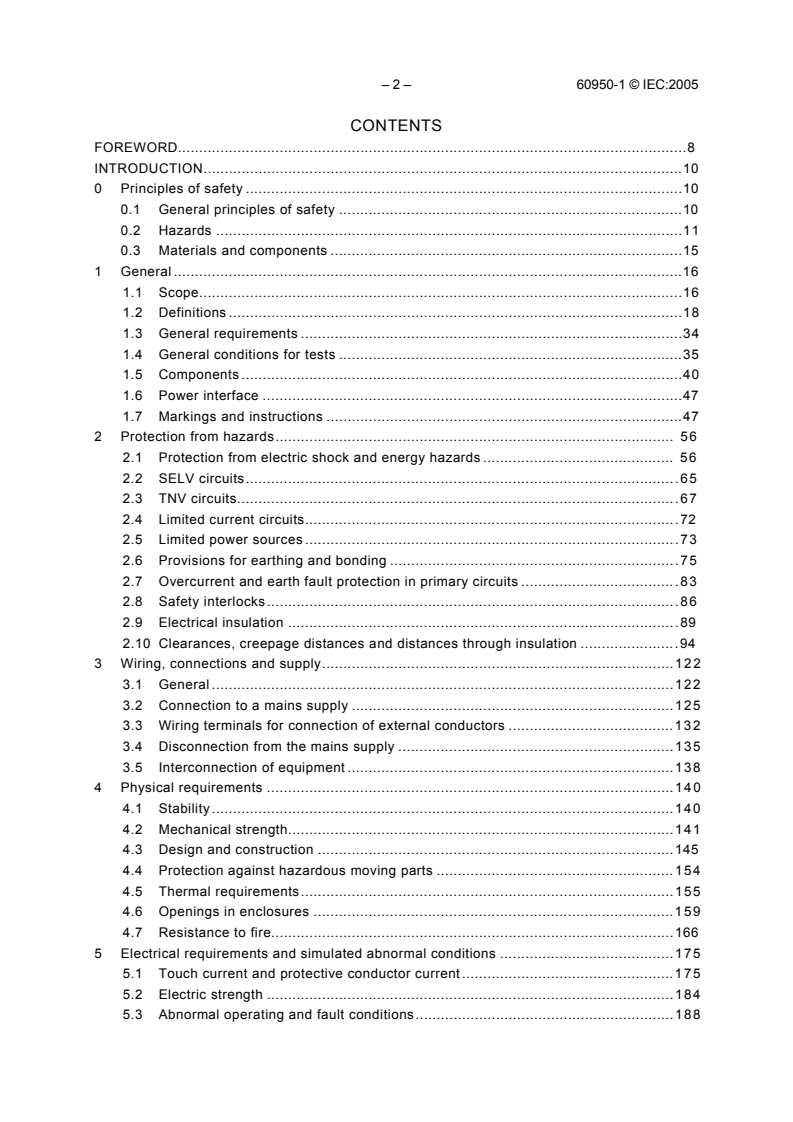
CONTENTS
FOREWORD.8
INTRODUCTION.10
0 Principles of safety .10
0.1 General principles of safety .10
0.2 Hazards .11
0.3 Materials and components .15
1 General .16
1.1 Scope.16
1.2 Definitions.18
1.3 General requirements .34
1.4 General conditions for tests .35
1.5 Components.40
1.6 Power interface .47
1.7 Markings and instructions .47
2 Protection from hazards. 56
2.1 Protection from electric shock and energy hazards . 56
2.2 SELV circuits.65
2.3 TNV circuits.67
2.4 Limited current circuits.72
2.5 Limited power sources .73
2.6 Provisions for earthing and bonding .75
2.7 Overcurrent and earth fault protection in primary circuits .83
2.8 Safety interlocks.86
2.9 Electrical insulation .89
2.10 Clearances, creepage distances and distances through insulation .94
3 Wiring, connections and supply.122
3.1 General.122
3.2 Connection to a mains supply .125
3.3 Wiring terminals for connection of external conductors .132
3.4 Disconnection from the mains supply .135
3.5 Interconnection of equipment .138
4 Physical requirements .140
4.1 Stability.140
4.2 Mechanical strength.141
4.3 Design and construction .145
4.4 Protection against hazardous moving parts .154
4.5 Thermal requirements.155
4.6 Openings in enclosures .159
4.7 Resistance to fire.166
5 Electrical requirements and simulated abnormal conditions .175
5.1 Touch current and protective conductor current.175
5.2 Electric strength .184
5.3 Abnormal operating and fault conditions.188
60950-1 © IEC:200560950-1 IEC:2005 –– 3 – 5 –
6 Connection to telecommunication networks .193
6.1 Protection of telecommunication network service persons, and users of other
equipment connected to the network, from hazards in the equipment.193
6.2 Protection of equipment users from overvoltages on telecommunication
networks .195
6.3 Protection of the telecommunication wiring system from overheating .198
7 Connection to cable distribution systems.199
7.1 General .199
7.2 Protection of cable distribution system service persons, and users of other
equipment connected to the system, from hazardous voltages in the
equipment.199
7.3 Protection of equipment users from overvoltages on the cable distribution
system.199
7.4 Insulation between primary circuits and cable distribution systems.200
Annex A (normative) Tests for resistance to heat and fire .202
Annex B (normative) Motor tests under abnormal conditions .205
Annex C (normative) Transformers.211
Annex D (normative) Measuring instruments for touch current tests .215
Annex E (normative) Temperature rise of a winding .217
Annex F (normative) Measurement of clearances and creepage distances .218
Annex G (normative) Alternative method for determining minimum clearances .226
Annex H (normative) Ionizing radiation .234
Annex J (normative) Table of electrochemical potentials (see 2.6.5.6).235
Annex K (normative) Thermal controls.236
Annex L (normative) Normal load conditions for some types of electrical business
equipment .238
Annex M (normative) Criteria for telephone ringing signals.240
Annex N (normative) Impulse test generators .245
Annex P (normative) Normative references.247
Annex Q (normative) Voltage dependent resistors (VDRs) .251
Annex R (informative) Examples of requirements for quality control programmes .252
Annex S (informative) Procedure for impulse testing.255
Annex T (informative) Guidance on protection against ingress of water .257
Annex U (normative) Insulated winding wires for use without interleaved insulation .259
Annex V (normative) AC power distribution systems .262
Annex W (informative) Summation of touch currents .269
Annex X (informative) Maximum heating effect in transformer tests.272
Annex Y (normative) Ultraviolet light conditioning test.274
Annex Z (informative) Overvoltage categories (see 2.10.3.2 and Clause G.2).275
Annex AA (normative) Mandrel test (see 2.10.5.8) .276
Annex BB (informative) Changes in the second edition .279
60950-1 IEC:2005 –– 4 – 7 – 60950-1 © IEC:2005
Bibliography .282
Index .284
Figure 2A – Test finger . 58
Figure 2B – Test pin . 59
Figure 2C – Test probe . 59
Figure 2D - Accessibility of internal conductive parts . 60
Figure 2E – Voltages in SELV circuits under single fault conditions. 66
Figure 2F – Maximum voltages permitted after a single fault . 68
Figure 2G – Test generator . 72
Figure 2H – Examples of application of insulation . 93
Figure 2J – Thermal ageing time .119
Figure 2K – Abrasion resistance test for coating layers.120
Figure 4A – Impact test using a steel ball .143
Figure 4B – Examples of cross-sections of designs of openings preventing vertical
access.160
Figure 4C – Examples of louvre design .160
Figure 4D – Enclosure openings.161
Figure 4E – Typical bottom of a fire enclosure for partially enclosed component or
assembly .162
Figure 4F – Baffle plate construction .163
Figure 5A – Test circuit for touch current of single-phase equipment on a star TN or TT
power supply system .177
Figure 5B – Test circuit for touch current of three-phase equipment on a star TN or TT
power supply system .177
Figure 6A – Test for separation between a telecommunication network and earth.195
Figure 6B – Application points of test voltage .196
Figure B.1 – Determination of arithmetic average temperature .206
Figure C.1 – Determination of arithmetic average temperature.212
Figure D.1 – Measuring instrument.215
Figure D.2 – Alternative measuring instrument .216
Figure F.1 – Narrow groove .219
Figure F.2 – Wide groove.219
Figure F.3 – V-shaped groove .219
Figure F.4 – Rib.219
Figure F.5 – Uncemented joint with narrow groove .220
Figure F.6 – Uncemented joint with wide groove.220
Figure F.7 – Uncemented joint with narrow and wide grooves .220
Figure F.8 – Narrow recess.221
Figure F.9 – Wide recess .221
Figure F.10 – Coating around terminals.222
Figure F.11 – Coating over printed wiring .222
60950-1 © IEC:200560950-1 IEC:2005 –– 5 – 9 –
Figure F.12 – Measurements through openings in enclosures .223
Figure F.13 – Intervening, unconnected conductive part .223
Figure F.14 – Solid insulating material.224
Figure F.15 – Thin sheet insulating material .224
Figure F.16 – Cemented joints in multi-layer printed board.224
Figure F.17 – Component filled with insulating compound .225
Figure F.18 – Partitioned bobbin .225
Figure M.1 – Definition of ringing period and cadence cycle.241
Figure M.2 – I limit curve for cadenced ringing signal .242
TS1
Figure M.3 – Peak and peak-to-peak currents.242
Figure M.4 – Ringing voltage trip criteria .244
Figure N.1 – ITU-T impulse test generator circuit.245
Figure N.2 – IEC 60065 impulse test generator circuit .246
Figure S.1 – Waveform on insulation without surge suppressors and no breakdown .255
Figure S.2 – Waveforms on insulation during breakdown without surge suppressors .256
Figure S.3 – Waveforms on insulation with surge suppressors in operation .256
Figure S.4 – Waveform on short-circuited surge suppressor and insulation .256
Figure V.1 – Examples of TN-S power distribution systems.264
Figure V.2 – Example of TN-C-S power distribution system.265
Figure V.3 – Example of TN-C power distribution system .265
Figure V.4 – Example of single-phase, three-wire TN-C power distribution system .266
Figure V.5 – Example of three line and neutral TT power distribution system.266
Figure V.6 – Example of three line TT power distribution system.267
Figure V.7 – Example of three line (and neutral) IT power distribution system .267
Figure V.8 – Example of three line IT power distribution system.268
Figure W.1 – Touch current from a floating circuit.269
Figure W.2 – Touch current from an earthed circuit .270
Figure W.3 – Summation of touch currents in a PABX.270
Figure AA.1 – Mandrel .276
Figure AA.2 – Initial position of mandrel .277
Figure AA.3 – Final position of mandrel .277
Table 1A – Voltage ranges of SELV and TNV circuits .26
Table 1B – Equivalence of flammability classes.30
Table 1C – Capacitor ratings according to IEC 60384-14 .42
Table 1D – Informative examples of application of capacitors .43
Table 2A – Distance through insulation of internal wiring . 61
Table 2B – Limits for power sources without an overcurrent protective device . 74
Table 2C – Limits for power sources with an overcurrent protective device. 74
60950-1 IEC:2005 –– 6 – 11 – 60950-1 © IEC:2005
Table 2D – Minimum size of protective bonding conductors .78
Table 2E – Test duration, a.c. mains supplies.79
Table 2F – Informative examples of protective devices in single-phase equipment or
subassemblies.85
Table 2G – Informative examples of protective devices in three-phase equipment .85
Table 2H – Examples of application of insulation .91
Table 2J – AC mains transient voltages.99
Table 2K – Minimum clearances for insulation in primary circuits and between primary
and secondary circuits .100
Table 2L – Additional clearances in primary circuits.101
Table 2M – Minimum clearances in secondary circuits .102
Table 2N – Minimum creepage distances .107
Table 2P – Tests for insulation in non-separable layers .111
Table 2Q – Minimum separation distances for coated printed boards .116
Table 2R – Insulation in printed boards .117
Table 3A – Sizes of cables and conduits for equipment having a rated current not
exceeding 16 A.127
Table 3B – Sizes of conductors .129
Table 3C – Physical tests on power supply cords .131
Table 3D – Range of conductor sizes to be accepted by terminals .133
Table 3E – Sizes of terminals for mains supply conductors and protective earthing
conductors .134
Table 4A – Minimum property retention limits after UV exposure.151
Table 4B – Temperature limits, materials and components.157
Table 4C – Touch temperature limits .158
Table 4D – Size and spacing of openings in metal bottoms of fire enclosures.164
Table 4E – Summary of material flammability requirements .174
Table 5A – Maximum current.179
Table 5B – Test voltages for electric strength tests based on peak working voltages Part 1. 186
Table 5B – Test voltages for electric strength tests based on peak working voltages Part 2. 187
Table 5C – Test voltages for electric strength tests based on required withstand voltages.188
Table 5D – Temperature limits for overload conditions.192
Table B.1 – Temperature limits for motor windings (except for running overload test) .206
Table B.2 – Permitted temperature limits for running overload tests .207
Table C.1 – Temperature limits for transformer windings.212
Table F.1 – Value of X .218
Table G.1 – AC mains transient voltages.227
60950-1 © IEC:200560950-1 IEC:2005 –– 7 – 13 –
Table G.2 – Minimum clearances up to 2 000 m above sea level.232
Table J.1 – Electrochemical potentials (V) .235
Table N.1 – Component values for Figures N.1 and N.2.246
Table R.1 – Rules for sampling and inspection – coated printed boards .253
Table R.2 – Rules for sampling and inspection – reduced clearances.254
Table T.1 – Extract from IEC 60529 .258
Table U.1 – Mandrel diameter .260
Table U.2 – Oven temperature .260
Table X.1 – Test steps .273
Table Z.1 – Overvoltage categories.275
60950-1 IEC:2005 –– 8 – 15 – 60950-1 © IEC:2005
INTERNATIONAL ELECTROTECHNICAL COMMISSION
____________
INFORMATION TECHNOLOGY EQUIPMENT –
SAFETY –
Part 1: General requirements
FOREWORD
1) The International Electrotechnical Commission (IEC) is a worldwide organization for standardization comprising
all national electrotechnical committees (IEC National Committees). The object of IEC is to promote
international co-operation on all questions concerning standardization in the electrical and electronic fields. To
this end and in addition to other activities, IEC publishes International Standards, Technical Specifications,
Technical Reports, Publicly Available Specifications (PAS) and Guides (hereafter referred to as “IEC
Publication(s)”). Their preparation is entrusted to technical committees; any IEC National Committee interested
in the subject dealt with may participate in this preparatory work. International, governmental and non-
governmental organizations liaising with the IEC also participate in this preparation. IEC collaborates closely
with the International Organization for Standardization (ISO) in accordance with conditions determined by
agreement between the two organizations.
2) The formal decisions or agreements of IEC on technical matters express, as nearly as possible, an international
consensus of opinion on the relevant subjects since each technical committee has representation from all
interested IEC National Committees.
3) IEC Publications have the form of recommendations for international use and are accepted by IEC National
Committees in that sense. While all reasonable efforts are made to ensure that the technical content of IEC
Publications is accurate, IEC cannot be held responsible for the way in which they are used or for any
misinterpretation by any end user.
4) In order to promote international uniformity, IEC National Committees undertake to apply IEC Publications
transparently to the maximum extent possible in their national and regional publications. Any divergence
between any IEC Publication and the corresponding national or regional publication shall be clearly indicated in
the latter.
5) IEC provides no marking procedure to indicate its approval and cannot be rendered responsible for any
equipment declared to be in conformity with an IEC Publication.
6) All users should ensure that they have the latest edition of this publication.
7) No liability shall attach to IEC or its directors, employees, servants or agents including individual experts and
members of its technical committees and IEC National Committees for any personal injury, property damage or
other damage of any nature whatsoever, whether direct or indirect, or for costs (including legal fees) and
expenses arising out of the publication, use of, or reliance upon, this IEC Publication or any other IEC
Publications.
8) Attention is drawn to the Normative references cited in this publication. Use of the referenced publications is
indispensable for the correct application of this publication.
9) Attention is drawn to the possibility that some of the elements of this IEC Publication may be the subject of
patent rights. IEC shall not be held responsible for identifying any or all such patent rights.
International Standard IEC 60950-1 has been prepared by IEC technical committee 108:
Safety of electronic equipment within the field of audio/video, information technology and
communication technology.
This second edition of IEC 60950-1 cancels and replaces the first edition of IEC 60950-1,
issued in 2001, and constitutes a technical revision. The principal changes in this edition as
compared with the first edition of IEC 60950-1 are given in Annex BB, including a list of
changed subclause, table and figure numbers.
������������������� �������
���������������������������������������������������������������
����� �����������������
��������������������������
�
�����������������������������������������������������������������������������������������������
�������������������������������������
�������������������������������������������������������������������������������������
�����������
����������������������������������������������������������������������������������������
����������������������������������������������������������������������������������������
�������������������������������������
�������������������������������������������������
��������������������������������������������������
���������������������������������������������������������������������������������������������������
������������������������������������������������������������������������������������������������
��������������������������������������������������������
����������������������������������������������������������������������������������������
����������������������������������������������
����������������������������������������������������������������������������������������������
�����������������
������������������������������������������������������
−� �������������������������������������������������������
−�������������������������������������������������������������
−� �����������������������������������������������������
−� ������������������������������������������ �����
��������������������������������������������������������������������������������������������
��������������������������������������������������������������������������������������������
�������������������������������������������������������������������������������������
�� �������������
�� �����������
�� ����������������������������������
�� ����������
�
�������������������������������������������������������������������������������������
�����������
�
�
60950-1 IEC:2005 –– 10 – 19 – 60950-1 © IEC:2005
INTRODUCTION
0 Principles of safety
The following principles have been adopted by technical committee 108 in the development of
this standard.
These principles do not cover performance or functional characteristics of equipment.
Words printed in SMALL CAPITALS are terms that are defined in 1.2 of this standard.
0.1 General principles of safety
It is essential that designers understand the underlying principles of safety requirements in
order that they can engineer safe equipment.
These principles are not an alternative to the detailed requirements of this standard, but are
intended to provide designers with an appreciation of the basis of these requirements. Where
the equipment involves technologies and materials or methods of construction not specifically
covered, the design of the equipment should provide a level of safety not less than those
described in these principles of safety.
Designers shall take into account not only normal operating conditions of the equipment but
also likely fault conditions, consequential faults, foreseeable misuse and external influences
such as temperature, altitude, pollution, moisture, overvoltages on the MAINS SUPPLY and
overvoltages on a TELECOMMUNICATION NETWORK or a CABLE DISTRIBUTION SYSTEM.
Dimensioning of insulation spacings should take account of possible reductions by
manufacturing tolerances, or where deformation could occur due to handling, shock and
vibration likely to be encountered during manufacture, transport and normal use.
The following priorities should be observed in determining what design measures to adopt:
− where possible, specify design criteria that will eliminate, reduce or guard against
hazards;
− where the above is not practicable because the functioning of the equipment would be
impaired, specify the use of protective means independent of the equipment, such as
personal protective equipment (which is not specified in this standard);
− where neither of the above measures is practicable, or in addition to those measures,
specify the provision of markings and instructions regarding the residual risks.
There are two types of persons whose safety needs to be considered, USERS (or OPERATORS)
and SERVICE PERSONS.
USER is the term applied to all persons other than SERVICE PERSONS. Requirements for
protection should assume that USERS are not trained to identify hazards, but will not
intentionally create a hazardous situation. Consequently, the requirements will provide
protection for cleaners and casual visitors as well as the assigned USERS. In general, USERS
60950-1 © IEC:200560950-1 IEC:2005 –– 11 – 21 –
should not have access to hazardous parts, and to this end, such parts should only be in
SERVICE ACCESS AREAS or in equipment located in RESTRICTED ACCESS LOCATIONS.
When USERS are admitted to RESTRICTED ACCESS LOCATIONS they shall be suitably instructed.
SERVICE PERSONS are expected to use their training and skill to avoid possible injury to
themselves and others due to obvious hazards that exist in SERVICE ACCESS AREAS of the
equipment or on equipment located in RESTRICTED ACCESS LOCATIONS. However, SERVICE
PERSONS should be protected against unexpected hazards. This can be done by, for example,
locating parts that need to be accessible for servicing away from electrical and mechanical
hazards, providing shields to avoid accidental contact with hazardous parts, and providing
labels or instructions to warn personnel about any residual risk.
Information about potential hazards can be marked on the equipment or provided with the
equipment, depending on the likelihood and severity of injury, or made available for SERVICE
PERSONS. In general, USERS shall not be exposed to hazards likely to cause injury, and
information provided for USERS should primarily aim at avoiding misuse and situations likely to
create hazards, such as connection to the wrong power source and replacement of fuses by
incorrect types.
MOVABLE EQUIPMENT is considered to present a slightly increased risk of shock, due to
possible extra strain on the supply cord leading to rupture of the earthing conductor. With
HAND-HELD EQUIPMENT, this risk is increased; wear on the cord is more likely, and further
hazards could arise if the units were dropped. TRANSPORTABLE EQUIPMENT introduces a further
factor because it can be used and carried in any orientation; if a small metallic object enters
an opening in the ENCLOSURE it can move around inside the equipment, possibly creating a
hazard.
0.2 Hazards
Application of a safety standard is intended to reduce the risk of injury or damage due to the
following:
− electric shock;
− energy related hazards;
− fire;
− heat related hazards;
− mechanical hazards;
− radiation;
− chemical hazards.
60950-1 IEC:2005 –– 12 – 23 – 60950-1 © IEC:2005
0.2.1 Electric shock
Electric shock is due to current passing through the human body. The resulting physiological
effects depend on the value and duration of the current and the path it takes through the
body. The value of the current depends on the applied voltage, the impedance of the source
and the impedance of the body. The body impedance depends in turn on the area of contact,
moisture in the area of contact and the applied voltage and frequency. Currents of
approximately half a milliampere can cause a reaction in persons in good health and may
cause injury indirectly due to involuntary reaction. Higher currents can have more direct
effects, such as burn or muscle tetanization leading to inability to let go or to ventricular
fibrillation.
Steady state voltages up to 42,4 V peak, or 60 V d.c., are not generally regarded as
hazardous under dry conditions for an area of contact equivalent to a human hand. Bare parts
that have to be touched or handled should be at earth potential or properly insulated.
Some equipment will be connected to telephone and other external networks. Some
TELECOMMUNICATION NETWORKS operate with signals such as voice and ringing superimposed
on a steady d.c. supply voltage; the total may exceed the values given above for steady-state
voltages. It is common practice for the SERVICE PERSONS of telephone companies to handle
parts of such circuits bare-handed. This has not caused serious injury, because of the use of
cadenced ringing and because there are limited areas of contact with bare conductors
normally handled by SERVICE PERSONS. However, the area of contact of a part accessible to
the USER, and the likelihood of the part being touched, should be further limited (for example,
by the shape and location of the part).
It is normal to provide two levels of protection for USERS to prevent electric shock. Therefore,
the operation of equipment under normal conditions and after a single fault, including any
consequential faults, should not create a shock hazard. However, provision of additional
protective measures, such as protective earthing or SUPPLEMENTARY INSULATION, is not
considered a substitute for, or a relief from, properly designed BASIC INSULATION.
Harm may result from: Examples of measures to reduce risks:
Contact with bare parts normally at Prevent USER access to parts at HAZARDOUS
HAZARDOUS VOLTAGES. VOLTAGES by fixed or locked covers, SAFETY
INTERLOCKS, etc. Discharge accessible
capacitors that are at HAZARDOUS VOLTAGES.
Breakdown of insulation between parts Provide BASIC INSULATION and connect the
normally at HAZARDOUS VOLTAGES and accessible conductive parts and circuits to
accessible conductive parts. earth so that exposure to the voltage which can
develop is limited because overcurrent
protection will disconnect the parts having low
impedance faults within a specified time;
or provide a metal screen connected to
protective earth between the parts, or provide
DOUBLE INSULATION or REINFORCED INSULATION
between the parts, so that breakdown to the
accessible part is not likely to occur.
60950-1 © IEC:200560950-1 IEC:2005 –– 13 – 25 –
Contact with circuits connected to Limit the accessibility and area of contact of such
TELECOMMUNICATION NETWORKS that exceed circuits, and separate them from unearthed parts
42,4 V peak or 60 V d.c. to which access is not limited.
Breakdown of USER-accessible insulation. Insulation that is accessible to the USER should
have adequate mechanical and electrical
strength to reduce the likelihood of contact with
HAZARDOUS VOLTAGES.
TOUCH CURRENT (leakage current) flowing Limit TOUCH CURRENT to a specified value, or
from parts at HAZARDOUS VOLTAGES to provide a high integrity protective earthing
accessible parts, or failure of a protective connection.
earthing connection. TOUCH CURRENT may
include current due to EMC filter
components connected between PRIMARY
CIRCUITS and accessible parts.
0.2.2 Energy related hazards
Injury or fire may result from a short-circuit between adjacent poles of high current supplies or
high capacitance circuits, causing:
− burns;
− arcing;
− ejection of molten metal.
Even circuits whose voltages are safe to touch may be hazardous in this respect.
Examples o
...
IEC 60950-1 ®
Edition 2.1 2012-05
INTERNATIONAL
STANDARD
NORME
INTERNATIONALE
colour
inside
Information technology equipment – Safety –
Part 1: General requirements
Matériels de traitement de l'information – Sécurité –
Partie 1: Exigences générales
All rights reserved. Unless otherwise specified, no part of this publication may be reproduced or utilized in any form
or by any means, electronic or mechanical, including photocopying and microfilm, without permission in writing from
either IEC or IEC's member National Committee in the country of the requester.
If you have any questions about IEC copyright or have an enquiry about obtaining additional rights to this publication,
please contact the address below or your local IEC member National Committee for further information.
Droits de reproduction réservés. Sauf indication contraire, aucune partie de cette publication ne peut être reproduite ni
utilisée sous quelque forme que ce soit et par aucun procédé, électronique ou mécanique, y compris la photocopie et les
microfilms, sans l'accord écrit de la CEI ou du Comité national de la CEI du pays du demandeur.
Si vous avez des questions sur le copyright de la CEI ou si vous désirez obtenir des droits supplémentaires sur cette
publication, utilisez les coordonnées ci-après ou contactez le Comité national de la CEI de votre pays de résidence.
IEC Central Office Tel.: +41 22 919 02 11
3, rue de Varembé Fax: +41 22 919 03 00
CH-1211 Geneva 20 info@iec.ch
Switzerland www.iec.ch
About the IEC
The International Electrotechnical Commission (IEC) is the leading global organization that prepares and publishes
International Standards for all electrical, electronic and related technologies.
About IEC publications
The technical content of IEC publications is kept under constant review by the IEC. Please make sure that you have the
latest edition, a corrigenda or an amendment might have been published.
Useful links:
IEC publications search - www.iec.ch/searchpub Electropedia - www.electropedia.org
The advanced search enables you to find IEC publications The world's leading online dictionary of electronic and
by a variety of criteria (reference number, text, technical electrical terms containing more than 30 000 terms and
committee,…). definitions in English and French, with equivalent terms in
It also gives information on projects, replaced and additional languages. Also known as the International
withdrawn publications. Electrotechnical Vocabulary (IEV) on-line.
IEC Just Published - webstore.iec.ch/justpublished Customer Service Centre - webstore.iec.ch/csc
Stay up to date on all new IEC publications. Just Published If you wish to give us your feedback on this publication
details all new publications released. Available on-line and or need further assistance, please contact the
also once a month by email. Customer Service Centre: csc@iec.ch.
A propos de la CEI
La Commission Electrotechnique Internationale (CEI) est la première organisation mondiale qui élabore et publie des
Normes internationales pour tout ce qui a trait à l'électricité, à l'électronique et aux technologies apparentées.
A propos des publications CEI
Le contenu technique des publications de la CEI est constamment revu. Veuillez vous assurer que vous possédez
l’édition la plus récente, un corrigendum ou amendement peut avoir été publié.
Liens utiles:
Recherche de publications CEI - www.iec.ch/searchpub Electropedia - www.electropedia.org
La recherche avancée vous permet de trouver des Le premier dictionnaire en ligne au monde de termes
publications CEI en utilisant différents critères (numéro de électroniques et électriques. Il contient plus de 30 000
référence, texte, comité d’études,…). termes et définitions en anglais et en français, ainsi que
Elle donne aussi des informations sur les projets et les les termes équivalents dans les langues additionnelles.
publications remplacées ou retirées. Egalement appelé Vocabulaire Electrotechnique
International (VEI) en ligne.
Just Published CEI - webstore.iec.ch/justpublished
Service Clients - webstore.iec.ch/csc
Restez informé sur les nouvelles publications de la CEI.
Just Published détaille les nouvelles publications parues. Si vous désirez nous donner des commentaires sur
Disponible en ligne et aussi une fois par mois par email. cette publication ou si vous avez des questions
contactez-nous: csc@iec.ch.
IEC 60950-1 ®
Edition 2.1 2012-05
INTERNATIONAL
STANDARD
NORME
INTERNATIONALE
colour
inside
Information technology equipment – Safety –
Part 1: General requirements
Matériels de traitement de l'information – Sécurité –
Partie 1: Exigences générales
INTERNATIONAL
ELECTROTECHNICAL
COMMISSION
COMMISSION
ELECTROTECHNIQUE
PRICE CODE
INTERNATIONALE
CODE PRIX CV
ICS 35.020; 35.260 ISBN 978-2-8322-0100-8
– 2 – 60950-1 IEC:2005+A1:2009
CONTENTS
FOREWORD . 7
INTRODUCTION . 9
0 Principles of safety . 9
0.1 General principles of safety . 9
0.2 Hazards . 10
0.3 Materials and components . 13
1 General . 14
1.1 Scope . 14
1.2 Definitions . 16
1.3 General requirements . 30
1.4 General conditions for tests . 32
1.5 Components . 36
1.6 Power interface . 43
1.7 Markings and instructions . 44
2 Protection from hazards . 53
2.1 Protection from electric shock and energy hazards . 53
2.2 SELV circuits . 61
2.3 TNV circuits. 63
2.4 Limited current circuits . 68
2.5 Limited power sources . 69
2.6 Provisions for earthing and bonding . 70
2.7 Overcurrent and earth fault protection in primary circuits . 78
2.8 Safety interlocks . 80
2.9 Electrical insulation . 83
2.10 Clearances, creepage distances and distances through insulation . 88
3 Wiring, connections and supply . 116
3.1 General . 116
3.2 Connection to a mains supply . 119
3.3 Wiring terminals for connection of external conductors . 125
3.4 Disconnection from the mains supply . 128
3.5 Interconnection of equipment . 131
4 Physical requirements . 132
4.1 Stability . 132
4.2 Mechanical strength . 132
4.3 Design and construction . 138
4.4 Protection against hazardous moving parts . 147
4.5 Thermal requirements . 149
4.6 Openings in enclosures . 153
4.7 Resistance to fire . 159
5 Electrical requirements and simulated abnormal conditions . 166
5.1 Touch current and protective conductor current . 166
5.2 Electric strength . 174
5.3 Abnormal operating and fault conditions . 178
60950-1 IEC:2005+A1:2009 – 3 –
6 Connection to telecommunication networks . 182
6.1 Protection of telecommunication network service persons, and users of other
equipment connected to the network, from hazards in the equipment . 182
6.2 Protection of equipment users from overvoltages on telecommunication
networks . 184
6.3 Protection of the telecommunication wiring system from overheating . 186
7 Connection to cable distribution systems . 187
7.1 General . 187
7.2 Protection of cable distribution system service persons, and users of other
equipment connected to the system, from hazardous voltages in the
equipment . 188
7.3 Protection of equipment users from overvoltages on the cable distribution
system . 188
7.4 Insulation between primary circuits and cable distribution systems . 188
Annex A (normative) Tests for resistance to heat and fire . 190
Annex B (normative) Motor tests under abnormal conditions . 193
Annex C (normative) Transformers . 199
Annex D (normative) Measuring instruments for touch current tests . 202
Annex E (normative) Temperature rise of a winding . 204
Annex F (normative) Measurement of clearances and creepage distances . 205
Annex G (normative) Alternative method for determining minimum clearances . 212
Annex H (normative) Ionizing radiation . 220
Annex J (normative) Table of electrochemical potentials (see 2.6.5.6) . 221
Annex K (normative) Thermal controls . 223
Annex L (normative) Normal load conditions for some types of electrical business
equipment . 225
Annex M (normative) Criteria for telephone ringing signals . 227
Annex N (normative) Impulse test generators . 232
Annex P (normative) Normative references . 234
Annex Q (normative) Voltage dependent resistors (VDRs) . 238
Annex R (informative) Examples of requirements for quality control programmes . 239
Annex S (informative) Procedure for impulse testing . 242
Annex T (informative) Guidance on protection against ingress of water . 244
Annex U (normative) Insulated winding wires for use without interleaved insulation . 246
Annex V (normative) AC power distribution systems . 249
Annex W (informative) Summation of touch currents . 256
Annex X (informative) Maximum heating effect in transformer tests . 259
Annex Y (normative) Ultraviolet light conditioning test. 261
Annex Z (informative) Overvoltage categories (see 2.10.3.2 and Clause G.2) . 262
Annex AA (normative) Mandrel test (see 2.10.5.8) . 263
Annex BB (informative) Changes in the second edition . 266
Annex CC (normative) Evaluation of integrated circuit (IC) current limiters . 269
Annex DD (normative) Requirements for the mounting means of rack-mounted
equipment . 271
Annex EE (normative) Household and home/office document/media shredders . 273
– 4 – 60950-1 © IEC:2005+A1:2012
Bibliography . 267
Index . 589
Figure 2A – Test finger . 56
Figure 2B – Test pin . 56
Figure 2C – Test probe . 56
Figure 2D - Accessibility of internal conductive parts . 57
Figure 2E – Voltages in SELV circuits under singl e fault c onditions . 62
Figure 2F – Maximum voltages permitted after a single fault . 64
Figure 2G – Test generator . 68
Figure 2H – Examples of application of insulation . 87
Figure 2J – Thermal ageing time . 113
Figure 2K – Abrasion resistance test for coating layers . 114
Figure 4A – Impact test using a steel ball . 135
Figure 4B – Examples of cross-sections of designs of openings preventing vertical
acc e ss . 153
Figure 4C – Examples of louvre design . 154
Figure 4D – Enclosure openings . 155
Figure 4E – Typical bottom of a fire enclosure for partially enclosed component or
assembly . 155
Figure 4F – Baffle plate construction . 156
Figure 5A – Test circuit for touch current of single-phase equipment on a star TN or TT
power supply system . 167
Figure 5B – Test circuit for touch current of three-phase equipment on a star TN or TT
power supply system . 168
Figure 6A – Test for separation between a telecommunication network and earth . 184
Figure 6B – Application points of test voltage . 185
Figure B.1 – Determination of arithmetic average temperature . 194
Figure C.1 – Determination of arithmetic average temperature . 200
Figure D.1 – Measuring instrument . 202
Figure D.2 – Alternative measuring instrument . 203
Figure F.1 – Narrow groove . 205
Figure F.2 – Wide groove . 205
Figure F.3 – V-shaped groove . 206
Figure F.4 – Rib . 206
Figure F.5 – Uncemented joint with narrow groove . 206
Figure F.6 – Uncemented joint with wide groove . 207
Figure F.7 – Uncemented joint with narrow and wide grooves . 207
Figure F.8 – Narrow recess . 207
Figure F.9 – Wide recess . 208
Figure F.10 – Coating around terminals . 208
Figure F.11 – Coating over printed wiring . 209
Figure F.12 – Measurements through openings in enclosures . 209
Figure F.13 – Intervening, unconnected conductive part . 210
Figure F.14 – Solid insulating material . 210
60950-1 © IEC:2005+A1:2012 – 5 –
Figure F.15 – Thin sheet insulating material . 210
Figure F.16 – Cemented joints in multi-layer printed board. 211
Figure F.17 – Component filled with insulating compound . 211
Figure F.18 – Partitioned bobbin . 211
Figure M.1 – Definition of ringing period and cadence cycle . 228
Figure M.2 – ITS1 limit curve for cadenced ringing signal . 229
Figure M.3 – Peak and peak-to-peak currents . 230
Figure M.4 – Ringing voltage trip criteria . 231
Figure N.1 – ITU-T impulse test generator circuit . 232
Figure N.2 – IEC 60065 impulse test generator circuit . 233
Figure S.1 – Waveform on insulation without surge suppressors and no breakdown . 242
Figure S.2 – Waveforms on insulation during breakdown without surge suppressors . 243
Figure S.3 – Waveforms on insulation with surge suppressors in operation . 243
Figure S.4 – Waveform on short-circuited surge suppressor and insulation . 243
Figure V.1 – Examples of TN-S power distribution systems . 251
Figure V.2 – Example of TN-C-S power distribution system . 252
Figure V.3 – Example of TN-C power distribution system . 252
Figure V.4 – Example of single-phase, three-wire TN-C power distribution system . 253
Figure V.5 – Example of three line and neutral TT power distribution system . 253
Figure V.6 – Example of three line TT power distribution system . 254
Figure V.7 – Example of three line (and neutral) IT power distribution system . 254
Figure V.8 – Example of three line IT power distribution system . 255
Figure W.1 – Touch current from a floating circuit . 256
Figure W.2 – Touch current from an earthed circuit . 257
Figure W.3 – Summation of touch currents in a PABX . 257
Figure AA.1 – Mandrel . 263
Figure AA.2 – Initial position of mandrel . 264
Figure AA.3 – Final position of mandrel . 264
Figure EE.1 – Wedge probe (overall view) . 275
Figure EE.2 – Wedge probe (tip detail) . 276
Table 1A – Voltage ranges of SELV and TNV circuits . 23
Table 1B – Equivalence of flammability classes . 27
Table 1C – Capacitor ratings according to IEC 60384-14 . 38
Table 1D – Informative examples of application of capacitors . 39
Table 2A – Distance through insulation of internal wiring . 58
Table 2B – Limits for power sources without an overcurrent protective device . 70
Table 2C – Limits for power sources with an overcurrent protective device . 70
Table 2D – Minimum size of protective bonding conductors . 73
Table 2E – Test duration, a.c. mains supplies . 74
Table 2F – Informative examples of protective devices in single-phase equipment or
subassemblies . . 79
Table 2G – Informative examples of protective devices in three-phase equipment . 80
Table 2H – Examples of application of insulation . 85
– 6 – 60950-1 © IEC:2005+A1:2012
Table 2J – AC mains transient voltages . 92
Table 2K – Minimum clearances for insulation in primary circuits and between primary
and secondary circuits . 94
Table 2L – Additional clearances in primary circuits . 94
Table 2M – Minimum clearances in secondary circuits . 96
Table 2N – Minimum creepage distances . 101
Table 2P – Tests for insulation in non-separable layers . 106
Table 2Q – Minimum separation distances for coated printed boards . 110
Table 2R – Insulation in printed boards . 112
Table 3A – Sizes of cables and conduits for equipment having a rated current not
exceeding 16 A . 121
Table 3B – Sizes of conductors . 122
Table 3C – Physical tests on power supply cords . 124
Table 3D – Range of conductor sizes to be accepted by terminals . 126
Table 3E – Sizes of terminals for mains supply conductors and protective earthing
conductors . 127
Table 4A – Minimum property retention limits after UV exposure . 143
Table 4B – Temperature limits, materials and components . 150
Table 4C – Touch temperature limits . 152
Table 4D – Size and spacing of openings in metal bottoms of fire enclosures . 156
Table 4E – Summary of material flammability requirements . 165
Table 5A – Maximum current . 170
Table 5B – Test voltages for electric strength tests based on peak working voltages Part 1 . 176
Table 5B – Test voltages for electric strength tests based on peak working voltages Part 2 . 177
Table 5C – Test voltages for electric strength tests based on required withstand voltages . 178
Table 5D – Temperature limits for overload conditions . 181
Table B.1 – Temperature limits for motor windings (except for running overload test) . 194
Table B.2 – Permitted temperature limits for running overload tests . 195
Table C.1 – Temperature limits for transformer windings . 200
Table F.1 – Value of X . 205
Table G.1 – AC mains transient voltages . 213
Table G.2 – Minimum clearances up to 2 000 m above sea level . 218
Table J.1 – Electrochemical potentials (V) . 221
Table N.1 – Component values for Figures N.1 and N.2 . 233
Table R.1 – Rules for sampling and inspection – coated printed boards . 240
Table R.2 – Rules for sampling and inspection – reduced c l earanc es . 241
Table T.1 – Extract from IEC 60529 . 245
Table U.1 – Mandrel diameter . 247
Table U.2 – Oven temperature . 247
Table X.1 – Test steps . 259
Table Z.1 – Overvoltage categories . 262
60950-1 IEC:2005+A1:2009 – 7 –
INTERNATIONAL ELECTROTECHNICAL COMMISSION
____________
INFORMATION TECHNOLOGY EQUIPMENT –
SAFETY –
Part 1: General requirements
FOREWORD
1) The International Electrotechnical Commission (IEC) is a worldwide organization for standardization comprising
all national electrotechnical committees (IEC National Committees). The object of IEC is to promote
international co-operation on all questions concerning standardization in the electrical and electronic fields. To
this end and in addition to other activities, IEC publishes International Standards, Technical Specifications,
Technical Reports, Publicly Available Specifications (PAS) and Guides (hereafter referred to as “IEC
Publication(s)”). Their preparation is entrusted to technical committees; any IEC National Committee interested
in the subject dealt with may participate in this preparatory work. International, governmental and non-
governmental organizations liaising with the IEC also participate in this preparation. IEC collaborates closely
with the International Organization for Standardization (ISO) in accordance with conditions determined by
agreement between the two organizations.
2) The formal decisions or agreements of IEC on technical matters express, as nearly as possible, an international
consensus of opinion on the relevant subjects since each technical committee has representation from all
interested IEC National Committees.
3) IEC Publications have the form of recommendations for international use and are accepted by IEC National
Committees in that sense. While all reasonable efforts are made to ensure that the technical content of IEC
Publications is accurate, IEC cannot be held responsible for the way in which they are used or for any
misinterpretation by any end user.
4) In order to promote international uniformity, IEC National Committees undertake to apply IEC Publications
transparently to the maximum extent possible in their national and regional publications. Any divergence
between any IEC Publication and the corresponding national or regional publication shall be clearly indicated in
the latter.
5) IEC itself does not provide any attestation of conformity. Independent certification bodies provide conformity
assessment services and, in some areas, access to IEC marks of conformity. IEC is not responsible for any
services carried out by independent certification bodies.
6) All users should ensure that they have the latest edition of this publication.
7) No liability shall attach to IEC or its directors, employees, servants or agents including individual experts and
members of its technical committees and IEC National Committees for any personal injury, property damage or
other damage of any nature whatsoever, whether direct or indirect, or for costs (including legal fees) and
expenses arising out of the publication, use of, or reliance upon, this IEC Publication or any other IEC
Publications.
8) Attention is drawn to the Normative references cited in this publication. Use of the referenced publications is
indispensable for the correct application of this publication.
9) Attention is drawn to the possibility that some of the elements of this IEC Publication may be the subject of
patent rights. IEC shall not be held responsible for identifying any or all such patent rights.
This consolidated version of IEC 60950-1 consists of the second edition (2005)
[documents 108/135A/FDIS and 108/147/RVD], its corrigendum 1 (2006) and its
amendment 1 (2009) [documents 108/350/FDIS and 108/357/RVD]. It bears the edition
number 2.1.
The technical content is therefore identical to the base edition and its amendment and
has been prepared for user convenience. A vertical line in the margin shows where the
base publication has been modified by amendment 1. Additions and deletions are
displayed in red, with deletions being struck through.
– 8 – 60950-1 © IEC:2005+A1:2012
International Standard IEC 60950-1 has been prepared by IEC technical committee 108:
Safety of electronic equipment within the field of audio/video, information technology and
communication technology.
IEC 60950-1 includes the basic requirements for the safety of information technology
equipment.
Additional parts of IEC 60950-1 will cover specific safety requirements for information
technology equipment having limited applications or having special features as follows:
Part 21: Remote feeding (published);
Part 22: Equipment installed outdoors (planned);
Part 23: Large data storage equipment (planned);
Except for notes, all text within a normative figure, or in a box under a normative table, is also
normative. Text with a superscript reference is linked to a particular item in the table. Other
text in a box under a table applies to the whole table.
Informative annexes and text beginning with the word "NOTE" are not normative. They are
provided only to give additional information.
"Country" notes are also informative but call attention to requirements that are normative in
those countries.
In this standard, the following print types are used:
Requirements proper and normative annexes: roman type.
Compliance statements and test specifications: italic type.
Notes in the text and in tables: smaller roman type.
Terms that are defined in 1.2: SMALL CAPITALS.
The committee has decided that the contents of the base publication and its amendments will
remain unchanged until the stability date indicated on the IEC web site under
"http://webstore.iec.ch" in the data related to the specific publication. At this date, the
publication will be
• reconfirmed,
• withdrawn,
• replaced by a revised edition, or
• amended.
The contents of the corrigendum of August 2012 have been included in this copy.
IMPORTANT – The “colour inside” logo on the cover page of this publication indicates
that it contains colours which are considered to be useful for the correct understanding
of its contents. Users should therefore print this publication using a colour printer.
60950-1 IEC:2005+A1:2009 – 9 –
INTRODUCTION
0 Principles of safety
The following principles have been adopted by technical committee 108 in the development of
this standard.
These principles do not cover performance or functional characteristics of equipment.
Words printed in SMALL CAPITALS are terms that are defined in 1.2 of this standard.
0.1 General principles of safety
It is essential that designers understand the underlying principles of safety requirements in
order that they can engineer safe equipment.
These principles are not an alternative to the detailed requirements of this standard, but are
intended to provide designers with an appreciation of the basis of these requirements. Where
the equipment involves technologies and materials or methods of construction not specifically
covered, the design of the equipment should provide a level of safety not less than those
described in these principles of safety.
Designers shall take into account not only normal operating conditions of the equipment but
also likely fault conditions, consequential faults, foreseeable misuse and external influences
such as temperature, altitude, pollution, moisture, overvoltages on the MAINS SUPPLY and
overvoltages on a TELECOMMUNICATION NETWORK or a CABLE DISTRIBUTION SYSTEM.
Dimensioning of insulation spacings should take account of possible reductions by
manufacturing tolerances, or where deformation could occur due to handling, shock and
vibration likely to be encountered during manufacture, transport and normal use.
The following priorities should be observed in determining what design measures to adopt:
− where possible, specify design criteria that will eliminate, reduce or guard against
hazards;
− where the above is not practicable because the functioning of the equipment would be
impaired, specify the use of protective means independent of the equipment, such as
personal protective equipment (which is not specified in this standard);
− where neither of the above measures is practicable, or in addition to those measures,
specify the provision of markings and instructions regarding the residual risks.
There are two types of persons whose safety needs to be considered, USERS (or OPERATORS)
and SERVICE PERSONS.
USER is the term applied to all persons other than SERVICE PERSONS. Requirements for
protection should assume that USERS are not trained to identify hazards, but will not
intentionally create a hazardous situation. Consequently, the requirements will provide
protection for cleaners and casual visitors as well as the assigned USERS. In general, USERS
should not have access to hazardous parts, and to this end, such parts should only be in
SERVICE ACCESS AREAS or in equipment located in RESTRICTED ACCESS LOCATIONS.
When USERS are admitted to RESTRICTED ACCESS LOCATIONS they shall be suitably instructed.
SERVICE PERSONS are expected to use their training and skill to avoid possible injury to
themselves and others due to obvious hazards that exist in SERVICE ACCESS AREAS of the
equipment or on equipment located in RESTRICTED ACCESS LOCATIONS. However, SERVICE
PERSONS should be protected against unexpected hazards. This can be done by, for example,
locating parts that need to be accessible for servicing away from electrical and mechanical
– 10 – 60950-1 IEC:2005+A1:2009
hazards, providing shields to avoid accidental contact with hazardous parts, and providing
labels or instructions to warn personnel about any residual risk.
Information about potential hazards can be marked on the equipment or provided with the
equipment, depending on the likelihood and severity of injury, or made available for SERVICE
PERSONS. In general, USERS shall not be exposed to hazards likely to cause injury, and
information provided for USERS should primarily aim at avoiding misuse and situations likely to
create hazards, such as connection to the wrong power source and replacement of fuses by
incorrect types.
MOVABLE EQUIPMENT is considered to present a slightly increased risk of shock, due to
possible extra strain on the supply cord leading to rupture of the earthing conductor. With
HAND-HELD EQUIPMENT, this risk is increased; wear on the cord is more likely, and further
hazards could arise if the units were dropped. TRANSPORTABLE EQUIPMENT introduces a further
factor because it can be used and carried in any orientation; if a small metallic object enters
an opening in the ENCLOSURE it can move around inside the equipment, possibly creating a
hazard.
0.2 Hazards
Application of a safety standard is intended to reduce the risk of injury or damage due to the
following:
− electric shock;
− energy related hazards;
− fire;
− heat related hazards;
− mechanical hazards;
− radiation;
− chemical hazards.
0.2.1 Electric shock
Electric shock is due to current passing through the human body. The resulting physiological
effects depend on the value and duration of the current and the path it takes through the
body. The value of the current depends on the applied voltage, the impedance of the source
and the impedance of the body. The body impedance depends in turn on the area of contact,
moisture in the area of contact and the applied voltage and frequency. Currents of
approximately half a milliampere can cause a reaction in persons in good health and may
cause injury indirectly due to involuntary reaction. Higher currents can have more direct
effects, such as burn or muscle tetanization leading to inability to let go or to ventricular
fibrillation.
Steady state voltages up to 42,4 V peak, or 60 V d.c., are not generally regarded as
hazardous under dry conditions for an area of contact equivalent to a human hand. Bare parts
that have to be touched or handled should be at earth potential or properly insulated.
Some equipment will be connected to telephone and other external networks. Some
TELECOMMUNICATION NETWORKS operate with signals such as voice and ringing superimposed
on a steady d.c. supply voltage; the total may exceed the values given above for steady-state
voltages. It is common practice for the SERVICE PERSONS of telephone companies to handle
parts of such circuits bare-handed. This has not caused serious injury, because of the use of
cadenced ringing and because there are limited areas of contact with bare conductors
SERVICE PERSONS. However, the area of contact of a part accessible to
normally handled by
the USER, and the likelihood of the part being touched, should be further limited (for example,
by the shape and location of the part).
60950-1 IEC:2005+A1:2009 – 11 –
It is normal to provide two levels of protection for USERS to prevent electric shock. Therefore,
the operation of equipment under normal conditions and after a single fault, including any
consequential faults, should not create a shock hazard. However, provision of additional
protective measures, such as protective earthing or SUPPLEMENTARY INSULATION, is not
considered a substitute for, or a relief from, properly designed BASIC INSULATION.
Harm may result from: Examples of measures to reduce risks:
Contact with bare parts normally at Prevent USER access to parts at HAZARDOUS
HAZARDOUS VOLTAGES. VOLTAGES by fixed or locked covers, S
...
IEC 60950-1 ®
Edition 2.2 2013-05
CONSOLIDATED VERSION
INTERNATIONAL
STANDARD
NORME
INTERNATIONALE
colour
inside
Information technology equipment – Safety –
Part 1: General requirements
Matériels de traitement de l'information – Sécurité –
Partie 1: Exigences générales
All rights reserved. Unless otherwise specified, no part of this publication may be reproduced or utilized in any form
or by any means, electronic or mechanical, including photocopying and microfilm, without permission in writing from
either IEC or IEC's member National Committee in the country of the requester.
If you have any questions about IEC copyright or have an enquiry about obtaining additional rights to this publication,
please contact the address below or your local IEC member National Committee for further information.
Droits de reproduction réservés. Sauf indication contraire, aucune partie de cette publication ne peut être reproduite ni
utilisée sous quelque forme que ce soit et par aucun procédé, électronique ou mécanique, y compris la photocopie et les
microfilms, sans l'accord écrit de la CEI ou du Comité national de la CEI du pays du demandeur.
Si vous avez des questions sur le copyright de la CEI ou si vous désirez obtenir des droits supplémentaires sur cette
publication, utilisez les coordonnées ci-après ou contactez le Comité national de la CEI de votre pays de résidence.
IEC Central Office Tel.: +41 22 919 02 11
3, rue de Varembé Fax: +41 22 919 03 00
CH-1211 Geneva 20 info@iec.ch
Switzerland www.iec.ch
About the IEC
The International Electrotechnical Commission (IEC) is the leading global organization that prepares and publishes
International Standards for all electrical, electronic and related technologies.
About IEC publications
The technical content of IEC publications is kept under constant review by the IEC. Please make sure that you have the
latest edition, a corrigenda or an amendment might have been published.
Useful links:
IEC publications search - www.iec.ch/searchpub Electropedia - www.electropedia.org
The advanced search enables you to find IEC publications The world's leading online dictionary of electronic and
by a variety of criteria (reference number, text, technical electrical terms containing more than 30 000 terms and
committee,…). definitions in English and French, with equivalent terms in
It also gives information on projects, replaced and additional languages. Also known as the International
withdrawn publications. Electrotechnical Vocabulary (IEV) on-line.
IEC Just Published - webstore.iec.ch/justpublished Customer Service Centre - webstore.iec.ch/csc
Stay up to date on all new IEC publications. Just Published If you wish to give us your feedback on this publication
details all new publications released. Available on-line and or need further assistance, please contact the
also once a month by email. Customer Service Centre: csc@iec.ch.
A propos de la CEI
La Commission Electrotechnique Internationale (CEI) est la première organisation mondiale qui élabore et publie des
Normes internationales pour tout ce qui a trait à l'électricité, à l'électronique et aux technologies apparentées.
A propos des publications CEI
Le contenu technique des publications de la CEI est constamment revu. Veuillez vous assurer que vous possédez
l’édition la plus récente, un corrigendum ou amendement peut avoir été publié.
Liens utiles:
Recherche de publications CEI - www.iec.ch/searchpub Electropedia - www.electropedia.org
La recherche avancée vous permet de trouver des Le premier dictionnaire en ligne au monde de termes
publications CEI en utilisant différents critères (numéro de électroniques et électriques. Il contient plus de 30 000
référence, texte, comité d’études,…). termes et définitions en anglais et en français, ainsi que
Elle donne aussi des informations sur les projets et les les termes équivalents dans les langues additionnelles.
publications remplacées ou retirées. Egalement appelé Vocabulaire Electrotechnique
International (VEI) en ligne.
Just Published CEI - webstore.iec.ch/justpublished
Service Clients - webstore.iec.ch/csc
Restez informé sur les nouvelles publications de la CEI.
Just Published détaille les nouvelles publications parues. Si vous désirez nous donner des commentaires sur
Disponible en ligne et aussi une fois par mois par email. cette publication ou si vous avez des questions
contactez-nous: csc@iec.ch.
IEC 60950-1 ®
Edition 2.2 2013-05
CONSOLIDATED VERSION
INTERNATIONAL
STANDARD
NORME
INTERNATIONALE
colour
inside
Information technology equipment – Safety –
Part 1: General requirements
Matériels de traitement de l'information – Sécurité –
Partie 1: Exigences générales
INTERNATIONAL
ELECTROTECHNICAL
COMMISSION
COMMISSION
ELECTROTECHNIQUE
INTERNATIONALE
ICS 35.020; 35.260 ISBN 978-2-8322-0820-5
– 2 – 60950-1 © IEC:2005+A1:2009
+A2:2013
CONTENTS
FOREWORD . 8
INTRODUCTION . 10
0 Principles of safety . 10
0.1 General principles of safety . 10
0.2 Hazards . 11
0.3 Materials and components . 14
1 General . 15
1.1 Scope . 15
1.2 Definitions . 17
1.3 General requirements . 32
1.4 General conditions for tests . 33
1.5 Components . 38
1.6 Power interface . 46
1.7 Markings and instructions . 46
2 Protection from hazards . 55
2.1 Protection from electric shock and energy hazards . 55
2.2 SELV circuits . 64
2.3 TNV circuits. 67
2.4 Limited current circuits . 72
2.5 Limited power sources . 73
2.6 Provisions for earthing and bonding . 74
2.7 Overcurrent and earth fault protection in primary circuits . 82
2.8 Safety interlocks . 87
2.9 Electrical insulation . 88
2.10 Clearances, creepage distances and distances through insulation . 94
3 Wiring, connections and supply . 123
3.1 General . 123
3.2 Connection to a mains supply . 126
3.3 Wiring terminals for connection of external conductors . 133
3.4 Disconnection from the mains supply . 136
3.5 Interconnection of equipment . 139
4 Physical requirements . 140
4.1 Stability . 140
4.2 Mechanical strength . 141
4.3 Design and construction . 145
4.4 Protection against hazardous moving parts . 154
4.5 Thermal requirements . 156
4.6 Openings in enclosures . 160
4.7 Resistance to fire . 166
5 Electrical requirements and simulated abnormal conditions . 173
5.1 Touch current and protective conductor current . 173
5.2 Electric strength . 181
5.3 Abnormal operating and fault conditions . 185
60950-1 © IEC:2005+A1:2009 – 3 –
+A2:2013
6 Connection to telecommunication networks . 189
6.1 Protection of telecommunication network service persons, and users of other
equipment connected to the network, from hazards in the equipment . 189
6.2 Protection of equipment users from overvoltages on telecommunication
networks . 191
6.3 Protection of the telecommunication wiring system from overheating . 194
7 Connection to cable distribution systems . 194
7.1 General . 194
7.2 Protection of cable distribution system service persons, and users of other
equipment connected to the system, from hazardous voltages in the
equipment . 195
7.3 Protection of equipment users from overvoltages on the cable distribution
system . 195
7.4 Insulation between primary circuits and cable distribution systems . 195
Annex A (normative) Tests for resistance to heat and fire . 198
Annex B (normative) Motor tests under abnormal conditions . 201
Annex C (normative) Transformers . 207
Annex D (normative) Measuring instruments for touch current tests . 210
Annex E (normative) Temperature rise of a winding . 212
Annex F (normative) Measurement of clearances and creepage distances . 213
Annex G (normative) Alternative method for determining minimum clearances . 221
Annex H (normative) Ionizing radiation . 229
Annex J (normative) Table of electrochemical potentials (see 2.6.5.6) . 230
Annex K (normative) Thermal controls . 232
Annex L (normative) Normal load conditions for some types of electrical business
equipment . 234
Annex M (normative) Criteria for telephone ringing signals . 236
Annex N (normative) Impulse test generators . 241
Annex P (normative) Normative references . 243
Annex Q (normative) Voltage dependent resistors (VDRs) . 248
Annex R (informative) Examples of requirements for quality control programmes . 250
Annex S (informative) Procedure for impulse testing . 253
Annex T (informative) Guidance on protection against ingress of water . 255
Annex U (normative) Insulated winding wires for use without interleaved insulation . 257
Annex V (normative) AC power distribution systems . 263
Annex W (informative) Summation of touch currents . 270
Annex X (informative) Maximum heating effect in transformer tests . 273
Annex Y (normative) Ultraviolet light conditioning test. 275
Annex Z (informative) Overvoltage categories (see 2.10.3.2 and Clause G.2) . 276
Annex AA (normative) Mandrel test (see 2.10.5.8) . 277
Annex BB (informative) Changes in the second edition . 280
Annex CC (normative) Evaluation of integrated circuit (IC) current limiters . 283
Annex DD (normative) Requirements for the mounting means of rack-mounted
equipment . 286
Annex EE (normative) Household and home/office document/media shredders . 288
– 4 – 60950-1 © IEC:2005+A1:2009
+A2:2013
Bibliography . 292
Index . 294
Figure 2A – Test finger . 58
Figure 2B – Test pin . 59
Figure 2C – Test probe . 59
Figure 2D - Accessibility of internal conductive parts . 60
Figure 2E – Voltages in SELV circuits under single fault conditions . 66
Figure 2E.1 – Voltages in SELV circuits under single fault conditions for a single pulse
above V1 . 65
Figure 2E.2 – Voltages in SELV circuits under single fault conditions for multiple
pulses above V1 . 66
Figure 2F – Maximum voltages permitted after a single fault . 68
Figure 2G – Test generator . 72
Figure 2H – Examples of application of insulation . 93
Figure 2J – Thermal ageing time . 120
Figure 2K – Abrasion resistance test for coating layers . 121
Figure 4A – Impact test using a steel ball. 143
Figure 4B – Examples of cross-sections of designs of openings preventing vertical
access . 160
Figure 4C – Examples of louvre design . 161
Figure 4D – Enclosure openings . 162
Figure 4E – Typical bottom of a fire enclosure for partially enclosed component or
assembly . 163
Figure 4F – Baffle plate construction . 163
Figure 5A – Test circuit for touch current of single-phase equipment on a star TN or TT
power supply system . 175
Figure 5B – Test circuit for touch current of three-phase equipment on a star TN or TT
power supply system . 175
Figure 6A – Test for separation between a telecommunication network and earth . 191
Figure 6B – Application points of test voltage . 192
Figure B.1 – Determination of arithmetic average temperature . 202
Figure C.1 – Determination of arithmetic average temperature . 208
Figure D.1 – Measuring instrument . 210
Figure D.2 – Alternative measuring instrument . 211
Figure F.1 – Narrow groove . 213
Figure F.2 – Wide groove . 213
Figure F.3 – V-shaped groove . 214
Figure F.4 – Rib . 214
Figure F.5 – Uncemented joint with narrow groove. 214
Figure F.6 – Uncemented joint with wide groove . 215
Figure F.7 – Uncemented joint with narrow and wide grooves . 215
Figure F.8 – Narrow recess . 216
Figure F.9 – Wide recess . 217
Figure F.10 – Coating around terminals . 217
60950-1 © IEC:2005+A1:2009 – 5 –
+A2:2013
Figure F.11 – Coating over printed wiring . 218
Figure F.12 – Measurements through openings in enclosures . 218
Figure F.13 – Intervening, unconnected conductive part . 219
Figure F.14 – Solid insulating material . 219
Figure F.15 – Thin sheet insulating material. 219
Figure F.16 – Cemented joints in multi-layer printed board . 220
Figure F.17 – Component filled with insulating compound . 220
Figure F.18 – Partitioned bobbin . 220
Figure M.1 – Definition of ringing period and cadence cycle . 237
Figure M.2 – ITS1 limit curve for cadenced ringing signal . 238
Figure M.3 – Peak and peak-to-peak currents . 239
Figure M.4 – Ringing voltage trip criteria . 240
Figure N.1 – ITU-T impulse test generator circuit . 241
Figure N.2 – IEC 60065 impulse test generator circuit . 242
Figure S.1 – Waveform on insulation without surge suppressors and no breakdown . 253
Figure S.2 – Waveforms on insulation during breakdown without surge suppressors . 254
Figure S.3 – Waveforms on insulation with surge suppressors in operation . 254
Figure S.4 – Waveform on short-circuited surge suppressor and insulation . 254
Figure V.1 – Examples of TN-S power distribution systems . 265
Figure V.2 – Example of TN-C-S power distribution system . 266
Figure V.3 – Example of TN-C power distribution system . 266
Figure V.4 – Example of single-phase, three-wire TN-C power distribution system . 267
Figure V.5 – Example of three line and neutral TT power distribution system . 267
Figure V.6 – Example of three line TT power distribution system . 268
Figure V.7 – Example of three line (and neutral) IT power distribution system . 268
Figure V.8 – Example of three line IT power distribution system . 269
Figure W.1 – Touch current from a floating circuit . 270
Figure W.2 – Touch current from an earthed circuit . 271
Figure W.3 – Summation of touch currents in a PABX . 271
Figure AA.1 – Mandrel . 277
Figure AA.2 – Initial position of mandrel . 278
Figure AA.3 – Final position of mandrel . 278
Figure AA.4 – Position of metal foil on insulating material . 278
Figure EE.1 – Wedge probe (overall view) . 290
Figure EE.2 – Wedge probe (tip detail) . 291
Table 1A – Voltage ranges of SELV and TNV circuits . 25
Table 1B – Equivalence of flammability classes . 28
Table 1C – Capacitor ratings according to IEC 60384-14 . 39
Table 1D – Informative examples of application of capacitors . 41
Table 2A – Distance through insulation of internal wiring . 61
Table 2B – Limits for power sources without an overcurrent protective device . 74
Table 2C – Limits for power sources with an overcurrent protective device . 74
– 6 – 60950-1 © IEC:2005+A1:2009
+A2:2013
Table 2D – Minimum size of protective bonding conductors . 77
Table 2E – Test duration, a.c. mains supplies . 79
Table 2F – Informative examples of protective devices in single-phase equipment or
subassemblies . 84
Table 2G – Informative examples of protective devices in three-phase equipment . 84
Table 2H – Examples of application of insulation . 90
Table 2J – AC mains transient voltages . 98
Table 2K – Minimum clearances for insulation in primary circuits and between primary
and secondary circuits . 100
Table 2L – Additional clearances in primary circuits . 100
Table 2M – Minimum clearances in secondary circuits . 102
Table 2N – Minimum creepage distances . 107
Table 2P – Tests for insulation in non-separable layers . 112
Table 2Q – Minimum separation distances for coated printed boards . 116
Table 2R – Insulation in printed boards . 118
Table 3A – Sizes of cables and conduits for equipment having a rated current not
exceeding 16 A . 128
Table 3B – Sizes of conductors . 130
Table 3C – Physical tests on power supply cords . 131
Table 3D – Range of conductor sizes to be accepted by terminals . 134
Table 3E – Sizes of terminals for mains supply conductors and protective earthing
conductors . 134
Table 4A – Minimum property retention limits after UV exposure. 151
Table 4B – Temperature limits, materials and components . 157
Table 4C – Touch temperature limits . 159
Table 4D – Size and spacing of openings in metal bottoms of fire enclosures . 163
Table 4E – Summary of material flammability requirements . 172
Table 5A – Maximum current . 177
Table 5B – Test voltages for electric strength tests based on peak working voltages Part 1 . 183
Table 5B – Test voltages for electric strength tests based on peak working voltages Part 2 . 184
Table 5C – Test voltages for electric strength tests based on required withstand voltages . 185
Table 5D – Temperature limits for overload conditions . 188
Table B.1 – Temperature limits for motor windings (except for running overload test) . 202
Table B.2 – Permitted temperature limits for running overload tests . 203
Table C.1 – Temperature limits for transformer windings . 208
Table F.1 – Value of X . 213
Table G.1 – AC mains transient voltages . 222
Table G.2 – Minimum clearances up to 2 000 m above sea level . 227
Table J.1 – Electrochemical potentials (V) . 230
Table N.1 – Component values for Figures N.1 and N.2 . 242
Table R.1 – Rules for sampling and inspection – coated printed boards . 251
Table R.2 – Rules for sampling and inspection – reduced clearances . 252
Table T.1 – Extract from IEC 60529 . 256
Table U.1 – Mandrel diameter . 261
60950-1 © IEC:2005+A1:2009 – 7 –
+A2:2013
Table U.2 – Oven temperature . 261
Table X.1 – Test steps . 273
Table Z.1 – Overvoltage categories . 276
– 8 – 60950-1 © IEC:2005+A1:2009
+A2:2013
INTERNATIONAL ELECTROTECHNICAL COMMISSION
____________
INFORMATION TECHNOLOGY EQUIPMENT –
SAFETY –
Part 1: General requirements
FOREWORD
1) The International Electrotechnical Commission (IEC) is a worldwide organization for standardization comprising
all national electrotechnical committees (IEC National Committees). The object of IEC is to promote
international co-operation on all questions concerning standardization in the electrical and electronic fields. To
this end and in addition to other activities, IEC publishes International Standards, Technical Specifications,
Technical Reports, Publicly Available Specifications (PAS) and Guides (hereafter referred to as “IEC
Publication(s)”). Their preparation is entrusted to technical committees; any IEC National Committee interested
in the subject dealt with may participate in this preparatory work. International, governmental and non-
governmental organizations liaising with the IEC also participate in this preparation. IEC collaborates closely
with the International Organization for Standardization (ISO) in accordance with conditions determined by
agreement between the two organizations.
2) The formal decisions or agreements of IEC on technical matters express, as nearly as possible, an international
consensus of opinion on the relevant subjects since each technical committee has representation from all
interested IEC National Committees.
3) IEC Publications have the form of recommendations for international use and are accepted by IEC National
Committees in that sense. While all reasonable efforts are made to ensure that the technical content of IEC
Publications is accurate, IEC cannot be held responsible for the way in which they are used or for any
misinterpretation by any end user.
4) In order to promote international uniformity, IEC National Committees undertake to apply IEC Publications
transparently to the maximum extent possible in their national and regional publications. Any divergence
between any IEC Publication and the corresponding national or regional publication shall be clearly indicated in
the latter.
5) IEC itself does not provide any attestation of conformity. Independent certification bodies provide conformity
assessment services and, in some areas, access to IEC marks of conformity. IEC is not responsible for any
services carried out by independent certification bodies.
6) All users should ensure that they have the latest edition of this publication.
7) No liability shall attach to IEC or its directors, employees, servants or agents including individual experts and
members of its technical committees and IEC National Committees for any personal injury, property damage or
other damage of any nature whatsoever, whether direct or indirect, or for costs (including legal fees) and
expenses arising out of the publication, use of, or reliance upon, this IEC Publication or any other IEC
Publications.
8) Attention is drawn to the Normative references cited in this publication. Use of the referenced publications is
indispensable for the correct application of this publication.
9) Attention is drawn to the possibility that some of the elements of this IEC Publication may be the subject of
patent rights. IEC shall not be held responsible for identifying any or all such patent rights.
This consolidated version of the official IEC Standard and its amendments has been prepared
for user convenience.
IEC 60950-1 edition 2.2 contains the second edition (2005) [documents 108/135A/FDIS and
108/147/RVD], its corrigendum 1 (2006), its amendment 1 (2009) [documents 108/350/FDIS and
108/357/RVD] and its corrigendum 1 (2012), and its amendment 2 (2013) [documents 108/507/
FDIS and 108/510/RVD].
A vertical line in the margin shows where the base publication has been modified by
amendments 1 and 2. Additions and deletions are displayed in red, with deletions being struck
through.
60950-1 © IEC:2005+A1:2009 – 9 –
+A2:2013
International Standard IEC 60950-1 has been prepared by IEC technical committee 108:
Safety of electronic equipment within the field of audio/video, information technology and
communication technology.
IEC 60950-1 includes the basic requirements for the safety of information technology
equipment.
Additional parts of IEC 60950-1 will cover specific safety requirements for information
technology equipment having limited applications or having special features as follows:
Part 21: Remote feeding (published);
Part 22: Equipment installed outdoors (planned);
Part 23: Large data storage equipment (planned);
Except for notes, all text within a normative figure, or in a box under a normative table, is also
normative. Text with a superscript reference is linked to a particular item in the table. Other
text in a box under a table applies to the whole table.
Informative annexes and text beginning with the word "NOTE" are not normative. They are
provided only to give additional information.
"Country" notes are also informative but call attention to requirements that are normative in
those countries.
In this standard, the following print types are used:
− Requirements proper and normative annexes: roman type.
− Compliance statements and test specifications: italic type.
− Notes in the text and in tables: smaller roman type.
− Terms that are defined in 1.2: SMALL CAPITALS.
The committee has decided that the contents of the base publication and its amendments will
remain unchanged until the stability date indicated on the IEC web site under
"http://webstore.iec.ch" in the data related to the specific publication. At this date, the
publication will be
• reconfirmed,
• withdrawn,
• replaced by a revised edition, or
• amended.
IMPORTANT – The “colour inside” logo on the cover page of this publication indicates
that it contains colours which are considered to be useful for the correct understanding
of its contents. Users should therefore print this publication using a colour printer.
– 10 – 60950-1 © IEC:2005+A1:2009
+A2:2013
INTRODUCTION
0 Principles of safety
The following principles have been adopted by technical committee 108 in the development of
this standard.
These principles do not cover performance or functional characteristics of equipment.
Words printed in SMALL CAPITALS are terms that are defined in 1.2 of this standard.
0.1 General principles of safety
It is essential that designers understand the underlying principles of safety requirements in
order that they can engineer safe equipment.
These principles are not an alternative to the detailed requirements of this standard, but are
intended to provide designers with an appreciation of the basis of these requirements. Where
the equipment involves technologies, components and materials or methods of construction
not specifically covered, the design of the equipment should provide a level of safety not less
than those described in these principles of safety.
NOTE The need for additional detailed requirements to cope with a new situation should be brought promptly to
the attention of the appropriate committee.
Designers shall take into account not only normal operating conditions of the equipment but
also likely fault conditions, consequential faults, foreseeable misuse and external influences
such as temperature, altitude, pollution, moisture, overvoltages on the MAINS SUPPLY and
overvoltages on a TELECOMMUNICATION NETWORK or a CABLE DISTRIBUTION SYSTEM.
Dimensioning of insulation spacings should take account of possible reductions by
manufacturing tolerances, or where deformation could occur due to handling, shock and
vibration likely to be encountered during manufacture, transport and normal use.
The following priorities should be observed in determining what design measures to adopt:
− where possible, specify design criteria that will eliminate, reduce or guard against
hazards;
− where the above is not practicable because the functioning of the equipment would be
impaired, specify the use of protective means independent of the equipment, such as
personal protective equipment (which is not specified in this standard);
− where neither of the above measures is practicable, or in addition to those measures,
specify the provision of markings and instructions regarding the residual risks.
There are two types of persons whose safety needs to be considered, USERS (or OPERATORS)
and SERVICE PERSONS.
USER is the term applied to all persons other than SERVICE PERSONS. Requirements for
protection should assume that USERS are not trained to identify hazards, but will not
intentionally create a hazardous situation. Consequently, the requirements will provide
USERS. In general, USERS
protection for cleaners and casual visitors as well as the assigned
should not have access to hazardous parts, and to this end, such parts should only be in
SERVICE ACCESS AREAS or in equipment located in RESTRICTED ACCESS LOCATIONS.
When USERS are admitted to RESTRICTED ACCESS LOCATIONS they shall be suitably instructed.
SERVICE PERSONS are expected to use their training and skill to avoid possible injury to
themselves and others due to obvious hazards that exist in SERVICE ACCESS AREAS of the
RESTRICTED ACCESS LOCATIONS. However, SERVICE
equipment or on equipment located in
60950-1 © IEC:2005+A1:2009 – 11 –
+A2:2013
PERSONS should be protected against unexpected hazards. This can be done by, for example,
locating parts that need to be accessible for servicing away from electrical and mechanical
hazards, providing shields to avoid accidental contact with hazardous parts, and providing
labels or instructions to warn personnel about any residual risk.
Information about potential hazards can be marked on the equipment or provided with the
equipment, depending on the likelihood and severity of injury, or made available for SERVICE
PERSONS. In general, USERS shall not be exposed to hazards likely to cause injury, and
information provided for USERS should primarily aim at avoiding misuse and situations likely to
create hazards, such as connection to the wrong power source and replacement of fuses by
incorrect types.
MOVABLE EQUIPMENT is considered to present a slightly increased risk of shock, due to
possible extra strain on the supply cord leading to rupture of the earthing conductor. With
HAND-HELD EQUIPMENT, this risk is increased; wear on the cord is more likely, and further
hazards could arise if the units were dropped. TRANSPORTABLE EQUIPMENT introduces a further
factor because it can be used and carried in any orientation; if a small metallic object enters
an opening in the ENCLOSURE it can move around inside the equipment, possibly creating a
hazard.
0.2 Hazards
Application of a safety standard is intended to reduce the risk of injury or damage due to the
following:
− electric shock;
− energy related hazards;
− fire;
− heat related hazards;
− mechanical hazards;
− radiation;
− chemical hazards.
0.2.1 Electric shock
Electric shock is due to current passing through the human body. The resulting physiological
effects depend on the value and duration of the current and the path it takes through the
body. The value of the current depends on the applied voltage, the impedance of the source
and the impedance of the body. The body impedance depends in turn on the area of contact,
moisture in the area of contact and the applied voltage and frequency. Currents of
approximately half a milliampere can cause a reaction in persons in good health and may
cause injury indirectly due to involuntary reaction. Higher currents can have more direct
effects, such as burn or muscle tetanization leading to inability to let go or to ventricular
fibrillation.
Steady state voltages up to 42,4 V peak, or 60 V d.c., are not generally regarded as
hazardous under dry conditions for an area of contact equivalent to a human hand. Bare parts
that have to be touched or handled should be at earth potential or properly insulated.
Some equipment will be connected to telephone and other external networks. Some
TELECOMMUNICATION NETWORKS operate with signals such as voice and ringing superimposed
on a steady d.c. supply voltage; the total may exceed the values given above for steady-state
voltages. It is common practice for the SERVICE PERSONS of telephone companies to handle
parts of such circuits bare-handed. This has not caused serious injury, because of the use of
cadenced ringing and because there are limited areas of contact with bare
...