

IEC 62031:2026
(Main)LED modules - Safety requirements
General Information
- Abstract
IEC 62031:2026 specifies safety requirements for LED modules for operation on DC supplies up to 1 500 V or on AC supplies up to 1 000 V. This document does not include requirements for performance characteristics of LED modules.
This document does not apply to:
- LED packages;
- LED modules for automotive lighting;
- OLED modules;
- LED lamps.
This third edition cancels and replaces the second edition published in 2018. This edition constitutes a technical revision.
This edition includes the following significant technical changes with respect to the previous edition:
a) Complete review of the document structure, detailed technical requirements and tests, including but not limited to what is individually described under items b) to i);
b) Clarification of the scope and revision of the applicability of this document to independent and integral LED modules;
c) Updated terms and definitions;
d) Clearer specification for clause general requirements and clause general test requirements;
e) Update of the marking clause, such as marking of control terminals;
f) A full review and update of the electrical safety, thermal safety, and mechanical safety requirements preventing misinterpretation and ambiguity;
g) Updated photobiological safety requirements;
h) Revised and updated fault conditions and abnormal conditions requirements;
i) Removal of the annex relating to conformity testing during manufacture.
- Status
- Published
- Publication Date
- 22-Feb-2026
- Technical Committee
- SC 34A - Electric light sources
- Current Stage
- PPUB - Publication issued
- Start Date
- 23-Feb-2026
- Completion Date
- 20-Mar-2026
Buy Documents
IEC 62031:2026 - LED modules - Safety requirements
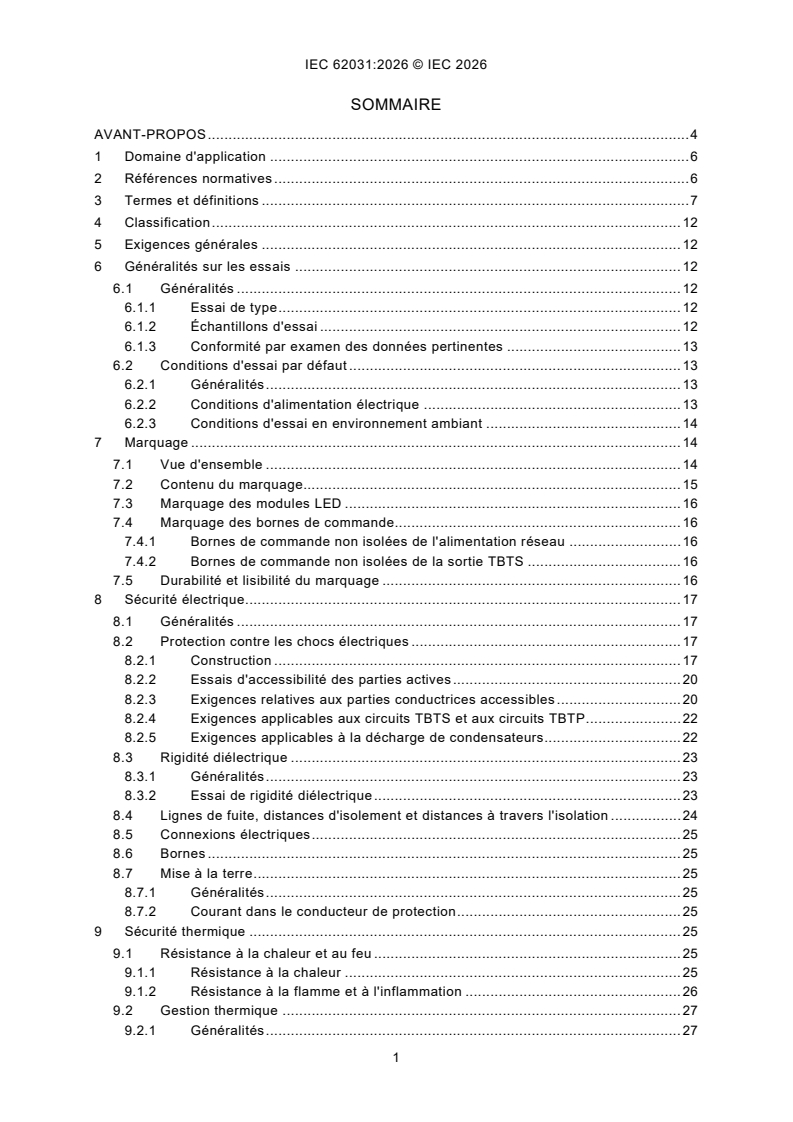
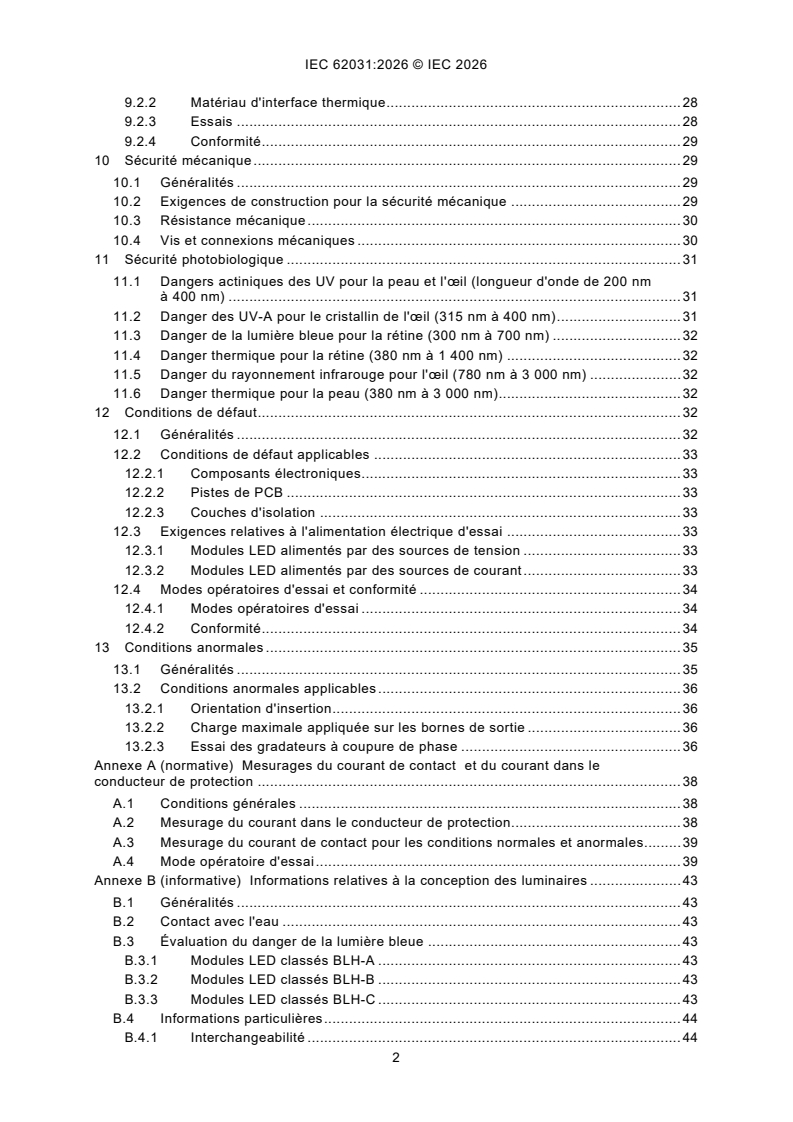
IEC 62031:2026 - Modules LED - Exigences de sécurité
IEC 62031:2026 - LED modules - Safety requirements
Overview
IEC 62031:2026 – LED Modules: Safety Requirements is an international standard developed by the International Electrotechnical Commission (IEC). It specifies comprehensive safety requirements for LED modules intended for operation on DC supplies up to 1,500 V and AC supplies up to 1,000 V. This standard is crucial for manufacturers, testing laboratories, and product designers working with LED technology to ensure product safety and regulatory compliance in a fast-growing market segment.
This third edition replaces the 2018 version with technical revisions for enhanced clarity, expanded safety requirements, and updates reflecting advancements in LED module technology. Importantly, the standard does not address performance characteristics or apply to LED packages, automotive LED modules, OLED modules, or complete LED lamps.
Key Topics
Scope & Applicability
- Applies to built-in LED modules for general lighting operating under specified voltage conditions.
- Excludes LED packages, automotive LED modules, OLED modules, and finished LED lamps.
Module Classification
- Integrated (LED module with built-in controlgear)
- Semi-integrated (some controlgear built in, separate power supply required)
- Non-integrated (external controlgear needed)
Safety Areas Covered
- Electrical Safety: Protection against electric shock, safe electrical design, insulation, and earthing requirements.
- Thermal Safety: Resistance to heat and flammability, and heat management to prevent hazardous temperatures in regular and fault conditions.
- Mechanical Safety: Constructional stability, mechanical strength, and durability of electrical connections.
- Photobiological Safety: Evaluation of ultraviolet (UV), blue light, and infrared radiation hazards to skin and eyes.
Testing and Compliance
- Specifies type testing to validate design compliance with safety requirements.
- Requirements for marking (including content, legibility, and durability), particularly regarding control terminals.
- Guidance for handling fault and abnormal conditions to prevent safety risks.
Definitions and Terminology
- Updated and clarified key terms for consistency and global understanding.
Applications
IEC 62031:2026 offers practical benefits in a wide range of industries and applications:
- Lighting Manufacturers: Ensures new and existing LED modules meet essential safety requirements, facilitating market access and product reliability.
- Product Designers/Engineers: Guides safer designs for luminaires, helping to integrate LED modules without compromising user or installer safety.
- Testing Laboratories: Provides a standardized framework for safety assessments and type-testing of LED modules.
- Compliance Officers: Supports regulatory conformity for products sold internationally by aligning with recognized best safety practices.
- Installers and Specifiers: Ensures that installed LED lighting systems are safe for end-users and compatible with other system components.
Adherence to this standard helps mitigate risks related to electric shock, fire, mechanical failure, and photobiological hazards, supporting safer lighting environments in commercial, residential, and industrial settings.
Related Standards
- IEC 60598-1:2024 – General requirements and tests for luminaires, including LED module integration.
- IEC 61347-1:2024 – Safety requirements for controlgear used with electric light sources.
- IEC 62471-7:2023 – Photobiological safety for visibly emitting light sources and luminaires.
- IEC 60990:2016 – Measurement of touch current and protective conductor current.
- IEC 60695 Series – Fire hazard testing methods relevant to heat and flame resistance.
- IEC 61032:1997 – Protection of persons and equipment by enclosures.
IEC 62031:2026 aligns with these and other referenced standards to ensure holistic safety in the design and application of LED modules.
Keywords: IEC 62031:2026, LED module safety, LED lighting standard, electrical safety, thermal safety, photobiological safety, international lighting standards, LED module compliance, type testing, LED controlgear, luminaire safety
Relations
- Effective Date
- 16-Feb-2024
Buy Documents
IEC 62031:2026 - LED modules - Safety requirements
IEC 62031:2026 - Modules LED - Exigences de sécurité
IEC 62031:2026 - LED modules - Safety requirements
Get Certified
Connect with accredited certification bodies for this standard

IMQ S.p.A. (Certification)
Italian electrical product certification.

SLG Prüf- und Zertifizierungs GmbH
German testing and certification body.

UL Solutions
Global safety science company with testing, inspection and certification.
Sponsored listings
Frequently Asked Questions
IEC 62031:2026 is a standard published by the International Electrotechnical Commission (IEC). Its full title is "LED modules - Safety requirements". This standard covers: IEC 62031:2026 specifies safety requirements for LED modules for operation on DC supplies up to 1 500 V or on AC supplies up to 1 000 V. This document does not include requirements for performance characteristics of LED modules. This document does not apply to: - LED packages; - LED modules for automotive lighting; - OLED modules; - LED lamps. This third edition cancels and replaces the second edition published in 2018. This edition constitutes a technical revision. This edition includes the following significant technical changes with respect to the previous edition: a) Complete review of the document structure, detailed technical requirements and tests, including but not limited to what is individually described under items b) to i); b) Clarification of the scope and revision of the applicability of this document to independent and integral LED modules; c) Updated terms and definitions; d) Clearer specification for clause general requirements and clause general test requirements; e) Update of the marking clause, such as marking of control terminals; f) A full review and update of the electrical safety, thermal safety, and mechanical safety requirements preventing misinterpretation and ambiguity; g) Updated photobiological safety requirements; h) Revised and updated fault conditions and abnormal conditions requirements; i) Removal of the annex relating to conformity testing during manufacture.
IEC 62031:2026 specifies safety requirements for LED modules for operation on DC supplies up to 1 500 V or on AC supplies up to 1 000 V. This document does not include requirements for performance characteristics of LED modules. This document does not apply to: - LED packages; - LED modules for automotive lighting; - OLED modules; - LED lamps. This third edition cancels and replaces the second edition published in 2018. This edition constitutes a technical revision. This edition includes the following significant technical changes with respect to the previous edition: a) Complete review of the document structure, detailed technical requirements and tests, including but not limited to what is individually described under items b) to i); b) Clarification of the scope and revision of the applicability of this document to independent and integral LED modules; c) Updated terms and definitions; d) Clearer specification for clause general requirements and clause general test requirements; e) Update of the marking clause, such as marking of control terminals; f) A full review and update of the electrical safety, thermal safety, and mechanical safety requirements preventing misinterpretation and ambiguity; g) Updated photobiological safety requirements; h) Revised and updated fault conditions and abnormal conditions requirements; i) Removal of the annex relating to conformity testing during manufacture.
IEC 62031:2026 is classified under the following ICS (International Classification for Standards) categories: 29.140.99 - Other standards related to lamps; 31.080.99 - Other semiconductor devices. The ICS classification helps identify the subject area and facilitates finding related standards.
IEC 62031:2026 has the following relationships with other standards: It is inter standard links to IEC 62031:2018. Understanding these relationships helps ensure you are using the most current and applicable version of the standard.
IEC 62031:2026 is available in PDF format for immediate download after purchase. The document can be added to your cart and obtained through the secure checkout process. Digital delivery ensures instant access to the complete standard document.
Standards Content (Sample)
IEC 62031 ®
Edition 3.0 2026-02
INTERNATIONAL
STANDARD
LED modules - Safety requirements
ICS 29.140.99; 31.080.99 ISBN 978-2-8327-1079-1
All rights reserved. Unless otherwise specified, no part of this publication may be reproduced or utilized in any form or
by any means, electronic or mechanical, including photocopying and microfilm, without permission in writing from either
IEC or IEC's member National Committee in the country of the requester. If you have any questions about IEC copyright
or have an enquiry about obtaining additional rights to this publication, please contact the address below or your local
IEC member National Committee for further information.
IEC Secretariat Tel.: +41 22 919 02 11
3, rue de Varembé info@iec.ch
CH-1211 Geneva 20 www.iec.ch
Switzerland
About the IEC
The International Electrotechnical Commission (IEC) is the leading global organization that prepares and publishes
International Standards for all electrical, electronic and related technologies.
About IEC publications
The technical content of IEC publications is kept under constant review by the IEC. Please make sure that you have the
latest edition, a corrigendum or an amendment might have been published.
IEC publications search - IEC Products & Services Portal - products.iec.ch
webstore.iec.ch/advsearchform Discover our powerful search engine and read freely all the
The advanced search enables to find IEC publications by a publications previews, graphical symbols and the glossary.
variety of criteria (reference number, text, technical With a subscription you will always have access to up to date
committee, …). It also gives information on projects, content tailored to your needs.
replaced and withdrawn publications.
Electropedia - www.electropedia.org
The world's leading online dictionary on electrotechnology,
IEC Just Published - webstore.iec.ch/justpublished
Stay up to date on all new IEC publications. Just Published containing more than 22 500 terminological entries in English
details all new publications released. Available online and and French, with equivalent terms in 25 additional languages.
once a month by email. Also known as the International Electrotechnical Vocabulary
(IEV) online.
IEC Customer Service Centre - webstore.iec.ch/csc
If you wish to give us your feedback on this publication or
need further assistance, please contact the Customer
Service Centre: sales@iec.ch.
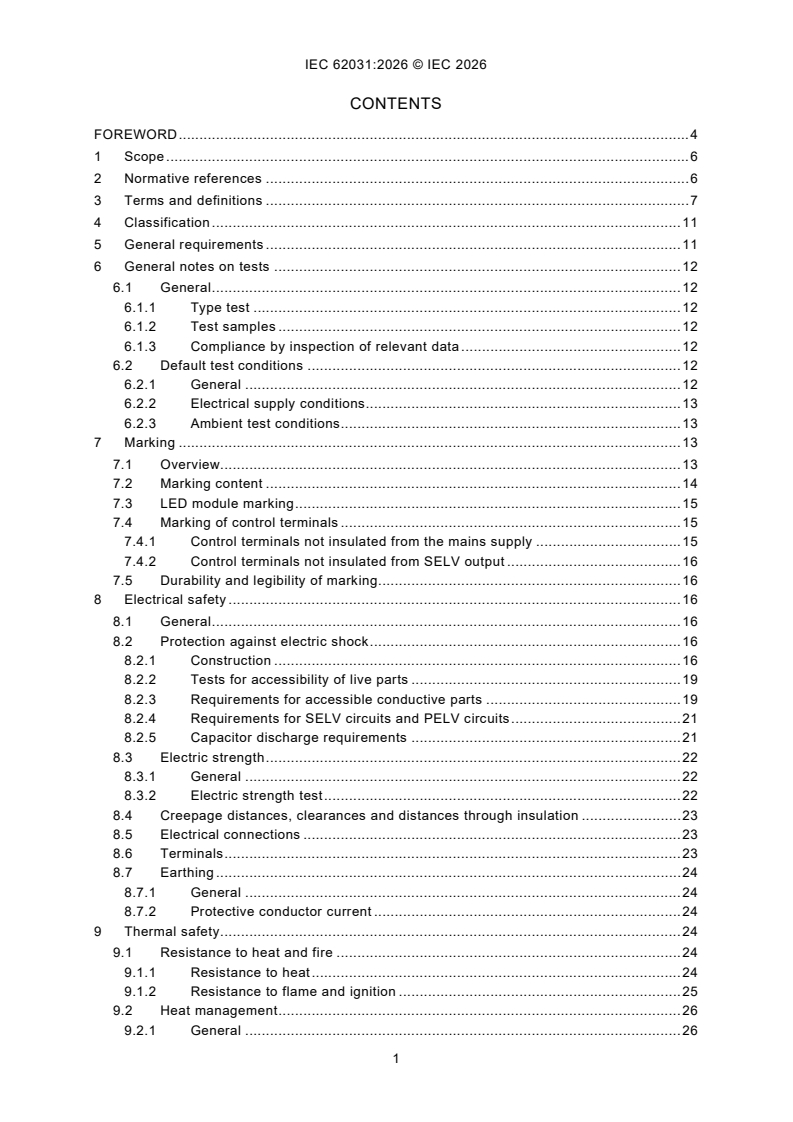
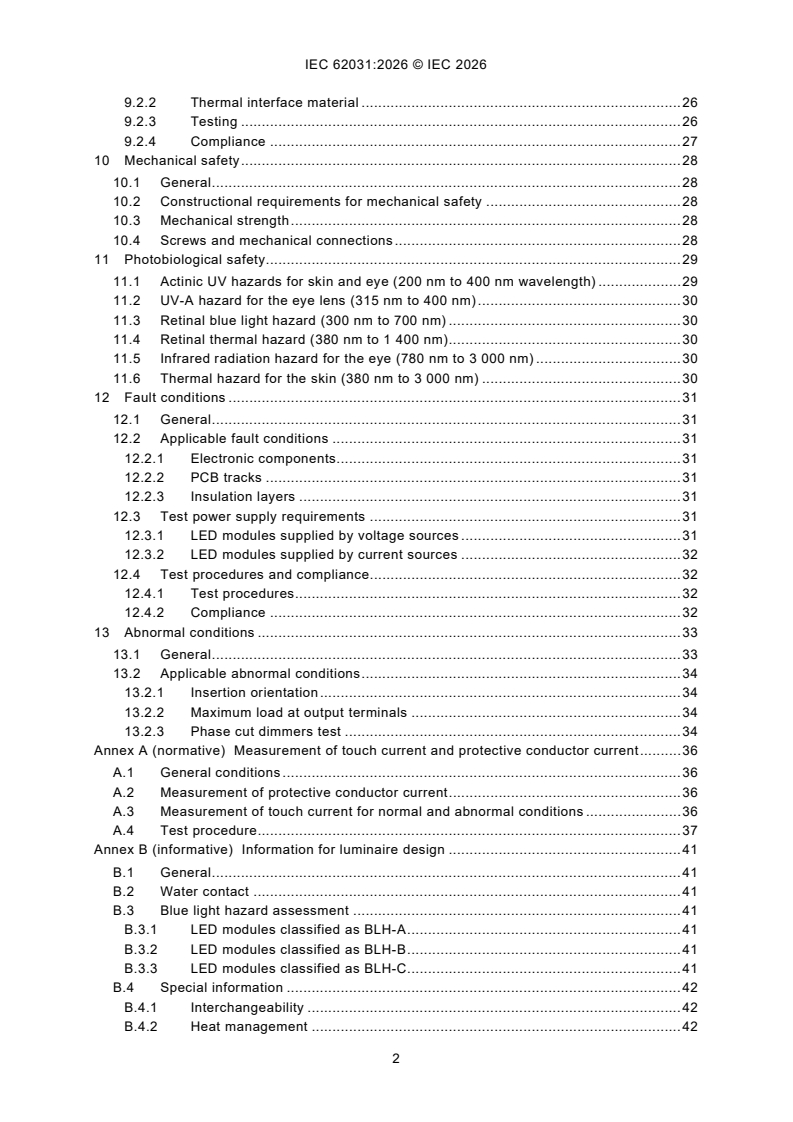
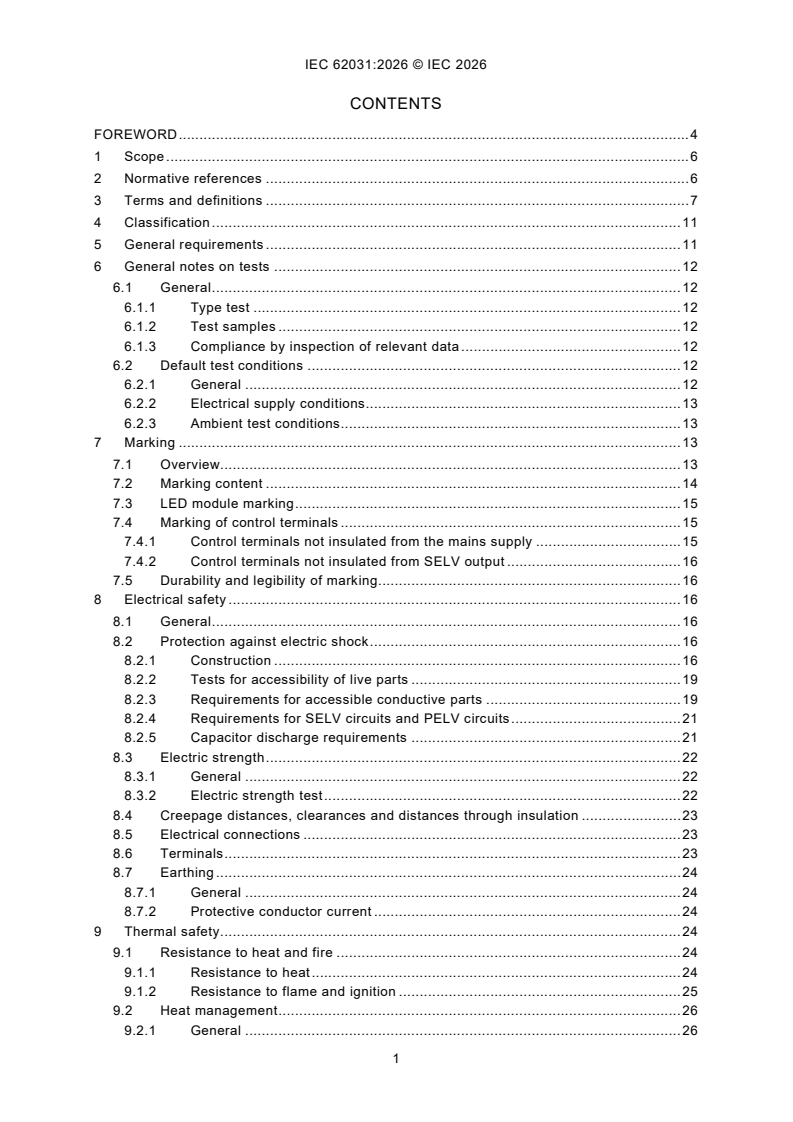
CONTENTS
FOREWORD . 4
1 Scope . 6
2 Normative references . 6
3 Terms and definitions . 7
4 Classification . 11
5 General requirements . 11
6 General notes on tests . 12
6.1 General . 12
6.1.1 Type test . 12
6.1.2 Test samples . 12
6.1.3 Compliance by inspection of relevant data . 12
6.2 Default test conditions . 12
6.2.1 General . 12
6.2.2 Electrical supply conditions . 13
6.2.3 Ambient test conditions . 13
7 Marking . 13
7.1 Overview. 13
7.2 Marking content . 14
7.3 LED module marking . 15
7.4 Marking of control terminals . 15
7.4.1 Control terminals not insulated from the mains supply . 15
7.4.2 Control terminals not insulated from SELV output . 16
7.5 Durability and legibility of marking . 16
8 Electrical safety . 16
8.1 General . 16
8.2 Protection against electric shock . 16
8.2.1 Construction . 16
8.2.2 Tests for accessibility of live parts . 19
8.2.3 Requirements for accessible conductive parts . 19
8.2.4 Requirements for SELV circuits and PELV circuits . 21
8.2.5 Capacitor discharge requirements . 21
8.3 Electric strength . 22
8.3.1 General . 22
8.3.2 Electric strength test . 22
8.4 Creepage distances, clearances and distances through insulation . 23
8.5 Electrical connections . 23
8.6 Terminals . 23
8.7 Earthing . 24
8.7.1 General . 24
8.7.2 Protective conductor current . 24
9 Thermal safety . 24
9.1 Resistance to heat and fire . 24
9.1.1 Resistance to heat . 24
9.1.2 Resistance to flame and ignition . 25
9.2 Heat management . 26
9.2.1 General . 26
9.2.2 Thermal interface material . 26
9.2.3 Testing . 26
9.2.4 Compliance . 27
10 Mechanical safety . 28
10.1 General . 28
10.2 Constructional requirements for mechanical safety . 28
10.3 Mechanical strength . 28
10.4 Screws and mechanical connections . 28
11 Photobiological safety . 29
11.1 Actinic UV hazards for skin and eye (200 nm to 400 nm wavelength) . 29
11.2 UV-A hazard for the eye lens (315 nm to 400 nm) . 30
11.3 Retinal blue light hazard (300 nm to 700 nm) . 30
11.4 Retinal thermal hazard (380 nm to 1 400 nm) . 30
11.5 Infrared radiation hazard for the eye (780 nm to 3 000 nm) . 30
11.6 Thermal hazard for the skin (380 nm to 3 000 nm) . 30
12 Fault conditions . 31
12.1 General . 31
12.2 Applicable fault conditions . 31
12.2.1 Electronic components. 31
12.2.2 PCB tracks . 31
12.2.3 Insulation layers . 31
12.3 Test power supply requirements . 31
12.3.1 LED modules supplied by voltage sources . 31
12.3.2 LED modules supplied by current sources . 32
12.4 Test procedures and compliance . 32
12.4.1 Test procedures . 32
12.4.2 Compliance . 32
13 Abnormal conditions . 33
13.1 General . 33
13.2 Applicable abnormal conditions . 34
13.2.1 Insertion orientation . 34
13.2.2 Maximum load at output terminals . 34
13.2.3 Phase cut dimmers test . 34
Annex A (normative) Measurement of touch current and protective conductor current . 36
A.1 General conditions . 36
A.2 Measurement of protective conductor current . 36
A.3 Measurement of touch current for normal and abnormal conditions . 36
A.4 Test procedure . 37
Annex B (informative) Information for luminaire design . 41
B.1 General . 41
B.2 Water contact . 41
B.3 Blue light hazard assessment . 41
B.3.1 LED modules classified as BLH-A . 41
B.3.2 LED modules classified as BLH-B . 41
B.3.3 LED modules classified as BLH-C . 41
B.4 Special information . 42
B.4.1 Interchangeability . 42
B.4.2 Heat management . 42
B.4.3 Working voltage . 44
B.4.4 LED module protection against electric shock . 44
B.4.5 Controlgear output current . 44
Annex C (informative) Information for controlgear design . 45
Bibliography . 46
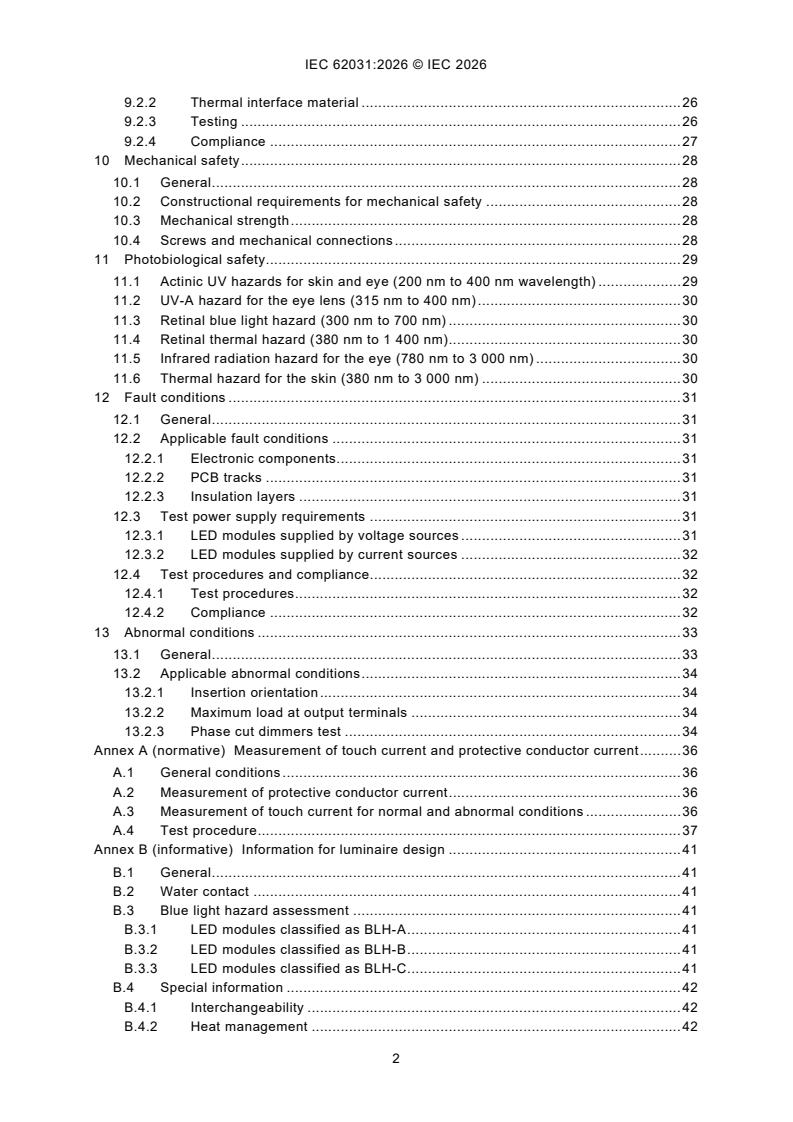
Figure 1 – Caution, risk of electric shock . 15
Figure 2 – Ball-pressure test apparatus . 24
Figure 3 – Abnormal temperature test set-up . 27
Figure 4 – Test circuit . 35
Figure A.1 – Test circuit: single-phase equipment on star TN or TT system . 38
Figure A.2 – Measuring network, touch current weighted for perception or reaction . 39
Figure A.3 – Test circuit including measuring network weighted for high frequency, to
measure protective conductor current . 39
Figure A.4 – Test circuit for touch currents between different accessible parts . 40
Figure B.1 – Diagrammatic cross section of an LED module fixed by means of a holder
for LED modules to a luminaire . 43
Table 1 – Overview on marking provisions . 14
Table 2 – Required number and type of Y capacitors . 18
Table 3 – Touch voltage limits . 20
Table 4 – Reduced touch voltage limits . 20
Table 5 – Touch current limits . 20
Table 6 – Electric strength test voltage . 23
Table 7 – Torque tests on screws . 29
Table A.1 – Position of switches n and p for the measurement . 38
INTERNATIONAL ELECTROTECHNICAL COMMISSION
____________
LED modules - Safety requirements
FOREWORD
1) The International Electrotechnical Commission (IEC) is a worldwide organization for standardization comprising
all national electrotechnical committees (IEC National Committees). The object of IEC is to promote international
co-operation on all questions concerning standardization in the electrical and electronic fields. To this end and
in addition to other activities, IEC publishes International Standards, Technical Specifications, Technical Reports,
Publicly Available Specifications (PAS) and Guides (hereafter referred to as "IEC Publication(s)"). Their
preparation is entrusted to technical committees; any IEC National Committee interested in the subject dealt with
may participate in this preparatory work. International, governmental and non-governmental organizations liaising
with the IEC also participate in this preparation. IEC collaborates closely with the International Organization for
Standardization (ISO) in accordance with conditions determined by agreement between the two organizations.
2) The formal decisions or agreements of IEC on technical matters express, as nearly as possible, an international
consensus of opinion on the relevant subjects since each technical committee has representation from all
interested IEC National Committees.
3) IEC Publications have the form of recommendations for international use and are accepted by IEC National
Committees in that sense. While all reasonable efforts are made to ensure that the technical content of IEC
Publications is accurate, IEC cannot be held responsible for the way in which they are used or for any
misinterpretation by any end user.
4) In order to promote international uniformity, IEC National Committees undertake to apply IEC Publications
transparently to the maximum extent possible in their national and regional publications. Any divergence between
any IEC Publication and the corresponding national or regional publication shall be clearly indicated in the latter.
5) IEC itself does not provide any attestation of conformity. Independent certification bodies provide conformity
assessment services and, in some areas, access to IEC marks of conformity. IEC is not responsible for any
services carried out by independent certification bodies.
6) All users should ensure that they have the latest edition of this publication.
7) No liability shall attach to IEC or its directors, employees, servants or agents including individual experts and
members of its technical committees and IEC National Committees for any personal injury, property damage or
other damage of any nature whatsoever, whether direct or indirect, or for costs (including legal fees) and
expenses arising out of the publication, use of, or reliance upon, this IEC Publication or any other IEC
Publications.
8) Attention is drawn to the Normative references cited in this publication. Use of the referenced publications is
indispensable for the correct application of this publication.
9) IEC draws attention to the possibility that the implementation of this document may involve the use of (a)
patent(s). IEC takes no position concerning the evidence, validity or applicability of any claimed patent rights in
respect thereof. As of the date of publication of this document, IEC had not received notice of (a) patent(s), which
may be required to implement this document. However, implementers are cautioned that this may not represent
the latest information, which may be obtained from the patent database available at https://patents.iec.ch. IEC
shall not be held responsible for identifying any or all such patent rights.
IEC 62031 has been prepared by subcommittee 34A: Electric light sources, of IEC technical
committee 34: Lighting. It is an International Standard.
This third edition cancels and replaces the second edition published in 2018. This edition
constitutes a technical revision.
This edition includes the following significant technical changes with respect to the previous
edition:
a) Complete review of the document structure, detailed technical requirements and tests,
including but not limited to what is individually described under items b) to i);
b) Clarification of the scope and revision of the applicability of this document to independent
and integral LED modules;
c) Updated terms and definitions;
d) Clearer specification for clause general requirements and clause general test requirements;
e) Update of the marking clause, such as marking of control terminals;
f) A full review and update of the electrical safety, thermal safety, and mechanical safety
requirements preventing misinterpretation and ambiguity;
g) Updated photobiological safety requirements;
h) Revised and updated fault conditions and abnormal conditions requirements;
i) Removal of the annex relating to conformity testing during manufacture.
The text of this International Standard is based on the following documents:
Draft Report on voting
34A/2464/FDIS 34A/2467/RVD
Full information on the voting for its approval can be found in the report on voting indicated in
the above table.
The language used for the development of this International Standard is English.
This document was drafted in accordance with ISO/IEC Directives, Part 2, and developed in
accordance with ISO/IEC Directives, Part 1 and ISO/IEC Directives, IEC Supplement, available
at www.iec.ch/members_experts/refdocs. The main document types developed by IEC are
described in greater detail at www.iec.ch/publications.
The committee has decided that the contents of this document will remain unchanged until the
stability date indicated on the IEC website under webstore.iec.ch in the data related to the
specific document. At this date, the document will be
– reconfirmed,
– withdrawn, or
– revised.
1 Scope
This document specifies safety requirements for LED modules for operation on DC supplies up
to 1 500 V or on AC supplies up to 1 000 V. This document does not include requirements for
performance characteristics of LED modules.
This document does not apply to:
– LED packages;
– LED modules for automotive lighting;
– OLED modules;
– LED lamps.
NOTE 1 Products that were designated as "independent LED modules" in the previous edition of IEC 62031 are
considered luminaires which comprise LED module(s) as an integral component.
NOTE 2 Requirements for LED modules that are an integral component of the luminaire are specified in
IEC 60598-1:2024. IEC 60598-1:2024, 4.3.1, makes reference back to this document as far as reasonable.
NOTE 3 Where the word "LED module" is used in this document, it is understood to be "built-in LED module".
2 Normative references
The following documents are referred to in the text in such a way that some or all of their content
constitutes requirements of this document. For dated references, only the edition cited applies.
For undated references, the latest edition of the referenced document (including any
amendments) applies.
IEC 60384-14:2023, Fixed capacitors for use in electronic equipment - Part 14: Sectional
specification - Fixed capacitors for electromagnetic interference suppression and connection to
the supply mains
IEC 60384-14:2023/AMD1:2025
IEC 60417, Graphical symbols for use on equipment, available at http://www.graphical-
symbols.info/equipment
IEC 60598-1:2024, Luminaires - Part 1: General requirements and tests
IEC 60695-2-10:2021, Fire hazard testing - Part 2-10: Glowing/hot-wire based test methods -
Glow-wire apparatus and common test procedure
IEC 60695-2-11:2021, Fire hazard testing - Part 2-11: Glowing/hot-wire based test methods -
Glow-wire flammability test method for end products (GWEPT)
IEC 60695-11-5:2016, Fire hazard testing - Part 11-5: Test flames - Needle-flame test method -
Apparatus, confirmatory test arrangement and guidance
IEC 60990:2016, Methods of measurement of touch current and protective conductor current
IEC 61032:1997, Protection of persons and equipment by enclosures - Probes for verification
IEC 61347-1:2024, Controlgear for electric light sources - Safety - Part 1: General requirements
IEC 61189-2:2006, Test methods for electrical materials, printed boards and other
interconnection structures and assemblies - Part 2: Test methods for materials for
interconnection structures
IEC 61249-2 (all parts), Materials for printed boards and other interconnecting structures -
Part 2: Reinforced base materials, clad and unclad
IEC 62368-1:2023, Audio/video, information and communication technology equipment - Part 1:
Safety requirements
IEC 62471-7:2023, Photobiological safety of lamps and lamp systems - Part 7: Light sources
and luminaires primarily emitting visible radiation
ISO 4046-4:2016, Paper, board, pulp and related terms - Vocabulary - Part 4: Paper and board
grades and converted products
ISO 7089:2000, Plain washers - Normal series - Product grade A
3 Terms and definitions
For the purposes of this document, the following terms and definitions apply.
ISO and IEC maintain terminology databases for use in standardization at the following
addresses:
– IEC Electropedia: available at https://www.electropedia.org/
– ISO Online browsing platform: available at https://www.iso.org/obp
3.1
ultraviolet hazard efficacy of luminous radiation
K
S,v
quotient of an ultraviolet hazard quantity by the corresponding photometric quantity
E
S
K =
S,v
E
v
where
−2
E is the effective actinic irradiance in W · m and
S
−2
E is the illuminance in lx = lm · m
v
−3 −2 −6 −1 −1
EXAMPLE With E = 10 W · m and E = 500 lx follows K = 2 · 10 W · lm = 2 mW · klm .
S v S,v
-1
Note 1 to entry: Ultraviolet hazard efficacy of luminous radiation is expressed in watt per lumen (W · lm ), possibly
−1
with a metric prefix (here mW · klm ).
Note 2 to entry: The ultraviolet hazard efficacy of luminous radiation is obtained by weighting the spectral power
distribution of the lamp or LED module with the UV hazard function S (λ). Information about the relevant UV hazard
UV
function is given in IEC 62471:2006. It only relates to possible hazards regarding UV exposure of human beings. It
does not deal with the possible influence of optical radiation on materials, such as mechanical damage or
discoloration.
[SOURCE: IEC 62471-7:2023, 3.17]
3.2
replaceable LED module
LED module designed to be replaced by an ordinary person or a skilled person
Note 1 to entry: When incorporated into a luminaire, a replaceable LED module can be classified as replaceable,
non-user replaceable or non-replaceable depending on the luminaire design.
3.3
non-user replaceable LED module
LED module designed to be replaced only by the manufacturer, its service agent, or similar
skilled person
Note 1 to entry: When incorporated into a luminaire a non-user replaceable LED module can become classified as
non-replaceable due to the luminaire design.
3.4
integrated LED module
LEDi module
LED module, incorporating controlgear and any additional elements necessary for stable
operation of the light source, designed for direct connection to the mains
[SOURCE: IEC 60050-845:2020, 845-27-059, modified – "supply voltage" replaced by "mains".]
3.5
semi-integrated LED module
LEDsi module
LED module that carries the control unit of the controlgear, and is operated by the separated
power supply of the controlgear
Note 1 to entry: The term control unit is specified in IEC 60050-845:2020, 845-28-057.
[SOURCE: IEC 60050-845:2020, 845-27-060, modified – the term “control gear” spelled as one
word, “controlgear” and Note 1 to entry added.]
3.6
non-integrated LED module
LEDni module
LED module which needs a separate control circuitry or controlgear to operate
[SOURCE: IEC 60050-845:2020, 845-27-061 – the term “control gear” spelled as one word,
“controlgear”, and Note 1 to entry deleted.]
3.7
rated value
declared value of a quantity, used for specification purposes and established
under standard test conditions
Note 1 to entry: To express the "rated value" of a particular quantity, the term "value" is replaced by the quantity
name; for example, rated power, rated voltage, rated current, and rated temperature.
Note 2 to entry: The standard test conditions are given in this document.
[SOURCE: IEC 60050-845:2020, 845-27-100, modified – The specific use
related equipment> changed to and the wording “declared by the
manufacturer or responsible vendor” deleted from the definition.]
3.8
type test
test or series of tests for the purpose of checking compliance of the design of a given product
with the requirements of the relevant standard
3.9
type test sample
sample consisting of one or more similar units being representative of the production for the
purpose of the type test
3.10
t -point
c
designated location on the surface of the LED module for measuring t
c
3.11
rated surface temperature
t
c
declared highest permissible temperature at the t -point
c
3.12
thermal power
P
d
power to be transferred from an LED module to the luminaire by means of heat conduction
Note 1 to entry: Thermal power is expressed in Watt (W).
Note 2 to entry: P is below the rated power of an LED module.
d
Note 3 to entry: For LED modules which do not require heat conduction to the luminaire, P is equal to zero.
d
3.13
terminal
conductive part of an LED module, provided for connecting that LED module to one or more
external conductors
[SOURCE: IEC 60050-151:2001, 151-12-12, modified – "device, electric circuit or electric
network" has been replaced by "LED module" and the Note has been deleted.]
3.14
mains
AC or DC power distribution system that supplies operating power to electrical equipment
Note 1 to entry: Mains include public or private utilities and, unless otherwise specified in this document, equivalent
sources such as motor-driven generators and uninterruptible power supplies.
3.15
interrupted DC
DC signal changing between zero and a certain level with a certain frequency, where the time
of the signal being at the certain level can vary within one period
Note 1 to entry: The abbreviated form of direct current "DC" is used to avoid confusion when used in combination
with "voltage" and "current" signal (e.g. interrupted DC voltage).
[SOURCE: IEC 61347-1:2024, 3.39]
3.16
live part
conductive part intended to be energized under normal operating conditions, including the
neutral conductor and mid-point conductor, but excluding the PEN conductor, PEM conductor
and PEL conductor
Note 1 to entry: PEN conductor, PEM conductor and PEL conductor are defined in IEC 60050-195:2021, 195-02-12,
195-02-13 and 195-02-14.
Note 2 to entry: This concept does not necessarily imply a risk of electric shock.
[SOURCE: IEC 60050-195:2021, 195-02-19, modified – The domain has been omitted, and
Note 1 and Note 2 to entry added.]
3.17
hazardous-live-part
live part that, under certain conditions, can give a harmful electric shock
Note 1 to entry: The neutral conductor is always regarded as a hazardous live part.
[SOURCE: IEC 60050-195:2021, 195-06-05, modified – Note 1 to entry has been replaced with
the new Note 1 to entry.]
3.18
pulse width modulation control
PWM control
pulse control in which the pulse width or frequency or both are modulated within each
fundamental period to produce a certain output waveform
[SOURCE: IEC 60050-551:1998, 551-16-30]
3.19
working voltage
highest RMS voltage across any insulation at any rated electrical supply conditions, transients
being neglected, under normal and under abnormal conditions
Note 1 to entry: The rated electrical supply conditions can be the rated voltage, the rated current or a rated supply
voltage range or rated supply current range.
3.20
extra-low voltage
ELV
voltage which does not exceed 50 V AC or 120 V ripple-free DC between conductors or between
any conductor and earth
Note 1 to entry: Ripple-free is conventionally defined as an RMS ripple voltage of not more than 10 % of the DC
component.
Note 2 to entry: Extra-low voltage (ELV) is part of the low-voltage (LV) band, see IEC 61140:2016, 4.2 and
IEC 61140:2016, Table 1.
3.21
SELV circuit
electric circuit in which the voltage cannot exceed the value of extra-low voltage:
– under normal conditions
– under abnormal operating conditions and
– under single fault conditions, including earth faults in other electric circuits
Note 1 to entry: SELV is the abbreviation for safety extra-low voltage.
[SOURCE: IEC 61140:2016, 3.26.1, modified – "system" replaced by "circuit"; added "under
abnormal operating conditions".]
3.22
PELV circuit
electric circuit in which the voltage cannot exceed the value of extra-low voltage:
– under normal conditions
– under abnormal operating conditions and
– under single fault conditions, except earth faults in other electric circuits
Note 1 to entry: PELV is the abbreviation for protective extra-low voltage.
[SOURCE: IEC 61140:2016, 3.26.2, modified – "system" replaced by "circuit"; added "under
abnormal operating conditions".]
3.23
FELV circuit
ELV circuit having the ELV voltage for functional reasons and not fulfilling the requirements for
SELV or PELV
Note 1 to entry: FELV is the abbreviation for functional extra-low voltage.
Note 2 to entry: A FELV circuit is not safe to touch and may be connected to protective earth.
[SOURCE: IEC 61558-1:2017, 3.7.19, modified – Note 1 to entry and Note 2 to entry added,
alternative term "functional extra low voltage-circuit" deleted.]
3.24
sample
one or more sampling items intended to provide information on the population or on the material
[SOURCE: IEC 60050-151:2001, 151-16-19]
3.25
sample item
one of the individual items in a population of similar items, or a portion of material forming a
cohesive entity and taken from one place and at one time
[SOURCE: IEC 60050-151:2001, 151-16-18]
4 Classification
LED modules are classified, according to the level of controlgear integration, as:
– integrated LED modules, LEDi module,
– semi-integrated LED modules, LEDsi module, or
– non-integrated LED modules, LEDni module.
5 General requirements
LED modules shall be so designed and constructed that, for their intended use, they cause no
danger to the users or surroundings.
Parts of LED modules providing hazard protection shall not become loose during normal
operation and handling.
Requirements, tests and compliances are provided in this document to reduce the risk of harm
to a tolerable level under normal operating conditions, abnormal operating conditions and single
fault conditions.
Where the terms "voltage" and "current" are used in this document, they imply the RMS values
unless otherwise stated.
Annex B and Annex C provide information for luminaire design and information for controlgear
design, respectively.
6 General notes on tests
6.1 General
6.1.1 Type test
Tests according to this document are type tests.
NOTE The requirements and tolerances specified in this document are related to testing of a type test sample
submitted by e.g. the manufacturer for that purpose. Compliance of type test samples does not ensure compliance
of the whole production of a manufacturer with this document. Conformity of production is the responsibility of the
manufacturer, and routine tests and quality insurance in addition to the type test can be necessary.
6.1.2 Test samples
Tests shall be carried out with type test samples.
NOTE 1 For example, damage to marking as a result of the marking test has no impact on electrical testing, thus
the LED module is still considered to be representative of production for other tests.
Unless otherwise specified in this document, the type test shall be carried out on one sample
consisting of one or more sample items submitted for the purpose of the type test.
All tests shall be carried out on each type of the LED module. Where there is a range of similar
LED modules for testing, samples representing the most onerous case within the range shall
be selected as relevant to the test criteria.
NOTE 2 As an example, it is not necessary to carry out overload condition tests separately on LED modules of one
type having different colour temperatures.
NOTE 3 It can be helpful to contact the manufacturer for information on a range of similar LED modules.
LED modules shall not be altered for the purposes of testing where the results of the tests could
be affected. Specially prepared sample items may be used, where necessary.
6.1.3 Compliance by inspection of relevant data
Where in this document compliance of materials, components or subassemblies is checked by
inspection or by testing of properties, compliance may be confirmed by reviewing any relevant
data or previous test results that are available.
6.2 Default test conditions
6.2.1 General
Unless otherwise specified in this document, the tests shall be conducted under the most
onerous operating conditions within the specified operating range. In addition to 6.2.2 and 6.2.3
the following parameters shall be taken into account:
– operating mode, including loading by external connected equipment;
– control settings and dimming conditions;
– position of movable parts;
– orientation.
NOTE It can be helpful to contact the manufacturer for information on the most onerous test conditions.
6.2.2 Electrical supply conditions
6.2.2.1 General
The supply voltage, current and frequency shall be stabilized within ± 1 % of the specified test
value. The peak-to-peak ripple of the DC test current or voltage shall not exceed 10 % of the
average value of the test current or voltage.
6.2.2.2 LED modules supplied by voltage sources
LED modules supplied by voltage sources usually comprise means to adjust their operating
current so they can be supplied by a voltage source that, ideally, has no impedance.
EXAMPLE 1 Mains supplied integrated LED modules (LEDi modules) and semi-integrated LED modules (LEDsi
modules).
Tests shall be carried out at the rated voltage, or at the most onerous value within the boundary
of rated voltage range, if not otherwise specified in this document.
For LED modules having alternative rated voltages or voltage ranges, tests shall be carried out
separately for each rated voltage or voltage range.
For AC rated LED modules, tests shall be carried out at the most onerous rated frequency.
For LED modules rated for both AC and DC, each test shall be carried out with the most onerous
voltage source condition.
Where LED modules are intended for operation on a battery supply, a DC power source may
supply the LED module under test, provided that the source impedance is equivalent to that of
a battery.
EXAMPLE 2 A non-inductive capacitor of appropriate rated voltage and with a capacitance of at least 50 μF
connected across the supply terminals of the units under test normally provides a source impedance simulating that
of a battery.
6.2.2.3 LED modules supplied by current sources
LED modules supplied by current sources usually do not comprise means to adjust their
operating current, the operating voltage of such LED modules results from the design and the
operating current.
EXAMPLE Non-integrated LED module (LEDni module).
Tests shall be carried out at the maximum rated current.
6.2.3 Ambient test conditions
Tests shall be carried out at an ambient temperature within the range of 10 °C to 30 °C unless
otherwise specified in this document.
7 Marking
7.1 Overview
The requirements of 7.2, 7.3, 7.4 and 7.5 apply. Table 1 gives an overview for information.
Table 1 – Overview on marking provisions
Entry according to 7.2 On LED module On data In technical
sheet literature
a) Mark of origin R
b) Model number or type reference R
c) Rated supply voltage X X X
d) Rated supply current X X X
e) Rated supply frequency X X X
f) Rated power X X X
g) Connections X X X
h) t and the t -point X X X
c c
i) Blue light hazard X X X
j) Thermal power P X X X
d
k) Working voltage and type of insulation as applicable X X X
l) Protection against electric shock X X X
m) SELV or PELV supplied only X X X
n) Isolating or separating controlgear only X X X
o) Non-user replaceable X X X
p) Output terminals X X X
Key
R required
X at least one of the three required (i.e. marking is on at least one of the following: LED module, data sheet, or
technical literature).
7.2 Marking content
The following marking information of LED modules shall be given:
a) Mark of origin (this may take the form of a trademark, the manufacturer's identification mark
or the name of the responsible vendor).
b) Model number or type reference.
c) Rated supply voltage(s) or the rated supply voltage range, if the LED module requires a
stable supply voltage, if applicable.
d) Rated supply current(s) or the rated supply current range, if the LED module requires a
stable supply current, if applicable.
e) Type of supply ("AC", "DC", or both) and the AC frequency or frequency range if applicable.
Symbols according to IEC 60417-5031:2002-10, IEC 60417-5032:2002-10,
IEC 60417-5033:2002-10 may be used.
f) Rated power.
g) Indication of position and purpose of the connections or connecting wires. In case of
connecting wires, this information shall be given in a wiring diagram. For LED modules
provided with a protective earthing termination, a statement that operation of the LED
module without connection to protective earth is permitted, if applicable.
h) Rated surface temperature t and the t -point.
c c
i) Blue light hazard radiance value or the corresponding application group (BLH-A, BLH-B or
BLH-C) according to Table 2 of IEC 62471-7:2023.
j) The thermal power P (for replaceable LED modules, except for non-user replaceable LED
d
modules). If P is not known exactly, the rated power of the LED module may be taken
d
instead, if applicable.
k) Working voltage at which the insulation between live parts of the LED module and parts of
the LED module that can come in contact with parts of a luminaire or which can be touched
when mounted in a luminaire is designed together with the type of the insulation.
NOTE 1 The type of insulation can be basic insulation, supplementary insulation, double or reinforced
insulation.
NOTE 2 Parts of the LED module designed as insulation barriers to a luminaire include insulation barriers
between live parts of the LED module and the mounting surface of the LED module or the parts of the LED
module designed to be touchable when mounted in the luminaire.
l) Information that the LED module relies upon
...
IEC 62031 ®
Edition 3.0 2026-02
NORME
INTERNATIONALE
Modules LED - Exigences de sécurité
ICS 29.140.99; 31.080.99 ISBN 978-2-8327-1079-1
Droits de reproduction réservés. Sauf indication contraire, aucune partie de cette publication ne peut être reproduite ni
utilisée sous quelque forme que ce soit et par aucun procédé, électronique ou mécanique, y compris la photocopie et
les microfilms, sans l'accord écrit de l'IEC ou du Comité national de l'IEC du pays du demandeur. Si vous avez des
questions sur le copyright de l'IEC ou si vous désirez obtenir des droits supplémentaires sur cette publication, utilisez
les coordonnées ci-après ou contactez le Comité national de l'IEC de votre pays de résidence.
IEC Secretariat Tel.: +41 22 919 02 11
3, rue de Varembé info@iec.ch
CH-1211 Geneva 20 www.iec.ch
Switzerland
A propos de l'IEC
La Commission Electrotechnique Internationale (IEC) est la première organisation mondiale qui élabore et publie des
Normes internationales pour tout ce qui a trait à l'électricité, à l'électronique et aux technologies apparentées.
A propos des publications IEC
Le contenu technique des publications IEC est constamment revu. Veuillez vous assurer que vous possédez l’édition la
plus récente, un corrigendum ou amendement peut avoir été publié.
Recherche de publications IEC - IEC Products & Services Portal - products.iec.ch
webstore.iec.ch/advsearchform Découvrez notre puissant moteur de recherche et consultez
La recherche avancée permet de trouver des publications gratuitement tous les aperçus des publications, symboles
IEC en utilisant différents critères (numéro de référence, graphiques et le glossaire. Avec un abonnement, vous aurez
texte, comité d’études, …). Elle donne aussi des toujours accès à un contenu à jour adapté à vos besoins.
informations sur les projets et les publications remplacées
ou retirées. Electropedia - www.electropedia.org
Le premier dictionnaire d'électrotechnologie en ligne au
IEC Just Published - webstore.iec.ch/justpublished monde, avec plus de 22 500 articles terminologiques en
Restez informé sur les nouvelles publications IEC. Just anglais et en français, ainsi que les termes équivalents
dans 25 langues additionnelles. Egalement appelé
Published détaille les nouvelles publications parues.
Disponible en ligne et une fois par mois par email. Vocabulaire Electrotechnique International (IEV) en ligne.
Service Clients - webstore.iec.ch/csc
Si vous désirez nous donner des commentaires sur cette
publication ou si vous avez des questions contactez-
nous: sales@iec.ch.
SOMMAIRE
AVANT-PROPOS . 4
1 Domaine d'application . 6
2 Références normatives . 6
3 Termes et définitions . 7
4 Classification . 12
5 Exigences générales . 12
6 Généralités sur les essais . 12
6.1 Généralités . 12
6.1.1 Essai de type . 12
6.1.2 Échantillons d'essai . 12
6.1.3 Conformité par examen des données pertinentes . 13
6.2 Conditions d'essai par défaut . 13
6.2.1 Généralités . 13
6.2.2 Conditions d'alimentation électrique . 13
6.2.3 Conditions d'essai en environnement ambiant . 14
7 Marquage . 14
7.1 Vue d'ensemble . 14
7.2 Contenu du marquage. 15
7.3 Marquage des modules LED . 16
7.4 Marquage des bornes de commande. 16
7.4.1 Bornes de commande non isolées de l'alimentation réseau . 16
7.4.2 Bornes de commande non isolées de la sortie TBTS . 16
7.5 Durabilité et lisibilité du marquage . 16
8 Sécurité électrique. 17
8.1 Généralités . 17
8.2 Protection contre les chocs électriques . 17
8.2.1 Construction . 17
8.2.2 Essais d'accessibilité des parties actives . 20
8.2.3 Exigences relatives aux parties conductrices accessibles . 20
8.2.4 Exigences applicables aux circuits TBTS et aux circuits TBTP . 22
8.2.5 Exigences applicables à la décharge de condensateurs . 22
8.3 Rigidité diélectrique . 23
8.3.1 Généralités . 23
8.3.2 Essai de rigidité diélectrique . 23
8.4 Lignes de fuite, distances d'isolement et distances à travers l'isolation . 24
8.5 Connexions électriques . 25
8.6 Bornes . 25
8.7 Mise à la terre . 25
8.7.1 Généralités . 25
8.7.2 Courant dans le conducteur de protection . 25
9 Sécurité thermique . 25
9.1 Résistance à la chaleur et au feu . 25
9.1.1 Résistance à la chaleur . 25
9.1.2 Résistance à la flamme et à l'inflammation . 26
9.2 Gestion thermique . 27
9.2.1 Généralités . 27
9.2.2 Matériau d'interface thermique . 28
9.2.3 Essais . 28
9.2.4 Conformité . 29
10 Sécurité mécanique . 29
10.1 Généralités . 29
10.2 Exigences de construction pour la sécurité mécanique . 29
10.3 Résistance mécanique . 30
10.4 Vis et connexions mécaniques . 30
11 Sécurité photobiologique . 31
11.1 Dangers actiniques des UV pour la peau et l'œil (longueur d'onde de 200 nm
à 400 nm) . 31
11.2 Danger des UV-A pour le cristallin de l'œil (315 nm à 400 nm) . 31
11.3 Danger de la lumière bleue pour la rétine (300 nm à 700 nm) . 32
11.4 Danger thermique pour la rétine (380 nm à 1 400 nm) . 32
11.5 Danger du rayonnement infrarouge pour l'œil (780 nm à 3 000 nm) . 32
11.6 Danger thermique pour la peau (380 nm à 3 000 nm) . 32
12 Conditions de défaut . 32
12.1 Généralités . 32
12.2 Conditions de défaut applicables . 33
12.2.1 Composants électroniques . 33
12.2.2 Pistes de PCB . 33
12.2.3 Couches d'isolation . 33
12.3 Exigences relatives à l'alimentation électrique d'essai . 33
12.3.1 Modules LED alimentés par des sources de tension . 33
12.3.2 Modules LED alimentés par des sources de courant . 33
12.4 Modes opératoires d'essai et conformité . 34
12.4.1 Modes opératoires d'essai . 34
12.4.2 Conformité . 34
13 Conditions anormales . 35
13.1 Généralités . 35
13.2 Conditions anormales applicables . 36
13.2.1 Orientation d'insertion . 36
13.2.2 Charge maximale appliquée sur les bornes de sortie . 36
13.2.3 Essai des gradateurs à coupure de phase . 36
Annexe A (normative) Mesurages du courant de contact et du courant dans le
conducteur de protection . 38
A.1 Conditions générales . 38
A.2 Mesurage du courant dans le conducteur de protection. 38
A.3 Mesurage du courant de contact pour les conditions normales et anormales . 39
A.4 Mode opératoire d'essai . 39
Annexe B (informative) Informations relatives à la conception des luminaires . 43
B.1 Généralités . 43
B.2 Contact avec l'eau . 43
B.3 Évaluation du danger de la lumière bleue . 43
B.3.1 Modules LED classés BLH-A . 43
B.3.2 Modules LED classés BLH-B . 43
B.3.3 Modules LED classés BLH-C . 43
B.4 Informations particulières . 44
B.4.1 Interchangeabilité . 44
B.4.2 Gestion thermique . 44
B.4.3 Tension de service . 46
B.4.4 Protection du module LED contre les chocs électriques . 46
B.4.5 Courant de sortie de l'appareillage . 46
Annexe C (informative) Informations relatives à la conception des appareillages de
commande . 47
Bibliographie . 48
Figure 1 – Danger, risque de choc électrique . 16
Figure 2 – Appareillage pour l'essai de pression à la bille . 26
Figure 3 – Montage d'essai de température anormale . 28
Figure 4 – Circuit d'essai . 37
Figure A.1 – Circuit d'essai: équipement monophasé en schéma TN ou TT en étoile . 40
Figure A.2 – Réseau de mesure, courant de contact pondéré pour perception ou
réaction . 41
Figure A.3 – Circuit d'essai comportant un réseau de mesure pondéré pour la haute
fréquence, destiné au mesurage du courant dans le conducteur de protection . 41
Figure A.4 – Circuit d'essai pour les courants de contact entre différentes parties
accessibles . 42
Figure B.1 – Coupe transversale schématique d'un module LED fixé à un luminaire au
moyen d'une douille pour modules LED . 45
Tableau 1 – Vue d'ensemble des dispositions de marquage . 14
Tableau 2 – Nombre exigé et type de condensateurs Y . 18
Tableau 3 – Limites de tension de contact . 20
Tableau 4 – Limites de tension de contact réduite . 21
Tableau 5 – Limites de courant de contact . 21
Tableau 6 – Tension d'essai de rigidité diélectrique . 24
Tableau 7 – Essais de couple sur les vis . 30
Tableau A.1 – Position des interrupteurs n et p pour le mesurage . 40
COMMISSION ÉLECTROTECHNIQUE INTERNATIONALE
____________
Modules LED - Exigences de sécurité
AVANT-PROPOS
1) La Commission Électrotechnique Internationale (IEC) est une organisation mondiale de normalisation composée
de l'ensemble des comités électrotechniques nationaux (Comités nationaux de l'IEC). L'IEC a pour objet de
favoriser la coopération internationale pour toutes les questions de normalisation dans les domaines de
l'électricité et de l'électronique. À cet effet, l'IEC – entre autres activités – publie des Normes internationales,
des Spécifications techniques, des Rapports techniques, des Spécifications accessibles au public (PAS) et des
Guides (ci-après dénommés "Publication(s) de l'IEC"). Leur élaboration est confiée à des comités d'études, aux
travaux desquels tout Comité national intéressé par le sujet traité peut participer. Les organisations
internationales, gouvernementales et non gouvernementales, en liaison avec l'IEC, participent également aux
travaux. L'IEC collabore étroitement avec l'Organisation Internationale de Normalisation (ISO), selon des
conditions fixées par accord entre les deux organisations.
2) Les décisions ou accords officiels de l'IEC concernant les questions techniques représentent, dans la mesure du
possible, un accord international sur les sujets étudiés, étant donné que les Comités nationaux de l'IEC intéressés
sont représentés dans chaque comité d'études.
3) Les Publications de l'IEC se présentent sous la forme de recommandations internationales et sont agréées
comme telles par les Comités nationaux de l'IEC. Tous les efforts raisonnables sont entrepris afin que l'IEC
s'assure de l'exactitude du contenu technique de ses publications; l'IEC ne peut pas être tenue responsable de
l'éventuelle mauvaise utilisation ou interprétation qui en est faite par un quelconque utilisateur final.
4) Dans le but d'encourager l'uniformité internationale, les Comités nationaux de l'IEC s'engagent, dans toute la
mesure possible, à appliquer de façon transparente les Publications de l'IEC dans leurs publications nationales
et régionales. Toutes divergences entre toutes Publications de l'IEC et toutes publications nationales ou
régionales correspondantes doivent être indiquées en termes clairs dans ces dernières.
5) L'IEC elle-même ne fournit aucune attestation de conformité. Des organismes de certification indépendants
fournissent des services d'évaluation de conformité et, dans certains secteurs, accèdent aux marques de
conformité de l'IEC. L'IEC n'est responsable d'aucun des services effectués par les organismes de certification
indépendants.
6) Tous les utilisateurs doivent s'assurer qu'ils sont en possession de la dernière édition de cette publication.
7) Aucune responsabilité ne doit être imputée à l'IEC, à ses administrateurs, employés, auxiliaires ou mandataires,
y compris ses experts particuliers et les membres de ses comités d'études et des Comités nationaux de l'IEC,
pour tout préjudice causé en cas de dommages corporels et matériels, ou de tout autre dommage de quelque
nature que ce soit, directe ou indirecte, ou pour supporter les coûts (y compris les frais de justice) et les dépenses
découlant de la publication ou de l'utilisation de cette Publication de l'IEC ou de toute autre Publication de l'IEC,
ou au crédit qui lui est accordé.
8) L'attention est attirée sur les références normatives citées dans cette publication. L'utilisation de publications
référencées est obligatoire pour une application correcte de la présente publication.
9) L'IEC attire l'attention sur le fait que la mise en application du présent document peut entraîner l'utilisation d'un
ou de plusieurs brevets. L'IEC ne prend pas position quant à la preuve, à la validité et à l'applicabilité de tout
droit de brevet revendiqué à cet égard. À la date de publication du présent document, l'IEC n'avait pas reçu
notification qu'un ou plusieurs brevets pouvaient être nécessaires à sa mise en application. Toutefois, il y a lieu
d'avertir les responsables de la mise en application du présent document que des informations plus récentes
sont susceptibles de figurer dans la base de données de brevets, disponible à l'adresse https://patents.iec.ch.
L'IEC ne saurait être tenue pour responsable de ne pas avoir identifié de tels droits de brevets.
L'IEC 62031 a été établie par le sous-comité 34A: Sources lumineuses électriques, du comité
d'études 34 de l'IEC: Éclairage. Il s'agit d'une Norme internationale.
Cette troisième édition annule et remplace la deuxième édition parue en 2018. Cette édition
constitue une révision technique.
Cette édition inclut les modifications techniques majeures suivantes par rapport à l'édition
précédente:
a) révision complète de la structure du document, description détaillée des exigences
techniques et essais, notamment les points b) à i) ci-dessous;
b) clarification du domaine d'application et révision de l'applicabilité du présent document aux
modules LED indépendants et intégrés;
c) mise à jour des termes et définitions;
d) spécification plus précise des articles "Exigences générales" et "Exigences générales pour
les essais";
e) mise à jour de l'article "Marquage", notamment le marquage des bornes de commande;
f) révision et mise à jour complètes des exigences relatives à la sécurité électrique, à la
sécurité thermique et à la sécurité mécanique, afin d'éviter toute confusion et toute
ambiguïté;
g) mise à jour des exigences relatives à la sécurité photobiologique;
h) révision et mise à jour des conditions de défaut et des conditions anormales;
i) suppression de l'annexe relative aux essais de conformité pendant la fabrication.
Le texte de cette Norme internationale est issu des documents suivants:
Projet Rapport de vote
34A/2464/FDIS 34A/2467/RVD
Le rapport de vote indiqué dans le tableau ci-dessus donne toute information sur le vote ayant
abouti à son approbation.
La langue employée pour l'élaboration de cette Norme internationale est l'anglais.
Ce document a été rédigé selon les Directives ISO/IEC, Partie 2, il a été développé selon les
Directives ISO/IEC, Partie 1 et les Directives ISO/IEC, Supplément IEC, disponibles sous
www.iec.ch/members_experts/refdocs. Les principaux types de documents développés par
l'IEC sont décrits plus en détail sous www.iec.ch/publications.
Le comité a décidé que le contenu de ce document ne sera pas modifié avant la date de stabilité
indiquée sur le site web de l'IEC sous webstore.iec.ch dans les données relatives au document
recherché. À cette date, le document sera
– reconduit,
– supprimé, ou
– révisé.
1 Domaine d'application
Le présent document spécifie les exigences de sécurité applicables aux modules à diodes
électroluminescentes (LED) pour un fonctionnement avec des alimentations jusqu'à 1 500 V en
courant continu ou jusqu'à 1 000 V en courant alternatif. Le présent document ne contient pas
d'exigences relatives aux caractéristiques de performances des modules LED.
Le présent document ne s'applique pas aux:
– boîtiers LED;
– modules LED pour l'éclairage automobile;
– modules OLED;
– lampes LED.
NOTE 1 Les produits désignés par le terme "modules LED indépendants" dans l'édition précédente de l'IEC 62031
sont considérés comme des luminaires intégrant un ou plusieurs modules LED.
NOTE 2 Les exigences relatives aux modules LED qui font partie intégrante du luminaire sont spécifiées dans
l'IEC 60598-1:2024. L'IEC 60598-1:2024, 4.3.1 fait référence au présent document pour autant que cela soit
raisonnable.
NOTE 3 Le terme "module LED", tel qu'il est utilisé dans le présent document, désigne un "module LED encastré".
2 Références normatives
Les documents suivants sont cités dans le texte de sorte qu'ils constituent, pour tout ou partie
de leur contenu, des exigences du présent document. Pour les références datées, seule
l'édition citée s'applique. Pour les références non datées, la dernière édition du document de
référence s'applique (y compris les éventuels amendements).
IEC 60384-14:2023, Condensateurs fixes utilisés dans les équipements électroniques -
Partie 14: Spécification intermédiaire - Condensateurs fixes pour la suppression des
interférences électromagnétiques et la connexion au réseau d'alimentation
IEC 60384-14:2023/AMD1:2025
IEC 60417, Symboles graphiques utilisables sur le matériel, disponible à l'adresse
http://www.graphical-symbols.info/equipment
IEC 60598-1:2024, Luminaires - Partie 1: Exigences générales et essais
IEC 60695-2-10:2021, Essais relatifs aux risques du feu - Partie 2-10: Essais au fil
incandescent/chauffant - Appareillage et méthode commune d'essai
IEC 60695-2-11:2021, Essais relatifs aux risques du feu - Partie 2-11: Essais au fil
incandescent/chauffant - Méthode d'essai d'inflammabilité pour produits finis (GWEPT)
IEC 60695-11-5:2016, Essais relatifs aux risques du feu - Partie 11-5: Flammes d'essai -
Méthode d'essai au brûleur-aiguille - Appareillage, dispositif d'essai de vérification et lignes
directrices
IEC 60990:2016, Méthodes de mesure du courant de contact et du courant dans le conducteur
de protection
IEC 61032:1997, Protection des personnes et des matériels par les enveloppes - Calibres
d'essai pour la vérification
IEC 61347-1:2024, Appareillages de commande pour les sources de lumière électriques -
Sécurité - Partie 1: Exigences générales
IEC 61189-2:2006, Test methods for electrical materials, printed boards and other
interconnection structures and assemblies - Part 2: Test methods for materials for
interconnection structures (disponible en anglais seulement)
IEC 61249-2 (toutes les parties), Matériaux pour circuits imprimés et autres structures
d'interconnexion - Partie 2: Matériaux de base renforcés plaqués et non plaqués
IEC 62368-1:2023, Équipements des technologies de l'audio/vidéo, de l'information et de la
communication - Partie 1: Exigences de sécurité
IEC 62471-7:2023, Sécurité photobiologique des lampes et des appareils utilisant des lampes
- Partie 7: Sources de lumière et luminaires qui émettent principalement un rayonnement visible
ISO 4046-4:2016, Papier, carton, pâtes et termes connexes - Vocabulaire - Partie 4: Catégories
et produits transformés de papier et de carton
ISO 7089:2000, Rondelles plates - Série normale - Grade A
3 Termes et définitions
Pour les besoins du présent document, les termes et définitions suivants s'appliquent.
L'ISO et l'IEC tiennent à jour des bases de données terminologiques destinées à être utilisées
en normalisation, consultables aux adresses suivantes:
– IEC Electropedia: disponible à l'adresse https://www.electropedia.org/
– ISO Online browsing platform: disponible à l'adresse https://www.iso.org/obp
3.1
efficacité d'un rayonnement lumineux pour le danger lié aux ultraviolets
K
S,v
quotient de la grandeur du danger des ultraviolets sur la grandeur photométrique
correspondante
E
S
K =
S,v
E
v
où
−2
E est l'éclairement énergétique actinique efficace en W · m et
S
−2
E est l'éclairement lumineux en lx = lm · m
v
−3 −2 −6 −1 −1
EXEMPLE Pour E = 10 W · m et E = 500 lx K = 2 · 10 W · lm = 2 mW · klm .
S v S,v
Note 1 à l'article: L'efficacité du danger des ultraviolets du rayonnement lumineux est exprimée en watts par lumen
-1 −1
(W · lm ), éventuellement avec un préfixe métrique (ici mW · klm ).
Note 2 à l'article: L'efficacité du danger des ultraviolets du rayonnement lumineux est obtenue en pondérant la
distribution de puissance spectrale de la lampe ou du module LED à l'aide de la fonction de danger S (λ). Des
UV
informations sur la fonction de danger UV pertinente sont données dans l'IEC 62471:2006. Elles traitent uniquement
des dangers potentiels liés à l'exposition des humains aux rayons UV. Ces informations ne traitent pas de l'effet
potentiel du rayonnement optique sur les matériaux, comme le dommage mécanique ou la décoloration.
[SOURCE: IEC 62471-7:2023, 3.17]
3.2
module LED remplaçable
module LED conçu pour être remplacé par une personne ordinaire ou une personne qualifiée
Note 1 à l'article: Lorsqu'il est incorporé dans un luminaire, un module LED remplaçable peut être classé comme
remplaçable, non remplaçable par l'utilisateur ou non remplaçable, en fonction de la conception du luminaire.
3.3
module LED non remplaçable par l'utilisateur
module LED conçu pour être remplacé uniquement par le fabricant, son agent de maintenance
ou une personne de qualification équivalente
Note 1 à l'article: Lorsqu'il est incorporé dans un luminaire, un module LED non remplaçable par l'utilisateur peut
se classer comme non remplaçable, en raison de la conception du luminaire.
3.4
module LED intégré
module LEDi
module LED, intégrant un appareillage de commande et les éléments complémentaires
éventuels nécessaires pour un fonctionnement stable de la source de lumière, conçu pour un
raccordement direct au réseau
[SOURCE: IEC 60050-845:2020, 845-27-059, modifié – "à la source de tension d'alimentation"
a été remplacé par "au réseau".]
3.5
module LED semi-intégré
module LEDsi
module LED qui comporte l'unité de commande de l'appareillage de commande et dont le
fonctionnement est assuré par l'alimentation séparée dudit mécanisme
Note 1 à l'article: Le terme "unité de commande" est spécifié dans l'IEC 60050-845:2020, 845-28-057.
[SOURCE: IEC 60050-845:2020, 845-27-060, modifié – La Note 1 à l'article a été ajoutée.]
3.6
module LED non intégré
module LEDni
module LED dont le fonctionnement nécessite un circuit ou un appareillage de commande
distinct
[SOURCE: IEC 60050-845:2020, 845-27-061, modifié – La Note 1 à l'article a été supprimée.]
3.7
valeur assignée
valeur déclarée d'une grandeur, utilisée à des fins de spécification et
établie dans des conditions normales d'essai
Note 1 à l'article: Pour exprimer la "valeur assignée" d'une grandeur particulière, le terme "valeur" est remplacé par
nom de la grandeur; par exemple, puissance assignée, tension assignée, courant assigné et température assignée.
Note 2 à l'article: Les conditions normales d'essai sont données dans le présent document.
[SOURCE: IEC 60050-845:2020, 845-27-100, modifiée – L'utilisation spécifique
lumière et matériels associés> a été remplacée par , et le passage "et telle
que déclarée par le fabricant ou le fournisseur responsable" a été supprimé dans la définition.]
3.8
essai de type
essai ou série d'essais ayant pour but de vérifier la conformité de la conception d'un produit
donné aux exigences de la norme appropriée
3.9
échantillon pour essai de type
échantillon consistant en une ou plusieurs unités similaires représentatives de la production,
en vue de l'essai de type
3.10
point t
c
emplacement désigné sur la surface du module LED pour le mesurage de t
c
3.11
température de surface assignée
t
c
température admissible la plus élevée déclarée au point t
c
3.12
puissance thermique
P
d
puissance à transférer d'un module LED au luminaire par conduction de chaleur
Note 1 à l'article: La puissance thermique est exprimée en watts (W).
Note 2 à l'article: P est inférieure à la puissance assignée d'un module LED.
d
Note 3 à l'article: Pour les modules LED qui n'exigent pas de conduction de chaleur au luminaire, P est égale à
d
zéro.
3.13
borne
partie conductrice d'un module LED, destinée à le connecter à un ou plusieurs conducteurs
extérieurs
[SOURCE: IEC 60050-151:2001, 151-12-12, modifié – "d'un appareil, d'un circuit électrique ou
d'un réseau électrique" a été remplacé par "d'un module LED" et la note à l'article a été
supprimée.]
3.14
réseau
système de distribution de l'alimentation en courant alternatif ou en courant continu qui fournit
une alimentation fonctionnelle à des équipements électriques
Note 1 à l'article: Les réseaux comprennent les services publics ou privés et, sauf spécification contraire dans le
présent document, des sources équivalentes telles que les générateurs à moteur et les alimentations sans coupure.
3.15
tension continue interrompue
signal de courant continu qui varie entre zéro et un niveau spécifique à une certaine fréquence,
le temps pendant lequel le signal se trouve à ce niveau spécifique pouvant varier au cours
d'une période
Note 1 à l'article: L'abréviation de courant continu "CC" est utilisée pour éviter toute confusion lorsqu'elle est utilisée
en combinaison avec le signal "tension" et le signal "courant" (par exemple, tension en courant continu interrompu).
[SOURCE: IEC 61347-1:2024, 3.39]
3.16
partie active
partie sous tension
partie conductrice destinée à être sous tension dans des conditions normales de
fonctionnement, y compris le conducteur neutre et le conducteur de point milieu, à l'exception
toutefois du conducteur PEN, du conducteur PEM et du conducteur PEL
Note 1 à l'article: Les termes "conducteur PEN", "conducteur PEM" et "conducteur PEL" sont définis dans
l'IEC 60050-195:2021, 195-02-12, 195-02-13 et 195-02-14.
Note 2 à l'article: Cette notion n'implique pas nécessairement un risque de choc électrique.
[SOURCE: IEC 60050-195:2021, 195-02-19, modifié – Le domaine n'a pas été repris, et les
Notes 1 et 2 à l'article ont été ajoutées.]
3.17
partie active dangereuse
partie sous tension dangereuse
partie active qui peut provoquer, dans certaines conditions, un choc électrique nuisible
Note 1 à l'article: Le conducteur de neutre est toujours considéré comme une partie active dangereuse.
[SOURCE: IEC 60050-195:2021, 195-06-05, modifié – La Note 1 à l'article a été remplacée par
une nouvelle Note 1 à l'article.]
3.18
commande à modulation de largeur d'impulsions
commande MLI
commande par impulsions dont la durée et/ou la fréquence sont modulées à l'intérieur de
chaque période du fondamental pour engendrer une certaine forme d'onde en sortie
[SOURCE: IEC 60050-551:1998, 551-16-30]
3.19
tension de service
tension efficace la plus élevée sur toute isolation, quelles que soient les conditions
d'alimentation électrique assignées et les transitoires étant ignorés, dans des conditions
normales et anormales.
Note 1 à l'article: Les conditions d'alimentation électrique assignée peuvent être la tension assignée, le courant
assigné ou une plage de tensions d'alimentation assignées ou une plage de courants d'alimentation assignés.
3.20
très basse tension
TBT
tension qui ne dépasse pas 50 V en courant alternatif ou 120 V en courant continu lissé entre
conducteurs ou entre n'importe quel conducteur et la terre
Note 1 à l'article: Une tension lissée est par convention définie comme une tension d'ondulation efficace inférieure
ou égale à 10 % de la composante continue.
Note 2 à l'article: La très basse tension (TBT) fait partie de la bande basse tension (BT), voir l'IEC 61140:2016, 4.2
et l'IEC 61140:2016, Tableau 1.
3.21
circuit TBTS
circuit électrique dont la tension ne peut pas dépasser la valeur de la très basse tension:
– dans des conditions normales;
– dans des conditions anormales de fonctionnement; et
– dans des conditions de premier défaut, y compris des défauts de mise à la terre d'autres
circuits électriques
Note 1 à l'article: TBTS est l'abréviation de très basse tension de sécurité.
[SOURCE: IEC 61140:2016, 3.26.1, modifié – "schéma" a été remplacé par " circuit "; "dans
des conditions anormales de fonctionnement" a été ajouté.]
3.22
circuit TBTP
circuit électrique dont la tension ne peut pas dépasser la valeur de la très basse tension:
– dans des conditions normales;
– dans des conditions anormales de fonctionnement; et
– dans des conditions de premier défaut, à l'exception des défauts à la terre dans les autres
circuits électriques
Note 1 à l'article: TBTP est l'abréviation de "très basse tension de protection".
[SOURCE: IEC 61140:2016, 3.26.2, modifié – "schéma" a été remplacé par " circuit "; "dans
des conditions anormales de fonctionnement" a été ajouté.]
3.23
circuit TBTF
circuit TBT ayant une très basse tension pour des raisons fonctionnelles, mais qui ne répond
pas aux exigences qui s'appliquent à la TBTS ou à la TBTP
Note 1 à l'article: TBTF est l'abréviation de "très basse tension fonctionnelle".
Note 2 à l'article: Il est dangereux de toucher un circuit TBTF, car celui-ci peut être connecté à la terre de protection.
[SOURCE: IEC 61558-1:2017, 3.7.19, modifié – Les Notes 1 et 2 à l'article ont été ajoutées, et
la variante "très basse tension de fonctionnement" a été supprimée.]
3.24
échantillon
une ou plusieurs entités d'échantillonnage destinées à fournir des informations sur la population
ou la matière
[SOURCE: IEC 60050-151:2001, 151-16-19]
3.25
entité d'échantillonnage
l'une des entités individuelles dans une population d'entités semblables, ou une portion de
matière formant une entité cohérente et prélevée en un lieu et en un moment
[SOURCE: IEC 60050-151:2001, 151-16-18]
4 Classification
Les modules LED sont classés en fonction du niveau d'intégration de l'appareillage de
commande, comme suit:
– modules LED intégrés, modules LEDi;
– modules LED semi-intégrés, modules LEDsi; ou
– modules LED non intégrés, modules LEDni.
5 Exigences générales
Les modules LED doivent être conçus et construits de telle sorte qu'ils ne présentent aucun
danger pour les utilisateurs ou l'environnement pendant l'utilisation prévue.
Les parties des modules LED qui assurent une protection contre les dangers ne doivent pas
prendre de jeu en conditions normales de fonctionnement et de manutention.
Les exigences, les essais et la conformité sont fournis dans le présent document pour réduire
le risque de dommage à un niveau tolérable dans les conditions normales de fonctionnement,
les conditions anormales de fonctionnement et les conditions de premier défaut.
Sauf indication contraire, lorsque les termes "tension" et "courant" sont utilisés dans le présent
document, ils font référence aux valeurs efficaces.
L'Annexe B et l'Annexe C fournissent respectivement des informations relatives à la conception
des luminaires et des informations relatives à la conception des appareillages de commande.
6 Généralités sur les essais
6.1 Généralités
6.1.1 Essai de type
Les essais spécifiés dans le présent document sont des essais de type.
NOTE Les exigences et les tolérances spécifiées dans le présent document s'appliquent aux essais d'un échantillon
pour essai de type soumis, par exemple, par le fabricant dans ce but. La conformité des échantillons pour essai de
type ne préjuge pas de celle de la production totale d'un fabricant au présent document. La conformité de la
production est de la responsabilité du fabricant, et des essais individuels de série et une assurance qualité peuvent
être nécessaires en complément de l'essai de type.
6.1.2 Échantillons d'essai
Les essais doivent être réalisés avec des échantillons pour essai de type.
NOTE 1 Par exemple, les dommages aux marquages dus à l'essai de marquage n'ont aucun effet sur les essais
électriques, de sorte que le module LED est toujours considéré comme étant représentatif de la production pour
d'autres essais.
Sauf spécification contraire dans le présent document, l'essai de type doit être réalisé sur un
échantillon constitué d'une ou plusieurs entités d'échantillonnage présentées en vue de l'essai
de type.
Tous les essais doivent être réalisés sur chaque type de module LED. Lorsqu'il existe une série
de modules LED similaires pour les essais, les échantillons représentant le cas le plus
défavorable de la série doivent être choisis en fonction des critères d'essai.
NOTE 2 À titre d'exemple, il n'est pas nécessaire d'effectuer séparément des essais de condition de surcharge sur
des modules LED d'un type ayant des températures de couleur différentes.
NOTE 3 Il peut être utile de contacter le fabricant pour obtenir des informations sur une série de modules LED
similaires.
Les modules LED ne doivent pas être altérés pour les besoins des essais lorsque les résultats
des essais peuvent s'en trouver modifiés. Des entités d'échantillonnage spécialement
confectionnées peuvent être utilisées, si cela est nécessaire.
6.1.3 Conformité par examen des données pertinentes
Lorsque, dans le présent document, la conformité des matériaux, composants ou
sous-ensembles est vérifiée par examen ou par essai des propriétés, la conformité peut être
confirmée par un examen des données pertinentes ou des résultats d'essais antérieurs disponibles.
6.2 Conditions d'essai par défaut
6.2.1 Généralités
Sauf spécification contraire dans le présent document, les essais doivent être effectués dans
les conditions de fonctionnement les plus défavorables dans la plage de fonctionnement
spécifiée. En complément de 6.2.2 et 6.2.3, les paramètres suivants doivent être pris en compte:
– le mode de fonctionnement, y compris la charge par des équipements connectés externes;
– les réglages de commande et les conditions de gradation;
– la position des parties mobiles;
– l'orientation.
NOTE Il peut être utile de contacter le fabricant pour obtenir des informations sur les conditions d'essai les plus
défavorables.
6.2.2 Conditions d'alimentation électrique
6.2.2.1 Généralités
La tension d'alimentation, le courant et la fréquence doivent être stabilisés à ± 1 % de la valeur
d'essai spécifiée. L'ondulation crête à crête de l'intensité ou de la tension d'essai en courant
continu ne doit pas dépasser 10 % de la valeur moyenne de l'intensité ou de la tension d'essai.
6.2.2.2 Modules LED alimentés par des sources de tension
Les modules LED alimentés par des sources de tension comportent généralement des moyens
de réglage de leur courant de fonctionnement, de sorte qu'ils puissent être alimentés par une
source de tension qui, dans l'idéal, n'a pas d'impédance.
EXEMPLE 1 Modules LED intégrés (modules LEDi) et modules LED semi-intégrés (modules LEDsi) alimentés par
le réseau.
Sauf spécification contraire dans le présent document, les essais doivent être effectués à la
tension assignée ou à la valeur la plus défavorable dans les limites de la plage de tensions
assignées.
Pour les modules LED possédant des tensions assignées ou des plages de tensions assignées
alternatives, les essais doivent être réalisés séparément pour chaque tension assignée ou
chaque plage de tensions assignées.
Pour les modules LED fonctionnant en courant alternatif, les essais doivent être effectués à la
fréquence assignée la plus défavorable.
Pour les modules LED fonctionnant à la fois en courant alternatif et en courant continu, chaque
essai doit être effectué dans la condition de source de tension la
...
IEC 62031 ®
Edition 3.0 2026-02
INTERNATIONAL
STANDARD
NORME
INTERNATIONALE
LED modules - Safety requirements
Modules LED - Exigences de sécurité
ICS 29.140.99, 31.080.99 ISBN 978-2-8327-1079-1
All rights reserved. Unless otherwise specified, no part of this publication may be reproduced or utilized in any form or
by any means, electronic or mechanical, including photocopying and microfilm, without permission in writing from either
IEC or IEC's member National Committee in the country of the requester. If you have any questions about IEC copyright
or have an enquiry about obtaining additional rights to this publication, please contact the address below or your local
IEC member National Committee for further information.
Droits de reproduction réservés. Sauf indication contraire, aucune partie de cette publication ne peut être reproduite ni
utilisée sous quelque forme que ce soit et par aucun procédé, électronique ou mécanique, y compris la photocopie et
les microfilms, sans l'accord écrit de l'IEC ou du Comité national de l'IEC du pays du demandeur. Si vous avez des
questions sur le copyright de l'IEC ou si vous désirez obtenir des droits supplémentaires sur cette publication, utilisez
les coordonnées ci-après ou contactez le Comité national de l'IEC de votre pays de résidence.
IEC Secretariat Tel.: +41 22 919 02 11
3, rue de Varembé info@iec.ch
CH-1211 Geneva 20 www.iec.ch
Switzerland
About the IEC
The International Electrotechnical Commission (IEC) is the leading global organization that prepares and publishes
International Standards for all electrical, electronic and related technologies.
About IEC publications
The technical content of IEC publications is kept under constant review by the IEC. Please make sure that you have the
latest edition, a corrigendum or an amendment might have been published.
IEC publications search - IEC Products & Services Portal - products.iec.ch
webstore.iec.ch/advsearchform Discover our powerful search engine and read freely all the
The advanced search enables to find IEC publications by a publications previews, graphical symbols and the glossary.
variety of criteria (reference number, text, technical With a subscription you will always have access to up to date
committee, …). It also gives information on projects, content tailored to your needs.
replaced and withdrawn publications.
Electropedia - www.electropedia.org
IEC Just Published - webstore.iec.ch/justpublished The world's leading online dictionary on electrotechnology,
Stay up to date on all new IEC publications. Just Published containing more than 22 500 terminological entries in English
details all new publications released. Available online and and French, with equivalent terms in 25 additional languages.
once a month by email. Also known as the International Electrotechnical Vocabulary
(IEV) online.
IEC Customer Service Centre - webstore.iec.ch/csc
If you wish to give us your feedback on this publication or
need further assistance, please contact the Customer
Service Centre: sales@iec.ch.
A propos de l'IEC
La Commission Electrotechnique Internationale (IEC) est la première organisation mondiale qui élabore et publie des
Normes internationales pour tout ce qui a trait à l'électricité, à l'électronique et aux technologies apparentées.
A propos des publications IEC
Le contenu technique des publications IEC est constamment revu. Veuillez vous assurer que vous possédez l’édition la
plus récente, un corrigendum ou amendement peut avoir été publié.
Recherche de publications IEC - IEC Products & Services Portal - products.iec.ch
webstore.iec.ch/advsearchform Découvrez notre puissant moteur de recherche et consultez
La recherche avancée permet de trouver des publications gratuitement tous les aperçus des publications, symboles
IEC en utilisant différents critères (numéro de référence, graphiques et le glossaire. Avec un abonnement, vous aurez
texte, comité d’études, …). Elle donne aussi des toujours accès à un contenu à jour adapté à vos besoins.
informations sur les projets et les publications remplacées
ou retirées. Electropedia - www.electropedia.org
Le premier dictionnaire d'électrotechnologie en ligne au
IEC Just Published - webstore.iec.ch/justpublished monde, avec plus de 22 500 articles terminologiques en
Restez informé sur les nouvelles publications IEC. Just anglais et en français, ainsi que les termes équivalents
Published détaille les nouvelles publications parues. dans 25 langues additionnelles. Egalement appelé
Disponible en ligne et une fois par mois par email. Vocabulaire Electrotechnique International (IEV) en ligne.
Service Clients - webstore.iec.ch/csc
Si vous désirez nous donner des commentaires sur cette
publication ou si vous avez des questions contactez-
nous: sales@iec.ch.
CONTENTS
FOREWORD . 4
1 Scope . 6
2 Normative references . 6
3 Terms and definitions . 7
4 Classification . 11
5 General requirements . 11
6 General notes on tests . 12
6.1 General . 12
6.1.1 Type test . 12
6.1.2 Test samples . 12
6.1.3 Compliance by inspection of relevant data . 12
6.2 Default test conditions . 12
6.2.1 General . 12
6.2.2 Electrical supply conditions . 13
6.2.3 Ambient test conditions . 13
7 Marking . 13
7.1 Overview. 13
7.2 Marking content . 14
7.3 LED module marking . 15
7.4 Marking of control terminals . 15
7.4.1 Control terminals not insulated from the mains supply . 15
7.4.2 Control terminals not insulated from SELV output . 16
7.5 Durability and legibility of marking . 16
8 Electrical safety . 16
8.1 General . 16
8.2 Protection against electric shock . 16
8.2.1 Construction . 16
8.2.2 Tests for accessibility of live parts . 19
8.2.3 Requirements for accessible conductive parts . 19
8.2.4 Requirements for SELV circuits and PELV circuits . 21
8.2.5 Capacitor discharge requirements . 21
8.3 Electric strength . 22
8.3.1 General . 22
8.3.2 Electric strength test . 22
8.4 Creepage distances, clearances and distances through insulation . 23
8.5 Electrical connections . 23
8.6 Terminals . 23
8.7 Earthing . 24
8.7.1 General . 24
8.7.2 Protective conductor current . 24
9 Thermal safety . 24
9.1 Resistance to heat and fire . 24
9.1.1 Resistance to heat . 24
9.1.2 Resistance to flame and ignition . 25
9.2 Heat management . 26
9.2.1 General . 26
9.2.2 Thermal interface material . 26
9.2.3 Testing . 26
9.2.4 Compliance . 27
10 Mechanical safety . 28
10.1 General . 28
10.2 Constructional requirements for mechanical safety . 28
10.3 Mechanical strength . 28
10.4 Screws and mechanical connections . 28
11 Photobiological safety . 29
11.1 Actinic UV hazards for skin and eye (200 nm to 400 nm wavelength) . 29
11.2 UV-A hazard for the eye lens (315 nm to 400 nm) . 30
11.3 Retinal blue light hazard (300 nm to 700 nm) . 30
11.4 Retinal thermal hazard (380 nm to 1 400 nm) . 30
11.5 Infrared radiation hazard for the eye (780 nm to 3 000 nm) . 30
11.6 Thermal hazard for the skin (380 nm to 3 000 nm) . 30
12 Fault conditions . 31
12.1 General . 31
12.2 Applicable fault conditions . 31
12.2.1 Electronic components. 31
12.2.2 PCB tracks . 31
12.2.3 Insulation layers . 31
12.3 Test power supply requirements . 31
12.3.1 LED modules supplied by voltage sources . 31
12.3.2 LED modules supplied by current sources . 32
12.4 Test procedures and compliance . 32
12.4.1 Test procedures . 32
12.4.2 Compliance . 32
13 Abnormal conditions . 33
13.1 General . 33
13.2 Applicable abnormal conditions . 34
13.2.1 Insertion orientation . 34
13.2.2 Maximum load at output terminals . 34
13.2.3 Phase cut dimmers test . 34
Annex A (normative) Measurement of touch current and protective conductor current . 36
A.1 General conditions . 36
A.2 Measurement of protective conductor current . 36
A.3 Measurement of touch current for normal and abnormal conditions . 36
A.4 Test procedure . 37
Annex B (informative) Information for luminaire design . 41
B.1 General . 41
B.2 Water contact . 41
B.3 Blue light hazard assessment . 41
B.3.1 LED modules classified as BLH-A . 41
B.3.2 LED modules classified as BLH-B . 41
B.3.3 LED modules classified as BLH-C . 41
B.4 Special information . 42
B.4.1 Interchangeability . 42
B.4.2 Heat management . 42
B.4.3 Working voltage . 44
B.4.4 LED module protection against electric shock . 44
B.4.5 Controlgear output current . 44
Annex C (informative) Information for controlgear design . 45
Bibliography . 46
Figure 1 – Caution, risk of electric shock . 15
Figure 2 – Ball-pressure test apparatus . 24
Figure 3 – Abnormal temperature test set-up . 27
Figure 4 – Test circuit . 35
Figure A.1 – Test circuit: single-phase equipment on star TN or TT system . 38
Figure A.2 – Measuring network, touch current weighted for perception or reaction . 39
Figure A.3 – Test circuit including measuring network weighted for high frequency, to
measure protective conductor current . 39
Figure A.4 – Test circuit for touch currents between different accessible parts . 40
Figure B.1 – Diagrammatic cross section of an LED module fixed by means of a holder
for LED modules to a luminaire . 43
Table 1 – Overview on marking provisions . 14
Table 2 – Required number and type of Y capacitors . 18
Table 3 – Touch voltage limits . 20
Table 4 – Reduced touch voltage limits . 20
Table 5 – Touch current limits . 20
Table 6 – Electric strength test voltage . 23
Table 7 – Torque tests on screws . 29
Table A.1 – Position of switches n and p for the measurement . 38
INTERNATIONAL ELECTROTECHNICAL COMMISSION
____________
LED modules - Safety requirements
FOREWORD
1) The International Electrotechnical Commission (IEC) is a worldwide organization for standardization comprising
all national electrotechnical committees (IEC National Committees). The object of IEC is to promote international
co-operation on all questions concerning standardization in the electrical and electronic fields. To this end and
in addition to other activities, IEC publishes International Standards, Technical Specifications, Technical Reports,
Publicly Available Specifications (PAS) and Guides (hereafter referred to as "IEC Publication(s)"). Their
preparation is entrusted to technical committees; any IEC National Committee interested in the subject dealt with
may participate in this preparatory work. International, governmental and non-governmental organizations liaising
with the IEC also participate in this preparation. IEC collaborates closely with the International Organization for
Standardization (ISO) in accordance with conditions determined by agreement between the two organizations.
2) The formal decisions or agreements of IEC on technical matters express, as nearly as possible, an international
consensus of opinion on the relevant subjects since each technical committee has representation from all
interested IEC National Committees.
3) IEC Publications have the form of recommendations for international use and are accepted by IEC National
Committees in that sense. While all reasonable efforts are made to ensure that the technical content of IEC
Publications is accurate, IEC cannot be held responsible for the way in which they are used or for any
misinterpretation by any end user.
4) In order to promote international uniformity, IEC National Committees undertake to apply IEC Publications
transparently to the maximum extent possible in their national and regional publications. Any divergence between
any IEC Publication and the corresponding national or regional publication shall be clearly indicated in the latter.
5) IEC itself does not provide any attestation of conformity. Independent certification bodies provide conformity
assessment services and, in some areas, access to IEC marks of conformity. IEC is not responsible for any
services carried out by independent certification bodies.
6) All users should ensure that they have the latest edition of this publication.
7) No liability shall attach to IEC or its directors, employees, servants or agents including individual experts and
members of its technical committees and IEC National Committees for any personal injury, property damage or
other damage of any nature whatsoever, whether direct or indirect, or for costs (including legal fees) and
expenses arising out of the publication, use of, or reliance upon, this IEC Publication or any other IEC
Publications.
8) Attention is drawn to the Normative references cited in this publication. Use of the referenced publications is
indispensable for the correct application of this publication.
9) IEC draws attention to the possibility that the implementation of this document may involve the use of (a)
patent(s). IEC takes no position concerning the evidence, validity or applicability of any claimed patent rights in
respect thereof. As of the date of publication of this document, IEC had not received notice of (a) patent(s), which
may be required to implement this document. However, implementers are cautioned that this may not represent
the latest information, which may be obtained from the patent database available at https://patents.iec.ch. IEC
shall not be held responsible for identifying any or all such patent rights.
IEC 62031 has been prepared by subcommittee 34A: Electric light sources, of IEC technical
committee 34: Lighting. It is an International Standard.
This third edition cancels and replaces the second edition published in 2018. This edition
constitutes a technical revision.
This edition includes the following significant technical changes with respect to the previous
edition:
a) Complete review of the document structure, detailed technical requirements and tests,
including but not limited to what is individually described under items b) to i);
b) Clarification of the scope and revision of the applicability of this document to independent
and integral LED modules;
c) Updated terms and definitions;
d) Clearer specification for clause general requirements and clause general test requirements;
e) Update of the marking clause, such as marking of control terminals;
f) A full review and update of the electrical safety, thermal safety, and mechanical safety
requirements preventing misinterpretation and ambiguity;
g) Updated photobiological safety requirements;
h) Revised and updated fault conditions and abnormal conditions requirements;
i) Removal of the annex relating to conformity testing during manufacture.
The text of this International Standard is based on the following documents:
Draft Report on voting
34A/2464/FDIS 34A/2467/RVD
Full information on the voting for its approval can be found in the report on voting indicated in
the above table.
The language used for the development of this International Standard is English.
This document was drafted in accordance with ISO/IEC Directives, Part 2, and developed in
accordance with ISO/IEC Directives, Part 1 and ISO/IEC Directives, IEC Supplement, available
at www.iec.ch/members_experts/refdocs. The main document types developed by IEC are
described in greater detail at www.iec.ch/publications.
The committee has decided that the contents of this document will remain unchanged until the
stability date indicated on the IEC website under webstore.iec.ch in the data related to the
specific document. At this date, the document will be
– reconfirmed,
– withdrawn, or
– revised.
1 Scope
This document specifies safety requirements for LED modules for operation on DC supplies up
to 1 500 V or on AC supplies up to 1 000 V. This document does not include requirements for
performance characteristics of LED modules.
This document does not apply to:
– LED packages;
– LED modules for automotive lighting;
– OLED modules;
– LED lamps.
NOTE 1 Products that were designated as "independent LED modules" in the previous edition of IEC 62031 are
considered luminaires which comprise LED module(s) as an integral component.
NOTE 2 Requirements for LED modules that are an integral component of the luminaire are specified in
IEC 60598-1:2024. IEC 60598-1:2024, 4.3.1, makes reference back to this document as far as reasonable.
NOTE 3 Where the word "LED module" is used in this document, it is understood to be "built-in LED module".
2 Normative references
The following documents are referred to in the text in such a way that some or all of their content
constitutes requirements of this document. For dated references, only the edition cited applies.
For undated references, the latest edition of the referenced document (including any
amendments) applies.
IEC 60384-14:2023, Fixed capacitors for use in electronic equipment - Part 14: Sectional
specification - Fixed capacitors for electromagnetic interference suppression and connection to
the supply mains
IEC 60384-14:2023/AMD1:2025
IEC 60417, Graphical symbols for use on equipment, available at http://www.graphical-
symbols.info/equipment
IEC 60598-1:2024, Luminaires - Part 1: General requirements and tests
IEC 60695-2-10:2021, Fire hazard testing - Part 2-10: Glowing/hot-wire based test methods -
Glow-wire apparatus and common test procedure
IEC 60695-2-11:2021, Fire hazard testing - Part 2-11: Glowing/hot-wire based test methods -
Glow-wire flammability test method for end products (GWEPT)
IEC 60695-11-5:2016, Fire hazard testing - Part 11-5: Test flames - Needle-flame test method -
Apparatus, confirmatory test arrangement and guidance
IEC 60990:2016, Methods of measurement of touch current and protective conductor current
IEC 61032:1997, Protection of persons and equipment by enclosures - Probes for verification
IEC 61347-1:2024, Controlgear for electric light sources - Safety - Part 1: General requirements
IEC 61189-2:2006, Test methods for electrical materials, printed boards and other
interconnection structures and assemblies - Part 2: Test methods for materials for
interconnection structures
IEC 61249-2 (all parts), Materials for printed boards and other interconnecting structures -
Part 2: Reinforced base materials, clad and unclad
IEC 62368-1:2023, Audio/video, information and communication technology equipment - Part 1:
Safety requirements
IEC 62471-7:2023, Photobiological safety of lamps and lamp systems - Part 7: Light sources
and luminaires primarily emitting visible radiation
ISO 4046-4:2016, Paper, board, pulp and related terms - Vocabulary - Part 4: Paper and board
grades and converted products
ISO 7089:2000, Plain washers - Normal series - Product grade A
3 Terms and definitions
For the purposes of this document, the following terms and definitions apply.
ISO and IEC maintain terminology databases for use in standardization at the following
addresses:
– IEC Electropedia: available at https://www.electropedia.org/
– ISO Online browsing platform: available at https://www.iso.org/obp
3.1
ultraviolet hazard efficacy of luminous radiation
K
S,v
quotient of an ultraviolet hazard quantity by the corresponding photometric quantity
E
S
K =
S,v
E
v
where
−2
E is the effective actinic irradiance in W · m and
S
−2
E is the illuminance in lx = lm · m
v
−3 −2 −6 −1 −1
EXAMPLE With E = 10 W · m and E = 500 lx follows K = 2 · 10 W · lm = 2 mW · klm .
S v S,v
-1
Note 1 to entry: Ultraviolet hazard efficacy of luminous radiation is expressed in watt per lumen (W · lm ), possibly
−1
with a metric prefix (here mW · klm ).
Note 2 to entry: The ultraviolet hazard efficacy of luminous radiation is obtained by weighting the spectral power
distribution of the lamp or LED module with the UV hazard function S (λ). Information about the relevant UV hazard
UV
function is given in IEC 62471:2006. It only relates to possible hazards regarding UV exposure of human beings. It
does not deal with the possible influence of optical radiation on materials, such as mechanical damage or
discoloration.
[SOURCE: IEC 62471-7:2023, 3.17]
3.2
replaceable LED module
LED module designed to be replaced by an ordinary person or a skilled person
Note 1 to entry: When incorporated into a luminaire, a replaceable LED module can be classified as replaceable,
non-user replaceable or non-replaceable depending on the luminaire design.
3.3
non-user replaceable LED module
LED module designed to be replaced only by the manufacturer, its service agent, or similar
skilled person
Note 1 to entry: When incorporated into a luminaire a non-user replaceable LED module can become classified as
non-replaceable due to the luminaire design.
3.4
integrated LED module
LEDi module
LED module, incorporating controlgear and any additional elements necessary for stable
operation of the light source, designed for direct connection to the mains
[SOURCE: IEC 60050-845:2020, 845-27-059, modified – "supply voltage" replaced by "mains".]
3.5
semi-integrated LED module
LEDsi module
LED module that carries the control unit of the controlgear, and is operated by the separated
power supply of the controlgear
Note 1 to entry: The term control unit is specified in IEC 60050-845:2020, 845-28-057.
[SOURCE: IEC 60050-845:2020, 845-27-060, modified – the term “control gear” spelled as one
word, “controlgear” and Note 1 to entry added.]
3.6
non-integrated LED module
LEDni module
LED module which needs a separate control circuitry or controlgear to operate
[SOURCE: IEC 60050-845:2020, 845-27-061 – the term “control gear” spelled as one word,
“controlgear”, and Note 1 to entry deleted.]
3.7
rated value
declared value of a quantity, used for specification purposes and established
under standard test conditions
Note 1 to entry: To express the "rated value" of a particular quantity, the term "value" is replaced by the quantity
name; for example, rated power, rated voltage, rated current, and rated temperature.
Note 2 to entry: The standard test conditions are given in this document.
[SOURCE: IEC 60050-845:2020, 845-27-100, modified – The specific use
related equipment> changed to and the wording “declared by the
manufacturer or responsible vendor” deleted from the definition.]
3.8
type test
test or series of tests for the purpose of checking compliance of the design of a given product
with the requirements of the relevant standard
3.9
type test sample
sample consisting of one or more similar units being representative of the production for the
purpose of the type test
3.10
t -point
c
designated location on the surface of the LED module for measuring t
c
3.11
rated surface temperature
t
c
declared highest permissible temperature at the t -point
c
3.12
thermal power
P
d
power to be transferred from an LED module to the luminaire by means of heat conduction
Note 1 to entry: Thermal power is expressed in Watt (W).
Note 2 to entry: P is below the rated power of an LED module.
d
Note 3 to entry: For LED modules which do not require heat conduction to the luminaire, P is equal to zero.
d
3.13
terminal
conductive part of an LED module, provided for connecting that LED module to one or more
external conductors
[SOURCE: IEC 60050-151:2001, 151-12-12, modified – "device, electric circuit or electric
network" has been replaced by "LED module" and the Note has been deleted.]
3.14
mains
AC or DC power distribution system that supplies operating power to electrical equipment
Note 1 to entry: Mains include public or private utilities and, unless otherwise specified in this document, equivalent
sources such as motor-driven generators and uninterruptible power supplies.
3.15
interrupted DC
DC signal changing between zero and a certain level with a certain frequency, where the time
of the signal being at the certain level can vary within one period
Note 1 to entry: The abbreviated form of direct current "DC" is used to avoid confusion when used in combination
with "voltage" and "current" signal (e.g. interrupted DC voltage).
[SOURCE: IEC 61347-1:2024, 3.39]
3.16
live part
conductive part intended to be energized under normal operating conditions, including the
neutral conductor and mid-point conductor, but excluding the PEN conductor, PEM conductor
and PEL conductor
Note 1 to entry: PEN conductor, PEM conductor and PEL conductor are defined in IEC 60050-195:2021, 195-02-12,
195-02-13 and 195-02-14.
Note 2 to entry: This concept does not necessarily imply a risk of electric shock.
[SOURCE: IEC 60050-195:2021, 195-02-19, modified – The domain has been omitted, and
Note 1 and Note 2 to entry added.]
3.17
hazardous-live-part
live part that, under certain conditions, can give a harmful electric shock
Note 1 to entry: The neutral conductor is always regarded as a hazardous live part.
[SOURCE: IEC 60050-195:2021, 195-06-05, modified – Note 1 to entry has been replaced with
the new Note 1 to entry.]
3.18
pulse width modulation control
PWM control
pulse control in which the pulse width or frequency or both are modulated within each
fundamental period to produce a certain output waveform
[SOURCE: IEC 60050-551:1998, 551-16-30]
3.19
working voltage
highest RMS voltage across any insulation at any rated electrical supply conditions, transients
being neglected, under normal and under abnormal conditions
Note 1 to entry: The rated electrical supply conditions can be the rated voltage, the rated current or a rated supply
voltage range or rated supply current range.
3.20
extra-low voltage
ELV
voltage which does not exceed 50 V AC or 120 V ripple-free DC between conductors or between
any conductor and earth
Note 1 to entry: Ripple-free is conventionally defined as an RMS ripple voltage of not more than 10 % of the DC
component.
Note 2 to entry: Extra-low voltage (ELV) is part of the low-voltage (LV) band, see IEC 61140:2016, 4.2 and
IEC 61140:2016, Table 1.
3.21
SELV circuit
electric circuit in which the voltage cannot exceed the value of extra-low voltage:
– under normal conditions
– under abnormal operating conditions and
– under single fault conditions, including earth faults in other electric circuits
Note 1 to entry: SELV is the abbreviation for safety extra-low voltage.
[SOURCE: IEC 61140:2016, 3.26.1, modified – "system" replaced by "circuit"; added "under
abnormal operating conditions".]
3.22
PELV circuit
electric circuit in which the voltage cannot exceed the value of extra-low voltage:
– under normal conditions
– under abnormal operating conditions and
– under single fault conditions, except earth faults in other electric circuits
Note 1 to entry: PELV is the abbreviation for protective extra-low voltage.
[SOURCE: IEC 61140:2016, 3.26.2, modified – "system" replaced by "circuit"; added "under
abnormal operating conditions".]
3.23
FELV circuit
ELV circuit having the ELV voltage for functional reasons and not fulfilling the requirements for
SELV or PELV
Note 1 to entry: FELV is the abbreviation for functional extra-low voltage.
Note 2 to entry: A FELV circuit is not safe to touch and may be connected to protective earth.
[SOURCE: IEC 61558-1:2017, 3.7.19, modified – Note 1 to entry and Note 2 to entry added,
alternative term "functional extra low voltage-circuit" deleted.]
3.24
sample
one or more sampling items intended to provide information on the population or on the material
[SOURCE: IEC 60050-151:2001, 151-16-19]
3.25
sample item
one of the individual items in a population of similar items, or a portion of material forming a
cohesive entity and taken from one place and at one time
[SOURCE: IEC 60050-151:2001, 151-16-18]
4 Classification
LED modules are classified, according to the level of controlgear integration, as:
– integrated LED modules, LEDi module,
– semi-integrated LED modules, LEDsi module, or
– non-integrated LED modules, LEDni module.
5 General requirements
LED modules shall be so designed and constructed that, for their intended use, they cause no
danger to the users or surroundings.
Parts of LED modules providing hazard protection shall not become loose during normal
operation and handling.
Requirements, tests and compliances are provided in this document to reduce the risk of harm
to a tolerable level under normal operating conditions, abnormal operating conditions and single
fault conditions.
Where the terms "voltage" and "current" are used in this document, they imply the RMS values
unless otherwise stated.
Annex B and Annex C provide information for luminaire design and information for controlgear
design, respectively.
6 General notes on tests
6.1 General
6.1.1 Type test
Tests according to this document are type tests.
NOTE The requirements and tolerances specified in this document are related to testing of a type test sample
submitted by e.g. the manufacturer for that purpose. Compliance of type test samples does not ensure compliance
of the whole production of a manufacturer with this document. Conformity of production is the responsibility of the
manufacturer, and routine tests and quality insurance in addition to the type test can be necessary.
6.1.2 Test samples
Tests shall be carried out with type test samples.
NOTE 1 For example, damage to marking as a result of the marking test has no impact on electrical testing, thus
the LED module is still considered to be representative of production for other tests.
Unless otherwise specified in this document, the type test shall be carried out on one sample
consisting of one or more sample items submitted for the purpose of the type test.
All tests shall be carried out on each type of the LED module. Where there is a range of similar
LED modules for testing, samples representing the most onerous case within the range shall
be selected as relevant to the test criteria.
NOTE 2 As an example, it is not necessary to carry out overload condition tests separately on LED modules of one
type having different colour temperatures.
NOTE 3 It can be helpful to contact the manufacturer for information on a range of similar LED modules.
LED modules shall not be altered for the purposes of testing where the results of the tests could
be affected. Specially prepared sample items may be used, where necessary.
6.1.3 Compliance by inspection of relevant data
Where in this document compliance of materials, components or subassemblies is checked by
inspection or by testing of properties, compliance may be confirmed by reviewing any relevant
data or previous test results that are available.
6.2 Default test conditions
6.2.1 General
Unless otherwise specified in this document, the tests shall be conducted under the most
onerous operating conditions within the specified operating range. In addition to 6.2.2 and 6.2.3
the following parameters shall be taken into account:
– operating mode, including loading by external connected equipment;
– control settings and dimming conditions;
– position of movable parts;
– orientation.
NOTE It can be helpful to contact the manufacturer for information on the most onerous test conditions.
6.2.2 Electrical supply conditions
6.2.2.1 General
The supply voltage, current and frequency shall be stabilized within ± 1 % of the specified test
value. The peak-to-peak ripple of the DC test current or voltage shall not exceed 10 % of the
average value of the test current or voltage.
6.2.2.2 LED modules supplied by voltage sources
LED modules supplied by voltage sources usually comprise means to adjust their operating
current so they can be supplied by a voltage source that, ideally, has no impedance.
EXAMPLE 1 Mains supplied integrated LED modules (LEDi modules) and semi-integrated LED modules (LEDsi
modules).
Tests shall be carried out at the rated voltage, or at the most onerous value within the boundary
of rated voltage range, if not otherwise specified in this document.
For LED modules having alternative rated voltages or voltage ranges, tests shall be carried out
separately for each rated voltage or voltage range.
For AC rated LED modules, tests shall be carried out at the most onerous rated frequency.
For LED modules rated for both AC and DC, each test shall be carried out with the most onerous
voltage source condition.
Where LED modules are intended for operation on a battery supply, a DC power source may
supply the LED module under test, provided that the source impedance is equivalent to that of
a battery.
EXAMPLE 2 A non-inductive capacitor of appropriate rated voltage and with a capacitance of at least 50 μF
connected across the supply terminals of the units under test normally provides a source impedance simulating that
of a battery.
6.2.2.3 LED modules supplied by current sources
LED modules supplied by current sources usually do not comprise means to adjust their
operating current, the operating voltage of such LED modules results from the design and the
operating current.
EXAMPLE Non-integrated LED module (LEDni module).
Tests shall be carried out at the maximum rated current.
6.2.3 Ambient test conditions
Tests shall be carried out at an ambient temperature within the range of 10 °C to 30 °C unless
otherwise specified in this document.
7 Marking
7.1 Overview
The requirements of 7.2, 7.3, 7.4 and 7.5 apply. Table 1 gives an overview for information.
Table 1 – Overview on marking provisions
Entry according to 7.2 On LED module On data In technical
sheet literature
a) Mark of origin R
b) Model number or type reference R
c) Rated supply voltage X X X
d) Rated supply current X X X
e) Rated supply frequency X X X
f) Rated power X X X
g) Connections X X X
h) t and the t -point X X X
c c
i) Blue light hazard X X X
j) Thermal power P X X X
d
k) Working voltage and type of insulation as applicable X X X
l) Protection against electric shock X X X
m) SELV or PELV supplied only X X X
n) Isolating or separating controlgear only X
...