

IEC 61400-40:2026
(Main)Wind energy generation systems - Part 40: Electromagnetic compatibility (EMC) - Requirements and test methods
General Information
- Abstract
IEC 61400-40:2026 provides the EMC requirements and test methods that apply to the individual wind turbine and all the sub systems which are part of the wind turbine.
The current document applies to measurements on individual wind turbines and not multiple wind turbines.
This document defines the requirements and test methods for the verification of the wind turbine performance against radiated emissions and the immunity of their components against conducted and radiated phenomena. This document is applicable to onshore and offshore wind turbines.
- Status
- Published
- Publication Date
- 24-Feb-2026
- Technical Committee
- TC 88 - Wind energy generation systems
- Drafting Committee
- PT 61400-40 - TC 88/PT 61400-40
- Current Stage
- PPUB - Publication issued
- Start Date
- 25-Feb-2026
- Completion Date
- 20-Feb-2026
Buy Documents
IEC 61400-40:2026 - Wind energy generation systems - Part 40: Electromagnetic compatibility (EMC) - Requirements and test methods
IEC 61400-40:2026 - Systèmes de génération d'énergie éolienne - Partie 40: Compatibilité électromagnétique (CEM) - Exigences et méthodes d'essai
IEC 61400-40:2026 - Wind energy generation systems - Part 40: Electromagnetic compatibility (EMC) - Requirements and test methods
Overview
IEC 61400-40:2026 - Wind energy generation systems – Part 40: Electromagnetic compatibility (EMC) – Requirements and test methods is an international standard published by the International Electrotechnical Commission (IEC). This standard defines the electromagnetic compatibility (EMC) requirements and the associated test methods for individual wind turbines and their subsystems. Its purpose is to ensure that wind turbines, whether onshore or offshore, operate without causing or suffering from undue electromagnetic interference.
IEC 61400-40:2026 specifies procedures for measuring and verifying both radiated emissions and electromagnetic immunity of wind turbine components. This document applies exclusively to measurements conducted on single wind turbines, not on arrays or wind farms, supporting manufacturers, operators, and testing bodies to demonstrate compliance with global EMC requirements.
Key Topics
- EMC Requirements: Clear criteria for limiting radiated and conducted emissions produced by wind turbines, covering frequency ranges from 150 kHz to 1 GHz.
- Test Methods: Standardized test setups for emission and immunity validation, including defined measurement points, equipment calibration, and environmental conditions.
- Immunity Verification: Requirements and procedures to verify wind turbine component resilience against electrostatic discharge, radiated and conducted disturbances, and surge events, referencing established IEC methodologies.
- Operational Modes: Specification of operational states (such as grid-disconnected, standby, medium load, and increased load) required for thorough EMC testing.
- Reporting and Documentation: Detailed requirements for capturing, recording, and reporting test data to ensure repeatability and transparency.
Applications
IEC 61400-40:2026 is essential for:
- Wind Turbine Manufacturers
Ensures newly developed wind turbines meet international EMC compliance for both emissions and immunity. This mitigates risks associated with electromagnetic interference, such as operational disruptions or regulatory non-compliance. - Project Developers and Operators
Supports smooth grid integration and ongoing site operations by confirming turbines are robust against electromagnetic disturbances present in both onshore and offshore environments. - Testing and Certification Bodies
Provides uniform procedures for EMC verification, enabling consistent, reproducible test results across different laboratories and assessment centers. - Regulatory Authorities
Facilitates regulatory approval processes by defining harmonized EMC limits and measurement techniques, promoting safe and interference-free wind energy deployment.
Related Standards
Several international standards are referenced within IEC 61400-40:2026 to provide a comprehensive framework for EMC testing and wind turbine operation, including:
- IEC 61400-1: Wind energy generation systems – Design requirements
- IEC 61000 series: Electromagnetic compatibility (EMC) standards, such as IEC 61000-4-2 (electrostatic discharge immunity), IEC 61000-4-3 (radiated RF immunity), and IEC 61000-6-2 (generic immunity standard for industrial environments)
- CISPR 11:2024: Limits and methods for measuring radio-frequency disturbances
- IEC 61400-2: Small wind turbines
- IEC 61400-21-1: Power quality requirements for grid-connected turbines (emission/flicker aspects outside the scope of IEC 61400-40 but referenced for completeness)
Practical Value
IEC 61400-40:2026 provides wind energy stakeholders with a clear, internationally recognized approach for addressing EMC issues, ensuring reliable turbine operation, reducing risk of equipment malfunction, and supporting grid interoperability. By adopting these standardized EMC requirements and test methods, the wind energy industry benefits from:
- Improved product safety and reliability
- Simplified global market access
- Streamlined regulatory approval
- Reduced risk of electromagnetic interference for wind energy installations
By adhering to IEC 61400-40:2026, wind turbine designers, manufacturers, and operators can assure the EMC performance of their products, aligning with global best practices and supporting the growth of the wind power sector.
Buy Documents
IEC 61400-40:2026 - Wind energy generation systems - Part 40: Electromagnetic compatibility (EMC) - Requirements and test methods
IEC 61400-40:2026 - Systèmes de génération d'énergie éolienne - Partie 40: Compatibilité électromagnétique (CEM) - Exigences et méthodes d'essai
IEC 61400-40:2026 - Wind energy generation systems - Part 40: Electromagnetic compatibility (EMC) - Requirements and test methods
Get Certified
Connect with accredited certification bodies for this standard

DNV
DNV is an independent assurance and risk management provider.

Lloyd's Register
Lloyd's Register is a global professional services organisation specialising in engineering and technology.
DNV Energy Systems
Energy and renewable energy certification.
Sponsored listings
Frequently Asked Questions
IEC 61400-40:2026 is a standard published by the International Electrotechnical Commission (IEC). Its full title is "Wind energy generation systems - Part 40: Electromagnetic compatibility (EMC) - Requirements and test methods". This standard covers: IEC 61400-40:2026 provides the EMC requirements and test methods that apply to the individual wind turbine and all the sub systems which are part of the wind turbine. The current document applies to measurements on individual wind turbines and not multiple wind turbines. This document defines the requirements and test methods for the verification of the wind turbine performance against radiated emissions and the immunity of their components against conducted and radiated phenomena. This document is applicable to onshore and offshore wind turbines.
IEC 61400-40:2026 provides the EMC requirements and test methods that apply to the individual wind turbine and all the sub systems which are part of the wind turbine. The current document applies to measurements on individual wind turbines and not multiple wind turbines. This document defines the requirements and test methods for the verification of the wind turbine performance against radiated emissions and the immunity of their components against conducted and radiated phenomena. This document is applicable to onshore and offshore wind turbines.
IEC 61400-40:2026 is classified under the following ICS (International Classification for Standards) categories: 27.180 - Wind turbine energy systems. The ICS classification helps identify the subject area and facilitates finding related standards.
IEC 61400-40:2026 is available in PDF format for immediate download after purchase. The document can be added to your cart and obtained through the secure checkout process. Digital delivery ensures instant access to the complete standard document.
Standards Content (Sample)
IEC 61400-40 ®
Edition 1.0 2026-02
INTERNATIONAL
STANDARD
Wind energy generation systems -
Part 40: Electromagnetic compatibility (EMC) - Requirements and test methods
ICS 27.180 ISBN 978-2-8327-1004-3
All rights reserved. Unless otherwise specified, no part of this publication may be reproduced or utilized in any form or
by any means, electronic or mechanical, including photocopying and microfilm, without permission in writing from either
IEC or IEC's member National Committee in the country of the requester. If you have any questions about IEC copyright
or have an enquiry about obtaining additional rights to this publication, please contact the address below or your local
IEC member National Committee for further information.
IEC Secretariat Tel.: +41 22 919 02 11
3, rue de Varembé info@iec.ch
CH-1211 Geneva 20 www.iec.ch
Switzerland
About the IEC
The International Electrotechnical Commission (IEC) is the leading global organization that prepares and publishes
International Standards for all electrical, electronic and related technologies.
About IEC publications
The technical content of IEC publications is kept under constant review by the IEC. Please make sure that you have the
latest edition, a corrigendum or an amendment might have been published.
IEC publications search - IEC Products & Services Portal - products.iec.ch
webstore.iec.ch/advsearchform Discover our powerful search engine and read freely all the
The advanced search enables to find IEC publications by a
publications previews, graphical symbols and the glossary.
variety of criteria (reference number, text, technical With a subscription you will always have access to up to date
committee, …). It also gives information on projects, content tailored to your needs.
replaced and withdrawn publications.
Electropedia - www.electropedia.org
IEC Just Published - webstore.iec.ch/justpublished The world's leading online dictionary on electrotechnology,
Stay up to date on all new IEC publications. Just Published containing more than 22 500 terminological entries in English
details all new publications released. Available online and and French, with equivalent terms in 25 additional languages.
once a month by email. Also known as the International Electrotechnical Vocabulary
(IEV) online.
IEC Customer Service Centre - webstore.iec.ch/csc
If you wish to give us your feedback on this publication or
need further assistance, please contact the Customer
Service Centre: sales@iec.ch.
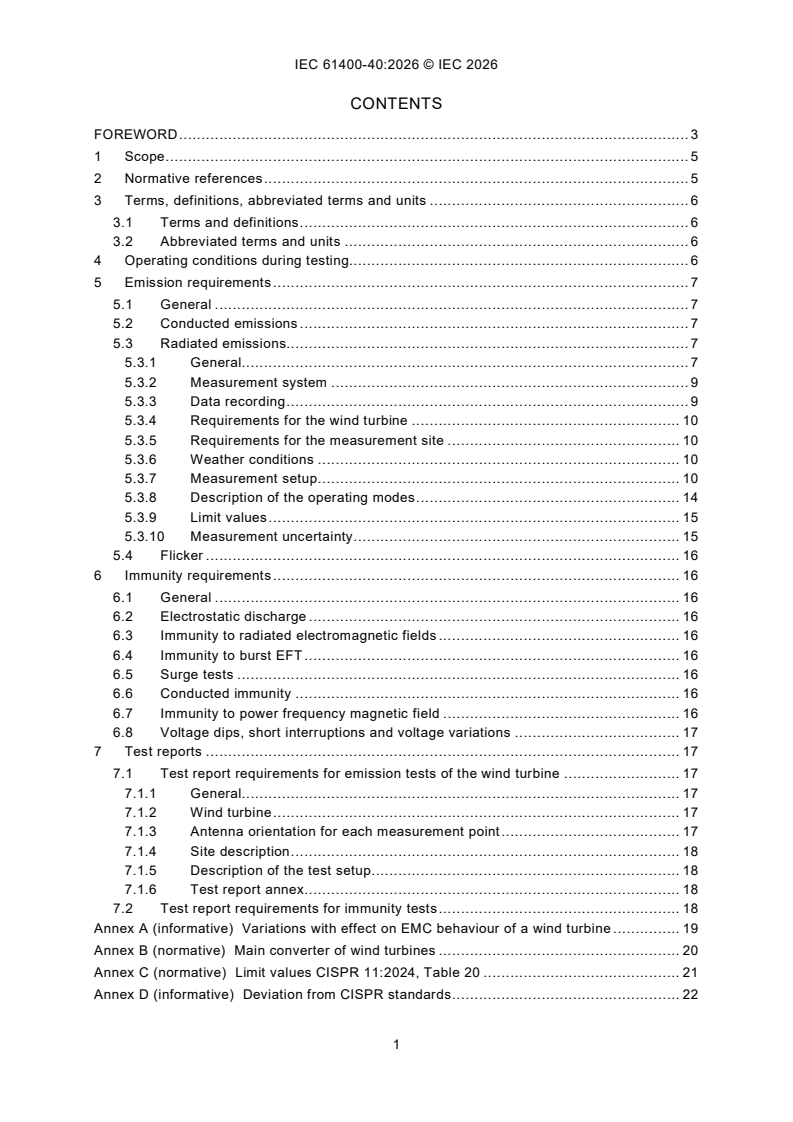
CONTENTS
FOREWORD . 3
1 Scope . 5
2 Normative references . 5
3 Terms, definitions, abbreviated terms and units . 6
3.1 Terms and definitions . 6
3.2 Abbreviated terms and units . 6
4 Operating conditions during testing. 6
5 Emission requirements . 7
5.1 General . 7
5.2 Conducted emissions . 7
5.3 Radiated emissions. 7
5.3.1 General. 7
5.3.2 Measurement system . 9
5.3.3 Data recording . 9
5.3.4 Requirements for the wind turbine . 10
5.3.5 Requirements for the measurement site . 10
5.3.6 Weather conditions . 10
5.3.7 Measurement setup . 10
5.3.8 Description of the operating modes . 14
5.3.9 Limit values . 15
5.3.10 Measurement uncertainty . 15
5.4 Flicker . 16
6 Immunity requirements . 16
6.1 General . 16
6.2 Electrostatic discharge . 16
6.3 Immunity to radiated electromagnetic fields . 16
6.4 Immunity to burst EFT . 16
6.5 Surge tests . 16
6.6 Conducted immunity . 16
6.7 Immunity to power frequency magnetic field . 16
6.8 Voltage dips, short interruptions and voltage variations . 17
7 Test reports . 17
7.1 Test report requirements for emission tests of the wind turbine . 17
7.1.1 General. 17
7.1.2 Wind turbine . 17
7.1.3 Antenna orientation for each measurement point . 17
7.1.4 Site description . 18
7.1.5 Description of the test setup . 18
7.1.6 Test report annex . 18
7.2 Test report requirements for immunity tests . 18
Annex A (informative) Variations with effect on EMC behaviour of a wind turbine . 19
Annex B (normative) Main converter of wind turbines . 20
Annex C (normative) Limit values CISPR 11:2024, Table 20 . 21
Annex D (informative) Deviation from CISPR standards . 22
Annex E (informative) Recommendation of a possible procedure to detect buried
cables . 23
Bibliography . 24
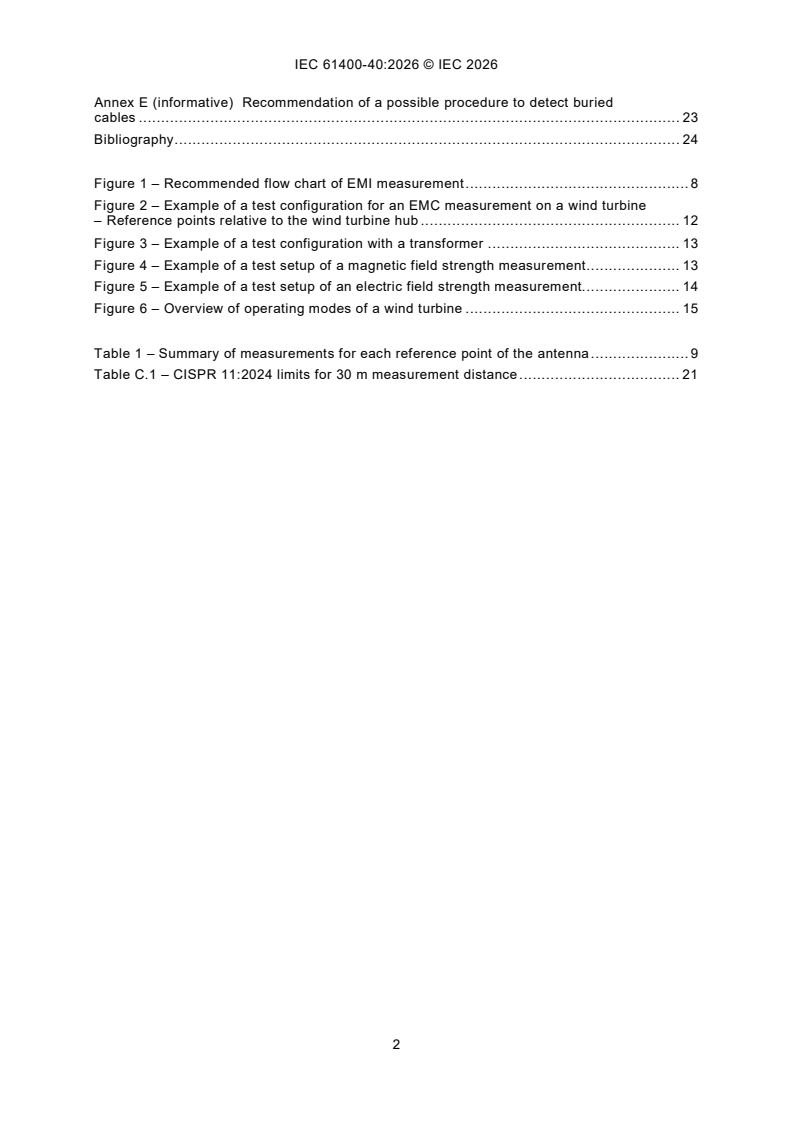
Figure 1 – Recommended flow chart of EMI measurement . 8
Figure 2 – Example of a test configuration for an EMC measurement on a wind turbine
– Reference points relative to the wind turbine hub . 12
Figure 3 – Example of a test configuration with a transformer . 13
Figure 4 – Example of a test setup of a magnetic field strength measurement . 13
Figure 5 – Example of a test setup of an electric field strength measurement. 14
Figure 6 – Overview of operating modes of a wind turbine . 15
Table 1 – Summary of measurements for each reference point of the antenna . 9
Table C.1 – CISPR 11:2024 limits for 30 m measurement distance . 21
INTERNATIONAL ELECTROTECHNICAL COMMISSION
____________
Wind energy generation systems -
Part 40: Electromagnetic compatibility (EMC) -
Requirements and test methods
FOREWORD
1) The International Electrotechnical Commission (IEC) is a worldwide organization for standardization comprising
all national electrotechnical committees (IEC National Committees). The object of IEC is to promote international
co-operation on all questions concerning standardization in the electrical and electronic fields. To this end and
in addition to other activities, IEC publishes International Standards, Technical Specifications, Technical Reports,
Publicly Available Specifications (PAS) and Guides (hereafter referred to as "IEC Publication(s)"). Their
preparation is entrusted to technical committees; any IEC National Committee interested in the subject dealt with
may participate in this preparatory work. International, governmental and non-governmental organizations liaising
with the IEC also participate in this preparation. IEC collaborates closely with the International Organization for
Standardization (ISO) in accordance with conditions determined by agreement between the two organizations.
2) The formal decisions or agreements of IEC on technical matters express, as nearly as possible, an international
consensus of opinion on the relevant subjects since each technical committee has representation from all
interested IEC National Committees.
3) IEC Publications have the form of recommendations for international use and are accepted by IEC National
Committees in that sense. While all reasonable efforts are made to ensure that the technical content of IEC
Publications is accurate, IEC cannot be held responsible for the way in which they are used or for any
misinterpretation by any end user.
4) In order to promote international uniformity, IEC National Committees undertake to apply IEC Publications
transparently to the maximum extent possible in their national and regional publications. Any divergence between
any IEC Publication and the corresponding national or regional publication shall be clearly indicated in the latter.
5) IEC itself does not provide any attestation of conformity. Independent certification bodies provide conformity
assessment services and, in some areas, access to IEC marks of conformity. IEC is not responsible for any
services carried out by independent certification bodies.
6) All users should ensure that they have the latest edition of this publication.
7) No liability shall attach to IEC or its directors, employees, servants or agents including individual experts and
members of its technical committees and IEC National Committees for any personal injury, property damage or
other damage of any nature whatsoever, whether direct or indirect, or for costs (including legal fees) and
expenses arising out of the publication, use of, or reliance upon, this IEC Publication or any other IEC
Publications.
8) Attention is drawn to the Normative references cited in this publication. Use of the referenced publications is
indispensable for the correct application of this publication.
9) IEC draws attention to the possibility that the implementation of this document may involve the use of (a)
patent(s). IEC takes no position concerning the evidence, validity or applicability of any claimed patent rights in
respect thereof. As of the date of publication of this document, IEC had not received notice of (a) patent(s), which
may be required to implement this document. However, implementers are cautioned that this may not represent
the latest information, which may be obtained from the patent database available at https://patents.iec.ch. IEC
shall not be held responsible for identifying any or all such patent rights.
IEC 61400-40 has been prepared by IEC technical committee 88: Wind energy generation
systems. It is an International Standard.
The text of this International Standard is based on the following documents:
Draft Report on voting
88/1131/FDIS 88/1144/RVD
Full information on the voting for its approval can be found in the report on voting indicated in
the above table.
The language used for the development of this International Standard is English.
This document was drafted in accordance with ISO/IEC Directives, Part 2, and developed in
accordance with ISO/IEC Directives, Part 1 and ISO/IEC Directives, IEC Supplement, available
at www.iec.ch/members_experts/refdocs. The main document types developed by IEC are
described in greater detail at www.iec.ch/publications.
A list of all parts of the IEC 61400 series, under the general title: Wind energy generation
systems, can be found on the IEC website.
The committee has decided that the contents of this document will remain unchanged until the
stability date indicated on the IEC website under webstore.iec.ch in the data related to the
specific document. At this date, the document will be
– reconfirmed,
– withdrawn, or
– revised.
1 Scope
This part of IEC 61400 provides the EMC requirements and test methods that apply to the
individual wind turbine and all the sub systems which are part of the wind turbine.
The current document applies to measurements on individual wind turbines and not multiple
wind turbines.
This document defines the requirements and test methods for the verification of the wind turbine
performance against radiated emissions and the immunity of their components against
conducted and radiated phenomena.
This document is applicable to onshore and offshore wind turbines.
Safety considerations are not covered by this standard.
2 Normative references
The following documents are referred to in the text in such a way that some or all of their content
constitutes requirements of this document. For dated references, only the edition cited applies.
For undated references, the latest edition of the referenced document (including any
amendments) applies.
IEC TR 61000-2-5, Electromagnetic compatibility (EMC) - Part 2-5: Environment - Description
and classification of electromagnetic environments
IEC 61000-4-2, Electromagnetic compatibility (EMC) - Part 4-2: Testing and measurement
techniques - Electrostatic discharge immunity test
IEC 61000-4-3, Electromagnetic compatibility (EMC) - Part 4-3: Testing and measurement
techniques - Radiated, radio-frequency, electromagnetic field immunity test
IEC 61000-4-4, Electromagnetic compatibility (EMC) - Part 4-4: Testing and measurement
techniques - Electrical fast transient/burst immunity test
IEC 61000-4-5, Electromagnetic compatibility (EMC) - Part 4-5: Testing and measurement
techniques - Surge immunity test
IEC 61000-4-6, Electromagnetic compatibility (EMC) - Part 4-6: Testing and measurement
techniques - Immunity to conducted disturbances, induced by radio-frequency fields
IEC 61000-4-8, Electromagnetic compatibility (EMC) - Part 4-8: Testing and measurement
techniques - Power frequency magnetic field immunity test
IEC 61000-4-11, Electromagnetic compatibility (EMC) - Part 4-11: Testing and measurement
techniques - Voltage dips, short interruptions and voltage variations immunity tests for
equipment with input current up to 16 A per phase
IEC 61000-4-34, Electromagnetic compatibility (EMC) - Part 4-34: Testing and measurement
techniques - Voltage dips, short interruptions and voltage variations immunity tests for
equipment with input current more than 16 A per phase
IEC 61000-6-2, Electromagnetic compatibility (EMC) - Part 6-2: Generic standards - Immunity
standard for industrial environments
IEC 61400-1, Wind energy generation systems - Part 1: Design requirements
IEC 61400-2, Wind turbines - Part 2: Small wind turbines
CISPR 11:2024, Industrial, scientific and medical equipment - Radio-frequency disturbance
characteristics - Limits and methods of measurement
CISPR 16-1-1:2019, Specification for radio disturbance and immunity measuring apparatus and
methods - Part 1-1: Radio disturbance and immunity measuring apparatus - Measuring
apparatus
CISPR 16-1-4, Specification for radio disturbance and immunity measuring apparatus and
methods - Part 1-4: Radio disturbance and immunity measuring apparatus - Antennas and test
sites for radiated disturbance measurements
CISPR 16-1-6, Specification for radio disturbance and immunity measuring apparatus and
methods - Part 1-6: Radio disturbance and immunity measuring apparatus - EMC antenna
calibration
CISPR 16-2-3:2016, Specification for radio disturbance and immunity measuring apparatus and
methods - Part 2-3: Methods of measurement of disturbances and immunity - Radiated
disturbance measurements
CISPR 16-2-3:2016/AMD1:2019
CISPR 16-2-3:2016/AMD2:2023
CISPR 16-4-2, Specification for radio disturbance and immunity measuring apparatus and
methods - Part 4-2: Uncertainties, statistics and limit modelling - Measurement instrumentation
uncertainty
3 Terms, definitions, abbreviated terms and units
3.1 Terms and definitions
For the purposes of this document, the terms and definitions given in IEC 61400-1, IEC 61400-2
and CISPR 11 apply.
ISO and IEC maintain terminology databases for use in standardization at the following
addresses:
– IEC Electropedia: available at https://www.electropedia.org/
– ISO Online browsing platform: available at https://www.iso.org/obp
3.2 Abbreviated terms and units
NOTE 1 Generic abbreviations are used in this document.
NOTE 2 Only generic symbols and units are used in this document.
EMI electromagnetic interference
EUT equipment under test
ESD electrostatic discharge
EFT electrical fast transient
4 Operating conditions during testing
Operating conditions specific for this document are included in the relevant clauses.
5 Emission requirements
5.1 General
The wind turbine shall fulfil the emission requirements of this document.
Additional requirements for main converters of wind turbines are shown in Annex B.
Changes on a wind turbine can have an effect on the EMC behaviour of the wind turbine. An
overview of the main characteristics that can have influence on EMC behaviour of a wind turbine
is described in Annex A.
5.2 Conducted emissions
For radio protection purposes, the radiated magnetic emissions of the whole wind turbine are
measured in the range of 150 kHz to 30 MHz (conducted emissions frequency range). Instead
of measuring the common mode/differential mode currents, the radiated magnetic emissions
generated by these currents are measured as described in 5.3.
Harmonic, interharmonic and higher frequency emission requirements which are relevant to
and are out
power quality for grid connected wind turbines are handled in IEC 61400-21-1 [1]
of scope of this document.
5.3 Radiated emissions
5.3.1 General
Due to continuous variation of wind speed and other external influences, the emissions of wind
turbines can vary during the measurements. The emissions from the wind turbine shall be
distinguished from ambient signals.
An overview of a recommended test sequence is given in Figure 1 and Table 1.
Description of Figure 1:
The measurements shall be executed under the following conditions:
• Reference points and orientations of the antenna are given in 5.3.7.
• The settings of the EMI-receiver are given in 5.3.7.
• The operating modes of the wind turbine are given in 5.3.8.
• To distinguish the emission of the wind turbine from prevailing ambient emissions, all
measurements on one reference point of the antenna should be executed in sequence
in one (short time) block like shown in Table 1. This is to ensure minimum natural
ambient emissions variations influencing the measurements. The assessment for
ambient emission detection given in CISPR 16-2-3:2016, Subclause A.4.3 to Clause A.5
shall be used.
• Discontinuous disturbances which occur sporadically shall be disregarded, like
described in CISPR 16-2-3:2016, 6.5.1.
___________
Numbers in square brackets refer to the Bibliography.
Figure 1 – Recommended flow chart of EMI measurement
NOTE Additional elevation angles can occur.
Table 1 – Summary of measurements for each reference point of the antenna
Id Operating mode Type of Frequency range Antenna Antenna
measurement elevation polarization
1 Disconnected from the grid Magnetic field 150 kHz to 30 MHz - Radial
2 Disconnected from the grid Electric field 30 MHz to 1 GHz Tower base Vertical
3 Disconnected from the grid Electric field 30 MHz to 1 GHz Tower base Horizontal
4 Disconnected from the grid Electric field 30 MHz to 1 GHz Nacelle Vertical
5 Disconnected from the grid Electric field 30 MHz to 1 GHz Nacelle Horizontal
6 Standby mode Magnetic field 150 kHz to 30 MHz - Radial
7 Standby mode Electric field 30 MHz to 1 GHz Tower base Vertical
8 Standby mode Electric field 30 MHz to 1 GHz Tower base Horizontal
9 Standby mode Electric field 30 MHz to 1 GHz Nacelle Vertical
10 Standby mode Electric field 30 MHz to 1 GHz Nacelle Horizontal
11 Medium load operation Magnetic field 150 kHz to 30 MHz - Radial
12 Medium load operation Electric field 30 MHz to 1 GHz Tower base Vertical
13 Medium load operation Electric field 30 MHz to 1 GHz Tower base Horizontal
14 Medium load operation Electric field 30 MHz to 1 GHz Nacelle Vertical
15 Medium load operation Electric field 30 MHz-1 GHz Nacelle Horizontal
16 Increased load operation Magnetic field 150 kHz to 30 MHz - Radial
17 Increased load operation Electric field 30 MHz to 1 GHz Tower base Vertical
18 Increased load operation Electric field 30 MHz to 1 GHz Tower base Horizontal
19 Increased load operation Electric field 30 MHz to 1 GHz Nacelle Vertical
20 Increased load operation Electric field 30 MHz to 1 GHz Nacelle Horizontal
5.3.2 Measurement system
5.3.2.1 General
Antenna calibration at 10 m distance is acceptable for the testing at all distances according to
this document which are ≥10 m.
CISPR 16-1-4 and CISPR 16-1-6 provide precise information for the calibration of antennas.
The EMI receiver shall fulfil the requirements specified in CISPR 16-1-1 and CISPR 16-2-3.
5.3.2.2 Auxiliary measurement equipment
It is not necessary to calibrate the auxiliary measurement equipment, as the values are
informative.
NOTE The following are examples of the auxiliary measurement equipment: distance meter, clock, compass,
sensors of wind turbine data and sensor of meteorological data.
T
...
IEC 61400-40 ®
Edition 1.0 2026-02
NORME
INTERNATIONALE
Systèmes de génération d'énergie éolienne -
Partie 40: Compatibilité électromagnétique (CEM) - Exigences et méthodes
d'essai
ICS 27.180 ISBN 978-2-8327-1004-3
Droits de reproduction réservés. Sauf indication contraire, aucune partie de cette publication ne peut être reproduite ni
utilisée sous quelque forme que ce soit et par aucun procédé, électronique ou mécanique, y compris la photocopie et
les microfilms, sans l'accord écrit de l'IEC ou du Comité national de l'IEC du pays du demandeur. Si vous avez des
questions sur le copyright de l'IEC ou si vous désirez obtenir des droits supplémentaires sur cette publication, utilisez
les coordonnées ci-après ou contactez le Comité national de l'IEC de votre pays de résidence.
IEC Secretariat Tel.: +41 22 919 02 11
3, rue de Varembé info@iec.ch
CH-1211 Geneva 20 www.iec.ch
Switzerland
A propos de l'IEC
La Commission Electrotechnique Internationale (IEC) est la première organisation mondiale qui élabore et publie des
Normes internationales pour tout ce qui a trait à l'électricité, à l'électronique et aux technologies apparentées.
A propos des publications IEC
Le contenu technique des publications IEC est constamment revu. Veuillez vous assurer que vous possédez l’édition la
plus récente, un corrigendum ou amendement peut avoir été publié.
Recherche de publications IEC - IEC Products & Services Portal - products.iec.ch
webstore.iec.ch/advsearchform Découvrez notre puissant moteur de recherche et consultez
La recherche avancée permet de trouver des publications gratuitement tous les aperçus des publications, symboles
IEC en utilisant différents critères (numéro de référence, graphiques et le glossaire. Avec un abonnement, vous aurez
texte, comité d’études, …). Elle donne aussi des toujours accès à un contenu à jour adapté à vos besoins.
informations sur les projets et les publications remplacées
ou retirées. Electropedia - www.electropedia.org
Le premier dictionnaire d'électrotechnologie en ligne au
IEC Just Published - webstore.iec.ch/justpublished monde, avec plus de 22 500 articles terminologiques en
Restez informé sur les nouvelles publications IEC. Just anglais et en français, ainsi que les termes équivalents
Published détaille les nouvelles publications parues. dans 25 langues additionnelles. Egalement appelé
Disponible en ligne et une fois par mois par email. Vocabulaire Electrotechnique International (IEV) en ligne.
Service Clients - webstore.iec.ch/csc
Si vous désirez nous donner des commentaires sur cette
publication ou si vous avez des questions contactez-
nous: sales@iec.ch.
SOMMAIRE
AVANT-PROPOS . 3
1 Domaine d'application . 5
2 Références normatives . 5
3 Termes, définitions, abréviations et unités . 6
3.1 Termes et définitions. 6
3.2 Abréviations et unités . 7
4 Conditions d'exploitation pendant les essais . 7
5 Exigences d'émission . 7
5.1 Généralités . 7
5.2 Émissions conduites . 7
5.3 Émissions rayonnées . 7
5.3.1 Généralités . 7
5.3.2 Système de mesure . 10
5.3.3 Enregistrement des données . 11
5.3.4 Exigences relatives à l'éolienne . 11
5.3.5 Exigences relatives au site de mesure . 11
5.3.6 Conditions climatiques . 12
5.3.7 Montage de mesure . 12
5.3.8 Description des modes de fonctionnement . 16
5.3.9 Valeurs limites . 17
5.3.10 Incertitude de mesure . 17
5.4 Papillotement . 18
6 Exigences d'immunité . 18
6.1 Généralités . 18
6.2 Décharges électrostatiques. 18
6.3 Immunité aux champs électromagnétiques rayonnés . 18
6.4 Immunité aux transitoires électriques rapides (EFT) en salves. 18
6.5 Essai d'ondes de choc . 18
6.6 Immunité aux perturbations conduites . 18
6.7 Immunité au champ magnétique à la fréquence du réseau . 19
6.8 Creux de tension, coupures brèves et variations de tension . 19
7 Rapports d'essai . 19
7.1 Exigences du rapport d'essai pour les essais d'émission de l'éolienne . 19
7.1.1 Généralités . 19
7.1.2 Éolienne . 19
7.1.3 Orientation de l'antenne pour chaque point de mesure . 20
7.1.4 Description du site . 20
7.1.5 Description du montage d'essai . 20
7.1.6 Annexe du rapport d'essai. 20
7.2 Exigences du rapport d'essai pour des essais d'immunité . 21
Annexe A (informative) Variations avec effet sur le comportement d'une éolienne en
matière de CEM . 22
Annexe B (normative) Convertisseur principal des éoliennes . 23
Annexe C (normative) Valeurs limites de la CISPR 11:2024, Tableau 20 . 24
Annexe D (informative) Écart par rapport aux normes CISPR . 25
Annexe E (informative) Recommandation d'une procédure possible pour détecter des
câbles enfouis . 26
Bibliographie . 27
Figure 1 – Organigramme recommandé de mesure des EMI . 9
Figure 2 – Exemple de configuration d'essai pour une mesure CEM sur une éolienne –
Points de référence par rapport au moyeu de l'éolienne. 14
Figure 3 – Exemple de configuration d'essai avec un transformateur . 14
Figure 4 – Exemple de montage d'essai de mesure de l'intensité du champ magnétique . 15
Figure 5 – Exemple de montage d'essai de mesure de l'intensité du champ électrique. 15
Figure 6 – Vue d'ensemble des modes de fonctionnement d'une éolienne . 17
Tableau 1 – Récapitulatif des mesurages pour chaque point de référence de l'antenne . 10
Tableau C.1 – Limites de la CISPR 11:2024 pour une distance de mesure de 30 m . 24
COMMISSION ÉLECTROTECHNIQUE INTERNATIONALE
____________
Systèmes de génération d'énergie éolienne -
Partie 40: Compatibilité électromagnétique (CEM) -
Exigences et méthodes d'essai
AVANT-PROPOS
1) La Commission Électrotechnique Internationale (IEC) est une organisation mondiale de normalisation composée
de l'ensemble des comités électrotechniques nationaux (Comités nationaux de l'IEC). L'IEC a pour objet de
favoriser la coopération internationale pour toutes les questions de normalisation dans les domaines de
l'électricité et de l'électronique. À cet effet, l'IEC – entre autres activités – publie des Normes internationales,
des Spécifications techniques, des Rapports techniques, des Spécifications accessibles au public (PAS) et des
Guides (ci-après dénommés "Publication(s) de l'IEC"). Leur élaboration est confiée à des comités d'études, aux
travaux desquels tout Comité national intéressé par le sujet traité peut participer. Les organisations
internationales, gouvernementales et non gouvernementales, en liaison avec l'IEC, participent également aux
travaux. L'IEC collabore étroitement avec l'Organisation Internationale de Normalisation (ISO), selon des
conditions fixées par accord entre les deux organisations.
2) Les décisions ou accords officiels de l'IEC concernant les questions techniques représentent, dans la mesure du
possible, un accord international sur les sujets étudiés, étant donné que les Comités nationaux de l'IEC intéressés
sont représentés dans chaque comité d'études.
3) Les Publications de l'IEC se présentent sous la forme de recommandations internationales et sont agréées
comme telles par les Comités nationaux de l'IEC. Tous les efforts raisonnables sont entrepris afin que l'IEC
s'assure de l'exactitude du contenu technique de ses publications; l'IEC ne peut pas être tenue responsable de
l'éventuelle mauvaise utilisation ou interprétation qui en est faite par un quelconque utilisateur final.
4) Dans le but d'encourager l'uniformité internationale, les Comités nationaux de l'IEC s'engagent, dans toute la
mesure possible, à appliquer de façon transparente les Publications de l'IEC dans leurs publications nationales
et régionales. Toutes divergences entre toutes Publications de l'IEC et toutes publications nationales ou
régionales correspondantes doivent être indiquées en termes clairs dans ces dernières.
5) L'IEC elle-même ne fournit aucune attestation de conformité. Des organismes de certification indépendants
fournissent des services d'évaluation de conformité et, dans certains secteurs, accèdent aux marques de
conformité de l'IEC. L'IEC n'est responsable d'aucun des services effectués par les organismes de certification
indépendants.
6) Tous les utilisateurs doivent s'assurer qu'ils sont en possession de la dernière édition de cette publication.
7) Aucune responsabilité ne doit être imputée à l'IEC, à ses administrateurs, employés, auxiliaires ou mandataires,
y compris ses experts particuliers et les membres de ses comités d'études et des Comités nationaux de l'IEC,
pour tout préjudice causé en cas de dommages corporels et matériels, ou de tout autre dommage de quelque
nature que ce soit, directe ou indirecte, ou pour supporter les coûts (y compris les frais de justice) et les dépenses
découlant de la publication ou de l'utilisation de cette Publication de l'IEC ou de toute autre Publication de l'IEC,
ou au crédit qui lui est accordé.
8) L'attention est attirée sur les références normatives citées dans cette publication. L'utilisation de publications
référencées est obligatoire pour une application correcte de la présente publication.
9) L'IEC attire l'attention sur le fait que la mise en application du présent document peut entraîner l'utilisation d'un
ou de plusieurs brevets. L'IEC ne prend pas position quant à la preuve, à la validité et à l'applicabilité de tout
droit de brevet revendiqué à cet égard. À la date de publication du présent document, l'IEC n'avait pas reçu
notification qu'un ou plusieurs brevets pouvaient être nécessaires à sa mise en application. Toutefois, il y a lieu
d'avertir les responsables de la mise en application du présent document que des informations plus récentes
sont susceptibles de figurer dans la base de données de brevets, disponible à l'adresse https://patents.iec.ch.
L'IEC ne saurait être tenue pour responsable de ne pas avoir identifié de tels droits de brevets.
L'IEC 61400-40 a été établie par le comité d'études 88 de l'IEC: Systèmes de génération
d'énergie éolienne. Il s'agit d'une Norme internationale.
Le texte de cette Norme internationale est issu des documents suivants:
Projet Rapport de vote
88/1131/FDIS 88/1144/RVD
Le rapport de vote indiqué dans le tableau ci-dessus donne toute information sur le vote ayant
abouti à son approbation.
La langue employée pour l'élaboration de cette Norme internationale est l'anglais.
Ce document a été rédigé selon les Directives ISO/IEC, Partie 2, il a été développé selon les
Directives ISO/IEC, Partie 1 et les Directives ISO/IEC, Supplément IEC, disponibles sous
www.iec.ch/members_experts/refdocs. Les principaux types de documents développés par
l'IEC sont décrits plus en détail sous www.iec.ch/publications.
Une liste de toutes les parties de la série IEC 61400, publiées sous le titre général: Systèmes
de génération d'énergie éolienne, se trouve sur le site web de l'IEC.
Le comité a décidé que le contenu de ce document ne sera pas modifié avant la date de stabilité
indiquée sur le site web de l'IEC sous webstore.iec.ch dans les données relatives au document
recherché. À cette date, le document sera
– reconduit,
– supprimé, ou
– révisé.
1 Domaine d'application
La présente partie de l'IEC 61400 fournit les exigences de CEM et les méthodes d'essai qui
s'appliquent aux éoliennes individuelles ainsi qu'à tous les sous-systèmes qui font partie de
l'éolienne.
Le présent document s'applique aux mesurages effectués sur des éoliennes individuelles et
non sur plusieurs éoliennes.
Le présent document définit les exigences et les méthodes d'essai pour la vérification des
performances des éoliennes en ce qui concerne les émissions rayonnées et de l'immunité de
leurs composants aux phénomènes conduits et rayonnés.
Le présent document s'applique aux éoliennes en mer et sur terre.
Les considérations relatives à la sécurité ne sont pas couvertes par la présente norme.
2 Références normatives
Les documents suivants sont cités dans le texte de sorte qu'ils constituent, pour tout ou partie
de leur contenu, des exigences du présent document. Pour les références datées, seule
l'édition citée s'applique. Pour les références non datées, la dernière édition du document de
référence s'applique (y compris les éventuels amendements).
IEC TR 61000-2-5, Compatibilité électromagnétique CEM) - Partie 2-5: Environnement -
Description et classification des environnements électromagnétiques
IEC 61000-4-2, Compatibilité électromagnétique (CEM) - Partie 4-2: Techniques d'essai et de
mesure - Essai d'immunité aux décharges électrostatiques
IEC 61000-4-3, Compatibilité électromagnétique (CEM) - Partie 4-3: Techniques d'essai et de
mesure - Essai d'immunité aux champs électromagnétiques rayonnés aux fréquences
radioélectriques
IEC 61000-4-4, Compatibilité électromagnétique (CEM) - Partie 4-4: Techniques d'essai et de
mesure - Essais d'immunité aux transitoires électriques rapides en salves
IEC 61000-4-5, Compatibilité électromagnétique (CEM) - Partie 4-5: Techniques d'essai et de
mesure - Essai d'immunité aux ondes de choc
IEC 61000-4-6, Compatibilité électromagnétique (CEM) - Partie 4-6: Techniques d'essai et de
mesure - Immunité aux perturbations conduites, induites par les champs aux fréquences
radioélectriques
IEC 61000-4-8, Compatibilité électromagnétique (CEM) - Partie 4-8: Techniques d'essai et de
mesure - Essai d'immunité au champ magnétique à la fréquence du réseau
IEC 61000-4-11, Compatibilité électromagnétique (CEM) - Partie 4-11: Techniques d'essai et
de mesure - Essais d'immunité aux creux de tension, coupures brèves et variations de tension
pour les appareils à courant d'entrée inférieur ou égal à 16 A par phase
IEC 61000-4-34, Compatibilité électromagnétique (CEM) - Partie 4-34: Techniques d'essai et
de mesure - Essais d'immunité aux creux de tension, coupures brèves et variations de tension
pour matériel ayant un courant appelé de plus de 16 A par phase
IEC 61000-6-2, Compatibilité électromagnétique (CEM) - Partie 6-2: Normes génériques -
Norme d'immunité pour les environnements industriels
IEC 61400-1, Systèmes de génération d'énergie éolienne - Partie 1: Exigences de conception
IEC 61400-2, Éoliennes - Partie 2: Petits aérogénérateurs
CISPR 11:2024, Appareils industriels, scientifiques et médicaux - Caractéristiques de
perturbations radioélectriques - Limites et méthodes de mesure
CISPR 16-1-1:2019, Spécifications des méthodes et des appareils de mesure des perturbations
radioélectriques et de l'immunité aux perturbations radioélectriques - Partie 1-1: Appareils de
mesure des perturbations radioélectriques et de l'immunité aux perturbations radioélectriques
- Appareils de mesure
CISPR 16-1-4, Spécifications des méthodes et des appareils de mesure des perturbations
radioélectriques et de l'immunité aux perturbations radioélectriques - Partie 1-4: Appareils de
mesure des perturbations radioélectriques et de l'immunité aux perturbations radioélectriques
- Antennes et emplacements d'essai pour les mesurages des perturbations rayonnées
CISPR 16-1-6, Spécifications des méthodes et des appareils de mesure des perturbations
radioélectriques et de l'immunité aux perturbations radioélectriques - Partie 1-6: Appareils de
mesure des perturbations radioélectriques et de l'immunité aux perturbations radioélectriques
- Étalonnage des antennes CEM
CISPR 16-2-3:2016, Spécifications des méthodes et des appareils de mesure des perturbations
radioélectriques et de l'immunité aux perturbations radioélectriques - Partie 2-3: Méthodes de
mesure des perturbations et de l'immunité - Mesurages des perturbations rayonnées
CISPR 16-2-3:2016/AMD1:2019
CISPR 16-2-3:2016/AMD2:2023
CISPR 16-4-2, Spécifications des méthodes et des appareils de mesure des perturbations
radioélectriques et de l'immunité aux perturbations radioélectriques - Partie 4-2: Incertitudes,
statistiques et modélisation des limites - Incertitudes de mesure de l'instrumentation
3 Termes, définitions, abréviations et unités
3.1 Termes et définitions
Pour les besoins du présent document, les termes et définitions de l'IEC 61400-1, l'IEC 61400-2
et la CISPR 11 s'appliquent.
L'ISO et l'IEC tiennent à jour des bases de données terminologiques destinées à être utilisées
en normalisation, consultables aux adresses suivantes:
– IEC Electropedia: disponible à l'adresse https://www.electropedia.org/
– ISO Online browsing platform: disponible à l'adresse https://www.iso.org/obp
3.2 Abréviations et unités
NOTE 1 Des abréviations génériques sont utilisées dans le présent document.
NOTE 2 Seuls des symboles et unités génériques sont utilisés dans le présent document.
EMI (ElectroMagnetic Interference) brouillage électromagnétique
EUT (Equipment Under Test) matériel soumis à l'essai
DES décharges électrostatiques
EFT (Electrical Fast Transient) transitoires électriques rapides
4 Conditions d'exploitation pendant les essais
Les conditions d'exploitation spécifiques du présent document sont incluses dans les articles
correspondants.
5 Exigences d'émission
5.1 Généralités
L'éolienne doit satisfaire aux exigences d'émission stipulées dans le présent document.
Des exigences supplémentaires pour les convertisseurs principaux des éoliennes sont données
à l'Annexe B.
Les modifications apportées à une éolienne peuvent avoir un effet sur le comportement de
l'éolienne en matière de CEM. L'Annexe A donne une vue d'ensemble des principales
caractéristiques qui peuvent avoir une incidence sur le comportement d'une éolienne en matière
de CEM.
5.2 Émissions conduites
À des fins de radioprotection, les émissions de champ magnétique rayonnées de l'ensemble de
l'éolienne sont mesurées dans la plage de 150 kHz à 30 MHz (plage de fréquences des
émissions conduites). Plutôt que de mesurer les courants en mode commun/mode différentiel,
les émissions de champ magnétique rayonnées générées par ces courants sont mesurées
comme cela est décrit au 5.3.
Les exigences relatives aux émissions d'harmoniques, d'interharmoniques et de fréquences
plus élevées qui sont pertinentes pour la qualité de puissance des éoliennes connectées au
réseau sont traitées dans l'IEC 61400-21-1 [1] et ne font pas partie du domaine d'application
du présent document.
5.3 Émissions rayonnées
5.3.1 Généralités
En raison de la variation continue de la vitesse du vent et d'autres influences externes, les
émissions des éoliennes peuvent varier au cours des mesurages. Les émissions de l'éolienne
doivent être distinguées des signaux ambiants.
Une vue d'ensemble d'une séquence d'essais recommandée est donnée à la Figure 1 et dans
le Tableau 1.
___________
Les chiffres entre crochets renvoient à la Bibliographie.
Description de la Figure 1:
Les mesurages doivent être réalisés dans les conditions suivantes:
• Les points de référence et les orientations de l'antenne sont indiqués au 5.3.7.
• Les paramètres du récepteur EMI sont indiqués au 5.3.7.
• Les modes de fonctionnement de l'éolienne sont indiqués au 5.3.8.
• Pour distinguer les émissions de l'éolienne des émissions ambiantes dominantes, il
convient de réaliser tous les mesurages en un point de référence de l'antenne en
séquence en un bloc (sur une courte période), comme cela est indiqué dans le
Tableau 1. Cela permet de réduire le plus possible les variations naturelles des
émissions ambiantes qui ont une influence sur les mesures. L'évaluation de la détection
des émissions ambiantes décrite dans la CISPR 16-2-3:2016, du Paragraphe A.4.3 à
l'Article A.5, doit être utilisée.
• Les perturbations discontinues qui se produisent sporadiquement doivent être ignorées,
comme cela est décrit dans la CISPR 16-2-3:2016, 6.5.1.
Figure 1 – Organigramme recommandé de mesure des EMI
NOTE Des angles d'élévation supplémentaires peuvent se produire.
Tableau 1 – Récapitulatif des mesurages pour chaque point de référence de l'antenne
Id Mode de fonctionnement Type de Plage de Élévation de Polarisation
mesurage fréquences l'antenne de l'antenne
1 Déconnecté du réseau Champ 150 kHz à 30 MHz - Radiale
magnétique
2 Déconnecté du réseau Champ 30 MHz à 1 GHz Base du mât Verticale
électrique
3 Déconnecté du réseau Champ 30 MHz à 1 GHz Base du mât Horizontale
électrique
4 Déconnecté du réseau Champ 30 MHz à 1 GHz Nacelle Verticale
électrique
5 Déconnecté du réseau Champ 30 MHz à 1 GHz Nacelle Horizontale
électrique
Champ
6 Mode veille 150 kHz à 30 MHz - Radiale
magnétique
7 Mode veille Champ 30 MHz à 1 GHz Base du mât Verticale
électrique
8 Mode veille Champ 30 MHz à 1 GHz Base du mât Horizontale
électrique
9 Mode veille Champ 30 MHz à 1 GHz Nacelle Verticale
électrique
10 Mode veille Champ 30 MHz à 1 GHz Nacelle Horizontale
électrique
11 Fonctionnement à charge Champ 150 kHz à 30 MHz - Radiale
moyenne magnétique
12 Fonctionnement à charge Champ 30 MHz à 1 GHz Base du mât Verticale
moyenne électrique
13 Fonctionnement à charge Champ 30 MHz à 1 GHz Base du mât Horizontale
moyenne électrique
14 Fonctionnement à charge Champ 30 MHz à 1 GHz Nacelle Verticale
moyenne électrique
15 Fonctionnement à charge Champ 30 MHz-1 GHz Nacelle Horizontale
moyenne électrique
16 Fonctionnement à charge Champ 150 kHz à 30 MHz - Radiale
accrue magnétique
17 Fonctionnement à charge Champ 30 MHz à 1 GHz Base du mât Verticale
accrue électrique
18 Fonctionnement à charge Champ 30 MHz à 1 GHz Base du mât Horizontale
accrue électrique
19 Fonctionnement à charge Champ 30 MHz à 1 GHz Nacelle Verticale
accrue électrique
20 Fonctionnement à charge Champ 30 MHz à 1 GHz Nacelle Horizontale
accrue électrique
5.3.2 Système de mesure
5.3.2.1 Généralités
L'étalonnage de l'antenne à une distance de 10 m est acceptable pour les essais à toutes les
distances conformes au présent document qui sont ≥ 10 m.
La CISPR 16-1-4 et la CISPR 16-1-6 fournissent des informations précises concernant
l'étalonnage des antennes.
Le récepteur EMI doit satisfaire aux exigences spécifiées dans la CISPR 16-1-1 et la
CISPR 16-2-3.
5.3.2.2 Matériel de mesure auxiliaire
Il n'est pas nécessaire d'étalonner le matériel de mesure auxiliaire, les valeurs étant
informatives.
NOTE Exemples de matériels de mesure auxiliaires: appareil de mesure des distances, horloge, boussole, capteurs
de données éoliennes et capteur de données météorologiques.
Le capteur de données météorologiques doit être placé sur le site de mesure dans un périmètre
de 100 m de rayon autour de la tour.
5.3.3 Enregistrement des données
Il convient d'enregistrer les données de fonctionnement de l'éolienne qui sont utiles à la
reproduction du mesurage. Au moins les valeurs de puissance active doivent êtr
...
IEC 61400-40 ®
Edition 1.0 2026-02
INTERNATIONAL
STANDARD
NORME
INTERNATIONALE
Wind energy generation systems -
Part 40: Electromagnetic compatibility (EMC) - Requirements and test methods
Systèmes de génération d'énergie éolienne -
Partie 40: Compatibilité électromagnétique (CEM) - Exigences et méthodes
d'essai
ICS 27.180 ISBN 978-2-8327-1004-3
All rights reserved. Unless otherwise specified, no part of this publication may be reproduced or utilized in any form or
by any means, electronic or mechanical, including photocopying and microfilm, without permission in writing from either
IEC or IEC's member National Committee in the country of the requester. If you have any questions about IEC copyright
or have an enquiry about obtaining additional rights to this publication, please contact the address below or your local
IEC member National Committee for further information.
Droits de reproduction réservés. Sauf indication contraire, aucune partie de cette publication ne peut être reproduite ni
utilisée sous quelque forme que ce soit et par aucun procédé, électronique ou mécanique, y compris la photocopie et
les microfilms, sans l'accord écrit de l'IEC ou du Comité national de l'IEC du pays du demandeur. Si vous avez des
questions sur le copyright de l'IEC ou si vous désirez obtenir des droits supplémentaires sur cette publication, utilisez
les coordonnées ci-après ou contactez le Comité national de l'IEC de votre pays de résidence.
IEC Secretariat Tel.: +41 22 919 02 11
3, rue de Varembé info@iec.ch
CH-1211 Geneva 20 www.iec.ch
Switzerland
About the IEC
The International Electrotechnical Commission (IEC) is the leading global organization that prepares and publishes
International Standards for all electrical, electronic and related technologies.
About IEC publications
The technical content of IEC publications is kept under constant review by the IEC. Please make sure that you have the
latest edition, a corrigendum or an amendment might have been published.
IEC publications search - IEC Products & Services Portal - products.iec.ch
webstore.iec.ch/advsearchform Discover our powerful search engine and read freely all the
The advanced search enables to find IEC publications by a publications previews, graphical symbols and the glossary.
variety of criteria (reference number, text, technical With a subscription you will always have access to up to date
committee, …). It also gives information on projects, content tailored to your needs.
replaced and withdrawn publications.
Electropedia - www.electropedia.org
IEC Just Published - webstore.iec.ch/justpublished The world's leading online dictionary on electrotechnology,
Stay up to date on all new IEC publications. Just Published containing more than 22 500 terminological entries in English
details all new publications released. Available online and and French, with equivalent terms in 25 additional languages.
once a month by email. Also known as the International Electrotechnical Vocabulary
(IEV) online.
IEC Customer Service Centre - webstore.iec.ch/csc
If you wish to give us your feedback on this publication or
need further assistance, please contact the Customer
Service Centre: sales@iec.ch.
A propos de l'IEC
La Commission Electrotechnique Internationale (IEC) est la première organisation mondiale qui élabore et publie des
Normes internationales pour tout ce qui a trait à l'électricité, à l'électronique et aux technologies apparentées.
A propos des publications IEC
Le contenu technique des publications IEC est constamment revu. Veuillez vous assurer que vous possédez l’édition la
plus récente, un corrigendum ou amendement peut avoir été publié.
Recherche de publications IEC - IEC Products & Services Portal - products.iec.ch
webstore.iec.ch/advsearchform Découvrez notre puissant moteur de recherche et consultez
La recherche avancée permet de trouver des publications gratuitement tous les aperçus des publications, symboles
IEC en utilisant différents critères (numéro de référence, graphiques et le glossaire. Avec un abonnement, vous aurez
texte, comité d’études, …). Elle donne aussi des toujours accès à un contenu à jour adapté à vos besoins.
informations sur les projets et les publications remplacées
ou retirées. Electropedia - www.electropedia.org
Le premier dictionnaire d'électrotechnologie en ligne au
IEC Just Published - webstore.iec.ch/justpublished monde, avec plus de 22 500 articles terminologiques en
Restez informé sur les nouvelles publications IEC. Just anglais et en français, ainsi que les termes équivalents
Published détaille les nouvelles publications parues. dans 25 langues additionnelles. Egalement appelé
Disponible en ligne et une fois par mois par email. Vocabulaire Electrotechnique International (IEV) en ligne.
Service Clients - webstore.iec.ch/csc
Si vous désirez nous donner des commentaires sur cette
publication ou si vous avez des questions contactez-
nous: sales@iec.ch.
CONTENTS
FOREWORD . 3
1 Scope . 5
2 Normative references . 5
3 Terms, definitions, abbreviated terms and units . 6
3.1 Terms and definitions . 6
3.2 Abbreviated terms and units . 6
4 Operating conditions during testing. 6
5 Emission requirements . 7
5.1 General . 7
5.2 Conducted emissions . 7
5.3 Radiated emissions. 7
5.3.1 General. 7
5.3.2 Measurement system . 9
5.3.3 Data recording . 9
5.3.4 Requirements for the wind turbine . 10
5.3.5 Requirements for the measurement site . 10
5.3.6 Weather conditions . 10
5.3.7 Measurement setup . 10
5.3.8 Description of the operating modes . 14
5.3.9 Limit values . 15
5.3.10 Measurement uncertainty . 15
5.4 Flicker . 16
6 Immunity requirements . 16
6.1 General . 16
6.2 Electrostatic discharge . 16
6.3 Immunity to radiated electromagnetic fields . 16
6.4 Immunity to burst EFT . 16
6.5 Surge tests . 16
6.6 Conducted immunity . 16
6.7 Immunity to power frequency magnetic field . 16
6.8 Voltage dips, short interruptions and voltage variations . 17
7 Test reports . 17
7.1 Test report requirements for emission tests of the wind turbine . 17
7.1.1 General. 17
7.1.2 Wind turbine . 17
7.1.3 Antenna orientation for each measurement point . 17
7.1.4 Site description . 18
7.1.5 Description of the test setup . 18
7.1.6 Test report annex . 18
7.2 Test report requirements for immunity tests . 18
Annex A (informative) Variations with effect on EMC behaviour of a wind turbine . 19
Annex B (normative) Main converter of wind turbines . 20
Annex C (normative) Limit values CISPR 11:2024, Table 20 . 21
Annex D (informative) Deviation from CISPR standards . 22
Annex E (informative) Recommendation of a possible procedure to detect buried
cables . 23
Bibliography . 24
Figure 1 – Recommended flow chart of EMI measurement . 8
Figure 2 – Example of a test configuration for an EMC measurement on a wind turbine
– Reference points relative to the wind turbine hub . 12
Figure 3 – Example of a test configuration with a transformer . 13
Figure 4 – Example of a test setup of a magnetic field strength measurement . 13
Figure 5 – Example of a test setup of an electric field strength measurement. 14
Figure 6 – Overview of operating modes of a wind turbine . 15
Table 1 – Summary of measurements for each reference point of the antenna . 9
Table C.1 – CISPR 11:2024 limits for 30 m measurement distance . 21
INTERNATIONAL ELECTROTECHNICAL COMMISSION
____________
Wind energy generation systems -
Part 40: Electromagnetic compatibility (EMC) -
Requirements and test methods
FOREWORD
1) The International Electrotechnical Commission (IEC) is a worldwide organization for standardization comprising
all national electrotechnical committees (IEC National Committees). The object of IEC is to promote international
co-operation on all questions concerning standardization in the electrical and electronic fields. To this end and
in addition to other activities, IEC publishes International Standards, Technical Specifications, Technical Reports,
Publicly Available Specifications (PAS) and Guides (hereafter referred to as "IEC Publication(s)"). Their
preparation is entrusted to technical committees; any IEC National Committee interested in the subject dealt with
may participate in this preparatory work. International, governmental and non-governmental organizations liaising
with the IEC also participate in this preparation. IEC collaborates closely with the International Organization for
Standardization (ISO) in accordance with conditions determined by agreement between the two organizations.
2) The formal decisions or agreements of IEC on technical matters express, as nearly as possible, an international
consensus of opinion on the relevant subjects since each technical committee has representation from all
interested IEC National Committees.
3) IEC Publications have the form of recommendations for international use and are accepted by IEC National
Committees in that sense. While all reasonable efforts are made to ensure that the technical content of IEC
Publications is accurate, IEC cannot be held responsible for the way in which they are used or for any
misinterpretation by any end user.
4) In order to promote international uniformity, IEC National Committees undertake to apply IEC Publications
transparently to the maximum extent possible in their national and regional publications. Any divergence between
any IEC Publication and the corresponding national or regional publication shall be clearly indicated in the latter.
5) IEC itself does not provide any attestation of conformity. Independent certification bodies provide conformity
assessment services and, in some areas, access to IEC marks of conformity. IEC is not responsible for any
services carried out by independent certification bodies.
6) All users should ensure that they have the latest edition of this publication.
7) No liability shall attach to IEC or its directors, employees, servants or agents including individual experts and
members of its technical committees and IEC National Committees for any personal injury, property damage or
other damage of any nature whatsoever, whether direct or indirect, or for costs (including legal fees) and
expenses arising out of the publication, use of, or reliance upon, this IEC Publication or any other IEC
Publications.
8) Attention is drawn to the Normative references cited in this publication. Use of the referenced publications is
indispensable for the correct application of this publication.
9) IEC draws attention to the possibility that the implementation of this document may involve the use of (a)
patent(s). IEC takes no position concerning the evidence, validity or applicability of any claimed patent rights in
respect thereof. As of the date of publication of this document, IEC had not received notice of (a) patent(s), which
may be required to implement this document. However, implementers are cautioned that this may not represent
the latest information, which may be obtained from the patent database available at https://patents.iec.ch. IEC
shall not be held responsible for identifying any or all such patent rights.
IEC 61400-40 has been prepared by IEC technical committee 88: Wind energy generation
systems. It is an International Standard.
The text of this International Standard is based on the following documents:
Draft Report on voting
88/1131/FDIS 88/1144/RVD
Full information on the voting for its approval can be found in the report on voting indicated in
the above table.
The language used for the development of this International Standard is English.
This document was drafted in accordance with ISO/IEC Directives, Part 2, and developed in
accordance with ISO/IEC Directives, Part 1 and ISO/IEC Directives, IEC Supplement, available
at www.iec.ch/members_experts/refdocs. The main document types developed by IEC are
described in greater detail at www.iec.ch/publications.
A list of all parts of the IEC 61400 series, under the general title: Wind energy generation
systems, can be found on the IEC website.
The committee has decided that the contents of this document will remain unchanged until the
stability date indicated on the IEC website under webstore.iec.ch in the data related to the
specific document. At this date, the document will be
– reconfirmed,
– withdrawn, or
– revised.
1 Scope
This part of IEC 61400 provides the EMC requirements and test methods that apply to the
individual wind turbine and all the sub systems which are part of the wind turbine.
The current document applies to measurements on individual wind turbines and not multiple
wind turbines.
This document defines the requirements and test methods for the verification of the wind turbine
performance against radiated emissions and the immunity of their components against
conducted and radiated phenomena.
This document is applicable to onshore and offshore wind turbines.
Safety considerations are not covered by this standard.
2 Normative references
The following documents are referred to in the text in such a way that some or all of their content
constitutes requirements of this document. For dated references, only the edition cited applies.
For undated references, the latest edition of the referenced document (including any
amendments) applies.
IEC TR 61000-2-5, Electromagnetic compatibility (EMC) - Part 2-5: Environment - Description
and classification of electromagnetic environments
IEC 61000-4-2, Electromagnetic compatibility (EMC) - Part 4-2: Testing and measurement
techniques - Electrostatic discharge immunity test
IEC 61000-4-3, Electromagnetic compatibility (EMC) - Part 4-3: Testing and measurement
techniques - Radiated, radio-frequency, electromagnetic field immunity test
IEC 61000-4-4, Electromagnetic compatibility (EMC) - Part 4-4: Testing and measurement
techniques - Electrical fast transient/burst immunity test
IEC 61000-4-5, Electromagnetic compatibility (EMC) - Part 4-5: Testing and measurement
techniques - Surge immunity test
IEC 61000-4-6, Electromagnetic compatibility (EMC) - Part 4-6: Testing and measurement
techniques - Immunity to conducted disturbances, induced by radio-frequency fields
IEC 61000-4-8, Electromagnetic compatibility (EMC) - Part 4-8: Testing and measurement
techniques - Power frequency magnetic field immunity test
IEC 61000-4-11, Electromagnetic compatibility (EMC) - Part 4-11: Testing and measurement
techniques - Voltage dips, short interruptions and voltage variations immunity tests for
equipment with input current up to 16 A per phase
IEC 61000-4-34, Electromagnetic compatibility (EMC) - Part 4-34: Testing and measurement
techniques - Voltage dips, short interruptions and voltage variations immunity tests for
equipment with input current more than 16 A per phase
IEC 61000-6-2, Electromagnetic compatibility (EMC) - Part 6-2: Generic standards - Immunity
standard for industrial environments
IEC 61400-1, Wind energy generation systems - Part 1: Design requirements
IEC 61400-2, Wind turbines - Part 2: Small wind turbines
CISPR 11:2024, Industrial, scientific and medical equipment - Radio-frequency disturbance
characteristics - Limits and methods of measurement
CISPR 16-1-1:2019, Specification for radio disturbance and immunity measuring apparatus and
methods - Part 1-1: Radio disturbance and immunity measuring apparatus - Measuring
apparatus
CISPR 16-1-4, Specification for radio disturbance and immunity measuring apparatus and
methods - Part 1-4: Radio disturbance and immunity measuring apparatus - Antennas and test
sites for radiated disturbance measurements
CISPR 16-1-6, Specification for radio disturbance and immunity measuring apparatus and
methods - Part 1-6: Radio disturbance and immunity measuring apparatus - EMC antenna
calibration
CISPR 16-2-3:2016, Specification for radio disturbance and immunity measuring apparatus and
methods - Part 2-3: Methods of measurement of disturbances and immunity - Radiated
disturbance measurements
CISPR 16-2-3:2016/AMD1:2019
CISPR 16-2-3:2016/AMD2:2023
CISPR 16-4-2, Specification for radio disturbance and immunity measuring apparatus and
methods - Part 4-2: Uncertainties, statistics and limit modelling - Measurement instrumentation
uncertainty
3 Terms, definitions, abbreviated terms and units
3.1 Terms and definitions
For the purposes of this document, the terms and definitions given in IEC 61400-1, IEC 61400-2
and CISPR 11 apply.
ISO and IEC maintain terminology databases for use in standardization at the following
addresses:
– IEC Electropedia: available at https://www.electropedia.org/
– ISO Online browsing platform: available at https://www.iso.org/obp
3.2 Abbreviated terms and units
NOTE 1 Generic abbreviations are used in this document.
NOTE 2 Only generic symbols and units are used in this document.
EMI electromagnetic interference
EUT equipment under test
ESD electrostatic discharge
EFT electrical fast transient
4 Operating conditions during testing
Operating conditions specific for this document are included in the relevant clauses.
5 Emission requirements
5.1 General
The wind turbine shall fulfil the emission requirements of this document.
Additional requirements for main converters of wind turbines are shown in Annex B.
Changes on a wind turbine can have an effect on the EMC behaviour of the wind turbine. An
overview of the main characteristics that can have influence on EMC behaviour of a wind turbine
is described in Annex A.
5.2 Conducted emissions
For radio protection purposes, the radiated magnetic emissions of the whole wind turbine are
measured in the range of 150 kHz to 30 MHz (conducted emissions frequency range). Instead
of measuring the common mode/differential mode currents, the radiated magnetic emissions
generated by these currents are measured as described in 5.3.
Harmonic, interharmonic and higher frequency emission requirements which are relevant to
and are out
power quality for grid connected wind turbines are handled in IEC 61400-21-1 [1]
of scope of this document.
5.3 Radiated emissions
5.3.1 General
Due to continuous variation of wind speed and other external influences, the emissions of wind
turbines can vary during the measurements. The emissions from the wind turbine shall be
distinguished from ambient signals.
An overview of a recommended test sequence is given in Figure 1 and Table 1.
Description of Figure 1:
The measurements shall be executed under the following conditions:
• Reference points and orientations of the antenna are given in 5.3.7.
• The settings of the EMI-receiver are given in 5.3.7.
• The operating modes of the wind turbine are given in 5.3.8.
• To distinguish the emission of the wind turbine from prevailing ambient emissions, all
measurements on one reference point of the antenna should be executed in sequence
in one (short time) block like shown in Table 1. This is to ensure minimum natural
ambient emissions variations influencing the measurements. The assessment for
ambient emission detection given in CISPR 16-2-3:2016, Subclause A.4.3 to Clause A.5
shall be used.
• Discontinuous disturbances which occur sporadically shall be disregarded, like
described in CISPR 16-2-3:2016, 6.5.1.
___________
Numbers in square brackets refer to the Bibliography.
Figure 1 – Recommended flow chart of EMI measurement
NOTE Additional elevation angles can occur.
Table 1 – Summary of measurements for each reference point of the antenna
Id Operating mode Type of Frequency range Antenna Antenna
measurement elevation polarization
1 Disconnected from the grid Magnetic field 150 kHz to 30 MHz - Radial
2 Disconnected from the grid Electric field 30 MHz to 1 GHz Tower base Vertical
3 Disconnected from the grid Electric field 30 MHz to 1 GHz Tower base Horizontal
4 Disconnected from the grid Electric field 30 MHz to 1 GHz Nacelle Vertical
5 Disconnected from the grid Electric field 30 MHz to 1 GHz Nacelle Horizontal
6 Standby mode Magnetic field 150 kHz to 30 MHz - Radial
7 Standby mode Electric field 30 MHz to 1 GHz Tower base Vertical
8 Standby mode Electric field 30 MHz to 1 GHz Tower base Horizontal
9 Standby mode Electric field 30 MHz to 1 GHz Nacelle Vertical
10 Standby mode Electric field 30 MHz to 1 GHz Nacelle Horizontal
11 Medium load operation Magnetic field 150 kHz to 30 MHz - Radial
12 Medium load operation Electric field 30 MHz to 1 GHz Tower base Vertical
13 Medium load operation Electric field 30 MHz to 1 GHz Tower base Horizontal
14 Medium load operation Electric field 30 MHz to 1 GHz Nacelle Vertical
15 Medium load operation Electric field 30 MHz-1 GHz Nacelle Horizontal
16 Increased load operation Magnetic field 150 kHz to 30 MHz - Radial
17 Increased load operation Electric field 30 MHz to 1 GHz Tower base Vertical
18 Increased load operation Electric field 30 MHz to 1 GHz Tower base Horizontal
19 Increased load operation Electric field 30 MHz to 1 GHz Nacelle Vertical
20 Increased load operation Electric field 30 MHz to 1 GHz Nacelle Horizontal
5.3.2 Measurement system
5.3.2.1 General
Antenna calibration at 10 m distance is acceptable for the testing at all distances according to
this document which are ≥10 m.
CISPR 16-1-4 and CISPR 16-1-6 provide precise information for the calibration of antennas.
The EMI receiver shall fulfil the requirements specified in CISPR 16-1-1 and CISPR 16-2-3.
5.3.2.2 Auxiliary measurement equipment
It is not necessary to calibrate the auxiliary measurement equipment, as the values are
informative.
NOTE The following are examples of the auxiliary measurement equipment: distance meter, clock, compass,
sensors of wind turbine data and sensor of meteorological data.
The sensor of meteorological data shall be placed at the measuring site within the perimeter of
100 m radius from the tower.
5.3.3 Data recording
Operation data of the wind turbine that are helpful to replicate the measurement should be
recorded. At least the active power values shall be documented in the test report in 10 minutes
RMS values, as well as the yaw angle in 10 minutes average values.
Other required operation data of the wind turbine shall be recorded at least in 10 minutes
average values with a time stamp.
At least every 10 minutes, one set of meteorological data shall be recorded (air humidity, air
temperature).
The timestamp of the recorded data shall be referenced to a common time reference with the
purpose of being able to make a correlation between the different measurements.
Radiated emissions levels which have been measured shall be recorded.
The data shall be used to generate documentation of the results of the measurements.
5.3.4 Requirements for the wind turbine
During the measurement, the power output of the wind turbine should be controlled to get the
operating modes according to 5.3.8.
If such function is not available, the measurements shall be done while the required
measurement conditions are reached by the available windspeed according to 5.3.8.
5.3.5 Requirements for the measurement site
The surface between the reference points of the antenna and the wind turbine should be as flat
and level as possible, accessible and free from obstacles in direction towards the wind turbine.
If a foundation mound is present for the wind turbine, it is defined to be part of the wind turbine.
The measurement site shall be documented in the test report.
5.3.6 Weather conditions
Weather conditions can have a significant impact on the measurement results. In order to
minimize their effect on the measured field strength levels, measurements should be carried
out in dry weather, free from precipitation, fog, upcoming thunder storms and higher field
strength conditions or significant weather changes.
5.3.7 Measurement setup
5.3.7.1 Settings of the EMI-receiver
At least the following EMI receiver settings shall be used:
– quasi-peak detector;
– observation time for each frequency step shall be longer than the slowest full rotation time
of the wind turbine rotor which is possible while generating active power;
– 150 kHz to 30 MHz: resolution bandwidth 9 kHz;
– 30 MHz to 1 000 MHz: resolution bandwidth 120 kHz;
– frequency step size for measurements: 50 % of the resolution bandwidth or less.
5.3.7.2 Antenna positioning
– The antenna reference point shall be aligned with respect to the wind turbine hub, in four
orthogonal directions, aligned with the four sides of the nacelle seen from the top
(see Figure 2).
– If a tower door exists, additional measurements shall be performed in alignment and directed
towards the tower door (see Figure 2). If the wind turbine has no door in the tower base,
this antenna reference point does not apply.
– The horizontal distance between the outer boundary of the tower at ground level of the wind
turbine and the reference point of the measurement antenna shall be 30 m with an accuracy
of ± 5 %.
– Additionally, two more reference points shall be defined. Those two reference points shall
have a horizontal distance of 65 m and 100 m in any direction with an accuracy of ± 5 %. In
case of high emissions detected, as an example coming from buried cables close to a
refence point, a new reference point shall be found. A possible procedure is shown in
Annex E.
– By referring to CISPR 16-2-3, measurement distance is the horizontal distance from the
outer wall of the wind turbine tower to the reference point of the antenna.
– The antenna reference point in relation to the hub shall be noted into the test report. In case
the wind turbine yaw angle varies more than ± 15° at one reference point, the reference
point shall be re-aligned with the hub/nacelle and the measurements of the last operation
mode shall be repeated.
– For detection of underground power cables, the antenna reference point can be shifted by
± 15° or by changing the measurement height. If a power cable was positively detected at
an antenna reference point and limits are exceeded because of the magnetic fields emitted
by the cables, those results shall be void and replaced by a new antenna reference point,
which is at least 30° away from any existing valid antenna reference point. A possible
procedure is shown in Annex E.
– If another electrical system is part of the EUT, such as an external transformer, other
antenna reference points are required. The orthogonal system of axes as described above
is copied and shifted so that the origin of the new axis systems is positioned on the additional
electrical system (see Figure 3 for orientation). A new antenna reference point is defined at
a horizontal distance of 30 m from the system in the opposite direction to the wind turbine.
The other antenna reference points shall be adjusted to points like shown in Figure 3. Two
overlapping circles centred at the midpoint of the midpoint of the wind turbine and the
electrical system outside of the wind turbine, with at distance between the outer walls of
both the wind turbine and the outside electrical system and the antenna reference points of
30 m, shall be used as shown in Figure 3. The measurement points should be placed on the
perimeter of the constructed overlapping circles with an accuracy of ± 5 % with respect to
the measurement distance.
– In presence of radio systems at measurement site, like described in CISPR 11:2024,
Clause 10, the procedure of CISPR 11:2024, Clause 10 shall be followed.
5.3.7.3 Measurement antenna
The antenna should be positioned as described below.
– The magnetic field strength in the frequency range from 150 kHz to 30 MHz shall be
measured in the direction of maximum radiation with the wind turbine in the mode of
operation generating the highest disturbance field strength. A loop antenna described in
CISPR 16-1-4:2019 and CISPR 16-1-4:2019/AMD2:2023, 4.3.2 shall be used as referenced
in CISPR 16-2-3:2016, 7.7.2, CISPR 16-2-3:2016/AMD1:2019, 7.7.2 and CISPR 16-2-
3:2016/AMD2:2023, 7.7.2. The configuration is shown in Figure 4.
– The electric field strength in the frequency range from 30 MHz to 1 000 MHz shall be
measured in the direction of maximum radiation with the wind turbine in the mode of
operation generating the highest disturbance field strength using broadband antennas. The
configuration is shown in Figure 5. If additional points of maximum radiation are available,
an additional elevation angle shall be chosen for these measurements.
– Two elevation angles shall be used for each E-field antenna position. See Figure 5:
• zero degrees pointing at the base of the tower,
• pointing towards the nacelle.
– The distance between the lowest point of the E-field-antenna and the ground shall be 0,25 m
or more as described in CISPR 16-2-3:2016, 7.3.5. The antenna reference point height shall
be 2,0 m ± 0,2 m and all measurements shall be carried out in horizontal and vertical
polarization. This shall be followed since a height scan is not practical for a wind turbine.
NOTE For magnetic field measurements, the experience and simulations have shown that the maximum radiated
emissions will be measured if the magnetic field antenna is mounted in radial direction to the wind turbine as shown
in Figure 4.
Figure 2 – Example of a test configuration for an EMC measurement on a wind turbine –
Reference points relative to the wind turbine hub
Figure 3 – Example of a test configuration with a transformer
Dimensions in millimetres
Figure 4 – Example of a test setup of a magnetic field strength measurement
Dimensions in millimetres
Figure 5 – Example of a test setup of an electric field strength measurement
5.3.8 Description of the operating modes
In accordance with CISPR 16-2-3:2016, 7.7, CISPR 16-2-3:2016/AMD1:2019, 7.7 and
CISPR 16-2-3:2016/AMD2:2023, 7.7, the wind turbine under test shall be measured under
conditions in which the wind turbine generates maximum emissions.
To measure the maximum emissions from the wind turbine, the measurements according to
Table 1 in the following defined operation modes of the wind turbine shall be executed:
– Mode 1: Shut down and disconnected from the grid
Equipment which is not allowed to switch off according to regulations and laws in the area
of the measurement site shall not be disabled in this mode. All other systems should be
switched off. This includes uninterrupted power supply systems.
– Mode 2: Standby mode
Standby mode should be declared and documented in the test report.
Electric and electronic systems are energized, and all available light shall be turned on. The
power conversion system is inactive.
– Mode 3: Medium load operation
The wind turbine shall produce active power in the range from 0 % up to <50 % of rated
power.
Derating of active power can be applied and shall be documented in the test report.
– Mode 4: Increased load operation
The wind turbine shall produce active power in the range from 50 % to 100 % of rated power.
The difference in power between the two operation modes (mode 3 and mode 4) shall be of at
least 20 %.
These ranges are displayed graphically in Figure 6.
Figure 6 – Overview of operating modes of a wind turbine
5.3.9 Limit values
5.3.9.1 General
According to CISPR 11, the wind turbines are classified in group 1, class A. Therefore, for wind
turbines which are measured in situ, the limit values in CISPR 11:2024, Table 20 apply.
Table C.1 gives an extract from CISPR 11 with the limit values to be applied as in shown in
Annex C. Deviations from CISPR standards are shown in Annex D.
5.3.9.2 Criteria for 65 m and 100 m measurements
If the measurements at 65 m and 100 m are not possible because of wide band ambient noise
levels in the same frequency range as the emissions from the wind turbine, alternative methods
(e.g. change of location, time slot, additional preamplifier) shall be considered. Only if no
alternatives can be found with reasonable effort and the procedure of CISPR 16-2-3:2016,
Annex A, CISPR 16-2-3:2016/AMD1:2019, Annex A and CISPR 16-2-3:2016/AMD2:2023,
Annex A is not applicable, it is not necessary to consider the measurements at 65 m and 100 m
for the evaluation according to this document. In this case, all efforts to fulfil the required
measurements shall be documented in detail (including spectra of the alternatives considered)
in the test report.
5.3.10 Measurement uncertainty
The uncertainty of the measuring equipment shall be handled in accordance with the
specifications of CISPR 16-4-2.
The contribution of the uncertainty due to the site itself is excluded from the uncertainty
calculation.
5.4 Flicker
Emission requirements relevant to power quality for grid connected wind turbines which are
specified in IEC 61400-21-1 are out of scope of this document.
6 Immunity requirements
6.1 General
Immunity requirements are applicable for subsystems and not for the whole wind turbine.
Detailed analyses can be necessary as a result of the electromagnetic compatibility analysis
and shall follow IEC TR 61000-2-5.
6.2 Electrostatic discharge
All components shall as minimum follow the requirements of IEC 61000-6-2. For the below
described phenomena, tests shall be carried out according to IEC 61000-4-2, test level 4 or x,
depending on the local EMC environment of the component placed in the wind turbine.
NOTE The operation of a wind turbine can also cause ESD-like phenomena. The blades of a wind turbine are able
to charge electrostatically due to the air friction of the rotating rotor blades. This happens in all operation modes
including standby. Weather conditions will also influence the level of electrostatic charge build up. If the earth
connection of the blades or the hub is not adequate, an ESD-like impulse can occur from the hub to the nacelle. This
impulse can disturb devices and systems in the nacelle.
6.3 Immunity to radiated electromagnetic fields
Test method shall be in accordance with IEC 61000-4-3 or alternative methods referenced in
IEC 61000-6-2. Levels, requirements and performance criteria shall be in accordance with
IEC 61000-6-2.
6.4 Immunity to burst EFT
Test method shall be in accordance with IEC 61000-4-4. Levels, requirements and performance
criteria shall be in accordance with IEC 61000-6-2.
In case of elevated levels from the application, the test levels shall be increased accordingly,
or mitigations shall be implemented to reduce the levels from the application.
6.5 Surge tests
Test method shall be in accordance with IEC 61000-4-5. Levels, requirements and performance
criteria shall be in accordance with IEC 61000-6-2.
NOTE Other waveforms and levels can be expected inside and outside the wind turbine.
6.6 Conducted immunity
The test method shall be in accordance with IEC 61000-4-6. Levels, requirements and
performance criteria shall be in accordance with IEC 61000-6-2.
6.7 Immunity to power frequency magnetic field
The test method shall be in accordance with IEC 61000-4-8. Levels, requirements and
performance criteria shall be in accordance with IEC 61000-6-2.
A wind turbine generates power frequency electromagnetic fields, which shall be considered as
phenomena for this document.
The power frequency electromagnetic fields are identified as a continuous phenomenon.
6.8 Voltage dips, short interruptions and voltage variations
The test method shall be in accordance with IEC 61000-4-34 or IEC 61000-4-11. Levels,
requirements and performance criteria shall be in accordance with IEC 61000-6-2.
7 Test reports
7.1 Test report requirements for emission tests of the wind turbine
7.1.1 General
The test report for emission measurements shall follow the requirements of CISPR 16-2-3 and
shall include all information of this document that is needed to reproduce the measurement.
The particular circumstances and conditions of the measurement site shall be documented,
including the measurement site and the points at which measurements were made.
All listed information in 7.1.2 to 7.1.6 shall be implemented in the test report.
7.1.2 Wind turbine
– GPS coordinates of the wind turbine,
– photo of the wind turbine,
– country,
– park address,
– wind park name,
– turbine number,
– date,
– time,
– active power plot,
– yaw angle plot,
– standby mode declaration as required in 5.3.8,
– derating mode information for medium load operation, if applicable,
– data of the identification of the wind turbine as described below in point "Machine
parameters" (see 7.1.6).
7.1.3 Antenna orientation for each measurement point
– antenna position,
– antenna orientation (H-field),
– antenna polarization (E-field),
– antenna elevation (E-field),
– minimum one representative photo of the H-field and minimum one E-field measurement.
7.1.4 Site description
– air humidity,
– air temperature,
– soil conditions (e.g. stony, sandy, mud, overgrown/dry, humid, wet),
– weather conditions (e.g. sunny, cloudy, thundery, sporadically rainy, etc.),
– if applicable: radio systems at measurement site,
– if applicable: reasons not to execute the measurements at 65 m and 100 m,
– if applicable: photos and description of all obstacles higher than approx. 1 m in a direct line
between the antenna and the wind turbine (e.g. mounds, trees, bushes, cargo containers, etc.),
– if applicable: passive electrically conducting structures in the vicinity (e.g. metallic fences),
– if applicable: active electrically conducting structures in the vicinity (e.g. electric fences).
7.1.5 Description of the test setup
– manufacturer of all measurement devices,
– model of all measurement devices,
– serial number of all measurement devices,
– calibration references of all EMC measurement devices.
7.1.6 Test report annex
7.1.6.1 General
The following minimum information shall be provided and be included as an annex of the test report:
7.1.6.2 Machine parameters
– model,
– wind turbine manufacturer and country,
– IEC wind turbine class,
– rated power,
– rated wind speed V ,
r
– rotor diameter,
– hub height(s).
7.1.6.3 Electrical network conditions
– normal supply voltage and range,
– normal supply frequency and range.
7.1.6.4 Major components (make/model/serial number)
– blade type,
– gear box type,
– generator type,
– tower type,
– main converter,
– pitch drive,
– yaw drive.
7.2 Test report requirements for immunity tests
The documentation requirements of the referenced test standards apply and it can be handled
in separate reports.
Annex A
(informative)
Variations with effect on EMC behaviour of a wind turbine
Changes on a wind turbine can have an effect on the EMC behaviour of the wind turbine. An
overview which main characteristics can have influence on EMC behaviour of a wind turbine is
described
...