

IEC 61400-5:2020/AMD1:2025
(Amendment)Amendment 1 - Wind energy generation systems - Part 5: Wind turbine blades
General Information
- Abstract
- Status
- Published
- Publication Date
- 27-Aug-2025
- Technical Committee
- TC 88 - Wind energy generation systems
- Current Stage
- PPUB - Publication issued
- Start Date
- 28-Aug-2025
- Completion Date
- 29-Aug-2025
Buy Documents
IEC 61400-5:2020/AMD1:2025 - Amendment 1 - Wind energy generation systems - Part 5: Wind turbine blades
IEC 61400-5:2020/AMD1:2025 - Amendement 1 - Systèmes de génération d'énergie éolienne - Partie 5: Pales d’éoliennes
IEC 61400-5:2020/AMD1:2025 - Amendment 1 - Wind energy generation systems - Part 5: Wind turbine blades
Overview
IEC 61400-5:2020/AMD1:2025 is the first amendment to IEC 61400-5:2020, focusing on wind turbine blades within the broader framework of wind energy generation systems. Published by the International Electrotechnical Commission (IEC), this standard amendment addresses crucial design, testing, manufacturing, and maintenance requirements for wind turbine blades. The updates reflect evolving industry practices and a drive for enhanced reliability and consistency in wind energy infrastructure.
This amendment aims to refine technical definitions, update methodologies for stability analysis, clarify quality management system requirements, and improve guidance on installation, operation, and maintenance. Comprehensively aligning with the latest global best practices, it supports manufacturers, operators, and certification bodies involved in wind turbine blade design and assessment.
Key Topics
IEC 61400-5:2020/AMD1:2025 introduces important changes and clarifications to ensure stronger standards in the wind energy sector:
- Design Requirements: Updates to structural stability verification, improved guidance on finite element (FE) analysis for global and local buckling, and stricter criteria for nonlinear behavior and geometric imperfections in blades.
- Material Characterization: Emphasis on using statistically derived characteristic values for material strength and stiffness, aligning with overarching requirements from IEC 61400-1.
- Validation and Testing: Adjustments in blade testing procedures for model validation, ensuring results reflect real-world applications and manufacturing tolerances.
- Manufacturing Processes: Streamlined requirements for workshop facilities and removal of specific manufacturer responsibilities, supporting flexibility while maintaining quality and safety.
- Quality Management: Clarification and simplification of quality management system requirements for manufacturing organizations.
- Installation, Operation, and Maintenance: Revised guidance for blade installation and maintenance, including the removal of redundant national or legal requirement references.
Applications
The practical implications and applications of IEC 61400-5:2020/AMD1:2025 span several areas in the wind energy industry:
- Wind Turbine Manufacturers: Ensure designs meet updated structural verification criteria and FE analysis standards, leading to safer, more reliable blades.
- Certification Bodies: Reference updated test procedures and validation steps as part of compliance assessment processes for wind turbine blades.
- Design Engineers: Apply new methods for evaluating the static and local stability of blades, incorporating advanced material characterization and modeling practices.
- Quality Management Teams: Adapt to clarified quality management requirements, improving auditability and process consistency in blade manufacturing.
- Maintenance and Installation Contractors: Follow refined operational guidance to ensure safe installation, handling, and long-term performance of wind turbine blades.
Related Standards
For comprehensive conformity and context, the following related standards should be considered alongside IEC 61400-5:2020/AMD1:2025:
- IEC 61400-1: Wind energy generation systems – Part 1: General requirements
- IEC 61400 Series: Additional parts covering topics such as design requirements, safety systems, grid integration, and offshore wind turbines
- ISO/IEC Directives: Guidelines governing the drafting and structure of international standards, ensuring harmonization and consistency
These standards collectively ensure that wind turbine blades are designed, manufactured, installed, and maintained following the highest international benchmarks for safety and performance.
IEC 61400-5:2020/AMD1:2025 supports the ongoing energy transition by fostering the development of robust, durable wind turbine blades critical to the global expansion of renewable wind energy. For more details, visit the IEC Webstore.
Relations
- Effective Date
- 12-Apr-2024
Buy Documents
IEC 61400-5:2020/AMD1:2025 - Amendment 1 - Wind energy generation systems - Part 5: Wind turbine blades
IEC 61400-5:2020/AMD1:2025 - Amendement 1 - Systèmes de génération d'énergie éolienne - Partie 5: Pales d’éoliennes
IEC 61400-5:2020/AMD1:2025 - Amendment 1 - Wind energy generation systems - Part 5: Wind turbine blades
Get Certified
Connect with accredited certification bodies for this standard

DNV
DNV is an independent assurance and risk management provider.

Lloyd's Register
Lloyd's Register is a global professional services organisation specialising in engineering and technology.
DNV Energy Systems
Energy and renewable energy certification.
Sponsored listings
Frequently Asked Questions
IEC 61400-5:2020/AMD1:2025 is a standard published by the International Electrotechnical Commission (IEC). Its full title is "Amendment 1 - Wind energy generation systems - Part 5: Wind turbine blades". This standard covers: Amendment 1 - Wind energy generation systems - Part 5: Wind turbine blades
Amendment 1 - Wind energy generation systems - Part 5: Wind turbine blades
IEC 61400-5:2020/AMD1:2025 is classified under the following ICS (International Classification for Standards) categories: 27.180 - Wind turbine energy systems. The ICS classification helps identify the subject area and facilitates finding related standards.
IEC 61400-5:2020/AMD1:2025 has the following relationships with other standards: It is inter standard links to IEC 61400-5:2020. Understanding these relationships helps ensure you are using the most current and applicable version of the standard.
IEC 61400-5:2020/AMD1:2025 is available in PDF format for immediate download after purchase. The document can be added to your cart and obtained through the secure checkout process. Digital delivery ensures instant access to the complete standard document.
Standards Content (Sample)
IEC 61400-5 ®
Edition 1.0 2025-08
INTERNATIONAL
STANDARD
AMENDMENT 1
Wind energy generation systems -
Part 5: Wind turbine blades
ICS 27.180 ISBN 978-2-8327-0612-1
IEC 61400-5:2020-06/AMD1:2025-08(en)
All rights reserved. Unless otherwise specified, no part of this publication may be reproduced or utilized in any form or
by any means, electronic or mechanical, including photocopying and microfilm, without permission in writing from either
IEC or IEC's member National Committee in the country of the requester. If you have any questions about IEC copyright
or have an enquiry about obtaining additional rights to this publication, please contact the address below or your local
IEC member National Committee for further information.
IEC Secretariat Tel.: +41 22 919 02 11
3, rue de Varembé info@iec.ch
CH-1211 Geneva 20 www.iec.ch
Switzerland
About the IEC
The International Electrotechnical Commission (IEC) is the leading global organization that prepares and publishes
International Standards for all electrical, electronic and related technologies.
About IEC publications
The technical content of IEC publications is kept under constant review by the IEC. Please make sure that you have the
latest edition, a corrigendum or an amendment might have been published.
IEC publications search - IEC Products & Services Portal - products.iec.ch
webstore.iec.ch/advsearchform Discover our powerful search engine and read freely all the
The advanced search enables to find IEC publications by a publications previews, graphical symbols and the glossary.
variety of criteria (reference number, text, technical With a subscription you will always have access to up to date
committee, …). It also gives information on projects, content tailored to your needs.
replaced and withdrawn publications.
Electropedia - www.electropedia.org
The world's leading online dictionary on electrotechnology,
IEC Just Published - webstore.iec.ch/justpublished
Stay up to date on all new IEC publications. Just Published containing more than 22 500 terminological entries in English
details all new publications released. Available online and and French, with equivalent terms in 25 additional languages.
once a month by email. Also known as the International Electrotechnical Vocabulary
(IEV) online.
IEC Customer Service Centre - webstore.iec.ch/csc
If you wish to give us your feedback on this publication or
need further assistance, please contact the Customer
Service Centre: sales@iec.ch.
INTERNATIONAL ELECTROTECHNICAL COMMISSION
____________
Wind energy generation systems -
Part 5: Wind turbine blades
AMENDMENT 1
FOREWORD
1) The International Electrotechnical Commission (IEC) is a worldwide organization for standardization comprising
all national electrotechnical committees (IEC National Committees). The object of IEC is to promote international
co-operation on all questions concerning standardization in the electrical and electronic fields. To this end and
in addition to other activities, IEC publishes International Standards, Technical Specifications, Technical Reports,
Publicly Available Specifications (PAS) and Guides (hereafter referred to as "IEC Publication(s)"). Their
preparation is entrusted to technical committees; any IEC National Committee interested in the subject dealt with
may participate in this preparatory work. International, governmental and non-governmental organizations liaising
with the IEC also participate in this preparation. IEC collaborates closely with the International Organization for
Standardization (ISO) in accordance with conditions determined by agreement between the two organizations.
2) The formal decisions or agreements of IEC on technical matters express, as nearly as possible, an international
consensus of opinion on the relevant subjects since each technical committee has representation from all
interested IEC National Committees.
3) IEC Publications have the form of recommendations for international use and are accepted by IEC National
Committees in that sense. While all reasonable efforts are made to ensure that the technical content of IEC
Publications is accurate, IEC cannot be held responsible for the way in which they are used or for any
misinterpretation by any end user.
4) In order to promote international uniformity, IEC National Committees undertake to apply IEC Publications
transparently to the maximum extent possible in their national and regional publications. Any divergence between
any IEC Publication and the corresponding national or regional publication shall be clearly indicated in the latter.
5) IEC itself does not provide any attestation of conformity. Independent certification bodies provide conformity
assessment services and, in some areas, access to IEC marks of conformity. IEC is not responsible for any
services carried out by independent certification bodies.
6) All users should ensure that they have the latest edition of this publication.
7) No liability shall attach to IEC or its directors, employees, servants or agents including individual experts and
members of its technical committees and IEC National Committees for any personal injury, property damage or
other damage of any nature whatsoever, whether direct or indirect, or for costs (including legal fees) and
expenses arising out of the publication, use of, or reliance upon, this IEC Publication or any other IEC
Publications.
8) Attention is drawn to the Normative references cited in this publication. Use of the referenced publications is
indispensable for the correct application of this publication.
9) IEC draws attention to the possibility that the implementation of this document may involve the use of (a)
patent(s). IEC takes no position concerning the evidence, validity or applicability of any claimed patent rights in
respect thereof. As of the date of publication of this document, IEC had not received notice of (a) patent(s), which
may be required to implement this document. However, implementers are cautioned that this may not represent
the latest information, which may be obtained from the patent database available at https://patents.iec.ch. IEC
shall not be held responsible for identifying any or all such patent rights.
Amendment 1 to IEC 61400-5:2020 has been prepared by the IEC technical committee 88: Wind
energy generation systems.
The text of this Amendment is based on the following documents:
Draft Report on voting
88/1086/FDIS 88/1107/RVD
Full information on the voting for its approval can be found in the report on voting indicated in
the above table.
The language used for the development of this Amendment is English.
This document was drafted in accordance with ISO/IEC Directives, Part 2, and developed in
accordance with ISO/IEC Directives, Part 1 and ISO/IEC Directives, IEC Supplement, available
at www.iec.ch/members_experts/refdocs. The main document types developed by IEC are
described in greater detail at www.iec.ch/publications/.
A list of all parts of the IEC 61400 series, under the general title: Wind energy generation
systems, can be found on the IEC website.
The committee has decided that the contents of this document will remain unchanged until the
stability date indicated on the IEC website under webstore.iec.ch in the data related to the
specific document. At this date, the document will be
• reconfirmed,
• withdrawn, or
• revised.
___________
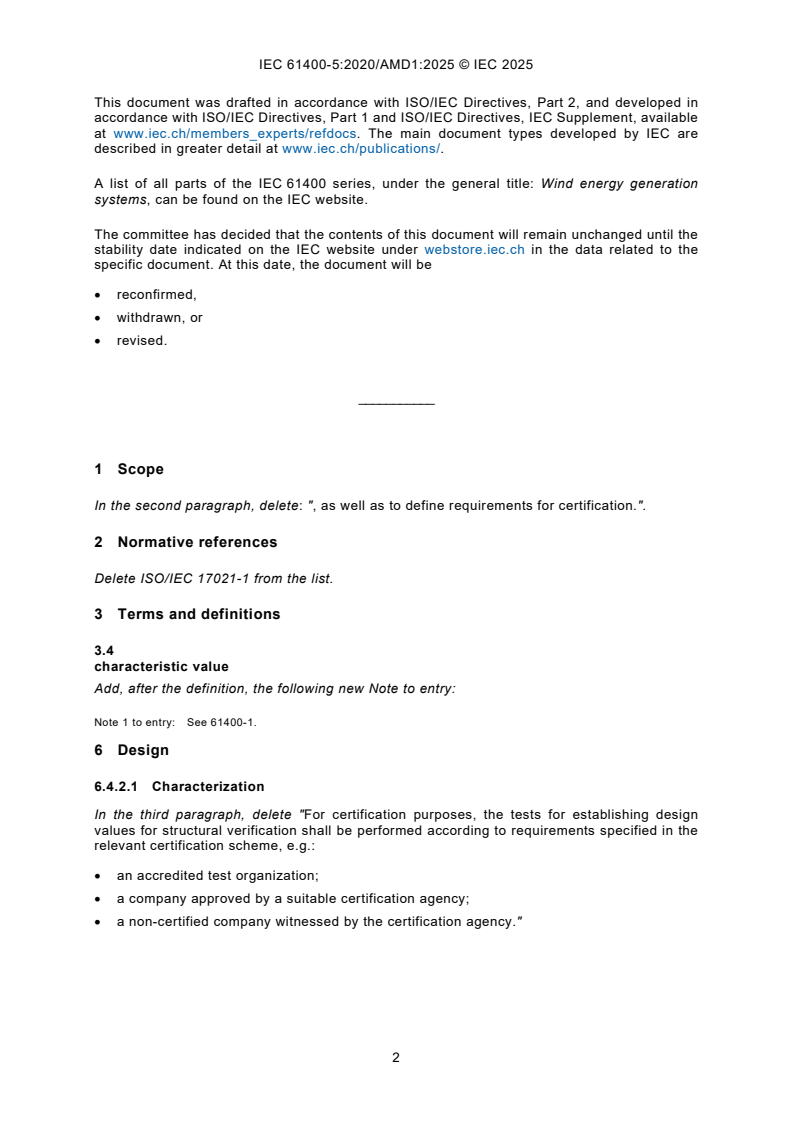
1 Scope
In the second paragraph, delete: ", as well as to define requirements for certification.".
2 Normative references
Delete ISO/IEC 17021-1 from the list.
3 Terms and definitio
...
IEC 61400-5 ®
Edition 1.0 2025-08
NORME
INTERNATIONALE
AMENDEMENT 1
Systèmes de génération d'énergie éolienne -
Partie 5: Pales d’éoliennes
ICS 27.180 ISBN 978-2-8327-0612-1
IEC 61400-5:2020-06/AMD1:2025-08(fr)
Droits de reproduction réservés. Sauf indication contraire, aucune partie de cette publication ne peut être reproduite ni
utilisée sous quelque forme que ce soit et par aucun procédé, électronique ou mécanique, y compris la photocopie et
les microfilms, sans l'accord écrit de l'IEC ou du Comité national de l'IEC du pays du demandeur. Si vous avez des
questions sur le copyright de l'IEC ou si vous désirez obtenir des droits supplémentaires sur cette publication, utilisez
les coordonnées ci-après ou contactez le Comité national de l'IEC de votre pays de résidence.
IEC Secretariat Tel.: +41 22 919 02 11
3, rue de Varembé info@iec.ch
CH-1211 Geneva 20 www.iec.ch
Switzerland
A propos de l'IEC
La Commission Electrotechnique Internationale (IEC) est la première organisation mondiale qui élabore et publie des
Normes internationales pour tout ce qui a trait à l'électricité, à l'électronique et aux technologies apparentées.
A propos des publications IEC
Le contenu technique des publications IEC est constamment revu. Veuillez vous assurer que vous possédez l’édition la
plus récente, un corrigendum ou amendement peut avoir été publié.
Recherche de publications IEC - IEC Products & Services Portal - products.iec.ch
webstore.iec.ch/advsearchform Découvrez notre puissant moteur de recherche et consultez
La recherche avancée permet de trouver des publications gratuitement tous les aperçus des publications, symboles
IEC en utilisant différents critères (numéro de référence, graphiques et le glossaire. Avec un abonnement, vous aurez
texte, comité d’études, …). Elle donne aussi des toujours accès à un contenu à jour adapté à vos besoins.
informations sur les projets et les publications remplacées
ou retirées. Electropedia - www.electropedia.org
Le premier dictionnaire d'électrotechnologie en ligne au
IEC Just Published - webstore.iec.ch/justpublished monde, avec plus de 22 500 articles terminologiques en
Restez informé sur les nouvelles publications IEC. Just anglais et en français, ainsi que les termes équivalents
dans 25 langues additionnelles. Egalement appelé
Published détaille les nouvelles publications parues.
Disponible en ligne et une fois par mois par email. Vocabulaire Electrotechnique International (IEV) en ligne.
Service Clients - webstore.iec.ch/csc
Si vous désirez nous donner des commentaires sur cette
publication ou si vous avez des questions contactez-
nous: sales@iec.ch.
COMMISSION ÉLECTROTECHNIQUE INTERNATIONALE
____________
Systėmes de génération d’énergie éolienne -
Partie 5: Pales d’éoliennes
AMENDEMENT 1
AVANT-PROPOS
1) La Commission Électrotechnique Internationale (IEC) est une organisation mondiale de normalisation composée
de l'ensemble des comités électrotechniques nationaux (Comités nationaux de l’IEC). L’IEC a pour objet de
favoriser la coopération internationale pour toutes les questions de normalisation dans les domaines de
l'électricité et de l'électronique. À cet effet, l’IEC – entre autres activités – publie des Normes internationales,
des Spécifications techniques, des Rapports techniques, des Spécifications accessibles au public (PAS) et des
Guides (ci-après dénommés "Publication(s) de l’IEC"). Leur élaboration est confiée à des comités d'études, aux
travaux desquels tout Comité national intéressé par le sujet traité peut participer. Les organisations
internationales, gouvernementales et non gouvernementales, en liaison avec l’IEC, participent également aux
travaux. L’IEC collabore étroitement avec l'Organisation Internationale de Normalisation (ISO), selon des
conditions fixées par accord entre les deux organisations.
2) Les décisions ou accords officiels de l’IEC concernant les questions techniques représentent, dans la mesure du
possible, un accord international sur les sujets étudiés, étant donné que les Comités nationaux de l’IEC intéressés
sont représentés dans chaque comité d’études.
3) Les Publications de l’IEC se présentent sous la forme de recommandations internationales et sont agréées
comme telles par les Comités nationaux de l’IEC. Tous les efforts raisonnables sont entrepris afin que l’IEC
s'assure de l'exactitude du contenu technique de ses publications; l’IEC ne peut pas être tenue responsable de
l'éventuelle mauvaise utilisation ou interprétation qui en est faite par un quelconque utilisateur final.
4) Dans le but d'encourager l'uniformité internationale, les Comités nationaux de l’IEC s'engagent, dans toute la
mesure possible, à appliquer de façon transparente les Publications de l’IEC dans leurs publications nationales
et régionales. Toutes divergences entre toutes Publications de l’IEC et toutes publications nationales ou
régionales correspondantes doivent être indiquées en termes clairs dans ces dernières.
5) L’IEC elle-même ne fournit aucune attestation de conformité. Des organismes de certification indépendants
fournissent des services d'évaluation de conformité et, dans certains secteurs, accèdent aux marques de
conformité de l’IEC. L’IEC n'est responsable d'aucun des services effectués par les organismes de certification
indépendants.
6) Tous les utilisateurs doivent s'assurer qu'ils sont en possession de la dernière édition de cette publication.
7) Aucune responsabilité ne doit être imputée à l’IEC, à ses administrateurs, employés, auxiliaires ou mandataires,
y compris ses experts particuliers et les membres de ses comités d'études et des Comités nationaux de l’IEC,
pour tout préjudice causé en cas de dommages corporels et matériels, ou de tout autre dommage de quelque
nature que ce soit, directe ou indirecte, ou pour supporter les coûts (y compris les frais de justice) et les dépenses
découlant de la publication ou de l'utilisation de cette Publication de l’IEC ou de toute autre Publication de l’IEC,
ou au crédit qui lui est accordé.
8) L'attention est attirée sur les références normatives citées dans cette publication. L'utilisation de publications
référencées est obligatoire pour une application correcte de la présente publication.
9) L'IEC attire l'attention sur le fait que la mise en application du présent document peut entraîner l'utilisation d'un
ou de plusieurs brevets. L'IEC ne prend pas position quant à la preuve, à la validité et à l'applicabilité de tout
droit de brevet revendiqué à cet égard. À la date de publication du présent document, l'IEC n'a pas reçu
notification qu'un ou plusieurs brevets pouvaient être nécessaires à sa mise en application. Toutefois, il y a lieu
d'avertir les responsables de la mise en application du présent document que des informations plus récentes
sont susceptibles de figurer dans la base de données de brevets, disponible à l'adresse https://patents.iec.ch.
L'IEC ne saurait être tenue pour responsable de ne pas avoir identifié de tels droits de brevets.
L'Amendement 1 de l’IEC 61400-5:2020 a été établi par le comité d’études 88 de l’IEC:
Systèmes de génération d'énergie éolienne.
Le texte de cet Amendement est issu des documents suivants:
Projet Rapport de vote
88/1086/FDIS 88/1107/RVD
Le rapport de vote indiqué dans le tableau ci-dessus donne toute information sur le vote ayant
abouti à son approbation.
La langue employée pour l'élaboration de cet Amendement est l'anglais.
Ce document a été rédigé selon les Directives ISO/IEC, Partie 2, il a été développé selon les
Directives ISO/IEC, Partie 1 et les Directives ISO/IEC, Supplément IEC, disponibles sous
www.iec.ch/members_experts/refdocs. Les principaux types de documents développés par
l'IEC sont décrits plus en détail sous www.iec.ch/publications/.
Une liste de toutes les parties de la série IEC 61400, publiées sous le titre général: Systèmes
de génération d'énergie éolienne, se trouve sur le site web de l'IEC.
Le comité a décidé que le contenu de ce document ne sera pas modifié avant la date de stabilité
indiquée sur le site web de l’IEC sous webstore.iec.ch dans les données relatives au document
recherché. À cette date, le document sera
• reconduit,
• supprimé, ou
• révisé.
___________
1 Domaine d’application
Au deuxième alinéa, supprimer: ", et de définir les exigences relatives à la certification.".
2 Références normatives
Supprimer l'ISO/IEC 17021-1 de la liste.
3 Termes et définitions
3.4
valeur caractéristique
Ajouter, après la définition, la nouvelle note à l’article suivante:
Note 1 à l'article: Voir 61400-1.
...
IEC 61400-5 ®
Edition 1.0 2025-08
INTERNATIONAL
STANDARD
NORME
INTERNATIONALE
AMENDMENT 1
AMENDEMENT 1
Wind energy generation systems -
Part 5: Wind turbine blades
Systèmes de génération d'énergie éolienne -
Partie 5: Pales d’éoliennes
ICS 27.180 ISBN 978-2-8327-0612-1
IEC 61400-5:2020-06/AMD1:2025-08(en-fr)
All rights reserved. Unless otherwise specified, no part of this publication may be reproduced or utilized in any form or
by any means, electronic or mechanical, including photocopying and microfilm, without permission in writing from either
IEC or IEC's member National Committee in the country of the requester. If you have any questions about IEC copyright
or have an enquiry about obtaining additional rights to this publication, please contact the address below or your local
IEC member National Committee for further information.
Droits de reproduction réservés. Sauf indication contraire, aucune partie de cette publication ne peut être reproduite ni
utilisée sous quelque forme que ce soit et par aucun procédé, électronique ou mécanique, y compris la photocopie et
les microfilms, sans l'accord écrit de l'IEC ou du Comité national de l'IEC du pays du demandeur. Si vous avez des
questions sur le copyright de l'IEC ou si vous désirez obtenir des droits supplémentaires sur cette publication, utilisez
les coordonnées ci-après ou contactez le Comité national de l'IEC de votre pays de résidence.
IEC Secretariat Tel.: +41 22 919 02 11
3, rue de Varembé info@iec.ch
CH-1211 Geneva 20 www.iec.ch
Switzerland
About the IEC
The International Electrotechnical Commission (IEC) is the leading global organization that prepares and publishes
International Standards for all electrical, electronic and related technologies.
About IEC publications
The technical content of IEC publications is kept under constant review by the IEC. Please make sure that you have the
latest edition, a corrigendum or an amendment might have been published.
IEC publications search - IEC Products & Services Portal - products.iec.ch
webstore.iec.ch/advsearchform Discover our powerful search engine and read freely all the
The advanced search enables to find IEC publications by a publications previews, graphical symbols and the glossary.
variety of criteria (reference number, text, technical With a subscription you will always have access to up to date
committee, …). It also gives information on projects, content tailored to your needs.
replaced and withdrawn publications.
Electropedia - www.electropedia.org
IEC Just Published - webstore.iec.ch/justpublished The world's leading online dictionary on electrotechnology,
Stay up to date on all new IEC publications. Just Published containing more than 22 500 terminological entries in English
details all new publications released. Available online and and French, with equivalent terms in 25 additional languages.
once a month by email. Also known as the International Electrotechnical Vocabulary
(IEV) online.
IEC Customer Service Centre - webstore.iec.ch/csc
If you wish to give us your feedback on this publication or
need further assistance, please contact the Customer
Service Centre: sales@iec.ch.
A propos de l'IEC
La Commission Electrotechnique Internationale (IEC) est la première organisation mondiale qui élabore et publie des
Normes internationales pour tout ce qui a trait à l'électricité, à l'électronique et aux technologies apparentées.
A propos des publications IEC
Le contenu technique des publications IEC est constamment revu. Veuillez vous assurer que vous possédez l’édition la
plus récente, un corrigendum ou amendement peut avoir été publié.
Recherche de publications IEC - IEC Products & Services Portal - products.iec.ch
webstore.iec.ch/advsearchform Découvrez notre puissant moteur de recherche et consultez
La recherche avancée permet de trouver des publications gratuitement tous les aperçus des publications, symboles
IEC en utilisant différents critères (numéro de référence, graphiques et le glossaire. Avec un abonnement, vous aurez
texte, comité d’études, …). Elle donne aussi des toujours accès à un contenu à jour adapté à vos besoins.
informations sur les projets et les publications remplacées
ou retirées. Electropedia - www.electropedia.org
Le premier dictionnaire d'électrotechnologie en ligne au
IEC Just Published - webstore.iec.ch/justpublished monde, avec plus de 22 500 articles terminologiques en
Restez informé sur les nouvelles publications IEC. Just anglais et en français, ainsi que les termes équivalents
Published détaille les nouvelles publications parues. dans 25 langues additionnelles. Egalement appelé
Disponible en ligne et une fois par mois par email. Vocabulaire Electrotechnique International (IEV) en ligne.
Service Clients - webstore.iec.ch/csc
Si vous désirez nous donner des commentaires sur cette
publication ou si vous avez des questions contactez-
nous: sales@iec.ch.
INTERNATIONAL ELECTROTECHNICAL COMMISSION
____________
Wind energy generation systems -
Part 5: Wind turbine blades
AMENDMENT 1
FOREWORD
1) The International Electrotechnical Commission (IEC) is a worldwide organization for standardization comprising
all national electrotechnical committees (IEC National Committees). The object of IEC is to promote international
co-operation on all questions concerning standardization in the electrical and electronic fields. To this end and
in addition to other activities, IEC publishes International Standards, Technical Specifications, Technical Reports,
Publicly Available Specifications (PAS) and Guides (hereafter referred to as "IEC Publication(s)"). Their
preparation is entrusted to technical committees; any IEC National Committee interested in the subject dealt with
may participate in this preparatory work. International, governmental and non-governmental organizations liaising
with the IEC also participate in this preparation. IEC collaborates closely with the International Organization for
Standardization (ISO) in accordance with conditions determined by agreement between the two organizations.
2) The formal decisions or agreements of IEC on technical matters express, as nearly as possible, an international
consensus of opinion on the relevant subjects since each technical committee has representation from all
interested IEC National Committees.
3) IEC Publications have the form of recommendations for international use and are accepted by IEC National
Committees in that sense. While all reasonable efforts are made to ensure that the technical content of IEC
Publications is accurate, IEC cannot be held responsible for the way in which they are used or for any
misinterpretation by any end user.
4) In order to promote international uniformity, IEC National Committees undertake to apply IEC Publications
transparently to the maximum extent possible in their national and regional publications. Any divergence between
any IEC Publication and the corresponding national or regional publication shall be clearly indicated in the latter.
5) IEC itself does not provide any attestation of conformity. Independent certification bodies provide conformity
assessment services and, in some areas, access to IEC marks of conformity. IEC is not responsible for any
services carried out by independent certification bodies.
6) All users should ensure that they have the latest edition of this publication.
7) No liability shall attach to IEC or its directors, employees, servants or agents including individual experts and
members of its technical committees and IEC National Committees for any personal injury, property damage or
other damage of any nature whatsoever, whether direct or indirect, or for costs (including legal fees) and
expenses arising out of the publication, use of, or reliance upon, this IEC Publication or any other IEC
Publications.
8) Attention is drawn to the Normative references cited in this publication. Use of the referenced publications is
indispensable for the correct application of this publication.
9) IEC draws attention to the possibility that the implementation of this document may involve the use of (a)
patent(s). IEC takes no position concerning the evidence, validity or applicability of any claimed patent rights in
respect thereof. As of the date of publication of this document, IEC had not received notice of (a) patent(s), which
may be required to implement this document. However, implementers are cautioned that this may not represent
the latest information, which may be obtained from the patent database available at https://patents.iec.ch. IEC
shall not be held responsible for identifying any or all such patent rights.
Amendment 1 to IEC 61400-5:2020 has been prepared by the IEC technical committee 88: Wind
energy generation systems.
The text of this Amendment is based on the following documents:
Draft Report on voting
88/1086/FDIS 88/1107/RVD
Full information on the voting for its approval can be found in the report on voting indicated in
the above table.
The language used for the development of this Amendment is English.
This document was drafted in accordance with ISO/IEC Directives, Part 2, and developed in
accordance with ISO/IEC Directives, Part 1 and ISO/IEC Directives, IEC Supplement, available
at www.iec.ch/members_experts/refdocs. The main document types developed by IEC are
described in greater detail at www.iec.ch/publications/.
A list of all parts of the IEC 61400 series, under the general title: Wind energy generation
systems, can be found on the IEC website.
The committee has decided that the contents of this document will remain unchanged until the
stability date indicated on the IEC website under webstore.iec.ch in the data related to the
specific document. At this date, the document will be
• reconfirmed,
• withdrawn, or
• revised.
___________
1 Scope
In the second paragraph, delete: ", as well as to define requirements for certification.".
2 Normative references
Delete ISO/IEC 17021-1 from the list.
3 Terms and definitions
3.4
characteristic value
Add, after the definition, the following new Note to entry:
Note 1 to entry: See 61400-1.
6 Design
6.4.2.1 Characterization
In the third paragraph, delete "For certification purposes, the tests for establishing design
values for structural verification shall be performed according to requirements specified in the
relevant certification scheme, e.g.:
• an accredited test organization;
• a company approved by a suitable certification agency;
• a non-certified company witnessed by the certification agency."
6.6.2.3 Stability analysis
Replace the existing text with the following:
Global static instability (i.e., global buckling) occurs when a small increase in load results in a
large and unstable increase in deformation, thereby limiting the capacity of the blade to carry
any further load. It shall be demonstrated that global static instability does not occur at any load
less than or equal to the product of the design load and the applicable combined factor of safety
required herein. Nonlinear increases in the deformation of the blade in response to increases
in load are permissible so long as the response remains stable, the blade does not lose its
ability to carry further increases in load, and the nonlinear response does not induce damage
in any structure due to other failure modes or result in excessive deflection of the blade towards
the tower.
Local instability (i.e., local buckling) refers to a portion of a structural member (e.g., sandwich
panel face sheet wrinkling or crimping) and shall be evaluated.
The verification of static stability shall be based on analytical or numerical methods, full scale
testing or a combination hereof.
6.6.3.2 Validation of global model by testing
In the first paragraph, replace "For certification, a general validation of the design through a
comparison with obtained results from full scale blade testing applies. This includes as a
minimum" with "When the design created in accordance with the requirements of this document
is validated through a comparison with obtained results from full scale blade testing, the
following applies as a minimum:".
6.6.3.3 Validation of analytical models and methods
Delete, at the end of the third paragraph, "and/or certified".
6.6.4.1 Definitions
Add, after "γ is the factor for load characterization." the following new text:
m5
The combined partial safety factor for materials in this document shall not be less than the
minimum partial safety factor for resistance specified in IEC 61400-1.
6.6.5.5 Sandwich core ultimate strength verification
In the first paragraph, replace "core material mean strength values." with "core material
statistically derived characteristic strength values".
6.6.5.6 Global static stability (global buckling)
Replace the first five paragraphs with the following new text and figure:
The designer shall verify through analysis that the blade does not lose its ability to carry load
due to static instability at the design load with a combined safety factor equal to the product of
γ and the factors γ through γ listed in the table below.
m0 m1 m5
The analyses shall be based on using statistically derived mean values of the material stiffness.
Thicknesses of sandwich cores shall be conservatively estimated, including potential
compression related to the selected method of manufacturing.
The suitability of the FE mesh density shall be demonstrated by a convergence study. A
sufficient accuracy of the mesh may be assumed when the (linear) buckling eigenvalue does
not change by more than 5 % if the mesh density is doubled in the region of the model pertinent
to the buckling mode in question.
For verification using linear methods of buckling analysis, it shall be demonstrated that the
minimum eigenvalue corresponding to the first eigenform exceeds the required combined safety
factor.
For verification using finite element analyses that model geometric non-linearity:
• The analysis shall demonstrate convergence when the combined safety factor γ has been
m
applied to the design load.
• The load vector directions shall be considered and related to the deformation of the blade
and consistent with the external loading.
• The FEM shall accurately reflect geometric imperfections related to validated production
tolerance data. Alternatively, in the absence of validated production tolerance data, a stress-
free pre-deformation proportional to the relevant linear buckling eigenforms (i.e., linear
modes with an eigenvalue less than the required combined safety factor, including
γ = 1,20) shall be applied to the structure with the height scaled to 0,25 % of the relevant
m4a
eigenform wavelength. For the non-linear analysis in each load direction, a single pre-
deformation may be formed from the superposition of the pre-deformations for the pertinent
eigenforms associated with each independent linear buckling mode that does not fulfil the
criteria for verification of static stability using a linear buckling calculation in that load
direction.
• Nonlinear response shall not
– result in failure of any structural member; all relevant failure modes shall be examined
as per the remaining requirements of this document, appropriately accounting for
nonlinear response;
– occur at a load low enough to result in local fatigue damage, as per requirements
elsewhere in this document;
– result in excessive deflection of the blade as defined elsewhere in this document.
The term "independent linear buckling mode" is used to distinguish between buckling modes
that appear at different locations on a blade and are due to distinctly different structural
responses of the blade to a given externally applied load, in contrast to multiple modes
emanating from a single location on the blade and reflective of a common structural response
of the blade to the applied load. For example, in Figure 6, modes 1, 2, and 3 would be
considered non-independent modes, while modes 1 and 20 would be considered independent
of each other. The pertinent ei
...