

IEC 60335-2-90:1997
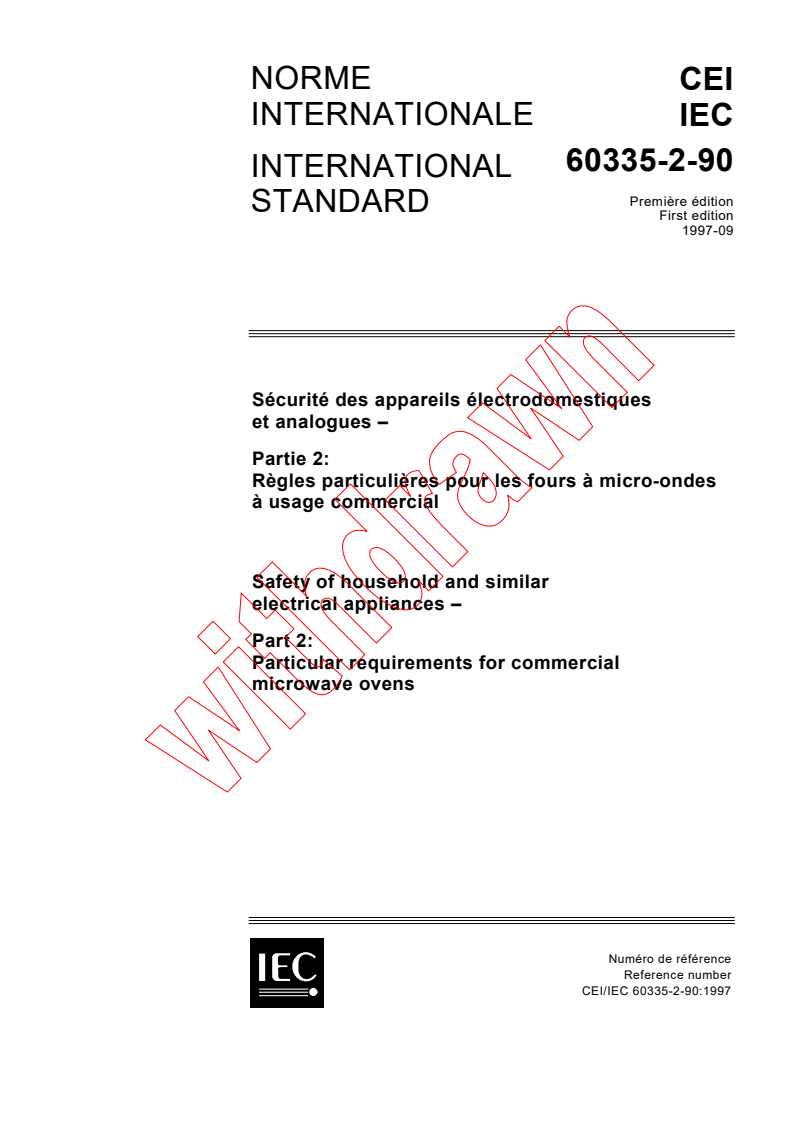
(Main)Safety of household and similar electrical appliances - Part 2: Particular requirements for commercial microwave ovens
General Information
- Abstract
Deals with the safety of microwave ovens for commercial use, which incorporate a door for user access to the cavity.
- Status
- Published
- Publication Date
- 25-Sep-1997
- Current Stage
- DELPUB - Deleted Publication
- Start Date
- 14-May-2002
- Completion Date
- 28-Aug-2026
Overview
The IEC 60335-2-90:1997 standard titled "Safety of household and similar electrical appliances – Part 2: Particular requirements for commercial microwave ovens" specifically addresses the safety criteria for microwave ovens used in commercial environments. This international standard, issued by the International Electrotechnical Commission (IEC), ensures that commercial microwave ovens equipped with a user-accessible door operate safely under normal and abnormal conditions.
Published in 1997, this first edition standard supplements the general safety requirements of IEC 60335-1 with detailed provisions tailored to the unique design and usage scenarios of commercial microwave ovens. It is a critical resource for manufacturers, safety engineers, regulatory bodies, and quality assurance professionals involved with commercial kitchen appliances.
Key Topics
- Scope and Application: Focuses on microwave ovens designed for commercial use, containing requirements related to user access, electrical safety, mechanical hazards, and appliance durability.
- Protection Measures: Includes guidelines for preventing user access to live electrical parts, ensuring overload protection, and safeguarding against leakage currents.
- Performance Testing: Specifies general conditions for testing heating efficiency, endurance under abnormal operation, moisture resistance, and mechanical strength.
- Marking and Instructions: Details mandatory appliance markings and user instructions to inform about proper use and safety precautions.
- Construction and Components: Provides criteria for internal wiring, the use of reliable components, correct supply connections, effective grounding provisions, and resistance to rust, fire, and heat.
- Hazard Prevention: Addresses protection against radiation, toxicity, mechanical instability, and risks from electrical discharges or insulation failures.
- Compliance with IEC 60335-1: This part must be used in conjunction with the latest edition of IEC 60335-1 and its amendments, integrating general safety approaches with commercial microwave oven specifics.
Applications
IEC 60335-2-90:1997 directly applies to:
- Manufacturers of commercial microwave ovens making units that serve restaurants, cafeterias, catering services, and other food-service businesses.
- Quality control and product safety testing labs validating compliance with international safety standards before market launch.
- Regulatory bodies ensuring public and user safety by setting standards for commercial kitchen appliance certifications.
- Design engineers developing microwave ovens that meet both functionality and internationally recognized safety parameters.
- Maintenance and repair services following standardized safety protocols when servicing commercial microwaves.
By adhering to IEC 60335-2-90, stakeholders can guarantee:
- Enhanced safety for commercial users handling microwave ovens in high-demand environments.
- Reduced risk of electrical shock, fire, and mechanical hazards.
- Longevity and reliability of devices sustained by standardized durability and component requirements.
- Clear marking and guidance that support safe installation, operation, and maintenance.
Related Standards
- IEC 60335-1: General safety requirements for household and similar electrical appliances. This standard forms the foundation and must be read alongside Part 2 for comprehensive safety coverage.
- IEC 60050: International Electrotechnical Vocabulary, which clarifies terminology used in electrical safety and appliance design.
- IEC 60027, 60417, 60617: Standards related to graphical symbols and letter symbols used on electrical equipment, important for markings and safety instructions on commercial microwave ovens.
- Additional IEC safety and testing standards addressing electrical equipment, environmental resistance, and user protection applicable to commercial kitchen appliances.
Adopting IEC 60335-2-90:1997 ensures commercial microwave ovens meet rigorous international safety standards, protecting users and property in professional cooking environments while supporting manufacturers with clear product development and testing guidelines.
Relations
- Effective Date
- 05-Sep-2023
Frequently Asked Questions
IEC 60335-2-90:1997 is a standard published by the International Electrotechnical Commission (IEC). Its full title is "Safety of household and similar electrical appliances - Part 2: Particular requirements for commercial microwave ovens". This standard covers: Deals with the safety of microwave ovens for commercial use, which incorporate a door for user access to the cavity.
Deals with the safety of microwave ovens for commercial use, which incorporate a door for user access to the cavity.
IEC 60335-2-90:1997 is classified under the following ICS (International Classification for Standards) categories: 97.040.20 - Cooking ranges, working tables, ovens and similar appliances. The ICS classification helps identify the subject area and facilitates finding related standards.
IEC 60335-2-90:1997 has the following relationships with other standards: It is inter standard links to IEC 60335-2-90:2002. Understanding these relationships helps ensure you are using the most current and applicable version of the standard.
IEC 60335-2-90:1997 is available in PDF format for immediate download after purchase. The document can be added to your cart and obtained through the secure checkout process. Digital delivery ensures instant access to the complete standard document.
Standards Content (Sample)
NORME
CEI
INTERNATIONALE
IEC
60335-2-90
INTERNATIONAL
Première édition
STANDARD
First edition
1997-09
Sécurité des appareils électrodomestiques
et analogues –
Partie 2:
Règles particulières pour les fours à micro-ondes
à usage commercial
Safety of household and similar
electrical appliances –
Part 2:
Particular requirements for commercial
microwave ovens
Numéro de référence
Reference number
CEI/IEC 60335-2-90:1997
Numéros des publications Numbering
Les publications de la CEI sont numérotées à partir de As from the 1st January 1997 all IEC publications are
60000 dès le 1er janvier 1997. issued with a designation in the 60000 series.
Publications consolidées Consolidated publications
Les versions consolidées de certaines publications de Consolidated versions of some IEC publications
la CEI incorporant amendements sont disponibles. Par including amendments are available. For example,
exemple, les numéros d’édition 1.0, 1.1 et 1.2 edition numbers 1.0, 1.1 and 1.2 refer, respectively, to
indiquent respectivement la publication de base, la the base publication, the base publication
publication de base incorporant l’amendement 1, et la incorporating amendment 1 and the base publication
publication de base incorporant les amendements 1 incorporating amendments 1 and 2.
et 2.
Validité de la présente publication Validity of this publication
Le contenu technique des publications de la CEI est The technical content of IEC publications is kept under
constamment revu par la CEI afin qu'il reflète l'état constant review by the IEC, thus ensuring that the
actuel de la technique. content reflects current technology.
Des renseignements relatifs à la date de Information relating to the date of the reconfirmation of
reconfirmation de la publication sont disponibles dans the publication is available in the IEC catalogue.
le Catalogue de la CEI.
Les renseignements relatifs à ces révisions, à l'établis- Information on the revision work, the issue of revised
sement des éditions révisées et aux amendements editions and amendments may be obtained from
peuvent être obtenus auprès des Comités nationaux de IEC National Committees and from the following
la CEI et dans les documents ci-dessous: IEC sources:
• Bulletin de la CEI • IEC Bulletin
• Annuaire de la CEI • IEC Yearbook
Accès en ligne* On-line access*
• Catalogue des publications de la CEI • Catalogue of IEC publications
Publié annuellement et mis à jour régulièrement Published yearly with regular updates
(Accès en ligne)* (On-line access)*
Terminologie, symboles graphiques Terminology, graphical and letter
et littéraux symbols
En ce qui concerne la terminologie générale, le lecteur For general terminology, readers are referred to
se reportera à la CEI 60050: Vocabulaire Electro- IEC 60050: International Electrotechnical Vocabulary
technique International (VEI). (IEV).
Pour les symboles graphiques, les symboles littéraux For graphical symbols, and letter symbols and signs
et les signes d'usage général approuvés par la CEI, le approved by the IEC for general use, readers are
lecteur consultera la CEI 60027: Symboles littéraux à referred to publications IEC 60027: Letter symbols to
utiliser en électrotechnique, la CEI 60417: Symboles be used in electrical technology, IEC 60417: Graphical
symbols for use on equipment. Index, survey and
graphiques utilisables sur le matériel. Index, relevé et
compilation des feuilles individuelles, et la CEI 60617: compilation of the single sheets and IEC 60617:
Symboles graphiques pour schémas. Graphical symbols for diagrams.
Publications de la CEI établies par IEC publications prepared by the same
le même comité d'études technical committee
L'attention du lecteur est attirée sur les listes figurant The attention of readers is drawn to the end pages of
à la fin de cette publication, qui énumèrent les this publication which list the IEC publications issued
publications de la CEI préparées par le comité by the technical committee which has prepared the
d'études qui a établi la présente publication. present publication.
* Voir adresse «site web» sur la page de titre. * See web site address on title page.
NORME
CEI
INTERNATIONALE
IEC
60335-2-90
INTERNATIONAL
Première édition
STANDARD
First edition
1997-09
Sécurité des appareils électrodomestiques
et analogues –
Partie 2:
Règles particulières pour les fours à micro-ondes
à usage commercial
Safety of household and similar
electrical appliances –
Part 2:
Particular requirements for commercial
microwave ovens
IEC 1997 Droits de reproduction réservés Copyright - all rights reserved
Aucune partie de cette publication ne peut être reproduite ni No part of this publication may be reproduced or utilized in
utilisée sous quelque forme que ce soit et par aucun any form or by any means, electronic or mechanical,
procédé, électronique ou mécanique, y compris la photo- including photocopying and microfilm, without permission in
copie et les microfilms, sans l'accord écrit de l'éditeur. writing from the publisher.
International Electrotechnical Commission 3, rue de Varembé Geneva, Switzerland
Telefax: +41 22 919 0300 e-mail: inmail@iec.ch IEC web site http: //www.iec.ch
CODE PRIX
Commission Electrotechnique Internationale
S
PRICE CODE
International Electrotechnical Commission
Pour prix, voir catalogue en vigueur
For price, see current catalogue
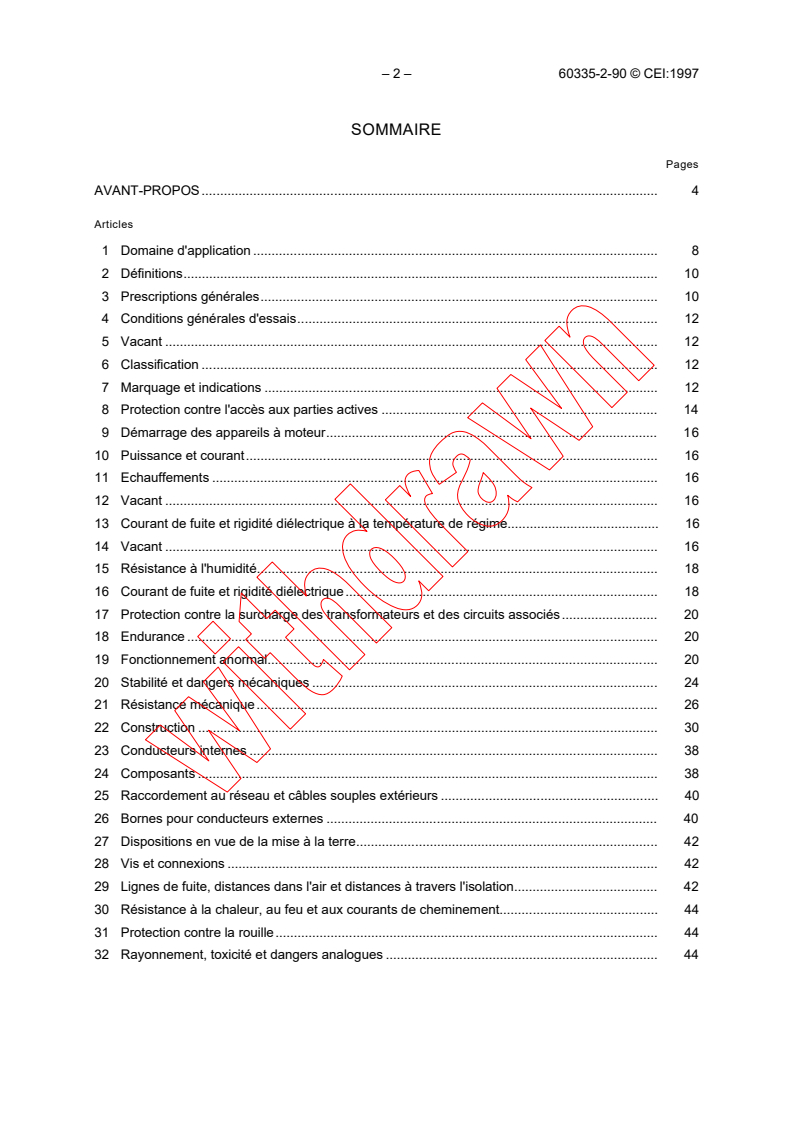
– 2 – 60335-2-90 © CEI:1997
SOMMAIRE
Pages
AVANT-PROPOS. 4
Articles
1 Domaine d'application . 8
2 Définitions. 10
3 Prescriptions générales. 10
4 Conditions générales d'essais. 12
5 Vacant . 12
6 Classification . 12
7 Marquage et indications . 12
8 Protection contre l'accès aux parties actives . 14
9 Démarrage des appareils à moteur. 16
10 Puissance et courant. 16
11 Echauffements. 16
12 Vacant. 16
13 Courant de fuite et rigidité diélectrique à la température de régime. 16
14 Vacant. 16
15 Résistance à l'humidité. 18
16 Courant de fuite et rigidité diélectrique. 18
17 Protection contre la surcharge des transformateurs et des circuits associés. 20
18 Endurance. 20
19 Fonctionnement anormal. 20
20 Stabilité et dangers mécaniques .24
21 Résistance mécanique. 26
22 Construction. 30
23 Conducteurs internes. 38
24 Composants. 38
25 Raccordement au réseau et câbles souples extérieurs . 40
26 Bornes pour conducteurs externes . 40
27 Dispositions en vue de la mise à la terre. 42
28 Vis et connexions . 42
29 Lignes de fuite, distances dans l'air et distances à travers l'isolation. 42
30 Résistance à la chaleur, au feu et aux courants de cheminement. 44
31 Protection contre la rouille. 44
32 Rayonnement, toxicité et dangers analogues . 44
60335-2-90 © IEC:1997 – 3 –
CONTENTS
Page
FOREWORD . 5
Cause
1 Scope. 9
2 Definitions. 11
3 General requirement. 11
4 General conditions for the tests. 13
5 Void. 13
6 Classification. 13
7 Marking and instructions . 13
8 Protection against access to live parts. 15
9 Starting of motor-operated appliances . 17
10 Power input and current . 17
11 Heating. 17
12 Void. 17
13 Leakage current and electric strength at operating temperature . 17
14 Void. 17
15 Moisture resistance. 19
16 Leakage current and electric strength. 19
17 Overload protection of transformers and associated circuits . 21
18 Endurance. 21
19 Abnormal operation. 21
20 Stability and mechanical hazards.25
21 Mechanical strength. 27
22 Construction. 31
23 Internal wiring. 39
24 Components. 39
25 Supply connection and external flexible cords . 41
26 Terminals for external conductors.41
27 Provision for earthing . 43
28 Screws and connections . 43
29 Creepage distances, clearances and distances through insulation . 43
30 Resistance to heat, fire and tracking.45
31 Resistance to rusting. 45
32 Radiation, toxicity and similar hazards . 45
– 4 – 60335-2-90 © CEI:1997
COMMISSION ÉLECTROTECHNIQUE INTERNATIONALE
_________
SÉCURITÉ DES APPAREILS ÉLECTRODOMESTIQUES
ET ANALOGUES –
Partie 2: Règles particulières pour les fours à micro-ondes
à usage commercial
AVANT-PROPOS
1) La CEI (Commission Electrotechnique Internationale) est une organisation mondiale de normalisation composée
de l'ensemble des comités électrotechniques nationaux (Comités nationaux de la CEI). La CEI a pour objet de
favoriser la coopération internationale pour toutes les questions de normalisation dans les domaines de
l'électricité et de l'électronique. A cet effet, la CEI, entre autres activités, publie des Normes internationales.
Leur élaboration est confiée à des comités d'études, aux travaux desquels tout Comité national intéressé par le
sujet traité peut participer. Les organisations internationales, gouvernementales et non gouvernementales, en
liaison avec la CEI, participent également aux travaux. La CEI collabore étroitement avec l'Organisation
Internationale de Normalisation (ISO), selon des conditions fixées par accord entre les deux organisations.
2) Les décisions ou accords officiels de la CEI concernant les questions techniques représentent, dans la mesure
du possible un accord international sur les sujets étudiés, étant donné que les Comités nationaux intéressés
sont représentés dans chaque comité d’études.
3) Les documents produits se présentent sous la forme de recommandations internationales. Ils sont publiés
comme normes, rapports techniques ou guides et agréés comme tels par les Comités nationaux.
4) Dans le but d'encourager l'unification internationale, les Comités nationaux de la CEI s'engagent à appliquer de
façon transparente, dans toute la mesure possible, les Normes internationales de la CEI dans leurs normes
nationales et régionales. Toute divergence entre la norme de la CEI et la norme nationale ou régionale
correspondante doit être indiquée en termes clairs dans cette dernière.
5) La CEI n’a fixé aucune procédure concernant le marquage comme indication d’approbation et sa responsabilité
n’est pas engagée quand un matériel est déclaré conforme à l’une de ses normes.
6) L’attention est attirée sur le fait que certains des éléments de la présente Norme internationale peuvent faire
l’objet de droits de propriété intellectuelle ou de droits analogues. La CEI ne saurait être tenue pour
responsable de ne pas avoir identifié de tels droits de propriété et de ne pas avoir signalé leur existence.
La présente partie de la Norme internationale CEI 60335 a été établie par le sous-comité 61B:
Sécurité des fours à micro-ondes, du comité d'études 61 de la CEI: Sécurité des appareils
électrodomestiques et analogues.
Elle constitue la première édition de la CEI 60335-2-90.
Le texte de cette norme est issu des documents suivants:
FDIS Rapport de vote
61B/111/FDIS 61B/117/RVD
Le rapport de vote indiqué dans le tableau ci-dessus donne toute information sur le vote ayant
abouti à l'approbation de cette norme.
La présente partie 2 doit être utilisée conjointement avec la dernière édition de la CEI 60335-1
et ses amendements. Elle a été établie sur la base de la troisième édition (1991) de cette
norme.
La présente partie 2 complète ou modifie les articles correspondants de la CEI 60335-1 de
façon à la transformer en norme CEI: Règles de sécurité pour les fours à micro-ondes à usage
commercial.
60335-2-90 © IEC:1997 – 5 –
INTERNATIONAL ELECTROTECHNICAL COMMISSION
_________
SAFETY OF HOUSEHOLD AND SIMILAR
ELECTRICAL APPLIANCES –
Part 2: Particular requirements for
commercial microwave ovens
FOREWORD
1) The IEC (International Electrotechnical Commission) is a worldwide organization for standardization comprising
all national electrotechnical committees (IEC National Committees). The object of the IEC is to promote
international co-operation on all questions concerning standardization in the electrical and electronic fields. To
this end and in addition to other activities, the IEC publishes International Standards. Their preparation is
entrusted to technical committees; any IEC National Committee interested in the subject dealt with may
participate in this preparatory work. International, governmental and non-governmental organizations liaising
with the IEC also participate in this preparation. The IEC collaborates closely with the International Organization
for Standardization (ISO) in accordance with conditions determined by agreement between the two
organizations.
2) The formal decisions or agreements of the IEC on technical matters express, as nearly as possible, an
international consensus of opinion on the relevant subjects since each technical committee has representation
from all interested National Committees.
3) The documents produced have the form of recommendations for international use and are published in the form
of standards, technical reports or guides and they are accepted by the National Committees in that sense.
4) In order to promote international unification, IEC National Committees undertake to apply IEC International
Standards transparently to the maximum extent possible in their national and regional standards. Any
divergence between the IEC Standard and the corresponding national or regional standard shall be clearly
indicated in the latter.
5) The IEC provides no marking procedure to indicate its approval and cannot be rendered responsible for any
equipment declared to be in conformity with one of its standards.
6) Attention is drawn to the possibility that some of the elements of this International Standard may be the subject
of patent rights. The IEC shall not be held responsible for identifying any or all such patent rights.
This part of International Standard IEC 60335 has been prepared by subcommittee 61B: Safety
of microwave ovens, of IEC technical committee 61: Safety of household and similar electrical
appliances.
It forms the first edition of IEC 60335-2-90.
The text of this standard is based on the following documents:
FDIS Report on voting
61B/111/FDIS 61B/117/RVD
Full information on the voting for the approval of this standard can be found in the report on
voting indicated in the above table.
This part 2 is to be used in conjunction with the latest edition of IEC 60335-1 and its
amendments. It was established on the basis of the third edition (1991) of that standard.
This part 2 supplements or modifies the corresponding clauses in IEC 60335-1, so as to
convert it into the IEC standard: Safety requirements for commercial microwave ovens.
– 6 – 60335-2-90 © CEI:1997
Lorsqu'un paragraphe particulier de la partie 1 n'est pas mentionné dans cette partie 2, ce
paragraphe s'applique pour autant qu'il soit raisonnable. Lorsque la présente norme spécifie
«addition», «modification» ou «remplacement», le texte correspondant de la partie 1 doit être
adapté en conséquence.
NOTES
1 Les caractères d'imprimerie suivants sont utilisés:
– prescriptions: caractères romains;
– modalités d'essais: caractères italiques;
– notes: petits caractères romains.
Les mots figurant en caractères gras dans le texte sont définis à l'article 2. Lorsqu'une définition de la partie 1
concerne un adjectif, l'adjectif et le nom associé figurent également en gras.
2 Les paragraphes, tableaux et figures complémentaires à ceux de la partie 1 sont numérotés à partir de 101.
Les annexes complémentaires à celles de la partie 1 sont appelées AA, BB, etc.
Les différences complémentaires suivantes existent dans certains pays:
– 4.3: Les fuites de micro-ondes ne doivent pas dépasser 10 W/m pendant l'essai initial (Canada, Japon et USA).
– 6.1: Les fours à micro-ondes peuvent être de la classe 0I si leur tension assignée ne dépasse pas 150 V (Japon).
– 7.12.1: Certaines mises en garde doivent être marquées sur l'appareil et être visibles pour l'usager
(Canada et Nouvelle-Zélande).
– Article 18: L’essai est réalisé sur deux appareils (USA).
– 19.11.2: La variation de la tension d'entrée n'est pas appliquée (USA).
– 19.13: Les fuites de micro-ondes sont mesurées uniquement à la fin de chaque essai (USA).
– 21.102: La force appliquée est de 222 N (USA).
– 21.105: Les fuites de micro-ondes ne doivent pas dépasser 50 W/m (Japon et USA).
– 22.111: Les fuites de micro-ondes sont mesurées uniquement à la fin de l'essai (USA).
– 22.112: Les fuites de micro-ondes ne doivent pas dépasser 50 W/m (Japon et USA).
– 22.115: Aucun accès à la cavité n'est autorisé (USA).
– 27.2: Une borne de raccordement d'un conducteur équipotentiel extérieur n'est pas requise (Japon).
60335-2-90 © IEC:1997 – 7 –
Where a particular subclause of part 1 is not mentioned in this part 2, that subclause applies
as far as is reasonable. Where this standard states "addition", "modification" or "replacement",
the relevant text in part 1 is to be adapted accordingly.
NOTES
1 The following print types are used:
– requirements: in roman type;
– test specifications: in italic type;
– notes: in small roman type.
Words in bold type in the text are defined in clause 2. When a definition of part 1 concerns an adjective, the
adjective and the associated noun are also in bold.
2 Subclauses, tables and figures which are additional to those in part 1 are numbered starting from 101.
Annexes which are additional to those in part 1 are lettered AA, BB, etc.
The following additional differences exist in some countries:
– 4.3: Microwave leakage is not to exceed 10 W/m during the initial test (Japan, USA and Canada).
– 6.1: Microwave ovens may be class OI if the rated voltage does not exceed more than 150 V (Japan).
– 7.12.1: Some warnings have to be marked on the appliance and be visible to the user (New Zealand and
Canada).
– Clause 18: The test is carried out on two appliances (USA).
– 19.11.2: The input voltage variation is not applied (USA).
– 19.13: Microwave leakage is only measured at the end of each test (USA).
– 21.102: The applied force is 222 N (USA).
– 21.105: Microwave leakage is not to exceed 50 W/m (Japan and USA).
– 22.111: Microwave leakage is only measured at the end of the test (USA).
– 22.112: Microwave leakage is not to exceed 50 W/m (Japan and USA).
– 22.115: All access to the cavity has to be prevented (USA).
– 7.2: A terminal for an external equipotential conductor is not required (Japan).
– 8 – 60335-2-90 © CEI:1997
SÉCURITÉ DES APPAREILS ÉLECTRODOMESTIQUES
ET ANALOGUES –
Partie 2: Règles particulières pour les fours à micro-ondes
à usage commercial
1 Domaine d'application
L'article de la partie 1 est remplacé par:
La présente norme traite de la sécurité électrique des fours à micro-ondes destinés à un usage
commercial, dont la tension assignée n'est pas supérieure à 250 V pour les appareils
monophasés connectés entre phase et neutre, et 480 V pour les autres appareils.
Les appareils couverts par cette norme comportent une porte pour permettre l’accès à la cavité
par les usagers.
NOTES
1 L’appareil peut être encastré dans un distributeur automatique, auquel cas la CEI 60335-2-75 peut
également être applicable.
2 Pour les fours comportant un moyen de chauffage conventionnel, la CEI 60335-2-36 ou la CEI 60335-2-42
peuvent également être applicables.
3 La présente norme s’applique également aux appareils faisant appel à d’autres formes d’énergie que
l’énergie électrique.
Cette norme ne tient en général pas compte
– de l’utilisation des appareils par des jeunes enfants ou des personnes handicapées sans
surveillance;
– de l'emploi de l'appareil comme jouet par des jeunes enfants.
NOTES
4 L'attention est attirée sur le fait que
– pour les appareils destinés à être utilisés dans des véhicules ou à bord des navires ou des avions, des
prescriptions supplémentaires peuvent être nécessaires;
– pour les appareils destinés à être utilisés dans les pays tropicaux, des prescriptions spéciales peuvent
être nécessaires;
– dans de nombreux pays, des prescriptions supplémentaires sont imposées par les organismes nationaux
de la santé publique, par les organismes nationaux responsables de la protection des travailleurs et par des
organismes similaires.
5 La présente norme ne s'applique pas
– aux fours à micro-ondes à usage domestique (CEI 60335-2-25);
1)
– aux combinés à usage domestique (CEI 60335-2-100) ;
fours à micro-ondes
– aux appareils à micro-ondes à convoyeur;
2)
– aux installations électrothermiques industrielles à hyperfréquences (CEI 60519-6) ;
3)
– aux appareils à usage médical (CEI 60601) ;
– aux appareils destinés à être utilisés dans des locaux présentant des conditions particulières, telles que
la présence d'une atmosphère corrosive ou explosive (poussière, vapeur ou gaz).
________
1)
A publier.
2)
CEI 60519-6: 1982, Spécifications pour la sécurité dans les installations électrothermiques industrielles à hyper-
fréquences.
3)
CEI 60601: Appareils électromédicaux.
60335-2-90 © IEC:1997 – 9 –
SAFETY OF HOUSEHOLD AND SIMILAR
ELECTRICAL APPLIANCES –
Part 2: Particular requirements for
commercial microwave ovens
1 Scope
This clause of part 1 is replaced by:
This standard deals with the safety of microwave ovens intended for commercial use, the
rated voltage being not more than 250 V for single-phase appliances connected between one
phase and neutral and 480 V for other appliances.
Appliances covered by this standard incorporate a door for user access to the cavity.
NOTES
1 The appliance may be built into a vending machine, in which case IEC 60335-2-75 may also be applicable.
2 IEC 60335-2-36 or IEC 60335-2-42 may also be applicable to ovens incorporating conventional heating
means.
3 Appliances that use non-electrical energy are within the scope of this standard.
This standard does not in general take into account
– the use of appliances by young children or infirm persons without supervision;
– playing with the appliance by young children.
NOTES
4 Attention is drawn to the fact that
– for appliances intended to be used in vehicles or on board ships or aircraft, additional requirements may
be necessary;
– for appliances intended to be used in tropical countries, special requirements may be necessary;
– in many countries, additional requirements are specified by the national health authorities, the national
authorities responsible for the protection of labour and similar authorities.
5 This standard does not apply to
– household microwave ovens (IEC 60335-2-25);
1)
– household combination microwave ovens (IEC 60335-2-100) ;
– conveyor type microwave appliances;
2)
– industrial microwave heating equipment (IEC 60519-6) ;
3)
– appliances for medical purposes (IEC 60601) ;
– appliances intended to be used in locations where special conditions prevail, such as the presence of a
corrosive or explosive atmosphere (dust, vapour or gas).
________
1)
To be published.
2)
IEC 60519-6: 1982, Safety in electroheat installations – Part 6: Specifications for safety in industrial
microwave testing equipment.
3)
IEC 60601: Medical electrical equipment.
– 10 – 60335-2-90 © CEI:1997
2 Définitions
L'article de la partie 1 est applicable avec les exceptions suivantes:
2.2.7 Addition:
NOTE – La fréquence assignée est la fréquence de l'alimentation.
2.2.9 Remplacement:
conditions de fonctionnement normales: Fonctionnement de l’appareil dans les conditions
suivantes:
L'appareil est mis en fonctionnement avec 1 000 g ± 50 g d'eau potable à une température initiale
de 20 °C ± 2 °C, dans un récipient cylindrique en verre de borosilicate ayant une épaisseur
maximale de 3 mm et un diamètre extérieur de 190 mm environ. Le récipient est placé au centre
de l’étagère. Si la puissance restituée assignée des micro-ondes est supérieure à 2 200 W,
on utilise deux récipients placés côte à côte dans la cavité.
2.101 four à micro-ondes: Appareil utilisant l'énergie électromagnétique d'une ou plusieurs
1)
bandes de fréquence lSM entre 300 MHz et 30 GHz, pour le chauffage des aliments ou des
boissons dans une cavité.
2.102 puissance restituée assignée des micro-ondes: Puissance restituée des micro-
ondes attribuée à l'appareil par le fabricant.
2.103 cavité: Espace délimité par les parois internes et la porte, dans lequel est placée la charge.
2.104 étagère: Support horizontal dans la cavité sur lequel est posée la charge.
2.105 verrouillage de porte: Dispositif ou système dont la fonction est d'empêcher le
fonctionnement du magnétron tant que la porte du four n'est pas fermée.
2.106 verrouillage asservi de porte: Système de verrouillage de porte incorporant un
dispositif de surveillance.
2.107 sonde thermique: Dispositif qui est introduit dans les denrées alimentaires pour en
mesurer la température et qui est un élément du dispositif de commande du four.
3 Prescriptions générales
L'article de la partie 1 est applicable.
________
1)
Les bandes de fréquence ISM sont les fréquences électromagnétiques établies par l'UIT et reprises dans la CISPR 11.
60335-2-90 © IEC:1997 – 11 –
2 Definitions
This clause of part 1 is applicable except as follows:
2.2.7 Addition:
NOTE – The rated frequency is the input frequency.
2.2.9 Replacement:
normal operation: Operation of the appliance under the following conditions:
The appliance is operated with 1 000 g ± 50 g of potable water at an initial temperature of
20 °C ± 2 °C in a cylindrical borosilicate glass vessel having a maximum thickness of 3 mm
and an outside diameter of approximately 190 mm. The vessel is placed on the centre of the
shelf. If the rated microwave power output exceeds 2 200 W, two such vessels are used and
placed contiguously in the cavity.
2.101 microwave oven: Appliance using electromagnetic energy in one or several of the ISM
1)
frequency bands between 300 MHz and 30 GHz, for heating food and beverages in a cavity.
2.102 rated microwave power output: Microwave power output assigned to the appliance by
the manufacturer.
2.103 cavity: Space enclosed by the inner walls and the door, and in which the load is placed.
2.104 shelf: Horizontal support in the cavity on which the load is placed.
2.105 door interlock: Device or system which prevents the operation of the magnetron
unless the oven door is closed.
2.106 monitored door interlock: Door interlock system which incorporates a supervision
device.
2.107 temperature sensing probe: Device which is inserted into the food to measure its
temperature and which is a part of an oven control.
3 General requirement
This clause of part 1 is applicable.
________
1)
ISM frequency bands are the electromagnetic frequencies established by the ITU and reproduced in CISPR 11.
– 12 – 60335-2-90 © CEI:1997
4 Conditions générales d'essais
L'article de la partie 1 est applicable avec les exceptions suivantes:
4.2 Addition:
NOTE – Un échantillon supplémentaire peut être demandé pour l'essai de 19.104. Six échantillons de
verrouillages sont prescrits pour l'essai de 24.101.
4.3 Modification:
Au lieu d'effectuer les essais dans l'ordre des articles, ils sont effectués dans l'ordre suivant
des articles et paragraphes: 32, 22.113, 22.108, 22.116, 7 à 17, 20, 21 (sauf 21.101 à 21.105),
18, 19 (sauf 19.104), 22 (sauf 22.108, 22.113 et 22.116), 23 à 31, 21.101 à 21.105 et 19.104.
4.101 Sauf spécification contraire, les fours à micro-ondes sont essayés comme des
appareils à moteur.
4.102 Les sondes thermiques de classe III sont soumises uniquement à l'essai de 22.112.
5 Vacant
6 Classification
L'article de la partie 1 est applicable avec l'exception suivante:
6.1 Addition:
Les fours à micro-ondes doivent être de la classe I.
7 Marquage et indications
L'article de la partie 1 est applicable avec les exceptions suivantes:
7.1 Addition:
Les appareils doivent porter l'indication de la fréquence nominale, en mégahertz, de la bande
lSM dans laquelle ils fonctionnent.
L'appareil doit porter, en substance, la mise en garde suivante en caractères d'au moins 3 mm
de haut. La mise en garde doit être visible lorsqu'on enlève un quelconque couvercle, si une
telle opération provoque une fuite de micro-ondes dépassant la valeur spécifiée à l'article 32.
MISE EN GARDE
ÉNERGIE MICRO-ONDES
NE PAS ENLEVER CE COUVERCLE
Si un appareil comporte un socle de prise de courant protégé par des fusibles autres que ceux
de type D, le courant assigné du fusible correspondant doit être indiqué. Lorsqu’un fusible miniature
est utilisé, le marquage doit indiquer que le fusible doit avoir un pouvoir de coupure élevé.
60335-2-90 © IEC:1997 – 13 –
4 General conditions for the tests
This clause of part 1 is applicable except as follows:
4.2 Addition:
NOTE – An additional sample may be required for the test of 19.104. Six samples of the interlocks are required
for the test of 24.101.
4.3 Modification:
Instead of carrying out the tests in the order of clauses, the following sequence of clauses and
subclauses applies: 32, 22.113, 22.108, 22.116, 7 to 17, 20, 21 (except 21.101 to 21.105), 18, 19
(except 19.104), 22 (except 22.108, 22.113 and 22.116), 23 to 31, 21.101 to 21.105 and 19.104.
4.101 Unless otherwise specified, microwave ovens are tested as motor-operated
appliances.
4.102 Class III temperature sensing probes are only subjected to the tests of 22.112.
5 Void
6 Classification
This clause of part 1 is applicable except as follows:
6.1 Addition:
Microwave ovens shall be of class I.
7 Marking and instructions
This clause of part 1 is applicable except as follows:
7.1 Addition:
Appliances shall be marked with the nominal frequency in megahertz of the ISM band in which
they operate.
The appliance shall be marked with the substance of the following warning in lettering at least
3 mm high. The warning shall be visible when removing any cover, if this results in microwave
leakage exceeding the value specified in clause 32.
WARNING
MICROWAVE ENERGY
DO NOT REMOVE THIS COVER
If an appliance incorporates a socket-outlet protected by means of fuses other than D-type
fuses, it shall be marked with the rated current of the relevant fuse. When a miniature fuse-link
is provided, this marking shall indicate that the fuse-link is to have a high breaking capacity.
– 14 – 60335-2-90 © CEI:1997
7.12 Addition:
Les instructions d'emploi doivent inclure, en substance, ce qui suit:
– vérifier que les ustensiles sont appropriés à l'usage dans un four à micro-ondes;
– lorsque des aliments sont chauffés dans des récipients jetables en matière plastique ou
papier, surveiller le four fréquemment à cause des risques d'inflammation;
– si de la fumée apparaît, débrancher le four et garder la porte fermée pour étouffer les
flammes éventuelles;
– il est recommandé de ne pas chauffer les oeufs dans leur coquille et les oeufs durs
entiers dans un four à micro-ondes car ils risquent d'exploser.
Les instructions d'emploi doivent inclure en substance les mises en garde suivantes:
– MISE EN GARDE – Si la porte ou les joints de porte sont endommagés, le four ne doit
pas être utilisé avant d'avoir été remis en état par une personne qualifiée;
– MISE EN GARDE – Il est dangereux pour quiconque autre qu'une personne qualifiée
d'effectuer une opération de maintenance ou une réparation qui nécessite le retrait d'un
couvercle protégeant contre l'exposition à l'énergie des micro-ondes.
Les instructions d'emploi doivent indiquer la puissance restituée assignée des micro-ondes.
Les instructions d'emploi des appareils équipés des moyens pour raccorder une sonde
thermique doivent inclure, en substance, l'indication suivante:
N'utiliser que la sonde thermique recommandée pour ce four à micro-ondes.
Les mises en garde suivantes doivent être imprimées en caractères d’au moins 5 mm de haut
sur un support permanent. Elle doivent comporter des instructions mises bien en évidence près
de l’appareil. Les mises en garde doivent également figurer dans les instructions d’emploi.
– MISE EN GARDE – Le chauffage de boissons par micro-ondes peut provoquer un
jaillissement brusque et différé de liquides en ébullition et des précautions doivent être
prises lorsqu'on manipule le récipient;
– MISE EN GARDE – Les biberons et les pots d'aliments pour bébés doivent être ouverts
pendant le chauffage; leur contenu doit être remué ou agité et la température doit en être
vérifiée avant consommation, afin d'éviter les brûlures;
– MISE EN GARDE – Les liquides ou autres nourritures ne doivent pas être chauffés dans
des récipients hermétiques car ils risquent d'exploser.
NOTE – Si le four est incorporé dans un distributeur automatique, ces instructions et mises en garde ne sont
peut-être pas nécessaires.
7.12.1 Addition:
Des instructions doivent être fournies indiquant
– la hauteur minimale de l'espace qui doit rester libre au-dessus de la surface supérieure du four;
– les instructions pour le nettoyage des joints de porte et des parties avoisinantes.
8 Protection contre l'accès aux parties actives
L'article de la partie 1 est applicable.
60335-2-90 © IEC:1997 – 15 –
7.12 Addition:
The instructions for use shall include the substance of the following:
– utensils should be checked to ensure that they are suitable for use in microwave ovens;
– when heating food in plastic or paper containers, check the oven frequently due to the
possibility of ignition;
– if smoke is observed, switch off or unplug the appliance and keep the door closed in
order to stifle any flames;
– eggs in their shell and whole hard-boiled eggs should not be heated in microwave ovens
since they may explode.
The instructions for use shall include the substance of the following warnings:
– WARNING – If the door or door seals are damaged, the oven must not be operated until
it has been repaired by a skilled person;
– WARNING – It is hazardous for anyone other than a skilled person to carry out any
service or repair operation which involves the removal of any cover which gives protection
against exposure to microwave energy.
The instructions for use shall state the rated microwave power output.
The instructions for appliances provided with a facility to use a temperature sensing probe
shall include the substance of the following:
Only use the temperature probe recommended for this microwave oven.
The following warnings shall be printed as a durable notice in lettering at least 5 mm in height.
They shall include instructions for installing in a conspicuous place close to the appliance. The
warnings shall also be included in the instructions for use.
– WARNING – Microwave heating of beverages can result in delayed eruptive boiling,
therefore care has to be taken when handling the container;
– WARNING – Feeding bottles and baby food jars shall be open when heated and the
contents are to be stirred or shaken, and the temperature is to be checked before
consumption, in order to avoid burns;
– WARNING – Liquids or other foods must not be heated in sealed containers since they
are liable to explode.
NOTE – If the oven is incorporated in a vending machine, these instructions and warnings may not be relevant.
7.12.1 Addition:
Instructions shall be provided which include
– the minimum height of free space necessary above the top surface of the oven;
– details for cleaning door seals and adjacent parts.
8 Protection against access to live parts
This clause of part 1 is applicable.
– 16 – 60335-2-90 © CEI:1997
9 Démarrage des appareils à moteur
L'article de la partie 1 n'est pas applicable.
10 Puissance et courant
L'article de la partie 1 est applicable.
11 Echauffements
L'article de la partie 1 est applicable avec les exceptions suivantes:
11.2 Addition:
Les appareils autres que les appareils encastrés sont placés comme spécifié pour les
appareils chauffants.
Un plafond est placé au-dessus de l'appareil à la hauteur minimale indiquée dans les
instructions. Le plafond a une profondeur de 300 mm à partir de la paroi arrière du coin d'essai
et une longueur qui dépasse d'au moins 150 mm la largeur de l'appareil.
11.7 Remplacement:
Les appareils qui peuvent être mis en fonctionnement en mode veille sont mis en
fonctionnement jusqu’à établissement des conditions de régime. Les autres appareils sont mis
en fonctionnement jusqu'à établissement des conditions de régime ou pour une durée totale de
fonctionnement de 2 h, suivant la durée la plus courte.
Les appareils sont mis en fonctionnement pendant des périodes consécutives séparées par
une période de repos de 1 min. Pendant les périodes de repos, la porte est ouverte et la
charge d’eau remplacée.
La durée de chaque période de fonctionnement est déterminée d'après la formule suivante:
12 000 N
t =
P
où
t est la durée, en minutes, arrondie à la minute la plus proche;
N est le nombre de récipients;
Pest la puissance restituée assignée des micro-ondes, en watts.
12 Vacant
13 Courant de fuite et rigidité diélectrique à la température de régime
L'article de la partie 1 est applicable.
14 Vacant
60335-2-90 © IEC:1997 – 17 –
9 Starting of motor-operated appliances
This clause of part 1 is not applicable.
10 Power input and current
This clause of part 1 is applicable.
11 Heating
This clause of part 1 is applicable except as follows:
11.2 Addition:
Appliances, other than built-in a
...