

IEC 60335-2-90:2024
(Main)Household and similar electrical appliances - Safety - Part 2-90: Particular requirements for commercial microwave ovens
General Information
- Abstract
IEC 60335-2-90:2024 deals with:
- the safety of microwave ovens with a cavity door intended for commercial use, their rated voltage being not more than 250 V for single-phase appliances connected between one phase and neutral and 480 V for other appliances.
These appliances are not intended for household and similar purposes. They are used for commercial processing of food, also in areas open to the public, for example in kitchens of restaurants, canteens, hospitals and in commercial enterprises such as bakeries and butcheries;
- the safety of combination microwave ovens with a cavity door, the requirements of which are contained in normative Annex AA;
- the safety of microwave ovens without a cavity door and with transportation means that are intended for commercial use only, for the heating of food and beverages, the requirements of which are contained in normative Annex BB.
Microwave ovens covered by normative Annex BB have transportation means for moving the load through the microwave oven. Requirements for tunnel microwave ovens and several types of microwave vending machines are covered.
This standard also deals with microwave ovens intended to be used on board ships, for which normative Annex EE is applicable.
In normative Annex BB, a microwave oven without a cavity door and with transportation means is described as a microwave oven. All clauses of this standard apply to these appliances unless otherwise specified in normative Annex BB.
This part of IEC 60335 also takes into account ordinary persons having access to the removing area of the vending machine.
The appliance can be built into a vending machine, in which case IEC 60335-2-75 can also be applicable.
Appliances that use non-electrical energy are within the scope of this standard.
As far as is practicable, this standard deals with the common hazards presented by these types of appliances.
This standard does not take into account the use of a microwave oven without a cavity door and with transportation means by ordinary persons except in the vicinity of entrance and exit ports.
The rationales for particular microwave exposure conditions and measures related to microwave energy being confined by an open structure are given in normative Annex BB.
Attention is drawn to the fact that
- for appliances intended to be used in vehicles or on trains, on board ships or board aircraft, additional requirements can be necessary;
- for appliances intended to be used in tropical countries, special requirements can be necessary;
- in many countries, the national health authorities, the national authorities responsible for the protection of labour and similar authorities specify additional requirements;
- in many countries, national authorities specify additional requirements to BB.22.101.1.
This standard does not apply to
- Microwave ovens including combination microwave ovens for household use covered by IEC 60335-2-25 and used in the following environments by laymen:
• staff kitchen areas in shops, offices and other working environments;
• farm houses;
• by clients in hotels, motels and other residential type environments;
• bed and breakfast type environments.
- industrial microwave heating equipment (IEC 60519-6);
- appliances for medical purposes (IEC 60601);
- appliances intended to be used in locations where special conditions prevail, such as the presence of a corrosive or explosive atmosphere (dust, vapour or gas).
This fifth edition cancels and replaces the fourth edition published in 2015 including its Amendment 1:2019. This edition constitutes a technical revision.
This edition includes the following significant technical changes with respect to the previous edition:
a) the appliance used in area open to the public has been introduced in Clause 1, 3.8.107, 7.12, 8.1.1, 11.8, 20.2, 22.103.2, 22.105 and 22.117;
b) Subclauses 5.5, 7.12.1, 11.2, 11.7, 20.1 and 20.101 have been modified to add for stacking installation;
c) Subclauses 7.1, 1
- Status
- Published
- Publication Date
- 10-Jul-2024
- Technical Committee
- SC 61B - Safety of stationary cooking appliances for household use, and microwave appliances for household and commercial use
- Drafting Committee
- MT 1 - TC 61/SC 61B/MT 1
- Current Stage
- PPUB - Publication issued
- Start Date
- 11-Jul-2024
- Completion Date
- 19-Jul-2024
Buy Documents
IEC 60335-2-90:2024 RLV - Household and similar electrical appliances - Safety - Part 2-90: Particular requirements for commercial microwave ovens
IEC 60335-2-90:2024 EXV - Household and similar electrical appliances - Safety - Part 2-90: Particular requirements for commercial microwave ovens
IEC 60335-2-90:2024 - Household and similar electrical appliances - Safety - Part 2-90: Particular requirements for commercial microwave ovens Released:7/11/2024
Overview
IEC 60335-2-90:2024 - Part 2-90 of the IEC 60335 series - specifies safety requirements for commercial microwave ovens. Edition 5.0 (2024) is a technical revision that replaces the 2015 edition and its 2019 amendment. The standard applies to microwave ovens with a cavity door intended for commercial use (rated ≤ 250 V single‑phase to neutral and ≤ 480 V for other appliances) and to specified non‑cavity and combination types covered in normative annexes.
Key topics and technical requirements
- Scope and applicability
- Commercial food‑processing microwave ovens used in restaurants, canteens, hospitals, bakeries, butcheries and other commercial enterprises.
- Includes combination microwave ovens (Annex AA) and conveyor/tunnel style ovens without a cavity door (Annex BB).
- Special provisions for ovens intended for shipboard use (Annex EE).
- Integration with IEC 60335‑1
- This part supplements and modifies IEC 60335‑1; both documents are used together.
- Safety topics covered
- Marking, instructions and user information.
- Protection against access to live parts, leakage current, electric strength and transient overvoltages.
- Heating, temperature‑rise limits of accessible surfaces (new in this edition).
- Stability, mechanical strength, internal wiring, components and earthing.
- Endurance, abnormal operation and moisture/fire resistance.
- Software evaluation (Annex R) and routine tests (Annex A).
- Special considerations
- Rationales and test methods for microwave exposure and leakage for open structures and conveyor systems are given in Annex BB.
- Provisions for vending machines (access/removal areas) and appliances built into vending machines - potential overlap with IEC 60335‑2‑75.
- Exclusions
- Household microwave ovens (IEC 60335‑2‑25), industrial microwave heating (IEC 60519‑6), medical appliances (IEC 60601), and equipment for hazardous atmospheres.
Practical applications - who uses this standard
- Manufacturers of commercial microwave ovens for product design, safety compliance and CE/CB marking support.
- Test laboratories and certification bodies for type testing, conformity assessment and certification.
- Safety engineers and R&D teams to implement protective measures for microwave leakage, electrical safety and mechanical hazards.
- Procurement, facility managers and regulators in food service, healthcare and hospitality specifying safe equipment for public areas.
- Vending machine and shipboard equipment designers applying the relevant annex requirements.
Related standards
- IEC 60335‑1 (general household and similar electrical appliances - safety)
- IEC 60335‑2‑25 (household microwave ovens)
- IEC 60335‑2‑75 (relevant for vending machines)
- IEC 60519‑6 (industrial microwave heating) and IEC 60601 (medical appliances) - for excluded categories
Keywords: IEC 60335-2-90, commercial microwave ovens safety, microwave oven standards, IEC 60335 series, Annex BB, Annex AA, Annex EE.
Relations
- Effective Date
- 05-Sep-2023
- Effective Date
- 05-Sep-2023
Buy Documents
IEC 60335-2-90:2024 RLV - Household and similar electrical appliances - Safety - Part 2-90: Particular requirements for commercial microwave ovens
IEC 60335-2-90:2024 EXV - Household and similar electrical appliances - Safety - Part 2-90: Particular requirements for commercial microwave ovens
IEC 60335-2-90:2024 - Household and similar electrical appliances - Safety - Part 2-90: Particular requirements for commercial microwave ovens Released:7/11/2024
Frequently Asked Questions
IEC 60335-2-90:2024 is a standard published by the International Electrotechnical Commission (IEC). Its full title is "Household and similar electrical appliances - Safety - Part 2-90: Particular requirements for commercial microwave ovens". This standard covers: IEC 60335-2-90:2024 deals with: - the safety of microwave ovens with a cavity door intended for commercial use, their rated voltage being not more than 250 V for single-phase appliances connected between one phase and neutral and 480 V for other appliances. These appliances are not intended for household and similar purposes. They are used for commercial processing of food, also in areas open to the public, for example in kitchens of restaurants, canteens, hospitals and in commercial enterprises such as bakeries and butcheries; - the safety of combination microwave ovens with a cavity door, the requirements of which are contained in normative Annex AA; - the safety of microwave ovens without a cavity door and with transportation means that are intended for commercial use only, for the heating of food and beverages, the requirements of which are contained in normative Annex BB. Microwave ovens covered by normative Annex BB have transportation means for moving the load through the microwave oven. Requirements for tunnel microwave ovens and several types of microwave vending machines are covered. This standard also deals with microwave ovens intended to be used on board ships, for which normative Annex EE is applicable. In normative Annex BB, a microwave oven without a cavity door and with transportation means is described as a microwave oven. All clauses of this standard apply to these appliances unless otherwise specified in normative Annex BB. This part of IEC 60335 also takes into account ordinary persons having access to the removing area of the vending machine. The appliance can be built into a vending machine, in which case IEC 60335-2-75 can also be applicable. Appliances that use non-electrical energy are within the scope of this standard. As far as is practicable, this standard deals with the common hazards presented by these types of appliances. This standard does not take into account the use of a microwave oven without a cavity door and with transportation means by ordinary persons except in the vicinity of entrance and exit ports. The rationales for particular microwave exposure conditions and measures related to microwave energy being confined by an open structure are given in normative Annex BB. Attention is drawn to the fact that - for appliances intended to be used in vehicles or on trains, on board ships or board aircraft, additional requirements can be necessary; - for appliances intended to be used in tropical countries, special requirements can be necessary; - in many countries, the national health authorities, the national authorities responsible for the protection of labour and similar authorities specify additional requirements; - in many countries, national authorities specify additional requirements to BB.22.101.1. This standard does not apply to - Microwave ovens including combination microwave ovens for household use covered by IEC 60335-2-25 and used in the following environments by laymen: • staff kitchen areas in shops, offices and other working environments; • farm houses; • by clients in hotels, motels and other residential type environments; • bed and breakfast type environments. - industrial microwave heating equipment (IEC 60519-6); - appliances for medical purposes (IEC 60601); - appliances intended to be used in locations where special conditions prevail, such as the presence of a corrosive or explosive atmosphere (dust, vapour or gas). This fifth edition cancels and replaces the fourth edition published in 2015 including its Amendment 1:2019. This edition constitutes a technical revision. This edition includes the following significant technical changes with respect to the previous edition: a) the appliance used in area open to the public has been introduced in Clause 1, 3.8.107, 7.12, 8.1.1, 11.8, 20.2, 22.103.2, 22.105 and 22.117; b) Subclauses 5.5, 7.12.1, 11.2, 11.7, 20.1 and 20.101 have been modified to add for stacking installation; c) Subclauses 7.1, 1
IEC 60335-2-90:2024 deals with: - the safety of microwave ovens with a cavity door intended for commercial use, their rated voltage being not more than 250 V for single-phase appliances connected between one phase and neutral and 480 V for other appliances. These appliances are not intended for household and similar purposes. They are used for commercial processing of food, also in areas open to the public, for example in kitchens of restaurants, canteens, hospitals and in commercial enterprises such as bakeries and butcheries; - the safety of combination microwave ovens with a cavity door, the requirements of which are contained in normative Annex AA; - the safety of microwave ovens without a cavity door and with transportation means that are intended for commercial use only, for the heating of food and beverages, the requirements of which are contained in normative Annex BB. Microwave ovens covered by normative Annex BB have transportation means for moving the load through the microwave oven. Requirements for tunnel microwave ovens and several types of microwave vending machines are covered. This standard also deals with microwave ovens intended to be used on board ships, for which normative Annex EE is applicable. In normative Annex BB, a microwave oven without a cavity door and with transportation means is described as a microwave oven. All clauses of this standard apply to these appliances unless otherwise specified in normative Annex BB. This part of IEC 60335 also takes into account ordinary persons having access to the removing area of the vending machine. The appliance can be built into a vending machine, in which case IEC 60335-2-75 can also be applicable. Appliances that use non-electrical energy are within the scope of this standard. As far as is practicable, this standard deals with the common hazards presented by these types of appliances. This standard does not take into account the use of a microwave oven without a cavity door and with transportation means by ordinary persons except in the vicinity of entrance and exit ports. The rationales for particular microwave exposure conditions and measures related to microwave energy being confined by an open structure are given in normative Annex BB. Attention is drawn to the fact that - for appliances intended to be used in vehicles or on trains, on board ships or board aircraft, additional requirements can be necessary; - for appliances intended to be used in tropical countries, special requirements can be necessary; - in many countries, the national health authorities, the national authorities responsible for the protection of labour and similar authorities specify additional requirements; - in many countries, national authorities specify additional requirements to BB.22.101.1. This standard does not apply to - Microwave ovens including combination microwave ovens for household use covered by IEC 60335-2-25 and used in the following environments by laymen: • staff kitchen areas in shops, offices and other working environments; • farm houses; • by clients in hotels, motels and other residential type environments; • bed and breakfast type environments. - industrial microwave heating equipment (IEC 60519-6); - appliances for medical purposes (IEC 60601); - appliances intended to be used in locations where special conditions prevail, such as the presence of a corrosive or explosive atmosphere (dust, vapour or gas). This fifth edition cancels and replaces the fourth edition published in 2015 including its Amendment 1:2019. This edition constitutes a technical revision. This edition includes the following significant technical changes with respect to the previous edition: a) the appliance used in area open to the public has been introduced in Clause 1, 3.8.107, 7.12, 8.1.1, 11.8, 20.2, 22.103.2, 22.105 and 22.117; b) Subclauses 5.5, 7.12.1, 11.2, 11.7, 20.1 and 20.101 have been modified to add for stacking installation; c) Subclauses 7.1, 1
IEC 60335-2-90:2024 is classified under the following ICS (International Classification for Standards) categories: 97.040.20 - Cooking ranges, working tables, ovens and similar appliances. The ICS classification helps identify the subject area and facilitates finding related standards.
IEC 60335-2-90:2024 has the following relationships with other standards: It is inter standard links to IEC 60335-2-90:2015, IEC 60335-2-90:2015/AMD1:2019. Understanding these relationships helps ensure you are using the most current and applicable version of the standard.
IEC 60335-2-90:2024 is available in PDF format for immediate download after purchase. The document can be added to your cart and obtained through the secure checkout process. Digital delivery ensures instant access to the complete standard document.
Standards Content (Sample)
IEC 60335-2-90 ®
Edition 5.0 2024-07
REDLINE VERSION
INTERNATIONAL
STANDARD
colour
inside
Household and similar electrical appliances – Safety –
Part 2-90: Particular requirements for commercial microwave ovens
All rights reserved. Unless otherwise specified, no part of this publication may be reproduced or utilized in any form
or by any means, electronic or mechanical, including photocopying and microfilm, without permission in writing from
either IEC or IEC's member National Committee in the country of the requester. If you have any questions about IEC
copyright or have an enquiry about obtaining additional rights to this publication, please contact the address below or
your local IEC member National Committee for further information.
IEC Secretariat Tel.: +41 22 919 02 11
3, rue de Varembé info@iec.ch
CH-1211 Geneva 20 www.iec.ch
Switzerland
About the IEC
The International Electrotechnical Commission (IEC) is the leading global organization that prepares and publishes
International Standards for all electrical, electronic and related technologies.
About IEC publications
The technical content of IEC publications is kept under constant review by the IEC. Please make sure that you have the
latest edition, a corrigendum or an amendment might have been published.
IEC publications search - webstore.iec.ch/advsearchform IEC Products & Services Portal - products.iec.ch
The advanced search enables to find IEC publications by a Discover our powerful search engine and read freely all the
variety of criteria (reference number, text, technical publications previews, graphical symbols and the glossary.
committee, …). It also gives information on projects, replaced With a subscription you will always have access to up to date
and withdrawn publications. content tailored to your needs.
IEC Just Published - webstore.iec.ch/justpublished
Electropedia - www.electropedia.org
Stay up to date on all new IEC publications. Just Published
The world's leading online dictionary on electrotechnology,
details all new publications released. Available online and once
containing more than 22 500 terminological entries in English
a month by email.
and French, with equivalent terms in 25 additional languages.
Also known as the International Electrotechnical Vocabulary
IEC Customer Service Centre - webstore.iec.ch/csc
(IEV) online.
If you wish to give us your feedback on this publication or need
further assistance, please contact the Customer Service
Centre: sales@iec.ch.
IEC 60335-2-90 ®
Edition 5.0 2024-07
REDLINE VERSION
INTERNATIONAL
STANDARD
colour
inside
Household and similar electrical appliances – Safety –
Part 2-90: Particular requirements for commercial microwave ovens
INTERNATIONAL
ELECTROTECHNICAL
COMMISSION
ICS 97.040.20 ISBN 978-2-8322-9406-2
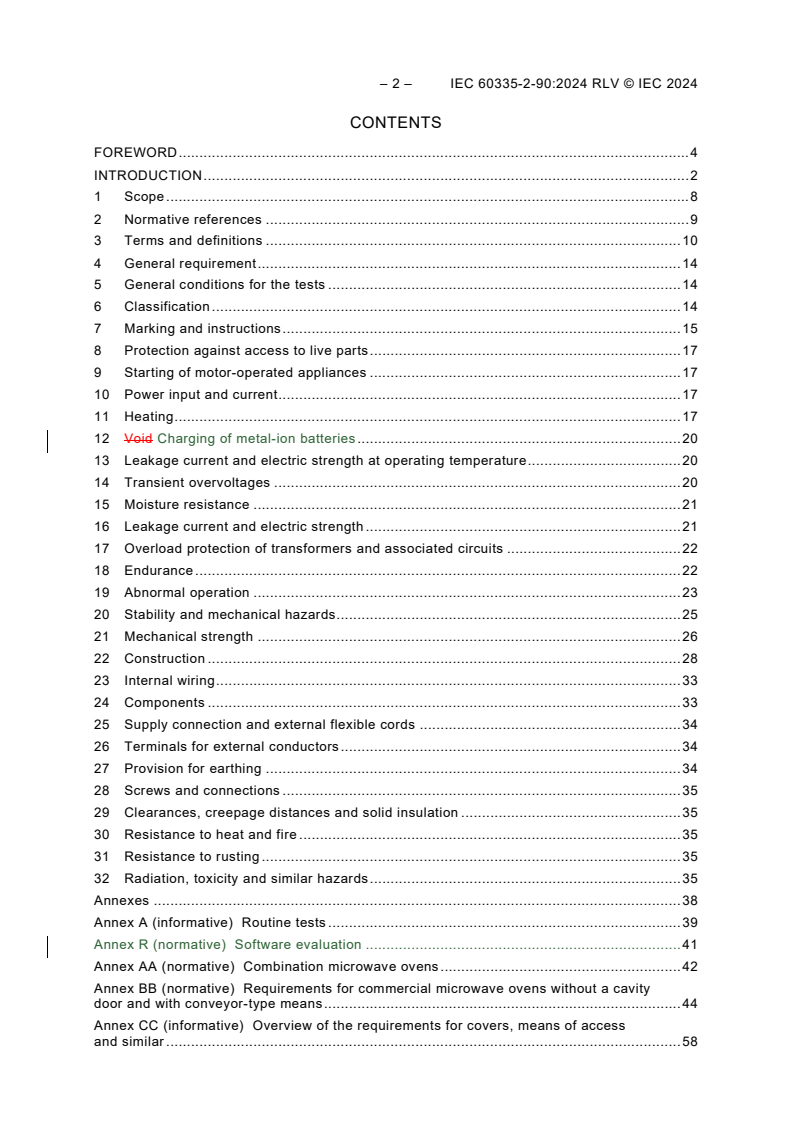
– 2 – IEC 60335-2-90:2024 RLV © IEC 2024
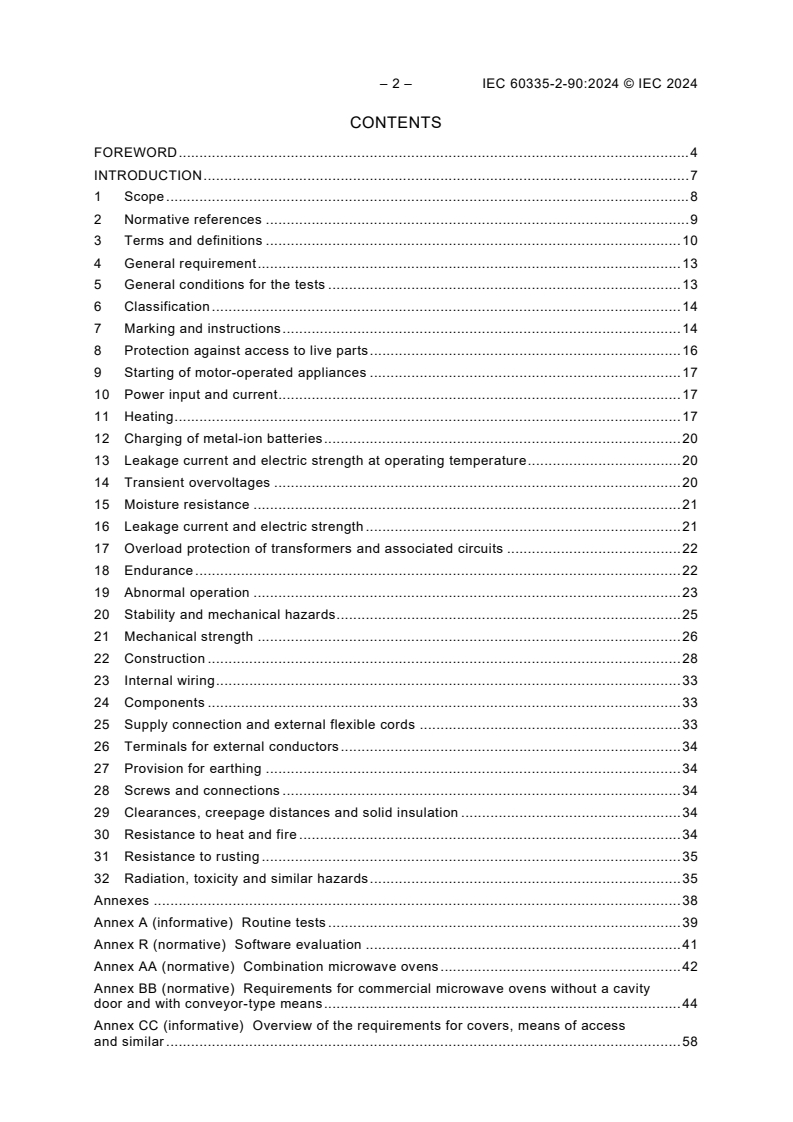
CONTENTS
FOREWORD . 4
INTRODUCTION . 2
1 Scope . 8
2 Normative references . 9
3 Terms and definitions . 10
4 General requirement . 14
5 General conditions for the tests . 14
6 Classification . 14
7 Marking and instructions . 15
8 Protection against access to live parts . 17
9 Starting of motor-operated appliances . 17
10 Power input and current . 17
11 Heating . 17
12 Void Charging of metal-ion batteries . 20
13 Leakage current and electric strength at operating temperature . 20
14 Transient overvoltages . 20
15 Moisture resistance . 21
16 Leakage current and electric strength . 21
17 Overload protection of transformers and associated circuits . 22
18 Endurance . 22
19 Abnormal operation . 23
20 Stability and mechanical hazards . 25
21 Mechanical strength . 26
22 Construction . 28
23 Internal wiring . 33
24 Components . 33
25 Supply connection and external flexible cords . 34
26 Terminals for external conductors . 34
27 Provision for earthing . 34
28 Screws and connections . 35
29 Clearances, creepage distances and solid insulation . 35
30 Resistance to heat and fire . 35
31 Resistance to rusting . 35
32 Radiation, toxicity and similar hazards . 35
Annexes . 38
Annex A (informative) Routine tests . 39
Annex R (normative) Software evaluation . 41
Annex AA (normative) Combination microwave ovens . 42
Annex BB (normative) Requirements for commercial microwave ovens without a cavity
door and with conveyor-type means . 44
Annex CC (informative) Overview of the requirements for covers, means of access
and similar . 58
Annex DD (informative) Rationales for the microwave barrier and associated leakage
tests . 60
Annex EE (normative) Microwave ovens intended to be used on board ships . 66
Bibliography . 70
Figure 101 – Test rod for door interlock concealment . 36
Figure 102 – Probe for measuring surface temperatures . 36
Figure 103 – Front view of appliance with identification of excluded areas . 37
Figure BB.1.201 – Splash apparatus . 55
Figure BB.2.202 – Arrangement for measurement of microwave leakage from access
openings . 56
Figure BB.3.203 – Examples of definitions of Clause 3 and Clause BB.3 . 57
Table 101 – Maximum temperature rises of external accessible surfaces under normal
operating conditions . 19
Table 102 – Maximum temperature rises of external accessible surfaces for appliances
intended to be used in areas open to the public under normal operating conditions . 20
Table 101 103 – Number of potatoes . 24
Table BB.101.201 – Specifications for microwave barriers . 51
Table BB.202 – Assembling torques for screwed connections providing earthing
continuity . 53
Table CC.1 – Overview of the requirements for covers, means of access and similar . 59
Table EE.201 – Assembling torques for screwed connections providing earthing
continuity . 69
– 4 – IEC 60335-2-90:2024 RLV © IEC 2024
INTERNATIONAL ELECTROTECHNICAL COMMISSION
____________
HOUSEHOLD AND SIMILAR ELECTRICAL APPLIANCES –
SAFETY –
Part 2-90: Particular requirements for commercial microwave ovens
FOREWORD
1) The International Electrotechnical Commission (IEC) is a worldwide organization for standardization comprising
all national electrotechnical committees (IEC National Committees). The object of IEC is to promote international
co-operation on all questions concerning standardization in the electrical and electronic fields. To this end and
in addition to other activities, IEC publishes International Standards, Technical Specifications, Technical Reports,
Publicly Available Specifications (PAS) and Guides (hereafter referred to as “IEC Publication(s)”). Their
preparation is entrusted to technical committees; any IEC National Committee interested in the subject dealt with
may participate in this preparatory work. International, governmental and non-governmental organizations liaising
with the IEC also participate in this preparation. IEC collaborates closely with the International Organization for
Standardization (ISO) in accordance with conditions determined by agreement between the two organizations.
2) The formal decisions or agreements of IEC on technical matters express, as nearly as possible, an international
consensus of opinion on the relevant subjects since each technical committee has representation from all
interested IEC National Committees.
3) IEC Publications have the form of recommendations for international use and are accepted by IEC National
Committees in that sense. While all reasonable efforts are made to ensure that the technical content of IEC
Publications is accurate, IEC cannot be held responsible for the way in which they are used or for any
misinterpretation by any end user.
4) In order to promote international uniformity, IEC National Committees undertake to apply IEC Publications
transparently to the maximum extent possible in their national and regional publications. Any divergence between
any IEC Publication and the corresponding national or regional publication shall be clearly indicated in the latter.
5) IEC itself does not provide any attestation of conformity. Independent certification bodies provide conformity
assessment services and, in some areas, access to IEC marks of conformity. IEC is not responsible for any
services carried out by independent certification bodies.
6) All users should ensure that they have the latest edition of this publication.
7) No liability shall attach to IEC or its directors, employees, servants or agents including individual experts and
members of its technical committees and IEC National Committees for any personal injury, property damage or
other damage of any nature whatsoever, whether direct or indirect, or for costs (including legal fees) and
expenses arising out of the publication, use of, or reliance upon, this IEC Publication or any other IEC
Publications.
8) Attention is drawn to the Normative references cited in this publication. Use of the referenced publications is
indispensable for the correct application of this publication.
9) IEC draws attention to the possibility that the implementation of this document may involve the use of (a)
patent(s). IEC takes no position concerning the evidence, validity or applicability of any claimed patent rights in
respect thereof. As of the date of publication of this document, IEC had not received notice of (a) patent(s), which
may be required to implement this document. However, implementers are cautioned that this may not represent
the latest information, which may be obtained from the patent database available at https://patents.iec.ch. IEC
shall not be held responsible for identifying any or all such patent rights.
This redline version of the official IEC Standard allows the user to identify the changes
made to the previous edition IEC 60335-2-90:2015+AMD1:2019 CSV. A vertical bar
appears in the margin wherever a change has been made. Additions are in green text,
deletions are in strikethrough red text.
IEC 60335-2-90 has been prepared by subcommittee 61B: Safety of microwave appliances for
household and commercial use, of IEC technical committee 61: Safety of household and similar
electrical appliances. It is an International Standard.
This fifth edition cancels and replaces the fourth edition published in 2015 including its
Amendment 1:2019. This edition constitutes a technical revision.
This edition includes the following significant technical changes with respect to the previous
edition:
a) the appliance used in area open to the public has been introduced in Clause 1, 3.8.107,
7.12, 8.1.1, 11.8, 20.2, 22.103.2, 22.105 and 22.117;
b) Subclauses 5.5, 7.12.1, 11.2, 11.7, 20.1 and 20.101 have been modified to add for stacking
installation;
c) Subclauses 7.1, 11.7 and 22.61 have been modified for the appliance outlets and socket-
outlets;
d) Subclause 7.12 has been improved in clarity;
e) maximum temperature rises of external accessible surfaces have been added in
Subclause 11.8;
f) test criterion has been modified in Subclause 15.101;
g) Subclause 16.101 has been modified to move the content of 16.101.1, 16.101.2 directly
under 16.101.
h) Subclauses 19.11.2, 19.13, Clause 21, Subclauses 22.105, 22.111 and Annex AA have
been improved in clarity;
i) Annex BB and Annex EE have been modified to add screw requirements.
The text of this International Standard is based on the following documents:
Draft Report on voting
61B/702/FDIS 61B/706/RVD
Full information on the voting for its approval can be found in the report on voting indicated in
the above table.
The language used for the development of this International Standard is English.
This document was drafted in accordance with ISO/IEC Directives, Part 2, and developed in
accordance with ISO/IEC Directives, Part 1 and ISO/IEC Directives, IEC Supplement, available
at www.iec.ch/members_experts/refdocs. The main document types developed by IEC are
described in greater detail at www.iec.ch/standardsdev/publications.
A list of all parts of the IEC 60335 series, under the general title: Household and similar
electrical appliances – Safety, can be found on the IEC website.
This part 2 is to be used in conjunction with the latest edition of IEC 60335-1 and its
amendments unless that edition precludes it; in that case, the latest edition that does not
preclude it is used. It was established on the basis of the sixth edition (2020) of that standard.
NOTE 1 When "Part 1" is mentioned in this standard, it refers to IEC 60335-1.
This part 2 supplements or modifies the corresponding clauses in IEC 60335-1, so as to convert
that publication into the IEC standard: Particular requirements for commercial microwave ovens.
– 6 – IEC 60335-2-90:2024 RLV © IEC 2024
When a particular subclause of Part 1 is not mentioned in part 2, that subclause applies as far
as is reasonable. When this standard states "addition", "modification" or "replacement", the
relevant text in Part 1 is to be adapted accordingly.
NOTE 2 The following numbering system is used:
– subclauses, tables and figures that are numbered starting from 101 are additional to those in Part 1;
– unless notes are in a new subclause or involve notes in Part 1, they are numbered starting from 101, including
those in a replaced clause or subclause;
– additional annexes are lettered AA, BB, etc.
NOTE 3 The following print types are used:
– requirements: in roman type;
– test specifications: in italic type;
– notes: in small roman type.
Words in bold type in the text are defined in Clause 3. When a definition concerns an adjective, the adjective and
the associated noun are also in bold.
The committee has decided that the contents of this document will remain unchanged until the
stability date indicated on the IEC website under webstore.iec.ch in the data related to the
specific document. At this date, the document will be
• reconfirmed,
• withdrawn, or
• revised.
NOTE 4 The attention of National Committees is drawn to the fact that equipment manufacturers and testing
organizations can need a transitional period following publication of a new, amended or revised IEC publication in
which to make products in accordance with the new requirements and to equip themselves for conducting new or
revised tests.
It is the recommendation of the committee that the content of this publication be adopted for implementation nationally
not earlier than 12 months or later than 36 months from the date of publication.
The following differences exist in the countries indicated below.
– 5.3:
Microwave leakage is not to exceed 10 W/m during the initial test (Japan,
USA and Canada).
– 6.1: Microwave ovens may be class 0I if the rated voltage does not exceed more
than 150 V (Japan).
– 7.12: Some warnings have to be marked on the appliance and be visible to the
user (Canada).
– Clause 18: The test is carried out on two appliances (USA).
– 19.11.2: The input voltage variation is not applied (USA).
– 19.13: Microwave leakage is only measured at the end of each test (USA).
– 21.102: The applied force is 222 N (USA).
– 21.105:
Microwave leakage is not to exceed 50 W/m (Japan and USA).
– 22.111: Microwave leakage is only measured at the end of the test (USA).
– 22.112:
Microwave leakage is not to exceed 50 W/m (Japan and USA).
– 22.116: All access to the cavity has to be prevented (USA).
– 27.2: A terminal for an external equipotential conductor is not required (Japan).
IMPORTANT – The "colour inside" logo on the cover page of this document indicates
that it contains colours which are considered to be useful for the correct understanding
of its contents. Users should therefore print this document using a colour printer.
INTRODUCTION
It has been assumed in the drafting of this International Standard that the execution of its
provisions is entrusted to appropriately qualified and experienced persons.
Guidance documents concerning the application of the safety requirements for appliances can
be accessed via TC 61 and SC 61B supporting documents on the IEC website
https://www.iec.ch/tc61/supportingdocuments
https://www.iec.ch/sc61b/supportingdocuments
This information is given for the convenience of users of this International Standard and does
not constitute a replacement for the normative text in this standard.
This standard recognizes the internationally accepted level of protection against hazards such
as electrical, mechanical, thermal, fire and radiation of appliances when operated as in normal
use taking into account the manufacturer's instructions. It also covers abnormal situations that
can be expected in practice and takes into account the way in which electromagnetic
phenomena can affect the safe operation of appliances.
This standard takes into account the requirements of IEC 60364 as far as possible so that there
is compatibility with the wiring rules when the appliance is connected to the supply mains.
However, national wiring rules may can differ.
If an appliance within the scope of this standard also incorporates functions that are covered
by another part 2 of IEC 60335, the relevant part 2 is applied to each function separately, as
far as is reasonable. If applicable, the influence of one function on the other is taken into
account.
When a part 2 standard does not include additional requirements to cover hazards dealt with in
Part 1, Part 1 applies.
NOTE 1 This means that the technical committees responsible for the part 2 standards have determined that it is
not necessary to specify particular requirements for the appliance in question over and above the general
requirements.
This standard is a product family standard dealing with the safety of appliances and takes
precedence over horizontal and generic standards covering the same subject.
NOTE 2 Horizontal and generic standards Horizontal publications, basic safety publications and group safety
publications covering a hazard are not applicable since they have been taken into consideration when developing
the general and particular requirements for the IEC 60335 series of standards. For example, in the case of
temperature requirements for surfaces on many appliances, generic standards, such as ISO 13732-1 for hot surfaces,
are not applicable in addition to Part 1 or part 2 standards.
An appliance that complies with the text of this standard will not necessarily be considered to
comply with the safety principles of the standard if, when examined and tested, it is found to
have other features which impair the level of safety covered by these requirements.
An appliance employing materials or having forms of construction differing from those detailed
in the requirements of this standard may can be examined and tested according to the intent of
the requirements and, if found to be substantially equivalent, may be considered to comply with
the standard.
NOTE 3 Standards dealing with non-safety aspects of household appliances are:
– IEC standards published by TC 59 concerning methods of measuring performance;
– CISPR 11, CISPR 14-1 and relevant IEC 61000-3 series standards concerning electromagnetic emissions;
– CISPR 14-2 concerning electromagnetic immunity;
– IEC standards published by TC 111 concerning environmental matters.
– 8 – IEC 60335-2-90:2024 RLV © IEC 2024
HOUSEHOLD AND SIMILAR ELECTRICAL APPLIANCES –
SAFETY –
Part 2-90: Particular requirements for commercial microwave ovens
1 Scope
This clause of Part 1 is replaced by the following.
This part of IEC 60335 deals with:
– the safety of microwave ovens with a cavity door intended for commercial use, their rated
voltage being not more than 250 V for single-phase appliances connected between one
phase and neutral and 480 V for other appliances.
These appliances are not intended for household and similar purposes. They are used for
commercial processing of food, also in areas open to the public, for example in kitchens
of restaurants, canteens, hospitals and in commercial enterprises such as bakeries and
butcheries;
– the safety of combination microwave ovens with a cavity door, the requirements of which
are contained in normative Annex AA;
– the safety of microwave ovens without a cavity door and with transportation means that
are intended for commercial use only, for the heating of food and beverages, the
requirements of which are contained in normative Annex BB.
Microwave ovens covered by normative Annex BB have transportation means for moving the
load through the microwave oven. Requirements for tunnel microwave ovens and several
types of microwave vending machines are covered.
This standard also deals with microwave ovens intended to be used on board ships, for which
normative Annex EE is applicable.
NOTE 101 In normative Annex BB, a microwave oven without a cavity door and with
transportation means is described as a microwave oven. All clauses of this standard apply
to these appliances unless otherwise specified in normative Annex BB.
This part of IEC 60335 also takes into account ordinary persons having access to the
removing area of the vending machine.
NOTE 102 The appliance may can be built into a vending machine, in which case IEC 60335-2-
75 maycan also be applicable.
NOTE 103 Appliances that use non-electrical energy are within the scope of this standard.
In general, this standard does not take into account
– the use of appliances by young children or infirm persons without supervision;
– playing with the appliance by young children.
As far as is practicable, this standard deals with the common hazards presented by these types
of appliances.
This standard does not take into account the use of a microwave oven without a cavity door
and with transportation means by ordinary persons except in the vicinity of entrance and
exit ports.
NOTE 104 The rationales for particular microwave exposure conditions and measures related to
microwave energy being confined by an open structure are given in normative Annex BB.
NOTE 105 Attention is drawn to the fact that
– for appliances intended to be used in vehicles or on trains, on board ships or board aircraft,
additional requirements may can be necessary;
– for appliances intended to be used in tropical countries, special requirements may can be
necessary;
– in many countries, the national health authorities, the national authorities responsible for
the protection of labour and similar authorities specify additional requirements;
– in many countries, national authorities specify additional requirements to BB.22.119101.1.
NOTE 106 This standard does not apply to
– household Microwave ovens including combination microwave ovens for household use
covered by IEC 60335-2-25 and used in the following environments by laymen:
• staff kitchen areas in shops, offices and other working environments;
• farm houses;
• by clients in hotels, motels and other residential type environments;
• bed and breakfast type environments.
– industrial microwave heating equipment (IEC 60519-6);
– appliances for medical purposes (IEC 60601);
– appliances intended to be used in locations where special conditions prevail, such as the
presence of a corrosive or explosive atmosphere (dust, vapour or gas).
2 Normative references
This clause of Part 1 is applicable except as follows.
Addition:
IEC 60068-2-6, Environmental testing – Part 2-6: Tests – Test Fc: Vibration (sinusoidal)
IEC 60068-2-27, Environmental testing – Part 2-27: Tests – Test Ea and guidance: Shock
IEC 60068-2-52, Environmental testing – Part 2-52: Tests – Test Kb: Salt mist, cyclic (sodium
chloride solution)
IEC 60335-2-36, Household and similar electrical appliances – Safety – Part 2-36: Particular
requirements for commercial electric cooking ranges, ovens, hobs and hob elements
IEC 60335-2-42, Household and similar electrical appliances – Safety – Part 2-42: Particular
requirements for commercial electric forced convection ovens, steam cookers and steam-
convection ovens
IEC 60335-2-49, Household and similar electrical appliances − Safety − Part 2-49: Particular
requirements for commercial electric hot cupboards appliances for keeping food and crockery
warm
– 10 – IEC 60335-2-90:2024 RLV © IEC 2024
IEC 60335-2-75, Household and similar electrical appliances – Safety – Part 2-75: Particular
requirements for commercial dispensing appliances and vending machines
IEC 60436:20042015, Electric dishwashers for household use – Methods for measuring the
performance
IEC 60436:2004/AMD 1:2009
IEC 60436:2004/AMD 2:2012
IEC 60436:2015/AMD1:2020
IEC 60584-1, Thermocouples – Part 1: EMF specifications and tolerances
ISO 898-1, Mechanical properties of fasteners made of carbon steel and alloy steel – Part 1:
Bolts, screws and studs with specified property classes – Coarse thread and fine pitch thread
ISO 3506-1, Fasteners – Mechanical properties of corrosion-resistant stainless steel fasteners
– Part 1: Bolts, screws and studs with specified grades and property classes
ISO 3506-2, Fasteners – Mechanical properties of corrosion-resistant stainless steel fasteners
– Part 2: Nuts with specified grades and property classes
ISO 3506-3, Mechanical properties of corrosion-resistant stainless steel fasteners – Part 3: Set
screws and similar fasteners not under tensile stress
ISO 3506-4, Mechanical properties of corrosion-resistant stainless steel fasteners – Part 4:
Tapping screws
3 Terms and definitions
This clause of Part 1 is applicable except as follows.
3.1 Definitions relating to physical characteristics
3.1.7
Note 101 to entry: The rated frequency is the input frequency.
3.1.9
normal operation
Modification:
Replace the first paragraph by the following:
operation of the appliance under the following conditions:
The appliance is operated with 1 000 g ± 50 g of potable water at an initial temperature of 20 °C
± 2 °C in a cylindrical borosilicate glass vessel having a maximum thickness of 3 mm and an
outside diameter of approximately 190 mm. The vessel is placed on the centre of the shelf. If
the rated microwave power output exceeds 2 200 W, two such vessels are used and placed
contiguously in the cavity.
3.1023.1.101
rated microwave power output
microwave power output assigned to the appliance by the manufacturer
3.5 Definitions relating to types of appliances
3.1013.5.101
microwave oven
appliance using electromagnetic energy in one or several of the ISM frequency bands between
300 MHz and 30 GHz, for heating food and beverages in a cavity
Note 1 to entry: ISM frequency bands are the electromagnetic frequencies established by the ITU and reproduced
in CISPR 11.
3.1273.5.102
combination microwave oven
microwave oven in which heat is also provided in the cavity by simultaneous or consecutive
operation of resistive heating elements
Note 1 to entry: The resistive heating elements are used to provide radiant heat, convection heat or steam.
3.6 Definitions relating to parts of an appliance
3.1033.6.101
cavity
space enclosed by the inner walls and the door in which the load is placed
3.1043.6.102
shelf
horizontal support in the cavity on which the load is placed
3.1053.6.103
door interlock
device or system that prevents the operation of the magnetron microwave generator(s), unless
the oven door is closed
3.1063.6.104
monitored door interlock
door interlock system that incorporates a supervision device
3.1073.6.105
temperature-sensing probe
device that is inserted into the food to measure its temperature and is a part of an oven control
3.1113.6.106
transportation means
means to transport the load through the microwave oven
Note 1 to entry: An example of a transportation means is a belt, an arm or an inclined plane.
3.1133.6.107
microwave enclosure
structure that is intended to confine microwave energy to a defined region
Note 1 to entry: Barriers mounted outside the microwave enclosure are not considered a part of the microwave
enclosure.
Note 2 to entry: A microwave enclosure may can consist of a cavity, quarter wave chokes (acting by impedance
transformation), mode chokes (acting by field pattern mismatching) and microwave energy absorbers.
___________
ISM frequency bands are the electromagnetic frequencies established by the ITU and reproduced in CISPR 11.
– 12 – IEC 60335-2-90:2024 RLV © IEC 2024
3.1143.6.108
microwave barrier
physical barrier, which is microwave transparent, limiting access to the microwave enclosure,
mounted outside the microwave enclosure and can only be removed with the aid of tools
Note 1 to entry: A microwave barrier may can be mounted between the microwave enclosure and the external
cover of the appliance.
Note 2 to entry: Devices such as an array of metal chains or hinged metal plates at entrance and exit ports
intended to reduce microwave leakage are not considered microwave barriers.
Note 3 to entry: Construction requirements are given in BB.22.119101.
Note 4 to entry: Informative Annex DD mentions about rationale for the microwave barrier and associated leakage
test.
3.1153.6.109
entrance and exit ports
openings in the microwave enclosure through which loads move
3.1163.6.110
loading area
area on which the load is placed
3.1173.6.111
means of monitored microwave interlock
means of microwave interlock that incorporates a supervision device
3.1183.6.112
protective blocking structure
movable mechanical structure located in the removing area limiting access to the microwave
enclosure
3.1193.6.113
removing area
area from which the load is removed
3.1203.6.114
viewing opening
opening in the cavity through which the warm up process can be visually monitored
3.1213.6.115
fixed means of connection
all parts of the microwave enclosure that are permanently open with the exception of entrance
and exit ports and viewing openings
Note 1 to entry: Fixed means of connection may can be used for venting and water flushing.
3.6.116
Void
3.1233.6.117
means of microwave interlock
mechanical or electrical safety devices or systems that operate when certain conditions are not
fulfilled (e.g. an interlock system that prevents the operation of the microwave generator when
a means of access is open)
3.1243.6.118
maintenance cover
structural feature of any part of the equipment that can be opened or removed by the use of a
tool to provide access for routine maintenance, service, replacement of expendable parts, etc.
in microwave containing areas
3.1253.6.119
cleaning cover
part of the microwave enclosure that can be opened or removed, only with the aid of a tool,
for frequent cleaning purposes, during operation
3.1263.6.120
reference surface
surface in the vicinity of entrance and exits ports defined depending on the reading of
microwave leakage of Clause BB.32 32.1 of normative Annex BB
Note 1 to entry: If the leakage reading is less or equal to 50 W/m , the reference surface is the surface of the
geometric opening of the microwave enclosure without microwave barrier.
Note 2 to entry: If the leakage reading exceeds 50 W/m , the reference surface is an artificial surface located
50 mm away from the locations where the sensor of the instrument measures leakage readings of 50 W/m straight
inwards towards the appliance.
Note 3 to entry: For further explanation, refer to Clause BB.32 32.1 of normative Annex BB.
3.8 Definitions relating to miscellaneous matters
3.1083.8.101
instructed person
person who is sufficiently instructed and monitored to know how to avoid any danger caused by
the operation of microwave ovens
3.1093.8.102
skilled person
person with suitable professional education, knowledge and experience to discern and to avoid
any danger caused by the operation of microwave ovens
3.1103.8.103
ordinary person
person who is neither a skilled person nor an instructed person
3.1123.8.104
load
food and beverages that can be heated up in a microwave oven
3.8.105
area open to the public
area in which the general public, including children, can have access
Note 1 to entry: Examples include customer areas in:
– grocery stores;
– canteens;
– train stations;
– self-service restaurants.
3.8.106
open deck
area that is exposed to marine environment
– 14 – IEC 60335-2-90:2024 RLV © IEC 2024
3.8.107
dayroom
area that can be exposed to marine environment from time to time
3.122
detachable means of access
all parts of the microwave enclosure that can be opened or removed without the aid of tools
to get access to the inside for maintenance, with the exception of entrance and exit ports and
viewing openings
Note 1 to entry: Examples of detachable means of access are tunnels that are opened by drop down or sliding
action and cavity lamp covers.
3.128
hot functional surface
surface that is intentionally heated by an internal heat source and that has to be hot to carry
out the intended function of the appliance
4 General requirement
This clause of Part 1 is applicable.
5 General conditions for the tests
This clause of Part 1 is applicable except as follows.
5.2 Addition:
NOTE 101 An additional sample may can be required for the test of 19.104.
Six samples of the interlocks are required for the test of 24.1.4.
5.3 Modification:
Instead of carrying out the tests in the order of clauses, the following sequence of clauses and
subclauses applies: 32.1, 22.113, 22.108, 22.116, Clause 7 to Clause 17, Clause 20,
Clause 21 (except 21.101 to 21.105), Clause 18, Clause 19 (except 19.104), Clause 22 (except
22.108, 22.113 and 22.116), Clause 23 to Clause 31 and 32.2, 21.101 to 21.105 and 19.104.
5.5 Addition:
The tests are carried out with the appliances in any stacked combination or any movable part
of it placed in the most unfavourable condition that can occur in normal use.
5.101 Microwave ovens are tested as motor-operated appliances.
5.102 Class III temperature-sensing probes are only subjected to the tests of 22.112.
6 Classification
This clause of Part 1 is applicable except as follows.
6.1 Modification:
Microwave ovens shall be class I.
7 Marking and instructions
This clause of Part 1 is applicable except as follows.
7.1 Addition:
Appliances shall be marked with the nominal frequency in megahertz of the ISM band in which
they operate.
If the removal of any cover results in microwave leakage exceeding the value specified in 32.1,
the cover shall be marked with the substance of the following:
WARNING: Microwave energy – Do not remove this cover
If an appliance incorporates a socket-outlet protected by means of fuses other than D-type
fuses, it shall be marked with the rated current of the relevant fuse. When a miniature fuse-link
is provided, this marking shall indicate that the fuse-link is to have a high breaking capacity.
If appliances have external enclosures, other than working surfaces, that cannot meet the limit
in Table 3 specified for external enclosures of motor-operated appliances, they shall be
marked with symbol IEC 60417-5041 (2002-10) or with the substance of the following:
CAUTION: Hot surface.
If appliances have external accessible surfaces, for which temperature rise limits are specified
in Table 101 and Table 102 and for which the provisions of footnote b to Table 101 and
Table 102 apply, then the appliance shall be marked with symbol IEC 60417-5041 (2002-10) or
with the substance of the following:
CAUTION: Hot surface
7.6 Addition:
[symbol IEC 60417-5021
equipotentiality
(2002-10)]
[symbol IEC 60417-5041
caution, hot surface
(2002-10)]
7.12 Addition:
The instructions shall include the substance of the following:
– WARNING: If the door or door seals are damaged, the oven must not be operated until it
has been repaired by a competent person.
– WARNING: It is hazardous for anyone other than a competent person to carry out any
service or repair operation that involves the removal of any cover which gives protection
against exposure to microwave energy.
NOTE 101 This warning is applicable if microwave leakage exceeds the limit specified in 32.1 during the
removal of any cover.
– WARNING: Liquids or other foods must not be heated in sealed containers since they are
liable to explode.
– 16 – IEC 60335-2-90:2024 RLV © IEC 2024
– WARNING: Microwave heating of beverages can result in delayed eruptive boiling, therefore
care must be taken when handling the container.
– WARNING: The contents of feeding bottles and baby food jars must be stirred or shaken
and the temperature checked before consumption, in order to avoid burns.
– The minimum height of free space necessary above the top surface of the oven.
– Only use utensils that are suitable for use in microwave ovens.
– When heating food in plastic or paper containers, keep an eye on the oven due to the
possibility of ignition.
– If smoke is observed, switch off or unplug the appliance and keep the door closed in order
to stifle any flames.
– Eggs in their shell and whole hard-boiled eggs should not be heated in microwave ovens
since they may explode even after microwave heating has ended.
– Details for cleaning door seals, cavities and adjacent parts.
– The oven should be cleaned regularly and any food deposits removed.
– Failure to maintain the oven in a clean condition could lead to deterioration of the surface
that could adversely affect the life of the appliance and possibly result in a hazardous
situation.
– Only use the temperature probe recommended for this oven (for appliances having a facility
to use a temperature-sensing probe).
– The appliance should not be cleaned with a water jet (for appliances intended to stand on
the floor and which are not at least IPX5).
– Statement on usage on commercial road vehicles (for appliances intended to be used on
commercial road vehicles).
– The appliance must not be cleaned with a steam cleaner (for appliances which are not at
least IPX5).
NOTE 101 If the oven is incorporated in a vending machine, these warnings and instructions may not be relevant
and therefore not required.
NOTE 102 If the oven is incorporated in a vending machine, no warnings and instructions can be required.
If symbol IEC 60417-5041 (2002-10) is marked on the appliance, its meaning shall be explained.
The manufacturer shall declare that the appliance is also intended to be used in an area open
to the public. For this case, it shall be stated whether this appliance is allowed to be placed or
...
IEC 60335-2-90 ®
Edition 5.0 2024-07
EXTENDED VERSION
INTERNATIONAL
STANDARD
colour
inside
This extended version of IEC 60335-2-90:2024 includes the content of the references made to
IEC 60335-1:2020
Household and similar electrical appliances – Safety –
Part 2-90: Particular requirements for commercial microwave ovens
All rights reserved. Unless otherwise specified, no part of this publication may be reproduced or utilized in any form
or by any means, electronic or mechanical, including photocopying and microfilm, without permission in writing from
either IEC or IEC's member National Committee in the country of the requester. If you have any questions about IEC
copyright or have an enquiry about obtaining additional rights to this publication, please contact the address below or
your local IEC member National Committee for further information.
IEC Secretariat Tel.: +41 22 919 02 11
3, rue de Varembé info@iec.ch
CH-1211 Geneva 20 www.iec.ch
Switzerland
About the IEC
The International Electrotechnical Commission (IEC) is the leading global organization that prepares and publishes
International Standards for all electrical, electronic and related technologies.
About IEC publications
The technical content of IEC publications is kept under constant review by the IEC. Please make sure that you have the
latest edition, a corrigendum or an amendment might have been published.
IEC publications search - webstore.iec.ch/advsearchform IEC Products & Services Portal - products.iec.ch
The advanced search enables to find IEC publications by a Discover our powerful search engine and read freely all the
variety of criteria (reference number, text, technical publications previews, graphical symbols and the glossary.
committee, …). It also gives information on projects, replaced With a subscription you will always have access to up to date
and withdrawn publications. content tailored to your needs.
IEC Just Published - webstore.iec.ch/justpublished
Electropedia - www.electropedia.org
Stay up to date on all new IEC publications. Just Published
The world's leading online dictionary on electrotechnology,
details all new publications released. Available online and once
containing more than 22 500 terminological entries in English
a month by email.
and French, with equivalent terms in 25 additional languages.
Also known as the International Electrotechnical Vocabulary
IEC Customer Service Centre - webstore.iec.ch/csc
(IEV) online.
If you wish to give us your feedback on this publication or need
further assistance, please contact the Customer Service
Centre: sales@iec.ch.
IEC 60335-2-90 ®
Edition 5.0 2024-07
EXTENDED VERSION
INTERNATIONAL
STANDARD
colour
inside
This extended version of IEC 60335-2-90:2024 includes the content of the references made to
IEC 60335-1:2020
Household and similar electrical appliances – Safety –
Part 2-90: Particular requirements for commercial microwave ovens
INTERNATIONAL
ELECTROTECHNICAL
COMMISSION
ICS 97.040.20 ISBN 978-2-8322-9407-9
IEC 60335-1:2020/ISH1:2021 – 1 –
© IEC 2021
INTERNATIONAL ELECTROTECHNICAL COMMISSION
____________
IEC 60335-1
Edition 6.0 2020-09
HOUSEHOLD AND SIMILAR ELECTRICAL APPLIANCES – SAFETY –
Part 1: General requirements
INTERPRETATION SHEET 1
This interpretation sheet has been prepared by IEC technical committee 61: Safety of
household and similar electrical appliances.
The text of this Interpretation Sheet is based on the following documents:
Draft Report on voting
61/5999/DISH 61/6009/RVDISH
Full information on the voting for its approval can be found in the report on voting indicated in
the above table.
___________
INTRODUCTION
Edition 6 of IEC 60335-1:2020 defines and introduces requirements for a detachable
power supply part of an appliance. In the document, 24.2 prohibits the use of a power
supply in a flexible cord.
QUESTION:
Does Subclause 24.2 prohibit the use of a detachable power supply part?
ANSWER
No, a "detachable power supply part" is a defined term and is not captured by the term
"power supply" as used in Subclause 24.2.
NOTE A detachable power supply part is captured by the defined term when the output of the power supply
part is detachable from the class III construction part of the appliance at:
– the power supply part, or
– the class III construction part of the appliance.
However, the supply cord (if any) does not have to be detachable from the detachable power supply part.
ICS 13.120; 97.030
IEC 60335-1:2020-09/ISH1:2021-11(en)
– 2 – IEC 60335-2-90:2024 EXV © IEC 2024
CONTENTS
FOREWORD . 6
INTRODUCTION to IEC 60335-1:2020 . 9
INTRODUCTION to IEC 60335-2-90:2024 . 11
1 Scope . 12
2 Normative references . 13
3 Terms and definitions . 19
4 General requirement . 33
5 General conditions for the tests . 33
6 Classification . 38
7 Marking and instructions . 38
8 Protection against access to live parts . 48
9 Starting of motor-operated appliances . 50
10 Power input and current . 51
11 Heating . 53
12 Charging of metal-ion batteries . 60
13 Leakage current and electric strength at operating temperature . 62
14 Transient overvoltages . 64
15 Moisture resistance . 65
16 Leakage current and electric strength . 68
17 Overload protection of transformers and associated circuits . 71
18 Endurance . 71
19 Abnormal operation . 72
20 Stability and mechanical hazards . 84
21 Mechanical strength . 86
22 Construction . 89
23 Internal wiring . 107
24 Components . 109
25 Supply connection and external flexible cords . 114
26 Terminals for external conductors . 122
27 Provision for earthing . 125
28 Screws and connections . 127
29 Clearances, creepage distances and solid insulation . 129
30 Resistance to heat and fire . 137
31 Resistance to rusting . 142
32 Radiation, toxicity and similar hazards . 142
Annex A (informative) Routine tests . 158
Annex B (normative) Battery-operated appliances, separable batteries and detachable
batteries for battery-operated appliances . 162
Annex C (normative) Ageing test on motors . 183
Annex D (normative) Thermal motor protectors . 184
Annex E (normative) Needle-flame test . 185
Annex F (normative) Capacitors . 186
Annex G (normative) Safety isolating transformers . 188
Annex H (normative) Switches . 189
Annex I (normative) Motors having basic insulation that is inadequate for the rated
voltage of the appliance . 191
Annex J (normative) Coated printed circuit boards . 193
Annex K (informative) Overvoltage categories . 194
Annex L (informative) Guidance for the measurement of clearances and creepage
distances . 195
Annex M (informative) Pollution degree . 198
Annex N (normative) Proof tracking test . 199
Annex O (informative) Selection and sequence of the tests of Clause 30 . 200
Annex P (informative) Guidance for the application of this standard to appliances
used in tropical climates . 205
Annex Q (informative) Sequence of tests for the evaluation of electronic circuits . 207
Annex R (normative) Software evaluation . 210
Annex S (informative) Guidance for the application of this standard on measurement
of power input and current based on the requirements of 10.1 and 10.2 concerning the
representative period . 224
Annex T (normative) UV-C radiation effect on non-metallic materials . 225
Annex U (normative) Appliances intended for remote communication through public
networks . 228
Annex AA (normative) Combination microwave ovens . 232
Annex BB (normative) Requirements for commercial microwave ovenswithout a cavity
door and with conveyor-type means . 234
Annex CC (informative) Overview of the requirements for covers, means of access
and similar . 248
Annex DD (informative) Rationales for the microwave barrier and associated leakage
tests . 250
Annex EE (normative) Microwave ovens intended to be used on board ships . 256
Bibliography . 260
Index of defined terms . 263
Figure 1 – Circuit diagram for leakage current measurement at operating temperature
for single-phase connection of class II appliances and for parts of class ll construction . 143
Figure 2 – Circuit diagram for leakage current measurement at operating temperature
for single-phase connection of other than class II appliances or parts of class ll
construction . 144
Figure 3 – Circuit diagram for leakage current measurement at operating temperature
for three-phase with neutral class II appliances and for parts of class ll construction . 145
Figure 4 – Circuit diagram for leakage current measurement at operating temperature
for three-phase with neutral appliances other than those of class II or parts of class ll
construction . 146
Figure 5 – Small part . 147
Figure 6 – Example of an electronic circuit with low-power points . 147
Figure 7 – Test finger nail . 148
Figure 8 – Flexing test apparatus . 149
Figure 9 – Constructions of cord anchorages . 150
Figure 10 – An example of parts of an earthing terminal . 151
– 4 – IEC 60335-2-90:2024 EXV © IEC 2024
Figure 11 – Examples of clearances . 152
Figure 12 – Example of the placement of the cylinder . 153
Figure 13 – Small parts cylinder . 154
Figure 14 – Example of a specified operating region of a lithium-ion cell during
charging . 155
Figure 101 – Test rod for door interlock concealment . 156
Figure 102 – Probe for measuring surface temperatures . 156
Figure 103 – Front view of appliance with identification of excluded areas . 157
Figure B.1 – Examples of battery-operated appliance constructions and application of
normative Annex B (1 of 2) . 180
Figure B.2 – Examples of correct polarity connection marking representing three
batteries . 182
Figure I.1 – Simulation of faults . 192
Figure L.1 – Sequence for the determination of clearances . 195
Figure L.2 – Sequence for the determination of creepage distances . 196
Figure L.3 – Measurement of clearances . 197
Figure O.1 – Tests for resistance to heat . 200
Figure O.2 – Selection and sequence of tests for resistance to fire in hand-held
appliances . 201
Figure O.3 – Selection and sequence of tests for resistance to fire in attended
appliances . 201
Figure O.4 – Selection and sequence of tests for resistance to fire in unattended
appliances . 202
Figure O.5 – Some applications of the term "within a distance of 3 mm" . 204
Figure Q.1 – Flowchart outlining the sequence of tests for the evaluation of electronic
circuits (1 of 2) . 208
Figure S.1 – Flowchart giving guidance on measurement of power input and current
concerning the representative period . 224
Figure BB.201 – Splash apparatus . 245
Figure BB.202 – Arrangement for measurement of microwave leakage from access
openings . 246
Figure BB.203 – Examples of definitions of Clause 3 . 247
Table 1 – Power input deviation . 51
Table 2 – Current deviation . 52
Table 3 – Maximum normal temperature rises . 55
Table 101 – Maximum temperature rises of external accessible surfaces under normal
operating conditions. 59
Table 102 – Maximum temperature rises of external accessible surfaces for appliances
intended to be used in areas open to the public under normal operating conditions . 60
Table 4 – Voltage for electric strength test . 64
Table 5 – Characteristics of high-voltage sources . 64
Table 6 – Impulse test voltage . 65
Table 7 – Test voltages. 70
Table 8 – Maximum winding temperature . 74
Table 9 – Maximum abnormal temperature rise . 80
Table 103 – Number of potatoes . 83
Table 10 – Dimensions of cables and conduits . 115
Table 11 – Minimum cross-sectional area of conductors . 117
Table 12 – Pull force and torque . 119
Table 13 – Nominal cross-sectional area of conductors . 124
Table 14 – Torque for testing screws and nuts . 128
Table 15 – Rated impulse voltage . 130
Table 16 – Minimum clearances . 130
Table 17 – Minimum creepage distances for basic insulation . 134
Table 18 – Minimum creepage distances for functional insulation . 135
Table 19 – Minimum thickness for accessible parts of reinforced insulation consisting
of a single layer . 137
Table A.1 – Test voltages . 159
Table B.1 – Artificial source characteristics . 164
Table B.2 – Total area of openings for metal-ion cells . 172
Table B.3 – Volume of air injected at 2 070 kPa . 172
Table C.1 – Test conditions . 183
Table R.1 – General fault/error conditions . 212
Table R.2 – Specific fault/error conditions . 214
Table R.3 – Semi-formal methods . 220
Table R.4 – Software architecture specification . 220
Table R.5 – Module design specification . 221
Table R.6 – Design and coding standards . 222
Table R.7 – Software safety validation . 222
Table T.1 – Minimum property retention limits after UV-C exposure . 226
Table T.2 – Minimum electric strength for internal wiring after UV-C exposure . 227
Table U.1 – Examples of acceptable measures against unauthorised access and
transmission fault/error modes . 230
Table BB.201 – Specifications for microwave barriers . 241
Table BB.202 – Assembling torques for screwed connections providing earthing
continuity . 243
Table CC.1 – Overview of the requirements for covers, means of access and similar . 249
Table EE.201 – Assembling torques for screwed connections providing earthing
continuity . 258
– 6 – IEC 60335-2-90:2024 EXV © IEC 2024
INTERNATIONAL ELECTROTECHNICAL COMMISSION
____________
HOUSEHOLD AND SIMILAR ELECTRICAL APPLIANCES –
SAFETY –
Part 2-90: Particular requirements for commercial microwave ovens
FOREWORD
1) The International Electrotechnical Commission (IEC) is a worldwide organization for standardization comprising
all national electrotechnical committees (IEC National Committees). The object of IEC is to promote international
co-operation on all questions concerning standardization in the electrical and electronic fields. To this end and
in addition to other activities, IEC publishes International Standards, Technical Specifications, Technical Reports,
Publicly Available Specifications (PAS) and Guides (hereafter referred to as “IEC Publication(s)”). Their
preparation is entrusted to technical committees; any IEC National Committee interested in the subject dealt with
may participate in this preparatory work. International, governmental and non-governmental organizations liaising
with the IEC also participate in this preparation. IEC collaborates closely with the International Organization for
Standardization (ISO) in accordance with conditions determined by agreement between the two organizations.
2) The formal decisions or agreements of IEC on technical matters express, as nearly as possible, an international
consensus of opinion on the relevant subjects since each technical committee has representation from all
interested IEC National Committees.
3) IEC Publications have the form of recommendations for international use and are accepted by IEC National
Committees in that sense. While all reasonable efforts are made to ensure that the technical content of IEC
Publications is accurate, IEC cannot be held responsible for the way in which they are used or for any
misinterpretation by any end user.
4) In order to promote international uniformity, IEC National Committees undertake to apply IEC Publications
transparently to the maximum extent possible in their national and regional publications. Any divergence between
any IEC Publication and the corresponding national or regional publication shall be clearly indicated in the latter.
5) IEC itself does not provide any attestation of conformity. Independent certification bodies provide conformity
assessment services and, in some areas, access to IEC marks of conformity. IEC is not responsible for any
services carried out by independent certification bodies.
6) All users should ensure that they have the latest edition of this publication.
7) No liability shall attach to IEC or its directors, employees, servants or agents including individual experts and
members of its technical committees and IEC National Committees for any personal injury, property damage or
other damage of any nature whatsoever, whether direct or indirect, or for costs (including legal fees) and
expenses arising out of the publication, use of, or reliance upon, this IEC Publication or any other IEC Publications.
8) Attention is drawn to the Normative references cited in this publication. Use of the referenced publications is
indispensable for the correct application of this publication.
9) IEC draws attention to the possibility that the implementation of this document may involve the use of (a) patent(s).
IEC takes no position concerning the evidence, validity or applicability of any claimed patent rights in respect
thereof. As of the date of publication of this document, IEC had not received notice of (a) patent(s), which may
be required to implement this document. However, implementers are cautioned that this may not represent the
latest information, which may be obtained from the patent database available at https://patents.iec.ch. IEC shall
not be held responsible for identifying any or all such patent rights.
This extended version (EXV) of the official IEC Standard provides the user with the
comprehensive content of the Standard.
made to IEC 60335-1:2020.
The specific content of IEC 60335-2-90:2024 is displayed on a blue background.
IEC 60335-2-90 has been prepared by subcommittee 61B: Safety of microwave appliances for
household and commercial use, of IEC technical committee 61: Safety of household and similar
electrical appliances. It is an International Standard.
This fifth edition cancels and replaces the fourth edition published in 2015 including its
Amendment 1:2019. This edition constitutes a technical revision.
This edition includes the following significant technical changes with respect to the previous
edition:
a) the appliance used in area open to the public has been introduced in Clause 1, 3.8.107,
7.12, 8.1.1, 11.8, 20.2, 22.103.2, 22.105 and 22.117;
b) Subclauses 5.5, 7.12.1, 11.2, 11.7, 20.1 and 20.101 have been modified to add for stacking
installation;
c) Subclauses 7.1, 11.7 and 22.61 have been modified for the appliance outlets and socket-
outlets;
d) Subclause 7.12 has been improved in clarity;
e) maximum temperature rises of external accessible surfaces have been added in
Subclause 11.8;
f) test criterion has been modified in Subclause 15.101;
g) Subclause 16.101 has been modified to move the content of 16.101.1, 16.101.2 directly
under 16.101.
h) Subclauses 19.11.2, 19.13, Clause 21, Subclauses 22.105, 22.111 and Annex AA have
been improved in clarity;
i) Annex BB and Annex EE have been modified to add screw requirements.
The text of this International Standard is based on the following documents:
Draft Report on voting
61B/702/FDIS 61B/706/RVD
Full information on the voting for its approval can be found in the report on voting indicated in
the above table.
The language used for the development of this International Standard is English.
This document was drafted in accordance with ISO/IEC Directives, Part 2, and developed in
accordance with ISO/IEC Directives, Part 1 and ISO/IEC Directives, IEC Supplement, available
at www.iec.ch/members_experts/refdocs. The main document types developed by IEC are
described in greater detail at www.iec.ch/standardsdev/publications.
A list of all parts of the IEC 60335 series, under the general title: Household and similar
electrical appliances – Safety, can be found on the IEC website.
This part 2 is to be used in conjunction with the latest edition of IEC 60335-1 and its
amendments unless that edition precludes it; in that case, the latest edition that does not
preclude it is used. It was established on the basis of the sixth edition (2020) of that standard.
NOTE 1 When "Part 1" is mentioned in this standard, it refers to IEC 60335-1.
This part 2 supplements or modifies the corresponding clauses in IEC 60335-1, so as to convert
that publication into the IEC standard: Particular requirements for commercial microwave ovens.
– 8 – IEC 60335-2-90:2024 EXV © IEC 2024
When a particular subclause of Part 1 is not mentioned in part 2, that subclause applies as far
as is reasonable. When this standard states "addition", "modification" or "replacement", the
relevant text in Part 1 is to be adapted accordingly.
NOTE 2 The following numbering system is used:
– subclauses, tables and figures that are numbered starting from 101 are additional to those in Part 1;
– unless notes are in a new subclause or involve notes in Part 1, they are numbered starting from 101, including
those in a replaced clause or subclause;
– additional annexes are lettered AA, BB, etc.
NOTE 3 The following print types are used:
– requirements: in roman type;
– test specifications: in italic type;
– notes: in small roman type.
Words in bold type in the text are defined in Clause 3. When a definition concerns an adjective, the adjective and
the associated noun are also in bold.
The committee has decided that the contents of this document will remain unchanged until the
stability date indicated on the IEC website under webstore.iec.ch in the data related to the
specific document. At this date, the document will be
• reconfirmed,
• withdrawn, or
• revised.
NOTE 4 The attention of National Committees is drawn to the fact that equipment manufacturers and testing
organizations can need a transitional period following publication of a new, amended or revised IEC publication in
which to make products in accordance with the new requirements and to equip themselves for conducting new or
revised tests.
It is the recommendation of the committee that the content of this publication be adopted for implementation nationally
not earlier than 12 months or later than 36 months from the date of publication.
The following differences exist in the countries indicated below.
– 5.3:
Microwave leakage is not to exceed 10 W/m during the initial test (Japan,
USA and Canada).
– 6.1: Microwave ovens may be class 0I if the rated voltage does not exceed more
than 150 V (Japan).
– 7.12: Some warnings have to be marked on the appliance and be visible to the user
(Canada).
– Clause 18: The test is carried out on two appliances (USA).
– 19.11.2: The input voltage variation is not applied (USA).
– 19.13: Microwave leakage is only measured at the end of each test (USA).
– 21.102: The applied force is 222 N (USA).
– 21.105:
Microwave leakage is not to exceed 50 W/m (Japan and USA).
– 22.111: Microwave leakage is only measured at the end of the test (USA).
– 22.112:
Microwave leakage is not to exceed 50 W/m (Japan and USA).
– 22.116: All access to the cavity has to be prevented (USA).
– 27.2: A terminal for an external equipotential conductor is not required (Japan).
IMPORTANT – The "colour inside" logo on the cover page of this document indicates
that it contains colours which are considered to be useful for the correct understanding
of its contents. Users should therefore print this document using a colour printer.
INTRODUCTION to IEC 60335-1:2020
It has been assumed in the drafting of this International Standard that the execution of its
provisions is entrusted to appropriately qualified and experienced persons.
Guidance documents concerning the application of the safety requirements for appliances can
be accessed via TC 61 supporting documents on the IEC website –
www.iec.ch/tc61/supportingdocuments
This information is given for the convenience of users of this International Standard and does
not constitute a replacement for the normative text in this standard.
This standard recognizes the internationally accepted level of protection against hazards such
as electrical, mechanical, thermal, fire and radiation of appliances when operated as in normal
use taking into account the manufacturer's instructions. It also covers abnormal situations that
can be expected in practice and takes into account the way in which electromagnetic
phenomena can affect the safe operation of appliances.
This standard takes into account the requirements of IEC 60364 as far as possible so that there
is compatibility with the wiring rules when the appliance is connected to the supply mains.
However, national wiring rules may differ.
If the functions of an appliance are covered by different parts 2 of IEC 60335, the relevant part 2
is applied to each function separately, as far as is reasonable. If applicable, the influence of
one function on the other is taken into account.
Throughout this publication, when "part 2" is mentioned, it refers to the relevant part of
IEC 60335.
When a part 2 standard does not include additional requirements to cover hazards dealt with in
Part 1, Part 1 applies.
NOTE 1 This means that the technical committees responsible for the part 2 standards have determined that it is
not necessary to specify particular requirements for the appliance in question over and above the general
requirements.
This standard is a product family standard dealing with the safety of appliances and takes
precedence over horizontal and generic standards covering the same subject.
NOTE 2 Horizontal publications, basic safety publications and group safety publications covering a hazard are not
applicable since they have been taken into consideration when developing the general and particular requirements
for the IEC 60335 series of standards.
Individual countries may wish to consider the application of this standard, as far as is
reasonable, to appliances not mentioned in a part 2, and to appliances designed on new
principles. In this case, consideration should be given to defining normal operation, specifying
the classification of the appliance according to Clause 6 and specifying whether the appliance
is operated attended or unattended. Consideration should also be given to particular categories
of likely users and to related specific risks such as access to live parts, hot surfaces or
hazardous moving parts.
An appliance that complies with the text of this standard will not necessarily be considered to
comply with the safety principles of this standard if, when examined and tested, it is found to
have other features which impair the level of safety covered by these requirements.
– 10 – IEC 60335-2-90:2024 EXV © IEC 2024
An appliance employing materials or having forms of construction differing from those detailed
in the requirements of this standard may be examined and tested according to the intent of the
requirements and, if found to be substantially equivalent, may be considered to comply with this
standard.
NOTE 3 Standards dealing with non-safety aspects of household appliances are:
– IEC standards published by TC 59 concerning methods of measuring performance;
– CISPR 11, CISPR 14-1 and relevant IEC 61000-3 series standards concerning electromagnetic emissions;
– CISPR 14-2 concerning electromagnetic immunity;
– IEC standards published by TC 111 concerning environmental matters.
INTRODUCTION to IEC 60335-2-90:2024
It has been assumed in the drafting of this International Standard that the execution of its
provisions is entrusted to appropriately qualified and experienced persons.
Guidance documents concerning the application of the safety requirements for appliances can
be accessed via TC 61 and SC 61B supporting documents on the IEC website
https://www.iec.ch/tc61/supportingdocuments
https://www.iec.ch/sc61b/supportingdocuments
This information is given for the convenience of users of this International Standard and does
not constitute a replacement for the normative text in this standard.
This standard recognizes the internationally accepted level of protection against hazards such
as electrical, mechanical, thermal, fire and radiation of appliances when operated as in normal
use taking into account the manufacturer's instructions. It also covers abnormal situations that
can be expected in practice and takes into account the way in which electromagnetic
phenomena can affect the safe operation of appliances.
This standard takes into account the requirements of IEC 60364 as far as possible so that there
is compatibility with the wiring rules when the appliance is connected to the supply mains.
However, national wiring rules can differ.
If an appliance within the scope of this standard also incorporates functions that are covered
by another part 2 of IEC 60335, the relevant part 2 is applied to each function separately, as
far as is reasonable. If applicable, the influence of one function on the other is taken into
account.
When a part 2 standard does not include additional requirements to cover hazards dealt with in
Part 1, Part 1 applies.
NOTE 1 This means that the technical committees responsible for the part 2 standards have determined that it is
not necessary to specify particular requirements for the appliance in question over and above the general
requirements.
This standard is a product family standard dealing with the safety of appliances and takes
precedence over horizontal and generic standards covering the same subject.
NOTE 2 Horizontal publications, basic safety publications and group safety publications covering a hazard are not
applicable since they have been taken into consideration when developing the general and particular requirements
for the IEC 60335 series of standards.
An appliance that complies with the text of this standard will not necessarily be considered to
comply with the safety principles of the standard if, when examined and tested, it is found to
have other features which impair the level of safety covered by these requirements.
An appliance employing materials or having forms of construction differing from those detailed
in the requirements of this standard can be examined and tested according to the intent of the
requirements and, if found to be substantially equivalent, may be considered to comply with the
standard.
NOTE 3 Standards dealing with non-safety aspects of household appliances are:
– IEC standards published by TC 59 concerning methods of measuring performance;
– CISPR 11, CISPR 14-1 and relevant IEC 61000-3 series standards concerning electromagnetic emissions;
– CISPR 14-2 concerning electromagnetic immunity;
– IEC standards published by TC 111 concerning environmental matters.
– 12 – IEC 60335-2-90:2024 EXV © IEC 2024
HOUSEHOLD AND SIMILAR ELECTRICAL APPLIANCES –
SAFETY –
Part 2-90: Particular requirements for commercial microwave ovens
1 Scope
This part of IEC 60335 deals with:
– the safety of microwave ovens with a cavity door intended for commercial use, their rated
voltage being not more than 250 V for single-phase appliances connected between one
phase and neutral and 480 V for other appliances.
These appliances are not intended for household and similar purposes. They are used for
commercial processing of food, also in areas open to the public, for example in kitchens
of restaurants, canteens, hospitals and in commercial enterprises such as bakeries and
butcheries;
– the safety of combination microwave ovens with a cavity door, the requirements of which
are contained in normative Annex AA;
– the safety of microwave ovens without a cavity door and with transportation means that
are intended for commercial use only, for the heating of food and beverages, the
requirements of which are contained in normative Annex BB.
Microwave ovens covered by normative Annex BB have transportation means for moving the
load through the microwave oven. Requirements for tunnel microwave ovens and several
types of microwave vending machines are covered.
This standard also deals with microwave ovens intended to be used on board ships, for which
normative Annex EE is applicable.
In normative Annex BB, a microwave oven without a cavity door and with transportation
means is described as a microwave oven. All clauses of this standard apply to these
appliances unless otherwise specified in normative Annex BB.
This part of IEC 60335 also takes into account ordinary persons having access to the
removing area of the vending machine.
The appliance can be built into a vending machine, in which case IEC 60335-2-75 can also be
applicable.
Appliances that use non-electrical energy are within the scope of this standard.
As far as is practicable, this standard dea
...
IEC 60335-2-90 ®
Edition 5.0 2024-07
INTERNATIONAL
STANDARD
NORME
INTERNATIONALE
Household and similar electrical appliances – Safety –
Part 2-90: Particular requirements for commercial microwave ovens
Appareils électrodomestiques et analogues – Sécurité –
Partie 2-90: Exigences particulières pour les fours à micro-ondes à usage
commercial
All rights reserved. Unless otherwise specified, no part of this publication may be reproduced or utilized in any form
or by any means, electronic or mechanical, including photocopying and microfilm, without permission in writing from
either IEC or IEC's member National Committee in the country of the requester. If you have any questions about IEC
copyright or have an enquiry about obtaining additional rights to this publication, please contact the address below or
your local IEC member National Committee for further information.
Droits de reproduction réservés. Sauf indication contraire, aucune partie de cette publication ne peut être reproduite ni
utilisée sous quelque forme que ce soit et par aucun procédé, électronique ou mécanique, y compris la photocopie et
les microfilms, sans l'accord écrit de l'IEC ou du Comité national de l'IEC du pays du demandeur. Si vous avez des
questions sur le copyright de l'IEC ou si vous désirez obtenir des droits supplémentaires sur cette publication, utilisez
les coordonnées ci-après ou contactez le Comité national de l'IEC de votre pays de résidence.
IEC Secretariat Tel.: +41 22 919 02 11
3, rue de Varembé info@iec.ch
CH-1211 Geneva 20 www.iec.ch
Switzerland
About the IEC
The International Electrotechnical Commission (IEC) is the leading global organization that prepares and publishes
International Standards for all electrical, electronic and related technologies.
About IEC publications
The technical content of IEC publications is kept under constant review by the IEC. Please make sure that you have the
latest edition, a corrigendum or an amendment might have been published.
IEC publications search - webstore.iec.ch/advsearchform IEC Products & Services Portal - products.iec.ch
The advanced search enables to find IEC publications by a Discover our powerful search engine and read freely all the
variety of criteria (reference number, text, technical publications previews, graphical symbols and the glossary.
committee, …). It also gives information on projects, replaced With a subscription you will always have access to up to date
and withdrawn publications. content tailored to your needs.
IEC Just Published - webstore.iec.ch/justpublished
Electropedia - www.electropedia.org
Stay up to date on all new IEC publications. Just Published
The world's leading online dictionary on electrotechnology,
details all new publications released. Available online and once
containing more than 22 500 terminological entries in English
a month by email.
and French, with equivalent terms in 25 additional languages.
Also known as the International Electrotechnical Vocabulary
IEC Customer Service Centre - webstore.iec.ch/csc
(IEV) online.
If you wish to give us your feedback on this publication or need
further assistance, please contact the Customer Service
Centre: sales@iec.ch.
A propos de l'IEC
La Commission Electrotechnique Internationale (IEC) est la première organisation mondiale qui élabore et publie des
Normes internationales pour tout ce qui a trait à l'électricité, à l'électronique et aux technologies apparentées.
A propos des publications IEC
Le contenu technique des publications IEC est constamment revu. Veuillez vous assurer que vous possédez l’édition la
plus récente, un corrigendum ou amendement peut avoir été publié.
Recherche de publications IEC - IEC Products & Services Portal - products.iec.ch
webstore.iec.ch/advsearchform Découvrez notre puissant moteur de recherche et consultez
La recherche avancée permet de trouver des publications IEC gratuitement tous les aperçus des publications, symboles
en utilisant différents critères (numéro de référence, texte, graphiques et le glossaire. Avec un abonnement, vous aurez
comité d’études, …). Elle donne aussi des informations sur les toujours accès à un contenu à jour adapté à vos besoins.
projets et les publications remplacées ou retirées.
Electropedia - www.electropedia.org
IEC Just Published - webstore.iec.ch/justpublished
Le premier dictionnaire d'électrotechnologie en ligne au monde,
Restez informé sur les nouvelles publications IEC. Just
avec plus de 22 500 articles terminologiques en anglais et en
Published détaille les nouvelles publications parues.
français, ainsi que les termes équivalents dans 25 langues
Disponible en ligne et une fois par mois par email.
additionnelles. Egalement appelé Vocabulaire
Electrotechnique International (IEV) en ligne.
Service Clients - webstore.iec.ch/csc
Si vous désirez nous donner des commentaires sur cette
publication ou si vous avez des questions contactez-nous:
sales@iec.ch.
IEC 60335-2-90 ®
Edition 5.0 2024-07
INTERNATIONAL
STANDARD
NORME
INTERNATIONALE
Household and similar electrical appliances – Safety –
Part 2-90: Particular requirements for commercial microwave ovens
Appareils électrodomestiques et analogues – Sécurité –
Partie 2-90: Exigences particulières pour les fours à micro-ondes à usage
commercial
INTERNATIONAL
ELECTROTECHNICAL
COMMISSION
COMMISSION
ELECTROTECHNIQUE
INTERNATIONALE
ICS 97.040.20 ISBN 978-2-8322-9185-6
– 2 – IEC 60335-2-90:2024 © IEC 2024
CONTENTS
FOREWORD . 4
INTRODUCTION . 7
1 Scope . 8
2 Normative references . 9
3 Terms and definitions . 10
4 General requirement . 13
5 General conditions for the tests . 13
6 Classification . 14
7 Marking and instructions . 14
8 Protection against access to live parts . 16
9 Starting of motor-operated appliances . 17
10 Power input and current . 17
11 Heating . 17
12 Charging of metal-ion batteries . 20
13 Leakage current and electric strength at operating temperature . 20
14 Transient overvoltages . 20
15 Moisture resistance . 21
16 Leakage current and electric strength . 21
17 Overload protection of transformers and associated circuits . 22
18 Endurance . 22
19 Abnormal operation . 23
20 Stability and mechanical hazards . 25
21 Mechanical strength . 26
22 Construction . 28
23 Internal wiring . 33
24 Components . 33
25 Supply connection and external flexible cords . 33
26 Terminals for external conductors . 34
27 Provision for earthing . 34
28 Screws and connections . 34
29 Clearances, creepage distances and solid insulation . 34
30 Resistance to heat and fire . 34
31 Resistance to rusting . 35
32 Radiation, toxicity and similar hazards . 35
Annexes . 38
Annex A (informative) Routine tests . 39
Annex R (normative) Software evaluation . 41
Annex AA (normative) Combination microwave ovens . 42
Annex BB (normative) Requirements for commercial microwave ovens without a cavity
door and with conveyor-type means . 44
Annex CC (informative) Overview of the requirements for covers, means of access
and similar . 58
Annex DD (informative) Rationales for the microwave barrier and associated leakage
tests . 60
Annex EE (normative) Microwave ovens intended to be used on board ships . 66
Bibliography . 70
Figure 101 – Test rod for door interlock concealment . 36
Figure 102 – Probe for measuring surface temperatures . 36
Figure 103 – Front view of appliance with identification of excluded areas . 37
Figure BB.201 – Splash apparatus . 55
Figure BB.202 – Arrangement for measurement of microwave leakage from access
openings . 56
Figure BB.203 – Examples of definitions of Clause 3 . 57
Table 101 – Maximum temperature rises of external accessible surfaces under normal
operating conditions . 19
Table 102 – Maximum temperature rises of external accessible surfaces for appliances
intended to be used in areas open to the public under normal operating conditions . 20
Table 103 – Number of potatoes . 24
Table BB.201 – Specifications for microwave barriers . 51
Table BB.202 – Assembling torques for screwed connections providing earthing
continuity . 53
Table CC.1 – Overview of the requirements for covers, means of access and similar . 59
Table EE.201 – Assembling torques for screwed connections providing earthing
continuity . 68
– 4 – IEC 60335-2-90:2024 © IEC 2024
INTERNATIONAL ELECTROTECHNICAL COMMISSION
____________
HOUSEHOLD AND SIMILAR ELECTRICAL APPLIANCES –
SAFETY –
Part 2-90: Particular requirements for commercial microwave ovens
FOREWORD
1) The International Electrotechnical Commission (IEC) is a worldwide organization for standardization comprising
all national electrotechnical committees (IEC National Committees). The object of IEC is to promote international
co-operation on all questions concerning standardization in the electrical and electronic fields. To this end and
in addition to other activities, IEC publishes International Standards, Technical Specifications, Technical Reports,
Publicly Available Specifications (PAS) and Guides (hereafter referred to as “IEC Publication(s)”). Their
preparation is entrusted to technical committees; any IEC National Committee interested in the subject dealt with
may participate in this preparatory work. International, governmental and non-governmental organizations liaising
with the IEC also participate in this preparation. IEC collaborates closely with the International Organization for
Standardization (ISO) in accordance with conditions determined by agreement between the two organizations.
2) The formal decisions or agreements of IEC on technical matters express, as nearly as possible, an international
consensus of opinion on the relevant subjects since each technical committee has representation from all
interested IEC National Committees.
3) IEC Publications have the form of recommendations for international use and are accepted by IEC National
Committees in that sense. While all reasonable efforts are made to ensure that the technical content of IEC
Publications is accurate, IEC cannot be held responsible for the way in which they are used or for any
misinterpretation by any end user.
4) In order to promote international uniformity, IEC National Committees undertake to apply IEC Publications
transparently to the maximum extent possible in their national and regional publications. Any divergence between
any IEC Publication and the corresponding national or regional publication shall be clearly indicated in the latter.
5) IEC itself does not provide any attestation of conformity. Independent certification bodies provide conformity
assessment services and, in some areas, access to IEC marks of conformity. IEC is not responsible for any
services carried out by independent certification bodies.
6) All users should ensure that they have the latest edition of this publication.
7) No liability shall attach to IEC or its directors, employees, servants or agents including individual experts and
members of its technical committees and IEC National Committees for any personal injury, property damage or
other damage of any nature whatsoever, whether direct or indirect, or for costs (including legal fees) and
expenses arising out of the publication, use of, or reliance upon, this IEC Publication or any other IEC
Publications.
8) Attention is drawn to the Normative references cited in this publication. Use of the referenced publications is
indispensable for the correct application of this publication.
9) IEC draws attention to the possibility that the implementation of this document may involve the use of (a)
patent(s). IEC takes no position concerning the evidence, validity or applicability of any claimed patent rights in
respect thereof. As of the date of publication of this document, IEC had not received notice of (a) patent(s), which
may be required to implement this document. However, implementers are cautioned that this may not represent
the latest information, which may be obtained from the patent database available at https://patents.iec.ch. IEC
shall not be held responsible for identifying any or all such patent rights.
IEC 60335-2-90 has been prepared by subcommittee 61B: Safety of microwave appliances for
household and commercial use, of IEC technical committee 61: Safety of household and similar
electrical appliances. It is an International Standard.
This fifth edition cancels and replaces the fourth edition published in 2015 including its
Amendment 1:2019. This edition constitutes a technical revision.
This edition includes the following significant technical changes with respect to the previous
edition:
a) the appliance used in area open to the public has been introduced in Clause 1, 3.8.107,
7.12, 8.1.1, 11.8, 20.2, 22.103.2, 22.105 and 22.117;
b) Subclauses 5.5, 7.12.1, 11.2, 11.7, 20.1 and 20.101 have been modified to add for stacking
installation;
c) Subclauses 7.1, 11.7 and 22.61 have been modified for the appliance outlets and socket-
outlets;
d) Subclause 7.12 has been improved in clarity;
e) maximum temperature rises of external accessible surfaces have been added in
Subclause 11.8;
f) test criterion has been modified in Subclause 15.101;
g) Subclause 16.101 has been modified to move the content of 16.101.1, 16.101.2 directly
under 16.101.
h) Subclauses 19.11.2, 19.13, Clause 21, Subclauses 22.105, 22.111 and Annex AA have
been improved in clarity;
i) Annex BB and Annex EE have been modified to add screw requirements.
The text of this International Standard is based on the following documents:
Draft Report on voting
61B/702/FDIS 61B/706/RVD
Full information on the voting for its approval can be found in the report on voting indicated in
the above table.
The language used for the development of this International Standard is English.
This document was drafted in accordance with ISO/IEC Directives, Part 2, and developed in
accordance with ISO/IEC Directives, Part 1 and ISO/IEC Directives, IEC Supplement, available
at www.iec.ch/members_experts/refdocs. The main document types developed by IEC are
described in greater detail at www.iec.ch/standardsdev/publications.
A list of all parts of the IEC 60335 series, under the general title: Household and similar
electrical appliances – Safety, can be found on the IEC website.
This part 2 is to be used in conjunction with the latest edition of IEC 60335-1 and its
amendments unless that edition precludes it; in that case, the latest edition that does not
preclude it is used. It was established on the basis of the sixth edition (2020) of that standard.
NOTE 1 When "Part 1" is mentioned in this standard, it refers to IEC 60335-1.
This part 2 supplements or modifies the corresponding clauses in IEC 60335-1, so as to convert
that publication into the IEC standard: Particular requirements for commercial microwave ovens.
When a particular subclause of Part 1 is not mentioned in part 2, that subclause applies as far
as is reasonable. When this standard states "addition", "modification" or "replacement", the
relevant text in Part 1 is to be adapted accordingly.
NOTE 2 The following numbering system is used:
– subclauses, tables and figures that are numbered starting from 101 are additional to those in Part 1;
– unless notes are in a new subclause or involve notes in Part 1, they are numbered starting from 101, including
those in a replaced clause or subclause;
– additional annexes are lettered AA, BB, etc.
NOTE 3 The following print types are used:
– requirements: in roman type;
– test specifications: in italic type;
– notes: in small roman type.
Words in bold type in the text are defined in Clause 3. When a definition concerns an adjective, the adjective and
the associated noun are also in bold.
– 6 – IEC 60335-2-90:2024 © IEC 2024
The committee has decided that the contents of this document will remain unchanged until the
stability date indicated on the IEC website under webstore.iec.ch in the data related to the
specific document. At this date, the document will be
• reconfirmed,
• withdrawn, or
• revised.
NOTE 4 The attention of National Committees is drawn to the fact that equipment manufacturers and testing
organizations can need a transitional period following publication of a new, amended or revised IEC publication in
which to make products in accordance with the new requirements and to equip themselves for conducting new or
revised tests.
It is the recommendation of the committee that the content of this publication be adopted for implementation nationally
not earlier than 12 months or later than 36 months from the date of publication.
The following differences exist in the countries indicated below.
– 5.3:
Microwave leakage is not to exceed 10 W/m during the initial test (Japan,
USA and Canada).
– 6.1: Microwave ovens may be class 0I if the rated voltage does not exceed more
than 150 V (Japan).
– 7.12: Some warnings have to be marked on the appliance and be visible to the user
(Canada).
– Clause 18: The test is carried out on two appliances (USA).
– 19.11.2: The input voltage variation is not applied (USA).
– 19.13: Microwave leakage is only measured at the end of each test (USA).
– 21.102: The applied force is 222 N (USA).
– 21.105:
Microwave leakage is not to exceed 50 W/m (Japan and USA).
– 22.111: Microwave leakage is only measured at the end of the test (USA).
– 22.112:
Microwave leakage is not to exceed 50 W/m (Japan and USA).
– 22.116: All access to the cavity has to be prevented (USA).
– 27.2: A terminal for an external equipotential conductor is not required (Japan).
INTRODUCTION
It has been assumed in the drafting of this International Standard that the execution of its
provisions is entrusted to appropriately qualified and experienced persons.
Guidance documents concerning the application of the safety requirements for appliances can
be accessed via TC 61 and SC 61B supporting documents on the IEC website
https://www.iec.ch/tc61/supportingdocuments
https://www.iec.ch/sc61b/supportingdocuments
This information is given for the convenience of users of this International Standard and does
not constitute a replacement for the normative text in this standard.
This standard recognizes the internationally accepted level of protection against hazards such
as electrical, mechanical, thermal, fire and radiation of appliances when operated as in normal
use taking into account the manufacturer's instructions. It also covers abnormal situations that
can be expected in practice and takes into account the way in which electromagnetic
phenomena can affect the safe operation of appliances.
This standard takes into account the requirements of IEC 60364 as far as possible so that there
is compatibility with the wiring rules when the appliance is connected to the supply mains.
However, national wiring rules can differ.
If an appliance within the scope of this standard also incorporates functions that are covered
by another part 2 of IEC 60335, the relevant part 2 is applied to each function separately, as
far as is reasonable. If applicable, the influence of one function on the other is taken into
account.
When a part 2 standard does not include additional requirements to cover hazards dealt with in
Part 1, Part 1 applies.
NOTE 1 This means that the technical committees responsible for the part 2 standards have determined that it is
not necessary to specify particular requirements for the appliance in question over and above the general
requirements.
This standard is a product family standard dealing with the safety of appliances and takes
precedence over horizontal and generic standards covering the same subject.
NOTE 2 Horizontal publications, basic safety publications and group safety publications covering a hazard are not
applicable since they have been taken into consideration when developing the general and particular requirements
for the IEC 60335 series of standards.
An appliance that complies with the text of this standard will not necessarily be considered to
comply with the safety principles of the standard if, when examined and tested, it is found to
have other features which impair the level of safety covered by these requirements.
An appliance employing materials or having forms of construction differing from those detailed
in the requirements of this standard can be examined and tested according to the intent of the
requirements and, if found to be substantially equivalent, may be considered to comply with the
standard.
NOTE 3 Standards dealing with non-safety aspects of household appliances are:
– IEC standards published by TC 59 concerning methods of measuring performance;
– CISPR 11, CISPR 14-1 and relevant IEC 61000-3 series standards concerning electromagnetic emissions;
– CISPR 14-2 concerning electromagnetic immunity;
– IEC standards published by TC 111 concerning environmental matters.
– 8 – IEC 60335-2-90:2024 © IEC 2024
HOUSEHOLD AND SIMILAR ELECTRICAL APPLIANCES –
SAFETY –
Part 2-90: Particular requirements for commercial microwave ovens
1 Scope
This clause of Part 1 is replaced by the following.
This part of IEC 60335 deals with:
– the safety of microwave ovens with a cavity door intended for commercial use, their rated
voltage being not more than 250 V for single-phase appliances connected between one
phase and neutral and 480 V for other appliances.
These appliances are not intended for household and similar purposes. They are used for
commercial processing of food, also in areas open to the public, for example in kitchens
of restaurants, canteens, hospitals and in commercial enterprises such as bakeries and
butcheries;
– the safety of combination microwave ovens with a cavity door, the requirements of which
are contained in normative Annex AA;
– the safety of microwave ovens without a cavity door and with transportation means that
are intended for commercial use only, for the heating of food and beverages, the
requirements of which are contained in normative Annex BB.
Microwave ovens covered by normative Annex BB have transportation means for moving the
load through the microwave oven. Requirements for tunnel microwave ovens and several
types of microwave vending machines are covered.
This standard also deals with microwave ovens intended to be used on board ships, for which
normative Annex EE is applicable.
In normative Annex BB, a microwave oven without a cavity door and with transportation
means is described as a microwave oven. All clauses of this standard apply to these
appliances unless otherwise specified in normative Annex BB.
This part of IEC 60335 also takes into account ordinary persons having access to the
removing area of the vending machine.
The appliance can be built into a vending machine, in which case IEC 60335-2-75 can also be
applicable.
Appliances that use non-electrical energy are within the scope of this standard.
As far as is practicable, this standard deals with the common hazards presented by these types
of appliances.
This standard does not take into account the use of a microwave oven without a cavity door
and with transportation means by ordinary persons except in the vicinity of entrance and
exit ports.
The rationales for particular microwave exposure conditions and measures related to microwave
energy being confined by an open structure are given in normative Annex BB.
Attention is drawn to the fact that
– for appliances intended to be used in vehicles or on trains, on board ships or board aircraft,
additional requirements can be necessary;
– for appliances intended to be used in tropical countries, special requirements can be
necessary;
– in many countries, the national health authorities, the national authorities responsible for
the protection of labour and similar authorities specify additional requirements;
– in many countries, national authorities specify additional requirements to BB.22.101.1.
This standard does not apply to
– Microwave ovens including combination microwave ovens for household use covered by
IEC 60335-2-25 and used in the following environments by laymen:
• staff kitchen areas in shops, offices and other working environments;
• farm houses;
• by clients in hotels, motels and other residential type environments;
• bed and breakfast type environments.
– industrial microwave heating equipment (IEC 60519-6);
– appliances for medical purposes (IEC 60601);
– appliances intended to be used in locations where special conditions prevail, such as the
presence of a corrosive or explosive atmosphere (dust, vapour or gas).
2 Normative references
This clause of Part 1 is applicable except as follows.
Addition:
IEC 60068-2-6, Environmental testing – Part 2-6: Tests – Test Fc: Vibration (sinusoidal)
IEC 60068-2-27, Environmental testing – Part 2-27: Tests – Test Ea and guidance: Shock
IEC 60068-2-52, Environmental testing – Part 2-52: Tests – Test Kb: Salt mist, cyclic (sodium
chloride solution)
IEC 60335-2-36, Household and similar electrical appliances – Safety – Part 2-36: Particular
requirements for commercial electric cooking ranges, ovens, hobs and hob elements
IEC 60335-2-42, Household and similar electrical appliances – Safety – Part 2-42: Particular
requirements for commercial electric forced convection ovens, steam cookers and steam-
convection ovens
IEC 60335-2-49, Household and similar electrical appliances − Safety − Part 2-49: Particular
requirements for commercial electric appliances for keeping food and crockery warm
IEC 60335-2-75, Household and similar electrical appliances – Safety – Part 2-75: Particular
requirements for commercial dispensing appliances and vending machines
IEC 60436:2015, Electric dishwashers for household use – Methods for measuring the
performance
IEC 60436:2015/AMD1:2020
IEC 60584-1, Thermocouples – Part 1: EMF specifications and tolerances
– 10 – IEC 60335-2-90:2024 © IEC 2024
ISO 898-1, Mechanical properties of fasteners made of carbon steel and alloy steel – Part 1:
Bolts, screws and studs with specified property classes – Coarse thread and fine pitch thread
ISO 3506-1, Fasteners – Mechanical properties of corrosion-resistant stainless steel fasteners
– Part 1: Bolts, screws and studs with specified grades and property classes
ISO 3506-2, Fasteners – Mechanical properties of corrosion-resistant stainless steel fasteners
– Part 2: Nuts with specified grades and property classes
ISO 3506-3, Mechanical properties of corrosion-resistant stainless steel fasteners – Part 3: Set
screws and similar fasteners not under tensile stress
ISO 3506-4, Mechanical properties of corrosion-resistant stainless steel fasteners – Part 4:
Tapping screws
3 Terms and definitions
This clause of Part 1 is applicable except as follows.
3.1 Definitions relating to physical characteristics
3.1.7
Note 101 to entry: The rated frequency is the input frequency.
3.1.9
normal operation
Modification:
Replace the first paragraph by the following:
operation of the appliance under the following conditions:
The appliance is operated with 1 000 g ± 50 g of potable water at an initial temperature of 20 °C
± 2 °C in a cylindrical borosilicate glass vessel having a maximum thickness of 3 mm and an
outside diameter of approximately 190 mm. The vessel is placed on the centre of the shelf. If
the rated microwave power output exceeds 2 200 W, two such vessels are used and placed
contiguously in the cavity.
3.1.101
rated microwave power output
microwave power output assigned to the appliance by the manufacturer
3.5 Definitions relating to types of appliances
3.5.101
microwave oven
appliance using electromagnetic energy in one or several of the ISM frequency bands between
300 MHz and 30 GHz, for heating food and beverages in a cavity
Note 1 to entry: ISM frequency bands are the electromagnetic frequencies established by the ITU and reproduced
in CISPR 11.
3.5.102
combination microwave oven
microwave oven in which heat is also provided in the cavity by simultaneous or consecutive
operation of resistive heating elements
Note 1 to entry: The resistive heating elements are used to provide radiant heat, convection heat or steam.
3.6 Definitions relating to parts of an appliance
3.6.101
cavity
space enclosed by the inner walls and the door in which the load is placed
3.6.102
shelf
horizontal support in the cavity on which the load is placed
3.6.103
door interlock
device or system that prevents the operation of the microwave generator(s), unless the oven
door is closed
3.6.104
monitored door interlock
door interlock system that incorporates a supervision device
3.6.105
temperature-sensing probe
device that is inserted into the food to measure its temperature and is a part of an oven control
3.6.106
transportation means
means to transport the load through the microwave oven
Note 1 to entry: An example of a transportation means is a belt, an arm or an inclined plane.
3.6.107
microwave enclosure
structure that is intended to confine microwave energy to a defined region
Note 1 to entry: Barriers mounted outside the microwave enclosure are not considered a part of the microwave
enclosure.
Note 2 to entry: A microwave enclosure can consist of a cavity, quarter wave chokes (acting by impedance trans-
formation), mode chokes (acting by field pattern mismatching) and microwave energy absorbers.
3.6.108
microwave barrier
physical barrier, which is microwave transparent, limiting access to the microwave enclosure,
mounted outside the microwave enclosure and can only be removed with the aid of tools
Note 1 to entry: A microwave barrier can be mounted between the microwave enclosure and the external cover
of the appliance.
Note 2 to entry: Devices such as an array of metal chains or hinged metal plates at entrance and exit ports
intended to reduce microwave leakage are not considered microwave barriers.
Note 3 to entry: Construction requirements are given in BB.22.101.
Note 4 to entry: Informative Annex DD mentions about rationale for the microwave barrier and associated leakage
test.
3.6.109
entrance and exit ports
openings in the microwave enclosure through which loads move
3.6.110
loading area
area on which the load is placed
– 12 – IEC 60335-2-90:2024 © IEC 2024
3.6.111
means of monitored microwave interlock
means of microwave interlock that incorporates a supervision device
3.6.112
protective blocking structure
movable mechanical structure located in the removing area limiting access to the microwave
enclosure
3.6.113
removing area
area from which the load is removed
3.6.114
viewing opening
opening in the cavity through which the warm up process can be visually monitored
3.6.115
fixed means of connection
all parts of the microwave enclosure that are permanently open with the exception of entrance
and exit ports and viewing openings
Note 1 to entry: Fixed means of connection can be used for venting and water flushing.
3.6.116
Void
3.6.117
means of microwave interlock
mechanical or electrical safety devices or systems that operate when certain conditions are not
fulfilled (e.g. an interlock system that prevents the operation of the microwave generator when
a means of access is open)
3.6.118
maintenance cover
structural feature of any part of the equipment that can be opened or removed by the use of a
tool to provide access for routine maintenance, service, replacement of expendable parts, etc.
in microwave containing areas
3.6.119
cleaning cover
part of the microwave enclosure that can be opened or removed, only with the aid of a tool,
for frequent cleaning purposes, during operation
3.6.120
reference surface
surface in the vicinity of entrance and exits ports defined depending on the reading of
microwave leakage of 32.1 of normative Annex BB
Note 1 to entry: If the leakage reading is less or equal to 50 W/m , the reference surface is the surface of the
geometric opening of the microwave enclosure without microwave barrier.
Note 2 to entry: If the leakage reading exceeds 50 W/m , the reference surface is an artificial surface located
50 mm away from the locations where the sensor of the instrument measures leakage readings of 50 W/m straight
inwards towards the appliance.
Note 3 to entry: For further explanation, refer to 32.1 of normative Annex BB.
3.8 Definitions relating to miscellaneous matters
3.8.101
instructed person
person who is sufficiently instructed and monitored to know how to avoid any danger caused by
the operation of microwave ovens
3.8.102
skilled person
person with suitable professional education, knowledge and experience to discern and to avoid
any danger caused by the operation of microwave ovens
3.8.103
ordinary person
person who is neither a skilled person nor an instructed person
3.8.104
load
food and beverages that can be heated up in a microwave oven
3.8.105
area open to the public
area in which the general public, including children, can have access
Note 1 to entry: Examples include customer areas in:
– grocery stores;
– canteens;
– train stations;
– self-service restaurants.
3.8.106
open deck
area that is exposed to marine environment
3.8.107
dayroom
area that can be exposed to marine environment from time to time
4 General requirement
This clause of Part 1 is applicable.
5 General conditions for the tests
This clause of Part 1 is applicable except as follows.
5.2 Addition:
An additional sample can be required for the test of 19.104.
Six samples of the interlocks are required for the test of 24.1.4.
– 14 – IEC 60335-2-90:2024 © IEC 2024
5.3 Modification:
Instead of carrying out the tests in the order of clauses, the following sequence of clauses and
subclauses applies: 32.1, 22.113, 22.108, 22.116, Clause 7 to Clause 17, Clause 20,
Clause 21 (except 21.101 to 21.105), Clause 18, Clause 19 (except 19.104), Clause 22 (except
22.108, 22.113 and 22.116), Clause 23 to Clause 31 and 32.2, 21.101 to 21.105 and 19.104.
5.5 Addition:
The tests are carried out with the appliances in any stacked combination or any movable part
of it placed in the most unfavourable condition that can occur in normal use.
5.101 Microwave ovens are tested as motor-operated appliances.
5.102 Class III temperature-sensing probes are only subjected to the tests of 22.112.
6 Classification
This clause of Part 1 is applicable except as follows.
6.1 Modification:
Microwave ovens shall be class I.
7 Marking and instructions
This clause of Part 1 is applicable except as follows.
7.1 Addition:
Appliances shall be marked with the nominal frequency in megahertz of the ISM band in which
they operate.
If the removal of any cover results in microwave leakage exceeding the value specified in 32.1,
the cover shall be marked with the substance of the following:
WARNING: Microwave energy – Do not remove this cover
If appliances have external enclosures, other than working surfaces, that cannot meet the limit
in Table 3 specified for external enclosures of motor-operated appliances, they shall be
marked with symbol IEC 60417-5041 (2002-10) or with the substance of the following:
CAUTION: Hot surface.
If appliances have external accessible surfaces, for which temperature rise limits are specified
in Table 101 and Table 102 and for which the provisions of footnote b to Table 101 and
Table 102 apply, then the appliance shall be marked with symbol IEC 60417-5041 (2002-10) or
with the substance of the following:
CAUTION: Hot surface
7.6 Addition:
[symbol IEC 60417-5021
equipotentiality
(2002-10)]
[symbol IEC 60417-5041
caution, hot surface
(2002-10)]
7.12 Addition:
The instructions shall include the substance of the following:
– WARNING: If the door or door seals are damaged, the oven must not be operated until it
has been repaired by a competent person.
– WARNING: It is hazardous for anyone other than a competent person to carry out any
service or repair operation that involves the removal of any cover which gives protection
against exposure to microwave energy.
NOTE 101 This warning is applicable if microwave leakage exceeds the limit specified in 32.1 during the
removal of any cover.
– WARNING: Liquids or other foods must not be heated in sealed containers since they are
liable to explode.
– WARNING: Microwave heating of beverages can result in delayed eruptive boiling, therefore
care must be taken when handling the container.
– WARNING: The contents of feeding bottles and baby food jars must be stirred or shaken
and the temperature checked before consumption, in order to avoid burns.
– The minimum height of free space necessary above the top surface of the oven.
– Only use utensils that are suitable for use in microwave ovens.
– When heating food in plastic or paper containers, keep an eye on the oven due to the
possibility of ignition.
– If smoke is observed, switch off or unplug the appliance and keep the door closed in order
to stifle any flames.
– Eggs in their shell and whole hard-boiled eggs should not be heated in microwave ovens
since they may explode even after microwave heating has ended.
– Details for cleaning door seals, cavities and adjacent parts.
– The oven should be cleaned regularly and any food deposits removed.
– Failure to maintain the oven in a clean condition could lead to deterioration of the surface
that could adversely affect the life of the appliance and possibly result in a hazardous
situation.
– Only use the temperature probe recommended for this oven (for appliances having a facility
to use a temperature-sensing probe).
– The appliance should not be cleaned with a water jet (for appliances intended to stand on
the floor and which are not at least IPX5).
– Statement on usage on commercial road vehicles (for appliances intended to be used on
commercial road vehicles).
– The appliance must not be cleaned with a steam cleaner (for appliances which are not at
least IPX5).
...