

IEC 61125:2018
(Main)Insulating liquids - Test methods for oxidation stability - Test method for evaluating the oxidation stability of insulating liquids in the delivered state
General Information
- Abstract
IEC 61125:2018 describes a test method for evaluating the oxidation stability of insulating liquids in the delivered state under accelerated conditions regardless of whether or not antioxidant additives are present. The duration of the test can be different depending on the insulating liquid type and is defined in the corresponding standards (e.g. in IEC 60296, IEC 61099, IEC 62770). The method can be used for measuring the induction period, the test being continued until the volatile acidity significantly exceeds 0,10 mg KOH/g in the case of mineral oils. This value can be significantly higher in the case of ester liquids.
Additional test methods such as those described in IEC TR 62036 based on differential scanning calorimetry can also be used as screening tests, but are out of the scope of this document.
This second edition cancels and replaces the first edition published in 1992 and Amendment 1: 2004. This edition constitutes a technical revision.
This edition includes the following significant technical changes with respect to the previous edition:
a) the title has been modified to include insulating liquids different from mineral insulating oils (hydrocarbon);
b) the method applies for insulating liquids in the delivered state;
c) former Method C is now the main normative method;
d) precision data of the main normative method has been updated concerning the dissipation factor;
e) former Method A has been deleted;
f) former Method B has been transferred to Annex B;
g) a new method evaluating the thermo-oxidative behaviour of esters is included in Annex C.
- Status
- Published
- Publication Date
- 11-Jan-2018
- Technical Committee
- TC 10 - Fluids for electrotechnical applications
- Drafting Committee
- MT 24 - TC 10/MT 24
- Current Stage
- PPUB - Publication issued
- Start Date
- 12-Jan-2018
- Completion Date
- 26-Jan-2018
Buy Documents
IEC 61125:2018 - Insulating liquids - Test methods for oxidation stability - Test method for evaluating the oxidation stability of insulating liquids in the delivered state Released:1/12/2018
Overview
IEC 61125:2018 is an international standard published by the International Electrotechnical Commission (IEC) that specifies a test method for evaluating the oxidation stability of insulating liquids in their delivered state. This method applies to a wide range of insulating liquids, including mineral oils and ester-based fluids, regardless of the presence of antioxidant additives. The test is conducted under accelerated conditions, providing valuable insights into the oxidation resistance of insulating liquids before they are put into service.
The standard is critical for ensuring the longevity and reliability of insulating liquids used in electrical equipment such as transformers and capacitors. This second edition, published in 2018, supersedes the original 1992 version and incorporates significant technical revisions that update test methodology, precision data, and applicability to various insulating liquids beyond mineral oils.
Key Topics
Scope and Purpose: IEC 61125:2018 defines procedures to measure oxidation stability using the induction period and acidity metrics such as volatile acidity (VA) and soluble acidity (SA). The oxidation test continues until VA surpasses 0.10 mg KOH/g for mineral oils or higher thresholds for ester liquids.
Test Methods: The main normative method involves testing the insulating liquid under controlled heating with a specific catalyst and measuring dissipation factor changes, acidity development, and sludge formation.
Apparatus and Chemicals: The standard details the required equipment including heating blocks, absorption tubes, flowmeters, and analytical balances, alongside reagents like normal heptane, potassium hydroxide, and oxidant gases.
Sample Conditioning and Preparation: Proper sample handling ensures repeatability of test results. Conditioning involves controlled storage and preparation before initiating oxidation testing.
Assessment Parameters:
- Sludge Formation: Indicates physical degradation.
- Volatile and Soluble Acidity: Quantitative chemical assessment of oxidation products.
- Dielectric Dissipation Factor (DDF): Electrical property changes indicate oxidation progress.
- Induction Period: Time until sharp increase in oxidation rate.
Precision and Repeatability: The standard presents statistical data supporting the reliability of test results upon repetition and reproducibility under defined conditions.
Annexes:
- Annex B focuses on measuring induction period with oxygen in inhibited insulating liquids.
- Annex C introduces a method for the thermo-oxidative behavior evaluation of unused ester insulating liquids.
Applications
Electrical Equipment Manufacturing: Ensures insulating liquids meet oxidation stability requirements, promoting equipment durability.
Quality Control and Certification: Assists laboratories and manufacturers in certifying insulating liquids against international performance criteria.
Transformer Maintenance and Life Assessment: Provides baseline oxidation stability data useful for predictive maintenance and operational decision-making.
Research and Development: Supports innovation in insulating liquid formulations by providing standardized oxidation testing protocols.
Environmental and Safety Compliance: Helps evaluate the long-term stability and potential degradation by-products that could impact environmental safety.
Related Standards
IEC 60296: Mineral insulating oils used in electrical equipment – Specifications and test methods.
IEC 61099: New insulating liquids – Test methods and specifications.
IEC 62770: Unsaturated esters based on natural and synthetic fatty oils – Specifications.
IEC TR 62036: Provides additional methods like differential scanning calorimetry (DSC) for screening oxidation stability, complementary but not within the IEC 61125 scope.
IEC 62021-2: Specifies test methods for assessing acidity in insulating liquids, referenced for reagents and indicators used in IEC 61125.
Conclusion
IEC 61125:2018 plays an essential role in the standardized evaluation of oxidation stability for insulating liquids in the electrical industry. Its rigorous test procedures provide manufacturers and users with dependable data to ensure insulating oils and liquids maintain optimal properties during storage and operational life. Adhering to this standard enhances the reliability, performance, and safety of electrical components relying on high-quality insulating fluids, bolstering global harmonization in testing and quality assurance.
Keywords: IEC 61125:2018, insulating liquids, oxidation stability test, insulating oil oxidation, dielectric dissipation factor, insulating liquids quality, test method, insulating liquid degradation, mineral oil oxidation, ester liquid oxidation, electrical insulating fluids, IEC standards.
Relations
- Effective Date
- 05-Sep-2023
- Effective Date
- 05-Sep-2023
Buy Documents
IEC 61125:2018 - Insulating liquids - Test methods for oxidation stability - Test method for evaluating the oxidation stability of insulating liquids in the delivered state Released:1/12/2018
Get Certified
Connect with accredited certification bodies for this standard

IMQ S.p.A. (Certification)
Italian electrical product certification.

SLG Prüf- und Zertifizierungs GmbH
German testing and certification body.

UL Solutions
Global safety science company with testing, inspection and certification.
Sponsored listings
Frequently Asked Questions
IEC 61125:2018 is a standard published by the International Electrotechnical Commission (IEC). Its full title is "Insulating liquids - Test methods for oxidation stability - Test method for evaluating the oxidation stability of insulating liquids in the delivered state". This standard covers: IEC 61125:2018 describes a test method for evaluating the oxidation stability of insulating liquids in the delivered state under accelerated conditions regardless of whether or not antioxidant additives are present. The duration of the test can be different depending on the insulating liquid type and is defined in the corresponding standards (e.g. in IEC 60296, IEC 61099, IEC 62770). The method can be used for measuring the induction period, the test being continued until the volatile acidity significantly exceeds 0,10 mg KOH/g in the case of mineral oils. This value can be significantly higher in the case of ester liquids. Additional test methods such as those described in IEC TR 62036 based on differential scanning calorimetry can also be used as screening tests, but are out of the scope of this document. This second edition cancels and replaces the first edition published in 1992 and Amendment 1: 2004. This edition constitutes a technical revision. This edition includes the following significant technical changes with respect to the previous edition: a) the title has been modified to include insulating liquids different from mineral insulating oils (hydrocarbon); b) the method applies for insulating liquids in the delivered state; c) former Method C is now the main normative method; d) precision data of the main normative method has been updated concerning the dissipation factor; e) former Method A has been deleted; f) former Method B has been transferred to Annex B; g) a new method evaluating the thermo-oxidative behaviour of esters is included in Annex C.
IEC 61125:2018 describes a test method for evaluating the oxidation stability of insulating liquids in the delivered state under accelerated conditions regardless of whether or not antioxidant additives are present. The duration of the test can be different depending on the insulating liquid type and is defined in the corresponding standards (e.g. in IEC 60296, IEC 61099, IEC 62770). The method can be used for measuring the induction period, the test being continued until the volatile acidity significantly exceeds 0,10 mg KOH/g in the case of mineral oils. This value can be significantly higher in the case of ester liquids. Additional test methods such as those described in IEC TR 62036 based on differential scanning calorimetry can also be used as screening tests, but are out of the scope of this document. This second edition cancels and replaces the first edition published in 1992 and Amendment 1: 2004. This edition constitutes a technical revision. This edition includes the following significant technical changes with respect to the previous edition: a) the title has been modified to include insulating liquids different from mineral insulating oils (hydrocarbon); b) the method applies for insulating liquids in the delivered state; c) former Method C is now the main normative method; d) precision data of the main normative method has been updated concerning the dissipation factor; e) former Method A has been deleted; f) former Method B has been transferred to Annex B; g) a new method evaluating the thermo-oxidative behaviour of esters is included in Annex C.
IEC 61125:2018 is classified under the following ICS (International Classification for Standards) categories: 01 - GENERALITIES. TERMINOLOGY. STANDARDIZATION. DOCUMENTATION; 29.040.10 - Insulating oils. The ICS classification helps identify the subject area and facilitates finding related standards.
IEC 61125:2018 has the following relationships with other standards: It is inter standard links to IEC 61125:1992, IEC 61125:1992/AMD1:2004. Understanding these relationships helps ensure you are using the most current and applicable version of the standard.
IEC 61125:2018 is available in PDF format for immediate download after purchase. The document can be added to your cart and obtained through the secure checkout process. Digital delivery ensures instant access to the complete standard document.
Standards Content (Sample)
IEC 61125 ®
Edition 2.0 2018-01
INTERNATIONAL
STANDARD
NORME
INTERNATIONALE
colour
inside
Insulating liquids – Test methods for oxidation stability
Test method for evaluating the oxidation stability of insulating liquids in the
delivered state
Isolants liquides – Méthodes d’essai de la stabilité à l’oxydation
Méthode d’essai pour évaluer la stabilité à l’oxydation des isolants liquides tels
que livrés
All rights reserved. Unless otherwise specified, no part of this publication may be reproduced or utilized in any form
or by any means, electronic or mechanical, including photocopying and microfilm, without permission in writing from
either IEC or IEC's member National Committee in the country of the requester. If you have any questions about IEC
copyright or have an enquiry about obtaining additional rights to this publication, please contact the address below or
your local IEC member National Committee for further information.
Droits de reproduction réservés. Sauf indication contraire, aucune partie de cette publication ne peut être reproduite
ni utilisée sous quelque forme que ce soit et par aucun procédé, électronique ou mécanique, y compris la photocopie
et les microfilms, sans l'accord écrit de l'IEC ou du Comité national de l'IEC du pays du demandeur. Si vous avez des
questions sur le copyright de l'IEC ou si vous désirez obtenir des droits supplémentaires sur cette publication, utilisez
les coordonnées ci-après ou contactez le Comité national de l'IEC de votre pays de résidence.
IEC Central Office Tel.: +41 22 919 02 11
3, rue de Varembé info@iec.ch
CH-1211 Geneva 20 www.iec.ch
Switzerland
About the IEC
The International Electrotechnical Commission (IEC) is the leading global organization that prepares and publishes
International Standards for all electrical, electronic and related technologies.
About IEC publications
The technical content of IEC publications is kept under constant review by the IEC. Please make sure that you have the
latest edition, a corrigenda or an amendment might have been published.
IEC Catalogue - webstore.iec.ch/catalogue Electropedia - www.electropedia.org
The stand-alone application for consulting the entire The world's leading online dictionary of electronic and
bibliographical information on IEC International Standards, electrical terms containing 21 000 terms and definitions in
Technical Specifications, Technical Reports and other English and French, with equivalent terms in 16 additional
documents. Available for PC, Mac OS, Android Tablets and languages. Also known as the International Electrotechnical
iPad. Vocabulary (IEV) online.
IEC publications search - webstore.iec.ch/advsearchform IEC Glossary - std.iec.ch/glossary
The advanced search enables to find IEC publications by a 67 000 electrotechnical terminology entries in English and
variety of criteria (reference number, text, technical French extracted from the Terms and Definitions clause of
committee,…). It also gives information on projects, replaced IEC publications issued since 2002. Some entries have been
and withdrawn publications. collected from earlier publications of IEC TC 37, 77, 86 and
CISPR.
IEC Just Published - webstore.iec.ch/justpublished
Stay up to date on all new IEC publications. Just Published IEC Customer Service Centre - webstore.iec.ch/csc
details all new publications released. Available online and If you wish to give us your feedback on this publication or
also once a month by email. need further assistance, please contact the Customer Service
Centre: sales@iec.ch.
A propos de l'IEC
La Commission Electrotechnique Internationale (IEC) est la première organisation mondiale qui élabore et publie des
Normes internationales pour tout ce qui a trait à l'électricité, à l'électronique et aux technologies apparentées.
A propos des publications IEC
Le contenu technique des publications IEC est constamment revu. Veuillez vous assurer que vous possédez l’édition la
plus récente, un corrigendum ou amendement peut avoir été publié.
Catalogue IEC - webstore.iec.ch/catalogue Electropedia - www.electropedia.org
Application autonome pour consulter tous les renseignements
Le premier dictionnaire en ligne de termes électroniques et
bibliographiques sur les Normes internationales,
électriques. Il contient 21 000 termes et définitions en anglais
Spécifications techniques, Rapports techniques et autres
et en français, ainsi que les termes équivalents dans 16
documents de l'IEC. Disponible pour PC, Mac OS, tablettes
langues additionnelles. Egalement appelé Vocabulaire
Android et iPad.
Electrotechnique International (IEV) en ligne.
Recherche de publications IEC -
Glossaire IEC - std.iec.ch/glossary
webstore.iec.ch/advsearchform
67 000 entrées terminologiques électrotechniques, en anglais
La recherche avancée permet de trouver des publications IEC et en français, extraites des articles Termes et Définitions des
en utilisant différents critères (numéro de référence, texte, publications IEC parues depuis 2002. Plus certaines entrées
comité d’études,…). Elle donne aussi des informations sur les antérieures extraites des publications des CE 37, 77, 86 et
projets et les publications remplacées ou retirées. CISPR de l'IEC.
IEC Just Published - webstore.iec.ch/justpublished Service Clients - webstore.iec.ch/csc
Restez informé sur les nouvelles publications IEC. Just Si vous désirez nous donner des commentaires sur cette
Published détaille les nouvelles publications parues. publication ou si vous avez des questions contactez-nous:
Disponible en ligne et aussi une fois par mois par email. sales@iec.ch.
IEC 61125 ®
Edition 2.0 2018-01
INTERNATIONAL
STANDARD
NORME
INTERNATIONALE
colour
inside
Insulating liquids – Test methods for oxidation stability
Test method for evaluating the oxidation stability of insulating liquids in the
delivered state
Isolants liquides – Méthodes d’essai de la stabilité à l’oxydation
Méthode d’essai pour évaluer la stabilité à l’oxydation des isolants liquides tels
que livrés
INTERNATIONAL
ELECTROTECHNICAL
COMMISSION
COMMISSION
ELECTROTECHNIQUE
INTERNATIONALE
ICS 29.040.10 ISBN 978-2-8322-5210-9
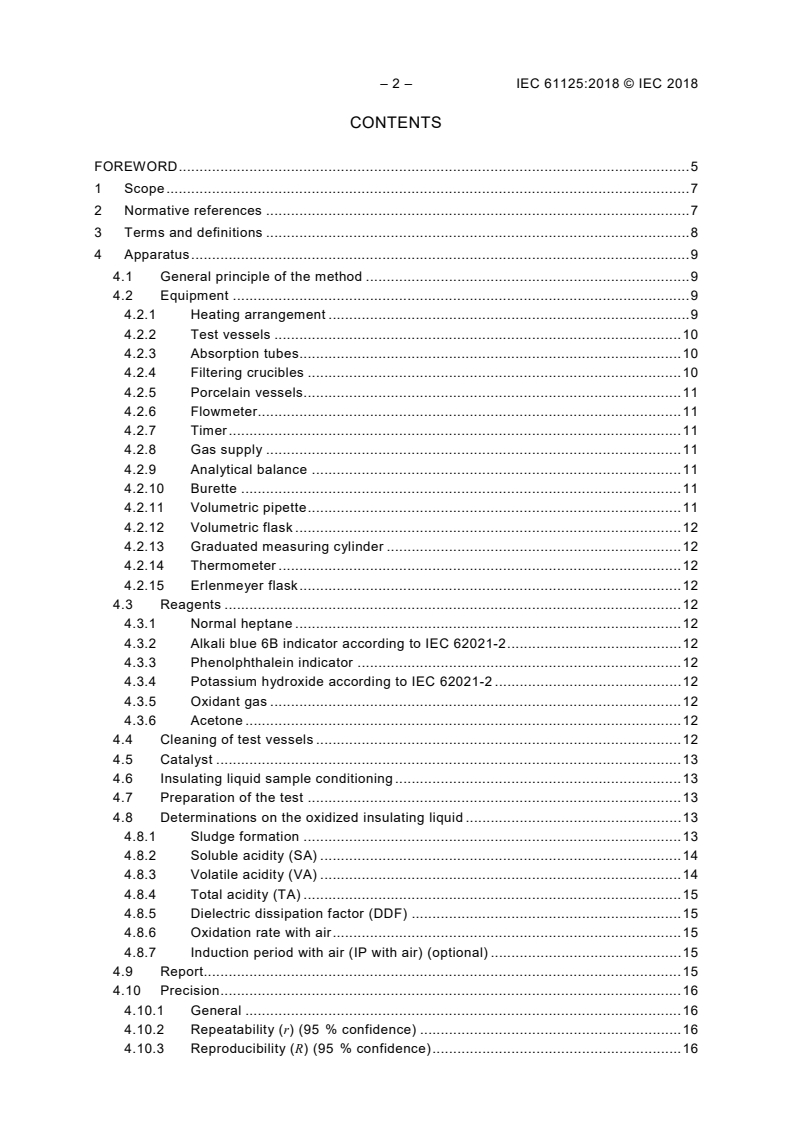
– 2 – IEC 61125:2018 © IEC 2018
CONTENTS
FOREWORD . 5
1 Scope . 7
2 Normative references . 7
3 Terms and definitions . 8
4 Apparatus . 9
4.1 General principle of the method . 9
4.2 Equipment . 9
4.2.1 Heating arrangement . 9
4.2.2 Test vessels . 10
4.2.3 Absorption tubes. 10
4.2.4 Filtering crucibles . 10
4.2.5 Porcelain vessels. 11
4.2.6 Flowmeter. 11
4.2.7 Timer . 11
4.2.8 Gas supply . 11
4.2.9 Analytical balance . 11
4.2.10 Burette . 11
4.2.11 Volumetric pipette . 11
4.2.12 Volumetric flask . 12
4.2.13 Graduated measuring cylinder . 12
4.2.14 Thermometer . 12
4.2.15 Erlenmeyer flask . 12
4.3 Reagents . 12
4.3.1 Normal heptane . 12
4.3.2 Alkali blue 6B indicator according to IEC 62021-2 . 12
4.3.3 Phenolphthalein indicator . 12
4.3.4 Potassium hydroxide according to IEC 62021-2 . 12
4.3.5 Oxidant gas . 12
4.3.6 Acetone . 12
4.4 Cleaning of test vessels . 12
4.5 Catalyst . 13
4.6 Insulating liquid sample conditioning . 13
4.7 Preparation of the test . 13
4.8 Determinations on the oxidized insulating liquid . 13
4.8.1 Sludge formation . 13
4.8.2 Soluble acidity (SA) . 14
4.8.3 Volatile acidity (VA) . 14
4.8.4 Total acidity (TA) . 15
4.8.5 Dielectric dissipation factor (DDF) . 15
4.8.6 Oxidation rate with air . 15
4.8.7 Induction period with air (IP with air) (optional) . 15
4.9 Report. 15
4.10 Precision . 16
4.10.1 General . 16
4.10.2 Repeatability (r) (95 % confidence) . 16
4.10.3 Reproducibility (R) (95 % confidence) . 16
Annex A (normative) Thermometer specifications . 20
Annex B (informative) Method for evaluating the oxidation stability of inhibited
insulating liquids in the delivery state by measurement of the induction period with
oxygen . 21
B.1 Outline of the method . 21
B.2 Reagents and test conditions . 21
B.3 Procedure . 21
B.3.1 General . 21
B.3.2 Preparation of the test . 21
B.3.3 Oxidation . 22
B.3.4 Determination of the induction period with oxygen . 22
B.3.5 Determinations on the oxidized oil (optional). 22
B.4 Report. 23
B.5 Precision . 23
B.5.1 General . 23
B.5.2 Relative repeatability (r) (95 % confidence) . 23
B.5.3 Relative reproducibility (R) (95 % confidence) . 23
Annex C (informative) Method for evaluation of thermo-oxidative behaviour of unused
ester insulating liquids . 24
C.1 Outline of the method . 24
C.2 Equipment . 24
C.2.1 Heating arrangement . 24
C.2.2 Test vessels . 24
C.2.3 Reagents . 24
C.3 Test procedure . 24
C.3.1 Sample conditioning and preparation . 24
C.3.2 Ageing procedure . 25
C.4 Determination of the oxidized insulating liquid . 25
C.4.1 Soluble acidity . 25
C.4.2 Dielectric dissipation factor (DDF) at 90 °C . 25
C.4.3 Appearance . 25
C.4.4 Kinematic viscosity . 25
C.5 Report. 25
C.6 Precision . 26
Bibliography . 27
Figure 1 – Typical 8 hole (4 x 2) aluminium heating block . 17
Figure 2 – Aluminium alloy temperature measuring block . 17
Figure 3 – Position of the tube in the oil bath . 18
Figure 4 – Oxidation tube or absorption tube . 18
Figure 5 – Oxidation tube and absorption tube assembly . 19
Figure C.1 – Headspace vial with copper catalyst . 25
Table 1 – Repeatability and reproducibility of the oxidation stability test of uninhibited
mineral oil in the delivered state for 164 h at 120 °C . 16
Table A.1 – Thermometer specifications . 20
Table B.1 – Precision data for induction time with oxygen for the oxidation test for
mineral oil according to Annex B . 23
– 4 – IEC 61125:2018 © IEC 2018
Table C.1 – Precision data for headspace procedure according to Annex C . 26
INTERNATIONAL ELECTROTECHNICAL COMMISSION
____________
INSULATING LIQUIDS – TEST METHODS FOR OXIDATION STABILITY
Test method for evaluating the oxidation stability of insulating
liquids in the delivered state
FOREWORD
1) The International Electrotechnical Commission (IEC) is a worldwide organization for standardization comprising
all national electrotechnical committees (IEC National Committees). The object of IEC is to promote
international co-operation on all questions concerning standardization in the electrical and electronic fields. To
this end and in addition to other activities, IEC publishes International Standards, Technical Specifications,
Technical Reports, Publicly Available Specifications (PAS) and Guides (hereafter referred to as “IEC
Publication(s)”). Their preparation is entrusted to technical committees; any IEC National Committee interested
in the subject dealt with may participate in this preparatory work. International, governmental and
non-governmental organizations liaising with the IEC also participate in this preparation. IEC collaborates
closely with the International Organization for Standardization (ISO) in accordance with conditions determined
by agreement between the two organizations.
2) The formal decisions or agreements of IEC on technical matters express, as nearly as possible, an international
consensus of opinion on the relevant subjects since each technical committee has representation from all
interested IEC National Committees.
3) IEC Publications have the form of recommendations for international use and are accepted by IEC National
Committees in that sense. While all reasonable efforts are made to ensure that the technical content of IEC
Publications is accurate, IEC cannot be held responsible for the way in which they are used or for any
misinterpretation by any end user.
4) In order to promote international uniformity, IEC National Committees undertake to apply IEC Publications
transparently to the maximum extent possible in their national and regional publications. Any divergence
between any IEC Publication and the corresponding national or regional publication shall be clearly indicated in
the latter.
5) IEC itself does not provide any attestation of conformity. Independent certification bodies provide conformity
assessment services and, in some areas, access to IEC marks of conformity. IEC is not responsible for any
services carried out by independent certification bodies.
6) All users should ensure that they have the latest edition of this publication.
7) No liability shall attach to IEC or its directors, employees, servants or agents including individual experts and
members of its technical committees and IEC National Committees for any personal injury, property damage or
other damage of any nature whatsoever, whether direct or indirect, or for costs (including legal fees) and
expenses arising out of the publication, use of, or reliance upon, this IEC Publication or any other IEC
Publications.
8) Attention is drawn to the Normative references cited in this publication. Use of the referenced publications is
indispensable for the correct application of this publication.
9) Attention is drawn to the possibility that some of the elements of this IEC Publication may be the subject of
patent rights. IEC shall not be held responsible for identifying any or all such patent rights.
International Standard IEC 61125 has been prepared by IEC technical committee 10: Fluids
for electrotechnical applications.
This second edition cancels and replaces the first edition published in 1992 and
Amendment 1:2004. This edition constitutes a technical revision.
This edition includes the following significant technical changes with respect to the previous
edition:
a) the title has been modified to include insulating liquids different from mineral insulating
oils (hydrocarbon);
b) the method applies for insulating liquids in the delivered state;
c) former Method C is now the main normative method;
d) precision data of the main normative method has been updated concerning the dissipation
factor;
– 6 – IEC 61125:2018 © IEC 2018
e) former Method A has been deleted;
f) former Method B has been transferred to Annex B;
g) a new method evaluating the thermo-oxidative behaviour of esters is included in Annex C.
The text of this standard is based on the following documents:
FDIS Report on voting
10/1047/FDIS 10/1052/RVD
Full information on the voting for the approval of this International Standard can be found in
the report on voting indicated in the above table.
This document has been drafted in accordance with the ISO/IEC Directives, Part 2.
The committee has decided that the contents of this document will remain unchanged until the
stability date indicated on the IEC website under "http://webstore.iec.ch" in the data related to
the specific document. At this date, the document will be
• reconfirmed,
• withdrawn,
• replaced by a revised edition, or
• amended.
IMPORTANT – The 'colour inside' logo on the cover page of this publication indicates
that it contains colours which are considered to be useful for the correct
understanding of its contents. Users should therefore print this document using a
colour printer.
INSULATING LIQUIDS – TEST METHODS FOR OXIDATION STABILITY
Test method for evaluating the oxidation stability of insulating
liquids in the delivered state
1 Scope
This document describes a test method for evaluating the oxidation stability of insulating
liquids in the delivered state under accelerated conditions regardless of whether or not
antioxidant additives are present. The duration of the test can be different depending on the
insulating liquid type and is defined in the corresponding standards (e.g. in IEC 60296,
IEC 61099, IEC 62770). The method can be used for measuring the induction period, the test
being continued until the volatile acidity significantly exceeds 0,10 mg KOH/g in the case of
mineral oils. This value can be significantly higher in the case of ester liquids.
The insulating liquid sample is maintained at 120 °C in the presence of a solid copper catalyst
whilst bubbling air at a constant flow. The degree of oxidation stability is estimated by
measurement of volatile acidity, soluble acidity, sludge, dielectric dissipation factor, or from
the time to develop a given amount of volatile acidity (induction period with air).
In informative Annex B, a test method for evaluating the oxidation stability of inhibited mineral
insulating oils in the delivered state by measurement of the induction period with oxygen is
described. The method is only intended for quality control purposes. The results do not
necessarily provide information on the performance in service. The oil sample is maintained
at 120 °C in the presence of a solid copper catalyst whilst bubbling through a constant flow of
oxygen. The degree of oxidation stability is estimated by the time taken by the oil to develop a
determined amount of volatile acidity (induction period with oxygen). Additional criteria such
as soluble and volatile acidities, sludge and dielectric dissipation factor can also be
determined after a specified duration.
In informative Annex C, a test method intended to simulate the thermo-oxidative behaviour of
ester insulating liquids (headspace of air at 150 °C for 164 h) is described.
Additional test methods such as those described in IEC TR 62036 based on differential
scanning calorimetry can also be used as screening tests, but are out of the scope of this
document.
2 Normative references
The following documents are referred to in the text in such a way that some or all of their
content constitutes requirements of this document. For dated references, only the edition
cited applies. For undated references, the latest edition of the referenced document (including
any amendments) applies.
IEC 60247, Insulating liquids – Measurement of relative permittivity, dielectric dissipation
factor (tan δ) and d.c. resistivity
IEC 62021-2, Insulating liquids – Determination of acidity – Part 2: Colorimetric titration
IEC 62021-3, Insulating liquids – Determination of acidity – Part 3: Test methods for non-
mineral insulating oils
– 8 – IEC 61125:2018 © IEC 2018
IEC 60422:2013, Mineral insulating oils in electrical equipment – Supervision and
maintenance guidance
ISO 383, Laboratory glassware – Interchangeable conical ground joints
ISO 4793, Laboratory sintered (fritted) filters – Porosity grading, classification and designation
ISO 6344-1, Coated abrasives – Grain size analysis – Part 1: Grain size distribution test
ISO 3104, Petroleum products – Transparent and opaque liquids – Determination of kinematic
viscosity and calculation of dynamic viscosity
ASTM E287, Standard specification for laboratory glass graduated burets
3 Terms and definitions
For the purposes of this document, the following terms and definitions apply.
ISO and IEC maintain terminological databases for use in standardization at the following
addresses:
• IEC Electropedia: available at http://www.electropedia.org/
• ISO Online browsing platform: available at http://www.iso.org/obp
3.1
unused insulating liquid
insulating liquid that has not been used in, or been in contact with electrical equipment or
other equipment not required for manufacture, storage or transport
Note 1 to entry: See also IEC 60296, IEC 61099 and IEC 62770.
3.2
recycled insulating liquid
insulating liquid previously used in electrical equipment that has been subjected to re-refining
or reclaiming (regeneration) off-site
Note 1 to entry: Any blend of unused and recycled oils is to be considered as recycled.
3.3
oxidation stability
ability of an insulating liquid to withstand oxidation under thermal stress and in the presence
of oxygen and a copper catalyst
Note 1 to entry: Oxidation stability gives general information about the stability of the insulating liquid under
service conditions in electrical equipment. The property is defined as resistance to formation of acidic compounds,
sludge and compounds influencing the dielectric dissipation factor (DDF) under given conditions. Test durations for
insulating liquids are described in the corresponding standards.
3.4
induction period with air
graphical representation of the oxidation rate over the entire period which can be obtained by
titrating volatile acidity daily (or at other suitable time interval) and plotting the cumulated
results against time
Note 1 to entry: The induction period with air is determined by reading the time corresponding to 0,10 mg KOH/g
volatile acidity in the case of mineral oil. In the case of ester liquids a higher value needs to be established.
3.5
volatile acidity
measurement of the amount of oxidation products collected in the water phase in the
absorption tube
3.6
soluble acidity
acidity (neutralization value) of oil as a measure of the acidic degradation products in the
insulating liquid
Note 1 to entry: The acidity of an oxidized oil is due to the formation of acidic oxidation products. Acids and other
oxidation products will, in conjunction with water and solid contaminants, affect the dielectric and other properties
of the oil. Acids have an impact on the degradation of cellulosic materials and may also be responsible for the
corrosion of metal parts in a transformer.
3.7
total acidity
sum of volatile and soluble acidity
3.8
sludge
polymerized degradation product of solid and liquid insulating material
Note 1 to entry: Sludge is soluble in oil up to a certain limit, depending on the oil solubility characteristics and
temperature.
3.9
dielectric dissipation factor
DDF
measure for dielectric losses within the oil
Note 1 to entry: High DDF values can indicate contamination of the oil by polar contaminants or poor refining
quality.
Note 2 to entry: DDF shall be measured at 90 °C, and in accordance with IEC 60247.
4 Apparatus
4.1 General principle of the method
The liquid sample to be tested, through which a stream of air is bubbled, is maintained for a
given period at 120 °C in the presence of solid copper. The resistance to oxidation is
evaluated from the amount of total sludge, total acidity and dielectric dissipation factor formed
or from the time to develop a given amount of volatile acidity (induction period with air).
4.2 Equipment
4.2.1 Heating arrangement
In order to achieve accurate measurements of the oxidation stability a strict control of the
temperature is of high importance. A thermostatically-controlled aluminium alloy block heater
or oil bath may be used to maintain the insulating liquid in the desired number of oxidation
tubes at the required temperature of 120 °C ± 0,5 °C (as examples see Figure 1 and Figure 3).
This temperature shall be read on a thermometer (see Annex A) inserted in an oxidation tube
to within 5 mm from the bottom; this oxidation tube shall be filled with the insulating liquid up
to the immersion line of the thermometer and placed in the heating bath.
The temperature of the upper surface of the thermal insulation top shall be maintained at
60 °C ± 5 °C. Measure this temperature by the use of a thermometer in a drilled aluminium
block (see Figure 2). The surfaces of this block, other than that against the upper surface of
the heating device, are protected by suitable thermal insulation of nominal 4 mm thickness.
– 10 – IEC 61125:2018 © IEC 2018
The thermal characteristics of this insulation shall be such as to allow the specified
temperatures to be achieved. This block should be placed as near to the holes as practicable
and within the area of the upper surface covering the heating device.
When using an aluminum heating block, the oxidation tubes are inserted into the holes to an
overall depth of 150 mm. The depth of the holes in the heating part of the block shall be at
least 125 mm and short aluminum alloy collars, passing through the insulating cover and
surrounding each oxidation tube, will ensure heating over the 150 mm length of the tube.
In the case of oil baths, the oxidation tubes shall be immersed to a depth of 137 mm in the oil
and to an overall depth of 150 mm in the bath (see Figure 3).
For both types of heating devices, the height of the oxidation tubes above the upper surface
shall be 60 mm and the diameter of the holes shall be just sufficient to allow insertion of the
specified tubes. In the case of slackness a 25 mm internal diameter O-ring may be placed
around the tube and pressed against the thermal insulation top or inserted into the annular
space between the tube and the thermal insulated top. The heating bath should be equipped
with supports to hold the absorption tubes.
When in use the heater shall be shielded from direct sunlight and air draughts.
NOTE When oil baths are used, it would be safer to place them in a fume hood.
4.2.2 Test vessels
Test tubes of borosilicate or neutral glass provided with a 24/29 ground joint (see ISO 383), of
the following dimensions in mm:
– overall length 210 ± 2
– external diameter 26 ± 0,5
– wall thickness 1,4 ± 0,2
– height of the head 28 ± 2
– air inlet tube:
• external diameter 5,0 ± 0,4
• wall thickness 0,8 ± 0,1
The test tube is fitted with a Drechsel head to which is attached the inlet tube which extends
to within 2,5 mm ± 0,5 mm from the bottom and has its end ground at an angle of 60° to the
horizontal axis (see Figure 4).
4.2.3 Absorption tubes
These are identical to the test vessels and the distance between the axes of the two tubes
shall be 150 mm ± 50 mm (see Figure 4 and Figure 5). Connections between the test and
absorption tubes should be as short as possible, of glass tubing butt-jointed to the vessels by
means of short flexible sleeves. Silicone rubber sleeving has been found suitable for this
purpose; however, the exposed silicone rubber surface shall be minimized in order to avoid
acids from being absorbed by the material. The absorption tubes are mounted outside the
heating device.
4.2.4 Filtering crucibles
Gooch-type crucibles with fused-in fritted glass disk according to ISO 4793 porosity 4,
designation grade P 16 of, for example, 35 ml capacity.
NOTE Alternatively polymeric membrane filters can be used, provided they are compatible with the insulating
liquids and solvents. Suitable membranes consist of a mixture of cellulose esters (cellulose nitrate + cellulose
acetate) with the following characteristics:
pore size: 8 µm;
thickness: 150 µm;
operating temperature: 120 °C in sterilizer and 75 °C under continuous filtration.
The filtration is improved by impregnating the membrane with a suitable wetting agent (e.g. octyl ethoxylate).
4.2.5 Porcelain vessels
Porcelain crucibles, capacity: 50 ml.
NOTE Alternatively, aluminium foil pans of the same capacity can be used.
4.2.6 Flowmeter
For measuring gas flow-rate a soap bubble flowmeter, a calibrated capillary tube flowmeter or
an electronic device can be used.
4.2.7 Timer
For measuring gas flow-rate with soap bubble flowmeter. Subdivisions of the graduation:
0,2 s.
4.2.8 Gas supply
To obtain accurate results it is of high importance to control and maintain the gas flow
constant and have a consistent high quality of the gas, this is obtained by the following
procedure: gas (oxygen or air according to the method) from a compressed gas cylinder or
line, is dried by passing through a scrubber bottle containing concentrated sulphuric acid and
then through a tower filled with alternate layers of glass wool and soda lime.
Alternatively drying tubes or a commercial gas purifier may be used.
The dried gas is passed into the oxidation tube via a flow control system which shall be
suitable for the specified flow-rate. This may consist of a manifold, connected to the gas-
purifying train, with a number of tappings, each provided with a fine-control adjustable
needle valve and supplying the gas to one oxidation tube.
The rate of gas flow may be conveniently measured by means of a flowmeter (see 4.2.6). In
that case, the difference in level of the liquid in the two limbs of the flowmeter should be
sufficiently great to ensure that adequate sensitivity of measurement is obtained over the
range of gas flow-rates.
However, any system known to be of equal or greater efficiency can be used.
NOTE A two-stage pressure regulator and a pressure compensator vessel can be helpful to achieve the required
accurate regulation of the gas pressure.
4.2.9 Analytical balance
Readability 0,1 mg.
4.2.10 Burette
Volume 10 ml with graduations of 0,01 ml, class A according to ASTM E287.
4.2.11 Volumetric pipette
Volume 25 ml, class A according to ASTM E287.
– 12 – IEC 61125:2018 © IEC 2018
4.2.12 Volumetric flask
Volume 500 ml, class A according to ASTM E287.
4.2.13 Graduated measuring cylinder
Volume 100 ml, class A according to ASTM E287.
4.2.14 Thermometer
A thermometer conforming to the requirements given in Annex A.
4.2.15 Erlenmeyer flask
Erlenmeyer flask, volume 500 ml, with ground glass stopper.
4.3 Reagents
4.3.1 Normal heptane
n-Heptane of analytical grade is to be used.
4.3.2 Alkali blue 6B indicator according to IEC 62021-2
Alkali blue 6B indicator is also known under the chemistry index 42765.
4.3.3 Phenolphthalein indicator
1 g of phenolphthalein per 100 ml of azeotropic ethanol (about 5 % water). Alternatively
isopropanol containing 5 % of water may be used.
NOTE Phenolphthalein fades rather quickly when exposed to strong direct light, should a faint tint be observed, it
is suggested that a few more drops of indicator are added.
4.3.4 Potassium hydroxide according to IEC 62021-2
0,05 mol/l alcoholic solution.
4.3.5 Oxidant gas
Synthetic air or air from compressed air line, free of hydrocarbons.
4.3.6 Acetone
Acetone of analytical grade is to be used.
4.4 Cleaning of test vessels
The test and the absorption tubes shall be chemically cleaned. Wash with acetone followed by
distilled or deionized water.
Drain and then soak in 95 % to 97 % sulphuric acid for a minimum of 16 h. Drain and
complete removal of acid by washing, first with tap water, then with distilled or deionized
water. Dry the tubes in an air oven at 105 °C for at least 3 h, and then allow cooling to room
temperature in a desiccator or a dry cabinet in which they are kept ready for use. Other
cleaning methods giving the same cleanliness result can be used.
4.5 Catalyst
The solid copper used as oxidation catalyst consists of a wire of soft electrolytic copper, of
diameter between 1 mm and 2 mm (of such a length as to give a surface area of
2 2
28,6 cm ± 0,3 cm ). To get accurate results it is of high importance that the copper surface
is properly prepared according to the following procedure:
– Immediately before use, the requisite length of copper wire is cleaned with P220 grade
silicon carbide abrasive cloth (ISO 6344-1). All traces of abrasive are removed with a
lintless filter paper and then with a dry, lintless cloth.
– Roll the wire into a spiral of approximately 2 cm external diameter and 5 cm long.
– The spiral is thoroughly cleaned by dipping it into normal heptane, then dried in air and
immediately introduced into the test vessel.
To avoid contamination, the prepared coil shall be handled only with tweezers. The copper
wire shall not be re-used.
4.6 Insulating liquid sample conditioning
Liquid to be tested shall be filtered through a previously dried (1 h at 105 °C) fritted glass
filter (ISO 4793, porosity 4, designation grade P16) or on membrane filters of 8 µm to remove
traces of sediment, fiber and excess water. The first 25 ml of filtrate should be discarded.
4.7 Preparation of the test
Adjust the heating bath to maintain the insulating liquid in all oxidation tubes at the required
temperature of 120 °C ± 0,5 °C (thermometer complying with the requirements of Annex A).
Weigh in each 25 g ± 0,1 g of insulating liquid into three oxidation tubes and insert the
catalyst coil previously prepared as described in 4.5. At least three oxidation tubes are
required to be able to measure the DDF (minimum two tubes) and sludge/oil acid number (one
tube). Insert the Drechsel head and place the tube into the heater using a rubber
O-ring if necessary to close the gap between the tube and the thermal insulated top.
Pour 25 ml of distilled water into one absorption tube. Insert the Drechsel head and
connect to the corresponding oxidation tube (see Figure 4).
Adjust the air flow to deliver 0,150 l/h ± 0,015 l/h measured by means of the
flowmeter (see 4.2.6) connected to the outlet end of the absorption tube (see Figure 5).
Oxidize the insulating liquid while maintaining its temperature at 120 °C ± 0,5 °C and
an air flow-rate of 0,150 l/h ± 0,015 l/h.
Check air flow and temperature daily.
4.8 Determinations on the oxidized insulating liquid
4.8.1 Sludge formation
The sludge shall be precipitated by adhering strictly to the procedure described below.
The sample of 25 g of artificially aged insulating liquid is cooled in the dark for 1 h,
and is then poured into an Erlenmeyer flask.
Use 300 ml normal heptane in successive fractions to rinse out the insulating liquid
adhering to the test tube, copper spiral and gas lead-in tube and add the washings to
the insulating liquid in the flask.
– 14 – IEC 61125:2018 © IEC 2018
The mixture is then allowed to stand in the dark for 24 h, at a temperature of 20 °C ± 5 °C,
before filtering through a filter crucible (or membrane filter) previously dried to constant
mass.
At the start of filtering only a small pressure drop should be used, to prevent the sludge
passing through the filter. Cloudy filtrates should be passed through a second time.
All traces of insulating liquid shall be removed by repeated washing of the sludge with normal
heptane. The total volume of the normal heptane used for the washing of the sludge shall be
150 ml. The filter containing the sludge is dried at 105 °C to constant mass.
Sludge adhering to the catalyst, to the test tube, and to the gas lead-in tube is transferred, by
dissolving it in small quantities of acetone (a total of 30 ml), to a tared porcelain vessel (or
aluminum foil pan). It is then dried at 105 °C, after the evaporation of the acetone, to constant
mass. The mass of the residue is added to that of the sludge obtained by precipitation with
normal heptane.
The total sludge is expressed as a percentage of the initial weight of the insulating liquid.
4.8.2 Soluble acidity (SA)
The heptane solution obtained after filtering off the sludge is collected in a 500 ml volumetric
flask and made up to mark with normal heptane. Three determinations of the neutralization
value are made on 100 ml samples of the heptane insulating liquid solution.
The determination is carried out with 100 ml of the heptane solution according to IEC 62021-2.
Calculate (Formula 1) the soluble acidity (SA), in milligrams of potassium hydroxide per gram
of insulating liquid, as follows:
M× 56,1× (V −V )× 5
2 1
SA= (1)
G
where:
M is the molarity of the alcoholic potassium hydroxide solution;
V is the volume of alcoholic potassium hydroxide solution in ml necessary to titrate the
normal heptane insulating liquid solution;
V is the volume of alcoholic potassium hydroxide solution in ml necessary to titrate
100 ml of normal heptane with an alkali blue 6B indicator solution according to
IEC 62021-2;
G is the mass of insulating liquid, in grams.
NOTE The potentiometric method for the determination of soluble acidity (IEC 62021-1) can be used alternatively
if proven to deliver the same result.
4.8.3 Volatile acidity (VA)
Volatile acidity is a measurement of the amount of oxidation
...