


IEC PAS 62453-4:2006
(Main)Field Device Tool (FDT) interface specification - Part 4: HART communication
General Information
- Abstract
provides information for integrating the HART protocol into the FDT interface specification (IEC 62453-1). This PAS neither contains the FDT specification nor modifies it.
- Status
- Replaced
- Publication Date
- 17-May-2006
- Technical Committee
- SC 65C - Industrial networks
- Current Stage
- DELPUB - Deleted Publication
- Start Date
- 18-Aug-2009
- Completion Date
- 28-Aug-2026
Relations
- Effective Date
- 05-Sep-2023
- Effective Date
- 05-Sep-2023
- Effective Date
- 05-Sep-2023
- Effective Date
- 05-Sep-2023
- Effective Date
- 05-Sep-2023
- Effective Date
- 05-Sep-2023
- Effective Date
- 05-Sep-2023
- Effective Date
- 05-Sep-2023
- Effective Date
- 05-Sep-2023
- Effective Date
- 05-Sep-2023
- Replaced By
IEC 62453-1:2009 - Field device tool (FDT) interface specification - Part 1: Overview and guidance - Effective Date
- 05-Sep-2023
- Effective Date
- 05-Sep-2023
- Effective Date
- 05-Sep-2023
- Effective Date
- 05-Sep-2023
- Effective Date
- 05-Sep-2023
Get Certified
Connect with accredited certification bodies for this standard

BSI Group
BSI (British Standards Institution) is the business standards company that helps organizations make excellence a habit.

DVS-ZERT GmbH
German welding certification society.
CARES (UK Certification Authority for Reinforcing Steels)
UK certification for reinforcing steels and construction.
Sponsored listings
Frequently Asked Questions
IEC PAS 62453-4:2006 is a technical specification published by the International Electrotechnical Commission (IEC). Its full title is "Field Device Tool (FDT) interface specification - Part 4: HART communication". This standard covers: provides information for integrating the HART protocol into the FDT interface specification (IEC 62453-1). This PAS neither contains the FDT specification nor modifies it.
provides information for integrating the HART protocol into the FDT interface specification (IEC 62453-1). This PAS neither contains the FDT specification nor modifies it.
IEC PAS 62453-4:2006 is classified under the following ICS (International Classification for Standards) categories: 25.040.40 - Industrial process measurement and control; 35.100.05 - Multilayer applications; 35.240.50 - IT applications in industry. The ICS classification helps identify the subject area and facilitates finding related standards.
IEC PAS 62453-4:2006 has the following relationships with other standards: It is inter standard links to IEC TR 62453-515:2009, IEC TR 62453-509:2009, IEC 62453-301:2009, IEC 62453-306:2009, IEC 62453-315:2009, IEC TR 62453-502:2009, IEC 62453-303-2:2009, IEC 62453-309:2009, IEC TR 62453-41:2009, IEC TR 62453-503-1:2009, IEC 62453-1:2009, IEC TR 62453-506:2009, IEC TR 62453-61:2009, IEC 62453-2:2009, IEC 62453-303-1:2009. Understanding these relationships helps ensure you are using the most current and applicable version of the standard.
IEC PAS 62453-4:2006 is available in PDF format for immediate download after purchase. The document can be added to your cart and obtained through the secure checkout process. Digital delivery ensures instant access to the complete standard document.
Standards Content (Sample)
PUBLICLY
IEC
AVAILABLE
PAS 62453-4
SPECIFICATION
First edition
Pre-Standard
2006-05
Field Device Tool (FDT) interface specification –
Part 4:
HART communication
Reference number
IEC/PAS 62453-4:2006(E)
Publication numbering
As from 1 January 1997 all IEC publications are issued with a designation in the
60000 series. For example, IEC 34-1 is now referred to as IEC 60034-1.
Consolidated editions
The IEC is now publishing consolidated versions of its publications. For example,
edition numbers 1.0, 1.1 and 1.2 refer, respectively, to the base publication, the
base publication incorporating amendment 1 and the base publication incorporating
amendments 1 and 2.
Further information on IEC publications
The technical content of IEC publications is kept under constant review by the IEC,
thus ensuring that the content reflects current technology. Information relating to
this publication, including its validity, is available in the IEC Catalogue of
publications (see below) in addition to new editions, amendments and corrigenda.
Information on the subjects under consideration and work in progress undertaken
by the technical committee which has prepared this publication, as well as the list
of publications issued, is also available from the following:
• IEC Web Site (www.iec.ch)
• Catalogue of IEC publications
The on-line catalogue on the IEC web site (www.iec.ch/searchpub) enables you to
search by a variety of criteria including text searches, technical committees
and date of publication. On-line information is also available on recently issued
publications, withdrawn and replaced publications, as well as corrigenda.
• IEC Just Published
This summary of recently issued publications (www.iec.ch/online_news/ justpub)
is also available by email. Please contact the Customer Service Centre (see
below) for further information.
• Customer Service Centre
If you have any questions regarding this publication or need further assistance,
please contact the Customer Service Centre:
Email: custserv@iec.ch
Tel: +41 22 919 02 11
Fax: +41 22 919 03 00
PUBLICLY
IEC
AVAILABLE
PAS 62453-4
SPECIFICATION
First edition
Pre-Standard
2006-05
Field Device Tool (FDT) interface specification –
Part 4:
HART communication
IEC 2006 Copyright - all rights reserved
No part of this publication may be reproduced or utilized in any form or by any means, electronic or
mechanical, including photocopying and microfilm, without permission in writing from the publisher.
International Electrotechnical Commission, 3, rue de Varembé, PO Box 131, CH-1211 Geneva 20, Switzerland
Telephone: +41 22 919 02 11 Telefax: +41 22 919 03 00 E-mail: inmail@iec.ch Web: www.iec.ch
PRICE CODE
Commission Electrotechnique Internationale
U
International Electrotechnical Commission
Международная Электротехническая Комиссия
For price, see current catalogue
– 2 – PAS 62453-4 © IEC:2006
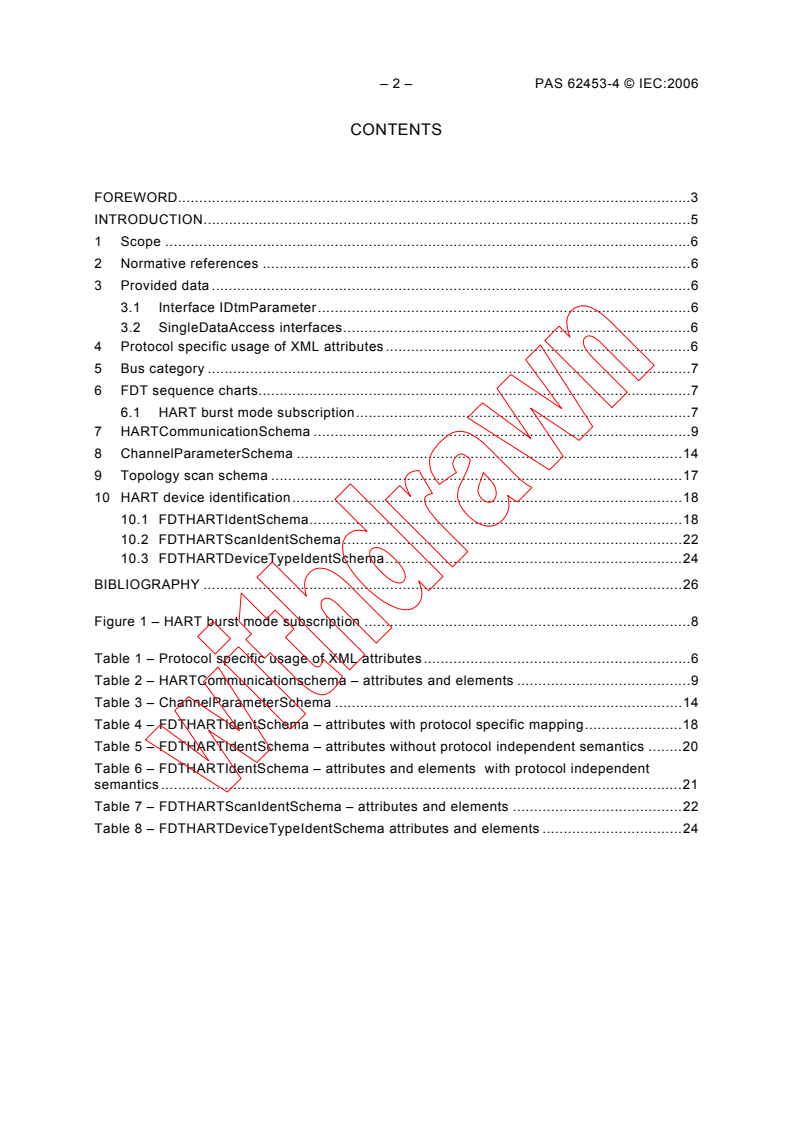
CONTENTS
FOREWORD.3
INTRODUCTION.5
1 Scope .6
2 Normative references .6
3 Provided data .6
3.1 Interface IDtmParameter.6
3.2 SingleDataAccess interfaces.6
4 Protocol specific usage of XML attributes.6
5 Bus category .7
6 FDT sequence charts.7
6.1 HART burst mode subscription.7
7 HARTCommunicationSchema .9
8 ChannelParameterSchema .14
9 Topology scan schema .17
10 HART device identification.18
10.1 FDTHARTIdentSchema.18
10.2 FDTHARTScanIdentSchema .22
10.3 FDTHARTDeviceTypeIdentSchema.24
BIBLIOGRAPHY .26
Figure 1 – HART burst mode subscription .8
Table 1 – Protocol specific usage of XML attributes.6
Table 2 – HARTCommunicationschema – attributes and elements .9
Table 3 – ChannelParameterSchema .14
Table 4 – FDTHARTIdentSchema – attributes with protocol specific mapping.18
Table 5 – FDTHARTIdentSchema – attributes without protocol independent semantics .20
Table 6 – FDTHARTIdentSchema – attributes and elements with protocol independent
semantics .21
Table 7 – FDTHARTScanIdentSchema – attributes and elements .22
Table 8 – FDTHARTDeviceTypeIdentSchema attributes and elements .24
PAS 62453-4 © IEC:2006 – 3 –
INTERNATIONAL ELECTROTECHNICAL COMMISSION
____________
Field Device Tool (FDT) interface specification –
Part 4: HART communication
FOREWORD
1) The International Electrotechnical Commission (IEC) is a worldwide organization for standardization comprising
all national electrotechnical committees (IEC National Committees). The object of IEC is to promote
international co-operation on all questions concerning standardization in the electrical and electronic fields. To
this end and in addition to other activities, IEC publishes International Standards, Technical Specifications,
Technical Reports, Publicly Available Specifications (PAS) and Guides (hereafter referred to as “IEC
Publication(s)”). Their preparation is entrusted to technical committees; any IEC National Committee interested
in the subject dealt with may participate in this preparatory work. International, governmental and non-
governmental organizations liaising with the IEC also participate in this preparation. IEC collaborates closely
with the International Organization for Standardization (ISO) in accordance with conditions determined by
agreement between the two organizations.
2) The formal decisions or agreements of IEC on technical matters express, as nearly as possible, an international
consensus of opinion on the relevant subjects since each technical committee has representation from all
interested IEC National Committees.
3) IEC Publications have the form of recommendations for international use and are accepted by IEC National
Committees in that sense. While all reasonable efforts are made to ensure that the technical content of IEC
Publications is accurate, IEC cannot be held responsible for the way in which they are used or for any
misinterpretation by any end user.
4) In order to promote international uniformity, IEC National Committees undertake to apply IEC Publications
transparently to the maximum extent possible in their national and regional publications. Any divergence
between any IEC Publication and the corresponding national or regional publication shall be clearly indicated in
the latter.
5) IEC provides no marking procedure to indicate its approval and cannot be rendered responsible for any
equipment declared to be in conformity with an IEC Publication.
6) All users should ensure that they have the latest edition of this publication.
7) No liability shall attach to IEC or its directors, employees, servants or agents including individual experts and
members of its technical committees and IEC National Committees for any personal injury, property damage or
other damage of any nature whatsoever, whether direct or indirect, or for costs (including legal fees) and
expenses arising out of the publication, use of, or reliance upon, this IEC Publication or any other IEC
Publications.
8) Attention is drawn to the Normative references cited in this publication. Use of the referenced publications is
indispensable for the correct application of this publication.
9) Attention is drawn to the possibility that some of the elements of this IEC Publication may be the subject of
patent rights. IEC shall not be held responsible for identifying any or all such patent rights.
A PAS is a technical specification not fulfilling the requirements for a standard but made
available to the public.
IEC-PAS 62453-4 has been processed by subcommittee 65C: Digital communications, of IEC
technical committee 65: Industrial-process measurement and control.
The text of this PAS is based on the This PAS was approved for
following document: publication by the P-members of the
committee concerned as indicated in
the following document
Draft PAS Report on voting
65C/398A/NP 65C/411/RVN
Following publication of this PAS, which is a pre-standard, the technical committee or
subcommittee concerned will transform it into an International Standard.
– 4 – PAS 62453-4 © IEC:2006
This PAS shall remain valid for an initial maximum period of three years starting from
2006-05. The validity may be extended for a single three-year period, following which it shall
be revised to become another type of normative document or shall be withdrawn.
IEC 62453 consists of the following parts under the general title Field Device Tool (FDT)
interface specification:
Part 1: Concepts and detailed description
Part 2: INTERBUS communication
Part 3: PROFIBUS communication
Part 4: HART communication
Part 5: FOUNDATION FIELDBUS communication
PAS 62453-4 © IEC:2006 – 5 –
INTRODUCTION
This PAS is an interface specification for developers of FDT components for Function Control
and Data Access within a Client Server architecture. The specification is a result of an
analysis and design process to develop standard interfaces to facilitate the development of
servers and clients by multiple vendors that shall inter-operate seamlessly.
With the integration of fieldbusses into control systems, there are a few other tasks which
must be performed. This applies to fieldbusses in general. Although there are fieldbus- and
device-specific tools, there is no unified way to integrate those tools into higher level system-
wide planning or engineering tools. In particular, for use in extensive and heterogeneous
control systems, typically in the area of the process industry, the unambiguous definition of
engineering interfaces that are easy to use for all those involved, is of great importance.
A device-specific software component, called DTM (Device Type Manager), is supplied by the
field device manufacturer with its device. The DTM is integrated into engineering tools via the
FDT interfaces defined in this specification. The approach to integration is in general open for
all kind of fieldbusses and thus meets the requirements for integrating different kinds of
devices into heterogeneous control systems.
– 6 – PAS 62453-4 © IEC:2006
Field Device Tool (FDT) interface specification –
Part 4: HART communication
1 Scope
This part of IEC 62435 provides information for integrating the HART protocol into the FDT
interface specification (IEC 62453-1). This PAS neither contains the FDT specification nor
modifies it.
2 Normative references
The following referenced documents are indispensable for the application of this PAS. For
dated references, only the edition cited applies. For undated references, the latest edition of
the referenced document (including any amendments) applies
IEC 62453-1: Field Device Tool (FDT) interface specification – Part 1: Concepts and detailed
description
3 Provided data
3.1 Interface IDtmParameter
The minimum set of provided data should be:
• The first four provided process related values (PV, SV, …) - if available - are modeled as
channel references. The referenced channel must include ranges and scaling.
3.2 SingleDataAccess interfaces
At least all parameters of the Universal and Common Practice (as far as the device supports
the function) commands must be exposed via the interfaces IDtmSingleDeviceDataAccess
and IDtmSingleInstanceDataAccess.
Furthermore the Response Byte 0 and the Response Byte 1 for each command must be
exposed.
4 Protocol specific usage of XML attributes
The following Table 1 shows how general attributes are used with HART devices.
Table 1 – Protocol specific usage of XML attributes
Attribute Description for use in HART
address The address attribute (defined in FDTDataTypesSchema.xml) is not mandatory
for the exposed parameters in the DTMs. But if the address attribute is used
the string must be constructed according to the rules of the semanticId. That
means the attribute ‘semanticId’ is always the same as the attribute ‘address’
busCategory See Clause 5
—————————
HART ® is the trade name of the a product supplied byHART Communication Foundation. This information is
given for convenience of users of this document and does not constitute an endorsment by IEC of the product
named. Equivalent products may be used if they can be shown to lead to the same results.
PAS 62453-4 © IEC:2006 – 7 –
Attribute Description for use in HART
deviceTypeId The attribute "fdt:DtmDeviceType/@deviceTypeId" must contain the
DeviceTypeID of the supported physical device according to the HCF online
product catalog
manufacturerId Enter manufacturer according to HCF list
semanticId The applicationDomain attribute is: FDT_HART
applicationDomain
The sematicId for HART protocol-related parameter is directly related to the
protocol specification. The definition of the HART commands is the base for the
semanticId. The semanticId for a parameter follows the following definition:
CMDxxBy
and
CMD31EXTENDEDxxBy
for extended HART 6 device family commands.
The semanticIds for the Response Byte 0 and 1 defined in the HART
specification are:
CMDxxRESPONSE_BYTE_0
CMDxxRESPONSE_BYTE_1
xx: represents the command number, getting the parameter via HART protocol
or the device family command number
y: start byte within the command definition
xx, yy are based on decimal format without leading ‘0’
subDeviceType Enter manufacturer-specific value
5 Bus category
HART protocol is identified by the following unique identifier in busCategory attributes within
XML BusCategory elements.
BusCategory Element Description
036D1498-387B-11D4-86E1-00E0987270B9 Support of HART protocol
6 FDT sequence charts
6.1 HART burst mode subscription
A subscription of device initiated data transfer can be requested by sending a
TransactionRequest with SubscribeRequest content (see Figure 1). The Communication
Channel may detect if the device is already in Burst Mode. In HART 5 this can be detected
only when HART Burst frames are received from the device. In HART 6 the Burst mode can
be detected using HART command 105. The Communication Channel answers on a
SubscribeRequest by calling OnTransactionResponse with a SubscribeResponse content. If
HART Burst frames are received, the device is in Burst mode and burstModeDetected value is
set to TRUE. This means that device DTM will start to receive Burst messages via
OnTransactionResponse mechanism. In case no burst messages were received,
burstModeDetected value is set to FALSE. It is up to device DTM to set device into Burst
mode. Then device DTM may call TransactionRequest with SubscribeRequest content again
in order to receive Burst messages.
– 8 – PAS 62453-4 © IEC:2006
In order to unsubscribe, the device DTM sends a TransactionRequest with a
UnsubcribeRequest. The Communication Channel answers by calling
OnTransactionResponse with a SubscribeResponse where burstModeDetected value is set to
FALSE. Device DTM will not receive any more Burst information via OnTransactionResponse
mechanism. The Communication Channel does not switch off the Burst Mode in the device.
The device DTM may switch Burst Mode on or off by using normal TransactionRequests
(HART command 109). This is independent of the subscription.
DTM Comm-DTM Device
TransactionRequest()
Subscribe request for device
initialized transaction mode
Comm-DTM
[*] BACK response
detects burst
Get information about active
frames
OnTransactionResponse()
burst mode (subscription mode
’on’)
[*] BACK response
Receives burst frames via
[*] OnTransactionResponse
transaction responses without
requests.
TransactionRequest()
Unsubscribe request and
Device remains
response about concluded
in burst mode
device initialized transaction
mode
OnTransactionResponse()
Figure 1 – HART burst mode subscription
Used methods:
IFdtCommunication::TransactionRequest()
IFdtCommunication::OnTransactionResponse()
PAS 62453-4 © IEC:2006 – 9 –
7 HARTCommunicationSchema
Used at: IFdtCommunication::ConnectRequest()
IFdtCommunicationEvents2::OnConnectResponse2()
IFdtCommunication::DisconnectRequest()
IFdtCommunicationEvents::OnDisconnectResponse ()
IFdtCommunication::TransactionRequest()
IFdtCommunicationEvents::OnTransactionResponse()
The XML document contains the address information and the communication data which are
explained in Table 2.
Table 2 – HARTCommunicationschema – attributes and elements
Attribute Description
address1 Address information according to the HART specification
address2 Address information according to the HART specification
address3 Address information according to the HART specification
burstFrame Information whether the HART response is a Burst frame (message or not)
burstModeDetected Indicates whether the Communication Channel has detected that the device is
already in burst mode. This is detected during a subscription request
commandNumber Address information according to the HART specification
communicationReference Mandatory identifier for a communication link to a device. This identifier is
allocated by the communication component during the connect. The address
information has to be used for all following communication calls
delayTime Minimum delay time in [ms] between two communication calls
deviceStatus Changed description
Status information. This is the second status byte returned in HART command
responses according to the HART specification
deviceTypeId Address information according to the HART specification
longFrameRequired Address information according to the HART specification
manufacturerId Address information according to the HART specification (see table relating to
MANUFACTURER IDENTIFICATION CODES)
preambleCount At the connect request the attribute is optional and contains a hint for the
communication component about the number of preambles, required by the device
type. At the connect response the attribute is mandatory and contains the
information about the currently used preambleCount
primaryMaster At the connect request the attribute is optional and contains a hint for a
communication component that a DTM requires communication as primary or
secondary master. At the connect response the attribute is mandatory contains the
information about the current state of the master
schemaVersion Defines the version of the schema
sequenceTime Period of time in [ms] for the whole sequence
shortAddress Address information according to the HART specification. This value is accessible
via the attribute slaveAddress defined within the DTMParameterSchema.
SlaveAddress is part of the BusInformation structure. These values must be set by
the responsible component as described in clause Nested Communication of
IEC/PAS 62453-1
value Variable for status information
systemTag System Tag of a DTM. It is strongly recommended to provide the attribute in the
Request document
– 10 – PAS 62453-4 © IEC:2006
Tag Description
Abort Describes the abort
CommandResponse – Changed description
Status information. This is computed from the first status byte returned in HART
command responses according to the HART specification. If bit 7 of the first status
byte is clear this value contains the value in the first status byte. If bit 7 is set this
element is not returned in the status structure
CommunicationStatus – Changed description
Status information. This is computed from the first status byte returned in HART
command responses according to the HART specification. If bit 7 of the first status
byte is set this value contains the value in the first status byte (this is where we
need to state whether it is the first status byte or bits 0-6 of the first status byte). If
bit 7 is clear this element is not returned in the status structure
ConnectRequest Describes the communication request
ConnectResponse Describes the communication response
DataExchangeRequest Describes the communication request
DataExchangeResponse Describes the communication response
DisconnectRequest Describes the communication request
DisconnectResponse Describes the communication response
SubscribeRequest Describes the subscription request for device initiated data transfer (HART Burst
mode)
SubscribeResponse Describes the subscription response request for device initiated data transfer
(HART Burst mode)
UnsubscribeRequest Describes the request to release the subscription for device initiated data transfer
(HART Burst mode)
UnsubscribeResponse Describes the response request to release the subscription for device initiated
data transfer (HART Burst mode)
FDT Root tag
LongAddress Address information according to the HART specification (only supported by HART
devices based on HART revision > 5, see related documentation)
In the HART protocol Manufacturer ID and Device type ID are contained in the
longaddress.
If the channel delivers different values in fdthart:manufacturerId /
fdthart:deviceTypeId and in the corresponding bytes in fdthart:LongAddress,
the following rule applies:
* The fdthart:LongAddress has to be used for communication and
* The fdthart:manufacturerId and fdthart:deviceTypeId may be used only as
information about the manufacturer and the type of device
SequenceBegin Describes the sequence begin
SequenceEnd Describes the sequence end
SequenceStart Describes the sequence start
ShortAddress Address information according to the HART specification
Status Status information according to the HART specification
NOTE The attribute ‘fdt:tag’, used within this schema, is accessible via the attribute ‘fdt:tag’ defined within the
DTMParameterSchema. ‘fdt:tag’ is part of the DtmDevice structure and contains the HART-specific value called
TAG, which is used e.g. within command #11, ‘READ UNIQUE IDENTIFIER ASSOCIATED WITH TAG’. These
values must be set by the responsible component as described in clause Nested Communication of
IEC/PAS 62453-1.
PAS 62453-4 © IEC:2006 – 11 –
– 12 – PAS 62453-4 © IEC:2006
...