

IEC 62453-301:2009
(Main)Field device tool (FDT) interface specification - Part 301: Communication profile integration - IEC 61784 CPF 1
General Information
- Abstract
IEC 62453-301:2009 provides information for integrating the FOUNDATION Fieldbus (FF) protocol into the FDT standard (IEC 62453-2). It describes communication definitions, protocol specific extensions and the means for block (e.g. transducer, resource or function blocks) representation. This part, in conjunction with the other parts of the first edition of the IEC 62453 series cancels and replaces IEC/PAS 62453-1, IEC/PAS 62453-2, IEC/PAS 62453-3, IEC/PAS 62453-4 and IEC/PAS 62453-5 published in 2006, and constitutes a technical revision. This bilingual version (2013-07) corresponds to the monolingual English version, published in 2009-06.
This publication is to be read in conjunction with IE C 62453-2:2009.
- Status
- Published
- Publication Date
- 12-May-2016
- Technical Committee
- SC 65E - Devices and integration in enterprise systems
- Current Stage
- PPUB - Publication issued
- Start Date
- 30-Jun-2009
- Completion Date
- 15-Jul-2009
Buy Documents

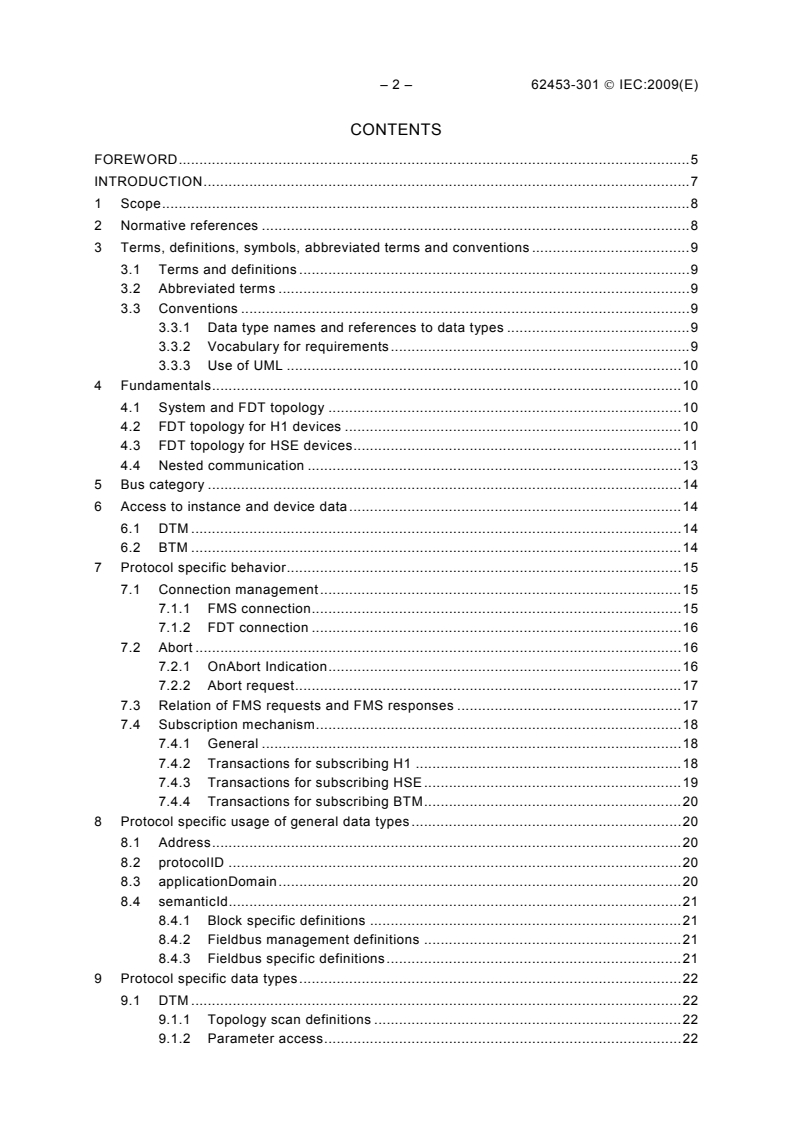
IEC 62453-301:2009 - Field device tool (FDT) interface specification - Part 301: Communication profile integration - IEC 61784 CPF 1 Released:6/30/2009



IEC 62453-301:2009+AMD1:2016 CSV - Field device tool (FDT) interface specification - Part 301:Communication profile integration - IEC 61784 CPF 1 Released:5/13/2016


IEC 62453-301:2009 - Field device tool (FDT) interface specification - Part 301: Communication profile integration - IEC 61784 CPF 1 Released:6/30/2009
Overview
IEC 62453-301:2009 specifies the integration of the FOUNDATION Fieldbus (FF) protocol with the Field Device Tool (FDT) standard as defined in IEC 62453-2. Developed by the International Electrotechnical Commission (IEC), this part of the IEC 62453 series addresses the communication profile integration for IEC 61784 CPF 1, enabling interoperability between field devices and system engineering tools within industrial communication networks.
This standard outlines definitions, protocol-specific extensions, and block representations (such as transducer, resource, or function blocks) necessary for integrating FF technology into FDT-based systems. By consolidating and revising previously published guidelines, IEC 62453-301:2009 enables diverse device types from various manufacturers to co-exist and be managed within unified automation architectures.
Key Topics
Integration of FOUNDATION Fieldbus (FF) Protocol:
Describes the requirements and mechanisms for incorporating FF communication profiles (H1 and HSE) into FDT-compliant tools and engineering environments.Communication Object Definitions:
Details device, block, and communication object models to support configuration, parameterization, and diagnostic data exchange for field devices.Protocol-specific Extensions:
Specifies how FF-specific functions, data types, and communication services (such as System Management and Fieldbus Message Specification) are mapped within the FDT framework.Device and Block Representation:
Defines the use of Device Type Managers (DTMs) and Block Type Managers (BTMs) for representing device functionalities and block-level access, ensuring comprehensive device integration.Bus Category and Identification:
Establishes unique identifiers and parameters for different FOUNDATION Fieldbus profiles and physical layers, supporting the correct identification and management of network elements.
Applications
IEC 62453-301:2009 provides practical value across multiple domains within industrial automation:
Seamless Device Integration:
Enables system integrators and end users to incorporate a wide range of FOUNDATION Fieldbus devices from different vendors into FDT-based systems without bespoke interface development.Unified Engineering Workflows:
Simplifies device commissioning, configuration, and lifecycle management through standard interfaces and hierarchical object models for network and device data.Cross-Vendor Interoperability:
Promotes an open architecture where engineering tools, asset management systems, and process control platforms can interact with field devices using a harmonized protocol specification.Support for Heterogeneous Networks:
Facilitates the integration of both FF H1 (low-speed) and FF HSE (High-Speed Ethernet) segments within the same system, enabling flexible and scalable industrial communication infrastructures.Lifecycle Efficiency:
Reduces complexity and maintenance costs by standardizing communication and device representation, which supports easier upgrades and expansion of installed systems.
Related Standards
IEC 62453-301:2009 is intended to be used in conjunction with several foundation and companion standards, including:
- IEC 62453-1: Field Device Tool (FDT) interface specification - Overview and guidance
- IEC 62453-2: Field Device Tool (FDT) interface specification - Concepts and detailed description
- IEC 61784-1: Industrial communication networks - Profiles - Part 1: Fieldbus profiles
- IEC 61158 series: Industrial communication networks - Fieldbus specifications (multiple parts covering physical, data link, and application layers)
- ISO 646: Information technology - ISO 7-bit coded character set for information interchange
IEC 62453-301:2009 thus plays a critical role in advancing open, interoperable automation solutions by defining the integration of FOUNDATION Fieldbus within the widely adopted FDT architecture, supporting modern industrial communications and flexible system design.
Relations
- Replaces
IEC PAS 62453-4:2006 - Field Device Tool (FDT) interface specification - Part 4: HART communication - Effective Date
- 05-Sep-2023
- Effective Date
- 05-Sep-2023
- Effective Date
- 05-Sep-2023
- Effective Date
- 05-Sep-2023
- Effective Date
- 05-Sep-2023
- Effective Date
- 05-Sep-2023
Buy Documents
IEC 62453-301:2009 - Field device tool (FDT) interface specification - Part 301: Communication profile integration - IEC 61784 CPF 1 Released:6/30/2009
IEC 62453-301:2009+AMD1:2016 CSV - Field device tool (FDT) interface specification - Part 301:Communication profile integration - IEC 61784 CPF 1 Released:5/13/2016
IEC 62453-301:2009 - Field device tool (FDT) interface specification - Part 301: Communication profile integration - IEC 61784 CPF 1 Released:6/30/2009
Get Certified
Connect with accredited certification bodies for this standard

BSI Group
BSI (British Standards Institution) is the business standards company that helps organizations make excellence a habit.

DVS-ZERT GmbH
German welding certification society.
CARES (UK Certification Authority for Reinforcing Steels)
UK certification for reinforcing steels and construction.
Sponsored listings
Frequently Asked Questions
IEC 62453-301:2009 is a standard published by the International Electrotechnical Commission (IEC). Its full title is "Field device tool (FDT) interface specification - Part 301: Communication profile integration - IEC 61784 CPF 1". This standard covers: IEC 62453-301:2009 provides information for integrating the FOUNDATION Fieldbus (FF) protocol into the FDT standard (IEC 62453-2). It describes communication definitions, protocol specific extensions and the means for block (e.g. transducer, resource or function blocks) representation. This part, in conjunction with the other parts of the first edition of the IEC 62453 series cancels and replaces IEC/PAS 62453-1, IEC/PAS 62453-2, IEC/PAS 62453-3, IEC/PAS 62453-4 and IEC/PAS 62453-5 published in 2006, and constitutes a technical revision. This bilingual version (2013-07) corresponds to the monolingual English version, published in 2009-06. This publication is to be read in conjunction with IE C 62453-2:2009.
IEC 62453-301:2009 provides information for integrating the FOUNDATION Fieldbus (FF) protocol into the FDT standard (IEC 62453-2). It describes communication definitions, protocol specific extensions and the means for block (e.g. transducer, resource or function blocks) representation. This part, in conjunction with the other parts of the first edition of the IEC 62453 series cancels and replaces IEC/PAS 62453-1, IEC/PAS 62453-2, IEC/PAS 62453-3, IEC/PAS 62453-4 and IEC/PAS 62453-5 published in 2006, and constitutes a technical revision. This bilingual version (2013-07) corresponds to the monolingual English version, published in 2009-06. This publication is to be read in conjunction with IE C 62453-2:2009.
IEC 62453-301:2009 is classified under the following ICS (International Classification for Standards) categories: 25.040.40 - Industrial process measurement and control; 35.100.05 - Multilayer applications; 35.110 - Networking. The ICS classification helps identify the subject area and facilitates finding related standards.
IEC 62453-301:2009 has the following relationships with other standards: It is inter standard links to IEC PAS 62453-4:2006, IEC PAS 62453-5:2006, IEC PAS 62453-3:2006, IEC PAS 62453-2:2006, IEC PAS 62453-1:2006, IEC 62453-301:2009/AMD1:2016. Understanding these relationships helps ensure you are using the most current and applicable version of the standard.
IEC 62453-301:2009 is available in PDF format for immediate download after purchase. The document can be added to your cart and obtained through the secure checkout process. Digital delivery ensures instant access to the complete standard document.
Standards Content (Sample)
IEC 62453-301 ®
Edition 1.0 2009-06
INTERNATIONAL
STANDARD
Field device tool (FDT) interface specification –
Part 301: Communication profile integration – IEC 61784 CPF 1
All rights reserved. Unless otherwise specified, no part of this publication may be reproduced or utilized in any form
or by any means, electronic or mechanical, including photocopying and microfilm, without permission in writing from
either IEC or IEC's member National Committee in the country of the requester.
If you have any questions about IEC copyright or have an enquiry about obtaining additional rights to this publication,
please contact the address below or your local IEC member National Committee for further information.
IEC Central Office
3, rue de Varembé
CH-1211 Geneva 20
Switzerland
Email: inmail@iec.ch
Web: www.iec.ch
About the IEC
The International Electrotechnical Commission (IEC) is the leading global organization that prepares and publishes
International Standards for all electrical, electronic and related technologies.
About IEC publications
The technical content of IEC publications is kept under constant review by the IEC. Please make sure that you have the
latest edition, a corrigenda or an amendment might have been published.
ƒ Catalogue of IEC publications: www.iec.ch/searchpub
The IEC on-line Catalogue enables you to search by a variety of criteria (reference number, text, technical committee,…).
It also gives information on projects, withdrawn and replaced publications.
ƒ IEC Just Published: www.iec.ch/online_news/justpub
Stay up to date on all new IEC publications. Just Published details twice a month all new publications released. Available
on-line and also by email.
ƒ Electropedia: www.electropedia.org
The world's leading online dictionary of electronic and electrical terms containing more than 20 000 terms and definitions
in English and French, with equivalent terms in additional languages. Also known as the International Electrotechnical
Vocabulary online.
ƒ Customer Service Centre: www.iec.ch/webstore/custserv
If you wish to give us your feedback on this publication or need further assistance, please visit the Customer Service
Centre FAQ or contact us:
Email: csc@iec.ch
Tel.: +41 22 919 02 11
Fax: +41 22 919 03 00
IEC 62453-301 ®
Edition 1.0 2009-06
INTERNATIONAL
STANDARD
Field device tool (FDT) interface specification –
Part 301: Communication profile integration – IEC 61784 CPF 1
INTERNATIONAL
ELECTROTECHNICAL
COMMISSION
PRICE CODE
XF
ICS 25.040.40; 35.100.05; 35.110 ISBN 978-2-88910-719-3
– 2 – 62453-301 © IEC:2009(E)
CONTENTS
FOREWORD.5
INTRODUCTION.7
1 Scope.8
2 Normative references .8
3 Terms, definitions, symbols, abbreviated terms and conventions .9
3.1 Terms and definitions .9
3.2 Abbreviated terms .9
3.3 Conventions .9
3.3.1 Data type names and references to data types .9
3.3.2 Vocabulary for requirements.9
3.3.3 Use of UML .10
4 Fundamentals.10
4.1 System and FDT topology .10
4.2 FDT topology for H1 devices .10
4.3 FDT topology for HSE devices.11
4.4 Nested communication .13
5 Bus category .14
6 Access to instance and device data.14
6.1 DTM .14
6.2 BTM .14
7 Protocol specific behavior.15
7.1 Connection management.15
7.1.1 FMS connection.15
7.1.2 FDT connection .16
7.2 Abort .16
7.2.1 OnAbort Indication.16
7.2.2 Abort request.17
7.3 Relation of FMS requests and FMS responses .17
7.4 Subscription mechanism.18
7.4.1 General .18
7.4.2 Transactions for subscribing H1 .18
7.4.3 Transactions for subscribing HSE.19
7.4.4 Transactions for subscribing BTM.20
8 Protocol specific usage of general data types .20
8.1 Address.20
8.2 protocolID .20
8.3 applicationDomain.20
8.4 semanticId.21
8.4.1 Block specific definitions .21
8.4.2 Fieldbus management definitions .21
8.4.3 Fieldbus specific definitions.21
9 Protocol specific data types.22
9.1 DTM .22
9.1.1 Topology scan definitions .22
9.1.2 Parameter access.22
62453-301 © IEC:2009(E) – 3 –
9.1.3 FF device data types .28
9.2 BTM .29
9.2.1 General .29
9.2.2 Parameter access - FF specific definitions.29
10 Network management data types.43
10.1 General .43
10.2 H1 network management definitions .43
10.3 HSE network management data types .43
11 Communication data types .85
11.1 Common data types .85
11.2 FF FMS data types .90
11.3 H1 communication data types.96
11.4 HSE communication data types .103
11.5 FDT FF standard block communication data types.110
12 Channel parameter data types.112
13 Device identification .114
13.1 Protocol specific handling of data type STRING .114
13.2 Common device type identification data types .115
13.3 Scan identification data types.121
13.4 Device type identification data types – provided by DTM .121
Annex A (informative) Implementation hints . 123
Annex B (normative) Levels of support.125
Bibliography.128
Figure 1 – Part 301 of the IEC 62453 series .7
Figure 2 – Object relations for H1 Device DTM .10
Figure 3 – Object relations for HSE application with DTMs and BTMs .12
Figure 4 – FMS mapping in the FDT connection.15
Figure 5 – FDT Disconnect service .16
Table 1 – Object relations for H1 Device DTM .11
Table 2 – Object relations for HSE application wtith DTMs and BTMs .13
Table 3 – FF specific protocol identifiers.14
Table 4 – Relation of FMS requests and FMS responses .17
Table 5 – Action object definitions (refer to FF-890):.23
Table 6 – Link object definitions.23
Table 7 – Alert object definitions.24
Table 8 – Trend object definitions .26
Table 9 – View definition.27
Table 10 – Domain object definitions .27
Table 11 – Program invocation object definitions .28
Table 12 – Structured FF device data types .29
Table 13 – Parameter mnemonic .30
Table 14 – Mnemonic of structured data types .38
Table 15 – Simple common data types.42
– 4 – 62453-301 © IEC:2009(E)
Table 16 – H1 Fieldbus Management data types.43
Table 17 – Simple HSE Fieldbus Management Definitions .43
Table 18 – Structured HSE Network management data types.49
Table 19 – Simple common data types.85
Table 20 – Structured common data types .87
Table 21 – Simple FF FMS data types .90
Table 22 – Structured FF FMS data types.91
Table 23 – Simple H1 communication data types .97
Table 24 – Structured H1 communication data types.98
Table 25 – Simple HSE communication data types .103
Table 26 – Structured HSE communication data types .104
Table 27 – Block communication data types.111
Table 28 – Simple FF channel data types .112
Table 29 – Structured FF channel data types.113
Table 30 – FieldbusFoundation H1 table.115
Table 31 – FieldbusFoundation HSE.117
Table 32 – FieldbusFoundation blocks .119
Table 33 – Simple Fieldbus Scan definitions .121
Table 34 – Device identification data types .122
Table B.1 – Levels of support .126
62453-301 © IEC:2009(E) – 5 –
INTERNATIONAL ELECTROTECHNICAL COMMISSION
____________
FIELD DEVICE TOOL (FDT) INTERFACE SPECIFICATION –
Part 301: Communication profile integration –
IEC 61784 CPF 1
FOREWORD
1) The International Electrotechnical Commission (IEC) is a worldwide organization for standardization comprising
all national electrotechnical committees (IEC National Committees). The object of IEC is to promote
international co-operation on all questions concerning standardization in the electrical and electronic fields. To
this end and in addition to other activities, IEC publishes International Standards, Technical Specifications,
Technical Reports, Publicly Available Specifications (PAS) and Guides (hereafter referred to as “IEC
Publication(s)”). Their preparation is entrusted to technical committees; any IEC National Committee interested
in the subject dealt with may participate in this preparatory work. International, governmental and non-
governmental organizations liaising with the IEC also participate in this preparation. IEC collaborates closely
with the International Organization for Standardization (ISO) in accordance with conditions determined by
agreement between the two organizations.
2) The formal decisions or agreements of IEC on technical matters express, as nearly as possible, an international
consensus of opinion on the relevant subjects since each technical committee has representation from all
interested IEC National Committees.
3) IEC Publications have the form of recommendations for international use and are accepted by IEC National
Committees in that sense. While all reasonable efforts are made to ensure that the technical content of IEC
Publications is accurate, IEC cannot be held responsible for the way in which they are used or for any
misinterpretation by any end user.
4) In order to promote international uniformity, IEC National Committees undertake to apply IEC Publications
transparently to the maximum extent possible in their national and regional publications. Any divergence
between any IEC Publication and the corresponding national or regional publication shall be clearly indicated in
the latter.
5) IEC provides no marking procedure to indicate its approval and cannot be rendered responsible for any
equipment declared to be in conformity with an IEC Publication.
6) All users should ensure that they have the latest edition of this publication.
7) No liability shall attach to IEC or its directors, employees, servants or agents including individual experts and
members of its technical committees and IEC National Committees for any personal injury, property damage or
other damage of any nature whatsoever, whether direct or indirect, or for costs (including legal fees) and
expenses arising out of the publication, use of, or reliance upon, this IEC Publication or any other IEC
Publications.
8) Attention is drawn to the Normative references cited in this publication. Use of the referenced publications is
indispensable for the correct application of this publication.
9) Attention is drawn to the possibility that some of the elements of this IEC Publication may be the subject of
patent rights. IEC shall not be held responsible for identifying any or all such patent rights.
International Standard IEC 62453-301 has been prepared by subcommittee 65E: Devices and
integration in enterprise systems, of IEC technical committee 65: Industrial-process
measurement, control and automation.
This part, in conjunction with the other parts of the first edition of the IEC 62453 series
cancels and replaces IEC/PAS 62453-1, IEC/PAS 62453-2, IEC/PAS 62453-3, IEC/PAS
62453-4 and IEC/PAS 62453-5 published in 2006, and constitutes a technical revision.
Each part of the IEC 62453-3xy series is intended to be read in conjunction with IEC 62453-2.
– 6 – 62453-301 © IEC:2009(E)
The text of this standard is based on the following documents:
FDIS Report on voting
65E/125/FDIS 65E/138/RVD
Full information on the voting for the approval of this standard can be found in the report on
voting indicated in the above table.
This publication has been drafted in accordance with the ISO/IEC Directives, Part 2.
A list of all parts of the IEC 62453 series, under the general title Field Device Tool (FDT)
interface specification, can be found on the IEC website.
The committee has decided that the contents of this publication will remain unchanged until
the maintenance result date indicated on the IEC web site under "http://webstore.iec.ch" in
the data related to the specific publication. At this date, the publication will be
• reconfirmed,
• withdrawn,
• replaced by a revised edition, or
• amended.
A bilingual version of this publication may be issued at a later date.
62453-301 © IEC:2009(E) – 7 –
INTRODUCTION
This part of IEC 62453 is an interface specification for developers of FDT (Field Device Tool)
components for function control and data access within a client/server architecture. The
specification is a result of an analysis and design process to develop standard interfaces to
facilitate the development of servers and clients by multiple vendors that need to interoperate
seamlessly.
With the integration of fieldbusses into control systems, there are a few other tasks which
need to be performed. In addition to fieldbus- and device-specific tools, there is a need to
integrate these tools into higher-level system-wide planning- or engineering tools. In
particular, for use in extensive and heterogeneous control systems, typically in the area of the
process industry, the unambiguous definition of engineering interfaces that are easy to use for
all those involved is of great importance.
A device-specific software component, called DTM (Device Type Manager), is supplied by the
field device manufacturer with its device. The DTM is integrated into engineering tools via the
FDT interfaces defined in this specification. The approach to integration is in general open for
all kinds of fieldbusses and thus meets the requirements for integrating different kinds of
devices into heterogeneous control systems.
Figure 1 shows how IEC 62453-301 is aligned in the structure of the IEC 62453 series.
Part 301
Communication
profile integration –
IEC 61784 CPF 1
IEC 1120/09
Figure 1 – Part 301 of the IEC 62453 series
– 8 – 62453-301 © IEC:2009(E)
FIELD DEVICE TOOL (FDT) INTERFACE SPECIFICATION –
Part 301: Communication profile integration –
IEC 61784 CPF 1
1 Scope
™
Communication Profile Family 1 (commonly known as FOUNDATION Fieldbus ) defines
communication profiles based on IEC 61158-2, Type 1, IEC 61158-3-1, IEC 61158-4-1,
IEC 61158-5-5, IEC 61158-5-9, IEC 61158-6-5, and IEC 61158-6-9. The basic profiles CP 1/1
(FF H1) and CP 1/2 (FF HSE) are defined in IEC 61784-1.
This part of IEC 62453 provides information for integrating the FOUNDATION™ Fieldbus (FF)
protocol into the FDT standard (IEC 62453-2).
The standard describes communication definitions, protocol specific extensions and the
means for block (e.g. transducer, resource or function blocks) representation.
The new protocol specific definitions are based on FF-specifications for H1 and HSE
protocols. Furthermore, the definitions contain information that is needed by systems to
configure FF devices.
The scope is limited to FOUNDATION™ Fieldbus device and system specific definitions.
2 Normative references
The following referenced documents are indispensable for the application of this specification.
For dated references, only the edition cited applies. For undated references, the latest edition
of the referenced document (including any amendments) applies
IEC 61158-2, Industrial communication networks – Fieldbus specifications – Part 2: Physical
layer specification and service definition
IEC 61158-3-1, Industrial communication networks – Fieldbus specifications – Part 3-1: Data-
link layer service definition – Type 1 elements
IEC 61158-4-1:2007, Industrial communication networks – Fieldbus specifications – Part 4-1
Data-link layer protocol specification – Type 1 elements
IEC 61158-5-5, Industrial communication networks – Fieldbus specifications – Part 5-5:
Application layer service definition – Type 5 elements
IEC 61158-5-9, Industrial communication networks – Fieldbus specifications – Part 5-9:
Application layer service definition – Type 9 elements
IEC 61158-6-5, Industrial communication networks – Fieldbus specifications – Part 6-5:
Application layer protocol specification – Type 5 elements
—————————
FOUNDATION™ Fieldbus is a trade name of the non-profit organization Fieldbus Foundation. This information
is given for the convenience of users of this International Standard and does not constitute an endorsement by
IEC of the trade name holder or any of its products. Compliance to this standard does not require use of the
trade name Foundation Fieldbus™. Use of the trade name FOUNDATION™ Fieldbus requires permission of
Fieldbus Foundation.
62453-301 © IEC:2009(E) – 9 –
IEC 61158-6-9, Industrial communication networks – Fieldbus specifications – Part 6-9:
Application layer protocol specification – Type 9 elements
IEC 61784-1, Industrial communication networks – Profiles – Part 1: Fieldbus profiles
IEC 62453-1:2009, Field Device Tool (FDT) interface specification – Part 1: Overview and
guidance
IEC 62453-2:2009, Field Device Tool (FDT) interface specification – Part 2: Concepts and
detailed description
ISO 646, Information technology – ISO 7-bit coded character set for information interchange
3 Terms, definitions, symbols, abbreviated terms and conventions
3.1 Terms and definitions
For the purposes of this document, the terms and definitions given in IEC 62453-1 and
IEC 62453-2 apply.
3.2 Abbreviated terms
For the purposes of this document, the abbreviations given in IEC 62453-1, IEC 62453-2 and
the following apply.
SM System Management
FDA Federation Drug Association
FF FOUNDATION™ Fieldbus
FMS Fieldbus Message Specification
DTM Device Type Manager
BTM Block Type Manager
H1 Low speed version of FF
HSE High Speed Ethernet
3.3 Conventions
3.3.1 Data type names and references to data types
The conventions for naming and referencing of data types are explained in IEC 62453-2
Clause A.1
3.3.2 Vocabulary for requirements
The following expressions are used when specifying requirements.
Usage of “shall” or “mandatory” No exceptions allowed.
Usage of “should” or “recommended” Strong recommendation. It may make sense in
special exceptional cases to differ from the
described behaviour.
Usage of “can’ or “optional’ Function or behaviour may be provided,
depending on defined conditions.
– 10 – 62453-301 © IEC:2009(E)
3.3.3 Use of UML
Figures in this standard are using UML notation as defined in Annex A of IEC 62453-1.
4 Fundamentals
4.1 System and FDT topology
This standard provides communication definitions, protocol-specific extensions and means for
device and block (e.g. resource, transducer or function blocks) configuration.
The communication definitions provide System Management (SM) and Fieldbus Message
Specification (FMS) communication.
Separate definitions are designed to support the different management parameters and
structures for H1 and HSE devices.
Protocol-specific definitions can be used to identify FOUNDATION™ Fieldbus devices and their
internal structure.
A FOUNDATION™ Fieldbus device is represented by a Device Type Manager (DTM) together
with a group of Block Type Managers (BTM). Each BTM represents the functionality of a block
functionality in an FF device.
4.2 FDT topology for H1 devices
An FF H1 topology may contain Communication DTM, Device DTM and BTMs.
EXAMPLE
The typical FDT topology for H1 devices is illustrated in Figure 2 and Table 1.
H1
H1-1
Communication
DTM
H1-2 H1 H1-2.3
Channel
Frame
H1-3 H1 Device
Application
DTM
H1-4 H1-4.5
Channel
H1-5
BTM for Block
IEC 1121/09
Figure 2 – Object relations for H1 Device DTM
62453-301 © IEC:2009(E) – 11 –
Table 1 – Object relations for H1 Device DTM
Relation Type of information Used definitions
H1-1 Management Parameter Access H1 Management data types (see 10. 2 )
FF common data types (see 11. 1)
H1-2 Network Topology FF common data types (see 11. 1)
Identification data types (see 13. 4)
Scan identification data types (see 13. 3)
Channel Parameter Access Channel parameter data types (see 12 )
H1-3 Management Parameter Access H1 Management data types (see 10. 2 )
FF common data types (see 11. 1)
H1-4 List of instantiated blocks FF common data types (see 11. 1)
BTM data types (see IEC 62453-2)
FF block data types (see 9. 2. 2 )
Identification data types (see 13. 4)
Scan identification data types (see 13. 3)
Channel Parameter Access Channel parameter data types (see 12 )
H1-5 Block Information BTM Information data types (see IEC 62453-2)
BTM data types (see IEC 62453-2)
Identification data types (see 13. 4)
Identification data types (see 13. 4) )
Initialization of BTM BTM Init data types (see IEC 62453-2)
BTM data types (see IEC 62453-2)
Parameter Access BTM parameter data types (see IEC 62453-2)
BTM data types (see IEC 62453-2)
H1-2.3 Communication FF FMS data types (see 11. 2)
H1 communication data types (see 11. 3)
FF common data types (see 11. 1)
H1-4.5 Block communication FF FMS data types (see 11. 2)
FF Block communication data types (see 11. 5 )
BTM data types (see IEC 62453-2)
FF common data types (see 11. 1)
4.3 FDT topology for HSE devices
An FF HSE topology may contain Communication DTM, GatewayDTM, Device DTM and
BTMs.
EXAMPLE
The typical FDT topology for a HSE based system is illustrated by Figure 3 and Table 2:
– 12 – 62453-301 © IEC:2009(E)
High Speed
HSE-1 Ethernet
Communication
DTM
HSE-2 HSE HSE-2.1
Channel
HSE-2.1
HSE-1 HSE Device
DTM
HSE-4
HSE-4.5
Channel
HSE-5 BTM for
Block
HSE-1 Linking
Frame
Device DTM
Application
HSE-7
HSE-7.10
H1 Channel
HSE-4 HSE-4.5
Channel
HSE-5 BTM for
Block
HSE-10 H1 Device
DTM
HSE-4
HSE-4.5
Channel
HSE-5 BTM for
Block
IEC 1122/09
Figure 3 – Object relations for HSE application with DTMs and BTMs
In this illustration, blue lines show the object hierarchy as it is managed in the FDT Frame
Application.
62453-301 © IEC:2009(E) – 13 –
Table 2 – Object relations for HSE application wtith DTMs and BTMs
Relation Type of information Used definitions
HSE-1 Management Parameter Access FF HSE management data types (see 10. 3 )
HSE-2 Network Topology FF common data types (see 11. 1)
Identification data types (see 13. 4)
Scan identification data types (see 13. 3)
Channel Parameter Access Channel parameter data types (see Clause 12)
HSE-2.1 Communication FF FMS data types (see 11. 2)
FF HSE communication data types (see 11. 4)
FF common data types (see 11. 1)
HSE-4.5 Block communication FF FMS data types (see 11. 2)
FF Block communication data types (see 11. 5 )
FF common data types (see 11. 1)
BTM data types (see IEC 62453-2)
HSE-4 List of instantiated blocks FF common data types (see 11. 1)
BTM data types (see IEC 62453-2)
Identification data types (see 13. 4)
Scan identification data types (see 13. 3)
Channel Parameter Access Channel parameter data types (see Clause 12)
HSE-5 Block Information BTM Information data types (see IEC 62453-2)
BTM data types (see IEC 62453-2)
Identification data types (see 13. 4)
Initialization of BTM BTM Init data types (see IEC 62453-2)
BTM data types (see IEC 62453-2)
Parameter Access BTM parameter data types (see IEC 62453-2)
BTM data types (see IEC 62453-2)
HSE-7 Network Topology FF common data types (see 11. 1)
FF HSE communication data types (see 11. 4)
FF Block communication data types (see 11. 5 )
Channel Parameter Access Channel parameter data types (see Clause 12)
H1 Management data types (see 10. 2 )
Parameter Access BTM parameter data types (see IEC 62453-2)
HSE-10 Management Parameter Access H1 Management data types (see 10. 2 )
FF common data types (see 11. 1)
HSE-7.10 Communication FF FMS data types (see 11. 2)
H1 communication data types (see 11. 3)
FF common data types (see 11. 1)
4.4 Nested communication
Standard FF blocks may be handled by BTMs implementing the standard behavior. These
BTMs may be connected to the corresponding DTM that provides the support of an “FDT FF
STANDARD BLOCK” communication protocol.
For device-specific BTMs, a device specific (it may be unique) bus category (CATID) shall be
defined for the protocol between DTM and BTM.
– 14 – 62453-301 © IEC:2009(E)
The Frame Application can use this bus category to identify the device specific blocks and it
can prevent a device-specific block from Device A to be assigned to a Device B that does not
support the block.
Different communication protocols defined in this document (H1, HSE, Standard blocks) can
use the same communication requests (FMS).
5 Bus category
FF protocols are identified in the protocolId element of the structured data type
'fdt:BusCategory' by the following unique identifiers (Table 3):
Table 3 – FF specific protocol identifiers
Protocol Id ProtocolId name Description
036D1691-387B-11D4-86E1-00E0987270B9 ‘FF H1’ Object supports FF H1 protocol
036D1692-387B-11D4-86E1-00E0987270B9 ‘FF HSE’ Object supports FF HSE protocol
036D1693-387B-11D4-86E1-00E0987270B9 ‘FF Standard Block’ For FDT FF standard block protocol
6 Access to instance and device data
6.1 DTM
The minimum set of provided data shall be:
• for FF devices System Management and Network Management parameters may be
provided by the DTM as specified in Clause 10 ;
• the DTM shall provide support for the data described in 9 . 1. 2;
• for each block in the device all standard block parameters shall be provided by the
corresponding BTM object as specified in IEC 62453 2.
It is recommended that all non-standard block parameters are also provided as specified in
9. 2.
A Device DTM shall provide access to the following groups of parameters if they are
presented to the user:
• link parameters;
• action parameters;
• alert parameters;
• trend parameters;
• domain objects;
• program invocation objects.
6.2 BTM
BTMs built according to the function block specification shall expose all parameters for the
corresponding block as defined for the DTM. All standard parameters defined for a block in
the FF specification shall be exposed. The manufacturer specific parameters may be added to
extend this list. User defined parameter shall be exposed if they exist.
62453-301 © IEC:2009(E) – 15 –
7 Protocol specific behavior
7.1 Connection management
The Connect service establishes an FDT connection. The FDT connection acts as a container
for FMS connections, as a container for SM connectionless services and as a container for
FDA sessions.
It is necessary to maintain the FMS connection separate from the underlying FDT connection.
7.1.1 FMS connection
FDT implements all FMS and SM services as transactions in the respective protocols. This
includes the services for the FMS connection management. FmsInitiate transaction and
FmsAbort transaction manage the lifetime of a FMS connection.
In order to open multiple FMS connections on the same FDT connection, a Transaction
service request is called with an FmsInitiateRequest element as argument.
The communication reference passed with the FmsInitiateRequest element identifies the FDT
connection to be used. The FmsInitiateResponse element returned with Transaction service
response provides a communication reference used for all further FMS services on that FMS
connection.
This mapping allows multiple FMS connections on one FDT connection.
IEC 1123/09
Figure 4 – FMS mapping in the FDT connection
– 16 – 62453-301 © IEC:2009(E)
If the FDT connection is closed, the FMS connections for this connection are also closed
automatically (by the communication channel) before the FDT Disconnect service is
completed.
Any transactions requested after that will fail. No outstanding services will be processed.
IEC 1124/09
Figure 5 – FDT Disconnect service
FMSAbort service request closes a single FMS connection.
7.1.2 FDT connection
FDT connection is using Connect service request:
• to establish an FDT connection intended for System Management services only. When
FDT connections for SM services only are established, the OpenSessionRequest element
is not part of the ConnectRequest. Any request to establish an FMS connection on this
type of FDT connection shall be rejected;
• to establish an FDT connection that represents a session as described with the
specification FF-588 Field Device Access Agent. FMS connections can be established by
using the FDT communication reference returned as a result of FDT connection
establishment. Note that multicast SM services are not allowed in this connection.
If an HSE device needs both types of connections it needs to create System management and
FDT Session Connections.
When a Frame Application requests the DTM to disconnect, all FMS connections and FDT
connections (SM and Session) shall be terminated.
7.2 Abort
7.2.1 OnAbort Indication
At any moment during the lifetime of the (FDT or FMS) Connection an OnAbort event
indication can be received by the DTM/BTM from the Communication Channel. There can be
two reasons for OnAbort Event:
• FMS Connection Abort;
• FDT Connection Abort.
The Communication reference uniquely identifies the Connection to be aborted. If a FDT
Connection Abort is indicated, all FMS connections of the corresponding FDT Connection
shall be terminated. No Abort requests are issued to the Communication Channel. All pending
requests shall be cancelled.
62453-301 © IEC:2009(E) – 17 –
If an FMS Connection Abort is indicated, only the FMS Connection identified by that
Communication Reference is terminated.
7.2.2 Abort request
At any moment during the lifetime of the (FDT or FMS) connections a DTM/BTM can issue an
Abort request to the Communication Channel. There can be two types of Communication
References in the Abort request:
• FMS Communication Reference;
• FDT Communication Reference.
The Communication reference uniquely identifies the Connection to be aborted.
If an FDT Connection Abort is requested, all related FMS connections in the Communication
channel shall be terminated. No separate Abort requests are issued to the Communication
Channel for the individual FMS Connections. All pending requests shall be cancelled.
If an FMS Communication Reference is used in the Abort, only the FMS Connection identified
by that Communication Reference is terminated.
7.3 Relation of FMS requests and FMS responses
If a DeviceDTM (communication client) issues an FMS request as in Table 4, it shall expect a
response as shown in the table.
Table 4 – Relation of FMS requests and FMS responses
Request Response (s)
FmsInitiateRequest FmsInitiateResponse
FmsInitiateError
FmsAbortRequest FmsStandardResponse
FmsReadRequest FmsReadResponse
FmsServiceError
FmsWriteRequest FmsStandardResponse
FmsServiceError
FmsStatusRequest FmsStatusResponse
FmsServiceError
FmsIdentifyRequest FmsIdentifyResponse
FmsServiceError
FmsDefineVariableListRequest FmsDefineVariableListResponse
FmsServiceError
FmsDeleteVariableListRequest FmsStandardResponse
FmsServiceError
FmsGetOdRequest FmsGetOdResponse FmsServiceError
FmsGenericInitiateDownloadSequenceRequ FmsStandardResponse
est
FmsServiceError
FmsGenericDownloadSegmentRequest FmsStandardResponse
FmsServiceError
FmsGenericTerminateDownloadSequenceRe FmsGenericTerminateDownloadSequenceResponse
quest
FmsServiceError
fms:FmsInformationReport fms:FmsInformationReport
– 18 – 62453-301 © IEC:2009(E)
Request Response (s)
fms:CreateProgramInvocation FmsStandardResponse
FmsServiceError
fms:DeleteProgramInvocation FmsStandardResponse
FmsServiceError
fms:Start FmsStandardResponse
FmsServiceError
fms:Stop FmsStandardResponse
FmsServiceError
fms:Resume FmsStandardResponse
FmsServiceError
fms:Reset FmsStandardResponse
FmsServiceError
fms:Kill FmsStandardResponse
FmsServiceError
H1SubscribeRequest H1SubscribeResponse
H1UnSubscribeRequest H1UnSubscribeResponse
HSESubscribeRequest HSESubscribeResponse
HSEUnSubscribeRequest HSEUnSubscribeResponse
Any Service fdt:CommunicationError
A DTM or a BTM can receive a standard FDT CommunicationError response instead of FMS
Transaction response to indicate a general communication error. Communication clients shall
be prepared to handle such a response.
If the FMS connection in the Device DTM is shared between several BTMs, all connections
will receive OnAbort event when the Device FMS connection is aborted.
7.4 Subscription mechanism
The FF subscription mechanism is based on the rules of the device initiated data transfer. For
a DTM that supports Device Initiated Data Transfer there may be one or multiple subscribers
expecting data at the same time.
7.4.1 General
To support the device initiated data transfer for IEC 61784 CPF 1 additional transaction
request and transaction responses are defined. Two transaction requests are used to initiate
the FMS subscription connection and four transaction responses are associated with the FMS
subscriptions. These transactions are detailed below:
• transaction request for subscribing;
• transaction response for subscribing;
• transaction request for unsubscribing;
• transaction response for unsubscribing;
• transaction detailing the FMS Information Report;
• transaction response detailing the FMS EventNotification.
7.4.2 Transactions for subscribing H1
Device DTM/BTM can subscribe to data by calling a H1SubscribeRequest Transaction. It can
subscribe for
62453-301 © IEC:2009(E) – 19 –
• data collected in a trend object [H1TrendSubscriptionInfo];
• single device parameter [H1ParameterSubscriptionInfo];
• an alarm or event[H1EventSubscriptionInfo].
Additional information to identify the device is provided in the transaction request. This
information may be used by the Communication Provider to speed up the process of
subscribing.
The result of the subscription mechanism is provided in the H1SubscribeResponse
transaction. The communication reference used is the communication reference of the FDT
connection.
The InvokeID of the subscription request will be used to provide the association between the
subscription and FmsInformationReport or FmsEventNotification transaction.
The InvokeID received during the subscription will be used for Unsubscribing.
The InvokeID uniquely identifies all transactions related to the created subscription and shall
not be used for any other transactions during the lifetime of the subscription.
7.4.3 Transactions for subscribing HSE
The HSE Linking Device DTM can subscribe to data by calling an HSESubscribeRequest
Transaction. DTMs can map the subscription from a H1 DTM to a HSE subscription.
The HSE subscription can be used to subscribe for data from
• an H1 device via a HSE Linking device;
• an HSE device.
It can subscribe for
• data in a trend object on an H1 device (HSETrendSubscriptionInfo);
• data in a trend object on an HSE device (LocalTrendSubscriptionInfo);
• single parameter from an H1 device (HSEParameterSubscriptionInfo);
• single parameter from an HSE device (LocalParameterSubscriptionInfo),
• an Event from an H1 device (HSEEventSubscriptionInfo);
• an Event from an HSE device (LocalEventSubscriptionInfo).
Additional information about the device is provided in the transaction request. This
information may be used by the Communication Provider to speed up the process of
subscribing.
The result of the subscription mechanism is provided in the HSESubscribeResponse
transaction.
The communication reference used is the communication reference of the FDT
...
IEC 62453-301 ®
Edition 1.1 2016-05
CONSOLIDATED VERSION
INTERNATIONAL
STANDARD
NORME
INTERNATIONALE
colour
inside
Field device tool (FDT) interface specification –
Part 301: Communication profile integration – IEC 61784 CPF 1
Spécification des interfaces des outils des dispositifs de terrain (FDT) –
Partie 301: Intégration des profils de communication – IEC 61784 CPF 1
All rights reserved. Unless otherwise specified, no part of this publication may be reproduced or utilized in any form
or by any means, electronic or mechanical, including photocopying and microfilm, without permission in writing from
either IEC or IEC's member National Committee in the country of the requester. If you have any questions about IEC
copyright or have an enquiry about obtaining additional rights to this publication, please contact the address below or
your local IEC member National Committee for further information.
Droits de reproduction réservés. Sauf indication contraire, aucune partie de cette publication ne peut être reproduite
ni utilisée sous quelque forme que ce soit et par aucun procédé, électronique ou mécanique, y compris la photocopie
et les microfilms, sans l'accord écrit de l'IEC ou du Comité national de l'IEC du pays du demandeur. Si vous avez des
questions sur le copyright de l'IEC ou si vous désirez obtenir des droits supplémentaires sur cette publication, utilisez
les coordonnées ci-après ou contactez le Comité national de l'IEC de votre pays de résidence.
IEC Central Office Tel.: +41 22 919 02 11
3, rue de Varembé Fax: +41 22 919 03 00
CH-1211 Geneva 20 info@iec.ch
Switzerland www.iec.ch
About the IEC
The International Electrotechnical Commission (IEC) is the leading global organization that prepares and publishes
International Standards for all electrical, electronic and related technologies.
About IEC publications
The technical content of IEC publications is kept under constant review by the IEC. Please make sure that you have the
latest edition, a corrigenda or an amendment might have been published.
IEC Catalogue - webstore.iec.ch/catalogue Electropedia - www.electropedia.org
The stand-alone application for consulting the entire The world's leading online dictionary of electronic and
bibliographical information on IEC International Standards, electrical terms containing 20 000 terms and definitions in
Technical Specifications, Technical Reports and other English and French, with equivalent terms in 15 additional
documents. Available for PC, Mac OS, Android Tablets and languages. Also known as the International Electrotechnical
iPad. Vocabulary (IEV) online.
IEC publications search - www.iec.ch/searchpub IEC Glossary - std.iec.ch/glossary
The advanced search enables to find IEC publications by a 65 000 electrotechnical terminology entries in English and
variety of criteria (reference number, text, technical French extracted from the Terms and Definitions clause of
committee,…). It also gives information on projects, replaced IEC publications issued since 2002. Some entries have been
and withdrawn publications. collected from earlier publications of IEC TC 37, 77, 86 and
CISPR.
IEC Just Published - webstore.iec.ch/justpublished
Stay up to date on all new IEC publications. Just Published IEC Customer Service Centre - webstore.iec.ch/csc
details all new publications released. Available online and If you wish to give us your feedback on this publication or
also once a month by email. need further assistance, please contact the Customer Service
Centre: csc@iec.ch.
A propos de l'IEC
La Commission Electrotechnique Internationale (IEC) est la première organisation mondiale qui élabore et publie des
Normes internationales pour tout ce qui a trait à l'électricité, à l'électronique et aux technologies apparentées.
A propos des publications IEC
Le contenu technique des publications IEC est constamment revu. Veuillez vous assurer que vous possédez l’édition la
plus récente, un corrigendum ou amendement peut avoir été publié.
Catalogue IEC - webstore.iec.ch/catalogue Electropedia - www.electropedia.org
Application autonome pour consulter tous les renseignements
Le premier dictionnaire en ligne de termes électroniques et
bibliographiques sur les Normes internationales,
électriques. Il contient 20 000 termes et définitions en anglais
Spécifications techniques, Rapports techniques et autres
et en français, ainsi que les termes équivalents dans 15
documents de l'IEC. Disponible pour PC, Mac OS, tablettes
langues additionnelles. Egalement appelé Vocabulaire
Android et iPad.
Electrotechnique International (IEV) en ligne.
Recherche de publications IEC - www.iec.ch/searchpub
Glossaire IEC - std.iec.ch/glossary
La recherche avancée permet de trouver des publications IEC
65 000 entrées terminologiques électrotechniques, en anglais
en utilisant différents critères (numéro de référence, texte,
et en français, extraites des articles Termes et Définitions des
comité d’études,…). Elle donne aussi des informations sur les
publications IEC parues depuis 2002. Plus certaines entrées
projets et les publications remplacées ou retirées.
antérieures extraites des publications des CE 37, 77, 86 et
CISPR de l'IEC.
IEC Just Published - webstore.iec.ch/justpublished
Restez informé sur les nouvelles publications IEC. Just Service Clients - webstore.iec.ch/csc
Published détaille les nouvelles publications parues. Si vous désirez nous donner des commentaires sur cette
Disponible en ligne et aussi une fois par mois par email. publication ou si vous avez des questions contactez-nous:
csc@iec.ch.
IEC 62453-301 ®
Edition 1.1 2016-05
CONSOLIDATED VERSION
INTERNATIONAL
STANDARD
NORME
INTERNATIONALE
colour
inside
Field device tool (FDT) interface specification –
Part 301: Communication profile integration – IEC 61784 CPF 1
Spécification des interfaces des outils des dispositifs de terrain (FDT) –
Partie 301: Intégration des profils de communication – IEC 61784 CPF 1
INTERNATIONAL
ELECTROTECHNICAL
COMMISSION
COMMISSION
ELECTROTECHNIQUE
INTERNATIONALE
ICS 25.040.40; 35.100.05; 35.110 ISBN 978-2-8322-3416-7
IEC 62453-301 ®
Edition 1.1 2016-05
CONSOLIDATED VERSION
REDLINE VERSION
VERSION REDLINE
colour
inside
Field device tool (FDT) interface specification –
Part 301: Communication profile integration – IEC 61784 CPF 1
Spécification des interfaces des outils des dispositifs de terrain (FDT) –
Partie 301: Intégration des profils de communication – IEC 61784 CPF 1
– 2 – IEC 62453-301:2009+AMD1:2016 CSV
IEC 2016
CONTENTS
FOREWORD. 5
INTRODUCTION . 7
1 Scope . 8
2 Normative references . 8
3 Terms, definitions, symbols, abbreviated terms and conventions . 9
3.1 Terms and definitions . 9
3.2 Abbreviated terms . 9
3.3 Conventions . 9
3.3.1 Data type names and references to data types . 9
3.3.2 Vocabulary for requirements . 9
3.3.3 Use of UML . 10
4 Fundamentals . 10
4.1 System and FDT topology . 10
4.2 FDT topology for H1 devices . 10
4.3 FDT topology for HSE devices . 11
4.4 Nested communication . 13
5 Bus category . 14
6 Access to instance and device data . 14
6.1 DTM . 14
6.2 BTM . 15
7 Protocol specific behavior . 15
7.1 Connection management . 15
7.1.1 FMS connection . 15
7.1.2 FDT connection. 16
7.2 Abort . 17
7.2.1 OnAbort Indication . 17
7.2.2 Abort request . 17
7.3 Relation of FMS requests and FMS responses . 17
7.4 Subscription mechanism . 19
7.4.1 General . 19
7.4.2 Transactions for subscribing H1 . 19
7.4.3 Transactions for subscribing HSE . 19
7.4.4 Transactions for subscribing BTM . 20
8 Protocol specific usage of general data types . 21
8.1 Address . 21
8.2 protocolID . 21
8.3 applicationDomain . 21
8.4 semanticId . 21
8.4.1 Block specific definitions . 21
8.4.2 Fieldbus management definitions . 22
8.4.3 Fieldbus specific definitions. 22
9 Protocol specific data types . 23
9.1 DTM . 23
9.1.1 Topology scan definitions . 23
9.1.2 Parameter access . 23
IEC 2016
9.1.3 FF device data types . 29
9.2 BTM . 30
9.2.1 General . 30
9.2.2 Parameter access - FF specific definitions . 30
10 Network management data types . 44
10.1 General . 44
10.2 H1 network management definitions . 44
10.3 HSE network management data types . 44
11 Communication data types . 87
11.1 Common data types . 87
11.2 FF FMS data types . 91
11.3 H1 communication data types . 97
11.4 HSE communication data types . 104
11.5 FDT FF standard block communication data types . 112
12 Channel parameter data types . 114
13 Device identification . 116
13.1 Protocol specific handling of data type STRING . 116
13.2 Common device type identification data types . 117
13.3 Scan identification data types . 123
13.4 Device type identification data types – provided by DTM . 123
Annex A (informative) Implementation hints . 125
Annex B (normative) Levels of support . 127
Bibliography . 130
Figure 1 – Part 301 of the IEC 62453 series . 7
Figure 2 – Object relations for H1 Device DTM . 10
Figure 3 – Object relations for HSE application with DTMs and BTMs . 12
Figure 4 – FMS mapping in the FDT connection . 16
Figure 5 – FDT Disconnect service . 16
Table 1 – Object relations for H1 Device DTM . 11
Table 2 – Object relations for HSE application wtith DTMs and BTMs . 13
Table 3 – FF specific protocol identifiers . 14
Table 4 – Relation of FMS requests and FMS responses . 18
Table 5 – Action object definitions (refer to FF-890): . 24
Table 6 – Link object definitions . 24
Table 7 – Alert object definitions . 25
Table 8 – Trend object definitions . 26
Table 9 – View definition . 28
Table 10 – Domain object definitions . 28
Table 11 – Program invocation object definitions . 29
Table 12 – Structured FF device data types . 30
Table 13 – Parameter mnemonic . 31
Table 14 – Mnemonic of structured data types . 39
Table 15 – Simple common data types . 43
– 4 – IEC 62453-301:2009+AMD1:2016 CSV
IEC 2016
Table 16 – H1 Fieldbus Management data types . 44
Table 17 – Simple HSE Fieldbus Management Definitions . 44
Table 18 – Structured HSE Network management data types . 50
Table 19 – Simple common data types . 87
Table 20 – Structured common data types . 88
Table 21 – Simple FF FMS data types . 91
Table 22 – Structured FF FMS data types . 93
Table 23 – Simple H1 communication data types . 98
Table 24 – Structured H1 communication data types. 99
Table 25 – Simple HSE communication data types . 104
Table 26 – Structured HSE communication data types . 105
Table 27 – Block communication data types . 113
Table 28 – Simple FF channel data types . 114
Table 29 – Structured FF channel data types . 115
Table 30 – FieldbusFoundation H1 table . 117
Table 31 – FieldbusFoundation HSE . 119
Table 32 – FieldbusFoundation blocks . 121
Table 33 – Simple Fieldbus Scan definitions . 123
Table 34 – Device identification data types . 124
Table 35 – Physical layer identifiers for H1 . 14
Table 36 – DataLink Layer Identifiers . 14
Table B.1 – Levels of support . 128
IEC 2016
INTERNATIONAL ELECTROTECHNICAL COMMISSION
____________
FIELD DEVICE TOOL (FDT) INTERFACE SPECIFICATION –
Part 301: Communication profile integration –
IEC 61784 CPF 1
FOREWORD
1) The International Electrotechnical Commission (IEC) is a worldwide organization for standardization comprising
all national electrotechnical committees (IEC National Committees). The object of IEC is to promote
international co-operation on all questions concerning standardization in the electrical and electronic fields. To
this end and in addition to other activities, IEC publishes International Standards, Technical Specifications,
Technical Reports, Publicly Available Specifications (PAS) and Guides (hereafter referred to as “IEC
Publication(s)”). Their preparation is entrusted to technical committees; any IEC National Committee interested
in the subject dealt with may participate in this preparatory work. International, governmental and non-
governmental organizations liaising with the IEC also participate in this preparation. IEC collaborates closely
with the International Organization for Standardization (ISO) in accordance with conditions determined by
agreement between the two organizations.
2) The formal decisions or agreements of IEC on technical matters express, as nearly as possible, an international
consensus of opinion on the relevant subjects since each technical committee has representation from all
interested IEC National Committees.
3) IEC Publications have the form of recommendations for international use and are accepted by IEC National
Committees in that sense. While all reasonable efforts are made to ensure that the technical content of IEC
Publications is accurate, IEC cannot be held responsible for the way in which they are used or for any
misinterpretation by any end user.
4) In order to promote international uniformity, IEC National Committees undertake to apply IEC Publications
transparently to the maximum extent possible in their national and regional publications. Any divergence
between any IEC Publication and the corresponding national or regional publication shall be clearly indicated in
the latter.
5) IEC itself does not provide any attestation of conformity. Independent certification bodies provide conformity
assessment services and, in some areas, access to IEC marks of conformity. IEC is not responsible for any
services carried out by independent certification bodies.
6) All users should ensure that they have the latest edition of this publication.
7) No liability shall attach to IEC or its directors, employees, servants or agents including individual experts and
members of its technical committees and IEC National Committees for any personal injury, property damage or
other damage of any nature whatsoever, whether direct or indirect, or for costs (including legal fees) and
expenses arising out of the publication, use of, or reliance upon, this IEC Publication or any other IEC
Publications.
8) Attention is drawn to the Normative references cited in this publication. Use of the referenced publications is
indispensable for the correct application of this publication.
9) Attention is drawn to the possibility that some of the elements of this IEC Publication may be the subject of
patent rights. IEC shall not be held responsible for identifying any or all such patent rights.
This consolidated version of the official IEC Standard and its amendment has been prepared
for user convenience.
IEC 62453-301 edition 1.1 contains the first edition (2009-06) [documents 65E/125/FDIS and
65E/138/RVD] and its amendment 1 (2016-05) [documents 65E/336/CDV and 65E/395A/RVC].
In this Redline version, a vertical line in the margin shows where the technical content is
modified by amendment 1. Additions are in green text, deletions are in strikethrough red text.
A separate Final version with all changes accepted is available in this publication.
– 6 – IEC 62453-301:2009+AMD1:2016 CSV
IEC 2016
International Standard IEC 62453-301 has been prepared by subcommittee 65E: Devices and
integration in enterprise systems, of IEC technical committee 65: Industrial-process
measurement, control and automation.
Each part of the IEC 62453-3xy series is intended to be read in conjunction with IEC 62453-2.
The French version of this standard has not been voted upon.
This publication has been drafted in accordance with the ISO/IEC Directives, Part 2.
A list of all parts of the IEC 62453 series, under the general title Field Device Tool (FDT)
interface specification, can be found on the IEC website.
The committee has decided that the contents of the base publication and its amendment will
remain unchanged until the stability date indicated on the IEC web site under
"http://webstore.iec.ch" in the data related to the specific publication. At this date, the
publication will be
• reconfirmed,
• withdrawn,
• replaced by a revised edition, or
• amended.
IMPORTANT – The 'colour inside' logo on the cover page of this publication indicates
that it contains colours which are considered to be useful for the correct
understanding of its contents. Users should therefore print this document using a
colour printer.
IEC 2016
INTRODUCTION
This part of IEC 62453 is an interface specification for developers of FDT (Field Device Tool)
components for function control and data access within a client/server architecture. The
specification is a result of an analysis and design process to develop standard interfaces to
facilitate the development of servers and clients by multiple vendors that need to interoperate
seamlessly.
With the integration of fieldbusses into control systems, there are a few other tasks which
need to be performed. In addition to fieldbus- and device-specific tools, there is a need to
integrate these tools into higher-level system-wide planning- or engineering tools. In
particular, for use in extensive and heterogeneous control systems, typically in the area of the
process industry, the unambiguous definition of engineering interfaces that are easy to use for
all those involved is of great importance.
A device-specific software component, called DTM (Device Type Manager), is supplied by the
field device manufacturer with its device. The DTM is integrated into engineering tools via the
FDT interfaces defined in this specification. The approach to integration is in general open for
all kinds of fieldbusses and thus meets the requirements for integrating different kinds of
devices into heterogeneous control systems.
Figure 1 shows how IEC 62453-301 is aligned in the structure of the IEC 62453 series.
IEC 1120/09
Figure 1 – Part 301 of the IEC 62453 series
– 8 – IEC 62453-301:2009+AMD1:2016 CSV
IEC 2016
FIELD DEVICE TOOL (FDT) INTERFACE SPECIFICATION –
Part 301: Communication profile integration –
IEC 61784 CPF 1
1 Scope
™
Communication Profile Family 1 (commonly known as FOUNDATION Fieldbus ) defines
communication profiles based on IEC 61158-2, Type 1, IEC 61158-3-1, IEC 61158-4-1,
IEC 61158-5-5, IEC 61158-5-9, IEC 61158-6-5, and IEC 61158-6-9. The basic profiles CP 1/1
(FF H1) and CP 1/2 (FF HSE) are defined in IEC 61784-1.
This part of IEC 62453 provides information for integrating the FOUNDATION™ Fieldbus (FF)
protocol into the FDT standard (IEC 62453-2).
The standard describes communication definitions, protocol specific extensions and the
means for block (e.g. transducer, resource or function blocks) representation.
The new protocol specific definitions are based on FF-specifications for H1 and HSE
protocols. Furthermore, the definitions contain information that is needed by systems to
configure FF devices.
The scope is limited to FOUNDATION™ Fieldbus device and system specific definitions.
2 Normative references
The following referenced documents are indispensable for the application of this specification.
For dated references, only the edition cited applies. For undated references, the latest edition
of the referenced document (including any amendments) applies
IEC 61158-2, Industrial communication networks – Fieldbus specifications – Part 2: Physical
layer specification and service definition
IEC 61158-3-1, Industrial communication networks – Fieldbus specifications – Part 3-1: Data-
link layer service definition – Type 1 elements
IEC 61158-4-1:2007, Industrial communication networks – Fieldbus specifications – Part 4-1
Data-link layer protocol specification – Type 1 elements
IEC 61158-5-5, Industrial communication networks – Fieldbus specifications – Part 5-5:
Application layer service definition – Type 5 elements
IEC 61158-5-9, Industrial communication networks – Fieldbus specifications – Part 5-9:
Application layer service definition – Type 9 elements
—————————
FOUNDATION™ Fieldbus is a trade name of the non-profit organization Fieldbus Foundation. This information
is given for the convenience of users of this International Standard and does not constitute an endorsement by
IEC of the trade name holder or any of its products. Compliance to this standard does not require use of the
trade name Foundation Fieldbus™. Use of the trade name FOUNDATION™ Fieldbus requires permission of
Fieldbus Foundation.
IEC 2016
IEC 61158-6-5, Industrial communication networks – Fieldbus specifications – Part 6-5:
Application layer protocol specification – Type 5 elements
IEC 61158-6-9, Industrial communication networks – Fieldbus specifications – Part 6-9:
Application layer protocol specification – Type 9 elements
IEC 61784-1, Industrial communication networks – Profiles – Part 1: Fieldbus profiles
IEC 62453-1:2009, Field Device Tool (FDT) interface specification – Part 1: Overview and
guidance
IEC 62453-2:2009, Field Device Tool (FDT) interface specification – Part 2: Concepts and
detailed description
ISO 646, Information technology – ISO 7-bit coded character set for information interchange
3 Terms, definitions, symbols, abbreviated terms and conventions
3.1 Terms and definitions
For the purposes of this document, the terms and definitions given in IEC 62453-1 and
IEC 62453-2 apply.
3.2 Abbreviated terms
For the purposes of this document, the abbreviations given in IEC 62453-1, IEC 62453-2 and
the following apply.
SM System Management
FDA Federation Drug Association
FF FOUNDATION™ Fieldbus
FMS Fieldbus Message Specification
DTM Device Type Manager
BTM Block Type Manager
H1 Low speed version of FF
HSE High Speed Ethernet
3.3 Conventions
3.3.1 Data type names and references to data types
The conventions for naming and referencing of data types are explained in IEC 62453-2
Clause A.1
3.3.2 Vocabulary for requirements
The following expressions are used when specifying requirements.
Usage of “shall” or “mandatory” No exceptions allowed.
Usage of “should” or “recommended” Strong recommendation. It may make sense in
special exceptional cases to differ from the
described behaviour.
Usage of “can’ or “optional’ Function or behaviour may be provided,
– 10 – IEC 62453-301:2009+AMD1:2016 CSV
IEC 2016
depending on defined conditions.
3.3.3 Use of UML
Figures in this standard are using UML notation as defined in Annex A of IEC 62453-1.
4 Fundamentals
4.1 System and FDT topology
This standard provides communication definitions, protocol-specific extensions and means for
device and block (e.g. resource, transducer or function blocks) configuration.
The communication definitions provide System Management (SM) and Fieldbus Message
Specification (FMS) communication.
Separate definitions are designed to support the different management parameters and
structures for H1 and HSE devices.
OUNDATION™ Fieldbus devices and their
Protocol-specific definitions can be used to identify F
internal structure.
A FOUNDATION™ Fieldbus device is represented by a Device Type Manager (DTM) together
with a group of Block Type Managers (BTM). Each BTM represents the functionality of a block
functionality in an FF device.
4.2 FDT topology for H1 devices
An FF H1 topology may contain Communication DTM, Device DTM and BTMs.
EXAMPLE
The typical FDT topology for H1 devices is illustrated in Figure 2 and Table 1.
H1
H1-1
Communication
DTM
H1-2 H1 H1-2.3
Channel
Frame
H1-3 H1 Device
Application
DTM
H1-4 H1-4.5
Channel
H1-5
BTM for Block
IEC 1121/09
Figure 2 – Object relations for H1 Device DTM
IEC 2016
Table 1 – Object relations for H1 Device DTM
Relation Type of information Used definitions
H1-1 Management Parameter Access H1 Management data types (see 10.2)
FF common data types (see 11.1)
H1-2 Network Topology FF common data types (see 11.1)
Identification data types (see 13.4)
Scan identification data types (see 13.3)
Channel Parameter Access Channel parameter data types (see 12)
H1-3 Management Parameter Access H1 Management data types (see 10.2)
FF common data types (see 11.1)
H1-4 List of instantiated blocks FF common data types (see 11.1)
BTM data types (see IEC 62453-2)
FF block data types (see 9.2.2 )
Identification data types (see 13.4)
Scan identification data types (see 13.3)
Channel Parameter Access Channel parameter data types (see 12)
H1-5 Block Information BTM Information data types (see IEC 62453-2)
BTM data types (see IEC 62453-2)
Identification data types (see 13.4)
Identification data types (see 13.4))
Initialization of BTM BTM Init data types (see IEC 62453-2)
BTM data types (see IEC 62453-2)
Parameter Access BTM parameter data types (see IEC 62453-2)
BTM data types (see IEC 62453-2)
H1-2.3 Communication FF FMS data types (see 11.2)
H1 communication data types (see 11.3)
FF common data types (see 11.1)
H1-4.5 Block communication FF FMS data types (see 11.2)
FF Block communication data types (see 11.5)
BTM data types (see IEC 62453-2)
FF common data types (see 11.1)
4.3 FDT topology for HSE devices
An FF HSE topology may contain Communication DTM, GatewayDTM, Device DTM and
BTMs.
EXAMPLE
The typical FDT topology for a HSE based system is illustrated by Figure 3 and Table 2:
– 12 – IEC 62453-301:2009+AMD1:2016 CSV
IEC 2016
High Speed
HSE-1 Ethernet
Communication
DTM
HSE-2 HSE HSE-2.1
Channel
HSE-2.1
HSE-1 HSE Device
DTM
HSE-4
HSE-4.5
Channel
HSE-5 BTM for
Block
HSE-1 Linking
Frame
Device DTM
Application
HSE-7
HSE-7.10
H1 Channel
HSE-4 HSE-4.5
Channel
HSE-5 BTM for
Block
HSE-10 H1 Device
DTM
HSE-4
HSE-4.5
Channel
HSE-5 BTM for
Block
IEC 1122/09
Figure 3 – Object relations for HSE application with DTMs and BTMs
In this illustration, blue lines show the object hierarchy as it is managed in the FDT Frame
Application.
IEC 2016
Table 2 – Object relations for HSE application wtith DTMs and BTMs
Relation Type of information Used definitions
HSE-1 Management Parameter Access FF HSE management data types (see 10.3)
HSE-2 Network Topology FF common data types (see 11.1)
Identification data types (see 13.4)
Scan identification data types (see 13.3)
Channel Parameter Access Channel parameter data types (see Clause 12)
HSE-2.1 Communication FF FMS data types (see 11.2)
FF HSE communication data types (see 11.4)
FF common data types (see 11.1)
HSE-4.5 Block communication FF FMS data types (see 11.2)
FF Block communication data types (see 11.5)
FF common data types (see 11.1)
BTM data types (see IEC 62453-2)
HSE-4 List of instantiated blocks FF common data types (see 11.1)
BTM data types (see IEC 62453-2)
Identification data types (see 13.4)
Scan identification data types (see 13.3)
Channel Parameter Access Channel parameter data types (see Clause 12)
HSE-5 Block Information BTM Information data types (see IEC 62453-2)
BTM data types (see IEC 62453-2)
Identification data types (see 13.4)
Initialization of BTM BTM Init data types (see IEC 62453-2)
BTM data types (see IEC 62453-2)
Parameter Access BTM parameter data types (see IEC 62453-2)
BTM data types (see IEC 62453-2)
HSE-7 Network Topology FF common data types (see 11.1)
FF HSE communication data types (see 11.4)
FF Block communication data types (see 11.5)
Channel Parameter Access Channel parameter data types (see Clause 12)
H1 Management data types (see 10.2)
Parameter Access BTM parameter data types (see IEC 62453-2)
HSE-10 Management Parameter Access H1 Management data types (see 10.2)
FF common data types (see 11.1)
HSE-7.10 Communication FF FMS data types (see 11.2)
H1 communication data types (see 11.3)
FF common data types (see 11.1)
4.4 Nested communication
Standard FF blocks may be handled by BTMs implementing the standard behavior. These
BTMs may be connected to the corresponding DTM that provides the support of an “FDT FF
STANDARD BLOCK” communication protocol.
For device-specific BTMs, a device specific (it may be unique) bus category (CATID) shall be
defined for the protocol between DTM and BTM.
– 14 – IEC 62453-301:2009+AMD1:2016 CSV
IEC 2016
The Frame Application can use this bus category to identify the device specific blocks and it
can prevent a device-specific block from Device A to be assigned to a Device B that does not
support the block.
Different communication protocols defined in this document (H1, HSE, Standard blocks) can
use the same communication requests (FMS).
5 Bus category
FF protocols are identified in the protocolId element of the structured data type
'fdt:BusCategory' by the following unique identifiers (Table 3):
Table 3 – FF specific protocol identifiers
Protocol Id ProtocolId name Description
036D1691-387B-11D4-86E1-00E0987270B9 ‘FF H1’ Object supports FF H1 protocol
036D1692-387B-11D4-86E1-00E0987270B9 ‘FF HSE’ Object supports FF HSE protocol
036D1693-387B-11D4-86E1-00E0987270B9 ‘FF Standard Block’ For FDT FF standard block protocol
FF protocols are using the following unique identifiers in physicalLayer members within
PhysicalLayer data type (Table 35 for H1):
Table 35 – Physical layer identifiers for H1
Identifier value Name Description
TM
0D8FB517-1D8D-4455-9CE1-1B4A5DD4A0D2 FF H1 FOUNDATION Fieldbus H1 physical
layer, as described in “FF 816 - 31,25
kbit/s Physical Layer”
Table 36 defines which DataLinkLayer shall be used in combination with the BusCategory
values defined in Table 3.
Table 36 – DataLink Layer Identifiers
Identifier value Name Description
63D4C62E-91A9-4904-BCFC-3D3479C2EBAD FDL FF - 822 H1 Data Link Protocol and FF –
821 H1 Data Link Services
6 Access to instance and device data
6.1 DTM
The minimum set of provided data shall be:
• for FF devices System Management and Network Management parameters may be
provided by the DTM as specified in Clause 10;
• the DTM shall provide support for the data described in 9.1.2;
• for each block in the device all standard block parameters shall be provided by the
corresponding BTM object as specified in IEC 62453 2.
It is recommended that all non-standard block parameters are also provided as specified
in 9.2.
IEC 2016
A Device DTM shall provide access to the following groups of parameters if they are
presented to the user:
• link parameters;
• action parameters;
• alert parameters;
• trend parameters;
• domain objects;
• program invocation objects.
6.2 BTM
BTMs built according to the function block specification shall expose all parameters for the
corresponding block as defined for the DTM. All standard parameters defined for a block in
the FF specification shall be exposed. The manufacturer specific parameters may be added to
extend this list. User defined parameter shall be exposed if they exist.
7 Protocol specific behavior
7.1 Connection management
The Connect service establishes an FDT connection. The FDT connection acts as a container
for FMS connections, as a container for SM connectionless services and as a container for
FDA sessions.
It is necessary to maintain the FMS connection separate from the underlying FDT connection.
7.1.1 FMS connection
FDT implements all FMS and SM services as transactions in the respective protocols. This
includes the services for the FMS connection management. FmsInitiate transaction and
FmsAbort transaction manage the lifetime of a FMS connection.
In order to open multiple FMS connections on the same FDT connection, a Transaction
service request is called with an FmsInitiateRequest element as argument.
The communication reference passed with the FmsInitiateRequest element identifies the FDT
connection to be used. The FmsInitiateResponse element returned with Transaction service
response provides a communication reference used for all further FMS services on that FMS
connection.
This mapping allows multiple FMS connections on one FDT connection.
– 16 – IEC 62453-301:2009+AMD1:2016 CSV
IEC 2016
IEC 1123/09
Figure 4 – FMS mapping in the FDT connection
If the FDT connection is closed, the FMS connections for this connection are also closed
automatically (by the communication channel) before the FDT Disconnect service is
completed.
Any transactions requested after that will fail. No outstanding services will be processed.
IEC 1124/09
Figure 5 – FDT Disconnect service
FMSAbort service request closes a single FMS connection.
7.1.2 FDT connection
FDT connection is using Connect service request:
• to establish an FDT connection intended for System Management services only. When
FDT connections for SM services only are established, the OpenSessionRequest element
IEC 2016
is not part of the ConnectRequest. Any request to establish an FMS connection on this
type of FDT connection shall be rejected;
• to establish an FDT connection that represents a session as described with the
specification FF-588 Field Device Access Agent. FMS connections can be established by
using the FDT communication reference returned as a result of FDT connection
establishment. Note that multicast SM services are not allowed in this connection.
If an HSE device needs both types of connections it needs to create System management and
FDT Session Connections.
When a Frame Application requests the DTM to disconnect, all FMS connections and FDT
connections (SM and Session) shall be terminated.
7.2 Abort
7.2.1 OnAbort Indication
At any moment during the lifetime of the (FDT or FMS) Connection an OnAbort event
indication can be received by the DTM/BTM from the Communication Channel. There can be
two reasons for OnAbort Event:
• FMS Connection Abort;
• FDT Connection Abort.
The Communication reference uniquely identifies the Connection to be aborted. If a FDT
Connection Abort is indicated, all FMS connections of the corresponding FDT Connection
shall be terminated. No Abort requests are issued to the Communication Channel. All pending
requests shall be cancelled.
If an FMS Connection Abort is indicated, only the FMS Connection identified by that
Communication Reference is terminated.
7.2.2 Abort request
At any moment during the lifetime of the (FDT or FMS) c
...
IEC 62453-301 ®
Edition 1.0 2009-06
INTERNATIONAL
STANDARD
NORME
INTERNATIONALE
colour
inside
Field device tool (FDT) interface specification –
Part 301: Communication profile integration – IEC 61784 CPF 1
Spécification des interfaces des outils des dispositifs de terrain (FDT) –
Partie 301: Intégration des profils de communication – CEI 61784 CPF 1
All rights reserved. Unless otherwise specified, no part of this publication may be reproduced or utilized in any form
or by any means, electronic or mechanical, including photocopying and microfilm, without permission in writing from
either IEC or IEC's member National Committee in the country of the requester.
If you have any questions about IEC copyright or have an enquiry about obtaining additional rights to this publication,
please contact the address below or your local IEC member National Committee for further information.
Droits de reproduction réservés. Sauf indication contraire, aucune partie de cette publication ne peut être reproduite ni
utilisée sous quelque forme que ce soit et par aucun procédé, électronique ou mécanique, y compris la photocopie et les
microfilms, sans l'accord écrit de la CEI ou du Comité national de la CEI du pays du demandeur.
Si vous avez des questions sur le copyright de la CEI ou si vous désirez obtenir des droits supplémentaires sur cette
publication, utilisez les coordonnées ci-après ou contactez le Comité national de la CEI de votre pays de résidence.
IEC Central Office Tel.: +41 22 919 02 11
3, rue de Varembé Fax: +41 22 919 03 00
CH-1211 Geneva 20 info@iec.ch
Switzerland www.iec.ch
About the IEC
The International Electrotechnical Commission (IEC) is the leading global organization that prepares and publishes
International Standards for all electrical, electronic and related technologies.
About IEC publications
The technical content of IEC publications is kept under constant review by the IEC. Please make sure that you have the
latest edition, a corrigenda or an amendment might have been published.
Useful links:
IEC publications search - www.iec.ch/searchpub Electropedia - www.electropedia.org
The advanced search enables you to find IEC publications The world's leading online dictionary of electronic and
by a variety of criteria (reference number, text, technical electrical terms containing more than 30 000 terms and
committee,…). definitions in English and French, with equivalent terms in
It also gives information on projects, replaced and additional languages. Also known as the International
withdrawn publications. Electrotechnical Vocabulary (IEV) on-line.
IEC Just Published - webstore.iec.ch/justpublished Customer Service Centre - webstore.iec.ch/csc
Stay up to date on all new IEC publications. Just Published If you wish to give us your feedback on this publication
details all new publications released. Available on-line and or need further assistance, please contact the
also once a month by email. Customer Service Centre: csc@iec.ch.
A propos de la CEI
La Commission Electrotechnique Internationale (CEI) est la première organisation mondiale qui élabore et publie des
Normes internationales pour tout ce qui a trait à l'électricité, à l'électronique et aux technologies apparentées.
A propos des publications CEI
Le contenu technique des publications de la CEI est constamment revu. Veuillez vous assurer que vous possédez
l’édition la plus récente, un corrigendum ou amendement peut avoir été publié.
Liens utiles:
Recherche de publications CEI - www.iec.ch/searchpub Electropedia - www.electropedia.org
La recherche avancée vous permet de trouver des Le premier dictionnaire en ligne au monde de termes
publications CEI en utilisant différents critères (numéro de électroniques et électriques. Il contient plus de 30 000
référence, texte, comité d’études,…). termes et définitions en anglais et en français, ainsi que
Elle donne aussi des informations sur les projets et les les termes équivalents dans les langues additionnelles.
publications remplacées ou retirées. Egalement appelé Vocabulaire Electrotechnique
International (VEI) en ligne.
Just Published CEI - webstore.iec.ch/justpublished
Service Clients - webstore.iec.ch/csc
Restez informé sur les nouvelles publications de la CEI.
Just Published détaille les nouvelles publications parues. Si vous désirez nous donner des commentaires sur
Disponible en ligne et aussi une fois par mois par email. cette publication ou si vous avez des questions
contactez-nous: csc@iec.ch.
IEC 62453-301 ®
Edition 1.0 2009-06
INTERNATIONAL
STANDARD
NORME
INTERNATIONALE
colour
inside
Field device tool (FDT) interface specification –
Part 301: Communication profile integration – IEC 61784 CPF 1
Spécification des interfaces des outils des dispositifs de terrain (FDT) –
Partie 301: Intégration des profils de communication – CEI 61784 CPF 1
INTERNATIONAL
ELECTROTECHNICAL
COMMISSION
COMMISSION
ELECTROTECHNIQUE
PRICE CODE
INTERNATIONALE
CODE PRIX XF
ICS 25.040.40; 35.100.05; 35.110 ISBN 978-2-8322-0992-9
– 2 – 62453-301 IEC:2009
CONTENTS
FOREWORD . 5
INTRODUCTION . 7
1 Scope . 8
2 Normative references . 8
3 Terms, definitions, symbols, abbreviated terms and conventions . 9
3.1 Terms and definitions . 9
3.2 Abbreviated terms . 9
3.3 Conventions . 9
3.3.1 Data type names and references to data types . 9
3.3.2 Vocabulary for requirements . 9
3.3.3 Use of UML . 10
4 Fundamentals . 10
4.1 System and FDT topology . 10
4.2 FDT topology for H1 devices . 10
4.3 FDT topology for HSE devices . 11
4.4 Nested communication . 13
5 Bus category . 14
6 Access to instance and device data . 14
6.1 DTM . 14
6.2 BTM . 14
7 Protocol specific behavior . 15
7.1 Connection management . 15
7.1.1 FMS connection . 15
7.1.2 FDT connection . 16
7.2 Abort . 16
7.2.1 OnAbort Indication . 16
7.2.2 Abort request . 17
7.3 Relation of FMS requests and FMS responses . 17
7.4 Subscription mechanism . 18
7.4.1 General . 18
7.4.2 Transactions for subscribing H1 . 18
7.4.3 Transactions for subscribing HSE . 19
7.4.4 Transactions for subscribing BTM . 20
8 Protocol specific usage of general data types . 20
8.1 Address . 20
8.2 protocolID . 20
8.3 applicationDomain . 20
8.4 semanticId . 21
8.4.1 Block specific definitions . 21
8.4.2 Fieldbus management definitions . 21
8.4.3 Fieldbus specific definitions . 21
9 Protocol specific data types . 22
9.1 DTM . 22
9.1.1 Topology scan definitions . 22
9.1.2 Parameter access . 22
9.1.3 FF device data types . 28
62453-301 IEC:2009 – 3 –
9.2 BTM . 29
9.2.1 General . 29
9.2.2 Parameter access - FF specific definitions . 29
10 Network management data types . 43
10.1 General . 43
10.2 H1 network management definitions . 43
10.3 HSE network management data types . 43
11 Communication data types . 85
11.1 Common data types . 85
11.2 FF FMS data types . 90
11.3 H1 communication data types . 96
11.4 HSE communication data types . 103
11.5 FDT FF standard block communication data types. 110
12 Channel parameter data types . 112
13 Device identification . 114
13.1 Protocol specific handling of data type STRING . 114
13.2 Common device type identification data types . 115
13.3 Scan identification data types . 121
13.4 Device type identification data types – provided by DTM . 121
Annex A (informative) Implementation hints . 123
Annex B (normative) Levels of support. 125
Bibliography . 128
Figure 1 – Part 301 of the IEC 62453 series . 7
Figure 2 – Object relations for H1 Device DTM . 10
Figure 3 – Object relations for HSE application with DTMs and BTMs . 12
Figure 4 – FMS mapping in the FDT connection . 15
Figure 5 – FDT Disconnect service . 16
Table 1 – Object relations for H1 Device DTM . 11
Table 2 – Object relations for HSE application wtith DTMs and BTMs . 13
Table 3 – FF specific protocol identifiers . 14
Table 4 – Relation of FMS requests and FMS responses . 17
Table 5 – Action object definitions (refer to FF-890): . 23
Table 6 – Link object definitions . 23
Table 7 – Alert object definitions . 24
Table 8 – Trend object definitions . 26
Table 9 – View definition . 27
Table 10 – Domain object definitions . 27
Table 11 – Program invocation object definitions . 28
Table 12 – Structured FF device data types . 29
Table 13 – Parameter mnemonic . 30
Table 14 – Mnemonic of structured data types . 38
Table 15 – Simple common data types . 42
Table 16 – H1 Fieldbus Management data types . 43
– 4 – 62453-301 IEC:2009
Table 17 – Simple HSE Fieldbus Management Definitions . 43
Table 18 – Structured HSE Network management data types. 49
Table 19 – Simple common data types . 85
Table 20 – Structured common data types . 87
Table 21 – Simple FF FMS data types . 90
Table 22 – Structured FF FMS data types . 91
Table 23 – Simple H1 communication data types . 97
Table 24 – Structured H1 communication data types . 98
Table 25 – Simple HSE communication data types . 103
Table 26 – Structured HSE communication data types . 104
Table 27 – Block communication data types . 111
Table 28 – Simple FF channel data types . 112
Table 29 – Structured FF channel data types . 113
Table 30 – FieldbusFoundation H1 table . 115
Table 31 – FieldbusFoundation HSE . 117
Table 32 – FieldbusFoundation blocks . 119
Table 33 – Simple Fieldbus Scan definitions . 121
Table 34 – Device identification data types . 122
Table B.1 – Levels of support . 126
62453-301 IEC:2009 – 5 –
INTERNATIONAL ELECTROTECHNICAL COMMISSION
____________
FIELD DEVICE TOOL (FDT) INTERFACE SPECIFICATION –
Part 301: Communication profile integration –
IEC 61784 CPF 1
FOREWORD
1) The International Electrotechnical Commission (IEC) is a worldwide organization for standardization comprising
all national electrotechnical committees (IEC National Committees). The object of IEC is to promote
international co-operation on all questions concerning standardization in the electrical and electronic fields. To
this end and in addition to other activities, IEC publishes International Standards, Technical Specifications,
Technical Reports, Publicly Available Specifications (PAS) and Guides (hereafter referred to as “IEC
Publication(s)”). Their preparation is entrusted to technical committees; any IEC National Committee interested
in the subject dealt with may participate in this preparatory work. International, governmental and non-
governmental organizations liaising with the IEC also participate in this preparation. IEC collaborates closely
with the International Organization for Standardization (ISO) in accordance with conditions determined by
agreement between the two organizations.
2) The formal decisions or agreements of IEC on technical matters express, as nearly as possible, an international
consensus of opinion on the relevant subjects since each technical committee has representation from all
interested IEC National Committees.
3) IEC Publications have the form of recommendations for international use and are accepted by IEC National
Committees in that sense. While all reasonable efforts are made to ensure that the technical content of IEC
Publications is accurate, IEC cannot be held responsible for the way in which they are used or for any
misinterpretation by any end user.
4) In order to promote international uniformity, IEC National Committees undertake to apply IEC Publications
transparently to the maximum extent possible in their national and regional publications. Any divergence
between any IEC Publication and the corresponding national or regional publication shall be clearly indicated in
the latter.
5) IEC provides no marking procedure to indicate its approval and cannot be rendered responsible for any
equipment declared to be in conformity with an IEC Publication.
6) All users should ensure that they have the latest edition of this publication.
7) No liability shall attach to IEC or its directors, employees, servants or agents including individual experts and
members of its technical committees and IEC National Committees for any personal injury, property damage or
other damage of any nature whatsoever, whether direct or indirect, or for costs (including legal fees) and
expenses arising out of the publication, use of, or reliance upon, this IEC Publication or any other IEC
Publications.
8) Attention is drawn to the Normative references cited in this publication. Use of the referenced publications is
indispensable for the correct application of this publication.
9) Attention is drawn to the possibility that some of the elements of this IEC Publication may be the subject of
patent rights. IEC shall not be held responsible for identifying any or all such patent rights.
International Standard IEC 62453-301 has been prepared by subcommittee 65E: Devices and
integration in enterprise systems, of IEC technical committee 65: Industrial-process
measurement, control and automation.
This part, in conjunction with the other parts of the first edition of the IEC 62453 series
cancels and replaces IEC/PAS 62453-1, IEC/PAS 62453-2, IEC/PAS 62453-3, IEC/PAS
62453-4 and IEC/PAS 62453-5 published in 2006, and constitutes a technical revision.
Each part of the IEC 62453-3xy series is intended to be read in conjunction with IEC 62453-2.
– 6 – 62453-301 IEC:2009
This bilingual version (2013-07) corresponds to the monolingual English version, published in
2009-06.
The text of this standard is based on the following documents:
FDIS Report on voting
65E/125/FDIS 65E/138/RVD
Full information on the voting for the approval of this standard can be found in the report on
voting indicated in the above table.
The French version of this standard has not been voted upon.
This publication has been drafted in accordance with the ISO/IEC Directives, Part 2.
A list of all parts of the IEC 62453 series, under the general title Field Device Tool (FDT)
interface specification, can be found on the IEC website.
The committee has decided that the contents of this publication will remain unchanged until
the maintenance result date indicated on the IEC web site under "http://webstore.iec.ch" in
the data related to the specific publication. At this date, the publication will be
• reconfirmed,
• withdrawn,
• replaced by a revised edition, or
• amended.
IMPORTANT – The 'colour inside' logo on the cover page of this publication indicates
that it contains colours which are considered to be useful for the correct
understanding of its contents. Users should therefore print this document using a
colour printer.
62453-301 IEC:2009 – 7 –
INTRODUCTION
This part of IEC 62453 is an interface specification for developers of FDT (Field Device Tool)
components for function control and data access within a client/server architecture. The
specification is a result of an analysis and design process to develop standard interfaces to
facilitate the development of servers and clients by multiple vendors that need to interoperate
seamlessly.
With the integration of fieldbusses into control systems, there are a few other tasks which
need to be performed. In addition to fieldbus- and device-specific tools, there is a need to
integrate these tools into higher-level system-wide planning- or engineering tools. In
particular, for use in extensive and heterogeneous control systems, typically in the area of the
process industry, the unambiguous definition of engineering interfaces that are easy to use for
all those involved is of great importance.
A device-specific software component, called DTM (Device Type Manager), is supplied by the
field device manufacturer with its device. The DTM is integrated into engineering tools via the
FDT interfaces defined in this specification. The approach to integration is in general open for
all kinds of fieldbusses and thus meets the requirements for integrating different kinds of
devices into heterogeneous control systems.
Figure 1 shows how IEC 62453-301 is aligned in the structure of the IEC 62453 series.
Part 301
Communication
profile integration –
IEC 61784 CPF 1
IEC 1120/09
Figure 1 – Part 301 of the IEC 62453 series
– 8 – 62453-301 IEC:2009
FIELD DEVICE TOOL (FDT) INTERFACE SPECIFICATION –
Part 301: Communication profile integration –
IEC 61784 CPF 1
1 Scope
™
Communication Profile Family 1 (commonly known as FOUNDATION Fieldbus ) defines
communication profiles based on IEC 61158-2, Type 1, IEC 61158-3-1, IEC 61158-4-1,
IEC 61158-5-5, IEC 61158-5-9, IEC 61158-6-5, and IEC 61158-6-9. The basic profiles CP 1/1
(FF H1) and CP 1/2 (FF HSE) are defined in IEC 61784-1.
This part of IEC 62453 provides information for integrating the FOUNDATION™ Fieldbus (FF)
protocol into the FDT standard (IEC 62453-2).
The standard describes communication definitions, protocol specific extensions and the
means for block (e.g. transducer, resource or function blocks) representation.
The new protocol specific definitions are based on FF-specifications for H1 and HSE
protocols. Furthermore, the definitions contain information that is needed by systems to
configure FF devices.
The scope is limited to FOUNDATION™ Fieldbus device and system specific definitions.
2 Normative references
The following referenced documents are indispensable for the application of this specification.
For dated references, only the edition cited applies. For undated references, the latest edition
of the referenced document (including any amendments) applies
IEC 61158-2, Industrial communication networks – Fieldbus specifications – Part 2: Physical
layer specification and service definition
IEC 61158-3-1, Industrial communication networks – Fieldbus specifications – Part 3-1: Data-
link layer service definition – Type 1 elements
IEC 61158-4-1:2007, Industrial communication networks – Fieldbus specifications – Part 4-1
Data-link layer protocol specification – Type 1 elements
IEC 61158-5-5, Industrial communication networks – Fieldbus specifications – Part 5-5:
Application layer service definition – Type 5 elements
IEC 61158-5-9, Industrial communication networks – Fieldbus specifications – Part 5-9:
Application layer service definition – Type 9 elements
IEC 61158-6-5, Industrial communication networks – Fieldbus specifications – Part 6-5:
Application layer protocol specification – Type 5 elements
—————————
FOUNDATION™ Fieldbus is a trade name of the non-profit organization Fieldbus Foundation. This information
is given for the convenience of users of this International Standard and does not constitute an endorsement by
IEC of the trade name holder or any of its products. Compliance to this standard does not require use of the
trade name Foundation Fieldbus™. Use of the trade name FOUNDATION™ Fieldbus requires permission of
Fieldbus Foundation.
62453-301 IEC:2009 – 9 –
IEC 61158-6-9, Industrial communication networks – Fieldbus specifications – Part 6-9:
Application layer protocol specification – Type 9 elements
IEC 61784-1, Industrial communication networks – Profiles – Part 1: Fieldbus profiles
IEC 62453-1:2009, Field Device Tool (FDT) interface specification – Part 1: Overview and
guidance
IEC 62453-2:2009, Field Device Tool (FDT) interface specification – Part 2: Concepts and
detailed description
ISO 646, Information technology – ISO 7-bit coded character set for information interchange
3 Terms, definitions, symbols, abbreviated terms and conventions
3.1 Terms and definitions
For the purposes of this document, the terms and definitions given in IEC 62453-1 and
IEC 62453-2 apply.
3.2 Abbreviated terms
For the purposes of this document, the abbreviations given in IEC 62453-1, IEC 62453-2 and
the following apply.
SM System Management
FDA Federation Drug Association
FF FOUNDATION™ Fieldbus
FMS Fieldbus Message Specification
DTM Device Type Manager
BTM Block Type Manager
H1 Low speed version of FF
HSE High Speed Ethernet
3.3 Conventions
3.3.1 Data type names and references to data types
The conventions for naming and referencing of data types are explained in IEC 62453-2
Clause A.1
3.3.2 Vocabulary for requirements
The following expressions are used when specifying requirements.
Usage of “shall” or “mandatory” No exceptions allowed.
Usage of “should” or “recommended” Strong recommendation. It may make sense in
special exceptional cases to differ from the
described behaviour.
Usage of “can’ or “optional’ Function or behaviour may be provided,
depending on defined conditions.
– 10 – 62453-301 IEC:2009
3.3.3 Use of UML
Figures in this standard are using UML notation as defined in Annex A of IEC 62453-1.
4 Fundamentals
4.1 System and FDT topology
This standard provides communication definitions, protocol-specific extensions and means for
device and block (e.g. resource, transducer or function blocks) configuration.
The communication definitions provide System Management (SM) and Fieldbus Message
Specification (FMS) communication.
Separate definitions are designed to support the different management parameters and
structures for H1 and HSE devices.
Protocol-specific definitions can be used to identify FOUNDATION™ Fieldbus devices and their
internal structure.
A FOUNDATION™ Fieldbus device is represented by a Device Type Manager (DTM) together
with a group of Block Type Managers (BTM). Each BTM represents the functionality of a block
functionality in an FF device.
4.2 FDT topology for H1 devices
An FF H1 topology may contain Communication DTM, Device DTM and BTMs.
EXAMPLE
The typical FDT topology for H1 devices is illustrated in Figure 2 and Table 1.
H1
H1-1
Communication
DTM
H1-2 H1 H1-2.3
Channel
Frame
H1-3 H1 Device
Application
DTM
H1-4 H1-4.5
Channel
H1-5
BTM for Block
IEC 1121/09
Figure 2 – Object relations for H1 Device DTM
62453-301 IEC:2009 – 11 –
Table 1 – Object relations for H1 Device DTM
Relation Type of information Used definitions
H1-1 Management Parameter Access H1 Management data types (see 10.2)
FF common data types (see 11.1)
H1-2 Network Topology FF common data types (see 11.1)
Identification data types (see 13.4)
Scan identification data types (see 13.3)
Channel Parameter Access Channel parameter data types (see 12)
H1-3 Management Parameter Access H1 Management data types (see 10.2)
FF common data types (see 11.1)
H1-4 List of instantiated blocks FF common data types (see 11.1)
BTM data types (see IEC 62453-2)
FF block data types (see 9.2.2 )
Identification data types (see 13.4)
Scan identification data types (see 13.3)
Channel Parameter Access Channel parameter data types (see 12)
H1-5 Block Information BTM Information data types (see IEC 62453-2)
BTM data types (see IEC 62453-2)
Identification data types (see 13.4)
Identification data types (see 13.4))
Initialization of BTM BTM Init data types (see IEC 62453-2)
BTM data types (see IEC 62453-2)
Parameter Access BTM parameter data types (see IEC 62453-2)
BTM data types (see IEC 62453-2)
H1-2.3 Communication FF FMS data types (see 11.2)
H1 communication data types (see 11.3)
FF common data types (see 11.1)
H1-4.5 Block communication FF FMS data types (see 11.2)
FF Block communication data types (see 11.5)
BTM data types (see IEC 62453-2)
FF common data types (see 11.1)
4.3 FDT topology for HSE devices
An FF HSE topology may contain Communication DTM, GatewayDTM, Device DTM and
BTMs.
EXAMPLE
The typical FDT topology for a HSE based system is illustrated by Figure 3 and Table 2:
– 12 – 62453-301 IEC:2009
High Speed
HSE-1 Ethernet
Communication
DTM
HSE-2 HSE HSE-2.1
Channel
HSE-2.1
HSE-1 HSE Device
DTM
HSE-4
HSE-4.5
Channel
HSE-5 BTM for
Block
HSE-1 Linking
Frame
Device DTM
Application
HSE-7
HSE-7.10
H1 Channel
HSE-4 HSE-4.5
Channel
HSE-5 BTM for
Block
HSE-10 H1 Device
DTM
HSE-4
HSE-4.5
Channel
HSE-5 BTM for
Block
IEC 1122/09
Figure 3 – Object relations for HSE application with DTMs and BTMs
In this illustration, blue lines show the object hierarchy as it is managed in the FDT Frame
Application.
62453-301 IEC:2009 – 13 –
Table 2 – Object relations for HSE application wtith DTMs and BTMs
Relation Type of information Used definitions
HSE-1 Management Parameter Access FF HSE management data types (see 10.3)
HSE-2 Network Topology FF common data types (see 11.1)
Identification data types (see 13.4)
Scan identification data types (see 13.3)
Channel Parameter Access Channel parameter data types (see Clause 12)
HSE-2.1 Communication FF FMS data types (see 11.2)
FF HSE communication data types (see 11.4)
FF common data types (see 11.1)
HSE-4.5 Block communication FF FMS data types (see 11.2)
FF Block communication data types (see 11.5)
FF common data types (see 11.1)
BTM data types (see IEC 62453-2)
HSE-4 List of instantiated blocks FF common data types (see 11.1)
BTM data types (see IEC 62453-2)
Identification data types (see 13.4)
Scan identification data types (see 13.3)
Channel Parameter Access Channel parameter data types (see Clause 12)
HSE-5 Block Information BTM Information data types (see IEC 62453-2)
BTM data types (see IEC 62453-2)
Identification data types (see 13.4)
Initialization of BTM BTM Init data types (see IEC 62453-2)
BTM data types (see IEC 62453-2)
Parameter Access BTM parameter data types (see IEC 62453-2)
BTM data types (see IEC 62453-2)
HSE-7 Network Topology FF common data types (see 11.1)
FF HSE communication data types (see 11.4)
FF Block communication data types (see 11.5)
Channel Parameter Access Channel parameter data types (see Clause 12)
H1 Management data types (see 10.2)
Parameter Access BTM parameter data types (see IEC 62453-2)
HSE-10 Management Parameter Access H1 Management data types (see 10.2)
FF common data types (see 11.1)
HSE-7.10 Communication FF FMS data types (see 11.2)
H1 communication data types (see 11.3)
FF common data types (see 11.1)
4.4 Nested communication
Standard FF blocks may be handled by BTMs implementing the standard behavior. These
BTMs may be connected to the corresponding DTM that provides the support of an “FDT FF
STANDARD BLOCK” communication protocol.
For device-specific BTMs, a device specific (it may be unique) bus category (CATID) shall be
defined for the protocol between DTM and BTM.
– 14 – 62453-301 IEC:2009
The Frame Application can use this bus category to identify the device specific blocks and it
can prevent a device-specific block from Device A to be assigned to a Device B that does not
support the block.
Different communication protocols defined in this document (H1, HSE, Standard blocks) can
use the same communication requests (FMS).
5 Bus category
FF protocols are identified in the protocolId element of the structured data type
'fdt:BusCategory' by the following unique identifiers (Table 3):
Table 3 – FF specific protocol identifiers
Protocol Id ProtocolId name Description
036D1691-387B-11D4-86E1-00E0987270B9 ‘FF H1’ Object supports FF H1 protocol
036D1692-387B-11D4-86E1-00E0987270B9 ‘FF HSE’ Object supports FF HSE protocol
036D1693-387B-11D4-86E1-00E0987270B9 ‘FF Standard Block’ For FDT FF standard block protocol
6 Access to instance and device data
6.1 DTM
The minimum set of provided data shall be:
• for FF devices System Management and Network Management parameters may be
provided by the DTM as specified in Clause 10;
• the DTM shall provide support for the data described in 9.1.2;
• for each block in the device all standard block parameters shall be provided by the
corresponding BTM object as specified in IEC 62453 2.
It is recommended that all non-standard block parameters are also provided as specified in
9.2.
A Device DTM shall provide access to the following groups of parameters if they are
presented to the user:
• link parameters;
• action parameters;
• alert parameters;
• trend parameters;
• domain objects;
• program invocation objects.
6.2 BTM
BTMs built according to the function block specification shall expose all parameters for the
corresponding block as defined for the DTM. All standard parameters defined for a block in
the FF specification shall be exposed. The manufacturer specific parameters may be added to
extend this list. User defined parameter shall be exposed if they exist.
62453-301 IEC:2009 – 15 –
7 Protocol specific behavior
7.1 Connection management
The Connect service establishes an FDT connection. The FDT connection acts as a container
for FMS connections, as a container for SM connectionless services and as a container for
FDA sessions.
It is necessary to maintain the FMS connection separate from the underlying FDT connection.
7.1.1 FMS connection
FDT implements all FMS and SM services as transactions in the respective protocols. This
includes the services for the FMS connection management. FmsInitiate transaction and
FmsAbort transaction manage the lifetime of a FMS connection.
In order to open multiple FMS connections on the same FDT connection, a Transaction
service request is called with an FmsInitiateRequest element as argument.
The communication reference passed with the FmsInitiateRequest element identifies the FDT
connection to be used. The FmsInitiateResponse element returned with Transaction service
response provides a communication reference used for all further FMS services on that FMS
connection.
This mapping allows multiple FMS connections on one FDT connection.
IEC 1123/09
Figure 4 – FMS mapping in the FDT connection
– 16 – 62453-301 IEC:2009
If the FDT connection is closed, the FMS connections for this connection are also closed
automatically (by the communication channel) before the FDT Disconnect service is
completed.
Any transactions requested after that will fail. No outstanding services will be processed.
IEC 1124/09
Figure 5 – FDT Disconnect service
FMSAbort service request closes a single FMS connection.
7.1.2 FDT connection
FDT connection is using Connect service request:
• to establish an FDT connection intended for System Management services only. When
FDT connections for SM services only are established, the OpenSessionRequest element
is not part of the ConnectRequest. Any request to establish an FMS connection on this
type of FDT connection shall be rejected;
• to establish an FDT connection that represents a session as described with the
specification FF-588 Field Device Access Agent. FMS connections can be established by
using the FDT communication reference returned as a result of FDT connection
establishment. Note that multicast SM services are not allowed in this connection.
If an HSE device needs both types of connections it needs to create System management and
FDT Session Connections.
When a Frame Application requests the DTM to disconnect, all FMS connections and FDT
connections (SM and Session) shall be terminated.
7.2 Abort
7.2.1 OnAbort Indication
At any moment during the lifetime of the (FDT or FMS) Connection an OnAbort event
indication can be received by the DTM/BTM from the Communication Channel. There can be
two reasons for OnAbort Event:
• FMS Connection Abort;
• FDT Connection Abort.
The Communication reference uniquely identifies the Connection to be aborted. If a FDT
Connection Abort is indicated, all FMS connections of the corresponding FDT Connection
shall be terminated. No Abort requests are issued to the Communication Channel. All pending
requests shall be cancelled.
62453-301 IEC:2009 – 17 –
If an FMS Connection Abort is indicated, only the FMS Connection identified by that
Communication Reference is terminated.
7.2.2 Abort request
At any moment during the lifetime of the (FDT or FMS) connections a DTM/BTM can issue an
Abort request to the Communication Channel. There can be two types of Communication
References in the Abort request:
• FMS Communication Reference;
• FDT Communication Reference.
The Communication reference uniquely identifies the Connection to be aborted.
If an FDT Connection Abort is requested, all related FMS connections in the Communication
channel shall be terminated. No separate Abort requests are issued to the Communication
Channel for the individual FMS Connections. All pending requests shall be cancelled.
If an FMS Communication Reference is used in the Abort, only the FMS Connection identified
by that Communication Reference is terminated.
7.3 Relation of FMS requests and FMS responses
If a DeviceDTM (communication client) issues an FMS request as in Table 4, it shall expect a
response as shown in the table.
Table 4 – Relation of FMS requests and FMS responses
Request Response (s)
FmsInitiateRequest FmsInitiateResponse
FmsInitiateError
FmsAbortRequest FmsStandardResponse
FmsReadRequest FmsReadResponse
FmsServiceError
FmsWriteRequest FmsStandardResponse
FmsServiceError
FmsStatusRequest FmsStatusResponse
FmsServiceError
FmsIdentifyRequest FmsIdentifyResponse
FmsServiceError
FmsDefineVariableListRequest FmsDefineVariableListResponse
FmsServiceError
FmsDeleteVariableListRequest FmsStandardResponse
FmsServiceError
FmsGetOdRequest FmsGetOdResponse FmsServiceError
FmsGenericInitiateDownloadSequenceRequ FmsStandardResponse
est
FmsServiceError
FmsGenericDownloadSegmentRequest FmsStandardResponse
FmsServiceError
FmsGenericTerminateDownloadSequenceRe FmsGenericTerminateDownloadSequenceResponse
quest
FmsServiceError
fms:FmsInformationReport fms:FmsInformationReport
– 18 – 62453-301 IEC:2009
Request Response (s)
fms:CreateProgramInvocation FmsStandardResponse
FmsServiceError
fms:DeleteProgramInvocation FmsStandardResponse
FmsServiceError
fms:Start FmsStandardResponse
FmsServiceError
fms:Stop FmsStandardResponse
FmsServiceError
fms:Resume FmsStandardResponse
FmsServiceError
fms:Reset FmsStandardResponse
FmsServiceError
fms:Kill FmsStandardResponse
FmsServiceError
H1SubscribeRequest H1SubscribeResponse
H1UnSubscribeRequest H1UnSubscribeResponse
HSESubscribeRequest HSESubscribeResponse
HSEUnSubscribeRequest HSEUnSubscribeResponse
Any Service fdt:CommunicationError
A DTM or a BTM can receive a standard FDT CommunicationError response instead of FMS
Transaction response to indicate a general communication error. Communication clients shall
be prepared to handle such a response.
If the FMS connection in the Device DTM is shared between se
...