

IEC 61010-2-101:2018
(Main)Safety requirements for electrical equipment for measurement, control, and laboratory use - Part 2-101: Particular requirements for in vitro diagnostic (IVD) medical equipment
General Information
- Abstract
IEC 61010-2-101:2018 applies to equipment intended for in vitro diagnostic (IVD) medical purposes, including self-test IVD medical purposes. It has the status of a group safety publication, as specified in IEC Guide 104. This document has been prepared in close collaboration with Working Group CENELEC BTTF 88.1. This third edition cancels and replaces the second edition published in 2015. This edition constitutes a technical revision. This edition includes the following significant technical changes with respect to the previous edition:
- adaptation of changes introduced by Amendment 1 of IEC 61010-1;
- added tolerance for stability of AC voltage test equipment to Clause 6.
This Part 2-101 is intended to be used in conjunction with IEC 61010-1. It was established on the basis of the third edition (2010) and its Amendment 1 (2016).
- Status
- Published
- Publication Date
- 04-Oct-2018
- Technical Committee
- TC 66 - Safety of measuring, control and laboratory equipment
- Drafting Committee
- MT 10 - TC 66/MT 10
- Current Stage
- PPUB - Publication issued
- Start Date
- 05-Oct-2018
- Completion Date
- 14-Sep-2018
Buy Documents
IEC 61010-2-101:2018 RLV - Safety requirements for electrical equipment for measurement, control, and laboratory use - Part 2-101: Particular requirements for in vitro diagnostic (IVD) medical equipment Released:10/5/2018
IEC 61010-2-101:2018 - Safety requirements for electrical equipment for measurement, control, and laboratory use - Part 2-101: Particular requirements for in vitro diagnostic (IVD) medical equipment Released:10/5/2018
Overview
IEC 61010-2-101:2018 is the third-edition, group safety publication that defines particular safety requirements for electrical equipment used for in vitro diagnostic (IVD) medical purposes, including equipment intended for self-testing by lay users. Published by the IEC in 2018, this Part 2 standard is intended to be used in conjunction with IEC 61010-1 and supplements or modifies Part 1 to address IVD-specific hazards and use scenarios. Significant changes in this edition include adaptation to Amendment 1 of IEC 61010-1 and an added tolerance for stability of AC voltage test equipment.
Key topics and requirements
This standard focuses on practical safety and documentation requirements for IVD electrical equipment. Key technical topics include:
- Scope and definitions specific to IVD devices (e.g., SAMPLE ZONE, LOADING ZONE, self-test IVD).
- Tests and performance verification required to demonstrate safety under normal and fault conditions.
- Protection against electric shock, mechanical hazards, and temperature/heat effects.
- Resistance to mechanical stress, spread of fire, and protection against fluids and foreign objects.
- Radiation, sonic/ultrasonic protection, and control of liberated gases/substances.
- Components, interlocks, and protective measures for hazards resulting from application.
- Marking and documentation requirements: manufacturer identification, model/serial or batch code, explicit IVD and self-test identification, consumable expiry instructions, and use of internationally recognized symbols.
- Risk management and RISK assessment consistent with IVD device use and biohazard risks.
- Special additions addressing biohazards and hazardous chemical substances within the equipment scope.
Practical applications and who uses it
IEC 61010-2-101 is used by:
- Manufacturers and designers of IVD analysers, point-of-care instruments, and self-test devices to ensure product safety from design through documentation.
- Compliance and regulatory teams preparing technical files and instructions for use.
- Test laboratories and certification bodies performing safety testing and conformity assessment in combination with IEC 61010-1.
- Safety engineers and risk managers conducting RISK assessments for biohazardous handling within equipment.
- Procurement and clinical engineering groups evaluating equipment safety features and labeling.
Practical uses include design validation, labelling/marking compliance, test-plan development, and supplier specifications for consumables and connectors (e.g., gas and liquid connections).
Related standards
- IEC 61010-1 (base safety requirements for measurement, control and laboratory equipment)
- ISO 14971 (medical device risk management) - normative reference added
- ISO 18113-5 (IVD labelling for self-testing instruments)
- ISO 13857 (safety distances to prevent access to hazard zones)
Keywords: IEC 61010-2-101, IVD safety requirements, in vitro diagnostic equipment, self-test IVD, laboratory equipment safety, IEC 61010-1, medical device risk assessment.
Relations
- Effective Date
- 09-Feb-2026
- Effective Date
- 09-Feb-2026
- Effective Date
- 05-Sep-2023
Buy Documents
IEC 61010-2-101:2018 RLV - Safety requirements for electrical equipment for measurement, control, and laboratory use - Part 2-101: Particular requirements for in vitro diagnostic (IVD) medical equipment Released:10/5/2018
IEC 61010-2-101:2018 - Safety requirements for electrical equipment for measurement, control, and laboratory use - Part 2-101: Particular requirements for in vitro diagnostic (IVD) medical equipment Released:10/5/2018
Get Certified
Connect with accredited certification bodies for this standard

BSI Group
BSI (British Standards Institution) is the business standards company that helps organizations make excellence a habit.

TÜV Rheinland
TÜV Rheinland is a leading international provider of technical services.

TÜV SÜD
TÜV SÜD is a trusted partner of choice for safety, security and sustainability solutions.
Sponsored listings
Frequently Asked Questions
IEC 61010-2-101:2018 is a standard published by the International Electrotechnical Commission (IEC). Its full title is "Safety requirements for electrical equipment for measurement, control, and laboratory use - Part 2-101: Particular requirements for in vitro diagnostic (IVD) medical equipment". This standard covers: IEC 61010-2-101:2018 applies to equipment intended for in vitro diagnostic (IVD) medical purposes, including self-test IVD medical purposes. It has the status of a group safety publication, as specified in IEC Guide 104. This document has been prepared in close collaboration with Working Group CENELEC BTTF 88.1. This third edition cancels and replaces the second edition published in 2015. This edition constitutes a technical revision. This edition includes the following significant technical changes with respect to the previous edition: - adaptation of changes introduced by Amendment 1 of IEC 61010-1; - added tolerance for stability of AC voltage test equipment to Clause 6. This Part 2-101 is intended to be used in conjunction with IEC 61010-1. It was established on the basis of the third edition (2010) and its Amendment 1 (2016).
IEC 61010-2-101:2018 applies to equipment intended for in vitro diagnostic (IVD) medical purposes, including self-test IVD medical purposes. It has the status of a group safety publication, as specified in IEC Guide 104. This document has been prepared in close collaboration with Working Group CENELEC BTTF 88.1. This third edition cancels and replaces the second edition published in 2015. This edition constitutes a technical revision. This edition includes the following significant technical changes with respect to the previous edition: - adaptation of changes introduced by Amendment 1 of IEC 61010-1; - added tolerance for stability of AC voltage test equipment to Clause 6. This Part 2-101 is intended to be used in conjunction with IEC 61010-1. It was established on the basis of the third edition (2010) and its Amendment 1 (2016).
IEC 61010-2-101:2018 is classified under the following ICS (International Classification for Standards) categories: 11.040.55 - Diagnostic equipment; 19.080 - Electrical and electronic testing. The ICS classification helps identify the subject area and facilitates finding related standards.
IEC 61010-2-101:2018 has the following relationships with other standards: It is inter standard links to EN ISO 18113-5:2024, EN ISO 18113-3:2024, IEC 61010-2-101:2015. Understanding these relationships helps ensure you are using the most current and applicable version of the standard.
IEC 61010-2-101:2018 is available in PDF format for immediate download after purchase. The document can be added to your cart and obtained through the secure checkout process. Digital delivery ensures instant access to the complete standard document.
Standards Content (Sample)
IEC 61010-2-101 ®
Edition 3.0 2018-10
REDLINE VERSION
INTERNATIONAL
STANDARD
colour
inside
GROUP SAFETY PUBLICATION
Safety requirements for electrical equipment for measurement, control and
laboratory use –
Part 2-101: Particular requirements for in vitro diagnostic (IVD) medical
equipment
All rights reserved. Unless otherwise specified, no part of this publication may be reproduced or utilized in any form
or by any means, electronic or mechanical, including photocopying and microfilm, without permission in writing from
either IEC or IEC's member National Committee in the country of the requester. If you have any questions about IEC
copyright or have an enquiry about obtaining additional rights to this publication, please contact the address below or
your local IEC member National Committee for further information.
IEC Central Office Tel.: +41 22 919 02 11
3, rue de Varembé info@iec.ch
CH-1211 Geneva 20 www.iec.ch
Switzerland
About the IEC
The International Electrotechnical Commission (IEC) is the leading global organization that prepares and publishes
International Standards for all electrical, electronic and related technologies.
About IEC publications
The technical content of IEC publications is kept under constant review by the IEC. Please make sure that you have the
latest edition, a corrigenda or an amendment might have been published.
IEC Catalogue - webstore.iec.ch/catalogue Electropedia - www.electropedia.org
The stand-alone application for consulting the entire The world's leading online dictionary of electronic and
bibliographical information on IEC International Standards, electrical terms containing 21 000 terms and definitions in
Technical Specifications, Technical Reports and other English and French, with equivalent terms in 16 additional
documents. Available for PC, Mac OS, Android Tablets and languages. Also known as the International Electrotechnical
iPad. Vocabulary (IEV) online.
IEC publications search - webstore.iec.ch/advsearchform IEC Glossary - std.iec.ch/glossary
The advanced search enables to find IEC publications by a 67 000 electrotechnical terminology entries in English and
variety of criteria (reference number, text, technical French extracted from the Terms and Definitions clause of
committee,…). It also gives information on projects, replaced IEC publications issued since 2002. Some entries have been
and withdrawn publications. collected from earlier publications of IEC TC 37, 77, 86 and
CISPR.
IEC Just Published - webstore.iec.ch/justpublished
Stay up to date on all new IEC publications. Just Published IEC Customer Service Centre - webstore.iec.ch/csc
details all new publications released. Available online and If you wish to give us your feedback on this publication or
also once a month by email. need further assistance, please contact the Customer Service
Centre: sales@iec.ch.
IEC 61010-2-101 ®
Edition 3.0 2018-10
REDLINE VERSION
INTERNATIONAL
STANDARD
colour
inside
GROUP SAFETY PUBLICATION
Safety requirements for electrical equipment for measurement, control and
laboratory use –
Part 2-101: Particular requirements for in vitro diagnostic (IVD) medical
equipment
INTERNATIONAL
ELECTROTECHNICAL
COMMISSION
ICS 11.040.55; 19.080 ISBN 978-2-8322-6114-9
– 2 – IEC 61010-2-101:2018 RLV © IEC 2018
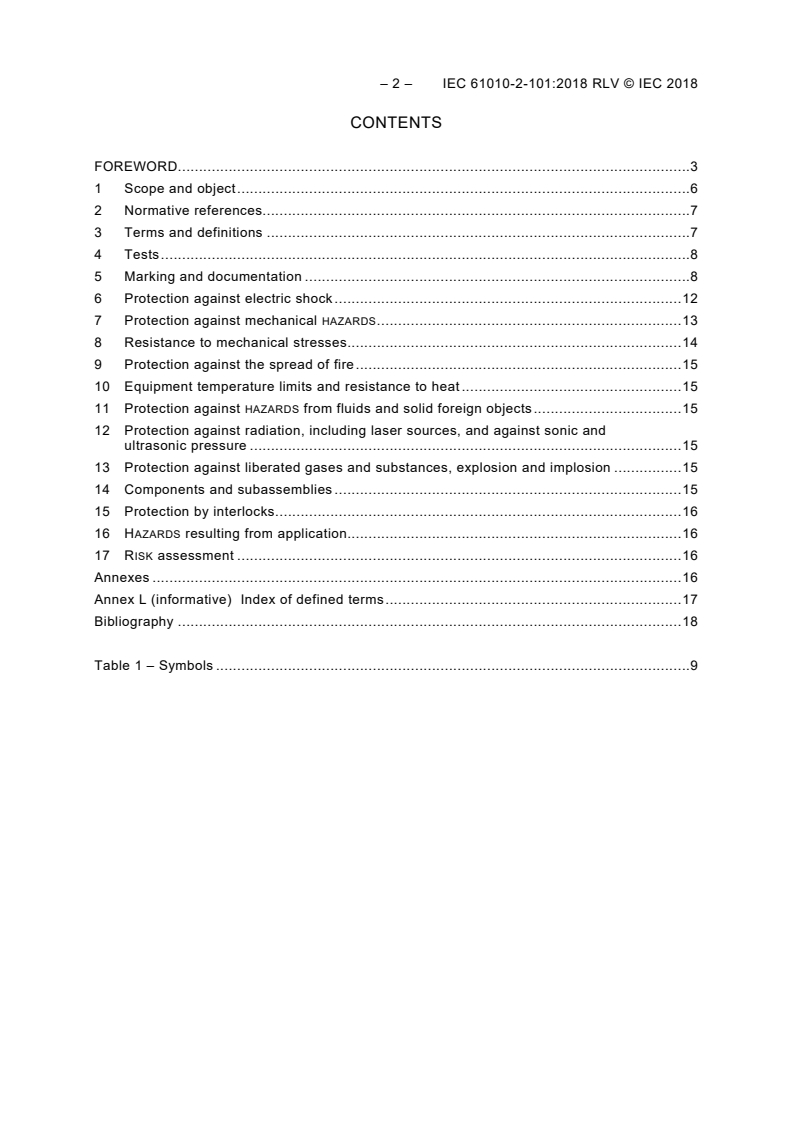
CONTENTS
FOREWORD . 3
1 Scope and object . 6
2 Normative references. 7
3 Terms and definitions . 7
4 Tests . 8
5 Marking and documentation . 8
6 Protection against electric shock . 12
7 Protection against mechanical HAZARDS . 13
8 Resistance to mechanical stresses . 14
9 Protection against the spread of fire . 15
10 Equipment temperature limits and resistance to heat . 15
11 Protection against HAZARDS from fluids and solid foreign objects . 15
12 Protection against radiation, including laser sources, and against sonic and
ultrasonic pressure . 15
13 Protection against liberated gases and substances, explosion and implosion . 15
14 Components and subassemblies . 15
15 Protection by interlocks . 16
16 HAZARDS resulting from application. 16
17 RISK assessment . 16
Annexes . 16
Annex L (informative) Index of defined terms . 17
Bibliography . 18
Table 1 – Symbols . 9
INTERNATIONAL ELECTROTECHNICAL COMMISSION
____________
SAFETY REQUIREMENTS FOR ELECTRICAL EQUIPMENT FOR
MEASUREMENT, CONTROL AND LABORATORY USE –
Part 2-101: Particular requirements for
in vitro diagnostic (IVD) medical equipment
FOREWORD
1) The International Electrotechnical Commission (IEC) is a worldwide organization for standardization comprising
all national electrotechnical committees (IEC National Committees). The object of IEC is to promote
international co-operation on all questions concerning standardization in the electrical and electronic fields. To
this end and in addition to other activities, IEC publishes International Standards, Technical Specifications,
Technical Reports, Publicly Available Specifications (PAS) and Guides (hereafter referred to as “IEC
Publication(s)”). Their preparation is entrusted to technical committees; any IEC National Committee interested
in the subject dealt with may participate in this preparatory work. International, governmental and non-
governmental organizations liaising with the IEC also participate in this preparation. IEC collaborates closely
with the International Organization for Standardization (ISO) in accordance with conditions determined by
agreement between the two organizations.
2) The formal decisions or agreements of IEC on technical matters express, as nearly as possible, an international
consensus of opinion on the relevant subjects since each technical committee has representation from all
interested IEC National Committees.
3) IEC Publications have the form of recommendations for international use and are accepted by IEC National
Committees in that sense. While all reasonable efforts are made to ensure that the technical content of IEC
Publications is accurate, IEC cannot be held responsible for the way in which they are used or for any
misinterpretation by any end user.
4) In order to promote international uniformity, IEC National Committees undertake to apply IEC Publications
transparently to the maximum extent possible in their national and regional publications. Any divergence
between any IEC Publication and the corresponding national or regional publication shall be clearly indicated in
the latter.
5) IEC itself does not provide any attestation of conformity. Independent certification bodies provide conformity
assessment services and, in some areas, access to IEC marks of conformity. IEC is not responsible for any
services carried out by independent certification bodies.
6) All users should ensure that they have the latest edition of this publication.
7) No liability shall attach to IEC or its directors, employees, servants or agents including individual experts and
members of its technical committees and IEC National Committees for any personal injury, property damage or
other damage of any nature whatsoever, whether direct or indirect, or for costs (including legal fees) and
expenses arising out of the publication, use of, or reliance upon, this IEC Publication or any other IEC
Publications.
8) Attention is drawn to the Normative references cited in this publication. Use of the referenced publications is
indispensable for the correct application of this publication.
9) Attention is drawn to the possibility that some of the elements of this IEC Publication may be the subject of
patent rights. IEC shall not be held responsible for identifying any or all such patent rights.
This redline version of the official IEC Standard allows the user to identify the changes
made to the previous edition. A vertical bar appears in the margin wherever a change
has been made. Additions are in green text, deletions are in strikethrough red text.
– 4 – IEC 61010-2-101:2018 RLV © IEC 2018
International Standard IEC 61010-2-101 has been prepared by IEC technical committee 66:
Safety of measuring, control and laboratory equipment.
It has the status of a group safety publication, as specified in IEC Guide 104.
This document has been prepared in close collaboration with Working Group
CENELEC BTTF 88.1.
This third edition cancels and replaces the second edition published in 2015. This edition
constitutes a technical revision.
This edition includes the following significant technical changes with respect to the previous
edition:
a) adaptation of changes introduced by Amendment 1 of IEC 61010-1;
b) added tolerance for stability of AC voltage test equipment to Clause 6.
The text of this International Standard is based on the following documents:
CDV Report on voting
66/644/CDV 66/669/RVC
Full information on the voting for the approval of this International Standard can be found in
the report on voting indicated in the above table.
This document has been drafted in accordance with the ISO/IEC Directives, Part 2.
A list of all parts of the IEC 61010 series, under the general title: Safety requirements for
electrical equipment for measurement, control, and laboratory use, may be found on the IEC
website.
This Part 2-101 is intended to be used in conjunction with IEC 61010-1. It was established on
the basis of the third edition (2010) and its Amendment 1 (2016).
This Part 2-101 supplements or modifies the corresponding clauses in IEC 61010-1 so as to
convert that publication into the IEC standard: Particular requirements for in vitro diagnostic
(IVD) medical equipment.
Where a particular subclause of Part 1 is not mentioned in this Part 2, that subclause applies
as far as is reasonable. Where this part states “addition”, “modification”, “replacement”, or
“deletion” the relevant requirement, test specification or note in Part 1 should be adapted
accordingly.
In this standard:
1) the following print types are used:
– requirements: in roman type;
– NOTES: in smaller roman type;
– conformity and test: in italic type;
– terms used throughout this standard which have been defined in clause 3: SMALL
ROMAN CAPITALS;
2) subclauses, figures, tables and notes which are additional to those in part 1 are numbered
starting from 101. Additional annexes are lettered starting from AA and additional list
items are lettered from aa).
The committee has decided that the contents of this document will remain unchanged until the
stability date indicated on the IEC website under "http://webstore.iec.ch" in the data related to
the specific document. At this date, the document will be
• reconfirmed,
• withdrawn,
• replaced by a revised edition, or
• amended.
IMPORTANT – The “colour inside” logo on the cover page of this publication indicates
that it contains colours which are considered to be useful for the correct understanding
of its contents. Users should therefore print this publication using a colour printer.
– 6 – IEC 61010-2-101:2018 RLV © IEC 2018
SAFETY REQUIREMENTS FOR ELECTRICAL EQUIPMENT FOR
MEASUREMENT, CONTROL AND LABORATORY USE –
Part 2-101: Particular requirements for
in vitro diagnostic (IVD) medical equipment
1 Scope and object
This clause of Part 1 is applicable except as follows:
1.1.1 Equipment included in scope
Replacement:
Replace the text, except the first paragraph, with the following new text:
This part of IEC 61010 applies to equipment intended for in vitro diagnostic (IVD) medical
purposes, including self-test IVD medical purposes.
IVD medical equipment, whether used alone or in combination, is intended by the
manufacturer to be used in vitro for the examination of specimens, including blood and tissue
samples, derived from the human body, solely or principally for the purpose of providing
information concerning one or more of the following:
• a physiological or pathological state; or
• a congenital abnormality;
• the determination of safety and compatibility with potential recipients;
• the monitoring of therapeutic measures.
Self-test IVD medical equipment is intended by the manufacturer for use by lay persons in a
home environment.
NOTE If all or part of the equipment falls within the scope of one or more other Part 2 standards of the IEC 61010
series as well as within the scope of this document, considerations have to be is given to those other Part 2
standards.
1.1.2 Equipment excluded from scope
Addition:
Add the following new item:
aa) equipment within the scope of IEC 61010-2-081 unless they are it is specifically
intended by their manufacturer to be used for in vitro diagnostic examination.
1.2 Object
1.2.1 Aspects included in scope
Addition:
Add the following two new items:
aa) biohazards;
bb) hazardous chemical substances.
1.2.2 Aspects excluded from scope
Addition:
Add the following new item and note:
aa) the handling or manipulation outside the equipment of material under analysis.
NOTE Requirements covering these subjects are the responsibility of committees preparing the relevant
standards.
2 Normative references
This clause of Part 1 is applicable except as follows:
Addition:
Add the following new references to the list:
ISO 14971, Medical devices – Application of risk management to medical devices
ISO 18113-5, In vitro diagnostic medical devices – Information supplied by the manufacturer
(labelling) – Part 5: In vitro diagnostic instruments for self-testing
ISO 13857, Safety of machinery – Safety distances to prevent hazard zones being reached by
upper and lower limbs
3 Terms and definitions
This clause of Part 1 is applicable except as follows:
3.1 Equipment and states of equipment
Addition:
Add the following new terms and definitions:
3.1.101
SAMPLE ZONE
area where OPERATOR access is typically unintended
Note 1 to entry: The inside of this zone presents mechanical HAZARDS and a more likely probability of
biohazardous human skin puncture.
3.1.102
LOADING ZONE
area of automated equipment where an OPERATOR handles sample or reagent material
3.5.12 RESPONSIBLE BODY
Addition:
Add the following new note:
Note 1 to entry: This is not the European Community Union's responsible authority.
– 8 – IEC 61010-2-101:2018 RLV © IEC 2018
4 Tests
This clause of Part 1 is applicable.
5 Marking and documentation
This clause of Part 1 is applicable except as follows:
5.1.1 General
Replacement:
Replace the third paragraph with the following new text:
Letter symbols for quantities and units shall be in accordance with IEC 60027 (all parts).
Internationally recognized symbols, including those of Table 1, shall be used as far as
possible. If other additional symbols are required, it shall not be possible to confuse them with
the internationally recognized symbols. There are no colour requirements for symbols.
Graphic symbols shall be explained in the documentation.
5.1.2 Identification
Replacement:
Replace the text with the following new text:
Equipment shall, as a minimum, be marked with the following information:
a) manufacturer’s name or trade mark, and the address. The address shall include at least
the city and country;
NOTE 1 National regulation may require more details on the address than required in a).
b) model number, name, or other means of identifying the equipment.
The following additional information shall be marked on the equipment or packaging or in the
instructions for use:
1) the serial number, for example SN XXXX or alternatively the batch code, preceded by
‘LOT’, using symbol 102 of Table 1;
2) the following information:
i) a clear indication that the equipment is IVD medical equipment;
ii) if applicable, a clear indication that the equipment is self-test IVD medical
equipment;
iii) if a potential RISK is posed, the identification of detachable components by the
manufacturer and the part identification, and where appropriate the batch code,
etc.;
3) instructions for use shall require requiring that the OPERATOR only use consumables
that are within their expiration date. Where this is required by regulation, the name and
address of the authorized representative of the manufacturer.
NOTE 2 For example, in the European Union this is the natural or legal person as established within
the European Community.
Table 1 – Symbols
Addition:
Add the following new symbols to Table 1:
Number Symbol Publication Description
Background colour
– optional;
Symbol colour
101 ISO 7000- 0659 (2004-01) Biological RISKS
– optional;
Outline / outline colour
– optional;
102 ISO 7000- 2492 (2004-01) Batch code
5.1.5 TERMINALS, connections and operating devices
Addition:
Add the following new subclause:
5.1.5.101 Gas and liquid connections
If necessary for safety, the equipment shall be clearly marked near to the connector on the
equipment with:
a) a means of identifying the gas or liquid to be used. Where no internationally recognized
symbol (including chemical formulae) exists, the equipment shall be marked with
symbol 14 of Table 1;
b) the maximum permitted pressure, or alternatively symbol 14 of Table 1 (see 5.4.3).
Conformity is checked by inspection.
Addition:
Add the following new subclause:
5.1.101 Transport and storage
Packaging of equipment shall be labelled to indicate any special conditions for transport or
storage (see 5.4.102).
Conformity is checked by inspection.
5.2 Warning markings
Replacement:
Replace the first paragraph by the following:
– 10 – IEC 61010-2-101:2018 RLV © IEC 2018
Warning Markings specified in 5.1.5.1, 5.1.5.2 c), 5.1.5.2 d), 5.1.5.101, 6.1.2 b), 7.3.2 b) 3),
7.4, 10.1, 13.2.2 and 13.101 shall meet the following requirements:
5.3 Durability of markings
Replacement:
Replace the first paragraph with the following new text:
Markings required by 5.1.2 to 5.2 shall remain clear and legible under conditions of NORMAL
USE, and resist the effects of temperature and rubbing, and of solvent and reagents likely to
NORMAL USE, including cleaning and decontaminating agents specified by
be encountered in
the manufacturer.
Addition:
Add, after the second paragraph, the following new text:
If a solvent or reagent specified for use with the equipment could affect the durability of a
particular marking, that marking is also rubbed for 30 s with the most frequently used and/or
NORMAL USE.
aggressive solvent or reagent to which the equipment is likely to be exposed in
A representative sample of groups of solvents or reagents likely to have a similar effect can
optionally be used.
5.4.1 General
Deletion:
Delete Note 2 in the second paragraph.
5.4.3 Equipment installation
Replacement:
Replace the title and text with the following new title and text:
5.4.3 Equipment transportation, installation and assembly instructions
Documentation for the RESPONSIBLE BODY shall include the following, if applicable:
a) instructions for transportation after delivery to the RESPONSIBLE BODY;
b) floor loading requirements;
NOTE Mass and dimensions are sufficient information for floor loading.
c) individual mass of heavy units;
d) location and mounting instructions, including the space required for ventilation, and for
safe and efficient OPERATOR maintenance;
e) assembly instructions;
f) instructions for protective earthing;
g) the sound data required by 12.5.1;
h) instructions relating to the handling, containment and exhaust of hazardous substances,
including any requirements for preventing back-syphonage;
i) any drainage systems required where a HAZARD could occur from the discharge of
biological and chemical substances and hot fluids;
j) details of protective measures relating to hazardous radiation (see Clause 12);
k) connections to the supply;
l) for PERMANENTLY CONNECTED EQUIPMENT only:
1) MAINS supply requirements and details of connections, including the RATED temperature
of the cable required at maximum RATED ambient temperature;
2) requirements for any external switch or circuit-breaker (see 6.11.23.1) and external
overcurrent protection devices (see 9.6.1) and a recommendation that the switch or
circuit-breaker be near the equipment if this is necessary for safety;
m) requirements for special services (for example air, cooling liquid) including pressure limits
and safety characteristics for special external services, for example: maximum and
minimum temperature, pressure, or flow of air or cooling liquid.
Conformity is checked by inspection of the documentation.
5.4.4 Equipment operation
Replacement:
Replace the first paragraph with the following new text:
Instructions for use shall include, if applicable:
a) details of operating controls and their use in all operating modes, with any sequence of
operation;
NOTE 1 IEC 60073 gives guidance on colours and symbols of operating controls.
b) an instruction not to position the equipment in such a way that it is difficult to operate the
disconnecting device (see 6.11);
c) instructions for interconnections to accessories and other equipment, including details of
suitable accessories, detachable parts and any special consumable materials;
d) limits for intermittent operation;
e) an explanation of symbols used on the equipment and, where HAZARDS are involved, the
reason for using a symbol in each particular case;
f) instructions for any actions to be taken by an OPERATOR to deal with a HAZARD resulting
from equipment spills, lock-ups, container breakage and similar malfunctions;
g) instructions and recommendations for cleaning and decontamination, with materials
recommended (see 11.2);
h) instructions for the disposal of hazardous waste;
i) if NORMAL USE involves the handling of hazardous chemical substances, instructions on
correct use and any need for training or personal protection measures;
j) appropriate instruction to use personal protective equipment (e.g. gloves, gowns) where
there could be contact with the skin when handling potentially infectious substances or
surfaces (such as human samples or reagents);
k) appropriate instructions and requirements for protection of the mouth, nose or eyes shall
be given where the equipment could emit hazardous aerosol vapours in NORMAL USE;
l) appropriate instructions and requirements for protective devices, such as protective
glasses shall be given where potentially hazardous visible or invisible radiation could be
emitted;
m) detailed instructions about RISK reduction procedures relating to flammable liquids (see
9.5 c));
n) details of methods of reducing the RISKS of burns from surfaces permitted to exceed the
temperature limits of 10.1;
o) appropriate warnings to reduce RISK during loading and unloading of samples and
reagents (see 7.3.102101);
– 12 – IEC 61010-2-101:2018 RLV © IEC 2018
p) instructions for the RESPONSIBLE BODY to ensure that all retaining hardware (e.g. screws,
fasteners) are in place on removable PROTECTIVE BARRIERS, and the removable PROTECTIVE
BARRIERS are in place on the instrument during normal operation;
TOOL is required to remove a fixed PROTECTIVE BARRIER and/or
q) a statement that, if a
ENCLOSURE guarding a SAMPLE ZONE, access to that tool should be controlled by the
RESPONSIBLE BODY;
r) a statement listing the tools to be controlled by the RESPONSIBLE BODY.
NOTE 2 Information on decontaminants, their use, dilution and potential application is contained in the Laboratory
Biosafety Manual, published by the World Health Organization and the Biosafety in Microbiological and Biomedical
Laboratories, published by Centers for Disease Control and Prevention and National Institutes of Health,
Washington. There are also national guidelines that cover these areas.
NOTE 3 Cleaning and decontamination may can be necessary as a safeguard when equipment and their its
accessories are maintained, repaired or transferred. Preferably manufacturers provide a format for the
RESPONSIBLE BODY to certify to those maintaining, repairing or transferring equipment that such a treatment has
been carried out.
Conformity is checked by inspection of the documentation.
Addition:
Add the following new subclauses:
5.4.4.101 Instructions for use of self-test IVD medical equipment
Instructions for use of self-test IVD medical equipment shall comply with ISO 18113-5.
5.4.101 Removal of equipment from use for repair or disposal
Instructions shall be provided for the RESPONSIBLE BODY for eliminating or reducing HAZARDS
involved in removal from use, transportation or disposal, or appropriate contact information
shall be provided in the documentation.
NOTE Regional or international requirements can apply.
Conformity is checked by inspection of the documentation.
5.4.102 Transport and storage
The manufacturer shall specify the conditions for transport and storage of the equipment. The
documentation shall contain a specification of the permissible environmental conditions for
transport and storage. Essential information shall be repeated on the outside of the package
using appropriate symbols (see 5.1.101).
When the manufacturer assumes responsibility for delivery and installation the above is not
required in the documentation.
Compliance is checked by inspection.
6 Protection against electric shock
This clause of part 1 is applicable except as follows:
6.8.3.1 The AC voltage test
Replacement:
Replace the first sentence with the following new sentence:
The voltage tester shall be capable of maintaining the test voltage throughout the test within
± 5 % of the specified value.
7 Protection against mechanical HAZARDS
This clause of part 1 is applicable, except as follows:
7.3.1 General
Replacement:
Replace the second sentence with the following new sentence:
The conditions specified in 7.3.4, 7.3.5, and 7.3.101 are considered to represent a tolerable
level.
Replace the conformity statement with the following new conformity statement:
Conformity is checked as specified in 7.3.2, 7.3.3, 7.3.4, 7.3.5, 7.3.101, and Clause 17 as
applicable.
7.3.2 Exceptions
Replacement:
Replace the text of item b) 3) text with the following new text:
there are warning markings prohibiting access by untrained OPERATORS. Markings shall be
placed within the area requiring maintenance where they can alert the OPERATOR to the
HAZARD. As an alternative, symbol 14 of Table 1 can be used, with the warnings included in
the documentation;
Addition:
Add the following new item to the list:
b) 4) there are OPERATOR maintenance instructions that specify safe maintenance
procedures.
7.3.3 RISK assessment for mechanical HAZARDS to body parts
Replacement:
Replace text with the following new text:
If equipment is specified by the manufacturer for continuous loading of sample and reagent
materials, and associated HAZARDS in the SAMPLE ZONE are solely caused by the sample
and/or reagent probes, 7.3.101 applies specifically for the SAMPLE ZONE. Subclause 7.3.101
does not apply to self-testing and point of care equipment.
RISKS shall be reduced to a tolerable level by at least the applicable minimum protective
measure of Table 12, taking into account the severity, probability of exposure and possibility
of avoiding the HAZARD.
Conformity is checked by evaluation of the RISK assessment documentation to ensure that the
RISKS have been eliminated or that only TOLERABLE RISKS remain.
– 14 – IEC 61010-2-101:2018 RLV © IEC 2018
Table 12 – Protective measures against mechanical HAZARDS to body parts
Replacement:
Replace the text of item B by the following text:
Moderate measures; emergency switches, PROTECTIVE BARRIERS or covers removable only
with a TOOL, distances (see ISO 13857), or separations (see ISO 13854 or EN 349).
Addition:
Add the following new subclause:
AMPLE ZONE
7.3.101 S
Equipment with a SAMPLE ZONE shall comply with the requirements of one or more of the
following:
aa) PROTECTIVE BARRIER; or
bb) all of the following measures, which apply:
1) the minimum maintained gap between LOADING ZONE and SAMPLE ZONE is 120 mm;
2) unintentional contact between OPERATOR and sample/reagent pipettor is unlikely;
3) the area between LOADING ZONE and SAMPLE ZONE is marked with symbol 14 and
OPERATOR the marking
symbol 101 of Table 1 (see 5.4.4 o)), or if not visible by the
shall be located in a visible manner and close to the area.
8 Resistance to mechanical stresses
This clause of part 1 is applicable except as follows:
8.1 General
Replacement:
Replace the text of item 3) with the following new text:
1) except for FIXED EQUIPMENT, for equipment with a mass over 100 kg, or for equipment
whose size and weight make unintentional movement unlikely and which is not moved in
NORMAL USE, the appropriate test of 8.3. The equipment is not operated during the tests.
Addition:
Add the following new subclause:
8.101 Transport and storage
When delivered in the manufacturer’s packaging, equipment shall not cause a HAZARD during
NORMAL USE after transport or storage in the conditions specified by the manufacturer
(see 5.1.101 and 5.4.101).
If the manufacturer assumes responsibility for delivery and installation, the above requirement
is met without inspection of test records.
Conformity is checked by inspection of records of transport tests performed by the
manufacturer.
NOTE Guidance on tests is given in ASTM D4169, and in the publications of the International Safe Transport
Association (ISTA).
9 Protection against the spread of fire
This clause of Part 1 is applicable.
10 Equipment temperature limits and resistance to heat
This clause of Part 1 is applicable.
11 Protection against HAZARDS from fluids and solid foreign objects
This clause of Part 1 is applicable.
12 Protection against radiation, including laser sources, and against sonic and
ultrasonic pressure
This clause of Part 1 is applicable.
13 Protection against liberated gases and substances, explosion and implosion
This clause of Part 1 is applicable except as follows:
Addition:
Add the following new subclause:
13.101 Biohazardous substances
Equipment that can be potentially infectious due to the samples or reagents used shall be
prominently marked with symbol 101 of Table 1. At minimum, a biohazard symbol shall be
near the sampling area and visible in NORMAL USE.
Biohazard symbols shall be near biohazardous areas accessed during OPERATOR maintenance
and visible only during this maintenance.
Symbol 101 of Table 1 shall be marked on containers or bags for biohazardous waste material
which can be removed from the equipment during NORMAL USE, and near any biohazardous
drain connection.
Equipment that can be hazardous due to the use of hazardous substances shall be marked
with the appropriate international symbol, or (if none is available) symbol 14 of Table 1.
14 Components and subassemblies
This clause of Part 1 is applicable except as follows:
14.3 Over-temperature protection devices
Addition:
Add the following new paragraph after the second paragraph:
– 16 – IEC 61010-2-101:2018 RLV © IEC 2018
Over-temperature protection devices in self-test IVD medical equipment shall not be
self-resetting.
15 Protection by interlocks
This clause of Part 1 is applicable except as follows:
15.1 General
Addition:
Add the following new text after the first sentence:
As an alternative method, for interlock systems containing electric/electronic or programmable
components (E/E/P components) the reliability and design requirements can be determined by
applying for example IEC 62061 (SIL) or ISO 13849 (all parts) (PL) or other solutions
providing equivalent functional safety.
16 HAZARDS resulting from application
This clause of Part 1 is applicable except as follows:
16.2 Ergonomic aspects
Replacement:
Replace the note with the following new note:
NOTE RISK assessment procedures for ergonomics can be found in IEC 62366-1, IEC TR 62366-2, EN 894-2,
EN 894-3, ISO 9241, SEMI S8 and other documents. Not all of the requirements in these documents will be
applicable to equipment within the scope of this document.
17 RISK assessment
This clause of Part 1 is replaced applicable except as follows:
Replacement:
Replace the text with the following new text:
RISK assessment shall be carried out and documented using the requirements of ISO 14971
for HAZARDS not addressed in this document and Part 1.
Conformity is checked by evaluation of the RISK assessment documentation to assure that the
RISKS have been eliminated or that only TOLERABLE RISKS remain.
Annexes
The annexes of Part 1 are applicable except as follows:
Annex L
(informative)
Index of defined terms
Addition:
Add the following new defined terms to the list:
LOADING ZONE . 3.1.102
SAMPLE ZONE . 3.1.101
– 18 – IEC 61010-2-101:2018 RLV © IEC 2018
Bibliography
The Bibliography of Part 1 is applicable, except as follows:
Deletion:
Delete the following reference:
ISO 14971, Medical devices – Application of risk management to medical devices
Addition:
Add the following new references:
IEC 62061, Safety of machinery – Functional safety of safety-related electrical, electronic and
programmable electronic control systems
IEC 62366-1, Medical devices – Part 1: Application of usability engineering to medical devices
IEC TR 62366-2, Medical devices – Part 2: Guidance on the application of usability
engineering to medical devices
ISO 13849 (all parts), Safety of machinery – Safety-related parts of control systems
ISO 15223-1, Medical devices – Symbols to be used with medical device labels, labelling and
information to be supplied – Part 1: General requirements
ASTM D4169, Standard practice for performance testing for shipping containers
Centers for Disease Control and Prevention and National Institutes of Health, Biosafety in
Microbiological and Biomedical Laboratories, Washington
EN 980:2008, Graphical symbols for use in the labelling of medical devices
World Health Organization, Laboratory Biosafety Manual
Publications of the International Safe Transport Association (ISTA)
___________
IEC 61010-2-101 ®
Edition 3.0 2018-10
INTERNATIONAL
STANDARD
NORME
INTERNATIONALE
GROUP SAFETY PUBLICATION
PUBLICATION GROUPÉE DE SÉCURITÉ
Safety requirements for electrical equipment for measurement, control and
laboratory use –
Part 2-101: Particular requirements for in vitro diagnostic (IVD) medical
equipment
Exigences de sécurité pour appareils électriques de mesurage, de régulation et
de laboratoire –
Partie 2-101: Exigences particulières pour le matériel médical de diagnostic in
vitro (DIV)
– 2 – IEC 61010-2-101:2018 © IEC 2018
CONTENTS
FOREWORD . 3
1 Scope and object . 5
2 Normative references. 6
3 Terms and definitions . 6
4 Tests . 6
5 Marking and documentation . 7
6 Protection against electric shock . 11
7 Protection against mechanical HAZARDS . 11
8 Resistance to mechanical stresses . 13
9 Protection against the spread of fire . 13
10 Equipment temperature limits and resistance to heat . 13
11 Protection against HAZARDS from fluids and solid foreign objects . 13
12 Protection against radiation, including laser sources, and against sonic and
ultrasonic pressure . 14
13 Protection against liberated gases and substances, explosion and implosion . 14
14 Components and subassemblies . 14
15 Protection by interlocks . 14
16 HAZARDS resulting from application. 15
17 RISK assessment . 15
Annexes . 15
Annex L (informative) Index of defined terms . 16
Bibliography . 17
Table 1 – Symbols . 8
INTERNATIONAL ELECTROTECHNICAL COMMISSION
____________
SAFETY REQUIREMENTS FOR ELECTRICAL EQUIPMENT FOR
MEASUREMENT, CONTROL AND LABORATORY USE –
Part 2-101: Particular requirements for
in vitro diagnostic (IVD) medical equipment
FOREWORD
1) The International Electrotechnical Commission (IEC) is a worldwide organization for standardization comprising
all national electrotechnical committees (IEC National Committees). The object of IEC is to promote
international co-operation on all questions concerning standardization in the electrical and electronic fields. To
this end and in addition to other activities, IEC publishes International Standards, Technical Specifications,
Technical Reports, Publicly Available Specifications (PAS) and Guides (hereafter referred to as “IEC
Publication(s)”). Their preparation is entrusted to technical committees; any IEC National Committee interested
in the subject dealt with may participate in this preparatory work. International, governmental and non-
governmental organizations liaising with the IEC also participate in this preparation. IEC collaborates closely
with the International Organization for Standardization (ISO) in accordance with conditions determined by
agreement between the two organizations.
2) The formal decisions or agreements of IEC on technical matters express, as nearly as possible, an international
consensus of opinion on the relevant subjects since each technical committee has representation from all
interested IEC National Committees.
3) IEC Publications have the form of recommendations for international use and are accepted by IEC National
Committees in that sense. While all reasonable efforts are made to ensure that the technical content of IEC
Publications is accurate, IEC cannot be held responsible for the way in which they are used or for any
misinterpretation by any end user.
4) In order to promote international uniformity, IEC National Committees undertake to apply IEC Publications
transparently to the maximum extent possible in their national and regional publications. Any divergence
between any IEC Publication and the corresponding national or regional publication shall be clearly indicated in
the latter.
5) IEC itself does not provide any attestation of conformity. Independent certification bodies provide conformity
assessment services and, in some areas, access to IEC marks of conformity. IEC is not responsible for any
services carried out by independent certification bodies.
6) All users should ensure that they have the latest edition of this publication.
7) No liability shall attach to IEC or its directors, employees, servants or agents including individual experts and
members of its technical committees and IEC National Committees for any personal injury, property damage or
other damage of any nature whatsoever, whether direct or indirect, or for costs (including legal fees) and
expenses arising out of the publication, use of, or reliance upon, this IEC Publication or any other IEC
Publications.
8) Attention is drawn to the Normative references cit
...
IEC 61010-2-101 ®
Edition 3.0 2018-10
INTERNATIONAL
STANDARD
NORME
INTERNATIONALE
GROUP SAFETY PUBLICATION
PUBLICATION GROUPÉE DE SÉCURITÉ
Safety requirements for electrical equipment for measurement, control and
laboratory use –
Part 2-101: Particular requirements for in vitro diagnostic (IVD) medical
equipment
Exigences de sécurité pour appareils électriques de mesurage, de régulation et
de laboratoire –
Partie 2-101: Exigences particulières pour le matériel médical de diagnostic in
vitro (DIV)
All rights reserved. Unless otherwise specified, no part of this publication may be reproduced or utilized in any form
or by any means, electronic or mechanical, including photocopying and microfilm, without permission in writing from
either IEC or IEC's member National Committee in the country of the requester. If you have any questions about IEC
copyright or have an enquiry about obtaining additional rights to this publication, please contact the address below or
your local IEC member National Committee for further information.
Droits de reproduction réservés. Sauf indication contraire, aucune partie de cette publication ne peut être reproduite
ni utilisée sous quelque forme que ce soit et par aucun procédé, électronique ou mécanique, y compris la photocopie
et les microfilms, sans l'accord écrit de l'IEC ou du Comité national de l'IEC du pays du demandeur. Si vous avez des
questions sur le copyright de l'IEC ou si vous désirez obtenir des droits supplémentaires sur cette publication, utilisez
les coordonnées ci-après ou contactez le Comité national de l'IEC de votre pays de résidence.
IEC Central Office Tel.: +41 22 919 02 11
3, rue de Varembé info@iec.ch
CH-1211 Geneva 20 www.iec.ch
Switzerland
About the IEC
The International Electrotechnical Commission (IEC) is the leading global organization that prepares and publishes
International Standards for all electrical, electronic and related technologies.
About IEC publications
The technical content of IEC publications is kept under constant review by the IEC. Please make sure that you have the
latest edition, a corrigenda or an amendment might have been published.
IEC Catalogue - webstore.iec.ch/catalogue Electropedia - www.electropedia.org
The stand-alone application for consulting the entire The world's leading online dictionary of electronic and
bibliographical information on IEC International Standards, electrical terms containing 21 000 terms and definitions in
Technical Specifications, Technical Reports and other English and French, with equivalent terms in 16 additional
documents. Available for PC, Mac OS, Android Tablets and languages. Also known as the International Electrotechnical
iPad. Vocabulary (IEV) online.
IEC publications search - webstore.iec.ch/advsearchform IEC Glossary - std.iec.ch/glossary
The advanced search enables to find IEC publications by a 67 000 electrotechnical terminology entries in English and
variety of criteria (reference number, text, technical French extracted from the Terms and Definitions clause of
committee,…). It also gives information on projects, replaced IEC publications issued since 2002. Some entries have been
and withdrawn publications. collected from earlier publications of IEC TC 37, 77, 86 and
CISPR.
IEC Just Published - webstore.iec.ch/justpublished
Stay up to date on all new IEC publications. Just Published IEC Customer Service Centre - webstore.iec.ch/csc
details all new publications released. Available online and If you wish to give us your feedback on this publication or
also once a month by email. need further assistance, please contact the Customer Service
Centre: sales@iec.ch.
A propos de l'IEC
La Commission Electrotechnique Internationale (IEC) est la première organisation mondiale qui élabore et publie des
Normes internationales pour tout ce qui a trait à l'électricité, à l'électronique et aux technologies apparentées.
A propos des publications IEC
Le contenu technique des publications IEC est constamment revu. Veuillez vous assurer que vous possédez l’édition la
plus récente, un corrigendum ou amendement peut avoir été publié.
Catalogue IEC - webstore.iec.ch/catalogue Electropedia - www.electropedia.org
Application autonome pour consulter tous les renseignements
Le premier dictionnaire en ligne de termes électroniques et
bibliographiques sur les Normes internationales,
électriques. Il contient 21 000 termes et définitions en anglais
Spécifications techniques, Rapports techniques et autres
et en français, ainsi que les termes équivalents dans 16
documents de l'IEC. Disponible pour PC, Mac OS, tablettes
langues additionnelles. Egalement appelé Vocabulaire
Android et iPad.
Electrotechnique International (IEV) en ligne.
Recherche de publications IEC -
Glossaire IEC - std.iec.ch/glossary
webstore.iec.ch/advsearchform
67 000 entrées terminologiques électrotechniques, en anglais
La recherche avancée permet de trouver des publications IEC et en français, extraites des articles Termes et Définitions des
en utilisant différents critères (numéro de référence, texte, publications IEC parues depuis 2002. Plus certaines entrées
comité d’études,…). Elle donne aussi des informations sur les antérieures extraites des publications des CE 37, 77, 86 et
projets et les publications remplacées ou retirées. CISPR de l'IEC.
IEC Just Published - webstore.iec.ch/justpublished Service Clients - webstore.iec.ch/csc
Restez informé sur les nouvelles publications IEC. Just Si vous désirez nous donner des commentaires sur cette
Published détaille les nouvelles publications parues. publication ou si vous avez des questions contactez-nous:
Disponible en ligne et aussi une fois par mois par email. sales@iec.ch.
IEC 61010-2-101 ®
Edition 3.0 2018-10
INTERNATIONAL
STANDARD
NORME
INTERNATIONALE
GROUP SAFETY PUBLICATION
PUBLICATION GROUPÉE DE SÉCURITÉ
Safety requirements for electrical equipment for measurement, control and
laboratory use –
Part 2-101: Particular requirements for in vitro diagnostic (IVD) medical
equipment
Exigences de sécurité pour appareils électriques de mesurage, de régulation et
de laboratoire –
Partie 2-101: Exigences particulières pour le matériel médical de diagnostic in
vitro (DIV)
INTERNATIONAL
ELECTROTECHNICAL
COMMISSION
COMMISSION
ELECTROTECHNIQUE
INTERNATIONALE
ICS 11.040.55; 19.080 ISBN 978-2-8322-6062-3
– 2 – IEC 61010-2-101:2018 © IEC 2018
CONTENTS
FOREWORD . 3
1 Scope and object . 5
2 Normative references. 6
3 Terms and definitions . 6
4 Tests . 6
5 Marking and documentation . 7
6 Protection against electric shock . 11
7 Protection against mechanical HAZARDS . 11
8 Resistance to mechanical stresses . 13
9 Protection against the spread of fire . 13
10 Equipment temperature limits and resistance to heat . 13
11 Protection against HAZARDS from fluids and solid foreign objects . 13
12 Protection against radiation, including laser sources, and against sonic and
ultrasonic pressure . 14
13 Protection against liberated gases and substances, explosion and implosion . 14
14 Components and subassemblies . 14
15 Protection by interlocks . 14
16 HAZARDS resulting from application. 15
17 RISK assessment . 15
Annexes . 15
Annex L (informative) Index of defined terms . 16
Bibliography . 17
Table 1 – Symbols . 8
INTERNATIONAL ELECTROTECHNICAL COMMISSION
____________
SAFETY REQUIREMENTS FOR ELECTRICAL EQUIPMENT FOR
MEASUREMENT, CONTROL AND LABORATORY USE –
Part 2-101: Particular requirements for
in vitro diagnostic (IVD) medical equipment
FOREWORD
1) The International Electrotechnical Commission (IEC) is a worldwide organization for standardization comprising
all national electrotechnical committees (IEC National Committees). The object of IEC is to promote
international co-operation on all questions concerning standardization in the electrical and electronic fields. To
this end and in addition to other activities, IEC publishes International Standards, Technical Specifications,
Technical Reports, Publicly Available Specifications (PAS) and Guides (hereafter referred to as “IEC
Publication(s)”). Their preparation is entrusted to technical committees; any IEC National Committee interested
in the subject dealt with may participate in this preparatory work. International, governmental and non-
governmental organizations liaising with the IEC also participate in this preparation. IEC collaborates closely
with the International Organization for Standardization (ISO) in accordance with conditions determined by
agreement between the two organizations.
2) The formal decisions or agreements of IEC on technical matters express, as nearly as possible, an international
consensus of opinion on the relevant subjects since each technical committee has representation from all
interested IEC National Committees.
3) IEC Publications have the form of recommendations for international use and are accepted by IEC National
Committees in that sense. While all reasonable efforts are made to ensure that the technical content of IEC
Publications is accurate, IEC cannot be held responsible for the way in which they are used or for any
misinterpretation by any end user.
4) In order to promote international uniformity, IEC National Committees undertake to apply IEC Publications
transparently to the maximum extent possible in their national and regional publications. Any divergence
between any IEC Publication and the corresponding national or regional publication shall be clearly indicated in
the latter.
5) IEC itself does not provide any attestation of conformity. Independent certification bodies provide conformity
assessment services and, in some areas, access to IEC marks of conformity. IEC is not responsible for any
services carried out by independent certification bodies.
6) All users should ensure that they have the latest edition of this publication.
7) No liability shall attach to IEC or its directors, employees, servants or agents including individual experts and
members of its technical committees and IEC National Committees for any personal injury, property damage or
other damage of any nature whatsoever, whether direct or indirect, or for costs (including legal fees) and
expenses arising out of the publication, use of, or reliance upon, this IEC Publication or any other IEC
Publications.
8) Attention is drawn to the Normative references cited in this publication. Use of the referenced publications is
indispensable for the correct application of this publication.
9) Attention is drawn to the possibility that some of the elements of this IEC Publication may be the subject of
patent rights. IEC shall not be held responsible for identifying any or all such patent rights.
International Standard IEC 61010-2-101 has been prepared by IEC technical committee 66:
Safety of measuring, control and laboratory equipment.
It has the status of a group safety publication, as specified in IEC Guide 104.
This document has been prepared in close collaboration with Working Group
CENELEC BTTF 88.1.
This third edition cancels and replaces the second edition published in 2015. This edition
constitutes a technical revision.
This edition includes the following significant technical changes with respect to the previous
edition:
– 4 – IEC 61010-2-101:2018 © IEC 2018
a) adaptation of changes introduced by Amendment 1 of IEC 61010-1;
b) added tolerance for stability of AC voltage test equipment to Clause 6.
The text of this International Standard is based on the following documents:
CDV Report on voting
66/644/CDV 66/669/RVC
Full information on the voting for the approval of this International Standard can be found in
the report on voting indicated in the above table.
This document has been drafted in accordance with the ISO/IEC Directives, Part 2.
A list of all parts of the IEC 61010 series, under the general title: Safety requirements for
electrical equipment for measurement, control, and laboratory use, may be found on the IEC
website.
This Part 2-101 is intended to be used in conjunction with IEC 61010-1. It was established on
the basis of the third edition (2010) and its Amendment 1 (2016).
This Part 2-101 supplements or modifies the corresponding clauses in IEC 61010-1 so as to
convert that publication into the IEC standard: Particular requirements for in vitro diagnostic
(IVD) medical equipment.
Where a particular subclause of Part 1 is not mentioned in this Part 2, that subclause applies
as far as is reasonable. Where this part states “addition”, “modification”, “replacement”, or
“deletion” the relevant requirement, test specification or note in Part 1 should be adapted
accordingly.
In this standard:
1) the following print types are used:
– requirements: in roman type;
– NOTES: in smaller roman type;
– conformity and test: in italic type;
– terms used throughout this standard which have been defined in clause 3: SMALL
ROMAN CAPITALS;
2) subclauses, figures, tables and notes which are additional to those in part 1 are numbered
starting from 101. Additional annexes are lettered starting from AA and additional list
items are lettered from aa).
The committee has decided that the contents of this document will remain unchanged until the
stability date indicated on the IEC website under "http://webstore.iec.ch" in the data related to
the specific document. At this date, the document will be
• reconfirmed,
• withdrawn,
• replaced by a revised edition, or
• amended.
SAFETY REQUIREMENTS FOR ELECTRICAL EQUIPMENT FOR
MEASUREMENT, CONTROL AND LABORATORY USE –
Part 2-101: Particular requirements for
in vitro diagnostic (IVD) medical equipment
1 Scope and object
This clause of Part 1 is applicable except as follows:
1.1.1 Equipment included in scope
Replacement:
Replace the text, except the first paragraph, with the following new text:
This part of IEC 61010 applies to equipment intended for in vitro diagnostic (IVD) medical
purposes, including self-test IVD medical purposes.
IVD medical equipment, whether used alone or in combination, is intended by the
manufacturer to be used in vitro for the examination of specimens, including blood and tissue
samples, derived from the human body, solely or principally for the purpose of providing
information concerning one or more of the following:
• a physiological or pathological state; or
• a congenital abnormality;
• the determination of safety and compatibility with potential recipients;
• the monitoring of therapeutic measures.
Self-test IVD medical equipment is intended by the manufacturer for use by lay persons in a
home environment.
NOTE If all or part of the equipment falls within the scope of one or more other Part 2 standards of the IEC 61010
series as well as within the scope of this document, consideration is given to those other Part 2 standards.
1.1.2 Equipment excluded from scope
Addition:
Add the following new item:
aa) equipment within the scope of IEC 61010-2-081 unless it is specifically intended by the
manufacturer to be used for in vitro diagnostic examination.
1.2 Object
1.2.1 Aspects included in scope
Addition:
Add the following two new items:
aa) biohazards;
bb) hazardous chemical substances.
– 6 – IEC 61010-2-101:2018 © IEC 2018
1.2.2 Aspects excluded from scope
Addition:
Add the following new item and note:
aa) the handling or manipulation outside the equipment of material under analysis.
NOTE Requirements covering these subjects are the responsibility of committees preparing the relevant
standards.
2 Normative references
This clause of Part 1 is applicable except as follows:
Addition:
Add the following new references to the list:
ISO 14971, Medical devices – Application of risk management to medical devices
ISO 18113-5, In vitro diagnostic medical devices – Information supplied by the manufacturer
(labelling) – Part 5: In vitro diagnostic instruments for self-testing
3 Terms and definitions
This clause of Part 1 is applicable except as follows:
3.1 Equipment and states of equipment
Addition:
Add the following new terms:
3.1.101
SAMPLE ZONE
area where OPERATOR access is typically unintended
Note 1 to entry: The inside of this zone presents mechanical HAZARDS and a more likely probability of
biohazardous human skin puncture.
3.1.102
LOADING ZONE
area of automated equipment where an OPERATOR handles sample or reagent material
3.5.12 RESPONSIBLE BODY
Addition:
Add the following new note:
Note 1 to entry: This is not the European Union's responsible authority.
4 Tests
This clause of Part 1 is applicable.
5 Marking and documentation
This clause of Part 1 is applicable except as follows:
5.1.1 General
Replacement:
Replace the third paragraph with the following new text:
Letter symbols for quantities and units shall be in accordance with IEC 60027 (all parts).
Internationally recognized symbols, including those of Table 1, shall be used as far as
possible. If other additional symbols are required, it shall not be possible to confuse them with
the internationally recognized symbols. There are no colour requirements for symbols.
Graphic symbols shall be explained in the documentation.
5.1.2 Identification
Replacement:
Replace the text with the following new text:
Equipment shall, as a minimum, be marked with the following information:
a) manufacturer’s name or trade mark, and the address. The address shall include at least
the city and country;
NOTE 1 National regulation may require more details on the address than required in a).
b) model number, name, or other means of identifying the equipment.
The following additional information shall be marked on the equipment or packaging or in the
instructions for use:
1) the serial number, for example SN XXXX or alternatively the batch code, preceded by
‘LOT’, using symbol 102 of Table 1;
2) the following information:
i) a clear indication that the equipment is IVD medical equipment;
ii) if applicable, a clear indication that the equipment is self-test IVD medical
equipment;
iii) if a potential RISK is posed, the identification of detachable components by the
manufacturer and the part identification, and where appropriate the batch code,
etc.;
3) instructions for use requiring that the OPERATOR only use consumables that are within
their expiration date. Where this is required by regulation, the name and address of the
authorized representative of the manufacturer.
NOTE 2 For example, in the European Union this is the natural or legal person as established within
the European Community.
– 8 – IEC 61010-2-101:2018 © IEC 2018
Table 1 – Symbols
Addition:
Add the following new symbols to Table 1:
Number Symbol Publication Description
Background colour
– optional;
Symbol colour
101 ISO 7000- 0659 (2004-01) Biological RISKS
– optional;
Outline / outline colour
– optional;
102 ISO 7000- 2492 (2004-01) Batch code
5.1.5 TERMINALS, connections and operating devices
Addition:
Add the following new subclause:
5.1.5.101 Gas and liquid connections
If necessary for safety, the equipment shall be clearly marked near the connector on the
equipment with:
a) a means of identifying the gas or liquid to be used. Where no internationally recognized
symbol (including chemical formulae) exists, the equipment shall be marked with
symbol 14 of Table 1;
b) the maximum permitted pressure, or alternatively symbol 14 of Table 1 (see 5.4.3).
Conformity is checked by inspection.
Addition:
Add the following new subclause:
5.1.101 Transport and storage
Packaging of equipment shall be labelled to indicate any special conditions for transport or
storage (see 5.4.102).
Conformity is checked by inspection.
5.3 Durability of markings
Replacement:
Replace the first paragraph with the following new text:
Markings required by 5.1.2 to 5.2 shall remain clear and legible under conditions of NORMAL
USE, and resist the effects of temperature and rubbing, and of solvent and reagents likely to
be encountered in NORMAL USE, including cleaning and decontaminating agents specified by
the manufacturer.
Addition:
Add, after the second paragraph, the following new text:
If a solvent or reagent specified for use with the equipment could affect the durability of a
particular marking, that marking is also rubbed for 30 s with the most frequently used and/or
aggressive solvent or reagent to which the equipment is likely to be exposed in NORMAL USE.
A representative sample of groups of solvents or reagents likely to have a similar effect can
optionally be used.
5.4.1 General
Deletion:
Delete Note 2.
5.4.3 Equipment installation
Replacement:
Replace the title and text with the following new title and text:
5.4.3 Equipment transportation, installation and assembly instructions
Documentation for the RESPONSIBLE BODY shall include the following, if applicable:
a) instructions for transportation after delivery to the RESPONSIBLE BODY;
b) floor loading requirements;
NOTE Mass and dimensions are sufficient information for floor loading.
c) individual mass of heavy units;
d) location and mounting instructions, including the space required for ventilation, and for
safe and efficient OPERATOR maintenance;
e) assembly instructions;
f) instructions for protective earthing;
g) the sound data required by 12.5.1;
h) instructions relating to the handling, containment and exhaust of hazardous substances,
including any requirements for preventing back-syphonage;
i) any drainage systems required where a HAZARD could occur from the discharge of
biological and chemical substances and hot fluids;
j) details of protective measures relating to hazardous radiation (see Clause 12);
k) connections to the supply;
l) for PERMANENTLY CONNECTED EQUIPMENT only:
1) MAINS supply requirements and details of connections, including the RATED temperature
of the cable required at maximum RATED ambient temperature;
2) requirements for any external switch or circuit-breaker (see 6.11.3.1) and external
overcurrent protection devices (see 9.6.1) and a recommendation that the switch or
circuit-breaker be near the equipment if this is necessary for safety;
– 10 – IEC 61010-2-101:2018 © IEC 2018
m) requirements and safety characteristics for special external services, for example:
maximum and minimum temperature, pressure, or flow of air or cooling liquid.
Conformity is checked by inspection of the documentation.
5.4.4 Equipment operation
Replacement:
Replace the first paragraph with the following new text:
Instructions for use shall include, if applicable:
a) details of operating controls and their use in all operating modes, with any sequence of
operation;
NOTE 1 IEC 60073 gives guidance on colours and symbols of operating controls.
b) an instruction not to position the equipment in such a way that it is difficult to operate the
disconnecting device (see 6.11);
c) instructions for interconnections to accessories and other equipment, including details of
suitable accessories, detachable parts and any special consumable materials;
d) limits for intermittent operation;
e) an explanation of symbols used on the equipment and, where HAZARDS are involved, the
reason for using a symbol in each particular case;
f) instructions for any actions to be taken by an OPERATOR to deal with a HAZARD resulting
from equipment spills, lock-ups, container breakage and similar malfunctions;
g) instructions and recommendations for cleaning and decontamination, with materials
recommended (see 11.2);
h) instructions for the disposal of hazardous waste;
i) if NORMAL USE involves the handling of hazardous chemical substances, instructions on
correct use and any need for training or personal protection measures;
j) appropriate instruction to use personal protective equipment (e.g. gloves, gowns) where
there could be contact with the skin when handling potentially infectious substances or
surfaces (such as human samples or reagents);
k) appropriate instructions and requirements for protection of the mouth, nose or eyes shall
be given where the equipment could emit hazardous aerosol vapours in NORMAL USE;
l) appropriate instructions and requirements for protective devices, such as protective
glasses shall be given where potentially hazardous visible or invisible radiation could be
emitted;
m) detailed instructions about RISK reduction procedures relating to flammable liquids (see
9.5 c));
n) details of methods of reducing the RISKS of burns from surfaces permitted to exceed the
temperature limits of 10.1;
o) appropriate warnings to reduce RISK during loading and unloading of samples and
reagents (see 7.3.101);
p) instructions for the RESPONSIBLE BODY to ensure that all retaining hardware (e.g. screws,
fasteners) are in place on removable PROTECTIVE BARRIERS, and the removable PROTECTIVE
BARRIERS are in place on the instrument during normal operation;
q) a statement that, if a TOOL is required to remove a fixed PROTECTIVE BARRIER and/or
ENCLOSURE guarding a SAMPLE ZONE, access to that tool should be controlled by the
RESPONSIBLE BODY;
r) a statement listing the tools to be controlled by the RESPONSIBLE BODY.
NOTE 2 Information on decontaminants, their use, dilution and potential application is contained in the Laboratory
Biosafety Manual, published by the World Health Organization and the Biosafety in Microbiological and Biomedical
Laboratories, published by Centers for Disease Control and Prevention and National Institutes of Health,
Washington. There are also national guidelines that cover these areas.
NOTE 3 Cleaning and decontamination can be necessary as a safeguard when equipment and its accessories are
maintained, repaired or transferred. Preferably manufacturers provide a format for the RESPONSIBLE BODY to certify
to those maintaining, repairing or transferring equipment that such a treatment has been carried out.
Conformity is checked by inspection of the documentation.
Addition:
Add the following new subclauses:
5.4.4.101 Instructions for use of self-test IVD medical equipment
Instructions for use of self-test IVD medical equipment shall comply with ISO 18113-5.
5.4.101 Removal of equipment from use for repair or disposal
Instructions shall be provided for the RESPONSIBLE BODY for eliminating or reducing HAZARDS
involved in removal from use, transportation or disposal, or appropriate contact information
shall be provided in the documentation.
NOTE Regional or international requirements can apply.
Conformity is checked by inspection of the documentation.
5.4.102 Transport and storage
The manufacturer shall specify the conditions for transport and storage of the equipment. The
documentation shall contain a specification of the permissible environmental conditions for
transport and storage. Essential information shall be repeated on the outside of the package
using appropriate symbols (see 5.1.101).
When the manufacturer assumes responsibility for delivery and installation the above is not
required in the documentation.
Compliance is checked by inspection.
6 Protection against electric shock
This clause of part 1 is applicable except as follows:
6.8.3.1 The AC voltage test
Replacement:
Replace the first sentence with the following new sentence:
The voltage tester shall be capable of maintaining the test voltage throughout the test within
± 5 % of the specified value.
7 Protection against mechanical HAZARDS
This clause of part 1 is applicable, except as follows:
– 12 – IEC 61010-2-101:2018 © IEC 2018
7.3.1 General
Replacement:
Replace the second sentence with the following new sentence:
The conditions specified in 7.3.4, 7.3.5, and 7.3.101 are considered to represent a tolerable
level.
Replace the conformity statement with the following new conformity statement:
Conformity is checked as specified in 7.3.2, 7.3.3, 7.3.4, 7.3.5, 7.3.101, and Clause 17 as
applicable.
7.3.2 Exceptions
Replacement:
Replace the text of item b) 3) text with the following new text:
there are warning markings prohibiting access by untrained OPERATORS. Markings shall be
placed within the area requiring maintenance where they can alert the OPERATOR to the
HAZARD. As an alternative, symbol 14 of Table 1 can be used, with the warnings included in
the documentation;
Addition:
Add the following new item to the list:
OPERATOR maintenance instructions that specify safe maintenance
b) 4) there are
procedures.
ISK assessment for mechanical HAZARDS to body parts
7.3.3 R
Replacement:
Replace text with the following new text:
If equipment is specified by the manufacturer for continuous loading of sample and reagent
materials, and associated HAZARDS in the SAMPLE ZONE are solely caused by the sample
and/or reagent probes, 7.3.101 applies specifically for the SAMPLE ZONE. Subclause 7.3.101
does not apply to self-testing and point of care equipment.
RISKS shall be reduced to a tolerable level by at least the applicable minimum protective
measure of Table 12, taking into account the severity, probability of exposure and possibility
of avoiding the HAZARD.
Conformity is checked by evaluation of the RISK assessment documentation to ensure that the
RISKS have been eliminated or that only TOLERABLE RISKS remain.
Addition:
Add the following new subclause:
AMPLE ZONE
7.3.101 S
Equipment with a SAMPLE ZONE shall comply with the requirements of one or more of the
following:
a) PROTECTIVE BARRIER; or
b) all of the following measures, which apply:
1) the minimum maintained gap between LOADING ZONE and SAMPLE ZONE is 120 mm;
2) unintentional contact between OPERATOR and sample/reagent pipettor is unlikely;
3) the area between LOADING ZONE and SAMPLE ZONE is marked with symbol 14 and
symbol 101 of Table 1 (see 5.4.4 o)), or if not visible by the OPERATOR the marking
shall be located in a visible manner and close to the area.
8 Resistance to mechanical stresses
This clause of part 1 is applicable except as follows:
8.1 General
Replacement:
Replace the text of item 3) with the following new text:
3) except for FIXED EQUIPMENT, for equipment with a mass over 100 kg, or for equipment
whose size and weight make unintentional movement unlikely and which is not moved in
NORMAL USE, the appropriate test of 8.3. The equipment is not operated during the tests.
Addition:
Add the following new subclause:
8.101 Transport and storage
When delivered in the manufacturer’s packaging, equipment shall not cause a HAZARD during
NORMAL USE after transport or storage in the conditions specified by the manufacturer
(see 5.1.101 and 5.4.101).
If the manufacturer assumes responsibility for delivery and installation, the above requirement
is met without inspection of test records.
Conformity is checked by inspection of records of transport tests performed by the
manufacturer.
NOTE Guidance on tests is given in ASTM D4169, and in the publications of the International Safe Transport
Association (ISTA).
9 Protection against the spread of fire
This clause of Part 1 is applicable.
10 Equipment temperature limits and resistance to heat
This clause of Part 1 is applicable.
11 Protection against HAZARDS from fluids and solid foreign objects
This clause of Part 1 is applicable.
– 14 – IEC 61010-2-101:2018 © IEC 2018
12 Protection against radiation, including laser sources, and against sonic and
ultrasonic pressure
This clause of Part 1 is applicable.
13 Protection against liberated gases and substances, explosion and implosion
This clause of Part 1 is applicable except as follows:
Addition:
Add the following new subclause:
13.101 Biohazardous substances
Equipment that can be potentially infectious due to the samples or reagents used shall be
prominently marked with symbol 101 of Table 1. At minimum, a biohazard symbol shall be
near the sampling area and visible in NORMAL USE.
Biohazard symbols shall be near biohazardous areas accessed during OPERATOR maintenance
and visible only during this maintenance.
Symbol 101 of Table 1 shall be marked on containers or bags for biohazardous waste material
which can be removed from the equipment during NORMAL USE, and near any biohazardous
drain connection.
Equipment that can be hazardous due to the use of hazardous substances shall be marked
with the appropriate international symbol, or (if none is available) symbol 14 of Table 1.
14 Components and subassemblies
This clause of Part 1 is applicable except as follows:
14.3 Over-temperature protection devices
Addition:
Add the following new paragraph after the second paragraph:
Over-temperature protection devices in self-test IVD medical equipment shall not be
self-resetting.
15 Protection by interlocks
This clause of Part 1 is applicable except as follows:
15.1 General
Addition:
Add the following new text after the first sentence:
As an alternative method, for interlock systems containing electric/electronic or programmable
components (E/E/P components) the reliability and design requirements can be determined by
applying for example IEC 62061 (SIL) or ISO 13849 (all parts) (PL) or other solutions
providing equivalent functional safety.
16 HAZARDS resulting from application
This clause of Part 1 is applicable except as follows:
16.2 Ergonomic aspects
Replacement:
Replace the note with the following new note:
NOTE RISK assessment procedures for ergonomics can be found in IEC 62366-1, IEC TR 62366-2, EN 894-2,
EN 894-3, ISO 9241, SEMI S8 and other documents. Not all of the requirements in these documents will be
applicable to equipment within the scope of this document.
17 RISK assessment
This clause of Part 1 is applicable except as follows:
Replacement:
Replace the text with the following new text:
RISK assessment shall be carried out and documented using the requirements of ISO 14971
for HAZARDS not addressed in this document and Part 1.
Conformity is checked by evaluation of the RISK assessment documentation to assure that the
RISKS have been eliminated or that only TOLERABLE RISKS remain.
Annexes
The annexes of Part 1 are applicable except as follows:
– 16 – IEC 61010-2-101:2018 © IEC 2018
Annex L
(informative)
Index of defined terms
Addition:
Add the following new defined terms to the list:
LOADING ZONE . 3.1.102
SAMPLE ZONE . 3.1.101
Bibliography
The Bibliography of Part 1 is applicable, except as follows:
Deletion:
Delete the following reference:
ISO 14971, Medical devices – Application of risk management to medical devices
Addition:
Add the following new references:
IEC 62061, Safety of machinery – Functional safety of safety-related electrical, electronic and
programmable electronic control systems
IEC 62366-1, Medical devices – Part 1: Application of usability engineering to medical devices
IEC TR 62366-2, Medical devices – Part 2: Guidance on the application of usability
engineering to medical devices
ISO 13849 (all parts), Safety of machinery – Safety-related parts of control systems
ISO 15223-1, Medical devices – Symbols to be used with medical device labels, labelling and
information to be supplied – Part 1: General requirements
ASTM D4169, Standard practice for performance testing for shipping containers
Centers for Disease Control and Prevention and National Institutes of Health, Biosafety in
Microbiological and Biomedical Laboratories, Washington
EN 980:2008, Graphical symbols for use in the labelling of medical devices
World Health Organization, Laboratory Biosafety Manual
Publications of the International Safe Transport Association (ISTA)
___________
– 18 – IEC 61010-2-101:2018 © IEC 2018
SOMMAIRE
AVANT-PROPOS . 19
1 Domaine d’application et objet . 21
2 Références normatives . 22
3 Termes et définitions . 22
4 Essais . 23
5 Marquage et documentation . 23
6 Protection contre les chocs électriques . 28
7 Protection contre les DANGERS mécaniques . 28
8 Résistance aux contraintes mécaniques . 29
9 Protection contre la propagation du feu . 30
10 Limites de température de l’appareil et résistance à la chaleur . 30
11 Protection contre les DANGERS des fluides et des corps solides étrangers . 30
12 Protection contre les radiations, y compris les sources laser, et contre la pression
acoustique et ultrasonique . 30
13 Protection contre les émissions de gaz et substances, les explosions et les
implosions . 30
14 Composants et sous-ensembles . 31
15 Protection par systèmes de verrouillage . 31
16 DANGERS résultant de l’application . 31
17 Appréciation du RISQUE . 31
Annexes . 32
Annexe L (informative) Index des termes définis . 33
Bibliographie . 34
Tableau 1 – Symboles . 24
COMMISSION ÉLECTROTECHNIQUE INTERNATIONALE
____________
EXIGENCES DE SÉCURITÉ POUR APPAREILS ÉLECTRIQUES
DE MESURAGE, DE RÉGULATION ET DE LABORATOIRE –
Partie 2-101: Exigences particulières pour le matériel
médical de diagnostic in vitro (DIV)
AVANT-PROPOS
1) La Commission Electrotechnique Internationale (IEC) est une organisation mondiale de normalisation
composée de l'ensemble des comités électrotechniques nationaux (Comités nationaux de l’IEC). L’IEC a pour
objet de favoriser la coopération internationale pour toutes les questions de normalisation dans les domaines
de l'électricité et de l'électronique. A cet effet, l’IEC – entre autres activités – publie des Normes
internationales, des Spécifications techniques, des Rapports techniques, des Spécifications accessibles au
public (PAS) et des Guides (ci-après dénommés "Publication(s) de l’IEC"). Leur élaboration est confiée à des
comités d'études, aux travaux desquels tout Comité national intéressé par le sujet traité peut participer. Les
organisations internationales, gouvernementales et non gouvernementales, en liaison avec l’IEC, participent
également aux travaux. L’IEC collabore étroitement avec l'Organisation Internationale de Normalisation (ISO),
selon des conditions fixées par accord entre les deux organisations.
2) Les décisions ou accords officiels de l’IEC concernant les questions techniques représentent, dans la mesure
du possible, un accord international sur les sujets étudiés, étant donné que les Comités nationaux de l’IEC
intéressés sont représentés dans chaque comité d’études.
3) Les Publications de l’IEC se présentent sous la forme de recommandations internationales et sont agréées
comme telles par les Comités nationaux de l’IEC. Tous les efforts raisonnables sont entrepris afin que l’IEC
s'assure de l'exactitude du contenu technique de ses publications; l’IEC ne peut pas être tenue responsable de
l'éventuelle mauvai
...