

IEC 61190-1-3:2007
(Main)Attachment materials for electronic assembly - Part 1-3: Requirements for electronic grade solder alloys and fluxed and non-fluxed solid solders for electronic soldering applications
General Information
- Abstract
IEC 61190-1-3:2007 prescribes the requirements and test methods for electronic grade solder alloys, for fluxed and non-fluxed bar, ribbon, powder solders and solder paste, for electronic soldering applications and for "special" electronic grade solders. For the generic specifications of solder alloys and fluxes, see ISO 9453, ISO 9454-1 and ISO 9454-2. This standard is a quality control document and is not intended to relate directly to the material's performance in the manufacturing process. The main changes with regard to the first edition concern a definition of lead-free solder alloy and an amendment to Table B.1 concerning lead-free solder alloys.
- Status
- Published
- Publication Date
- 09-Nov-2010
- Technical Committee
- TC 91 - Electronics assembly technology
- Drafting Committee
- WG 2 - TC 91/WG 2
- Current Stage
- DELPUB - Deleted Publication
- Start Date
- 13-Dec-2017
- Completion Date
- 28-Aug-2026
Buy Documents
IEC 61190-1-3:2007 - Attachment materials for electronic assembly - Part 1-3: Requirements for electronic grade solder alloys and fluxed and non-fluxed solid solders for electronic soldering applications Released:4/26/2007
IEC 61190-1-3:2007 - Attachment materials for electronic assembly - Part 1-3: Requirements for electronic grade solder alloys and fluxed and non-fluxed solid solders for electronic soldering applications Released:4/26/2007
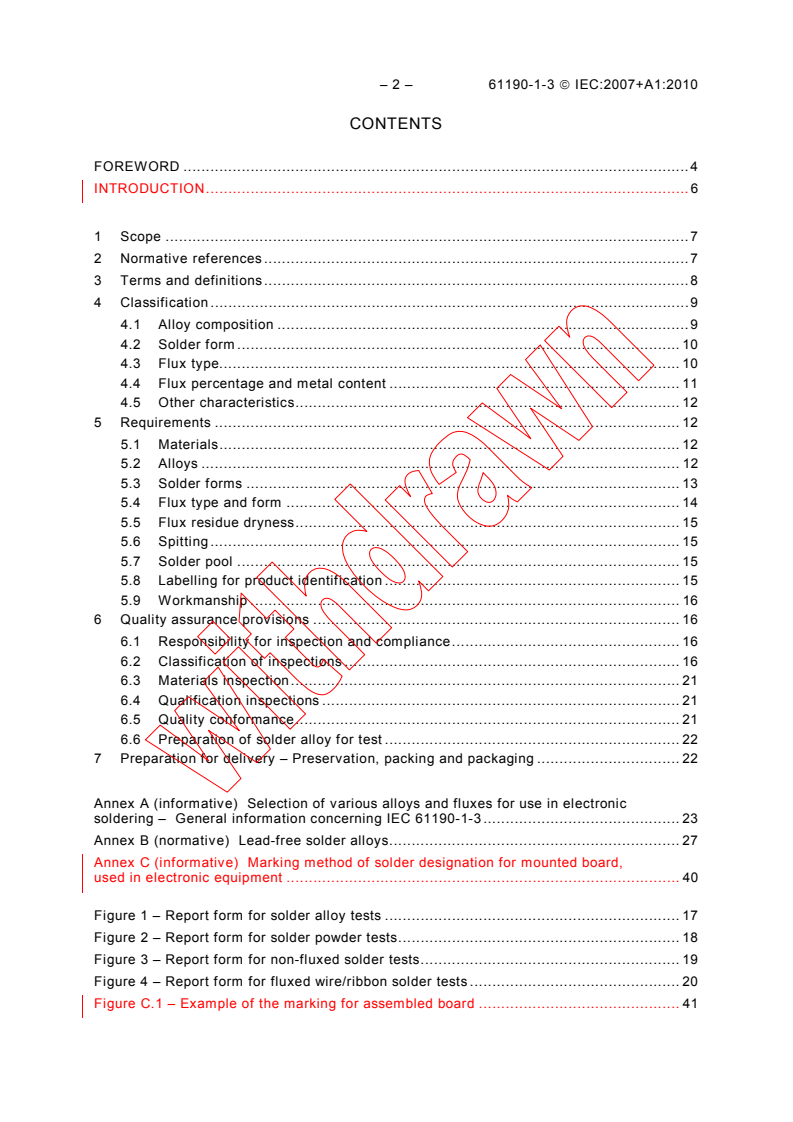
IEC 61190-1-3:2007+AMD1:2010 CSV - Attachment materials for electronic assembly - Part 1-3: Requirements for electronic grade solder alloys and fluxed and non-fluxed solid solders for electronic soldering applications Released:11/10/2010
Overview
IEC 61190-1-3:2007 - Attachment materials for electronic assembly, Part 1‑3 - defines quality and test requirements for electronic grade solder alloys and fluxed and non‑fluxed solid solders used in electronic soldering applications. The standard covers composition and classification of solder alloys, forms (bar, ribbon, powder, solder paste), flux types and proportions, test methods, labelling, inspection and quality assurance. It is a quality control document and is not intended to predict process performance on the production line.
Key topics and requirements
- Scope of materials: Fluxed and non‑fluxed bar, ribbon, powder solders, solder paste and “special” electronic grade solders (e.g., preforms, multi‑alloy powders).
- Alloy classification: Grouping by composition (including cross‑references for tin‑lead, lead‑free and specialty alloys) and solidus/liquidus characteristics (see Annex B).
- Solder forms and flux: Definitions of solder form, flux type, flux percentage and acceptable metal content; tables listing standard powders and flux designations.
- Test methods and inspections: Prescribed test methods and report forms (figures and tables) for materials inspection, qualification and acceptance testing.
- Quality assurance: Requirements for inspection responsibilities, classification of inspections, preparation of test samples, and conformance reporting.
- Delivery and packaging: Preservation, packing, and labelling requirements for product identification and traceability.
- Informative and normative annexes: Annex A (selection guidance) and Annex B (normative lead‑free solder alloy data and cross‑references).
- Notable updates (2007): Inclusion of a definition for lead‑free solder alloy and amendments to Table B.1 regarding lead‑free alloys.
Applications and users
IEC 61190‑1‑3:2007 is aimed at organizations that manufacture, supply or verify solder materials for electronics, including:
- Solder alloy and solder paste manufacturers
- Electronic assembly suppliers and contract manufacturers (PCBA assemblers)
- Incoming materials inspection and quality control laboratories
- Procurement and specification engineers writing material acceptance criteria
- Test labs performing solder alloy qualification and certification
Practical uses include establishing acceptance criteria for incoming solder materials, standardizing test reports, ensuring traceability and supporting supplier audits.
Related standards
- ISO 9453, ISO 9454‑1, ISO 9454‑2 (generic solder alloy and flux specifications)
- IEC 61190‑1‑1 (soldering fluxes) and IEC 61190‑1‑2 (solder pastes)
- IEC 61189‑5 / IEC 61189‑6 (test methods)
- IEC 60194 (terms and definitions), ISO 9001 (quality systems)
Note: IEC 61190‑1‑3 includes patent notices for certain alloy compositions; users should check intellectual‑property status relevant to their region.
Relations
- Effective Date
- 05-Sep-2023
- Effective Date
- 05-Sep-2023
- Effective Date
- 05-Sep-2023
Buy Documents
IEC 61190-1-3:2007 - Attachment materials for electronic assembly - Part 1-3: Requirements for electronic grade solder alloys and fluxed and non-fluxed solid solders for electronic soldering applications Released:4/26/2007
IEC 61190-1-3:2007 - Attachment materials for electronic assembly - Part 1-3: Requirements for electronic grade solder alloys and fluxed and non-fluxed solid solders for electronic soldering applications Released:4/26/2007
IEC 61190-1-3:2007+AMD1:2010 CSV - Attachment materials for electronic assembly - Part 1-3: Requirements for electronic grade solder alloys and fluxed and non-fluxed solid solders for electronic soldering applications Released:11/10/2010
Frequently Asked Questions
IEC 61190-1-3:2007 is a standard published by the International Electrotechnical Commission (IEC). Its full title is "Attachment materials for electronic assembly - Part 1-3: Requirements for electronic grade solder alloys and fluxed and non-fluxed solid solders for electronic soldering applications". This standard covers: IEC 61190-1-3:2007 prescribes the requirements and test methods for electronic grade solder alloys, for fluxed and non-fluxed bar, ribbon, powder solders and solder paste, for electronic soldering applications and for "special" electronic grade solders. For the generic specifications of solder alloys and fluxes, see ISO 9453, ISO 9454-1 and ISO 9454-2. This standard is a quality control document and is not intended to relate directly to the material's performance in the manufacturing process. The main changes with regard to the first edition concern a definition of lead-free solder alloy and an amendment to Table B.1 concerning lead-free solder alloys.
IEC 61190-1-3:2007 prescribes the requirements and test methods for electronic grade solder alloys, for fluxed and non-fluxed bar, ribbon, powder solders and solder paste, for electronic soldering applications and for "special" electronic grade solders. For the generic specifications of solder alloys and fluxes, see ISO 9453, ISO 9454-1 and ISO 9454-2. This standard is a quality control document and is not intended to relate directly to the material's performance in the manufacturing process. The main changes with regard to the first edition concern a definition of lead-free solder alloy and an amendment to Table B.1 concerning lead-free solder alloys.
IEC 61190-1-3:2007 is classified under the following ICS (International Classification for Standards) categories: 31.190 - Electronic component assemblies. The ICS classification helps identify the subject area and facilitates finding related standards.
IEC 61190-1-3:2007 has the following relationships with other standards: It is inter standard links to IEC 61190-1-3:2007/AMD1:2010, IEC 61190-1-3:2017, IEC 61190-1-3:2002. Understanding these relationships helps ensure you are using the most current and applicable version of the standard.
IEC 61190-1-3:2007 is available in PDF format for immediate download after purchase. The document can be added to your cart and obtained through the secure checkout process. Digital delivery ensures instant access to the complete standard document.
Standards Content (Sample)
INTERNATIONAL IEC
STANDARD 61190-1-3
Second edition
2007-04
Attachment materials for electronic assembly –
Part 1-3:
Requirements for electronic grade solder alloys
and fluxed and non-fluxed solid solders
for electronic soldering applications
Reference number
All rights reserved. Unless otherwise specified, no part of this publication may be reproduced or utilized in any form
or by any means, electronic or mechanical, including photocopying and microfilm, without permission in writing from
either IEC or IEC's member National Committee in the country of the requester.
If you have any questions about IEC copyright or have an enquiry about obtaining additional rights to this publication,
please contact the address below or your local IEC member National Committee for further information.
IEC Central Office
3, rue de Varembé
CH-1211 Geneva 20
Switzerland
Email: inmail@iec.ch
Web: www.iec.ch
About the IEC
The International Electrotechnical Commission (IEC) is the leading global organization that prepares and publishes
International Standards for all electrical, electronic and related technologies.
About IEC publications
The technical content of IEC publications is kept under constant review by the IEC. Please make sure that you have the
latest edition, a corrigenda or an amendment might have been published.
ƒ Catalogue of IEC publications: www.iec.ch/searchpub
The IEC on-line Catalogue enables you to search by a variety of criteria (reference number, text, technical committee,…).
It also gives information on projects, withdrawn and replaced publications.
ƒ IEC Just Published: www.iec.ch/online_news/justpub
Stay up to date on all new IEC publications. Just Published details twice a month all new publications released. Available
on-line and also by email.
ƒ Customer Service Centre: www.iec.ch/webstore/custserv
If you wish to give us your feedback on this publication or need further assistance, please visit the Customer Service
Centre FAQ or contact us:
Email: csc@iec.ch
Tel.: +41 22 919 02 11
Fax: +41 22 919 03 00
INTERNATIONAL IEC
STANDARD 61190-1-3
Second edition
2007-04
Attachment materials for electronic assembly –
Part 1-3:
Requirements for electronic grade solder alloys
and fluxed and non-fluxed solid solders
for electronic soldering applications
PRICE CODE
Commission Electrotechnique Internationale V
International Electrotechnical Commission
МеждународнаяЭлектротехническаяКомиссия
For price, see current catalogue
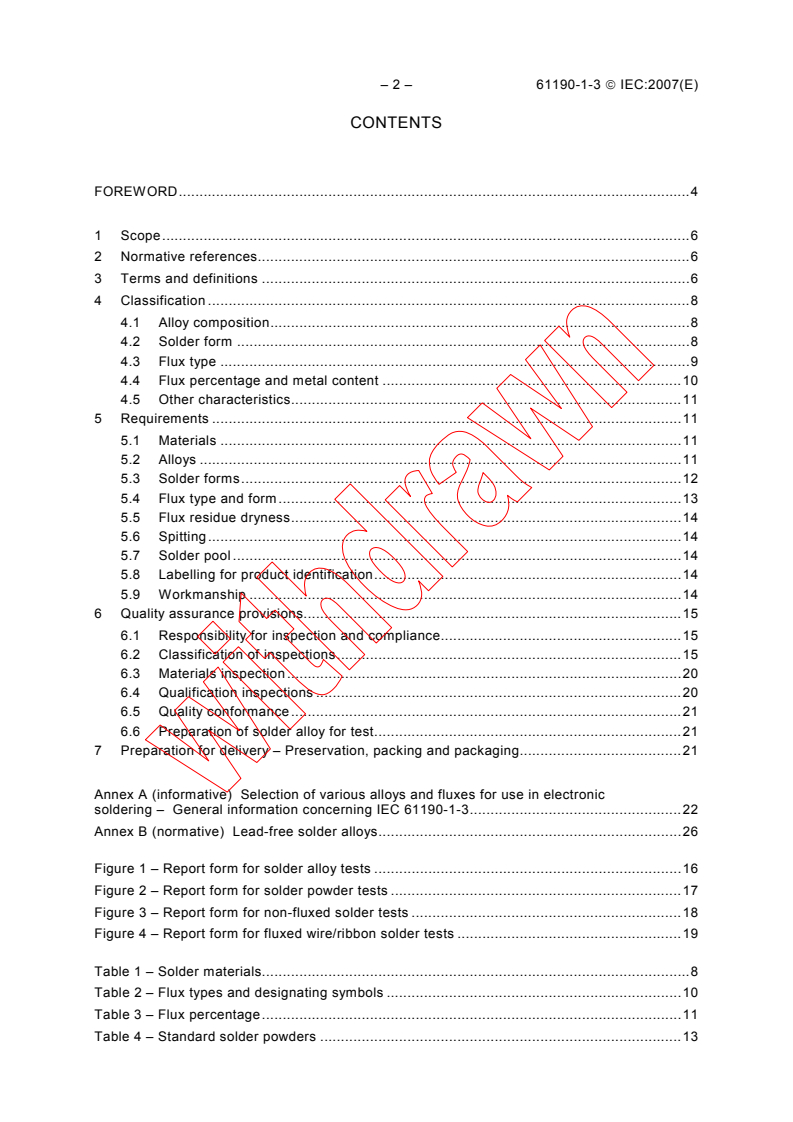
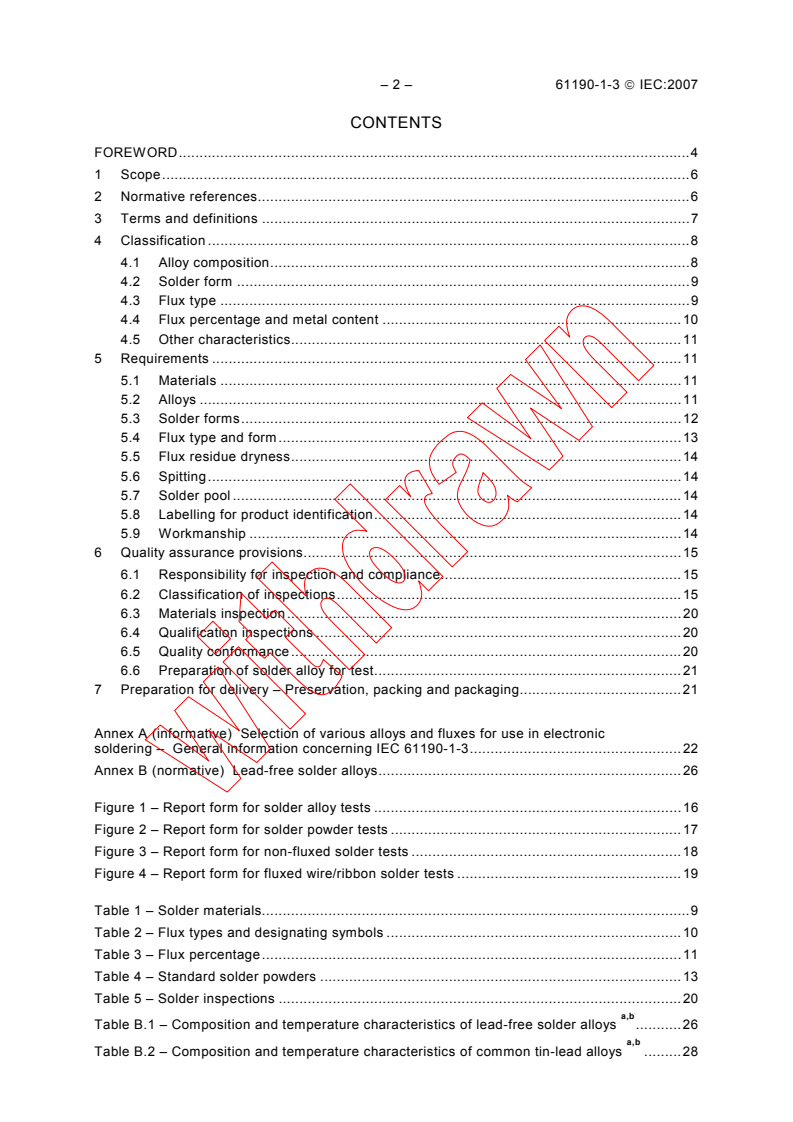
– 2 – 61190-1-3 © IEC:2007(E)
CONTENTS
FOREWORD.4
1 Scope.6
2 Normative references.6
3 Terms and definitions .6
4 Classification .8
4.1 Alloy composition.8
4.2 Solder form .8
4.3 Flux type .9
4.4 Flux percentage and metal content .10
4.5 Other characteristics.11
5 Requirements .11
5.1 Materials .11
5.2 Alloys .11
5.3 Solder forms.12
5.4 Flux type and form.13
5.5 Flux residue dryness.14
5.6 Spitting.14
5.7 Solder pool .14
5.8 Labelling for product identification.14
5.9 Workmanship .14
6 Quality assurance provisions.15
6.1 Responsibility for inspection and compliance.15
6.2 Classification of inspections.15
6.3 Materials inspection.20
6.4 Qualification inspections .20
6.5 Quality conformance.21
6.6 Preparation of solder alloy for test.21
7 Preparation for delivery – Preservation, packing and packaging.21
Annex A (informative) Selection of various alloys and fluxes for use in electronic
soldering – General information concerning IEC 61190-1-3.22
Annex B (normative) Lead-free solder alloys.26
Figure 1 – Report form for solder alloy tests .16
Figure 2 – Report form for solder powder tests .17
Figure 3 – Report form for non-fluxed solder tests .18
Figure 4 – Report form for fluxed wire/ribbon solder tests .19
Table 1 – Solder materials.8
Table 2 – Flux types and designating symbols .10
Table 3 – Flux percentage.11
Table 4 – Standard solder powders .13
61190-1-3 © IEC:2007(E) – 3 –
Table 5 – Solder inspections .20
a, b
Table B.1 – Composition, and temperature characteristics of lead-free solder alloys .26
a, b
Table B.2 – Composition and temperature characteristics of common tin-lead alloys .28
Table B.3 – Composition and temperature characteristics for specialty (non-tin/lead)
a,b
alloys .30
Table B.4 – Cross reference from solidus and liquidus temperatures to alloy names by
a
temperature .31
Table B.5 – Cross-reference from ISO 9453 alloy numbers and designations to
IEC 61190-1-3 alloy names .34
– 4 – 61190-1-3 © IEC:2007(E)
INTERNATIONAL ELECTROTECHNICAL COMMISSION
___________
ATTACHMENT MATERIALS FOR ELECTRONIC ASSEMBLY –
Part 1-3: Requirements for electronic grade solder alloys and
fluxed and non-fluxed solid solders for electronic soldering applications
FOREWORD
1) The International Electrotechnical Commission (IEC) is a worldwide organization for standardization comprising
all national electrotechnical committees (IEC National Committees). The object of IEC is to promote
international co-operation on all questions concerning standardization in the electrical and electronic fields. To
this end and in addition to other activities, IEC publishes International Standards, Technical Specifications,
Technical Reports, Publicly Available Specifications (PAS) and Guides (hereafter referred to as “IEC
Publication(s)”). Their preparation is entrusted to technical committees; any IEC National Committee interested
in the subject dealt with may participate in this preparatory work. International, governmental and non-
governmental organizations liaising with the IEC also participate in this preparation. IEC collaborates closely
with the International Organization for Standardization (ISO) in accordance with conditions determined by
agreement between the two organizations.
2) The formal decisions or agreements of IEC on technical matters express, as nearly as possible, an international
consensus of opinion on the relevant subjects since each technical committee has representation from all
interested IEC National Committees.
3) IEC Publications have the form of recommendations for international use and are accepted by IEC National
Committees in that sense. While all reasonable efforts are made to ensure that the technical content of IEC
Publications is accurate, IEC cannot be held responsible for the way in which they are used or for any
misinterpretation by any end user.
4) In order to promote international uniformity, IEC National Committees undertake to apply IEC Publications
transparently to the maximum extent possible in their national and regional publications. Any divergence
between any IEC Publication and the corresponding national or regional publication shall be clearly indicated in
the latter.
5) IEC provides no marking procedure to indicate its approval and cannot be rendered responsible for any
equipment declared to be in conformity with an IEC Publication.
6) All users should ensure that they have the latest edition of this publication.
7) No liability shall attach to IEC or its directors, employees, servants or agents including individual experts and
members of its technical committees and IEC National Committees for any personal injury, property damage or
other damage of any nature whatsoever, whether direct or indirect, or for costs (including legal fees) and
expenses arising out of the publication, use of, or reliance upon, this IEC Publication or any other IEC
Publications.
8) Attention is drawn to the Normative references cited in this publication. Use of the referenced publications is
indispensable for the correct application of this publication.
The International Electrotechnical Commission (IEC) draws attention to the fact that it is claimed that compliance
with this document may involve the use of a patent concerning in particular alloy compositions. IEC takes no
position concerning the evidence, validity and scope of this patent right.
The holder of this patent right has assured the IEC that he/she is willing to negotiate licences under reasonable and
non-discriminatory terms and conditions with applicants throughout the world. In this respect, the statement of the
holder of this patent right is registered with IEC. Information may be obtained from:
For Sn96Ag2,5Bi1Cu,5:
US PAT No. 4879096
Cookson Electronics Assembly Materials
600 Route 440 Jersey City,New Jersey 07304
For Sn96,5Ag3Cu,5, Sn95,8Ag3,5Cu,7 and Sn95,5Ag3,8Cu,7:
US PAT No. 5527628
Iowa State University Research Foundation, Inc.
310 Lab of Mechanics
Ames, Iowa 50011-2131, U.S.A.
61190-1-3 © IEC:2007(E) – 5 –
For Sn88In8Ag3,5Bi,5:
JP PAT No. 3040929
For Sn96,5Ag3Cu,5, Sn95,8Ag3,5Cu,7 and Sn95,5Ag3,8Cu,7:
JP PAT No. 3027441
Matsushita Electric Industrial Co., Ltd.
Matsushita IMP Building 20F 1-3-7, Shiromi, Chouh-ku, Osaka, 540-6319, Japan
For Sn92In4Ag3,5Bi,5
JP PAT No. 2805595
Mitsui Mining & Smelting Co., Ltd.
Gate City Ohsaki-West Tower 19th Fl. 1-11-1 Osaki, Shinagawa-ku, Tokyo, 141-8584, Japan
For Sn96,5Ag3Cu,5, Sn95,8Ag3,5Cu,7, Sn95,5Ag3,8Cu,7 and Sn95,5Ag4,0Cu,5
JP PAT No. 3027441
Senju Metal Industry Co., Ltd.
Senju Hashido-cho 23, Adachi-ku, Tokyo, 120-8555, Japan
NOTE Patent rights vary between country of manufacture, sale, use and final destination; suppliers or users
remain responsible for establishing the exact legal position relevant to their own situation.
Attention is drawn to the possibility that some of the elements of this document may be the subject of patent rights
other than those identified above. IEC shall not be held responsible for identifying any or all such patent rights.
International Standard IEC 61190-1-3 has been prepared by IEC technical committee 91:
Electronics assembly technology.
This second edition cancels and replaces the first edition, published in 2002, and constitutes a
technical revision. The main changes with regard to the first edition concern a definition of
lead-free solder alloy and an amendment to Table B.1 concerning lead-free solder alloys.
The text of this standard is based on the following documents:
FDIS Report on voting
91/647/FDIS 91/679/RVD
Full information on the voting for the approval of this standard can be found in the report on
voting indicated in the above table.
This publication has been drafted in accordance with the ISO/IEC Directives, Part 2.
A list of all parts in the IEC 61190 series, under the general title Attachment materials for
electronic assembly, can be found on the IEC website.
The committee has decided that the contents of this publication will remain unchanged until the
maintenance result date indicated on the IEC web site under "http://webstore.iec.ch" in the data
related to the specific publication. At this date, the publication will be
• reconfirmed;
• withdrawn;
• replaced by a revised edition, or
• amended.
A bilingual version of this publication may be issued at a later date.
– 6 – 61190-1-3 © IEC:2007(E)
ATTACHMENT MATERIALS FOR ELECTRONIC ASSEMBLY –
Part 1-3: Requirements for electronic grade solder alloys and
fluxed and non-fluxed solid solders for electronic soldering applications
1 Scope
This part of IEC 61190 prescribes the requirements and test methods for electronic grade
solder alloys, for fluxed and non-fluxed bar, ribbon, powder solders and solder paste, for
electronic soldering applications and for “special” electronic grade solders. For the generic
specifications of solder alloys and fluxes, see ISO 9453, ISO 9454-1 and ISO 9454-2. This
standard is a quality control document and is not intended to relate directly to the material's
performance in the manufacturing process
Special electronic grade solders include all solders which do not fully comply with the
requirements of standard solder alloys and solder materials listed herein. Examples of special
solders include anodes, ingots, preforms, bars with hook and eye ends, multiple-alloy solder
powders, etc.
2 Normative references
The following referenced documents are indispensable for the application of this document. For
dated references, only the edition cited applies. For undated references, the latest edition of
the referenced document (including any amendments) applies.
IEC 60194, Printed board design, manufacture and assembly – Terms and definitions
IEC 61190-1-1:2002, Attachment materials for electronic assembly – Part 1-1: Requirements
for soldering fluxes for high-quality interconnects in electronics assembly
IEC 61190-1-2, Attachment materials for electronic assembly – Part 1-2: Requirements for
solder pastes for high-quality interconnections in electronics assembly
IEC 61189-5, Test methods for electrical materials, interconnection structures and assemblies –
Part 5: Test methods for printed board assemblies
IEC 61189-6, Test methods for electrical materials, interconnection structures and assemblies –
Part 6: Test methods for materials used in manufacturing electronic assemblies
ISO 9001, Quality management systems – Requirements
ISO 9453, Soft solder alloys – Chemical compositions and forms
ISO-9454-1:1990, Soft soldering fluxes – Classification and requirements – Part 1: Classifi-
cation, labelling and packing
ISO-9454-2:1998, Soft soldering fluxes – Classification and requirements – Part 2: Perform-
ance requirements
3 Terms and definitions
For the purposes of this document, the terms and definitions given in IEC 60194, as well as the
following apply. Terms marked with an asterisk (*) are taken from IEC 60194 and are reprinted
here for convenience.
61190-1-3 © IEC:2007(E) – 7 –
3.1
acceptance tests *
those tests deemed necessary to determine the acceptability of a product and as agreed to by
both purchaser and vendor
3.2
alloy
substance having metallic properties and being composed of two or more chemical elements of
which at least one is an elemental metal
3.3
basis metal *
metal upon which coatings are deposited, also referred to as base metal
3.4
corrosion (chemical/electrolytic) *
attack of chemicals, flux, and flux residues on base metals
3.5
density (phototool) *
mass of a surface per unit volume, usually expressed in grams per cubic centimetre
3.6
dewetting *
condition that results when molten solder coats a surface and then recedes to leave irregularly
shaped mounds of solder that are separated by areas that are covered with a thin film of solder
and with the basis metal not exposed
3.7
eutectic (n.) *
alloy having the composition indicated by the eutectic point on an equilibrium diagram or an
alloy structure of intermixed solid constituents formed by a eutectic reaction
3.8
eutectic (adj.) *
isothermal reversible reaction in which, on cooling, a liquid solution is converted into two or
more intimately mixed solids, with the number of solids formed being the same as the number
of components
3.9
flux *
chemically - and physically-active compound that, when heated, promotes the wetting of a base
metal surface by molten solder by removing minor surface oxidation and other surface films
and by protecting the surfaces from reoxidation during a soldering operation
3.10
flux characterization *
series of tests that determines the basic corrosive and conductive properties of fluxes and flux
residues
3.11
flux residue *
flux-related contaminant that is present on or near the surface of a solder connection
3.12
liquidus
temperature at which a solder alloy changes from a paste form to a liquid form
– 8 – 61190-1-3 © IEC:2007(E)
3.13
nonwetting (solder) *
partial adherence of molten solder to a surface that it has contacted and where basis metal
remains exposed
3.14
lead-free solder
solder alloy the lead content of which h is equal to, or less than 0,10 % by mass
3.15
solder *
metal alloy with a melting temperature that is below 450 °C.
NOTE Metal alloy with a melting temperature less than 450 °C is classified as “soft solder”.
3.16
solderability *
ability of a metal to be wetted by molten solder
3.17
solidus
temperature at which a solder alloy changes from a solid to a paste form
3.18
wetting, solder *
formation of a relatively uniform, smooth, unbroken, and adherent film of solder to a basis
metal.
4 Classification
Soldering materials covered by this standard shall be classified by alloy composition, solder
form, flux type, flux percentage and by other characteristics peculiar to the solder material form.
4.1 Alloy composition
The solder alloys covered by this standard are the alloys listed in Tables B.1, B.2 and B.3 and
include pure tin and pure indium. Each alloy is identified by an alloy name composed of a
series of alphanumeric characters. These characters identify the component elements in the
alloy by chemical symbol and nominal percentage by mass. They terminate with an arbitrarily
assigned alloy variation letter (A, B, C, D). Alloys are also identified by an alloy short name.
This is an alphanumeric designation composed of the chemical symbol for the key element in
the alloy (see Clause A.4), the nominal percentage of that element in the alloy and the
arbitrarily assigned alloy variation letter.
Tables B.1, B.2 and B.3 identify alloy composition, short name and temperature characteristics;
Table B.4 cross-references solidus and liquidus temperatures to alloy names and Table B.5
cross-references ISO alloy numbers and designations from ISO 9453 to alloy names.
4.2 Solder form
Table 1 shows the forms of solder materials covered by this standard listed with their single-
letter designating symbols.
Table 1 – Solder materials
Identifying symbol Solder form
F Flux (only)
61190-1-3 © IEC:2007(E) – 9 –
P Paste (cream)
B Bar
D Powder
R Ribbon
W Wire
S Special
4.3 Flux type
The flux types used in/on solders covered by this standard are listed in Table 2. The
requirements for fluxes are covered by IEC 61190-1-1.
– 10 – 61190-1-3 © IEC:2007(E)
Table 2 – Flux types and designating symbols
Flux materials Flux activity levels IEC flux ISO flux
a c d
of composition designator designator
b
wt. % halide
Rosin Low (<0,01) L0 ROL0 1.1.1
(RO) Low (<0,15) L1 ROL1 1.1.2.W, 1.1.2.X
Moderate (<0,01) M0 ROM0 1.1.3.W
Moderate (0,15–2,0) M1 ROM1 1.1.2.Y, 1.1.2.Z
High (<0,01) H0 ROH0 1.1.3.X
High (>2,0) H1 ROH1 1.1.2.Z
Resin Low (<0,01) L0 REL0 1.2.1
(RE) Low (<0,15) L1 REL1 1.2.2.W, 1.2.2.X
Moderate (<0,01) M0 REM0 1.2.3.W
Moderate (0, 15 – 2,0) M1 REM1 1.2.2.Y, 1.2.2.Z
High (<0,01) H0 REH0 1.2.3.X
High (>2,0) H1 REH1 1.2.2.Z
Organic Low (<0,01) L0 ORL0 2.1., 2.2.3.E
(OR) Low (<0, 15) L1 ORL1 -
Moderate (<0,01) M0 ORM0 -
Moderate (0, 15 – 2,0) M1 ORM1 2.1.2, 2.2.2
High (<0,01) H0 ORH0 2.2.3.0
High (>2,0) H1 ORH1 2.2.2
Inorganic Low (<0,01) L0 INL0 Not applicable
(IN) Low (<0, 15) L1 INL1 (inorganic ISO flux is
different)
Moderate (<0,01) M0 INM0
Moderate (0, 15 – 2,0) M1 INM1
High (<0,01) H0 INH0
High (>2,0) H1 INH1
a
Fluxes are available in S (solid), P (paste/cream) or L (liquid) forms.
b
See 7.1 and 7.2 of IEC 61190-1-1 for comparisons of RO, RE, OR and IN composition classes and L, M and H
activity levels with the traditional classes such as R, RMA, RA, water soluble and low solids ”no-clean.''.
c
The 0 and 1 indicate absence and presence of halides, respectively. See 4.2.3 of IEC 61190-1-1 for an
explanation of L, M and H nomenclature.
d
ISO designations are similar to IEC designators with minor differences in characteristics
4.4 Flux percentage and metal content
The nominal percentage of flux, by mass, in solid-form solder products is identified as the flux
percentage. The flux percentage in/on solid solders is identified by a single alphanumeric
character in accordance with Table 3. “Metal content” refers to the percentage of metal in
solder paste (see IEC 61190-1-2).
61190-1-3 © IEC:2007(E) – 11 –
Table 3 – Flux percentage
Design Nominal Allowable Design Nominal Allowable Design Allowable
Nominal
symbol range symbol range symbol range
% % % % % %
0 None 5 2,5 2,2 – 2,8 A 5,0 4,7 – 5,3
1 0,5 0,2 – 0,8 6 3,0 2,7 – 3,3 B 5,5 5,2 – 5,8
2 1,0 0,7 – 1,3 7 3,5 3,2 – 3,8 C 6,0 5,7 – 6,3
3 1,5 1,2 – 1,8 8 4,0 3,7 – 4,3 D 6,5 6,2 – 6,8
4 2,0 1,7 – 2,3 9 4,5 4,2 – 4,8
4.5 Other characteristics
Standard bar solders are further classified by unit mass. Wire solders are further classified by
wire size (outside diameter) and unit mass. Ribbon solders are further classified by thickness,
width and unit mass. Powder solders are further classified by powder particle size distribution
and unit mass.
5 Requirements
5.1 Materials
Materials shall be used which permit the solder product to conform to the specified
requirements. The use of recovered or recycled materials is encouraged. Recovered or
recycled materials shall conform to or exceed comparable standards for virgin raw materials.
5.2 Alloys
The solder alloy shall be as specified (see Annex B). For the purposes of this standard,
electronic grade solder alloys are all those listed in Tables B.1, B.2 and B.3, including pure tin
(Sn99) and pure indium (In99). The elements listed in Tables B.1, B.2 and B.3 for an alloy are
considered to be the component elements of that alloy. Only the component elements of an
alloy are desirable and all other elements are impurities for that alloy. To the maximum extent
feasible and unless otherwise specified, solder alloy metal, including solder powder, shall be a
homogenous mixture of the component elements of the alloy, such that each particle of the
metal is the same alloy. Unless otherwise specified, the percentage by mass of impurity
elements in alloys which are identified with an “A”, “B”, or “C” suffix shall not exceed the
following values and the values listed in 5.2.1, 5.2.2, and 5.2.3 respectively, and the
percentage by mass of impurity elements in alloys which are identified with a “D” suffix shall
conform to the requirements in 5.2.4.
Ag: 0,05 Au: 0,05 Cu: 0,05 Ni: 0,01 Sn: 0,25
Al: 0,001 Bi: 0,10 Fe: 0,02 Pb: 0,10 Zn: 0,001
As: 0,03 Cd: 0,002 In: 0,10
The percentage of each element in an alloy shall be determined by any standard analytical
procedure. Wet chemistry shall be used as the referee procedure.
5.2.1 Variation A alloys
In alloys which are identified with an “A” suffix, the percentage by mass of antimony (Sb) as an
impurity element shall not exceed 0,50.
– 12 – 61190-1-3 © IEC:2007(E)
5.2.2 Variation B alloys
In alloys which are identified with a “B” suffix, the percentage by mass of antimony as an
impurity element shall not exceed 0,20.
5.2.3 Variation C alloys
In alloys which are identified with a “C” suffix, the percentage by mass of antimony as an
impurity element shall not exceed 0,05.
5.2.4 Variation D alloys
Alloys identified with a “D” suffix are ultra-pure alloys that are intended for use in barrier-free
die attachment applications. In alloys identified with a “D” suffix, the combined total percentage
by mass of all impurity elements shall not exceed 0,05 and the combined total percentage by
mass of each of the following sets of impurity elements shall not exceed 0,000 5:
Set 1: Be, Hg, Mg, and Zn. Set 2: As, Bi, P, and Sb.
5.3 Solder forms
This standard covers solders in the form of bars, wires, ribbons, and powders, and special
solders. Normally bar solders and solder powder are not fluxed, and wire, ribbon, and special
solders may be non-fluxed, flux-cored, flux-coated, or both flux-cored and flux-coated. Users
should determine from prospective sources the standard solder form characteristics that are
available and should specify standard characteristics to the maximum extent feasible.
5.3.1 Bar solder
The nominal cross-section area, the nominal length, and the nominal mass shall be as
specified (see Clause A.2 c)). Unless otherwise specified (see Clause A.2 d)), the actual cross-
section area shall not vary from the nominal value by more than 50 %, the actual length shall
not vary from the nominal value by more than 20 %, and the actual mass shall not vary from
the nominal value by more than 10 %. Bars with special end configurations, such as hooks or
eyes, are classified as special solders.
5.3.2 Wire solder
The wire size, flux type, and flux percentage shall be as specified (see Clause A.2 e)). Unless
otherwise specified (see Clause A.2f)), wire solders shall have a circular cross-section, the
wire size shall indicate the nominal outside diameter of the wire and the actual outside
diameter shall not vary from the nominal diameter by more than ±5 % or ±0,05 mm, whichever
is greater.
5.3.3 Ribbon solder
The ribbon thickness and width, flux type, and flux percentage shall be as specified (see
Clause A.2 g)). Unless otherwise specified (see Clause A.2 h)), ribbon solders shall have a
rectangular cross-section, and the actual thickness and width shall not vary from their nominal
values by more than ±5 % or ±0,05 mm, whichever is greater.
5.3.4 Solder powder
The powder size and shape shall be as specified (see Clauses A.2 i)) and A.2 j)). The
characteristics of six standard solder powders, sizes 1 through 6, are listed in Table 4. When
shape is not specified, solder powder shall be spherical. Solder powder shall be smooth and
bright and free of adhering small particles and oxides to the maximum extent possible.
NOTE Solder powders made with high-lead alloys are not “bright” by nature, but they should not appear unusually
dark. Solder powders which contain more than one solder alloy (multiple-alloy powders) are classified as special
solders.
61190-1-3 © IEC:2007(E) – 13 –
Table 4 – Standard solder powders
Powder Percentages of powder by mass
size
None larger Less than 1 % At least 80 % At least 90 % Less than 10 %
symbol
than larger than between between smaller than
μm μm μm μm μm
1 160 150 150 – 75 20
2 80 75 75 – 45 20
3 50 45 45 – 25 20
4 40 38 38 – 20 20
5 28 25 25 – 15 15
6 18 15 15 – 5 5
5.3.4.1 Powder size
Maximum particle size shall be determined in accordance with IEC 61189-6, Test method 6X04.
Powder particle size distribution shall be determined in accordance with IEC 61189-6, Test
methods 6X01, 6X02 or 6X03.
5.3.4.2 Powder shape
Solder powder shape shall be determined by visual observation using a binocular microscope
with sufficient magnification, by the light beam scatter method, or by a suitable microscopic
imaging analysis method. Solder powders visually determined to have at least 90 % of the
particles with a length to width ratio of 1:2 or less shall be classified as spherical powders.
Solder powders having a light beam scatter deviation result or an image analysis result that is
equivalent to the above visual results shall be classified as spherical powders. All other
powders shall be classified as non-spherical.
5.3.5 Special solder
All pertinent characteristics and tolerances for special form solders shall be specified (see
Clause A.2 k)). Special solders include all solders which do not fully conform to another solder
classification identified herein or in IEC 61190-1-2. Special solders include, but are not
necessarily limited to, anodes, bars with hook or eye ends, chips, ingots, multiple-alloy
powders, pellets, preforms, rings, sleeves, etc.
5.4 Flux type and form
The flux type and form shall be as specified (see Clause A.2 l)). Fluxes used in the
manufacture of solder products shall conform to the requirements of IEC 61190-1-1. Fluxes
shall have been fully tested and characterized in accordance with IEC 61190-1-1, and shall
have not been altered since being tested except for the addition of inert plasticizers.
5.4.1 Flux percentage
The percentage by mass of flux in/on solders shall be as specified (see Clause A.2 m)). For
fluxed solders other than solder paste, the flux percentage is identified in accordance with
Table 3. The flux percentage of flux-coated and/or flux-cored solder shall be determined in
accordance with IEC 61189-6, Test method 6C09.
5.4.2 Solder cores
Unless otherwise specified (see Clause A.2 n)), the core(s) of flux-cored solders may be of any
construction, provided it is (they are) continuous, uniform in cross-section, and symmetrically
disposed in the solder. When appropriate, the core(s) in the solder should be sealed at both
ends by a suitable means to prevent flux from leaking out.
– 14 – 61190-1-3 © IEC:2007(E)
5.4.3 Solder coatings
Unless otherwise specified (see Clause A.2 o)), the coatings on flux-coated solders shall be
dry and tack-free such that individual pieces do not stick together when the temperature and
humidity are maintained at, or below, 25 °C and 60 % RH.
5.5 Flux residue dryness
When specified (see Clause A.2 p)), the dryness characteristics of the reflowed residue of
fluxed solders shall be determined in accordance with IEC 61189-5, Test method 5X12. When
a fluxed solder is tested in accordance with Test method 5X12, the flux residue of “no-clean”
solders and, when specified, other flux type solders, shall be free of tackiness (‘not tacky’).
5.6 Spitting
When specified (see Clause A.2q)), the spitting characteristics of flux-cored wire and ribbon
solders shall be determined in accordance with IEC 61189-5, Test method 5X13.
5.7 Solder pool
When specified (see Clause A.2 r)), the solder pool characteristics of fluxed solder shall be
determined in accordance with IEC 61189-5, Test method 5X14. When fluxed solder is tested
in accordance with test method 5X14, the flux shall promote the spreading of molten solder
over the coupon to form integrally thereon a coat of solder which shall feather out to a thin
edge. There shall be no evidence of dewetting or nonwetting. Neither shall there be any
evidence of spattering, as indicated by the presence of flux and/or flux residue particles outside
the main pool of residue. Irregularly shaped solder pools do not necessarily indicate dewetting
or nonwetting.
5.8 Labelling for product identification
Unless otherwise specified (see Clause A.2 s)), solder bars shall be marked with the alloy
name or alloy short name and the manufacturer's name or commonly accepted symbol. Unless
otherwise specified, spools, packages, and containers of wire, ribbon, and powder solders, and
written documentation accompanying bar and special solders shall be marked with the
following information.
a) the manufacturer's name and address;
b) the number and revision designation of this standard;
c) the solder product description, and the manufacturer's designation of the solder product;
d) the net mass of the solder (and nominal unit mass of bar solder);
e) the batch number(s);
f) the date(s) of manufacture;
g) expected useful life of solder product, if applicable;
h) all applicable health and safety markings including lead free marking or lead containing
marking;
i) any other information which may be pertinent to the particular solder form;
j) any other markings or labelling specified in the contract or purchase order.
5.9 Workmanship
Solder products shall be made uniform in quality and free from defects which limit service life
or affect the serviceability or appearance.
61190-1-3 © IEC:2007(E) – 15 –
6 Quality assurance provisions
6.1 Responsibility for inspection and compliance
The user shall specify the qualification and quality conformance inspections (see Clause A.2 t)).
The solder product manufacturer is responsible for the performance of qualification and quality
conformance inspections. The manufacturer may use his own or any other facility for the
performance of these inspections, unless the facility is disapproved by the user.
It is the responsibility of the manufacturer to ascertain that all solder products or supplies
delivered to the user, or submitted for user acceptance, conform to the requirements of the
contract or purchase order and Clause 5 above. The absence of any inspection requirements
shall not relieve the vendor of this responsibility.
Materials covered by this specification shall meet all the requirements of Clause 5. The
inspection(s) excluding the performance inspections defined in this specification shall become
a part of the contractor's overall inspection system or quality programme. The vendor has
responsibility for ensuring that all products or supplies submitted to the user for acceptance
comply with all requirements of the purchase order contract.
6.1.1 Quality assurance programme
When required by the user, a quality assurance programme for material furnished under this
specification shall be established and maintained in accordance with ISO 9001, or as otherwise
agreed on between user and manufacturer, and shall be monitored by the qualifying activity.
6.1.2 Test equipment and inspection facilities
Test/measuring equipment and inspection facilities of sufficient accuracy, quality and quantity
to permit performance of the required inspection(s) shall be established and maintained or
designated by the supplier. Establishment and maintenance of a calibration system to control
the accuracy of the measuring and test equipment shall be in accordance with the general
requirements of IEC 61189-5 and IEC 61189-6, as appropriate.
6.1.3 Inspection conditions
Unless otherwise specified, all inspections shall be performed in accordance with the test
conditions specified in Clause 5.
6.2 Classification of inspections
The inspections specified in this standard are classified as follows:
a) materials inspection (6.3);
b) qualification inspection (6.4);
c) quality conformance (6.5).
Figures 1 through 4 are suitable for, and recommended for, recording the results of alloy and of
solid form solder inspections. Where applicable, definitive results should be entered on the
report forms. Where definitive results are not required or appropriate, successful completion of
inspections should be indicated by check marks on the report forms.
– 16 – 61190-1-3 © IEC:2007(E)
Test report on solder alloy (for suffix A, B, and C alloys)
Enter appropriate information in top portion and requirements columns of report and complete
report by entering the test results or checkmarks in the appropriate spaces.
Alloy designation: _______________________________________________________________
Manufacturer's identification: ______________________________________________________
Manufacturer's batch number: _____________________________________________________
Date of manufacture: ____________________________________________________________
Date inspection completed: __________________ Overall results : ___Pass ___Fail
Testing methods used: ___________________________________________________________
_____________________________________________________________
Inspection performed by: __________________ Witnessed by __________________________
Elements Required percentages
Percentage in Tested by
Pass/Fail
As an alloy As an impurity
sample and date
element element
Ag 0,05 Max
Al 0,001 Max
As 0,03 Max
Au 0,05 Max
Bi 0,10 Max
Cd 0,002 Max
Cu 0,05 Max
Fe 0,02 Max
In 0,10 Max
Ni 0,01 Max
Pb 0,10 Max
Sb ___ 0,50 Max
___ 0,20 Max
___ 0,05 Max
Sn 0,25 Max
Zn 0,001 Max
1. Overall results: Check "Pass" if the test results for all elements conform to the requirements, otherwise check
"Fail."
2. Pass/Fail: Enter "P" for an element if test results conform to the actual requirement, otherwise, enter "F."
3. When antimony (Sb) is an impurity in the alloy being tested, check the appropriate Sb percentage requirement in
column 3.
Comments: ____________________________________________________________________
_____________________________________________________________________________
_____________________________________________________________________________
_____________________________________________________________________________
Figure 1 – Report form for solder alloy tests
61190-1-3 © IEC:2007(E) – 17 –
Test report on solder powder
Enter appropriate information in top portion and requirements columns of report and complete
report by entering the test results or checkmarks in the appropriate spaces.
Alloy designation: _________________________ Powder size number ____________________
Manufacturer's identification: ______________________________________________________
Manufacturer's batch number: _____________________________________________________
Date of manufacture: ____________________________________________________________
Date inspection completed: __________________ Overall results : ___Pass ___Fail
Testing methods used: ___________________________________________________________
_____________________________________________________________
Inspection performed by: __________________ Witnessed by __________________________
Inspections Requirements Test results Pass/fail Tested by
obtained and date
Material
Visual
Alloy
Max. powder size:
0 % larger than _____ μm
Powder size:
< 1 % larger than _____ μm
≥ 80 % between ___ − ___ μm
≥ 90 % between ___ − ___ μm
< 10 % smaller than _____ μm
Powder shape
1. Overall results: Check "Pass" if the test results for all elements conform to the requirements, otherwise check
"Fail."
2. Pass/Fail: Enter "P" for an element if test results conform to the actual requirement, otherwise, enter "F."
Comments: ___________________________________________________________________________
____________________________________________________________________________________
____________________________________________________________________________________
____________________________________________________________________________________
____________________________________________________________________________________
____________________________________________________________________________________
____________________________________________________________________________________
Figure 2 – Report form for solder powder tests
– 18 – 61190-1-3 © IEC:2007(E)
Test report on non-fluxed solder
Enter appropriate information in top portion and requirements columns of report and complete
report by entering the test results or checkmarks in the appropriate spaces.
Solder designation: ______________________________________________________________
Inspection purpose: QPL I.D. Number: ______________________________________
____ Qualification Manufacturer's identification:______________________________
____ Quality conformance A Manufacturer's batch number: _____________________________
____ Quality conformance B Date of manufacture: ____________________________________
____ Shelf-life extension Original USE-BY date: ___________________________________
____ Performance Revised USE-BY dat
...
IEC 61190-1-3
Edition 2.0 2007-04
INTERNATIONAL
STANDARD
NORME
INTERNATIONALE
Attachment materials for electronic assembly –
Part 1-3: Requirements for electronic grade solder alloys and fluxed and non-
fluxed solid solders for electronic soldering applications
Matériaux de fixation pour les assemblages électroniques –
Partie 1-3: Exigences relatives aux alliages à braser de catégorie électronique et
brasures solides fluxées et non fluxées pour les applications de brasage
électronique
All rights reserved. Unless otherwise specified, no part of this publication may be reproduced or utilized in any form or by
any means, electronic or mechanical, including photocopying and microfilm, without permission in writing from either IEC or
IEC's member National Committee in the country of the requester.
If you have any questions about IEC copyright or have an enquiry about obtaining additional rights to this publication,
please contact the address below or your local IEC member National Committee for further information.
Droits de reproduction réservés. Sauf indication contraire, aucune partie de cette publication ne peut être reproduite
ni utilisée sous quelque forme que ce soit et par aucun procédé, électronique ou mécanique, y compris la photocopie
et les microfilms, sans l'accord écrit de la CEI ou du Comité national de la CEI du pays du demandeur.
Si vous avez des questions sur le copyright de la CEI ou si vous désirez obtenir des droits supplémentaires sur cette
publication, utilisez les coordonnées ci-après ou contactez le Comité national de la CEI de votre pays de résidence.
IEC Central Office
3, rue de Varembé
CH-1211 Geneva 20
Switzerland
Email: inmail@iec.ch
Web: www.iec.ch
About the IEC
The International Electrotechnical Commission (IEC) is the leading global organization that prepares and publishes
International Standards for all electrical, electronic and related technologies.
About IEC publications
The technical content of IEC publications is kept under constant review by the IEC. Please make sure that you have the
latest edition, a corrigenda or an amendment might have been published.
ƒ Catalogue of IEC publications: www.iec.ch/searchpub
The IEC on-line Catalogue enables you to search by a variety of criteria (reference number, text, technical committee,…).
It also gives information on projects, withdrawn and replaced publications.
ƒ IEC Just Published: www.iec.ch/online_news/justpub
Stay up to date on all new IEC publications. Just Published details twice a month all new publications released. Available
on-line and also by email.
ƒ Electropedia: www.electropedia.org
The world's leading online dictionary of electronic and electrical terms containing more than 20 000 terms and definitions
in English and French, with equivalent terms in additional languages. Also known as the International Electrotechnical
Vocabulary online.
ƒ Customer Service Centre: www.iec.ch/webstore/custserv
If you wish to give us your feedback on this publication or need further assistance, please visit the Customer Service
Centre FAQ or contact us:
Email: csc@iec.ch
Tel.: +41 22 919 02 11
Fax: +41 22 919 03 00
A propos de la CEI
La Commission Electrotechnique Internationale (CEI) est la première organisation mondiale qui élabore et publie des
normes internationales pour tout ce qui a trait à l'électricité, à l'électronique et aux technologies apparentées.
A propos des publications CEI
Le contenu technique des publications de la CEI est constamment revu. Veuillez vous assurer que vous possédez
l’édition la plus récente, un corrigendum ou amendement peut avoir été publié.
ƒ Catalogue des publications de la CEI: www.iec.ch/searchpub/cur_fut-f.htm
Le Catalogue en-ligne de la CEI vous permet d’effectuer des recherches en utilisant différents critères (numéro de référence,
texte, comité d’études,…). Il donne aussi des informations sur les projets et les publications retirées ou remplacées.
ƒ Just Published CEI: www.iec.ch/online_news/justpub
Restez informé sur les nouvelles publications de la CEI. Just Published détaille deux fois par mois les nouvelles
publications parues. Disponible en-ligne et aussi par email.
ƒ Electropedia: www.electropedia.org
Le premier dictionnaire en ligne au monde de termes électroniques et électriques. Il contient plus de 20 000 termes et
définitions en anglais et en français, ainsi que les termes équivalents dans les langues additionnelles. Egalement appelé
Vocabulaire Electrotechnique International en ligne.
ƒ Service Clients: www.iec.ch/webstore/custserv/custserv_entry-f.htm
Si vous désirez nous donner des commentaires sur cette publication ou si vous avez des questions, visitez le FAQ du
Service clients ou contactez-nous:
Email: csc@iec.ch
Tél.: +41 22 919 02 11
Fax: +41 22 919 03 00
IEC 61190-1-3
Edition 2.0 2007-04
INTERNATIONAL
STANDARD
NORME
INTERNATIONALE
Attachment materials for electronic assembly –
Part 1-3: Requirements for electronic grade solder alloys and fluxed and non-
fluxed solid solders for electronic soldering applications
Matériaux de fixation pour les assemblages électroniques –
Partie 1-3: Exigences relatives aux alliages à braser de catégorie électronique et
brasures solides fluxées et non fluxées pour les applications de brasage
électronique
INTERNATIONAL
ELECTROTECHNICAL
COMMISSION
COMMISSION
ELECTROTECHNIQUE
PRICE CODE
INTERNATIONALE
W
CODE PRIX
ICS 31.190 ISBN 2-8318-9838-2
– 2 – 61190-1-3 © IEC:2007
CONTENTS
FOREWORD.4
1 Scope.6
2 Normative references.6
3 Terms and definitions .7
4 Classification .8
4.1 Alloy composition.8
4.2 Solder form .9
4.3 Flux type .9
4.4 Flux percentage and metal content .10
4.5 Other characteristics.11
5 Requirements .11
5.1 Materials .11
5.2 Alloys .11
5.3 Solder forms.12
5.4 Flux type and form.13
5.5 Flux residue dryness.14
5.6 Spitting.14
5.7 Solder pool .14
5.8 Labelling for product identification.14
5.9 Workmanship .14
6 Quality assurance provisions.15
6.1 Responsibility for inspection and compliance.15
6.2 Classification of inspections.15
6.3 Materials inspection.20
6.4 Qualification inspections .20
6.5 Quality conformance.20
6.6 Preparation of solder alloy for test.21
7 Preparation for delivery – Preservation, packing and packaging.21
Annex A (informative) Selection of various alloys and fluxes for use in electronic
soldering – General information concerning IEC 61190-1-3.22
Annex B (normative) Lead-free solder alloys.26
Figure 1 – Report form for solder alloy tests .16
Figure 2 – Report form for solder powder tests .17
Figure 3 – Report form for non-fluxed solder tests .18
Figure 4 – Report form for fluxed wire/ribbon solder tests .19
Table 1 – Solder materials.9
Table 2 – Flux types and designating symbols .10
Table 3 – Flux percentage.11
Table 4 – Standard solder powders .13
Table 5 – Solder inspections .20
a,b
Table B.1 – Composition and temperature characteristics of lead-free solder alloys .26
a,b
Table B.2 – Composition and temperature characteristics of common tin-lead alloys .28
61190-1-3 © IEC:2007 – 3 –
Table B.3 – Composition and temperature characteristics for specialty (non-tin/lead)
a,b
alloys .30
Table B.4 – Cross reference from solidus and liquidus temperatures to alloy names by
a
temperature .31
Table B.5 – Cross-reference from ISO 9453 alloy numbers and designations to
IEC 61190-1-3 alloy names .34
– 4 – 61190-1-3 © IEC:2007
INTERNATIONAL ELECTROTECHNICAL COMMISSION
___________
ATTACHMENT MATERIALS FOR ELECTRONIC ASSEMBLY –
Part 1-3: Requirements for electronic grade solder alloys and
fluxed and non-fluxed solid solders for electronic soldering applications
FOREWORD
1) The International Electrotechnical Commission (IEC) is a worldwide organization for standardization comprising
all national electrotechnical committees (IEC National Committees). The object of IEC is to promote
international co-operation on all questions concerning standardization in the electrical and electronic fields. To
this end and in addition to other activities, IEC publishes International Standards, Technical Specifications,
Technical Reports, Publicly Available Specifications (PAS) and Guides (hereafter referred to as “IEC
Publication(s)”). Their preparation is entrusted to technical committees; any IEC National Committee interested
in the subject dealt with may participate in this preparatory work. International, governmental and non-
governmental organizations liaising with the IEC also participate in this preparation. IEC collaborates closely
with the International Organization for Standardization (ISO) in accordance with conditions determined by
agreement between the two organizations.
2) The formal decisions or agreements of IEC on technical matters express, as nearly as possible, an international
consensus of opinion on the relevant subjects since each technical committee has representation from all
interested IEC National Committees.
3) IEC Publications have the form of recommendations for international use and are accepted by IEC National
Committees in that sense. While all reasonable efforts are made to ensure that the technical content of IEC
Publications is accurate, IEC cannot be held responsible for the way in which they are used or for any
misinterpretation by any end user.
4) In order to promote international uniformity, IEC National Committees undertake to apply IEC Publications
transparently to the maximum extent possible in their national and regional publications. Any divergence
between any IEC Publication and the corresponding national or regional publication shall be clearly indicated in
the latter.
5) IEC provides no marking procedure to indicate its approval and cannot be rendered responsible for any
equipment declared to be in conformity with an IEC Publication.
6) All users should ensure that they have the latest edition of this publication.
7) No liability shall attach to IEC or its directors, employees, servants or agents including individual experts and
members of its technical committees and IEC National Committees for any personal injury, property damage or
other damage of any nature whatsoever, whether direct or indirect, or for costs (including legal fees) and
expenses arising out of the publication, use of, or reliance upon, this IEC Publication or any other IEC
Publications.
8) Attention is drawn to the Normative references cited in this publication. Use of the referenced publications is
indispensable for the correct application of this publication.
The International Electrotechnical Commission (IEC) draws attention to the fact that it is claimed that compliance
with this document may involve the use of a patent concerning in particular alloy compositions. IEC takes no
position concerning the evidence, validity and scope of this patent right.
The holder of this patent right has assured the IEC that he/she is willing to negotiate licences under reasonable and
non-discriminatory terms and conditions with applicants throughout the world. In this respect, the statement of the
holder of this patent right is registered with IEC. Information may be obtained from:
For Sn96Ag2,5Bi1Cu,5:
US PAT No. 4879096
Cookson Electronics Assembly Materials
600 Route 440 Jersey City,New Jersey 07304
For Sn96,5Ag3Cu,5, Sn95,8Ag3,5Cu,7 and Sn95,5Ag3,8Cu,7:
US PAT No. 5527628
Iowa State University Research Foundation, Inc.
310 Lab of Mechanics
Ames, Iowa 50011-2131, U.S.A.
61190-1-3 © IEC:2007 – 5 –
For Sn88In8Ag3,5Bi,5:
JP PAT No. 3040929
For Sn96,5Ag3Cu,5, Sn95,8Ag3,5Cu,7 and Sn95,5Ag3,8Cu,7:
JP PAT No. 3027441
Matsushita Electric Industrial Co., Ltd.
Matsushita IMP Building 20F 1-3-7, Shiromi, Chouh-ku, Osaka, 540-6319, Japan
For Sn92In4Ag3,5Bi,5
JP PAT No. 2805595
Mitsui Mining & Smelting Co., Ltd.
Gate City Ohsaki-West Tower 19th Fl. 1-11-1 Osaki, Shinagawa-ku, Tokyo, 141-8584, Japan
For Sn96,5Ag3Cu,5, Sn95,8Ag3,5Cu,7, Sn95,5Ag3,8Cu,7 and Sn95,5Ag4,0Cu,5
JP PAT No. 3027441
Senju Metal Industry Co., Ltd.
Senju Hashido-cho 23, Adachi-ku, Tokyo, 120-8555, Japan
NOTE Patent rights vary between country of manufacture, sale, use and final destination; suppliers or users
remain responsible for establishing the exact legal position relevant to their own situation.
Attention is drawn to the possibility that some of the elements of this document may be the subject of patent rights
other than those identified above. IEC shall not be held responsible for identifying any or all such patent rights.
International Standard IEC 61190-1-3 has been prepared by IEC technical committee 91:
Electronics assembly technology.
This second edition cancels and replaces the first edition, published in 2002, and constitutes a
technical revision. The main changes with regard to the first edition concern a definition of
lead-free solder alloy and an amendment to Table B.1 concerning lead-free solder alloys.
This bilingual version, published in 2008-05, corresponds to the English version.
The text of this standard is based on the following documents:
FDIS Report on voting
91/647/FDIS 91/679/RVD
Full information on the voting for the approval of this standard can be found in the report on
voting indicated in the above table.
The French version of this standard has not been voted upon.
This publication has been drafted in accordance with the ISO/IEC Directives, Part 2.
A list of all parts in the IEC 61190 series, under the general title Attachment materials for
electronic assembly, can be found on the IEC website.
The committee has decided that the contents of this publication will remain unchanged until the
maintenance result date indicated on the IEC web site under "http://webstore.iec.ch" in the data
related to the specific publication. At this date, the publication will be
• reconfirmed;
• withdrawn;
• replaced by a revised edition, or
• amended.
– 6 – 61190-1-3 © IEC:2007
ATTACHMENT MATERIALS FOR ELECTRONIC ASSEMBLY –
Part 1-3: Requirements for electronic grade solder alloys and
fluxed and non-fluxed solid solders for electronic soldering applications
1 Scope
This part of IEC 61190 prescribes the requirements and test methods for electronic grade
solder alloys, for fluxed and non-fluxed bar, ribbon, powder solders and solder paste, for
electronic soldering applications and for “special” electronic grade solders. For the generic
specifications of solder alloys and fluxes, see ISO 9453, ISO 9454-1 and ISO 9454-2. This
standard is a quality control document and is not intended to relate directly to the material's
performance in the manufacturing process
Special electronic grade solders include all solders which do not fully comply with the
requirements of standard solder alloys and solder materials listed herein. Examples of special
solders include anodes, ingots, preforms, bars with hook and eye ends, multiple-alloy solder
powders, etc.
2 Normative references
The following referenced documents are indispensable for the application of this document. For
dated references, only the edition cited applies. For undated references, the latest edition of
the referenced document (including any amendments) applies.
IEC 60194, Printed board design, manufacture and assembly – Terms and definitions
IEC 61190-1-1:2002, Attachment materials for electronic assembly – Part 1-1: Requirements
for soldering fluxes for high-quality interconnects in electronics assembly
IEC 61190-1-2, Attachment materials for electronic assembly – Part 1-2: Requirements for
solder pastes for high-quality interconnections in electronics assembly
IEC 61189-5, Test methods for electrical materials, interconnection structures and assemblies
– Part 5: Test methods for printed board assemblies
IEC 61189-6, Test methods for electrical materials, interconnection structures and assemblies
– Part 6: Test methods for materials used in manufacturing electronic assemblies
ISO 9001, Quality management systems – Requirements
ISO 9453, Soft solder alloys – Chemical compositions and forms
ISO-9454-1:1990, Soft soldering fluxes – Classification and requirements – Part 1: Classifi-
cation, labelling and packing
ISO-9454-2:1998, Soft soldering fluxes – Classification and requirements – Part 2: Perform-
ance requirements
61190-1-3 © IEC:2007 – 7 –
3 Terms and definitions
For the purposes of this document, the terms and definitions given in IEC 60194, as well as the
following apply. Terms marked with an asterisk (*) are taken from IEC 60194 and are reprinted
here for convenience.
3.1
acceptance tests *
those tests deemed necessary to determine the acceptability of a product and as agreed to by
both purchaser and vendor
3.2
alloy
substance having metallic properties and being composed of two or more chemical elements of
which at least one is an elemental metal
3.3
basis metal *
metal upon which coatings are deposited, also referred to as base metal
3.4
corrosion (chemical/electrolytic) *
attack of chemicals, flux, and flux residues on base metals
3.5
density (phototool) *
mass of a surface per unit volume, usually expressed in grams per cubic centimetre
3.6
dewetting *
condition that results when molten solder coats a surface and then recedes to leave irregularly
shaped mounds of solder that are separated by areas that are covered with a thin film of solder
and with the basis metal not exposed
3.7
eutectic (n.) *
alloy having the composition indicated by the eutectic point on an equilibrium diagram or an
alloy structure of intermixed solid constituents formed by a eutectic reaction
3.8
eutectic (adj.) *
isothermal reversible reaction in which, on cooling, a liquid solution is converted into two or
more intimately mixed solids, with the number of solids formed being the same as the number
of components
3.9
flux *
chemically - and physically-active compound that, when heated, promotes the wetting of a base
metal surface by molten solder by removing minor surface oxidation and other surface films
and by protecting the surfaces from reoxidation during a soldering operation
3.10
flux characterization *
series of tests that determines the basic corrosive and conductive properties of fluxes and flux
residues
– 8 – 61190-1-3 © IEC:2007
3.11
flux residue *
flux-related contaminant that is present on or near the surface of a solder connection
3.12
liquidus
temperature at which a solder alloy changes from a paste form to a liquid form
3.13
nonwetting (solder) *
partial adherence of molten solder to a surface that it has contacted and where basis metal
remains exposed
3.14
lead-free solder
solder alloy the lead content of which is equal to, or less than 0,10 % by mass
3.15
solder *
metal alloy with a melting temperature that is below 450 °C.
NOTE Metal alloy with a melting temperature less than 450 °C is classified as “soft solder”.
3.16
solderability *
ability of a metal to be wetted by molten solder
3.17
solidus
temperature at which a solder alloy changes from a solid to a paste form
3.18
wetting, solder *
formation of a relatively uniform, smooth, unbroken, and adherent film of solder to a basis
metal.
4 Classification
Soldering materials covered by this standard shall be classified by alloy composition, solder
form, flux type, flux percentage and by other characteristics peculiar to the solder material form.
4.1 Alloy composition
The solder alloys covered by this standard are the alloys listed in Tables B.1, B.2 and B.3 and
include pure tin and pure indium. Each alloy is identified by an alloy name composed of a
series of alphanumeric characters. These characters identify the component elements in the
alloy by chemical symbol and nominal percentage by mass. They terminate with an arbitrarily
assigned alloy variation letter (A, B, C, D). Alloys are also identified by an alloy short name.
This is an alphanumeric designation composed of the chemical symbol for the key element in
the alloy (see Clause A.4), the nominal percentage of that element in the alloy and the
arbitrarily assigned alloy variation letter.
Tables B.1, B.2 and B.3 identify alloy composition, short name and temperature characteristics;
Table B.4 cross-references solidus and liquidus temperatures to alloy names and Table B.5
cross-references ISO alloy numbers and designations from ISO 9453 to alloy names.
61190-1-3 © IEC:2007 – 9 –
4.2 Solder form
Table 1 shows the forms of solder materials covered by this standard listed with their single-
letter designating symbols.
Table 1 – Solder materials
Identifying symbol Solder form
F Flux (only)
P Paste (cream)
B Bar
D Powder
R Ribbon
W Wire
S Special
4.3 Flux type
The flux types used in/on solders covered by this standard are listed in Table 2. The
requirements for fluxes are covered by IEC 61190-1-1.
– 10 – 61190-1-3 © IEC:2007
Table 2 – Flux types and designating symbols
Flux materials Flux activity levels IEC flux ISO flux
a c d
of composition designator designator
b
wt. % halide
Rosin Low (<0,01) L0 ROL0 1.1.1
(RO) Low (<0,15) L1 ROL1 1.1.2.W, 1.1.2.X
Moderate (<0,01) M0 ROM0 1.1.3.W
Moderate (0,15–2,0) M1 ROM1 1.1.2.Y, 1.1.2.Z
High (<0,01) H0 ROH0 1.1.3.X
High (>2,0) H1 ROH1 1.1.2.Z
Resin Low (<0,01) L0 REL0 1.2.1
(RE) Low (<0,15) L1 REL1 1.2.2.W, 1.2.2.X
Moderate (<0,01) M0 REM0 1.2.3.W
Moderate (0,15 – 2,0) M1 REM1 1.2.2.Y, 1.2.2.Z
High (<0,01) H0 REH0 1.2.3.X
High (>2,0) H1 REH1 1.2.2.Z
Organic Low (<0,01) L0 ORL0 2.1., 2.2.3.E
(OR) Low (<0,15) L1 ORL1 -
Moderate (<0,01) M0 ORM0 -
Moderate (0,15 – 2,0) M1 ORM1 2.1.2, 2.2.2
High (<0,01) H0 ORH0 2.2.3.0
High (>2,0) H1 ORH1 2.2.2
Inorganic Low (<0,01) L0 INL0 Not applicable
(IN) Low (<0,15) L1 INL1 (inorganic ISO flux is
different)
Moderate (<0,01) M0 INM0
Moderate (0,15 – 2,0) M1 INM1
High (<0,01) H0 INH0
High (>2,0) H1 INH1
a
Fluxes are available in S (solid), P (paste/cream) or L (liquid) forms.
b
See 7.1 and 7.2 of IEC 61190-1-1 for comparisons of RO, RE, OR and IN composition classes and L, M and H
activity levels with the traditional classes such as R, RMA, RA, water soluble and low solids ”no-clean.''.
c
The 0 and 1 indicate absence and presence of halides, respectively. See 4.2.3 of IEC 61190-1-1 for an
explanation of L, M and H nomenclature.
d
ISO designations are similar to IEC designators with minor differences in characteristics
4.4 Flux percentage and metal content
The nominal percentage of flux, by mass, in solid-form solder products is identified as the flux
percentage. The flux percentage in/on solid solders is identified by a single alphanumeric
character in accordance with Table 3. “Metal content” refers to the percentage of metal in
solder paste (see IEC 61190-1-2).
61190-1-3 © IEC:2007 – 11 –
Table 3 – Flux percentage
Design Nominal Allowable Design Nominal Allowable Design Allowable
Nominal
symbol range symbol range symbol range
% % % % % %
0 None 5 2,5 2,2 – 2,8 A 5,0 4,7 – 5,3
1 0,5 0,2 – 0,8 6 3,0 2,7 – 3,3 B 5,5 5,2 – 5,8
2 1,0 0,7 – 1,3 7 3,5 3,2 – 3,8 C 6,0 5,7 – 6,3
3 1,5 1,2 – 1,8 8 4,0 3,7 – 4,3 D 6,5 6,2 – 6,8
4 2,0 1,7 – 2,3 9 4,5 4,2 – 4,8
4.5 Other characteristics
Standard bar solders are further classified by unit mass. Wire solders are further classified by
wire size (outside diameter) and unit mass. Ribbon solders are further classified by thickness,
width and unit mass. Powder solders are further classified by powder particle size distribution
and unit mass.
5 Requirements
5.1 Materials
Materials shall be used which permit the solder product to conform to the specified
requirements. The use of recovered or recycled materials is encouraged. Recovered or
recycled materials shall conform to or exceed comparable standards for virgin raw materials.
5.2 Alloys
The solder alloy shall be as specified (see Annex B). For the purposes of this standard,
electronic grade solder alloys are all those listed in Tables B.1, B.2 and B.3, including pure tin
(Sn99) and pure indium (In99). The elements listed in Tables B.1, B.2 and B.3 for an alloy are
considered to be the component elements of that alloy. Only the component elements of an
alloy are desirable and all other elements are impurities for that alloy. To the maximum extent
feasible and unless otherwise specified, solder alloy metal, including solder powder, shall be a
homogenous mixture of the component elements of the alloy, such that each particle of the
metal is the same alloy. Unless otherwise specified, the percentage by mass of impurity
elements in alloys which are identified with an “A”, “B”, or “C” suffix shall not exceed the
following values and the values listed in 5.2.1, 5.2.2, and 5.2.3 respectively, and the
percentage by mass of impurity elements in alloys which are identified with a “D” suffix shall
conform to the requirements in 5.2.4.
Ag: 0,05 Au: 0,05 Cu: 0,05 Ni: 0,01 Sn: 0,25
Al: 0,001 Bi: 0,10 Fe: 0,02 Pb: 0,10 Zn: 0,001
As: 0,03 Cd: 0,002 In: 0,10
The percentage of each element in an alloy shall be determined by any standard analytical
procedure. Wet chemistry shall be used as the referee procedure.
5.2.1 Variation A alloys
In alloys which are identified with an “A” suffix, the percentage by mass of antimony (Sb) as an
impurity element shall not exceed 0,50.
– 12 – 61190-1-3 © IEC:2007
5.2.2 Variation B alloys
In alloys which are identified with a “B” suffix, the percentage by mass of antimony as an
impurity element shall not exceed 0,20.
5.2.3 Variation C alloys
In alloys which are identified with a “C” suffix, the percentage by mass of antimony as an
impurity element shall not exceed 0,05.
5.2.4 Variation D alloys
Alloys identified with a “D” suffix are ultra-pure alloys that are intended for use in barrier-free
die attachment applications. In alloys identified with a “D” suffix, the combined total percentage
by mass of all impurity elements shall not exceed 0,05 and the combined total percentage by
mass of each of the following sets of impurity elements shall not exceed 0,000 5:
Set 1: Be, Hg, Mg, and Zn. Set 2: As, Bi, P, and Sb.
5.3 Solder forms
This standard covers solders in the form of bars, wires, ribbons, and powders, and special
solders. Normally bar solders and solder powder are not fluxed, and wire, ribbon, and special
solders may be non-fluxed, flux-cored, flux-coated, or both flux-cored and flux-coated. Users
should determine from prospective sources the standard solder form characteristics that are
available and should specify standard characteristics to the maximum extent feasible.
5.3.1 Bar solder
The nominal cross-section area, the nominal length, and the nominal mass shall be as
specified (see Clause A.2 c)). Unless otherwise specified (see Clause A.2 d)), the actual cross-
section area shall not vary from the nominal value by more than 50 %, the actual length shall
not vary from the nominal value by more than 20 %, and the actual mass shall not vary from
the nominal value by more than 10 %. Bars with special end configurations, such as hooks or
eyes, are classified as special solders.
5.3.2 Wire solder
The wire size, flux type, and flux percentage shall be as specified (see Clause A.2 e)). Unless
otherwise specified (see Clause A.2f)), wire solders shall have a circular cross-section, the
wire size shall indicate the nominal outside diameter of the wire and the actual outside
diameter shall not vary from the nominal diameter by more than ±5 % or ±0,05 mm, whichever
is greater.
5.3.3 Ribbon solder
The ribbon thickness and width, flux type, and flux percentage shall be as specified (see
Clause A.2 g)). Unless otherwise specified (see Clause A.2 h)), ribbon solders shall have a
rectangular cross-section, and the actual thickness and width shall not vary from their nominal
values by more than ±5 % or ±0,05 mm, whichever is greater.
5.3.4 Solder powder
The powder size and shape shall be as specified (see Clauses A.2 i)) and A.2 j)). The
characteristics of six standard solder powders, sizes 1 through 6, are listed in Table 4. When
shape is not specified, solder powder shall be spherical. Solder powder shall be smooth and
bright and free of adhering small particles and oxides to the maximum extent possible.
NOTE Solder powders made with high-lead alloys are not “bright” by nature, but they should not appear unusually
dark. Solder powders which contain more than one solder alloy (multiple-alloy powders) are classified as special
solders.
61190-1-3 © IEC:2007 – 13 –
Table 4 – Standard solder powders
Powder Percentages of powder by mass
size
None larger Less than 1 % At least 80 % At least 90 % Less than 10 %
symbol
than larger than between between smaller than
μm μm μm μm μm
1 160 150 150 – 75 20
2 80 75 75 – 45 20
3 50 45 45 – 25 20
4 40 38 38 – 20 20
5 28 25 25 – 15 15
6 18 15 15 – 5 5
5.3.4.1 Powder size
Maximum particle size shall be determined in accordance with IEC 61189-6, Test method 6X04.
Powder particle size distribution shall be determined in accordance with IEC 61189-6, Test
methods 6X01, 6X02 or 6X03.
5.3.4.2 Powder shape
Solder powder shape shall be determined by visual observation using a binocular microscope
with sufficient magnification, by the light beam scatter method, or by a suitable microscopic
imaging analysis method. Solder powders visually determined to have at least 90 % of the
particles with a length to width ratio of 1:2 or less shall be classified as spherical powders.
Solder powders having a light beam scatter deviation result or an image analysis result that is
equivalent to the above visual results shall be classified as spherical powders. All other
powders shall be classified as non-spherical.
5.3.5 Special solder
All pertinent characteristics and tolerances for special form solders shall be specified (see
Clause A.2 k)). Special solders include all solders which do not fully conform to another solder
classification identified herein or in IEC 61190-1-2. Special solders include, but are not
necessarily limited to, anodes, bars with hook or eye ends, chips, ingots, multiple-alloy
powders, pellets, preforms, rings, sleeves, etc.
5.4 Flux type and form
The flux type and form shall be as specified (see Clause A.2 l)). Fluxes used in the
manufacture of solder products shall conform to the requirements of IEC 61190-1-1. Fluxes
shall have been fully tested and characterized in accordance with IEC 61190-1-1, and shall
have not been altered since being tested except for the addition of inert plasticizers.
5.4.1 Flux percentage
The percentage by mass of flux in/on solders shall be as specified (see Clause A.2 m)). For
fluxed solders other than solder paste, the flux percentage is identified in accordance with
Table 3. The flux percentage of flux-coated and/or flux-cored solder shall be determined in
accordance with IEC 61189-6, Test method 6C09.
5.4.2 Solder cores
Unless otherwise specified (see Clause A.2 n)), the core(s) of flux-cored solders may be of any
construction, provided it is (they are) continuous, uniform in cross-section, and symmetrically
disposed in the solder. When appropriate, the core(s) in the solder should be sealed at both
ends by a suitable means to prevent flux from leaking out.
– 14 – 61190-1-3 © IEC:2007
5.4.3 Solder coatings
Unless otherwise specified (see Clause A.2 o)), the coatings on flux-coated solders shall be
dry and tack-free such that individual pieces do not stick together when the temperature and
humidity are maintained at, or below, 25 °C and 60 % RH.
5.5 Flux residue dryness
When specified (see Clause A.2 p)), the dryness characteristics of the reflowed residue of
fluxed solders shall be determined in accordance with IEC 61189-5, Test method 5X12. When
a fluxed solder is tested in accordance with Test method 5X12, the flux residue of “no-clean”
solders and, when specified, other flux type solders, shall be free of tackiness (‘not tacky’).
5.6 Spitting
When specified (see Clause A.2q)), the spitting characteristics of flux-cored wire and ribbon
solders shall be determined in accordance with IEC 61189-5, Test method 5X13.
5.7 Solder pool
When specified (see Clause A.2 r)), the solder pool characteristics of fluxed solder shall be
determined in accordance with IEC 61189-5, Test method 5X14. When fluxed solder is tested
in accordance with test method 5X14, the flux shall promote the spreading of molten solder
over the coupon to form integrally thereon a coat of solder which shall feather out to a thin
edge. There shall be no evidence of dewetting or nonwetting. Neither shall there be any
evidence of spattering, as indicated by the presence of flux and/or flux residue particles outside
the main pool of residue. Irregularly shaped solder pools do not necessarily indicate dewetting
or nonwetting.
5.8 Labelling for product identification
Unless otherwise specified (see Clause A.2 s)), solder bars shall be marked with the alloy
name or alloy short name and the manufacturer's name or commonly accepted symbol. Unless
otherwise specified, spools, packages, and containers of wire, ribbon, and powder solders, and
written documentation accompanying bar and special solders shall be marked with the
following information.
a) the manufacturer's name and address;
b) the number and revision designation of this standard;
c) the solder product description, and the manufacturer's designation of the solder product;
d) the net mass of the solder (and nominal unit mass of bar solder);
e) the batch number(s);
f) the date(s) of manufacture;
g) expected useful life of solder product, if applicable;
h) all applicable health and safety markings including lead free marking or lead containing
marking;
i) any other information which may be pertinent to the particular solder form;
j) any other markings or labelling specified in the contract or purchase order.
5.9 Workmanship
Solder products shall be made uniform in quality and free from defects which limit service life
or affect the serviceability or appearance.
61190-1-3 © IEC:2007 – 15 –
6 Quality assurance provisions
6.1 Responsibility for inspection and compliance
The user shall specify the qualification and quality conformance inspections (see Clause A.2 t)).
The solder product manufacturer is responsible for the performance of qualification and quality
conformance inspections. The manufacturer may use his own or any other facility for the
performance of these inspections, unless the facility is disapproved by the user.
It is the responsibility of the manufacturer to ascertain that all solder products or supplies
delivered to the user, or submitted for user acceptance, conform to the requirements of the
contract or purchase order and Clause 5 above. The absence of any inspection requirements
shall not relieve the vendor of this responsibility.
Materials covered by this specification shall meet all the requirements of Clause 5. The
inspection(s) excluding the performance inspections defined in this specification shall become
a part of the contractor's overall inspection system or quality programme. The vendor has
responsibility for ensuring that all products or supplies submitted to the user for acceptance
comply with all requirements of the purchase order contract.
6.1.1 Quality assurance programme
When required by the user, a quality assurance programme for material furnished under this
specification shall be established and maintained in accordance with ISO 9001, or as otherwise
agreed on between user and manufacturer, and shall be monitored by the qualifying activity.
6.1.2 Test equipment and inspection facilities
Test/measuring equipment and inspection facilities of sufficient accuracy, quality and quantity
to permit performance of the required inspection(s) shall be established and maintained or
designated by the supplier. Establishment and maintenance of a calibration system to control
the accuracy of the measuring and test equipment shall be in accordance with the general
requirements of IEC 61189-5 and IEC 61189-6, as appropriate.
6.1.3 Inspection conditions
Unless otherwise specified, all inspections shall be performed in accordance with the test
conditions specified in Clause 5.
6.2 Classification of inspections
The inspections specified in this standard are classified as follows:
a) materials inspection (6.3);
b) qualification inspection (6.4);
c) quality conformance (6.5).
Figures 1 through 4 are suitable for, and recommended for, recording the results of alloy and of
solid form solder inspections. Where applicable, definitive results should be entered on the
report forms. Where definitive results are not required or appropriate, successful completion of
inspections should be indicated by check marks on the report forms.
– 16 – 61190-1-3 © IEC:2007
Test report on solder alloy (for suffix A, B, and C alloys)
Enter appropriate information in top portion and requirements columns of report and complete
report by entering the test results or checkmarks in the appropriate spaces.
Alloy designation: _______________________________________________________________
Manufacturer's identification: ______________________________________________________
Manufacturer's batch number: _____________________________________________________
Date of manufacture: ____________________________________________________________
Date inspection completed: __________________ Overall results : ___Pass ___Fail
Testing methods used: ___________________________________________________________
_____________________________________________________________
Inspection performed by: __________________ Witnessed by __________________________
Elements Required percentages
Percentage in Tested by
Pass/Fail
As an alloy As an impurity
sample and date
element element
Ag 0,05 Max
Al 0,001 Max
As 0,03 Max
Au 0,05 Max
Bi 0,10 Max
Cd 0,002 Max
Cu 0,05 Max
Fe 0,02 Max
In 0,10 Max
Ni 0,01 Max
Pb 0,10 Max
Sb ___ 0,50 Max
___ 0,20 Max
___ 0,05 Max
Sn 0,25 Max
Zn 0,001 Max
1. Overall results: Check "Pass" if the test results for all elements conform to the requirements, otherwise check
"Fail."
2. Pass/Fail: Enter "P" for an element if test results conform to the actual requirement, otherwise, enter "F."
3. When antimony (Sb) is an impurity in the alloy being tested, check the appropriate Sb percentage requirement in
column 3.
Comments: ____________________________________________________________________
_____________________________________________________________________________
_____________________________________________________________________________
_____________________________________________________________________________
Figure 1 – Report form for solder alloy tests
61190-1-3 © IEC:2007 – 17 –
Test report on solder powder
Enter appropriate information in top portion and requirements columns of report and complete
report by entering the test results or checkmarks in the appropriate spaces.
Alloy
...
IEC 61190-1-3 ®
Edition 2.1 2010-11
INTERNATIONAL
STANDARD
NORME
INTERNATIONALE
colour
inside
Attachment materials for electronic assembly –
Part 1-3: Requirements for electronic grade solder alloys and fluxed and non-
fluxed solid solders for electronic soldering applications
Matériaux de fixation pour les assemblages électroniques –
Partie 1-3: Exigences relatives aux alliages à braser de catégorie électronique et
brasures solides fluxées et non fluxées pour les applications de brasage
électronique
All rights reserved. Unless otherwise specified, no part of this publication may be reproduced or utilized in any form or by
any means, electronic or mechanical, including photocopying and microfilm, without permission in writing from either IEC or
IEC's member National Committee in the country of the requester.
If you have any questions about IEC copyright or have an enquiry about obtaining additional rights to this publication,
please contact the address below or your local IEC member National Committee for further information.
Droits de reproduction réservés. Sauf indication contraire, aucune partie de cette publication ne peut être reproduite
ni utilisée sous quelque forme que ce soit et par aucun procédé, électronique ou mécanique, y compris la photocopie
et les microfilms, sans l'accord écrit de la CEI ou du Comité national de la CEI du pays du demandeur.
Si vous avez des questions sur le copyright de la CEI ou si vous désirez obtenir des droits supplémentaires sur cette
publication, utilisez les coordonnées ci-après ou contactez le Comité national de la CEI de votre pays de résidence.
IEC Central Office
3, rue de Varembé
CH-1211 Geneva 20
Switzerland
Email: inmail@iec.ch
Web: www.iec.ch
About the IEC
The International Electrotechnical Commission (IEC) is the leading global organization that prepares and publishes
International Standards for all electrical, electronic and related technologies.
About IEC publications
The technical content of IEC publications is kept under constant review by the IEC. Please make sure that you have the
latest edition, a corrigenda or an amendment might have been published.
§ Catalogue of IEC publications: www.iec.ch/searchpub
The IEC on-line Catalogue enables you to search by a variety of criteria (reference number, text, technical committee,…).
It also gives information on projects, withdrawn and replaced publications.
§ IEC Just Published: www.iec.ch/online_news/justpub
Stay up to date on all new IEC publications. Just Published details twice a month all new publications released. Available
on-line and also by email.
§ Electropedia: www.electropedia.org
The world's leading online dictionary of electronic and electrical terms containing more than 20 000 terms and definitions
in English and French, with equivalent terms in additional languages. Also known as the International Electrotechnical
Vocabulary online.
§ Customer Service Centre: www.iec.ch/webstore/custserv
If you wish to give us your feedback on this publication or need further assistance, please visit the Customer Service
Centre FAQ or contact us:
Email: csc@iec.ch
Tel.: +41 22 919 02 11
Fax: +41 22 919 03 00
A propos de la CEI
La Commission Electrotechnique Internationale (CEI) est la première organisation mondiale qui élabore et publie des
normes internationales pour tout ce qui a trait à l'électricité, à l'électronique et aux technologies apparentées.
A propos des publications CEI
Le contenu technique des publications de la CEI est constamment revu. Veuillez vous assurer que vous possédez
l’édition la plus récente, un corrigendum ou amendement peut avoir été publié.
§ Catalogue des publications de la CEI: www.iec.ch/searchpub/cur_fut-f.htm
Le Catalogue en-ligne de la CEI vous permet d’effectuer des recherches en utilisant différents critères (numéro de référence,
texte, comité d’études,…). Il donne aussi des informations sur les projets et les publications retirées ou remplacées.
§ Just Published CEI: www.iec.ch/online_news/justpub
Restez informé sur les nouvelles publications de la CEI. Just Published détaille deux fois par mois les nouvelles
publications parues. Disponible en-ligne et aussi par email.
§ Electropedia: www.electropedia.org
Le premier dictionnaire en ligne au monde de termes électroniques et électriques. Il contient plus de 20 000 termes et
définitions en anglais et en français, ainsi que les termes équivalents dans les langues additionnelles. Egalement appelé
Vocabulaire Electrotechnique International en ligne.
§ Service Clients: www.iec.ch/webstore/custserv/custserv_entry-f.htm
Si vous désirez nous donner des commentaires sur cette publication ou si vous avez des questions, visitez le FAQ du
Service clients ou contactez-nous:
Email: csc@iec.ch
Tél.: +41 22 919 02 11
Fax: +41 22 919 03 00
IEC 61190-1-3 ®
Edition 2.1 2010-11
INTERNATIONAL
STANDARD
NORME
INTERNATIONALE
colour
inside
Attachment materials for electronic assembly –
Part 1-3: Requirements for electronic grade solder alloys and fluxed and non-
fluxed solid solders for electronic soldering applications
Matériaux de fixation pour les assemblages électroniques –
Partie 1-3: Exigences relatives aux alliages à braser de catégorie électronique et
brasures solides fluxées et non fluxées pour les applications de brasage
électronique
INTERNATIONAL
ELECTROTECHNICAL
COMMISSION
COMMISSION
ELECTROTECHNIQUE
PRICE CODE
INTERNATIONALE
CN
CODE PRIX
ICS 31.190 ISBN 978-2-88912-192-2
– 2 – 61190-1-3 ã IEC:2007+A1:2010
CONTENTS
FOREWORD . 4
INTRODUCTION . 6
1 Scope . 7
2 Normativ e references . 7
3 Terms and definitions . 8
4 Classif ication . 9
4.1 Alloy composition . 9
4.2 Solder form . 10
4.3 Flux type. 10
4.4 Flux percentage and metal content . 11
4.5 Other characteristics . 12
5 Requirements . 12
5.1 Materials . 12
5.2 Alloys . 12
5.3 Solder forms . 13
5.4 Flux type and form . 14
5.5 Flux residue dryness . 15
5.6 Spitting . 15
5.7 Solder pool . 15
5.8 Labelling for product identification . 15
5.9 W orkmanship . 16
6 Quality assurance provisions . 16
6.1 Responsibility for inspection and compliance . 16
6.2 Classification of inspections . 16
6.3 Materials inspection . 21
6.4 Qualification inspections . 21
6.5 Quality conformance . 21
6.6 Preparation of solder alloy for test . 22
7 Preparation for delivery – Preservation, packing and packaging . 22
Annex A (informative) Selection of various alloys and fluxes for use in electronic
soldering – General information concerning IEC 61190-1-3 . 23
Annex B (normative) Lead-free solder alloys . 27
Annex C (informative) Marking method of solder designation for mounted board,
used in electronic equipment . 40
Figure 1 – Report form for solder alloy tests . 17
Figure 2 – Report form for solder powder tests . 18
Figure 3 – Report form for non-fluxed solder tests . 19
Figure 4 – Report form for fluxed wire/ribbon solder tests . 20
Figure C.1 – Example of the marking for assembled board . 41
61190-1-3 ã IEC:2007+A1:2010 – 3 –
Table 1 – Solder materials . 10
Table 2 – Flux types and designating symbols . 11
Table 3 – Flux percentage . 12
Table 4 – Standard solder powders . 14
Table 5 – Solder inspections . 21
a,b
Table B.1 – Composition and temperature characteristics of lead-free solder alloys . 27
a,b
Table B.2 – Composition and temperature characteristics of common tin-lead alloys . 31
Table B.3 – Composition and temperature characteristics for specialty (non-tin/lead)
a,b
alloys . 33
Table B.4 – Cross reference from solidus and liquidus temperatures to alloy names
a
by temperature . 34
Table B.5 – Cross-reference from ISO 9453 alloy numbers and designations to
IEC 61190-1-3 alloy names . 38
– 4 – 61190-1-3 ã IEC:2007+A1:2010
INTERNATIONAL ELECTROTECHNICAL COMMISSION
___________
ATTACHMENT MATERIALS FOR ELECTRONIC ASSEMBLY –
Part 1-3: Requirements for electronic grade solder alloys and
fluxed and non-fluxed solid solders for electronic soldering applications
FOREWORD
1) The International Electrotechnical Commission (IEC) is a worldwide organization for standardization comprising
all national electrotechnical committees (IEC National Committees). The object of IEC is to promote international
co-operation on all questions concerning standardization in the electrical and electronic fields. To this end and in
addition to other activities, IEC publishes International Standards, Technical Specifications, Technical Reports,
Publicly Available Specifications (PAS) and Guides (hereafter referred to as “IEC Publication(s)”). Their
preparation is entrusted to technical committees; any IEC National Committee interested in the subject dealt with
may participate in this preparatory work. International, governmental and non-governmental organizations liaising
with the IEC also participate in this preparation. IEC collaborates closely with the International Organization for
Standardization (ISO) in accordance with conditions determined by agreement between the two organizations.
2) The formal decisions or agreements of IEC on technical matters express, as nearly as possible, an international
consensus of opinion on the relevant subjects since each technical committee has representation from all
interested IEC National Committees.
3) IEC Publications have the form of recommendations for international use and are accepted by IEC National
Committees in that sense. While all reasonable efforts are made to ensure that the technical content of IEC
Publications is accurate, IEC cannot be held responsible for the way in which they are used or for any
misinterpretation by any end user.
4) In order to promote international uniformity, IEC National Committees undertake to apply IEC Publications
transparently to the maximum extent possible in their national and regional publications. Any divergence between
any IEC Publication and the corresponding national or regional publication shall be clearly indicated in the latter.
5) IEC itself does not provide any attestation of conformity. Independent certification bodies provide conformity
assessment services and, in some areas, access to IEC marks of conformity. IEC is not responsible for any
services carried out by independent certification bodies.
6) All users should ensure that they have the latest edition of this publication.
7) No liability shall attach to IEC or its directors, employees, servants or agents including individual experts and
members of its technical committees and IEC National Committees for any personal injury, property damage or
other damage of any nature whatsoever, whether direct or indirect, or for costs (including legal fees) and
expenses arising out of the publication, use of, or reliance upon, this IEC Publication or any other IEC
Publications.
8) Attention is drawn to the Normative references cited in this publication. Use of the referenced publications is
indispensable for the correct application of this publication.
The International Electrotechnical Commission (IEC) draws attention to the fact that it is claimed that compliance
with this document may involve the use of a patent concerning in particular alloy compositions. IEC takes no position
concerning the evidence, validity and scope of this patent right.
The holder of this patent right has assured the IEC that he/she is willing to negotiate licences under reasonable and
non-discriminatory terms and conditions with applicants throughout the world. In this respect, the statement of the
holder of this patent right is registered with IEC. Information may be obtained from:
For Sn96Ag2,5Bi1Cu,5:
US PAT No. 4879096
Cookson Electronics Assembly Materials
600 Route 440 Jersey City,New Jersey 07304
For Sn96,5Ag3Cu,5, Sn95,8Ag3,5Cu,7 and Sn95,5Ag3,8Cu,7:
US PAT No. 5527628
Iowa State University Research Foundation, Inc.
310 Lab of Mechanics
Ames, Iowa 50011-2131, U.S.A.
61190-1-3 ã IEC:2007+A1:2010 – 5 –
For Sn88In8Ag3,5Bi,5:
JP PAT No. 3040929
For Sn96,5Ag3Cu,5, Sn95,8Ag3,5Cu,7 and Sn95,5Ag3,8Cu,7:
JP PAT No. 3027441
Matsushita Electric Industrial Co., Ltd.
Matsushita IMP Building 20F 1-3-7, Shiromi, Chouh-ku, Osaka, 540-6319, Japan
For Sn92In4Ag3,5Bi,5
JP PAT No. 2805595
Mitsui Mining & Smelting Co., Ltd.
Gate City Ohsaki-West Tower 19th Fl. 1-11-1 Osaki, Shinagawa-ku, Tokyo, 141-8584, Japan
For Sn96,5Ag3Cu,5, Sn95,8Ag3,5Cu,7, Sn95,5Ag3,8Cu,7 and Sn95,5Ag4,0Cu,5
JP PAT No. 3027441
Senju Metal Industry Co., Ltd.
Senju Hashido-cho 23, Adachi-ku, Tokyo, 120-8555, Japan
NOTE Patent rights vary between country of manufacture, sale, use and final destination; suppliers or users remain
responsible for establishing the exact legal position relevant to their own situation.
Attention is drawn to the possibility that some of the elements of this document may be the subject of patent rights
other than those identified above. IEC shall not be held responsible for identifying any or all such patent rights.
This consolidated version of IEC 61190-1-3 consists of the second edition (2007)
[documents 91/647/FDIS and 91/679/RVD] and its amendment 1 (2010) [documents
91/920/FDIS and 91/925/RVD]. It bears the edition number 2.1.
The technical content is therefore identical to the base edition and its amendment
and has been prepared for user convenience. A vertical line in the margin shows
where the base publication has been modified by amendment 1. Additions and
deletions are displayed in red, with deletions being struck through.
International Standard has been prepared by IEC technical committee 91: Electronics
assembly technology.
This bilingual version, published in 2008-05, corresponds to the English version.
The French version of this standard has not been voted upon.
This publication has been drafted in accordance with the ISO/IEC Directives, Part 2.
A list of all parts in the IEC 61190 series, under the general title Attachment materials for
electronic assembly, can be found on the IEC website.
The committee has decided that the contents of the base publication and its amendments will remain
unchanged until the stability date indicated on the IEC web site under "http://webstore.iec.ch" in the
data related to the specific publication. At this date, the publication will be
• reconfirmed,
• withdrawn,
• replaced by a revised edition, or
• amended.
IMPORTANT – The “colour inside” logo on the cover page of this publication
indicates that it contains colours which are considered to be useful for the correct
understanding of its contents. Users should therefore print this publication using a
colour printer.
– 6 – 61190-1-3 ã IEC:2007+A1:2010
INTRODUCTION
Attention is drawn to the possibility that some of the elements of this document may be the
subject of patent rights. IEC shall not be held responsible for identifying any or all such
patent rights.
The International Electrotechnical Commission (IEC) draws attention to the fact that it is
claimed that compliance with this document may involve the use of a patent concerning in
particular alloys compositions.
IEC takes no position concerning the evidence, validity and scope of this patent right.
The holder of this patent right has assured the IEC that he/she is willing to negotiate
licences under reasonable and non-discriminatory terms and conditions with applicants
throughout the world. In this respect, the statement of the holder of this patent right is
registered with IEC. Information may be obtained from:
US PAT No. 4879096
Cookson Electronics Assembly Materials
600 Route 440 Jersey City,New Jersey 07304
US PAT No. 5527628
Iowa State University Research Foundation, Inc.
310 Lab of Mechanics
Ames, Iowa 50011-2131, U.S.A.
JP PAT No. 3040929
JP PAT No. 3027441
Matsushita Electric Industrial Co., Ltd.
Matsushita IMP Building 20F 1-3-7, Shiromi, Chouh-ku, Osaka, 540-6319, Japan
JP PAT No. 2805595
Mitsui Mining & Smelting Co., Ltd.
Gate City Ohsaki-West Tower 19th Fl. 1-11-1 Osaki, Shinagawa-ku, Tokyo, 141-8584, Japan
JP PAT No. 3027441
Senju Metal Industry Co., Ltd.
Senju Hashido-cho 23, Adachi-ku, Tokyo, 120-8555, Japan
NOTE Patent rights vary between country of manufacture, sale, use and final destination; suppliers or users remain
responsible for establishing the exact legal position relevant to their own situation.
Attention is drawn to the possibility that some of the elements of this document may be the
subject of patent rights other than those identified above. IEC shall not be held responsible
for identifying any or all such patent rights.
61190-1-3 ã IEC:2007+A1:2010 – 7 –
ATTACHMENT MATERIALS FOR ELECTRONIC ASSEMBLY –
Part 1-3: Requirements for electronic grade solder alloys and
fluxed and non-fluxed solid solders for electronic soldering applications
1 Scope
This part of IEC 61190 prescribes the requirements and test methods for electronic grade
solder alloys, for fluxed and non-fluxed bar, ribbon, powder solders and solder paste, for
electronic soldering applications and for “special” electronic grade solders. For the generic
specifications of solder alloys and fluxes, see ISO 9453, ISO 9454-1 and ISO 9454-2. This
standard is a quality control document and is not intended to relate directly to the material's
performance in the manufacturing process
Special electronic grade solders include all solders which do not fully comply with the
requirements of standard solder alloys and solder materials listed herein. Examples of
special solders include anodes, ingots, preforms, bars with hook and eye ends, multiple-
alloy solder powders, etc.
2 Normative references
The following referenced documents are indispensable for the application of this document.
For dated references, only the edition cited applies. For undated references, the latest
edition of the referenced document (including any amendments) applies.
IEC 60194, Printed board design, manufacture and assembly – Terms and definitions
IEC 61190-1-1:2002, Attachment materials for electronic assembly – Part 1-1: Requirements
for soldering fluxes for high-quality interconnects in electronics assembly
IEC 61190-1-2, Attachment materials for electronic assembly – Part 1-2: Requirements for
solder pastes for high-quality interconnections in electronics assembly
IEC 61189-5, Test methods for electrical materials, interconnection structures and assemblies –
Part 5: Test methods for printed board assemblies
IEC 61189-6, Test methods for electrical materials, interconnection structures and assemblies –
Part 6: Test methods for materials used in manufacturing electronic assemblies
ISO 9001, Quality management systems – Requirements
ISO 9453:2006, Soft solder alloys – Chemical compositions and forms
ISO-9454-1:1990, Soft soldering fluxes – Classification and requirements – Part 1: Classifi-
cation, labelling and packing
ISO-9454-2:1998, Soft soldering fluxes – Classification and requirements – Part 2: Perform-
ance requirements
– 8 – 61190-1-3 ã IEC:2007+A1:2010
3 Terms and definitions
For the purposes of this document, the terms and definitions given in IEC 60194, as well as
the following apply. Terms marked with an asterisk (*) are taken from IEC 60194 and are
reprinted here for convenience.
3.1
acceptance tests *
those tests deemed necessary to determine the acceptability of a product and as agreed to
by both purchaser and vendor
3.2
alloy
substance having metallic properties and being composed of two or more chemical
elements of which at least one is an elemental metal
3.3
basis metal *
metal upon which coatings are deposited, also referred to as base metal
3.4
corrosion (chemical/electrolytic) *
attack of chemicals, flux, and flux residues on base metals
3.5
density (phototool) *
mass of a surface per unit volume, usually expressed in grams per cubic centimetre
3.6
dewetting *
condition that results when molten solder coats a surface and then recedes to leave
irregularly shaped mounds of solder that are separated by areas that are covered with a thin
film of solder and with the basis metal not exposed
3.7
eutectic (n.) *
alloy having the composition indicated by the eutectic point on an equilibrium diagram or an
alloy structure of intermixed solid constituents formed by a eutectic reaction
3.8
eutectic (adj.) *
isothermal reversible reaction in which, on cooling, a liquid solution is converted into two or
more intimately mixed solids, with the number of solids formed being the same as the
number of components
3.9
flux *
chemically - and physically-active compound that, when heated, promotes the wetting of a
base metal surface by molten solder by removing minor surface oxidation and other surface
films and by protecting the surfaces from reoxidation during a soldering operation
3.10
flux characterization *
series of tests that determines the basic corrosive and conductive properties of fluxes and
flux residues
61190-1-3 ã IEC:2007+A1:2010 – 9 –
3.11
flux residue *
flux-related contaminant that is present on or near the surface of a solder connection
3.12
liquidus
temperature at which a solder alloy changes from a paste form to a liquid form
3.13
nonwetting (solder) *
partial adherence of molten solder to a surface that it has contacted and where basis metal
remains exposed
3.14
lead-free solder
solder alloy the lead content of which is equal to, or less than 0,10 % by mass
3.15
solder *
metal alloy with a melting temperature that is below 450 °C.
NOTE Metal alloy with a melting temperature less than 450 °C is classified as “soft solder”.
3.16
solderability *
ability of a metal to be wetted by molten solder
3.17
solidus
temperature at which a solder alloy changes from a solid to a paste form
3.18
wetting, solder *
formation of a relatively uniform, smooth, unbroken, and adherent film of solder to a basis
metal.
4 Classification
Soldering materials covered by this standard shall be classified by alloy composition, solder
form, flux type, flux percentage and by other characteristics peculiar to the solder material
form.
4.1 Alloy composition
The solder alloys covered by this standard are the alloys listed in Tables B.1, B.2 and B.3
and include pure tin and pure indium. Each alloy is identified by an alloy name composed of
a series of alphanumeric characters. These characters identify the component elements in
the alloy by chemical symbol and nominal percentage by mass. They terminate with an
arbitrarily assigned alloy variation letter (A, B, C, D). Alloys are also identified by an alloy
short name. This is an alphanumeric designation composed of the chemical symbol for the
key element in the alloy (see Clause A.4), the nominal percentage of that element in the
alloy and the arbitrarily assigned alloy variation letter.
Tables B.1, B.2 and B.3 identify alloy composition, short name and temperature
characteristics; Table B.4 cross-references solidus and liquidus temperatures to alloy
names and Table B.5 cross-references ISO alloy numbers and designations from ISO 9453
to alloy names.
– 10 – 61190-1-3 ã IEC:2007+A1:2010
NOTE The alloy short name can be used as identifier of solder alloy(s) in mounted boards used in electrical and
electronic equipment (see Annex C).
4.2 Solder form
Table 1 shows the forms of solder materials covered by this standard listed with their
single-letter designating symbols.
Table 1 – Solder materials
Identifying symbol Solder form
F Flux (only)
P Paste (cream)
B Bar
D Powder
R Ribbon
W W ire
S Special
4.3 Flux type
The flux types used in/on solders covered by this standard are listed in Table 2. The
requirements for fluxes are covered by IEC 61190-1-1.
61190-1-3 ã IEC:2007+A1:2010 – 11 –
Table 2 – Flux types and designating symbols
Flux materials Flux activity levels IEC flux ISO flux
a c d
of composition designator designator
b
wt. % halide
Rosin Low (<0,01) L0 ROL0 1.1.1
(RO) Low (<0,15) L1 ROL1 1.1.2.W, 1.1.2.X
Moderate (<0,01) M0 ROM0 1.1.3.W
Moderate (0,15–2,0) M1 ROM1 1.1.2.Y, 1.1.2.Z
High (<0,01) H0 ROH0 1.1.3.X
High (>2,0) H1 ROH1 1.1.2.Z
Resin Low (<0,01) L0 REL0 1.2.1
(RE) Low (<0,15) L1 REL1 1.2.2.W, 1.2.2.X
Moderate (<0,01) M0 REM0 1.2.3.W
Moderate (0,15 – 2,0) M1 REM1 1.2.2.Y, 1.2.2.Z
High (<0,01) H0 REH0 1.2.3.X
High (>2,0) H1 REH1 1.2.2.Z
Organic Low (<0,01) L0 ORL0 2.1., 2.2.3.E
(OR) Low (<0,15) L1 ORL1 -
Moderate (<0,01) M0 ORM0 -
Moderate (0,15 – 2,0) M1 ORM1 2.1.2, 2.2.2
High (<0,01) H0 ORH0 2.2.3.0
High (>2,0) H1 ORH1 2.2.2
Inorganic Low (<0,01) L0 INL0 Not applicable
(IN) Low (<0,15) L1 INL1 (inorganic ISO flux is
different)
Moderate (<0,01) M0 INM0
Moderate (0,15 – 2,0) M1 INM1
High (<0,01) H0 INH0
High (>2,0) H1 INH1
a
Fluxes are available in S (solid), P (paste/cream) or L (liquid) forms.
b
See 7.1 and 7.2 of IEC 61190-1-1 for comparisons of RO, RE, OR and IN composition classes and L, M and H
activity levels with the traditional classes such as R, RMA, RA, water soluble and low solids ”no-clean.''.
c
The 0 and 1 indicate absence and presence of halides, respectively. See 4.2.3 of IEC 61190-1-1 for an
explanation of L, M and H nomenclature.
d
ISO designations are similar to IEC designators with minor differences in characteristics
4.4 Flux percentage and metal content
The nominal percentage of flux, by mass, in solid-form solder products is identified as the
flux percentage. The flux percentage in/on solid solders is identified by a single
alphanumeric character in accordance with Table 3. “Metal content” refers to the percentage
of metal in solder paste (see IEC 61190-1-2).
– 12 – 61190-1-3 ã IEC:2007+A1:2010
Table 3 – Flux percentage
Design Nominal Allowable Design Nominal Allowable Design Allowable
Nominal
symbol range symbol range symbol range
% % % % % %
0 None 5 2,5 2,2 – 2,8 A 5,0 4,7 – 5,3
1 0,5 0,2 – 0,8 6 3,0 2,7 – 3,3 B 5,5 5,2 – 5,8
2 1,0 0,7 – 1,3 7 3,5 3,2 – 3,8 C 6,0 5,7 – 6,3
3 1,5 1,2 – 1,8 8 4,0 3,7 – 4,3 D 6,5 6,2 – 6,8
4 2,0 1,7 – 2,3 9 4,5 4,2 – 4,8
4.5 Other characteristics
Standard bar solders are further classified by unit mass. Wire solders are further classified
by wire size (outside diameter) and unit mass. Ribbon solders are further classified by
thickness, width and unit mass. Powder solders are further classified by powder particle size
distribution and unit mass.
5 Requirements
5.1 Materials
Materials shall be used which permit the solder product to conform to the specified
requirements. The use of recovered or recycled materials is encouraged. Recovered or
recycled materials shall conform to or exceed comparable standards for virgin raw materials.
5.2 Alloys
The solder alloy shall be as specified (see Annex B). For the purposes of this standard,
electronic grade solder alloys are all those listed in Tables B.1, B.2 and B.3, including pure
tin (Sn99) and pure indium (In99). The elements listed in Tables B.1, B.2 and B.3 for an
alloy are considered to be the component elements of that alloy. Only the component
elements of an alloy are desirable and all other elements are impurities for that alloy. To
the maximum extent feasible and unless otherwise specified, solder alloy metal, including
solder powder, shall be a homogenous mixture of the component elements of the alloy,
such that each particle of the metal is the same alloy. Unless otherwise specified, the
percentage by mass of impurity elements in alloys which are identified with an “A”, “B”, or
“C” suffix shall not exceed the following values and the values listed in 5.2.1, 5.2.2, and
5.2.3 respectively, and the percentage by mass of impurity elements in alloys which are
identified with a “D” suffix shall conform to the requirements in 5.2.4.
Ag: 0,05 Au: 0,05 Cu: 0,05 Ni: 0,01 Sn: 0,25
Al: 0,001 Bi: 0,10 Fe: 0,02 Pb: 0,10 Zn: 0,001
As: 0,03 Cd: 0,002 In: 0,10
The percentage of each element in an alloy shall be determined by any standard analytical
procedure. Wet chemistry shall be used as the referee procedure.
5.2.1 Variation A alloys
In alloys which are identified with an “A” suffix, the percentage by mass of antimony (Sb) as
an impurity element shall not exceed 0,50.
61190-1-3 ã IEC:2007+A1:2010 – 13 –
5.2.2 Variation B alloys
In alloys which are identified with a “B” suffix, the percentage by mass of antimony as an
impurity element shall not exceed 0,20.
5.2.3 Variation C alloys
In alloys which are identified with a “C” suffix, the percentage by mass of antimony as an
impurity element shall not exceed 0,05.
5.2.4 Variation D alloys
Alloys identified with a “D” suffix are ultra-pure alloys that are intended for use in barrier-
free die attachment applications. In alloys identified with a “D” suffix, the combined total
percentage by mass of all impurity elements shall not exceed 0,05 and the combined total
percentage by mass of each of the following sets of impurity elements shall not exceed
0,000 5:
Set 1: Be, Hg, Mg, and Zn. Set 2: As, Bi, P, and Sb.
5.3 Solder forms
This standard covers solders in the form of bars, wires, ribbons, and powders, and special
solders. Normally bar solders and solder powder are not fluxed, and wire, ribbon, and
special solders may be non-fluxed, flux-cored, flux-coated, or both flux-cored and flux-
coated. Users should determine from prospective sources the standard solder form
characteristics that are available and should specify standard characteristics to the
maximum extent feasible.
5.3.1 Bar solder
The nominal cross-section area, the nominal length, and the nominal mass shall be as
specified (see Clause A.2 c)). Unless otherwise specified (see Clause A.2 d)), the actual
cross-section area shall not vary from the nominal value by more than 50 %, the actual
length shall not vary from the nominal value by more than 20 %, and the actual mass shall
not vary from the nominal value by more than 10 %. Bars with special end configurations,
such as hooks or eyes, are classified as special solders.
5.3.2 Wire solder
The wire size, flux type, and flux percentage shall be as specified (see Clause A.2 e)).
Unless otherwise specified (see Clause A.2f)), wire solders shall have a circular cross-
section, the wire size shall indicate the nominal outside diameter of the wire and the actual
outside diameter shall not vary from the nominal diameter by more than ±5 % or ±0,05 mm,
whichever is greater.
5.3.3 Ribbon solder
The ribbon thickness and width, flux type, and flux percentage shall be as specified (see
Clause A.2 g)). Unless otherwise specified (see Clause A.2 h)), ribbon solders shall have a
rectangular cross-section, and the actual thickness and width shall not vary from their
nominal values by more than ±5 % or ±0,05 mm, whichever is greater.
5.3.4 Solder powder
The powder size and shape shall be as specified (see Clauses A.2 i)) and A.2 j)). The
characteristics of six standard solder powders, sizes 1 through 6, are listed in Table 4.
When shape is not specified, solder powder shall be spherical. Solder powder shall be
– 14 – 61190-1-3 ã IEC:2007+A1:2010
smooth and bright and free of adhering small particles and oxides to the maximum extent
possible.
NOTE Solder powders made with high-lead alloys are not “bright” by nature, but they should not appear unusually
dark. Solder powders which contain more than one solder alloy (multiple-alloy powders) are classified as special
solders.
Table 4 – Standard solder powders
Powder Percentages of powder by mass
size
None larger Less than 1 % At least 80 % At least 90 % Less than 10 %
symbol
than larger than between between smaller than
mm mm mm mm mm
1 160 150 150 – 75 20
2 80 75 75 – 45 20
3 50 45 45 – 25 20
4 40 38 38 – 20 20
5 28 25 25 – 15 15
6 18 15 15 – 5 5
5.3.4.1 Powder size
Maximum particle size shall be determined in accordance with IEC 61189-6, Test method
6X04. Powder particle size distribution shall be determined in accordance with IEC 61189-6,
Test methods 6X01, 6X02 or 6X03.
5.3.4.2 Powder shape
Solder powder shape shall be determined by visual observation using a binocular
microscope with sufficient magnification, by the light beam scatter method, or by a suitable
microscopic imaging analysis method. Solder powders visually determined to have at least
90 % of the particles with a length to width ratio of 1:2 or less shall be classified as
spherical powders. Solder powders having a light beam scatter deviation result or an image
analysis result that is equivalent to the above visual results shall be classified as spherical
powders. All other powders shall be classified as non-spherical.
5.3.5 Special solder
All pertinent characteristics and tolerances for special form solders shall be specified (see
Clause A.2 k)). Special solders include all solders which do not fully conform to another
solder classification identified herein or in IEC 61190-1-2. Special solders include, but are
not necessarily limited to, anodes, bars with hook or eye ends, chips, ingots, multiple-alloy
powders, pellets, preforms, rings, sleeves, etc.
5.4 Flux type and form
The flux type and form shall be as specified (see Clause A.2 l)). Fluxes used in the
manufacture of solder products shall conform to the requirements of IEC 61190-1-1. Fluxes
shall have been fully tested and characterized in accordance with IEC 61190-1-1, and shall
have not been altered since being tested except for the addition of inert plasticizers.
5.4.1 Flux percentage
The percentage by mass of flux in/on solders shall be as specified (see Clause A.2 m)). For
fluxed solders other than solder paste, the flux percentage is identified in accordance with
Table 3. The flux percentage of flux-coated and/or flux-cored solder shall be determined in
accordance with IEC 61189-6, Test method 6C09.
61190-1-3 ã IEC:2007+A1:2010 – 15 –
5.4.2 Solder cores
Unless otherwise specified (see Clause A.2 n)), the core(s) of flux-cored solders may be of
any construction, provided it is (they are) continuous, uniform in cross-section, and
symmetrically disposed in the solder. When appropriate, the core(s) in the solder should be
sealed at both ends by a suitable means to prevent flux from leaking out.
5.4.3 Solder coatings
Unless otherwise specified (see Clause A.2 o)), the coatings on flux-coated solders shall be
dry and tack-free such that individual pieces do not stick together when the temperature and
humidity are maintained at, or below, 25 °C and 60 % RH.
5.5 Flux residue dryness
When specified (see Clause A.2 p)), the dryness characteristics of the reflowed residue of
fluxed solders shall be determined in accordance with IEC 61189-5, Test method 5X12.
When a fluxed solder is tested in accordance with Test method 5X12, the flux residue of
“no-clean” solders and, when specified, other flux type solders, shall be free of tackiness
(‘not tacky’).
5.6 Spitting
When specified (see Clause A.2q)), the spitting characteristics of flux-cored wire and ribbon
solders shall be determined in accordance with IEC 61189-5, Test method 5X13.
5.7 Solder pool
When specified (see Clause A.2 r)), the solder pool characteristics of fluxed solder shall be
determined in accordance with IEC 61189-5, Test method 5X14. When fluxed solder is
tested in accordance with test method 5X14, the flux shall promote the spreading of molten
solder over the coupon to form integrally thereon a coat of solder which shall feather out to
a thin edge. There shall be no evidence of dewetting or nonwetting. Neither shall there be
any evidence of spattering, as indicated by the presence of flux and/or flux residue particles
outside the main pool of residue. Irregularly shaped solder pools do not necessarily indicate
dewetting or nonwetting.
5.8 Labelling for product identification
Unless otherwise specified (see Clause A.2 s)), solder bars shall be marked with the alloy
name or alloy short name and the manufacturer's name or commonly accepted symbol.
Unless otherwise specified, spools, packages, and containers of wire, ribbon, and powder
solders, and written documentation accompanying bar and special solders shall be marked
with the following information.
a) the manufacturer's name and address;
b) the number and revision designation of this standard;
c) the solder product description, and the manufacturer's designation of the solder product;
d) the net mass of the solder (and nominal unit mass of bar solder);
e) the batch number(s);
f) the date(s) of manufacture;
g) expected useful life of solder product, if applicable;
h) all applicable health and safety markings including lead free marking or lead containing
marking;
i) any other information which may be pertinent to the particular solder form;
j) any other markings or labelling specified in the contract or purchase order.
– 16 – 61190-1-3 ã IEC:2007+A1:2010
5.9 Workmanship
Solder products shall be made uniform in quality and free from defects which limit service
life or affect the serviceability or appearance.
6 Quality assurance provisions
6.1 Responsibility for inspection and compliance
The user shall specify the qualification and quality conformance inspections (see Clause
A.2 t)). The solder product manufacturer is responsible for the performance of qualification
and quality conformance inspections. The manufacturer may use his own or any other
facility for the performance of these inspections, unless the facility is disapproved by the
user.
It is the responsibility of the manufacturer to ascertain that all solder products or supplies
delivered to the user, or submitted for user acceptance, conform to the requirements of the
contract or purchase order and Clause 5 above. The absence of any inspection
requirements shall not relieve the vendor of this responsibility.
Materials covered by this specification shall meet all the requirements of Clause 5. The
inspection(s) excluding the performance inspections defined in this specification shall
become a part of the contractor's overall inspection system or quality programme. The
vendor has responsibility for ensuring that all products or supplies submitted to the user for
acceptance comply with all requirements of the purchase order contract.
6.1.1 Quality assurance programme
When required by the user, a quality assurance programme for material furnished under this
specification shall be established and maintained in accordance with ISO 9001, or as
otherwise agreed on between user and manufacturer, and shall be monitored by the
qualifying activity.
6.1.2 Test equipment and inspection facilities
Test/measuring equipment and inspection facilities of sufficient accuracy, quality and
quantity to permit performance of the required inspection(s) shall be established and
maintained or designated by the supplier. Establishment and maintenance of a calibration
system to control the accuracy of the measuring and test equipment shall be in accordance
with the general requirements of IEC 61189-5 and IEC 61189-6, as appropriate.
6.1.3 Inspection conditions
Unless otherwise specified, all inspections shall be performed in accordance with the tes
...