

IEC 60194-2:2025
(Main)Electronic assembly, design and circuit boards - Vocabulary - Part 2: Common usage in electronic technologies as well as electronic assembly technologies
General Information
- Abstract
IEC 60194-2:2025 covers terms and definitions related to circuit board and electronic assembly technologies as well as other electronic technologies.
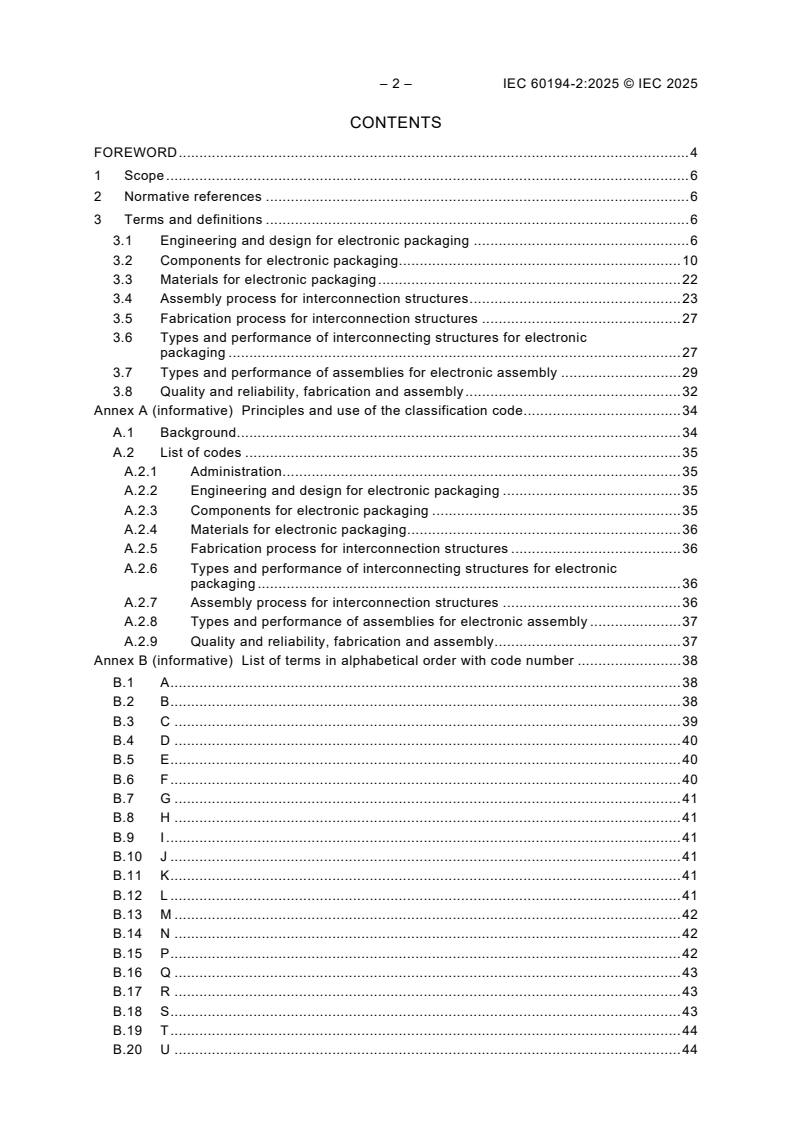
The terms have been classified according to the decimal classification code (DCC) and this DCC number appears just below the defined term. The DCC numbering is fully explained in Annex A.
A list of terms in alphabetical order with code number is provided in Annex B.
This edition includes the following significant technical changes with respect to the previous edition:
a) exclusion of 116 terms transferred to IEV;
b) inclusion of 9 new terms related to printed electronics and packaging technology;
c) revision of definitions of 23 terms reflecting current technology;
d) three "printed wiring" terms were removed;
e) reintroduction of identification codes for terms.
- Status
- Published
- Publication Date
- 11-Feb-2025
- Technical Committee
- TC 91 - Electronics assembly technology
- Drafting Committee
- WG 5 - TC 91/WG 5
- Current Stage
- PPUB - Publication issued
- Start Date
- 12-Feb-2025
- Completion Date
- 28-Feb-2025
Overview
IEC 60194-2:2025 - Electronic assembly, design and circuit boards - Vocabulary (Part 2) defines standardized terms and definitions used in circuit board, electronic assembly and related electronic technologies. The edition classifies terminology using a decimal classification code (DCC) (explained in Annex A) and provides an alphabetical term list with codes (Annex B). This 2025 revision updates vocabulary to reflect advances such as printed electronics and packaging technologies while aligning with the IEC Electropedia/IEV.
Key topics
- Structured vocabulary and classification
- Terms are grouped and assigned DCC numbers for consistent referencing across documentation and standards.
- Annex A explains the DCC scheme; Annex B lists terms in alphabetical order with codes.
- Scope of terminology
- Engineering and design for electronic packaging
- Components and materials for electronic packaging
- Fabrication and assembly processes for interconnection structures
- Types and performance of interconnecting structures and assemblies
- Quality, reliability, fabrication and assembly terms
- Notable technical changes in 2025 edition
- 116 terms transferred to the International Electrotechnical Vocabulary (IEV)
- Addition of 9 new terms related to printed electronics and packaging
- Revision of 23 definitions to reflect current technology
- Removal of three “printed wiring” terms and reintroduction of identification codes for terms
- Reference and alignment
- Developed by IEC Technical Committee 91 (Electronics assembly technology) and designed to work with IEC Electropedia and other IEC terminology resources.
Applications
IEC 60194-2:2025 is a practical resource for:
- Design engineers and PCB designers - ensure consistent terminology in specifications, schematic notes and design reviews.
- Manufacturing and assembly engineers - standardize process descriptions, work instructions and process controls.
- Quality, reliability and test engineers - use uniform definitions when creating inspection criteria, reliability reports and failure analyses.
- Standards authors, technical writers and translators - maintain precise, unambiguous language across standards, datasheets and multilingual documentation.
- Purchasing and supply-chain teams - clarify component and process requirements in procurement documents and contracts.
- Academia and training providers - teach current, industry-aligned terminology for electronics packaging and assembly.
Related standards
- IEC 60194 series (other parts under the same general title)
- IEC 60194-1:2021 (referenced for related plane terminology)
- IEC Electropedia / IEV - authoritative online terminology resource
Keywords: IEC 60194-2:2025, electronic assembly vocabulary, circuit boards terminology, DCC classification, printed electronics terminology, IEC standards, electronics packaging vocabulary.
Relations
- Effective Date
- 05-Sep-2023
Frequently Asked Questions
IEC 60194-2:2025 is a standard published by the International Electrotechnical Commission (IEC). Its full title is "Electronic assembly, design and circuit boards - Vocabulary - Part 2: Common usage in electronic technologies as well as electronic assembly technologies". This standard covers: IEC 60194-2:2025 covers terms and definitions related to circuit board and electronic assembly technologies as well as other electronic technologies. The terms have been classified according to the decimal classification code (DCC) and this DCC number appears just below the defined term. The DCC numbering is fully explained in Annex A. A list of terms in alphabetical order with code number is provided in Annex B. This edition includes the following significant technical changes with respect to the previous edition: a) exclusion of 116 terms transferred to IEV; b) inclusion of 9 new terms related to printed electronics and packaging technology; c) revision of definitions of 23 terms reflecting current technology; d) three "printed wiring" terms were removed; e) reintroduction of identification codes for terms.
IEC 60194-2:2025 covers terms and definitions related to circuit board and electronic assembly technologies as well as other electronic technologies. The terms have been classified according to the decimal classification code (DCC) and this DCC number appears just below the defined term. The DCC numbering is fully explained in Annex A. A list of terms in alphabetical order with code number is provided in Annex B. This edition includes the following significant technical changes with respect to the previous edition: a) exclusion of 116 terms transferred to IEV; b) inclusion of 9 new terms related to printed electronics and packaging technology; c) revision of definitions of 23 terms reflecting current technology; d) three "printed wiring" terms were removed; e) reintroduction of identification codes for terms.
IEC 60194-2:2025 is classified under the following ICS (International Classification for Standards) categories: 31.180 - Printed circuits and boards; 31.190 - Electronic component assemblies. The ICS classification helps identify the subject area and facilitates finding related standards.
IEC 60194-2:2025 has the following relationships with other standards: It is inter standard links to IEC 60194-2:2017. Understanding these relationships helps ensure you are using the most current and applicable version of the standard.
IEC 60194-2:2025 is available in PDF format for immediate download after purchase. The document can be added to your cart and obtained through the secure checkout process. Digital delivery ensures instant access to the complete standard document.
Standards Content (Sample)
IEC 60194-2 ®
Edition 2.0 2025-02
INTERNATIONAL
STANDARD
Electronic assembly, design and circuit boards – Vocabulary –
Part 2: Common usage in electronic technologies as well as electronic assembly
technologies
All rights reserved. Unless otherwise specified, no part of this publication may be reproduced or utilized in any form
or by any means, electronic or mechanical, including photocopying and microfilm, without permission in writing from
either IEC or IEC's member National Committee in the country of the requester. If you have any questions about IEC
copyright or have an enquiry about obtaining additional rights to this publication, please contact the address below or
your local IEC member National Committee for further information.
IEC Secretariat Tel.: +41 22 919 02 11
3, rue de Varembé info@iec.ch
CH-1211 Geneva 20 www.iec.ch
Switzerland
About the IEC
The International Electrotechnical Commission (IEC) is the leading global organization that prepares and publishes
International Standards for all electrical, electronic and related technologies.
About IEC publications
The technical content of IEC publications is kept under constant review by the IEC. Please make sure that you have the
latest edition, a corrigendum or an amendment might have been published.
IEC publications search - webstore.iec.ch/advsearchform IEC Products & Services Portal - products.iec.ch
The advanced search enables to find IEC publications by a Discover our powerful search engine and read freely all the
variety of criteria (reference number, text, technical publications previews, graphical symbols and the glossary.
committee, …). It also gives information on projects, replaced With a subscription you will always have access to up to date
and withdrawn publications. content tailored to your needs.
IEC Just Published - webstore.iec.ch/justpublished
Electropedia - www.electropedia.org
Stay up to date on all new IEC publications. Just Published
The world's leading online dictionary on electrotechnology,
details all new publications released. Available online and once
containing more than 22 500 terminological entries in English
a month by email.
and French, with equivalent terms in 25 additional languages.
Also known as the International Electrotechnical Vocabulary
IEC Customer Service Centre - webstore.iec.ch/csc
(IEV) online.
If you wish to give us your feedback on this publication or need
further assistance, please contact the Customer Service
Centre: sales@iec.ch.
IEC 60194-2 ®
Edition 2.0 2025-02
INTERNATIONAL
STANDARD
Electronic assembly, design and circuit boards – Vocabulary –
Part 2: Common usage in electronic technologies as well as electronic
assembly technologies
INTERNATIONAL
ELECTROTECHNICAL
COMMISSION
ICS 31.180; 31.190 ISBN 978-2-8327-0159-1
– 2 – IEC 60194-2:2025 © IEC 2025
CONTENTS
FOREWORD . 4
1 Scope . 6
2 Normative references . 6
3 Terms and definitions . 6
3.1 Engineering and design for electronic packaging . 6
3.2 Components for electronic packaging. 10
3.3 Materials for electronic packaging . 22
3.4 Assembly process for interconnection structures . 23
3.5 Fabrication process for interconnection structures . 27
3.6 Types and performance of interconnecting structures for electronic
packaging . 27
3.7 Types and performance of assemblies for electronic assembly . 29
3.8 Quality and reliability, fabrication and assembly . 32
Annex A (informative) Principles and use of the classification code. 34
A.1 Background. 34
A.2 List of codes . 35
A.2.1 Administration. 35
A.2.2 Engineering and design for electronic packaging . 35
A.2.3 Components for electronic packaging . 35
A.2.4 Materials for electronic packaging . 36
A.2.5 Fabrication process for interconnection structures . 36
A.2.6 Types and performance of interconnecting structures for electronic
packaging . 36
A.2.7 Assembly process for interconnection structures . 36
A.2.8 Types and performance of assemblies for electronic assembly . 37
A.2.9 Quality and reliability, fabrication and assembly. 37
Annex B (informative) List of terms in alphabetical order with code number . 38
B.1 A . 38
B.2 B . 38
B.3 C . 39
B.4 D . 40
B.5 E . 40
B.6 F . 40
B.7 G . 41
B.8 H . 41
B.9 I . 41
B.10 J . 41
B.11 K . 41
B.12 L . 41
B.13 M . 42
B.14 N . 42
B.15 P . 42
B.16 Q . 43
B.17 R . 43
B.18 S . 43
B.19 T . 44
B.20 U . 44
B.21 V . 44
B.22 W . 44
Bibliography . 45
Figure 1 – Pin grid array . 14
Figure 2 – Passive array . 14
Figure 3 – Leaded surface-mount component – Gull wing shaped lead (Courtesy of
Aalto University) . 16
Figure 4 – Ball grid array (BGA) . 19
Figure 5 – Bumped die with inner lead . 25
Figure 6 – Flip chip . 26
Figure 7 – Chip on board (COB) . 31
– 4 – IEC 60194-2:2025 © IEC 2025
INTERNATIONAL ELECTROTECHNICAL COMMISSION
____________
ELECTRONIC ASSEMBLY, DESIGN AND CIRCUIT BOARDS –
VOCABULARY –
Part 2: Common usage in electronic technologies
as well as electronic assembly technologies
FOREWORD
1) The International Electrotechnical Commission (IEC) is a worldwide organization for standardization comprising
all national electrotechnical committees (IEC National Committees). The object of IEC is to promote international
co-operation on all questions concerning standardization in the electrical and electronic fields. To this end and
in addition to other activities, IEC publishes International Standards, Technical Specifications, Technical Reports,
Publicly Available Specifications (PAS) and Guides (hereafter referred to as “IEC Publication(s)”). Their
preparation is entrusted to technical committees; any IEC National Committee interested in the subject dealt with
may participate in this preparatory work. International, governmental and non-governmental organizations liaising
with the IEC also participate in this preparation. IEC collaborates closely with the International Organization for
Standardization (ISO) in accordance with conditions determined by agreement between the two organizations.
2) The formal decisions or agreements of IEC on technical matters express, as nearly as possible, an international
consensus of opinion on the relevant subjects since each technical committee has representation from all
interested IEC National Committees.
3) IEC Publications have the form of recommendations for international use and are accepted by IEC National
Committees in that sense. While all reasonable efforts are made to ensure that the technical content of IEC
Publications is accurate, IEC cannot be held responsible for the way in which they are used or for any
misinterpretation by any end user.
4) In order to promote international uniformity, IEC National Committees undertake to apply IEC Publications
transparently to the maximum extent possible in their national and regional publications. Any divergence between
any IEC Publication and the corresponding national or regional publication shall be clearly indicated in the latter.
5) IEC itself does not provide any attestation of conformity. Independent certification bodies provide conformity
assessment services and, in some areas, access to IEC marks of conformity. IEC is not responsible for any
services carried out by independent certification bodies.
6) All users should ensure that they have the latest edition of this publication.
7) No liability shall attach to IEC or its directors, employees, servants or agents including individual experts and
members of its technical committees and IEC National Committees for any personal injury, property damage or
other damage of any nature whatsoever, whether direct or indirect, or for costs (including legal fees) and
expenses arising out of the publication, use of, or reliance upon, this IEC Publication or any other IEC
Publications.
8) Attention is drawn to the Normative references cited in this publication. Use of the referenced publications is
indispensable for the correct application of this publication.
9) IEC draws attention to the possibility that the implementation of this document may involve the use of (a)
patent(s). IEC takes no position concerning the evidence, validity or applicability of any claimed patent rights in
respect thereof. As of the date of publication of this document, IEC had not received notice of (a) patent(s), which
may be required to implement this document. However, implementers are cautioned that this may not represent
the latest information, which may be obtained from the patent database available at https://patents.iec.ch. IEC
shall not be held responsible for identifying any or all such patent rights.
IEC 60194-2 has been prepared by IEC technical committee 91: Electronics assembly
technology. It is an International Standard.
This second edition cancels and replaces the first edition published in 2017. This edition
constitutes a technical revision.
This edition includes the following significant technical changes with respect to the previous
edition:
a) exclusion of 116 terms transferred to IEV;
b) inclusion of 9 new terms related to printed electronics and packaging technology;
c) revision of definitions of 23 terms reflecting current technology;
d) three "printed wiring" terms were removed;
e) reintroduction of identification codes for terms.
The text of this International Standard is based on the following documents:
Draft Report on voting
91/1996/FDIS 91/2014/RVD
Full information on the voting for its approval can be found in the report on voting indicated in
the above table.
The language used for the development of this International Standard is English.
This document was drafted in accordance with ISO/IEC Directives, Part 2, and developed in
accordance with ISO/IEC Directives, Part 1 and ISO/IEC Directives, IEC Supplement, available
at www.iec.ch/members_experts/refdocs. The main document types developed by IEC are
described in greater detail at www.iec.ch/publications.
A list of all parts in the IEC 60194 series, published under the general title Electronic assembly,
design and circuit boards, can be found on the IEC website.
Future documents in this series will carry the new general title as cited above. Titles of existing
documents in this series will be updated at the time of the next edition.
The committee has decided that the contents of this document will remain unchanged until the
stability date indicated on the IEC website under webstore.iec.ch in the data related to the
specific document. At this date, the document will be
• reconfirmed,
• withdrawn, or
• revised.
– 6 – IEC 60194-2:2025 © IEC 2025
ELECTRONIC ASSEMBLY, DESIGN AND CIRCUIT BOARDS –
VOCABULARY –
Part 2: Common usage in electronic technologies
as well as electronic assembly technologies
1 Scope
This part of IEC 60194 covers terms and definitions related to circuit board and electronic
assembly technologies as well as other electronic technologies.
The terms have been classified according to the decimal classification code (DCC) and this
DCC number appears just below the defined term. The DCC numbering is fully explained in
Annex A.
A list of terms in alphabetical order with code number is provided in Annex B.
2 Normative references
There are no normative references in this document.
3 Terms and definitions
For the purposes of this document, the following terms and definitions apply.
ISO and IEC maintain terminology databases for use in standardization at the following
addresses:
• IEC Electropedia: available at https://www.electropedia.org/
• ISO Online browsing platform: available at https://www.iso.org/obp
In order to avoid two ID numbers, the usual practice of numbering every paragraph (every term
and definition) in front of the paragraph has not been followed in this document. The official IEC
number is the number which follows the DCC and the period (e.g., 21.xxxx).
3.1 Engineering and design for electronic packaging
3.1.1
ground plane
20.1413
conductor layer, or portion thereof, that serves as a common reference for electrical circuit
returns, shielding, or heat sinking
Note 1 to entry: See also "signal plane" and "voltage plane" in IEC 60194-1:2021.
3.1.2
analogue circuit
21.0037
electrical circuit that provides a continuous relationship between its input and output
3.1.3
attenuation
21.0061
decrease of the energy of an electromagnetic wave during its propagation, represented
quantitatively by the ratio of the power flux densities at two specified points
Note 1 to entry: Attenuation is generally expressed in decibels.
[SOURCE: IEC 60050-705:1995, 705-02-05]
3.1.4
capacitive coupling
21.0174
electrical interaction between two conductors that is caused by the capacitance between them
3.1.5
characteristic impedance
21.0194
capacitive coupling quantity defined for a mode of propagation at a given frequency in a specific
uniform transmission line or uniform waveguide by one of the three following relations:
Z = SI/ || (1)
Z = /| US| (2)
Z = UI/
(3)
where
Z is the complex characteristic impedance,
S is the complex power, and
U and I are the values, usually complex, respectively of a voltage and a current
conventionally defined for each type of mode by analogy with transmission line equations.
EXAMPLE 1 For a parallel-wire transmission line, U and I can be uniquely defined, and the three equations are
consistent. If the transmission line is lossless, the characteristic impedance is real.
EXAMPLE 2 For a waveguide, the conventional definitions for U and I depend on the type of mode and generally
lead to three different values of the characteristic impedance.
EXAMPLE 3 For a circular waveguide in the dominant mode ТЕ , U = the RMS voltage along the diameter where
the magnitude of the electric field strength vector is a maximum, I = the RMS longitudinal current.
EXAMPLE 4 For a rectangular waveguide in the dominant mode TE , U = the RMS voltage between midpoints of
the two conductor faces normal to the electric field strength vector, I = the RMS longitudinal current following on one
surface normal to the electric field strength vector.
[SOURCE: IEC 60050-726:1982, 726-07-01]
3.1.6
circuit
21.0213
number of electrical elements and devices that have been interconnected to perform a desired
electrical function
– 8 – IEC 60194-2:2025 © IEC 2025
3.1.7
compensation circuit
21.0231
electrical circuit that alters the functioning of another circuit to which it is applied to achieve a
desired performance
3.1.8
crosstalk
21.0327
spurious signal
21.1006
undesirable transfer of electrical energy between neighbouring conductors (coupling) by mutual
inductance and capacitance
Note 1 to entry: See also "backward crosstalk" and "forward crosstalk".
3.1.9
digital circuit
21.0380
electrical circuit that provides two (binary) or three distinct relationships (states) between its
input and output
3.1.10
electromagnetic compatibility
EMC
21.0427
ability of equipment or a system to function satisfactorily in its electromagnetic environment
without introducing intolerable electromagnetic disturbances to anything in that environment
[SOURCE: IEC 60050-161:1990, 161-01-07]
3.1.11
electromagnetic interference
EMI
21.0431
degradation of the performance of a piece of equipment, transmission channel or system
caused by an electromagnetic disturbance
Note 1 to entry: In French, the terms "perturbation électromagnétique" and "brouillage électromagnétique"
designate respectively the cause and the effect and should not be used indiscriminately.
Note 2 to entry: In English, the terms "electromagnetic disturbance" and "electromagnetic interference" designate
respectively the cause and the effect, but they are often used indiscriminately.
[SOURCE: IEC 60050-161:1990, 161-01-06]
3.1.12
electrostatic discharge
ESD
21.1716
transfer of electric charge between bodies of different electrostatic potential in proximity or
through direct contact
[SOURCE: IEC 60050-161:1990, 161-01-22]
3.1.13
electrostatic discharge sensitive device
21.0441
device with known sensitivity or susceptibility to ESD
3.1.14
far-end crosstalk
21.0473
forward crosstalk
21.1406
noise induced into a adjacent line, as seen at the end of the adjacent line that is the farthest
from the signal source, because the adjacent line has been placed next to an active line
3.1.15
leakage current
21.0699
electric current in an unintended conductive path under normal conditions
[SOURCE: IEC 60050-161:1990, 195-05-15]
3.1.16
line coupling
21.0711
interaction between two transmission lines that is caused by their mutual inductance and
capacitance
3.1.17
load capacitance
21.0713
capacitance seen by the output of a logic circuit or other signal source
3.1.18
microwave integrated circuit
21.0762
integrated circuit that performs at microwave frequencies
3.1.19
near-end crosstalk
21.0795
backward crosstalk
21.1332
noise induced into an adjacent line, as seen at that end of the adjacent line which is closest to
the signal source, when this line has been placed near an active line
3.1.20
logic circuit
21.1005
functional digital circuit used to perform computational functions
3.1.21
conductor
22.0254
electrical path
20.0837
single conductive path in a conductive pattern
[SOURCE: IEC 60050-161:1990, 541-01-20]
3.1.22
printed contact
22.0915
element of a conductive pattern that serves as one part of a contact system
– 10 – IEC 60194-2:2025 © IEC 2025
3.1.23
signal conductor
22.0934
individual conductor that is used to transmit an impressed electrical signal
3.1.24
signal line
22.0935
conductor used to transmit a signal from one part of a circuit to another
3.1.25
conductive pattern
22.1362
configuration formed by the electrically conductive material of a circuit board
3.1.26
primary side
22.1484
side of a packaging and interconnecting structure that is defined as such on the master drawing
3.1.27
secondary side
22.1517
side of a packaging and interconnecting structure that is opposite the primary side
3.1.28
base material thickness
22.1604
thickness of the base material excluding conductive foil or material deposited on the surfaces
3.1.29
termination
22.1773
end of a conductor that connects the conductor to a terminal, distributing frame, switch or matrix
3.2 Components for electronic packaging
3.2.1
active device
30.0016
electronic component whose basic character changes while operating on an applied signal
Note 1 to entry: This includes diodes, transistors, thyristors, and integrated circuits that are used for the
rectification, amplification, switching, etc., of analogue or digital circuits in either monolithic or hybrid form.
3.2.2
add-on component
30.0019
discrete or integrated packaged or chip components that are attached to a film circuit in order
to complete the circuit's function
3.2.3
package cover
30.0053
cover that encloses the contents In the cavity of a package in the final sealing operation
3.2.4
CMOS
complementary metal oxide semiconductor
30.0221
complementary metal oxide semiconductor devices wherein N type and P type transistors are
connected together for switching
3.2.5
discrete component
30.0392
separate part of a circuit board assembly that performs a circuit function
EXAMPLE resistor, capacitor, transistor.
3.2.6
heatsink
30.0594
mechanical device that is made of a high thermal- conductivity and low specific- heat material
that dissipates heat generated by a component or assembly
3.2.7
microcircuit
30.0727
relatively high-density combination of equivalent circuit elements that are interconnected so as
to perform as an indivisible electronic circuit component
3.2.8
microelectronics
30.0759
field of science and engineering that deals with highly miniaturized electronic circuits and their
use
[SOURCE: IEC 60050-161:1990, 521-10-01]
3.2.9
monolithic integrated circuit
30.0777
integrated circuit in the form of a monolithic structure
3.2.10
package cap
30.0821
cuplike package cover
3.2.11
package lid
30.0822
flat package cover
3.2.12
perimeter sealing area
30.0844
surface on the perimeter of a package cavity that is used as an attachment to the package cover
3.2.13
semiconductor
30.1289
solid material, such as silicon, that has a resistivity that is midway between that of a conductor
and of a resistor
– 12 – IEC 60194-2:2025 © IEC 2025
3.2.14
quad flat J-lead
QFJ
30.1400
generic rectangular component package, containing an electronic device, with leads on all four
sides that are formed in a "j" shape
3.2.15
quad flat no-lead
QFN
30.1402
generic rectangular component package outline wherein the metal pad terminations are formed
on four sides of the bottom of a package
3.2.16
integrated circuit
30.1426
combination of inseparable associated circuit elements that are formed in place and
interconnected on or within a single base material to perform a particular electrical function
3.2.17
passive component
30.1468
discrete electronic device whose basic character does not change while it processes
an applied signal
3.2.18
very large scale integration
VLSI
30.1559
integrated circuits with more than 80 000 transistors on a single die that are interconnected with
conductors that are 1 μm or less in width
3.2.19
wafer level packaging
30.1564
technique of partial encapsulation and protection of die while still on the wafer and before the
wafer is divided into singulated dies
3.2.20
hermetic
30.1867
condition of sealing a component from incoming gases to a specific of inward diffusion
−6 3
cm /s
normally less than 1 × 10
3.2.21
base plane
30.2011
plane that includes the lowest point of the mounting surface of the package, except for packages
using stand-offs
3.2.22
through hole package
THP
31.0858
electronic package for pin insertion assembly type of components or devices
3.2.23
single-inline package
SIP
31.0942
component package with one straight row of pins or wire leads
3.2.24
leaded chip carrier
31.1224
chip carrier whose external connections consist of leads that are around and down the side of
the package
Note 1 to entry: See also "leadless chip carrier".
3.2.25
dual inline package
DIP
31.1387
basically, rectangular component package that has a row of leads extending from each of the
longer sides of its body that are formed at right angles to a plane and parallel to the base of its
body
3.2.26
ceramic dual inline package
CERDIP
31.1611
package that has a body of ceramic material, is hermetically sealed by a glass and that has two
parallel rows of pins
3.2.27
ceramic pin grid array
ceramic PGA
31.1612
pin grid array package (PGA) made of ceramic material, hermetically sealed by metal that has
pin-type leads in a matrix of rows and columns; terminals may be missing from some row-
column intersection
3.2.28
pin grid array
PGA
31.1965
square or rectangular component package with pins protruding from the bottom surface with a
pitch perpendicular to the plane of the package
SEE: Figure 1
– 14 – IEC 60194-2:2025 © IEC 2025
Figure 1 – Pin grid array
3.2.29
passive array
32.1295
multiple passive components of similar function mounted on the primary interconnect substrate
SEE: Figure 2
Figure 2 – Passive array
Note 1 to entry: Examples include an array of capacitors or resistors.
3.2.30
chip carrier
33.0208
low-profile, usually square, surface-mount component semiconductor package whose die cavity
or die mounting area is a large fraction of the package size and whose external connections
are usually on all four sides of the package
3.2.31
coplanar leads
33.0295
flat beam leads of a component package that have been formed so that they can simultaneously
contact one plane of a base material
3.2.32
flat pack
33.0523
rectangular component package that has a row of leads extending from each of the longer sides
of its body that are parallel to the base of its body
3.2.33
metal package
33.0579
hybrid circuit package made mainly of metal
3.2.34
leadless device
33.0694
separated part (or whole) of a wafer intended to perform a function or functions in a device
3.2.35
known tested die
KTD
33.0910
die-form semiconductor product functionally verified by probing tests equal to the expected
performance of the packaged product, without full quality assurance by supplier(s)
Note 1 to entry: The testing requirements are according to the agreement between trading partners.
3.2.36
multichip module
MCM
33.1110
module that contains two or more dice and/or minimally packaged dice
Note 1 to entry: Also see "hybrid circuit" and "multi-chip package".
3.2.37
multi-chip package
MCP
33.1112
package that contains more than one dice and/or minimally packaged dice
3.2.38
leaded surface-mount component
33.1435
surface-mount component for which external connections consist of leads that are around and
down the side of the package
SEE: Figure 3
– 16 – IEC 60194-2:2025 © IEC 2025
Key
1 Knee
2 Upper bend radius
3 Lower bend radius
4 Land
5 Heel
6 Foot
7 Toe
Figure 3 – Leaded surface-mount component –
Gull wing shaped lead (Courtesy of Aalto University)
Note 1 to entry: See also "leadless surface-mount component" in IEC 60194-1:2021.
3.2.39
leadless chip carrier
33.1435
chip carrier whose external connections consist of metallized terminations that are an integral
part of the component body
3.2.40
bipolar device
33.1573
device in which both majority and minority carriers are present
3.2.41
bonding pad
33.1585
area of metallization on an integrated circuit die that permits connection of fine wires or a
circuit element to the die
3.2.42
ceramic quad flat package
CQFP
33.1613
quad flat package (QPF) made of a ceramic material, hermetically sealed by metal, with leads
extending from all four sides
3.2.43
QFP with bumper
BQFP
33.1835
QFP package with a guarding bumper
3.2.44
quad flat pack
QFP
33.1836
generic square or rectangular component package, containing a semiconductor die, with leads
on all four sides that are formed in a "gullwing" shape
3.2.45
fine pitch QFP
33.1837
quad flat pack (QFP) package whose lead pitch centres at 0,65 mm or less
3.2.46
chip scale package
CSP
33.1838
generic term for packaging technologies that result in a packaged part that is only marginally
larger than the internal die
3.2.47
land grid array
LGA
33.1891
square package with termination lands located in a grid pattern on the bottom of the package
3.2.48
plastic ball grid array
PBGA
33.1971
polymer-based BGA
3.2.49
plastic leaded chip carrier
PLCC
33.1972
surface-mount family of integrated circuit plastic packages with leads exiting from all four sides
of the package
3.2.50
plastic quad flat pack
PQFP
33.1974
surface-mount family of integrated circuit packages, bounded on all four sides by bumpers, with
leads exiting from all four sides of the package and formed into a "gullwing" lead format
3.2.51
single chip package
SCP
33.2034
integrated circuit package containing only one semiconductor die
– 18 – IEC 60194-2:2025 © IEC 2025
3.2.52
small outline J-lead
SOJ
33.2040
generic rectangular component package, whose chip cavity or mounting area occupies a major
portion of the package area, with leads on two opposite sides that are formed in a "J" shape
3.2.53
small outline no-lead
SON
33.2050
generic rectangular component package outline wherein the metal pad terminations are formed
on two sides of the bottom of the package
3.2.54
small outline package
SOP
33.2060
generic rectangular component package, whose chip cavity or mounting area occupies a major
portion of the package area, with leads or metal pad surfaces on two opposite sides
3.2.55
system in package
SiP
33.2070
multi-chip package (MCP) that performs a system function
3.2.56
system on a chip
SoC
33.2072
active die that functions as a complete system aside from power delivery and second level
memory
Note 1 to entry: Second level memory are different forms of on-die memory additional to traditional registers and
cache/SRAM; newer memory types such as ReRAM, MRAM, hybrid D/PC-RAM or integrated HBM are possible.
3.2.57
tape carrier package
TCP
33.2077
semiconductor package that has the TAB connection and is coated with a resin
3.2.58
wafer-level package
33.2110
chip-scale package whose size is generally equal to the size of the
semiconductor device it contains and that is formed by processing on a complete wafer rather
than on an individual device
Note 1 to entry: Because of the wafer-level processing, the size of a wafer-level package may be defined by finer
dimensions and tighter tolerances than those for a similar non-wafer-level package.
Note 2 to entry: The package size will change with changes in the size of the die.
3.2.59
area array package
34.0811
package that has terminations arranged in a grid on the bottom of the package and contained
within the package outline
3.2.60
ball grid array
BGA
34.1096
surface mount package that has solder balls attached to one side of a substrate in a matrix of
rows and columns; terminals may be missing from some row-column intersections
[SOURCE: IEC 60191-6-18:2018]
SEE: Figure 4
Figure 4 – Ball grid array (BGA)
3.2.61
cupping
34.1801
condition of a ball grid array package after reflow where the corners turn up and away
from the circuit board laminate surface
Note 1 to entry: This condition in the worst case causes the balls on the outside row to be in tension and the balls
in the centre to be in compression.
Note 2 to entry: Opposite of "doming ".
3.2.62
doming
34.2011
condition of a ball grid array package after reflow where the corners turn down and
toward the circuit board laminate surface
Note 1 to entry: This condition in the worst case causes the balls on the outside row to be compressed and the balls
in the centre to be in tension.
Note 2 to entry: Opposite of "cupping ".
3.2.63
bare die
35.0111
unpackaged discrete semiconductor or integrated circuit with pads on the upper surface suitable
for interconnection to the substrate or package
– 20 – IEC 60194-2:2025 © IEC 2025
3.2.64
bond pads
35.0121
metallised areas on the die that are used for temporary or permanent electrical connection
(bonding)
3.2.65
chip
35.0205
SEE: "die".
3.2.66
dice
35.0373
more than one die
3.2.67
die
35.0375
separated part (or whole) of a wafer intended to perform a function or functions in a device
3.2.68
die device
35.0381
bare die, with or without connection structures, or a minimally packaged die
3.2.69
junction temperature
35.0666
temperature of the region of a transition between the p-type and n-type semiconductor material
in a transistor or diode element during operation
3.2.70
known good die
KGD
35.0846
die-form semiconductor product that provides assurance of equivalent quality and reliability as
that found in its conventionally packaged counterparts
3.2.71
probed die
PD
35.0912
semiconductor die evaluated by probing tests, but without quality assurance by supplier(s)
3.2.72
uncased device
35.1122
component without a package
3.2.73
wafer
35.1145
slice or a flat disc, either of semiconductor material or of such a material deposited on a
substrate, in which one or more circuits or devices can be processed
3.2.74
dicing
35.1685
separating of wafers into individual die
3.2.75
wire bond
35.2130
completed wire connection that provides electrical continuity between the die and a terminal
3.2.76
backfill
36.0075
filling a hybrid circuit package with a dry inert gas prior to hermetic sealing
3.2.77
compression seal
36.0243
tight joint made between a component package and its leads that is formed as heated metal
cools and shrinks around a glass insulator
3.2.78
support ring
36.1033
ring made of a dielectric material that is used to hold beam leads in place relative to one another
outside of a packaged device
3.2.79
J-leads
36.1752
preferred surface mount lead form used on PLCCs (plastic leaded chip carrier), so named
because the lead the lead has J shape, departs the package body near its Z-axis centreline, is
formed down then rolled under the package
Note 1 to entry: Leads so formed are shaped like the letter "J."
3.2.80
lead frame
36.1902
metallic portion of the device package on which the integrated circuit die is mounted and
connected from the die or dice bonding sites to the structure that becomes the outer leads of
the package
3.2.81
coaxial cable
37.0220
cable in the form of a central wire surrounded by a conductor tubing or sheathing that serves
as a shield and return
3.2.82
metal oxide semiconductor
MOS
39.1050
fabrication technology, resulting in the creation of FET devices
– 22 – IEC 60194-2:2025 © IEC 2025
3.2.83
passive network
39.1275
multiple passive components that have more than one function and are formed on the surface
of a separate substrate and packaged in a single SMD case
Note 1 to entry: The case is then mounted on the primary interconnected substrate of the system.
Note 2 to entry: Passive networks typically have several internal connections to form simple functions such as
terminations or filters.
3.2.84
silicon on insulator
SOI
39.1410
fabrication technology that uses an insulating material as the bulk material instead of silicon,
which may be sapphire (SOS)
Note 1 to entry: Silicon on insulator is a general term.
3.2.85
silicon on sapphire
SOS
39.1450
specific fabrication technology that uses sapphire, a variety of corundum (Al O ), as the bulk
2 3
material instead of silicon
3.3 Materials for electronic packaging
3.3.1
conductivity
40.0250
ability of a substance or material to conduct electricity
3.3.2
conductivity
40.0261
ability of a substance or material to conduct heat
3.3.3
anisotropy
40.0685
condition for a substance having differing values for properties, such as permittivity, depending
on the direction within the material
3.3.4
printed electronics sheet board
40.1276
sheet (board) of forming an electronically functional pattern and/or devices on a large-scale by
printing of conductive materials
3.3.5
base material
40.1334
insulating material upon which a conductive pattern may be formed
3.3.6
bias
44.0105
filling yarn that is off-square with the warp ends of a fabric
3.3.7
constraining core
44.0273
supporting plane that is internal to a packaging and interconnecting structure
3.3.8
creel
44.0315
device used as a yarn package rack to hold warp ends for a section beam
3.3.9
supporting plane
44.1032
planar structure that is a part of a packaging and interconnecting structure in order to provide
mechanical support, thermo-mechanical constraint, thermal conduction and/or electrical
characteristics
Note 1 to entry: It may be either internal or external to the packaging and interconnecting structure.
Note 2 to entry: See also "constraining core".
3.3.10
chemical vapour deposition
45.0202
process in which vapours and gases react chemically to produce deposits at the surface of a
substrate
[SOURCE: IEC 60050-841:2004, 841-22-07]
3.3.11
conductive ink
45.0235
conductive fluid in which chemical precursors, polymers, or particles are dissolved or dispersed
[SOURCE: IEC 62899-101:2019]
3.3.12
conductive medium
45.0261
material with a suspended powder of an electrically conductive material
Note 1 to entry: See also conductive paints, inks, pastes.
3.3.13
film conductor
45.0501
conductor formed in place on a base material by depositing a conductive material using
screening, plating or evaporating techniques
3.4 Assembly process for interconnection structures
3.4.1
bridging
70.0149
unintentional formation of a conductive path between conductors
– 24 – IEC 60194-2:2025 © IEC 2025
3.4.2
mixed component mounting technology
70.1452
component mounting technology that uses both through-hole and
surface-mounting technologies on the same packaging and interconnecting structure
3.4.3
component mounting site
70.1632
location on a packaging and interconnecting structure (P&I) that consists of a land pattern and
conductor fan-out to additional lands for testing or vias that are associated with the mounting
of a single component
3.4.4
flexible material interconnect construction
FMIC
70.1846
integration of passive and active components with mechanical components (including switches
and connectors) on a flexible or thin base material, i.e., flexible circuit board, in order to produce
an electronic assembly
3.4.5
pick-up tool
73.1759
tool used to pick up surface-mount components from a packaging medium for placement on a
substrate and which may be hand activated or a part of a pick-and-place machine
3.4.6
pick-up force
73.1760
force required to pick up a surface-mount component from its packaging medium for placement
on a substrate
3.4.7
b
...