

IEC TR 62267-2:2011
(Main)Railway applications - Automated urban guided transport (AUGT) - Safety requirements - Part 2: Hazard analysis at top system level
General Information
- Abstract
IEC/TR 62267-2:2011(E) provides a non normative generic hazard analysis at top system level conducted for the development of IEC 62267 for Automated Urban Guided Transport (AUGT) systems. This report is applicable to all systems covered by the scope of IEC 62267. This generic hazard analysis can be used for specific AUGT systems to support the necessary activities in lifecycle process following IEC 62278.
- Status
- Published
- Publication Date
- 13-Mar-2011
- Technical Committee
- TC 9 - Electrical equipment and systems for railways
- Drafting Committee
- WG 45 - TC 9/WG 45
- Current Stage
- PPUB - Publication issued
- Start Date
- 14-Mar-2011
- Completion Date
- 15-Jun-2011
Overview - IEC TR 62267-2:2011 (AUGT hazard analysis at top system level)
IEC TR 62267-2:2011 is a technical report from IEC TC9 that provides a non‑normative generic hazard analysis at top system level for Automated Urban Guided Transport (AUGT) systems. It documents top‑level hazards, associated causes and triggers, and lists possible safeguards to compensate for the absence of on‑board operational staff (Driverless Train Operation - DTO, and Unattended Train Operation - UTO). The report is intended as a guidance tool to support lifecycle activities and specific risk analyses required by IEC 62278 (RAMS).
Key topics and technical requirements
- Scope and applicability
- Generic hazard analysis for all systems covered by IEC 62267.
- Non‑normative: intended to guide, not to mandate safeguards or acceptable residual risk.
- System definition and basic functions
- Based on the generic AUGT system boundaries and basic functions defined in IEC 62267.
- Methodology
- Structured hazard analysis using: Hazard → Cause → Trigger → Hazardous situation → Accident (Effect).
- Results organized in a hazard analysis table (Table 1) with numbered hazardous situations and suggested safeguards.
- Safeguard identification
- Lists possible measures (barriers) that mitigate identified hazardous situations and compensate for absent operational staff.
- Safeguards are derived from operational experience in existing AUGT systems worldwide.
- Role in lifecycle
- Supports lifecycle phases defined in IEC 62278, particularly hazard identification (phase 3) and determination of safety‑related system requirements (phase 4).
- Limitations
- Does not determine which safeguards must be applied for a given local context - choice and risk tolerability are the responsibility of Transport Authorities and Safety Regulatory Authorities.
Practical applications and users
Who uses IEC TR 62267-2:2011:
- System designers and integrators developing AUGT systems.
- Safety assessors and RAMS engineers performing hazard identification and risk analysis.
- Transport authorities and safety regulators evaluating DTO/UTO proposals and approvals.
- Operators planning mitigation strategies for driverless or unattended operation.
Practical uses:
- As a checklist for top‑level hazards and typical causes/triggers.
- To identify candidate safeguards and to harmonize specific risk analyses across projects.
- To support the generation of safety requirements and documentation during system lifecycle phases.
Related standards
- IEC 62267:2009 - Railway applications: AUGT - Safety requirements (generic safety requirements referenced by this report).
- IEC 62278:2002 - Railway applications: Specification and demonstration of Reliability, Availability, Maintainability and Safety (RAMS), used for lifecycle compliance.
Keywords: IEC TR 62267-2:2011, AUGT, automated urban guided transport, hazard analysis, railway safety, DTO, UTO, IEC 62267, IEC 62278, RAMS.
Get Certified
Connect with accredited certification bodies for this standard

IMQ S.p.A. (Certification)
Italian electrical product certification.

IRIS Certification (UNIFE)
International Railway Industry Standard certification.

SLG Prüf- und Zertifizierungs GmbH
German testing and certification body.
Sponsored listings
Frequently Asked Questions
IEC TR 62267-2:2011 is a technical report published by the International Electrotechnical Commission (IEC). Its full title is "Railway applications - Automated urban guided transport (AUGT) - Safety requirements - Part 2: Hazard analysis at top system level". This standard covers: IEC/TR 62267-2:2011(E) provides a non normative generic hazard analysis at top system level conducted for the development of IEC 62267 for Automated Urban Guided Transport (AUGT) systems. This report is applicable to all systems covered by the scope of IEC 62267. This generic hazard analysis can be used for specific AUGT systems to support the necessary activities in lifecycle process following IEC 62278.
IEC/TR 62267-2:2011(E) provides a non normative generic hazard analysis at top system level conducted for the development of IEC 62267 for Automated Urban Guided Transport (AUGT) systems. This report is applicable to all systems covered by the scope of IEC 62267. This generic hazard analysis can be used for specific AUGT systems to support the necessary activities in lifecycle process following IEC 62278.
IEC TR 62267-2:2011 is classified under the following ICS (International Classification for Standards) categories: 29.140.20 - Incandescent lamps; 45.060.01 - Railway rolling stock in general. The ICS classification helps identify the subject area and facilitates finding related standards.
IEC TR 62267-2:2011 is available in PDF format for immediate download after purchase. The document can be added to your cart and obtained through the secure checkout process. Digital delivery ensures instant access to the complete standard document.
Standards Content (Sample)
IEC/TR 62267-2 ®
Edition 1.0 2011-03
TECHNICAL
REPORT
Railway applications – Automated urban guided transport (AUGT) – Safety
requirements –
Part 2: Hazard analysis at top system level
IEC/TR 62267-2:2011(E)
All rights reserved. Unless otherwise specified, no part of this publication may be reproduced or utilized in any form or by
any means, electronic or mechanical, including photocopying and microfilm, without permission in writing from either IEC or
IEC's member National Committee in the country of the requester.
If you have any questions about IEC copyright or have an enquiry about obtaining additional rights to this publication,
please contact the address below or your local IEC member National Committee for further information.
Droits de reproduction réservés. Sauf indication contraire, aucune partie de cette publication ne peut être reproduite
ni utilisée sous quelque forme que ce soit et par aucun procédé, électronique ou mécanique, y compris la photocopie
et les microfilms, sans l'accord écrit de la CEI ou du Comité national de la CEI du pays du demandeur.
Si vous avez des questions sur le copyright de la CEI ou si vous désirez obtenir des droits supplémentaires sur cette
publication, utilisez les coordonnées ci-après ou contactez le Comité national de la CEI de votre pays de résidence.
IEC Central Office
3, rue de Varembé
CH-1211 Geneva 20
Switzerland
Email: inmail@iec.ch
Web: www.iec.ch
About IEC publications
The technical content of IEC publications is kept under constant review by the IEC. Please make sure that you have the
latest edition, a corrigenda or an amendment might have been published.
Catalogue of IEC publications: www.iec.ch/searchpub
The IEC on-line Catalogue enables you to search by a variety of criteria (reference number, text, technical committee,…).
It also gives information on projects, withdrawn and replaced publications.
IEC Just Published: www.iec.ch/online_news/justpub
Stay up to date on all new IEC publications. Just Published details twice a month all new publications released. Available
on-line and also by email.
Electropedia: www.electropedia.org
The world's leading online dictionary of electronic and electrical terms containing more than 20 000 terms and definitions
in English and French, with equivalent terms in additional languages. Also known as the International Electrotechnical
Vocabulary online.
Customer Service Centre: www.iec.ch/webstore/custserv
If you wish to give us your feedback on this publication or need further assistance, please visit the Customer Service
Centre FAQ or contact us:
Email: csc@iec.ch
Tel.: +41 22 919 02 11
Fax: +41 22 919 03 00
IEC/TR 62267-2 ®
Edition 1.0 2011-03
TECHNICAL
REPORT
Railway applications – Automated urban guided transport (AUGT) – Safety
requirements –
Part 2: Hazard analysis at top system level
INTERNATIONAL
ELECTROTECHNICAL
COMMISSION
PRICE CODE
S
ICS 45.060 ISBN 978-2-88912-423-7
– 2 – TR 62267-2 © IEC:2011(E)
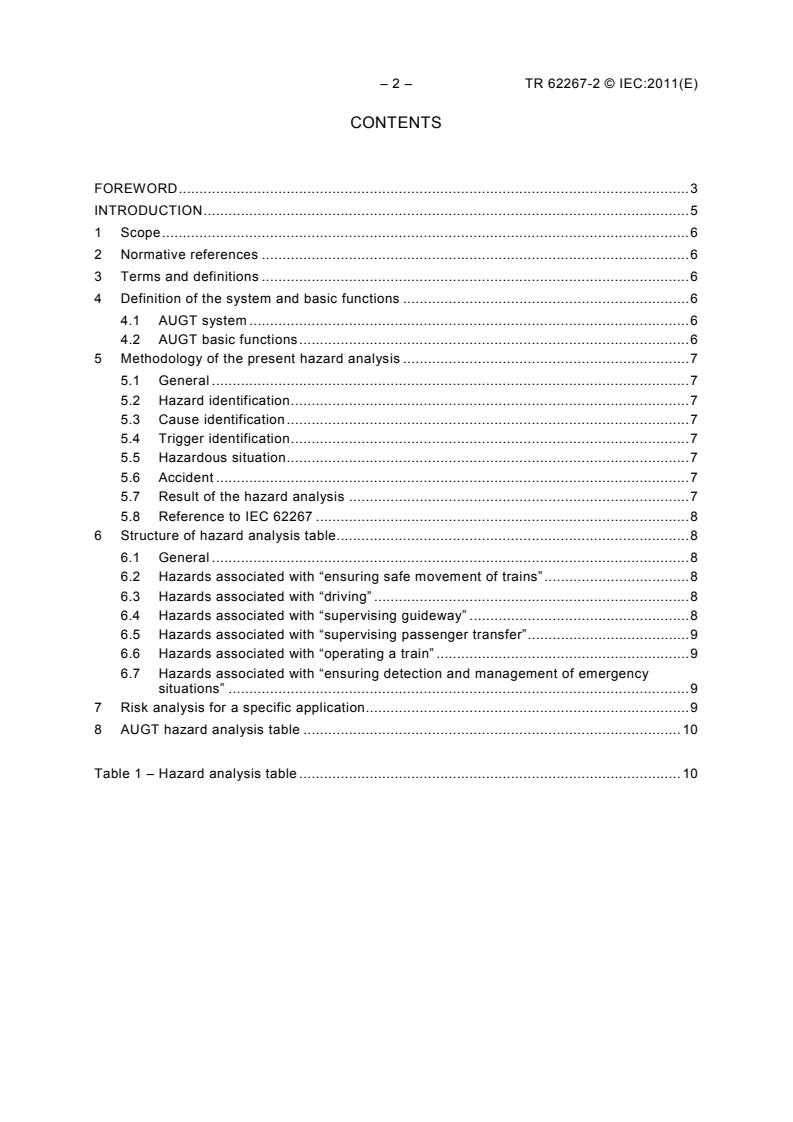
CONTENTS
FOREWORD . 3
INTRODUCTION . 5
1 Scope . 6
2 Normative references . 6
3 Terms and definitions . 6
4 Definition of the system and basic functions . 6
4.1 AUGT system . 6
4.2 AUGT basic functions . 6
5 Methodology of the present hazard analysis . 7
5.1 General . 7
5.2 Hazard identification . 7
5.3 Cause identification . 7
5.4 Trigger identification . 7
5.5 Hazardous situation . 7
5.6 Accident . 7
5.7 Result of the hazard analysis . 7
5.8 Reference to IEC 62267 . 8
6 Structure of hazard analysis table. 8
6.1 General . 8
6.2 Hazards associated with “ensuring safe movement of trains” . 8
6.3 Hazards associated with “driving” . 8
6.4 Hazards associated with “supervising guideway” . 8
6.5 Hazards associated with “supervising passenger transfer” . 9
6.6 Hazards associated with “operating a train” . 9
6.7 Hazards associated with “ensuring detection and management of emergency
situations” . 9
7 Risk analysis for a specific application. 9
8 AUGT hazard analysis table . 10
Table 1 – Hazard analysis table . 10
TR 62267-2 © IEC:2011(E) – 3 –
INTERNATIONAL ELECTROTECHNICAL COMMISSION
____________
RAILWAY APPLICATIONS –
AUTOMATED URBAN GUIDED TRANSPORT (AUGT) –
SAFETY REQUIREMENTS –
Part 2: Hazard analysis at top system level
FOREWORD
1) The International Electrotechnical Commission (IEC) is a worldwide organization for standardization comprising
all national electrotechnical committees (IEC National Committees). The object of IEC is to promote
international co-operation on all questions concerning standardization in the electrical and electronic fields. To
this end and in addition to other activities, IEC publishes International Standards, Technical Specifications,
Technical Reports, Publicly Available Specifications (PAS) and Guides (hereafter referred to as “IEC
Publication(s)”). Their preparation is entrusted to technical committees; any IEC National Committee interested
in the subject dealt with may participate in this preparatory work. International, governmental and non-
governmental organizations liaising with the IEC also participate in this preparation. IEC collaborates closely
with the International Organization for Standardization (ISO) in accordance with conditions determined by
agreement between the two organizations.
2) The formal decisions or agreements of IEC on technical matters express, as nearly as possible, an international
consensus of opinion on the relevant subjects since each technical committee has representation from all
interested IEC National Committees.
3) IEC Publications have the form of recommendations for international use and are accepted by IEC National
Committees in that sense. While all reasonable efforts are made to ensure that the technical content of IEC
Publications is accurate, IEC cannot be held responsible for the way in which they are used or for any
misinterpretation by any end user.
4) In order to promote international uniformity, IEC National Committees undertake to apply IEC Publications
transparently to the maximum extent possible in their national and regional publications. Any divergence
between any IEC Publication and the corresponding national or regional publication shall be clearly indicated in
the latter.
5) IEC itself does not provide any attestation of conformity. Independent certification bodies provide conformity
assessment services and, in some areas, access to IEC marks of conformity. IEC is not responsible for any
services carried out by independent certification bodies.
6) All users should ensure that they have the latest edition of this publication.
7) No liability shall attach to IEC or its directors, employees, servants or agents including individual experts and
members of its technical committees and IEC National Committees for any personal injury, property damage or
other damage of any nature whatsoever, whether direct or indirect, or for costs (including legal fees) and
expenses arising out of the publication, use of, or reliance upon, this IEC Publication or any other IEC
Publications.
8) Attention is drawn to the Normative references cited in this publication. Use of the referenced publications is
indispensable for the correct application of this publication.
9) Attention is drawn to the possibility that some of the elements of this IEC Publication may be the subject of
patent rights. IEC shall not be held responsible for identifying any or all such patent rights.
The main task of IEC technical committees is to prepare International Standards. However, a
technical committee may propose the publication of a technical report when it has collected
data of a different kind from that which is normally published as an International Standard, for
example "state of the art".
IEC 62267-2, which is a technical report, has been prepared by IEC technical committee 9:
Electrical equipment and systems for railways.
– 4 – TR 62267-2 © IEC:2011(E)
The text of this technical report is based on the following documents:
Enquiry draft Report on voting
9/1390/DTR 9/1423A/RVC
Full information on the voting for the approval of this technical report can be found in the
report on voting indicated in the above table.
This publication has been drafted in accordance with the ISO/IEC Directives, Part 2.
A list of all parts of IEC 62267 series, under the general title Railway applications –
Automated urban guided transport (AUGT) – Safety requirements, can be found on the IEC
website.
The committee has decided that the contents of this publication will remain unchanged until
the stability date indicated on the IEC web site under "http://webstore.iec.ch" in the data
related to the specific publication. At this date, the publication will be
• reconfirmed,
• withdrawn,
• replaced by a revised edition, or
• amended.
A bilingual version of this publication may be issued at a later date.
TR 62267-2 © IEC:2011(E) – 5 –
INTRODUCTION
This Technical Report publishes the hazard analysis at top system level conducted by
members of working group 45 of IEC technical committee 9 in order to allocate possible
safeguards able to compensate for the absence of a driver in the front cabin of the train or
attendant staff from the train as mentioned in 4.2 of IEC 62267:2009.
The hazard analysis is structured in accordance to basic functions of train operations
following Table 1 of IEC 62267:2009 covering the basic hazards of train operations.
The hazard analysis tabulates the identified hazards with their associated causes and triggers
as well as providing an associated list of possible safeguards able to compensate the
absence of operational staff from the front cabin of a train. The results of hazard analysis do
not state the choice of safeguards or the acceptable level of residual risk which may vary
depending on the local safety culture. The choice of a listed safeguard or combination of
safeguards, or the choice not to use any safeguard to compensate or mitigate a specific
hazard in a specific application depends on the risk tolerability which is to be assessed under
the responsibility of the Transport Authority and Safety Regulatory Authority by a specific risk
analysis. This technical report, therefore, does not judge whether a safeguard or a
combination of safeguards is necessary.
However, this technical report is intended to support Transport Authorities and Safety
Regulatory Authorities in hazard identification as well as selecting and combining safeguards
as a basis for a specific risk analysis required for any application with regard to their local
safety culture.
IEC 62267 can be seen as a generic guideline specifying detailed safety requirements for
safeguards proposed as a result of the present generic hazard analysis for the design of
specific AUGT systems. The hazard analysis and the safeguards derived from it, together with
their safety requirements, are based on experiences gained from design and operation of
existing AUGT systems in North America, Europe and Asia.
The present generic hazard analysis and the derived safety requirements can be seen and
used as part of the lifecycle of the system as defined in IEC 62278, required for any railway
application including AUGT systems. The present hazard analysis covers the required hazard
identification as part of risk analysis (lifecycle phase 3) and determination of safety-related
system requirements (lifecycle phase 4) on a generic level, which is indispensable for
design/implementation of an AUGT system. Because IEC 62267 specifies safety requirements
on a generic level only, a specific risk analysis including specific hazard identification must be
conducted. In order to facilitate the process of specific risk analysis and determine system
requirements, the present hazard identification, the list of possible safeguards and the
methodology can be used as a guide to verify the conditions of specific system environment.
The use of the present hazard analysis and derived methodology can additionally help
harmonize the process of specific risk analysis in this field of application. Such a harmonized
process has the intention to facilitate the necessary agreements between Transport
Authorities and the resulting approval by Safety Regulatory Authorities.
– 6 – TR 62267-2 © IEC:2011(E)
RAILWAY APPLICATIONS –
AUTOMATED URBAN GUIDED TRANSPORT (AUGT) –
SAFETY REQUIREMENTS –
Part 2: Hazard analysis at top system level
1 Scope
This technical report provides a non normative generic hazard analysis at top system level
conducted for the development of IEC 62267 for Automated Urban Guided Transport (AUGT)
systems. This report is applicable to all systems covered by the scope of IEC 62267.
This generic hazard analysis cannot be used for specific applications without taking into
account the specific system environment and local safety culture.
This generic hazard analysis can be used for specific AUGT systems to support the necessary
activities in lifecycle process following IEC 62278 (RAMS).
2 Normative references
The following referenced documents are indispensable for the application of this document.
For dated references, only the edition cited applies. For undated references, the latest edition
of the referenced document (including any amendments) applies.
IEC 62267:2009, Railway applications – Automated urban guided transport (AUGT) – Safety
requirements
IEC 62278:2002, Railway applications – Specification and demonstration of reliability,
availability, maintainability and safety (RAMS)
3 Terms and definitions
For the purposes of this document, the terms and definitions set out in IEC 62267 apply.
4 Definition of the system and basic functions
4.1 AUGT system
The hazard analysis at top system level has been carried out based on a generic system
definition which is described in Clause 5 of IEC 62267:2009. This system definition contains
the system boundaries and application conditions as required by IEC 62278. Additionally,
entities to be protected (persons with different purposes and behaviours present in the system
as well as property) because exposed to possible hazardous situations, have been taken into
account as defined in Clause 6 of IEC 62267:2009.
4.2 AUGT basic functions
The hazard analysis at top system level has been carried out based on generic basic
functions identified in Table 1 of IEC 62267:2009.
TR 62267-2 © IEC:2011(E) – 7 –
5 Methodology of the present hazard analysis
5.1 General
It is the purpose of the hazard analysis to demonstrate that the AUGT application is as safe
as applications with drivers. This is the reason that it has been structured following the basic
functions of AUGT systems as identified in Table 1 of IEC 62267:2009.
5.2 Hazard identification
The column “Hazard” shows the top-level hazards identified. A hazard is considered as a
matter of fact present in the system as a result of train operations (e.g. closing and opening of
train doors) or possible influences to these operations (e.g. obstacle in the guideway).
5.3 Cause identification
The column “Cause” contains the reason or description why the hazard may lead to an
accident.
5.4 Trigger identification
The column “Trigger” contains the possible event(s) or condition(s) which leads from the
identified hazard to an accident.
5.5 Hazardous situation
The combination of hazard, cause and trigger are mentioned and tabulated in Clause 7 of
IEC 62267:2009 as “hazardous situation”. It shall be noted that a hazardous situation can be
mitigated usually only by avoiding or mitigating causes and/or triggers. Table 1 gives a unique
number for each hazardous situation.
5.6 Accident
The column “Accident (Effect)” in Table 1 contains the assumed harmful consequence for
each identified hazard, cause and trigger.
5.7 Result of the hazard analysis
The column “Safeguard” in Table 1 lists possible measures (barriers) which are able to
compensate the absence of
• a train driver from the front cabin of the train (Driverless Train Operation – DTO), or
• any attendant staff on board train (Unattended Train Operation – UTO),
in order to mitigate the hazardous situations to a sufficient level. The possible safeguards are
gained from the experience of AUGT systems operated in the world and defined in a way that
they are able to cover causes and/or triggers related to a hazard and to the assumed
consequence.
During the development of the hazard analysis for each mitigation and thereby each
safeguard of the identified hazards, the question of whether the safeguard compensates for
the absence of driver (DTO) or staff (UTO) was addressed by the group. The resulting hazard
analysis table (Table 1) shows the safeguards that were found to be able to either mitigate or
compensate the identified hazards, taking into account the local safety culture. When the
safeguard on its own compensates the absence of driver or staff for the identified hazard, the
character “C” has been entered in the column “Remark”.
– 8 – TR 62267-2 © IEC:2011(E)
5.8 Reference to IEC 62267
The column “IEC 62267:2009” provides the references to the safety requirements described in
Clause 8 of IEC 62267:2009 which might be considered for choosing safeguards or
appropriate combinations of safeguards and to establish their system requirements as
requested by lifecycle phase 4, described in 6.4 of of IEC 62278:2002.
The entry “Out of scope” is provided if a hazardous situation and the assigned safeguard are
not specific to AUGT systems because in conventional operations operational staff on board
trains is not involved in hazard mitigation. Thus, “Out of scope” is entered in the column when
no reference to a safeguard is provided in IEC 62267.
6 Structure of hazard analysis table
6.1 General
The present hazard analysis table (Table 1) is structured according to the basic functions of
train operations for which a driver from the front cabin or attendant staff on board the train
has a responsibility for ensuring safe operation depending on the grade of sutomation. Each
basic function is intended to cover their associated top-level hazards as described below.
6.2 Hazards associated with “ensuring safe movement of trains”
Ensuring safe movement of trains and its associated basic functions “ensure safe route”,
“ensure safe separation of trains” and “ensure safe speed” is intended to cover all hazards
leading to derailment or collision of trains with other trains or infrastructure caused by
• unsafe routes and route elements (e.g. moving points, flank movements or oncoming train
movements),
• insufficient spacing between trains and between train and infrastructure (e.g. line end),
• exceeding permitted speed (e.g. due to wrong determination, or wrong adherence).
Due to the fact that “safe movement of trains” has to be considered, at least from Semi
Automated Train Operation (STO) onwards, as never being under the responsibility of
operations staff on board trains and as being realised as state of the art by technical train
control and protection systems, it was decided to declare these basic functions as not AUGT
specific. However, safe movement of trains and coverage of associated hazards is the most
important prerequisite for any AUGT system as stated by IEC 62267:2009.
6.3 Hazards associated with “driving”
“Driving” represented by the basic function “control acceleration and braking” shall be
considered as not being under the responsibility of operations staff on board trains at least
from Semi Automated Train Operation (STO) onwards.
Automation of acceleration and braking is realised as state of the art by technical systems.
Therefore it was decided to declare these basic functions as not AUGT specific, taking into
account that the associated hazards caused by insufficient acceleration and braking are
covered by the basic function “ensure safe speed”.
6.4 Hazards associated with “supervising guideway”
In grades of automation DTO and UTO, the responsibility of on board staff for supervising the
guideway in order to prevent as far as possible collisions with unmeant obstacles or persons
in the guideway has to be mitigated sufficiently because operations staff is absent from the
front cabin of the train.
Therefore the basic function “prevent collision with obstacles” is intended to cover all hazards
endangering moving trains and their passengers caused by intrusive elements outside trains
TR 62267-2 © IEC:2011(E) – 9 –
(e.g. cars, parts of infrastructure, tools for maintenance left on the track) into the clearance of
guideway.
Therefore the basic function “prevent collision with persons” is intended to cover all hazards
for persons who are endangered by moving trains caused by intrusion into the clearance of
guideway (e.g. fall into platform track) or while present beside moving trains (e.g. waiting at
platform edge).
6.5 Hazards associated with “supervising passenger transfer”
In grade of automation UTO, the responsibility of on board staff for supervising the passenger
transfer between platforms in stations and the train in order to prevent as far as possible
injuries to persons shall be mitigated sufficiently because operations staff is absent from the
train. Therefore
• the basic function “control passenger doors” is intended to cover all hazards endangering
passengers caused by unintentional opening and closing of passenger doors,
• the basic function “Prevent person injuries between cars or between platform and train” is
intended to cover all hazards endangering passengers while passing between platform
and train caused by gaps between cars of a train and between car body and platform
edge,
• the basic function “Ensure safe starting conditions” is intended to cover all hazards
endangering persons caused by unexpected starting of trains (e.g. train start with open
doors, train start with trapped obstacle between door leaves).
6.6 Hazards associated with “operating a train”
In grade of automation UTO, the responsibility of on board staff for operating a train in order
to prevent as far as possible unsafe situations for passengers shall be mitigated sufficiently
because operations staff responsible for operating a train is absent. Therefore
• the basic function “put in or take out of operation” is intended to cover all hazards
endangering passengers caused by putting faulty trains in operation and endangering
passengers in trains taken out of operation,
• the basic function “Supervise the status of a train” is intended to cover all hazards
endangering passengers caused by train failures arising during operation.
6.7 Hazards associated with “ensuring detection and management of emergency
situations”
In grade of automation UTO, the responsibility of on board staff for detecting emergency
situations and to react in an appropriate way in order to minimize their consequences to
passengers and property shall be mitigated sufficiently because operations staff is absent
from the train.
Therefore this basic function is intended to cover all hazards endangering passengers caused
by emergency situations (e.g. fire/smoke, derailment, flooded guideway). It shall be noted that
emergency situations are sometimes the result of failed measures or failed safeguards
intended to prevent arising of the situation.
7 Risk analysis for a specific application
A risk analysis is mandatory according to IEC 62278 and shall be carried out for each specific
AUGT application. It includes risk assessment and ensures that all risks arising from the
specific application have been taken into account.
The risk analysis for a specific application is also intended to identify secondary hazards
related to failure analysis of the chosen safeguards and to determine their required safety
targets leading to the accepted residual risk.
– 10 – TR 62267-2 © IEC:2011(E)
8 AUGT hazard analysis table
Table 1 – Hazard analysis table
Case Hazard Cause Trigger Accident No. Safeguard Remark IEC 62267:
(effect) 2009
0.1 Ensuring safe movement of trains / Ensure safe route
Hazardous situations resulting from Derailment of 1 Train control and Out of
unsafe routes and route elements (e.g. trains or protection system scope
moving points, flank movements or collision with
oncoming train movements) other trains
Ensuring safe movement of trains / Ensure safe separation of trains
0.2
Hazardous situations resulting from Collision with 1 Train control and Out of
insufficient spacing between trains and other train or protection system scope
between train and infrastructure (e.g. infrastructure
line end)
0.3 Ensuring safe movement of trains / Ensure safe speed
Hazardous situations resulting from Derailment or 1 Train control and Out of
exceeding permitted speed (e.g. to collision with protection system scope
wrong determination or wrong other train or
adherence) infrastructure
0.4 Driving
Hazardous situations resulting from – 1 Train control and Non- Out of
insufficient acceleration and braking are protection system safety scope
considered as covered by the basic related
Automated acceleration
function ensure safe speed following function
and braking
state of the art because
covered
by ensure
safe
speed
1 Supervising guideway / Prevent collision with obstacles
1.1 Obstacle Element from Train is Collision with 1 External rules Proce- Out of
in outside approaching obstacle, dures if scope
guideway protrudes person might work is in
clearance into the be injured e.g. progress
guideway derailment, near the
clearance collision, tunnel
inside tunnel destroying of
e.g. drill the car body
1.2 Obstacle Element from Train is Collision with 1 Rules for checking 8.3.4
in outside the approaching obstacle, guideway clearance
guideway system has person might
2 Physical barriers on 8.7.4
clearance fallen into the be injured e.g.
bridges
guideway derailment,
clearance collision,
3 Physical barriers along 8.7.3
e.g. tree, destroying of
the track
the car body
crane, car
(vandalism
4 Wayside obstacle C 8.7.7
included)
detection device
5 On board obstacle C 8.5.
...