

IEC 62503:2008
(Main)Multimedia quality - Method of assessment of synchronization of audio and video
General Information
- Abstract
IEC 62503:2008 provides a subjective (or perceptible) and statistical method of assessment of overall, or end-to-end, difference of delays between real world and reproduced scenes in terms of video and accompanying audio recoded in a medium.
- Status
- Published
- Publication Date
- 07-Sep-2008
- Technical Committee
- TA 20 - Analogue and digital audio
- Current Stage
- PPUB - Publication issued
- Start Date
- 08-Sep-2008
- Completion Date
- 30-Nov-2008
Buy Documents
IEC 62503:2008 - Multimedia quality - Method of assessment of synchronization of audio and video Released:9/8/2008
IEC 62503:2008 - Multimedia quality - Method of assessment of synchronization of audio and video Released:9/8/2008
Overview
IEC 62503:2008 - Multimedia quality: Method of assessment of synchronization of audio and video - defines a subjective and statistical method to assess perceived audio‑video synchronization (lip‑sync) for reproduced multimedia. The standard specifies how to prepare test material, run human‑subject assessments, and analyse the results to estimate the overall end‑to‑end delay between real‑world events and reproduced video and accompanying audio. It complements objective measurement methods and references ITU‑R BT.500‑11 for subjective assessment procedures.
Key Topics
- Scope and purpose
- Provides a perceptual method to evaluate audio‑video synchronization (lip sync) for consumer multimedia reproduction (excludes professional broadcast).
- Does not prescribe pass/fail limits; it standardizes the assessment method and reporting.
- Terms and definitions
- Key terms include lip sync, test video clip, test video sequence, subject, and outlier.
- Test material preparation
- Use short clips (typically 10–20 s) such as bust shots of a speaker; audio channel serves as the timing reference.
- Create a randomized test sequence where audio is time‑shifted relative to video (both audio lead and audio lag), with padding as needed.
- Label clips with title frames to identify sequence numbers and preserve audio‑video sync on storage (e.g., CD‑ROM).
- Recommended time‑shift increment (ΔT): 10 ms for fine resolution.
- Subjective assessment procedure
- Minimum 15 untrained subjects (general public) rate each clip under controlled listening and viewing conditions.
- Use a five‑grade impairment scale (from “Imperceptible” to “Very annoying”), aligned with ITU‑R BT.500‑11 guidance.
- Data processing and analysis
- Remove outliers, compute subjective opinion scores and statistical estimates, and report normalized impairment responses and estimated synchronization offsets.
Applications
- Evaluating consumer devices and playback systems (TVs, set‑top boxes, media players) for audio‑video synchronization perceived by end users.
- Quality assurance and user‑experience testing for streaming services, multimedia players, mobile devices, and consumer electronics.
- Human‑factors research into perceptual thresholds for audio leading or lagging video (lip‑sync tolerance).
- Supporting product specifications, interoperability testing, and comparative studies of codecs and rendering pipelines.
Who should use it
- QA engineers and test labs, AV system integrators, device and codec manufacturers, multimedia researchers, and standards developers seeking a repeatable subjective method to quantify lip‑sync impairment.
Related standards
- ITU‑R BT.500‑11 (Methodology for subjective assessment of TV picture quality)
- ITU‑R BT.1359‑1 and BT.1377 (related AV synchronization recommendations)
- ISO/IEC 13818‑1 (MPEG timestamps referenced for synchronization schemes)
Keywords: IEC 62503, lip sync, audio‑video synchronization, AV synchronization, multimedia quality, subjective assessment, test video clips, time‑shifted audio.
Buy Documents
IEC 62503:2008 - Multimedia quality - Method of assessment of synchronization of audio and video Released:9/8/2008
IEC 62503:2008 - Multimedia quality - Method of assessment of synchronization of audio and video Released:9/8/2008
Get Certified
Connect with accredited certification bodies for this standard

ANCE
Mexican certification and testing association.

Intertek Slovenia
Intertek testing, inspection, and certification services in Slovenia.

LNE (Laboratoire National de Métrologie et d'Essais)
French national laboratory for metrology and testing.
Sponsored listings
Frequently Asked Questions
IEC 62503:2008 is a standard published by the International Electrotechnical Commission (IEC). Its full title is "Multimedia quality - Method of assessment of synchronization of audio and video". This standard covers: IEC 62503:2008 provides a subjective (or perceptible) and statistical method of assessment of overall, or end-to-end, difference of delays between real world and reproduced scenes in terms of video and accompanying audio recoded in a medium.
IEC 62503:2008 provides a subjective (or perceptible) and statistical method of assessment of overall, or end-to-end, difference of delays between real world and reproduced scenes in terms of video and accompanying audio recoded in a medium.
IEC 62503:2008 is classified under the following ICS (International Classification for Standards) categories: 01 - GENERALITIES. TERMINOLOGY. STANDARDIZATION. DOCUMENTATION; 33.160.01 - Audio, video and audiovisual systems in general. The ICS classification helps identify the subject area and facilitates finding related standards.
IEC 62503:2008 is available in PDF format for immediate download after purchase. The document can be added to your cart and obtained through the secure checkout process. Digital delivery ensures instant access to the complete standard document.
Standards Content (Sample)
IEC 62503
Edition 1.0 2008-09
INTERNATIONAL
STANDARD
Multimedia quality – Method of assessment of synchronization of audio and
video
All rights reserved. Unless otherwise specified, no part of this publication may be reproduced or utilized in any form
or by any means, electronic or mechanical, including photocopying and microfilm, without permission in writing from
either IEC or IEC's member National Committee in the country of the requester.
If you have any questions about IEC copyright or have an enquiry about obtaining additional rights to this publication,
please contact the address below or your local IEC member National Committee for further information.
IEC Central Office
3, rue de Varembé
CH-1211 Geneva 20
Switzerland
Email: inmail@iec.ch
Web: www.iec.ch
About the IEC
The International Electrotechnical Commission (IEC) is the leading global organization that prepares and publishes
International Standards for all electrical, electronic and related technologies.
About IEC publications
The technical content of IEC publications is kept under constant review by the IEC. Please make sure that you have the
latest edition, a corrigenda or an amendment might have been published.
ƒ Catalogue of IEC publications: www.iec.ch/searchpub
The IEC on-line Catalogue enables you to search by a variety of criteria (reference number, text, technical committee,…).
It also gives information on projects, withdrawn and replaced publications.
ƒ IEC Just Published: www.iec.ch/online_news/justpub
Stay up to date on all new IEC publications. Just Published details twice a month all new publications released. Available
on-line and also by email.
ƒ Electropedia: www.electropedia.org
The world's leading online dictionary of electronic and electrical terms containing more than 20 000 terms and definitions
in English and French, with equivalent terms in additional languages. Also known as the International Electrotechnical
Vocabulary online.
ƒ Customer Service Centre: www.iec.ch/webstore/custserv
If you wish to give us your feedback on this publication or need further assistance, please visit the Customer Service
Centre FAQ or contact us:
Email: csc@iec.ch
Tel.: +41 22 919 02 11
Fax: +41 22 919 03 00
IEC 62503
Edition 1.0 2008-09
INTERNATIONAL
STANDARD
Multimedia quality – Method of assessment of synchronization of audio and
video
INTERNATIONAL
ELECTROTECHNICAL
COMMISSION
PRICE CODE
M
ICS 33.160.01 ISBN 2-8318-9986-9
– 2 – 62503 © IEC:2008(E)
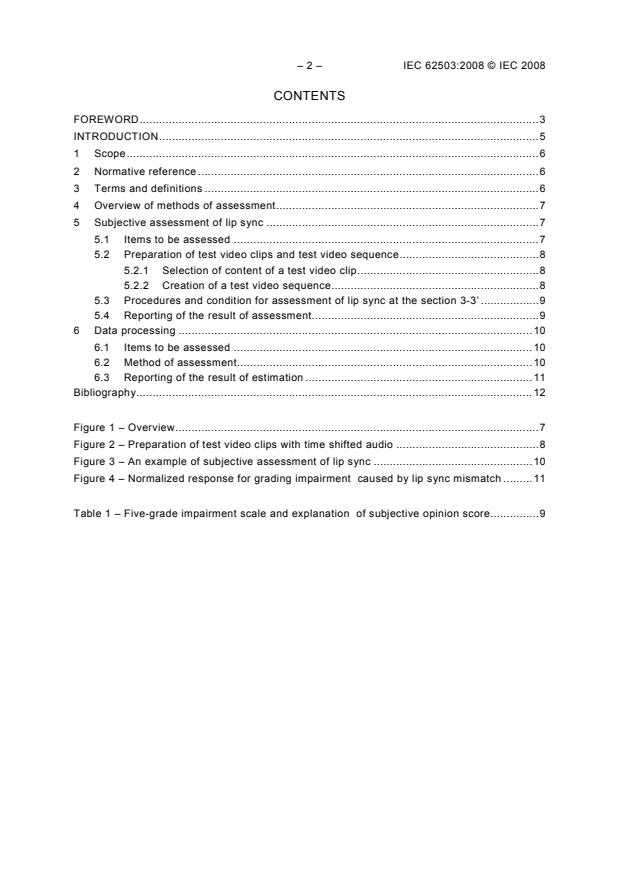
CONTENTS
FOREWORD.3
INTRODUCTION.5
1 Scope.6
2 Normative reference .6
3 Terms and definitions .6
4 Overview of methods of assessment.7
5 Subjective assessment of lip sync .7
5.1 Items to be assessed .7
5.2 Preparation of test video clips and test video sequence.8
5.2.1 Selection of content of a test video clip.8
5.2.2 Creation of a test video sequence.8
5.3 Procedures and condition for assessment of lip sync at the section 3-3’ .9
5.4 Reporting of the result of assessment.9
6 Data processing .10
6.1 Items to be assessed .10
6.2 Method of assessment.10
6.3 Reporting of the result of estimation .11
Bibliography.12
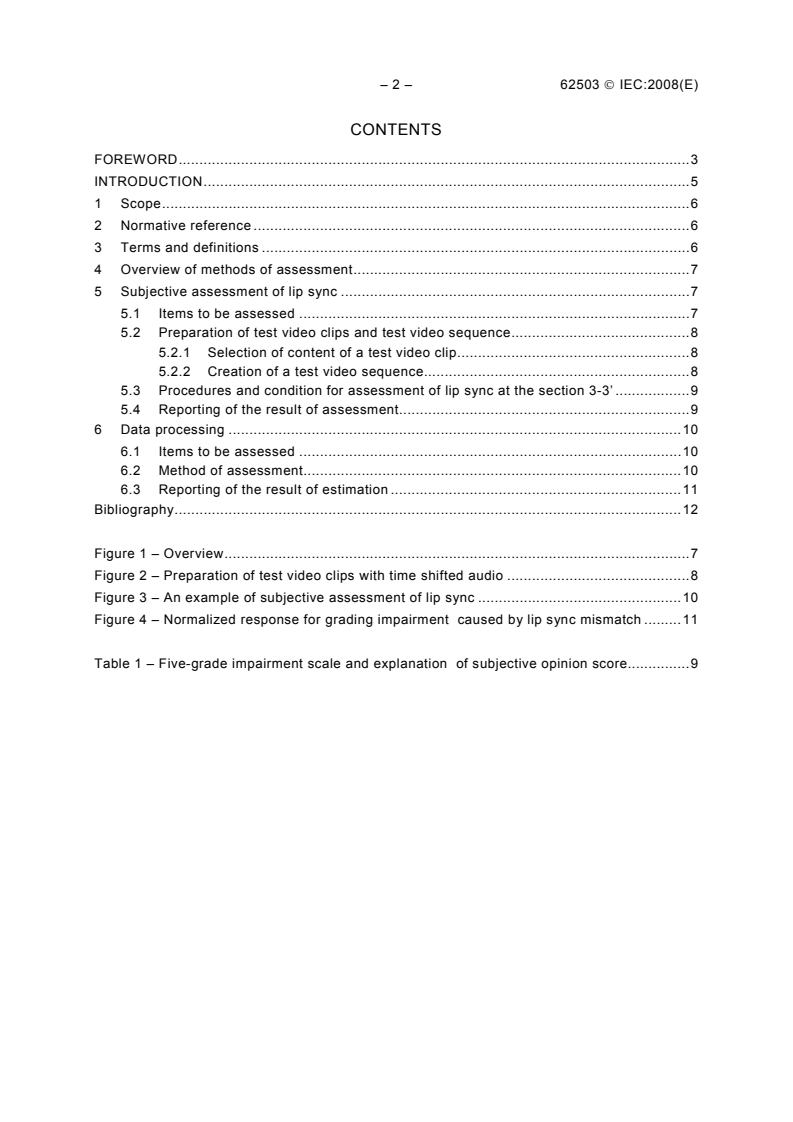
Figure 1 – Overview.7
Figure 2 – Preparation of test video clips with time shifted audio .8
Figure 3 – An example of subjective assessment of lip sync .10
Figure 4 – Normalized response for grading impairment caused by lip sync mismatch .11
Table 1 – Five-grade impairment scale and explanation of subjective opinion score.9
62503 © IEC:2008(E) – 3 –
INTERNATIONAL ELECTROTECHNICAL COMMISSION
____________
MULTIMEDIA QUALITY –
METHOD OF ASSESSMENT OF
SYNCHRONIZATION OF AUDIO AND VIDEO
FOREWORD
1) The International Electrotechnical Commission (IEC) is a worldwide organization for standardization comprising
all national electrotechnical committees (IEC National Committees). The object of IEC is to promote
international co-operation on all questions concerning standardization in the electrical and electronic fields. To
this end and in addition to other activities, IEC publishes International Standards, Technical Specifications,
Technical Reports, Publicly Available Specifications (PAS) and Guides (hereafter referred to as “IEC
Publication(s)”). Their preparation is entrusted to technical committees; any IEC National Committee interested
in the subject dealt with may participate in this preparatory work. International, governmental and non-
governmental organizations liaising with the IEC also participate in this preparation. IEC collaborates closely
with the International Organization for Standardization (ISO) in accordance with conditions determined by
agreement between the two organizations.
2) The formal decisions or agreements of IEC on technical matters express, as nearly as possible, an international
consensus of opinion on the relevant subjects since each technical committee has representation from all
interested IEC National Committees.
3) IEC Publications have the form of recommendations for international use and are accepted by IEC National
Committees in that sense. While all reasonable efforts are made to ensure that the technical content of IEC
Publications is accurate, IEC cannot be held responsible for the way in which they are used or for any
misinterpretation by any end user.
4) In order to promote international uniformity, IEC National Committees undertake to apply IEC Publications
transparently to the maximum extent possible in their national and regional publications. Any divergence
between any IEC Publication and the corresponding national or regional publication shall be clearly indicated in
the latter.
5) IEC provides no marking procedure to indicate its approval and cannot be rendered responsible for any
equipment declared to be in conformity with an IEC Publication.
6) All users should ensure that they have the latest edition of this publication.
7) No liability shall attach to IEC or its directors, employees, servants or agents including individual experts and
members of its technical committees and IEC National Committees for any personal injury, property damage or
other damage of any nature whatsoever, whether direct or indirect, or for costs (including legal fees) and
expenses arising out of the publication, use of, or reliance upon, this IEC Publication or any other IEC
Publications.
8) Attention is drawn to the Normative references cited in this publication. Use of the referenced publications is
indispensable for the correct application of this publication.
9) Attention is drawn to the possibility that some of the elements of this IEC Publication may be the subject of
patent rights. IEC shall not be held responsible for identifying any or all such patent rights.
International Standard IEC 62503 has been prepared by technical area 11: Quality for audio,
video and multimedia systems, of IEC technical committee 100: Audio, video and multimedia
systems and equipment.
The text of this standard is based on the following documents:
CDV Report on voting
100/1277/CDV 100/1358/RVC
Full information on the voting for the approval of this standard can be found in the report on
voting indicated in the above table.
This publication has been drafted in accordance with the ISO/IEC Directives, Part 2.
– 4 – 62503 © IEC:2008(E)
The committee has decided that the contents of this publication will remain unchanged until
the maintenance result date indicated on the IEC web site under "http://webstore.iec.ch" in
the data related to the specific publication. At this date, the publication will be
• reconfirmed,
• withdrawn,
• replaced by a revised edition, or
• amended.
A bilingual version of this publication may be issued at a later date.
62503 © IEC:2008(E) – 5 –
INTRODUCTION
Contemporary multimedia systems are realized by digital technology. Depending on what
digital processing is being applied, time delays differ among medium channels for
reproduction as perceptible stimulus for a human audience. An example is video delay against
audio, which is identified by such terms as lip sync or AV-sync. Video delay against audio will
be inevitable for large sized displays, because necessary time for rendering and visualization
will be proportional to the number of picture elements.
There should also be additional factors to be considered. They include synchronization
problem during medium gathering, production, post-production, processing in various aspects
to combine these multiple media and to be sent out or recorded as “multimedia”.
There is a need for international standards to provide the following three related
methodologies:
a) an objective method of measurement for difference of delays between reproduced audio
and video (lip sync) by multimedia systems and equipment,
b) a subjective (or perceptible) and statistical method of assessment of overall difference of
delays between a real world and a reproduced scene and sound,
c) a method of estimation of implied difference of delays inherent in multimedia received,
recorded or under reproduction.
This International Standard addresses the item b) using typical multimedia content such as
bust shots of news casters because of easiness in defining synchronization of audio and
video. Since a range of perceptibly allowable miss-synchronization and sensitivity of human
audience for lead and delayed audio against accompanied video depends on human
sensation and the conditions for assessment, a clearly defined method of assessment of such
characteristics should be standardised.
This International Standard is intended to supplement Recommendation ITU-R BT.1359-1,
[1] , as well as partly answer the request of ITU-R to IEC that has been stated in
Recommendation ITU-R BT.1377 [2].
Technical contents are based on a study in Faculty of Engineering, Chiba University in Japan,
conducted in April 2006.
___________
Numbers in square brackets refer to the Bibliography.
– 6 – 62503 © IEC:2008(E)
MULTIMEDIA QUALITY –
METHOD OF ASSESSMENT OF
SYNCHRONIZATION OF AUDIO AND VIDEO
1 Scope
This International Standard provides a subjective (or perceptible) and statistical method of
assessment of overall, or end-to-end, difference of delays between real world and reproduced
scenes in terms of video and accompanying audio recoded in a medium.
This International Standard does not specify limiting values for those results obtained by the
app
...
IEC 62503 ®
Edition 1.0 2008-09
INTERNATIONAL
STANDARD
NORME
INTERNATIONALE
colour
inside
Multimedia quality – Method of assessment of synchronization of audio and
video
Qualité pour les systèmes multimédia – Méthode d'évaluation de la
synchronisation de l'audio et de la vidéo
All rights reserved. Unless otherwise specified, no part of this publication may be reproduced or utilized in any form
or by any means, electronic or mechanical, including photocopying and microfilm, without permission in writing from
either IEC or IEC's member National Committee in the country of the requester. If you have any questions about IEC
copyright or have an enquiry about obtaining additional rights to this publication, please contact the address below or
your local IEC member National Committee for further information.
Droits de reproduction réservés. Sauf indication contraire, aucune partie de cette publication ne peut être reproduite
ni utilisée sous quelque forme que ce soit et par aucun procédé, électronique ou mécanique, y compris la photocopie
et les microfilms, sans l'accord écrit de l'IEC ou du Comité national de l'IEC du pays du demandeur. Si vous avez des
questions sur le copyright de l'IEC ou si vous désirez obtenir des droits supplémentaires sur cette publication, utilisez
les coordonnées ci-après ou contactez le Comité national de l'IEC de votre pays de résidence.
IEC Central Office Tel.: +41 22 919 02 11
3, rue de Varembé Fax: +41 22 919 03 00
CH-1211 Geneva 20 info@iec.ch
Switzerland www.iec.ch
About the IEC
The International Electrotechnical Commission (IEC) is the leading global organization that prepares and publishes
International Standards for all electrical, electronic and related technologies.
About IEC publications
The technical content of IEC publications is kept under constant review by the IEC. Please make sure that you have the
latest edition, a corrigenda or an amendment might have been published.
IEC Catalogue - webstore.iec.ch/catalogue Electropedia - www.electropedia.org
The stand-alone application for consulting the entire The world's leading online dictionary of electronic and
bibliographical information on IEC International Standards, electrical terms containing more than 30 000 terms and
Technical Specifications, Technical Reports and other definitions in English and French, with equivalent terms in 14
documents. Available for PC, Mac OS, Android Tablets and additional languages. Also known as the International
iPad. Electrotechnical Vocabulary (IEV) online.
IEC publications search - www.iec.ch/searchpub IEC Glossary - std.iec.ch/glossary
The advanced search enables to find IEC publications by a More than 55 000 electrotechnical terminology entries in
variety of criteria (reference number, text, technical English and French extracted from the Terms and Definitions
committee,…). It also gives information on projects, replaced clause of IEC publications issued since 2002. Some entries
and withdrawn publications. have been collected from earlier publications of IEC TC 37,
77, 86 and CISPR.
IEC Just Published - webstore.iec.ch/justpublished
Stay up to date on all new IEC publications. Just Published IEC Customer Service Centre - webstore.iec.ch/csc
details all new publications released. Available online and If you wish to give us your feedback on this publication or
also once a month by email. need further assistance, please contact the Customer Service
Centre: csc@iec.ch.
A propos de l'IEC
La Commission Electrotechnique Internationale (IEC) est la première organisation mondiale qui élabore et publie des
Normes internationales pour tout ce qui a trait à l'électricité, à l'électronique et aux technologies apparentées.
A propos des publications IEC
Le contenu technique des publications IEC est constamment revu. Veuillez vous assurer que vous possédez l’édition la
plus récente, un corrigendum ou amendement peut avoir été publié.
Catalogue IEC - webstore.iec.ch/catalogue Electropedia - www.electropedia.org
Application autonome pour consulter tous les renseignements
Le premier dictionnaire en ligne de termes électroniques et
bibliographiques sur les Normes internationales,
électriques. Il contient plus de 30 000 termes et définitions en
Spécifications techniques, Rapports techniques et autres
anglais et en français, ainsi que les termes équivalents dans
documents de l'IEC. Disponible pour PC, Mac OS, tablettes
14 langues additionnelles. Egalement appelé Vocabulaire
Android et iPad.
Electrotechnique International (IEV) en ligne.
Recherche de publications IEC - www.iec.ch/searchpub
Glossaire IEC - std.iec.ch/glossary
La recherche avancée permet de trouver des publications IEC Plus de 55 000 entrées terminologiques électrotechniques, en
en utilisant différents critères (numéro de référence, texte, anglais et en français, extraites des articles Termes et
comité d’études,…). Elle donne aussi des informations sur les Définitions des publications IEC parues depuis 2002. Plus
projets et les publications remplacées ou retirées. certaines entrées antérieures extraites des publications des
CE 37, 77, 86 et CISPR de l'IEC.
IEC Just Published - webstore.iec.ch/justpublished
Service Clients - webstore.iec.ch/csc
Restez informé sur les nouvelles publications IEC. Just
Published détaille les nouvelles publications parues. Si vous désirez nous donner des commentaires sur cette
Disponible en ligne et aussi une fois par mois par email. publication ou si vous avez des questions contactez-nous:
csc@iec.ch.
IEC 62503 ®
Edition 1.0 2008-09
INTERNATIONAL
STANDARD
NORME
INTERNATIONALE
colour
inside
Multimedia quality – Method of assessment of synchronization of audio and
video
Qualité pour les systèmes multimédia – Méthode d'évaluation de la
synchronisation de l'audio et de la vidéo
INTERNATIONAL
ELECTROTECHNICAL
COMMISSION
COMMISSION
ELECTROTECHNIQUE
PRICE CODE
INTERNATIONALE
CODE PRIX M
ICS 33.160.01 ISBN 978-2-8322-1359-9
– 2 – IEC 62503:2008 © IEC 2008
CONTENTS
FOREWORD . 3
INTRODUCTION . 5
1 Scope . 6
2 Normative reference . 6
3 Terms and definitions . 6
4 Overview of methods of assessment . 7
5 Subjective assessment of lip sync . 7
5.1 Items to be assessed . 7
5.2 Preparation of test video clips and test video sequence . 8
5.2.1 Selection of content of a test video clip . 8
5.2.2 Creation of a test video sequence. 8
5.3 Procedures and condition for assessment of lip sync at the section 3-3’ . 9
5.4 Reporting of the result of assessment. 9
6 Data processing . 10
6.1 Items to be assessed . 10
6.2 Method of assessment. 10
6.3 Reporting of the result of estimation . 11
Bibliography . 12
Figure 1 – Overview . 7
Figure 2 – Preparation of test video clips with time shifted audio . 8
Figure 3 – An example of subjective assessment of lip sync . 10
Figure 4 – Normalized response for grading impairment caused by lip sync mismatch . 11
Table 1 – Five-grade impairment scale and explanation of subjective opinion score. 9
INTERNATIONAL ELECTROTECHNICAL COMMISSION
____________
MULTIMEDIA QUALITY –
METHOD OF ASSESSMENT OF
SYNCHRONIZATION OF AUDIO AND VIDEO
FOREWORD
1) The International Electrotechnical Commission (IEC) is a worldwide organization for standardization comprising
all national electrotechnical committees (IEC National Committees). The object of IEC is to promote
international co-operation on all questions concerning standardization in the electrical and electronic fields. To
this end and in addition to other activities, IEC publishes International Standards, Technical Specifications,
Technical Reports, Publicly Available Specifications (PAS) and Guides (hereafter referred to as “IEC
Publication(s)”). Their preparation is entrusted to technical committees; any IEC National Committee interested
in the subject dealt with may participate in this preparatory work. International, governmental and non-
governmental organizations liaising with the IEC also participate in this preparation. IEC collaborates closely
with the International Organization for Standardization (ISO) in accordance with conditions determined by
agreement between the two organizations.
2) The formal decisions or agreements of IEC on technical matters express, as nearly as possible, an international
consensus of opinion on the relevant subjects since each technical committee has representation from all
interested IEC National Committees.
3) IEC Publications have the form of recommendations for international use and are accepted by IEC National
Committees in that sense. While all reasonable efforts are made to ensure that the technical content of IEC
Publications is accurate, IEC cannot be held responsible for the way in which they are used or for any
misinterpretation by any end user.
4) In order to promote international uniformity, IEC National Committees undertake to apply IEC Publications
transparently to the maximum extent possible in their national and regional publications. Any divergence
between any IEC Publication and the corresponding national or regional publication shall be clearly indicated in
the latter.
5) IEC provides no marking procedure to indicate its approval and cannot be rendered responsible for any
equipment declared to be in conformity with an IEC Publication.
6) All users should ensure that they have the latest edition of this publication.
7) No liability shall attach to IEC or its directors, employees, servants or agents including individual experts and
members of its technical committees and IEC National Committees for any personal injury, property damage or
other damage of any nature whatsoever, whether direct or indirect, or for costs (including legal fees) and
expenses arising out of the publication, use of, or reliance upon, this IEC Publication or any other IEC
Publications.
8) Attention is drawn to the Normative references cited in this publication. Use of the referenced publications is
indispensable for the correct application of this publication.
9) Attention is drawn to the possibility that some of the elements of this IEC Publication may be the subject of
patent rights. IEC shall not be held responsible for identifying any or all such patent rights.
International Standard IEC 62503 has been prepared by technical area 11: Quality for audio,
video and multimedia systems, of IEC technical committee 100: Audio, video and multimedia
systems and equipment.
This bilingual version (2014-04) corresponds to the monolingual English version, published in
2008-09.
The text of this standard is based on the following documents:
CDV Report on voting
100/1277/CDV 100/1358/RVC
Full information on the voting for the approval of this standard can be found in the report on
voting indicated in the above table.
The French version of this standard has not been voted upon.
– 4 – IEC 62503:2008 © IEC 2008
This publication has been drafted in accordance with the ISO/IEC Directives, Part 2.
The committee has decided that the contents of this publication will remain unchanged until
the maintenance result date indicated on the IEC web site under "http://webstore.iec.ch" in
the data related to the specific publication. At this date, the publication will be
• reconfirmed,
• withdrawn,
• replaced by a revised edition, or
• amended.
IMPORTANT – The 'colour inside' logo on the cover page of this publication indicates
that it contains colours which are considered to be useful for the correct
understanding of its contents. Users should therefore print this document using a
colour printer.
INTRODUCTION
Contemporary multimedia systems are realized by digital technology. Depending on what
digital processing is being applied, time delays differ among medium channels for
reproduction as perceptible stimulus for a human audience. An example is video delay against
audio, which is identified by such terms as lip sync or AV-sync. Video delay against audio will
be inevitable for large sized displays, because necessary time for rendering and visualization
will be proportional to the number of picture elements.
There should also be additional factors to be considered. They include synchronization
problem during medium gathering, production, post-production, processing in various aspects
to combine these multiple media and to be sent out or recorded as “multimedia”.
There is a need for international standards to provide the following three related
methodologies:
a) an objective method of measurement for difference of delays between reproduced audio
and video (lip sync) by multimedia systems and equipment,
b) a subjective (or perceptible) and statistical method of assessment of overall difference of
delays between a real world and a reproduced scene and sound,
c) a method of estimation of implied difference of delays inherent in multimedia received,
recorded or under reproduction.
This International Standard addresses the item b) using typical multimedia content such as
bust shots of news casters because of easiness in defining synchronization of audio and
video. Since a range of perceptibly allowable miss-synchronization and sensitivity of human
audience for lead and delayed audio against accompanied video depends on human
sensation and the conditions for assessment, a clearly defined method of assessment of such
characteristics should be standardised.
This International Standard is intended to supplement Recommendation ITU-R BT.1359-1,
[1] , as well as partly answer the request of ITU-R to IEC that has been stated in
Recommendation ITU-R BT.1377 [2].
Technical contents are based on a study in Faculty of Engineering, Chiba University in Japan,
conducted in April 2006.
___________
Numbers in square brackets refer to the Bibliography.
– 6 – IEC 62503:2008 © IEC 2008
MULTIMEDIA QUALITY –
METHOD OF ASSESSMENT OF
SYNCHRONIZATION OF AUDIO AND VIDEO
1 Scope
This International Standard provides a subjective (or perceptible) and statistical method of
assessment of overall, or end-to-end, difference of delays between real world and reproduced
scenes in terms of video and accompanying audio recoded in a medium.
This International Standard does not specify limiting values for those results obtained by the
application of the provisions in this standard. It excludes applications to professional
broadcast systems.
2 Normative reference
The following referenced document is indispensable for the application of this document. For
dated references, only the edition cited applies. For undated references, the latest edition of
the referenced document (including any amendments) applies.
ITU-R BT.500-11:2002, Methodology for the subjective assessment of the quality of television
pictures
3 Terms and definitions
For the purposes of this document, the following terms and definitions apply.
3.1
lip sync
video delay against accompanying audio
3.2
outlier
subjective opinion score outside ms± , where m is a sample mean of the original scores of a
set of subjects for the same video delay and s is a standard deviation of the scores
3.3
subject
ordinary untrained human audience of audio and video reproduction; random sample of
individual members of general public
3.4
test video clip
short duration of video frames with accompanying audio to be used as original
3.5
test video sequence
random series of test video clips where the audio channels are shifted in time compared to
the original
4 Overview of methods of assessment
Figure 1 depicts overview of possible objective methods of measurement and subjective
method of assessment to acquire necessary parameters corresponding to lip sync.
0 1 2 3
A Decompression and A'
Encoding and
reproduction
compression
Listen
V V'
Encoding and Decompression and
compression reproduction
Speak and act
Watch
0' 1' 2' 3'
∆t = 0 ∆t ∆t ∆t
0 1 2 3
IEC 1487/08
Figure 1 – Overview
The leftmost in Figure 1 is a real world and the rightmost in Figure 1 is a reproduced world.
Lip sync at the section 0-0’, i.e. scene delay in reference to accompanying sound, is normally
zero; in other words null video delay against accompanying audio is expected; ∆t =0 . Where
∆t ≠ 0 is foreseen, it shall also be taken into account.
Lip sync at the section 1-1’ is supposed to be introduced by separate acquisition of physical
phenomena by microphones and video cameras followed by yet further separate digital
processing for audio and video data. It will cause lip sync of ∆≠t 0 .
NOTE In case of MPEG-2 encoding, there is the scheme of synchronization using Decoding Time Stamp (DTS) as
well as Presentation Time Stamp (PTS) embedded in the header of Packetized Elementary Stream (PES). See
ISO/IEC 13818-1 [11].
Lip sync at the section 2-2’ is supposed to be introduced by reproduction process for audio
and video channels separately such as decompression, rendering and reproduction. It will
cause lip sync of ∆≠t 0 , which can be measured using a reference test multimedia material
with ∆=t 0 .
Lip sync at the section 3-3’ is in the reproduced multimedia world and assessed by human
subjects. Subjective opinion scores on lip sync are statistically analyzed to find estimated
value for ∆≠t 0 ; corresponding to the amount of compensation for just-synchronized
reproduction.
5 Subjective assessment of lip sync
5.1 Items to be assessed
Subjective grading level of miss-synchronization of video and audio.
– 8 – IEC 62503:2008 © IEC 2008
5.2 Preparation of test video clips and test video sequence
5.2.1 Selection of content of a test video clip
Since lip sync is a kind of human perception, it may depend on the contents of the video and
accompanying audio. Especially when it is related to movement of lips of a human speaker, a
match between a spoken language and a mother tongue may affect the result.
NOTE In this International Standard, in order to provide worked examples, speech in Japanese language uttered
by a well trained processional news reader is watched and listened to by the subjects with the same mother tongue.
A bust shot of a news reader shall be extracted, duration of which should be around 10 s to
20 s. Data of audio channel of the video clip shall be taken as the timing reference.
Possible amount of time caused by miss-synchronization in this original video clip, ∆t at the
section 1-1’, is unknown. However, this international standard provides the method to
estimate overall lip sync ∆t including ∆t and ∆t . Namely, ∆t = ∆t +∆t +∆t .
3 0 1 3 0 12
5.2.2 Creation of a test video sequence
The test video sequence shall be a randomised series of the video clip selected in 5.2.1, in
which each of the audio channels shall be replaced by time-shifted audio data with necessary
duration of padding as a leader or a trailer depending on the direction of the time shift.
Preparation of such video clips is show in Figure 2 as in the image frames with delayed audio
and with led audio. The amount of time shifts and is subject to be adjusted.
T T
l d
Image
frames
Original
audio
T
0 l
Delayed
audio PADDING
T
d
Led
audio PADDING
IEC 1488/08
Figure 2 – Preparation of test video clips with time shifted audio
To allow for each of the video clips with the time-shifted audio composing the test video
sequence to be visually identified by a subject, each video clip prepared in accordance with
Figure 2 should be preceded by a necessary number of title frames which include a sequence
number.
The amount of time shifts for audio data, T andT , shall be determined taking into account
l d
the sum of the lip sync in reproduction system, ∆t , and possible lip sync in the original video
clip, ∆t . The amount of increment and decrement of the time shift ∆T for T or T shall be
1 l d
decided in accordance with precision of assessment.
In this standard, ∆T = 10 ms is recommended.
The test video sequence should be stored in a medium such as CD-ROM for use in 5.3
without losing audio-video synchronization.
5.3 Procedures and condition for assessment of lip sync at the section 3-3’
The procedures described below shall be followed.
a) The test video sequence being composed of randomized order of the same short video
clips of different time-shifted audio (plus and minus) in reference to video shall be
reproduced to subjects.
b) The number of the subjects shall be at least 15. Each of them shall be asked to report its
subjective opinion score for each of the video clips in the test video sequence under a
fixed viewing and audible condition.
c) An advance instruction to the subjects shall be provided on the five-grade impairment
scale recommended by ITU-R BT.500-11 for subjective judgement, as shown in Table 1.
Table 1 – Five-grade impairment scale and explanation
of subjective opinion score
Grade Explanation
5 Imperceptible (Complete agreement of audio and video)
4 Perceptible but not annoying (miss-synchronization is within the acceptable degree)
Slightly annoying (slight miss-synchronization is recognized)
2 Annoying (apparent miss-synchronization is recognized and beyond acceptable degree)
1 Very annoying (not synchronized at all)
d) Viewing distance of the reproduced test video sequence L shall be four times of
reproduction height H of video frames: LH= 4 .
e) Audio shall be reproduced by a headphone or a loudspeaker. Use of the headphone is
recommended to prevent any multi-path echo in a test room.
NOTE Taking into account the travel speed of sound waves, the time for the sound pressure of a speaker to
reach to ears of the observer should be regarded as an additional audio delay.
f) Illumination of a test room where the audio-video reproduction system is installed should
be around 300 lx with correlated colour temperature of about 6 500 K.
5.4 Reporting of the result of assessment
Taking into account outliers from the original five-grade opinion scores, averaged subjective
opinion scores shall be plotted against predetermined audio shift, T or −T , as exemplified in
l d
Figure 3, with error bars of mc± , where m is a sample mean of the opinion scores of a set of
subjects for the same video clip and c is a 95 % confidence interval of each of the respective
mean opinion scores.
The horizontal axis shall be the amount of time shifts of the audio channel or the value of T
l
in Figure 2.
– 10 – IEC 62503:2008 © IEC 2008
–150 –100 –50 0 50 100 150 200
Amount of time shifts of audio channel (ms)
IEC 1489/08
Figure 3 – An example of subjective assessment of lip sync
The report shall also include the following information:
a) description of a kind of audio and video source used in the assessment, such as spoken
language in case of a speech and duration of the test video clip;
b) the number of the subjects;
c) illumination level and correlated colour temperature of lighting used; and
d) the position and distance from the display and speakers to the observer, in case of
headphone not being used.
6 Data processing
6.1 Items to be assessed
Subjective time difference in milliseconds between reproduced video and associated audio.
6.2 Method of assessment
The mean opinion scores in the five-grade impairment scale reported in figure 3 shall be
regressed by the stepwise linear functions as shown by the set of equations (1) to (3).
g = a (t − t ) + g , for tt< (1)
1 1 0 1
g = g , for t ≤t ≤t (2)
0 12
g = a (t −t ) + g , for tt< (3)
2 2 0 2
Mean opinion score with confidence interval
in terms of Figure 1, should be
A horizontal coordinate value, or an estimate for ∆t
calculated as an intersection of the two lines defined by equation (1) and equation (3).
Namely, ∆t is expressed by equation (4).
at −a t
11 2 2
∆t = (4)
aa−
NOTE An amount of the lip sync, i.e. video delay against audio needed to be compensated falls between t and
t in equation (2). The value of ∆t calculated by equation (4) is one of possible estimates.
2 3
Figure 4 explains the scheme of the method of estimation by an example, in which the vertical
line at the intersection coordinate of the two lines corresponds to an estimated lip sync
compensation ∆t .
|∆t | = 102
–150 –100 –50 0 50 100 150 200
Amount of time shifts of audio channel (ms)
IEC 1490/08
Figure 4 – Normalized response for grading impairment
caused by lip sync mismatch
6.3 Reporting of the result of estimation
The amount of overall audio time shift to compensate lip sync obtained by the regression and
and
the extrapolation shall be reported in milliseconds together with the time parameters t t
1 2
as shown below.
t −3 ms
t = 152 ms
∆=t 102 ms
Mean opinion score
=
– 12 – IEC 62503:2008 © IEC 2008
Bibliography
[1] Recommendation ITU-R BT.1359-1: Relative timing of sound and vision for
broadcasting (1998)
[2] Recommendation ITU-R BT.1377: Labelling of video and audio apparatus throughput
(processing) delay (1998)
[3] ATSC Implementation Subcommittee Finding: Relative timing of sound and vision for
broadcast operations, Advanced Television Systems Committee Doc. IS-191 (26 June
2003)
[4] EBU Technical Recommendation R37-2007: The relative timing of the so
...