

IEC 61340-4-5:2018
(Main)Electrostatics - Part 4-5: Standard test methods for specific applications - Methods for characterizing the electrostatic protection of footwear and flooring in combination with a person
General Information
- Abstract
IEC 61340-4-5:2018 specifies test methods for evaluating electrostatic protection provided by a system of footwear and flooring in combination with a person. Test results are valid only for the specific footwear and flooring combination tested. The test methods are not intended for individual product qualification purposes. This edition includes the following significant technical changes with respect to the previous edition:
a) normative references have been updated;
b) Figure 2 has been improved and expanded to include actual examples of body voltage recordings, and text has been added to explain how to interpret recordings;
c) an alternative walking pattern has been added in an informative annex.
- Status
- Published
- Publication Date
- 11-Jan-2018
- Technical Committee
- TC 101 - Electrostatics
- Drafting Committee
- MT 9 - TC 101/MT 9
- Current Stage
- PPUB - Publication issued
- Start Date
- 12-Jan-2018
- Completion Date
- 19-Jan-2018
Buy Documents
IEC 61340-4-5:2018 RLV - Electrostatics - Part 4-5: Standard test methods for specific applications - Methods for characterizing the electrostatic protection of footwear and flooring in combination with a person Released:1/12/2018
IEC 61340-4-5:2018 - Electrostatics - Part 4-5: Standard test methods for specific applications - Methods for characterizing the electrostatic protection of footwear and flooring in combination with a person Released:1/12/2018
Overview
IEC 61340-4-5:2018 - "Electrostatics - Part 4-5: Standard test methods for specific applications - Methods for characterizing the electrostatic protection of footwear and flooring in combination with a person" - defines laboratory and on-site test procedures to evaluate how a person + footwear + flooring system controls electrostatic charge. The standard focuses on measuring electrical resistance and chargeability (via walking tests and body-voltage recordings) to characterise electrostatic protection. Test results apply only to the exact footwear/flooring combination tested and are not intended as standalone product qualification.
Key topics and technical requirements
- Scope: Test methods for characterizing electrostatic protection of a person wearing specific footwear on a specific floor covering. Results are combination‑specific.
- Measured parameters:
- Electrical resistance of the footwear/flooring/person system (setups and procedures described).
- Chargeability determined by a walking test and body‑voltage recordings (examples and guidance for interpretation included).
- Conditioning and environment: Laboratory conditioning is specified - typically (23 ± 2) °C and (12 ± 3) % relative humidity with at least 48 h conditioning (text gives additional pre‑conditioning guidance for textile floor coverings).
- Specimen preparation: Floor specimen dimensions and mounting rules (e.g., ~2 m × 1 m specimens) and handling of groundable points are specified to simulate end‑use.
- Test apparatus and procedures: Detailed setups for resistance and chargeability measurement, cleaning procedures for footwear, calibration/verification methods for body‑voltage systems (normative annex), and an informative annex with an alternative walking pattern.
- Important notes: Safety warning for electrical hazard precautions during testing. The edition includes updated normative references, improved body voltage figures for interpretation, and an added alternative walking pattern.
Practical applications
- ESD control verification: Assess combined performance of ESD footwear and flooring in electronics manufacturing, cleanrooms, semiconductor fabs, and assembly areas.
- Flooring and footwear selection: Support decision making when choosing floor coverings and ESD footwear to reduce triboelectric charging in sensitive environments.
- Site acceptance testing: On-site evaluation of installed floors in production areas where the floor will be used without separate earthing points.
- R&D and troubleshooting: Characterize charge generation during human movement to troubleshoot intermittent ESD events or validate mitigation strategies.
Who should use this standard
- ESD/cleanroom engineers, QA managers, test laboratories, flooring and footwear manufacturers, facilities/plant engineers, and safety officers responsible for electrostatic discharge control.
Related standards
- IEC 61340-4-1 (electrical resistance of floor coverings and installed floors)
- IEC 61340-1-2 (terms/definitions related to electrostatics)
- IEC 60093, IEC 62631-3-1 (resistivity test methods)
- ISO 1957 (floor covering specimen selection)
Keywords: IEC 61340-4-5, electrostatic protection, footwear and flooring, test methods, chargeability, electrical resistance, body voltage, ESD control.
Relations
- Effective Date
- 05-Sep-2023
Buy Documents
IEC 61340-4-5:2018 RLV - Electrostatics - Part 4-5: Standard test methods for specific applications - Methods for characterizing the electrostatic protection of footwear and flooring in combination with a person Released:1/12/2018
IEC 61340-4-5:2018 - Electrostatics - Part 4-5: Standard test methods for specific applications - Methods for characterizing the electrostatic protection of footwear and flooring in combination with a person Released:1/12/2018
Get Certified
Connect with accredited certification bodies for this standard

IMQ S.p.A. (Certification)
Italian electrical product certification.

SLG Prüf- und Zertifizierungs GmbH
German testing and certification body.

UL Solutions
Global safety science company with testing, inspection and certification.
Sponsored listings
Frequently Asked Questions
IEC 61340-4-5:2018 is a standard published by the International Electrotechnical Commission (IEC). Its full title is "Electrostatics - Part 4-5: Standard test methods for specific applications - Methods for characterizing the electrostatic protection of footwear and flooring in combination with a person". This standard covers: IEC 61340-4-5:2018 specifies test methods for evaluating electrostatic protection provided by a system of footwear and flooring in combination with a person. Test results are valid only for the specific footwear and flooring combination tested. The test methods are not intended for individual product qualification purposes. This edition includes the following significant technical changes with respect to the previous edition: a) normative references have been updated; b) Figure 2 has been improved and expanded to include actual examples of body voltage recordings, and text has been added to explain how to interpret recordings; c) an alternative walking pattern has been added in an informative annex.
IEC 61340-4-5:2018 specifies test methods for evaluating electrostatic protection provided by a system of footwear and flooring in combination with a person. Test results are valid only for the specific footwear and flooring combination tested. The test methods are not intended for individual product qualification purposes. This edition includes the following significant technical changes with respect to the previous edition: a) normative references have been updated; b) Figure 2 has been improved and expanded to include actual examples of body voltage recordings, and text has been added to explain how to interpret recordings; c) an alternative walking pattern has been added in an informative annex.
IEC 61340-4-5:2018 is classified under the following ICS (International Classification for Standards) categories: 17.220.99 - Other standards related to electricity and magnetism; 29.020 - Electrical engineering in general; 61.060 - Footwear. The ICS classification helps identify the subject area and facilitates finding related standards.
IEC 61340-4-5:2018 has the following relationships with other standards: It is inter standard links to IEC 61340-4-5:2004. Understanding these relationships helps ensure you are using the most current and applicable version of the standard.
IEC 61340-4-5:2018 is available in PDF format for immediate download after purchase. The document can be added to your cart and obtained through the secure checkout process. Digital delivery ensures instant access to the complete standard document.
Standards Content (Sample)
IEC 61340-4-5 ®
Edition 2.0 2018-01
REDLINE VERSION
INTERNATIONAL
STANDARD
colour
inside
Electrostatics –
Part 4-5: Standard test methods for specific applications – Methods for
characterizing the electrostatic protection of footwear and flooring in
combination with a person
All rights reserved. Unless otherwise specified, no part of this publication may be reproduced or utilized in any form
or by any means, electronic or mechanical, including photocopying and microfilm, without permission in writing from
either IEC or IEC's member National Committee in the country of the requester. If you have any questions about IEC
copyright or have an enquiry about obtaining additional rights to this publication, please contact the address below or
your local IEC member National Committee for further information.
IEC Central Office Tel.: +41 22 919 02 11
3, rue de Varembé info@iec.ch
CH-1211 Geneva 20 www.iec.ch
Switzerland
About the IEC
The International Electrotechnical Commission (IEC) is the leading global organization that prepares and publishes
International Standards for all electrical, electronic and related technologies.
About IEC publications
The technical content of IEC publications is kept under constant review by the IEC. Please make sure that you have the
latest edition, a corrigenda or an amendment might have been published.
IEC Catalogue - webstore.iec.ch/catalogue Electropedia - www.electropedia.org
The stand-alone application for consulting the entire The world's leading online dictionary of electronic and
bibliographical information on IEC International Standards, electrical terms containing 21 000 terms and definitions in
Technical Specifications, Technical Reports and other English and French, with equivalent terms in 16 additional
documents. Available for PC, Mac OS, Android Tablets and languages. Also known as the International Electrotechnical
iPad. Vocabulary (IEV) online.
IEC publications search - webstore.iec.ch/advsearchform IEC Glossary - std.iec.ch/glossary
The advanced search enables to find IEC publications by a 67 000 electrotechnical terminology entries in English and
variety of criteria (reference number, text, technical French extracted from the Terms and Definitions clause of
committee,…). It also gives information on projects, replaced IEC publications issued since 2002. Some entries have been
and withdrawn publications. collected from earlier publications of IEC TC 37, 77, 86 and
CISPR.
IEC Just Published - webstore.iec.ch/justpublished
Stay up to date on all new IEC publications. Just Published IEC Customer Service Centre - webstore.iec.ch/csc
details all new publications released. Available online and If you wish to give us your feedback on this publication or
also once a month by email. need further assistance, please contact the Customer Service
Centre: sales@iec.ch.
IEC 61340-4-5 ®
Edition 2.0 2018-01
REDLINE VERSION
INTERNATIONAL
STANDARD
colour
inside
Electrostatics –
Part 4-5: Standard test methods for specific applications – Methods for
characterizing the electrostatic protection of footwear and flooring in
combination with a person
INTERNATIONAL
ELECTROTECHNICAL
COMMISSION
ICS 17.220.99; 29.020; 61.060 ISBN 978-2-8322-5278-9
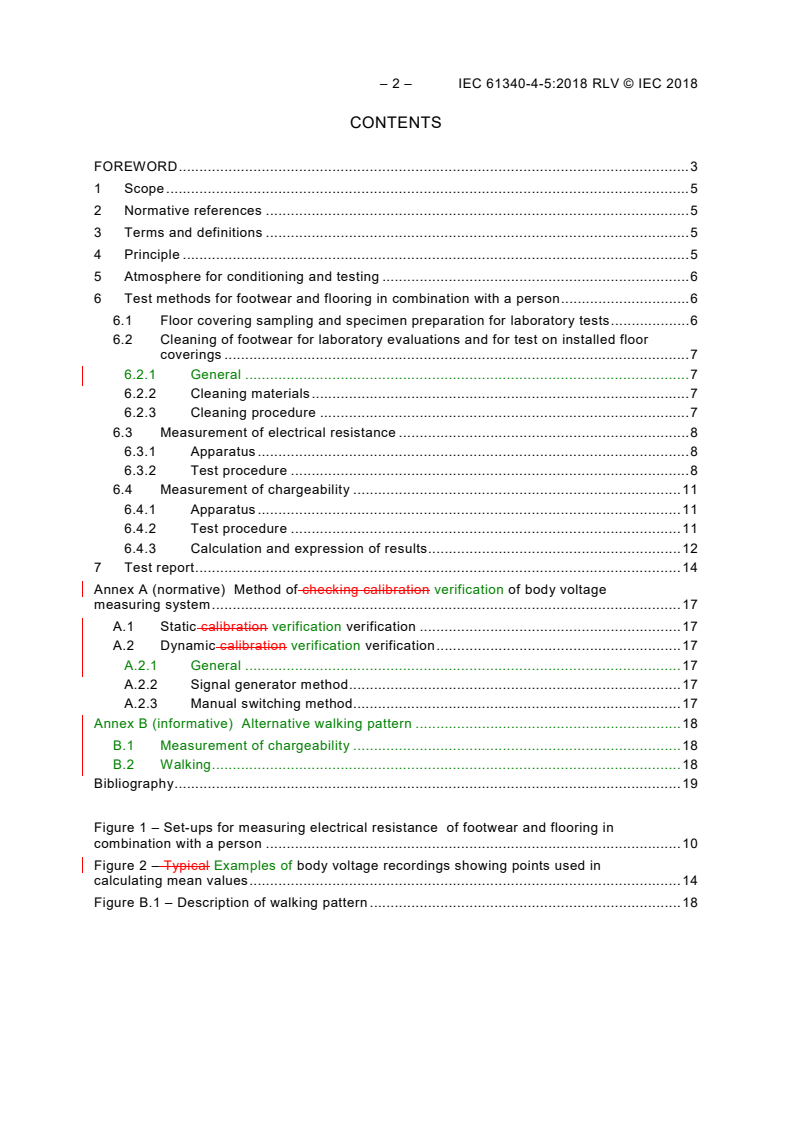
– 2 – IEC 61340-4-5:2018 RLV © IEC 2018
CONTENTS
FOREWORD . 3
1 Scope . 5
2 Normative references . 5
3 Terms and definitions . 5
4 Principle . 5
5 Atmosphere for conditioning and testing . 6
6 Test methods for footwear and flooring in combination with a person . 6
6.1 Floor covering sampling and specimen preparation for laboratory tests . 6
6.2 Cleaning of footwear for laboratory evaluations and for test on installed floor
coverings . 7
6.2.1 General . 7
6.2.2 Cleaning materials . 7
6.2.3 Cleaning procedure . 7
6.3 Measurement of electrical resistance . 8
6.3.1 Apparatus . 8
6.3.2 Test procedure . 8
6.4 Measurement of chargeability . 11
6.4.1 Apparatus . 11
6.4.2 Test procedure . 11
6.4.3 Calculation and expression of results. 12
7 Test report . 14
Annex A (normative) Method of checking calibration verification of body voltage
measuring system . 17
A.1 Static calibration verification verification . 17
A.2 Dynamic calibration verification verification . 17
A.2.1 General . 17
A.2.2 Signal generator method . 17
A.2.3 Manual switching method. 17
Annex B (informative) Alternative walking pattern . 18
B.1 Measurement of chargeability . 18
B.2 Walking . 18
Bibliography . 19
Figure 1 – Set-ups for measuring electrical resistance of footwear and flooring in
combination with a person . 10
Figure 2 – Typical Examples of body voltage recordings showing points used in
calculating mean values . 14
Figure B.1 – Description of walking pattern . 18
INTERNATIONAL ELECTROTECHNICAL COMMISSION
____________
ELECTROSTATICS –
Part 4-5: Standard test methods for specific applications – Methods
for characterizing the electrostatic protection of footwear
and flooring in combination with a person
FOREWORD
1) The International Electrotechnical Commission (IEC) is a worldwide organization for standardization comprising
all national electrotechnical committees (IEC National Committees). The object of IEC is to promote
international co-operation on all questions concerning standardization in the electrical and electronic fields. To
this end and in addition to other activities, IEC publishes International Standards, Technical Specifications,
Technical Reports, Publicly Available Specifications (PAS) and Guides (hereafter referred to as “IEC
Publication(s)”). Their preparation is entrusted to technical committees; any IEC National Committee interested
in the subject dealt with may participate in this preparatory work. International, governmental and non-
governmental organizations liaising with the IEC also participate in this preparation. IEC collaborates closely
with the International Organization for Standardization (ISO) in accordance with conditions determined by
agreement between the two organizations.
2) The formal decisions or agreements of IEC on technical matters express, as nearly as possible, an international
consensus of opinion on the relevant subjects since each technical committee has representation from all
interested IEC National Committees.
3) IEC Publications have the form of recommendations for international use and are accepted by IEC National
Committees in that sense. While all reasonable efforts are made to ensure that the technical content of IEC
Publications is accurate, IEC cannot be held responsible for the way in which they are used or for any
misinterpretation by any end user.
4) In order to promote international uniformity, IEC National Committees undertake to apply IEC Publications
transparently to the maximum extent possible in their national and regional publications. Any divergence
between any IEC Publication and the corresponding national or regional publication shall be clearly indicated in
the latter.
5) IEC itself does not provide any attestation of conformity. Independent certification bodies provide conformity
assessment services and, in some areas, access to IEC marks of conformity. IEC is not responsible for any
services carried out by independent certification bodies.
6) All users should ensure that they have the latest edition of this publication.
7) No liability shall attach to IEC or its directors, employees, servants or agents including individual experts and
members of its technical committees and IEC National Committees for any personal injury, property damage or
other damage of any nature whatsoever, whether direct or indirect, or for costs (including legal fees) and
expenses arising out of the publication, use of, or reliance upon, this IEC Publication or any other IEC
Publications.
8) Attention is drawn to the Normative references cited in this publication. Use of the referenced publications is
indispensable for the correct application of this publication.
9) Attention is drawn to the possibility that some of the elements of this IEC Publication may be the subject of
patent rights. IEC shall not be held responsible for identifying any or all such patent rights.
This redline version of the official IEC Standard allows the user to identify the changes
made to the previous edition. A vertical bar appears in the margin wherever a change
has been made. Additions are in green text, deletions are in strikethrough red text.
– 4 – IEC 61340-4-5:2018 RLV © IEC 2018
International Standard IEC 61340-4-5 has been prepared by IEC technical committee 101:
Electrostatics.
This second edition cancels and replaces the first edition published in 2004. This edition
constitutes a technical revision.
This edition includes the following significant technical changes with respect to the previous
edition:
a) normative references have been updated;
b) Figure 2 has been improved and expanded to include actual examples of body voltage
recordings, and text has been added to explain how to interpret recordings;
c) an alternative walking pattern has been added in an informative annex.
The text of this International Standard is based on the following documents:
FDIS Report on voting
101/545/FDIS 101/552/RVD
Full information on the voting for the approval of this International Standard can be found in
the report on voting indicated in the above table.
This document has been drafted in accordance with the ISO/IEC Directives, Part 2.
A list of all the parts in the IEC 61340 series, published under the general title Electrostatics,
can be found on the IEC website.
The committee has decided that the contents of this document will remain unchanged until the
stability date indicated on the IEC website under "http://webstore.iec.ch" in the data related to
the specific document. At this date, the document will be
• reconfirmed,
• withdrawn,
• replaced by a revised edition, or
• amended.
IMPORTANT – The 'colour inside' logo on the cover page of this publication indicates
that it contains colours which are considered to be useful for the correct
understanding of its contents. Users should therefore print this document using a
colour printer.
ELECTROSTATICS –
Part 4-5: Standard test methods for specific applications – Methods
for characterizing the electrostatic protection of footwear
and flooring in combination with a person
1 Scope
This part of IEC 61340 specifies test methods for evaluating electrostatic protection provided
by a system of footwear and flooring in combination with a person.
Test results are valid only for the specific footwear and flooring combination tested.
The test methods are not intended for individual material or system classification product
qualification purposes.
2 Normative references
The following documents are referred to in the text in such a way that some or all of their
content constitutes requirements of this document. For dated references, only the edition
cited applies. For undated references, the latest edition of the referenced document (including
any amendments) applies.
IEC 60093, Methods of test for volume resistivity and surface resistivity of solid electrical
insulating materials
IEC 62631-3-1, Dielectric and resistive properties of solid insulating materials – Part 3-1:
Determination of resistive properties (DC methods) – Volume resistance and volume
resistivity – General method
IEC 61340-4-1, Electrostatics – Part 4-1: Standard test methods for specific applications –
Electrostatic Electrical resistance of floor coverings and installed floors
ISO 1957, Machine-made textile floor coverings – Selection and cutting of specimens for
physical tests
3 Terms and definitions
For the purposes of this document, the terms and definitions given in IEC 61340-1-2 apply.
No terms and definitions are listed in this document.
ISO and IEC maintain terminological databases for use in standardization at the following
addresses:
• IEC Electropedia: available at http://www.electropedia.org/
• ISO Online browsing platform: available at http://www.iso.org/obp
– 6 – IEC 61340-4-5:2018 RLV © IEC 2018
4 Principle
The characterization of a system is achieved by measuring electrical resistance and
chargeability of the footwear and flooring in combination with a person. Chargeability is
determined using a walking test.
WARNING – Test procedures described in this document may can expose personnel to
potentially hazardous electrical conditions. Appropriate electrical hazard reduction practices
should be exercised, and proper earthing instructions for the equipment used should be
followed when performing tests.
5 Atmosphere for conditioning and testing
The following requirements supersede any other specification for the atmosphere for
conditioning and testing that may be given in one or more of the documents referred to in this
document.
Unless otherwise agreed, the atmosphere for conditioning and testing for laboratory
evaluations shall be (23 ± 2) °C and (12 ± 3) % relative humidity. The conditioning time prior
to testing shall be at least 48 h. Textile floor coverings are preferably pre-conditioned for at
least 24 h at (20 ± 2) °C and (65 ± 3) % relative humidity prior to conditioning and testing.
During pre-conditioning and conditioning, specimens shall be placed on a rack or other
suitable support that allows free circulation of air around them.
Whenever tests are made in uncontrolled conditions, for example tests on installed floors, the
ambient temperature and relative humidity at the time of measurement shall be recorded.
6 Test methods for footwear and flooring in combination with a person
6.1 Floor covering sampling and specimen preparation for laboratory tests
Sampling and selection of specimens for laboratory tests shall be carried out according to the
principles specified in ISO 1957. For the purposes of this document, the general principles of
ISO 1957 apply to all types of floor covering. From each sample, select a specimen
measuring (2 ± 0,1) m × (1 ± 0,1) m or, in the case of tiles, select sufficient tiles and/or part
tiles to make up a single specimen area of (2 ± 0,1) m × (1 ± 0,1) m.
For tests on floor coverings that will be installed with specific earth connections, a groundable
point shall be attached to the test specimen in accordance with the manufacturer’s
instructions, or as otherwise agreed, and in a way that simulates end use earthing methods.
For chargeability tests on floor coverings that will be installed without specific earth
connections, groundable points shall not be attached to the test specimen.
Sensible electrical resistance measurements cannot be made in the laboratory on floor
coverings that will be installed without specific earth connections. Measurement of the
electrical resistance of footwear and flooring in combination with a person shall only be made
on such floor coverings once installed.
The test specimen shall be mounted or loose-laid on nominal 6,3 6 mm tempered or standard
hardboard, according to the manufacturer’s instructions or as otherwise agreed. When
mounted or loose-laid on the hardboard, there shall be a gap of at least 10 mm between each
edge of the specimen and the corresponding edge of the hardboard.
The hardboard shall be clean, smooth and have a point-to-point resistance of greater than
10 Ω when tested under the environmental conditions specified in Clause 5 and according
to the test method specified in IEC 61340-4-1.
Floor finishes shall be tested in conjunction with floor coverings representative of the type for
which the finishes are intended. The floor covering shall be prepared and mounted as detailed
above. The finish under test shall then be applied to the floor covering in accordance with the
manufacturer's instructions or as otherwise agreed. In cases where the manufacturer
recommends the use of additional groundable points on the surface of the floor covering,
these shall be installed as per the manufacturer’s instructions prior to application of the finish,
or as otherwise agreed.
NOTE Test results can be significantly affected by the presence of dirt or other contaminants
on the surface of floor coverings. Any cleaning performed on floor coverings shall be carried
out as per the manufacturer’s instructions prior to conditioning.
Generally, tests are performed on floor coverings as received, i.e. with finishes and special
treatments as appropriate. If the permanency of such finishes and treatments is being
investigated, specimens may be submitted to a cleaning process or to practical wear
conditions before testing, either for laboratory evaluations or on installed floor coverings.
6.2 Cleaning of footwear for laboratory evaluations and for test on installed floor
coverings
6.2.1 General
Test results can be significantly affected by the presence of dirt or other contaminants on the
soles of footwear. Any cleaning performed on footwear prior to and during testing shall be as
follows. If it is required to test footwear "as received" or "as used", then cleaning shall be
omitted from the test procedure.
6.2.2 Cleaning materials
6.2.2.1 Sandpaper
P280 grade sandpaper.
6.2.2.2 Scoured cotton cloth
The cloth shall be free from finish and detergent.
6.2.2.3 Ethanol
Concentration ≥ 95 %.
6.2.3 Cleaning procedure
Scrub the sole of each item of footwear using a piece of scoured cotton (6.2.2.2) wetted with
ethanol (6.2.2.3) to remove any chemical substance from the surface.
When using ethanol, personal protective equipment is advised.
When the soles are dry, abrade with a fine sandpaper (6.2.2.1), then remove the dust using a
dry piece of scoured cotton. Finally, scrub the sole of each item of footwear again using a
fresh piece of scoured cotton wetted with ethanol. This final stage only shall be repeated
between each set of measurements. Ensure soles are dry before making measurements.
– 8 – IEC 61340-4-5:2018 RLV © IEC 2018
6.3 Measurement of electrical resistance
6.3.1 Apparatus
6.3.1.1 Resistance measuring apparatus
6.3.1.1.1 General
A self-contained DC resistance meter (ohmmeter) or DC power supply and current meter in
the appropriate configuration for resistance measurement, with a ±10 % accuracy, and
fulfilling the following requirements.
NOTE For safety reasons, it should be ensured that the maximum current of the measuring
circuit does not exceed 5 mA.
6.3.1.1.2 For laboratory evaluations
The apparatus shall have a circuit voltage while under load of 10 V ± 0,5 V for resistance
6 6
below 1,0 × 10 Ω, and 100 V ± 5 V for resistance of 1,0 × 10 Ω and above. The measuring
range of the apparatus shall be at least one order of magnitude either side of the expected
range of resistance being measured. The apparatus shall be used in a manner that ensures
unintended earth paths do not influence measurements.
6.3.1.1.3 For acceptance testing
The apparatus shall have an open circuit voltage of 10 V ± 0,5 V for resistance below
6 6
1,0 × 10 Ω, and 100 V ± 5 V for resistance of 1,0 × 10 Ω and above. The measuring range
of the apparatus shall be at least one order of magnitude either side of the expected range of
resistance being measured. The apparatus shall be used in a manner that ensures unintended
earth paths do not influence measurements.
Laboratory evaluation equipment as specified in 6.3.1.1.2 may also be used for acceptance
testing. In case of dispute, only a laboratory evaluation apparatus shall be used.
6.3.1.2 Hand-held electrode
A stainless steel round stock or tube, approximately 25 mm diameter and 75 mm in length
with a banana plug receptacle or screw connector attached to one end of the cylinder.
6.3.2 Test procedure
Wear the test footwear on both feet for at least 10 min prior to the commencement of testing.
Connect the negative lead of the resistance measuring apparatus (6.3.1.1) to the groundable
point of the test floor covering (laboratory tests) or to earth (tests on installed floor coverings).
Connect the other lead to the hand-held electrode (6.3.1.2). Stand with both feet on the test
floor covering and firmly grasp the hand-held electrode – see Figure 1 a) and Figure 1 b).
3 5
IEC
a) – Laboratory set-up
– 10 – IEC 61340-4-5:2018 RLV © IEC 2018
IEC
b) – Test set-up for installed flooring
Key
1 hand-held electrode (6.3.1.2)
2 resistance measuring apparatus (6.3.1.1)
3 groundable point (6.1)
4 floor covering under test
5 support material (6.1)
6 installed flooring
7 building earth
Figure 1 – Set-ups for measuring electrical resistance
of footwear and flooring in combination with a person
Starting with the voltage set to 10 V, take a reading of the resistance 15 s ± 2 s after applying
the test voltage. If the value exceeds 10 Ω, select 100 V and repeat the measurement.
Record the reading which matches the voltage and resistance range specified in 6.3.1.1. If the
resistance falls below 10 Ω when making a measurement using 100 V, this reading shall be
the one recorded.
Repeat the measuring procedure with only the left foot in contact with the test floor covering
and with the right foot held in the air about 150 mm above the floor covering.
Repeat the measuring procedure with only the right foot in contact with the test floor covering
and with the left foot held in the air about 150 mm above the floor covering.
For laboratory tests, measurements shall be made at five different locations distributed evenly
over the area of the test specimen.
For tests on installed floor coverings, at least five measurements shall be made for each floor
covering material. For large floor areas, at least five measurements per 500 m of each floor
covering material shall be made. Where there is evidence of wear, chemical or water spillage
or visible dirt, then at least three measurements shall be made on such affected areas.
6.4 Measurement of chargeability
6.4.1 Apparatus
6.4.1.1 Body voltage measuring system
An electrostatic voltmeter, a hand-held electrode (6.3.1.2) and an autographic recorder
meeting the following requirements:
a) input resistance of electrostatic voltmeter ≥ 10 Ω;
b) input capacitance of electrostatic voltmeter, hand-held electrode and connecting leads
≤ 30 pF;
c) system response time shall be such that full-scale deflection on the recorder is reached
within 0,25 s;
d) system resolution shall be at least one-tenth of the voltage level concerned; for example,
for the comfort of personnel, body voltages of several kilovolts are considered, in which
case the resolution of the measuring system shall be 0,1 kV; in the electronics industry,
body voltages of 100 V are considered, in which case the resolution of the measuring
system shall be 10 V;
e) system accuracy of ±10 %.
6.4.1.2 Ionizing source
Capable of eliminating electrostatic charge from the surface of footwear and floor covering
specimens.
NOTE All relevant safety precautions and regulations should be observed.
6.4.2 Test procedure
6.4.2.1 General
For laboratory evaluations on floor coverings that will be installed with specific earth
connections, measurements shall be made on specimens fitted with suitable groundable
points (see 6.1) and connected to earth. When carrying out laboratory evaluations on floor
coverings that will be installed without specific earth connections, groundable points shall not
be attached to test specimens, which shall remain isolated from earth whilst measurements
are made.
For laboratory evaluations, the procedures described in 6.4.2.2 to 6.4.2.5 inclusive shall be
carried out three times for each combination of footwear and floor covering to be tested.
For tests on installed floor coverings, the procedures described in 6.4.2.2 to 6.4.2.5 inclusive
shall be carried out at least five times for each combination of footwear and floor covering to
be tested. For large floor areas, procedures 6.4.2.2 to 6.4.2.5 inclusive shall be carried out at
least five times per 500 m of each floor covering material. Where there is evidence of wear,
chemical or water spillage or visible dirt, then at least three of these measurements shall be
made on such affected areas. For verification of the body voltage measurement system, see
Annex A.
6.4.2.2 Discharging test items
Eliminate any residual electrostatic charge on the footwear and floor covering using the
ionizing source (6.4.1.2). Loose-laid specimens for laboratory evaluations shall be discharged
– 12 – IEC 61340-4-5:2018 RLV © IEC 2018
on both sides before re-positioning them carefully without sliding on the support material
(6.1).
6.4.2.3 Donning footwear
The operative shall don the footwear whilst sitting on a nearby seat. The operative shall be
earthed and the soles of the footwear discharged using the ionizing source (6.4.1.2). The
operative then stands on the floor covering without sliding.
Footwear shall be fastened securely as in normal use.
6.4.2.4 Zeroing the system
The operative shall take hold of the hand-held electrode connected to the body voltage
measuring system (6.4.1.1) and shall momentarily touch an earth bonding point to zero the
system.
6.4.2.5 Walking
There are many ways one could choose to walk. The walking pattern described here
simulates forward and backward movements typical of workers in a number of disciplines.
However, other walking patterns are acceptable (see Annex B) assuming that they simulate
actual walking patterns in the intended installation.
Users of this test method should choose a walking pattern typical of the majority of the
workers within the intended installation.
If no other walking pattern is specified, the following shall be used.
The operative shall walk on the floor covering at a rate of two steps per second whilst
maintaining the body facing in the same direction throughout the test. The operative shall
cover as much of the test area as possible by walking forwards and backwards, but avoiding
scuffing or pivoting. The test area is the whole area of the floor covering specimen for
laboratory evaluations, or an equivalent size area of installed flooring. The stepping action
shall maintain the sole of the footwear parallel to the floor covering specimen at all times
while lifting the footwear between 50 mm and 80 mm. For laboratory evaluations, the
operative shall not come closer than 0,5 m to the wall, or any object in the room, and shall
continue walking until the peak voltage ceases to rise, or for 60 s, whichever occurs first.
After walking, the operative shall remove the footwear and, if required, clean the soles (6.2).
6.4.3 Calculation and expression of results
For each walking measurement, the arithmetic mean of the five highest valleys and the
arithmetic mean of the five highest peaks shall be calculated (see Figure 2). The results shall
be expressed in relation to the voltage of concern and the resolution of the measuring system.
For example, for personnel comfort, the results may be expressed in kilovolts to the nearest
0,1 kV, or for the electronics industry, the results may be expressed in volts to the nearest
10 V.
Dissipative shoes on ESD flooring
70,00
60,00
50,00
40,00
30,00
20,00
10,00
0,00
0 10 20 30 40 50 60
Seconds
IEC
a) – Positive polarity body voltage recording
Insulating shoes on insulating flooring
Plateau region
Seconds
IEC
b) – Negative polarity body voltage recording
Volts Volts
– 14 – IEC 61340-4-5:2018 RLV © IEC 2018
Dissipative shoes on ESD flooring
Seconds
IEC
c) – Body voltage recording with positive and negative data points
Key
five highest peaks
●
● five highest valleys
Figure 2 – Examples of body voltage recordings showing points
used in calculating mean values
In footwear/flooring systems where there is minimal charge dissipation from the operator,
average body voltage tends to increase at the start of the test but after some time reaches a
plateau, as shown in the example in Figure 2 a) and Figure 2 b). In cases such as this, the
highest valleys and highest peaks means shall be taken from the plateau region.
In footwear/flooring systems where minimal charge is generated, or in which there is
significant charge dissipation, the measured body voltage can change polarity, as shown in
the example in Figure 2 c). It is clear in this example that the magnitude of the negative peaks
is greater than the magnitude of the positive peaks. Therefore, the five highest negative
valleys and five highest negative peaks shall be taken.
In cases where there are both positive and negative data points in one recording, and there is
no clear difference in the magnitude of positive and negative data point, arithmetic means
shall be calculated for the five highest positive valleys, the five highest positive peaks, the five
highest negative valleys and the five highest negative peaks.
7 Test report
The test report shall include at least the following information:
a) reference to this document;
b) all the information necessary for complete identification of test samples;
c) identification of instrumentation used;
d) date of testing;
e) atmosphere for pre-conditioning, conditioning and testing as follows:
Volts
– for laboratory evaluations: temperature and relative humidity during pre-conditioning
(if used), conditioning and testing, and the duration of any pre-conditioning and
conditioning;
– for tests on installed floors: temperature and relative humidity during testing;
f) details of any cleaning or finishing procedures for both footwear and floor covering
materials;
g) details of procedures and materials used to fix specimens to hardboard;
h) details of procedures and materials used to fix groundable points to specimens;
i) type of measurement: electrical resistance or chargeability;
j) for chargeability, the pattern and rate of walking;
k) all individual results for each type of measurement on each specimen;
l) average of all results for each type of measurement on each sample;
m) any operations not specified in this document, or in any standard to which normative
reference is made, or regarded as optional, which might have affected the results.
– 16 – IEC 61340-4-5:2018 RLV © IEC 2018
P1 P2 P3 P4 P5
T1 T2 T3 T4 T5
IEC 921/04
Figure 2a – Positive polarity body voltage recording
T1 T2 T3 T4 T5
P1 P2 P3 P4 P5
IEC 922/04
Figure 2b – Negative polarity body voltage recording
Key
P1 to P5: five highest peaks
T1 to T5: five highest valleys
Figure 2 – Typical body voltage recordings showing points
used in calculating mean values
Annex A
(normative)
Method of checking calibration verification of body
voltage measuring system
A.1 Static calibration verification
The body voltage measuring system zero voltage point is checked by connecting the
hand-held electrode to an earth bonding point. After being disconnected from the earth
bonding point, the system is then checked by connecting the hand-held electrode to an output
terminal of a stable DC voltage supply. At least three voltage levels of both positive and
negative polarity shall be confirmed, for example 1 kV, 2 kV and 5 kV; or 100 V, 200 V and
500 V.
A.2 Dynamic calibration verification
A.2.1 General
The body voltage measuring system is calibrated verified by a dynamic method using either a
signal generator or a manual switching procedure.
A.2.2 Signal generator method
The hand-held electrode is connected to the output terminal of a signal generator with
an output amplitude appropriate to the body voltages to be measured, for example
1 kV ± 0,1 kV or 100 V ± 10 V. The output frequency shall be 2 Hz with a rise/fall time of not
greater than 2 ms. The procedure is carried out with both positive and negative polarity. Any
overshoot or undershoot in the autographic recording of the voltage shall not exceed 10 % of
the applied voltage amplitude.
A.2.3 Manual switching method
The voltage supply for this procedure shall have a suitable over-current protection circuit.
Additional protection for the operative may be obtained by placing a high voltage tolerant
resistor of 1 MΩ to 10 MΩ in series with the output of the voltage supply.
An operative gripping the hand-held electrode in one hand stands on an insulating platform of
volume resistivity ≥ 10 Ωm, measured according to IEC 60093 62631-3-1. With the other
hand, the operative alternately touches an output terminal from a stable DC voltage supply
and then an earth bonding point. The output from the voltage supply is set as appropriate to
the body voltages to be measured, for example 1 kV ± 0,1 kV or 100 V ± 10 V. The operative
charges and discharges at a rate of two cycles per second. A metronome is used to provide
the cycle for switching. The procedure is carried out with both positive and negative polarity.
Any overshoot or undershoot in the autographic recording of the voltage shall not exceed
10 % of the applied voltage amplitude.
– 18 – IEC 61340-4-5:2018 RLV © IEC 2018
Annex B
(informative)
Alternative walking pattern
B.1 Measurement of chargeability
B.2 Walking
The operative shall walk on the floor covering at a rate of two steps per second whilst
maintaining the body facing in the same direction throughout the test. The following walking
pattern is followed (see Figure B.1).
1) The operative shall begin (starting position) with the left foot at position 5 and right foot at
position 6.
2) From this position, the operative will move the left foot to position 1 and right foot to
position 2.
3) Without pausing, the operative will move the left foot from position 1 to position 3 and right
foot from position 2 to position 4.
4) Without pausing, the operative will move the left foot from position 3 to position 5 and right
foot from position 4 to position 6.
5) At this position (starting position), the operative will pause for 2 seconds.
6) Repeat steps 1 through 6 for ten (10) cycles.
Groundable point
Start and stop position
Left foot Right foot
Groundable point
IEC
Figure B.1 – Description of walking pattern
Bibliography
IEC 61340-1-2, Electrostatics – Part 1-2: Definitions of all parts of the IEC 61340 series
IEC 61340-4-3, Electrostatics – Part 4-3: Standard test methods for specific applications –
Footwear
___________
———————
Under consideration.
IEC 61340-4-5 ®
Edition 2.0 2018-01
INTERNATIONAL
STANDARD
NORME
INTERNATIONALE
colour
inside
Electrostatics –
Part 4-5: Standard test methods for specific applications – Methods for
characterizing the electrostatic protection of footwear and flooring in
combination with a person
Électrostatique –
Partie 4-5: Méthodes d'essai normalisées pour des applications spécifiques –
Méthodes de caractérisation de la protection électrostatique des chaussures et
des revêtements de sol par rapport à une personne
– 2 – IEC 61340-4-5:2018 © IEC 2018
CONTENTS
FOREWORD . 3
1 Scope . 5
2 Normative references . 5
3 Terms and definitions . 5
4 Principle . 5
5 Atmosphere for conditioning and testing . 6
6 Test methods for footwear and flooring in combination with a person . 6
6.1 Floor covering sampling and specimen preparation for laboratory tests . 6
6.2 Cleaning of footwear for laboratory evaluations and for test on installed floor
coverings . 7
6.2.1 General . 7
6.2.2 Cleaning materials . 7
6.2.3 Cleaning procedure . 7
6.3 Measurement of electrical resistance . 7
6.3.1 Apparatus . 7
6.3.2 Test procedure . 8
6.4 Measurement of chargeability . 11
6.4.1 Apparatus . 11
6.4.2 Test procedure . 11
6.4.3 Calculation and expression of results. 12
7 Test report . 14
Annex A (normative) Method of verification of body voltage measuring system . 16
A.1 Static verification . 16
A.2 Dynamic verification . 16
A.2.1 General . 16
A.2.2 Signal generator method . 16
A.2.3 Manual switching method. 16
Annex B (informative) Alternative walking pattern . 17
B.1 Measurement of chargeability . 17
B.2 Walking . 17
Bibliography . 18
Figure 1 – Set-ups for measuring electrical resistance of footwear and flooring in
combination with a person . 10
Figure 2 – Examples of body voltage recordings showing points used in calculating
mean values . 14
Figure B.1 – Description of walking pattern . 17
INTERNATIONAL ELECTROTECHNICAL COMMISSION
____________
ELECTROSTATICS –
Part 4-5: Standard test methods for specific applications – Methods
for characterizing the electrostatic protection of footwear
and flooring in combination with a person
FOREWORD
1) The International Electrotechnical Commission (IEC) is a wo
...
IEC 61340-4-5 ®
Edition 2.0 2018-01
INTERNATIONAL
STANDARD
NORME
INTERNATIONALE
colour
inside
Electrostatics –
Part 4-5: Standard test methods for specific applications – Methods for
characterizing the electrostatic protection of footwear and flooring in
combination with a person
Électrostatique –
Partie 4-5: Méthodes d'essai normalisées pour des applications spécifiques –
Méthodes de caractérisation de la protection électrostatique des chaussures et
des revêtements de sol par rapport à une personne
All rights reserved. Unless otherwise specified, no part of this publication may be reproduced or utilized in any form
or by any means, electronic or mechanical, including photocopying and microfilm, without permission in writing from
either IEC or IEC's member National Committee in the country of the requester. If you have any questions about IEC
copyright or have an enquiry about obtaining additional rights to this publication, please contact the address below or
your local IEC member National Committee for further information.
Droits de reproduction réservés. Sauf indication contraire, aucune partie de cette publication ne peut être reproduite
ni utilisée sous quelque forme que ce soit et par aucun procédé, électronique ou mécanique, y compris la photocopie
et les microfilms, sans l'accord écrit de l'IEC ou du Comité national de l'IEC du pays du demandeur. Si vous avez des
questions sur le copyright de l'IEC ou si vous désirez obtenir des droits supplémentaires sur cette publication, utilisez
les coordonnées ci-après ou contactez le Comité national de l'IEC de votre pays de résidence.
IEC Central Office Tel.: +41 22 919 02 11
3, rue de Varembé Fax: +41 22 919 03 00
CH-1211 Geneva 20 info@iec.ch
Switzerland www.iec.ch
About the IEC
The International Electrotechnical Commission (IEC) is the leading global organization that prepares and publishes
International Standards for all electrical, electronic and related technologies.
About IEC publications
The technical content of IEC publications is kept under constant review by the IEC. Please make sure that you have the
latest edition, a corrigenda or an amendment might have been published.
IEC Catalogue - webstore.iec.ch/catalogue Electropedia - www.electropedia.org
The stand-alone application for consulting the entire The world's leading online dictionary of electronic and
bibliographical information on IEC International Standards, electrical terms containing 20 000 terms and definitions in
Technical Specifications, Technical Reports and other English and French, with equivalent terms in 16 additional
documents. Available for PC, Mac OS, Android Tablets and languages. Also known as the International Electrotechnical
iPad. Vocabulary (IEV) online.
IEC publications search - www.iec.ch/searchpub IEC Glossary - std.iec.ch/glossary
The advanced search enables to find IEC publications by a 65 000 electrotechnical terminology entries in English and
variety of criteria (reference number, text, technical French extracted from the Terms and Definitions clause of
committee,…). It also gives information on projects, replaced IEC publications issued since 2002. Some entries have been
and withdrawn publications. collected from earlier publications of IEC TC 37, 77, 86 and
CISPR.
IEC Just Published - webstore.iec.ch/justpublished
Stay up to date on all new IEC publications. Just Published IEC Customer Service Centre - webstore.iec.ch/csc
details all new publications released. Available online and If you wish to give us your feedback on this publication or
also once a month by email. need further assistance, please contact the Customer Service
Centre: csc@iec.ch.
A propos de l'IEC
La Commission Electrotechnique Internationale (IEC) est la première organisation mondiale qui élabore et publie des
Normes internationales pour tout ce qui a trait à l'électricité, à l'électronique et aux technologies apparentées.
A propos des publications IEC
Le contenu technique des publications IEC est constamment revu. Veuillez vous assurer que vous possédez l’édition la
plus récente, un corrigendum ou amendement peut avoir été publié.
Catalogue IEC - webstore.iec.ch/catalogue Electropedia - www.electropedia.org
Application autonome pour consulter tous les renseignements
Le premier dictionnaire en ligne de termes électroniques et
bibliographiques sur les Normes internationales,
électriques. Il contient 20 000 termes et définitions en anglais
Spécifications techniques, Rapports techniques et autres
et en français, ainsi que les termes équivalents dans 16
documents de l'IEC. Disponible pour PC, Mac OS, tablettes
langues additionnelles. Egalement appelé Vocabulaire
Android et iPad.
Electrotechnique International (IEV) en ligne.
Recherche de publications IEC - www.iec.ch/searchpub
Glossaire IEC - std.iec.ch/glossary
65 000 entrées terminologiques électrotechniques, en anglais
La recherche avancée permet de trouver des publications IEC
en utilisant différents critères (numéro de référence, texte, et en français, extraites des articles Termes et Définitions des
comité d’études,…). Elle donne aussi des informations sur les publications IEC parues depuis 2002. Plus certaines entrées
projets et les publications remplacées ou retirées. antérieures extraites des publications des CE 37, 77, 86 et
CISPR de l'IEC.
IEC Just Published - webstore.iec.ch/justpublished
Service Clients - webstore.iec.ch/csc
Restez informé sur les nouvelles publications IEC. Just
Published détaille les nouvelles publications parues. Si vous désirez nous donner des commentaires sur cette
Disponible en ligne et aussi une fois par mois par email. publication ou si vous avez des questions contactez-nous:
csc@iec.ch.
IEC 61340-4-5 ®
Edition 2.0 2018-01
INTERNATIONAL
STANDARD
NORME
INTERNATIONALE
colour
inside
Electrostatics –
Part 4-5: Standard test methods for specific applications – Methods for
characterizing the electrostatic protection of footwear and flooring in
combination with a person
Électrostatique –
Partie 4-5: Méthodes d'essai normalisées pour des applications spécifiques –
Méthodes de caractérisation de la protection électrostatique des chaussures et
des revêtements de sol par rapport à une personne
INTERNATIONAL
ELECTROTECHNICAL
COMMISSION
COMMISSION
ELECTROTECHNIQUE
INTERNATIONALE
ICS 17.220.99; 29.020; 61.060 ISBN 978-2-8322-5181-2
– 2 – IEC 61340-4-5:2018 © IEC 2018
CONTENTS
FOREWORD . 3
1 Scope . 5
2 Normative references . 5
3 Terms and definitions . 5
4 Principle . 5
5 Atmosphere for conditioning and testing . 6
6 Test methods for footwear and flooring in combination with a person . 6
6.1 Floor covering sampling and specimen preparation for laboratory tests . 6
6.2 Cleaning of footwear for laboratory evaluations and for test on installed floor
coverings . 7
6.2.1 General . 7
6.2.2 Cleaning materials . 7
6.2.3 Cleaning procedure . 7
6.3 Measurement of electrical resistance . 7
6.3.1 Apparatus . 7
6.3.2 Test procedure . 8
6.4 Measurement of chargeability . 11
6.4.1 Apparatus . 11
6.4.2 Test procedure . 11
6.4.3 Calculation and expression of results. 12
7 Test report . 14
Annex A (normative) Method of verification of body voltage measuring system . 16
A.1 Static verification . 16
A.2 Dynamic verification . 16
A.2.1 General . 16
A.2.2 Signal generator method . 16
A.2.3 Manual switching method. 16
Annex B (informative) Alternative walking pattern . 17
B.1 Measurement of chargeability . 17
B.2 Walking . 17
Bibliography . 18
Figure 1 – Set-ups for measuring electrical resistance of footwear and flooring in
combination with a person . 10
Figure 2 – Examples of body voltage recordings showing points used in calculating
mean values . 14
Figure B.1 – Description of walking pattern . 17
INTERNATIONAL ELECTROTECHNICAL COMMISSION
____________
ELECTROSTATICS –
Part 4-5: Standard test methods for specific applications – Methods
for characterizing the electrostatic protection of footwear
and flooring in combination with a person
FOREWORD
1) The International Electrotechnical Commission (IEC) is a worldwide organization for standardization comprising
all national electrotechnical committees (IEC National Committees). The object of IEC is to promote
international co-operation on all questions concerning standardization in the electrical and electronic fields. To
this end and in addition to other activities, IEC publishes International Standards, Technical Specifications,
Technical Reports, Publicly Available Specifications (PAS) and Guides (hereafter referred to as “IEC
Publication(s)”). Their preparation is entrusted to technical committees; any IEC National Committee interested
in the subject dealt with may participate in this preparatory work. International, governmental and non-
governmental organizations liaising with the IEC also participate in this preparation. IEC collaborates closely
with the International Organization for Standardization (ISO) in accordance with conditions determined by
agreement between the two organizations.
2) The formal decisions or agreements of IEC on technical matters express, as nearly as possible, an international
consensus of opinion on the relevant subjects since each technical committee has representation from all
interested IEC National Committees.
3) IEC Publications have the form of recommendations for international use and are accepted by IEC National
Committees in that sense. While all reasonable efforts are made to ensure that the technical content of IEC
Publications is accurate, IEC cannot be held responsible for the way in which they are used or for any
misinterpretation by any end user.
4) In order to promote international uniformity, IEC National Committees undertake to apply IEC Publications
transparently to the maximum extent possible in their national and regional publications. Any divergence
between any IEC Publication and the corresponding national or regional publication shall be clearly indicated in
the latter.
5) IEC itself does not provide any attestation of conformity. Independent certification bodies provide conformity
assessment services and, in some areas, access to IEC marks of conformity. IEC is not responsible for any
services carried out by independent certification bodies.
6) All users should ensure that they have the latest edition of this publication.
7) No liability shall attach to IEC or its directors, employees, servants or agents including individual experts and
members of its technical committees and IEC National Committees for any personal injury, property damage or
other damage of any nature whatsoever, whether direct or indirect, or for costs (including legal fees) and
expenses arising out of the publication, use of, or reliance upon, this IEC Publication or any other IEC
Publications.
8) Attention is drawn to the Normative references cited in this publication. Use of the referenced publications is
indispensable for the correct application of this publication.
9) Attention is drawn to the possibility that some of the elements of this IEC Publication may be the subject of
patent rights. IEC shall not be held responsible for identifying any or all such patent rights.
International Standard IEC 61340-4-5 has been prepared by IEC technical committee 101:
Electrostatics.
This second edition cancels and replaces the first edition published in 2004. This edition
constitutes a technical revision.
This edition includes the following significant technical changes with respect to the previous
edition:
a) normative references have been updated;
b) Figure 2 has been improved and expanded to include actual examples of body voltage
recordings, and text has been added to explain how to interpret recordings;
c) an alternative walking pattern has been added in an informative annex.
– 4 – IEC 61340-4-5:2018 © IEC 2018
The text of this International Standard is based on the following documents:
FDIS Report on voting
101/545/FDIS 101/552/RVD
Full information on the voting for the approval of this International Standard can be found in
the report on voting indicated in the above table.
This document has been drafted in accordance with the ISO/IEC Directives, Part 2.
A list of all the parts in the IEC 61340 series, published under the general title Electrostatics,
can be found on the IEC website.
The committee has decided that the contents of this document will remain unchanged until the
stability date indicated on the IEC website under "http://webstore.iec.ch" in the data related to
the specific document. At this date, the document will be
• reconfirmed,
• withdrawn,
• replaced by a revised edition, or
• amended.
IMPORTANT – The 'colour inside' logo on the cover page of this publication indicates
that it contains colours which are considered to be useful for the correct
understanding of its contents. Users should therefore print this document using a
colour printer.
ELECTROSTATICS –
Part 4-5: Standard test methods for specific applications – Methods
for characterizing the electrostatic protection of footwear
and flooring in combination with a person
1 Scope
This part of IEC 61340 specifies test methods for evaluating electrostatic protection provided
by a system of footwear and flooring in combination with a person.
Test results are valid only for the specific footwear and flooring combination tested.
The test methods are not intended for individual product qualification purposes.
2 Normative references
The following documents are referred to in the text in such a way that some or all of their
content constitutes requirements of this document. For dated references, only the edition
cited applies. For undated references, the latest edition of the referenced document (including
any amendments) applies.
IEC 62631-3-1, Dielectric and resistive properties of solid insulating materials – Part 3-1:
Determination of resistive properties (DC methods) – Volume resistance and volume
resistivity – General method
IEC 61340-4-1, Electrostatics – Part 4-1: Standard test methods for specific applications –
Electrical resistance of floor coverings and installed floors
ISO 1957, Machine-made textile floor coverings – Selection and cutting of specimens for
physical tests
3 Terms and definitions
No terms and definitions are listed in this document.
ISO and IEC maintain terminological databases for use in standardization at the following
addresses:
• IEC Electropedia: available at http://www.electropedia.org/
• ISO Online browsing platform: available at http://www.iso.org/obp
4 Principle
The characterization of a system is achieved by measuring electrical resistance and
chargeability of the footwear and flooring in combination with a person. Chargeability is
determined using a walking test.
WARNING – Test procedures described in this document can expose personnel to potentially
hazardous electrical conditions. Appropriate electrical hazard reduction practices should be
– 6 – IEC 61340-4-5:2018 © IEC 2018
exercised, and proper earthing instructions for the equipment used should be followed when
performing tests.
5 Atmosphere for conditioning and testing
The following requirements supersede any other specification for the atmosphere for
conditioning and testing that may be given in one or more of the documents referred to in this
document.
Unless otherwise agreed, the atmosphere for conditioning and testing for laboratory
evaluations shall be (23 ± 2) °C and (12 ± 3) % relative humidity. The conditioning time prior
to testing shall be at least 48 h. Textile floor coverings are preferably pre-conditioned for at
least 24 h at (20 ± 2) °C and (65 ± 3) % relative humidity prior to conditioning and testing.
During pre-conditioning and conditioning, specimens shall be placed on a rack or other
suitable support that allows free circulation of air around them.
Whenever tests are made in uncontrolled conditions, for example tests on installed floors, the
ambient temperature and relative humidity at the time of measurement shall be recorded.
6 Test methods for footwear and flooring in combination with a person
6.1 Floor covering sampling and specimen preparation for laboratory tests
Sampling and selection of specimens for laboratory tests shall be carried out according to the
principles specified in ISO 1957. For the purposes of this document, the general principles of
ISO 1957 apply to all types of floor covering. From each sample, select a specimen
measuring (2 ± 0,1) m × (1 ± 0,1) m or, in the case of tiles, select sufficient tiles and/or part
tiles to make up a single specimen area of (2 ± 0,1) m × (1 ± 0,1) m.
For tests on floor coverings that will be installed with specific earth connections, a groundable
point shall be attached to the test specimen in accordance with the manufacturer’s
instructions, or as otherwise agreed, and in a way that simulates end use earthing methods.
For chargeability tests on floor coverings that will be installed without specific earth
connections, groundable points shall not be attached to the test specimen.
Sensible electrical resistance measurements cannot be made in the laboratory on floor
coverings that will be installed without specific earth connections. Measurement of the
electrical resistance of footwear and flooring in combination with a person shall only be made
on such floor coverings once installed.
The test specimen shall be mounted or loose-laid on nominal 6 mm tempered or standard
hardboard, according to the manufacturer’s instructions or as otherwise agreed. When
mounted or loose-laid on the hardboard, there shall be a gap of at least 10 mm between each
edge of the specimen and the corresponding edge of the hardboard.
The hardboard shall be clean, smooth and have a point-to-point resistance of greater than
10 Ω when tested under the environmental conditions specified in Clause 5 and according
to the test method specified in IEC 61340-4-1.
Floor finishes shall be tested in conjunction with floor coverings representative of the type for
which the finishes are intended. The floor covering shall be prepared and mounted as detailed
above. The finish under test shall then be applied to the floor covering in accordance with the
manufacturer's instructions or as otherwise agreed. In cases where the manufacturer
recommends the use of additional groundable points on the surface of the floor covering,
these shall be installed as per the manufacturer’s instructions prior to application of the finish,
or as otherwise agreed.
Test results can be significantly affected by the presence of dirt or other contaminants on the
surface of floor coverings. Any cleaning performed on floor coverings shall be carried out as
per the manufacturer’s instructions prior to conditioning.
Generally, tests are performed on floor coverings as received, i.e. with finishes and special
treatments as appropriate. If the permanency of such finishes and treatments is being
investigated, specimens may be submitted to a cleaning process or to practical wear
conditions before testing, either for laboratory evaluations or on installed floor coverings.
6.2 Cleaning of footwear for laboratory evaluations and for test on installed floor
coverings
6.2.1 General
Test results can be significantly affected by the presence of dirt or other contaminants on the
soles of footwear. Any cleaning performed on footwear prior to and during testing shall be as
follows. If it is required to test footwear "as received" or "as used", then cleaning shall be
omitted from the test procedure.
6.2.2 Cleaning materials
6.2.2.1 Sandpaper
P280 grade sandpaper.
6.2.2.2 Scoured cotton cloth
The cloth shall be free from finish and detergent.
6.2.2.3 Ethanol
Concentration ≥ 95 %.
6.2.3 Cleaning procedure
Scrub the sole of each item of footwear using a piece of scoured cotton (6.2.2.2) wetted with
ethanol (6.2.2.3) to remove any chemical substance from the surface.
When using ethanol, personal protective equipment is advised.
When the soles are dry, abrade with a fine sandpaper (6.2.2.1), then remove the dust using a
dry piece of scoured cotton. Finally, scrub the sole of each item of footwear again using a
fresh piece of scoured cotton wetted with ethanol. This final stage only shall be repeated
between each set of measurements. Ensure soles are dry before making measurements.
6.3 Measurement of electrical resistance
6.3.1 Apparatus
6.3.1.1 Resistance measuring apparatus
6.3.1.1.1 General
A self-contained DC resistance meter (ohmmeter) or DC power supply and current meter in
the appropriate configuration for resistance measurement, with a ±10 % accuracy, and
fulfilling the following requirements.
For safety reasons, it should be ensured that the maximum current of the measuring circuit
does not exceed 5 mA.
– 8 – IEC 61340-4-5:2018 © IEC 2018
6.3.1.1.2 For laboratory evaluations
The apparatus shall have a circuit voltage while under load of 10 V ± 0,5 V for resistance
6 6
below 1,0 × 10 Ω, and 100 V ± 5 V for resistance of 1,0 × 10 Ω and above. The measuring
range of the apparatus shall be at least one order of magnitude either side of the expected
range of resistance being measured. The apparatus shall be used in a manner that ensures
unintended earth paths do not influence measurements.
6.3.1.1.3 For acceptance testing
The apparatus shall have an open circuit voltage of 10 V ± 0,5 V for resistance below
6 6
1,0 × 10 Ω, and 100 V ± 5 V for resistance of 1,0 × 10 Ω and above. The measuring range
of the apparatus shall be at least one order of magnitude either side of the expected range of
resistance being measured. The apparatus shall be used in a manner that ensures unintended
earth paths do not influence measurements.
Laboratory evaluation equipment as specified in 6.3.1.1.2 may also be used for acceptance
testing. In case of dispute, only a laboratory evaluation apparatus shall be used.
6.3.1.2 Hand-held electrode
A stainless steel round stock or tube, approximately 25 mm diameter and 75 mm in length
with a banana plug receptacle or screw connector attached to one end of the cylinder.
6.3.2 Test procedure
Wear the test footwear on both feet for at least 10 min prior to the commencement of testing.
Connect the negative lead of the resistance measuring apparatus (6.3.1.1) to the groundable
point of the test floor covering (laboratory tests) or to earth (tests on installed floor coverings).
Connect the other lead to the hand-held electrode (6.3.1.2). Stand with both feet on the test
floor covering and firmly grasp the hand-held electrode – see Figure 1 a) and Figure 1 b).
3 5
IEC
a) – Laboratory set-up
– 10 – IEC 61340-4-5:2018 © IEC 2018
IEC
b) – Test set-up for installed flooring
Key
1 hand-held electrode (6.3.1.2)
2 resistance measuring apparatus (6.3.1.1)
3 groundable point (6.1)
4 floor covering under test
5 support material (6.1)
6 installed flooring
7 building earth
Figure 1 – Set-ups for measuring electrical resistance
of footwear and flooring in combination with a person
Starting with the voltage set to 10 V, take a reading of the resistance 15 s ± 2 s after applying
Ω, select 100 V and repeat the measurement.
the test voltage. If the value exceeds 10
Record the reading which matches the voltage and resistance range specified in 6.3.1.1. If the
resistance falls below 10 Ω when making a measurement using 100 V, this reading shall be
the one recorded.
Repeat the measuring procedure with only the left foot in contact with the test floor covering
and with the right foot held in the air about 150 mm above the floor covering.
Repeat the measuring procedure with only the right foot in contact with the test floor covering
and with the left foot held in the air about 150 mm above the floor covering.
For laboratory tests, measurements shall be made at five different locations distributed evenly
over the area of the test specimen.
For tests on installed floor coverings, at least five measurements shall be made for each floor
covering material. For large floor areas, at least five measurements per 500 m of each floor
covering material shall be made. Where there is evidence of wear, chemical or water spillage
or visible dirt, then at least three measurements shall be made on such affected areas.
6.4 Measurement of chargeability
6.4.1 Apparatus
6.4.1.1 Body voltage measuring system
An electrostatic voltmeter, a hand-held electrode (6.3.1.2) and an autographic recorder
meeting the following requirements:
a) input resistance of electrostatic voltmeter ≥ 10 Ω;
b) input capacitance of electrostatic voltmeter, hand-held electrode and connecting leads
≤ 30 pF;
c) system response time shall be such that full-scale deflection on the recorder is reached
within 0,25 s;
d) system resolution shall be at least one-tenth of the voltage level concerned; for example,
for the comfort of personnel, body voltages of several kilovolts are considered, in which
case the resolution of the measuring system shall be 0,1 kV; in the electronics industry,
body voltages of 100 V are considered, in which case the resolution of the measuring
system shall be 10 V;
e) system accuracy of ±10 %.
6.4.1.2 Ionizing source
Capable of eliminating electrostatic charge from the surface of footwear and floor covering
specimens.
All relevant safety precautions and regulations should be observed.
6.4.2 Test procedure
6.4.2.1 General
For laboratory evaluations on floor coverings that will be installed with specific earth
connections, measurements shall be made on specimens fitted with suitable groundable
points (see 6.1) and connected to earth. When carrying out laboratory evaluations on floor
coverings that will be installed without specific earth connections, groundable points shall not
be attached to test specimens, which shall remain isolated from earth whilst measurements
are made.
For laboratory evaluations, the procedures described in 6.4.2.2 to 6.4.2.5 inclusive shall be
carried out three times for each combination of footwear and floor covering to be tested.
For tests on installed floor coverings, the procedures described in 6.4.2.2 to 6.4.2.5 inclusive
shall be carried out at least five times for each combination of footwear and floor covering to
be tested. For large floor areas, procedures 6.4.2.2 to 6.4.2.5 inclusive shall be carried out at
least five times per 500 m of each floor covering material. Where there is evidence of wear,
chemical or water spillage or visible dirt, then at least three of these measurements shall be
made on such affected areas. For verification of the body voltage measurement system, see
Annex A.
6.4.2.2 Discharging test items
Eliminate any residual electrostatic charge on the footwear and floor covering using the
ionizing source (6.4.1.2). Loose-laid specimens for laboratory evaluations shall be discharged
– 12 – IEC 61340-4-5:2018 © IEC 2018
on both sides before re-positioning them carefully without sliding on the support material
(6.1).
6.4.2.3 Donning footwear
The operative shall don the footwear whilst sitting on a nearby seat. The operative shall be
earthed and the soles of the footwear discharged using the ionizing source (6.4.1.2). The
operative then stands on the floor covering without sliding.
Footwear shall be fastened securely as in normal use.
6.4.2.4 Zeroing the system
The operative shall take hold of the hand-held electrode connected to the body voltage
measuring system (6.4.1.1) and shall momentarily touch an earth bonding point to zero the
system.
6.4.2.5 Walking
There are many ways one could choose to walk. The walking pattern described here
simulates forward and backward movements typical of workers in a number of disciplines.
However, other walking patterns are acceptable (see Annex B) assuming that they simulate
actual walking patterns in the intended installation.
Users of this test method should choose a walking pattern typical of the majority of the
workers within the intended installation.
If no other walking pattern is specified, the following shall be used.
The operative shall walk on the floor covering at a rate of two steps per second whilst
maintaining the body facing in the same direction throughout the test. The operative shall
cover as much of the test area as possible by walking forwards and backwards, but avoiding
scuffing or pivoting. The test area is the whole area of the floor covering specimen for
laboratory evaluations, or an equivalent size area of installed flooring. The stepping action
shall maintain the sole of the footwear parallel to the floor covering specimen at all times
while lifting the footwear between 50 mm and 80 mm. For laboratory evaluations, the
operative shall not come closer than 0,5 m to the wall, or any object in the room, and shall
continue walking until the peak voltage ceases to rise, or for 60 s, whichever occurs first.
After walking, the operative shall remove the footwear and, if required, clean the soles (6.2).
6.4.3 Calculation and expression of results
For each walking measurement, the arithmetic mean of the five highest valleys and the
arithmetic mean of the five highest peaks shall be calculated (see Figure 2). The results shall
be expressed in relation to the voltage of concern and the resolution of the measuring system.
For example, for personnel comfort, the results may be expressed in kilovolts to the nearest
0,1 kV, or for the electronics industry, the results may be expressed in volts to the nearest
10 V.
Dissipative shoes on ESD flooring
70,00
60,00
50,00
40,00
30,00
20,00
10,00
0,00
0 10 20 30 40 50 60
Seconds
IEC
a) – Positive polarity body voltage recording
Insulating shoes on insulating flooring
Plateau region
Seconds
IEC
b) – Negative polarity body voltage recording
Volts Volts
– 14 – IEC 61340-4-5:2018 © IEC 2018
Dissipative shoes on ESD flooring
Seconds
IEC
c) – Body voltage recording with positive and negative data points
Key
five highest peaks
●
five highest valleys
●
Figure 2 – Examples of body voltage recordings showing points
used in calculating mean values
In footwear/flooring systems where there is minimal charge dissipation from the operator,
average body voltage tends to increase at the start of the test but after some time reaches a
plateau, as shown in the example in Figure 2 a) and Figure 2 b). In cases such as this, the
highest valleys and highest peaks means shall be taken from the plateau region.
In footwear/flooring systems where minimal charge is generated, or in which there is
significant charge dissipation, the measured body voltage can change polarity, as shown in
the example in Figure 2 c). It is clear in this example that the magnitude of the negative peaks
is greater than the magnitude of the positive peaks. Therefore, the five highest negative
valleys and five highest negative peaks shall be taken.
In cases where there are both positive and negative data points in one recording, and there is
no clear difference in the magnitude of positive and negative data point, arithmetic means
shall be calculated for the five highest positive valleys, the five highest positive peaks, the five
highest negative valleys and the five highest negative peaks.
7 Test report
The test report shall include at least the following information:
a) reference to this document;
b) all the information necessary for complete identification of test samples;
c) identification of instrumentation used;
d) date of testing;
e) atmosphere for pre-conditioning, conditioning and testing as follows:
Volts
– for laboratory evaluations: temperature and relative humidity during pre-conditioning
(if used), conditioning and testing, and the duration of any pre-conditioning and
conditioning;
– for tests on installed floors: temperature and relative humidity during testing;
f) details of any cleaning or finishing procedures for both footwear and floor covering
materials;
g) details of procedures and materials used to fix specimens to hardboard;
h) details of procedures and materials used to fix groundable points to specimens;
i) type of measurement: electrical resistance or chargeability;
j) for chargeability, the pattern and rate of walking;
k) all individual results for each type of measurement on each specimen;
l) average of all results for each type of measurement on each sample;
m) any operations not specified in this document, or in any standard to which normative
reference is made, or regarded as optional, which might have affected the results.
– 16 – IEC 61340-4-5:2018 © IEC 2018
Annex A
(normative)
Method of verification of body
voltage measuring system
A.1 Static verification
The body voltage measuring system zero voltage point is checked by connecting the
hand-held electrode to an earth bonding point. After being disconnected from the earth
bonding point, the system is then checked by connecting the hand-held electrode to an output
terminal of a stable DC voltage supply. At least three voltage levels of both positive and
negative polarity shall be confirmed, for example 1 kV, 2 kV and 5 kV; or 100 V, 200 V and
500 V.
A.2 Dynamic verification
A.2.1 General
The body voltage measuring system is verified by a dynamic method using either a signal
generator or a manual switching procedure.
A.2.2 Signal generator method
The hand-held electrode is connected to the output terminal of a signal generator with
an output amplitude appropriate to the body voltages to be measured, for example
1 kV ± 0,1 kV or 100 V ± 10 V. The output frequency shall be 2 Hz with a rise/fall time of not
greater than 2 ms. The procedure is carried out with both positive and negative polarity. Any
overshoot or undershoot in the autographic recording of the voltage shall not exceed 10 % of
the applied voltage amplitude.
A.2.3 Manual switching method
The voltage supply for this procedure shall have a suitable over-current protection circuit.
Additional protection for the operative may be obtained by placing a high voltage tolerant
resistor of 1 MΩ to 10 MΩ in series with the output of the voltage supply.
An operative gripping the hand-held electrode in one hand stands on an insulating platform of
volume resistivity ≥ 10 Ωm, measured according to IEC 62631-3-1. With the other hand, the
operative alternately touches an output terminal from a stable DC voltage supply and then an
earth bonding point. The output from the voltage supply is set as appropriate to the body
voltages to be measured, for example 1 kV ± 0,1 kV or 100 V ± 10 V. The operative charges
and discharges at a rate of two cycles per second. A metronome is used to provide the cycle
for switching. The procedure is carried out with both positive and negative polarity. Any
overshoot or undershoot in the autographic recording of the voltage shall not exceed 10 % of
the applied voltage amplitude.
Annex B
(informative)
Alternative walking pattern
B.1 Measurement of chargeability
B.2 Walking
The operative shall walk on the floor covering at a rate of two steps per second whilst
maintaining the body facing in the same direction throughout the test. The following walking
pattern is followed (see Figure B.1).
1) The operative shall begin (starting position) with the left foot at position 5 and right foot at
position 6.
2) From this position, the operative will move the left foot to position 1 and right foot to
position 2.
3) Without pausing, the operative will move the left foot from position 1 to position 3 and right
foot from position 2 to position 4.
4) Without pausing, the operative will move the left foot from position 3 to position 5 and right
foot from position 4 to position 6.
5) At this position (starting position), the operative will pause for 2 seconds.
6) Repeat steps 1 through 6 for ten (10) cycles.
Groundable point
Start and stop position
Left foot Right foot
Groundable point
IEC
Figure B.1 – Description of walking pattern
– 18 – IEC 61340-4-5:2018 © IEC 2018
Bibliography
IEC 61340-4-3, Electrostatics – Part 4-3: Standard test methods for specific applications –
Footwear
___________
– 20 – IEC 61340-4-5:2018 © IEC 2018
SOMMAIRE
AVANT-PROPOS . 21
1 Domaine d'application . 23
2 Références normatives . 23
3 Termes et définitions . 23
4 Principe . 23
5 Atmosphère pour conditionnement et essais . 24
6 Méthodes d'essai des chaussures et des revêtements de sol par rapport à une
personne . 24
6.1 Echantillonnage du revêtement de sol et préparation de l'éprouvette pour les
essais de laboratoire . 24
6.2 Nettoyage des chaussures pour les évaluations de laboratoire et pour les
essais sur les revêtements de sol finis . 25
6.2.1 Généralités . 25
6.2.2 Matériaux de nettoyage . 25
6.2.3 Procédure de nettoyage . 25
6.3 Mesure de la résistance électrique . 26
6.3.1 Appareil . 26
6.3.2 Procédure d'essai . 26
6.4 Mesure de l'aptitude à la charge . 29
6.4.1 Appareil . 29
6.4.2 Procédure d'essai . 29
6.4.3 Calcul et expression des résultats . 30
7 Rapport d'essai . 32
Annexe A (normative) Méthode de vérification du système de mesure de la tension du
corps . 34
A.1 Vérification statique . 34
A.2 Vérification dynamique . 34
A.2.1 Généralités . 34
A.2.2 Méthode utilisant le générateur de signal . 34
A.2.3 Mé
...