

IEC 61188-5-5:2007
(Main)Printed boards and printed board assemblies - Design and use - Part 5-5: Attachment (land/joint) considerations - Components with gull-wing leads on four sides
General Information
- Abstract
IEC 61188-5-5:2007 provides information on land pattern geometries used for the surface attachment of electronic components with gull-wing leads on four sides. The intent of the information presented herein is to provide the appropriate size, shape and tolerances of surface mount land patterns to ensure sufficient area for the appropriate solder fillet, and also allow for inspection, testing and reworking of those solder joints.
This publication is to be read in conjunction with IEC 61188-5-1 :2002.
- Status
- Published
- Publication Date
- 29-Oct-2007
- Technical Committee
- TC 91 - Electronics assembly technology
- Drafting Committee
- WG 12 - TC 91/WG 12
- Current Stage
- PPUB - Publication issued
- Start Date
- 30-Oct-2007
- Completion Date
- 15-Nov-2007
Buy Documents
IEC 61188-5-5:2007 - Printed boards and printed board assemblies - Design and use - Part 5-5: Attachment (land/joint) considerations - Components with gull-wing leads on four sides Released:10/30/2007

IEC 61188-5-5:2007 - Printed boards and printed board assemblies - Design and use - Part 5-5: Attachment (land/joint) considerations - Components with gull-wing leads on four sides Released:10/30/2007
Overview
IEC 61188-5-5:2007 is an international standard for PCB designers and electronics assemblers that defines land pattern geometries for components with gull‑wing leads on four sides (quad packages such as PQFP/CQFP). The document describes appropriate land sizes, shapes and tolerances to ensure adequate solder fillet formation and to allow reliable inspection, testing and rework of surface‑mount solder joints. It is intended to be read in conjunction with IEC 61188-5-1 (generic attachment requirements).
Key topics and requirements
- Component family coverage: Guidance covers four‑sided gull‑wing packages (PQFP, CQFP and variants including PLQFP, PTQFP), with lead pitches typically in the 1.0 mm to 0.30 mm range.
- Land pattern design: Recommended land geometries and identification system for robustness, based on a mathematical model that balances land protrusions and courtyard excesses.
- Three‑level dimensioning: Land patterns are provided at three robustness levels (maximum, median, minimum) to accommodate manufacturing tolerances and different design priorities.
- Solder joint fillet: Guidance on fillet geometry to ensure sufficient wetting and mechanical attachment for various solder alloys (including lead‑free and tin‑lead), emphasizing process compatibility.
- Process considerations: Primarily targeted at reflow soldering and stencil/paste application; notes on wave‑soldering modifications (orientation and solder thieves) where applicable.
- Inspection, testing and rework: Land pattern layouts are specified to permit visual/X‑ray inspection, electrical testing and practical rework processes.
- Reference model: Land pattern dimensions are derived from the generic requirements in IEC 61188-5-1, ensuring consistency across the IEC 61188 series.
Applications
- PCB footprint creation for quad gull‑wing ICs in CAD libraries.
- Design verification to achieve reliable solder fillets and manufacturability for surface‑mount assemblies.
- DFM/DFT checks during PCB layout and assembly process planning.
- Establishing inspection criteria and rework strategies for high‑density quad packages.
- Use by electronics OEMs, contract manufacturers (CMs), and test engineers to align PCB design with assembly process capabilities.
Who should use this standard
- PCB designers and CAD library engineers
- Process engineers (assembly and soldering)
- Quality, inspection and test engineers
- Contract manufacturers and EMS providers
- Product reliability and rework specialists
Related standards
- IEC 61188-5-1 - Printed boards and printed board assemblies - Design and use - Part 5-1: Attachment (land/joint) considerations - Generic requirements
- Other parts of the IEC 61188 series for broader PCB design and use guidance
Keywords: IEC 61188-5-5, land pattern, gull-wing leads, PQFP, surface mount, solder fillet, PCB design, printed boards, reflow soldering, land/joint considerations.
Relations
- Effective Date
- 05-Sep-2023
- Effective Date
- 05-Sep-2023
Buy Documents
IEC 61188-5-5:2007 - Printed boards and printed board assemblies - Design and use - Part 5-5: Attachment (land/joint) considerations - Components with gull-wing leads on four sides Released:10/30/2007
IEC 61188-5-5:2007 - Printed boards and printed board assemblies - Design and use - Part 5-5: Attachment (land/joint) considerations - Components with gull-wing leads on four sides Released:10/30/2007
Frequently Asked Questions
IEC 61188-5-5:2007 is a standard published by the International Electrotechnical Commission (IEC). Its full title is "Printed boards and printed board assemblies - Design and use - Part 5-5: Attachment (land/joint) considerations - Components with gull-wing leads on four sides". This standard covers: IEC 61188-5-5:2007 provides information on land pattern geometries used for the surface attachment of electronic components with gull-wing leads on four sides. The intent of the information presented herein is to provide the appropriate size, shape and tolerances of surface mount land patterns to ensure sufficient area for the appropriate solder fillet, and also allow for inspection, testing and reworking of those solder joints. This publication is to be read in conjunction with IEC 61188-5-1 :2002.
IEC 61188-5-5:2007 provides information on land pattern geometries used for the surface attachment of electronic components with gull-wing leads on four sides. The intent of the information presented herein is to provide the appropriate size, shape and tolerances of surface mount land patterns to ensure sufficient area for the appropriate solder fillet, and also allow for inspection, testing and reworking of those solder joints. This publication is to be read in conjunction with IEC 61188-5-1 :2002.
IEC 61188-5-5:2007 is classified under the following ICS (International Classification for Standards) categories: 31.180 - Printed circuits and boards. The ICS classification helps identify the subject area and facilitates finding related standards.
IEC 61188-5-5:2007 has the following relationships with other standards: It is inter standard links to IEC 61188-6-3:2024, IEC 61188-6-2:2021. Understanding these relationships helps ensure you are using the most current and applicable version of the standard.
IEC 61188-5-5:2007 is available in PDF format for immediate download after purchase. The document can be added to your cart and obtained through the secure checkout process. Digital delivery ensures instant access to the complete standard document.
Standards Content (Sample)
IEC 61188-5-5
Edition 1.0 2007-10
INTERNATIONAL
STANDARD
Printed boards and printed board assemblies – Design and use –
Part 5-5: Attachment (land/joint) considerations – Components with gull-wing
leads on four sides
All rights reserved. Unless otherwise specified, no part of this publication may be reproduced or utilized in any form
or by any means, electronic or mechanical, including photocopying and microfilm, without permission in writing from
either IEC or IEC's member National Committee in the country of the requester.
If you have any questions about IEC copyright or have an enquiry about obtaining additional rights to this publication,
please contact the address below or your local IEC member National Committee for further information.
IEC Central Office
3, rue de Varembé
CH-1211 Geneva 20
Switzerland
Email: inmail@iec.ch
Web: www.iec.ch
About the IEC
The International Electrotechnical Commission (IEC) is the leading global organization that prepares and publishes
International Standards for all electrical, electronic and related technologies.
About IEC publications
The technical content of IEC publications is kept under constant review by the IEC. Please make sure that you have the
latest edition, a corrigenda or an amendment might have been published.
ƒ Catalogue of IEC publications: www.iec.ch/searchpub
The IEC on-line Catalogue enables you to search by a variety of criteria (reference number, text, technical committee,…).
It also gives information on projects, withdrawn and replaced publications.
ƒ IEC Just Published: www.iec.ch/online_news/justpub
Stay up to date on all new IEC publications. Just Published details twice a month all new publications released. Available
on-line and also by email.
ƒ Electropedia: www.electropedia.org
The world's leading online dictionary of electronic and electrical terms containing more than 20 000 terms and definitions
in English and French, with equivalent terms in additional languages. Also known as the International Electrotechnical
Vocabulary online.
ƒ Customer Service Centre: www.iec.ch/webstore/custserv
If you wish to give us your feedback on this publication or need further assistance, please visit the Customer Service
Centre FAQ or contact us:
Email: csc@iec.ch
Tel.: +41 22 919 02 11
Fax: +41 22 919 03 00
IEC 61188-5-5
Edition 1.0 2007-10
INTERNATIONAL
STANDARD
Printed boards and printed board assemblies – Design and use –
Part 5-5: Attachment (land/joint) considerations – Components with gull-wing
leads on four sides
INTERNATIONAL
ELECTROTECHNICAL
COMMISSION
PRICE CODE
X
ICS 31.180 ISBN 2-8318-9342-9
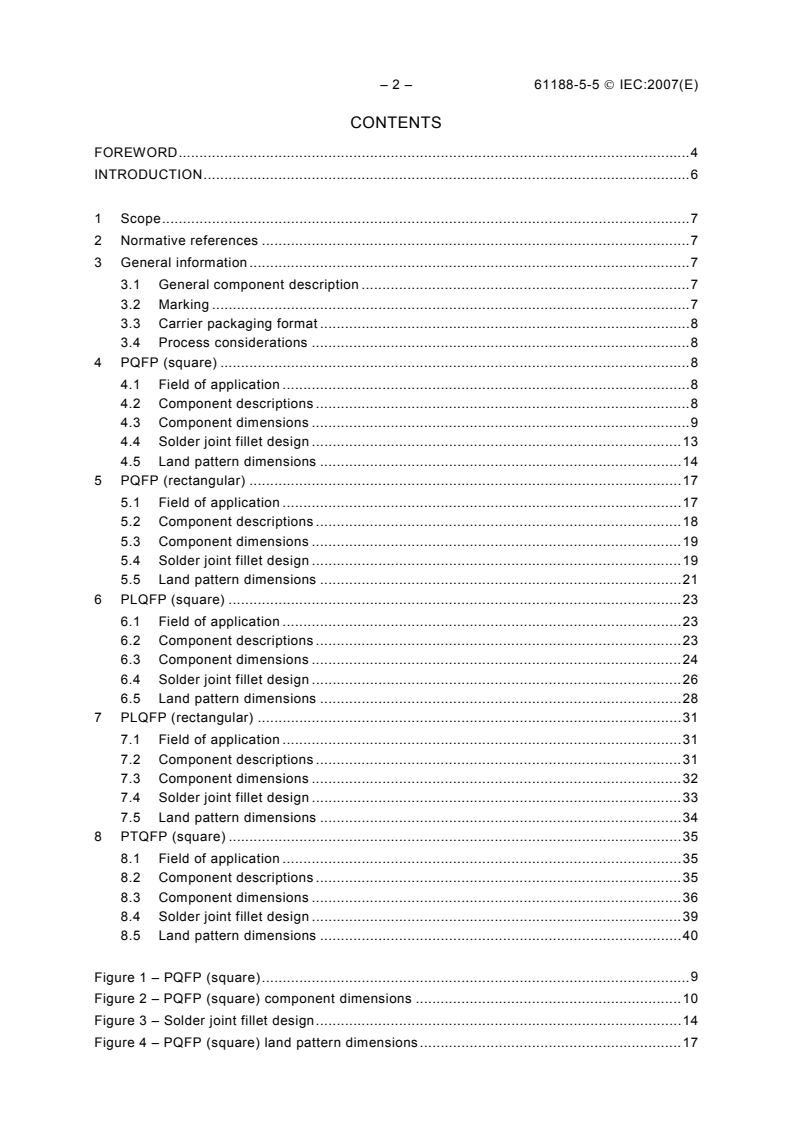
– 2 – 61188-5-5 © IEC:2007(E)
CONTENTS
FOREWORD.4
INTRODUCTION.6
1 Scope.7
2 Normative references .7
3 General information.7
3.1 General component description .7
3.2 Marking .7
3.3 Carrier packaging format .8
3.4 Process considerations .8
4 PQFP (square) .8
4.1 Field of application .8
4.2 Component descriptions .8
4.3 Component dimensions .9
4.4 Solder joint fillet design .13
4.5 Land pattern dimensions .14
5 PQFP (rectangular) .17
5.1 Field of application .17
5.2 Component descriptions .18
5.3 Component dimensions .19
5.4 Solder joint fillet design .19
5.5 Land pattern dimensions .21
6 PLQFP (square) .23
6.1 Field of application .23
6.2 Component descriptions .23
6.3 Component dimensions .24
6.4 Solder joint fillet design .26
6.5 Land pattern dimensions .28
7 PLQFP (rectangular) .31
7.1 Field of application .31
7.2 Component descriptions .31
7.3 Component dimensions .32
7.4 Solder joint fillet design .33
7.5 Land pattern dimensions .34
8 PTQFP (square) .35
8.1 Field of application .35
8.2 Component descriptions .35
8.3 Component dimensions .36
8.4 Solder joint fillet design .39
8.5 Land pattern dimensions .40
Figure 1 – PQFP (square).9
Figure 2 – PQFP (square) component dimensions .10
Figure 3 – Solder joint fillet design.14
Figure 4 – PQFP (square) land pattern dimensions.17
61188-5-5 © IEC:2007(E) – 3 –
Figure 5 – PQFP (rectangular) .18
Figure 6 – PQFP (rectangular) component dimensions .19
Figure 7 – Solder joint fillet design.21
Figure 8 – PQFP (rectangular) land pattern dimensions .22
Figure 9 – PLQFP (square) .23
Figure 10 – PLQFP (square) component dimensions .24
Figure 11 – Solder joint fillet design.28
Figure 12 – PLQFP (square) land pattern dimensions .31
Figure 13 – PLQFP (rectangular) .32
Figure 14 – PLQFP (rectangular) component dimensions.32
Figure 15 – Solder joint fillet design.34
Figure 16 – PLQFP (rectangular) land pattern dimensions .35
Figure 17 – PTQFP (square).36
Figure 18 – PTQFP component dimensions .37
Figure 19 – Solder joint fillet design.40
Figure 20 – PTQFP land pattern dimensions.42
– 4 – 61188-5-5 © IEC:2007(E)
INTERNATIONAL ELECTROTECHNICAL COMMISSION
____________
PRINTED BOARDS AND PRINTED BOARD ASSEMBLIES –
DESIGN AND USE –
Part 5-5: Attachment (land/joint) considerations –
Components with gull-wing leads on four sides
FOREWORD
1) The International Electrotechnical Commission (IEC) is a worldwide organization for standardization comprising
all national electrotechnical committees (IEC National Committees). The object of IEC is to promote
international co-operation on all questions concerning standardization in the electrical and electronic fields. To
this end and in addition to other activities, IEC publishes International Standards, Technical Specifications,
Technical Reports, Publicly Available Specifications (PAS) and Guides (hereafter referred to as “IEC
Publication(s)”). Their preparation is entrusted to technical committees; any IEC National Committee interested
in the subject dealt with may participate in this preparatory work. International, governmental and non-
governmental organizations liaising with the IEC also participate in this preparation. IEC collaborates closely
with the International Organization for Standardization (ISO) in accordance with conditions determined by
agreement between the two organizations.
2) The formal decisions or agreements of IEC on technical matters express, as nearly as possible, an international
consensus of opinion on the relevant subjects since each technical committee has representation from all
interested IEC National Committees.
3) IEC Publications have the form of recommendations for international use and are accepted by IEC National
Committees in that sense. While all reasonable efforts are made to ensure that the technical content of IEC
Publications is accurate, IEC cannot be held responsible for the way in which they are used or for any
misinterpretation by any end user.
4) In order to promote international uniformity, IEC National Committees undertake to apply IEC Publications
transparently to the maximum extent possible in their national and regional publications. Any divergence
between any IEC Publication and the corresponding national or regional publication shall be clearly indicated in
the latter.
5) IEC provides no marking procedure to indicate its approval and cannot be rendered responsible for any
equipment declared to be in conformity with an IEC Publication.
6) All users should ensure that they have the latest edition of this publication.
7) No liability shall attach to IEC or its directors, employees, servants or agents including individual experts and
members of its technical committees and IEC National Committees for any personal injury, property damage or
other damage of any nature whatsoever, whether direct or indirect, or for costs (including legal fees) and
expenses arising out of the publication, use of, or reliance upon, this IEC Publication or any other IEC
Publications.
8) Attention is drawn to the Normative references cited in this publication. Use of the referenced publications is
indispensable for the correct application of this publication.
9) Attention is drawn to the possibility that some of the elements of this IEC Publication may be the subject of
patent rights. IEC shall not be held responsible for identifying any or all such patent rights.
International Standard IEC 61188-5-5 has been prepared by IEC technical committee 91:
Electronics assembly technology.
The text of this standard is based on the following documents:
FDIS Report on voting
91/704/FDIS 91/736/RVD
Full information on the voting for the approval of this standard can be found in the report on
voting indicated in the above table.
This publication has been drafted in accordance with the ISO/IEC Directives, Part 2.
IEC 61188-5-5 is to be read in conjunction with IEC 61188-5-1.
61188-5-5 © IEC:2007(E) – 5 –
A list of all parts of the IEC 61188 series, under the general title Printed boards and printed
board assemblies – Design and use, can be found on the IEC website.
The committee has decided that the contents of this publication will remain unchanged until
the maintenance result date indicated on the IEC web site under "http://webstore.iec.ch" in
the data related to the specific publication. At this date, the publication will be
• reconfirmed;
• withdrawn;
• replaced by a revised edition, or
• amended.
A bilingual version of this publication may be issued at a later date.
– 6 – 61188-5-5 © IEC:2007(E)
INTRODUCTION
This part of IEC 61188 covers land patterns for components with gull-wing leads on four sides.
Each clause gives information in accordance with the following format.
The proposed land pattern dimensions in this standard are based upon the fundamental
tolerance calculation combined with the given land protrusions and courtyard excesses (see
IEC 61188-5-1, Generic requirements). The courtyard includes all issues of the normal
manufacturing necessities.
The unaltered land pattern dimensions of this part are generally applicable for the solder
paste application plus reflow soldering process. For application of the wave soldering process,
the land pattern dimensions normally have to be modified. Orientation parallel to the wave
direction is preferable and special, suitably dimensioned solder thieves should be added.
This standard offers a threefold land pattern dimensioning (levels 1, 2, and 3) on the basis of
a threefold set of land protrusions and courtyard excesses: maximum (max.); median (mdn)
and minimum (min.). Each land pattern has been assigned an identification number to indicate
the characteristics of the specific robustness of the land patterns. Users also have the
opportunity to organize the information so that it is most useful for their particular design.
If a user has good reason to use a concept different from that of IEC 61188-5-1, or if the user
prefers unusual land protrusions, this standard should be used for checking the resulting
solder fillet size.
It is the responsibility of the user to verify the SMD land patterns used for achieving an
undisturbed mounting process including testing and an ensured reliability for the product
stress conditions in use.
Component dimensions listed in this standard are those available on the market and should
be regarded as for reference only.
61188-5-5 © IEC:2007(E) – 7 –
PRINTED BOARDS AND PRINTED BOARD ASSEMBLIES –
DESIGN AND USE –
Part 5-5: Attachment (land/joint) considerations –
Components with gull-wing leads on four sides
1 Scope
This part of IEC 61188 provides information on land pattern geometries used for the surface
attachment of electronic components with gull-wing leads on four sides. The intent of the
information presented herein is to provide the appropriate size, shape and tolerances of
surface mount land patterns to ensure sufficient area for the appropriate solder fillet, and also
allow for inspection, testing and reworking of those solder joints.
Each clause contains a specific set of criteria such that the information presented is
consistent, providing information on the component, the component dimensions, the solder
joint design and the land pattern dimensions.
The land pattern dimensions are based on a mathematical model that establishes a platform
for a solder joint attachment to the printed board. The existing models create a platform that is
capable of establishing a reliable solder alloy used to make that joint (lead-free, tin lead, etc.).
Process requirements for solder reflow are different based on the solder alloy and should be
analyzed in order that the process is above that temperature a sufficient time to form a
reliable metallurgical bond.
2 Normative references
The following referenced documents are indispensable for the application of this document.
For dated references, only the edition cited applies. For undated references, the latest edition
of the referenced document (including any amendments) applies.
IEC 61188-5-1, Printed boards and printed board assemblies – Design and use – Part 5-1:
Attachment (land/joint) considerations – Generic requirements
3 General information
3.1 General component description
The four-sided gull wing family is characterized by gull-wing leads on four sides of a square or
rectangular package. The family includes both molded plastic and ceramic case styles. The
acronyms PQFP (plastic quad flat pack) and CQFP (ceramic quad flat pack) are also used to
describe the family.
There are several lead pitches within the family form 1,0 mm to 0,30 mm. High lead-court
packages are available in this family that accommodate complex, high lead-count chips.
3.2 Marking
The PQFP and CQFP families of parts are generally marked with the manufacturer’s part
numbers, manufacturer’s name or symbol and a pin 1 indicator. Some parts may have a pin 1
feature in the case shape instead of pin 1 marking. Additional markings may include date-
code manufacturing lot and/or manufacturing location.
– 8 – 61188-5-5 © IEC:2007(E)
3.3 Carrier packaging format
Carrier packaging format may be provided in tube but packaging tray carries are preferred for
best handling and high volume applications. Bulk packaging is not acceptable because of lead
co-planarity required for placement and soldering.
3.4 Process considerations
PQFP and CQFP packages are normally processed by reflow solder operations.
High lead-count fine pitch parts may require special processing outside the normal pick/place
and reflow manufacturing operations.
4 PQFP (square)
4.1 Field of application
This clause provides the component and land pattern dimensions for square PQFP (plastic
quad flat pack) components. Basic construction of the PQFP device is also covered. At the
end of this clause is a listing of the tolerances and target solder joint dimensions used to
arrive at the land pattern dimensions.
4.2 Component descriptions
PQFPs are widely used in a variety of applications for commercial, industrial or military
electronics.
4.2.1 Basic construction
The quad flat pack has been developed for applications requiring low height and high density.
The PQFP, along with the LSOP components, are frequently used in memory card
applications (see Figure 1).
4.2.1.1 Termination materials
Leads shall be solder-coated with a tin/lead alloy. The solder should contain between 58 % to
68 % tin. Solder may be applied to the leads by hot dipping or by plating from solution. Plated
solder terminations should be subjected to post plating reflow operation to fuse the solder.
The tin/lead finish should be at least 0,007 5 mm thick.
4.2.1.2 Marking
All parts shall be marked with a part number and an index area. The index area shall identify
the location of pin 1.
4.2.1.3 Carrier package format
The carrier package format for flat packs may be tubular in shape but, in most instances, flat
packs are delivered in a carrier tray.
4.2.1.4 Process considerations
PQFPs are usually processed using standard reflow solder processes. Parts should be
capable of withstanding ten cycles through a standard reflow system operating at 235 °C.
Each cycle shall consist of 60 s exposure at 235 °C.
61188-5-5 © IEC:2007(E) – 9 –
IEC 2022/07
Figure 1 – PQFP (square)
4.3 Component dimensions
Land pattern dimensional data may need to be adjusted if the component dimensional data
does not match JEDEC and/or JEITA sheets.
Figure 2 provides the component dimensions for PQFP (square) components.
– 10 – 61188-5-5 © IEC:2007(E)
Lp
A
L1
S
IEC 2023/07
Dimensions in millimetres
L2 L1 Lp
EIAJ codes JEDEC code
Min. Max. Min. Max. Min. Max.
P-QFP-0036-0505-1,00 P-QFP/036-5x5-1,00 12,95 13,45 12,95 13,45 0,73 1,03
P-QFP-0044-0505-0,80 P-QFP/044-5x5-0,80 12,95 13,45 12,95 13,45 0,73 1,03
P-QFP-0052-0505-0,65 P-QFP/052-5x5-0,65 12,95 13,45 12,95 13,45 0,73 1,03
P-QFP-0048-1212-0,80 P-QFP/048-12x12-0,80 14,95 15,45 14,95 13,45 0,73 1,03
P-QFP-0052-1414-1,00 P-QFP/052-14x14-1,00 16,95 17,45 16,95 17,45 0,73 1,03
P-QFP-0064-1414-0,80 P-QFP/064-14x14-0,80 16,95 17,45 16,95 17,45 0,73 1,03
P-QFP-0080-1414-0,65 P-QFP/080-14x14-0,65 15,75 17,45 16,95 17,45 0,73 1,03
P-QFP-0100-1414-0,50 P-QFP/100-14x14-0,50 15,75 16,25 15,75 16,25 0,45 0,75
P-QFP-0120-1414-0,40 P-QFP/120-14x14-0,40 15,75 16,25 15,75 16,25 0,45 0,75
P-QFP-0168-1414-0,30 P-QFP/168-14x14-0,30 15,75 16,25 15,75 16,25 0,45 0,75
P-QFP-0076-2020-1,00 P-QFP/076-20x20-1,00 22,95 23,45 22,95 23,45 0,73 1,03
P-QFP-0076-2020-1,00 P-QFP/076-20x20-1,00 22,95 23,45 22,95 23,45 0,73 1,03
P-QFP-0088-2020-0,80 P-QFP/088-20x20-0,80 22,95 23,45 22,95 23,45 0,73 1,03
P-QFP-0088-2020-0,80 P-QFP/088-20x20-0,80
22,95 23,45 22,95 23,45 0,73 1,03
W S* B A P H
Remarks
Min. Nom. Max. Min. Max.
0,34 0,40 0,46 10,89 11,55 10,0 10,0 1,00 2,45
0,29 0,35 0,41 10,89 11,55 10,0 10,0 0,80 2,45
0,22 0,30 0,36 10,89 11,55 10,0 10,0 0,65 2,45
0,29 0,35 0,41 12,89 13,55 12,0 12,0 0,80 2,45
0,34 0,40 0,46 14,89 15,55 14,0 14,0 1,00 3,15
0,29 0,35 0,41 14,89 15,55 14,0 14,0 0,80 3,15
0,22 0,30 0,36 14,89 15,55 14,0 14,0 0,65 3,15
0,17 0,20 0,23 14,25 14,91 14,0 14,0 0,50 3,15
0,13 0,16 0,19 14,25 14,91 14,0 14,0 0,40 3,15
0,09 0,12 0,15 14,25 14,91 14,0 14,0 0,40 3,15
0,34 0,40 0,46 20,89 21,55 20,0 20,0 1,00 3,15 Low stand-off
0,34 0,40 0,46 20,89 21,55 20,0 20,0 1,00 3,40 High stand-off
0,29 0,35 0,41 20,89 21,55 20,0 20,0 0,80 3,15 Low stand-off
0,29 0,35 0,41 20,89 21,55 20,0 20,0 0,80 3,40 High stand-off
* Calculated value.
Figure 2 – PQFP (square) component dimensions
L2
B
H W P
0,25
61188-5-5 © IEC:2007(E) – 11 –
Lp
A
L1
S
IEC 2023/07
Dimensions in millimetres
L2 L1 Lp
EIAJ codes JEDEC code
Min. Max. Min. Max. Min. Max.
P-QFP-0112-2020-0,65 P-QFP/112-20x20-0,65 22,95 23,45 22,95 23,45 0,73 1,03
P-QFP-0112-2020-0,65 P-QFP/112-20x20-0,65 22,95 23,45 22,95 23,45 0,73 1,03
P-QFP-0144-2020-0,50 P-QFP/144-20x20-0,50 21,75 22,25 21,75 22,25 0,45 0,75
P-QFP-0144-2020-0,50 P-QFP/144-20x20-0,50 21,75 22,25 21,75 22,25 0,45 0,75
P-QFP-0176-2020-0,40 P-QFP/176-20x20-0,40 21,75 22,25 21,75 22,25 0,45 0,75
P-QFP-0176-2020-0,40 P-QFP/176-20x20-0,40 21,75 22,25 21,75 22,25 0,45 0,75
P-QFP-0240-2020-0,30 P-QFP/240-20x20-0,30 21,75 22,25 21,75 22,25 0,45 0,75
P-QFP-0176-2424-0,50 P-QFP/176-24x24-0,50 26,35 26,85 26,35 26,85 0,45 0,75
P-QFP-0176-2424-0,50 P-QFP/176-24x24-0,50 26,35 26,85 26,35 26,85 0,45 0,75
P-QFP-0216-2424-0,40 P-QFP/216-24x24-0,40 26,35 26,85 26,35 26,85 0,45 0,75
P-QFP-0216-2424-0,40 P-QFP/216-24x24-0,40 26,35 26,85 26,35 26,85 0,45 0,75
P-QFP-0128-2828-0,80 P-QFP/128-28x28-0,80 30,95 31,45 30,95 31,45 0,73 1,03
P-QFP-0128-2828-0,80 P-QFP/128-28x28-0,80 30,95 31,45 30,95 31,45 0,73 1,03
P-QFP-0160-2828-0,65 P-QFP/160-28x28-0,65 30,95 31,45 30,95 31,45 0,73 1,03
W S*
B A P H Remarks
Min. Nom. Max. Min. Max.
0,22 0,30 0,36 20,89 21,55 20,0 20,0 0,65 3,15 Low stand-off
0,22 0,30 0,36 20,89 21,55 20,0 20,0 0,65 3,40 High stand-off
0,17 0,2 0,23 20,25 20,91 20,0 20,0 0,50 3,15 Low stand-off
0,17 0,2 0,23 20,25 20,91 20,0 20,0 0,50 3,40 High stand-off
0,13 0,16 0,19 20,25 20,91 20,0 20,0 0,40 3,15 Low stand-off
0,13 0,16 0,19 20,25 20,91 20,0 20,0 0,40 3,40 High stand-off
0,09 0,12 0,15 20,25 20,91 20,0 20,0 0,30 3,40 Low stand-off
0,17 0,2 0,23 24,85 25,51 24,0 24,0 0,50 3,85 High stand-off
0,17 0,2 0,23 24,85 25,51 24,0 24,0 0,50 4,10 Low stand-off
0,13 0,16 0,19 24,85 25,51 24,0 24,0 0,40 3,85 High stand-off
0,13 0,16 0,19 24,85 25,51 24,0 24,0 0,40 4,10 Low stand-off
0,29 0,35 0,41 28,89 29,55 28,0 28,0 0,80 3,85 High stand-off
0,29 0,35 0,41 28,89 29,55 28,0 28,0 0,80 4,10 Low stand-off
0,22 0,3 0,36 28,89 29,55 28,0 28,0 0,65 3,85 High stand-off
* Calculated value.
Figure 2 (continued)
L2
B
H W P
0,25
– 12 – 61188-5-5 © IEC:2007(E)
Lp
A
L1
S
IEC 2023/07
Dimensions in millimetres
EIAJ codes JEDEC code L2 L1 Lp
Min. Max. Min. Max. Min. Max.
P-QFP-0160-2828-0,65 P-QFP/160-28x28-0,65 30,95 31,45 30,95 31,45 0,73 1,03
P-QFP-0208-2828-0,50 P-QFP/208-28x28-0,50 30,35 30,85 30,35 30,85 0,45 0,75
P-QFP-0208-2828-0,50 P-QFP/208-28x28-0,50 30,35 30,85 30,35 30,85 0,45 0,75
P-QFP-0256-2828-0,40 P-QFP/256-28x28-0,40 30,35 30,85 30,35 30,85 0,45 0,75
P-QFP-0256-2828-0,40 P-QFP/256-28x28-0,40 30,35 30,85 30,35 30,85 0,45 0,75
P-QFP-0184-3232-0,65 P-QFP/184-32x32-0,65 34,95 35,45 34,95 35,45 0,73 1,03
P-QFP-0240-3232-0,50 P-QFP/240-32x32-0,50 34,95 34,85 34,95 34,85 0,45 0,75
P-QFP-0296-3232-0,40 P-QFP/296-32x32-0,40 34,95 34,85 34,95 34,85 0,45 0,75
P-QFP-0272-3636-0,50 P-QFP/272-36x36-0,50 38,35 38,85 38,35 38,85 0,45 0,75
P-QFP-0336-3636-0,40 P-QFP/336-36x36-0,40 38,35 38,85 38,35 38,85 0,45 0,75
P-QFP-0232-4040-0,65 P-QFP/232-40x40-0,65 42,95 43,45 42,95 43,45 0,73 1,03
P-QFP-0304-4040-0,50 P-QFP/304-40x40-0,50 42,35 42,85 42,35 42,85 0,45 0,75
P-QFP-0376-4040-0,40 P-QFP/376-40x40-0,40 42,35 42,85 42,35 42,85 0,45 0,75
W S* B A P H
Remarks
Min. Nom. Max. Max. Max.
0,22 0,3 0,36 28,89 29,55 28,0 28,0 0,65 4,10 Low stand-off
0,17 0,2 0,23 28,85 29,51 28,0 28,0 0,50 3,85 High stand-off
0,17 0,2 0,23 28,85 29,51 28,0 28,0 0,50 4,10 High stand-off
0,13 0,16 0,19 28,85 29,51 28,0 28,0 0,40 3,85 High stand-off
0,13 0,16 0,19 28,85 29,51 28,0 28,0 0,40 4,10 High stand-off
0,22 0,3 0,36 32,89 29,51 32,0 32,0 0,65 4,10 High stand-off
0,17 0,2 0,23 33,45 33,89 32,0 32,0 0,50 4,10 High stand-off
0,13 0,16 0,19 33,45 33,89 32,0 32,0 0,40 4,10 High stand-off
0,17 0,2 0,23 36,85 37,51 36,0 36,0 0,50 4,50 High stand-off
0,13 0,16 0,19 36,85 37,51 36,0 36,0 0,40 4,50 High stand-off
0,22 0,3 0,36 40,89 41,55 40,0 40,0 0,65 4,50 High stand-off
0,17 0,2 0,23 40,85 41,51 40,0 40,0 0,50 4,50 High stand-off
0,13 0,16 0,19 40,85 41,51 40,0 40,0 0,40 4,50 High stand-off
* Calculated value.
Figure 2 (continued)
L2
B
H W P
0,25
61188-5-5 © IEC:2007(E) – 13 –
4.4 Solder joint fillet design
Figure 3 shows the shape and dimensions of the solder fillet after the soldering process. The
minimum, median and maximum dimensions of each of toe, heel and side fillet are determined
by taking into consideration solder joint reliability and also quality and productivity in the
mounting process of parts.
In designing land patterns, three accuracy factors need to be taken into consideration:
– parts dimensions accuracy (C);
– parts mount accuracy on PWBs (P);
– land shape accuracy of PWBs (F),
in addition to fillet dimensions. The formulae to obtain the tolerance resulted from these
factors are basically as follows:
a) Design consideration when soldered without self-alignment effect (level 1)
In the flow soldering process there is no self-alignment effect. Thus, the formulae cannot
be simplified but remain the same, as follows:
2 2 2
Zmax = Lmin + 2J max + T
T = + +
T T F P C
T L1 L1 L
2 2 2
Gmin = Smax (rms) – 2J max – T
T = + +
H H F P C
H L1 L1 S
2 2 2
Xmax = Wmin + 2J max + T
T = + +
S S F P C
S L1 L1 W
b) Design consideration when soldered without self-alignment effect (level 2)
2 2 2
mdn + T
Zmax = Lmin + 2J
T = + +
T T F P C
L2 L2 L
T
2 2 2
Gmin = Smax(rms) – 2J mdn – T
T = + +
H H F P C
L2 L2 S
H
2 2 2
Xmax = Wmin + 2J mdn + T
T = + +
S S F P C
L2 L2 W
S
c) Design consideration when soldered with self-alignment effect (level 3)
2 2 2
Zmax = Lmin + 2J min + T
T = + +
T T F P C
T L3 L3 L
2 2 2
Gmin = Smax(rms) – 2J min – T
T = + +
H H F P C
H L3 L3 S
2 2 2
Xmax = Wmin + 2 J min + T
T = + +
S S F P C
S L3 L3 W
In the reflow soldering process, there is a self-alignment effect. In the surface mount process
of reflow soldering, parts mount displacement when soldered can be cancelled by self-
alignment effect (therefore factor P can be regarded as 0). In addition, the tolerance of the
land shape accuracy of PWBs is about ±30 µm, and this is extremely small when compared
with that of the parts dimensions accuracy (therefore factor F can be regarded also as 0).
Thus, the formulae can be simplified as follows:
T = C Zmax = Lmin + 2J min + C = Lmax + 2J min
T L, T L T
T = C Gmin = Smax (rms) – 2J min – C
H S, H S
T = C Xmax = Wmin + 2J min + C = Wmax + 2J min
S W, S W S
In addition, the following value Gmin ≥ A, B is also necessary so that the land should not be
hidden under the QFP. The stand-off of the component mould is nearly zero. The land pattern
design should be made to prevent the lead from floating caused by the solder under the
component.
– 14 – 61188-5-5 © IEC:2007(E)
Any tolerance other than the above may be used depending on the soldering strength
required, the capability of the production process used, and so on.
J J
T S W
J
H Xmax.
Zmax.
IEC 2011/07
Dimensions in millimetres
Solder joint
Tolerance
assumptions
Toe Heel Side
Component
pitch
F P J J J
T H S
L-1/ L-1/
C Max. Mdn Min. C Max. Mdn Min. C Max. Mdn Min.
L S W
L-2/L-3 L-2/L-3
1,00 0,1 0,1 0,5 0,55 0,35 0,2 0,656 0,5 0,35 0,2 0,12 0,05 0 0
0,80 0,1 0,1 0,5 0,55 0,35 0,2 0,656 0,5 0,35 0,2 0,12 0,05 0 0
0,65 0,1 0,1 0,5 0,55 0,35 0,2 0,656 0,5 0,35 0,2 0,14 0,05 0 0
0,50 0,1 0,1 0,5 0,55 0,35 0,2 0,656 0,2 0,2 0,2 0,06 0 0 0
0,40 0,1 0,1 0,5 0,55 0,35 0,2 0,656 0,2 0,2 0,2 0,06 0 0 0
0,30 0,1 0,1 0,5 0,55 0,35 0,2 0,656 0,2 0,2 0,2 0,06 0 0 0
NOTE PQFP with lead pitch of 0,5 mm or less are not suitable for flow soldering.
Figure 3 – Solder joint fillet design
4.5 Land pattern dimensions
Figure 4 shows land pattern dimensions for PQFP (square) for reflow and flow soldering.
These values are calculated based on the formula for the solder joint fillet design of 4.5.
The courtyard is calculated using the following formula and rounded off (round-off factor is to
the nearest 0,05 mm for minimum values and to the nearest 0,5 mm for maximum values).
2 2
CY ={whichever larger [L1min + F + P + C ] or [Z1]} + (courtyard excess × 2)
1 L
2 2
CY ={whichever larger [L2min + F + P + C ] or [Z2]} + (courtyard excess × 2)
2 L
61188-5-5 © IEC:2007(E) – 15 –
CY
P
Y
IEC 2024/07
Dimensions in millimetres
Pattern
CY CY
EIAJ code JEDEC code Z G X Y P
1 2
identifier
Level 1
5000M P-QFP-0036-0505-1,00 P-QFP/036-5x5-1,00 14,6 10,0 0,63 2,3 1,00 16 16
5001M P-QFP-0044-0505-0,80 P-QFP/044-5x5-0,80 14,6 10,0 0,58 2,3 0,80 16 16
5002M P-QFP-0052-0505-0,65 P-QFP/052-5x5-0,65 14,6 10,0 0,52 2,3 0,65 16 16
5003M P-QFP-0048-1212-0,80 P-QFP/048-12x12-0,80 16,6 12,0 0,58 2,3 0,80 18 18
5004M P-QFP-0052-1414-1,00 P-QFP/052-14x14-1,00 18,6 14,0 0,63 2,3 1,00 20 20
5005M P-QFP-0064-1414-0,80 P-QFP/064-14x14-0,80 18,6 14,0 0,58 2,3 0,80 20 20
5006M P-QFP-0080-1414-0,65 P-QFP/080-14x14-0,65 18,6 14,0 0,52 2,3 0,65 20 20
5007M P-QFP-0100-1414-0,50 P-QFP/100-14x14-0,50 17,4 14,0 0,33 1,7 0,50 19 19
5008M P-QFP-0120-1414-0,40 P-QFP/120-14x14-0,40 17,4 14,0 0,29 1,7 0,40 19 19
5010M P-QFP-0076-2020-1,00 P-QFP/076-20x20-1,00 24,6 20,0 0,63 2,3 1,00 26 26
5011M P-QFP-0076-2020-1,00 P-QFP/076-20x20-1,00 24,6 20,0 0,63 2,3 1,00 26 26
5012M P-QFP-0088-2020-0,80 P-QFP/088-20x20-0,80 24,6 20,0 0,58 2,3 0,80 26 26
5013M P-QFP-0088-2020-0,80 P-QFP/088-20x20-0,80 24,6 20,0 0,58 2,3 0,80 26 26
5014M P-QFP-0112-2020-0,65 P-QFP/112-20x20-0,65 24,6 20,0 0,52 2,3 0,65 26 26
5015M P-QFP-0112-2020-0,65 P-QFP/112-20x20-0,65 24,6 20,0 0,52 2,3 0,65 26 26
5016M P-QFP-0144-2020-0,50 P-QFP/144-20x20-0,50 23,4 20,0 0,33 1,7 0,50 25 25
5017M P-QFP-0144-2020-0,50 P-QFP/144-20x20-0,50 23,4 20,0 0,33 1,7 0,50 25 25
5018M P-QFP-0176-2020-0,40 P-QFP/176-20x20-0,40 23,4 20,0 0,29 1,7 0,40 25 25
5019M P-QFP-0176-2020-0,40 P-QFP/176-20x20-0,40 23,4 20,0 0,29 1,7 0,40 25 25
5021M P-QFP-0176-2424-0,50 P-QFP/176-24x24-0,50 28,0 24,4 0,33 1,8 0,50 29 29
5022M P-QFP-0176-2424-0,50 P-QFP/176-24x24-0,50 28,0 24,4 0,33 1,8 0,50 29 29
5023M P-QFP-0216-2424-0,40 P-QFP/216-24x24-0,40 28,0 24,4 0,29 1,8 0,40 29 29
5024M P-QFP-0216-2424-0,40 P-QFP/216-24x24-0,40 28,0 24,4 0,29 1,8 0,40 29 29
5025M P-QFP-0128-2828-0,80 P-QFP/128-28x28-0,80 32,6 28,0 0,58 2,3 0,80 34 34
5026M P-QFP-0128-2828-0,80 P-QFP/128-28x28-0,80 32,6 28,0 0,58 2,3 0,80 34 34
5027M P-QFP-0160-2828-0,65 P-QFP/160-28x28-0,65 32,6 28,0 0,52 2,3 0,65 34 34
5028M P-QFP-0160-2828-0,65 P-QFP/160-28x28-0,65 32,6 28,0 0,52 2,3 0,65 34 34
5029M P-QFP-0208-2828-0,50 P-QFP/208-28x28-0,50 32,0 28,4 0,33 1,8 0,50 33 33
5030M P-QFP-0208-2828-0,50 P-QFP/208-28x28-0,50 32,0 28,4 0,33 1,8 0,50 33 33
5031M P-QFP-0256-2828-0,40 P-QFP/256-28x28-0,40 32,0 28,4 0,29 1,8 0,40 33 33
5032M P-QFP-0256-2828-0,40 P-QFP/256-28x28-0,40 32,0 28,4 0,29 1,8 0,40 33 33
5033M P-QFP-0184-3232-0,65 P-QFP/184-32x32-0,65 36,6 32,0 0,52 2,3 0,65 38 38
5034M P-QFP-0240-3232-0,50 P-QFP/240-32x32-0,50 36,4 33,0 0,33 1,7 0,50 38 38
5035M P-QFP-0296-3232-0,40 P-QFP/296-32x32-0,40 36,4 33,0 0,29 1,7 0,40 38 38
5036M P-QFP-0272-3636-0,50 P-QFP/272-36x36-0,50 40,0 36,4 0,33 1,8 0,50 41 41
5037M P-QFP-0336-3636-0,40 P-QFP/336-36x36-0,40 40,0 36,4 0,29 1,8 0,40 41 41
5038M P-QFP-0232-4040-0,65 P-QFP/232-40x40-0,65 44,6 40,0 0,52 2,3 0,65 46 46
5039M P-QFP-0304-4040-0,50 P-QFP/304-40x40-0,50 44,0 40,4 0,33 1,8 0,50 45 45
5040M P-QFP-0376-4040-0,40 P-QFP/376-40x40-0,40 44,0 40,4 0,29 1,8 0,40 45 45
G
Z
CY
X
– 16 – 61188-5-5 © IEC:2007(E)
Pattern
EIAJ code JEDEC code Z G X Y P CY CY
1 2
identifier
Level 2
5000N P-QFP-0036-0505-1,00 P-QFP/036-5x5-1,00 14,2 10,1 0,53 2,05 1,00 14,7 14,7
5001N P-QFP-0044-0505-0,80 P-QFP/044-5x5-0,80 14,2 10,1 0,48 2,05 0,80 14,7 14,7
5002N P-QFP-0052-0505-0,65 P-QFP/052-5x5-0,65 14,2 10,1 0,42 2,05 0,65 14,7 14,7
5003N P-QFP-0048-1212-0,80 P-QFP/048-12x12-0,80 16,2 12,1 0,48 2,05 0,80 16,7 16,7
5004N P-QFP-0052-1414-1,00 P-QFP/052-14x14-1,00 18,2 14,1 0,53 2,05 1,00 18,7 18,7
5005N P-QFP-0064-1414-0,80 P-QFP/064-14x14-0,80 18,2 14,1 0,48 2,05 0,80 18,7 18,7
5006N P-QFP-0080-1414-0,65 P-QFP/080-14x14-0,65 18,2 14,1 0,42 2,05 0,65 18,7 18,7
5007N P-QFP-0100-1414-0,50 P-QFP/100-14x14-0,50 17,0 14,0 0,33 1,50 0,50 17,5 17,5
5008N P-QFP-0120-1414-0,40 P-QFP/120-14x14-0,40 17,0 14,0 0,29 1,50 0,40 17,5 17,5
5010N P-QFP-0076-2020-1,00 P-QFP/076-20x20-1,00 24,2 20,1 0,53 2,05 1,00 24,7 24,7
5011N P-QFP-0076-2020-1,00 P-QFP/076-20x20-1,00 24,2 20,1 0,53 2,05 1,00 24,7 24,7
5012N P-QFP-0088-2020-0,80 P-QFP/088-20x20-0,80 24,2 20,1 0,48 2,05 0,80 24,7 24,7
5013N P-QFP-0088-2020-0,80 P-QFP/088-20x20-0,80 24,2 20,1 0,48 2,05 0,80 24,7 24,7
5014N P-QFP-0112-2020-0,65 P-QFP/112-20x20-0,65 24,2 20,1 0,42 2,05 0,65 24,7 24,7
5015N P-QFP-0112-2020-0,65 P-QFP/112-20x20-0,65 24,2 20,1 0,42 2,05 0,65 24,7 24,7
5016N P-QFP-0144-2020-0,50 P-QFP/144-20x20-0,50 23,0 20,0 0,33 1,50 0,50 23,5 23,5
5017N P-QFP-0144-2020-0,50 P-QFP/144-20x20-0,50 23,0 20,0 0,33 1,50 0,50 23,5 23,5
5018N P-QFP-0176-2020-0,40 P-QFP/176-20x20-0,40 23,0 20,0 0,29 1,50 0,40 23,5 23,5
5019N P-QFP-0176-2020-0,40 P-QFP/176-20x20-0,40 23,0 20,0 0,29 1,50 0,40 23,5 23,5
5021N P-QFP-0176-2424-0,50 P-QFP/176-24x24-0,50 27,6 24,4 0,33 1,60 0,50 28,1 28,1
5022N P-QFP-0176-2424-0,50 P-QFP/176-24x24-0,50 27,6 24,4 0,33 1,60 0,50 28,1 28,1
5023N P-QFP-0216-2424-0,40 P-QFP/216-24x24-0,40 27,6 24,4 0,29 1,60 0,40 28,1 28,1
5024N P-QFP-0216-2424-0,40 P-QFP/216-24x24-0,40 27,6 24,4 0,29 1,60 0,40 28,1 28,1
5025N P-QFP-0128-2828-0,80 P-QFP/128-28x28-0,80 32,6 28,1 0,48 2,05 0,80 32,7 32,7
5026N P-QFP-0128-2828-0,80 P-QFP/128-28x28-0,80 32,6 28,1 0,48 2,05 0,80 32,7 32,7
5027N P-QFP-0160-2828-0,65 P-QFP/160-28x28-0,65 32,6 28,1 0,42 2,05 0,65 32,7 32,7
5028N P-QFP-0160-2828-0,65 P-QFP/160-28x28-0,65 32,6 28,1 0,42 2,05 0,65 32,7 32,7
5029N P-QFP-0208-2828-0,50 P-QFP/208-28x28-0,50 31,6 28,4 0,33 1,60 0,50 32,1 32,1
5030N P-QFP-0208-2828-0,50 P-QFP/208-28x28-0,50 31,6 28,4 0,33 1,60 0,50 32,1 32,1
5031N P-QFP-0256-2828-0,40 P-QFP/256-28x28-0,40 31,6 28,4 0,29 1,60 0,40 32,1 32,1
5032N P-QFP-0256-2828-0,40 P-QFP/256-28x28-0,40 31,6 28,4 0,29 1,60 0,40 32,1 32,1
5033N P-QFP-0184-3232-0,65 P-QFP/184-32x32-0,65 36,2 32,1 0,42 2,05 0,65 36,7 36,7
5034N P-QFP-0240-3232-0,50 P-QFP/240-32x32-0,50 35,9 33,0 0,33 1,45 0,50 36,4 36,4
5035N P-QFP-0296-3232-0,40 P-QFP/296-32x32-0,40 35,9 33,0 0,29 1,45 0,40 36,4 36,4
5036N P-QFP-0272-3636-0,50 P-QFP/272-36x36-0,50 39,6 36,4 0,33 1,60 0,50 40,1 40,1
5037N P-QFP-0336-3636-0,40 P-QFP/336-36x36-0,40 39,6 36,4 0,29 1,60 0,40 40,1 40,1
5038N P-QFP-0232-4040-0,65 P-QFP/232-40x40-0,65 44,2 40,1 0,42 2,05 0,65 44,7 44,7
5039N P-QFP-0304-4040-0,50 P-QFP/304-40x40-0,50 43,6 40,4 0,33 1,60 0,50 44,1 44,1
5040N P-QFP-0376-4040-0,40 P-QFP/376-40x40-0,40 43,6 40,4 0,29 1,60 0,40 44,1 44,1
61188-5-5 © IEC:2007(E) – 17 –
Pattern
CY CY
EIAJ code JEDEC code Z G X Y P
1 2
identifier
Level 3
5000L P-QFP-0036-0505-1,00 P-QFP/036-5x5-1,00 13,75 10,45 0,50 1,65 1,00 14,0 14,0
5001L P-QFP-0044-0505-0,80 P-QFP/044-5x5-0,80 13,75 10,45 0,40 1,65 0,80 14,0 14,0
5002L P-QFP-0052-0505-0,65 P-QFP/052-5x5-0,65 13,75 10,45 0,35 1,65 0,65 14,0 14,0
5003L P-QFP-0048-1212-0,80 P-QFP/048-12x12-0,80 15,75 12,45 0,40 1,65 0,80 16,0 16,0
5004L P-QFP-0052-1414-1,00 P-QFP/052-14x14-1,00 17,75 14,45 0,50 1,65 1,00 18,0 18,0
5005L P-QFP-0064-1414-0,80 P-QFP/064-14x14-0,80 17,75 14,45 0,40 1,65 0,80 18,0 18,0
5006L P-QFP-0080-1414-0,65 P-QFP/080-14x14-0,65 17,75 14,45 0,35 1,65 0,65 18,0 18,0
5007L P-QFP-0100-1414-0,50 P-QFP/100-14x14-0,50 16,55 13,85 0,25 1,35 0,50 16,8 16,8
5008L P-QFP-0120-1414-0,40 P-QFP/120-14x14-0,40 16,55 13,85 0,20 1,35 0,40 16,8 16,8
5009L P-QFP-0168-1414-0,30 P-QFP/168-14x14-0,30 16,55 13,85 0,15 1,35 0,30 16,8 16,8
5010L P-QFP-0076-2020-1,00 P-QFP/076-20x20-1,00 23,75 20,45 0,50 1,65 1,00 24,0 24,0
5011L P-QFP-0076-2020-1,00 P-QFP/076-20x20-1,00 23,75 20,45 0,50 1,65 1,00 24,0 24,0
5012L P-QFP-0088-2020-0,80 P-QFP/088-20x20-0,80 23,75 20,45 0,40 1,65 0,80 24,0 24,0
5013L P-QFP-0088-2020-0,80 P-QFP/088-20x20-0,80 23,75 20,45 0,40 1,65 0,80 24,0 24,0
5014L P-QFP-0112-2020-0,65 P-QFP/112-20x20-0,65 23,75 20,45 0,35 1,65 0,65 24,0 24,0
5015L P-QFP-0112-2020-0,65 P-QFP/112-20x20-0,65 23,75 20,45 0,35 1,65 0,65 24,0 24,0
5016L P-QFP-0144-2020-0,50 P-QFP/144-20x20-0,50 22,55 19,85 0,25 1,35 0,50 22,8 22,8
5017L P-QFP-0144-2020-0,50 P-QFP/144-20x20-0,50 22,55 19,85 0,25 1,35 0,50 22,8 22,8
5018L P-QFP-0176-2020-0,40 P-QFP/176-20x20-0,40 22,55 19,85 0,20 1,35 0,40 22,8 22,8
5019L P-QFP-0176-2020-0,40 P-QFP/176-20x20-0,40 22,55 19,85 0,20 1,35 0,40 22,8 22,8
5020L P-QFP-0240-2020-0,30 P-QFP/240-20x20-0,30 22,55 19,85 0,15 1,35 0,30 22,8 22,8
5021L P-QFP-0176-2424-0,50 P-QFP/176-24x24-0,50 27,15 24,45 0,25 1,35 0,50 27,4 27,4
5022L P-QFP-0176-2424-0,50 P-QFP/176-24x24-0,50 27,15 24,45 0,25 1,35 0,50 27,4 27,4
5023L P-QFP-0216-2424-0,40 P-QFP/216-24x24-0,40 27,15 24,45 0,20 1,35 0,40 27,4 27,4
5024L P-QFP-0216-2424-0,40 P-QFP/216-24x24-0,40 27,15 24,45 0,20 1,35 0,40 27,4 27,4
5025L P-QFP-0128-2828-0,80 P-QFP/128-28x28-0,80 31,75 28,45 0,40 1,65 0,80 32,0 32,0
5026L P-QFP-0128-2828-0,80 P-QFP/128-28x28-0,80 31,75 28,45 0,40 1,65 0,80 32,0 32,0
5027L P-QFP-0160-2828-0,65 P-QFP/160-28x28-0,65 31,75 28,45 0,35 1,65 0,65 32,0 32,0
5028L P-QFP-0160-2828-0,65 P-QFP/160-28x28-0,65 31,75 28,45 0,35 1,65 0,65 32,0 32,0
5029L P-QFP-0208-2828-0,50 P-QFP/208-28x28-0,50 31,15 28,45 0,25 1,35 0,50 31,4 31,4
5030L P-QFP-0208-2828-0,50 P-QFP/208-28x28-0,50 31,15 28,45 0,25 1,35 0,50 31,4 31,4
5031L P-QFP-0256-2828-0,40 P-QFP/256-28x28-0,40 31,15 28,45 0,20 1,35 0,40 31,4 31,4
5032L P-QFP-0256-2828-0,40 P-QFP/256-28x28-0,40 31,15 28,45 0,20 1,35 0,40 31,4 31,4
5033L P-QFP-0184-3232-0,65 P-QFP/184-32x32-0,65 35,75 32,40 0,35 1,65 0,65 36,0 36,0
5034L P-QFP-0240-3232-0,50 P-QFP/240-32x32-0,50 35,15 33,00 0,25 1,05 0,50 35,4 35,4
5035L P-QFP-0296-3232-0,40 P-QFP/296-32x32-0,40 35,15 33,00 0,20 1,05 0,40 35,4 35,4
5036L P-QFP-0272-3636-0,50 P-QFP/272-36x36-0,50 39,15 36,40 0,25 1,35 0,50 39,4 39,4
5037L P-QFP-0336-3636-0,40 P-QFP/336-36x36-0,40 39,15 36,40 0,20 1,35 0,40 39,4 39,4
5038L P-QFP-0232-4040-0,65 P-QFP/232-40x40-0,65 43,75 40,40 0,35 1,65 0,65 44,0 44,0
5039L P-QFP-0304-4040-0,50 P-QFP/304-40x40-0,50 43,15 40,40 0,25 1,35 0,50 43,4 43,4
5040L P-QFP-0376-4040-0,40 P-QFP/376-40x40-0,40 43,15 40,40 0,20 1,35 0,40 43,4 43,4
* When the X dimension is used, it is necessary to confirm whether the space between adjacent land patterns is
proper.
Figure 4 – PQFP (square) land pattern dimensions
5 PQFP (rectangular)
5.1 Field of application
This clause provides the component and land pattern dimensions for rectangular PQFP
(plastic quad flat pack) components. Basic construction of the PQFP device is also covered.
– 18 – 61188-5-5 © IEC:2007(E)
At the end of this clause is a listing of the tolerances and target solder joint dimensions used
to arrive at the land pattern dimensions.
5.2 Component descriptions
PQFPs are widely used in a variety of applications for commercial, industrial or military
electronics.
5.2.1 Basic construction
The quad flat pack has been developed for applications requiring low height and high density.
The PQFPs, along with the LSOP components, are frequently used in memory card
applications (see Figure 5).
5.2.1.1 Termination materials
Leads shall be solder-coated with a tin/lead alloy. The solder should contain between 58 % to
68 % tin. Solder may be applied to the leads by hot dipping or by plating from solution. Plated
solder terminations should be subjected to post plating reflow operation to fuse the solder.
The tin/lead finish should be at least 0,007 5 mm thick.
For applications involving the removal of lead there are a number of lead free or lead free
compatible finishes. Solderability testi
...
IEC 61188-5-5 ®
Edition 1.0 2007-10
INTERNATIONAL
STANDARD
NORME
INTERNATIONALE
Printed boards and printed board assemblies – Design and use –
Part 5-5: Attachment (land/joint) considerations – Components with gull-wing
leads on four sides
Cartes imprimées et cartes imprimées équipées – Conception et utilisation –
Partie 5-5: Considérations sur les liaisons pistes-soudures – Composants à
sorties en aile de mouette sur quatre côtés
All rights reserved. Unless otherwise specified, no part of this publication may be reproduced or utilized in any form or by
any means, electronic or mechanical, including photocopying and microfilm, without permission in writing from either IEC or
IEC's member National Committee in the country of the requester.
If you have any questions about IEC copyright or have an enquiry about obtaining additional rights to this publication,
please contact the address below or your local IEC member National Committee for further information.
Droits de reproduction réservés. Sauf indication contraire, aucune partie de cette publication ne peut être reproduite
ni utilisée sous quelque forme que ce soit et par aucun procédé, électronique ou mécanique, y compris la photocopie
et les microfilms, sans l'accord écrit de la CEI ou du Comité national de la CEI du pays du demandeur.
Si vous avez des questions sur le copyright de la CEI ou si vous désirez obtenir des droits supplémentaires sur cette
publication, utilisez les coordonnées ci-après ou contactez le Comité national de la CEI de votre pays de résidence.
IEC Central Office
3, rue de Varembé
CH-1211 Geneva 20
Switzerland
Email: inmail@iec.ch
Web: www.iec.ch
About the IEC
The International Electrotechnical Commission (IEC) is the leading global organization that prepares and publishes
International Standards for all electrical, electronic and related technologies.
About IEC publications
The technical content of IEC publications is kept under constant review by the IEC. Please make sure that you have the
latest edition, a corrigenda or an amendment might have been published.
ƒ Catalogue of IEC publications: www.iec.ch/searchpub
The IEC on-line Catalogue enables you to search by a variety of criteria (reference number, text, technical committee,…).
It also gives information on projects, withdrawn and replaced publications.
ƒ IEC Just Published: www.iec.ch/online_news/justpub
Stay up to date on all new IEC publications. Just Published details twice a month all new publications released. Available
on-line and also by email.
ƒ Electropedia: www.electropedia.org
The world's leading online dictionary of electronic and electrical terms containing more than 20 000 terms and definitions
in English and French, with equivalent terms in additional languages. Also known as the International Electrotechnical
Vocabulary online.
ƒ Customer Service Centre: www.iec.ch/webstore/custserv
If you wish to give us your feedback on this publication or need further assistance, please visit the Customer Service
Centre FAQ or contact us:
Email: csc@iec.ch
Tel.: +41 22 919 02 11
Fax: +41 22 919 03 00
A propos de la CEI
La Commission Electrotechnique Internationale (CEI) est la première organisation mondiale qui élabore et publie des
normes internationales pour tout ce qui a trait à l'électricité, à l'électronique et aux technologies apparentées.
A propos des publications CEI
Le contenu technique des publications de la CEI est constamment revu. Veuillez vous assurer que vous possédez
l’édition la plus récente, un corrigendum ou amendement peut avoir été publié.
ƒ Catalogue des publications de la CEI: www.iec.ch/searchpub/cur_fut-f.htm
Le Catalogue en-ligne de la CEI vous permet d’effectuer des recherches en utilisant différents critères (numéro de référence,
texte, comité d’études,…). Il donne aussi des informations sur les projets et les publications retirées ou remplacées.
ƒ Just Published CEI: www.iec.ch/online_news/justpub
Restez informé sur les nouvelles publications de la CEI. Just Published détaille deux fois par mois les nouvelles
publications parues. Disponible en-ligne et aussi par email.
ƒ Electropedia: www.electropedia.org
Le premier dictionnaire en ligne au monde de termes électroniques et électriques. Il contient plus de 20 000 termes et
définitions en anglais et en français, ainsi que les termes équivalents dans les langues additionnelles. Egalement appelé
Vocabulaire Electrotechnique International en ligne.
ƒ Service Clients: www.iec.ch/webstore/custserv/custserv_entry-f.htm
Si vous désirez nous donner des commentaires sur cette publication ou si vous avez des questions, visitez le FAQ du
Service clients ou contactez-nous:
Email: csc@iec.ch
Tél.: +41 22 919 02 11
Fax: +41 22 919 03 00
IEC 61188-5-5 ®
Edition 1.0 2007-10
INTERNATIONAL
STANDARD
NORME
INTERNATIONALE
Printed boards and printed board assemblies – Design and use –
Part 5-5: Attachment (land/joint) considerations – Components with gull-wing
leads on four sides
Cartes imprimées et cartes imprimées équipées – Conception et utilisation –
Partie 5-5: Considérations sur les liaisons pistes-soudures – Composants à
sorties en aile de mouette sur quatre côtés
INTERNATIONAL
ELECTROTECHNICAL
COMMISSION
COMMISSION
ELECTROTECHNIQUE
PRICE CODE
INTERNATIONALE
X
CODE PRIX
ICS 31.180 ISBN 978-2-88910-435-2
– 2 – 61188-5-5 © IEC:2007
CONTENTS
FOREWORD.4
INTRODUCTION.6
1 Scope.7
2 Normative references .7
3 General information.7
3.1 General component description .7
3.2 Marking .7
3.3 Carrier packaging format .8
3.4 Process considerations .8
4 PQFP (square) .8
4.1 Field of application .8
4.2 Component descriptions .8
4.3 Component dimensions .9
4.4 Solder joint fillet design .13
4.5 Land pattern dimensions .14
5 PQFP (rectangular) .17
5.1 Field of application .17
5.2 Component descriptions .18
5.3 Component dimensions .19
5.4 Solder joint fillet design .19
5.5 Land pattern dimensions .21
6 PLQFP (square) .23
6.1 Field of application .23
6.2 Component descriptions .23
6.3 Component dimensions .24
6.4 Solder joint fillet design .26
6.5 Land pattern dimensions .28
7 PLQFP (rectangular) .31
7.1 Field of application .31
7.2 Component descriptions .31
7.3 Component dimensions .32
7.4 Solder joint fillet design .33
7.5 Land pattern dimensions .34
8 PTQFP (square) .35
8.1 Field of application .35
8.2 Component descriptions .35
8.3 Component dimensions .36
8.4 Solder joint fillet design .39
8.5 Land pattern dimensions .40
Bibliography.43
Figure 1 – PQFP (square).9
Figure 2 – PQFP (square) component dimensions .10
Figure 3 – Solder joint fillet design.14
Figure 4 – PQFP (square) land pattern dimensions.17
61188-5-5 © IEC:2007 – 3 –
Figure 5 – PQFP (rectangular) .18
Figure 6 – PQFP (rectangular) component dimensions .19
Figure 7 – Solder joint fillet design.21
Figure 8 – PQFP (rectangular) land pattern dimensions .22
Figure 9 – PLQFP (square) .23
Figure 10 – PLQFP (square) component dimensions .24
Figure 11 – Solder joint fillet design.28
Figure 12 – PLQFP (square) land pattern dimensions .31
Figure 13 – PLQFP (rectangular) .32
Figure 14 – PLQFP (rectangular) component dimensions.32
Figure 15 – Solder joint fillet design.34
Figure 16 – PLQFP (rectangular) land pattern dimensions .35
Figure 17 – PTQFP (square).36
Figure 18 – PTQFP component dimensions .37
Figure 19 – Solder joint fillet design.40
Figure 20 – PTQFP land pattern dimensions.42
– 4 – 61188-5-5 © IEC:2007
INTERNATIONAL ELECTROTECHNICAL COMMISSION
____________
PRINTED BOARDS AND PRINTED BOARD ASSEMBLIES –
DESIGN AND USE –
Part 5-5: Attachment (land/joint) considerations –
Components with gull-wing leads on four sides
FOREWORD
1) The International Electrotechnical Commission (IEC) is a worldwide organization for standardization comprising
all national electrotechnical committees (IEC National Committees). The object of IEC is to promote
international co-operation on all questions concerning standardization in the electrical and electronic fields. To
this end and in addition to other activities, IEC publishes International Standards, Technical Specifications,
Technical Reports, Publicly Available Specifications (PAS) and Guides (hereafter referred to as “IEC
Publication(s)”). Their preparation is entrusted to technical committees; any IEC National Committee interested
in the subject dealt with may participate in this preparatory work. International, governmental and non-
governmental organizations liaising with the IEC also participate in this preparation. IEC collaborates closely
with the International Organization for Standardization (ISO) in accordance with conditions determined by
agreement between the two organizations.
2) The formal decisions or agreements of IEC on technical matters express, as nearly as possible, an international
consensus of opinion on the relevant subjects since each technical committee has representation from all
interested IEC National Committees.
3) IEC Publications have the form of recommendations for international use and are accepted by IEC National
Committees in that sense. While all reasonable efforts are made to ensure that the technical content of IEC
Publications is accurate, IEC cannot be held responsible for the way in which they are used or for any
misinterpretation by any end user.
4) In order to promote international uniformity, IEC National Committees undertake to apply IEC Publications
transparently to the maximum extent possible in their national and regional publications. Any divergence
between any IEC Publication and the corresponding national or regional publication shall be clearly indicated in
the latter.
5) IEC provides no marking procedure to indicate its approval and cannot be rendered responsible for any
equipment declared to be in conformity with an IEC Publication.
6) All users should ensure that they have the latest edition of this publication.
7) No liability shall attach to IEC or its directors, employees, servants or agents including individual experts and
members of its technical committees and IEC National Committees for any personal injury, property damage or
other damage of any nature whatsoever, whether direct or indirect, or for costs (including legal fees) and
expenses arising out of the publication, use of, or reliance upon, this IEC Publication or any other IEC
Publications.
8) Attention is drawn to the Normative references cited in this publication. Use of the referenced publications is
indispensable for the correct application of this publication.
9) Attention is drawn to the possibility that some of the elements of this IEC Publication may be the subject of
patent rights. IEC shall not be held responsible for identifying any or all such patent rights.
International Standard IEC 61188-5-5 has been prepared by IEC technical committee 91:
Electronics assembly technology.
This bilingual version, published in 2009-09, corresponds to the English version.
The text of this standard is based on the following documents:
FDIS Report on voting
91/704/FDIS 91/736/RVD
Full information on the voting for the approval of this standard can be found in the report on
voting indicated in the above table.
The French version of this standard has not been voted upon.
61188-5-5 © IEC:2007 – 5 –
This publication has been drafted in accordance with the ISO/IEC Directives, Part 2.
IEC 61188-5-5 is to be read in conjunction with IEC 61188-5-1.
A list of all parts of the IEC 61188 series, under the general title Printed boards and printed
board assemblies – Design and use, can be found on the IEC website.
The committee has decided that the contents of this publication will remain unchanged until
the maintenance result date indicated on the IEC web site under "http://webstore.iec.ch" in
the data related to the specific publication. At this date, the publication will be
• reconfirmed;
• withdrawn;
• replaced by a revised edition, or
• amended.
– 6 – 61188-5-5 © IEC:2007
INTRODUCTION
This part of IEC 61188 covers land patterns for components with gull-wing leads on four sides.
Each clause gives information in accordance with the following format.
The proposed land pattern dimensions in this standard are based upon the fundamental
tolerance calculation combined with the given land protrusions and courtyard excesses (see
IEC 61188-5-1, Generic requirements). The courtyard includes all issues of the normal
manufacturing necessities.
The unaltered land pattern dimensions of this part are generally applicable for the solder
paste application plus reflow soldering process. For application of the wave soldering process,
the land pattern dimensions normally have to be modified. Orientation parallel to the wave
direction is preferable and special, suitably dimensioned solder thieves should be added.
This standard offers a threefold land pattern dimensioning (levels 1, 2, and 3) on the basis of
a threefold set of land protrusions and courtyard excesses: maximum (max.); median (mdn)
and minimum (min.). Each land pattern has been assigned an identification number to indicate
the characteristics of the specific robustness of the land patterns. Users also have the
opportunity to organize the information so that it is most useful for their particular design.
If a user has good reason to use a concept different from that of IEC 61188-5-1, or if the user
prefers unusual land protrusions, this standard should be used for checking the resulting
solder fillet size.
It is the responsibility of the user to verify the SMD land patterns used for achieving an
undisturbed mounting process including testing and an ensured reliability for the product
stress conditions in use.
Component dimensions listed in this standard are those available on the market and should
be regarded as for reference only.
61188-5-5 © IEC:2007 – 7 –
PRINTED BOARDS AND PRINTED BOARD ASSEMBLIES –
DESIGN AND USE –
Part 5-5: Attachment (land/joint) considerations –
Components with gull-wing leads on four sides
1 Scope
This part of IEC 61188 provides information on land pattern geometries used for the surface
attachment of electronic components with gull-wing leads on four sides. The intent of the
information presented herein is to provide the appropriate size, shape and tolerances of
surface mount land patterns to ensure sufficient area for the appropriate solder fillet, and also
allow for inspection, testing and reworking of those solder joints.
Each clause contains a specific set of criteria such that the information presented is
consistent, providing information on the component, the component dimensions, the solder
joint design and the land pattern dimensions.
The land pattern dimensions are based on a mathematical model that establishes a platform
for a solder joint attachment to the printed board. The existing models create a platform that is
capable of establishing a reliable solder alloy used to make that joint (lead-free, tin lead, etc.).
Process requirements for solder reflow are different based on the solder alloy and should be
analyzed in order that the process is above that temperature a sufficient time to form a
reliable metallurgical bond.
2 Normative references
The following referenced documents are indispensable for the application of this document.
For dated references, only the edition cited applies. For undated references, the latest edition
of the referenced document (including any amendments) applies.
IEC 61188-5-1, Printed boards and printed board assemblies – Design and use – Part 5-1:
Attachment (land/joint) considerations – Generic requirements
3 General information
3.1 General component description
The four-sided gull wing family is characterized by gull-wing leads on four sides of a square or
rectangular package. The family includes both molded plastic and ceramic case styles. The
acronyms PQFP (plastic quad flat pack) and CQFP (ceramic quad flat pack) are also used to
describe the family.
There are several lead pitches within the family form 1,0 mm to 0,30 mm. High lead-court
packages are available in this family that accommodate complex, high lead-count chips.
3.2 Marking
The PQFP and CQFP families of parts are generally marked with the manufacturer’s part
numbers, manufacturer’s name or symbol and a pin 1 indicator. Some parts may have a pin 1
feature in the case shape instead of pin 1 marking. Additional markings may include date-
code manufacturing lot and/or manufacturing location.
– 8 – 61188-5-5 © IEC:2007
3.3 Carrier packaging format
Carrier packaging format may be provided in tube but packaging tray carries are preferred for
best handling and high volume applications. Bulk packaging is not acceptable because of lead
co-planarity required for placement and soldering.
3.4 Process considerations
PQFP and CQFP packages are normally processed by reflow solder operations.
High lead-count fine pitch parts may require special processing outside the normal pick/place
and reflow manufacturing operations.
4 PQFP (square)
4.1 Field of application
This clause provides the component and land pattern dimensions for square PQFP (plastic
quad flat pack) components. Basic construction of the PQFP device is also covered. At the
end of this clause is a listing of the tolerances and target solder joint dimensions used to
arrive at the land pattern dimensions.
4.2 Component descriptions
PQFPs are widely used in a variety of applications for commercial, industrial or military
electronics.
4.2.1 Basic construction
The quad flat pack has been developed for applications requiring low height and high density.
The PQFP, along with the LSOP components, are frequently used in memory card
applications (see Figure 1).
4.2.1.1 Termination materials
Leads shall be solder-coated with a tin/lead alloy. The solder should contain between 58 % to
68 % tin. Solder may be applied to the leads by hot dipping or by plating from solution. Plated
solder terminations should be subjected to post plating reflow operation to fuse the solder.
The tin/lead finish should be at least 0,007 5 mm thick.
4.2.1.2 Marking
All parts shall be marked with a part number and an index area. The index area shall identify
the location of pin 1.
4.2.1.3 Carrier package format
The carrier package format for flat packs may be tubular in shape but, in most instances, flat
packs are delivered in a carrier tray.
4.2.1.4 Process considerations
PQFPs are usually processed using standard reflow solder processes. Parts should be
capable of withstanding ten cycles through a standard reflow system operating at 235 °C.
Each cycle shall consist of 60 s exposure at 235 °C.
61188-5-5 © IEC:2007 – 9 –
IEC 2022/07
Figure 1 – PQFP (square)
4.3 Component dimensions
Land pattern dimensional data may need to be adjusted if the component dimensional data
does not match JEDEC and/or JEITA sheets.
Figure 2 provides the component dimensions for PQFP (square) components.
– 10 – 61188-5-5 © IEC:2007
Lp
A
L1
S
IEC 2023/07
Dimensions in millimetres
L2 L1 Lp
EIAJ codes JEDEC code
Min. Max. Min. Max. Min. Max.
P-QFP-0036-0505-1,00 P-QFP/036-5x5-1,00 12,95 13,45 12,95 13,45 0,73 1,03
P-QFP-0044-0505-0,80 P-QFP/044-5x5-0,80 12,95 13,45 12,95 13,45 0,73 1,03
P-QFP-0052-0505-0,65 P-QFP/052-5x5-0,65 12,95 13,45 12,95 13,45 0,73 1,03
P-QFP-0048-1212-0,80 P-QFP/048-12x12-0,80 14,95 15,45 14,95 13,45 0,73 1,03
P-QFP-0052-1414-1,00 P-QFP/052-14x14-1,00 16,95 17,45 16,95 17,45 0,73 1,03
P-QFP-0064-1414-0,80 P-QFP/064-14x14-0,80 16,95 17,45 16,95 17,45 0,73 1,03
P-QFP-0080-1414-0,65 P-QFP/080-14x14-0,65 15,75 17,45 16,95 17,45 0,73 1,03
P-QFP-0100-1414-0,50 P-QFP/100-14x14-0,50 15,75 16,25 15,75 16,25 0,45 0,75
P-QFP-0120-1414-0,40 P-QFP/120-14x14-0,40 15,75 16,25 15,75 16,25 0,45 0,75
P-QFP-0168-1414-0,30 P-QFP/168-14x14-0,30 15,75 16,25 15,75 16,25 0,45 0,75
P-QFP-0076-2020-1,00 P-QFP/076-20x20-1,00 22,95 23,45 22,95 23,45 0,73 1,03
P-QFP-0076-2020-1,00 P-QFP/076-20x20-1,00 22,95 23,45 22,95 23,45 0,73 1,03
P-QFP-0088-2020-0,80 P-QFP/088-20x20-0,80 22,95 23,45 22,95 23,45 0,73 1,03
P-QFP-0088-2020-0,80 P-QFP/088-20x20-0,80
22,95 23,45 22,95 23,45 0,73 1,03
W S* B A P H
Remarks
Min. Nom. Max. Min. Max.
0,34 0,40 0,46 10,89 11,55 10,0 10,0 1,00 2,45
0,29 0,35 0,41 10,89 11,55 10,0 10,0 0,80 2,45
0,22 0,30 0,36 10,89 11,55 10,0 10,0 0,65 2,45
0,29 0,35 0,41 12,89 13,55 12,0 12,0 0,80 2,45
0,34 0,40 0,46 14,89 15,55 14,0 14,0 1,00 3,15
0,29 0,35 0,41 14,89 15,55 14,0 14,0 0,80 3,15
0,22 0,30 0,36 14,89 15,55 14,0 14,0 0,65 3,15
0,17 0,20 0,23 14,25 14,91 14,0 14,0 0,50 3,15
0,13 0,16 0,19 14,25 14,91 14,0 14,0 0,40 3,15
0,09 0,12 0,15 14,25 14,91 14,0 14,0 0,40 3,15
0,34 0,40 0,46 20,89 21,55 20,0 20,0 1,00 3,15 Low stand-off
0,34 0,40 0,46 20,89 21,55 20,0 20,0 1,00 3,40 High stand-off
0,29 0,35 0,41 20,89 21,55 20,0 20,0 0,80 3,15 Low stand-off
0,29 0,35 0,41 20,89 21,55 20,0 20,0 0,80 3,40 High stand-off
* Calculated value.
Figure 2 – PQFP (square) component dimensions
L2
B
H W P
0,25
61188-5-5 © IEC:2007 – 11 –
Lp
A
L1
S
IEC 2023/07
Dimensions in millimetres
L2 L1 Lp
EIAJ codes JEDEC code
Min. Max. Min. Max. Min. Max.
P-QFP-0112-2020-0,65 P-QFP/112-20x20-0,65 22,95 23,45 22,95 23,45 0,73 1,03
P-QFP-0112-2020-0,65 P-QFP/112-20x20-0,65 22,95 23,45 22,95 23,45 0,73 1,03
P-QFP-0144-2020-0,50 P-QFP/144-20x20-0,50 21,75 22,25 21,75 22,25 0,45 0,75
P-QFP-0144-2020-0,50 P-QFP/144-20x20-0,50 21,75 22,25 21,75 22,25 0,45 0,75
P-QFP-0176-2020-0,40 P-QFP/176-20x20-0,40 21,75 22,25 21,75 22,25 0,45 0,75
P-QFP-0176-2020-0,40 P-QFP/176-20x20-0,40 21,75 22,25 21,75 22,25 0,45 0,75
P-QFP-0240-2020-0,30 P-QFP/240-20x20-0,30 21,75 22,25 21,75 22,25 0,45 0,75
P-QFP-0176-2424-0,50 P-QFP/176-24x24-0,50 26,35 26,85 26,35 26,85 0,45 0,75
P-QFP-0176-2424-0,50 P-QFP/176-24x24-0,50 26,35 26,85 26,35 26,85 0,45 0,75
P-QFP-0216-2424-0,40 P-QFP/216-24x24-0,40 26,35 26,85 26,35 26,85 0,45 0,75
P-QFP-0216-2424-0,40 P-QFP/216-24x24-0,40 26,35 26,85 26,35 26,85 0,45 0,75
P-QFP-0128-2828-0,80 P-QFP/128-28x28-0,80 30,95 31,45 30,95 31,45 0,73 1,03
P-QFP-0128-2828-0,80 P-QFP/128-28x28-0,80 30,95 31,45 30,95 31,45 0,73 1,03
P-QFP-0160-2828-0,65 P-QFP/160-28x28-0,65 30,95 31,45 30,95 31,45 0,73 1,03
W S*
B A P H Remarks
Min. Nom. Max. Min. Max.
0,22 0,30 0,36 20,89 21,55 20,0 20,0 0,65 3,15 Low stand-off
0,22 0,30 0,36 20,89 21,55 20,0 20,0 0,65 3,40 High stand-off
0,17 0,2 0,23 20,25 20,91 20,0 20,0 0,50 3,15 Low stand-off
0,17 0,2 0,23 20,25 20,91 20,0 20,0 0,50 3,40 High stand-off
0,13 0,16 0,19 20,25 20,91 20,0 20,0 0,40 3,15 Low stand-off
0,13 0,16 0,19 20,25 20,91 20,0 20,0 0,40 3,40 High stand-off
0,09 0,12 0,15 20,25 20,91 20,0 20,0 0,30 3,40 Low stand-off
0,17 0,2 0,23 24,85 25,51 24,0 24,0 0,50 3,85 High stand-off
0,17 0,2 0,23 24,85 25,51 24,0 24,0 0,50 4,10 Low stand-off
0,13 0,16 0,19 24,85 25,51 24,0 24,0 0,40 3,85 High stand-off
0,13 0,16 0,19 24,85 25,51 24,0 24,0 0,40 4,10 Low stand-off
0,29 0,35 0,41 28,89 29,55 28,0 28,0 0,80 3,85 High stand-off
0,29 0,35 0,41 28,89 29,55 28,0 28,0 0,80 4,10 Low stand-off
0,22 0,3 0,36 28,89 29,55 28,0 28,0 0,65 3,85 High stand-off
* Calculated value.
Figure 2 (continued)
L2
B
H W P
0,25
– 12 – 61188-5-5 © IEC:2007
Lp
A
L1
S
IEC 2023/07
Dimensions in millimetres
EIAJ codes JEDEC code L2 L1 Lp
Min. Max. Min. Max. Min. Max.
P-QFP-0160-2828-0,65 P-QFP/160-28x28-0,65 30,95 31,45 30,95 31,45 0,73 1,03
P-QFP-0208-2828-0,50 P-QFP/208-28x28-0,50 30,35 30,85 30,35 30,85 0,45 0,75
P-QFP-0208-2828-0,50 P-QFP/208-28x28-0,50 30,35 30,85 30,35 30,85 0,45 0,75
P-QFP-0256-2828-0,40 P-QFP/256-28x28-0,40 30,35 30,85 30,35 30,85 0,45 0,75
P-QFP-0256-2828-0,40 P-QFP/256-28x28-0,40 30,35 30,85 30,35 30,85 0,45 0,75
P-QFP-0184-3232-0,65 P-QFP/184-32x32-0,65 34,95 35,45 34,95 35,45 0,73 1,03
P-QFP-0240-3232-0,50 P-QFP/240-32x32-0,50 34,95 34,85 34,95 34,85 0,45 0,75
P-QFP-0296-3232-0,40 P-QFP/296-32x32-0,40 34,95 34,85 34,95 34,85 0,45 0,75
P-QFP-0272-3636-0,50 P-QFP/272-36x36-0,50 38,35 38,85 38,35 38,85 0,45 0,75
P-QFP-0336-3636-0,40 P-QFP/336-36x36-0,40 38,35 38,85 38,35 38,85 0,45 0,75
P-QFP-0232-4040-0,65 P-QFP/232-40x40-0,65 42,95 43,45 42,95 43,45 0,73 1,03
P-QFP-0304-4040-0,50 P-QFP/304-40x40-0,50 42,35 42,85 42,35 42,85 0,45 0,75
P-QFP-0376-4040-0,40 P-QFP/376-40x40-0,40 42,35 42,85 42,35 42,85 0,45 0,75
W S* B A P H
Remarks
Min. Nom. Max. Max. Max.
0,22 0,3 0,36 28,89 29,55 28,0 28,0 0,65 4,10 Low stand-off
0,17 0,2 0,23 28,85 29,51 28,0 28,0 0,50 3,85 High stand-off
0,17 0,2 0,23 28,85 29,51 28,0 28,0 0,50 4,10 High stand-off
0,13 0,16 0,19 28,85 29,51 28,0 28,0 0,40 3,85 High stand-off
0,13 0,16 0,19 28,85 29,51 28,0 28,0 0,40 4,10 High stand-off
0,22 0,3 0,36 32,89 29,51 32,0 32,0 0,65 4,10 High stand-off
0,17 0,2 0,23 33,45 33,89 32,0 32,0 0,50 4,10 High stand-off
0,13 0,16 0,19 33,45 33,89 32,0 32,0 0,40 4,10 High stand-off
0,17 0,2 0,23 36,85 37,51 36,0 36,0 0,50 4,50 High stand-off
0,13 0,16 0,19 36,85 37,51 36,0 36,0 0,40 4,50 High stand-off
0,22 0,3 0,36 40,89 41,55 40,0 40,0 0,65 4,50 High stand-off
0,17 0,2 0,23 40,85 41,51 40,0 40,0 0,50 4,50 High stand-off
0,13 0,16 0,19 40,85 41,51 40,0 40,0 0,40 4,50 High stand-off
* Calculated value.
Figure 2 (continued)
L2
B
H W P
0,25
61188-5-5 © IEC:2007 – 13 –
4.4 Solder joint fillet design
Figure 3 shows the shape and dimensions of the solder fillet after the soldering process. The
minimum, median and maximum dimensions of each of toe, heel and side fillet are determined
by taking into consideration solder joint reliability and also quality and productivity in the
mounting process of parts.
In designing land patterns, three accuracy factors need to be taken into consideration:
– parts dimensions accuracy (C);
– parts mount accuracy on PWBs (P);
– land shape accuracy of PWBs (F),
in addition to fillet dimensions. The formulae to obtain the tolerance resulted from these
factors are basically as follows:
a) Design consideration when soldered without self-alignment effect (level 1)
In the flow soldering process there is no self-alignment effect. Thus, the formulae cannot
be simplified but remain the same, as follows:
2 2 2
Zmax = Lmin + 2J max + T
T = + +
T T F P C
T L1 L1 L
2 2 2
Gmin = Smax (rms) – 2J max – T
T = + +
H H F P C
H L1 L1 S
2 2 2
Xmax = Wmin + 2J max + T
T = + +
S S F P C
S L1 L1 W
b) Design consideration when soldered without self-alignment effect (level 2)
2 2 2
mdn + T
Zmax = Lmin + 2J
T = + +
T T F P C
L2 L2 L
T
2 2 2
Gmin = Smax(rms) – 2J mdn – T
T = + +
H H F P C
L2 L2 S
H
2 2 2
Xmax = Wmin + 2J mdn + T
T = + +
S S F P C
L2 L2 W
S
c) Design consideration when soldered with self-alignment effect (level 3)
2 2 2
Zmax = Lmin + 2J min + T
T = + +
T T F P C
T L3 L3 L
2 2 2
Gmin = Smax(rms) – 2J min – T
T = + +
H H F P C
H L3 L3 S
2 2 2
Xmax = Wmin + 2 J min + T
T = + +
S S F P C
S L3 L3 W
In the reflow soldering process, there is a self-alignment effect. In the surface mount process
of reflow soldering, parts mount displacement when soldered can be cancelled by self-
alignment effect (therefore factor P can be regarded as 0). In addition, the tolerance of the
land shape accuracy of PWBs is about ±30 μm, and this is extremely small when compared
with that of the parts dimensions accuracy (therefore factor F can be regarded also as 0).
Thus, the formulae can be simplified as follows:
T = C Zmax = Lmin + 2J min + C = Lmax + 2J min
T L, T L T
T = C Gmin = Smax (rms) – 2J min – C
H S, H S
T = C Xmax = Wmin + 2J min + C = Wmax + 2J min
S W, S W S
In addition, the following value Gmin ≥ A, B is also necessary so that the land should not be
hidden under the QFP. The stand-off of the component mould is nearly zero. The land pattern
design should be made to prevent the lead from floating caused by the solder under the
component.
– 14 – 61188-5-5 © IEC:2007
Any tolerance other than the above may be used depending on the soldering strength
required, the capability of the production process used, and so on.
J J
T S W
J
H Xmax.
Zmax.
IEC 2011/07
Dimensions in millimetres
Solder joint
Tolerance
assumptions
Toe Heel Side
Component
pitch
F P J J J
T H S
L-1/ L-1/
C Max. Mdn Min. C Max. Mdn Min. C Max. Mdn Min.
L S W
L-2/L-3 L-2/L-3
1,00 0,1 0,1 0,5 0,55 0,35 0,2 0,656 0,5 0,35 0,2 0,12 0,05 0 0
0,80 0,1 0,1 0,5 0,55 0,35 0,2 0,656 0,5 0,35 0,2 0,12 0,05 0 0
0,65 0,1 0,1 0,5 0,55 0,35 0,2 0,656 0,5 0,35 0,2 0,14 0,05 0 0
0,50 0,1 0,1 0,5 0,55 0,35 0,2 0,656 0,2 0,2 0,2 0,06 0 0 0
0,40 0,1 0,1 0,5 0,55 0,35 0,2 0,656 0,2 0,2 0,2 0,06 0 0 0
0,30 0,1 0,1 0,5 0,55 0,35 0,2 0,656 0,2 0,2 0,2 0,06 0 0 0
NOTE PQFP with lead pitch of 0,5 mm or less are not suitable for flow soldering.
Figure 3 – Solder joint fillet design
4.5 Land pattern dimensions
Figure 4 shows land pattern dimensions for PQFP (square) for reflow and flow soldering.
These values are calculated based on the formula for the solder joint fillet design of 4.5.
The courtyard is calculated using the following formula and rounded off (round-off factor is to
the nearest 0,05 mm for minimum values and to the nearest 0,5 mm for maximum values).
2 2
CY ={whichever larger [L1min + F + P + C ] or [Z1]} + (courtyard excess × 2)
1 L
2 2
CY ={whichever larger [L2min + F + P + C ] or [Z2]} + (courtyard excess × 2)
2 L
61188-5-5 © IEC:2007 – 15 –
CY
P
Y
IEC 2024/07
Dimensions in millimetres
Pattern
CY CY
EIAJ code JEDEC code Z G X Y P
1 2
identifier
Level 1
5000M P-QFP-0036-0505-1,00 P-QFP/036-5x5-1,00 14,6 10,0 0,63 2,3 1,00 16 16
5001M P-QFP-0044-0505-0,80 P-QFP/044-5x5-0,80 14,6 10,0 0,58 2,3 0,80 16 16
5002M P-QFP-0052-0505-0,65 P-QFP/052-5x5-0,65 14,6 10,0 0,52 2,3 0,65 16 16
5003M P-QFP-0048-1212-0,80 P-QFP/048-12x12-0,80 16,6 12,0 0,58 2,3 0,80 18 18
5004M P-QFP-0052-1414-1,00 P-QFP/052-14x14-1,00 18,6 14,0 0,63 2,3 1,00 20 20
5005M P-QFP-0064-1414-0,80 P-QFP/064-14x14-0,80 18,6 14,0 0,58 2,3 0,80 20 20
5006M P-QFP-0080-1414-0,65 P-QFP/080-14x14-0,65 18,6 14,0 0,52 2,3 0,65 20 20
5007M P-QFP-0100-1414-0,50 P-QFP/100-14x14-0,50 17,4 14,0 0,33 1,7 0,50 19 19
5008M P-QFP-0120-1414-0,40 P-QFP/120-14x14-0,40 17,4 14,0 0,29 1,7 0,40 19 19
5010M P-QFP-0076-2020-1,00 P-QFP/076-20x20-1,00 24,6 20,0 0,63 2,3 1,00 26 26
5011M P-QFP-0076-2020-1,00 P-QFP/076-20x20-1,00 24,6 20,0 0,63 2,3 1,00 26 26
5012M P-QFP-0088-2020-0,80 P-QFP/088-20x20-0,80 24,6 20,0 0,58 2,3 0,80 26 26
5013M P-QFP-0088-2020-0,80 P-QFP/088-20x20-0,80 24,6 20,0 0,58 2,3 0,80 26 26
5014M P-QFP-0112-2020-0,65 P-QFP/112-20x20-0,65 24,6 20,0 0,52 2,3 0,65 26 26
5015M P-QFP-0112-2020-0,65 P-QFP/112-20x20-0,65 24,6 20,0 0,52 2,3 0,65 26 26
5016M P-QFP-0144-2020-0,50 P-QFP/144-20x20-0,50 23,4 20,0 0,33 1,7 0,50 25 25
5017M P-QFP-0144-2020-0,50 P-QFP/144-20x20-0,50 23,4 20,0 0,33 1,7 0,50 25 25
5018M P-QFP-0176-2020-0,40 P-QFP/176-20x20-0,40 23,4 20,0 0,29 1,7 0,40 25 25
5019M P-QFP-0176-2020-0,40 P-QFP/176-20x20-0,40 23,4 20,0 0,29 1,7 0,40 25 25
5021M P-QFP-0176-2424-0,50 P-QFP/176-24x24-0,50 28,0 24,4 0,33 1,8 0,50 29 29
5022M P-QFP-0176-2424-0,50 P-QFP/176-24x24-0,50 28,0 24,4 0,33 1,8 0,50 29 29
5023M P-QFP-0216-2424-0,40 P-QFP/216-24x24-0,40 28,0 24,4 0,29 1,8 0,40 29 29
5024M P-QFP-0216-2424-0,40 P-QFP/216-24x24-0,40 28,0 24,4 0,29 1,8 0,40 29 29
5025M P-QFP-0128-2828-0,80 P-QFP/128-28x28-0,80 32,6 28,0 0,58 2,3 0,80 34 34
5026M P-QFP-0128-2828-0,80 P-QFP/128-28x28-0,80 32,6 28,0 0,58 2,3 0,80 34 34
5027M P-QFP-0160-2828-0,65 P-QFP/160-28x28-0,65 32,6 28,0 0,52 2,3 0,65 34 34
5028M P-QFP-0160-2828-0,65 P-QFP/160-28x28-0,65 32,6 28,0 0,52 2,3 0,65 34 34
5029M P-QFP-0208-2828-0,50 P-QFP/208-28x28-0,50 32,0 28,4 0,33 1,8 0,50 33 33
5030M P-QFP-0208-2828-0,50 P-QFP/208-28x28-0,50 32,0 28,4 0,33 1,8 0,50 33 33
5031M P-QFP-0256-2828-0,40 P-QFP/256-28x28-0,40 32,0 28,4 0,29 1,8 0,40 33 33
5032M P-QFP-0256-2828-0,40 P-QFP/256-28x28-0,40 32,0 28,4 0,29 1,8 0,40 33 33
5033M P-QFP-0184-3232-0,65 P-QFP/184-32x32-0,65 36,6 32,0 0,52 2,3 0,65 38 38
5034M P-QFP-0240-3232-0,50 P-QFP/240-32x32-0,50 36,4 33,0 0,33 1,7 0,50 38 38
5035M P-QFP-0296-3232-0,40 P-QFP/296-32x32-0,40 36,4 33,0 0,29 1,7 0,40 38 38
5036M P-QFP-0272-3636-0,50 P-QFP/272-36x36-0,50 40,0 36,4 0,33 1,8 0,50 41 41
5037M P-QFP-0336-3636-0,40 P-QFP/336-36x36-0,40 40,0 36,4 0,29 1,8 0,40 41 41
5038M P-QFP-0232-4040-0,65 P-QFP/232-40x40-0,65 44,6 40,0 0,52 2,3 0,65 46 46
5039M P-QFP-0304-4040-0,50 P-QFP/304-40x40-0,50 44,0 40,4 0,33 1,8 0,50 45 45
5040M P-QFP-0376-4040-0,40 P-QFP/376-40x40-0,40 44,0 40,4 0,29 1,8 0,40 45 45
G
Z
CY
X
– 16 – 61188-5-5 © IEC:2007
Pattern
EIAJ code JEDEC code Z G X Y P CY CY
1 2
identifier
Level 2
5000N P-QFP-0036-0505-1,00 P-QFP/036-5x5-1,00 14,2 10,1 0,53 2,05 1,00 14,7 14,7
5001N P-QFP-0044-0505-0,80 P-QFP/044-5x5-0,80 14,2 10,1 0,48 2,05 0,80 14,7 14,7
5002N P-QFP-0052-0505-0,65 P-QFP/052-5x5-0,65 14,2 10,1 0,42 2,05 0,65 14,7 14,7
5003N P-QFP-0048-1212-0,80 P-QFP/048-12x12-0,80 16,2 12,1 0,48 2,05 0,80 16,7 16,7
5004N P-QFP-0052-1414-1,00 P-QFP/052-14x14-1,00 18,2 14,1 0,53 2,05 1,00 18,7 18,7
5005N P-QFP-0064-1414-0,80 P-QFP/064-14x14-0,80 18,2 14,1 0,48 2,05 0,80 18,7 18,7
5006N P-QFP-0080-1414-0,65 P-QFP/080-14x14-0,65 18,2 14,1 0,42 2,05 0,65 18,7 18,7
5007N P-QFP-0100-1414-0,50 P-QFP/100-14x14-0,50 17,0 14,0 0,33 1,50 0,50 17,5 17,5
5008N P-QFP-0120-1414-0,40 P-QFP/120-14x14-0,40 17,0 14,0 0,29 1,50 0,40 17,5 17,5
5010N P-QFP-0076-2020-1,00 P-QFP/076-20x20-1,00 24,2 20,1 0,53 2,05 1,00 24,7 24,7
5011N P-QFP-0076-2020-1,00 P-QFP/076-20x20-1,00 24,2 20,1 0,53 2,05 1,00 24,7 24,7
5012N P-QFP-0088-2020-0,80 P-QFP/088-20x20-0,80 24,2 20,1 0,48 2,05 0,80 24,7 24,7
5013N P-QFP-0088-2020-0,80 P-QFP/088-20x20-0,80 24,2 20,1 0,48 2,05 0,80 24,7 24,7
5014N P-QFP-0112-2020-0,65 P-QFP/112-20x20-0,65 24,2 20,1 0,42 2,05 0,65 24,7 24,7
5015N P-QFP-0112-2020-0,65 P-QFP/112-20x20-0,65 24,2 20,1 0,42 2,05 0,65 24,7 24,7
5016N P-QFP-0144-2020-0,50 P-QFP/144-20x20-0,50 23,0 20,0 0,33 1,50 0,50 23,5 23,5
5017N P-QFP-0144-2020-0,50 P-QFP/144-20x20-0,50 23,0 20,0 0,33 1,50 0,50 23,5 23,5
5018N P-QFP-0176-2020-0,40 P-QFP/176-20x20-0,40 23,0 20,0 0,29 1,50 0,40 23,5 23,5
5019N P-QFP-0176-2020-0,40 P-QFP/176-20x20-0,40 23,0 20,0 0,29 1,50 0,40 23,5 23,5
5021N P-QFP-0176-2424-0,50 P-QFP/176-24x24-0,50 27,6 24,4 0,33 1,60 0,50 28,1 28,1
5022N P-QFP-0176-2424-0,50 P-QFP/176-24x24-0,50 27,6 24,4 0,33 1,60 0,50 28,1 28,1
5023N P-QFP-0216-2424-0,40 P-QFP/216-24x24-0,40 27,6 24,4 0,29 1,60 0,40 28,1 28,1
5024N P-QFP-0216-2424-0,40 P-QFP/216-24x24-0,40 27,6 24,4 0,29 1,60 0,40 28,1 28,1
5025N P-QFP-0128-2828-0,80 P-QFP/128-28x28-0,80 32,6 28,1 0,48 2,05 0,80 32,7 32,7
5026N P-QFP-0128-2828-0,80 P-QFP/128-28x28-0,80 32,6 28,1 0,48 2,05 0,80 32,7 32,7
5027N P-QFP-0160-2828-0,65 P-QFP/160-28x28-0,65 32,6 28,1 0,42 2,05 0,65 32,7 32,7
5028N P-QFP-0160-2828-0,65 P-QFP/160-28x28-0,65 32,6 28,1 0,42 2,05 0,65 32,7 32,7
5029N P-QFP-0208-2828-0,50 P-QFP/208-28x28-0,50 31,6 28,4 0,33 1,60 0,50 32,1 32,1
5030N P-QFP-0208-2828-0,50 P-QFP/208-28x28-0,50 31,6 28,4 0,33 1,60 0,50 32,1 32,1
5031N P-QFP-0256-2828-0,40 P-QFP/256-28x28-0,40 31,6 28,4 0,29 1,60 0,40 32,1 32,1
5032N P-QFP-0256-2828-0,40 P-QFP/256-28x28-0,40 31,6 28,4 0,29 1,60 0,40 32,1 32,1
5033N P-QFP-0184-3232-0,65 P-QFP/184-32x32-0,65 36,2 32,1 0,42 2,05 0,65 36,7 36,7
5034N P-QFP-0240-3232-0,50 P-QFP/240-32x32-0,50 35,9 33,0 0,33 1,45 0,50 36,4 36,4
5035N P-QFP-0296-3232-0,40 P-QFP/296-32x32-0,40 35,9 33,0 0,29 1,45 0,40 36,4 36,4
5036N P-QFP-0272-3636-0,50 P-QFP/272-36x36-0,50 39,6 36,4 0,33 1,60 0,50 40,1 40,1
5037N P-QFP-0336-3636-0,40 P-QFP/336-36x36-0,40 39,6 36,4 0,29 1,60 0,40 40,1 40,1
5038N P-QFP-0232-4040-0,65 P-QFP/232-40x40-0,65 44,2 40,1 0,42 2,05 0,65 44,7 44,7
5039N P-QFP-0304-4040-0,50 P-QFP/304-40x40-0,50 43,6 40,4 0,33 1,60 0,50 44,1 44,1
5040N P-QFP-0376-4040-0,40 P-QFP/376-40x40-0,40 43,6 40,4 0,29 1,60 0,40 44,1 44,1
61188-5-5 © IEC:2007 – 17 –
Pattern
CY CY
EIAJ code JEDEC code Z G X Y P
1 2
identifier
Level 3
5000L P-QFP-0036-0505-1,00 P-QFP/036-5x5-1,00 13,75 10,45 0,50 1,65 1,00 14,0 14,0
5001L P-QFP-0044-0505-0,80 P-QFP/044-5x5-0,80 13,75 10,45 0,40 1,65 0,80 14,0 14,0
5002L P-QFP-0052-0505-0,65 P-QFP/052-5x5-0,65 13,75 10,45 0,35 1,65 0,65 14,0 14,0
5003L P-QFP-0048-1212-0,80 P-QFP/048-12x12-0,80 15,75 12,45 0,40 1,65 0,80 16,0 16,0
5004L P-QFP-0052-1414-1,00 P-QFP/052-14x14-1,00 17,75 14,45 0,50 1,65 1,00 18,0 18,0
5005L P-QFP-0064-1414-0,80 P-QFP/064-14x14-0,80 17,75 14,45 0,40 1,65 0,80 18,0 18,0
5006L P-QFP-0080-1414-0,65 P-QFP/080-14x14-0,65 17,75 14,45 0,35 1,65 0,65 18,0 18,0
5007L P-QFP-0100-1414-0,50 P-QFP/100-14x14-0,50 16,55 13,85 0,25 1,35 0,50 16,8 16,8
5008L P-QFP-0120-1414-0,40 P-QFP/120-14x14-0,40 16,55 13,85 0,20 1,35 0,40 16,8 16,8
5009L P-QFP-0168-1414-0,30 P-QFP/168-14x14-0,30 16,55 13,85 0,15 1,35 0,30 16,8 16,8
5010L P-QFP-0076-2020-1,00 P-QFP/076-20x20-1,00 23,75 20,45 0,50 1,65 1,00 24,0 24,0
5011L P-QFP-0076-2020-1,00 P-QFP/076-20x20-1,00 23,75 20,45 0,50 1,65 1,00 24,0 24,0
5012L P-QFP-0088-2020-0,80 P-QFP/088-20x20-0,80 23,75 20,45 0,40 1,65 0,80 24,0 24,0
5013L P-QFP-0088-2020-0,80 P-QFP/088-20x20-0,80 23,75 20,45 0,40 1,65 0,80 24,0 24,0
5014L P-QFP-0112-2020-0,65 P-QFP/112-20x20-0,65 23,75 20,45 0,35 1,65 0,65 24,0 24,0
5015L P-QFP-0112-2020-0,65 P-QFP/112-20x20-0,65 23,75 20,45 0,35 1,65 0,65 24,0 24,0
5016L P-QFP-0144-2020-0,50 P-QFP/144-20x20-0,50 22,55 19,85 0,25 1,35 0,50 22,8 22,8
5017L P-QFP-0144-2020-0,50 P-QFP/144-20x20-0,50 22,55 19,85 0,25 1,35 0,50 22,8 22,8
5018L P-QFP-0176-2020-0,40 P-QFP/176-20x20-0,40 22,55 19,85 0,20 1,35 0,40 22,8 22,8
5019L P-QFP-0176-2020-0,40 P-QFP/176-20x20-0,40 22,55 19,85 0,20 1,35 0,40 22,8 22,8
5020L P-QFP-0240-2020-0,30 P-QFP/240-20x20-0,30 22,55 19,85 0,15 1,35 0,30 22,8 22,8
5021L P-QFP-0176-2424-0,50 P-QFP/176-24x24-0,50 27,15 24,45 0,25 1,35 0,50 27,4 27,4
5022L P-QFP-0176-2424-0,50 P-QFP/176-24x24-0,50 27,15 24,45 0,25 1,35 0,5
...