

IEC 60364-7-712:2017
(Main)Low voltage electrical installations - Part 7-712: Requirements for special installations or locations - Solar photovoltaic (PV) power supply systems
General Information
- Abstract
IEC 60364-7-712:2017 applies to the electrical installation of PV systems intended to supply all or part of an installation. The equipment of a PV installation, like any other item of equipment, is dealt with only so far as its selection and application in the installation is concerned. This new edition includes significant revisions and extensions, taking into account experience gained in the construction and operation of PV installations, and developments made in technology, since the first edition of this standard was published.
- Status
- Published
- Publication Date
- 09-Apr-2017
- Technical Committee
- TC 64 - Electrical installations and protection against electric shock
- Drafting Committee
- JWG 32 - TC 64/JWG 32
Buy Documents
IEC 60364-7-712:2017 RLV - Low voltage electrical installations - Part 7-712: Requirements for special installations or locations - Solar photovoltaic (PV) power supply systems Released:4/10/2017
IEC 60364-7-712:2017 - Low voltage electrical installations - Part 7-712: Requirements for special installations or locations - Solar photovoltaic (PV) power supply systems Released:4/10/2017
Overview
IEC 60364-7-712:2017 - Low voltage electrical installations - Part 7-712: Requirements for special installations or locations - Solar photovoltaic (PV) power supply systems - is the 2017 (Edition 2.0) IEC standard that specifies requirements for the electrical installation of PV systems supplying all or part of a building’s installation. It addresses selection and application of PV equipment in the context of low-voltage installations and incorporates experience and technological developments since the first edition.
Key Topics and Technical Requirements
This standard covers the practical and safety-related aspects of PV installations, including:
- Scope and system assessment
- Definition of PV installation types, distribution system configurations and general functional arrangements (arrays, strings, subarrays, PCEs - power conversion equipment).
- Protection for safety
- Measures against electric shock (including double/reinforced insulation, SELV/PELV and fault-protection strategies).
- Protection against thermal effects and fire risks from electrical equipment.
- Overcurrent protection: selection and coordination of overload and short‑circuit protective devices on DC and AC sides.
- Protection against voltage disturbances and electromagnetic interference, including transient overvoltages and lightning-related considerations.
- Selection and erection of equipment
- Requirements for wiring systems, conductor sizing, current-carrying capacity, voltage drop, routing, and fire-minimizing practices.
- Isolation, switching and control devices for disconnecting PV arrays, including functional earthing arrangements and device response times.
- Identification, marking and prevention of mutual detrimental influence between PV equipment and other services.
- Earthing, protective conductors and bonding
- Guidance on earthing arrangements for different PV functional configurations and PCE isolation.
- Inspection, testing and documentation
- Requirements for commissioning, periodic testing, insulation resistance monitoring and required installation information.
- Informative and normative annexes
- Practical tools and examples: calculation methods for voltages/currents, signs/labels, blocking diode behavior, arc fault detection and country-specific notes.
Practical Applications and Users
IEC 60364-7-712 is used by:
- PV system designers and electrical engineers to ensure safe, code-compliant system architecture.
- Installers and contractors for correct wiring, protection and earthing practice on rooftop, façade and ground-mounted PV systems.
- Manufacturers of inverters, combiner boxes and PV-related electrical equipment for device selection and compliance.
- Inspectors, testing laboratories, certification bodies and building owners for commissioning, maintenance and safety verification.
Typical applications: residential and commercial rooftop PV, building-integrated PV, battery-coupled systems, grid-connected and off-grid low-voltage PV installations.
Related Standards (if applicable)
- Other parts of the IEC 60364 series (low-voltage installations)
- National electrical codes and local building regulations
- IEC standards relevant to PV modules, inverters and balance-of-system equipment (consult normative references in 60364‑7‑712 for specifics)
Keywords: IEC 60364-7-712, PV systems, solar photovoltaic, low voltage electrical installations, protection against electric shock, earthing, wiring systems, arc fault detection, PCE.
Relations
- Effective Date
- 05-Sep-2023
- Effective Date
- 05-Sep-2023
Buy Documents
IEC 60364-7-712:2017 RLV - Low voltage electrical installations - Part 7-712: Requirements for special installations or locations - Solar photovoltaic (PV) power supply systems Released:4/10/2017
IEC 60364-7-712:2017 - Low voltage electrical installations - Part 7-712: Requirements for special installations or locations - Solar photovoltaic (PV) power supply systems Released:4/10/2017
Get Certified
Connect with accredited certification bodies for this standard

DNV
DNV is an independent assurance and risk management provider.

Lloyd's Register
Lloyd's Register is a global professional services organisation specialising in engineering and technology.

DIBt (Deutsches Institut für Bautechnik)
German Institute for Building Technology.
Sponsored listings
Frequently Asked Questions
IEC 60364-7-712:2017 is a standard published by the International Electrotechnical Commission (IEC). Its full title is "Low voltage electrical installations - Part 7-712: Requirements for special installations or locations - Solar photovoltaic (PV) power supply systems". This standard covers: IEC 60364-7-712:2017 applies to the electrical installation of PV systems intended to supply all or part of an installation. The equipment of a PV installation, like any other item of equipment, is dealt with only so far as its selection and application in the installation is concerned. This new edition includes significant revisions and extensions, taking into account experience gained in the construction and operation of PV installations, and developments made in technology, since the first edition of this standard was published.
IEC 60364-7-712:2017 applies to the electrical installation of PV systems intended to supply all or part of an installation. The equipment of a PV installation, like any other item of equipment, is dealt with only so far as its selection and application in the installation is concerned. This new edition includes significant revisions and extensions, taking into account experience gained in the construction and operation of PV installations, and developments made in technology, since the first edition of this standard was published.
IEC 60364-7-712:2017 is classified under the following ICS (International Classification for Standards) categories: 27.160 - Solar energy engineering; 29.020 - Electrical engineering in general; 91.140.50 - Electricity supply systems. The ICS classification helps identify the subject area and facilitates finding related standards.
IEC 60364-7-712:2017 has the following relationships with other standards: It is inter standard links to IEC 60364-7-712:2025, IEC 60364-7-712:2002. Understanding these relationships helps ensure you are using the most current and applicable version of the standard.
IEC 60364-7-712:2017 is available in PDF format for immediate download after purchase. The document can be added to your cart and obtained through the secure checkout process. Digital delivery ensures instant access to the complete standard document.
Standards Content (Sample)
IEC 60364-7-712 ®
Edition 2.0 2017-04
REDLINE VERSION
INTERNATIONAL
STANDARD
colour
inside
Low voltage electrical installations of buildings –
Part 7-712: Requirements for special installations or locations – Solar
photovoltaic (PV) power supply systems
All rights reserved. Unless otherwise specified, no part of this publication may be reproduced or utilized in any form
or by any means, electronic or mechanical, including photocopying and microfilm, without permission in writing from
either IEC or IEC's member National Committee in the country of the requester. If you have any questions about IEC
copyright or have an enquiry about obtaining additional rights to this publication, please contact the address below or
your local IEC member National Committee for further information.
IEC Central Office Tel.: +41 22 919 02 11
3, rue de Varembé Fax: +41 22 919 03 00
CH-1211 Geneva 20 info@iec.ch
Switzerland www.iec.ch
About the IEC
The International Electrotechnical Commission (IEC) is the leading global organization that prepares and publishes
International Standards for all electrical, electronic and related technologies.
About IEC publications
The technical content of IEC publications is kept under constant review by the IEC. Please make sure that you have the
latest edition, a corrigenda or an amendment might have been published.
IEC Catalogue - webstore.iec.ch/catalogue Electropedia - www.electropedia.org
The stand-alone application for consulting the entire The world's leading online dictionary of electronic and
bibliographical information on IEC International Standards, electrical terms containing 20 000 terms and definitions in
Technical Specifications, Technical Reports and other English and French, with equivalent terms in 16 additional
documents. Available for PC, Mac OS, Android Tablets and languages. Also known as the International Electrotechnical
iPad. Vocabulary (IEV) online.
IEC publications search - www.iec.ch/searchpub IEC Glossary - std.iec.ch/glossary
The advanced search enables to find IEC publications by a 65 000 electrotechnical terminology entries in English and
variety of criteria (reference number, text, technical French extracted from the Terms and Definitions clause of
committee,…). It also gives information on projects, replaced IEC publications issued since 2002. Some entries have been
and withdrawn publications. collected from earlier publications of IEC TC 37, 77, 86 and
CISPR.
IEC Just Published - webstore.iec.ch/justpublished
Stay up to date on all new IEC publications. Just Published IEC Customer Service Centre - webstore.iec.ch/csc
details all new publications released. Available online and If you wish to give us your feedback on this publication or
also once a month by email. need further assistance, please contact the Customer Service
Centre: csc@iec.ch.
IEC 60364-7-712 ®
Edition 2.0 2017-04
REDLINE VERSION
INTERNATIONAL
STANDARD
colour
inside
Low voltage electrical installations of buildings –
Part 7-712: Requirements for special installations or locations – Solar
photovoltaic (PV) power supply systems
INTERNATIONAL
ELECTROTECHNICAL
COMMISSION
ICS 27.160; 29.020; 91.140.50 ISBN 978-2-8322-4231-5
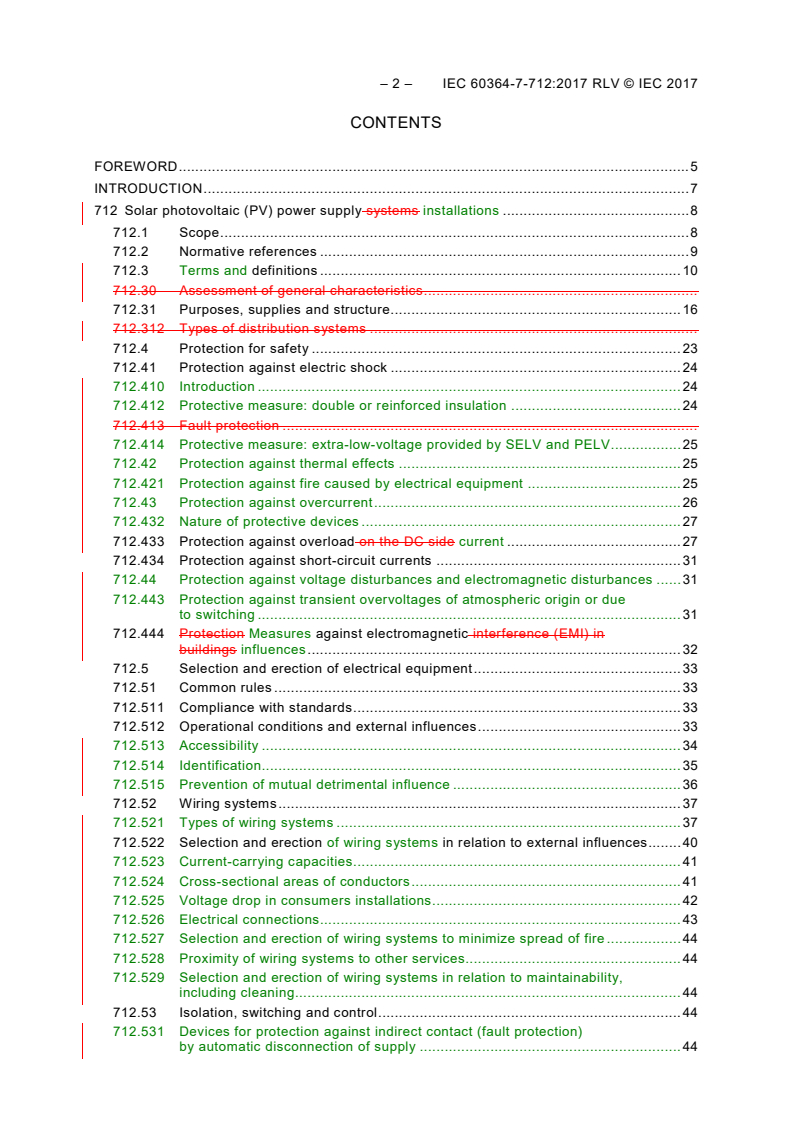
– 2 – IEC 60364-7-712:2017 RLV © IEC 2017
CONTENTS
FOREWORD . 5
INTRODUCTION . 7
712 Solar photovoltaic (PV) power supply systems installations . 8
712.1 Scope . 8
712.2 Normative references . 9
712.3 Terms and definitions . 10
712.30 Assessment of general characteristics .
712.31 Purposes, supplies and structure . 16
712.312 Types of distribution systems .
712.4 Protection for safety . 23
712.41 Protection against electric shock . 24
712.410 Introduction . 24
712.412 Protective measure: double or reinforced insulation . 24
712.413 Fault protection .
712.414 Protective measure: extra-low-voltage provided by SELV and PELV . 25
712.42 Protection against thermal effects . 25
712.421 Protection against fire caused by electrical equipment . 25
712.43 Protection against overcurrent . 26
712.432 Nature of protective devices . 27
712.433 Protection against overload on the DC side current . 27
712.434 Protection against short-circuit currents . 31
712.44 Protection against voltage disturbances and electromagnetic disturbances . 31
712.443 Protection against transient overvoltages of atmospheric origin or due
to switching . 31
712.444 Protection Measures against electromagnetic interference (EMI) in
buildings influences . 32
712.5 Selection and erection of electrical equipment . 33
712.51 Common rules . 33
712.511 Compliance with standards . 33
712.512 Operational conditions and external influences . 33
712.513 Accessibility . 34
712.514 Identification. 35
712.515 Prevention of mutual detrimental influence . 36
712.52 Wiring systems . 37
712.521 Types of wiring systems . 37
712.522 Selection and erection of wiring systems in relation to external influences . 40
712.523 Current-carrying capacities . 41
712.524 Cross-sectional areas of conductors . 41
712.525 Voltage drop in consumers installations . 42
712.526 Electrical connections. 43
712.527 Selection and erection of wiring systems to minimize spread of fire . 44
712.528 Proximity of wiring systems to other services. 44
712.529 Selection and erection of wiring systems in relation to maintainability,
including cleaning. 44
712.53 Isolation, switching and control . 44
712.531 Devices for protection against indirect contact (fault protection)
by automatic disconnection of supply . 44
712.532 Devices for protection against thermal effects . 47
712.533 Devices for protection against overcurrent . 48
712.534 Devices for protection against transient overvoltages . 49
712.536 Isolation and switching . 51
712.54 Earthing arrangements and protective conductors and protective bonding
conductors . 52
712.542 Earthing arrangements . 52
712.55 Other equipment. 53
712.6 Inspection and testing . 54
Annex A (informative) PV installation information . 57
Annex B (normative) Calculation of U and I . 61
OC MAX SC MAX
Annex C (informative) Examples of signs . 63
Annex D (informative) Blocking diode . 64
Annex E (informative) Arc fault detection and interruption in PV arrays . 68
Annex F (informative) List of notes concerning certain countries . 70
Bibliography . 71
Figure 712.1 – PV installation – General schema – One array .
Figure 712.1 – General functional configuration of a PV installation . 16
Figure 712.2 – PV installation – Example with several arrays .
Figure 712.2 – PV array diagram – single string case . 17
Figure 712.3 – PV array diagram – multiple parallel string case . 18
Figure 712.4 – PV array diagram – multiple parallel string case with array divided into
subarrays . 19
Figure 712.5 – PV array using a PCE with multiple MPPT DC inputs . 20
Figure 712.6 – PV array using a PCE with multiple DC inputs internally connected to a
common DC bus . 21
Figure 712.7 – Example of a PV array diagram where strings are grouped under one
overload protective device per group . 29
Figure 712.8 – Example of an indication showing the presence of a photovoltaic
installation on a building . 35
Figure 712.9 – Examples of cables with reinforced protection . 39
Figure 712.10 – PV string wiring with minimum loop area . 40
Figure A.712.1 – Single string PV array . 57
Figure A.712.2 – Parallel connected multi-string PV array . 58
Figure A.712.3 – Unearthed PV array connected to the AC side via a PCE with
transformer . 59
Figure A.712.4 – Unearthed PV array connected to the AC side via a PCE without a
transformer . 59
Figure A.721.5 – Earthed PV array connected to the AC side via a PCE with
transformer . 59
Figure A.712.6 –Earthed PV array connected to the AC side via a PCE without a
transformer, the transformer being separate . 60
Figure C.712.1 – Example of sign required on PV array combiner boxes (712.514.102) . 63
Figure C.712.2 – Example of switchboard sign for identification of PV on a building . 63
Figure D.712.1 – Effect of blocking diode at short circuit in PV string . 65
– 4 – IEC 60364-7-712:2017 RLV © IEC 2017
Figure D.712.2 – Effect of blocking diode where there is an insulation fault on a PV
installation with earthing on the DC negative side . 66
Figure D.712.3 – Effect of blocking diode where there is a fault on a PV installation
with earthing on the DC positive side . 66
Figure E.712.1 – Examples of types of arcs in PV arrays . 68
Table 712.1 – Calculation of the critical length L . 32
crit
Table 712.2 – Minimum current rating of circuits . 42
Table 712.3 – Requirements for different system types based on PCE isolation and PV
array functional earthing . 45
Table 712.4 – Minimum insulation resistance thresholds for detection of failure of
insulation to earth . 46
Table 712.5 – Response time limits for sudden changes in residual current . 47
Table 712.6 – Rated current of automatic disconnecting device in the functional
earthing conductor . 48
Table 712.7 – Impulse withstand voltage U where no information is available . 50
w
Table 712.8 – Disconnection device requirements in PV array installations . 52
Table A.712.1 – PV DC configurations . 58
ELECTROTECHNICAL COMMISSION
____________
LOW VOLTAGE ELECTRICAL INSTALLATIONS OF BUILDINGS –
Part 7-712: Requirements for special installations or locations –
Solar photovoltaic (PV) power supply systems
FOREWORD
1) The International Electrotechnical Commission (IEC) is a worldwide organization for standardization
comprising all national electrotechnical committees (IEC National Committees). The object of IEC is to
promote international co-operation on all questions concerning standardization in the electrical and electronic
fields. To this end and in addition to other activities, IEC publishes International Standards, Technical
Specifications, Technical Reports, Publicly Available Specifications (PAS) and Guides (hereafter referred to
as “IEC Publication(s)”). Their preparation is entrusted to technical committees; any IEC National Committee
interested in the subject dealt with may participate in this preparatory work. International, governmental and
non-governmental organizations liaising with the IEC also participate in this preparation. IEC collaborates
closely with the International Organization for Standardization (ISO) in accordance with conditions determined
by agreement between the two organizations.
2) The formal decisions or agreements of IEC on technical matters express, as nearly as possible, an
international consensus of opinion on the relevant subjects since each technical committee has
representation from all interested IEC National Committees.
3) IEC Publications have the form of recommendations for international use and are accepted by IEC National
Committees in that sense. While all reasonable efforts are made to ensure that the technical content of IEC
Publications is accurate, IEC cannot be held responsible for the way in which they are used or for any
misinterpretation by any end user.
4) In order to promote international uniformity, IEC National Committees undertake to apply IEC Publications
transparently to the maximum extent possible in their national and regional publications. Any divergence
between any IEC Publication and the corresponding national or regional publication shall be clearly indicated
in the latter.
5) IEC itself does not provide any attestation of conformity. Independent certification bodies provide conformity
assessment services and, in some areas, access to IEC marks of conformity. IEC is not responsible for any
services carried out by independent certification bodies.
6) All users should ensure that they have the latest edition of this publication.
7) No liability shall attach to IEC or its directors, employees, servants or agents including individual experts and
members of its technical committees and IEC National Committees for any personal injury, property damage
or other damage of any nature whatsoever, whether direct or indirect, or for costs (including legal fees) and
expenses arising out of the publication, use of, or reliance upon, this IEC Publication or any other IEC
Publications.
8) Attention is drawn to the Normative references cited in this publication. Use of the referenced publications is
indispensable for the correct application of this publication.
9) Attention is drawn to the possibility that some of the elements of this IEC Publication may be the subject of
patent rights. IEC shall not be held responsible for identifying any or all such patent rights.
This redline version of the official IEC Standard allows the user to identify the changes
made to the previous edition. A vertical bar appears in the margin wherever a change
has been made. Additions are in green text, deletions are in strikethrough red text.
– 6 – IEC 60364-7-712:2017 RLV © IEC 2017
International Standard IEC 60364-7-712 has been prepared by IEC technical committee 64:
Electrical installations and protection against electric shock.
This second edition cancels and replaces the first edition, published in 2002. This edition
constitutes a technical revision.
This edition includes the following significant technical changes with respect to the previous
edition:
a) The technical content has been extensively revised and expanded, taking into account
experience gained in the construction and operation of PV installations, and developments
made in technology, since the first edition of this standard was published.
The text of this standard is based on the following documents:
FDIS Report on voting
64/2154/FDIS 64/2163/RVD
Full information on the voting for the approval of this standard can be found in the report on
voting indicated in the above table.
This publication has been drafted in accordance with the ISO/IEC Directives, Part 2.
Attention is drawn to the co-existence of IEC 60364-7-712 and IEC 62548 standards. Both
standards have been developed in close coordination by different technical committees.
A list of all parts in the IEC 60364 series, published under the general title Low voltage
electrical installations, can be found on the IEC website.
The reader's attention is drawn to the fact that Annex F lists all of the “in-some-country”
clauses on differing practices of a less permanent nature relating to the subject of this
standard.
The committee has decided that the contents of this publication will remain unchanged until
the stability date indicated on the IEC website under "http://webstore.iec.ch" in the data
related to the specific publication. At this date, the publication will be
• reconfirmed,
• withdrawn,
• replaced by a revised edition, or
• amended.
IMPORTANT – The 'colour inside' logo on the cover page of this publication indicates
that it contains colours which are considered to be useful for the correct
understanding of its contents. Users should therefore print this document using a
colour printer.
INTRODUCTION
For the purpose of this part of IEC 60364 (IEC 60364-7-712), the requirements of the general
parts 1 to 6 of IEC 60364 apply.
The IEC 60364-7-7XX parts of IEC 60364 contain particular requirements for special
installations or locations which are based on the requirements of the general parts of
IEC 60364 (IEC 60364-1 to IEC 60364-6). These IEC 60364-7-7XX parts are considered in
conjunction with the requirements of the general parts.
The particular requirements of this part of IEC 60364 supplement, modify or replace certain of
the requirements of the general parts of IEC 60364 being valid at the time of publication of
this part. The absence of reference to the exclusion of a part or a clause of a general part
means that the corresponding clauses of the general requirements contained in parts 1 to 6 of
IEC 60364 part are applicable (undated reference).
Requirements of other 7XX parts being relevant for installations covered by this part also
apply. This part may therefore also supplement, modify or replace certain of these
requirements valid at the time of publication of this part.
The clause numbering appearing after 712 refers to the corresponding parts or clauses of this
part follows the pattern and corresponding references of IEC 60364. Numbering of clauses
does not, therefore, necessarily follow sequentially. The numbers following the particular
number of this part are those of the corresponding parts, or clauses of the other parts of the
IEC 60364 series, valid at the time of publication of this part, as indicated in the normative
references of this document (dated reference). If requirements or explanations additional to
those of the other parts of the IEC 60364 series are needed, the numbering of such items
appears as 712.101, 712.102, 712.103, etc.
Numbering of figures and tables takes the number of this part followed by a sequential
number. For annexes, the numbering of figures and tables takes the letter of the annex, the
number of the part and a sequential number.
In the case where new or amended general parts with modified numbering were published
after this part was issued, the clause numbers referring to a general part in this 712 part may
no longer align with the latest edition of the general part. Dated references should be
observed.
– 8 – IEC 60364-7-712:2017 RLV © IEC 2017
LOW VOLTAGE ELECTRICAL INSTALLATIONS OF BUILDINGS –
Part 7-712: Requirements for special installations or locations –
Solar photovoltaic (PV) power supply systems
712 Solar photovoltaic (PV) power supply systems installations
NOTE The abbreviation “PV” is used for "solar photovoltaic" “Photovoltaic”. Photovoltaic installations are,
hereafter, known as PV installations.
712.1 Scope
This part of IEC 60364 applies to the electrical installation of PV power supply systems
including systems with AC modules intended to supply all or part of an installation.
NOTE 1 Standards for PV equipment are being prepared by TC 82.
NOTE 2 Requirements for PV power supply systems which are intended for stand-alone operation are under
consideration.
The equipment of a PV installation, like any other item of equipment, is dealt with only so far
as its selection and application in the installation is concerned.
A PV installation starts from a PV module or a set of PV modules connected in series with
their cables, provided by the PV module manufacturer, up to the user installation or the utility
supply point (point of common coupling).
Requirements of this document apply to
• PV installations not connected to a system for distribution of electricity to the public,
• PV installations in parallel with a system for distribution of electricity to the public,
• PV installations as an alternative to a system for distribution of electricity to the public,
• appropriate combinations of the above.
This document does not cover the specific installation requirements for batteries or other
energy storage methods.
NOTE 1 Additional requirements for PV installations with battery storage capabilities on the DC side are under
consideration.
NOTE 2 This document does cover the protection requirements of PV arrays which develop as a result of the use
of batteries in PV installations.
For systems using DC-DC converters, additional requirements regarding voltage and current
rating, switching, and protective devices can apply. These requirements are under
consideration.
The object of this document is to address the design safety requirements arising from the
particular characteristics of PV installations. DC systems, and PV arrays in particular, pose
some hazards in addition to those derived from conventional AC power installations, including
the ability to produce and sustain electrical arcs with currents that are not greater than normal
operating currents.
In grid connected PV installations the safety requirements of this document are, however,
critically dependent on the PCE associated with PV arrays complying with the requirements of
IEC 62109-1 and IEC 62109-2.
712.2 Normative references
The following documents are referred to in the text in such a way that some or all of their
content constitutes requirements of this document. For dated references, only the edition
cited applies. For undated references, the latest edition of the referenced document (including
any amendments) applies.
IEC 60050(826):1982, International Electrotechnical Vocabulary (IEV) – Chapter 826:
Electrical installations of buildings
IEC 60228, Conductors of insulated cables
IEC 60269-6, Low-voltage fuses – Part 6: Supplementary requirements for fuse-links for the
protection of solar photovoltaic energy systems
IEC 60332-1-2, Tests on electric and optical fibre cables under fire conditions – Part 1-2: Test
for vertical flame propagation for a single insulated wire or cable – Procedure for 1 kW
pre-mixed flame
IEC 60364 (all parts), Low-voltage electrical installations
IEC 60364-4-41:2005, Low-voltage electrical installations – Part 4-41: Protection for safety –
Protection against electric shock
IEC 60364-4-43, Low-voltage electrical installations – Part 4-43: Protection for safety –
Protection against overcurrent
IEC 60364-4-44, Low-voltage electrical installations – Part 4-44: Protection for safety –
Protection against voltage disturbances and electromagnetic disturbances
IEC 60439-1, Low-voltage switchgear and controlgear assemblies – Part 1: Type-tested and
partially type-tested assemblies
IEC 60670 (all parts), Boxes and enclosures for electrical accessories for household and
similar fixed electrical installations
IEC/TR 60755, General requirements for residual current operated protective devices
Amendment 2 (1992)
IEC 60898 (all parts), Electrical accessories – Circuit-breakers for overcurrent protection for
household and similar installations
IEC 60898-2, Circuit-breakers for overcurrent protection for household and similar
installations – Part 2: Circuit-breakers for a.c. and d.c. operation
IEC 60904-3, Photovoltaic devices – Part 3: Measurement principles for terrestrial photo-
voltaic (PV) solar devices with reference spectral irradiance data
IEC 60947 (all parts), Low-voltage switchgear and controlgear
IEC 60947-1, Low-voltage switchgear and controlgear – Part 1: General rules
– 10 – IEC 60364-7-712:2017 RLV © IEC 2017
IEC 60947-2, Low-voltage switchgear and controlgear – Part 2: Circuit breakers
IEC 60947-3, Low-voltage switchgear and controlgear – Part 3: Switches, disconnectors,
switch-disconnectors and fuse-combination units
IEC 61140, Protection against electric shock – Common aspects for installation and
equipment
IEC 61215 (all parts), Crystalline silicon Terrestrial photovoltaic (PV) modules – Design
qualification and type approval
IEC 61439 (all parts), Low-voltage switchgear and controlgear assemblies
IEC 61439-2, Low-voltage switchgear and controlgear assemblies – Part 2: Power switchgear
and controlgear assemblies
IEC 61557-8:2014, Electrical safety in low voltage distribution systems up to 1 000 V a.c. and
1 500 V d.c. – Equipment for testing, measuring or monitoring of protective measures – Part 8:
Insulation monitoring devices for IT systems
IEC 62109 (all parts), Safety of power converters for use in photovoltaic power systems
IEC 62109-1:2010, Safety of power converters for use in photovoltaic power systems – Part 1:
General requirements
IEC 62109-2, Safety of power converters for use in photovoltaic power systems – Part 2:
Particular requirements for inverters
IEC 62262, Degrees of protection provided by enclosures for electrical equipment against
external mechanical impacts (IK code)
IEC 62423, Type F and type B residual current operated circuit-breakers with and without
integral overcurrent protection for household and similar uses
IEC 62446-1, Photovoltaic (PV) systems – Requirements for testing, documentation and
maintenance – Part 1: Grid connected systems – Documentation, commissioning tests and
inspection
IEC 62852:2014, Connectors for DC-application in photovoltaic systems – Safety
requirements and tests
712.3 Terms and definitions
(See also figures 712.1 and 712.2).
For the purposes of this document, the definitions of IEC 60050(826) as well as the following
terms and definitions apply.
ISO and IEC maintain terminological databases for use in standardization at the following
addresses:
• IEC Electropedia: available at http://www.electropedia.org/
• ISO Online browsing platform: available at http://www.iso.org/obp
712.3.1
PV cell
photovoltaic cell
solar cell
solar photovoltaic cell
basic PV device which can generate electricity when exposed to light such as solar radiation
most elementary device that exhibits the photovoltaic effect, i.e the direct non-thermal
conversion of radiant energy into electrical energy
Note 1 to entry: The preferred term is "solar photovoltaic cell" or "photovoltaic cell", colloquially referred to as a
"solar cell".
[SOURCE: IEC 61836:2007, 3.1.43 a), modified — "that exhibits … electrical energy" has
been added]
712.3.2
PV module
smallest complete environmentally protected assembly of interconnected PV cells
Note 1 to entry: See IEC 60904-3.
712.3.3
PV string
circuit in which PV modules are connected in series, in order for a PV array to generate the
required output voltage of one or more series-connected modules
[SOURCE: IEC 61836:2007, modified – "or one or more" has been added]
712.3.4
PV array
mechanically and electrically integrated assembly of electrically interconnected PV modules,
PV strings or PV sub-arrays and other necessary components, to form a DC power supply unit
Note 1 to entry: For the purposes of this document a PV array is all components up to the DC input terminals of
an invertor or DC loads. A PV array does not include its foundation, tracking apparatus, thermal control, and other
such components.
Note 2 to entry: A PV array may consist of a single PV module, a single PV string, or several parallel-connected
strings, or several parallel-connected PV sub-arrays and their associated electrical components (see Figure 712.2
to Figure 712.4). For the purposes of this document the boundary of a PV array is the output side of the PV array
disconnecting device.
712.3.5
PV array junction box
enclosure where all PV strings of any PV array are electrically connected and where
protection devices can be located if necessary
712.3.6
PV generator
assembly of PV arrays
712.3.7
PV generator junction box
enclosure where all PV arrays are electrically connected and where protection devices can be
located if necessary
712.3.5
PV sub-array
electrical subset of a PV array formed of parallel connected PV modules or PV strings
– 12 – IEC 60364-7-712:2017 RLV © IEC 2017
712.3.6
PV string cable
cable interconnecting PV the modules to form in a PV string, or connecting the string to a
combiner box, PCE or other DC loads
Note 1 to entry: Examples of PV string cable are shown in Figure 712.3 and Figure 712.4.
712.3.7
PV array cable
output cable of a PV array that carries the total output current of the array
712.3.10
PV DC main cable
cable connecting the PV generator junction box to the DC terminals of the PV inverter
712.3.11
PV inverter
device which converts DC voltage and DC current into AC voltage and AC current
712.3.8
PV AC supply cable
cable connecting the AC terminals of the PV inverter PCE to a distribution circuit board of the
electrical installation
712.3.9
PV AC supply circuit
circuit connecting the AC terminals of the PV PCE to a distribution board of the electrical
installation
712.3.10
PV AC module
integrated module/inverter PCE assembly where the electrical interface terminals are AC
alternating current only and where no access is provided to the DC side
712.3.11
PV installation
erected equipment of a PV power supply system installation
712.3.12
standard test conditions
STC
test conditions specified in IEC 60904-3 for PV cells and PV modules
standard set of reference conditions used for the testing and rating of photovoltaic cells and
modules as given in the relevant product standard for example IEC 61215
Note 1 to entry: The standard test conditions given in IEC 61215 for PV modules are:
a) PV cell temperature of 25 °C;
b) irradiance in the plane of the PV cell or module of 1 000 W/m ;
c) light spectrum corresponding to an atmospheric air mass of 1,5.
Note 2 to entry: This note applies to the French language only.
712.3.13
open-circuit voltage under standard test conditions
U
OC STC
voltage under standard test conditions across an unloaded (open) PV module, PV string or PV
array, PV generator, or on the DC side of the PV inverter PCE
712.3.14
open-circuit maximum voltage
U
OC MAX
maximum voltage across an unloaded (open) PV module, PV string, or PV array, or on the DC
side of the PV PCE
Note 1 to entry: The method for determining U is given in Annex B.
OC MAX
712.3.15
short-circuit current under standard test conditions
I
SC STC
short-circuit current of a PV module, PV string or PV array or PV generator under standard
test conditions
712.3.16
short-circuit maximum current
I
SC MAX
maximum short-circuit current of a PV module, PV string or PV array
Note 1 to entry: The method for determining I is given in Annex B.
SC MAX
712.3.17
backfeed current
maximum current that can pass from PCE to the PV array and its wiring under normal or
single fault conditions
712.3.18
reverse current
current that can backfeed into a PV circuit from parallel connected strings or sub-arrays as
the result of a fault, for example a short-circuit in the affected circuit
712.3.19
short-circuit current rating
I
SCPV
maximum prospective short-circuit current from the PV array for which the SPD, in conjunction
with the disconnectors specified, is rated
712.3.20
DC side
part of a PV installation from a PV cell the PV modules to the DC terminals of the PV inverter
PCE
712.3.21
AC side
part of a PV installation from the AC terminals of the PV inverter PCE to the point of
connection of the PV supply cable to the electrical installation
712.3.20
simple separation
separation between circuits or between a circuit and earth by means of basic insulation
712.3.22
maximum power point tracking
MPPT
control strategy whereby PV array operation is always at or near the point on a PV device's
current-voltage characteristic where the product of electric current and voltage yields the
maximum electrical power under specified operating conditions
Note 1 to entry: This note applies to the French language only.
– 14 – IEC 60364-7-712:2017 RLV © IEC 2017
712.3.23
I
MOD_MAX_OCPR
PV module maximum overcurrent protection rating
Note 1 to entry: See IEC 61730-2.
712.3.24
blocking diode
diode connected in series with module(s), strings and sub-array(s) to block reverse current
712.3.25
bypass diode
diode connected across one or more cells in the forward current direction
Note 1 to entry: The purpose is to allow the module current to bypass shaded or broken cells to prevent hot spot
or hot cell damage resulting from the reverse voltage biasing from the other cells in that module.
712.3.26
functional earthing
FE
earthing a point or points in a system or in an installation or in equipment for purposes other
than electrical safety
Note 1 to entry: Such a system is not considered to be an earthed array.
Note 2 to entry: Examples of functional array earthing include earthing one conductor through an impedance, or
only temporarily earthing the array for functional or performance reasons.
Note 3 to entry: In a PCE intended for an array not connected to a functional earth that uses a resistive
measurement network to measure the array impedance to earth, that measurement network is not considered a
form of functional earth.
Note 4 to entry: This note applies to the French language only.
[SOURCE: IEC 60050-826:2004, 826-13-10, modified – the notes have been added]
712.3.27
irradiance
G
electromagnetic radiated solar power per unit of area
Note 1 to entry: Irradiance is expressed in W/m .
[SOURCE: IEC 61836:2007, 3.6.25 modified – the note and sub-entries have been deleted]
712.3.28
I
SC ARRAY
short-circuit current of the PV array at standard test conditions
712.3.29
I
SC MOD
short-circuit current of a PV module or PV string at standard test conditions (STC), as
specified by the manufacturer in the product specification plate
Note 1 to entry: As PV strings are a group of PV modules connected in series, the short-circuit current of a string
is equal to I .
SC MOD
712.3.30
I
SC S-ARRAY
short-circuit current of a PV sub-array at standard test conditions (STC)
712.3.31
power conversion equipment
PCE
system that converts the electrical power delivered by the PV array into the appropriate
frequency and/or voltage values to be delivered to the load, or stored in a battery or injected
into the electricity grid
SEE: Figure 712.2 to Figure 712.4.
Note 1 to entry: This note applies to the French language only.
712.3.32
inverter
PCE which converts DC voltage and DC current of the PV array into AC voltage and AC
current
Note 1 to entry: This note applies to the French language only.
712.3.33
isolated PCE
PCE with at least simple separation between the main power output circuits and PV circuits
Note 1 to entry: The simple separation may be either integral to the PCE or provided externally, for example a
PCE with an external isolating transformer.
Note 2 to entry: In a PCE with more than two external circuits, there may be isolation between some pairs of
circuits and no isolation between others. For example, an inverter with PV, battery, and mains circuits may provide
isolation between the mains circuit and the PV circuit, but no isolation between the PV and battery circuits.
712.3.34
non-isolated PCE
PCE without the minimum separation between the main power output and PV circuits or with
leakage currents greater than the requirements for an isolated PCE
712.3.35
PV array combiner box
enclosure where PV sub-arrays are connected and which may also contain overcurrent
protection and/or switch-disconnection devices
Note 1 to entry: Small arrays generally do not contain sub-arrays but are simply made up of strings, whereas
large arrays are generally made up of multiple sub-arrays.
712.3.36
PV string combiner box
enclosure where PV strings are connected which may also contain overcurrent protective
devices and/or switch-disconnectors
712.3.37
PV sub-array cable
output cable of a PV sub-array that carries the output current of its associated sub-array
712.3.38
U
OC ARRAY
open-circuit voltage at standard test conditions of a PV array
712.3.39
V
OC MOD
open circuit voltage of a PV module at standard test conditions, as specified by the
manufacturer in the product specification
– 16 – IEC 60364-7-712:2017 RLV © IEC 2017
712.30 Assessment of general characteristics
712.31 Purposes, supplies and structure
712.31.101 PV array configuration
712.31.101.1 General
PV arrays are used to supply power to an application circuit.
Figure 712.1 illustrates the general functional configuration of a PV installation.
Application
PV circuit
array
Array
circuit
IEC
Figure 712.1 – General functional configuration of a PV installation
Three kinds of application circuit are considered:
• PV array is connected to DC loads;
• PV array is connected to AC installation via a PCE which includes at least simple
separation;
• PV array is connected to AC installation via a PCE which does not include simple
separation.
712.31.101.1.1 PV Installation architectures
The relation of a PV array to earth is determined by whether any earthing of the array for
functional reasons is in use, the impedance of the earthing connection and also by the earth
status of the application circuit (e.g. PCE or other equipment) to which it is connected. This
and the location of the earth connection all affect safety for the PV array (refer to Annex A).
The requirements of manufacturers of PV modules and manufacturers of the PCE to which the
PV array is connected shall be taken into account in determining the most appropriate system
earthing arrangement.
Protective earthing of any of the conductors of the PV array is not permitted. Earthing of one
of the conductors of the PV array for functional reasons is not allowed unless there is at least
simple separation from mains earth provided either internally in the PCE or externally via a
separate transformer.
If the simple separation is provided externally there shall be no o
...
IEC 60364-7-712 ®
Edition 2.0 2017-04
INTERNATIONAL
STANDARD
NORME
INTERNATIONALE
colour
inside
Low voltage electrical installations –
Part 7-712: Requirements for special installations or locations – Solar
photovoltaic (PV) power supply systems
Installations électriques basse tension –
Partie 7-712: Exigences applicables aux installations ou emplacements
spéciaux – Installations d'énergie solaire photovoltaïque (PV)
All rights reserved. Unless otherwise specified, no part of this publication may be reproduced or utilized in any form
or by any means, electronic or mechanical, including photocopying and microfilm, without permission in writing from
either IEC or IEC's member National Committee in the country of the requester. If you have any questions about IEC
copyright or have an enquiry about obtaining additional rights to this publication, please contact the address below or
your local IEC member National Committee for further information.
Droits de reproduction réservés. Sauf indication contraire, aucune partie de cette publication ne peut être reproduite
ni utilisée sous quelque forme que ce soit et par aucun procédé, électronique ou mécanique, y compris la photocopie
et les microfilms, sans l'accord écrit de l'IEC ou du Comité national de l'IEC du pays du demandeur. Si vous avez des
questions sur le copyright de l'IEC ou si vous désirez obtenir des droits supplémentaires sur cette publication, utilisez
les coordonnées ci-après ou contactez le Comité national de l'IEC de votre pays de résidence.
IEC Central Office Tel.: +41 22 919 02 11
3, rue de Varembé Fax: +41 22 919 03 00
CH-1211 Geneva 20 info@iec.ch
Switzerland www.iec.ch
About the IEC
The International Electrotechnical Commission (IEC) is the leading global organization that prepares and publishes
International Standards for all electrical, electronic and related technologies.
About IEC publications
The technical content of IEC publications is kept under constant review by the IEC. Please make sure that you have the
latest edition, a corrigenda or an amendment might have been published.
IEC Catalogue - webstore.iec.ch/catalogue Electropedia - www.electropedia.org
The stand-alone application for consulting the entire The world's leading online dictionary of electronic and
bibliographical information on IEC International Standards, electrical terms containing 20 000 terms and definitions in
Technical Specifications, Technical Reports and other English and French, with equivalent terms in 16 additional
documents. Available for PC, Mac OS, Android Tablets and languages. Also known as the International Electrotechnical
iPad. Vocabulary (IEV) online.
IEC publications search - www.iec.ch/searchpub IEC Glossary - std.iec.ch/glossary
The advanced search enables to find IEC publications by a 65 000 electrotechnical terminology entries in English and
variety of criteria (reference number, text, technical French extracted from the Terms and Definitions clause of
committee,…). It also gives information on projects, replaced IEC publications issued since 2002. Some entries have been
and withdrawn publications. collected from earlier publications of IEC TC 37, 77, 86 and
CISPR.
IEC Just Published - webstore.iec.ch/justpublished
Stay up to date on all new IEC publications. Just Published IEC Customer Service Centre - webstore.iec.ch/csc
details all new publications released. Available online and If you wish to give us your feedback on this publication or
also once a month by email. need further assistance, please contact the Customer Service
Centre: csc@iec.ch.
A propos de l'IEC
La Commission Electrotechnique Internationale (IEC) est la première organisation mondiale qui élabore et publie des
Normes internationales pour tout ce qui a trait à l'électricité, à l'électronique et aux technologies apparentées.
A propos des publications IEC
Le contenu technique des publications IEC est constamment revu. Veuillez vous assurer que vous possédez l’édition la
plus récente, un corrigendum ou amendement peut avoir été publié.
Catalogue IEC - webstore.iec.ch/catalogue Electropedia - www.electropedia.org
Application autonome pour consulter tous les renseignements
Le premier dictionnaire en ligne de termes électroniques et
bibliographiques sur les Normes internationales,
électriques. Il contient 20 000 termes et définitions en anglais
Spécifications techniques, Rapports techniques et autres
et en français, ainsi que les termes équivalents dans 16
documents de l'IEC. Disponible pour PC, Mac OS, tablettes
langues additionnelles. Egalement appelé Vocabulaire
Android et iPad.
Electrotechnique International (IEV) en ligne.
Recherche de publications IEC - www.iec.ch/searchpub
Glossaire IEC - std.iec.ch/glossary
65 000 entrées terminologiques électrotechniques, en anglais
La recherche avancée permet de trouver des publications IEC
en utilisant différents critères (numéro de référence, texte, et en français, extraites des articles Termes et Définitions des
comité d’études,…). Elle donne aussi des informations sur les publications IEC parues depuis 2002. Plus certaines entrées
projets et les publications remplacées ou retirées. antérieures extraites des publications des CE 37, 77, 86 et
CISPR de l'IEC.
IEC Just Published - webstore.iec.ch/justpublished
Service Clients - webstore.iec.ch/csc
Restez informé sur les nouvelles publications IEC. Just
Published détaille les nouvelles publications parues. Si vous désirez nous donner des commentaires sur cette
Disponible en ligne et aussi une fois par mois par email. publication ou si vous avez des questions contactez-nous:
csc@iec.ch.
IEC 60364-7-712 ®
Edition 2.0 2017-04
INTERNATIONAL
STANDARD
NORME
INTERNATIONALE
colour
inside
Low voltage electrical installations –
Part 7-712: Requirements for special installations or locations – Solar
photovoltaic (PV) power supply systems
Installations électriques basse tension –
Partie 7-712: Exigences applicables aux installations ou emplacements
spéciaux – Installations d'énergie solaire photovoltaïque (PV)
INTERNATIONAL
ELECTROTECHNICAL
COMMISSION
COMMISSION
ELECTROTECHNIQUE
INTERNATIONALE
ICS 27.160; 29.020; 91.140.50 ISBN 978-2-8322-4006-9
– 2 – IEC 60364-7-712:2017 © IEC 2017
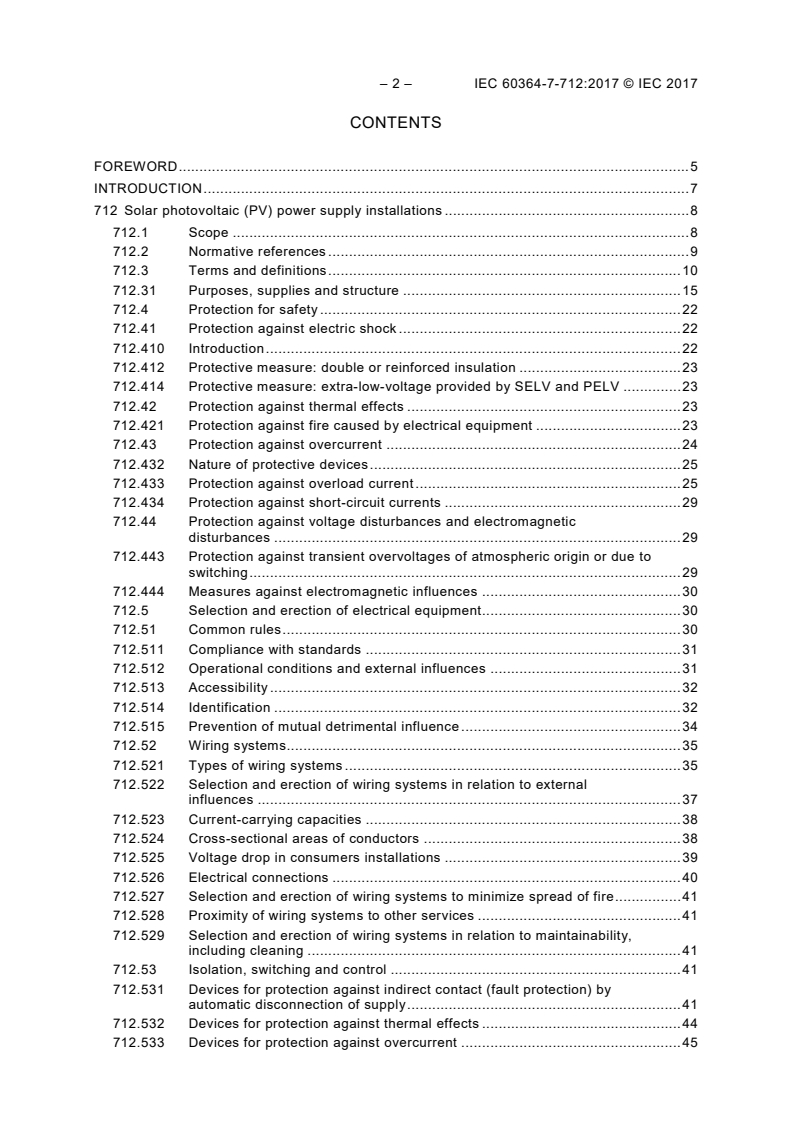
CONTENTS
FOREWORD . 5
INTRODUCTION . 7
712 Solar photovoltaic (PV) power supply installations . 8
712.1 Scope . 8
712.2 Normative references . 9
712.3 Terms and definitions . 10
712.31 Purposes, supplies and structure . 15
712.4 Protection for safety . 22
712.41 Protection against electric shock . 22
712.410 Introduction . 22
712.412 Protective measure: double or reinforced insulation . 23
712.414 Protective measure: extra-low-voltage provided by SELV and PELV . 23
712.42 Protection against thermal effects . 23
712.421 Protection against fire caused by electrical equipment . 23
712.43 Protection against overcurrent . 24
712.432 Nature of protective devices . 25
712.433 Protection against overload current . 25
712.434 Protection against short-circuit currents . 29
712.44 Protection against voltage disturbances and electromagnetic
disturbances . 29
712.443 Protection against transient overvoltages of atmospheric origin or due to
switching . 29
712.444 Measures against electromagnetic influences . 30
712.5 Selection and erection of electrical equipment. 30
712.51 Common rules . 30
712.511 Compliance with standards . 31
712.512 Operational conditions and external influences . 31
712.513 Accessibility . 32
712.514 Identification . 32
712.515 Prevention of mutual detrimental influence . 34
712.52 Wiring systems . 35
712.521 Types of wiring systems . 35
712.522 Selection and erection of wiring systems in relation to external
influences . 37
712.523 Current-carrying capacities . 38
712.524 Cross-sectional areas of conductors . 38
712.525 Voltage drop in consumers installations . 39
712.526 Electrical connections . 40
712.527 Selection and erection of wiring systems to minimize spread of fire . 41
712.528 Proximity of wiring systems to other services . 41
712.529 Selection and erection of wiring systems in relation to maintainability,
including cleaning . 41
712.53 Isolation, switching and control . 41
712.531 Devices for protection against indirect contact (fault protection) by
automatic disconnection of supply . 41
712.532 Devices for protection against thermal effects . 44
712.533 Devices for protection against overcurrent . 45
712.534 Devices for protection against transient overvoltages . 46
712.536 Isolation and switching . 48
712.54 Earthing arrangements and protective conductors . 49
712.542 Earthing arrangements . 49
712.55 Other equipment . 50
712.6 Inspection and testing . 50
Annex A (informative) PV installation information . 51
Annex B (normative) Calculation of U and I . 54
OC MAX SC MAX
Annex C (informative) Examples of signs . 56
Annex D (informative) Blocking diode . 57
Annex E (informative) Arc fault detection and interruption in PV arrays . 61
Annex F (informative) List of notes concerning certain countries . 62
Bibliography . 63
Figure 712.1 – General functional configuration of a PV installation . 15
Figure 712.2 – PV array diagram – single string case . 16
Figure 712.3 – PV array diagram – multiple parallel string case . 17
Figure 712.4 – PV array diagram – multiple parallel string case with array divided into
subarrays . 18
Figure 712.5 – PV array using a PCE with multiple MPPT DC inputs . 19
Figure 712.6 – PV array using a PCE with multiple DC inputs internally connected to a
common DC bus . 20
Figure 712.7 – Example of a PV array diagram where strings are grouped under one
overload protective device per group . 27
Figure 712.8 – Example of an indication showing the presence of a photovoltaic
installation on a building . 33
Figure 712.9 – Examples of cables with reinforced protection . 36
Figure 712.10 – PV string wiring with minimum loop area . 37
Figure A.712.1 – Single string PV array . 51
Figure A.712.2 – Parallel connected multi-string PV array . 52
Figure A.712.3 – Unearthed PV array connected to the AC side via a PCE with
transformer . 53
Figure A.712.4 – Unearthed PV array connected to the AC side via a PCE without a
transformer . 53
Figure A.721.5 – Earthed PV array connected to the AC side via a PCE with
transformer . 53
Figure A.712.6 –Earthed PV array connected to the AC side via a PCE without a
transformer, the transformer being separate . 53
Figure C.712.1 – Example of sign required on PV array combiner boxes (712.514.102) . 56
Figure C.712.2 – Example of switchboard sign for identification of PV on a building . 56
Figure D.712.1 – Effect of blocking diode at short circuit in PV string . 58
Figure D.712.2 – Effect of blocking diode where there is an insulation fault on a PV
installation with earthing on the DC negative side . 58
Figure D.712.3 – Effect of blocking diode where there is a fault on a PV installation
with earthing on the DC positive side . 59
Figure E.712.1 – Examples of types of arcs in PV arrays . 61
– 4 – IEC 60364-7-712:2017 © IEC 2017
Table 712.1 – Calculation of the critical length L . 30
crit
Table 712.2 – Minimum current rating of circuits . 39
Table 712.3 – Requirements for different system types based on PCE isolation and PV
array functional earthing . 42
Table 712.4 – Minimum insulation resistance thresholds for detection of failure of
insulation to earth . 43
Table 712.5 – Response time limits for sudden changes in residual current . 44
Table 712.6 – Rated current of automatic disconnecting device in the functional
earthing conductor . 45
Table 712.7 – Impulse withstand voltage U where no information is available . 47
w
Table 712.8 – Disconnection device requirements in PV array installations . 48
Table A.712.1 – PV DC configurations . 52
INTERNATIONAL ELECTROTECHNICAL COMMISSION
____________
LOW VOLTAGE ELECTRICAL INSTALLATIONS –
Part 7-712: Requirements for special installations or locations –
Solar photovoltaic (PV) power supply systems
FOREWORD
1) The International Electrotechnical Commission (IEC) is a worldwide organization for standardization
comprising all national electrotechnical committees (IEC National Committees). The object of IEC is to
promote international co-operation on all questions concerning standardization in the electrical and electronic
fields. To this end and in addition to other activities, IEC publishes International Standards, Technical
Specifications, Technical Reports, Publicly Available Specifications (PAS) and Guides (hereafter referred to
as “IEC Publication(s)”). Their preparation is entrusted to technical committees; any IEC National Committee
interested in the subject dealt with may participate in this preparatory work. International, governmental and
non-governmental organizations liaising with the IEC also participate in this preparation. IEC collaborates
closely with the International Organization for Standardization (ISO) in accordance with conditions determined
by agreement between the two organizations.
2) The formal decisions or agreements of IEC on technical matters express, as nearly as possible, an
international consensus of opinion on the relevant subjects since each technical committee has
representation from all interested IEC National Committees.
3) IEC Publications have the form of recommendations for international use and are accepted by IEC National
Committees in that sense. While all reasonable efforts are made to ensure that the technical content of IEC
Publications is accurate, IEC cannot be held responsible for the way in which they are used or for any
misinterpretation by any end user.
4) In order to promote international uniformity, IEC National Committees undertake to apply IEC Publications
transparently to the maximum extent possible in their national and regional publications. Any divergence
between any IEC Publication and the corresponding national or regional publication shall be clearly indicated
in the latter.
5) IEC itself does not provide any attestation of conformity. Independent certification bodies provide conformity
assessment services and, in some areas, access to IEC marks of conformity. IEC is not responsible for any
services carried out by independent certification bodies.
6) All users should ensure that they have the latest edition of this publication.
7) No liability shall attach to IEC or its directors, employees, servants or agents including individual experts and
members of its technical committees and IEC National Committees for any personal injury, property damage
or other damage of any nature whatsoever, whether direct or indirect, or for costs (including legal fees) and
expenses arising out of the publication, use of, or reliance upon, this IEC Publication or any other IEC
Publications.
8) Attention is drawn to the Normative references cited in this publication. Use of the referenced publications is
indispensable for the correct application of this publication.
9) Attention is drawn to the possibility that some of the elements of this IEC Publication may be the subject of
patent rights. IEC shall not be held responsible for identifying any or all such patent rights.
International Standard IEC 60364-7-712 has been prepared by IEC technical committee 64:
Electrical installations and protection against electric shock.
This second edition cancels and replaces the first edition, published in 2002. This edition
constitutes a technical revision.
This edition includes the following significant technical changes with respect to the previous
edition:
a) The technical content has been extensively revised and expanded, taking into account
experience gained in the construction and operation of PV installations, and developments
made in technology, since the first edition of this standard was published.
– 6 – IEC 60364-7-712:2017 © IEC 2017
The text of this standard is based on the following documents:
FDIS Report on voting
64/2154/FDIS 64/2163/RVD
Full information on the voting for the approval of this standard can be found in the report on
voting indicated in the above table.
This publication has been drafted in accordance with the ISO/IEC Directives, Part 2.
Attention is drawn to the co-existence of IEC 60364-7-712 and IEC 62548 standards. Both
standards have been developed in close coordination by different technical committees.
A list of all parts in the IEC 60364 series, published under the general title Low voltage
electrical installations, can be found on the IEC website.
The reader's attention is drawn to the fact that Annex F lists all of the “in-some-country”
clauses on differing practices of a less permanent nature relating to the subject of this
standard.
The committee has decided that the contents of this publication will remain unchanged until
the stability date indicated on the IEC website under "http://webstore.iec.ch" in the data
related to the specific publication. At this date, the publication will be
• reconfirmed,
• withdrawn,
• replaced by a revised edition, or
• amended.
IMPORTANT – The 'colour inside' logo on the cover page of this publication indicates
that it contains colours which are considered to be useful for the correct
understanding of its contents. Users should therefore print this document using a
colour printer.
INTRODUCTION
For the purpose of this part of IEC 60364 (IEC 60364-7-712), the requirements of the general
parts 1 to 6 of IEC 60364 apply.
The IEC 60364-7-7XX parts of IEC 60364 contain particular requirements for special
installations or locations which are based on the requirements of the general parts of
IEC 60364 (IEC 60364-1 to IEC 60364-6). These IEC 60364-7-7XX parts are considered in
conjunction with the requirements of the general parts.
The particular requirements of this part of IEC 60364 supplement, modify or replace certain of
the requirements of the general parts of IEC 60364 being valid at the time of publication of
this part. The absence of reference to the exclusion of a part or a clause of a general part
means that the corresponding clauses of the general part are applicable (undated reference).
Requirements of other 7XX parts being relevant for installations covered by this part also
apply. This part may therefore also supplement, modify or replace certain of these
requirements valid at the time of publication of this part.
The clause numbering of this part follows the pattern and corresponding references of
IEC 60364. The numbers following the particular number of this part are those of the
corresponding parts, or clauses of the other parts of the IEC 60364 series, valid at the time of
publication of this part, as indicated in the normative references of this document (dated
reference). If requirements or explanations additional to those of the other parts of the
IEC 60364 series are needed, the numbering of such items appears as 712.101, 712.102,
712.103, etc.
Numbering of figures and tables takes the number of this part followed by a sequential
number. For annexes, the numbering of figures and tables takes the letter of the annex, the
number of the part and a sequential number.
In the case where new or amended general parts with modified numbering were published
after this part was issued, the clause numbers referring to a general part in this 712 part may
no longer align with the latest edition of the general part. Dated references should be
observed.
– 8 – IEC 60364-7-712:2017 © IEC 2017
LOW VOLTAGE ELECTRICAL INSTALLATIONS –
Part 7-712: Requirements for special installations or locations –
Solar photovoltaic (PV) power supply systems
712 Solar photovoltaic (PV) power supply installations
NOTE The abbreviation “PV” is used for “Photovoltaic”. Photovoltaic installations are, hereafter, known as PV
installations.
712.1 Scope
This part of IEC 60364 applies to the electrical installation of PV systems intended to supply
all or part of an installation.
The equipment of a PV installation, like any other item of equipment, is dealt with only so far
as its selection and application in the installation is concerned.
A PV installation starts from a PV module or a set of PV modules connected in series with
their cables, provided by the PV module manufacturer, up to the user installation or the utility
supply point (point of common coupling).
Requirements of this document apply to
• PV installations not connected to a system for distribution of electricity to the public,
• PV installations in parallel with a system for distribution of electricity to the public,
• PV installations as an alternative to a system for distribution of electricity to the public,
• appropriate combinations of the above.
This document does not cover the specific installation requirements for batteries or other
energy storage methods.
NOTE 1 Additional requirements for PV installations with battery storage capabilities on the DC side are under
consideration.
NOTE 2 This document does cover the protection requirements of PV arrays which develop as a result of the use
of batteries in PV installations.
For systems using DC-DC converters, additional requirements regarding voltage and current
rating, switching, and protective devices can apply. These requirements are under
consideration.
The object of this document is to address the design safety requirements arising from the
particular characteristics of PV installations. DC systems, and PV arrays in particular, pose
some hazards in addition to those derived from conventional AC power installations, including
the ability to produce and sustain electrical arcs with currents that are not greater than normal
operating currents.
In grid connected PV installations the safety requirements of this document are, however,
critically dependent on the PCE associated with PV arrays complying with the requirements of
IEC 62109-1 and IEC 62109-2.
712.2 Normative references
The following documents are referred to in the text in such a way that some or all of their
content constitutes requirements of this document. For dated references, only the edition
cited applies. For undated references, the latest edition of the referenced document (including
any amendments) applies.
IEC 60228, Conductors of insulated cables
IEC 60269-6, Low-voltage fuses – Part 6: Supplementary requirements for fuse-links for the
protection of solar photovoltaic energy systems
IEC 60332-1-2, Tests on electric and optical fibre cables under fire conditions – Part 1-2: Test
for vertical flame propagation for a single insulated wire or cable – Procedure for 1 kW
pre-mixed flame
IEC 60364 (all parts), Low-voltage electrical installations
IEC 60364-4-41:2005, Low-voltage electrical installations – Part 4-41: Protection for safety –
Protection against electric shock
IEC 60364-4-43, Low-voltage electrical installations – Part 4-43: Protection for safety –
Protection against overcurrent
IEC 60364-4-44, Low-voltage electrical installations – Part 4-44: Protection for safety –
Protection against voltage disturbances and electromagnetic disturbances
IEC 60670 (all parts), Boxes and enclosures for electrical accessories for household and
similar fixed electrical installations
IEC 60898 (all parts), Electrical accessories – Circuit-breakers for overcurrent protection for
household and similar installations
IEC 60898-2, Circuit-breakers for overcurrent protection for household and similar
installations – Part 2: Circuit-breakers for a.c. and d.c. operation
IEC 60947 (all parts), Low-voltage switchgear and controlgear
IEC 60947-1, Low-voltage switchgear and controlgear – Part 1: General rules
IEC 60947-2, Low-voltage switchgear and controlgear – Part 2: Circuit breakers
IEC 60947-3, Low-voltage switchgear and controlgear – Part 3: Switches, disconnectors,
switch-disconnectors and fuse-combination units
IEC 61140, Protection against electric shock – Common aspects for installation and
equipment
IEC 61215 (all parts), Terrestrial photovoltaic (PV) modules − Design qualification and type
approval
IEC 61439 (all parts), Low-voltage switchgear and controlgear assemblies
IEC 61439-2, Low-voltage switchgear and controlgear assemblies – Part 2: Power switchgear
and controlgear assemblies
– 10 – IEC 60364-7-712:2017 © IEC 2017
IEC 61557-8:2014, Electrical safety in low voltage distribution systems up to 1 000 V a.c. and
1 500 V d.c. – Equipment for testing, measuring or monitoring of protective measures – Part 8:
Insulation monitoring devices for IT systems
IEC 62109 (all parts), Safety of power converters for use in photovoltaic power systems
IEC 62109-1:2010, Safety of power converters for use in photovoltaic power systems – Part 1:
General requirements
IEC 62109-2, Safety of power converters for use in photovoltaic power systems – Part 2:
Particular requirements for inverters
IEC 62262, Degrees of protection provided by enclosures for electrical equipment against
external mechanical impacts (IK code)
IEC 62423, Type F and type B residual current operated circuit-breakers with and without
integral overcurrent protection for household and similar uses
IEC 62446-1, Photovoltaic (PV) systems – Requirements for testing, documentation and
maintenance – Part 1: Grid connected systems – Documentation, commissioning tests and
inspection
IEC 62852:2014, Connectors for DC-application in photovoltaic systems – Safety
requirements and tests
712.3 Terms and definitions
For the purposes of this document, the following terms and definitions apply.
ISO and IEC maintain terminological databases for use in standardization at the following
addresses:
• IEC Electropedia: available at http://www.electropedia.org/
• ISO Online browsing platform: available at http://www.iso.org/obp
712.3.1
PV cell
photovoltaic cell
solar cell
solar photovoltaic cell
most elementary device that exhibits the photovoltaic effect, i.e the direct non-thermal
conversion of radiant energy into electrical energy
Note 1 to entry: The preferred term is "solar photovoltaic cell" or "photovoltaic cell", colloquially referred to as a
"solar cell".
[SOURCE: IEC 61836:2007, 3.1.43 a), modified — "that exhibits … electrical energy" has
been added]
712.3.2
PV module
smallest complete environmentally protected assembly of interconnected cells
Note 1 to entry: See IEC 60904-3.
712.3.3
PV string
circuit of one or more series-connected modules
[SOURCE: IEC 61836:2007, modified – "or one or more" has been added]
712.3.4
PV array
assembly of electrically interconnected PV modules, PV strings or PV sub-arrays
Note 1 to entry: For the purposes of this document a PV array is all components up to the DC input terminals of
an invertor or DC loads. A PV array does not include its foundation, tracking apparatus, thermal control, and other
such components.
Note 2 to entry: A PV array may consist of a single PV module, a single PV string, or several parallel-connected
strings, or several parallel-connected PV sub-arrays and their associated electrical components (see Figure 712.2
to Figure 712.4). For the purposes of this document the boundary of a PV array is the output side of the PV array
disconnecting device.
712.3.5
PV sub-array
electrical subset of a PV array formed of parallel connected PV modules or PV strings
712.3.6
PV string cable
cable interconnecting the modules in a PV string, or connecting the string to a combiner box,
PCE or other DC loads
Note 1 to entry: Examples of PV string cable are shown in Figure 712.3 and Figure 712.4.
712.3.7
PV array cable
cable of a PV array that carries the total output current of the array
712.3.8
PV AC supply cable
cable connecting the AC terminals of the PV PCE to a distribution board of the electrical
installation
712.3.9
PV AC supply circuit
circuit connecting the AC terminals of the PV PCE to a distribution board of the electrical
installation
712.3.10
PV AC module
integrated module/PCE assembly where the electrical interface terminals are alternating
current only and where no access is provided to the DC side
712.3.11
PV installation
erected equipment of a PV power supply installation
712.3.12
standard test conditions
STC
standard set of reference conditions used for the testing and rating of photovoltaic cells and
modules as given in the relevant product standard for example IEC 61215
Note 1 to entry: The standard test conditions given in IEC 61215 for PV modules are:
a) PV cell temperature of 25 °C;
b) irradiance in the plane of the PV cell or module of 1 000 W/m ;
c) light spectrum corresponding to an atmospheric air mass of 1,5.
– 12 – IEC 60364-7-712:2017 © IEC 2017
Note 2 to entry: This note applies to the French language only.
712.3.13
open-circuit voltage under standard test conditions
U
OC STC
voltage under standard test conditions across an unloaded (open) PV module, PV string, or
PV array, or on the DC side of the PV PCE
712.3.14
open-circuit maximum voltage
U
OC MAX
maximum voltage across an unloaded (open) PV module, PV string, or PV array, or on the DC
side of the PV PCE
Note 1 to entry: The method for determining U is given in Annex B.
OC MAX
712.3.15
short-circuit current under standard test conditions
I
SC STC
short-circuit current of a PV module, PV string, or PV array under standard test conditions
712.3.16
short-circuit maximum current
I
SC MAX
maximum short-circuit current of a PV module, PV string or PV array
Note 1 to entry: The method for determining I is given in Annex B.
SC MAX
712.3.17
backfeed current
maximum current that can pass from PCE to the PV array and its wiring under normal or
single fault conditions
712.3.18
reverse current
current that can backfeed into a PV circuit from parallel connected strings or sub-arrays as
the result of a fault, for example a short-circuit in the affected circuit
712.3.19
short-circuit current rating
I
SCPV
maximum prospective short-circuit current from the PV array for which the SPD, in conjunction
with the disconnectors specified, is rated
712.3.20
DC side
part of a PV installation from the PV modules to the DC terminals of the PV PCE
712.3.21
AC side
part of a PV installation from the AC terminals of the PV PCE to the point of connection of the
PV supply cable to the electrical installation
712.3.22
maximum power point tracking
MPPT
control strategy whereby PV array operation is always at or near the point on a PV device's
current-voltage characteristic where the product of electric current and voltage yields the
maximum electrical power under specified operating conditions
Note 1 to entry: This note applies to the French language only.
712.3.23
I
MOD_MAX_OCPR
PV module maximum overcurrent protection rating
Note 1 to entry: See IEC 61730-2.
712.3.24
blocking diode
diode connected in series with module(s), strings and sub-array(s) to block reverse current
712.3.25
bypass diode
diode connected across one or more cells in the forward current direction
Note 1 to entry: The purpose is to allow the module current to bypass shaded or broken cells to prevent hot spot
or hot cell damage resulting from the reverse voltage biasing from the other cells in that module.
712.3.26
functional earthing
FE
earthing a point or points in a system or in an installation or in equipment for purposes other
than electrical safety
Note 1 to entry: Such a system is not considered to be an earthed array.
Note 2 to entry: Examples of functional array earthing include earthing one conductor through an impedance, or
only temporarily earthing the array for functional or performance reasons.
Note 3 to entry: In a PCE intended for an array not connected to a functional earth that uses a resistive
measurement network to measure the array impedance to earth, that measurement network is not considered a
form of functional earth.
Note 4 to entry: This note applies to the French language only.
[SOURCE: IEC 60050-826:2004, 826-13-10, modified – the notes have been added]
712.3.27
irradiance
G
electromagnetic radiated solar power per unit of area
Note 1 to entry: Irradiance is expressed in W/m .
[SOURCE: IEC 61836:2007, 3.6.25 modified – the note and sub-entries have been deleted]
712.3.28
I
SC ARRAY
short-circuit current of the PV array at standard test conditions
712.3.29
I
SC MOD
short-circuit current of a PV module or PV string at standard test conditions (STC), as
specified by the manufacturer in the product specification plate
Note 1 to entry: As PV strings are a group of PV modules connected in series, the short-circuit current of a string
is equal to I .
SC MOD
712.3.30
I
SC S-ARRAY
short-circuit current of a PV sub-array at standard test conditions (STC)
– 14 – IEC 60364-7-712:2017 © IEC 2017
712.3.31
power conversion equipment
PCE
system that converts the electrical power delivered by the PV array into the appropriate
frequency and/or voltage values to be delivered to the load, or stored in a battery or injected
into the electricity grid
SEE: Figure 712.2 to Figure 712.4.
Note 1 to entry: This note applies to the French language only.
712.3.32
inverter
PCE which converts DC voltage and DC current of the PV array into AC voltage and AC
current
Note 1 to entry: This note applies to the French language only.
712.3.33
isolated PCE
PCE with at least simple separation between the main power output circuits and PV circuits
Note 1 to entry: The simple separation may be either integral to the PCE or provided externally, for example a
PCE with an external isolating transformer.
Note 2 to entry: In a PCE with more than two external circuits, there may be isolation between some pairs of
circuits and no isolation between others. For example, an inverter with PV, battery, and mains circuits may provide
isolation between the mains circuit and the PV circuit, but no isolation between the PV and battery circuits.
712.3.34
non-isolated PCE
PCE without the minimum separation between the main power output and PV circuits or with
leakage currents greater than the requirements for an isolated PCE
712.3.35
PV array combiner box
enclosure where PV sub-arrays are connected and which may also contain overcurrent
protection and/or switch-disconnection devices
Note 1 to entry: Small arrays generally do not contain sub-arrays but are simply made up of strings, whereas
large arrays are generally made up of multiple sub-arrays.
712.3.36
PV string combiner box
enclosure where PV strings are connected which may also contain overcurrent protective
devices and/or switch-disconnectors
712.3.37
PV sub-array cable
output cable of a PV sub-array that carries the output current of its associated sub-array
712.3.38
U
OC ARRAY
open-circuit voltage at standard test conditions of a PV array
712.3.39
V
OC MOD
open circuit voltage of a PV module at standard test conditions, as specified by the
manufacturer in the product specification
712.31 Purposes, supplies and structure
712.31.101 PV array configuration
712.31.101.1 General
PV arrays are used to supply power to an application circuit.
Figure 712.1 illustrates the general functional configuration of a PV installation.
Application
PV circuit
array
Array
circuit
IEC
Figure 712.1 – General functional configuration of a PV installation
Three kinds of application circuit are considered:
• PV array is connected to DC loads;
• PV array is connected to AC installation via a PCE which includes at least simple
separation;
• PV array is connected to AC installation via a PCE which does not include simple
separation.
712.31.101.1.1 PV Installation architectures
The relation of a PV array to earth is determined by whether any earthing of the array for
functional reasons is in use, the impedance of the earthing connection and also by the earth
status of the application circuit (e.g. PCE or other equipment) to which it is connected. This
and the location of the earth connection all affect safety for the PV array (refer to Annex A).
The requirements of manufacturers of PV modules and manufacturers of the PCE to which the
PV array is connected shall be taken into account in determining the most appropriate system
earthing arrangement.
Protective earthing of any of the conductors of the PV array is not permitted. Earthing of one
of the conductors of the PV array for functional reasons is not allowed unless there is at least
simple separation from mains earth provided either internally in the PCE or externally via a
separate transformer.
If the simple separation is provided externally there shall be no other equipment connected to
the same circuit as the PCE.
NOTE A DC current-carrying conductor that is connected to earth is considered to be a live conductor.
– 16 –
...