

IEC 60364-7-712:2025
(Main)Low-voltage electrical installations - Part 7-712: Requirements for special installations or locations - Solar photovoltaic (PV) power supply installations
General Information
- Abstract
IEC 60364-7-712:2025 applies to electrical installations of PV systems. The equipment of a PV system, like any other item of equipment, is dealt with only so far as its selection and application in the installation is concerned. A PV installation comprises all equipment from PV modules(s) up to the connection point to other parts of the installation, for example a distribution board or the utility supply point (point of connection).
This part of IEC 60364 includes requirements on electrical installation resulting from the installation of PV power supply installations.
Requirements relating to the possible installation of energy storage systems (e.g. batteries) are included.
Requirements are also included for PV installations for island mode operation described in IEC 60364-8-82.
This third edition cancels and replaces the second edition published in 2017. This edition constitutes a technical revision.
This edition includes the following significant technical changes with respect to the previous edition:
a) The technical content has been extensively revised and expanded, taking into account experience gained in the construction and operation of PV installations, and developments made in technology, since the second edition was published.
b) Key changes include requirements for PV power generation plants, direct connection to battery circuits, introduction of DC bus circuit and DCUs.
- Status
- Published
- Publication Date
- 20-Oct-2025
- Technical Committee
- TC 64 - Electrical installations and protection against electric shock
- Drafting Committee
- JWG 32 - TC 64/JWG 32
- Current Stage
- PPUB - Publication issued
- Start Date
- 21-Oct-2025
- Completion Date
- 07-Nov-2025
Buy Documents
IEC 60364-7-712:2025 - Low-voltage electrical installations - Part 7-712: Requirements for special installations or locations - Solar photovoltaic (PV) power supply installations Released:10/21/2025
IEC 60364-7-712:2025 - Installations électriques a basse tension - Partie 7-712: Exigences applicables aux installations ou emplacements spéciaux - Installations d'énergie solaire photovoltaique (PV) Released:10/21/2025
IEC 60364-7-712:2025 - Low-voltage electrical installations - Part 7-712: Requirements for special installations or locations - Solar photovoltaic (PV) power supply installations Released:10/21/2025
Overview
IEC 60364-7-712:2025 is the International Electrotechnical Commission standard for low-voltage electrical installations specific to solar photovoltaic (PV) power supply installations. This third edition (2025) replaces the 2017 edition and provides a technical revision that addresses the entire PV installation from PV modules up to the point of connection (e.g., distribution board or utility supply point). The standard covers selection and application of equipment in the installation and includes requirements for energy storage systems (batteries) and island mode (standalone) operation as described in IEC 60364-8-82.
Key Topics
- Scope & Structure: Defines a PV installation as all equipment from PV modules to connection points; supplements general IEC 60364 Parts 1–6 and Part 8 requirements.
- Protective Measures for Safety: Protection against electric shock, thermal effects, overcurrent and transient overvoltages; requirements for automatic disconnection, double/reinforced insulation, SELV/PELV where applicable.
- Selection & Erection of Equipment: Rules for compliant component selection, operational conditions, accessibility, identification and prevention of mutual detrimental influence.
- Wiring Systems & Cables: Types of wiring systems, current-carrying capacities, conductor cross-sections, connections and measures to minimize fire spread.
- Devices & Monitoring: Overcurrent protection, isolation and switching devices, transient overvoltage protection, insulation monitoring and fault detection.
- Earthing & Bonding: Earthing arrangements and protective bonding conductors tailored for PV systems and DC bus configurations.
- Energy Storage & DC Architectures: Requirements for battery integration, direct battery connections, DC bus circuits and DCUs (DC unit/string definitions).
- Verification & Calculation Annexes: Verification, calculation methods for voltages and currents, cable temperature correction factors and performance/architecture examples.
Applications
IEC 60364-7-712:2025 is used to ensure safe, code-compliant design, installation, verification and operation of PV installations, including:
- Rooftop and ground-mounted solar arrays
- PV power generation plants and microgrids
- Hybrid PV + battery energy storage systems (BESS)
- Systems intended for island mode or grid-connected operation
Who Should Use This Standard
- Electrical designers and system integrators for PV and BESS
- Installers, contractors and commissioning engineers
- Safety inspectors, certification bodies and utilities
- Asset owners, facility managers and regulators
- Manufacturers of PV inverters, DCUs, protective devices and PV cables
Related Standards
- IEC 60364 (general Parts 1–6, Part 8) - baseline for low-voltage installations
- IEC 60364-8-82 - requirements for island mode operation (referenced in this part)
Keywords: IEC 60364-7-712:2025, solar photovoltaic (PV), PV installations, low-voltage electrical installations, DC bus, energy storage, batteries, PV power generation plants, protective devices, earthing, wiring systems.
Relations
- Effective Date
- 05-Sep-2023
Buy Documents
IEC 60364-7-712:2025 - Low-voltage electrical installations - Part 7-712: Requirements for special installations or locations - Solar photovoltaic (PV) power supply installations Released:10/21/2025
IEC 60364-7-712:2025 - Installations électriques a basse tension - Partie 7-712: Exigences applicables aux installations ou emplacements spéciaux - Installations d'énergie solaire photovoltaique (PV) Released:10/21/2025
IEC 60364-7-712:2025 - Low-voltage electrical installations - Part 7-712: Requirements for special installations or locations - Solar photovoltaic (PV) power supply installations Released:10/21/2025
Get Certified
Connect with accredited certification bodies for this standard

DNV
DNV is an independent assurance and risk management provider.

Lloyd's Register
Lloyd's Register is a global professional services organisation specialising in engineering and technology.

DIBt (Deutsches Institut für Bautechnik)
German Institute for Building Technology.
Sponsored listings
Frequently Asked Questions
IEC 60364-7-712:2025 is a standard published by the International Electrotechnical Commission (IEC). Its full title is "Low-voltage electrical installations - Part 7-712: Requirements for special installations or locations - Solar photovoltaic (PV) power supply installations". This standard covers: IEC 60364-7-712:2025 applies to electrical installations of PV systems. The equipment of a PV system, like any other item of equipment, is dealt with only so far as its selection and application in the installation is concerned. A PV installation comprises all equipment from PV modules(s) up to the connection point to other parts of the installation, for example a distribution board or the utility supply point (point of connection). This part of IEC 60364 includes requirements on electrical installation resulting from the installation of PV power supply installations. Requirements relating to the possible installation of energy storage systems (e.g. batteries) are included. Requirements are also included for PV installations for island mode operation described in IEC 60364-8-82. This third edition cancels and replaces the second edition published in 2017. This edition constitutes a technical revision. This edition includes the following significant technical changes with respect to the previous edition: a) The technical content has been extensively revised and expanded, taking into account experience gained in the construction and operation of PV installations, and developments made in technology, since the second edition was published. b) Key changes include requirements for PV power generation plants, direct connection to battery circuits, introduction of DC bus circuit and DCUs.
IEC 60364-7-712:2025 applies to electrical installations of PV systems. The equipment of a PV system, like any other item of equipment, is dealt with only so far as its selection and application in the installation is concerned. A PV installation comprises all equipment from PV modules(s) up to the connection point to other parts of the installation, for example a distribution board or the utility supply point (point of connection). This part of IEC 60364 includes requirements on electrical installation resulting from the installation of PV power supply installations. Requirements relating to the possible installation of energy storage systems (e.g. batteries) are included. Requirements are also included for PV installations for island mode operation described in IEC 60364-8-82. This third edition cancels and replaces the second edition published in 2017. This edition constitutes a technical revision. This edition includes the following significant technical changes with respect to the previous edition: a) The technical content has been extensively revised and expanded, taking into account experience gained in the construction and operation of PV installations, and developments made in technology, since the second edition was published. b) Key changes include requirements for PV power generation plants, direct connection to battery circuits, introduction of DC bus circuit and DCUs.
IEC 60364-7-712:2025 is classified under the following ICS (International Classification for Standards) categories: 27.160 - Solar energy engineering; 29.020 - Electrical engineering in general; 91.140.50 - Electricity supply systems. The ICS classification helps identify the subject area and facilitates finding related standards.
IEC 60364-7-712:2025 has the following relationships with other standards: It is inter standard links to IEC 60364-7-712:2017. Understanding these relationships helps ensure you are using the most current and applicable version of the standard.
IEC 60364-7-712:2025 is available in PDF format for immediate download after purchase. The document can be added to your cart and obtained through the secure checkout process. Digital delivery ensures instant access to the complete standard document.
Standards Content (Sample)
IEC 60364-7-712 ®
Edition 3.0 2025-10
INTERNATIONAL
STANDARD
Low-voltage electrical installations -
Part 7-712: Requirements for special installations or locations - Solar
photovoltaic (PV) power supply installations
ICS 27.160; 91.140.50; 29.020 ISBN 978-2-8327-0770-8
All rights reserved. Unless otherwise specified, no part of this publication may be reproduced or utilized in any form or
by any means, electronic or mechanical, including photocopying and microfilm, without permission in writing from either
IEC or IEC's member National Committee in the country of the requester. If you have any questions about IEC copyright
or have an enquiry about obtaining additional rights to this publication, please contact the address below or your local
IEC member National Committee for further information.
IEC Secretariat Tel.: +41 22 919 02 11
3, rue de Varembé info@iec.ch
CH-1211 Geneva 20 www.iec.ch
Switzerland
About the IEC
The International Electrotechnical Commission (IEC) is the leading global organization that prepares and publishes
International Standards for all electrical, electronic and related technologies.
About IEC publications
The technical content of IEC publications is kept under constant review by the IEC. Please make sure that you have the
latest edition, a corrigendum or an amendment might have been published.
IEC publications search - IEC Products & Services Portal - products.iec.ch
webstore.iec.ch/advsearchform Discover our powerful search engine and read freely all the
The advanced search enables to find IEC publications by a
publications previews, graphical symbols and the glossary.
variety of criteria (reference number, text, technical With a subscription you will always have access to up to date
committee, …). It also gives information on projects, content tailored to your needs.
replaced and withdrawn publications.
Electropedia - www.electropedia.org
IEC Just Published - webstore.iec.ch/justpublished The world's leading online dictionary on electrotechnology,
Stay up to date on all new IEC publications. Just Published containing more than 22 500 terminological entries in English
details all new publications released. Available online and and French, with equivalent terms in 25 additional languages.
once a month by email. Also known as the International Electrotechnical Vocabulary
(IEV) online.
IEC Customer Service Centre - webstore.iec.ch/csc
If you wish to give us your feedback on this publication or
need further assistance, please contact the Customer
Service Centre: sales@iec.ch.
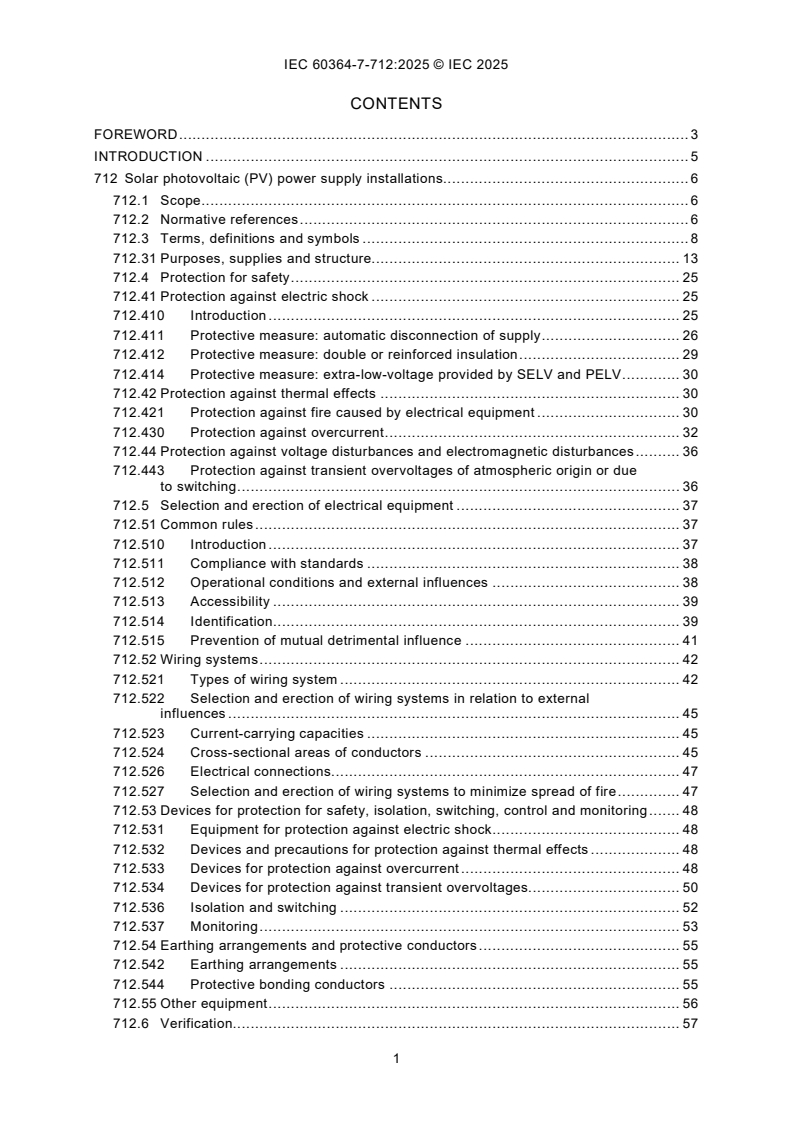
CONTENTS
FOREWORD . 3
INTRODUCTION . 5
712 Solar photovoltaic (PV) power supply installations. 6
712.1 Scope . 6
712.2 Normative references . 6
712.3 Terms, definitions and symbols . 8
712.31 Purposes, supplies and structure. 13
712.4 Protection for safety . 25
712.41 Protection against electric shock . 25
712.410 Introduction . 25
712.411 Protective measure: automatic disconnection of supply . 26
712.412 Protective measure: double or reinforced insulation . 29
712.414 Protective measure: extra-low-voltage provided by SELV and PELV . 30
712.42 Protection against thermal effects . 30
712.421 Protection against fire caused by electrical equipment . 30
712.430 Protection against overcurrent . 32
712.44 Protection against voltage disturbances and electromagnetic disturbances . 36
712.443 Protection against transient overvoltages of atmospheric origin or due
to switching . 36
712.5 Selection and erection of electrical equipment . 37
712.51 Common rules . 37
712.510 Introduction . 37
712.511 Compliance with standards . 38
712.512 Operational conditions and external influences . 38
712.513 Accessibility . 39
712.514 Identification . 39
712.515 Prevention of mutual detrimental influence . 41
712.52 Wiring systems . 42
712.521 Types of wiring system . 42
712.522 Selection and erection of wiring systems in relation to external
influences . 45
712.523 Current-carrying capacities . 45
712.524 Cross-sectional areas of conductors . 45
712.526 Electrical connections. 47
712.527 Selection and erection of wiring systems to minimize spread of fire . 47
712.53 Devices for protection for safety, isolation, switching, control and monitoring . 48
712.531 Equipment for protection against electric shock . 48
712.532 Devices and precautions for protection against thermal effects . 48
712.533 Devices for protection against overcurrent . 48
712.534 Devices for protection against transient overvoltages. 50
712.536 Isolation and switching . 52
712.537 Monitoring . 53
712.54 Earthing arrangements and protective conductors . 55
712.542 Earthing arrangements . 55
712.544 Protective bonding conductors . 55
712.55 Other equipment . 56
712.6 Verification. 57
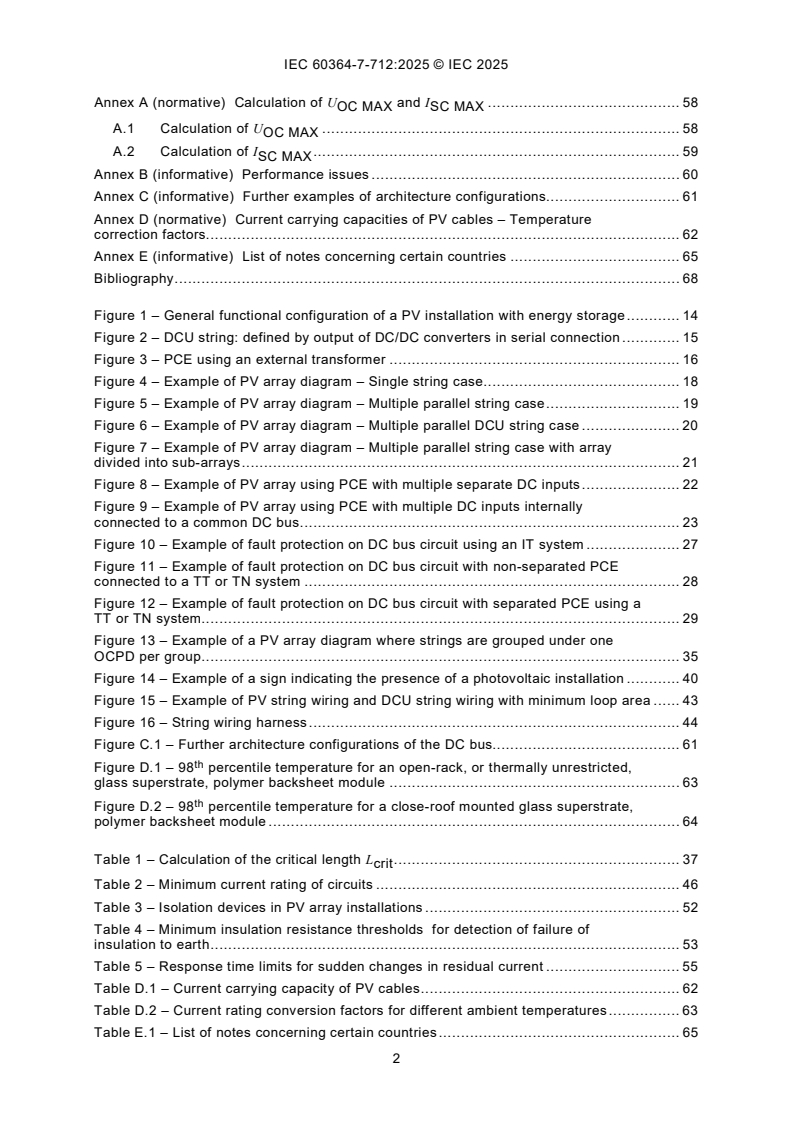
Annex A (normative) Calculation of U and I . 58
OC MAX SC MAX
A.1 Calculation of U . 58
OC MAX
A.2 Calculation of I . 59
SC MAX
Annex B (informative) Performance issues . 60
Annex C (informative) Further examples of architecture configurations. 61
Annex D (normative) Current carrying capacities of PV cables – Temperature
correction factors. 62
Annex E (informative) List of notes concerning certain countries . 65
Bibliography . 68
Figure 1 – General functional configuration of a PV installation with energy storage . 14
Figure 2 – DCU string: defined by output of DC/DC converters in serial connection . 15
Figure 3 – PCE using an external transformer . 16
Figure 4 – Example of PV array diagram – Single string case . 18
Figure 5 – Example of PV array diagram – Multiple parallel string case . 19
Figure 6 – Example of PV array diagram – Multiple parallel DCU string case . 20
Figure 7 – Example of PV array diagram – Multiple parallel string case with array
divided into sub-arrays . 21
Figure 8 – Example of PV array using PCE with multiple separate DC inputs . 22
Figure 9 – Example of PV array using PCE with multiple DC inputs internally
connected to a common DC bus . 23
Figure 10 – Example of fault protection on DC bus circuit using an IT system . 27
Figure 11 – Example of fault protection on DC bus circuit with non-separated PCE
connected to a TT or TN system . 28
Figure 12 – Example of fault protection on DC bus circuit with separated PCE using a
TT or TN system. 29
Figure 13 – Example of a PV array diagram where strings are grouped under one
OCPD per group . 35
Figure 14 – Example of a sign indicating the presence of a photovoltaic installation . 40
Figure 15 – Example of PV string wiring and DCU string wiring with minimum loop area . 43
Figure 16 – String wiring harness . 44
Figure C.1 – Further architecture configurations of the DC bus. 61
th
Figure D.1 – 98 percentile temperature for an open-rack, or thermally unrestricted,
glass superstrate, polymer backsheet module . 63
th
Figure D.2 – 98 percentile temperature for a close-roof mounted glass superstrate,
polymer backsheet module . 64
Table 1 – Calculation of the critical length L . 37
crit
Table 2 – Minimum current rating of circuits . 46
Table 3 – Isolation devices in PV array installations . 52
Table 4 – Minimum insulation resistance thresholds for detection of failure of
insulation to earth . 53
Table 5 – Response time limits for sudden changes in residual current . 55
Table D.1 – Current carrying capacity of PV cables . 62
Table D.2 – Current rating conversion factors for different ambient temperatures . 63
Table E.1 – List of notes concerning certain countries . 65
INTERNATIONAL ELECTROTECHNICAL COMMISSION
____________
Low-voltage electrical installations -
Part 7-712: Requirements for special installations or locations -
Solar photovoltaic (PV) power supply installations
FOREWORD
1) The International Electrotechnical Commission (IEC) is a worldwide organization for standardization comprising
all national electrotechnical committees (IEC National Committees). The object of IEC is to promote international
co-operation on all questions concerning standardization in the electrical and electronic fields. To this end and
in addition to other activities, IEC publishes International Standards, Technical Specifications, Technical Reports,
Publicly Available Specifications (PAS) and Guides (hereafter referred to as "IEC Publication(s)"). Their
preparation is entrusted to technical committees; any IEC National Committee interested in the subject dealt with
may participate in this preparatory work. International, governmental and non-governmental organizations liaising
with the IEC also participate in this preparation. IEC collaborates closely with the International Organization for
Standardization (ISO) in accordance with conditions determined by agreement between the two organizations.
2) The formal decisions or agreements of IEC on technical matters express, as nearly as possible, an international
consensus of opinion on the relevant subjects since each technical committee has representation from all
interested IEC National Committees.
3) IEC Publications have the form of recommendations for international use and are accepted by IEC National
Committees in that sense. While all reasonable efforts are made to ensure that the technical content of IEC
Publications is accurate, IEC cannot be held responsible for the way in which they are used or for any
misinterpretation by any end user.
4) In order to promote international uniformity, IEC National Committees undertake to apply IEC Publications
transparently to the maximum extent possible in their national and regional publications. Any divergence between
any IEC Publication and the corresponding national or regional publication shall be clearly indicated in the latter.
5) IEC itself does not provide any attestation of conformity. Independent certification bodies provide conformity
assessment services and, in some areas, access to IEC marks of conformity. IEC is not responsible for any
services carried out by independent certification bodies.
6) All users should ensure that they have the latest edition of this publication.
7) No liability shall attach to IEC or its directors, employees, servants or agents including individual experts and
members of its technical committees and IEC National Committees for any personal injury, property damage or
other damage of any nature whatsoever, whether direct or indirect, or for costs (including legal fees) and
expenses arising out of the publication, use of, or reliance upon, this IEC Publication or any other IEC
Publications.
8) Attention is drawn to the Normative references cited in this publication. Use of the referenced publications is
indispensable for the correct application of this publication.
9) IEC draws attention to the possibility that the implementation of this document may involve the use of (a)
patent(s). IEC takes no position concerning the evidence, validity or applicability of any claimed patent rights in
respect thereof. As of the date of publication of this document, IEC had not received notice of (a) patent(s), which
may be required to implement this document. However, implementers are cautioned that this may not represent
the latest information, which may be obtained from the patent database available at https://patents.iec.ch. IEC
shall not be held responsible for identifying any or all such patent rights.
IEC 60364-7-712 has been prepared by IEC technical committee 64: Electrical installations and
protection against electric shock. It is an International Standard.
This third edition cancels and replaces the second edition published in 2017. This edition
constitutes a technical revision.
This edition includes the following significant technical changes with respect to the previous
edition:
a) The technical content has been extensively revised and expanded, taking into account
experience gained in the construction and operation of PV installations, and developments
made in technology, since the second edition was published.
b) Key changes include requirements for PV power generation plants, direct connection to
battery circuits, introduction of DC bus circuit and DCUs.
The text of this International Standard is based on the following documents:
Draft Report on voting
64/2765/FDIS 64/2785/RVD
Full information on the voting for its approval can be found in the report on voting indicated in
the above table.
The language used for the development of this International Standard is English.
This document was drafted in accordance with ISO/IEC Directives, Part 2, and developed in
accordance with ISO/IEC Directives, Part 1 and ISO/IEC Directives, IEC Supplement, available
at www.iec.ch/members_experts/refdocs. The main document types developed by IEC are
described in greater detail at www.iec.ch/publications.
A list of all parts in the IEC 60364 series, published under the general title Low-voltage electrical
installations, can be found on the IEC website.
The reader's attention is drawn to the fact that Annex E lists all of the "in-some-country" clauses
on differing practices of a less permanent nature relating to the subject of this document.
The committee has decided that the contents of this document will remain unchanged until the
stability date indicated on the IEC website under webstore.iec.ch in the data related to the
specific document. At this date, the document will be
– reconfirmed,
– withdrawn, or
– revised.
INTRODUCTION
For the purposes of this part of IEC 60364 (IEC 60364-7-712), the requirements of the general
Part 1 to Part 6 and Part 8 of IEC 60364 apply.
The IEC 60364-7-7XX parts of IEC 60364 contain particular requirements for special
installations or locations which are based on the requirements of the general parts of IEC 60364
(IEC 60364-1 to IEC 60364-6 and IEC 60364-8). These IEC 60364-7-7XX parts are considered
in conjunction with the requirements of the general parts.
The particular requirements of this document supplement, modify or replace certain of the
requirements of the general parts of IEC 60364 being valid at the time of publication of this
document. The absence of reference to the exclusion of a part or a clause of a general part
means that the corresponding clauses of the general part are applicable (undated references).
Requirements of other IEC 60364-7XX parts being relevant for installations covered by this
document also apply. This document can therefore also supplement, modify or replace certain
of these requirements valid at the time of publication of this document.
The clause numbering of this document follows the pattern and corresponding references of
IEC 60364. The numbers following the particular number of this document are those of the
corresponding parts, or clauses of the other parts of the IEC 60364 series, valid at the time of
publication of this document, as indicated in the normative references of this document (dated
references). If requirements or explanations additional to those of the other parts of the
IEC 60364 series are necessary, the numbering of such items appears as 712.101, 712.102,
712.103, etc.
In the case where new or amended general parts with modified numbering were published after
this document was issued, it is possible that the clause numbers referring to a general part in
this document will possibly no longer align with the latest edition of the general part. Dated
references should be observed.
Attention is drawn to the co-existence of IEC 60364-7-712 and IEC 62548-1. Both standards
have been developed in close coordination by different technical committees.
712 Solar photovoltaic (PV) power supply installations
712.1 Scope
The particular requirements of this part of IEC 60364 apply to electrical installations of PV
systems.
The equipment of a PV system, like any other item of equipment, is dealt with only so far as its
selection and application in the installation is concerned. A PV installation comprises all
equipment from PV modules(s) up to the connection point to other parts of the installation, for
example a distribution board or the utility supply point (point of connection).
This part of IEC 60364 includes requirements on electrical installation resulting from the
installation of PV power supply installations.
Requirements relating to the possible installation of energy storage systems (e.g. batteries) are
included.
Requirements are also included for PV installations for island mode operation described in
IEC 60364-8-82.
NOTE 1 The abbreviated term "PV" is used for "photovoltaic". Photovoltaic installations are, hereafter, referred to
as PV installations.
NOTE 2 Additional requirements for PV systems floating on water are under development.
712.2 Normative references
The following documents are referred to in the text in such a way that some or all of their content
constitutes requirements of this document. For dated references, only the edition cited applies.
For undated references, the latest edition of the referenced document (including any
amendments) applies.
IEC 60228, Conductors of insulated cables
IEC 60269 (all parts), Low-voltage fuses
IEC 60364-1:2025, Low-voltage electrical installations - Part 1: Fundamental principles,
assessment of general characteristics, and definitions
IEC 60364-4-41:2005, Low-voltage electrical installations - Part 4-41: Protection for safety -
Protection against electric shock
IEC 60364-4-41:2005/AMD1:2017
IEC 60364-4-42:2024, Low-voltage electrical installations - Part 4-42: Protection for safety -
Protection against thermal effects
IEC 60364-4-43:2023, Low-voltage electrical installations - Part 4-43: Protection for safety -
Protection against overcurrent
IEC 60364-4-44:2007, Low-voltage electrical installations - Part 4-44: Protection for safety -
Protection against voltage disturbances and electromagnetic disturbances
IEC 60364-4-44:2007/AMD1:2015
IEC 60364-4-44:2007/AMD2:2018
IEC 60364-5-51:2005, Electrical installations of buildings - Part 5-51: Selection and erection of
electrical equipment - Common rules
IEC 60364-5-52:2009, Low-voltage electrical installations - Part 5-52: Selection and erection of
electrical equipment - Wiring systems
IEC 60364-5-53:2019, Low-voltage electrical installations - Part 5-53: Selection and erection of
electrical equipment - Devices for protection for safety, isolation, switching, control and
monitoring
IEC 60364-5-53:2019/AMD1:2020
IEC 60364-5-54:2011, Low-voltage electrical installations - Part 5-54: Selection and erection of
electrical equipment - Earthing arrangements and protective conductors
IEC 60364-5-54:2011/AMD1:2021
IEC 60364-5-55:2011, Electrical installations of buildings - Part 5-55: Selection and erection of
electrical equipment - Other equipment
IEC 60364-5-55:2011/AMD1:2012
IEC 60364-5-55:2011/AMD2:2016
IEC 60364-6:2016, Low voltage electrical installations - Part 6: Verification
IEC 60529, Degrees of protection provided by enclosures (IP Code)
IEC 60670 (all parts), Boxes and enclosures for electrical accessories for household and similar
fixed electrical installations
IEC 60898-2, Electrical accessories - Circuit-breakers for overcurrent protection for household
and similar installations - Part 2: Circuit-breakers for AC and DC operation
IEC 60898-3, Electrical accessories - Circuit-breakers for overcurrent protection for household
and similar installations - Part 3: Circuit-breakers for DC operation
IEC 60947-1, Low-voltage switchgear and controlgear - Part 1: General rules
IEC 60947-2:2024, Low-voltage switchgear and controlgear - Part 2: Circuit-breakers
IEC 60947-3:2020, Low-voltage switchgear and controlgear - Part 3: Switches, disconnectors,
switch-disconnectors and fuse-combination units
IEC 60947-6-2, Low-voltage switchgear and controlgear - Part 6-2: Multiple function
equipment - Control and protective switching devices (or equipment) (CPS)
IEC 61140, Protection against electric shock - Common aspects for installation and equipment
IEC 61386-24, Conduit systems for cable management - Part 24: Particular requirements -
Conduit systems buried underground
IEC 61439 (all parts), Low-voltage switchgear and controlgear assemblies
IEC 61439-2:2020, Low-voltage switchgear and controlgear assemblies - Part 2: Power
switchgear and controlgear assemblies
IEC 61557-8, Electrical safety in low voltage distribution systems up to 1 000 V a.c. and
1 500 V d.c. - Equipment for testing, measuring or monitoring of protective measures - Part 8:
Insulation monitoring devices for IT systems
IEC 61643-31, Low-voltage surge protective devices - Part 31: Requirements and test methods
for SPDs for photovoltaic installations
IEC 61730 (all parts), Photovoltaic (PV) module safety qualification
IEC 62109 (all parts), Safety of power converters for use in photovoltaic power systems
IEC 62109-1:2010, Safety of power converters for use in photovoltaic power systems - Part 1:
General requirements
IEC 62262, Degrees of protection provided by enclosures for electrical equipment against
external mechanical impacts (IK code)
IEC 62423, Type F and type B residual current operated circuit-breakers with and without
integral overcurrent protection for household and similar uses
IEC 62446-1, Photovoltaic (PV) systems - Requirements for testing, documentation and
maintenance - Part 1: Grid connected systems - Documentation, commissioning tests and
inspection
IEC 62446-2, Photovoltaic (PV) systems - Requirements for testing, documentation and
maintenance - Part 2: Grid connected systems - Maintenance of PV systems
IEC 62852, Connectors for DC-application in photovoltaic systems - Safety requirements and
tests
IEC 62930, Electric cables for photovoltaic systems with a voltage rating of 1,5 kV DC
IEC TS 63053, General requirements for residual current operated protective devices for DC
system
IEC 63112, Photovoltaic (PV) arrays - Earth fault protection equipment - Safety and safety-
related functionality
712.3 Terms, definitions and symbols
712.3.1 Terms and definitions
For the purposes of this document, the following terms and definitions apply.
ISO and IEC maintain terminology databases for use in standardization at the following
addresses:
– IEC Electropedia: available at https://www.electropedia.org/
– ISO Online browsing platform: available at https://www.iso.org/obp
712.3.1.1
PV cell
photovoltaic cell
most elementary device that exhibits the photovoltaic effect
[SOURCE: IEC TS 61836:2016, 3.1.48.1, modified – The preferred term "PV cell" has been
added, "photovoltaic device" has been replaced by "device that exhibits the photovoltaic effect"
and the Note to entry has been deleted.]
712.3.1.2
PV module
complete and environmentally protected assembly of interconnected photovoltaic cells
[SOURCE: IEC TS 61836:2016, 3.1.48.7, modified – In the term, "photovoltaic" has been
replaced by "PV", and the Note to entry has been deleted.]
712.3.1.3
PV string
circuit of one or more series-connected PV modules
Note 1 to entry: If only some PV modules of a PV string are equipped with a DCU, the string is still considered as
a PV string.
[SOURCE: IEC TS 61836:2016, 3.3.59.6, modified – In the term, "photovoltaic" has been
replaced by "PV", in the definition, "one or more" has been added, and the Note to entry has
been added.]
712.3.1.4
PV array
assembly of electrically interconnected PV modules, PV strings, DCU strings or PV sub-arrays
up to the DC bus circuit, final PCE or DC load
Note 1 to entry: For the purposes of this document, a PV array is all components up to the DC input terminals of a
final PCE or DC load. A PV array does not include its foundation, module supporting structures, tracking apparatus,
thermal control, and other such components.
Note 2 to entry: A PV array can consist of a single PV module, a single PV string, or several parallel-connected
strings, or several parallel-connected PV sub-arrays and their associated electrical components. The boundary of a
PV array is the output side of the PV array disconnecting device.
712.3.1.5
PV sub-array
electrical subset of a PV array formed of parallel connected PV strings or DCU strings
712.3.1.6
PV string cable
cable interconnecting the modules in a PV string, the PCE in a DCU string or connecting the
string to a combiner box, PCE or other DC loads
Note 1 to entry: Examples of PV string cable are shown in Figure 5 and Figure 6.
712.3.1.7
PV array cable
cable of a PV array that carries the total output current of the array
712.3.1.8
PV sub-array cable
output cable of a PV sub-array that carries the output current of its associated sub-array
712.3.1.9
PV AC supply cable
cable connecting the AC terminals of the PCE to a distribution board of the electrical installation
712.3.1.10
PV installation
erected equipment from PV modules(s) up to the connection point to other parts of the
installation
Note 1 to entry: A distribution board and the utility supply point are examples of a connection point.
712.3.1.11
standard test conditions
STC
standard set of reference conditions used for the testing and rating of photovoltaic cells and
modules
Note 1 to entry: The standard test conditions given in IEC 61215-1 for PV modules are:
a) PV cell temperature of 25 °C;
b) irradiance in the plane of the PV cell or module of 1 000 W/m ;
c) light spectrum corresponding to an atmospheric air mass of 1,5.
712.3.1.12
open-circuit voltage under standard test conditions
U
OC STC
voltage under standard test conditions across an unloaded (open) PV module, PV string, PV
sub-array or PV array
712.3.1.13
open-circuit maximum voltage
U
OC MAX
maximum voltage across an unloaded (open) PV module, PV string, DCU string, PV sub-array
or PV array
Note 1 to entry: The method for determining U is given in Annex A.
OC MAX
712.3.1.14
short-circuit current under standard test conditions
I
SC STC
short-circuit current of a PV string or PV array under standard test conditions
712.3.1.15
short-circuit maximum current
I
SC MAX
maximum current of a PV module, PV string, DCU string, PV sub-array or PV array under short-
circuit conditions
Note 1 to entry: The method for determining I is given in Annex A.
SC MAX
712.3.1.16
backfeed current
I
BF
current that can pass from the PCE to the PV array and its wiring under normal or single fault
conditions
712.3.1.17
reverse current
current that can flow in the reverse direction into a PV circuit from parallel connected strings or
sub-arrays as the result of a fault
712.3.1.18
DC side
PV circuit, battery circuit, DC bus circuit or DCU string circuit of a PV installation
712.3.1.19
AC side
part of a PV installation from the AC terminals of the inverter to the point of connection of the
PV AC supply cable to the electrical installation
712.3.1.20
maximum power point tracking
MPPT
control strategy whereby operation of the PV modules is always at or near the point on a PV
device's current-voltage characteristic where the product of electric current and voltage yields
the maximum electrical power under specified operating conditions
712.3.1.21
blocking diode
diode connected in series with module(s), strings and sub-array(s) to block reverse or backfeed
currents
712.3.1.22
irradiance
G
electromagnetic radiated solar power per unit of area
Note 1 to entry: Irradiance is expressed in W/m .
[SOURCE: IEC TS 61836:2016, 3.6.26, modified – In the definition, "solar" has been added,
and Note 2 to entry has been deleted.]
712.3.1.23
power conversion equipment
PCE
electrical device converting one kind of electrical power from a voltage or current source into
another kind of electrical power with respect to voltage, current and frequency
EXAMPLE DC/DC converters, DCUs, DC/AC inverters, DC/DC charge controllers.
712.3.1.24
inverter
INV
PCE which converts DC voltage and DC current into AC voltage and AC current
712.3.1.25
separated PCE
PCE with at least simple separation between the input and output
Note 1 to entry: The term "separated PCE" includes inverters with either internal or external transformer.
Note 2 to entry: In PCE with more than two external circuits, there can be isolation between some pairs of circuits
and no isolation between others. For example, an inverter with PV, battery, and mains circuits can provide isolation
between the mains circuit and the PV circuit, but no isolation between the PV and battery circuits.
712.3.1.26
non-separated PCE
PCE without at least simple separation between the input and output
712.3.1.27
PV array combiner box
enclosure where PV sub-arrays are connected, and which can also contain overcurrent
protection or switch-disconnection devices or both
Note 1 to entry: Small arrays generally do not contain sub-arrays but are simply made up of strings, whereas large
arrays are generally made up of multiple sub-arrays.
712.3.1.28
PV string combiner box
enclosure where PV strings or DCU strings are connected, and which can also contain
overcurrent protective devices or switch-disconnectors or both
712.3.1.29
DC bus circuit
intermediate DC circuit connected between several items of PCE where all are connected in
parallel
712.3.1.30
PV power generation plant
type of ground mounted PV installation, which is operated under supervision with restricted
access solely for the purpose of providing electrical energy to the distribution system
Note 1 to entry: PV systems on buildings do not fall under the definition of PV power generation plants.
712.3.1.31
building-integrated PV system
photovoltaic system providing one or more functions of the building envelope
EXAMPLE Roof-integrated or facade-integrated systems.
712.3.1.32
string wiring harness
prefabricated cable assembly that aggregates the output of multiple PV string conductors along
a single main cable
Note 1 to entry: The term "string wiring harness" includes harnesses with or without fusing on the individual string
conductors. The wiring harness typically does not include a disconnect device in line.
712.3.1.33
DC conditioning unit
DCU
PCE converting the output of one or more PV modules to a different DC voltage and current
712.3.1.34
DCU string
circuit of one or more series connected DCUs
712.3.1.35
auxiliary power supply circuit
circuit to supply auxiliary electrical equipment within a PV installation
712.3.1.36
battery conversion unit
BCU
unidirectional or bidirectional PCE for converting power of one or more batteries to a different
DC voltage and current
Note 1 to entry: This unit can be incorporated into a battery unit.
712.3.1.37
final PCE
PCE which supplies loads or an AC or DC distribution network
712.3.1.38
application circuit
AC or DC circuit supplied from the DC side of the PV installation
Note 1 to entry: See 712.3.1.18 for the definition of "DC side".
Note 2 to entry: This circuit can be directly connected to the DC side of the PV installation or via the PCE.
712.3.2 Symbols
I PV module maximum overcurrent protection rating
MOD_MAX_OCPR
I short-circuit current of a PV module at standard test conditions (STC),
SC MOD
as specified by the manufacturer
U maximum voltage of the DC bus
DC MAX-BUS
I maximum output current of the DCU string
DCU_string_max
I overcurrent protection rating of the DCU
DCU OCPR
W unit of power of PV array under standard test conditions
p
712.31 Purposes, supplies and structure
712.31.101 PV installation configurations
712.31.101.1 General
Figure 1 and Figure 2 are examples that generally illustrate installation configurations. They
are not intended as design guidelines and it is possible that they do not show complete and
correct features such as protection and control.
NOTE Circuit colours in Figure 1 and Figure 2 are only used for illustration and are not aligned with the colours
specified in IEC 60445.
a) Common DC bus interconnected to PV and b) AC coupled PV and battery system
battery circuit via PCE
c) Combined PV-battery system d) Multiple-input PCE system
e) PV and battery circuit connected via PCE
Key
1 PCE (DCU)
2 PCE (BCU)
3 PCE (INV)
Type of electric circuit:
PV string or array circuit (blue)
Battery circuit: defined by battery (green)
AC mains circuit: defined by AC source (black)
DC bus circuit: intermediate circuit, connected between different PCE, where all items of PCE are connected in
parallel (red)
Figure 1 – General functional configuration of a PV installation with energy storage
a) DCU string system b) DCU string system with battery
Key
1 PCE (DCU)
2 PCE (BCU)
3 PCE (INV)
Type of electric circuit:
PV string or sub-array circuit (blue)
Battery circuit: defined by battery (green)
AC mains circuit: defined by AC source (black)
DCU string circuit: defined by output of DC/DC converters in serial connection (purple)
denotes additional modules with DCU
Figure 2 – DCU string: defined by output of DC/DC converters in serial connection
Annex C shows further examples of installation configurations.
712.31.101.2 PV array and DC architecture
PV arrays are used to supply power to an application as DC load, other DC circuits or AC
circuits connected by an inverter.
The system may:
– include a separation between the PV array and the application circuit; or
– be non-separated as there is no separation between the PV array and the application circuit.
If separated, the separation may be either integral to the PCE or provided externally by a
transformer as shown in Figure 3 or other PCE with at least simple separation.
Live conductor(s) of the PV array shall not be connected to a protective earthing conductor or
terminal.
NOTE 1 PEM, PEN, and PEL conductors are therefore not used in PV arrays.
No conductor of the PV array shall be functionally earthed, except where this is provided by the
PCE.
NOTE 2 In a system where the PCE is separated using an external transformer, the AC circuit between the inverter
AC output and the transformer is often unearthed (to allow flexibility regarding functional earthing of the PV array).
If the PV array is functionally earthed in the PCE, some inverter topologies will impose a high common-mode voltage
(i.e. to earth) on the unearthed AC circuit.
Where the PCE functionally earths the PV array and provides separation using an external
transformer:
– all conductors and equipment located on the AC circuit between the PCE and the external
transformer shall be rated for the common-mode voltage (RMS and rated recurring peak
voltage) to earth specified by the PCE manufacturer, or shall be separated by a transformer
or other equipment such that the common-mode voltage is not present (e.g. an auxiliary
power supply);
– the transformer(s) used shall be rated for the common-mode voltage (RMS and rated
recurring peak voltage).
Key
1 external transformer
2 auxiliary transformer
3 auxiliary power supply
Type of electric circuit:
PV circuit: defined by PV module of string (blue)
AC circuit: defined by AC output of inverter (light grey)
AC auxiliary power supply circuit: defined by AC auxiliary (dark grey)
AC mains circuit: defined by AC source (black)
Figure 3 – PCE using an external transformer
Where separation is provided using an external transformer and more than one item of PCE is
connected in parallel to a common winding, the different items of PCE shall be specified as
suitable for this arrangement.
NOTE 3 Parallel connection of PCE can cause circulating currents through earth if the PCE is not designed to
mitigate such currents.
712.31.101.3 Additional requirements for PV power generation plants
NOTE 1 Owing to these additional requirements, other clauses in this document contain modified requirements,
e.g. 712.514.101.1 and 712.537.1.2.101.
Access to a PV power generation plant shall be physically restricted by fences, walls or other
means.
A PV power generation plant shall be accessible and operated only by skilled (BA5) or instructed
(BA4) persons.
A PV power generation plant shall be connected only to:
– a network for distribution of electricity having a voltage higher than low voltage, or
– industrial DC distribution circuits, where the protection measures are effective under all
irradiance conditions.
NOTE 2 The fault current contribution from the PV array can be very low or zero depending on irradiance or
time of day. In the design and selection of protection measures in the DC distribution system, the full range of
available fault current from the PV array and other sources is taken into account
The electrical loads within the PV power generation plant shall only be used for the purposes
of plant operations.
A PV power generation plant can also include an energy storage system.
A PV power generation plant is required to be under daily supervision so that any faults are
eliminated with the shortest practicable delay.
NOTE 3 See IEC TS 62738 for guidance.
712.31.101.4 Array electrical diagrams
A PV array can have:
– only one string;
– multiple single strings connected in parallel in a PV string combiner box;
– multiple single strings where PV panels are individually connected to a DCU;
– more than one sub-array.
The PCE can be connected to:
– a single PV array;
– more than one PV array individually connected to the PCE.
The diagrams in Figure 4 to Figure 7 show the basic electrical configurations of single string,
multiple parallel string, multiple parallel DCU string and multi-sub-array PV, respectively.
NOTE Figure 4 to Figure 9 are examples that generally illustrate array configurations. They are not intended as
design guidelines, and it is possible that they do not show complete and correct features such as protection and
control.
In Figure 4, Figure 5, Figure 6, Figure 7, Figure 8 and Figure 9, components drawn in dotted
format are not required in all cases. The figures indicate one possible location in the circuit
when they are necessary.
---------------
...
IEC 60364-7-712 ®
Edition 3.0 2025-10
NORME
INTERNATIONALE
Installations électriques à basse tension -
Partie 7-712: Exigences applicables aux installations ou emplacements spéciaux -
Installations d'énergie solaire photovoltaïque (PV)
ICS 27.160; 91.140.50; 29.020 ISBN 978-2-8327-0770-8
Droits de reproduction réservés. Sauf indication contraire, aucune partie de cette publication ne peut être reproduite ni
utilisée sous quelque forme que ce soit et par aucun procédé, électronique ou mécanique, y compris la photocopie et
les microfilms, sans l'accord écrit de l'IEC ou du Comité national de l'IEC du pays du demandeur. Si vous avez des
questions sur le copyright de l'IEC ou si vous désirez obtenir des droits supplémentaires sur cette publication, utilisez
les coordonnées ci-après ou contactez le Comité national de l'IEC de votre pays de résidence.
IEC Secretariat Tel.: +41 22 919 02 11
3, rue de Varembé info@iec.ch
CH-1211 Geneva 20 www.iec.ch
Switzerland
A propos de l'IEC
La Commission Electrotechnique Internationale (IEC) est la première organisation mondiale qui élabore et publie des
Normes internationales pour tout ce qui a trait à l'électricité, à l'électronique et aux technologies apparentées.
A propos des publications IEC
Le contenu technique des publications IEC est constamment revu. Veuillez vous assurer que vous possédez l’édition la
plus récente, un corrigendum ou amendement peut avoir été publié.
Recherche de publications IEC - IEC Products & Services Portal - products.iec.ch
webstore.iec.ch/advsearchform Découvrez notre puissant moteur de recherche et consultez
La recherche avancée permet de trouver des publications gratuitement tous les aperçus des publications, symboles
IEC en utilisant différents critères (numéro de référence, graphiques et le glossaire. Avec un abonnement, vous aurez
texte, comité d’études, …). Elle donne aussi des toujours accès à un contenu à jour adapté à vos besoins.
informations sur les projets et les publications remplacées
ou retirées. Electropedia - www.electropedia.org
Le premier dictionnaire d'électrotechnologie en ligne au
IEC Just Published - webstore.iec.ch/justpublished monde, avec plus de 22 500 articles terminologiques en
Restez informé sur les nouvelles publications IEC. Just anglais et en français, ainsi que les termes équivalents
Published détaille les nouvelles publications parues. dans 25 langues additionnelles. Egalement appelé
Disponible en ligne et une fois par mois par email. Vocabulaire Electrotechnique International (IEV) en ligne.
Service Clients - webstore.iec.ch/csc
Si vous désirez nous donner des commentaires sur cette
publication ou si vous avez des questions contactez-
nous: sales@iec.ch.
SOMMAIRE
AVANT-PROPOS . 4
INTRODUCTION . 6
712 Installations d’énergie solaire photovoltaïque (PV) . 7
712.1 Domaine d’application . 7
712.2 Références normatives . 7
712.3 Termes, définitions et symboles . 9
712.31 Objet, alimentations et structure . 15
712.4 Protection pour assurer la sécurité . 27
712.41 Protection contre les chocs électriques . 27
712.410 Introduction . 27
712.411 Mesure de protection: coupure automatique de l’alimentation . 28
712.412 Mesure de protection: isolation double ou renforcée . 31
712.414 Mesure de protection: protection par très basse tension (TBTS et TBTP) . 32
712.42 Protection contre les effets thermiques . 32
712.421 Protection contre l’incendie provoqué par un matériel électrique . 32
712.430 Protection contre les surintensités . 34
712.44 Protection contre les perturbations de tension et les perturbations
électromagnétiques. 38
712.443 Protection contre les surtensions transitoires d’origine atmosphérique
ou dues à des manœuvres. 38
712.5 Choix et mise en œuvre des matériels électriques . 40
712.51 Règles communes . 40
712.510 Introduction . 40
712.511 Conformité aux normes. 40
712.512 Conditions de service et influences externes. 40
712.513 Accessibilité . 41
712.514 Identification . 41
712.515 Indépendance des matériels . 43
712.52 Canalisations . 44
712.521 Types de canalisation . 44
712.522 Choix et mise en œuvre des canalisations en fonction des influences
externes . 48
712.523 Courants admissibles . 48
712.524 Sections des conducteurs . 48
712.526 Raccordements électriques . 51
712.527 Choix et mise en œuvre des canalisations pour réduire le plus possible
la propagation du feu . 51
712.53 Dispositifs de protection pour assurer la sécurité, le sectionnement,
la coupure, la commande et la surveillance . 52
712.531 Matériels de protection contre les chocs électriques . 52
712.532 Dispositifs et mesures de protection contre les effets thermiques . 52
712.533 Dispositifs de protection contre les surintensités . 52
712.534 Dispositifs de protection contre les surtensions transitoires . 54
712.536 Sectionnement et coupure . 56
712.537 Surveillance . 57
712.54 Installations de mise à la terre et conducteurs de protection . 60
712.542 Installations de mise à la terre . 60
712.544 Conducteurs de liaison de protection . 60
712.55 Autres matériels . 61
712.6 Vérification. 61
Annexe A (normative) Calcul de U et I . 62
OC MAX SC MAX
A.1 Calcul de U . 62
OC MAX
A.2 Calcul de I . 63
SC MAX
Annexe B (informative) Problèmes de performances . 64
Annexe C (informative) Autres exemples de configurations d’architecture . 65
Annexe D (normative) Courants admissibles des câbles PV – Facteurs de correction
de température . 67
Annexe E (informative) Liste des notes concernant certains pays . 70
Bibliographie . 73
Figure 1 — Configuration fonctionnelle générale d’une installation PV avec stockage
d’énergie . 16
Figure 2 — Chaîne DCU: définie par la sortie des convertisseurs continu/continu en
connexion série . 17
Figure 3 — PCE utilisant un transformateur externe . 18
Figure 4 — Exemple de schéma d’un groupe PV — Cas d’une chaîne unique . 20
Figure 5 — Exemple de schéma d’un groupe PV — Cas de plusieurs chaînes en
parallèle . 21
Figure 6 — Exemple de schéma d’un groupe PV — Cas de plusieurs chaînes DCU en
parallèle . 22
Figure 7 — Exemple de schéma d’un groupe PV — Cas de plusieurs chaînes en
parallèle avec groupe divisé en sous-groupes . 23
Figure 8 — Exemple de groupe PV qui utilise un PCE avec plusieurs entrées en
courant continu séparées . 24
Figure 9 — Exemple de groupe PV qui utilise un PCE avec plusieurs entrées en
courant continu connectées en interne à un bus commun en courant continu . 25
Figure 10 — Exemple de protection en cas de défaut sur un circuit de bus en courant
continu utilisant un système IT . 29
Figure 11 — Exemple de protection en cas de défaut sur un circuit de bus en courant
continu avec un PCE non séparé raccordé à un système TT ou TN . 30
Figure 12 — Exemple de protection en cas de défaut sur le circuit de bus en courant
continu avec un PCE séparé utilisant un système TT ou TN . 31
Figure 13 — Exemple de schéma de groupe PV dans lequel les chaînes sont
regroupées sous un OCPD par groupe . 37
Figure 14 — Exemple de signalisation indiquant la présence d’une installation
photovoltaïque . 42
Figure 15 — Exemple câblage de chaîne PV et câblage de chaîne DCU avec surface
de boucle minimale . 45
Figure 16 — Faisceaux de câbles de chaînes . 47
Figure C.1 — Autres configurations d’architecture du bus en courant continu . 66
e
Figure D.1 — Température au 98 centile pour un module ouvert, ou thermiquement
non restreint, à substrat de verre et face arrière en polymère . 68
e
Figure D.2 – Température au 98 centile pour un module fermé monté sur le toit,
à substrat de verre et face arrière en polymère . 69
Tableau 1 — Calcul de la longueur critique L . 39
crit
Tableau 2 — Courant assigné minimal des circuits . 50
Tableau 3 — Dispositifs de sectionnement dans les installations de groupe PV . 56
Tableau 4 — Seuils minimaux de résistance d’isolement pour la détection des défauts
d’isolement par rapport à la terre . 58
Tableau 5 — Limites de temps de réponse pour les variations brusques de courant
différentiel résiduel . 59
Tableau D.1 — Capacité de transport de courant des câbles PV . 67
Tableau D.2 — Facteurs de conversion du courant assigné pour différentes
températures ambiantes . 68
Tableau E.1 — Liste de notes concernant certains pays . 70
COMMISSION ÉLECTROTECHNIQUE INTERNATIONALE
____________
Installations électriques à basse tension -
Partie 7-712: Exigences applicables aux installations ou emplacements
spéciaux -Installations d’énergie solaire photovoltaïque (PV)
AVANT-PROPOS
1) La Commission Électrotechnique Internationale (IEC) est une organisation mondiale de normalisation composée
de l’ensemble des comités électrotechniques nationaux (Comités nationaux de l’IEC). L’IEC a pour objet de
favoriser la coopération internationale pour toutes les questions de normalisation dans les domaines de
l’électricité et de l’électronique. À cet effet, l’IEC – entre autres activités – publie des Normes internationales,
des Spécifications techniques, des Rapports techniques, des Spécifications accessibles au public (PAS) et des
Guides (ci-après dénommés "Publication(s) de l’IEC"). Leur élaboration est confiée à des comités d’études,
aux travaux desquels tout Comité national intéressé par le sujet traité peut participer. Les organisations
internationales, gouvernementales et non gouvernementales, en liaison avec l’IEC, participent également aux
travaux. L’IEC collabore étroitement avec l’Organisation Internationale de Normalisation (ISO), selon des
conditions fixées par accord entre les deux organisations.
2) Les décisions ou accords officiels de l’IEC concernant les questions techniques représentent, dans la mesure du
possible, un accord international sur les sujets étudiés, étant donné que les Comités nationaux de l’IEC intéressés
sont représentés dans chaque comité d’études.
3) Les Publications de l’IEC se présentent sous la forme de recommandations internationales et sont agréées
comme telles par les Comités nationaux de l’IEC. Tous les efforts raisonnables sont entrepris afin que l’IEC
s’assure de l’exactitude du contenu technique de ses publications; l’IEC ne peut pas être tenue responsable de
l’éventuelle mauvaise utilisation ou interprétation qui en est faite par un quelconque utilisateur final.
4) Dans le but d’encourager l’uniformité internationale, les Comités nationaux de l’IEC s’engagent, dans toute la
mesure possible, à appliquer de façon transparente les Publications de l’IEC dans leurs publications nationales
et régionales. Toutes divergences entre toutes Publications de l’IEC et toutes publications nationales ou
régionales correspondantes doivent être indiquées en termes clairs dans ces dernières.
5) L’IEC elle-même ne fournit aucune attestation de conformité. Des organismes de certification indépendants
fournissent des services d’évaluation de conformité et, dans certains secteurs, accèdent aux marques de
conformité de l’IEC. L’IEC n’est responsable d’aucun des services effectués par les organismes de certification
indépendants.
6) Tous les utilisateurs doivent s’assurer qu’ils sont en possession de la dernière édition de cette publication.
7) Aucune responsabilité ne doit être imputée à l’IEC, à ses administrateurs, employés, auxiliaires ou mandataires,
y compris ses experts particuliers et les membres de ses comités d’études et des Comités nationaux de l’IEC,
pour tout préjudice causé en cas de dommages corporels et matériels, ou de tout autre dommage de quelque
nature que ce soit, directe ou indirecte, ou pour supporter les coûts (y compris les frais de justice) et les dépenses
découlant de la publication ou de l’utilisation de cette Publication de l’IEC ou de toute autre Publication de l’IEC,
ou au crédit qui lui est accordé.
8) L’attention est attirée sur les références normatives citées dans cette publication. L’utilisation de publications
référencées est obligatoire pour une application correcte de la présente publication.
9) L’IEC attire l’attention sur le fait que la mise en application du présent document peut entraîner l’utilisation d’un
ou de plusieurs brevets. L’IEC ne prend pas position quant à la preuve, à la validité et à l’applicabilité de tout
droit de brevet revendiqué à cet égard. À la date de publication du présent document, l’IEC n’avait pas reçu
notification qu’un ou plusieurs brevets pouvaient être nécessaires à sa mise en application. Toutefois, il y a lieu
d’avertir les responsables de la mise en application du présent document que des informations plus récentes
sont susceptibles de figurer dans la base de données de brevets, disponible à l’adresse https://patents.iec.ch.
L’IEC ne saurait être tenue pour responsable de ne pas avoir identifié de tels droits de brevets.
L’IEC 60364-7-712 a été établie par le comité d’études 64 de l’IEC: Installations électriques et
protection contre les chocs électriques. Il s’agit d’une Norme internationale.
Cette troisième édition annule et remplace la deuxième édition parue en 2017. Cette édition
constitue une révision technique.
Cette édition inclut les modifications techniques majeures suivantes par rapport à l’édition
précédente:
a) le contenu technique a été considérablement revu et étendu, pour tenir compte du retour
d’expérience dans la construction et l’exploitation des installations photovoltaïques, et des
développements technologiques depuis la parution de la seconde édition.
b) Les principales modifications concernent les exigences relatives aux centrales
photovoltaïques, la connexion directe aux circuits de batterie, l’introduction du circuit de bus
en courant continu et les DCU.
Le texte de cette Norme internationale est issu des documents suivants:
Projet Rapport de vote
64/2765/FDIS 64/2785/RVD
Le rapport de vote indiqué dans le tableau ci-dessus donne toute information sur le vote ayant
abouti à son approbation.
La langue employée pour l’élaboration de la présente Norme internationale est l’anglais.
Ce document a été rédigé selon les Directives ISO/IEC, Partie 2, il a été développé selon les
Directives ISO/IEC, Partie 1 et les Directives ISO/IEC, Supplément IEC, disponibles sous
www.iec.ch/members_experts/refdocs. Les principaux types de documents développés par
l’IEC sont décrits plus en détail sous www.iec.ch/publications.
Une liste de toutes les parties de la série IEC 60364, publiées sous le titre général
Installations électriques à basse tension, peut être consultée sur le site web de l’IEC.
L’attention du lecteur est attirée sur le fait que l’Annexe E énumère tous les articles traitant des
différences à caractère moins permanent "inhérentes à certains pays", concernant le sujet du
présent document.
Le comité a décidé que le contenu de ce document ne sera pas modifié avant la date de stabilité
indiquée sur le site web de l’IEC sous webstore.iec.ch dans les données relatives au document
recherché. À cette date, le document sera
– reconduit,
– supprimé, ou
– révisé.
INTRODUCTION
Pour les besoins de la présente partie de l’IEC 60364 (IEC 60364-7-712), les exigences des
parties générales 1 à 6 et de la partie 8 de l’IEC 60364 s’appliquent.
Les parties 7-7XX de l’IEC 60364 contiennent des exigences particulières pour les installations
et emplacements spéciaux, qui sont fondées sur les exigences des parties générales de
l’IEC 60364 (IEC 60364-1 à IEC 60364-6 et IEC 60364-8). Ces parties IEC 60364-7-7XX sont
prises en compte conjointement avec les exigences des parties générales.
Les exigences particulières du présent document complètent, modifient ou remplacent
certaines des exigences des parties générales de l’IEC 60364 en vigueur au moment de la
publication du présent document. L’absence de référence à l’exclusion d’une partie ou d’un
article d’une partie générale signifie que les articles correspondants de la partie générale sont
applicables (références non datées).
Les exigences des autres parties de l’IEC 60364-7XX pertinentes pour les installations
couvertes par le présent document s’appliquent également. Par conséquent, le présent
document peut également compléter, modifier ou remplacer certaines de ces exigences en
vigueur au moment de sa publication.
La numérotation des articles du présent document suit la structure et les références
correspondantes de l’IEC 60364. Les numéros placés derrière le numéro spécifique du présent
document sont ceux des parties ou des articles correspondants des autres parties de la série
IEC 60364, en vigueur au moment de la publication du présent document, comme indiqué dans
les références normatives du présent document (références datées). Si des exigences ou des
explications en plus de celles des autres parties de la série IEC 60364 sont nécessaires,
la numérotation de tels éléments se fait de la manière suivante 712.101, 712.102, 712.103, etc.
Si des parties générales nouvelles ou amendées étaient publiées avec une numérotation
modifiée après la parution du présent document, il est possible que les numéros d’articles se
référant à une partie générale du présent document ne correspondent plus avec la dernière
édition des parties générales. Il conviendrait alors de prendre en compte les références datées.
L’attention est attirée sur la co-existence des normes IEC 60364-7-712 et IEC 62548-1.
Ces deux normes ont été établies en étroite collaboration par deux comités d’études différents.
712 Installations d’énergie solaire photovoltaïque (PV)
712.1 Domaine d’application
Les exigences particulières de la présente partie de l’IEC 60364 s’appliquent aux installations
électriques des systèmes PV.
Les équipements d’un système PV, ainsi que tout autre élément, ne sont traités que du point
de vue de leur choix et mise en œuvre dans l’installation. Une installation photovoltaïque
comprend tous les équipements, depuis le ou les modules photovoltaïques jusqu’au point de
connexion avec d’autres parties de l’installation (par exemple un tableau de répartition ou le
point d’alimentation du réseau de distribution public [point de connexion]).
La présente partie de l’IEC 60364 inclut des exigences relatives à l’installation électrique
résultant de la mise en place d’installations d’alimentation en énergie photovoltaïque.
Des exigences concernant l’installation éventuelle de systèmes de stockage d’énergie
(par exemple des batteries) sont incluses.
Des exigences sont également incluses pour les installations photovoltaïques en mode îlot
décrites dans l’IEC 60364-8-82.
NOTE 1 L’abréviation "PV" est utilisée pour "photovoltaïque". Ainsi, les installations photovoltaïques sont ci-après
appelées installations PV.
NOTE 2 Des exigences supplémentaires pour les systèmes photovoltaïques flottant sur l’eau sont en cours
d’élaboration.
712.2 Références normatives
Les documents suivants sont cités dans le texte de sorte qu’ils constituent, pour tout ou partie
de leur contenu, des exigences du présent document. Pour les références datées,
seule l’édition citée s’applique. Pour les références non datées, la dernière édition du document
de référence s’applique (y compris les éventuels amendements).
IEC 60228, Âmes des câbles isolés
IEC 60269 (toutes les parties), Fusibles basse tension
IEC 60364-1:2025, Installations électriques à basse tension - Partie 1: Principes fondamentaux,
détermination des caractéristiques générales et définitions
IEC 60364-4-41:2005, Installations électriques à basse tension - Partie 4-41: Protection pour
assurer la sécurité - Protection contre les chocs électriques
IEC 60364-4-41:2005/AMD1:2017
IEC 60364-4-42:2024, Installations électriques à basse tension - Partie 4-42: Protection pour
assurer la sécurité - Protection contre les effets thermiques
IEC 60364-4-43:2023, Installations électriques à basse tension - Partie 4-43: Protection pour
assurer la sécurité - Protection contre les surintensités
IEC 60364-4-44:2007, Installations électriques à basse tension - Partie 4-44: Protection pour
assurer la sécurité - Protection contre les perturbations de tension et les perturbations
électromagnétiques
IEC 60364-4-44:2007/AMD1:2015
IEC 60364-4-44:2007/AMD2:2018
IEC 60364-5-51:2005, Installations électriques des bâtiments - Partie 5-51: Choix et mise en
œuvre des matériels électriques - Règles communes
IEC 60364-5-52:2009, Installations électriques à basse tension - Partie 5-52: Choix et mise en
œuvre des matériels électriques - Canalisations
IEC 60364-5-53:2019, Installations électriques à basse tension - Partie 5-53: Choix et mise en
œuvre des matériels électriques - Dispositifs de protection pour assurer la sécurité, le
sectionnement, la coupure, la commande et la surveillance
IEC 60364-5-53:2019/AMD1:2020
IEC 60364-5-54:2011, Installations électriques basse-tension - Partie 5-54: Choix et mise en
œuvre des matériels électriques - Installations de mise à la terre et conducteurs de protection
IEC 60364-5-54:2011/AMD1:2021
IEC 60364-5-55:2011, Installations électriques des bâtiments - Partie 5-55: Choix et mise en
œuvre des matériels électriques - Autres matériels
IEC 60364-5-55:2011/AMD1:2012
IEC 60364-5-55:2011/AMD2:2016
IEC 60364-6:2016, Installations électriques à basse tension - Partie 6: Vérification
IEC 60529, Degrés de protection procurés par les enveloppes (Code IP)
IEC 60670 (toutes les parties), Boîtes et enveloppes pour appareillage électrique pour
installations électriques fixes pour usages domestiques et analogues
IEC 60898-2, Petit appareillage - Disjoncteurs pour la protection contre les surintensités pour
installations domestiques et analogues - Partie 2: Disjoncteurs pour le fonctionnement en
courant alternatif et en courant continu
IEC 60898-3, Petit appareillage - Disjoncteurs pour la protection contre les surintensités pour
installations domestiques et analogues - Partie 3: Disjoncteurs pour le fonctionnement en
courant continu
IEC 60947-1, Appareillage à basse tension - Partie 1: Règles générales
IEC 60947-2:2024, Appareillage à basse tension - Partie 2: Disjoncteurs
IEC 60947-3:2020, Appareillage à basse tension - Partie 3: Interrupteurs, sectionneurs,
interrupteurs-sectionneurs et combinés fusibles
IEC 60947-6-2, Appareillage à basse tension - Partie 6-2: Matériels à fonctions multiples -
Appareils (ou matériel) de connexion de commande de protection (ACP)
IEC 61140, Protection contre les chocs électriques - Aspects communs aux installations et aux
matériels
IEC 61386-24, Systèmes de conduits pour la gestion du câblage - Partie 24: Règles
particulières - Systèmes de conduits enterrés dans le sol
IEC 61439 (toutes les parties), Ensembles d’appareillage à basse tension
IEC 61439-2:2020, Ensembles d’appareillage à basse tension - Partie 2:
Ensembles d’appareillage de puissance
IEC 61557-8, Sécurité électrique dans les réseaux de distribution basse tension au plus égale
à 1 000 V c.a. et 1 500 V c.c. - Dispositifs de contrôle, de mesure ou de surveillance de mesures
de protection - Partie 8: Contrôleur permanent d’isolement pour réseaux IT
IEC 61643-31, Parafoudres basse tension - Partie 31: Parafoudres pour usage spécifique
y compris en courant continu - Exigences et méthodes d’essai des parafoudres pour
installations photovoltaïques
IEC 61730 (toutes les parties), Qualification pour la sûreté de fonctionnement des modules
photovoltaïques (PV)
IEC 62109 (toutes les parties), Sécurité des convertisseurs de puissance utilisés dans les
systèmes photovoltaïques
IEC 62109-1:2010, Sécurité des convertisseurs de puissance utilisés dans les systèmes
photovoltaïques - Partie 1: Exigences générales
IEC 62262, Degrés de protection procurés par les enveloppes de matériels électriques contre
les impacts mécaniques externes (code IK)
IEC 62423, Interrupteurs automatiques à courant différentiel résiduel de type B et de type F
avec et sans protection contre les surintensités incorporée pour usages domestiques et
analogues
IEC 62446-1, Systèmes photovoltaïques (PV) - Exigences pour les essais, la documentation et
la maintenance - Partie 1: Systèmes connectés au réseau électrique - Documentation, essais
de mise en service et examen
IEC 62446-2, Systèmes photovoltaïques (PV) - Exigences pour les essais, la documentation et
la maintenance - Partie 2: Systèmes connectés au réseau électrique - Maintenance des
systèmes PV
IEC 62852, Connecteurs pour applications en courant continu pour systèmes photovoltaïques -
Exigences de sécurité et essais
IEC 62930, Electric cables for photovoltaic systems with a voltage rating of 1,5 kV DC
(disponible en anglais seulement)
IEC TS 63053, General requirements for residual current operated protective devices for DC
system (disponible en anglais seulement)
IEC 63112, Groupes photovoltaïques (PV) - Matériel de protection contre les défauts à la terre -
Sécurité et fonctionnalités relatives à la sécurité
712.3 Termes, définitions et symboles
712.3.1 Termes et définitions
Pour les besoins du présent document, les termes et définitions suivants s’appliquent.
L’ISO et l’IEC tiennent à jour des bases de données terminologiques destinées à être utilisées
en normalisation, consultables aux adresses suivantes:
– IEC Electropedia: disponible à l’adresse https://www.electropedia.org/
– ISO Online browsing platform: disponible à l’adresse https://www.iso.org/obp
712.3.1.1
cellule PV
cellule photovoltaïque
dispositif le plus élémentaire présentant l’effet photovoltaïque
[SOURCE: Cette source n'existe que dans la langue anglaise.]
712.3.1.2
module PV
ensemble de cellules photovoltaïques interconnectées complètement protégé contre
l’environnement
[SOURCE: Cette source n'existe que dans la langue anglaise.]
712.3.1.3
chaîne PV
circuit constitué d’un ou de plusieurs modules PV connectés en série
Note 1 à l’article: Si seuls certains modules PV d’une chaîne PV sont équipés d’une DCU, la chaîne est toujours
considérée comme une chaîne PV.
[SOURCE: Cette source n'existe que dans la langue anglaise.]
712.3.1.4
groupe PV
ensemble de modules PV, de chaînes PV, de chaînes DCU ou de sous-groupes PV
interconnectés électriquement jusqu’au circuit de bus en courant continu, jusqu’au PCE final
ou jusqu’à la charge en courant continu
Note 1 à l’article: Pour les besoins du présent document, un groupe PV représente tous les composants jusqu’aux
bornes d’entrée du côté courant continu d’un PCE final ou d’une charge en courant continu. Les fondations,
les structures de support du module, l’appareillage de conversion, le contrôle thermique et les autres composants
de ce type sont exclus du groupe PV.
Note 2 à l’article: Un groupe PV peut être constitué d’un seul module PV, d’une seule chaîne PV ou de plusieurs
chaînes montées en parallèle, ou de plusieurs sous-groupes PV montés en parallèle ainsi que des composants
électriques qui leur sont associés. La frontière d’un groupe PV est le côté sortie du dispositif de sectionnement du
groupe PV.
712.3.1.5
sous-groupe PV
sous-ensemble électrique d’un groupe PV constitué de chaînes PV ou chaînes DCU connectées
en parallèle
712.3.1.6
câble de chaîne PV
câble servant à interconnecter les modules en chaîne PV, le PCE dans une chaîne DCU ou à
connecter la chaîne à un coffret de regroupement, un PCE ou d’autres charges en courant
continu
Note 1 à l’article: Des exemples de câble de chaîne PV sont représentés à la Figure 5 et à la Figure 6.
712.3.1.7
câble de groupe PV
câble de sortie d’un groupe PV transportant le courant de sortie total du groupe
712.3.1.8
câble de sous-groupe PV
câble de sortie d’un sous-groupe PV transportant le courant de sortie du sous-groupe auquel il
est associé
712.3.1.9
câble d’alimentation PV en courant alternatif
câble reliant les bornes du côté courant alternatif du PCE à un tableau de répartition de
l’installation électrique
712.3.1.10
installation PV
équipements mis en œuvre depuis le ou les modules photovoltaïques jusqu’au point de
connexion avec d’autres parties de l’installation
Note 1 à l’article: Un tableau de répartition ou le point d’alimentation du réseau de distribution public sont des
exemples de point de connexion.
712.3.1.11
conditions d’essai normalisées
STC
ensemble normalisé de conditions de référence, utilisé pour les essais et la définition des
caractéristiques assignées des cellules et modules photovoltaïques
Note 1 à l’article: Les conditions d’essai normalisées données dans l’IEC 61215-1 pour les modules PV sont:
a) une température de cellule PV de 25 °C;
b) un éclairement énergétique dans le plan de la cellule ou du module PV de 1 000 W/m ;
c) un spectre lumineux correspondant à une masse d’air atmosphérique de 1,5.
Note 2 à l'article: L’abréviation "STC" est dérivée du terme anglais développé correspondant "standard test
conditions".
712.3.1.12
tension en circuit ouvert dans des conditions d’essai normalisées
U
OC STC
tension, dans des conditions d’essai normalisées, aux bornes d’un module PV,
d’une chaîne PV, d’un sous-groupe PV ou d’un groupe PV non chargé (ouvert)
712.3.1.13
tension maximale en circuit ouvert
U
OC MAX
tension maximale aux bornes d’un module PV, d’une chaîne PV, d’une chaîne DCU, d’un
sous-groupe PV ou d’un groupe PV non chargé (ouvert)
Note 1 à l’article: La méthode de détermination d’U est donnée à l’Annexe A.
OC MAX
712.3.1.14
courant de court-circuit dans les conditions d’essai normalisées
I
SC STC
courant de court-circuit d’une chaîne PV ou d’un groupe PV dans les conditions d’essai
normalisées
712.3.1.15
courant maximal de court-circuit
I
SC MAX
courant maximal d’un module PV, d’une chaîne PV, d’une chaîne DCU, d’un sous-groupe PV
ou d’un groupe PV en conditions de court-circuit
Note 1 à l’article: La méthode de détermination d’I est donnée à l’Annexe A.
SC MAX
712.3.1.16
courant de retour
I
BF
courant pouvant passer du PCE au groupe PV et à son câblage dans des conditions normales
ou de premier défaut
712.3.1.17
courant inverse
courant pouvant circuler en sens inverse dans un circuit PV à partir de chaînes ou de
sous-groupes connectés en parallèle par suite d’un défaut
712.3.1.18
côté courant continu
circuit PV, circuit de batterie, circuit de bus en courant continu ou circuit de chaîne DCU d’une
installation PV
712.3.1.19
côté courant alternatif
partie d’une l’installation PV située entre les bornes côté courant alternatif de l’onduleur et le
point de connexion du câble d’alimentation PV en courant alternatif à l’installation électrique
712.3.1.20
suivi du point de fonctionnement à puissance maximale
MPPT
stratégie de contrôle dans laquelle le fonctionnement des modules PV est toujours égal au ou
proche du point des caractéristiques de tension-courant du dispositif PV, auquel le produit du
courant et de la tension génère la tension électrique maximale dans des conditions de
fonctionnement spécifiées
712.3.1.21
diode antiretour
diode connectée en série à un ou plusieurs modules, chaînes et sous-groupes pour bloquer les
courants inverses ou de retour
712.3.1.22
éclairement énergétique
G
alimentation photovoltaïque rayonnée électromagnétique par unité de zone
Note 1 à l’article: L’éclairement énergétique est exprimé en W/m .
[SOURCE: Cette source n'existe que dans la langue anglaise.]
712.3.1.23
équipement de conversion de puissance
PCE
dispositif électrique qui convertit un type d’énergie électrique à partir d’une source de tension
ou de courant en un type d’énergie électrique différent en ce qui concerne la tension, le courant
et la fréquence
EXEMPLE Les convertisseurs continu/continu, les DCU, les onduleurs continu/alternatif, les contrôleurs de charge
continu/continu, entre autres, sont des équipements de conversion de puissance.
Note 1 à l'article: L’abréviation "PCE" est dérivée du terme anglais développé correspondant "power conversion
equipment".
712.3.1.24
onduleur
OND
PCE qui convertit la tension continue et le courant continu en une tension alternative et un
courant alternatif
712.3.1.25
PCE séparé
PCE avec au moins une séparation simple entre l’entrée et la sortie
Note 1 à l’article: L’expression "PCE séparé" inclut les onduleurs avec un transformateur interne ou externe.
Note 2 à l’article: Dans un PCE avec plus de deux circuits externes, il peut y avoir un isolement entre certaines
paires de circuits et pas d’isolement entre d’autres paires. Par exemple, un onduleur avec un circuit PV, un circuit
de batterie et un circuit d’alimentation peut fournir un isolement entre le circuit du réseau de distribution et le
circuit PV, mais ne pas en fournir entre le circuit PV et le circuit de batterie.
712.3.1.26
PCE non séparé
PCE sans séparation, au moins simple, entre l’entrée et la sortie
712.3.1.27
coffret de regroupement de groupes PV
enveloppe dans laquelle les sous-groupes PV sont connectés et qui peut également contenir
des appareillages de protection contre les surintensités ou des dispositifs de coupure et
sectionnement, ou les deux
Note 1 à l’article: En général, les groupes de petites dimensions ne contiennent pas de sous-groupes et sont
simplement constitués de chaînes, contrairement aux groupes importants qui sont généralement constitués de
plusieurs sous-groupes.
712.3.1.28
coffret de regroupement de chaînes PV
enveloppe dans laquelle les chaînes PV ou DCU sont connectées et qui peut également
contenir des dispositifs de protection contre les surintensités ou des interrupteurs-sectionneurs,
ou les deux
712.3.1.29
circuit de bus en courant continu
circuit intermédiaire à courant continu connecté entre plusieurs éléments de PCE,
tous connectés en parallèle
712.3.1.30
centrale photovoltaïque
type d’installation photovoltaïque au sol, exploitée sous surveillance avec un accès limité dans
le seul but de fournir de l’énergie électrique au système de distribution
Note 1 à l’article: Les systèmes PV installés sur les bâtiments n’entrent pas dans la définition d’une centrale
photovoltaïque.
712.3.1.31
système photovoltaïque intégré à un bâtiment
système photovoltaïque assurant une ou plusieurs fonctions de l’enveloppe d’un bâtiment
EXEMPLE Systèmes intégrés à la toiture ou en façade.
712.3.1.32
faisceau de câbles de chaînes
assemblage de câbles préfabriqué qui regroupe la sortie de plusieurs chaînes de conducteurs
PV le long d’un même câble principal
Note 1 à l’article: L’expression "faisceaux de câbles de chaînes" inclut les faisceaux avec ou sans fusibles sur les
différentes chaînes de conducteurs. Un faisceau de câbles ne comporte généralement pas de dispositif de
sectionnement en ligne.
712.3.1.33
Unité de traitement en courant continu
DCU
PCE convertissant la sortie d’un ou de plusieurs modules PV en une tension et un courant
continus différents
Note 1 à l'article: L’abréviation "DCU" est dérivée du terme anglais développé correspondant "DC conditioning unit".
712.3.1.34
chaîne DCU
circuit constitué d’une ou de plusieurs DCU connectées en série
712.3.1.35
circuit d’alimentation auxiliaire
circuit permettant d’alimenter le matériel électrique auxiliaire d’une installation photovoltaïque
712.3.1.36
unité de conversion de batterie
BCU
PCE unidirectionnel ou bidirectionnel permettant de convertir la puissance d’une ou de
plusieurs batteries en une tension et un courant continus différents
Note 1 à l’article: Cette unité peut être incorporée à une batterie.
712.3.1.37
PCE final
PCE qui alimente les charges ou un réseau de distribution en courant alternatif ou continu
712.3.1.38
circuit d’utilisation
circuit en courant alternatif ou continu, alimenté depuis le côté courant continu de
l’installation PV
Note 1 à l’article: Voir en 712.3.1.18 pour la définition de "côté courant continu".
Note 2 à l’article: Ce circuit peut être directement raccordé au côté courant continu de l’installation PV ou par
l’intermédiaire du PCE.
712.3.2 Symboles
I valeur assignée maximale de protection contre les surintensités du
MOD_MAX_OCPR
module PV
I courant de court-circuit d’un module PV dans des conditions d’essai
SC MOD
normalisées (STC) conformément aux spécifications indiquées par le
fabricant
U tension maximale du bus en courant continu
DC MAX-BUS
I courant de sortie maximal de la chaîne DCU
DCU_string_max
I valeur assignée de protection contre les surintensités de la DCU
DCU OCPR
W unité de puissance d’un groupe PV dans les conditions d’essai normales
p
712.31 Objet, alimentations et structure
712.31.101 Configurations des installations PV
712.31.101.1 Généralités
La Figure 1 et la Figure 2 sont des exemples qui représentent de manière générale les
configurations des installations. Elles ne sont pas conçues comme des lignes directrices de
conception et il est possible qu’elles ne présentent pas de caractéristiques complètes et
correctes telles que la protection et les commandes.
NOTE Les couleurs des circuits représentées à la Figure 1 et la Figure 2 ne sont utilisées qu’à des fins d’illustration
et ne sont pas alignées sur les couleurs spécifiées dans l’IEC 60445.
a) Bus commun en courant continu interconnecté b) Système PV et de batterie couplé en courant
au circuit PV et de batterie par l’intermédiaire du alternatif
PCE
c) Système combiné PV-batterie d) Système PCE à entrées multiples
e) Circuit PV et de batterie connecté par l’intermédiaire du PCE
Légende
1 PCE (DCU)
2 PCE (BCU)
3 PCE (OND)
Type de circuit électrique:
Circuit de chaîne ou groupe PV (bleu)
Circuit de batterie: défini par la batterie (vert)
Circuit d’alimentation en courant alternatif: défini par la source de courant alternatif (noir)
Circuit de bus e
...
IEC 60364-7-712 ®
Edition 3.0 2025-10
INTERNATIONAL
STANDARD
NORME
INTERNATIONALE
Low-voltage electrical installations -
Part 7-712: Requirements for special installations or locations - Solar
photovoltaic (PV) power supply installations
Installations électriques à basse tension -
Partie 7-712: Exigences applicables aux installations ou emplacements spéciaux -
Installations d'énergie solaire photovoltaïque (PV)
ICS 27.160, 91.140.50, 29.020 ISBN 978-2-8327-0770-8
All rights reserved. Unless otherwise specified, no part of this publication may be reproduced or utilized in any form or
by any means, electronic or mechanical, including photocopying and microfilm, without permission in writing from either
IEC or IEC's member National Committee in the country of the requester. If you have any questions about IEC copyright
or have an enquiry about obtaining additional rights to this publication, please contact the address below or your local
IEC member National Committee for further information.
Droits de reproduction réservés. Sauf indication contraire, aucune partie de cette publication ne peut être reproduite ni
utilisée sous quelque forme que ce soit et par aucun procédé, électronique ou mécanique, y compris la photocopie et
les microfilms, sans l'accord écrit de l'IEC ou du Comité national de l'IEC du pays du demandeur. Si vous avez des
questions sur le copyright de l'IEC ou si vous désirez obtenir des droits supplémentaires sur cette publication, utilisez
les coordonnées ci-après ou contactez le Comité national de l'IEC de votre pays de résidence.
IEC Secretariat Tel.: +41 22 919 02 11
3, rue de Varembé info@iec.ch
CH-1211 Geneva 20 www.iec.ch
Switzerland
About the IEC
The International Electrotechnical Commission (IEC) is the leading global organization that prepares and publishes
International Standards for all electrical, electronic and related technologies.
About IEC publications
The technical content of IEC publications is kept under constant review by the IEC. Please make sure that you have the
latest edition, a corrigendum or an amendment might have been published.
IEC publications search - IEC Products & Services Portal - products.iec.ch
webstore.iec.ch/advsearchform Discover our powerful search engine and read freely all the
The advanced search enables to find IEC publications by a publications previews, graphical symbols and the glossary.
variety of criteria (reference number, text, technical With a subscription you will always have access to up to date
committee, …). It also gives information on projects, content tailored to your needs.
replaced and withdrawn publications.
Electropedia - www.electropedia.org
IEC Just Published - webstore.iec.ch/justpublished The world's leading online dictionary on electrotechnology,
Stay up to date on all new IEC publications. Just Published containing more than 22 500 terminological entries in English
details all new publications released. Available online and and French, with equivalent terms in 25 additional languages.
once a month by email. Also known as the International Electrotechnical Vocabulary
(IEV) online.
IEC Customer Service Centre - webstore.iec.ch/csc
If you wish to give us your feedback on this publication or
need further assistance, please contact the Customer
Service Centre: sales@iec.ch.
A propos de l'IEC
La Commission Electrotechnique Internationale (IEC) est la première organisation mondiale qui élabore et publie des
Normes internationales pour tout ce qui a trait à l'électricité, à l'électronique et aux technologies apparentées.
A propos des publications IEC
Le contenu technique des publications IEC est constamment revu. Veuillez vous assurer que vous possédez l’édition la
plus récente, un corrigendum ou amendement peut avoir été publié.
Recherche de publications IEC - IEC Products & Services Portal - products.iec.ch
webstore.iec.ch/advsearchform Découvrez notre puissant moteur de recherche et consultez
La recherche avancée permet de trouver des publications gratuitement tous les aperçus des publications, symboles
IEC en utilisant différents critères (numéro de référence, graphiques et le glossaire. Avec un abonnement, vous aurez
texte, comité d’études, …). Elle donne aussi des toujours accès à un contenu à jour adapté à vos besoins.
informations sur les projets et les publications remplacées
ou retirées. Electropedia - www.electropedia.org
Le premier dictionnaire d'électrotechnologie en ligne au
IEC Just Published - webstore.iec.ch/justpublished monde, avec plus de 22 500 articles terminologiques en
Restez informé sur les nouvelles publications IEC. Just anglais et en français, ainsi que les termes équivalents
Published détaille les nouvelles publications parues. dans 25 langues additionnelles. Egalement appelé
Disponible en ligne et une fois par mois par email. Vocabulaire Electrotechnique International (IEV) en ligne.
Service Clients - webstore.iec.ch/csc
Si vous désirez nous donner des commentaires sur cette
publication ou si vous avez des questions contactez-
nous: sales@iec.ch.
CONTENTS
FOREWORD . 3
INTRODUCTION . 5
712 Solar photovoltaic (PV) power supply installations. 6
712.1 Scope . 6
712.2 Normative references . 6
712.3 Terms, definitions and symbols . 8
712.31 Purposes, supplies and structure. 13
712.4 Protection for safety . 25
712.41 Protection against electric shock . 25
712.410 Introduction . 25
712.411 Protective measure: automatic disconnection of supply . 26
712.412 Protective measure: double or reinforced insulation . 29
712.414 Protective measure: extra-low-voltage provided by SELV and PELV . 30
712.42 Protection against thermal effects . 30
712.421 Protection against fire caused by electrical equipment . 30
712.430 Protection against overcurrent . 32
712.44 Protection against voltage disturbances and electromagnetic disturbances . 36
712.443 Protection against transient overvoltages of atmospheric origin or due
to switching . 36
712.5 Selection and erection of electrical equipment . 37
712.51 Common rules . 37
712.510 Introduction . 37
712.511 Compliance with standards . 38
712.512 Operational conditions and external influences . 38
712.513 Accessibility . 39
712.514 Identification . 39
712.515 Prevention of mutual detrimental influence . 41
712.52 Wiring systems . 42
712.521 Types of wiring system . 42
712.522 Selection and erection of wiring systems in relation to external
influences . 45
712.523 Current-carrying capacities . 45
712.524 Cross-sectional areas of conductors . 45
712.526 Electrical connections. 47
712.527 Selection and erection of wiring systems to minimize spread of fire . 47
712.53 Devices for protection for safety, isolation, switching, control and monitoring . 48
712.531 Equipment for protection against electric shock . 48
712.532 Devices and precautions for protection against thermal effects . 48
712.533 Devices for protection against overcurrent . 48
712.534 Devices for protection against transient overvoltages. 50
712.536 Isolation and switching . 52
712.537 Monitoring . 53
712.54 Earthing arrangements and protective conductors . 55
712.542 Earthing arrangements . 55
712.544 Protective bonding conductors . 55
712.55 Other equipment . 56
712.6 Verification. 57
Annex A (normative) Calculation of U and I . 58
OC MAX SC MAX
A.1 Calculation of U . 58
OC MAX
A.2 Calculation of I . 59
SC MAX
Annex B (informative) Performance issues . 60
Annex C (informative) Further examples of architecture configurations. 61
Annex D (normative) Current carrying capacities of PV cables – Temperature
correction factors. 62
Annex E (informative) List of notes concerning certain countries . 65
Bibliography . 68
Figure 1 – General functional configuration of a PV installation with energy storage . 14
Figure 2 – DCU string: defined by output of DC/DC converters in serial connection . 15
Figure 3 – PCE using an external transformer . 16
Figure 4 – Example of PV array diagram – Single string case . 18
Figure 5 – Example of PV array diagram – Multiple parallel string case . 19
Figure 6 – Example of PV array diagram – Multiple parallel DCU string case . 20
Figure 7 – Example of PV array diagram – Multiple parallel string case with array
divided into sub-arrays . 21
Figure 8 – Example of PV array using PCE with multiple separate DC inputs . 22
Figure 9 – Example of PV array using PCE with multiple DC inputs internally
connected to a common DC bus . 23
Figure 10 – Example of fault protection on DC bus circuit using an IT system . 27
Figure 11 – Example of fault protection on DC bus circuit with non-separated PCE
connected to a TT or TN system . 28
Figure 12 – Example of fault protection on DC bus circuit with separated PCE using a
TT or TN system. 29
Figure 13 – Example of a PV array diagram where strings are grouped under one
OCPD per group . 35
Figure 14 – Example of a sign indicating the presence of a photovoltaic installation . 40
Figure 15 – Example of PV string wiring and DCU string wiring with minimum loop area . 43
Figure 16 – String wiring harness . 44
Figure C.1 – Further architecture configurations of the DC bus. 61
th
Figure D.1 – 98 percentile temperature for an open-rack, or thermally unrestricted,
glass superstrate, polymer backsheet module . 63
th
Figure D.2 – 98 percentile temperature for a close-roof mounted glass superstrate,
polymer backsheet module . 64
Table 1 – Calculation of the critical length L . 37
crit
Table 2 – Minimum current rating of circuits . 46
Table 3 – Isolation devices in PV array installations . 52
Table 4 – Minimum insulation resistance thresholds for detection of failure of
insulation to earth . 53
Table 5 – Response time limits for sudden changes in residual current . 55
Table D.1 – Current carrying capacity of PV cables . 62
Table D.2 – Current rating conversion factors for different ambient temperatures . 63
Table E.1 – List of notes concerning certain countries . 65
INTERNATIONAL ELECTROTECHNICAL COMMISSION
____________
Low-voltage electrical installations -
Part 7-712: Requirements for special installations or locations -
Solar photovoltaic (PV) power supply installations
FOREWORD
1) The International Electrotechnical Commission (IEC) is a worldwide organization for standardization comprising
all national electrotechnical committees (IEC National Committees). The object of IEC is to promote international
co-operation on all questions concerning standardization in the electrical and electronic fields. To this end and
in addition to other activities, IEC publishes International Standards, Technical Specifications, Technical Reports,
Publicly Available Specifications (PAS) and Guides (hereafter referred to as "IEC Publication(s)"). Their
preparation is entrusted to technical committees; any IEC National Committee interested in the subject dealt with
may participate in this preparatory work. International, governmental and non-governmental organizations liaising
with the IEC also participate in this preparation. IEC collaborates closely with the International Organization for
Standardization (ISO) in accordance with conditions determined by agreement between the two organizations.
2) The formal decisions or agreements of IEC on technical matters express, as nearly as possible, an international
consensus of opinion on the relevant subjects since each technical committee has representation from all
interested IEC National Committees.
3) IEC Publications have the form of recommendations for international use and are accepted by IEC National
Committees in that sense. While all reasonable efforts are made to ensure that the technical content of IEC
Publications is accurate, IEC cannot be held responsible for the way in which they are used or for any
misinterpretation by any end user.
4) In order to promote international uniformity, IEC National Committees undertake to apply IEC Publications
transparently to the maximum extent possible in their national and regional publications. Any divergence between
any IEC Publication and the corresponding national or regional publication shall be clearly indicated in the latter.
5) IEC itself does not provide any attestation of conformity. Independent certification bodies provide conformity
assessment services and, in some areas, access to IEC marks of conformity. IEC is not responsible for any
services carried out by independent certification bodies.
6) All users should ensure that they have the latest edition of this publication.
7) No liability shall attach to IEC or its directors, employees, servants or agents including individual experts and
members of its technical committees and IEC National Committees for any personal injury, property damage or
other damage of any nature whatsoever, whether direct or indirect, or for costs (including legal fees) and
expenses arising out of the publication, use of, or reliance upon, this IEC Publication or any other IEC
Publications.
8) Attention is drawn to the Normative references cited in this publication. Use of the referenced publications is
indispensable for the correct application of this publication.
9) IEC draws attention to the possibility that the implementation of this document may involve the use of (a)
patent(s). IEC takes no position concerning the evidence, validity or applicability of any claimed patent rights in
respect thereof. As of the date of publication of this document, IEC had not received notice of (a) patent(s), which
may be required to implement this document. However, implementers are cautioned that this may not represent
the latest information, which may be obtained from the patent database available at https://patents.iec.ch. IEC
shall not be held responsible for identifying any or all such patent rights.
IEC 60364-7-712 has been prepared by IEC technical committee 64: Electrical installations and
protection against electric shock. It is an International Standard.
This third edition cancels and replaces the second edition published in 2017. This edition
constitutes a technical revision.
This edition includes the following significant technical changes with respect to the previous
edition:
a) The technical content has been extensively revised and expanded, taking into account
experience gained in the construction and operation of PV installations, and developments
made in technology, since the second edition was published.
b) Key changes include requirements for PV power generation plants, direct connection to
battery circuits, introduction of DC bus circuit and DCUs.
The text of this International Standard is based on the following documents:
Draft Report on voting
64/2765/FDIS 64/2785/RVD
Full information on the voting for its approval can be found in the report on voting indicated in
the above table.
The language used for the development of this International Standard is English.
This document was drafted in accordance with ISO/IEC Directives, Part 2, and developed in
accordance with ISO/IEC Directives, Part 1 and ISO/IEC Directives, IEC Supplement, available
at www.iec.ch/members_experts/refdocs. The main document types developed by IEC are
described in greater detail at www.iec.ch/publications.
A list of all parts in the IEC 60364 series, published under the general title Low-voltage electrical
installations, can be found on the IEC website.
The reader's attention is drawn to the fact that Annex E lists all of the "in-some-country" clauses
on differing practices of a less permanent nature relating to the subject of this document.
The committee has decided that the contents of this document will remain unchanged until the
stability date indicated on the IEC website under webstore.iec.ch in the data related to the
specific document. At this date, the document will be
– reconfirmed,
– withdrawn, or
– revised.
INTRODUCTION
For the purposes of this part of IEC 60364 (IEC 60364-7-712), the requirements of the general
Part 1 to Part 6 and Part 8 of IEC 60364 apply.
The IEC 60364-7-7XX parts of IEC 60364 contain particular requirements for special
installations or locations which are based on the requirements of the general parts of IEC 60364
(IEC 60364-1 to IEC 60364-6 and IEC 60364-8). These IEC 60364-7-7XX parts are considered
in conjunction with the requirements of the general parts.
The particular requirements of this document supplement, modify or replace certain of the
requirements of the general parts of IEC 60364 being valid at the time of publication of this
document. The absence of reference to the exclusion of a part or a clause of a general part
means that the corresponding clauses of the general part are applicable (undated references).
Requirements of other IEC 60364-7XX parts being relevant for installations covered by this
document also apply. This document can therefore also supplement, modify or replace certain
of these requirements valid at the time of publication of this document.
The clause numbering of this document follows the pattern and corresponding references of
IEC 60364. The numbers following the particular number of this document are those of the
corresponding parts, or clauses of the other parts of the IEC 60364 series, valid at the time of
publication of this document, as indicated in the normative references of this document (dated
references). If requirements or explanations additional to those of the other parts of the
IEC 60364 series are necessary, the numbering of such items appears as 712.101, 712.102,
712.103, etc.
In the case where new or amended general parts with modified numbering were published after
this document was issued, it is possible that the clause numbers referring to a general part in
this document will possibly no longer align with the latest edition of the general part. Dated
references should be observed.
Attention is drawn to the co-existence of IEC 60364-7-712 and IEC 62548-1. Both standards
have been developed in close coordination by different technical committees.
712 Solar photovoltaic (PV) power supply installations
712.1 Scope
The particular requirements of this part of IEC 60364 apply to electrical installations of PV
systems.
The equipment of a PV system, like any other item of equipment, is dealt with only so far as its
selection and application in the installation is concerned. A PV installation comprises all
equipment from PV modules(s) up to the connection point to other parts of the installation, for
example a distribution board or the utility supply point (point of connection).
This part of IEC 60364 includes requirements on electrical installation resulting from the
installation of PV power supply installations.
Requirements relating to the possible installation of energy storage systems (e.g. batteries) are
included.
Requirements are also included for PV installations for island mode operation described in
IEC 60364-8-82.
NOTE 1 The abbreviated term "PV" is used for "photovoltaic". Photovoltaic installations are, hereafter, referred to
as PV installations.
NOTE 2 Additional requirements for PV systems floating on water are under development.
712.2 Normative references
The following documents are referred to in the text in such a way that some or all of their content
constitutes requirements of this document. For dated references, only the edition cited applies.
For undated references, the latest edition of the referenced document (including any
amendments) applies.
IEC 60228, Conductors of insulated cables
IEC 60269 (all parts), Low-voltage fuses
IEC 60364-1:2025, Low-voltage electrical installations - Part 1: Fundamental principles,
assessment of general characteristics, and definitions
IEC 60364-4-41:2005, Low-voltage electrical installations - Part 4-41: Protection for safety -
Protection against electric shock
IEC 60364-4-41:2005/AMD1:2017
IEC 60364-4-42:2024, Low-voltage electrical installations - Part 4-42: Protection for safety -
Protection against thermal effects
IEC 60364-4-43:2023, Low-voltage electrical installations - Part 4-43: Protection for safety -
Protection against overcurrent
IEC 60364-4-44:2007, Low-voltage electrical installations - Part 4-44: Protection for safety -
Protection against voltage disturbances and electromagnetic disturbances
IEC 60364-4-44:2007/AMD1:2015
IEC 60364-4-44:2007/AMD2:2018
IEC 60364-5-51:2005, Electrical installations of buildings - Part 5-51: Selection and erection of
electrical equipment - Common rules
IEC 60364-5-52:2009, Low-voltage electrical installations - Part 5-52: Selection and erection of
electrical equipment - Wiring systems
IEC 60364-5-53:2019, Low-voltage electrical installations - Part 5-53: Selection and erection of
electrical equipment - Devices for protection for safety, isolation, switching, control and
monitoring
IEC 60364-5-53:2019/AMD1:2020
IEC 60364-5-54:2011, Low-voltage electrical installations - Part 5-54: Selection and erection of
electrical equipment - Earthing arrangements and protective conductors
IEC 60364-5-54:2011/AMD1:2021
IEC 60364-5-55:2011, Electrical installations of buildings - Part 5-55: Selection and erection of
electrical equipment - Other equipment
IEC 60364-5-55:2011/AMD1:2012
IEC 60364-5-55:2011/AMD2:2016
IEC 60364-6:2016, Low voltage electrical installations - Part 6: Verification
IEC 60529, Degrees of protection provided by enclosures (IP Code)
IEC 60670 (all parts), Boxes and enclosures for electrical accessories for household and similar
fixed electrical installations
IEC 60898-2, Electrical accessories - Circuit-breakers for overcurrent protection for household
and similar installations - Part 2: Circuit-breakers for AC and DC operation
IEC 60898-3, Electrical accessories - Circuit-breakers for overcurrent protection for household
and similar installations - Part 3: Circuit-breakers for DC operation
IEC 60947-1, Low-voltage switchgear and controlgear - Part 1: General rules
IEC 60947-2:2024, Low-voltage switchgear and controlgear - Part 2: Circuit-breakers
IEC 60947-3:2020, Low-voltage switchgear and controlgear - Part 3: Switches, disconnectors,
switch-disconnectors and fuse-combination units
IEC 60947-6-2, Low-voltage switchgear and controlgear - Part 6-2: Multiple function
equipment - Control and protective switching devices (or equipment) (CPS)
IEC 61140, Protection against electric shock - Common aspects for installation and equipment
IEC 61386-24, Conduit systems for cable management - Part 24: Particular requirements -
Conduit systems buried underground
IEC 61439 (all parts), Low-voltage switchgear and controlgear assemblies
IEC 61439-2:2020, Low-voltage switchgear and controlgear assemblies - Part 2: Power
switchgear and controlgear assemblies
IEC 61557-8, Electrical safety in low voltage distribution systems up to 1 000 V a.c. and
1 500 V d.c. - Equipment for testing, measuring or monitoring of protective measures - Part 8:
Insulation monitoring devices for IT systems
IEC 61643-31, Low-voltage surge protective devices - Part 31: Requirements and test methods
for SPDs for photovoltaic installations
IEC 61730 (all parts), Photovoltaic (PV) module safety qualification
IEC 62109 (all parts), Safety of power converters for use in photovoltaic power systems
IEC 62109-1:2010, Safety of power converters for use in photovoltaic power systems - Part 1:
General requirements
IEC 62262, Degrees of protection provided by enclosures for electrical equipment against
external mechanical impacts (IK code)
IEC 62423, Type F and type B residual current operated circuit-breakers with and without
integral overcurrent protection for household and similar uses
IEC 62446-1, Photovoltaic (PV) systems - Requirements for testing, documentation and
maintenance - Part 1: Grid connected systems - Documentation, commissioning tests and
inspection
IEC 62446-2, Photovoltaic (PV) systems - Requirements for testing, documentation and
maintenance - Part 2: Grid connected systems - Maintenance of PV systems
IEC 62852, Connectors for DC-application in photovoltaic systems - Safety requirements and
tests
IEC 62930, Electric cables for photovoltaic systems with a voltage rating of 1,5 kV DC
IEC TS 63053, General requirements for residual current operated protective devices for DC
system
IEC 63112, Photovoltaic (PV) arrays - Earth fault protection equipment - Safety and safety-
related functionality
712.3 Terms, definitions and symbols
712.3.1 Terms and definitions
For the purposes of this document, the following terms and definitions apply.
ISO and IEC maintain terminology databases for use in standardization at the following
addresses:
– IEC Electropedia: available at https://www.electropedia.org/
– ISO Online browsing platform: available at https://www.iso.org/obp
712.3.1.1
PV cell
photovoltaic cell
most elementary device that exhibits the photovoltaic effect
[SOURCE: IEC TS 61836:2016, 3.1.48.1, modified – The preferred term "PV cell" has been
added, "photovoltaic device" has been replaced by "device that exhibits the photovoltaic effect"
and the Note to entry has been deleted.]
712.3.1.2
PV module
complete and environmentally protected assembly of interconnected photovoltaic cells
[SOURCE: IEC TS 61836:2016, 3.1.48.7, modified – In the term, "photovoltaic" has been
replaced by "PV", and the Note to entry has been deleted.]
712.3.1.3
PV string
circuit of one or more series-connected PV modules
Note 1 to entry: If only some PV modules of a PV string are equipped with a DCU, the string is still considered as
a PV string.
[SOURCE: IEC TS 61836:2016, 3.3.59.6, modified – In the term, "photovoltaic" has been
replaced by "PV", in the definition, "one or more" has been added, and the Note to entry has
been added.]
712.3.1.4
PV array
assembly of electrically interconnected PV modules, PV strings, DCU strings or PV sub-arrays
up to the DC bus circuit, final PCE or DC load
Note 1 to entry: For the purposes of this document, a PV array is all components up to the DC input terminals of a
final PCE or DC load. A PV array does not include its foundation, module supporting structures, tracking apparatus,
thermal control, and other such components.
Note 2 to entry: A PV array can consist of a single PV module, a single PV string, or several parallel-connected
strings, or several parallel-connected PV sub-arrays and their associated electrical components. The boundary of a
PV array is the output side of the PV array disconnecting device.
712.3.1.5
PV sub-array
electrical subset of a PV array formed of parallel connected PV strings or DCU strings
712.3.1.6
PV string cable
cable interconnecting the modules in a PV string, the PCE in a DCU string or connecting the
string to a combiner box, PCE or other DC loads
Note 1 to entry: Examples of PV string cable are shown in Figure 5 and Figure 6.
712.3.1.7
PV array cable
cable of a PV array that carries the total output current of the array
712.3.1.8
PV sub-array cable
output cable of a PV sub-array that carries the output current of its associated sub-array
712.3.1.9
PV AC supply cable
cable connecting the AC terminals of the PCE to a distribution board of the electrical installation
712.3.1.10
PV installation
erected equipment from PV modules(s) up to the connection point to other parts of the
installation
Note 1 to entry: A distribution board and the utility supply point are examples of a connection point.
712.3.1.11
standard test conditions
STC
standard set of reference conditions used for the testing and rating of photovoltaic cells and
modules
Note 1 to entry: The standard test conditions given in IEC 61215-1 for PV modules are:
a) PV cell temperature of 25 °C;
b) irradiance in the plane of the PV cell or module of 1 000 W/m ;
c) light spectrum corresponding to an atmospheric air mass of 1,5.
712.3.1.12
open-circuit voltage under standard test conditions
U
OC STC
voltage under standard test conditions across an unloaded (open) PV module, PV string, PV
sub-array or PV array
712.3.1.13
open-circuit maximum voltage
U
OC MAX
maximum voltage across an unloaded (open) PV module, PV string, DCU string, PV sub-array
or PV array
Note 1 to entry: The method for determining U is given in Annex A.
OC MAX
712.3.1.14
short-circuit current under standard test conditions
I
SC STC
short-circuit current of a PV string or PV array under standard test conditions
712.3.1.15
short-circuit maximum current
I
SC MAX
maximum current of a PV module, PV string, DCU string, PV sub-array or PV array under short-
circuit conditions
Note 1 to entry: The method for determining I is given in Annex A.
SC MAX
712.3.1.16
backfeed current
I
BF
current that can pass from the PCE to the PV array and its wiring under normal or single fault
conditions
712.3.1.17
reverse current
current that can flow in the reverse direction into a PV circuit from parallel connected strings or
sub-arrays as the result of a fault
712.3.1.18
DC side
PV circuit, battery circuit, DC bus circuit or DCU string circuit of a PV installation
712.3.1.19
AC side
part of a PV installation from the AC terminals of the inverter to the point of connection of the
PV AC supply cable to the electrical installation
712.3.1.20
maximum power point tracking
MPPT
control strategy whereby operation of the PV modules is always at or near the point on a PV
device's current-voltage characteristic where the product of electric current and voltage yields
the maximum electrical power under specified operating conditions
712.3.1.21
blocking diode
diode connected in series with module(s), strings and sub-array(s) to block reverse or backfeed
currents
712.3.1.22
irradiance
G
electromagnetic radiated solar power per unit of area
Note 1 to entry: Irradiance is expressed in W/m .
[SOURCE: IEC TS 61836:2016, 3.6.26, modified – In the definition, "solar" has been added,
and Note 2 to entry has been deleted.]
712.3.1.23
power conversion equipment
PCE
electrical device converting one kind of electrical power from a voltage or current source into
another kind of electrical power with respect to voltage, current and frequency
EXAMPLE DC/DC converters, DCUs, DC/AC inverters, DC/DC charge controllers.
712.3.1.24
inverter
INV
PCE which converts DC voltage and DC current into AC voltage and AC current
712.3.1.25
separated PCE
PCE with at least simple separation between the input and output
Note 1 to entry: The term "separated PCE" includes inverters with either internal or external transformer.
Note 2 to entry: In PCE with more than two external circuits, there can be isolation between some pairs of circuits
and no isolation between others. For example, an inverter with PV, battery, and mains circuits can provide isolation
between the mains circuit and the PV circuit, but no isolation between the PV and battery circuits.
712.3.1.26
non-separated PCE
PCE without at least simple separation between the input and output
712.3.1.27
PV array combiner box
enclosure where PV sub-arrays are connected, and which can also contain overcurrent
protection or switch-disconnection devices or both
Note 1 to entry: Small arrays generally do not contain sub-arrays but are simply made up of strings, whereas large
arrays are generally made up of multiple sub-arrays.
712.3.1.28
PV string combiner box
enclosure where PV strings or DCU strings are connected, and which can also contain
overcurrent protective devices or switch-disconnectors or both
712.3.1.29
DC bus circuit
intermediate DC circuit connected between several items of PCE where all are connected in
parallel
712.3.1.30
PV power generation plant
type of ground mounted PV installation, which is operated under supervision with restricted
access solely for the purpose of providing electrical energy to the distribution system
Note 1 to entry: PV systems on buildings do not fall under the definition of PV power generation plants.
712.3.1.31
building-integrated PV system
photovoltaic system providing one or more functions of the building envelope
EXAMPLE Roof-integrated or facade-integrated systems.
712.3.1.32
string wiring harness
prefabricated cable assembly that aggregates the output of multiple PV string conductors along
a single main cable
Note 1 to entry: The term "string wiring harness" includes harnesses with or without fusing on the individual string
conductors. The wiring harness typically does not include a disconnect device in line.
712.3.1.33
DC conditioning unit
DCU
PCE converting the output of one or more PV modules to a different DC voltage and current
712.3.1.34
DCU string
circuit of one or more series connected DCUs
712.3.1.35
auxiliary power supply circuit
circuit to supply auxiliary electrical equipment within a PV installation
712.3.1.36
battery conversion unit
BCU
unidirectional or bidirectional PCE for converting power of one or more batteries to a different
DC voltage and current
Note 1 to entry: This unit can be incorporated into a battery unit.
712.3.1.37
final PCE
PCE which supplies loads or an AC or DC distribution network
712.3.1.38
application circuit
AC or DC circuit supplied from the DC side of the PV installation
Note 1 to entry: See 712.3.1.18 for the definition of "DC side".
Note 2 to entry: This circuit can be directly connected to the DC side of the PV installation or via the PCE.
712.3.2 Symbols
I PV module maximum overcurrent protection rating
MOD_MAX_OCPR
I short-circuit current of a PV module at standard test conditions (STC),
SC MOD
as specified by the manufacturer
U maximum voltage of the DC bus
DC MAX-BUS
I maximum output current of the DCU string
DCU_string_max
I overcurrent protection rating of the DCU
DCU OCPR
W unit of power of PV array under standard test conditions
p
712.31 Purposes, supplies and structure
712.31.101 PV installation configurations
712.31.101.1 General
Figure 1 and Figure 2 are examples that generally illustrate installation configurations. They
are not intended as design guidelines and it is possible that they do not show complete and
correct features such as protection and control.
NOTE Circuit colours in Figure 1 and Figure 2 are only used for illustration and are not aligned with the colours
specified in IEC 60445.
a) Common DC bus interconnected to PV and b) AC coupled PV and battery system
battery circuit via PCE
c) Combined PV-battery system d) Multiple-input PCE system
e) PV and battery circuit connected via PCE
Key
1 PCE (DCU)
2 PCE (BCU)
3 PCE (INV)
Type of electric circuit:
PV string or array circuit (blue)
Battery circuit: defined by battery (green)
AC mains circuit: defined by AC source (black)
DC bus circuit: intermediate circuit, connected between different PCE, where all items of PCE are connected in
parallel (red)
Figure 1 – General functional configuration of a PV installation with energy storage
a) DCU string system b) DCU string system with battery
Key
1 PCE (DCU)
2 PCE (BCU)
3 PCE (INV)
Type of electric circuit:
PV string or sub-array circuit (blue)
Battery circuit: defined by battery (green)
AC mains circuit: defined by AC source (black)
DCU string circuit: defined by output of DC/DC converters in serial connection (purple)
denotes additional modules with DCU
Figure 2 – DCU string: defined by output of DC/DC converters in serial connection
Annex C shows further examples of installation configurations.
712.31.101.2 PV array and DC architecture
PV arrays are used to supply power to an application as DC load, other DC circuits or AC
circuits connected by an inverter.
The system may:
– include a separation between the PV array and the application circuit; or
– be non-separated as there is no separation between the PV array and the application circuit.
If separated, the separation may be either integral to the PCE or provided externally by a
transformer as shown in Figure 3 or other PCE with at least simple separation.
Live conductor(s) of the PV array shall not be connected to a protective earthing conductor or
terminal.
NOTE 1 PEM, PEN, and PEL conductors are therefore not used in PV arrays.
No conductor of the PV array shall be functionally earthed, except where this is provided by the
PCE.
NOTE 2 In a system where the PCE is separated using an external transformer, the AC circuit between the inverter
AC output and the transformer is often unearthed (to allow flexibility regarding functional earthing of the PV array).
If the PV array is functionally earthed in the PCE, some inverter topologies will impose a high common-mode voltage
(i.e. to earth) on the unearthed AC circuit.
Where the PCE functionally earths the PV array and provides separation using an external
transformer:
– all conductors and equipment located on the AC circuit between the PCE and the external
transformer shall be rated for the common-mode voltage (RMS and rated recurring peak
voltage) to earth specified by the PCE manufacturer, or shall be separated by a transformer
or other equipment such that the common-mode voltage is not present (e.g. an auxiliary
power supply);
– the transformer(s) used shall be rated for the common-mode voltage (RMS and rated
recurring peak voltage).
Key
1 external transformer
2 auxiliary transformer
3 auxiliary power supply
Type of electric circuit:
PV circuit: defined by PV module of string (blue)
AC circuit: defined by AC output of inverter (light grey)
AC auxiliary power supply circuit: defined by AC auxiliary (dark grey)
AC mains circuit: defined by AC source (black)
Figure 3 – PCE using an external transformer
Where separation is provided using an external transformer and more than one item of PCE is
connected in parallel to a common winding, the different items of PCE shall be specified as
suitable for this arrangement.
NOTE 3 Par
...