


CISPR 24:2010
(Main)Information technology equipment - Immunity characteristics - Limits and methods of measurement
General Information
- Abstract
CISPR 24:2010 applies to information technology equipment (ITE) as defined in CISPR 22. The object of this publication is to establish requirements that will provide an adequate level of intrinsic immunity so that the equipment will operate as intended in its environment. The publication defines the immunity test requirements for equipment within its scope in relation to continuous and transient conducted and radiated disturbances, including electrostatic discharges (ESD). Procedures are defined for the measurement of ITE and limits are specified which are developed for ITE within the frequency range from 0 Hz to 400 GHz. For exceptional environmental conditions, special mitigation measures may be required. Owing to testing and performance assessment considerations, some tests are specified in defined frequency bands or at selected frequencies. Equipment which fulfils the requirements at these frequencies is deemed to fulfil the requirements in the entire frequency range from 0 Hz to 400 GHz for electromagnetic phenomena. The test requirements are specified for each port considered. This second edition cancels and replaces the first edition published in 1997, and its Amendments 1(2001) and 2(2002). It is a technical revision. This edition includes the following significant technical changes with respect to the previous edition:
- dated references updated;
- option of using a 4 % step size for continuous conducted immunity test deleted;
- revision of Annex A for telephony equipment including methodology for measuring the demodulation from a speaker/hands free device;
- inclusion of new annex related to DSL equipment. The contents of the corrigendum of June 2011 have been included in this copy.
- Status
- Withdrawn
- Publication Date
- 16-Apr-2015
- Withdrawal Date
- 30-Jul-2020
- Current Stage
- WPUB - Publication withdrawn
- Start Date
- 31-Jul-2020
- Completion Date
- 31-Jul-2020
Buy Documents
CISPR 24:2010 - Information technology equipment - Immunity characteristics - Limits and methods of measurement Released:8/24/2010

CISPR 24:2010+AMD1:2015 CSV - Information technology equipment - Immunity characteristics - Limitsand methods of measurement Released:4/17/2015
Relations
- Effective Date
- 05-Sep-2023
- Effective Date
- 05-Sep-2023
- Effective Date
- 05-Sep-2023
- Effective Date
- 05-Sep-2023
- Effective Date
- 05-Sep-2023
Buy Documents
CISPR 24:2010 - Information technology equipment - Immunity characteristics - Limits and methods of measurement Released:8/24/2010
CISPR 24:2010+AMD1:2015 CSV - Information technology equipment - Immunity characteristics - Limitsand methods of measurement Released:4/17/2015
Get Certified
Connect with accredited certification bodies for this standard

ANCE
Mexican certification and testing association.

Intertek Slovenia
Intertek testing, inspection, and certification services in Slovenia.

LNE (Laboratoire National de Métrologie et d'Essais)
French national laboratory for metrology and testing.
Sponsored listings
Frequently Asked Questions
CISPR 24:2010 is a standard published by the International Electrotechnical Commission (IEC). Its full title is "Information technology equipment - Immunity characteristics - Limits and methods of measurement". This standard covers: CISPR 24:2010 applies to information technology equipment (ITE) as defined in CISPR 22. The object of this publication is to establish requirements that will provide an adequate level of intrinsic immunity so that the equipment will operate as intended in its environment. The publication defines the immunity test requirements for equipment within its scope in relation to continuous and transient conducted and radiated disturbances, including electrostatic discharges (ESD). Procedures are defined for the measurement of ITE and limits are specified which are developed for ITE within the frequency range from 0 Hz to 400 GHz. For exceptional environmental conditions, special mitigation measures may be required. Owing to testing and performance assessment considerations, some tests are specified in defined frequency bands or at selected frequencies. Equipment which fulfils the requirements at these frequencies is deemed to fulfil the requirements in the entire frequency range from 0 Hz to 400 GHz for electromagnetic phenomena. The test requirements are specified for each port considered. This second edition cancels and replaces the first edition published in 1997, and its Amendments 1(2001) and 2(2002). It is a technical revision. This edition includes the following significant technical changes with respect to the previous edition: - dated references updated; - option of using a 4 % step size for continuous conducted immunity test deleted; - revision of Annex A for telephony equipment including methodology for measuring the demodulation from a speaker/hands free device; - inclusion of new annex related to DSL equipment. The contents of the corrigendum of June 2011 have been included in this copy.
CISPR 24:2010 applies to information technology equipment (ITE) as defined in CISPR 22. The object of this publication is to establish requirements that will provide an adequate level of intrinsic immunity so that the equipment will operate as intended in its environment. The publication defines the immunity test requirements for equipment within its scope in relation to continuous and transient conducted and radiated disturbances, including electrostatic discharges (ESD). Procedures are defined for the measurement of ITE and limits are specified which are developed for ITE within the frequency range from 0 Hz to 400 GHz. For exceptional environmental conditions, special mitigation measures may be required. Owing to testing and performance assessment considerations, some tests are specified in defined frequency bands or at selected frequencies. Equipment which fulfils the requirements at these frequencies is deemed to fulfil the requirements in the entire frequency range from 0 Hz to 400 GHz for electromagnetic phenomena. The test requirements are specified for each port considered. This second edition cancels and replaces the first edition published in 1997, and its Amendments 1(2001) and 2(2002). It is a technical revision. This edition includes the following significant technical changes with respect to the previous edition: - dated references updated; - option of using a 4 % step size for continuous conducted immunity test deleted; - revision of Annex A for telephony equipment including methodology for measuring the demodulation from a speaker/hands free device; - inclusion of new annex related to DSL equipment. The contents of the corrigendum of June 2011 have been included in this copy.
CISPR 24:2010 is classified under the following ICS (International Classification for Standards) categories: 33.100.20 - Immunity. The ICS classification helps identify the subject area and facilitates finding related standards.
CISPR 24:2010 has the following relationships with other standards: It is inter standard links to CISPR 24:2010/AMD1:2015, CISPR 24:2010/COR1:2011, CISPR 24:1997, CISPR 24:1997/AMD2:2002, CISPR 24:1997/AMD1:2001. Understanding these relationships helps ensure you are using the most current and applicable version of the standard.
CISPR 24:2010 is available in PDF format for immediate download after purchase. The document can be added to your cart and obtained through the secure checkout process. Digital delivery ensures instant access to the complete standard document.
Standards Content (Sample)
CISPR 24
Edition 2.0 2010-08
INTERNATIONAL
STANDARD
NORME
INTERNATIONALE
INTERNATIONAL SPECIAL COMMITTEE ON RADIO INTERFERENCE
COMITÉ INTERNATIONAL SPÉCIAL DES PERTURBATIONS RADIOÉLECTRIQUES
Information technology equipment – Immunity characteristics – Limits and
methods of measurement
Appareils de traitement de l'information – Caractéristiques d'immunité – Limites
et méthodes de mesure
All rights reserved. Unless otherwise specified, no part of this publication may be reproduced or utilized in any form or by
any means, electronic or mechanical, including photocopying and microfilm, without permission in writing from either IEC or
IEC's member National Committee in the country of the requester.
If you have any questions about IEC copyright or have an enquiry about obtaining additional rights to this publication,
please contact the address below or your local IEC member National Committee for further information.
Droits de reproduction réservés. Sauf indication contraire, aucune partie de cette publication ne peut être reproduite
ni utilisée sous quelque forme que ce soit et par aucun procédé, électronique ou mécanique, y compris la photocopie
et les microfilms, sans l'accord écrit de la CEI ou du Comité national de la CEI du pays du demandeur.
Si vous avez des questions sur le copyright de la CEI ou si vous désirez obtenir des droits supplémentaires sur cette
publication, utilisez les coordonnées ci-après ou contactez le Comité national de la CEI de votre pays de résidence.
IEC Central Office
3, rue de Varembé
CH-1211 Geneva 20
Switzerland
Email: inmail@iec.ch
Web: www.iec.ch
About the IEC
The International Electrotechnical Commission (IEC) is the leading global organization that prepares and publishes
International Standards for all electrical, electronic and related technologies.
About IEC publications
The technical content of IEC publications is kept under constant review by the IEC. Please make sure that you have the
latest edition, a corrigenda or an amendment might have been published.
ƒ Catalogue of IEC publications: www.iec.ch/searchpub
The IEC on-line Catalogue enables you to search by a variety of criteria (reference number, text, technical committee,…).
It also gives information on projects, withdrawn and replaced publications.
ƒ IEC Just Published: www.iec.ch/online_news/justpub
Stay up to date on all new IEC publications. Just Published details twice a month all new publications released. Available
on-line and also by email.
ƒ Electropedia: www.electropedia.org
The world's leading online dictionary of electronic and electrical terms containing more than 20 000 terms and definitions
in English and French, with equivalent terms in additional languages. Also known as the International Electrotechnical
Vocabulary online.
ƒ Customer Service Centre: www.iec.ch/webstore/custserv
If you wish to give us your feedback on this publication or need further assistance, please visit the Customer Service
Centre FAQ or contact us:
Email: csc@iec.ch
Tel.: +41 22 919 02 11
Fax: +41 22 919 03 00
A propos de la CEI
La Commission Electrotechnique Internationale (CEI) est la première organisation mondiale qui élabore et publie des
normes internationales pour tout ce qui a trait à l'électricité, à l'électronique et aux technologies apparentées.
A propos des publications CEI
Le contenu technique des publications de la CEI est constamment revu. Veuillez vous assurer que vous possédez
l’édition la plus récente, un corrigendum ou amendement peut avoir été publié.
ƒ Catalogue des publications de la CEI: www.iec.ch/searchpub/cur_fut-f.htm
Le Catalogue en-ligne de la CEI vous permet d’effectuer des recherches en utilisant différents critères (numéro de référence,
texte, comité d’études,…). Il donne aussi des informations sur les projets et les publications retirées ou remplacées.
ƒ Just Published CEI: www.iec.ch/online_news/justpub
Restez informé sur les nouvelles publications de la CEI. Just Published détaille deux fois par mois les nouvelles
publications parues. Disponible en-ligne et aussi par email.
ƒ Electropedia: www.electropedia.org
Le premier dictionnaire en ligne au monde de termes électroniques et électriques. Il contient plus de 20 000 termes et
définitions en anglais et en français, ainsi que les termes équivalents dans les langues additionnelles. Egalement appelé
Vocabulaire Electrotechnique International en ligne.
ƒ Service Clients: www.iec.ch/webstore/custserv/custserv_entry-f.htm
Si vous désirez nous donner des commentaires sur cette publication ou si vous avez des questions, visitez le FAQ du
Service clients ou contactez-nous:
Email: csc@iec.ch
Tél.: +41 22 919 02 11
Fax: +41 22 919 03 00
CISPR 24
Edition 2.0 2010-08
INTERNATIONAL
STANDARD
NORME
INTERNATIONALE
INTERNATIONAL SPECIAL COMMITTEE ON RADIO INTERFERENCE
COMITÉ INTERNATIONAL SPÉCIAL DES PERTURBATIONS RADIOÉLECTRIQUES
Information technology equipment – Immunity characteristics – Limits and
methods of measurement
Appareils de traitement de l'information – Caractéristiques d'immunité – Limites
et méthodes de mesure
INTERNATIONAL
ELECTROTECHNICAL
COMMISSION
COMMISSION
ELECTROTECHNIQUE
PRICE CODE
INTERNATIONALE
X
CODE PRIX
ICS 33.100.10 ISBN 978-2-88912-163-2
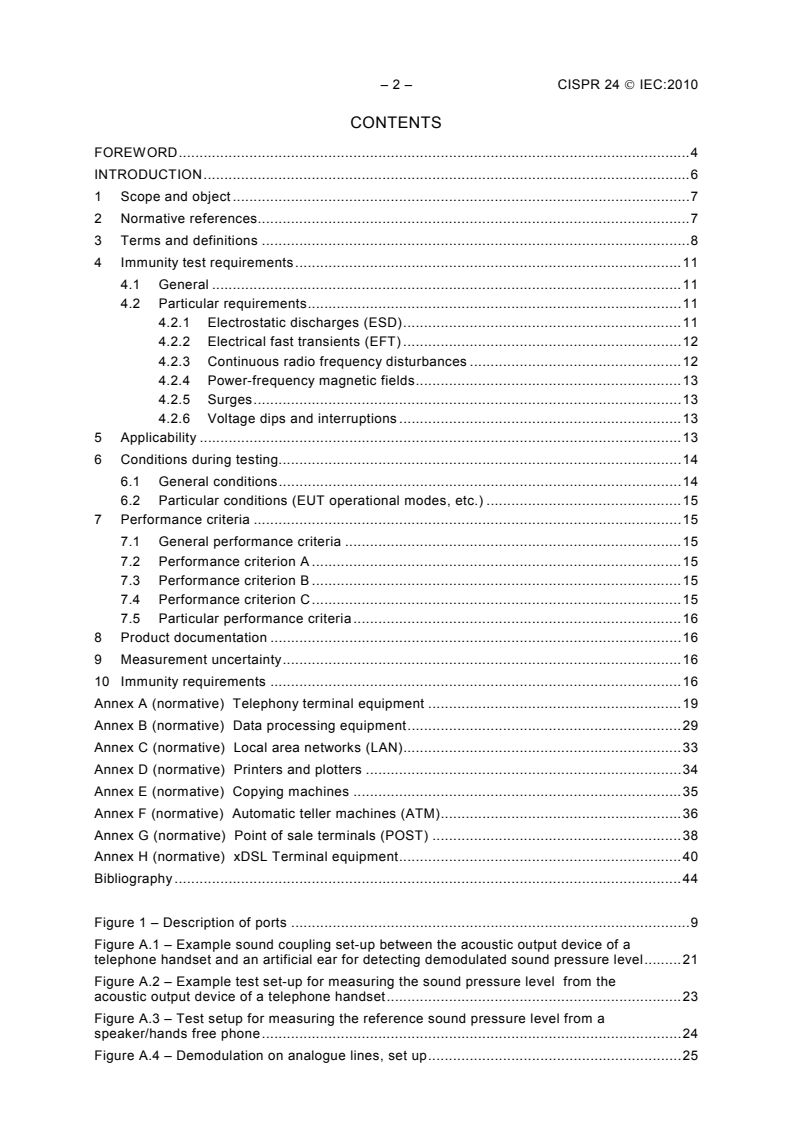
– 2 – CISPR 24 © IEC:2010
CONTENTS
FOREWORD.4
INTRODUCTION.6
1 Scope and object .7
2 Normative references.7
3 Terms and definitions .8
4 Immunity test requirements.11
4.1 General .11
4.2 Particular requirements.11
4.2.1 Electrostatic discharges (ESD).11
4.2.2 Electrical fast transients (EFT) .12
4.2.3 Continuous radio frequency disturbances .12
4.2.4 Power-frequency magnetic fields.13
4.2.5 Surges.13
4.2.6 Voltage dips and interruptions .13
5 Applicability .13
6 Conditions during testing.14
6.1 General conditions.14
6.2 Particular conditions (EUT operational modes, etc.) .15
7 Performance criteria .15
7.1 General performance criteria .15
7.2 Performance criterion A .15
7.3 Performance criterion B .15
7.4 Performance criterion C.15
7.5 Particular performance criteria.16
8 Product documentation .16
9 Measurement uncertainty.16
10 Immunity requirements .16
Annex A (normative) Telephony terminal equipment .19
Annex B (normative) Data processing equipment.29
Annex C (normative) Local area networks (LAN).33
Annex D (normative) Printers and plotters .34
Annex E (normative) Copying machines .35
Annex F (normative) Automatic teller machines (ATM).36
Annex G (normative) Point of sale terminals (POST) .38
Annex H (normative) xDSL Terminal equipment.40
Bibliography .44
Figure 1 – Description of ports .9
Figure A.1 – Example sound coupling set-up between the acoustic output device of a
telephone handset and an artificial ear for detecting demodulated sound pressure level.21
Figure A.2 – Example test set-up for measuring the sound pressure level from the
acoustic output device of a telephone handset.23
Figure A.3 – Test setup for measuring the reference sound pressure level from a
speaker/hands free phone.24
Figure A.4 – Demodulation on analogue lines, set up.25
CISPR 24 © IEC:2010 – 3 –
Figure A.5 – Example of typical small key telephone system or PABX .27
Figure H.1 – DSL access system configuration .40
Table 1 – Immunity, enclosure port.16
Table 2 – Immunity, signal ports and telecommunication ports.17
Table 3 – Immunity, input d.c. power port (excluding equipment marketed with a
a.c./d.c. power converter).17
Table 4 – Immunity, input a.c. power ports (including equipment marketed with a
separate a.c./d.c power converter) .18
Table A.1 – Criteria applied to TTE functions, used during continuous disturbances
testing.19
Table A.2 – Maximum acoustic demodulated levels at an ear piece .22
Table A.3 – Maximum acoustic demodulated levels relative to reference level.23
Table A.4 – Maximum demodulated differential mode signals at analogue ports.25
Table A.5 – TTE performance criteria for spot frequency tests .26
Table A.6 – TTE performance criteria for non-continuous radio frequency disturbances .26
Table A.7 – Test configurations and performance assessment methods applicable to a
PABX and associated terminals for continuous RF disturbance tests .28
Table H.1 – ITU-T recommendations for xDSL systems .41
Table H.2 – Example cable attenuation.41
– 4 – CISPR 24 © IEC:2010
INTERNATIONAL ELECTROTECHNICAL COMMISSION
____________
INFORMATION TECHNOLOGY EQUIPMENT –
IMMUNITY CHARACTERISTICS –
LIMITS AND METHODS OF MEASUREMENT
FOREWORD
1) The International Electrotechnical Commission (IEC) is a worldwide organization for standardization comprising
all national electrotechnical committees (IEC National Committees). The object of IEC is to promote
international co-operation on all questions concerning standardization in the electrical and electronic fields. To
this end and in addition to other activities, IEC publishes International Standards, Technical Specifications,
Technical Reports, Publicly Available Specifications (PAS) and Guides (hereafter referred to as “IEC
Publication(s)”). Their preparation is entrusted to technical committees; any IEC National Committee interested
in the subject dealt with may participate in this preparatory work. International, governmental and non-
governmental organizations liaising with the IEC also participate in this preparation. IEC collaborates closely
with the International Organization for Standardization (ISO) in accordance with conditions determined by
agreement between the two organizations.
2) The formal decisions or agreements of IEC on technical matters express, as nearly as possible, an international
consensus of opinion on the relevant subjects since each technical committee has representation from all
interested IEC National Committees.
3) IEC Publications have the form of recommendations for international use and are accepted by IEC National
Committees in that sense. While all reasonable efforts are made to ensure that the technical content of IEC
Publications is accurate, IEC cannot be held responsible for the way in which they are used or for any
misinterpretation by any end user.
4) In order to promote international uniformity, IEC National Committees undertake to apply IEC Publications
transparently to the maximum extent possible in their national and regional publications. Any divergence
between any IEC Publication and the corresponding national or regional publication shall be clearly indicated in
the latter.
5) IEC itself does not provide any attestation of conformity. Independent certification bodies provide conformity
assessment services and, in some areas, access to IEC marks of conformity. IEC is not responsible for any
services carried out by independent certification bodies.
6) All users should ensure that they have the latest edition of this publication.
7) No liability shall attach to IEC or its directors, employees, servants or agents including individual experts and
members of its technical committees and IEC National Committees for any personal injury, property damage or
other damage of any nature whatsoever, whether direct or indirect, or for costs (including legal fees) and
expenses arising out of the publication, use of, or reliance upon, this IEC Publication or any other IEC
Publications.
8) Attention is drawn to the Normative references cited in this publication. Use of the referenced publications is
indispensable for the correct application of this publication.
9) Attention is drawn to the possibility that some of the elements of this IEC Publication may be the subject of
patent rights. IEC shall not be held responsible for identifying any or all such patent rights.
International Standard CISPR 24 has been prepared by CISPR subcommittee I:
Electromagnetic compatibility of information technology equipment, multimedia equipment and
receivers.
This second edition cancels and replaces the first edition published in 1997, and its
Amendments 1(2001) and 2 (2002). It is a technical revision.
This edition includes the following significant technical changes with respect to the previous
edition:
• dated references updated;
• option of using a 4 % step size for continuous conducted immunity test deleted;
• revision of Annex A for telephony equipment including methodology for measuring the
demodulation from a speaker / hands free device;
• inclusion of new annex related to DSL equipment.
CISPR 24 © IEC:2010 – 5 –
The text of this standard is based on the following documents:
FDIS Report on voting
CIS/I/331/FDIS CIS/I/334/RVD
Full information on the voting for the approval of this standard can be found in the report on
voting indicated in the above table.
This publication has been drafted in accordance with the ISO/IEC Directives, Part 2.
The committee has decided that the contents of this publication will remain unchanged until
the stability date indicated on the IEC web site under "http://webstore.iec.ch" in the data
related to the specific publication. At this date, the publication will be
• reconfirmed,
• withdrawn,
• replaced by a revised edition, or
• amended.
The contents of the corrigendum of June 2011 have been included in this copy.
– 6 – CISPR 24 © IEC:2010
INTRODUCTION
This CISPR publication establishes uniform requirements for the electromagnetic immunity of
information technology equipment. The test methods are given in the referenced Basic EMC
Immunity Standards. This publication specifies applicable tests, test levels, product operating
conditions and assessment criteria.
CISPR 24 © IEC:2010 – 7 –
INFORMATION TECHNOLOGY EQUIPMENT –
IMMUNITY CHARACTERISTICS –
LIMITS AND METHODS OF MEASUREMENT
1 Scope and object
This CISPR publication applies to information technology equipment (ITE) as defined in
CISPR 22.
The object of this publication is to establish requirements that will provide an adequate level of
intrinsic immunity so that the equipment will operate as intended in its environment. The
publication defines the immunity test requirements for equipment within its scope in relation to
continuous and transient conducted and radiated disturbances, including electrostatic
discharges (ESD).
Procedures are defined for the measurement of ITE and limits are specified which are
developed for ITE within the frequency range from 0 Hz to 400 GHz.
For exceptional environmental conditions, special mitigation measures may be required.
Owing to testing and performance assessment considerations, some tests are specified in
defined frequency bands or at selected frequencies. Equipment which fulfils the requirements
at these frequencies is deemed to fulfil the requirements in the entire frequency range from
0 Hz to 400 GHz for electromagnetic phenomena.
The test requirements are specified for each port considered.
NOTE 1 Safety considerations are not covered in this publication.
NOTE 2 In special cases, situations will arise where the level of disturbance may exceed the levels specified in
this publication, for example where a hand-held transmitter is used in proximity to equipment. In these instances,
special mitigation measures may have to be employed.
2 Normative references
The following referenced documents are indispensable for the application of this document. For
dated references, only the edition cited applies. For undated references, the latest edition of
the referenced document (including any amendments) applies.
IEC 60050-161:1990, International Electrotechnical Vocabulary (IEV) – Chapter 161:
Electromagnetic compatibility
IEC 60318-1:2009, Electroacoustics – Simulators of human head and ear – Part 1: Ear
simulator for the measurement of supra-aural and circumaural earphones
IEC 61000-4-2:2008, Electromagnetic compatibility (EMC) – Part 4-2: Testing and
measurement techniques – Electrostatic discharge immunity test
IEC 61000-4-3:2006, Electromagnetic compatibility (EMC) – Part 4-3: Testing and
measurement techniques – Radiated, radio-frequency, electromagnetic field immunity test
Amendment 1(2007)
Amendment 2(2010)
IEC 61000-4-4:2004, Electromagnetic compatibility (EMC) – Part 4-4: Testing and
measurement techniques – Electrical fast transient/burst immunity test
– 8 – CISPR 24 © IEC:2010
IEC 61000-4-5:2005, Electromagnetic compatibility (EMC) – Part 4-5: Testing and
measurement techniques – Surge immunity test
IEC 61000-4-6:2008, Electromagnetic compatibility (EMC) – Part 4-6: Testing and
measurement techniques – Immunity to conducted disturbances, induced by radio-frequency
fields
IEC 61000-4-8:2009, Electromagnetic compatibility (EMC) – Part 4-8: Testing and
measurement techniques – Power frequency magnetic field immunity test
IEC 61000-4-11:2004, Electromagnetic compatibility (EMC) – Part 4-11: Testing and
measurement techniques – Voltage dips, short interruptions and voltage variations immunity
tests
CISPR 16-1-2:2003, Specification for radio disturbance and immunity measuring apparatus and
methods – Part 1-2: Radio disturbance and immunity measuring apparatus – Ancillary
equipment – Conducted disturbances
Amendment 1(2004)
Amendment 2(2006)
CISPR 20:2006, Sound and television broadcast receivers and associated equipment –
Immunity characteristics – Limits and methods of measurement
CISPR 22:2008, Information technology equipment – Radio disturbance characteristics – Limits
and methods of measurement
3 Terms and definitions
For the purposes of this document, the terms and definitions given in IEC 60050-161, and the
following apply.
3.1
degradation
unwanted change in operational performance of an EUT due to electromagnetic disturbances.
This does not necessarily mean malfunction or catastrophic failure
3.2
equipment under test
EUT
representative device or functionally interactive group of devices (that is a system) which
includes one or more host units that is subjected to test procedures specified in this publication
3.3
information technology equipment
ITE
any equipment:
a) which has a primary function of either (or a combination of) entry, storage, display,
retrieval, transmission, processing, switching, or control, of data and of telecommunication
messages and which may be equipped with one or more terminal ports typically operated
for information transfer;
b) with a rated supply voltage not exceeding 600 V.
It includes, for example, data processing equipment, office machines, electronic business
equipment and telecommunication equipment.
Any equipment (or part of the ITE equipment) which has a primary function of radio trans-
mission and/or reception according to the ITU Radio Regulations are excluded from the scope
of this publication.
CISPR 24 © IEC:2010 – 9 –
NOTE Any equipment which has a function of radio transmission and/or reception according to the definitions of
the ITU Radio Regulations should fulfil the national radio regulations, whether or not this publication is also valid.
Equipment, for which all disturbance requirements in the frequency range are explicitly formul-
ated in other IEC or CISPR publications, are excluded from the scope of this publication.
[3.1 of CISPR 22:2008]
3.4
jitter (of a cathode ray tube (CRT) monitor)
peak-to-peak variation in the geometric location of picture elements on the viewing surface of
the CRT monitor
3.5
port
particular interface of the specified EUT with the external electromagnetic environment (see
Figure 1)
Enclosure port
DC power port Earth port
Information technology
AC power port Signal port
equipment
Telecommunication port
IEC 2016/10
Figure 1 – Description of ports
3.6
enclosure port
physical boundary of the EUT through which electromagnetic fields may radiate or impinge. For
plug-in units, the physical boundary will be defined by the host unit
3.7
telephony call
process exercised in the network and the telecommunication terminal equipment (TTE) to allow
interchange of information (speech, video or data) with another TTE through the network
NOTE The call should be operated in the way specified by the manufacturer. For circuit switched services, the
exchange of data should be considered to be possible when a 64 kbit/s channel or equivalent is available for both
parties. For packet service, the exchange of information should be considered to be possible when a virtual path is
established to the called TTE.
3.8
establishment of a telephony call
the operating procedure for a user or an automatic process in conjunction with the network to
reach the capability to exchange information with another TTE
NOTE See Note of 3.7.
3.9
reception of a telephony call
the operating procedure for a user or an automatic process initiated by, and in conjunction with,
the network to reach the capability to exchange information with another TTE
NOTE See Note of 3.7.
3.10
maintenance of a telephony call
the capability of exchanging information without having to clear and re-establish a call
NOTE See Note of 3.7.
– 10 – CISPR 24 © IEC:2010
3.11
clearing of a telephony call
the operating procedure for a user or an automatic process in conjunction with the network
(either at the initiative of the local party or the distant party) to stop the capability of exchanging
information by an orderly return to a state where the establishment of a new call is possible
NOTE See Note of 3.7.
3.12
network terminator
NT
associated equipment representing the termination of the telecommunication network
3.13
telephony service
a service providing users with the ability for real-time two-way speech conversation via a
network
[see ITU-T, I.241.1]
3.14
telecommunications terminal equipment
TTE
equipment intended to be connected to a public or private telecommunications network, that is:
a) to be connected directly to the termination of a telecommunications network in order to
send, process or receive information; or
b) to inter-work with a telecommunications network being connected directly or indirectly to
the termination of a telecommunications network in order to send, process or receive
information
3.15
multifunction equipment
information technology equipment in which two or more functions subject to this standard
and/or to other standards are provided in the same unit
NOTE Examples of multifunction equipment include
− a personal computer provided with a telecommunication function and/or broadcast reception function;
− a personal computer provided with a measuring function, etc.
3.16
telecommunication network port
point of connection for voice, data and signaling transfers intended to interconnect widely
dispersed systems via such means as direct connection to multi-user telecommunications
networks (e.g. public switched telecommunications networks (PSTN), integrated services
digital networks (ISDN), x-type digital subscriber lines (xDSL), etc.), local area networks (e.g.
Ethernet, Token Ring, etc.) and similar networks
NOTE A port generally intended for interconnection of components of an ITE system under test (e.g. RS-232,
IEEE Standard 1284 (parallel printer), Universal Serial Bus (USB), IEEE Standard 1394 (“Fire Wire”), etc.) and used
in accordance with its functional specifications (e.g. for the maximum length of cable connected to it), is not
considered to be a telecommunications/network port under this definition.
3.17
analogue interface
an interface that transmits and receives signals whose characteristic quantities follow
continuously the variations of another physical quantity representing information
CISPR 24 © IEC:2010 – 11 –
3.18
acoustic interface
port at which audio signals emanate and/or originate
3.19
associated equipment
AE
equipment needed to exercise and/or monitor the operation of the EUT in a representative way
4 Immunity test requirements
4.1 General
The immunity test requirements for equipment are given on a port-by-port basis.
Tests shall be conducted in a well-defined and reproducible manner.
The tests shall be carried out as single tests in sequence. The sequence of testing is optional.
The description of the test, the test generator, the test methods and the test set-up are given in
IEC basic EMC standards which are referred to in the following tables.
The contents of these IEC basic EMC standards are not repeated here; however, modifications
or additional information needed for the practical application of the tests are given in this
publication.
4.2 Particular requirements
4.2.1 Electrostatic discharges (ESD)
The test procedure shall be in accordance with IEC 61000-4-2, with the following modifications
and clarifications.
Electrostatic discharges shall be applied only to those points and surfaces of the EUT which
are expected to be touched during usual operation, including user access, as specified in the
user manual, for example cleaning or adding consumables when the EUT is powered.
The number of test points is EUT dependent. The requirements of 8.3.1 and A.5 of IEC 61000-
4-2 shall be taken into consideration when selecting test points. The application of discharges
to the contacts of open connectors is not required.
Guidance on the selection of actual test points is given in A.5 of IEC 61000-4-2. When
selecting test points particular attention shall be given to keyboards, dialing pads, power
switches, mice, drive slots, card slots, around communication ports, etc.
The discharges shall be applied in two ways:
a) Contact discharges to the conductive surfaces and to coupling planes:
The EUT shall be exposed to at least 200 discharges, 100 each at negative and positive
polarity, at a minimum of four test points. For table-top equipment one of the test points shall
be the centre front edge of the horizontal coupling plane, which shall be subjected to at least
50 indirect discharges (25 of each polarity). All other test points shall each receive at least 50
direct contact discharges (25 of each polarity). All areas normally touched by the user should
be tested. If no direct contact test points are available, then at least 200 indirect discharges
shall be applied in the indirect mode (see IEC 61000-4-2 for use of the Vertical Conducting
Plane (VCP)).
– 12 – CISPR 24 © IEC:2010
For contact discharge, the requirement to apply ESD discharges at lower levels, as defined in
Clause 5 of IEC 61000-4-2, is not applicable.
b) Air discharge at apertures and insulating surfaces:
On those parts of the EUT where it is not possible to perform contact discharge testing, the
EUT should be investigated to identify the user accessible points where breakdown may occur;
examples are openings at edges of keys, or the covers of keyboards and telephone handsets.
Such points are tested using the air discharge method.
4.2.2 Electrical fast transients (EFT)
The test method is given in IEC 61000-4-4. However, the test set-up for in situ measurements
is not applicable for ITE.
The test procedure is as given in IEC 61000-4-4 together with the following changes and
clarifications:
– if the EUT contains several ports with the same particular interface, only one shall be
tested;
– multiconductor cables, such as a 50-pair telecommunication cable, shall be tested as a
single cable. Cables shall not be split or divided into groups of conductors for this test;
– applicable only to cables which according to the manufacturer’s specification support
communication on cable lengths greater than 3 m;
– the cable length between the EUT and the coupling device shall be as short as possible in
the range 0,5 m to 3,0 m.
4.2.3 Continuous radio frequency disturbances
4.2.3.1 General
The frequency range for the radiated field test is 80 MHz to 1 000 MHz. The frequency range
for the continuous conducted test is 0,15 MHz to 80 MHz.
The frequency ranges are scanned as specified; however, at a limited number of selected
frequencies a more comprehensive functional test may be required. The requirement to
undertake this additional selected frequency test is not universally applicable to all products,
but only to products which have this requirement specified in Annex A (under particular product
specific requirements). The selected frequencies are given in Tables 1 to 4.
The dwell time at each frequency shall not be less than the time necessary for the EUT to be
exercised and to be able to respond. However, the dwell time shall not exceed 5 seconds at
each of the frequencies during the scan.
The time to exercise the EUT shall not be interpreted as a total time of a programme or a cycle
but related to the reaction time in case of failure of the EUT.
Unless required by an annex of this document, clock and other sensitive frequencies do not
need to be assessed separately.
4.2.3.2 Continuous radiated disturbances
The test procedure shall be in accordance with IEC 61000-4-3.
The EUT shall be positioned so that the four sides of the EUT shall be exposed to the
electromagnetic field in sequence. In each position the performance of the EUT will be
investigated.
CISPR 24 © IEC:2010 – 13 –
In the case where the most sensitive surface side of the EUT is known throughout the
frequency range (for example, via preliminary tests), testing may be restricted to that surface
side only. Where it is not possible to determine the most sensitive face with any certainty (for
example where different faces are sensitive at different frequencies) all four faces shall be
tested.
If the EUT is too large such that it cannot be fully illuminated by the radiating antenna, or
exceeds the size of the Uniform Field Area (UFA) then partial illumination shall be used. The
EUT can be repositioned so that the front surface remains within the UFA in order to illuminate
those sections of the EUT that were previously outside the UFA.
4.2.3.3 Continuous conducted disturbances
There shall be no additional deviations from IEC 61000-4-6 (other than those specified
in 4.2.3.1).
4.2.4 Power-frequency magnetic fields
The test procedure shall be in accordance with IEC 61000-4-8.
The EUT shall be arranged and connected to satisfy its functional requirements, and shall be
placed at the centre of the coil system (immersion method).
The cables supplied by the EUT manufacturer shall be used or, in their absence, suitable
alternative cables of the type appropriate to the signals involved shall be used.
Physically large products need not be completely submerged in the magnetic field, only the
sensitive devices (such as CRT monitors if they are the only sensitive parts). In this case, and
if the CRT monitor is integral with the ITE, then the CRT monitor or sensitive device may be
removed for testing.
4.2.5 Surges
The test procedure shall be in accordance with IEC 61000-4-5.
4.2.6 Voltage dips and interruptions
The test procedure shall be in accordance with IEC 61000-4-11.
5 Applicability
Tests shall be applied to the relevant ports of the EUT according to Tables 1 to 4.
It may be determined from consideration of the electrical characteristics and usage of
particular EUT that some of the tests are inappropriate and therefore unnecessary. In such a
case, it is required that both the decision and the justification not to apply any particular test to
any particular port be recorded in the test report.
Multifunction equipment which is subjected simultaneously to different clauses of this standard
and/or other standards shall be tested with each function operated in isolation, if this can be
achieved without physically modifying the equipment internally. The equipment thus tested shall
be deemed to have complied with the requirements of all clauses/standards when each
function has satisfied the requirements of the relevant clause/standard. For example, a
personal computer with a broadcast reception function shall be tested with the broadcast
reception function disabled according to this standard and then tested with only the broadcast
reception function activated according to CISPR 20, if it can operate each function in isolation
under normal operation.
– 14 – CISPR 24 © IEC:2010
For equipment which it is not practical to test with each function operated in isolation, or where
the isolation of a particular function would result in the equipment being unable to fulfil its
primary function, or where the simultaneous operation of several functions would result in
saving measurement time, the EUT shall be deemed to have complied if it meets the provisions
of the relevant clause/standard with the necessary functions operated. For example, if a
personal computer with a broadcast reception function cannot operate the broadcast reception
function in isolation from the computing function, the personal computer may be tested with the
computing function and broadcast reception function activated according to this standard and
to CISPR 20 with respect to these requirements.
Where an allowance is made excluding specific ports or frequencies or functions in a standard
because of different test specification and/or test set-up and/or performance criterion, the
allowance may be made when relevant functions within multifunction equipment are tested
against a different standard (e.g. excluding of the application of Table 2 to an antenna port or
excluding of the evaluation of the broadcast function during a measurement of equipment
containing the broadcast reception function according to this standard).
Dependent upon the EUT more than one criterion defined in the annexes may apply, for
example a TTE attached to a LAN shall meet the criteria defined in Annex A and Annex C.
6 Conditions during testing
6.1 General conditions
The tests shall be made exercising all primary functions in the most representative mode
consistent with typical applications. The test sample shall be configured in a manner consistent
with typical installation practice.
If the EUT is part of a system or can be connected to associated equipment, then the
equipment shall be tested while connected to the minimum representative configuration of
associated equipment necessary to exercise the ports in a similar manner to that described in
Clause 8 of CISPR 22.
The configuration and mode of operating during the tests shall be precisely noted in the test
report. It is not always possible to test every function of the apparatus; in such cases, the most
critical mode of operation shall be selected.
If the EUT either has a large number of terminals or a large number of ports with similar
connection types, then a sufficient number shall be selected to simulate the actual operating
conditions and to ensure that all the different types of termination are covered.
Coil cables (such as keyboard cables) shall not be intentionally stretched during testing. For
such cables, the length specified in the table notes refers to the stretched conditions.
The test equipment or associated equipment (for example NT or simulator) connected to the
EUT shall not have any influence on the result of the testing.
In cases where a manufacturer’s specification requires external protection devices or
measures which are clearly specified in the user’s manual, then the test requirements of this
standard shall be applied with the external protection devices or measures in place.
During testing, the environmental conditions and supply voltages shall remain within the
operating ranges specified for the product unless otherwise indicated in the basic standard.
If an earth connection independent of the power supply cable is provided, this earth connection
shall be installed according to the specifications of the manufacturer for the tests given in
Tables 1 to 4.
CISPR 24 © IEC:2010 – 15 –
6.2 Particular conditions (EUT operational modes, etc.)
The particular conditions specified in the annexes take precedence over the corresponding
parts of the general conditions.
Where particular conditions for specific functions are not given in this standard, then the
general conditions shall apply.
7 Performance criteria
7.1 General performance criteria
The manufacturer has the obligation to express the performance criteria in terms which relate
to the performance of his specific product when used as intended.
The following performance criteria are applicable, and shall only be evaluated when the
functions referred to are implemented.
Examples of functions defined by the manufacturer to be evaluated during testing include, but
are not limited to, the following:
– essential operational modes and states;
– tests of all peripheral access (hard disks, floppy disks, printers, keyboard, mouse, etc.);
– quality of software execution;
– quality of data display and transmission;
– quality of speech transmission.
7.2 Performance criterion A
During and after the test the EUT shall continue to operate as intended without operator
intervention. No degradation of performance or loss of function is allowed below a minimum
performance level specified by the manufacturer when the EUT is used as intended. The
performance level may be replaced by a permissible loss of performance. If the minimum
performance level or the permissible performance loss is not specified by the manufacturer,
then either of these may be derived from the product description and documentation, and by
what the user may reasonably expect from the EUT if used as intended.
7.3 Performance criterion B
After the test, the EUT shall continue to operate as intended without operator intervention. No
degradation of performance or loss of function is allowed, after the application of the
phenomena below a performance level specified by the manufacturer, when the EUT is used
as intended. The performance level may be replaced by a permissible loss of performance.
During the test, degradation of performance is allowed. However, no change of operating state
or stored data is allowed to persist after the test.
If the minimum performance level (or the permissible performance loss) is not specified by the
manufacturer, then either of these may be derived from the product description and
documentation, and by what the user may reasonably expect from the EUT if used as intended.
7.4 Performance criterion C
During and after testing, a temporary loss of function is allowed, provided the function is self-
recoverable, or can be restored by the operation of the controls or cycling of the power to the
EUT by the user in accordance with the manufacturer’s instructions.
– 16 – CISPR 24 © IEC:2010
Functions, and/or information stored in non-volatile memory, or protected by a battery backup,
shall not be lost.
7.5 Particular performance criteria
The particular performance criteria which are specified in the normative annexes take
precedence over the corresponding parts of the general performance criteria.
Where particular performance criteria for specific functions are not given, then the general
performance criteria shall apply.
8 Product documentation
The specification used by the manufacturer to define the performance criteria for the testing
required by this standard shall be made available to the user upon request.
9 Measurement uncertainty
When applying the test levels given in Tables 1 to 4, the requirem
...
CISPR 24 ®
Edition 2.1 2015-04
CONSOLIDATED VERSION
INTERNATIONAL
STANDARD
NORME
INTERNATIONALE
colour
inside
INTERNATIONAL SPECIAL COMMITTEE ON RADIO INTERFERENCE
COMITÉ INTERNATIONAL SPÉCIAL DES PERTURBATIONS RADIOÉLECTRIQUES
Information technology equipment – Immunity characteristics – Limits and
methods of measurement
Appareils de traitement de l'information – Caractéristiques d'immunité – Limites
et méthodes de mesure
All rights reserved. Unless otherwise specified, no part of this publication may be reproduced or utilized in any form
or by any means, electronic or mechanical, including photocopying and microfilm, without permission in writing from
either IEC or IEC's member National Committee in the country of the requester. If you have any questions about IEC
copyright or have an enquiry about obtaining additional rights to this publication, please contact the address below or
your local IEC member National Committee for further information.
Droits de reproduction réservés. Sauf indication contraire, aucune partie de cette publication ne peut être reproduite
ni utilisée sous quelque forme que ce soit et par aucun procédé, électronique ou mécanique, y compris la photocopie
et les microfilms, sans l'accord écrit de l'IEC ou du Comité national de l'IEC du pays du demandeur. Si vous avez des
questions sur le copyright de l'IEC ou si vous désirez obtenir des droits supplémentaires sur cette publication, utilisez
les coordonnées ci-après ou contactez le Comité national de l'IEC de votre pays de résidence.
IEC Central Office Tel.: +41 22 919 02 11
3, rue de Varembé Fax: +41 22 919 03 00
CH-1211 Geneva 20 info@iec.ch
Switzerland www.iec.ch
About the IEC
The International Electrotechnical Commission (IEC) is the leading global organization that prepares and publishes
International Standards for all electrical, electronic and related technologies.
About IEC publications
The technical content of IEC publications is kept under constant review by the IEC. Please make sure that you have the
latest edition, a corrigenda or an amendment might have been published.
IEC Catalogue - webstore.iec.ch/catalogue Electropedia - www.electropedia.org
The stand-alone application for consulting the entire The world's leading online dictionary of electronic and
bibliographical information on IEC International Standards, electrical terms containing more than 30 000 terms and
Technical Specifications, Technical Reports and other definitions in English and French, with equivalent terms in 15
documents. Available for PC, Mac OS, Android Tablets and additional languages. Also known as the International
iPad. Electrotechnical Vocabulary (IEV) online.
IEC publications search - www.iec.ch/searchpub IEC Glossary - std.iec.ch/glossary
The advanced search enables to find IEC publications by a More than 60 000 electrotechnical terminology entries in
variety of criteria (reference number, text, technical English and French extracted from the Terms and Definitions
committee,…). It also gives information on projects, replaced clause of IEC publications issued since 2002. Some entries
and withdrawn publications. have been collected from earlier publications of IEC TC 37,
77, 86 and CISPR.
IEC Just Published - webstore.iec.ch/justpublished
Stay up to date on all new IEC publications. Just Published IEC Customer Service Centre - webstore.iec.ch/csc
details all new publications released. Available online and If you wish to give us your feedback on this publication or
also once a month by email. need further assistance, please contact the Customer Service
Centre: csc@iec.ch.
A propos de l'IEC
La Commission Electrotechnique Internationale (IEC) est la première organisation mondiale qui élabore et publie des
Normes internationales pour tout ce qui a trait à l'électricité, à l'électronique et aux technologies apparentées.
A propos des publications IEC
Le contenu technique des publications IEC est constamment revu. Veuillez vous assurer que vous possédez l’édition la
plus récente, un corrigendum ou amendement peut avoir été publié.
Catalogue IEC - webstore.iec.ch/catalogue Electropedia - www.electropedia.org
Application autonome pour consulter tous les renseignements
Le premier dictionnaire en ligne de termes électroniques et
bibliographiques sur les Normes internationales,
électriques. Il contient plus de 30 000 termes et définitions en
Spécifications techniques, Rapports techniques et autres
anglais et en français, ainsi que les termes équivalents dans
documents de l'IEC. Disponible pour PC, Mac OS, tablettes
15 langues additionnelles. Egalement appelé Vocabulaire
Android et iPad.
Electrotechnique International (IEV) en ligne.
Recherche de publications IEC - www.iec.ch/searchpub
Glossaire IEC - std.iec.ch/glossary
La recherche avancée permet de trouver des publications IEC Plus de 60 000 entrées terminologiques électrotechniques, en
en utilisant différents critères (numéro de référence, texte, anglais et en français, extraites des articles Termes et
comité d’études,…). Elle donne aussi des informations sur les Définitions des publications IEC parues depuis 2002. Plus
projets et les publications remplacées ou retirées. certaines entrées antérieures extraites des publications des
CE 37, 77, 86 et CISPR de l'IEC.
IEC Just Published - webstore.iec.ch/justpublished
Service Clients - webstore.iec.ch/csc
Restez informé sur les nouvelles publications IEC. Just
Published détaille les nouvelles publications parues. Si vous désirez nous donner des commentaires sur cette
Disponible en ligne et aussi une fois par mois par email. publication ou si vous avez des questions contactez-nous:
csc@iec.ch.
CISPR 24 ®
Edition 2.1 2015-04
CONSOLIDATED VERSION
INTERNATIONAL
STANDARD
NORME
INTERNATIONALE
colour
inside
INTERNATIONAL SPECIAL COMMITTEE ON RADIO INTERFERENCE
COMITÉ INTERNATIONAL SPÉCIAL DES PERTURBATIONS RADIOÉLECTRIQUES
Information technology equipment – Immunity characteristics – Limits and
methods of measurement
Appareils de traitement de l'information – Caractéristiques d'immunité – Limites
et méthodes de mesure
INTERNATIONAL
ELECTROTECHNICAL
COMMISSION
COMMISSION
ELECTROTECHNIQUE
INTERNATIONALE
ICS 33.100.20 ISBN 978-2-8322-2625-4
CISPR 24 ®
Edition 2.1 2015-04
CONSOLIDATED VERSION
REDLINE VERSION
VERSION REDLINE
colour
inside
INTERNATIONAL SPECIAL COMMITTEE ON RADIO INTERFERENCE
COMITÉ INTERNATIONAL SPÉCIAL DES PERTURBATIONS RADIOÉLECTRIQUES
Information technology equipment – Immunity characteristics – Limits and
methods of measurement
Appareils de traitement de l'information – Caractéristiques d'immunité – Limites
et méthodes de mesure
– 2 – CISPR 24:2010
+AMD1:2015 CSV IEC 2015
CONTENTS
FOREWORD . 4
INTRODUCTION . 6
1 Scope and object . 7
2 Normative references. 7
3 Terms and definitions . 8
4 Immunity test requirements . 11
4.1 General . 11
4.2 Particular requirements . 11
4.2.1 Electrostatic discharges (ESD) . 11
4.2.2 Electrical fast transients (EFT) . 12
4.2.3 Continuous radio frequency disturbances . 12
4.2.4 Power-frequency magnetic fields . 13
4.2.5 Surges . 13
4.2.6 Voltage dips and interruptions . 13
5 Applicability . 13
6 Conditions during testing. 14
6.1 General conditions . 14
6.2 Particular conditions (EUT operational modes, etc.) . 15
7 Performance criteria . 15
7.1 General performance criteria . 15
7.2 Performance criterion A . 15
7.3 Performance criterion B . 15
7.4 Performance criterion C . 16
7.5 Particular performance criteria . 16
8 Product documentation . 16
9 Measurement uncertainty . 16
10 Immunity requirements . 16
Annex A (normative) Telephony terminal equipment . 19
Annex B (normative) Data processing equipment . 31
Annex C (normative) Local area networks (LAN) . 35
Annex D (normative) Printers and plotters . 36
Annex E (normative) Copying machines . 37
Annex F (normative) Automatic teller machines (ATM) . 38
Annex G (normative) Point of sale terminals (POST) . 40
Annex H (normative) xDSL Terminal equipment . 42
Bibliography . 46
Figure 1 – Description of ports . 9
Figure A.1 – Example sound coupling set-up between the acoustic output device of a
telephone handset and an artificial ear for detecting demodulated sound pressure level . 21
Figure A.2 – Example test set-up for measuring the sound pressure level from the
acoustic output device of a telephone handset . 23
Figure A.3 – Test setup for measuring the reference sound pressure level from a
speaker/hands free phone . 24
+AMD1:2015 CSV IEC 2015
Figure A.4 – Demodulation on analogue lines, set up . 25
Figure A.5 – Example of typical small key telephone system or PABX . 28
Figure A.6 – Example test set-up for A.2.6 with secondary device using the method
A.2.2 . 27
Figure A.7 – Example test set-up for A.2.6 with secondary device using the method
A.2.3 . 27
Figure H.1 – DSL access system configuration . 42
Table 1 – Immunity, enclosure port . 16
Table 2 – Immunity, signal ports and telecommunication ports . 17
Table 3 – Immunity, input d.c. power port (excluding equipment marketed with a
a.c./d.c. power converter) . 17
Table 4 – Immunity, input a.c. power ports (including equipment marketed with a
separate a.c./d.c power converter) . 18
Table A.1 – Criteria applied to TTE functions, used during continuous disturbances
testing . 19
Table A.2 – Maximum acoustic demodulated levels at an ear piece . 22
Table A.3 – Maximum acoustic demodulated levels relative to reference level . 23
Table A.4 – Maximum demodulated differential mode signals at analogue ports . 25
Table A.5 – TTE performance criteria for spot frequency tests . 26
Table A.6 – TTE performance criteria for non-continuous radio frequency disturbances . 28
Table A.7 – Test configurations and performance assessment methods applicable to a
PABX and associated terminals for continuous RF disturbance tests . 30
Table H.1 – ITU-T recommendations for xDSL systems . 43
Table H.2 – Example cable attenuation Attenuation values representing cable lengths . 43
– 4 – CISPR 24:2010
+AMD1:2015 CSV IEC 2015
INTERNATIONAL ELECTROTECHNICAL COMMISSION
____________
INFORMATION TECHNOLOGY EQUIPMENT –
IMMUNITY CHARACTERISTICS –
LIMITS AND METHODS OF MEASUREMENT
FOREWORD
1) The International Electrotechnical Commission (IEC) is a worldwide organization for standardization comprising
all national electrotechnical committees (IEC National Committees). The object of IEC is to promote
international co-operation on all questions concerning standardization in the electrical and electronic fields. To
this end and in addition to other activities, IEC publishes International Standards, Technical Specifications,
Technical Reports, Publicly Available Specifications (PAS) and Guides (hereafter referred to as “IEC
Publication(s)”). Their preparation is entrusted to technical committees; any IEC National Committee interested
in the subject dealt with may participate in this preparatory work. International, governmental and non-
governmental organizations liaising with the IEC also participate in this preparation. IEC collaborates closely
with the International Organization for Standardization (ISO) in accordance with conditions determined by
agreement between the two organizations.
2) The formal decisions or agreements of IEC on technical matters express, as nearly as possible, an international
consensus of opinion on the relevant subjects since each technical committee has representation from all
interested IEC National Committees.
3) IEC Publications have the form of recommendations for international use and are accepted by IEC National
Committees in that sense. While all reasonable efforts are made to ensure that the technical content of IEC
Publications is accurate, IEC cannot be held responsible for the way in which they are used or for any
misinterpretation by any end user.
4) In order to promote international uniformity, IEC National Committees undertake to apply IEC Publications
transparently to the maximum extent possible in their national and regional publications. Any divergence
between any IEC Publication and the corresponding national or regional publication shall be clearly indicated in
the latter.
5) IEC itself does not provide any attestation of conformity. Independent certification bodies provide conformity
assessment services and, in some areas, access to IEC marks of conformity. IEC is not responsible for any
services carried out by independent certification bodies.
6) All users should ensure that they have the latest edition of this publication.
7) No liability shall attach to IEC or its directors, employees, servants or agents including individual experts and
members of its technical committees and IEC National Committees for any personal injury, property damage or
other damage of any nature whatsoever, whether direct or indirect, or for costs (including legal fees) and
expenses arising out of the publication, use of, or reliance upon, this IEC Publication or any other IEC
Publications.
8) Attention is drawn to the Normative references cited in this publication. Use of the referenced publications is
indispensable for the correct application of this publication.
9) Attention is drawn to the possibility that some of the elements of this IEC Publication may be the subject of
patent rights. IEC shall not be held responsible for identifying any or all such patent rights.
This consolidated version of the official IEC Standard and its amendment has been prepared
for user convenience.
CISPR 24 edition 2.1 contains the second edition (2010-08) [documents CIS/I/331/FDIS and CIS/
I/334/RVD] and its amendment 1 (2015-04) [documents CIS/I/500/FDIS and CIS/I/504/RVD].
In this Redline version, a vertical line in the margin shows where the technical content is
modified by amendment 1. Additions and deletions are displayed in red, with
deletions being struck through. A separate Final version with all changes accepted is
available in this publication.
+AMD1:2015 CSV IEC 2015
International Standard CISPR 24 has been prepared by CISPR subcommittee I:
Electromagnetic compatibility of information technology equipment, multimedia equipment and
receivers.
This edition includes the following significant technical changes with respect to the previous
edition:
• dated references updated;
• option of using a 4 % step size for continuous conducted immunity test deleted;
• revision of Annex A for telephony equipment including methodology for measuring the
demodulation from a speaker / hands free device;
• inclusion of new annex related to DSL equipment.
This publication has been drafted in accordance with the ISO/IEC Directives, Part 2.
The committee has decided that the contents of the base publication and its amendment will
remain unchanged until the stability date indicated on the IEC web site under
"http://webstore.iec.ch" in the data related to the specific publication. At this date, the
publication will be
• reconfirmed,
• withdrawn,
• replaced by a revised edition, or
• amended.
The contents of the corrigendum of June 2011 have been included in this copy.
IMPORTANT – The 'colour inside' logo on the cover page of this publication indicates
that it contains colours which are considered to be useful for the correct understanding
of its contents. Users should therefore print this document using a colour printer.
– 6 – CISPR 24:2010
+AMD1:2015 CSV IEC 2015
INTRODUCTION
This CISPR publication establishes uniform requirements for the electromagnetic immunity of
information technology equipment. The test methods are given in the referenced Basic EMC
Immunity Standards. This publication specifies applicable tests, test levels, product operating
conditions and assessment criteria.
+AMD1:2015 CSV IEC 2015
INFORMATION TECHNOLOGY EQUIPMENT –
IMMUNITY CHARACTERISTICS –
LIMITS AND METHODS OF MEASUREMENT
1 Scope and object
This CISPR publication applies to information technology equipment (ITE) as defined in
CISPR 22.
The object of this publication is to establish requirements that will provide an adequate level of
intrinsic immunity so that the equipment will operate as intended in its environment. The
publication defines the immunity test requirements for equipment within its scope in relation to
continuous and transient conducted and radiated disturbances, including electrostatic
discharges (ESD).
Procedures are defined for the measurement of ITE and limits are specified which are
developed for ITE within the frequency range from 0 Hz to 400 GHz.
For exceptional environmental conditions, special mitigation measures may be required.
Owing to testing and performance assessment considerations, some tests are specified in
defined frequency bands or at selected frequencies. Equipment which fulfils the requirements
at these frequencies is deemed to fulfil the requirements in the entire frequency range from
0 Hz to 400 GHz for electromagnetic phenomena.
The test requirements are specified for each port considered.
NOTE 1 Safety considerations are not covered in this publication.
NOTE 2 In special cases, situations will arise where the level of disturbance may exceed the levels specified in
this publication, for example where a hand-held transmitter is used in proximity to equipment. In these instances,
special mitigation measures may have to be employed.
2 Normative references
The following referenced documents are indispensable for the application of this document. For
dated references, only the edition cited applies. For undated references, the latest edition of
the referenced document (including any amendments) applies.
IEC 60050-161:1990, International Electrotechnical Vocabulary (IEV) – Chapter 161:
Electromagnetic compatibility
IEC 60318-1:2009, Electroacoustics – Simulators of human head and ear – Part 1: Ear
simulator for the measurement of supra-aural and circumaural earphones
IEC 61000-4-2:2008, Electromagnetic compatibility (EMC) – Part 4-2: Testing and
measurement techniques – Electrostatic discharge immunity test
IEC 61000-4-3:2006, Electromagnetic compatibility (EMC) – Part 4-3: Testing and
measurement techniques – Radiated, radio-frequency, electromagnetic field immunity test
Amendment 1(2007)
Amendment 2(2010)
IEC 61000-4-4:2004, Electromagnetic compatibility (EMC) – Part 4-4: Testing and
measurement techniques – Electrical fast transient/burst immunity test
– 8 – CISPR 24:2010
+AMD1:2015 CSV IEC 2015
IEC 61000-4-5:2005, Electromagnetic compatibility (EMC) – Part 4-5: Testing and
measurement techniques – Surge immunity test
IEC 61000-4-6:2008, Electromagnetic compatibility (EMC) – Part 4-6: Testing and
measurement techniques – Immunity to conducted disturbances, induced by radio-frequency
fields
IEC 61000-4-8:2009, Electromagnetic compatibility (EMC) – Part 4-8: Testing and
measurement techniques – Power frequency magnetic field immunity test
IEC 61000-4-11:2004, Electromagnetic compatibility (EMC) – Part 4-11: Testing and
measurement techniques – Voltage dips, short interruptions and voltage variations immunity
tests
CISPR 16-1-2:2003, Specification for radio disturbance and immunity measuring apparatus and
methods – Part 1-2: Radio disturbance and immunity measuring apparatus – Ancillary
equipment – Conducted disturbances
Amendment 1(2004)
Amendment 2(2006)
CISPR 20:2006, Sound and television broadcast receivers and associated equipment –
Immunity characteristics – Limits and methods of measurement
CISPR 22:2008, Information technology equipment – Radio disturbance characteristics – Limits
and methods of measurement
3 Terms and definitions
For the purposes of this document, the terms and definitions given in IEC 60050-161, and the
following apply.
3.1
degradation
unwanted change in operational performance of an EUT due to electromagnetic disturbances.
This does not necessarily mean malfunction or catastrophic failure
3.2
equipment under test
EUT
representative device or functionally interactive group of devices (that is a system) which
includes one or more host units that is subjected to test procedures specified in this publication
3.3
information technology equipment
ITE
any equipment:
a) which has a primary function of either (or a combination of) entry, storage, display,
retrieval, transmission, processing, switching, or control, of data and of telecommunication
messages and which may be equipped with one or more terminal ports typically operated
for information transfer;
b) with a rated supply voltage not exceeding 600 V.
It includes, for example, data processing equipment, office machines, electronic business
equipment and telecommunication equipment.
Any equipment (or part of the ITE equipment) which has a primary function of radio trans-
mission and/or reception according to the ITU Radio Regulations are excluded from the scope
of this publication.
+AMD1:2015 CSV IEC 2015
NOTE Any equipment which has a function of radio transmission and/or reception according to the definitions of
the ITU Radio Regulations should fulfil the national radio regulations, whether or not this publication is also valid.
Equipment, for which all disturbance requirements in the frequency range are explicitly formul-
ated in other IEC or CISPR publications, are excluded from the scope of this publication.
[3.1 of CISPR 22:2008]
3.4
jitter (of a cathode ray tube (CRT) monitor)
peak-to-peak variation in the geometric location of picture elements on the viewing surface of
the CRT monitor
3.5
port
particular interface of the specified EUT with the external electromagnetic environment (see
Figure 1)
Enclosure port
DC power port Earth port
Information technology
AC power port Signal port
equipment
Telecommunication port
IEC 2016/10
Figure 1 – Description of ports
3.6
enclosure port
physical boundary of the EUT through which electromagnetic fields may radiate or impinge. For
plug-in units, the physical boundary will be defined by the host unit
3.7
telephony call
process exercised in the network and the telecommunication terminal equipment (TTE) to allow
interchange of information (speech, video or data) with another TTE through the network
NOTE The call should be operated in the way specified by the manufacturer. For circuit switched services, the
exchange of data should be considered to be possible when a 64 kbit/s channel or equivalent is available for both
parties. For packet service, the exchange of information should be considered to be possible when a virtual path is
established to the called TTE.
3.8
establishment of a telephony call
the operating procedure for a user or an automatic process in conjunction with the network to
reach the capability to exchange information with another TTE
NOTE See Note of 3.7.
3.9
reception of a telephony call
the operating procedure for a user or an automatic process initiated by, and in conjunction with,
the network to reach the capability to exchange information with another TTE
NOTE See Note of 3.7.
3.10
maintenance of a telephony call
the capability of exchanging information without having to clear and re-establish a call
NOTE See Note of 3.7.
– 10 – CISPR 24:2010
+AMD1:2015 CSV IEC 2015
3.11
clearing of a telephony call
the operating procedure for a user or an automatic process in conjunction with the network
(either at the initiative of the local party or the distant party) to stop the capability of exchanging
information by an orderly return to a state where the establishment of a new call is possible
NOTE See Note of 3.7.
3.12
network terminator
NT
associated equipment representing the termination of the telecommunication network
3.13
telephony service
a service providing users with the ability for real-time two-way speech conversation via a
network
[see ITU-T, I.241.1]
3.14
telecommunications terminal equipment
TTE
equipment intended to be connected to a public or private telecommunications network, that is:
a) to be connected directly to the termination of a telecommunications network in order to
send, process or receive information; or
b) to inter-work with a telecommunications network being connected directly or indirectly to
the termination of a telecommunications network in order to send, process or receive
information
3.15
multifunction equipment
information technology equipment in which two or more functions subject to this standard
and/or to other standards are provided in the same unit
NOTE Examples of multifunction equipment include
− a personal computer provided with a telecommunication function and/or broadcast reception function;
− a personal computer provided with a measuring function, etc.
3.16
telecommunication network port
point of connection for voice, data and signaling transfers intended to interconnect widely
dispersed systems via such means as direct connection to multi-user telecommunications
networks (e.g. public switched telecommunications networks (PSTN), integrated services
digital networks (ISDN), x-type digital subscriber lines (xDSL), etc.), local area networks (e.g.
Ethernet, Token Ring, etc.) and similar networks
NOTE A port generally intended for interconnection of components of an ITE system under test (e.g. RS-232,
IEEE Standard 1284 (parallel printer), Universal Serial Bus (USB), IEEE Standard 1394 (“Fire Wire”), etc.) and used
in accordance with its functional specifications (e.g. for the maximum length of cable connected to it), is not
considered to be a telecommunications/network port under this definition.
3.17
analogue interface
an interface that transmits and receives signals whose characteristic quantities follow
continuously the variations of another physical quantity representing information
+AMD1:2015 CSV IEC 2015
3.18
acoustic interface
port at which audio signals emanate and/or originate
3.19
associated equipment
AE
equipment needed to exercise and/or monitor the operation of the EUT in a representative way
4 Immunity test requirements
4.1 General
The immunity test requirements for equipment are given on a port-by-port basis.
Tests shall be conducted in a well-defined and reproducible manner.
The tests shall be carried out as single tests in sequence. The sequence of testing is optional.
The description of the test, the test generator, the test methods and the test set-up are given in
IEC basic EMC standards which are referred to in the following tables.
The contents of these IEC basic EMC standards are not repeated here; however, modifications
or additional information needed for the practical application of the tests are given in this
publication.
4.2 Particular requirements
4.2.1 Electrostatic discharges (ESD)
The test procedure shall be in accordance with IEC 61000-4-2, with the following modifications
and clarifications.
Electrostatic discharges shall be applied only to those points and surfaces of the EUT which
are expected to be touched during usual operation, including user access, as specified in the
user manual, for example cleaning or adding consumables when the EUT is powered.
The number of test points is EUT dependent. The requirements of 8.3.1 and A.5 of IEC 61000-
4-2 shall be taken into consideration when selecting test points. The application of discharges
to the contacts of open connectors is not required.
Guidance on the selection of actual test points is given in A.5 of IEC 61000-4-2. When
selecting test points particular attention shall be given to keyboards, dialing pads, power
switches, mice, drive slots, card slots, around communication ports, etc.
The discharges shall be applied in two ways:
a) Contact discharges to the conductive surfaces and to coupling planes:
The EUT shall be exposed to at least 200 discharges, 100 each at negative and positive
polarity, at a minimum of four test points. For table-top equipment one of the test points shall
be the centre front edge of the horizontal coupling plane, which shall be subjected to at least
50 indirect discharges (25 of each polarity). All other test points shall each receive at least 50
direct contact discharges (25 of each polarity). All areas normally touched by the user should
be tested. If no direct contact test points are available, then at least 200 indirect discharges
shall be applied in the indirect mode (see IEC 61000-4-2 for use of the Vertical Conducting
Plane (VCP)).
– 12 – CISPR 24:2010
+AMD1:2015 CSV IEC 2015
For contact discharges, the there is no requirement to apply ESD discharges at lower levels, as
defined in Clause 5 of IEC 61000-4-2, is not applicable voltages below the test level defined in
Table 1.
b) Air discharge at apertures and insulating surfaces:
On those parts of the EUT where it is not possible to perform contact discharge testing, the
EUT should be investigated to identify the user accessible points where breakdown may occur;
examples are openings at edges of keys, or the covers of keyboards and telephone handsets.
Such points are tested using the air discharge method.
4.2.2 Electrical fast transients (EFT)
The test method is given in IEC 61000-4-4. However, the test set-up for in situ measurements
is not applicable for ITE.
The test procedure is as given in IEC 61000-4-4 together with the following changes and
clarifications:
– if the EUT contains several ports with the same particular interface, only one shall be
tested;
– multiconductor cables, such as a 50-pair telecommunication cable, shall be tested as a
single cable. Cables shall not be split or divided into groups of conductors for this test;
– applicable only to cables which according to the manufacturer’s specification support
communication on cable lengths greater than 3 m;
– the cable length between the EUT and the coupling device shall be as short as possible in
the range 0,5 m to 3,0 m.
4.2.3 Continuous radio frequency disturbances
4.2.3.1 General
The frequency range for the radiated field test is 80 MHz to 1 000 MHz. The frequency range
for the continuous conducted test is 0,15 MHz to 80 MHz.
The frequency ranges are scanned as specified; however, at a limited number of selected
frequencies a more comprehensive functional test may be required. The requirement to
undertake this additional selected frequency test is not universally applicable to all products,
but only to products which have this requirement specified in Annex A (under particular product
specific requirements). The selected frequencies are given in Tables 1 to 4.
The dwell time at each frequency shall not be less than the time necessary for the EUT to be
exercised and to be able to respond. However, the dwell time shall not exceed 5 seconds at
each of the frequencies during the scan.
The time to exercise the EUT shall not be interpreted as a total time of a programme or a cycle
but related to the reaction time in case of failure of the EUT.
Unless required by an annex of this document, clock and other sensitive frequencies do not
need to be assessed separately.
Recognising that a 1 % step size is preferred, the frequency range can be swept incrementally
with a step size not exceeding 4 % of the previous frequency with a test level of twice the value
of the specified test level in order to reduce the testing time for equipment requiring testing in
multiple configurations and/or long cycle times.
The step size and test level used shall be recorded in the test report.
+AMD1:2015 CSV IEC 2015
4.2.3.2 Continuous radiated disturbances
The test procedure shall be in accordance with IEC 61000-4-3.
The EUT shall be positioned so that the four sides of the EUT shall be exposed to the
electromagnetic field in sequence. In each position the performance of the EUT will be
investigated.
In the case where the most sensitive surface side of the EUT is known throughout the
frequency range (for example, via preliminary tests), testing may be restricted to that surface
side only. Where it is not possible to determine the most sensitive face with any certainty (for
example where different faces are sensitive at different frequencies) all four faces shall be
tested.
If the EUT is too large such that it cannot be fully illuminated by the radiating antenna, or
exceeds the size of the Uniform Field Area (UFA) then partial illumination shall be used. The
EUT can be repositioned so that the front surface remains within the UFA in order to illuminate
those sections of the EUT that were previously outside the UFA.
4.2.3.3 Continuous conducted disturbances
There shall be no additional deviations from IEC 61000-4-6 (other than those specified
in 4.2.3.1).
4.2.4 Power-frequency magnetic fields
The test procedure shall be in accordance with IEC 61000-4-8.
The EUT shall be arranged and connected to satisfy its functional requirements, and shall be
placed at the centre of the coil system (immersion method).
The cables supplied by the EUT manufacturer shall be used or, in their absence, suitable
alternative cables of the type appropriate to the signals involved shall be used.
Physically large products need not be completely submerged in the magnetic field, only the
sensitive devices (such as CRT monitors if they are the only sensitive parts). In this case, and
if the CRT monitor is integral with the ITE, then the CRT monitor or sensitive device may be
removed for testing.
4.2.5 Surges
The test procedure shall be in accordance with IEC 61000-4-5.
4.2.6 Voltage dips and interruptions
The test procedure shall be in accordance with IEC 61000-4-11.
5 Applicability
Tests shall be applied to the relevant ports of the EUT according to Tables 1 to 4.
It may be determined from consideration of the electrical characteristics and usage of
particular EUT that some of the tests are inappropriate and therefore unnecessary. In such a
case, it is required that both the decision and the justification not to apply any particular test to
any particular port be recorded in the test report.
Multifunction equipment which is subjected simultaneously to different clauses of this standard
and/or other standards shall be tested with each function operated in isolation, if this can be
– 14 – CISPR 24:2010
+AMD1:2015 CSV IEC 2015
achieved without physically modifying the equipment internally. The equipment thus tested shall
be deemed to have complied with the requirements of all clauses/standards when each
function has satisfied the requirements of the relevant clause/standard. For example, a
personal computer with a broadcast reception function shall be tested with the broadcast
reception function disabled according to this standard and then tested with only the broadcast
reception function activated according to CISPR 20, if it can operate each function in isolation
under normal operation.
For equipment which it is not practical to test with each function operated in isolation, or where
the isolation of a particular function would result in the equipment being unable to fulfil its
primary function, or where the simultaneous operation of several functions would result in
saving measurement time, the EUT shall be deemed to have complied if it meets the provisions
of the relevant clause/standard with the necessary functions operated. For example, if a
personal computer with a broadcast reception function cannot operate the broadcast reception
function in isolation from the computing function, the personal computer may be tested with the
computing function and broadcast reception function activated according to this standard and
to CISPR 20 with respect to these requirements.
Where an allowance is made excluding specific ports or frequencies or functions in a standard
because of different test specification and/or test set-up and/or performance criterion, the
allowance may be made when relevant functions within multifunction equipment are tested
against a different standard (e.g. excluding of the application of Table 2 to an antenna port or
excluding of the evaluation of the broadcast function during a measurement of equipment
containing the broadcast reception function according to this standard).
Dependent upon the EUT more than one criterion defined in the annexes may apply, for
example a TTE attached to a LAN shall meet the criteria defined in Annex A and Annex C.
6 Conditions during testing
6.1 General conditions
The tests shall be made exercising all primary functions in the most representative mode
consistent with typical applications. The test sample shall be configured in a manner consistent
with typical installation practice.
If the EUT is part of a system or can be connected to associated equipment, then the
equipment shall be tested while connected to the minimum representative configuration of
associated equipment necessary to exercise the ports in a similar manner to that described in
Clause 8 of CISPR 22.
The configuration and mode of operating during the tests shall be precisely noted in the test
report. It is not always possible to test every function of the apparatus; in such cases, the most
critical mode of operation shall be selected.
If the EUT either has a large number of terminals or a large number of ports with similar
connection types, then a sufficient number shall be selected to simulate the actual operating
conditions and to ensure that all the different types of termination are covered.
Coil cables (such as keyboard cables) shall not be intentionally stretched during testing. For
such cables, the length specified in the table notes refers to the stretched conditions.
The test equipment or associated equipment (for example NT or simulator) connected to the
EUT shall not have any influence on the result of the testing.
In cases where a manufacturer’s specification requires external protection devices or
measures which are clearly specified in the user’s manual, then the test requirements of this
standard shall be applied with the external protection devices or measures in place.
+AMD1:2015 CSV IEC 2015
During testing, the environmental conditions and supply voltages shall remain within the
operating ranges specified for the product unless otherwise indicated in the basic standard.
If an earth connection independent of the power supply cable is provided, this earth connect
...