

IEC 60601-1-9:2007
(Main)Medical electrical equipment - Part 1-9: General requirements for basic safety and essential performance - Collateral Standard: Requirements for environmentally conscious design
General Information
- Abstract
IEC 60601-1-9:2007 The objective of this collateral standard is to improve the environmental impact for the entire range of medical electrical equipment, taking into account all stages of the product life cycle:
- product specification;
- design;
- manufacturing;
- sales, logistics, installation;
- use;
- end of life management. This means protecting the environment and human health from hazardous substances, conserving raw materials and energy, minimizing the generation of waste, as well as minimizing the adverse environmental impacts associated with waste. The criteria needed to reach this goal must be integrated into all stages of the medical electrical equipment life cycle from the specification stage to end of life management. The environmental impacts of me equipment through all life-cycle stages are determined from the medical electrical equipment's environmental aspects defined during the identification of need, product planning, and design stages. Consideration of environmental aspects as early as possible in these stages can produce numerous benefits that might include lower costs, stimulation of innovation and creativity, and increased knowledge about the product. It can also provide new business opportunities, and improved product quality as well as reduction of adverse environmental impacts. The assessment of the environmental aspects and impacts of medical electrical equipment is a developing science and it is anticipated that this collateral standard will require periodic updating as the science develops. The requirements given in this collateral standard do not replace national or international laws and regulations. Environmental protection is one element of the overall risk management process as required by the general standard. The acceptability of medical electrical equipment's environmental impacts are balanced against other factors, such as the product's intended function, performance, safety, cost, marketability, quality, legal and regulatory requirements. This balance can differ depending on the intended function of the medical electrical equipment. For example, a solution appropriate for life-saving or life-supporting medical electrical equipment might not be appropriate for a device intended to correct a minor ailment. A manufacturer of medical electrical equipment might have to justify, as a result of risk management, that a medical benefit outweighs the associated adverse environmental impacts.
- Status
- Published
- Publication Date
- 21-Jul-2020
- Technical Committee
- SC 62A - Common aspects of medical equipment, software, and systems
- Drafting Committee
- WG 20 - TC 62/SC 62A/WG 20
- Current Stage
- PPUB - Publication issued
- Start Date
- 10-Jul-2007
- Completion Date
- 15-Sep-2007
Buy Documents
IEC 60601-1-9:2007 - Medical electrical equipment - Part 1-9: General requirements for basic safety and essential performance - Collateral Standard: Requirements for environmentally conscious design Released:7/10/2007
IEC 60601-1-9:2007+AMD1:2013 CSV - Medical electrical equipment - Part 1-9: General requirements forbasic safety and essential performance - Collateral Standard: Requirements for environmentally conscious design Released:6/18/2013

IEC 60601-1-9:2007+AMD1:2013+AMD2:2020 CSV - Medical electrical equipment - Part 1-9: General requirements for basic safety and essential performance - Collateral Standard: Requirements for environmentally conscious design Released:7/22/2020
Overview
IEC 60601-1-9:2007 is an international collateral standard developed by the International Electrotechnical Commission (IEC) that defines the general requirements for environmentally conscious design of medical electrical equipment. This standard complements the general safety and essential performance requirements outlined in IEC 60601-1, focusing specifically on reducing the environmental impact throughout the entire product life cycle.
The standard aims to promote sustainable practices by integrating environmental considerations into every stage of medical electrical equipment development, from initial specification and design to manufacturing, use, and end-of-life management. It balances environmental protection with safety, performance, and regulatory compliance to help manufacturers achieve both medical and ecological objectives.
Key Topics
Environmental Impact Reduction
Emphasizes minimizing negative effects on the environment and human health caused by hazardous substances, resource consumption, energy use, and waste generation related to medical electrical equipment.Life Cycle Approach
Covers all stages of the product life cycle:- Product specification
- Design and development
- Manufacturing processes
- Sales, logistics, and installation
- Operational use
- End-of-life disposal and recycling
Identification of Environmental Aspects
Requires manufacturers to identify and assess environmental aspects early during product planning and design to reduce adverse impacts proactively.Risk Management Integration
Incorporates environmental protection as part of the overall risk management process, allowing trade-offs between environmental impacts and product performance, safety, cost, and legal requirements.Continuous Improvement and Updating
Recognizes that the assessment of environmental aspects is evolving, with the standard subject to periodic revision based on advances in environmental science and technology.Compliance and Justification
While not replacing legal obligations, the standard encourages manufacturers to justify design decisions where environmental impacts may be balanced against medical benefits, especially for critical life-saving devices.
Applications
IEC 60601-1-9 is essential for manufacturers, designers, regulatory bodies, and healthcare providers involved with medical electrical equipment, ensuring products:
- Are developed with environmental sustainability in mind, reducing waste and hazardous material use.
- Deliver medical benefits while minimizing ecological footprints throughout usage and disposal.
- Comply with international standards that facilitate global market acceptance and support corporate environmental responsibility goals.
- Enable innovative design approaches that can reduce energy consumption and resource depletion.
- Support improved product quality and cost-effectiveness by integrating environmental criteria from the early stages of development.
Related Standards
IEC 60601-1: Medical Electrical Equipment – Part 1: General Requirements for Basic Safety and Essential Performance
Provides the foundational safety and performance requirements with which IEC 60601-1-9 is used in conjunction.ISO 14000 Series (Environmental Management)
Guides environmental management systems and practices that align with lifecycle considerations suggested in IEC 60601-1-9.RoHS Directive (Restriction of Hazardous Substances)
National and regional regulations complementing this standard by restricting the use of specific hazardous materials in electrical and electronic equipment.WEEE Directive (Waste Electrical and Electronic Equipment)
Governs the end-of-life management and recycling of medical electrical devices consistent with the lifecycle approach promoted by IEC 60601-1-9.
By adhering to IEC 60601-1-9:2007, stakeholders can foster environmentally conscious design practices that improve sustainability, safety, and regulatory compliance in medical electrical equipment, ultimately contributing to better healthcare outcomes with reduced environmental impact.
Relations
- Effective Date
- 25-Aug-2026
- Effective Date
- 25-Aug-2026
- Effective Date
- 25-Aug-2026
- Effective Date
- 25-Aug-2026
- Effective Date
- 05-Sep-2023
- Effective Date
- 05-Sep-2023
Buy Documents
IEC 60601-1-9:2007 - Medical electrical equipment - Part 1-9: General requirements for basic safety and essential performance - Collateral Standard: Requirements for environmentally conscious design Released:7/10/2007
IEC 60601-1-9:2007+AMD1:2013 CSV - Medical electrical equipment - Part 1-9: General requirements forbasic safety and essential performance - Collateral Standard: Requirements for environmentally conscious design Released:6/18/2013
IEC 60601-1-9:2007+AMD1:2013+AMD2:2020 CSV - Medical electrical equipment - Part 1-9: General requirements for basic safety and essential performance - Collateral Standard: Requirements for environmentally conscious design Released:7/22/2020
Get Certified
Connect with accredited certification bodies for this standard

BSI Group
BSI (British Standards Institution) is the business standards company that helps organizations make excellence a habit.

TÜV Rheinland
TÜV Rheinland is a leading international provider of technical services.

TÜV SÜD
TÜV SÜD is a trusted partner of choice for safety, security and sustainability solutions.
Sponsored listings
Frequently Asked Questions
IEC 60601-1-9:2007 is a standard published by the International Electrotechnical Commission (IEC). Its full title is "Medical electrical equipment - Part 1-9: General requirements for basic safety and essential performance - Collateral Standard: Requirements for environmentally conscious design". This standard covers: IEC 60601-1-9:2007 The objective of this collateral standard is to improve the environmental impact for the entire range of medical electrical equipment, taking into account all stages of the product life cycle: - product specification; - design; - manufacturing; - sales, logistics, installation; - use; - end of life management. This means protecting the environment and human health from hazardous substances, conserving raw materials and energy, minimizing the generation of waste, as well as minimizing the adverse environmental impacts associated with waste. The criteria needed to reach this goal must be integrated into all stages of the medical electrical equipment life cycle from the specification stage to end of life management. The environmental impacts of me equipment through all life-cycle stages are determined from the medical electrical equipment's environmental aspects defined during the identification of need, product planning, and design stages. Consideration of environmental aspects as early as possible in these stages can produce numerous benefits that might include lower costs, stimulation of innovation and creativity, and increased knowledge about the product. It can also provide new business opportunities, and improved product quality as well as reduction of adverse environmental impacts. The assessment of the environmental aspects and impacts of medical electrical equipment is a developing science and it is anticipated that this collateral standard will require periodic updating as the science develops. The requirements given in this collateral standard do not replace national or international laws and regulations. Environmental protection is one element of the overall risk management process as required by the general standard. The acceptability of medical electrical equipment's environmental impacts are balanced against other factors, such as the product's intended function, performance, safety, cost, marketability, quality, legal and regulatory requirements. This balance can differ depending on the intended function of the medical electrical equipment. For example, a solution appropriate for life-saving or life-supporting medical electrical equipment might not be appropriate for a device intended to correct a minor ailment. A manufacturer of medical electrical equipment might have to justify, as a result of risk management, that a medical benefit outweighs the associated adverse environmental impacts.
IEC 60601-1-9:2007 The objective of this collateral standard is to improve the environmental impact for the entire range of medical electrical equipment, taking into account all stages of the product life cycle: - product specification; - design; - manufacturing; - sales, logistics, installation; - use; - end of life management. This means protecting the environment and human health from hazardous substances, conserving raw materials and energy, minimizing the generation of waste, as well as minimizing the adverse environmental impacts associated with waste. The criteria needed to reach this goal must be integrated into all stages of the medical electrical equipment life cycle from the specification stage to end of life management. The environmental impacts of me equipment through all life-cycle stages are determined from the medical electrical equipment's environmental aspects defined during the identification of need, product planning, and design stages. Consideration of environmental aspects as early as possible in these stages can produce numerous benefits that might include lower costs, stimulation of innovation and creativity, and increased knowledge about the product. It can also provide new business opportunities, and improved product quality as well as reduction of adverse environmental impacts. The assessment of the environmental aspects and impacts of medical electrical equipment is a developing science and it is anticipated that this collateral standard will require periodic updating as the science develops. The requirements given in this collateral standard do not replace national or international laws and regulations. Environmental protection is one element of the overall risk management process as required by the general standard. The acceptability of medical electrical equipment's environmental impacts are balanced against other factors, such as the product's intended function, performance, safety, cost, marketability, quality, legal and regulatory requirements. This balance can differ depending on the intended function of the medical electrical equipment. For example, a solution appropriate for life-saving or life-supporting medical electrical equipment might not be appropriate for a device intended to correct a minor ailment. A manufacturer of medical electrical equipment might have to justify, as a result of risk management, that a medical benefit outweighs the associated adverse environmental impacts.
IEC 60601-1-9:2007 is classified under the following ICS (International Classification for Standards) categories: 11.040.01 - Medical equipment in general; 13.020.01 - Environment and environmental protection in general. The ICS classification helps identify the subject area and facilitates finding related standards.
IEC 60601-1-9:2007 has the following relationships with other standards: It is inter standard links to EN ISO 80601-2-61:2011, EN ISO 80601-2-55:2011, EN ISO 11197:2016, EN ISO 80601-2-56:2012, IEC 60601-1-9:2007/AMD1:2013, IEC 60601-1-9:2007/AMD2:2020. Understanding these relationships helps ensure you are using the most current and applicable version of the standard.
IEC 60601-1-9:2007 is available in PDF format for immediate download after purchase. The document can be added to your cart and obtained through the secure checkout process. Digital delivery ensures instant access to the complete standard document.
Standards Content (Sample)
INTERNATIONAL IEC
STANDARD
CEI
60601-1-9
NORME
First edition
INTERNATIONALE
Première édition
2007-07
Medical electrical equipment –
Part 1-9:
General requirements for basic
safety and essential performance –
Collateral Standard: Requirements for
environmentally conscious design
Appareils électromédicaux –
Partie 1-9:
Exigences générales pour la sécurité
de base et les performances essentielles –
Norme collatérale: Exigences pour une
conception éco-responsable
Reference number
Numéro de référence
IEC/CEI 60601-1-9:2007
All rights reserved. Unless otherwise specified, no part of this publication may be reproduced or utilized in any form
or by any means, electronic or mechanical, including photocopying and microfilm, without permission in writing from
either IEC or IEC's member National Committee in the country of the requester.
If you have any questions about IEC copyright or have an enquiry about obtaining additional rights to this publication,
please contact the address below or your local IEC member National Committee for further information.
Droits de reproduction réservés. Sauf indication contraire, aucune partie de cette publication ne peut être reproduite
ni utilisée sous quelque forme que ce soit et par aucun procédé, électronique ou mécanique, y compris la photocopie
et les microfilms, sans l'accord écrit de la CEI ou du Comité national de la CEI du pays du demandeur.
Si vous avez des questions sur le copyright de la CEI ou si vous désirez obtenir des droits supplémentaires sur cette
publication, utilisez les coordonnées ci-après ou contactez le Comité national de la CEI de votre pays de résidence.
IEC Central Office
3, rue de Varembé
CH-1211 Geneva 20
Switzerland
Email: inmail@iec.ch
Web: www.iec.ch
About the IEC
The International Electrotechnical Commission (IEC) is the leading global organization that prepares and publishes
International Standards for all electrical, electronic and related technologies.
About IEC publications
The technical content of IEC publications is kept under constant review by the IEC. Please make sure that you have the
latest edition, a corrigenda or an amendment might have been published.
ƒ Catalogue of IEC publications: www.iec.ch/searchpub
The IEC on-line Catalogue enables you to search by a variety of criteria (reference number, text, technical committee,…).
It also gives information on projects, withdrawn and replaced publications.
ƒ IEC Just Published: www.iec.ch/online_news/justpub
Stay up to date on all new IEC publications. Just Published details twice a month all new publications released. Available
on-line and also by email.
ƒ Customer Service Centre: www.iec.ch/webstore/custserv
If you wish to give us your feedback on this publication or need further assistance, please visit the Customer Service
Centre FAQ or contact us:
Email: csc@iec.ch
Tel.: +41 22 919 02 11
Fax: +41 22 919 03 00
A propos de la CEI
La Commission Electrotechnique Internationale (CEI) est la première organisation mondiale qui élabore et publie des
normes internationales pour tout ce qui a trait à l'électricité, à l'électronique et aux technologies apparentées.
A propos des publications CEI
Le contenu technique des publications de la CEI est constamment revu. Veuillez vous assurer que vous possédez
l’édition la plus récente, un corrigendum ou amendement peut avoir été publié.
ƒ Catalogue des publications de la CEI: www.iec.ch/searchpub/cur_fut-f.htm
Le Catalogue en-ligne de la CEI vous permet d’effectuer des recherches en utilisant différents critères (numéro de
référence, texte, comité d’études,…). Il donne aussi des informations sur les projets et les publications retirées ou
remplacées.
ƒ Just Published CEI: www.iec.ch/online_news/justpub
Restez informé sur les nouvelles publications de la CEI. Just Published détaille deux fois par mois les nouvelles
publications parues. Disponible en-ligne et aussi par email.
ƒ Service Clients: www.iec.ch/webstore/custserv/custserv_entry-f.htm
Si vous désirez nous donner des commentaires sur cette publication ou si vous avez des questions, visitez le FAQ du
Service clients ou contactez-nous:
Email: csc@iec.ch
Tél.: +41 22 919 02 11
Fax: +41 22 919 03 00
INTERNATIONAL IEC
STANDARD
CEI
60601-1-9
NORME
First edition
INTERNATIONALE
Première édition
2007-07
Medical electrical equipment –
Part 1-9:
General requirements for basic
safety and essential performance –
Collateral Standard: Requirements for
environmentally conscious design
Appareils électromédicaux –
Partie 1-9:
Exigences générales pour la sécurité
de base et les performances essentielles –
Norme collatérale: Exigences pour une
conception éco-responsable
PRICE CODE
U
CODE PRIX
Commission Electrotechnique Internationale
International Electrotechnical Commission
МеждународнаяЭлектротехническаяКомиссия
For price, see current catalogue
Pour prix, voir catalogue en vigueur
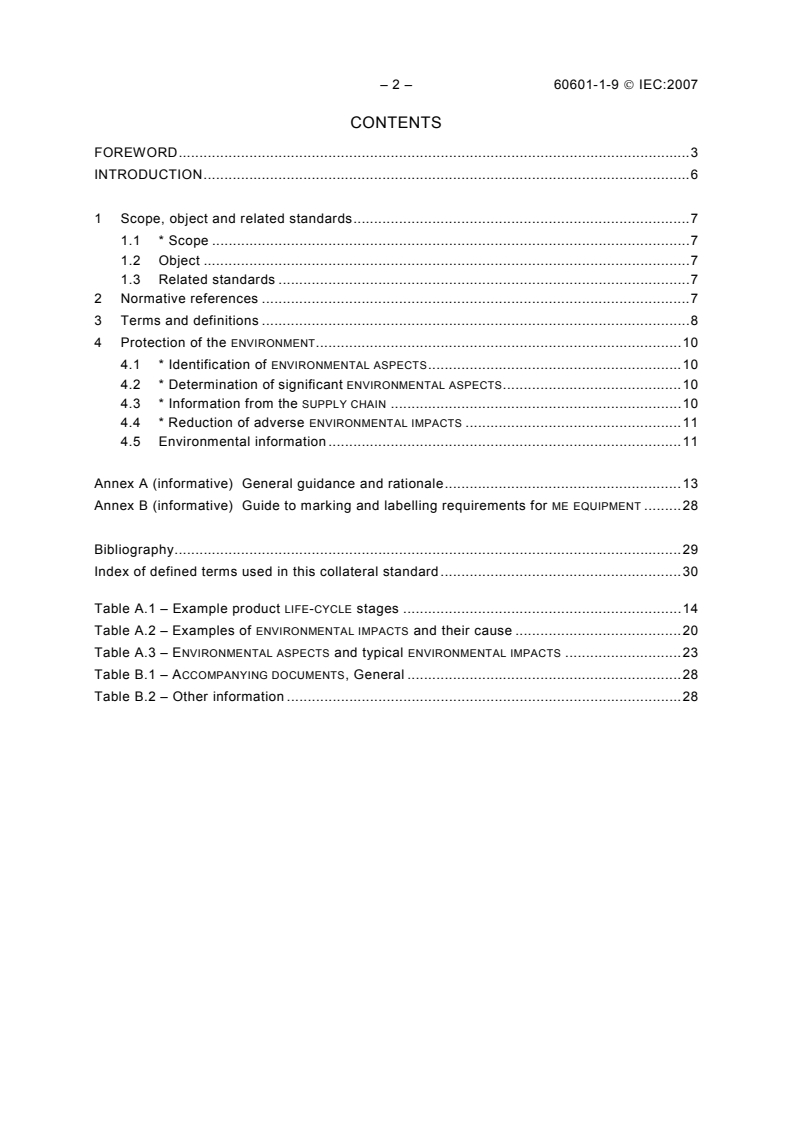
– 2 – 60601-1-9 © IEC:2007
CONTENTS
FOREWORD.3
INTRODUCTION.6
1 Scope, object and related standards.7
1.1 * Scope .7
1.2 Object .7
1.3 Related standards .7
2 Normative references .7
3 Terms and definitions .8
4 Protection of the ENVIRONMENT.10
4.1 * Identification of ENVIRONMENTAL ASPECTS.10
4.2 * Determination of significant ENVIRONMENTAL ASPECTS.10
4.3 * Information from the SUPPLY CHAIN .10
4.4 * Reduction of adverse ENVIRONMENTAL IMPACTS .11
4.5 Environmental information.11
Annex A (informative) General guidance and rationale.13
Annex B (informative) Guide to marking and labelling requirements for ME EQUIPMENT .28
Bibliography.29
Index of defined terms used in this collateral standard.30
Table A.1 – Example product LIFE-CYCLE stages .14
Table A.2 – Examples of ENVIRONMENTAL IMPACTS and their cause .20
Table A.3 – ENVIRONMENTAL ASPECTS and typical ENVIRONMENTAL IMPACTS .23
Table B.1 – ACCOMPANYING DOCUMENTS, General .28
Table B.2 – Other information .28
60601-1-9 © IEC:2007 – 3 –
INTERNATIONAL ELECTROTECHNICAL COMMISSION
____________
MEDICAL ELECTRICAL EQUIPMENT –
Part 1-9: General requirements for basic safety
and essential performance –
Collateral Standard:
Requirements for environmentally conscious design
FOREWORD
1) The International Electrotechnical Commission (IEC) is a worldwide organization for standardization comprising
all national electrotechnical committees (IEC National Committees). The object of IEC is to promote
international co-operation on all questions concerning standardization in the electrical and electronic fields. To
this end and in addition to other activities, IEC publishes International Standards, Technical Specifications,
Technical Reports, Publicly Available Specifications (PAS) and Guides (hereafter referred to as “IEC
Publication(s)”). Their preparation is entrusted to technical committees; any IEC National Committee interested
in the subject dealt with may participate in this preparatory work. International, governmental and non-
governmental organizations liaising with the IEC also participate in this preparation. IEC collaborates closely
with the International Organization for Standardization (ISO) in accordance with conditions determined by
agreement between the two organizations.
2) The formal decisions or agreements of IEC on technical matters express, as nearly as possible, an international
consensus of opinion on the relevant subjects since each technical committee has representation from all
interested IEC National Committees.
3) IEC Publications have the form of recommendations for international use and are accepted by IEC National
Committees in that sense. While all reasonable efforts are made to ensure that the technical content of IEC
Publications is accurate, IEC cannot be held responsible for the way in which they are used or for any
misinterpretation by any end user.
4) In order to promote international uniformity, IEC National Committees undertake to apply IEC Publications
transparently to the maximum extent possible in their national and regional publications. Any divergence
between any IEC Publication and the corresponding national or regional publication shall be clearly indicated in
the latter.
5) IEC provides no marking procedure to indicate its approval and cannot be rendered responsible for any
equipment declared to be in conformity with an IEC Publication.
6) All users should ensure that they have the latest edition of this publication.
7) No liability shall attach to IEC or its directors, employees, servants or agents including individual experts and
members of its technical committees and IEC National Committees for any personal injury, property damage or
other damage of any nature whatsoever, whether direct or indirect, or for costs (including legal fees) and
expenses arising out of the publication, use of, or reliance upon, this IEC Publication or any other IEC
Publications.
8) Attention is drawn to the Normative references cited in this publication. Use of the referenced publications is
indispensable for the correct application of this publication.
9) Attention is drawn to the possibility that some of the elements of this IEC Publication may be the subject of
patent rights. IEC shall not be held responsible for identifying any or all such patent rights.
International standard IEC 60601-1-9 has been prepared by IEC subcommittee 62A: Common
aspects of electrical equipment used in medical practice, of IEC technical committee 62:
Electrical equipment in medical practice.
This first edition constitutes a collateral standard to IEC 60601-1: Medical electrical
equipment – Part 1: General requirements for safety and essential performance hereafter
referred to as the general standard.
– 4 – 60601-1-9 © IEC:2007
The text of this standard is based on the following documents:
FDIS Report on voting
62A/571/FDIS 62A/575/RVD
Full information on the voting for the approval of this standard can be found in the report on
voting indicated in the above table.
This publication has been drafted in accordance with the ISO/IEC Directives, Part 2.
In the 60601 series of publications, collateral standards specify general requirements for
safety applicable to:
– a subgroup of MEDICAL ELECTRICAL EQUIPMENT (e.g. radiological equipment); or
– a specific characteristic of all MEDICAL ELECTRICAL EQUIPMENT, not fully addressed in the
general standard (e.g. alarm systems).
In this collateral standard, the following print types are used:
– Requirements and definitions: roman type.
– Test specifications: italic type.
– Informative material appearing outside of tables, such as notes, examples and references: in smaller type.
Normative text of tables is also in a smaller type.
– TERMS DEFINED IN CLAUSE 3 OF THE GENERAL STANDARD, IN THIS COLLATERAL STANDARD OR AS
NOTED: SMALL CAPITALS.
In referring to the structure of this standard, the term
– “clause” means one of the four numbered divisions within the table of contents, inclusive
of all subdivisions (e.g. Clause 4 includes subclauses 4.1, 4.2, etc.);
– “subclause” means a numbered subdivision of a clause (e.g. 4.1, 4.5 and 4.5.1 are all
subclauses of Clause 4).
References to clauses within this standard are preceded by the term “Clause” followed by the
clause number. References to subclauses within this standard are by number only.
In this standard, the conjunctive “or” is used as an “inclusive or” so a statement is true if any
combination of the conditions is true.
The verbal forms used in this standard conform to usage described in Annex H of the ISO/IEC
Directives, Part 2. For the purposes of this standard, the auxiliary verb:
– “shall” means that compliance with a requirement or a test is mandatory for compliance
with this standard;
– “should” means that compliance with a requirement or a test is recommended but is not
mandatory for compliance with this standard;
– “may” is used to describe a permissible way to achieve compliance with a requirement or
test.
Clauses, subclauses and definitions for which a rationale is provided in informative Annex A
are marked with an asterisk (*).
A list of all parts of the IEC 60601 series, published under the general title Medical electrical
equipment, can be found on the IEC website.
60601-1-9 © IEC:2007 – 5 –
The committee has decided that the contents of this publication will remain unchanged until
the maintenance result date indicated on the IEC web site under "http://webstore.iec.ch" in
the data related to the specific publication. At this date, the publication will be
• reconfirmed;
• withdrawn;
• replaced by a revised edition, or
• amended.
– 6 – 60601-1-9 © IEC:2007
INTRODUCTION
The objective of this collateral standard is to improve the ENVIRONMENTAL IMPACT for the entire
range of MEDICAL ELECTRICAL EQUIPMENT, taking into account all stages of the product LIFE
CYCLE:
– product specification;
– design;
– manufacturing;
– sales, logistics, installation;
– use;
– END OF LIFE management.
This means protecting the ENVIRONMENT and human health from HAZARDOUS SUBSTANCES,
conserving raw materials and energy, minimizing the generation of WASTE, as well as
minimizing the adverse ENVIRONMENTAL IMPACTS associated with WASTE. The criteria needed to
reach this goal must be integrated into all stages of the MEDICAL ELECTRICAL EQUIPMENT LIFE
CYCLE from the specification stage to END OF LIFE management.
The ENVIRONMENTAL IMPACTS of ME EQUIPMENT through all LIFE-CYCLE stages are determined
from the MEDICAL ELECTRICAL EQUIPMENT’S ENVIRONMENTAL ASPECTS defined during the
identification of need, product planning, and design stages (see Table A.1). Consideration of
ENVIRONMENTAL ASPECTS as early as possible in these stages can produce numerous benefits
that might include lower costs, stimulation of innovation and creativity, and increased
knowledge about the product. It can also provide new business opportunities, and improved
product quality as well as reduction of adverse ENVIRONMENTAL IMPACTS. The assessment of
the ENVIRONMENTAL ASPECTS and IMPACTS of MEDICAL ELECTRICAL EQUIPMENT is a developing
science and it is anticipated that this collateral standard will require periodic updating as the
science develops.
The requirements given in this collateral standard do not replace national or international laws
and regulations.
Environmental protection is one element of the overall RISK MANAGEMENT PROCESS as required
by the general standard.
The acceptability of MEDICAL ELECTRICAL EQUIPMENT'S ENVIRONMENTAL IMPACTS are balanced
against other factors, such as the product’s intended function, performance, safety, cost,
marketability, quality, legal and regulatory requirements. This balance can differ depending on
the intended function of the MEDICAL ELECTRICAL EQUIPMENT. For example, a solution
appropriate for life-saving or life-supporting MEDICAL ELECTRICAL EQUIPMENT might not be
appropriate for a device intended to correct a minor ailment. A MANUFACTURER of MEDICAL
ELECTRICAL EQUIPMENT might have to justify, as a result of RISK MANAGEMENT, that a medical
benefit outweighs the associated adverse ENVIRONMENTAL IMPACTS.
60601-1-9 © IEC:2007 – 7 –
MEDICAL ELECTRICAL EQUIPMENT –
Part 1-9: General requirements for basic safety
and essential performance –
Collateral Standard:
Requirements for environmentally conscious design
1 Scope, object and related standards
1.1 * Scope
This International Standard applies to the reduction of adverse ENVIRONMENTAL IMPACTS of
MEDICAL ELECTRICAL EQUIPMENT, hereafter referred to as ME EQUIPMENT.
MEDICAL ELECTRICAL SYSTEMS are excluded from the scope of this collateral standard.
1.2 Object
The object of this collateral standard is to specify general requirements, in addition to those of
the general standard, for the reduction of the adverse ENVIRONMENTAL IMPACT of
ME EQUIPMENT, and to serve as the basis for particular standards.
1.3 Related standards
1.3.1 IEC 60601-1
For ME EQUIPMENT, this collateral standard complements IEC 60601-1.
When referring to IEC 60601-1 or to this collateral standard, either individually or in
combination, the following conventions are used:
– "the general standard" designates IEC 60601-1 alone;
– "this collateral standard" designates IEC 60601-1-9 alone;
– "this standard" designates the combination of the general standard and this collateral
standard.
1.3.2 Particular standards
A requirement in a particular standard takes priority over the corresponding requirement in
this collateral standard.
1.3.3 Environmental standards
This standard takes into account the ISO 14000 series of environmental standards with
1)
particular emphasis on ISO 14062 [8] .
2 Normative references
The following referenced documents are indispensable for the application of this document.
For dated references, only the edition cited applies. For undated references, the latest edition
of the referenced document (including any amendments) applies.
—————————
1)
Figures in square brackets refer to the Bibliography.
– 8 – 60601-1-9 © IEC:2007
IEC 60601-1:2005, Medical electrical equipment – Part 1: General requirements for basic
safety and essential performance
3 Terms and definitions
For the purposes of this document, the terms and definitions given in IEC 60601-1:2005 and
the following definitions apply.
NOTE An index of defined terms is found beginning on page 30.
3.1
DESIGN AND DEVELOPMENT
set of PROCESSES that transforms requirements into specified characteristics or into the
specification of a product, PROCESS or system
NOTE 1 The terms “design” and “development” are sometimes used synonymously and sometimes used to define
different stages of the overall PROCESS of turning an idea into a product.
NOTE 2 Product development is the PROCESS of taking a product idea from planning to market launch and post-
market review of the product, in which business strategies, marketing considerations, research methods and design
aspects are used to take a product to a point of practical use. It includes improvements or modifications to existing
products or PROCESSES
NOTE 3 The integration of ENVIRONMENTAL ASPECTS into product DESIGN AND DEVELOPMENT can also be termed
design for the ENVIRONMENT (DFE), eco-design, the environmental part of product stewardship, etc.
[ISO/TR 14062:2002, definition 3.3]
3.2
END OF LIFE
EOL
state of a ME EQUIPMENT when it is finally removed from its INTENDED USE
NOTE Adapted from IEC Guide 109:2003, Definition 3.1.
3.3
ENVIRONMENT
surroundings in which an ORGANIZATION operates, including air, water, land, natural resources,
flora, fauna, humans and their interrelation
NOTE Surroundings in this context extend from within an ORGANIZATION to the global system.
[ISO 14001:2004, definition 3.5]
3.4
* ENVIRONMENTAL ASPECT
element of an ORGANIZATION’S activities, products or services that can interact with the
ENVIRONMENT
NOTE A significant ENVIRONMENTAL ASPECT has or can have a significant ENVIRONMENTAL IMPACT.
[ISO 14001:2004, definition 3.6]
3.5
* ENVIRONMENTAL IMPACT
any change to the ENVIRONMENT, whether adverse or beneficial, wholly or partially resulting
from an ORGANIZATION'S ENVIRONMENTAL ASPECTS
[ISO 14001:2004, definition 3.7]
60601-1-9 © IEC:2007 – 9 –
3.6
HAZARDOUS SUBSTANCE
substance which can affect human health or the ENVIRONMENT with an immediate or retarded
effect
[IEC Guide 109: 2003, definition 3.6, modified]
3.7
LIFE CYCLE
consecutive and interlinked stages of a product system, from raw material acquisition or
generation from natural resources to final disposal
[ISO 14040:2006, definition 3.1]
3.8
LIFE-CYCLE ASSESSMENT
LCA
compilation and evaluation of the inputs, outputs and the potential ENVIRONMENTAL IMPACTS of
a product system throughout its LIFE CYCLE
[ISO 14040:2006, definition 3.2]
3.9
ORGANIZATION
company, corporation, firm, enterprise, authority or institution, or part or combination thereof,
whether incorporated or not, public or private, that has its own functions and administration
NOTE For ORGANIZATIONS with more than one operating unit, a single operating unit may be defined as an
ORGANIZATION.
[ISO 14001:2004, definition 3.16]
3.10
PACKAGING
material that is used to protect or contain a product during transportation, storage and
marketing
NOTE 1 For the purposes of this standard, the term PACKAGING also includes any item that is physically attached
to, or included with, a product or its container for the purpose of marketing the product.
NOTE 2 Adapted from ISO 14021:1999, definition 3.1.10.
3.11
RECYCLING
reprocessing in a production PROCESS of the WASTE materials for the original purpose or for
other purposes but excluding energy recovery
[IEC Guide 109:2003, definition 3.16]
3.12
REUSE
utilization of ME EQUIPMENT or a part of ME EQUIPMENT, after it has been disposed of by the
RESPONSIBLE ORGANIZATION as WASTE, for a similar purpose to that for which it was originally
intended by the MANUFACTURER
3.13
SUPPLY CHAIN
those involved, through upstream and downstream linkages, in PROCESSES and activities
delivering value in the form of products to the MANUFACTURER
NOTE 1 In practice, the expression “interlinked chain” applies from suppliers to those involved in END OF LIFE
processing.
NOTE 2 In practice, the expressions “product chain”, “value chain” are often used.
NOTE 3 Adapted from ISO/TR 14062:2002, definition 3.9.
– 10 – 60601-1-9 © IEC:2007
3.14
WASTE
substance or object which the holder disposes of, or is required to dispose of, pursuant to the
provisions of national law in force
[IEC Guide 109:2003, definition 3.18]
4 Protection of the ENVIRONMENT
4.1 * Identification of ENVIRONMENTAL ASPECTS
HE MANUFACTURER shall establish, implement and maintain a PROCESS to identify and
T
document the relevant ENVIRONMENTAL ASPECTS of ME EQUIPMENT across all LIFE-CYCLE stages.
Examples of ENVIRONMENTAL ASPECTS are:
– use of HAZARDOUS SUBSTANCES;
– emissions to air;
– releases to surface water and ground water;
– WASTE, especially HAZARDOUS SUBSTANCES;
– use of natural resources, energy and raw materials;
– noise, vibration, odour, dust, electromagnetic fields etc.;
– transport (both for goods and services and employees);
– RISKS from environmental accidents and ENVIRONMENTAL IMPACTS arising, or likely to arise,
as consequences of incidents, accidents and potential emergency situations; and
– use and contamination of the biosphere.
Compliance is checked by inspection of the relevant design documents and PROCESS
description.
4.2 * Determination of significant ENVIRONMENTAL ASPECTS
MANUFACTURER shall establish, implement and maintain a PROCESS to qualitatively or
The
quantitatively determine and document the ENVIRONMENTAL ASPECTS that can have significant
ENVIRONMENTAL IMPACTS (i.e. significant ENVIRONMENTAL ASPECTS) during all LIFE-CYCLE stages
of the ME EQUIPMENT.
Compliance is checked by inspection of the relevant design documents and PROCESS
description.
4.3 * Information from the SUPPLY CHAIN
The MANUFACTURER shall establish, implement and maintain PROCESSES to:
– identify those suppliers (including services) that are likely to contribute significant
ENVIRONMENTAL ASPECTS to the ME EQUIPMENT; and
– obtain from those SUPPLIERS the information necessary to assist the MANUFACTURER in
identifying and assessing the ENVIRONMENTAL ASPECTS of the ME EQUIPMENT as required in
4.1 and 4.2.
If, despite the MANUFACTURER’S efforts, ORGANIZATIONS within the SUPPLY CHAIN fail to provide
the information requested by the MANUFACTURER, the MANUFACTURER shall provide an
estimation of the missing information and document the rationale.
NOTE To fully assess the ENVIRONMENTAL ASPECTS across the entire life of the ME EQUIPMENT it is necessary for
the MANUFACTURER to gather information and involve the environmentally significant SUPPLIERS during the concept
and design stage.
60601-1-9 © IEC:2007 – 11 –
Compliance is checked by inspection of the relevant design documents and PROCESS
description.
4.4 * Reduction of adverse ENVIRONMENTAL IMPACTS
The MANUFACTURER shall establish and document targets for the significant ENVIRONMENTAL
ASPECTS of the ME EQUIPMENT to minimize as far as reasonable the adverse ENVIRONMENTAL
IMPACTS across all LIFE-CYCLE stages. The documented targets shall be based on functional as
well as environmental requirements, and, when available, previous product designs.
During the ME EQUIPMENT concept and specification setting stage, the MANUFACTURER shall
consider, as far as reasonable, novel emerging or alternative technologies and/or solutions for
the ME EQUIPMENT that reduce significant adverse ENVIRONMENTAL IMPACTS.
The MANUFACTURER shall assess and document the actual significant ENVIRONMENTAL ASPECTS
across all LIFE-CYCLE stages of a representative prototype of the final design of the ME
EQUIPMENT. Any deviations from the targets shall be assessed and documented for
consideration in future designs.
Compliance is checked by inspection of the relevant design documents.
4.5 Environmental information
4.5.1 * PACKAGING of ME EQUIPMENT
The MANUFACTURER shall make available information on the type and mass of PACKAGING
material(s).
NOTE ‘Type’ of PACKAGING refers, as a minimum, to the generic description (e.g. cardboard, plastic, wood, glass
etc).
Compliance is checked by verifying the availability of the information.
4.5.2 * Instructions for minimizing ENVIRONMENTAL IMPACT during NORMAL USE
The MANUFACTURER shall provide instructions for minimizing the ENVIRONMENTAL IMPACT of the
ME EQUIPMENT during NORMAL USE in the ACCOMPANYING DOCUMENTS.
The instructions shall cover the following items where applicable:
– instructions on how to install the ME EQUIPMENT in order to minimize the ENVIRONMENTAL
IMPACT during its EXPECTED SERVICE LIFE;
– instructions on how to use and maintain the ME EQUIPMENT in order to minimize the
ENVIRONMENTAL IMPACT during its EXPECTED SERVICE LIFE;
– consumption during NORMAL USE (e.g. energy, consumable materials/parts, disposables,
water, gasses, chemicals/reagents etc.);
– emissions during NORMAL USE (e.g. WASTE water, WASTE consumable materials, acoustic
energy, heat, gasses, vapours, particulates, HAZARDOUS SUBSTANCES and other WASTE);
and
– information on the location within the ME EQUIPMENT of HAZARDOUS SUBSTANCES,
radioactive sources and induced radioactive materials.
Compliance is checked by inspection of the ACCOMPANYING DOCUMENTS.
– 12 – 60601-1-9 © IEC:2007
4.5.3 * Information for END OF LIFE management
The MANUFACTURER shall provide the RESPONSIBLE ORGANIZATION with information for the
proper disposal of the ME EQUIPMENT at END OF LIFE.
The MANUFACTURER shall make available information to WASTE treatment facilities necessary
for the environmentally responsible management of END OF LIFE ME EQUIPMENT. The
information shall contain:
– the location of components and parts within the ME EQUIPMENT that contain stored energy
or pose other HAZARDS that can result in an unacceptable RISK to disassemblers or others
and methods for controlling such RISKS;
– the identity and location of HAZARDOUS SUBSTANCES requiring special handling and
treatment; and
– disassembly instructions sufficient for the safe removal of these HAZARDOUS SUBSTANCES
including radioactive sources and induced radioactive materials within the ME EQUIPMENT.
Compliance is checked by verifying the availability of the information.
60601-1-9 © IEC:2007 – 13 –
Annex A
(informative)
General guidance and rationale
A.1 General guidance
In the future, MANUFACTURERS and RESPONSIBLE ORGANIZATIONS will be required to holistically
meet enhanced environmental criteria and to further improve product quality and safety.
ME EQUIPMENT is intended to have beneficial effects on humans. However if the damage to the
ENVIRONMENT caused by the ME EQUIPMENT outweighs the medical benefits, this is counter-
productive to the intended function of the ME EQUIPMENT. ME EQUIPMENT should be designed,
manufactured, used and discarded in a manner that is environmentally responsible.
The objective of this collateral standard is to reduce the ENVIRONMENTAL IMPACTS of the
ME EQUIPMENT taking into account all the ME EQUIPMENT LIFE-CYCLE stages. Benefits of
implementing this collateral standard include, for example, the reduction of potential sources
of HARM, HAZARDOUS SUBSTANCES and WASTE, and savings of natural resources, raw materials
and energy. Benefits can be grouped into transportation reduction, cost reduction and a
positive public perception of the MANUFACTURER as a good corporate citizen.
LIFE-CYCLE ASSESSMENT is a tool that can be used to reduce the ENVIRONMENTAL IMPACT of ME
EQUIPMENT. The principle and framework for LIFE-CYCLE ASSESSMENT is described in
ISO 14040 [7]. MANUFACTURERS undertaking LIFE-CYCLE ASSESSMENT will have to select or
develop their own PROCESSES and assessment tools to achieve product-related environmental
improvements.
The ENVIRONMENTAL IMPACTS of ME EQUIPMENT are largely determined during the DESIGN AND
DEVELOPMENT stage. Therefore, in order to reduce the adverse ENVIRONMENTAL IMPACTS of the
new ME EQUIPMENT:
– adverse ENVIRONMENTAL IMPACT reduction should be seen as starting at the identification of
need and flowing throughout DESIGN AND DEVELOPMENT;
– it is highly desirable to start the ENVIRONMENTAL ASPECT/IMPACT assessment as early as
possible in product planning.
Typically the ME EQUIPMENT LIFE CYCLE includes the stages in Table A.1. Table A.1 contains
both environmental considerations and, where applicable, examples of ENVIRONMENTAL
ASPECTS for each LIFE-CYCLE stage.
Environmental protection is not a subject that is covered in all engineering training.
Consequently this rationale is more detailed than normal for a standard of this type.
The following is one of many examples of the LIFE-CYCLE stages of ME EQUIPMENT.
– 14 – 60601-1-9 © IEC:2007
Table A.1 – Example product LIFE-CYCLE stages
Stage Activity Characteristics Environmental considerations
Identification of a market need (including It might be possible to meet the identified need
environmental expectations). For example, by solutions not requiring the production of a
Exploration,
market needs can be defined from direct new product. The ENVIRONMENTAL ASPECTS of
identification of
customer demand or market feedback. adapting existing products or non-physical
opportunities and
product solutions (e.g. a time counter can be
management
replaced by a software module or hardware
decision
can be replaced by a service solution) should
be explored.
A solution requiring a product has been Define and assess ENVIRONMENT-related
identified. Comparison of the expected targets. Identify requirements that result from
ENVIRONMENTAL IMPACTS of the proposed these targets. Establish these requirements in
product against previous or competitive the requirement specification (e.g. reduce
products is appropriate. Legal and other energy consumption over the product LIFE
normative information needs to be CYCLE by 20%).
considered.
Requirement
specification
The Requirement specification is created.
The requirement specification should detail
required performance and not propose
specific solutions, so as to allow innovative
and novel approaches.
The project is formalized.
The point at which preliminary solutions to The optimal stage at which to consider creative
the need are explored. Ideas will be solutions to reduce adverse ENVIRONMENTAL
documented informally; the design will be IMPACTS. e.g. consideration can be given to:
very fluid. Up to this point, there has been
– modifying, upgrading, refurbishing
little commitment of time or materials.
existing products
Communications with suppliers are informal
– novel technologies
and exploratory.
– creative design solutions
– alternative material choice (Including
reduction/removal of HAZARDOUS
SUBSTANCES)
– use of recycled materials
– use of recovered components/assemblies
– new production PROCESSES
– alternative energy sources
– PACKAGING
– Reduction/elimination of consumables
Product concept
– Service and maintenance
– Extended durability
– Marketing and promotional materials
– END OF LIFE REUSE/RECYCLING and
material recovery
There might be experimentation with different
configurations so that the design solution with
the optimum balance between product benefit,
performance and ENVIRONMENTAL IMPACT can
be easily and cost-effectively established.
Most appropriate point at which the
assessment of product ENVIRONMENTAL
ASPECTS and ENVIRONMENTAL IMPACTS can be
determined. Strategic suppliers become
involved in the design solutions and start to
become important to the environmental profile
of the ME EQUIPMENT.
Identification of
Planning
need
60601-1-9 © IEC:2007 – 15 –
Table A.1 – Example product LIFE-CYCLE stages (continued)
Stage Activity Characteristics Environmental considerations
Design solution now becoming Establish environmental targets and
established. Information necessary requirements for the design, considering all
to turn the concept into a formal LIFE-CYCLE stages, in the design specification.
product is gathered. Components
The design is refined and incremental
and assemblies are developed or
environmentally beneficial changes can
sourced. Although changes to the
usually be made, especially in the areas of
specification can be made, this now
material reduction and component selection.
starts to incur costs.
Appropriate production PROCESSES should be
considered as these can be a significant
source of adverse ENVIRONMENTAL IMPACTS. All
suppliers start to become integrated into the
development PROCESS and their environmental
performance will have effects on the overall
DESIGN AND
ENVIRONMENTAL IMPACT of the ME EQUIPMENT.
DEVELOPMENT
Consideration must be given to limiting the
amount and number of materials used in the
ME EQUIPMENT. (As a general rule the smaller
and lighter the better, as this has a
subsequent benefit on PACKAGING,
transportation and END OF LIFE as well.)
Efforts should be made to eliminate
HAZARDOUS SUBSTANCES both in the product
and during the production PROCESS.
Where the use of HAZARDOUS SUBSTANCES is
unavoidable ME EQUIPMENT construction and
operation should consider RISKS.
Design now established and major The ENVIRONMENTAL IMPACT of the ME
changes now only possible at great EQUIPMENT design should be confirmed against
Prototype expense. A physical model exists. the assessment documented at the product
testing Testing against the specification will concept stage.
including TYPE have commenced and design will be
Significant deviations from expected results
TESTING validated against original need.
should be investigated.
Representative sample(s) can be
submitted for TYPE TESTING.
Manufactured ME EQUIPMENT Consideration should be given to
subjected to final testing to ensure ENVIRONMENTAL ASPECTS resulting from
Product testing
quality and confirm conformance extreme operating conditions (e.g. as a result
with standards. of safety factor / margin).
The design of the ME EQUIPMENT is Production PROCESS ENVIRONMENTAL ASPECTS
now fixed and is being manufactured (e.g. production WASTE, water usage, energy
to revision controlled drawings and consumption, component logistics, HAZARDOUS
Product
assembly method sheets. SUBSTANCES) should be considered.
manufacturing
SUPPLY CHAIN PROCESSES and work sub-
contracted out should also be considered.
Production Testing Design
– 16 – 60601-1-9 © IEC:2007
Table A.1 – Example product LIFE-CYCLE stages (continued)
Stage Activity Characteristics Environmental considerations
ME EQUIPMENT can be in final Consideration needs to be given to adverse
PACKAGING and is stored pending ENVIRONMENTAL IMPACTS caused by failure of
Storage shipment to RESPONSIBLE the ME EQUIPMENT when stored outside the
ORGANIZATIONS. specified storage conditions, e.g. by bursting a
container that leaks corrosive materials.
ME EQUIPMENT being shipped to Consideration needs to be given to type and
designated sites. reusability of PACKAGING, transportation
method, weight of ME EQUIPMENT and whether
the ME EQUIPMENT can be assembled on site or
shipped assembled. Logistical efficiency can
be enhanced by:
– contracting suppliers / subcontractors to
Product
deliver directly to the RESPONSIBLE
transport
ORGANIZATION / distributor if possible
– by ensuring that packaged ME EQUIPMENT
can stack efficiently in standard generic
transportation containers.
– collecting old products for REUSE,
recovery or RECYCLING.
New ME EQUIPMENT is installed at Although installation is not normally
site prior to being used. environmentally significant, should the product
require substantial quantities of HAZARDOUS
SUBSTANCES (e.g. transformer oil)
consideration has to be given to ease of
transportation and handling of these
Installation
substances, as well as the disposal of any
excess at the end of the installation PROCESS.
The use of specialized mechanical handling or
assembly tools should be avoided where
possible.
Distribution
60601-1-9 © IEC:2007 – 17 –
Table A.1 – Example product LIFE-CYCLE stages (continued)
Stage Activity Characteristics Environmental considerations
NORMAL USE INTENDED USE of ME EQUIPMENT Examples of ENVIRONMENTAL ASPECTS during
NORMAL USE include:
− energy
− consumables (including batteries)
− chemicals (especially HAZARDOUS
SUBSTANCES)
− natural resources, e.g. water
− smoke or gasses
− WASTE (including contaminated material)
− heat (e.g. ME EQUIPMENT could make
substantial demands on air-conditioning)
The consumption of energy during NORMAL USE
can be a major ENVIRONMENTAL ASPECT of ME
EQUIPMENT and should not be overlooked.
Repair and ME EQUIPMENT is maintained or Examples of ENVIRONMENTAL ASPECTS to be
maintenance repaired to ensure continued considered are:
operation to specification.
– WASTE (service materials, spare parts)
– transportation (technical staff / spare
parts)
– HAZARDOUS SUBSTANCES (used in technical
maintenance)
– PACKAGING WASTE (spare parts)
– energy use (testing and calibration)
– emissions to:
– air
– soil
– ground water/rivers
– sewer
– water usage:
– ground (water extraction)
– purchased / purified
Service and maintenance can be very
important in ensuring that ME EQUIPMENT works
at peak efficiency.
Removal from RESPONSIBLE ORGANIZATION has no RESPONSIBLE ORGANIZATION decides whether
service further use for the ME EQUIPMENT. to:
a
– sell second hand
– transfer to the MANUFACTURER or other
b
authorized ORGANIZATION
– The ME EQUIPMENT is refurbished
and resold
– The ME EQUIPMENT is disassembled
and parts / components are
incorporated into new products or
used as spare parts
– The ME EQUIPMENT is disassembled
and parts/components recycled
(EOL)
– The ME EQUIPMENT is put to landfill /
incineration (EOL)
– disposed of as WASTE. (EOL)
– send to treatment centre for
RECYCLING
– THE ME EQUIPMENT is landfilled
c
/incinerated
END OF LIFE (EOL) Use
– 18 – 60601-1-9 © IEC:2007
Table A.1 – Example product LIFE-CYCLE stages (continued)
Stage Activity Characteristics Environmental considerations
Consideration must be given to the following.
The ME EQUIPMENT is disassembled
and parts / components reused or – MANUFACTURERS can gain new product
recycled. development information from the
examination of EOL components.
– It should generally be easy and safe for
people to remove HAZARDOUS SUBSTANCES
(e.g., consumable parts such as batteries
and oil) from the EOL ME EQUIPMENT. Full
instructions must be available to enable
RESPONSIBLE ORGANIZATIONS or others to
undertake these tasks.
The MANUFACTURER should provide
guidance if trained personnel are required
to remove the HAZARDOUS SUBSTANCES
(e.g. radioactive material)
– HAZARDS that can result in an
unacceptable RISK to disassemblers or
others (e.g. retained energy sources)
should be detailed. This is particularly
important if there is a possibility of those
working on the ME EQUIPMENT being
END OF LIFE
exposed to a biohazard.
(EOL)
management
– All HAZARDOUS SUBSTANCES with the
potential for leaching or which could
continue to present long-term RISK to
health or the ENVIRONMENT should be
removed from ME EQUIPMENT prior to
landfill. All local laws and regulations
controlling landfill disposal and
incineration should be complied with.
– In the case of the REUSE of components of
ME EQUIPMENT, consideration needs to be
made of the ENVIRONMENTAL ASPECTS
associated with the REUSE, in comparison
to the ENVIRONMENTAL ASPECTS of
producing a new (and possibly more
efficient) component with lower
ENVIRONMENTAL IMPACTS.
– Recovered materials must be channelled
into the appropriate recovery stream
– Transportation can have a significant
effect on the viability of any recovery
operation.
The ME EQUIPMENT (or Landfilling or incinerating WASTE
parts / components) are ME EQUIPMENT / components / parts is the least
landfilled/incinerated. environmentally desirable route of disposal.
Landfill or incineration should only be
considered when all other options have been
explored, and found to be unfeasible. Many
countries have very strict laws on what may or
may not be landfilled.
a
Continued use of equipment can have significant environmental advantages, however the continued use of
ME EQUIPMENT in a clinical application can carry higher PATIENT RISK.
b
"Authorized ORGANIZATION" is an ORGANIZATION authorised by the MANUFACTURER and/or national authorities, t
...
IEC 60601-1-9 ®
Edition 1.1 2013-06
INTERNATIONAL
STANDARD
NORME
INTERNATIONALE
colour
inside
Medical electrical equipment –
Part 1-9: General requirements for basic safety and essential performance –
Collateral Standard: Requirements for environmentally conscious design
Appareils électromédicaux –
Partie 1-9: Exigences générales pour la sécurité de base et les performances
essentielles – Norme collatérale: Exigences pour une conception éco-
responsable
All rights reserved. Unless otherwise specified, no part of this publication may be reproduced or utilized in any form
or by any means, electronic or mechanical, including photocopying and microfilm, without permission in writing from
either IEC or IEC's member National Committee in the country of the requester.
If you have any questions about IEC copyright or have an enquiry about obtaining additional rights to this publication,
please contact the address below or your local IEC member National Committee for further information.
Droits de reproduction réservés. Sauf indication contraire, aucune partie de cette publication ne peut être reproduite ni
utilisée sous quelque forme que ce soit et par aucun procédé, électronique ou mécanique, y compris la photocopie et les
microfilms, sans l'accord écrit de la CEI ou du Comité national de la CEI du pays du demandeur.
Si vous avez des questions sur le copyright de la CEI ou si vous désirez obtenir des droits supplémentaires sur cette
publication, utilisez les coordonnées ci-après ou contactez le Comité national de la CEI de votre pays de résidence.
IEC Central Office Tel.: +41 22 919 02 11
3, rue de Varembé Fax: +41 22 919 03 00
CH-1211 Geneva 20 info@iec.ch
Switzerland www.iec.ch
About the IEC
The International Electrotechnical Commission (IEC) is the leading global organization that prepares and publishes
International Standards for all electrical, electronic and related technologies.
About IEC publications
The technical content of IEC publications is kept under constant review by the IEC. Please make sure that you have the
latest edition, a corrigenda or an amendment might have been published.
Useful links:
IEC publications search - www.iec.ch/searchpub Electropedia - www.electropedia.org
The advanced search enables you to find IEC publications The world's leading online dictionary of electronic and
by a variety of criteria (reference number, text, technical electrical terms containing more than 30 000 terms and
committee,…). definitions in English and French, with equivalent terms in
It also gives information on projects, replaced and additional languages. Also known as the International
withdrawn publications. Electrotechnical Vocabulary (IEV) on-line.
IEC Just Published - webstore.iec.ch/justpublished Customer Service Centre - webstore.iec.ch/csc
Stay up to date on all new IEC publications. Just Published If you wish to give us your feedback on this publication
details all new publications released. Available on-line and or need further assistance, please contact the
also once a month by email. Customer Service Centre: csc@iec.ch.
A propos de la CEI
La Commission Electrotechnique Internationale (CEI) est la première organisation mondiale qui élabore et publie des
Normes internationales pour tout ce qui a trait à l'électricité, à l'électronique et aux technologies apparentées.
A propos des publications CEI
Le contenu technique des publications de la CEI est constamment revu. Veuillez vous assurer que vous possédez
l’édition la plus récente, un corrigendum ou amendement peut avoir été publié.
Liens utiles:
Recherche de publications CEI - www.iec.ch/searchpub Electropedia - www.electropedia.org
La recherche avancée vous permet de trouver des Le premier dictionnaire en ligne au monde de termes
publications CEI en utilisant différents critères (numéro de électroniques et électriques. Il contient plus de 30 000
référence, texte, comité d’études,…). termes et définitions en anglais et en français, ainsi que
Elle donne aussi des informations sur les projets et les les termes équivalents dans les langues additionnelles.
publications remplacées ou retirées. Egalement appelé Vocabulaire Electrotechnique
International (VEI) en ligne.
Just Published CEI - webstore.iec.ch/justpublished
Service Clients - webstore.iec.ch/csc
Restez informé sur les nouvelles publications de la CEI.
Just Published détaille les nouvelles publications parues. Si vous désirez nous donner des commentaires sur
Disponible en ligne et aussi une fois par mois par email. cette publication ou si vous avez des questions
contactez-nous: csc@iec.ch.
IEC 60601-1-9 ®
Edition 1.1 2013-06
INTERNATIONAL
STANDARD
NORME
INTERNATIONALE
colour
inside
Medical electrical equipment –
Part 1-9: General requirements for basic safety and essential performance –
Collateral Standard: Requirements for environmentally conscious design
Appareils électromédicaux –
Partie 1-9: Exigences générales pour la sécurité de base et les performances
essentielles – Norme collatérale: Exigences pour une conception éco-
responsable
INTERNATIONAL
ELECTROTECHNICAL
COMMISSION
COMMISSION
ELECTROTECHNIQUE
INTERNATIONALE
ICS 11.040; 13.020 ISBN 978-2-8322-0876-2
– 2 – 60601-1-9 IEC:2007+A1:2013
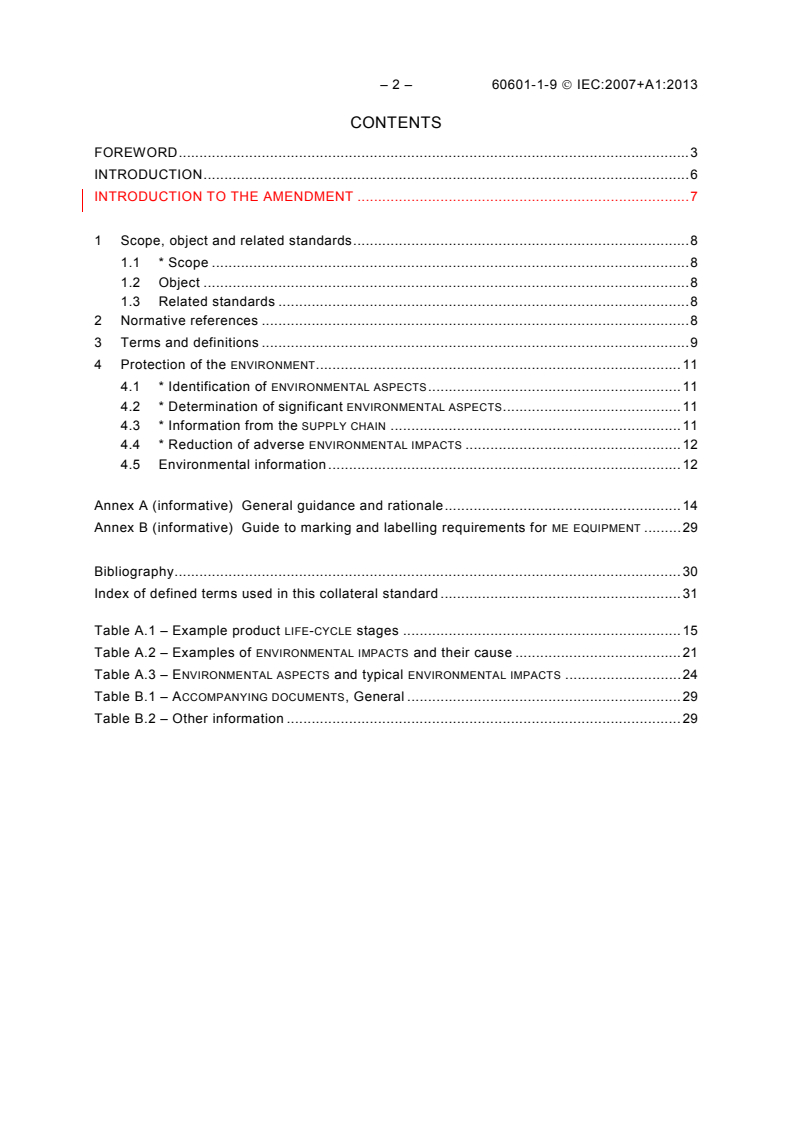
CONTENTS
FOREWORD . 3
INTRODUCTION . 6
INTRODUCTION TO THE AMENDMENT . 7
1 Scope, object and related standards . 8
1.1 * Scope . 8
1.2 Object . 8
1.3 Related standards . 8
2 Normative references . 8
3 Terms and definitions . 9
4 Protection of the ENVIRONMENT . 11
4.1 * Identification of ENVIRONMENTAL ASPECTS . 11
4.2 * Determination of significant ENVIRONMENTAL ASPECTS . 11
4.3 * Information from the SUPPLY CHAIN . 11
4.4 * Reduction of adverse ENVIRONMENTAL IMPACTS . 12
4.5 Environmental information . 12
Annex A (informative) General guidance and rationale . 14
Annex B (informative) Guide to marking and labelling requirements for ME EQUIPMENT . 29
Bibliography . 30
Index of defined terms used in this collateral standard . 31
Table A.1 – Example product LIFE-CYCLE stages . 15
Table A.2 – Examples of ENVIRONMENTAL IMPACTS and their cause . 21
Table A.3 – ENVIRONMENTAL ASPECTS and typical ENVIRONMENTAL IMPACTS . 24
Table B.1 – ACCOMPANYING DOCUMENTS, General . 29
Table B.2 – Other information . 29
60601-1-9 IEC:2007+A1:2013 – 3 –
INTERNATIONAL ELECTROTECHNICAL COMMISSION
____________
MEDICAL ELECTRICAL EQUIPMENT –
Part 1-9: General requirements for basic safety
and essential performance –
Collateral Standard:
Requirements for environmentally conscious design
FOREWORD
1) The International Electrotechnical Commission (IEC) is a worldwide organization for standardization comprising
all national electrotechnical committees (IEC National Committees). The object of IEC is to promote
international co-operation on all questions concerning standardization in the electrical and electronic fields. To
this end and in addition to other activities, IEC publishes International Standards, Technical Specifications,
Technical Reports, Publicly Available Specifications (PAS) and Guides (hereafter referred to as “IEC
Publication(s)”). Their preparation is entrusted to technical committees; any IEC National Committee interested
in the subject dealt with may participate in this preparatory work. International, governmental and non-
governmental organizations liaising with the IEC also participate in this preparation. IEC collaborates closely
with the International Organization for Standardization (ISO) in accordance with conditions determined by
agreement between the two organizations.
2) The formal decisions or agreements of IEC on technical matters express, as nearly as possible, an international
consensus of opinion on the relevant subjects since each technical committee has representation from all
interested IEC National Committees.
3) IEC Publications have the form of recommendations for international use and are accepted by IEC National
Committees in that sense. While all reasonable efforts are made to ensure that the technical content of IEC
Publications is accurate, IEC cannot be held responsible for the way in which they are used or for any
misinterpretation by any end user.
4) In order to promote international uniformity, IEC National Committees undertake to apply IEC Publications
transparently to the maximum extent possible in their national and regional publications. Any divergence
between any IEC Publication and the corresponding national or regional publication shall be clearly indicated in
the latter.
5) IEC provides no marking procedure to indicate its approval and cannot be rendered responsible for any
equipment declared to be in conformity with an IEC Publication.
6) All users should ensure that they have the latest edition of this publication.
7) No liability shall attach to IEC or its directors, employees, servants or agents including individual experts and
members of its technical committees and IEC National Committees for any personal injury, property damage or
other damage of any nature whatsoever, whether direct or indirect, or for costs (including legal fees) and
expenses arising out of the publication, use of, or reliance upon, this IEC Publication or any other IEC
Publications.
8) Attention is drawn to the Normative references cited in this publication. Use of the referenced publications is
indispensable for the correct application of this publication.
9) Attention is drawn to the possibility that some of the elements of this IEC Publication may be the subject of
patent rights. IEC shall not be held responsible for identifying any or all such patent rights.
This consolidated version of IEC 60601-1-9 consists of the first edition (2007)
[documents 62A/571/FDIS and 62A/575/RVD] and its amendment 1 (2013) [documents
62A/874/FDIS and 62A/881/RVD]. It bears the edition number 1.1.
The technical content is therefore identical to the base edition and its amendment and
has been prepared for user convenience. A vertical line in the margin shows where the
base publication has been modified by amendment 1. Additions and deletions are
displayed in red, with deletions being struck through.
– 4 – 60601-1-9 IEC:2007+A1:2013
International standard IEC 60601-1-9 has been prepared by IEC subcommittee 62A: Common
aspects of electrical equipment used in medical practice, of IEC technical committee 62:
Electrical equipment in medical practice.
The first edition of this publication constitutes a collateral standard to IEC 60601-1: Medical
electrical equipment – Part 1: General requirements for safety and essential performance
hereafter referred to as the general standard.
This publication has been drafted in accordance with the ISO/IEC Directives, Part 2.
In the 60601 series of publications, collateral standards specify general requirements for
safety applicable to:
– a subgroup of MEDICAL ELECTRICAL EQUIPMENT (e.g. radiological equipment); or
– a specific characteristic of all MEDICAL ELECTRICAL EQUIPMENT, not fully addressed in the
general standard (e.g. alarm systems).
In this collateral standard, the following print types are used:
– Requirements and definitions: roman type.
– Test specifications: italic type.
– Informative material appearing outside of tables, such as notes, examples and references: in smaller type.
Normative text of tables is also in a smaller type.
– TERMS DEFINED IN CLAUSE 3 OF THE GENERAL STANDARD, IN THIS COLLATERAL STANDARD OR AS
NOTED: SMALL CAPITALS.
In referring to the structure of this standard, the term
– “clause” means one of the four numbered divisions within the table of contents, inclusive
of all subdivisions (e.g. Clause 4 includes subclauses 4.1, 4.2, etc.);
– “subclause” means a numbered subdivision of a clause (e.g. 4.1, 4.5 and 4.5.1 are all
subclauses of Clause 4).
References to clauses within this standard are preceded by the term “Clause” followed by the
clause number. References to subclauses within this standard are by number only.
In this standard, the conjunctive “or” is used as an “inclusive or” so a statement is true if any
combination of the conditions is true.
The verbal forms used in this standard conform to usage described in Annex H of the ISO/IEC
Directives, Part 2. For the purposes of this standard, the auxiliary verb:
– “shall” means that compliance with a requirement or a test is mandatory for compliance
with this standard;
– “should” means that compliance with a requirement or a test is recommended but is not
mandatory for compliance with this standard;
– “may” is used to describe a permissible way to achieve compliance with a requirement or
test.
Clauses, subclauses and definitions for which a rationale is provided in informative Annex A
are marked with an asterisk (*).
A list of all parts of the IEC 60601 series, published under the general title Medical electrical
equipment, can be found on the IEC website.
60601-1-9 IEC:2007+A1:2013 – 5 –
The committee has decided that the contents of the base publication and its amendment will
remain unchanged until the stability date indicated on the IEC web site under
"http://webstore.iec.ch" in the data related to the specific publication. At this date, the
publication will be
• reconfirmed;
• withdrawn;
• replaced by a revised edition, or
• amended.
NOTE The attention of National Committees is drawn to the fact that equipment manufacturers and testing
organizations may need a transitional period following publication of a new, amended or revised IEC or
ISO publication in which to make products in accordance with the new requirements and to equip themselves for
conducting new or revised tests. It is the recommendation of the committee that the content of this publication be
adopted for mandatory implementation nationally not earlier than 3 years from the date of publication.
IMPORTANT – The “colour inside” logo on the cover page of this publication indicates
that it contains colours which are considered to be useful for the correct understanding
of its contents. Users should therefore print this publication using a colour printer.
– 6 – 60601-1-9 IEC:2007+A1:2013
INTRODUCTION
The objective of this collateral standard is to improve the ENVIRONMENTAL IMPACT for the entire
range of MEDICAL ELECTRICAL EQUIPMENT, taking into account all stages of the product LIFE
CYCLE:
– product specification;
– design;
– manufacturing;
– sales, logistics, installation;
– use;
– END OF LIFE management.
This means protecting the ENVIRONMENT and human health from HAZARDOUS SUBSTANCES,
conserving raw materials and energy, minimizing the generation of WASTE, as well as
minimizing the adverse ENVIRONMENTAL IMPACTS associated with WASTE. The criteria needed to
reach this goal must be integrated into all stages of the MEDICAL ELECTRICAL EQUIPMENT LIFE
CYCLE from the specification stage to END OF LIFE management.
The ENVIRONMENTAL IMPACTS of ME EQUIPMENT through all LIFE-CYCLE stages are determined
from the MEDICAL ELECTRICAL EQUIPMENT’S ENVIRONMENTAL ASPECTS defined during the
identification of need, product planning, and design stages (see Table A.1). Consideration of
ENVIRONMENTAL ASPECTS as early as possible in these stages can produce numerous benefits
that might include lower costs, stimulation of innovation and creativity, and increased
knowledge about the product. It can also provide new business opportunities, and improved
product quality as well as reduction of adverse ENVIRONMENTAL IMPACTS. The assessment of
the ENVIRONMENTAL ASPECTS and IMPACTS of MEDICAL ELECTRICAL EQUIPMENT is a developing
science and it is anticipated that this collateral standard will require periodic updating as the
science develops.
The requirements given in this collateral standard do not replace national or international laws
and regulations.
Environmental protection is one element of the overall RISK MANAGEMENT PROCESS as required
by the general standard.
The acceptability of MEDICAL ELECTRICAL EQUIPMENT'S ENVIRONMENTAL IMPACTS are balanced
against other factors, such as the product’s intended function, performance, safety, cost,
marketability, quality, legal and regulatory requirements. This balance can differ depending on
the intended function of the MEDICAL ELECTRICAL EQUIPMENT. For example, a solution
appropriate for life-saving or life-supporting MEDICAL ELECTRICAL EQUIPMENT might not be
appropriate for a device intended to correct a minor ailment. A MANUFACTURER of MEDICAL
ELECTRICAL EQUIPMENT might have to justify, as a result of RISK MANAGEMENT, that a medical
benefit outweighs the associated adverse ENVIRONMENTAL IMPACTS.
60601-1-9 IEC:2007+A1:2013 – 7 –
INTRODUCTION TO THE AMENDMENT
The first edition of IEC 60601-1-9 was published in 2007. This amendment is intended to
update the references to IEC 60601-1:2005 to include Amendment 1:2012 and to make a few
minor editorial updates.
– 8 – 60601-1-9 IEC:2007+A1:2013
MEDICAL ELECTRICAL EQUIPMENT –
Part 1-9: General requirements for basic safety
and essential performance –
Collateral Standard:
Requirements for environmentally conscious design
1 Scope, object and related standards
1.1 * Scope
This International Standard applies to the reduction of adverse ENVIRONMENTAL IMPACTS of
MEDICAL ELECTRICAL EQUIPMENT, hereafter referred to as ME EQUIPMENT.
MEDICAL ELECTRICAL SYSTEMS are excluded from the scope of this collateral standard.
1.2 Object
The object of this collateral standard is to specify general requirements, in addition to those of
the general standard, for the reduction of the adverse ENVIRONMENTAL IMPACT of
ME EQUIPMENT, and to serve as the basis for particular standards.
1.3 Related standards
1.3.1 IEC 60601-1
For ME EQUIPMENT, this collateral standard complements IEC 60601-1.
When referring to IEC 60601-1 or to this collateral standard, either individually or in
combination, the following conventions are used:
– "the general standard" designates IEC 60601-1 alone (IEC 60601-1:2005A1:2012);
– "this collateral standard" designates IEC 60601-1-9 alone (IEC 60601-1-9:2007A1:2013);
– "this standard" designates the combination of the general standard and this collateral
standard.
1.3.2 Particular standards
A requirement in a particular standard takes priority over the corresponding requirement in
this collateral standard.
1.3.3 Environmental standards
This standard takes into account the ISO 14000 series of environmental standards with
1)
particular emphasis on ISO 14062 [8] .
2 Normative references
The following referenced documents, in whole or in part, are normatively referenced in this
document and are indispensable for its application of this document. For dated references,
—————————
1)
Figures in square brackets refer to the Bibliography.
60601-1-9 IEC:2007+A1:2013 – 9 –
only the edition cited applies. For undated references, the latest edition of the referenced
document (including any amendments) applies.
IEC 60601-1:2005, Medical electrical equipment – Part 1: General requirements for basic
safety and essential performance
Amendment 1:2012
3 Terms and definitions
For the purposes of this document, the terms and definitions given in
IEC 60601-1:2005+A1:2012 and the following definitions apply.
NOTE An index of defined terms is found beginning on page 30.
3.1
DESIGN AND DEVELOPMENT
set of PROCESSES that transforms requirements into specified characteristics or into the
specification of a product, PROCESS or system
NOTE 1 The terms “design” and “development” are sometimes used synonymously and sometimes used to define
different stages of the overall PROCESS of turning an idea into a product.
NOTE 2 Product development is the PROCESS of taking a product idea from planning to market launch and post-
market review of the product, in which business strategies, marketing considerations, research methods and design
aspects are used to take a product to a point of practical use. It includes improvements or modifications to existing
products or PROCESSES
NOTE 3 The integration of ENVIRONMENTAL ASPECTS into product DESIGN AND DEVELOPMENT can also be termed
design for the ENVIRONMENT (DFE), eco-design, the environmental part of product stewardship, etc.
[ISO/TR 14062:2002, definition 3.3]
3.2
END OF LIFE
EOL
state of a ME EQUIPMENT when it is finally removed from its INTENDED USE
NOTE Adapted from IEC Guide 109:2003, Definition 3.1.
3.3
ENVIRONMENT
surroundings in which an ORGANIZATION operates, including air, water, land, natural resources,
flora, fauna, humans and their interrelation
NOTE Surroundings in this context extend from within an ORGANIZATION to the global system.
[ISO 14001:2004, definition 3.5]
3.4
* ENVIRONMENTAL ASPECT
element of an ORGANIZATION’S activities, products or services that can interact with the
ENVIRONMENT
NOTE A significant ENVIRONMENTAL ASPECT has or can have a significant ENVIRONMENTAL IMPACT.
[ISO 14001:2004, definition 3.6]
3.5
* ENVIRONMENTAL IMPACT
any change to the ENVIRONMENT, whether adverse or beneficial, wholly or partially resulting
from an ORGANIZATION'S ENVIRONMENTAL ASPECTS
[ISO 14001:2004, definition 3.7]
– 10 – 60601-1-9 IEC:2007+A1:2013
3.6
HAZARDOUS SUBSTANCE
substance which can affect human health or the ENVIRONMENT with an immediate or retarded
effect
[IEC Guide 109: 2003, definition 3.6, modified]
3.7
LIFE CYCLE
consecutive and interlinked stages of a product system, from raw material acquisition or
generation from natural resources to final disposal
[ISO 14040:2006, definition 3.1]
3.8
LIFE-CYCLE ASSESSMENT
LCA
compilation and evaluation of the inputs, outputs and the potential ENVIRONMENTAL IMPACTS of
a product system throughout its LIFE CYCLE
[ISO 14040:2006, definition 3.2]
3.9
ORGANIZATION
company, corporation, firm, enterprise, authority or institution, or part or combination thereof,
whether incorporated or not, public or private, that has its own functions and administration
NOTE For ORGANIZATIONS with more than one operating unit, a single operating unit may be defined as an
ORGANIZATION.
[ISO 14001:2004, definition 3.16]
3.10
PACKAGING
material that is used to protect or contain a product during transportation, storage and
marketing
NOTE 1 For the purposes of this standard, the term PACKAGING also includes any item that is physically attached
to, or included with, a product or its container for the purpose of marketing the product.
NOTE 2 Adapted from ISO 14021:1999, definition 3.1.10.
3.11
RECYCLING
reprocessing in a production PROCESS of the WASTE materials for the original purpose or for
other purposes but excluding energy recovery
[IEC Guide 109:2003, definition 3.16]
3.12
REUSE
ME EQUIPMENT or a part of ME EQUIPMENT, after it has been disposed of by the
utilization of
RESPONSIBLE ORGANIZATION as WASTE, for a similar purpose to that for which it was originally
intended by the MANUFACTURER
3.13
SUPPLY CHAIN
those involved, through upstream and downstream linkages, in PROCESSES and activities
delivering value in the form of products to the MANUFACTURER
NOTE 1 In practice, the expression “interlinked chain” applies from suppliers to those involved in END OF LIFE
processing.
NOTE 2 In practice, the expressions “product chain”, “value chain” are often used.
NOTE 3 Adapted from ISO/TR 14062:2002, definition 3.9.
60601-1-9 IEC:2007+A1:2013 – 11 –
3.14
WASTE
substance or object which the holder disposes of, or is required to dispose of, pursuant to the
provisions of national law in force
[IEC Guide 109:2003, definition 3.18]
4 Protection of the ENVIRONMENT
4.1 * Identification of ENVIRONMENTAL ASPECTS
THE MANUFACTURER shall establish, implement and maintain a PROCESS to identify and
document the relevant ENVIRONMENTAL ASPECTS of ME EQUIPMENT across all LIFE-CYCLE stages.
ENVIRONMENTAL ASPECTS are:
Examples of
– use of HAZARDOUS SUBSTANCES;
– emissions to air;
– releases to surface water and ground water;
WASTE, especially HAZARDOUS SUBSTANCES;
–
– use of natural resources, energy and raw materials;
– noise, vibration, odour, dust, electromagnetic fields etc.;
– transport (both for goods and services and employees);
RISKS from environmental accidents and ENVIRONMENTAL IMPACTS arising, or likely to arise,
–
as consequences of incidents, accidents and potential emergency situations; and
– use and contamination of the biosphere.
Compliance is checked by inspection of the relevant design documents and PROCESS
description.
4.2 * Determination of significant ENVIRONMENTAL ASPECTS
The MANUFACTURER shall establish, implement and maintain a PROCESS to qualitatively or
quantitatively determine and document the ENVIRONMENTAL ASPECTS that can have significant
ENVIRONMENTAL IMPACTS (i.e. significant ENVIRONMENTAL ASPECTS) during all LIFE-CYCLE stages
of the ME EQUIPMENT.
Compliance is checked by inspection of the relevant design documents and PROCESS
description.
4.3 * Information from the SUPPLY CHAIN
The MANUFACTURER shall establish, implement and maintain PROCESSES to:
– identify those suppliers (including services) that are likely to contribute significant
ENVIRONMENTAL ASPECTS to the ME EQUIPMENT; and
SUPPLIERS the information necessary to assist the MANUFACTURER in
– obtain from those
identifying and assessing the ENVIRONMENTAL ASPECTS of the ME EQUIPMENT as required in
4.1 and 4.2.
If, despite the MANUFACTURER’S efforts, ORGANIZATIONS within the SUPPLY CHAIN fail to provide
the information requested by the MANUFACTURER, the MANUFACTURER shall provide an
estimation of the missing information and document the rationale.
NOTE To fully assess the ENVIRONMENTAL ASPECTS across the entire life of the ME EQUIPMENT it is necessary for
the MANUFACTURER to gather information and involve the environmentally significant SUPPLIERS during the concept
and design stage.
– 12 – 60601-1-9 IEC:2007+A1:2013
Compliance is checked by inspection of the relevant design documents and PROCESS
description.
4.4 * Reduction of adverse ENVIRONMENTAL IMPACTS
The MANUFACTURER shall establish and document targets for the significant ENVIRONMENTAL
ASPECTS of the ME EQUIPMENT to minimize as far as reasonable the adverse ENVIRONMENTAL
IMPACTS across all LIFE-CYCLE stages. The documented targets shall be based on functional as
well as environmental requirements, and, when available, previous product designs.
During the ME EQUIPMENT concept and specification setting stage, the MANUFACTURER shall
consider, as far as reasonable, novel emerging or alternative technologies and/or solutions for
the ME EQUIPMENT that reduce significant adverse ENVIRONMENTAL IMPACTS.
The MANUFACTURER shall assess and document the actual significant ENVIRONMENTAL ASPECTS
across all LIFE-CYCLE stages of a representative prototype of the final design of the ME
EQUIPMENT. Any deviations from the targets shall be assessed and documented for
consideration in future designs.
Compliance is checked by inspection of the relevant design documents.
4.5 Environmental information
4.5.1 * PACKAGING of ME EQUIPMENT
The MANUFACTURER shall make available information on the type and mass of PACKAGING
material(s).
NOTE ‘Type’ of PACKAGING refers, as a minimum, to the generic description (e.g. cardboard, plastic, wood, glass
etc).
Compliance is checked by verifying the availability of the information.
4.5.2 * Instructions for minimizing ENVIRONMENTAL IMPACT during NORMAL USE
The MANUFACTURER shall provide instructions for minimizing the ENVIRONMENTAL IMPACT of the
ME EQUIPMENT during NORMAL USE in the ACCOMPANYING DOCUMENTS.
The instructions shall cover the following items where applicable:
– instructions on how to install the ME EQUIPMENT in order to minimize the ENVIRONMENTAL
IMPACT during its EXPECTED SERVICE LIFE;
– instructions on how to use and maintain the ME EQUIPMENT in order to minimize the
ENVIRONMENTAL IMPACT during its EXPECTED SERVICE LIFE;
– consumption during NORMAL USE (e.g. energy, consumable materials/parts, disposables,
water, gasses, chemicals/reagents etc.);
– emissions during NORMAL USE (e.g. WASTE water, WASTE consumable materials, acoustic
energy, heat, gasses, vapours, particulates, HAZARDOUS SUBSTANCES and other WASTE);
and
– information on the location within the ME EQUIPMENT of HAZARDOUS SUBSTANCES,
radioactive sources and induced radioactive materials.
Compliance is checked by inspection of the ACCOMPANYING DOCUMENTS.
60601-1-9 IEC:2007+A1:2013 – 13 –
4.5.3 * Information for END OF LIFE management
The MANUFACTURER shall provide the RESPONSIBLE ORGANIZATION with information for the
proper disposal of the ME EQUIPMENT at END OF LIFE.
The MANUFACTURER shall make available information to WASTE treatment facilities necessary
for the environmentally responsible management of END OF LIFE ME EQUIPMENT. The
information shall contain:
– the location of components and parts within the ME EQUIPMENT that contain stored energy
or pose other HAZARDS that can result in an unacceptable RISK to disassemblers or others
and methods for controlling such RISKS;
– the identity and location of HAZARDOUS SUBSTANCES requiring special handling and
treatment; and
– disassembly instructions sufficient for the safe removal of these HAZARDOUS SUBSTANCES
including radioactive sources and induced radioactive materials within the ME EQUIPMENT.
Compliance is checked by verifying the availability of the information.
– 14 – 60601-1-9 IEC:2007+A1:2013
Annex A
(informative)
General guidance and rationale
A.1 General guidance
In the future, MANUFACTURERS and RESPONSIBLE ORGANIZATIONS will be required to holistically
meet enhanced environmental criteria and to further improve product quality and safety.
ME EQUIPMENT is intended to have beneficial effects on humans. However if the damage to the
ENVIRONMENT caused by the ME EQUIPMENT outweighs the medical benefits, this is counter-
productive to the intended function of the ME EQUIPMENT. ME EQUIPMENT should be designed,
manufactured, used and discarded in a manner that is environmentally responsible.
The objective of this collateral standard is to reduce the ENVIRONMENTAL IMPACTS of the
ME EQUIPMENT taking into account all the ME EQUIPMENT LIFE-CYCLE stages. Benefits of
implementing this collateral standard include, for example, the reduction of potential sources
of HARM, HAZARDOUS SUBSTANCES and WASTE, and savings of natural resources, raw materials
and energy. Benefits can be grouped into transportation reduction, cost reduction and a
positive public perception of the MANUFACTURER as a good corporate citizen.
LIFE-CYCLE ASSESSMENT is a tool that can be used to reduce the ENVIRONMENTAL IMPACT of ME
EQUIPMENT. The principle and framework for LIFE-CYCLE ASSESSMENT is described in
ISO 14040 [7]. MANUFACTURERS undertaking LIFE-CYCLE ASSESSMENT will have to select or
develop their own PROCESSES and assessment tools to achieve product-related environmental
improvements.
The ENVIRONMENTAL IMPACTS of ME EQUIPMENT are largely determined during the DESIGN AND
DEVELOPMENT stage. Therefore, in order to reduce the adverse ENVIRONMENTAL IMPACTS of the
new ME EQUIPMENT:
– adverse ENVIRONMENTAL IMPACT reduction should be seen as starting at the identification of
need and flowing throughout DESIGN AND DEVELOPMENT;
– it is highly desirable to start the ENVIRONMENTAL ASPECT/IMPACT assessment as early as
possible in product planning.
Typically the ME EQUIPMENT LIFE CYCLE includes the stages in Table A.1. Table A.1 contains
both environmental considerations and, where applicable, examples of ENVIRONMENTAL
ASPECTS for each LIFE-CYCLE stage.
Environmental protection is not a subject that is covered in all engineering training.
Consequently this rationale is more detailed than normal for a standard of this type.
The following is one of many examples of the LIFE-CYCLE stages of ME EQUIPMENT.
60601-1-9 IEC:2007+A1:2013 – 15 –
Table A.1 – Example product LIFE-CYCLE stages
Stage Activity Characteristics Environmental considerations
Identification of a market need (including It might be possible to meet the identified need
environmental expectations). For example, by solutions not requiring the production of a
Exploration,
market needs can be defined from direct new product. The ENVIRONMENTAL ASPECTS of
identification of
customer demand or market feedback. adapting existing products or non-physical
opportunities and
product solutions (e.g. a time counter can be
management
replaced by a software module or hardware
decision
can be replaced by a service solution) should
be explored.
A solution requiring a product has been Define and assess ENVIRONMENT-related
identified. Comparison of the expected targets. Identify requirements that result from
ENVIRONMENTAL IMPACTS of the proposed these targets. Establish these requirements in
product against previous or competitive the requirement specification (e.g. reduce
products is appropriate. Legal and other energy consumption over the product LIFE
normative information needs to be CYCLE by 20%).
considered.
Requirement
specification
The Requirement specification is created.
The requirement specification should detail
required performance and not propose
specific solutions, so as to allow innovative
and novel approaches.
The project is formalized.
The point at which preliminary solutions to The optimal stage at which to consider creative
the need are explored. Ideas will be solutions to reduce adverse ENVIRONMENTAL
documented informally; the design will be IMPACTS. e.g. consideration can be given to:
very fluid. Up to this point, there has been
– modifying, upgrading, refurbishing
little commitment of time or materials.
existing products
Communications with suppliers are informal
– novel technologies
and exploratory.
– creative design solutions
– alternative material choice (Including
reduction/removal of HAZARDOUS
SUBSTANCES)
– use of recycled materials
– use of recovered components/assemblies
– new production PROCESSES
– alternative energy sources
– PACKAGING
– Reduction/elimination of consumables
Product concept
– Service and maintenance
– Extended durability
– Marketing and promotional materials
– END OF LIFE REUSE/RECYCLING and
material recovery
There might be experimentation with different
configurations so that the design solution with
the optimum balance between product benefit,
performance and ENVIRONMENTAL IMPACT can
be easily and cost-effectively established.
Most appropriate point at which the
assessment of product ENVIRONMENTAL
ASPECTS and ENVIRONMENTAL IMPACTS can be
determined. Strategic suppliers become
involved in the design solutions and start to
become important to the environmental profile
of the ME EQUIPMENT.
Identification of
Planning
need
– 16 – 60601-1-9 IEC:2007+A1:2013
Table A.1 – Example product LIFE-CYCLE stages (continued)
Stage Activity Characteristics Environmental considerations
Design solution now becoming Establish environmental targets and
established. Information necessary requirements for the design, considering all
to turn the concept into a formal LIFE-CYCLE stages, in the design specification.
product is gathered. Components
The design is refined and incremental
and assemblies are developed or
environmentally beneficial changes can
sourced. Although changes to the
usually be made, especially in the areas of
specification can be made, this now
material reduction and component selection.
starts to incur costs.
Appropriate production PROCESSES should be
considered as these can be a significant
source of adverse ENVIRONMENTAL IMPACTS. All
suppliers start to become integrated into the
development PROCESS and their environmental
performance will have effects on the overall
DESIGN AND
ENVIRONMENTAL IMPACT of the ME EQUIPMENT.
DEVELOPMENT
Consideration must be given to limiting the
amount and number of materials used in the
ME EQUIPMENT. (As a general rule the smaller
and lighter the better, as this has a
subsequent benefit on PACKAGING,
transportation and END OF LIFE as well.)
Efforts should be made to eliminate
HAZARDOUS SUBSTANCES both in the product
and during the production PROCESS.
Where the use of HAZARDOUS SUBSTANCES is
unavoidable ME EQUIPMENT construction and
operation should consider RISKS.
Design now established and major The ENVIRONMENTAL IMPACT of the ME
changes now only possible at great EQUIPMENT design should be confirmed against
Prototype expense. A physical model exists. the assessment documented at the product
testing Testing against the specification will concept stage.
including TYPE have commenced and design will be
Significant deviations from expected results
TESTING validated against original need.
should be investigated.
Representative sample(s) can be
submitted for TYPE TESTING.
Manufactured ME EQUIPMENT Consideration should be given to
subjected to final testing to ensure ENVIRONMENTAL ASPECTS resulting from
Product testing
quality and confirm conformance extreme operating conditions (e.g. as a result
with standards. of safety factor / margin).
The design of the ME EQUIPMENT is Production PROCESS ENVIRONMENTAL ASPECTS
now fixed and is being manufactured (e.g. production WASTE, water usage, energy
to revision controlled drawings and consumption, component logistics, HAZARDOUS
Product
assembly method sheets. SUBSTANCES) should be considered.
manufacturing
SUPPLY CHAIN PROCESSES and work sub-
contracted out should also be considered.
Production Testing Design
60601-1-9 IEC:2007+A1:2013 – 17 –
Table A.1 – Example product LIFE-CYCLE stages (continued)
Stage Activity Characteristics Environmental considerations
ME EQUIPMENT can be in final Consideration needs to be given to adverse
PACKAGING and is stored pending ENVIRONMENTAL IMPACTS caused by failure of
Storage shipment to RESPONSIBLE the ME EQUIPMENT when stored outside the
ORGANIZATIONS. specified storage conditions, e.g. by bursting a
container that leaks corrosive materials.
ME EQUIPMENT being shipped to Consideration needs to be given to type and
designated sites. reusability of PACKAGING, transportation
method, weight of ME EQUIPMENT and whether
the ME EQUIPMENT can be assembled on site or
shipped assembled. Logistical efficiency can
be enhanced by:
– contracting suppliers / subcontractors to
Product
deliver directly to the RESPONSIBLE
transport
ORGANIZATION / distributor if possible
– by ensuring that packaged ME EQUIPMENT
can stack efficiently in standard generic
transportation containers.
– collecting old products for REUSE,
recovery or RECYCLING.
New ME EQUIPMENT is installed at Although installation is not normally
site prior to being used. environmentally significant, should the product
require substantial quantities of HAZARDOUS
SUBSTANCES (e.g. transformer oil)
consideration has to be given to ease of
transportation and handling of these
Installation
substances, as well as the disposal of any
excess at the end of the installation PROCESS.
The use of specialized mechanical handling or
assembly tools should be avoided where
possible.
Distribution
– 18 – 60601-1-9 IEC:2007+A1:2013
Table A.1 – Example product LIFE-CYCLE stages (continued)
Stage Activity Characteristics Environmental considerations
NORMAL USE INTENDED USE of ME EQUIPMENT Examples of ENVIRONMENTAL ASPECTS during
NORMAL USE include:
− energy
− consumables (including batteries)
− chemicals (especially HAZARDOUS
SUBSTANCES)
− natural resources, e.g. water
− smoke or gasses
− WASTE (including contaminated material)
− heat (e.g. ME EQUIPMENT could make
substantial demands on air-conditioning)
The consumption of energy during NORMAL USE
can be a major ENVIRONMENTAL ASPECT of ME
EQUIPMENT and should not be overlooked.
Repair and ME EQUIPMENT is maintained or Examples of ENVIRONMENTAL ASPECTS to be
maintenance repaired to ensure continued considered are:
operation to specification.
– WASTE (service materials, spare parts)
– transportation (technical staff / spare
parts)
– HAZARDOUS SUBSTANCES (used in technical
maintenance)
– PACKAGING WASTE (spare parts)
– energy use (testing and calibration)
– emissions to:
– air
– soil
– ground water/rivers
– sewer
– water usage:
– ground (water extraction)
– purchased / purified
Service and maintenance can be very
important in ensuring that ME EQUIPMENT works
at peak efficiency.
Removal from RESPONSIBLE ORGANIZATION has no ESPONSIBLE ORGANIZATION decides whether
R
service further use for the ME EQUIPMENT. to:
a
– sell second hand
– transfer to the MANUFACTURER or other
b
authorized ORGANIZATION
– The ME EQUIPMENT is refurbished
and resold
– The ME EQUIPMENT is disassembled
and parts / components are
incorporated into new products or
used as spare parts
– The ME EQUIPMENT is disassembled
and parts/components recycled
(EOL)
– The ME EQUIPMENT is put to landfill /
incineration (EOL)
– disposed of as WASTE. (EOL)
– send to treatment centre for
RECYCLING
...
IEC 60601-1-9 ®
Edition 1.2 2020-07
CONSOLIDATED VERSION
INTERNATIONAL
STANDARD
NORME
INTERNATIONALE
colour
inside
Medical electrical equipment –
Part 1-9: General requirements for basic safety and essential performance –
Collateral Standard: Requirements for environmentally conscious design
Appareils électromédicaux –
Partie 1-9: Exigences générales pour la sécurité de base et les performances
essentielles – Norme collatérale: Exigences pour une conception éco-
responsable
All rights reserved. Unless otherwise specified, no part of this publication may be reproduced or utilized in any form
or by any means, electronic or mechanical, including photocopying and microfilm, without permission in writing from
either IEC or IEC's member National Committee in the country of the requester. If you have any questions about IEC
copyright or have an enquiry about obtaining additional rights to this publication, please contact the address below or
your local IEC member National Committee for further information.
Droits de reproduction réservés. Sauf indication contraire, aucune partie de cette publication ne peut être reproduite
ni utilisée sous quelque forme que ce soit et par aucun procédé, électronique ou mécanique, y compris la photocopie
et les microfilms, sans l'accord écrit de l'IEC ou du Comité national de l'IEC du pays du demandeur. Si vous avez des
questions sur le copyright de l'IEC ou si vous désirez obtenir des droits supplémentaires sur cette publication, utilisez
les coordonnées ci-après ou contactez le Comité national de l'IEC de votre pays de résidence.
IEC Central Office Tel.: +41 22 919 02 11
3, rue de Varembé info@iec.ch
CH-1211 Geneva 20 www.iec.ch
Switzerland
About the IEC
The International Electrotechnical Commission (IEC) is the leading global organization that prepares and publishes
International Standards for all electrical, electronic and related technologies.
About IEC publications
The technical content of IEC publications is kept under constant review by the IEC. Please make sure that you have the
latest edition, a corrigendum or an amendment might have been published.
IEC publications search - webstore.iec.ch/advsearchform Electropedia - www.electropedia.org
The advanced search enables to find IEC publications by a The world's leading online dictionary on electrotechnology,
variety of criteria (reference number, text, technical containing more than 22 000 terminological entries in English
committee,…). It also gives information on projects, replaced and French, with equivalent terms in 16 additional languages.
and withdrawn publications. Also known as the International Electrotechnical Vocabulary
(IEV) online.
IEC Just Published - webstore.iec.ch/justpublished
Stay up to date on all new IEC publications. Just Published IEC Glossary - std.iec.ch/glossary
details all new publications released. Available online and 67 000 electrotechnical terminology entries in English and
once a month by email. French extracted from the Terms and definitions clause of
IEC publications issued between 2002 and 2015. Some
IEC Customer Service Centre - webstore.iec.ch/csc entries have been collected from earlier publications of IEC
If you wish to give us your feedback on this publication or TC 37, 77, 86 and CISPR.
need further assistance, please contact the Customer Service
Centre: sales@iec.ch.
A propos de l'IEC
La Commission Electrotechnique Internationale (IEC) est la première organisation mondiale qui élabore et publie des
Normes internationales pour tout ce qui a trait à l'électricité, à l'électronique et aux technologies apparentées.
A propos des publications IEC
Le contenu technique des publications IEC est constamment revu. Veuillez vous assurer que vous possédez l’édition la
plus récente, un corrigendum ou amendement peut avoir été publié.
Recherche de publications IEC - Electropedia - www.electropedia.org
webstore.iec.ch/advsearchform Le premier dictionnaire d'électrotechnologie en ligne au
La recherche avancée permet de trouver des publications IEC monde, avec plus de 22 000 articles terminologiques en
en utilisant différents critères (numéro de référence, texte, anglais et en français, ainsi que les termes équivalents dans
comité d’études,…). Elle donne aussi des informations sur les 16 langues additionnelles. Egalement appelé Vocabulaire
projets et les publications remplacées ou retirées. Electrotechnique International (IEV) en ligne.
IEC Just Published - webstore.iec.ch/justpublished Glossaire IEC - std.iec.ch/glossary
Restez informé sur les nouvelles publications IEC. Just 67 000 entrées terminologiques électrotechniques, en anglais
Published détaille les nouvelles publications parues. et en français, extraites des articles Termes et définitions des
Disponible en ligne et une fois par mois par email. publications IEC parues entre 2002 et 2015. Plus certaines
entrées antérieures extraites des publications des CE 37, 77,
Service Clients - webstore.iec.ch/csc 86 et CISPR de l'IEC.
Si vous désirez nous donner des commentaires sur cette
publication ou si vous avez des questions contactez-nous:
sales@iec.ch.
IEC 60601-1-9 ®
Edition 1.2 2020-07
CONSOLIDATED VERSION
INTERNATIONAL
STANDARD
NORME
INTERNATIONALE
colour
inside
Medical electrical equipment –
Part 1-9: General requirements for basic safety and essential performance –
Collateral Standard: Requirements for environmentally conscious design
Appareils électromédicaux –
Partie 1-9: Exigences générales pour la sécurité de base et les performances
essentielles – Norme collatérale: Exigences pour une conception éco-
responsable
INTERNATIONAL
ELECTROTECHNICAL
COMMISSION
COMMISSION
ELECTROTECHNIQUE
INTERNATIONALE
ICS 11.040.01; 13.020.01 ISBN 978-2-8322-8707-1
IEC 60601-1-9 ®
Edition 1.2 2020-07
REDLINE VERSION
VERSION REDLINE
colour
inside
Medical electrical equipment –
Part 1-9: General requirements for basic safety and essential performance –
Collateral Standard: Requirements for environmentally conscious design
Appareils électromédicaux –
Partie 1-9: Exigences générales pour la sécurité de base et les performances
essentielles – Norme collatérale: Exigences pour une conception éco-
responsable
– 2 – IEC 60601-1-9:2007+AMD1:2013
+AMD2:2020 CSV IEC 2020
CONTENTS
FOREWORD . 3
INTRODUCTION . 6
INTRODUCTION to Amendment 1 . 7
INTRODUCTION to Amendment 2 . 7
1 Scope, object and related standards . 8
1.1 * Scope . 8
1.2 Object . 8
1.3 Related standards . 8
2 Normative references . 9
3 Terms and definitions . 9
4 Protection of the ENVIRONMENT . 11
4.1 * Identification of ENVIRONMENTAL ASPECTS . 11
4.2 * Determination of significant ENVIRONMENTAL ASPECTS . 11
4.3 * Information from the SUPPLY CHAIN . 11
4.4 * Reduction of adverse ENVIRONMENTAL IMPACTS . 12
4.5 Environmental information . 12
Annex A (informative) General guidance and rationale . 14
Annex B (informative) Guide to marking and labelling requirements for ME EQUIPMENT . 29
Bibliography . 30
Index of defined terms used in this collateral standard . 31
Table A.1 – Example product LIFE-CYCLE stages . 15
Table A.2 – Examples of ENVIRONMENTAL IMPACTS and their cause . 21
Table A.3 – ENVIRONMENTAL ASPECTS and typical ENVIRONMENTAL IMPACTS . 24
Table B.1 – ACCOMPANYING DOCUMENTS, General . 29
Table B.2 – Other information . 29
+AMD2:2020 CSV IEC 2020
INTERNATIONAL ELECTROTECHNICAL COMMISSION
____________
MEDICAL ELECTRICAL EQUIPMENT –
Part 1-9: General requirements for basic safety
and essential performance –
Collateral Standard:
Requirements for environmentally conscious design
FOREWORD
1) The International Electrotechnical Commission (IEC) is a worldwide organization for standardization comprising
all national electrotechnical committees (IEC National Committees). The object of IEC is to promote
international co-operation on all questions concerning standardization in the electrical and electronic fields. To
this end and in addition to other activities, IEC publishes International Standards, Technical Specifications,
Technical Reports, Publicly Available Specifications (PAS) and Guides (hereafter referred to as “IEC
Publication(s)”). Their preparation is entrusted to technical committees; any IEC National Committee interested
in the subject dealt with may participate in this preparatory work. International, governmental and non-
governmental organizations liaising with the IEC also participate in this preparation. IEC collaborates closely
with the International Organization for Standardization (ISO) in accordance with conditions determined by
agreement between the two organizations.
2) The formal decisions or agreements of IEC on technical matters express, as nearly as possible, an international
consensus of opinion on the relevant subjects since each technical committee has representation from all
interested IEC National Committees.
3) IEC Publications have the form of recommendations for international use and are accepted by IEC National
Committees in that sense. While all reasonable efforts are made to ensure that the technical content of IEC
Publications is accurate, IEC cannot be held responsible for the way in which they are used or for any
misinterpretation by any end user.
4) In order to promote international uniformity, IEC National Committees undertake to apply IEC Publications
transparently to the maximum extent possible in their national and regional publications. Any divergence
between any IEC Publication and the corresponding national or regional publication shall be clearly indicated in
the latter.
5) IEC provides no marking procedure to indicate its approval and cannot be rendered responsible for any
equipment declared to be in conformity with an IEC Publication.
6) All users should ensure that they have the latest edition of this publication.
7) No liability shall attach to IEC or its directors, employees, servants or agents including individual experts and
members of its technical committees and IEC National Committees for any personal injury, property damage or
other damage of any nature whatsoever, whether direct or indirect, or for costs (including legal fees) and
expenses arising out of the publication, use of, or reliance upon, this IEC Publication or any other IEC
Publications.
8) Attention is drawn to the Normative references cited in this publication. Use of the referenced publications is
indispensable for the correct application of this publication.
9) Attention is drawn to the possibility that some of the elements of this IEC Publication may be the subject of
patent rights. IEC shall not be held responsible for identifying any or all such patent rights.
This consolidated version of the official IEC Standard and its amendments has been
prepared for user convenience.
IEC 60601-1-9 edition 1.2 contains the first edition (2007-07) [documents 62A/571/FDIS
and 62A/575/RVD], its amendment 1 (2013-06) [documents 62A/874/FDIS and
62A/881/RVD] and its amendment 2 (2020-07) [documents 62A/1393/FDIS and
62A/1408/RVD].
In this Redline version, a vertical line in the margin shows where the technical content
is modified by amendments 1 and 2. Additions are in green text, deletions are in
strikethrough red text. A separate Final version with all changes accepted is available
in this publication.
– 4 – IEC 60601-1-9:2007+AMD1:2013
+AMD2:2020 CSV IEC 2020
International standard IEC 60601-1-9 has been prepared by IEC subcommittee 62A: Common
aspects of electrical equipment used in medical practice, of IEC technical committee 62:
Electrical equipment in medical practice.
The first edition of this publication constitutes a collateral standard to IEC 60601-1: Medical
electrical equipment – Part 1: General requirements for safety and essential performance
hereafter referred to as the general standard.
This publication has been drafted in accordance with the ISO/IEC Directives, Part 2.
In the 60601 series of publications, collateral standards specify general requirements for
safety applicable to:
MEDICAL ELECTRICAL EQUIPMENT (e.g. radiological equipment); or
– a subgroup of
– a specific characteristic of all MEDICAL ELECTRICAL EQUIPMENT, not fully addressed in the
general standard (e.g. alarm systems).
In this collateral standard, the following print types are used:
– Requirements and definitions: roman type.
– Test specifications: italic type.
– Informative material appearing outside of tables, such as notes, examples and references: in smaller type.
Normative text of tables is also in a smaller type.
– TERMS DEFINED IN CLAUSE 3 OF THE GENERAL STANDARD, IN THIS COLLATERAL STANDARD OR AS
NOTED: SMALL CAPITALS.
In referring to the structure of this standard, the term
– “clause” means one of the four numbered divisions within the table of contents, inclusive
of all subdivisions (e.g. Clause 4 includes subclauses 4.1, 4.2, etc.);
– “subclause” means a numbered subdivision of a clause (e.g. 4.1, 4.5 and 4.5.1 are all
subclauses of Clause 4).
References to clauses within this standard are preceded by the term “Clause” followed by the
clause number. References to subclauses within this standard are by number only.
In this standard, the conjunctive “or” is used as an “inclusive or” so a statement is true if any
combination of the conditions is true.
The verbal forms used in this standard conform to usage described in Annex H of the ISO/IEC
Directives, Part 2. For the purposes of this standard, the auxiliary verb:
– “shall” means that compliance with a requirement or a test is mandatory for compliance
with this standard;
– “should” means that compliance with a requirement or a test is recommended but is not
mandatory for compliance with this standard;
– “may” is used to describe a permissible way to achieve compliance with a requirement or
test.
Clauses, subclauses and definitions for which a rationale is provided in informative Annex A
are marked with an asterisk (*).
A list of all parts of the IEC 60601 series, published under the general title Medical electrical
equipment, can be found on the IEC website.
+AMD2:2020 CSV IEC 2020
The committee has decided that the contents of the base publication and its amendments will
remain unchanged until the stability date indicated on the IEC web site under
"http://webstore.iec.ch" in the data related to the specific publication. At this date, the
publication will be
• reconfirmed;
• withdrawn;
• replaced by a revised edition, or
• amended.
NOTE The attention of National Committees is drawn to the fact that equipment manufacturers and testing
organizations may need a transitional period following publication of a new, amended or revised IEC or
ISO publication in which to make products in accordance with the new requirements and to equip themselves for
conducting new or revised tests. It is the recommendation of the committee that the content of this publication be
adopted for mandatory implementation nationally not earlier than 3 years from the date of publication.
IMPORTANT – The “colour inside” logo on the cover page of this publication indicates
that it contains colours which are considered to be useful for the correct understanding
of its contents. Users should therefore print this publication using a colour printer.
– 6 – IEC 60601-1-9:2007+AMD1:2013
+AMD2:2020 CSV IEC 2020
INTRODUCTION
The objective of this collateral standard is to improve the ENVIRONMENTAL IMPACT for the entire
range of MEDICAL ELECTRICAL EQUIPMENT, taking into account all stages of the product LIFE
CYCLE:
– product specification;
– design;
– manufacturing;
– sales, logistics, installation;
– use;
– END OF LIFE management.
This means protecting the ENVIRONMENT and human health from HAZARDOUS SUBSTANCES,
conserving raw materials and energy, minimizing the generation of WASTE, as well as
minimizing the adverse ENVIRONMENTAL IMPACTS associated with WASTE. The criteria needed to
reach this goal must be integrated into all stages of the MEDICAL ELECTRICAL EQUIPMENT LIFE
CYCLE from the specification stage to END OF LIFE management.
The ENVIRONMENTAL IMPACTS of ME EQUIPMENT through all LIFE-CYCLE stages are determined
from the MEDICAL ELECTRICAL EQUIPMENT’S ENVIRONMENTAL ASPECTS defined during the
identification of need, product planning, and design stages (see Table A.1). Consideration of
ENVIRONMENTAL ASPECTS as early as possible in these stages can produce numerous benefits
that might include lower costs, stimulation of innovation and creativity, and increased
knowledge about the product. It can also provide new business opportunities, and improved
product quality as well as reduction of adverse ENVIRONMENTAL IMPACTS. The assessment of
the ENVIRONMENTAL ASPECTS and IMPACTS of MEDICAL ELECTRICAL EQUIPMENT is a developing
science and it is anticipated that this collateral standard will require periodic updating as the
science develops.
The requirements given in this collateral standard do not replace national or international laws
and regulations.
Environmental protection is one element of the overall RISK MANAGEMENT PROCESS as required
by the general standard.
The acceptability of MEDICAL ELECTRICAL EQUIPMENT'S ENVIRONMENTAL IMPACTS are balanced
against other factors, such as the product’s intended function, performance, safety, cost,
marketability, quality, legal and regulatory requirements. This balance can differ depending on
the intended function of the MEDICAL ELECTRICAL EQUIPMENT. For example, a solution
appropriate for life-saving or life-supporting MEDICAL ELECTRICAL EQUIPMENT might not be
appropriate for a device intended to correct a minor ailment. A MANUFACTURER of MEDICAL
ELECTRICAL EQUIPMENT might have to justify, as a result of RISK MANAGEMENT, that a medical
benefit outweighs the associated adverse ENVIRONMENTAL IMPACTS.
+AMD2:2020 CSV IEC 2020
INTRODUCTION to Amendment 1
The first edition of IEC 60601-1-9 was published in 2007. This amendment is intended to
update the references to IEC 60601-1:2005 to include Amendment 1:2012 and to make a few
minor editorial updates.
INTRODUCTION to Amendment 2
The first edition of IEC 60601-1-9 was published in 2007 and amended in 2013. Since the
publication of IEC 60601-1-9:2007+A1:2013, the IEC Subcommittee (SC) 62A Secretariat has
been collecting issues from a variety of sources including comments from National
Committees. At the November 2015 meeting of IEC/SC 62A in Kobe, Japan, the
subcommittee initiated a process to identify high-priority issues that need to be considered in
an amendment and should not wait until the second edition of IEC 60601-1-9, which is
presently targeted for publication sometime after 2024.
As directed in item 1 of Kobe Resolution 1, the IEC/SC 62A Chairman Advisory Group (CAG)
considered the 7 issues collected by the SC/62A Secretariat for IEC 60601-1-9:2007 and
determined that none met the selection criteria stated in Kobe Resolution 1.
However, an amendment is needed to update the reference to IEC 60601-1:2005+A1:2012
+A2:2020. In London in 2018, SC 62A approved the development of an administrative
amendment to IEC 60601-1-9:2007+A1:2013.
Because this is an amendment to IEC 60601-1-9:2007, the style in force at the time of
publication of IEC 60601-1-9 has been applied to this amendment. The specified in
ISO/IEC Directives Part 2:2018 has only been applied when implementing the new style
guidance would not result in additional editorial changes.
Users of this document should note that when constructing the dated references to specific
elements in a standard, such as definitions, amendments are only referenced if they modified
the text being cited. For example, if a reference is made to a definition that has not been
modified by an amendment, then the reference to the amendment is not included in the dated
reference.
– 8 – IEC 60601-1-9:2007+AMD1:2013
+AMD2:2020 CSV IEC 2020
MEDICAL ELECTRICAL EQUIPMENT –
Part 1-9: General requirements for basic safety
and essential performance –
Collateral Standard:
Requirements for environmentally conscious design
1 Scope, object and related standards
1.1 * Scope
This International Standard applies to the reduction of adverse ENVIRONMENTAL IMPACTS of
MEDICAL ELECTRICAL EQUIPMENT, hereafter referred to as ME EQUIPMENT.
MEDICAL ELECTRICAL SYSTEMS are excluded from the scope of this collateral standard.
1.2 Object
The object of this collateral standard is to specify general requirements, in addition to those of
the general standard, for the reduction of the adverse ENVIRONMENTAL IMPACT of
ME EQUIPMENT, and to serve as the basis for particular standards.
1.3 Related standards
1.3.1 IEC 60601-1
For ME EQUIPMENT, this collateral standard complements IEC 60601-1.
When referring to IEC 60601-1 or to this collateral standard, either individually or in
combination, the following conventions are used:
– "the general standard" designates IEC 60601-1 alone (IEC 60601-1:2005+A1:2012),
including any amendments;
– "this collateral standard" designates IEC 60601-1-9 alone (IEC 60601-1-9:2007+A1:2013),
including any amendments;
– "this standard" designates the combination of the general standard and this collateral
standard.
1.3.2 Particular standards
A requirement in a particular standard takes priority over the corresponding requirement in
this collateral standard.
1.3.3 Environmental standards
This standard takes into account the ISO 14000 series of environmental standards with
1)
particular emphasis on ISO 14062 [8] .
—————————
1)
Figures in square brackets refer to the Bibliography.
+AMD2:2020 CSV IEC 2020
2 Normative references
The following referenced documents, in whole or in part, are normatively referenced in this
document and are indispensable for its application of this document. For dated references,
only the edition cited applies. For undated references, the latest edition of the referenced
document (including any amendments) applies.
IEC 60601-1:2005, Medical electrical equipment – Part 1: General requirements for basic
safety and essential performance
Amendment 1:2012
Amendment 2:2020
3 Terms and definitions
For the purposes of this document, the terms and definitions given in
IEC 60601-1:2005+A1:2012+A2:2020 and the following definitions apply.
NOTE An index of defined terms is found beginning on page 30.
3.1
DESIGN AND DEVELOPMENT
set of PROCESSES that transforms requirements into specified characteristics or into the
specification of a product, PROCESS or system
NOTE 1 The terms “design” and “development” are sometimes used synonymously and sometimes used to define
different stages of the overall PROCESS of turning an idea into a product.
NOTE 2 Product development is the PROCESS of taking a product idea from planning to market launch and post-
market review of the product, in which business strategies, marketing considerations, research methods and design
aspects are used to take a product to a point of practical use. It includes improvements or modifications to existing
products or PROCESSES
NOTE 3 The integration of ENVIRONMENTAL ASPECTS into product DESIGN AND DEVELOPMENT can also be termed
design for the ENVIRONMENT (DFE), eco-design, the environmental part of product stewardship, etc.
[ISO/TR 14062:2002, definition 3.3]
3.2
END OF LIFE
EOL
state of a ME EQUIPMENT when it is finally removed from its INTENDED USE
NOTE Adapted from IEC Guide 109:2003, Definition 3.1.
3.3
ENVIRONMENT
surroundings in which an ORGANIZATION operates, including air, water, land, natural resources,
flora, fauna, humans and their interrelation
NOTE Surroundings in this context extend from within an ORGANIZATION to the global system.
[ISO 14001:2004, definition 3.5]
3.4
* ENVIRONMENTAL ASPECT
element of an ORGANIZATION’S activities, products or services that can interact with the
ENVIRONMENT
NOTE A significant ENVIRONMENTAL ASPECT has or can have a significant ENVIRONMENTAL IMPACT.
[ISO 14001:2004, definition 3.6]
– 10 – IEC 60601-1-9:2007+AMD1:2013
+AMD2:2020 CSV IEC 2020
3.5
* ENVIRONMENTAL IMPACT
any change to the ENVIRONMENT, whether adverse or beneficial, wholly or partially resulting
from an ORGANIZATION'S ENVIRONMENTAL ASPECTS
[ISO 14001:2004, definition 3.7]
3.6
HAZARDOUS SUBSTANCE
substance which can affect human health or the ENVIRONMENT with an immediate or retarded
effect
[IEC Guide 109: 2003, definition 3.6, modified]
3.7
LIFE CYCLE
consecutive and interlinked stages of a product system, from raw material acquisition or
generation from natural resources to final disposal
[ISO 14040:2006, definition 3.1]
3.8
LIFE-CYCLE ASSESSMENT
LCA
compilation and evaluation of the inputs, outputs and the potential ENVIRONMENTAL IMPACTS of
a product system throughout its LIFE CYCLE
[ISO 14040:2006, definition 3.2]
3.9
ORGANIZATION
company, corporation, firm, enterprise, authority or institution, or part or combination thereof,
whether incorporated or not, public or private, that has its own functions and administration
NOTE For ORGANIZATIONS with more than one operating unit, a single operating unit may be defined as an
ORGANIZATION.
[ISO 14001:2004, definition 3.16]
3.10
PACKAGING
material that is used to protect or contain a product during transportation, storage and
marketing
NOTE 1 For the purposes of this standard, the term PACKAGING also includes any item that is physically attached
to, or included with, a product or its container for the purpose of marketing the product.
NOTE 2 Adapted from ISO 14021:1999, definition 3.1.10.
3.11
RECYCLING
reprocessing in a production PROCESS of the WASTE materials for the original purpose or for
other purposes but excluding energy recovery
[IEC Guide 109:2003, definition 3.16]
3.12
REUSE
utilization of ME EQUIPMENT or a part of ME EQUIPMENT, after it has been disposed of by the
RESPONSIBLE ORGANIZATION as WASTE, for a similar purpose to that for which it was originally
intended by the MANUFACTURER
+AMD2:2020 CSV IEC 2020
3.13
SUPPLY CHAIN
those involved, through upstream and downstream linkages, in PROCESSES and activities
delivering value in the form of products to the MANUFACTURER
NOTE 1 In practice, the expression “interlinked chain” applies from suppliers to those involved in END OF LIFE
processing.
NOTE 2 In practice, the expressions “product chain”, “value chain” are often used.
NOTE 3 Adapted from ISO/TR 14062:2002, definition 3.9.
3.14
WASTE
substance or object which the holder disposes of, or is required to dispose of, pursuant to the
provisions of national law in force
[IEC Guide 109:2003, definition 3.18]
4 Protection of the ENVIRONMENT
4.1 * Identification of ENVIRONMENTAL ASPECTS
THE MANUFACTURER shall establish, implement and maintain a PROCESS to identify and
document the relevant ENVIRONMENTAL ASPECTS of ME EQUIPMENT across all LIFE-CYCLE stages.
Examples of ENVIRONMENTAL ASPECTS are:
– use of HAZARDOUS SUBSTANCES;
– emissions to air;
– releases to surface water and ground water;
– WASTE, especially HAZARDOUS SUBSTANCES;
– use of natural resources, energy and raw materials;
– noise, vibration, odour, dust, electromagnetic fields etc.;
– transport (both for goods and services and employees);
– RISKS from environmental accidents and ENVIRONMENTAL IMPACTS arising, or likely to arise,
as consequences of incidents, accidents and potential emergency situations; and
– use and contamination of the biosphere.
Compliance is checked by inspection of the relevant design documents and PROCESS
description.
4.2 * Determination of significant ENVIRONMENTAL ASPECTS
The MANUFACTURER shall establish, implement and maintain a PROCESS to qualitatively or
quantitatively determine and document the ENVIRONMENTAL ASPECTS that can have significant
ENVIRONMENTAL IMPACTS (i.e. significant ENVIRONMENTAL ASPECTS) during all LIFE-CYCLE stages
of the ME EQUIPMENT.
Compliance is checked by inspection of the relevant design documents and PROCESS
description.
SUPPLY CHAIN
4.3 * Information from the
The MANUFACTURER shall establish, implement and maintain PROCESSES to:
– identify those suppliers (including services) that are likely to contribute significant
ENVIRONMENTAL ASPECTS to the ME EQUIPMENT; and
– 12 – IEC 60601-1-9:2007+AMD1:2013
+AMD2:2020 CSV IEC 2020
– obtain from those SUPPLIERS the information necessary to assist the MANUFACTURER in
identifying and assessing the ENVIRONMENTAL ASPECTS of the ME EQUIPMENT as required in
4.1 and 4.2.
If, despite the MANUFACTURER’S efforts, ORGANIZATIONS within the SUPPLY CHAIN fail to provide
the information requested by the MANUFACTURER, the MANUFACTURER shall provide an
estimation of the missing information and document the rationale.
NOTE To fully assess the ENVIRONMENTAL ASPECTS across the entire life of the ME EQUIPMENT it is necessary for
the MANUFACTURER to gather information and involve the environmentally significant SUPPLIERS during the concept
and design stage.
Compliance is checked by inspection of the relevant design documents and PROCESS
description.
4.4 * Reduction of adverse ENVIRONMENTAL IMPACTS
The MANUFACTURER shall establish and document targets for the significant ENVIRONMENTAL
ASPECTS of the ME EQUIPMENT to minimize as far as reasonable the adverse ENVIRONMENTAL
IMPACTS across all LIFE-CYCLE stages. The documented targets shall be based on functional as
well as environmental requirements, and, when available, previous product designs.
During the ME EQUIPMENT concept and specification setting stage, the MANUFACTURER shall
consider, as far as reasonable, novel emerging or alternative technologies and/or solutions for
the ME EQUIPMENT that reduce significant adverse ENVIRONMENTAL IMPACTS.
The MANUFACTURER shall assess and document the actual significant ENVIRONMENTAL ASPECTS
across all LIFE-CYCLE stages of a representative prototype of the final design of the ME
EQUIPMENT. Any deviations from the targets shall be assessed and documented for
consideration in future designs.
Compliance is checked by inspection of the relevant design documents.
4.5 Environmental information
4.5.1 * PACKAGING of ME EQUIPMENT
The MANUFACTURER shall make available information on the type and mass of PACKAGING
material(s).
NOTE ‘Type’ of PACKAGING refers, as a minimum, to the generic description (e.g. cardboard, plastic, wood, glass
etc).
Compliance is checked by verifying the availability of the information.
4.5.2 * Instructions for minimizing ENVIRONMENTAL IMPACT during NORMAL USE
The MANUFACTURER shall provide instructions for minimizing the ENVIRONMENTAL IMPACT of the
ME EQUIPMENT during NORMAL USE in the ACCOMPANYING DOCUMENTS.
The instructions shall cover the following items where applicable:
– instructions on how to install the ME EQUIPMENT in order to minimize the ENVIRONMENTAL
IMPACT during its EXPECTED SERVICE LIFE;
– instructions on how to use and maintain the ME EQUIPMENT in order to minimize the
ENVIRONMENTAL IMPACT during its EXPECTED SERVICE LIFE;
– consumption during NORMAL USE (e.g. energy, consumable materials/parts, disposables,
water, gasses, chemicals/reagents etc.);
– emissions during NORMAL USE (e.g. WASTE water, WASTE consumable materials, acoustic
energy, heat, gasses, vapours, particulates, HAZARDOUS SUBSTANCES and other WASTE);
and
+AMD2:2020 CSV IEC 2020
– information on the location within the ME EQUIPMENT of HAZARDOUS SUBSTANCES,
radioactive sources and induced radioactive materials.
Compliance is checked by inspection of the ACCOMPANYING DOCUMENTS.
4.5.3 * Information for END OF LIFE management
The MANUFACTURER shall provide the RESPONSIBLE ORGANIZATION with information for the
proper disposal of the ME EQUIPMENT at END OF LIFE.
The MANUFACTURER shall make available information to WASTE treatment facilities necessary
for the environmentally responsible management of END OF LIFE ME EQUIPMENT. The
information shall contain:
– the location of components and parts within the ME EQUIPMENT that contain stored energy
or pose other HAZARDS that can result in an unacceptable RISK to disassemblers or others
RISKS;
and methods for controlling such
– the identity and location of HAZARDOUS SUBSTANCES requiring special handling and
treatment; and
– disassembly instructions sufficient for the safe removal of these HAZARDOUS SUBSTANCES
including radioactive sources and induced radioactive materials within the ME EQUIPMENT.
Compliance is checked by verifying the availability of the information.
– 14 – IEC 60601-1-9:2007+AMD1:2013
+AMD2:2020 CSV IEC 2020
Annex A
(informative)
General guidance and rationale
A.1 General guidance
In the future, MANUFACTURERS and RESPONSIBLE ORGANIZATIONS will be required to holistically
meet enhanced environmental criteria and to further improve product quality and safety.
ME EQUIPMENT is intended to have beneficial effects on humans. However if the damage to the
ENVIRONMENT caused by the ME EQUIPMENT outweighs the medical benefits, this is counter-
productive to the intended function of the ME EQUIPMENT. ME EQUIPMENT should be designed,
manufactured, used and discarded in a manner that is environmentally responsible.
The objective of this collateral standard is to reduce the ENVIRONMENTAL IMPACTS of the
ME EQUIPMENT taking into account all the ME EQUIPMENT LIFE-CYCLE stages. Benefits of
implementing this collateral standard include, for example, the reduction of potential sources
of HARM, HAZARDOUS SUBSTANCES and WASTE, and savings of natural resources, raw materials
and energy. Benefits can be grouped into transportation reduction, cost reduction and a
positive public perception of the MANUFACTURER as a good corporate citizen.
LIFE-CYCLE ASSESSMENT is a tool that can be used to reduce the ENVIRONMENTAL IMPACT of ME
EQUIPMENT. The principle and framework for LIFE-CYCLE ASSESSMENT is described in
ISO 14040 [7]. MANUFACTURERS undertaking LIFE-CYCLE ASSESSMENT will have to select or
develop their own PROCESSES and assessment tools to achieve product-related environmental
improvements.
The ENVIRONMENTAL IMPACTS of ME EQUIPMENT are largely determined during the DESIGN AND
DEVELOPMENT stage. Therefore, in order to reduce the adverse ENVIRONMENTAL IMPACTS of the
new ME EQUIPMENT:
– adverse ENVIRONMENTAL IMPACT reduction should be seen as starting at the identification of
need and flowing throughout DESIGN AND DEVELOPMENT;
– it is highly desirable to start the ENVIRONMENTAL ASPECT/IMPACT assessment as early as
possible in product planning.
Typically the ME EQUIPMENT LIFE CYCLE includes the stages in Table A.1. Table A.1 contains
both environmental considerations and, where applicable, examples of ENVIRONMENTAL
ASPECTS for each LIFE-CYCLE stage.
Environmental protection is not a subject that is covered in all engineering training.
Consequently this rationale is more detailed than normal for a standard of this type.
The following is one of many examples of the LIFE-CYCLE stages of ME EQUIPMENT.
+AMD2:2020 CSV IEC 2020
Table A.1 – Example product LIFE-CYCLE stages
Stage Activity Characteristics Environmental considerations
Identification of a market need (including It might be possible to meet the identified need
environmental expectations). For example, by solutions not requiring the production of a
Exploration,
market needs can be defined from direct new product. The ENVIRONMENTAL ASPECTS of
identification of
customer demand or market feedback. adapting existing products or non-physical
opportunities and
product solutions (e.g. a time counter can be
management
replaced by a software module or hardware
decision
can be replaced by a service solution) should
be explored.
A solution requiring a product has been Define and assess ENVIRONMENT-related
identified. Comparison of the expected targets. Identify requirements that result from
ENVIRONMENTAL IMPACTS of the proposed these targets. Establish these requirements in
product against previous or competitive the requirement specification (e.g. reduce
products is appropriate. Legal and other energy consumption over the product LIFE
normative information needs to be CYCLE by 20%).
considered.
Requirement
specification
The Requirement specification is created.
The requirement specification should detail
required performance and not propose
specific solutions, so as to allow innovative
and novel approaches.
The project is formalized.
The optimal stage at which to consider creative
The point at which preliminary solutions to
the need are explored. Ideas will be solutions to reduce adverse ENVIRONMENTAL
documented informally; the design will be IMPACTS. e.g. consideration can be given to:
very fluid. Up to this point, there has been
– modifying, upgrading, refurbishing
little commitment of time or materials.
existing products
Communications with suppliers are informal
– novel technologies
and exploratory.
– creative design solutions
– alternative material choice (Including
reduction/removal of HAZARDOUS
SUBSTANCES)
– use of recycled materials
– use of recovered components/assemblies
– new production PROCESSES
– alternative energy sources
– PACKAGING
– Reduction/elimination of consumables
Product concept
– Service and maintenance
– Extended durability
– Marketing and promotional materials
– END OF LIFE REUSE/RECYCLING and
material recovery
There might be experimentation with different
configurations so that the design solution with
the optimum balance between product benefit,
performance and ENVIRONMENTAL IMPACT can
be easily and cost-effectively established.
Most appropriate point at which the
assessment of product ENVIRONMENTAL
ASPECTS and ENVIRONMENTAL IMPACTS can be
determined. Strategic suppliers become
involved in the design solutions and start to
become important to the environmental profile
of the ME EQUIPMENT.
Identification of
Planning
need
– 16 – IEC 60601-1-9:2007+AMD1:2013
+AMD2:2020 CSV IEC 2020
Table A.1 – Example product LIFE-CYCLE stages (continued)
Stage Activity Characteristics Environmental considerations
Design solution now becoming Establish environmental targets and
established. Information necessary requirements for the design, considering all
to turn the concept into a formal LIFE-CYCLE stages, in the design specification.
product is gathered. Components
The design is refined and incremental
and assemblies are developed or
environmentally beneficial changes can
sourced. Although changes to the
usually be made, especially in the areas of
specification can be made, this now
material reduction and component selection.
starts to incur costs.
Appropriate production PROCESSES should be
considered as these can be a significant
source of adverse ENVIRONMENTAL IMPACTS. All
suppliers start to become integrated into the
development PROCESS and their environmental
performance will have effects on the overall
DESIGN AND
ENVIRONMENTAL IMPACT of the ME EQUIPMENT.
DEVELOPMENT
Consideration must be given to limiting the
amount and number of materials used in the
ME EQUIPMENT. (As a general rule the smaller
and lighter the better, as this has a
subsequent benefit on PACKAGING,
transportation and END OF LIFE as well.)
Efforts should be made to eliminate
HAZARDOUS SUBSTANCES both in the product
and during the production PROCESS.
Where the use of HAZARDOUS SUBSTANCES is
unavoidable ME EQUIPMENT construction and
operation should consider RISKS.
Design now established and major The ENVIRONMENTAL IMPACT of the ME
changes now only possible at great EQUIPMENT design should be confirmed against
Prototype expense. A physical model exists. the assessment documented at the product
testing Testing against the specification will concept stage.
including TYPE have commenced and design will be
Significant deviations from expected results
TESTING validated against original need.
should be investigated.
Representative sample(s) can be
submitted for TYPE TESTING.
Manufactured ME EQUIPMENT Consideration should be given to
subjected to final testing to ensure ENVIRONMENTAL ASPECTS resulting from
Product testing
quality and confirm conformance extreme operating conditions (e.g. as a result
with standards. of safety factor / margin).
The design of the ME EQUIPMENT is Production PROCESS ENVIRONMENTAL ASPECTS
now fixed and is being manufactured (e.g. production WASTE, water usage, energy
to revision controlled drawings and consumption, component logistics, HAZARDOUS
Product
assembly method sheets. SUBSTANCES) should be considered.
manufacturing
SUPPLY CHAIN PROCESSES and work sub-
contracted out sh
...